
How to get finance for a car yard in NZ: deposits and terms
A car-yard finance deal is shaped by more than the deposit. If you’re working out how to get finance for a car yard in NZ, start by understanding how the deposit, repayment plan and loan term fit your business’s borrowing needs. Car-yard finance loans in New Zealand usually run for 1 to 5 years.
It’s understandable to focus on how much you’ll need upfront and whether repayments will be manageable. The amount borrowed and the repayment period also shape the finance, so consider them together.
This guide explains how finance for a car yard works, what can influence the deposit and repayments, and how loan terms may affect your cash flow. You’ll have a clearer picture of the details a finance professional considers when shaping a borrowing option around your business.
Key Takeaways
- Car-yard finance loans in New Zealand usually run for 1 to 5 years, so consider how the repayment term fits your business plans.
- A deposit affects how much you need to borrow and the repayments that follow; the right structure depends on your business finances.
- Lenders assess an application by looking at income, expenses and credit history, so be ready to explain how the business will manage repayments.
- Buying a dealership business and funding its premises or fit-out are different needs, and may call for different finance structures.
- Limited dealership experience doesn’t automatically rule out finance; a lender may also consider your wider business plan and financial position.
Deposits, repayments and loan terms
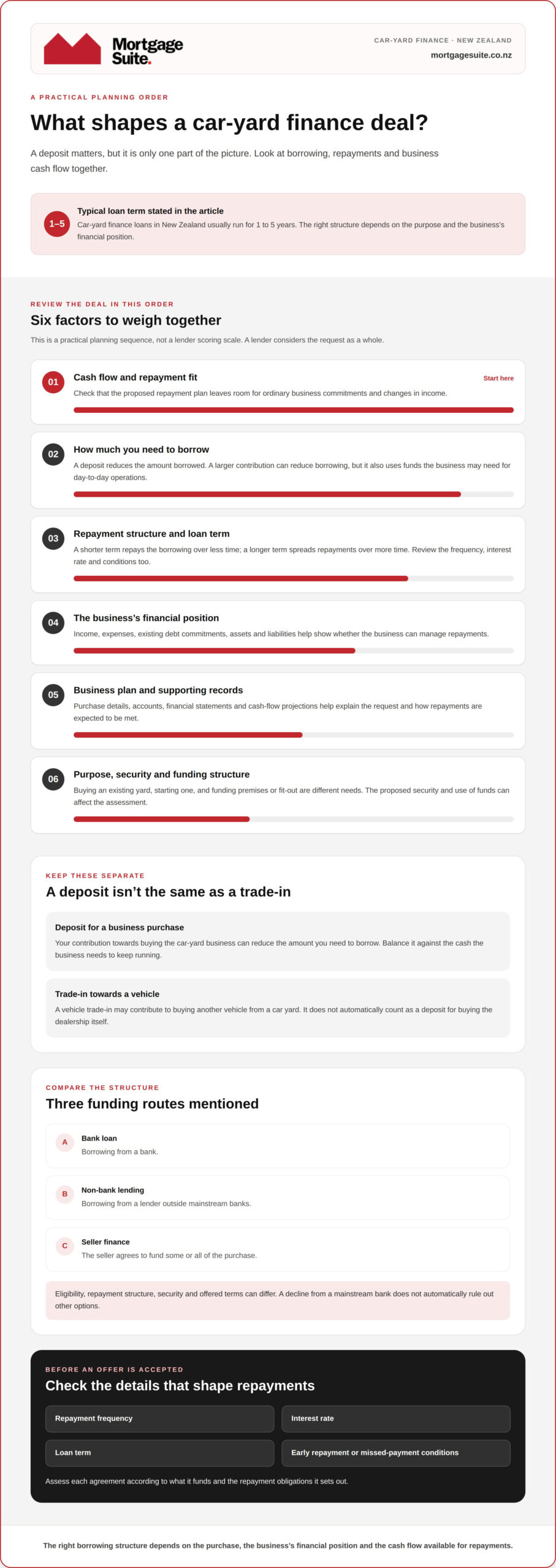
For a car-yard business loan, the deposit, repayment structure and loan term shape how much you borrow and how the debt fits your plans. In New Zealand, car-yard finance loans usually run for 1 to 5 years, although the right structure depends on the purpose and the business’s financial position.
Deposits and trade-ins
A deposit is money you contribute towards a purchase, reducing the amount you need to borrow. A trade-in is a vehicle offered towards the cost of another vehicle. Both can affect the amount financed, but they relate to different transactions. A trade-in may contribute to a vehicle purchase from a car yard; buying the yard itself is a business-finance decision. Keep these funding needs separate when discussing the structure.
For a business purchase, the deposit is one part of the overall funding plan. The lender considers the amount requested alongside the business’s financial position and ability to meet repayments. A larger contribution can reduce the borrowing, but it also uses funds that may be needed for day-to-day operations. Weigh the purchase against the cash the business needs to keep running.
When the finance is for a vehicle rather than the dealership, a trade-in can contribute towards that vehicle’s purchase price, reducing the amount to finance. It does not automatically count as a deposit for buying a car-yard business. Trading in a vehicle for another car is a separate arrangement from borrowing to acquire a dealership.
Repayments and loan terms
Repayments are scheduled amounts paid towards a loan, while the loan term is the period allowed for repayment. Together, they determine how quickly the debt is repaid and the regular commitment the business must plan for. New Zealand car-yard finance loans usually have a 1 to 5-year term, so compare the repayment structure with the business’s expected cash flow.
A shorter loan term means repaying the borrowed amount over less time, while a longer term spreads repayments over more time. The interest rate and repayment schedule also affect the amount and timing of payments. Even a repayment plan that looks manageable on paper needs to leave room for ordinary business commitments and changes in income.
Before accepting an offer, review the repayment frequency, interest rate, term and any conditions for early repayment or missed payments. For consumer vehicle finance, the lender’s disclosure after approval explains the consequences of default or early repayment. That disclosure relates to vehicle finance, not necessarily a loan to buy a dealership. Assess each agreement according to its purpose and repayment obligations.
How car-yard finance works
For a dealership purchase, a finance professional assesses the proposed deal alongside your business’s ability to repay the borrowing.
Finance options for buying or starting a car yard
Car-yard finance is business borrowing to fund an acquisition or establish a dealership. The purpose matters because buying an existing yard differs from starting one. An acquisition may involve an established business, while a start-up plan needs to explain how the operation will earn income.
For either route, a finance professional reviews the amount required, the proposed use of funds, your financial position, and the business plan. This helps shape the application and identify the information a lender needs to assess the request. Keep the dealership purchase separate from any borrowing for premises, stock, or other business needs.
Government grants or business support may help only if a programme’s purpose and eligibility criteria fit the proposed activity. Unlike a loan, a grant does not have to be repaid under loan terms. Treat any possible support separately from the core finance plan for buying or starting a car yard.
Comparing bank loans, non-bank lenders and seller finance with a finance professional
A finance professional can compare bank loans, non-bank lending, and seller finance by considering eligibility, repayment structure, security, and the terms offered for the specific purchase. A bank loan comes from a bank; a non-bank loan comes from a lender outside mainstream banks; seller finance involves the seller agreeing to fund some or all of the purchase.
The comparison matters because structures and conditions can differ. A finance professional can assess how each repayment arrangement fits the purchase plan and projected cash flow. If a mainstream bank declines an application, that does not automatically rule out other options. The reasons for the decision help determine what could be considered next.
Prepare the purchase details, business accounts, financial statements, income and expense information, existing debt commitments, asset and liability details, and a business plan with cash-flow projections. A finance professional can use these records to present the request clearly and explain how the business expects to meet repayments.
Common pressure points include cash flow that cannot support the proposed repayments, existing debts that limit borrowing capacity, incomplete financial records, and a business plan that does not explain the purchase clearly. A lender also considers the proposed security and overall funding structure, so gaps in these areas can affect its assessment.
To talk through how your business plan and borrowing needs fit together, discuss your finance options.
What types of finance are available to buy or start a car yard in New Zealand?
Financing a dealership site involves distinct needs: buying premises, acquiring land, developing a site, or fitting out a building. The structure depends on what the funds will pay for and how the business plans to repay them. Separating each purpose shows how the property and car-yard operation fit into the overall plan. Understanding how to get finance for a car yard in NZ starts with identifying those separate funding needs.
Business finance for an acquisition or start-up
A business loan is borrowing for business purposes, such as purchasing an existing car yard or funding a new operation. For an acquisition, the application can explain what is being purchased and how the business plans to generate income. For a start-up, the plan needs to set out the proposed operation and expected cash flow.
The distinction matters: an established dealership may have trading and financial records, while a new yard relies more on its proposed business plan. In either case, a finance professional can organise the application around its purpose, the funds required, and the business’s ability to meet repayments. This gives the lender a clearer view of the request.
Commercial property finance for dealership premises
Commercial property finance may fund premises used for a dealership. The lender assesses the property and borrowing request alongside the business’s financial position. Buying a building already used as a car yard differs from purchasing a business that operates from leased premises. Make clear whether the property, the operating business, or both are part of the purchase.
Property details explain the site’s intended use and place in the business plan. A finance professional can present them alongside the business’s income, expenses, and existing commitments. This links the proposed property borrowing to the business’s ability to manage repayments, rather than treating the building as a separate decision.
Property development finance and choosing a structure
Property development finance may suit a project involving development of land or buildings, rather than a straightforward purchase of an operating car yard. The project’s purpose and stages matter: development funding relates to the proposed work, while a business loan addresses business borrowing needs.
Starting a yard on land that needs development differs from buying ready-to-use premises. A finance professional can identify whether the request concerns the business, commercial property, or development, then present each purpose clearly. This helps ensure the application explains what the funds are intended to achieve.
As you consider how to get finance for a car yard in NZ, compare each option by purpose, repayment structure, security, and fit with the business plan. A new operator, for example, may need to explain both the proposed trading model and premises plans. Matching the finance to the actual purchase helps keep the application focused and borrowing aligned with the yard’s plans.
Can you get finance to buy a car yard with no prior dealership experience?
A lack of dealership experience does not, by itself, determine the outcome of a finance application. The lender also considers the purchase, your financial position, and how the business plans to repay the borrowing. Explain how you intend to run the car yard, even if you have not worked in a dealership before.
Show how your skills transfer to the business
Relevant experience can include running another business, managing staff, handling sales, or overseeing finances. For example, managing a retail team may show familiarity with customer service and day-to-day operations. Explain your role and responsibilities, then connect them to the work involved in operating a dealership. A finance professional can present this background alongside the purchase details.
Make the operating plan clear
A business plan explains how the car yard will operate and earn income. Set out the target customers, sales approach, staffing plan, and expected operating needs. If you plan to employ someone with dealership experience, describe their responsibilities and how they will support daily operations. Clear roles help explain how the business will address any experience gaps.
Cash-flow projections show how the business expects to meet loan repayments. Base them on the costs and income in your proposed plan, rather than broad assumptions. A finance professional can bring the projections together with the purchase information and your financial records, giving the lender a clearer view of how the proposed operation is expected to work.
Present your financial position and purchase details
Include relevant financial information, such as income, expenses, existing debt commitments, assets, and liabilities. Business accounts and financial statements show the position you are starting from. The purchase details should explain what the borrowing will fund, whether acquiring an operating car yard or establishing a new business. Keeping the purposes distinct makes the request easier to assess.
Security and available funds also form part of the overall picture. A finance professional can set out which assets support the application and how the proposed funding fits the purchase. If you are buying an existing dealership, trading records can provide context for its operations. If you are starting from scratch, explain how the business will build its customer base and manage its finances.
Address gaps before the application goes forward
Applications may face difficulty if financial records are incomplete, projected cash flow does not support repayments, or the business plan leaves key operating details unclear. A decline from a mainstream bank is not a final judgement on your ability to run a car yard. The reasons for the decision can help a finance professional identify what needs clearer explanation or a different funding approach.
What finance options are available for dealership premises, land, and fit-out in NZ?
Financing a dealership site involves distinct needs: buying premises, acquiring land, developing a site, or fitting out a building. The structure depends on what the funds will pay for and how the business plans to repay them. Separating each purpose shows how the property and car-yard operation fit into the overall plan.
Buying existing dealership premises
Commercial property finance may fund premises used for a dealership. The lender assesses the property and borrowing request alongside the business’s financial position. Buying a building already used as a car yard differs from purchasing a business that operates from leased premises. Make clear whether the property, the operating business, or both are part of the purchase.
Property details explain the site’s intended use and place in the business plan. A finance professional can present them alongside the business’s income, expenses, and existing commitments. This links the proposed property borrowing to the business’s ability to manage repayments, rather than treating the building as a separate decision.
Purchasing land or preparing a development site
Land for a future dealership may involve a different funding purpose from buying a ready-to-use yard. If the plan includes developing the site, Property Development Funding may be relevant to the development work. Explain the intended use of the land and how the project relates to the proposed car-yard business.
A site that needs preparation before dealership operations begin calls for a plan that distinguishes the land purchase from development activity. A finance professional can set out the stages and funds associated with each purpose. This clarifies what the borrowing supports and how the business expects to move from site purchase to trading.
Funding a fit-out
A fit-out prepares premises for the dealership’s intended use. This could include adapting an existing building for customer-facing areas or preparing office space for business operations. A business loan may be considered for business-related fit-out needs, while property development finance may suit a wider development project. The purpose and scope of the work shape how the request is presented.
Keep fit-out plans separate from property purchase details. A finance professional can organise the proposed work, business plan, and financial information into a clear explanation of the funding need. For example, a yard buying an existing site and updating its offices has both a property purpose and a fit-out purpose to explain.
Match the funding to the project
The key distinction is what the funds will support: commercial property finance relates to premises, development finance to a development project, and business borrowing to business needs such as a fit-out. A finance professional can help structure the request around those purposes and the business’s repayment capacity. Discuss your dealership property finance options to map the premises, land and fit-out needs into a clear funding plan.
Mortgage Suite
Mortgage Suite Ltd can help you assess business finance options for buying or starting a car yard. It considers your plans, financial position, and borrowing needs, then helps shape an application around the business purpose. If the project includes development work, Property Development Funding may also be relevant.
A decline from a mainstream bank does not automatically end the discussion. Mortgage Suite Ltd offers non-bank lending options and can help you consider an approach that may fit your circumstances. The next step is to discuss what you are buying, how the yard will operate, and what funding the plan requires.
If you’re ready to talk through your car-yard finance plans, contact Mortgage Suite Ltd.
Take the next step towards your car-yard plans
Working out how to get finance for a car yard in NZ is an opportunity to turn a broad idea into a clear business plan. Before moving ahead, decide what you want to own, how you see the yard operating, and what role you will take in its day-to-day running. Those choices help shape a useful conversation about finance that fits your plans.
Mortgage Suite offers Business Loans and Home Loans, including First Home Buyers. For a car-yard purchase, focus the discussion on your business goals and the finance you need to pursue them. If a mainstream bank has declined your application, you can still discuss whether non-bank lending may suit your circumstances. Approval is not guaranteed, but a clear conversation can help identify possible next steps.
Ready to talk through your plans? Contact Mortgage Suite about your finance options and take the next step at your pace.
Frequently Asked Questions
What deposit and lending criteria do NZ banks require for car yard business finance?
There is no single deposit amount for every car-yard business loan. Lenders assess the proposed borrowing against the business’s financial position, income, expenses, existing commitments and credit history. An application to buy an established yard may require different supporting information from a start-up proposal. A finance professional can present the purchase plan, cash-flow information and available contribution together, helping the lender assess how the borrowing may be repaid.
How does floorplan or stock finance work for NZ used-car dealers?
Floorplan or stock finance generally refers to funding used to acquire vehicles for dealership stock, rather than to buy the premises or business. The borrowing arrangements depend on the lender’s terms and proposed facility. Review the full written terms, including how repayments relate to each vehicle. This helps you assess how the facility fits stock turnover and the yard’s cash flow.
What loan terms apply to car yard business loans in New Zealand?
Repayment terms vary with the lender, loan structure, security and the business’s financial position. No single repayment arrangement applies to every car-yard business loan. Review the repayment schedule and consider whether the timing suits the business’s cash flow. Check any conditions affecting early repayment before accepting an offer.