
How to pay off your mortgage faster in NZ with extra repayments
Extra repayments can reduce the interest you pay and help clear your mortgage sooner. If you’re working out how to pay off your mortgage faster in NZ, start by checking your lender’s rules, especially if your loan has a fixed interest rate. The amount you can repay early without affecting your loan terms depends on those rules.
Even an extra amount paid regularly can add up. For example, on a NZ$500,000 mortgage at 7% over 25 years, adding NZ$100 to each fortnightly repayment is estimated to save NZ$90,000 in interest and pay off the loan about three years earlier. Your result will depend on your loan and repayment setup, but the principle is straightforward: paying down the balance sooner leaves less for interest to accrue on.
This guide explains how to pay off your mortgage faster in NZ by checking repayment limits, choosing between regular extra payments and a lump sum, and considering a change in repayment frequency. You’ll also learn how to compare the effects and balance a faster payoff with flexibility in your budget.
Key Takeaways
- Check your loan terms before making extra or lump-sum repayments, particularly when your interest rate is fixed.
- Regular extra repayments can reduce the balance faster, but choose an amount that still leaves room in your budget.
- Fixed-rate loans may have limits or conditions for extra payments, so understand how your lender treats them before changing your repayment plan.
- Repayment frequency can affect how much you pay over a year; compare the total paid, not just the amount of each instalment.
- Use the examples in the article as a guide, then weigh up potential interest savings against the flexibility you want from your mortgage.
1. Checking lender rules for extra or lump-sum repayments
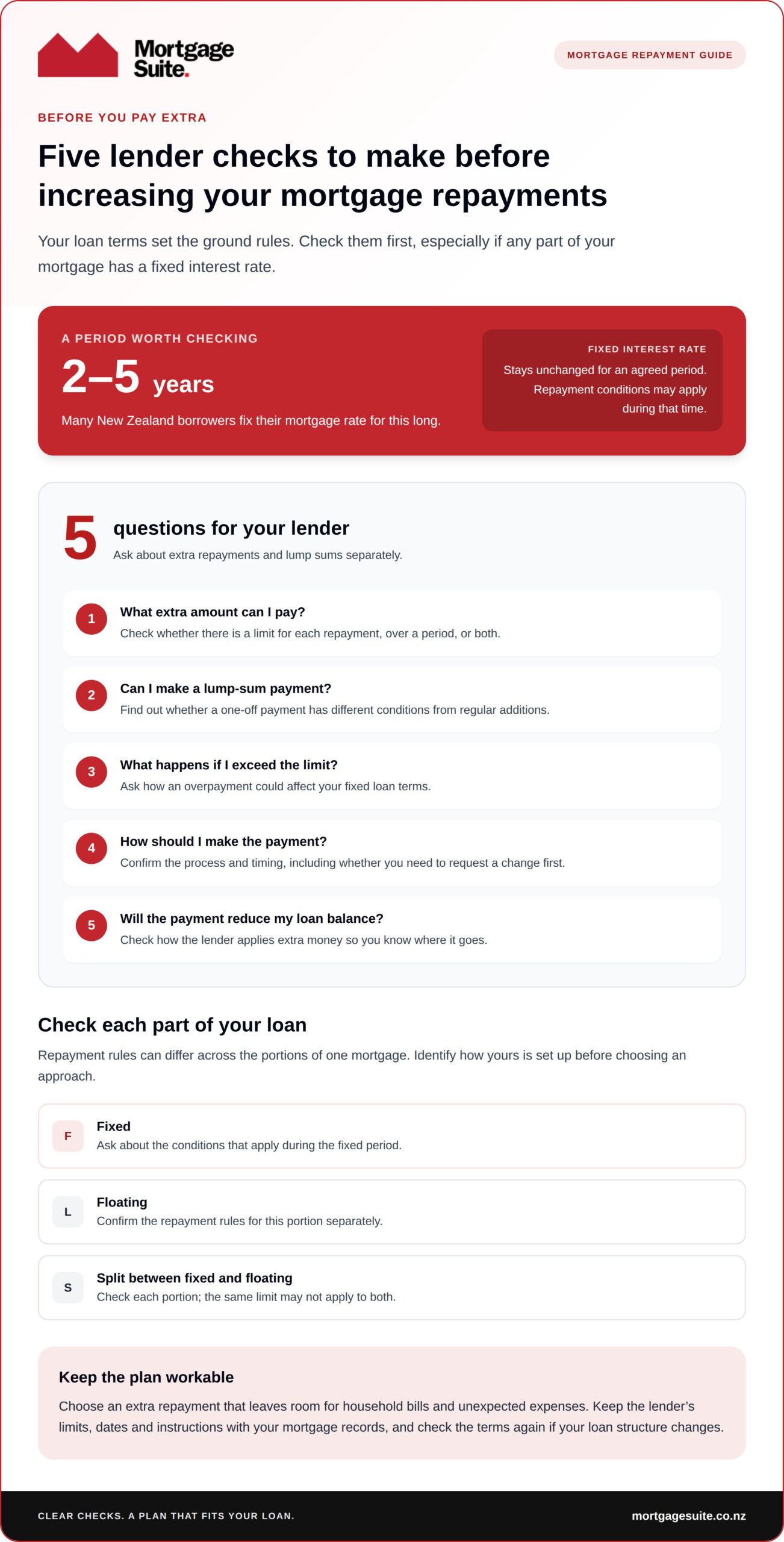
Before increasing repayments, ask your lender or mortgage broker how much extra you can pay without affecting your home loan terms. This check matters particularly for a fixed interest rate, which stays unchanged for an agreed period. Many New Zealand borrowers fix their mortgage rates for 2-5 years, so the repayment conditions can apply throughout that period.
Start with your loan documents and check whether your mortgage is fixed, floating or split between both. Repayment rules can differ between portions, even within one home loan. Ask specifically about regular extra payments and one-off lump sums rather than assuming the same limit applies to both.
Ask your lender or mortgage adviser these questions to clarify your options:
- What extra amount can I pay? Ask whether the lender sets a limit for each repayment, a total over a period, or both.
- Can I make a lump-sum payment? Find out whether a one-off payment has different conditions from smaller, regular additions.
- What happens if I exceed the limit? Ask how an overpayment affects your fixed loan terms and what changes might apply.
- How should the payment be made? Confirm the process and timing, including whether you need to request the change before making the payment.
- Will the payment reduce the loan balance? Check how the lender applies extra money, so it goes towards the mortgage rather than being treated differently.
These details let you compare options based on your loan’s terms, not a general rule. For example, if regular extra payments are allowed but lump sums have different conditions, a steady increase may suit you better. If you’re considering a lump sum, ask how its timing affects your fixed-rate portion and whether you need to arrange it in advance.
Keep the lender’s response with your mortgage records, including any limits, dates and instructions. If your mortgage has fixed and floating portions, ask about each separately. This makes it easier to see where extra repayments can go and which terms may be affected.
Once you understand the rules, decide on a repayment approach that fits your budget. A permitted extra payment still needs to leave room for regular household expenses and unexpected bills. Revisit the lender’s conditions when your fixed period ends or your loan structure changes, because your repayment options may change too.
2. Increasing regular mortgage repayments
If you’re exploring how to pay off your mortgage faster in NZ, increasing a regular repayment can be a practical starting point. Interest is calculated on the amount owing, so reducing the balance sooner can lower the interest charged over time. The effect depends on your loan balance, interest rate, payment schedule and how long you maintain the increase.
Choose an amount that fits your budget, then arrange a recurring payment with your lender. For example, you could add a small amount to each scheduled repayment rather than relying on occasional spare cash. A regular increase is easier to plan for and can make progress more consistent. If your income changes, review the extra payment to keep it manageable.
Before changing your payment, confirm how the lender applies extra money and whether your loan conditions allow the change. Rules can differ between fixed and floating portions. For a fixed rate, ask whether regular increases are permitted and what happens if you exceed the allowance. Once you understand the process, choose dates that suit your pay cycle and check your statements show the extra amount going towards the mortgage.
Some borrowers prefer small increases when their budget allows; others set a regular amount and review it as circumstances change. Either approach should leave room for household bills and unexpected expenses. If your income varies, a modest recurring increase may be easier to maintain than a larger payment that becomes difficult in a quieter month.
An offset account is an account whose balance reduces the loan balance used to calculate interest. Revolving credit works differently: it gives you access to a loan limit that you can draw on and repay. Either option may suit someone who can keep funds against the debt and manage spending carefully. Compare the lender’s terms and account features with your cash-flow habits before choosing.
To see how different repayment amounts might affect your loan, use a mortgage repayment calculator. Enter your current details, then adjust the repayment amount or frequency to compare estimates. A calculator can help you explore ways to pay off a mortgage faster in NZ, but use your lender’s terms to understand how the change applies to your loan.
Keep your plan workable. An increase that leaves no breathing room can be hard to sustain, even if the projected payoff date looks appealing. Review the amount when your income or regular costs change, and keep repayments aligned with your household budget.
3. Making extra repayments on a fixed-rate mortgage
A fixed interest rate gives you set repayments during an agreed period, but extra payments may be restricted by your lender’s terms. Many New Zealand borrowers fix for 2-5 years, so plan ahead rather than assuming you can freely change repayments throughout that period. For example, a salary increase could make a higher repayment affordable, but your loan conditions determine how to apply it.
When your fixed period ends, you can consider setting a higher regular repayment or choosing a shorter loan term as part of refixing. Weigh the remaining balance against the repayment you can sustain and how quickly you want to clear the loan. Discuss the new structure with your lender before agreeing to it.
As your fixed-rate expiry approaches, decide what matters most. A higher repayment can reduce the balance faster while keeping the remaining term, while a shorter term increases the required repayment and aims for an earlier finish. The lender’s offer, your income and other commitments all affect which option is workable.
Use the time before expiry to prepare a simple comparison:
- Find the expiry date. Note when the current fixed period ends and when you need to make a new arrangement.
- Set a repayment target. Choose an amount you can keep paying after essential household bills and other debt repayments.
- Compare loan terms. Ask how a shorter term changes the scheduled repayment, alongside the option of keeping the current term and paying more.
- Ask how extra money is treated. Confirm whether any payment before the fixed period ends is allowed, and what conditions apply.
- Review the proposed structure. Check that the new repayment date, amount and term match your household budget.
When your fixed rate expires, get your current loan balance and the lender’s available refixing options. Compare your scheduled payment with the higher amount you could comfortably maintain. Ask the lender how each option affects the term and repayment schedule, then confirm any agreed changes in writing. This gives you a practical basis for choosing, rather than relying on the headline rate alone.
If your fixed-rate expiry is still some time away, try the proposed higher payment in your budget first. For example, set aside the extra amount regularly without changing your mortgage payment yet. This shows whether it fits alongside routine expenses and gives you useful information when discussing the refix. If the budget feels tight, a smaller increase may be easier to sustain than a plan that leaves little room for changing expenses.
4. Potential interest savings and reduced mortgage terms
Extra repayments can make a sizeable difference over a long mortgage, though the outcome depends on your repayment plan. In one New Zealand example, a NZ$500,000 mortgage at 7% over 25 years incurs NZ$560,000 in interest. The figures show why even a manageable change can matter over time.
For that NZ$500,000 mortgage, adding NZ$100 to each fortnightly repayment is estimated to save NZ$90,000 in interest and clear the loan about three years earlier. Adding NZ$200 each fortnight is estimated to save NZ$154,000 and shorten repayment by five years. These examples use the same loan amount, rate and original term, making the different extra-payment levels easier to compare.
A lump sum can also reduce interest if you keep repayments constant afterwards. In the same example, paying NZ$30,000 off the mortgage is estimated to save NZ$122,000 in interest and finish repayment three years earlier. The best fit depends on whether you have money available now or prefer a regular increase you can plan around. A lump sum reduces the balance at once; regular extra payments build progress over time.
Paying off your mortgage faster isn’t automatically the best use of every spare dollar. Putting too much into the loan can leave less cash for unexpected bills, while another debt may have a higher interest rate. Before making a lump-sum payment, compare its likely benefit with keeping accessible savings or reducing other debts. Factor in any lender conditions on extra payments, especially for a fixed-rate portion.
To assess an option, compare the extra amount, the interest saved and the time removed from the loan. Keep your regular repayment affordable, then consider how your plan would hold up if your income or household costs changed. A plan that depends on every spare dollar can be difficult to maintain, even if its projection looks attractive.
Remember that a shorter mortgage term and lower interest costs are related, but not identical goals. You could keep the scheduled term and pay more regularly, or use a lump sum while maintaining repayments. The example of paying NZ$1,767 each fortnight on a NZ$500,000 mortgage at 7% estimates total interest of NZ$443,000. Compare projections like these with your own loan details and repayment structure.
For a practical next step, choose an extra amount that leaves room in your budget, then compare regular payments with a lump sum. Ask your lender how each option affects your loan and confirm the conditions before acting. These checks can help you pursue a faster payoff without overlooking cash-flow needs or other debt.
5. Switching from monthly to fortnightly repayments
Changing your repayment frequency can help you pay down a mortgage sooner, but the benefit comes from the total paid each year. There are 26 fortnights in a year. If you pay half your monthly repayment every fortnight, you make the equivalent of 13 monthly repayments per year. That extra monthly repayment reduces the balance faster than simply dividing the annual amount into smaller payments.
Consider a New Zealand example: required repayments on a NZ$500,000 mortgage at 7% over 25 years are NZ$1,630 per fortnight. Paying half the monthly repayment every fortnight on that loan is estimated to save close to NZ$117,000 in interest and finish repayment four years earlier. The estimate depends on the example’s loan amount, rate and term, so it’s not a direct forecast for every mortgage.
The key is to avoid confusing “fortnightly” with “twice a month”. A fortnightly schedule differs from a twice-monthly schedule, so check how your lender sets the payment dates. Paying half your monthly amount every fortnight creates the extra annual repayment because it follows the fortnightly calendar. Confirm the payment amount and frequency with your lender, so the schedule matches the approach you intend.
Before switching, compare the total paid over a year under both schedules. Check that the fortnightly amount is genuinely half your monthly repayment, rather than a smaller figure chosen for convenience. Then consider how the payment dates fit your income. A schedule that aligns with regular pay can make budgeting easier, while awkward dates may leave less available for bills.
Interest rate changes can also affect the result. In another New Zealand example, keeping fortnightly repayments at NZ$1,630 after refinancing a NZ$500,000 mortgage from 7% to 6% is estimated to save NZ$190,000 in interest and shorten repayment by four years. This illustrates how maintaining the same payment after a rate reduction can direct more towards the loan balance. It is a separate example, not an added saving to combine with the fortnightly-payment estimate.
Use the following steps to assess the change:
- Write down your current monthly repayment and calculate half of that amount for each fortnightly payment.
- Compare the annual totals to see whether the fortnightly plan includes the equivalent of 13 monthly repayments per year.
- Check the payment dates against your income schedule and household bills.
- Ask your lender how the new schedule applies to your loan, especially if it has fixed and floating portions.
Fortnightly payments can provide a simple structure for paying more over a year, but the higher total needs to fit your budget. Compare the full repayment amount with your other commitments before changing the schedule.
Mortgage Suite
Mortgage Suite provides no-obligation mortgage broking and financial advice to help you explore home loan options and consider how your loan structure fits your repayment goals. If you’re weighing a faster payoff against keeping room in your budget, we can help clarify the trade-offs and the questions to raise with your lender. Mortgage Suite supports borrowers seeking home loans, including first-home buyers, by matching clients with lenders. The right approach depends on your loan terms, income and plans, so look beyond the interest rate alone. Contact Mortgage Suite for a no-obligation conversation about your next step.
Make your next mortgage decision a considered one
Paying your mortgage sooner is a long-term choice, not a race. Choose a repayment plan that supports your goals while leaving flexibility for life’s changes. If your income, household needs or property plans shift, revisit whether your current loan still suits you. The best way to pay off your mortgage faster in NZ is one you can maintain without putting unnecessary pressure on your budget.
Mortgage Suite can help you consider lending options for different stages and goals, including Home Loans for First Home Buyers and Business Loans. If you’re unsure how your mortgage structure fits your plans, contact Mortgage Suite for a no-obligation conversation about the next step.
Contact Mortgage Suite today to discuss your lending needs. A clear plan can make the road ahead feel more manageable, and you can take it one decision at a time.
Frequently Asked Questions
How does making extra mortgage repayments reduce the loan term and interest in New Zealand?
Extra repayments reduce the outstanding balance, leaving less for interest to be calculated on. If you keep your scheduled repayment unchanged after reducing the balance, more of each later payment can go towards paying down the loan. For example, regular extra payments can steadily reduce the balance, while a lump sum reduces it sooner. Your loan structure and payment timing affect the result.
What are New Zealand bank rules for extra mortgage repayments?
There isn’t one repayment rule that applies to every New Zealand mortgage. Lenders set conditions for additional payments, and fixed-rate portions may have limits on repayments outside those conditions. Terms may also distinguish between regular increases and one-off payments. Read your loan terms to understand how each option is treated before changing your payment arrangement.
How much can you repay above your regular home loan payment in NZ?
There is no single extra repayment amount that applies across all New Zealand home loans. The amount you can pay depends on your lender’s terms and whether the payment applies to a fixed-rate portion. Some loan conditions set an allowance for extra payments, and conditions for payments beyond it vary by lender. Confirm the applicable limit and how it is measured before making a larger payment.
How do fixed and floating mortgage rates affect extra repayments in NZ?
A fixed interest rate stays unchanged for an agreed period, and its terms may restrict extra repayments. A floating portion has a variable rate and generally offers more flexibility to change repayments, though the rate can move. If your mortgage combines both, assess each portion separately. The split matters: an extra payment to one part may have different effects from a payment to the other.
How can a mortgage repayment calculator estimate interest savings and an earlier payoff date?
A repayment calculator estimates the effect of changing your payment using details such as your loan balance, interest rate, remaining term and repayment frequency. Enter your current settings first, then adjust the extra amount or schedule to compare projections. The result can show estimated interest and an indicative payoff date, but may not include every lender condition or future rate change. Use it to compare scenarios, not as a lender statement.
Should you use an offset mortgage or revolving credit to pay off a mortgage faster in New Zealand?
An offset account reduces the loan balance used to calculate interest, while revolving credit lets you draw on and repay a loan limit. Either may suit you if you can keep funds against the debt and manage spending carefully. Compare the lender’s terms and features with your cash-flow habits.