
KiwiSaver First Home Withdrawal: Your 2026 Guide to Getting on the Property Ladder
What if the information you’re relying on to buy your first house is actually years out of date? If you’ve been searching for the First Home Grant NZ, you might have noticed things look a bit different lately, as that specific scheme ended back in 2024. It’s completely normal to feel overwhelmed by the shifting rules or worried that the big banks will simply say no because your situation doesn’t fit their perfect little box. You want a home of your own, but the finance-speak about deposit requirements and government paperwork makes the property ladder feel more like a mountain.
The good news is that your KiwiSaver remains one of your most powerful tools for securing a deposit in 2026. This guide is here to help you understand exactly how to get your money out and onto a sale and purchase agreement without the confusing jargon. We’ll break down the latest withdrawal rules and show you how a dedicated broker acts as your advocate, handling the heavy lifting with lenders so you can focus on finding the right keys. You’ll walk away with a clear plan and the confidence that home ownership is still well within your reach.
Key Takeaways
- Learn how to use your KiwiSaver savings to build a deposit, keeping just NZ$1,000 in your account to stay a member.
- Find out if you qualify for a withdrawal after three years of membership, even if those years weren’t all in a row.
- Understand why the First Home Grant NZ is no longer an option and discover the 2026 alternatives that can still help you get over the line.
- Get a simple, jargon-free plan for requesting your determination letter and working with a solicitor to make the process easy.
- Discover how a dedicated broker can negotiate on your behalf to find a home loan, especially if the big banks have said no.
Using your KiwiSaver first home withdrawal in 2026
KiwiSaver isn’t just a pot of gold waiting for you at the end of your career. For most people entering the market today, it’s a massive leg-up that makes the dream of owning a home actually possible. Since the government discontinued the First Home Grant NZ in 2024, your personal savings have become the star of the show. In 2026, your balance is likely your most significant asset, and knowing how to tap into it is the first step toward your own front door.
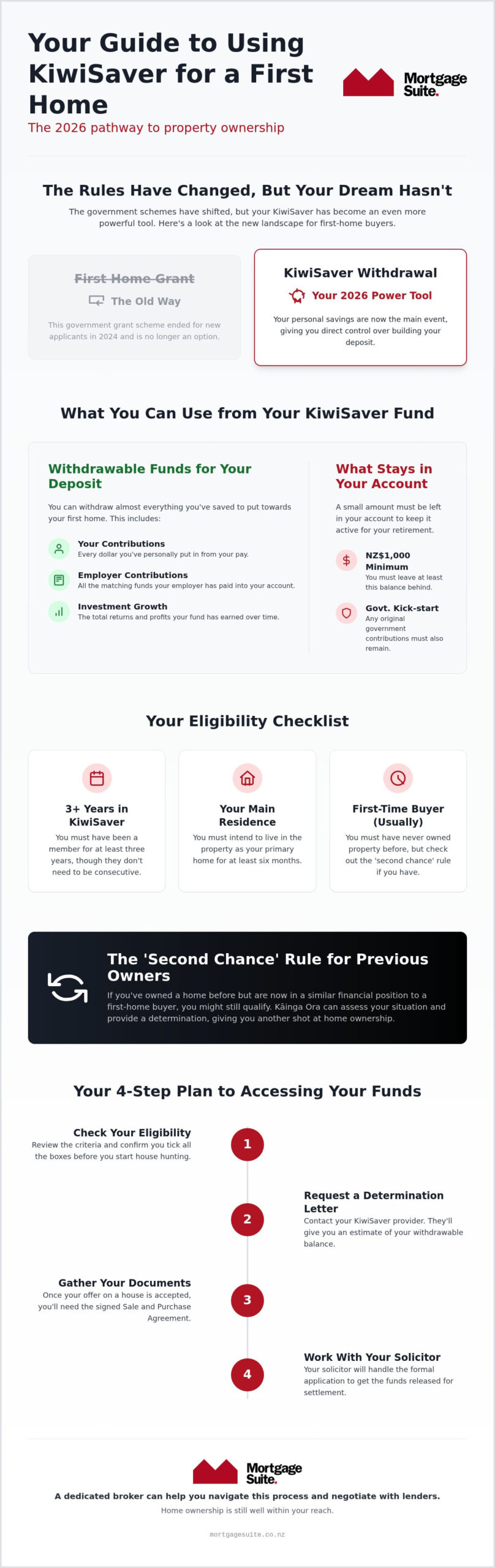
You can generally withdraw almost every cent you’ve worked hard to save. The only catch is that you must leave a minimum of NZ$1,000 in your account, plus any original government kick-start payments you received when you first joined. This ensures your membership in the KiwiSaver scheme remains active for the future. It’s a straightforward way to turn years of automatic deductions into a tangible house deposit that gets you moving.
The basics of the first home withdrawal
So, what exactly can you put toward your new home? You’re entitled to take out your own contributions, the money your employer has chipped in, and all the investment growth your fund has earned over time. While the First Home Grant NZ is no longer available to new buyers, the ability to access your own compounded savings is more valuable than ever. The “three-year rule” is the main hurdle; you need to have been a member for at least 36 months total. These don’t have to be consecutive years, which is great news if you’ve taken a break from work or lived overseas.
There’s one non-negotiable condition: you must intend to live in the property as your main home for at least six months. This withdrawal isn’t designed for people looking to build a rental empire right away. It’s for people who want a place to call their own. If you’re unsure how much you might need to top up your KiwiSaver funds, using a mortgage calculator can help you see the full picture of your buying power.
Why your KiwiSaver is the key to your mortgage
Banks view KiwiSaver funds very differently from a sudden lump sum of cash. When a lender sees a healthy KiwiSaver balance, they see a history of disciplined saving and financial stability. It proves you’ve been consistently preparing for this moment, which builds trust before you even sit down for an interview. The psychological boost is just as important; seeing a significant sum ready to go gives you the confidence to negotiate with sellers. The KiwiSaver withdrawal is the primary tool for Kiwi first-home buyers in 2026 to bridge the gap between their savings and a home loan.
Checking your eligibility for a first home withdrawal
Before you start picking out paint colours, you need to be sure you actually qualify to use your funds. While the First Home Grant NZ is a thing of the past, the eligibility for your own KiwiSaver withdrawal is thankfully much simpler. You must have been a member of KiwiSaver for at least three years. It’s a common misconception that these years must be in a row; as long as you’ve hit that 36-month total, you’re usually good to go. Additionally, the home must be in New Zealand and you have to intend to live in it yourself for at least six months.
The rules are designed to help people get into their own homes, which is why the criteria focus on your history as a saver and your intention as a resident. Even though the First Home Grant NZ stopped accepting new applicants in 2024, many buyers still use that term when they really mean their KiwiSaver withdrawal. If you’re unsure about your specific timeline or whether you’ve contributed enough over the years, we can help you look at your situation and give you a clear answer.
The Second Chance rule for previous owners
Owned a home before? You might still be in luck. Life happens, and sometimes people find themselves back at square one financially after a relationship split or business change. This is where the “second-chance” rule comes in. Kāinga Ora looks at your current financial position to see if it’s similar to that of a first-home buyer. If they agree, you can still access your KiwiSaver. You’ll need to get this status confirmed by applying for a first home withdrawal determination before you make an offer on a property. It’s a vital step that gives previous owners a fair go at getting back on the ladder.
Common traps to avoid when applying
Don’t let simple mistakes stall your progress. Organising your paperwork early is the best way to stay ahead of the game. Here are a few things to watch out for:
- The Timing Trap: Leaving your eligibility check until the last minute. Your provider needs time to process your request, and banks won’t give you the green light without that confirmation.
- The Investment Trap: Assuming you can use these funds for a “buy-to-let” investment property. The rules are strict: this money is for a home you’ll actually live in.
- The Paperwork Trap: Not having a solicitor ready to handle the withdrawal. Your lawyer is the one who actually requests the funds from your provider, so you need them on board early.
If you’re feeling a bit lost in the requirements or worried your history might be too complex, the team at Mortgage Suite can help you navigate the process and confirm where you stand.
A simple step-by-step to getting your money out
Getting your money out of your account shouldn’t feel like a mission to the moon. While you might have heard stories about the First Home Grant NZ from friends who bought a few years ago, your focus in 2026 is entirely on the KiwiSaver withdrawal process. It’s a well-trodden path with clear stages that, when done in the right order, make your settlement day a lot less stressful. We’ve seen every scenario and know that a little preparation goes a long way in keeping the banks happy.
The process generally follows these four milestones:
- Step 1: Contact your KiwiSaver provider early to request a “letter of determination.” This isn’t just a balance check; it’s an official document that confirms exactly how much you can withdraw for your deposit.
- Step 2: Once you’ve found a property, you’ll need to engage a solicitor. They are essential for the legal side of the transaction and act as the bridge between you and your provider.
- Step 3: Fill out the withdrawal forms provided by your scheme manager. Your solicitor will help you double-check these to ensure there are no errors that could cause delays.
- Step 4: Your solicitor handles the actual transfer. The funds move from your provider into the solicitor’s trust account, and then to the seller on settlement day.
Timing is everything for a smooth settlement
Timing is everything. You generally need at least 10 to 15 working days for the money to move between accounts once the paperwork is signed. One of the biggest dangers is making an unconditional offer on a house without having your funds confirmed and ready to go. If the money doesn’t arrive in time for settlement, you could face penalty interest or even lose your deposit. We help coordinate the conversation between your solicitor, the bank, and your provider to ensure everyone is on the same page well before the deadline. If you haven’t checked your KiwiSaver first-home withdrawal eligibility yet, now is the time to get that letter of determination in your hands.
The role of your solicitor in the process
Your solicitor is the gatekeeper of your funds and your primary protector during the purchase. They ensure that all the conditions of the sale are met before any money changes hands. To make the process feel smooth as, they will need your signed withdrawal forms, a copy of the sale and purchase agreement, and a statutory declaration. They handle the heavy lifting of the legal requirements so you don’t have to worry about the fine print. You can learn more about the mortgage process at our Mortgage School to see how your legal and financial steps work together to get you those keys.
Making your house deposit go further in 2026
Getting a deposit together is often the hardest part of the journey, but your KiwiSaver isn’t the only tool in your belt. While your savings do the heavy lifting, you might be looking for ways to stretch that amount to give you more options in the market. Many people still ask about the First Home Grant NZ, but since that scheme ended in 2024, the landscape has changed. Today, buyers are looking at the First Home Loan as the primary alternative, which allows you to buy with as little as a 5% deposit if you meet the income requirements.
Another common way to boost your buying power is through a family gift. If your parents or relatives are in a position to help, a gifted sum can work alongside your KiwiSaver to reduce the amount you need to borrow. However, banks don’t just care about the size of your deposit; they also look closely at your serviceability. This is a fancy way of asking if you can actually afford the weekly repayments once you’re in the house. You can use our mortgage calculator to see how different deposit sizes change your potential loan and what your repayments might look like.
The First Home Grant vs. Withdrawal
It’s vital to understand the difference between these two. The First Home Grant NZ was a government gift that you didn’t have to pay back, whereas your withdrawal is simply accessing your own hard-earned savings. In 2026, the First Home Loan scheme is the go-to for those with smaller deposits. To qualify, your before-tax income for the last 12 months must be NZ$95,000 or less for a single buyer, or NZ$150,000 or less for a household or single buyer with dependents. If you’re feeling a bit lost with these numbers, check out our Ultimate First Home Buyer Guide for a deeper dive into the rules.
What if your deposit is still a bit short?
If you haven’t hit the standard 20% deposit mark, don’t panic. Many lenders will still talk to you, though they might charge a low equity premium or require lender’s mortgage insurance, which is typically around 1.2%. This fee can often be added to your loan so you don’t have to find the cash upfront. A broker is spot on for this situation because we know which lenders are more flexible and which schemes can get you the keys with a 5% or 10% deposit. If you’re ready to see what’s possible for your specific situation, let’s have a chat about your options today.
How Mortgage Suite helps you cross the finish line
Even with your KiwiSaver sorted and a clear understanding of the rules, the final sprint to settlement can be the most taxing part of the journey. This is where Krish and the team at Mortgage Suite step in to handle the heavy lifting. We act as your personal advocates, ensuring you aren’t just another number in a bank’s system. While the First Home Grant NZ might have been a straightforward government handout in the past, today’s market requires a much more tactical approach to negotiation and paperwork.
We take the stress out of the equation by managing the constant back-and-forth with lenders. Our goal is to ensure your application is presented in the best possible light, negotiating terms that suit your life rather than the bank’s bottom line. Since the First Home Grant NZ was retired, the burden of proof for borrowers has increased, making it even more important to have a seasoned professional in your corner who knows exactly how to navigate the 2026 lending environment. We handle the chasing and the fine print so you can focus on the exciting part: finding your new home.
When the mainstream banks are not playing ball
It can be incredibly disheartening to have a big bank turn you down, especially when you’ve done everything right with your savings. However, a “no” from a mainstream lender is often just a sign that your situation doesn’t fit their rigid, automated criteria. We specialise in helping first-home buyers whose lives are a bit more “outside the box,” whether you are self-employed, have a unique income structure, or are working with a smaller deposit. By using our guide to 2nd tier lenders in NZ, you can see how alternative home loans provide a viable path forward when the traditional banks won’t play ball. Being declined by a big bank is not the end of the road; it’s often just a sign that you need a different map.
Start your journey with an expert on your side
Navigating the property market alone often means dealing with impersonal call centres and automated responses that don’t understand your personal story. With over 20 years of banking experience, we bring a level of institutional knowledge that you simply won’t find anywhere else. We know how lenders think and what they need to see to say “yes.” You can read our client reviews to see how we’ve helped others overcome obstacles that seemed impossible. Starting your journey with an expert means you have a dedicated negotiator who values your success as much as you do, making the entire process heaps better than trying to go it alone.
Step Into Your New Home with Confidence
Buying your first home is a massive milestone, and while the rules often shift, the path to ownership remains clear. You now understand that your KiwiSaver is the most powerful tool in your belt for a deposit, especially since the First Home Grant NZ is no longer an option for new buyers. By checking your eligibility early and getting your paperwork organised with a solicitor, you remove the biggest stress points before they even appear.
It’s important to remember that a decline from a major bank doesn’t mean your dream has to stop. Alternative lending options exist for unique situations, and having an expert negotiator makes all the difference. When you’re ready to turn your savings into a front door key, talk to Krish and the team about your first home loan today. We offer over 20 years of banking expertise and are specialists in 2nd tier lending. You’ll receive friendly, jargon-free advice that puts your needs first. Your journey to home ownership is well within reach, and we’re here to help you every step of the way.
Frequently Asked Questions
Can I use my KiwiSaver to buy an investment property?
No, you cannot use your KiwiSaver funds to purchase an investment property. These funds are specifically intended to help you buy your first home to live in yourself. You’re required to live in the property as your primary residence for at least six months. If you’re looking to build a rental portfolio, we can help you explore residential investment property loans through other channels that don’t rely on your retirement savings.
How much of my KiwiSaver can I actually withdraw for a first home?
You can generally withdraw almost your entire balance to put toward your deposit. The only requirement is that you must leave a minimum of NZ$1,000 in your account. You also cannot withdraw any original government kick-start payments. While the First Home Grant NZ ended in 2024, this withdrawal remains the most effective way for most Kiwis to secure enough funds to satisfy bank deposit requirements in 2026.
What happens to my KiwiSaver if my house sale falls through?
Your funds are simply sent back to your KiwiSaver provider if your house purchase doesn’t go through for any reason. Your solicitor handles this process, ensuring the money goes directly back into your account rather than being paid to you. This protects your retirement savings so they are ready for when you find the next property. It’s a standard safety net that ensures your hard-earned money isn’t lost during a failed transaction.
Can I use KiwiSaver to build a new home on Māori land?
Yes, you can use your KiwiSaver to build a home on Māori land, provided you have the legal right to occupy that land. This is a great option for many first-home buyers who want to build on ancestral land. You’ll still need to meet the standard three-year membership criteria and intend to live in the home as your main residence. We recommend getting your paperwork organised early to ensure the process goes smoothly.
Do I have to pay back the KiwiSaver money I withdraw for my first home?
No, you never have to pay back the money you withdraw from your KiwiSaver for a home purchase. Because this is your own money, it’s a permanent withdrawal rather than a loan. While the First Home Grant NZ was a separate government payment, this withdrawal is your own cash contribution. Once the funds are used for your deposit, they help you secure a more favourable home loan from the start.
Can my partner and I both use our KiwiSaver for the same house?
Absolutely, you and your partner can both use your individual KiwiSaver balances to buy a home together. As long as you both meet the eligibility criteria, combining your funds can give your deposit a massive boost. This often makes it easier to reach the 20% mark or qualify for better interest rates. We can help you both navigate the paperwork to ensure your combined savings are presented effectively to potential lenders.
What is the Second Chance KiwiSaver withdrawal?
The Second Chance withdrawal is a scheme for people who have owned a home before but are now in a similar financial position to a first-home buyer. Kāinga Ora assesses your assets to see if you qualify for this special status. If they give you the green light, you can access your KiwiSaver just like a first-time buyer. It’s a vital lifeline for those starting over after a significant life change.
How long does it take to get the KiwiSaver funds into my solicitor’s account?
You should allow at least 10 to 15 working days for the funds to reach your solicitor’s trust account. This timeline starts once your provider has received all the correctly completed forms from your solicitor. Because delays can happen, it’s vital not to leave this until the last minute. We coordinate with your legal team to ensure everything is submitted early, so your money is ready and waiting well before settlement day.