
Lending Criteria for Business Loans in NZ: What Lenders Assess
Could the same business look like a sound lending option to one lender and a poor fit to another? If you’re trying to understand lending criteria for business loans nz, that uncertainty can make it hard to know what records to prepare or whether a bank’s requirements suit your business. Lenders commonly assess cash flow, credit history, business experience and any security offered, but the weight they give each factor can vary.
A strong application explains why you need funding, how you expect to repay it and which records support your plan. This guide covers the areas lenders may assess, why requirements differ and how to prepare your information. If a mainstream bank says no, it doesn’t necessarily mean your options have run out. Mortgage Suite can help you compare lender pathways and present your funding needs clearly, without promising approval.
Key Takeaways
- The lending criteria for business loans nz can vary between lenders, so a decline from one bank isn’t necessarily the end of your options.
- Prepare a clear explanation of your funding purpose, trading background and existing commitments, with records and forecasts ready to support it.
- Compare term loans, overdrafts and revolving credit by how you’ll access and repay the funds, not just by the headline rate.
- Before applying, map out the repayments and check that your application matches your business records.
- Mortgage Suite can help you compare lender pathways, with advice that’s free of charge and comes with no obligation.
What do NZ business loan lending criteria usually assess?
Lending criteria are the factors a lender uses to assess a business loan application. There isn’t one universal pass-or-fail formula. A lender may consider why you need the funds, whether the business can manage repayments, what records support your figures and whether security is available. The mix depends on the lender, the loan structure and your business circumstances.
Repayment capacity is central. The lender wants to understand how the loan could be repaid from the business’s income. That means looking beyond a single strong month at the wider picture: cash coming in, regular expenses and existing commitments. Financial statements, account records and forecasts can help explain how the business is tracking. A lender may also consider credit history, the owner’s experience and any assets offered as security. For a general overview of types of business loans and assessment factors, see Wikipedia. The criteria for a particular application will depend on the lender and the business.
Lenders’ criteria differ because each lender weighs the purpose, evidence and circumstances of an application in its own way.
Why the purpose of borrowing matters
Be specific about what the funds are for. Working capital could help cover day-to-day business needs, while equipment finance is tied to buying or replacing machinery or other equipment. A start-up may need funds to establish operations, while a property-related loan may support a commercial property purchase or development. Each purpose raises different questions about how the money will be used and how repayments could be made. A clear explanation helps the lender understand the request, but it doesn’t automatically qualify the business for finance.
For example, if you’re seeking funds for equipment, explain what you plan to buy and how it will support the business. For working capital, describe the cash-flow need and how it fits with expected income. Connecting the request to your business plan helps the lender assess the supporting information.
Why no single checklist fits every business
A new business may need to explain its start-up plan and expected income. An established business may be assessed using its trading history and financial records. Seasonal or irregular income can prompt questions about quieter periods and how repayments could be managed. The amount requested and proposed loan structure may also affect what a lender needs to understand. One lender’s checklist isn’t necessarily the rule for every application.
Be ready to explain the parts of your business that shape its financial picture:
- Trading stage: When the business began operating and how it has developed.
- Income pattern: How and when revenue comes in, including seasonal changes.
- Repayment plan: Where repayments are expected to come from and how existing commitments fit in.
- Security: Whether you’re offering an asset and how it relates to the funding request.
A bank decline can be disappointing, but it isn’t a final judgement on your business. It may reflect that lender’s requirements or its view of the application. Understanding the reason and presenting your purpose and evidence clearly can help you decide what to discuss next.
Which business loan criteria should you prepare to explain?
A clear application helps a lender follow the story behind your figures: what you need, how the business earns income and where repayments are expected to come from. The lending criteria for business loans nz aren’t identical across lenders, so prepare to explain your circumstances rather than trying to fit a generic checklist.
Before you apply, organise your answers and supporting information around these points:
- Purpose: State what the funding will pay for and how it supports the business.
- Trading background: Summarise when you began trading, what has changed and any relevant experience.
- Income: Explain your main sources of revenue, usual payment patterns and any recent changes.
- Existing commitments: List current borrowing and regular business obligations so the full picture is clear.
- Proposed repayments: Show how you expect to meet repayments from business income, allowing for quieter periods and other commitments.
Depending on the application, a lender may ask for financial statements, current management accounts, bank records and business forecasts. Requirements vary, but having relevant information organised makes it easier to respond if more detail is requested.
Business records and cash flow
Cash flow is the money moving into and out of your business. Current statements, management accounts and relevant bank records can show how income and expenses change over time. If you keep accounts in MYOB or Xero, reports from those platforms may help support your application, but they aren’t universal requirements. Check that figures and dates line up across your documents.
If income varies, explain why and give context. For example, a business with seasonal work could describe when its busier and quieter periods usually fall, and how that affects the timing of incoming payments. If trading has changed, explain what shifted and whether the records or forecasts show the same pattern. Be direct about a dip or irregular month rather than leaving the lender to guess.
Repayment plan, existing debt and security
Connect your repayment plan to the business’s expected income. Explain what cash may be available after operating expenses and existing commitments, and how you’ve allowed for periods when income could be lower. Lenders may ask about current borrowing, repayment obligations and whether security is available. Security is an asset offered to support lending, but not every business loan requires property or a personal guarantee.
Clear, consistent evidence helps a lender understand both the funding request and how your business plans to repay it. Before submitting your application, compare it with your accounts and forecasts. Resolve any differences or explain them plainly. This preparation can make follow-up questions easier to answer and keep the discussion focused on your circumstances.
How do NZ business loan options differ by purpose and lender?
The right structure depends on what the funds need to do. A one-off equipment purchase, a temporary gap between invoices and expenses, and buying a commercial property are different needs. They may call for different ways of accessing and repaying finance. Lender availability and requirements vary, so a structure that suits one business may not suit another.
Match the loan structure to the funding need
A term loan provides a lump sum with a defined repayment schedule and end date. It may suit a planned purchase where you know how much funding you need. More flexible options can suit changing or short-term cash-flow needs, but access and repayment arrangements depend on the lender.
| Structure | Potential use | Access to funds | Repayment approach |
|---|---|---|---|
| Term loan | A planned purchase, such as business equipment | A lump sum is provided | Repayments follow an agreed schedule and end date |
| Overdraft | Short-term cash-flow gaps, such as timing differences between income and bills | Funds can be drawn as needed, subject to the lender’s arrangement | Repayment and account conditions depend on the lender |
| Revolving credit | Ongoing working-capital needs that can rise and fall | Funds may be drawn, repaid and accessed again within an agreed limit | Repayments depend on the facility’s terms and how much is used |
These are broad descriptions, not a promise that every lender offers each structure or uses the same terms. A short cash-flow gap may call for flexible access, while a longer-term purchase may be easier to plan around with scheduled repayments. Consider when you’ll need the money, whether you’ll need it all at once and how the business expects to repay it.
Commercial property finance is a distinct pathway from general-purpose business borrowing. A property purchase or other property-backed need brings the property and its role in the funding request into the assessment. If commercial property is your goal, compare options designed for that purpose rather than assuming a standard business loan will fit.
Compare banks, private lenders and non-bank lenders
Banks, private lenders and non-bank lenders can differ in the structures they offer and how they assess a business’s records, income pattern, security and purpose. A non-bank lender may be another pathway if a mainstream bank’s criteria don’t fit your circumstances, but that doesn’t guarantee approval or a better outcome. Compare the repayment approach and conditions as well as how you’ll access the funds. The lending criteria for business loans nz depend on both the lender and the details of your application, so focus on the fit between your purpose, structure and repayment plan.
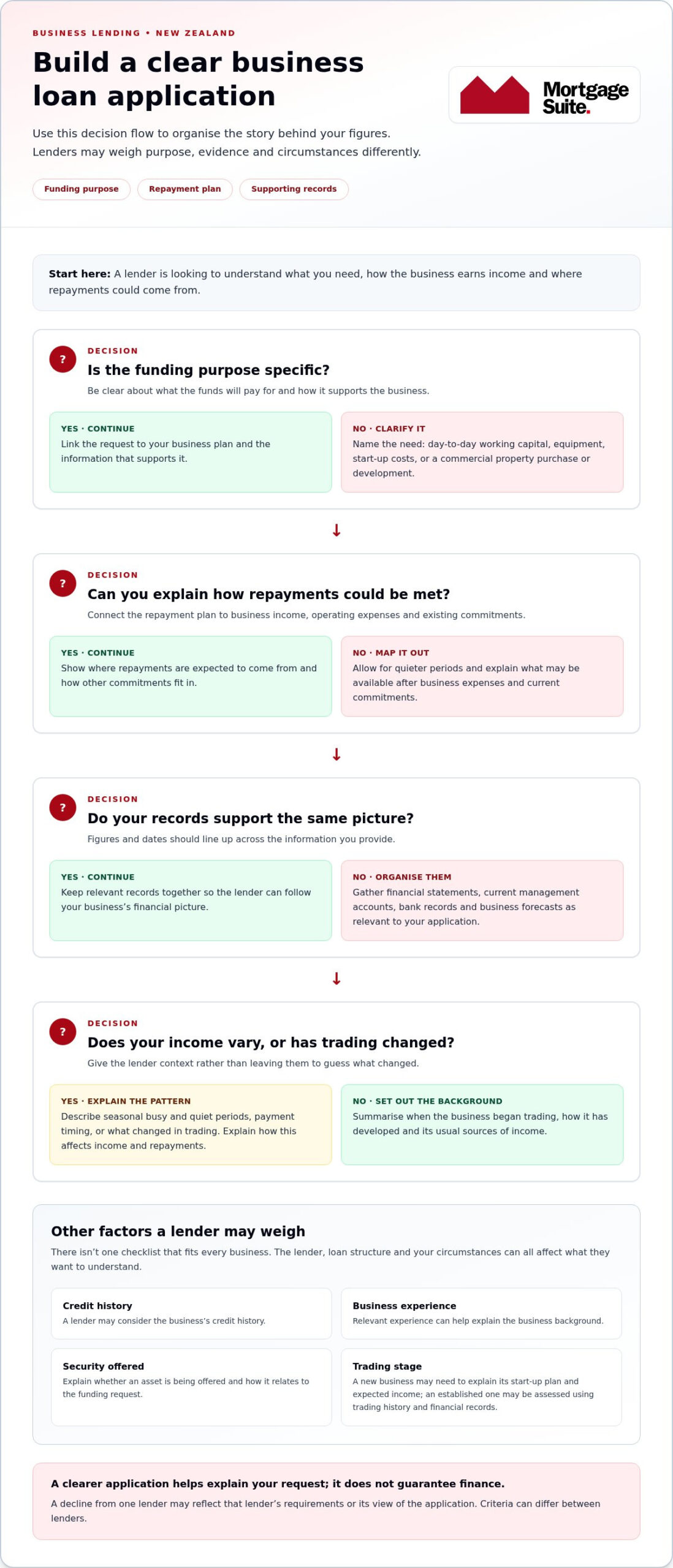
What checklist can help you get a business loan application ready?
Getting your application in order doesn’t mean guessing what every lender will ask for. It means making the request easy to understand, keeping your information accurate and being ready to explain the details that shape your business’s financial picture. Use this sequence to prepare, then tailor the records you share to the lender and application.
- Define the funding purpose. Write down what the funds will be used for, when you’ll need them and what the business expects to gain. Be specific, whether the need is to support day-to-day operations, buy equipment or pursue a property-related goal.
- Assemble relevant records. Gather current financial statements, management accounts, bank records and forecasts that help explain trading, income and existing commitments. Documents vary by application, so treat this as a starting point rather than a universal list.
- Map out repayments. Show where repayments are expected to come from and how they fit alongside regular business expenses and existing borrowing. Use realistic cash-flow assumptions, including quieter periods or changes in when customers pay.
- Compare suitable structures. Consider whether the business needs a lump sum or more flexible access to funds, and how the repayment approach fits the purpose. Choose a structure that makes sense for the need, not just one that sounds appealing.
Consistency matters. Check that figures in your application agree with your accounts and forecasts, and make sure the dates and descriptions tell the same story. If something has changed, explain it rather than trying to make different records appear to match. Clear, accurate information gives a lender a more useful basis for considering the request.
Build a clear funding summary
Set out how much you’re seeking based on your funding needs, and explain what the funds will cover, when they’re needed and how they’re expected to benefit the business. Link that benefit to a realistic repayment plan. Show how expected cash flow could support repayments after operating expenses and other commitments.
A short written summary can keep your application focused. It also gives you a useful reference when comparing the lending criteria for business loans nz, because you can see whether a lender’s proposed structure fits your purpose and repayment expectations.
Prepare for lender questions
Organise records that support your trading history, income, commitments and funding request. Note any questions you still need to answer, and prepare a plain-English explanation for uneven revenue, a recent change in trading or another unusual circumstance. Before sharing information, check key figures across your application and records so any differences are explained clearly.
If you’d like help organising your funding request and comparing lender pathways, Mortgage Suite can help you discuss your business loan options. Advice is free of charge with no obligation, and the outcome depends on the lender’s assessment.
How Mortgage Suite can help compare business loan criteria in NZ
Understanding the lending criteria for business loans nz can be challenging when each lender has its own way of assessing a request. Mortgage Suite starts by understanding your business purpose and circumstances, then helps compare lender pathways that may fit. The focus is on presenting your needs clearly and discussing suitable structures, rather than treating one lender’s checklist as the rule for every business.
The discussion can cover why you need funding, how your business operates, your repayment plan and any security available. Mortgage Suite works with banks, private lenders and non-bank lenders, helping you consider options beyond one application route. The aim is to make the differences between pathways easier to understand so you can decide what to discuss next.
Support for complex or non-standard applications
If your circumstances don’t fit a mainstream bank’s usual approach, a decline doesn’t necessarily end the search. Mortgage Suite arranges business loans, commercial loans, non-bank lending and bridging finance, and can help you consider whether another lender pathway may be appropriate. Different lenders assess applications differently, but no pathway guarantees funding. The right next step depends on your business, purpose and available information.
Founder Krish Krishna began his banking career before establishing Mortgage Suite in 2000. His more than two decades of banking experience informs the way the business approaches lending. You can also read client reviews of its support as you consider your next step.
A simple next step to discuss your funding needs
You don’t need to have every detail perfectly sorted before starting a conversation. Be ready to explain what the funding is for, what’s happening in the business and what you’d like to achieve. If a bank has already declined the application, it can help to share the reasons given and any information that has changed since then. This gives the discussion a practical starting point without assuming another lender will reach the same decision.
Mortgage Suite’s advice is free of charge and comes with no obligation. You can talk through your circumstances, compare possible lender pathways and consider what questions to raise next, without any promise of approval. Read about Mortgage Suite’s business loan support.
Make your next funding decision with clarity
You don’t need to predict every question a lender might ask. Focus on what you want the funding to make possible, what you can support with clear information and where you still need guidance. That gives you a practical starting point, even if your circumstances are complicated or a previous application didn’t go to plan.
The lending criteria for business loans nz can feel like a moving target, but you can approach the next step with a clearer sense of what matters to your business. If you’re unsure which part of your request needs more explanation, or want help weighing up a suitable way forward, a conversation can help you decide what to address first. Mortgage Suite’s advice is free of charge with no obligation, and there’s no promise of approval.
Talk with Mortgage Suite about your business funding plans. Start with what you need and where you’d like the business to go.
Frequently Asked Questions
Can a start-up apply for a business loan in New Zealand?
Yes, a start-up can apply, but whether finance is suitable depends on the lender’s assessment. The lending criteria for business loans nz may include the business plan, what the funds will support, how repayments could be made and what records are available. For a new venture, include relevant evidence such as early sales or confirmed customer work where available. Clearly label forecasts as estimates, not completed trading results.
Do business lenders always require property as security?
No. Security requirements vary with the lender, facility and details of the application. Some lending may be supported by an asset, while other arrangements may not require property. A personal guarantee may also form part of some applications, but it isn’t a universal condition. Before agreeing to a structure, make sure you understand what security is being offered and what responsibility you would take on.
What records might a lender ask for when assessing a business loan?
A lender may ask for financial statements, current management accounts, bank records, cash-flow information and details of existing borrowing or other commitments. It may also request forecasts or extra records that explain a particular feature of the application. Label documents clearly by date and status, such as final or draft, so recorded results are easy to distinguish from estimates. The exact request depends on the lender and your circumstances.
Can I apply for a business loan after a bank has declined my application?
Yes, you can explore another application after a decline, though approval isn’t assured. First, identify the reason given. It may relate to the requested structure, the information supplied or how the lender assessed the business. Addressing that point before applying elsewhere can make your next discussion more focused. Another lender may view the circumstances differently, but will still make its own assessment.
Can business loan funds be used for more than one purpose?
Possibly, but the lender and loan structure determine which uses are acceptable. If you’re combining needs, such as buying equipment while covering operating expenses, set out each purpose separately and explain how much of the request relates to it. This helps avoid confusion about how the funds are intended to be used. If the needs have different timing or repayment expectations, explain that too, as it may affect which structure is appropriate.
Does a business need accounting software to apply for a loan?
No single accounting platform is required for every business loan application. Some lenders offer application pathways that use accounting software, while others may assess information provided through statements, reports or other records. MYOB and Xero are examples of platforms used by some businesses, not a universal condition. Keep your financial information organised and make sure it clearly reflects the business’s activity, whether or not you use software.