
Small Business Loan NZ: A Roundup of Funding Options for 2026
What if the reason your bank said “no” had nothing to do with your company’s potential and everything to do with their rigid, outdated tick-boxes? Many Kiwi business owners spend weeks wrestling with complex application forms only to be met with a cold, automated rejection because their financials look a bit “non-standard”. It is incredibly frustrating to feel like just another file in a giant system when you are trying to build a legacy. We understand that your business is more than just a balance sheet; it is the result of your hard work and passion.
Finding a small business loan NZ doesn’t have to be a source of constant stress. You deserve a flexible lender who acts as a partner rather than a gatekeeper, helping you secure growth funds without the sleepless nights. This article will help you understand the different types of funding available in the current market and how to choose the right fit for your company’s growth. We will break down the funding landscape for 2026, explore the practical differences between secured and unsecured options, and look at how personalised service can help you overcome the obstacles often found at larger institutions.
Key Takeaways
- Understand how to use business finance as a strategic tool to fuel growth while keeping your personal and company debts separate.
- Compare classic term loans with flexible lines of credit to find the right cash flow solution for your specific projects.
- See why a small business loan NZ from a second-tier lender often provides the flexibility that mainstream banks lack for unique businesses.
- Master the essential steps to get your financials organised and clearly explain how new funding will drive your future profits.
- Learn how a personalised approach and decades of industry experience can help you bypass automated systems to secure the best possible deal.
What exactly is a small business loan in the NZ market?
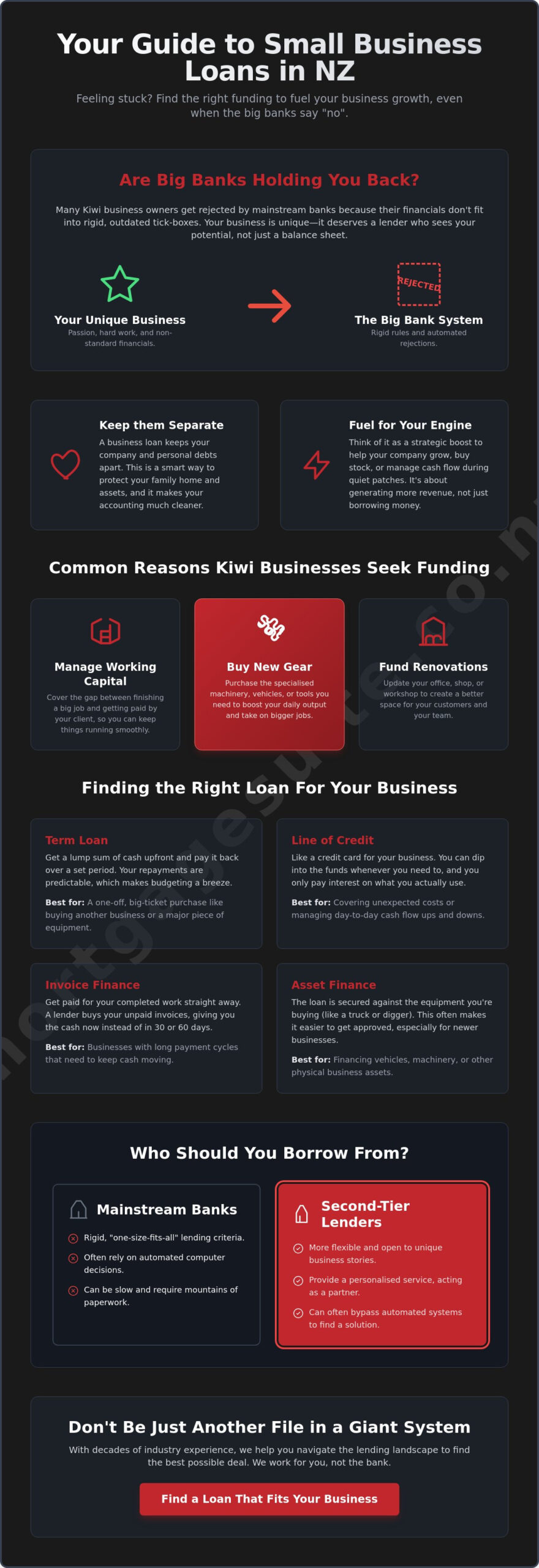
In its simplest form, a small business loan NZ is a financial tool designed to help your company grow or stay steady during quiet patches. Think of it as a boost for your company’s engine. Unlike a personal loan used for a holiday or a new car, business-purpose borrowing is specifically about generating more revenue or improving your operations. It is the fuel that allows you to take on a bigger contract, buy bulk stock at a discount, or move into a larger warehouse before you have the full amount of cash sitting in your account.
Separating your personal debt from your business debt is a smart move for any owner. It helps protect your family assets and makes your yearly accounting much cleaner. We have noticed more Kiwi owners moving away from traditional bank overdrafts recently. This shift is happening because many big banks are tightening their lending rules or trimming overdraft limits without much warning. A structured loan often provides more certainty than an overdraft that could be reviewed or reduced at the bank’s whim. Whether you are dealing with a “feast or famine” cash flow cycle or just need to bridge a gap, the right loan provides a safety net that lets you focus on the work itself rather than worrying about the bank balance every morning.
Common reasons Kiwis seek business funding
- Purchasing new vehicles or specialised machinery: Getting the right tools to increase your daily output or take on more technical jobs.
- Funding renovations: Updating your office, retail shop, or workshop to create a better environment for your team and customers.
- Managing working capital: Covering the gap between finishing a large project and actually getting paid by the client.
Asset finance vs. general business loans
There are several different types of business funding to consider depending on your specific needs. Asset finance is quite straightforward because the equipment you are buying, like a truck or a digger, usually acts as the security for the loan. If you are a newer business, asset finance is often easier to secure because the lender has a physical item to hold as a guarantee. This reduces their risk and can sometimes lead to better terms for you.
General-purpose business loans offer more flexibility. You can use these funds for things that don’t have a physical “serial number”, such as a new marketing campaign, hiring a key staff member, or launching a new service line. Because there is not always a physical asset involved, lenders will look more closely at your overall cash flow and business history. Choosing between these options depends on your long-term goals, but having a seasoned expert to help you weigh up the pros and cons ensures you don’t end up with a structure that hinders your future growth.
A roundup of business funding types available to you
Choosing the right small business loan NZ depends entirely on what you plan to do with the money. A classic term loan is often the best fit for a one-off, long-term project. You receive a lump sum upfront and pay it back over a set period, which makes your monthly budgeting very predictable. If you are looking to buy the building your business operates from, a commercial mortgage works in a similar way but over a much longer timeframe. Owning your premises can be a fantastic way to build equity rather than just paying off someone else’s mortgage. If you are considering this path, our step-by-step guide on how to buy commercial property loan NZ requirements and processes will walk you through exactly what to expect.
For day-to-day operations, you might consider a business line of credit or invoice finance. A line of credit lets you dip into funds only when you need them, meaning you only pay interest on what you actually use. Invoice finance is a bit different; it allows you to get paid early for work you have already finished by “selling” your unpaid invoices to a lender. This is a brilliant way to keep cash moving if your clients usually take 30 or 60 days to pay. Even government initiatives like the Small Business Cashflow Scheme have shown how specific, targeted funding can help Kiwis manage through unpredictable times. If you are unsure which path fits your current goals, talking to an expert about business loans can help clarify your options.
Choosing between secured and unsecured loans
The main trade-off here is between cost and speed. A secured loan usually requires you to pledge an asset, such as a property or a piece of heavy machinery, as a guarantee. Because this lowers the risk for the lender, you can often secure a much lower interest rate. For instance, while some specialist lenders might charge 14.99% or more for unsecured debt, a property-backed loan could be significantly cheaper. Unsecured loans are faster to get because there is no asset to value, but you will pay a premium for that convenience through higher rates and smaller borrowing limits.
The rise of flexible business facilities
Modern lending has moved beyond the clunky, old-fashioned bank overdraft. Many SMEs are now opting for flexible business facilities that allow you to pay down your balance and then “re-borrow” up to your limit whenever you need to. A business flexible facility acts as a safety net for cash flow, giving you peace of mind that funds are there if you need them. These facilities are replacing overdrafts because they often offer better terms and more transparency, helping you stay in control of your debt rather than feeling like the bank is in the driver’s seat.
Mainstream banks vs. 2nd tier lenders: Which is right for you?
When you start looking for a small business loan NZ, the local branch is usually the first stop. However, the experience can be a bit of a letdown for many owners. Big banks rely heavily on “tick-box” systems and automated platforms. If your business doesn’t fit their exact template, or if your financials have a few quirks because you’re self-employed, the computer often says no before a human even looks at your file. It is a rigid approach that doesn’t always account for the reality of running a company in 2026, especially when you need a lender who can see your potential rather than just your past tax returns.
This is where 2nd tier lenders come into play. These are specialised companies that take a more holistic, big-picture view of your situation. They don’t just look at a credit score; they look at your current contracts, your daily cash flow, and your future plans. Speed is another massive factor that sets them apart. While a mainstream bank might take weeks to process a single application, a non-bank lender can often give you an answer in a matter of days. If you have found a piece of equipment you need to buy immediately to finish a lucrative job, that speed is worth its weight in gold. Knowing when to use a bank for low-cost, slow-moving debt and when to look for alternative capital is a key skill for any growing business.
The benefits of 2nd tier lending solutions
They offer much more flexible criteria, which is a lifesaver for self-employed Kiwis who might not have two years of perfect tax returns ready to go. If your business has a shorter trading history, a 2nd tier lender is far more likely to listen to your story and look at your bank statements to understand your true earning power. You get a personalised assessment from a person who understands the local market, rather than just being a number in an automated bank queue.
Comparing the long-term costs
We often talk to clients who are worried about the cost of non-bank finance. It is true that 2nd tier lenders often charge a slightly higher interest rate than a mainstream bank. However, you have to weigh that cost against the opportunity of growth. A slightly higher rate is often worth the ease of access if it means you can secure a new contract or expand your team today. Many of our clients use this type of finance as a stepping stone; you use the funds to grow your turnover and prove your stability, which eventually makes you more attractive to a mainstream bank later on. For a deeper dive into these differences, you can read our guide on Commercial Mortgage New Zealand: Comparing Mainstream Banks vs 2nd Tier Lenders in 2026.
How to get your business “loan-ready” in 5 steps
Preparing for a small business loan NZ is a lot like getting a house ready for an auction. You want to make sure everything looks its best before the inspectors start poking around. It isn’t just about filling out a form; it’s about presenting a professional, reliable image of your company. The first and most vital step is to organise your financials. Ensure your Profit and Loss statement and balance sheet are completely up to date. Lenders need to see that you have a firm grip on your numbers. If your records are a bit of a muddle, it signals to the lender that your management might be too.
Next, you must know your “why”. You need to be able to explain, in plain English, exactly how the funds will generate a profit. If you’re borrowing to buy a new piece of specialised machinery, show them the extra revenue that machine will bring in each month. Lenders love a clear plan. While you’re at it, check your credit score. Many owners forget that lenders will often look at both your business and personal credit history. If there’s an old, unpaid utility bill from five years ago causing a blemish, it’s better to fix it now rather than being surprised during the application process. You should also identify what security you can offer, whether it’s the asset you’re buying or equity in a property, to help lower your interest rate.
Finally, don’t try to navigate this alone. Talking to an expert who understands the 2026 lending market can save you dozens of hours of legwork and help you avoid the common traps that lead to a “no”. If you want to put your best foot forward, you can get in touch about a business loan with a team that knows exactly what lenders are looking for.
The documents you’ll likely need
Most lenders now use secure digital links to view your last six months of bank statements, which saves you from printing out reams of paper. You’ll also need a clear, one-page summary of what the funds are for and proof of your business registration and GST status. Having these ready to go shows you’re serious and well-organised.
Common pitfalls to avoid
One of the biggest mistakes is “credit shopping” by applying to multiple lenders at once. Each application can leave a mark on your credit file, and too many at once makes you look like a high-risk borrower. Also, be careful not to underestimate how much you actually need. It’s often better to borrow a slightly larger amount once than to have to go back and ask for more a few months later. Lastly, always have a plan for how you’ll manage repayments during those inevitable quiet months.
Navigating the NZ lending landscape with a steady hand
Many business owners feel like they are shouting into a void when dealing with big bank call centres. An automated application might be efficient for the bank, but it rarely captures the nuance of your specific situation. Securing a small business loan NZ should be a collaborative process, not a cold transaction. Having a steady hand to guide you means having someone who knows how to frame your story so lenders see the opportunity rather than the risk. It is about moving away from the “computer says no” culture and towards a solution that actually supports your goals.
With 20 years of banking experience, our team has seen how the internal gears of lending institutions turn. We know the questions they will ask before they even ask them. This deep institutional knowledge allows us to act as your dedicated advocate, negotiating terms that a standard application would never uncover. We don’t just look for any loan; we look for the one that fits your business lifecycle. Whether you are a tradie needing a new vehicle or a company looking for complex funding, we bridge the gap between the rigid world of banking and your personal needs as a borrower.
The Mortgage Suite difference for business owners
It starts with personal mentorship from Krish Krishna and the team. We don’t just process files; we provide a consultative experience that helps you understand your options clearly. We specialise in both residential and commercial property-backed business loans, which often provide the most cost-effective way to fund growth. By using equity in your home or premises, we can often unlock better rates than standalone business debt. Our focus is always on the long-term relationship. We want to see your business thrive year after year, which is why we prioritise your success over just closing a one-off transaction.
Taking the next step for your business
The path to growth doesn’t have to be paved with endless paperwork and stress. A quick conversation is often all it takes to clarify which funding option is best for your current stage. We handle the heavy lifting, from the initial negotiations to the final signatures, so you can stay focused on running your company. Having a professional handle the legwork ensures you don’t miss out on better terms simply because you didn’t have time to shop around. If you are ready to explore what is possible, reach out for a no-obligation chat about your goals. We are here to help you find a way forward that feels right for you and your future.
Empowering your business for the years ahead
We have explored how the right funding acts as a powerful catalyst for growth, whether you are choosing between secured debt or understanding why 2nd tier lenders offer the flexibility mainstream banks lack. Getting your company “loan-ready” by organising your financials and knowing your “why” is the most effective way to secure the capital you need to scale. By understanding the full range of options available in 2026, you can make a decision that supports your cash flow rather than hindering it.
Navigating the search for a small business loan NZ doesn’t have to be a solo mission or a source of stress. With over 20 years of banking and brokerage experience, our team at Mortgage Suite Ltd specialises in finding creative solutions for businesses that big institutions often decline. We provide a highly personalised, jargon-free service that treats you like a partner rather than just another application number. Let’s find the right business loan for your next big move and ensure your company has the steady financial support it deserves. You have already done the hard work of building your business; now let us help you secure its future growth with confidence.
Frequently Asked Questions
What is the maximum amount I can borrow for a small business loan in NZ?
The maximum you can borrow for a small business loan NZ typically reaches up to $500,000 with many specialist lenders. Some providers offer smaller amounts starting from $2,000 to cover minor expenses. Your specific limit depends on your company’s turnover, how long you have been trading, and whether you are providing any assets as security for the debt.
Do I need to provide security like my home for a business loan?
You don’t always need to use your family home as security for a business loan. Many lenders offer unsecured options that rely on your business’s cash flow instead of physical assets. However, if you do choose to use property as a guarantee, you will often be rewarded with a lower interest rate and a higher borrowing limit because the lender’s risk is lower.
How long does the application process usually take for a non-bank loan?
Non-bank lenders usually move much faster than traditional institutions, often providing an initial decision within 24 to 48 hours. If your paperwork is organised and you use digital bank statement links, the funds can sometimes be in your account within a single business day. This speed is a massive help when you need to jump on a time-sensitive opportunity or fix a cash flow gap.
Can I get a business loan if I have only been trading for six months?
Yes, you can certainly find funding even if you have only been trading for six months. While mainstream banks often want to see two years of perfect tax returns, 2nd tier lenders are more interested in your recent bank statements and growth potential. You might find that an unsecured small business loan NZ is a more accessible option at this early stage of your journey.
What is the difference between a secured and an unsecured business loan?
The main difference is what happens if you can’t make your repayments. A secured loan is backed by a physical asset, like a truck or a property, which the lender can take if things go wrong. Because this is lower risk for them, the interest rates are usually cheaper. Unsecured loans don’t require assets but come with higher rates to cover the lender’s extra risk.
How do interest rates for business loans compare to home loan rates?
Interest rates for business loans are almost always higher than home loan rates because the risk to the lender is greater. For example, while a home-backed business rate might sit around 6% to 10%, an unsecured loan from a specialist lender could start at 14.99% and go higher. It’s a trade-off for the speed and flexibility you receive when you don’t fit the standard bank criteria.
Can I use a business loan to pay off tax debt or existing creditors?
Yes, using a business loan to clear tax debt or pay off urgent creditors is a common strategy to get a company back on track. Many 2nd tier lenders are happy to help with debt consolidation if it means your daily cash flow will improve. It’s often better to have one manageable loan repayment than several stressful debts hanging over your head while you’re trying to grow.
Will a business loan application affect my personal credit score?
Applying for a business loan will usually show up on your personal credit report. Most lenders perform a thorough check of your credit history as part of their assessment process. It’s a good idea to avoid applying to several different lenders at once. Too many enquiries in a short space of time can lower your score and make you look like a higher risk to potential lenders.