
Mortgage for Self Employed NZ: The 2026 Guide to Getting Approved
You’ve spent years building a successful business, only to have a bank manager look at your tax returns and tell you that you don’t earn enough to buy a family home. It’s a frustrating irony. While you’re contributing to the 17% of New Zealand’s GDP generated by the self-employed, the traditional lending system often makes you feel like a second-class citizen. Securing a mortgage for self employed NZ business owners shouldn’t feel like a battle against your own success, especially when your accountant is doing their job by minimising your taxable income.
We know that your bank statements tell a much richer story than a single line on a tax summary. It’s completely normal to feel overwhelmed by the endless paperwork or anxious about how a fluctuating income looks to a rigid credit department. This guide is designed to cut through that confusion and show you exactly how to present your finances to get a “yes”. You’ll learn how to navigate 2026 bank requirements, understand the “add-backs” that boost your borrowing power, and discover why a non-bank lender might be the partner your business actually deserves.
Key Takeaways
- Discover how to tidy up your personal and business bank statements 90 days before you apply so the bank sees exactly what they want.
- Learn the hidden ways lenders calculate your income and how to protect your borrowing power even if your accountant has reduced your taxable profit.
- Find out why 2nd tier lenders are often the best choice for a mortgage for self employed NZ business owners who don’t fit into a standard bank box.
- Understand the “add-back” process that lets you count certain business expenses as income to help you qualify for a larger loan.
- Gain a clear path to approval by using two decades of banking expertise to negotiate with lenders on your behalf.
Why being your own boss makes banks nervous (and how to fix it)
Being your own boss is the ultimate Kiwi dream. You have the freedom to call the shots and build something of your own. However, for a bank, that freedom often looks like “risk”. Mainstream lenders are built on a foundation of predictability. They love seeing a steady salary hit a bank account every fortnight. When you’re self-employed, your income might go up and down depending on the season or a big project. This fluctuation makes credit departments nervous because they can’t easily put you into a standard box.
The reality is that the problem usually isn’t how much you earn. It’s how that income is presented. Getting a What is a mortgage? approved as a business owner isn’t impossible; it just requires a different strategy. You can’t just hand over a few payslips and call it a day. Securing a mortgage for self employed NZ requires showing the bank that your business is a reliable engine that can support a long-term commitment. You can learn more about how banks think and how to prepare your finances at our mortgage school.
The difference between how you and the bank see profit
You likely look at your business and see a growing venture with healthy cash flow and happy clients. The bank looks at your financial statements and sees a list of potential liabilities. Your accountant’s job is often to reduce your taxable income to save you money at tax time. While that’s great for your pocket, it can hurt your borrowing power. Lenders apply a “stability test” to see if your profit is consistent. They want to know that if the market dips, you can still meet your repayments without stress.
The common hurdles for sole traders and company directors
If you’re a sole trader, the biggest hurdle is usually mixing your personal and business money. Banks will scrutinise your bank statements to see if your business is actually funding your lifestyle or if it’s struggling to stay afloat. It’s a common trap that’s easily fixed with a bit of organisation. By keeping these accounts separate, you provide a clear window into the business’s actual health.
Company directors face a different set of questions. The bank will look closely at your shareholder salary and any earnings you’ve kept in the business. They want to see that the company is strong enough to keep paying you even during quiet months. To improve your chances, start thinking like a bank manager. Look for patterns of growth and keep your records tidy. If you can prove your business has a steady pulse, you’re halfway to a “yes”. We see the hard work behind the mortgage for self employed NZ application and know how to present that value to the right lender.
Cracking the code: How lenders actually calculate your income
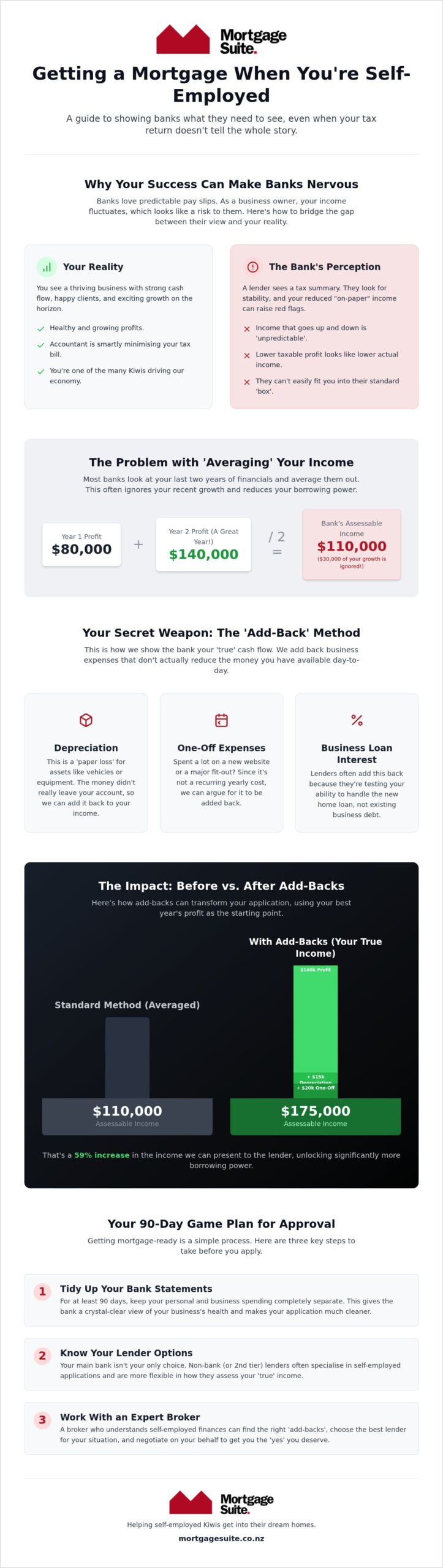
Most banks in New Zealand want to see your last two years of financial statements to get a handle on your earnings. They typically take the profit from year one and year two, then average them out to find a middle ground. This is their way of checking for stability, but it can be incredibly frustrating if your most recent year was much better than the one before. If you earned $80,000 in 2024 but jumped to $140,000 in 2025, a standard bank might still only “count” you as earning $110,000. It feels like they are ignoring your hard-earned growth and punishing your success.
This is where the “Add-back” method becomes your secret weapon. Add-backs are non-cash expenses or one-off costs that increase your real borrowing power. By identifying these specific items, we can often show the lender that your actual cash flow is much higher than what your tax return suggests. It’s about bridging the gap between what your accountant says to the IRD and what the bank needs to see to approve your mortgage for self employed NZ application.
The magic of “Add-backs” explained simply
Banks are looking for your “true” income, so they allow us to add back certain expenses that don’t actually affect your daily cash flow. We look for these three common items first:
- Depreciation: This is a “paper loss” for things like vehicles or equipment. It reduces your tax bill, but the money didn’t actually leave your bank account this month.
- One-off expenses: If you spent $20,000 on a new website, a major office move, or a specific piece of machinery, that’s a one-time cost. It won’t happen again next year, so the bank can often ignore it.
- Interest on business loans: Lenders often add this back because they are testing your ability to handle your new home loan, not your old business debt.
What if you only have one year of accounts?
Sometimes a business is too new for the two-year rule, or perhaps you’ve recently changed your business structure from a sole trader to a company director. While the big banks might show you the door, certain flexible lenders are happy to look at just one year of accounts if the business is performing well. This is common for high-growth sectors where the first year was spent setting up and the second year is where the real profit kicked in.
You can use our mortgage calculator to see how these different income figures change what you might be able to borrow. Understanding these nuances is the difference between a decline and an approval. If you want to see how your specific business numbers stack up, it’s a good idea to talk to an expert who can present your mortgage for self employed NZ case to the right lender.
Bank vs Non-Bank: Finding the right fit for your business
Most Kiwis head straight to the “Big Four” banks when they want a home loan. It’s a natural first step, but for a business owner, it can be a disheartening one. These mainstream lenders are set up for simplicity. They prefer applicants with a fixed salary and a tidy PAYE history. If your situation is even slightly complex, you might find yourself facing a brick wall. However, a “no” from a major bank isn’t the end of the road. It’s often just a sign that you need a different path to secure a mortgage for self employed NZ business owners.
This is where 2nd tier lenders, or non-bank lenders, come into play. These institutions specialise in borrowers who don’t fit into a standard box. They have the flexibility to look at the “why” behind your numbers rather than just the “what”. They understand that a dip in profit might mean you were reinvesting in growth, not that your business is failing. Learn more about 2nd tier lender New Zealand options to see how they differ from the traditional banks.
When to choose a 2nd tier lender
There are several scenarios where a non-bank lender is actually the smarter first choice. If you have been in business for less than two years, or if your company structure is particularly complex, 2nd tier lenders are far more likely to listen. They are also the primary providers of “Low Doc” (low documentation) loans. These are perfect if your full financial statements aren’t ready but you have other ways to prove your income, such as GST returns or business bank statements.
It’s important to be realistic about the trade-off. Because these lenders take on more perceived risk, their interest rates are typically higher than the “special” rates offered by mainstream banks. As of mid-2026, rates for these alternative loans often start around 6.35% and can go higher depending on your specific profile. You might also expect an establishment fee of 1% to 2%, but for many, this is a small price to pay for the keys to a new home.
The “Bridge” strategy: Moving back to the bank
You don’t have to stay with a non-bank lender for the entire life of your loan. We often use them as a “bridge”. This strategy involves getting you into your home now using a 2nd tier lender, then spending the next 12 to 24 months tidying up your financials. Once you have a clean track record of repayments and two years of solid accounts, we can look at refinancing you back to a mainstream bank with lower rates.
This approach is a particularly smart move for home loans for first home buyers who are self-employed. It allows you to get onto the property ladder while house prices are moving, rather than waiting years for your paperwork to be “perfect” for a big bank. We act as your partner throughout this entire transition, ensuring you always have a clear path toward the best possible deal for your mortgage for self employed NZ.
The 90-day game plan to get your application mortgage-ready
Preparation is the difference between an immediate “yes” and a long, drawn-out “maybe”. When you apply for a home loan, the bank isn’t just looking at your business profit; they are looking at your personal financial habits. They will scrutinise every line of your personal and business bank statements to see how you handle money. The goal is to show a clear, consistent pattern of saving and spending that proves you can handle the responsibility of a mortgage for self employed NZ borrowers.
Getting your ducks in a row before you even talk to a lender is the best way to avoid unnecessary stress. Think of this 90-day window as a chance to present the absolute best version of your financial life to the credit manager. It’s about removing any “red flags” that might give a bank an excuse to decline your application.
Tidying up your bank statements
In the three months leading up to your application, you need to be on your best behaviour. Avoid “un-arranged overdrafts” or late fees at all costs. To a bank manager, a $15 overdraft fee looks like a sign of poor cash flow management, even if it was just an oversight. It’s also vital to keep your business and personal spending strictly separate. If you’re constantly dipping into the business account to pay for groceries, it makes the bank’s job much harder and can slow down your approval significantly.
You should also look at reducing “discretionary” spending where possible. Those daily café runs or weekend shopping trips might not seem like much, but they can lower your “affordability score”. Banks calculate how much you can borrow based on what’s left over after your daily living costs. By tightening the belt for 90 days, you show the lender that you have the discipline to manage a larger commitment and a successful mortgage for self employed NZ.
The paperwork checklist for self-employed Kiwis
Having a tidy folder makes for a much smoother application process. Banks have a zero-tolerance policy for tax debt, so ensure your GST and income tax payments are completely up to date before you submit anything. To get started, you will need to gather the following:
- Your IR3 summaries for the last two financial years.
- A full set of financial accounts, including your Profit & Loss and Balance Sheet.
- Confirmation from your accountant that your tax affairs are in order.
If you’re feeling unsure about which documents you need or how to present them, check out our Mortgage School for more tips on document prep. We’ve seen every possible scenario and know exactly what a credit manager is looking for. To ensure your application is as strong as it can be, you can start your 90-day preparation with us today.
How an expert broker negotiates a “Yes” for you
A mortgage broker isn’t just a middleman who passes papers from one person to another. When you are looking for a mortgage for self employed NZ, a broker acts as your advocate and chief negotiator. We don’t just “submit” an application and hope for the best. Instead, we build a comprehensive case that highlights why you are a fantastic borrower, even if your tax returns don’t tell the whole story. With over 20 years of banking experience, Krish Krishna knows exactly how to speak the bank’s language and what buttons to push to get a deal over the line.
Understanding the “inside” of a bank’s decision-making process is a massive advantage for our clients. We know the specific criteria each lender uses and, more importantly, we know their current appetites. Some banks might be wary of certain industries, while others are actively looking to grow their small business portfolio. You can read our client reviews to see how this insider knowledge has turned a “no” into a “yes” for countless Kiwi business owners.
The power of the “Cover Letter”
The numbers on a Profit & Loss statement are just data points. They don’t show your personal passion, your 15 years of industry expertise, or the major contract you just signed for the coming year. That’s why every application we send includes a detailed cover letter. We tell the “story” behind your business numbers. If there was a dip in profit because you moved offices or upgraded your fleet, we explain that clearly so the bank manager sees it as an investment in growth rather than a sign of struggle.
Our goal is to remove obstacles before the bank even has a chance to bring them up. By pre-empting their questions and providing the answers upfront, we make it much easier for a credit manager to approve the loan. We highlight your business’s future potential and your proven track record, ensuring the mortgage for self employed NZ process feels like a partnership rather than a confrontation.
Your partner in property
Running a business is a full-time job, and you don’t have the hours to waste on a constant back-and-forth with a bank. We handle the stress, the follow-up calls, and the technical queries so you can stay focused on your clients. We aren’t interested in one-off transactions; we want to be your steady hand in a fluctuating market for years to come.
You can learn more about us and our passion for helping Kiwis get ahead. We’re here to ensure that being your own boss helps you get into a home, not holds you back. Whether you are buying your first place or growing an investment portfolio, we provide the seasoned professionalism you need to succeed.
Take the next step toward your new home
Securing a mortgage for self employed NZ business owners doesn’t have to be a source of stress. By understanding how lenders view your income and using strategies like “add-backs” or 2nd tier lending as a bridge, you can overcome the hurdles that often stop others. A bank’s rigid rules aren’t the final word on your financial success. With the right preparation and a clear 90-day plan, you can present a case that even the toughest credit manager will respect.
At Mortgage Suite Ltd, we aren’t just processing applications; we’re building partnerships. Krish Krishna uses over 20 years of expert banking experience to navigate complex loan profiles and find the right fit for your unique business. As a passionate Kiwi-owned and operated brokerage, we specialise in finding solutions when mainstream banks say no. Don’t let your business success hold back your home ownership dreams. Book a free, honest chat with Krish to sort your mortgage today. We are ready to help you move forward with confidence.
Frequently Asked Questions
Can I get a mortgage if I have been self-employed for less than two years?
Yes, you certainly can, though mainstream banks usually prefer a 24-month history. If your business is performing well after just one year, we can look at specialist lenders who prioritise current cash flow over long-term history. These lenders often use your GST returns or latest bank statements to verify your income. This flexibility allows you to secure a home loan without waiting for multiple years of tax returns to be finalised.
How much deposit do I need for a self-employed home loan in NZ?
Most self-employed borrowers will need a 20% deposit for an existing owner-occupied home. While some first-home schemes allow for 5%, these have strict income caps that many business owners exceed. If you are looking at an investment property, you will generally need 30%. Having a solid 20% deposit is often the “hard rule” for 2nd tier lenders in 2026, as it offsets the perceived risk of fluctuating business income.
What documents do I need to provide if I do not have a formal accountant?
If you manage your own books, you can still apply by providing your IR3 summaries directly from myIR. You will also need to provide at least six months of business bank statements and your most recent GST returns. These documents help the lender see the “real-time” health of your business. We specialise in helping business owners organise this paperwork to ensure it meets the strict requirements for a mortgage for self employed NZ.
Can I use my business profit to pay for my house deposit?
Yes, you can use retained earnings or business profit for your deposit, usually by paying yourself a dividend or a director’s salary. The lender will want to see that withdrawing this cash won’t negatively impact your business’s ability to pay its bills or trade effectively. It is a good idea to chat with us early so we can help you time this withdrawal correctly without making the bank nervous about your cash flow.
What happens if the bank declines my self-employed mortgage application?
A decline from a mainstream bank is often just a “not today” rather than a “never”. We start by reviewing the bank’s feedback to see if the issue was your income calculation, deposit size, or account conduct. Often, we can move the application to a 2nd tier lender who has more flexible rules. Alternatively, we can create a 90-day plan to fix the specific issues and reapply once your financial profile is stronger.
Is the interest rate higher for self-employed borrowers?
If you meet the standard criteria of a mainstream bank, your interest rate will be the same as any other borrower. However, if you require a “Low Doc” or specialist loan because your financials are complex, the rates are typically higher. In 2026, these alternative rates often start from 6.35%. While this is higher than a standard “special” rate, it provides the flexibility needed to get you into a home sooner.
Can I get a mortgage if I have some tax debt with the IRD?
Mainstream banks have a zero-tolerance policy for tax debt, but specialist lenders are often more pragmatic. If you have a formal repayment plan in place with the IRD and a history of making those payments on time, we can often find a solution. In some cases, we can even structure the new mortgage to pay off the tax debt entirely. This clears your record and simplifies your monthly outgoing payments into one manageable loan.
How does a 2nd tier loan help me get into a house sooner?
2nd tier lenders focus on your ability to afford the loan today rather than sticking to rigid historical rules. They are far more likely to accept a shorter business history or alternative proof of income, such as six months of bank statements. This means you don’t have to wait years for your tax returns to catch up with your actual business success. It is a faster path to securing a mortgage for self employed NZ when banks say no.