
Financing a Leaky Home in NZ: Your 2026 Guide to Lending Options
If your bank manager just handed you a decline letter because of monolithic cladding, it feels like the end of the road for your property dreams. But a “no” from a mainstream lender isn’t a final judgment on your financial future. Many Kiwis find themselves in this exact position, facing the stress of a home that doesn’t fit the standard box. You deserve a fair go, and that often starts with looking beyond the traditional banking system to find a solution that works for your specific situation.
We understand the anxiety around re-cladding and moisture risks is overwhelming. You’ve likely spent many nights wondering how you’ll ever get ahead. This guide is designed to help you navigate the complexities of financing a leaky home nz in 2026, giving you a clear path to secure the funding required to get your property sorted. We’ll show you how to move forward with confidence, even if the big banks have already turned you away.
You’ll learn how to work with a non-bank financial institution to bridge the gap, the role of a professional building report, and how a staged drawdown process keeps your project on track. We also explain how an equity safety net protects you while you work toward a future refinance into a standard term loan once the work is complete.
Key Takeaways
- Learn why monolithic cladding makes mainstream banks nervous and how to manage the strict Loan-to-Value restrictions they often apply to these properties.
- Explore how a non-bank financial institution can provide a path forward for financing a leaky home nz, ensuring you get a fair go after a bank decline.
- Understand how a staged drawdown process works to fund your base construction and siteworks while keeping your remediation project on a steady track.
- See why a detailed building report is your best tool for negotiation and how to prepare for a serviceability stress test with professional guidance.
- Discover the benefits of having a dedicated negotiator with 20 years of experience to help you navigate 2nd tier loans and get your property sorted.
Why Financing a Leaky Home in NZ is a Unique Challenge
Facing a weathertightness issue is one of the most stressful experiences a Kiwi homeowner can endure. It isn’t just about the physical rot; it’s about the financial uncertainty that follows. In 2026, “leaky building syndrome” refers to properties, typically built between 1988 and 2004, where moisture becomes trapped behind the exterior walls. Because these homes often use direct-fixed monolithic plaster, the water has nowhere to go, leading to structural damage that is hidden from the naked eye. This history, rooted in the New Zealand leaky homes crisis, has made lenders extremely cautious. Having a steady hand like Krish Krishna, who brings 20 years of industry experience, is vital to navigating this landscape.
Securing financing a leaky home nz is difficult because banks view these properties as high-risk security. If the timber frame is compromised, the value of the asset drops significantly. We see many clients who feel overwhelmed by the complexity of these rules, but getting your property sorted is possible when you have a dedicated negotiator on your side to advocate for a fair go.
The Risk of Monolithic Cladding for Lenders
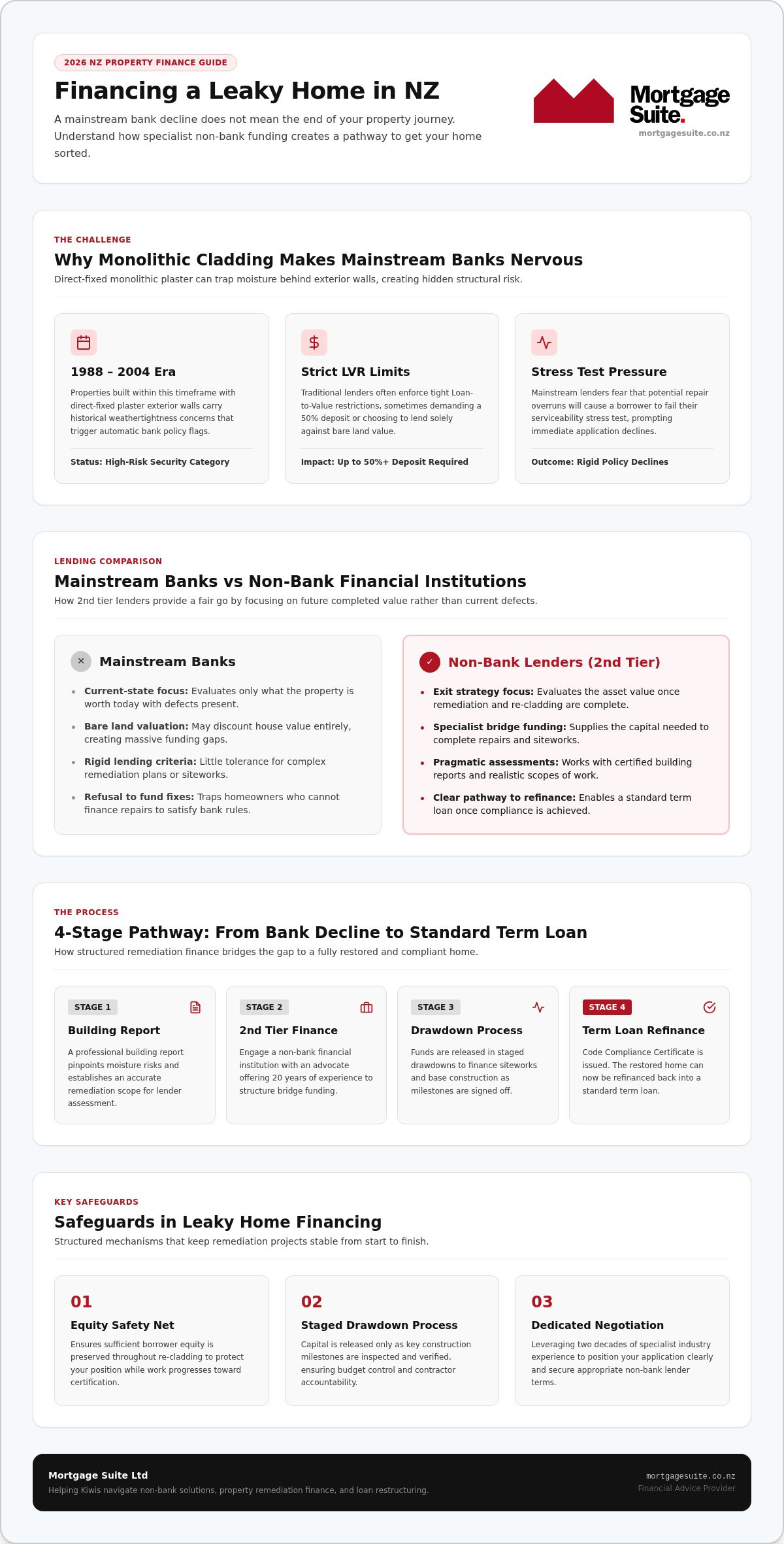
Lenders treat monolithic cladding as a security risk because moisture ingress can destroy a building’s structural integrity long before the owner notices a problem. When a bank lends money, they rely on the property’s market value to protect their investment. If a building report reveals systemic leaks, that resale potential plummets. In some cases, banks will only lend against the bare land value, ignoring the house entirely. This creates a massive gap for buyers or owners who need capital to move forward with their lives.
Why Traditional Banks Often Say No
Mainstream banks operate on rigid internal policies designed to minimise risk. They often apply very tight Loan-to-Value restrictions to any home with monolithic cladding, sometimes requiring a 50 percent deposit or more. Even with the Reserve Bank’s LVR settings allowing more high-LVR lending in 2026, banks remain hesitant to use that allowance on “leaky” properties. They worry that a serviceability stress test might fail if the owner is hit with unexpected repair bills that they haven’t budgeted for.
If your local bank manager said no, don’t take it as a final judgement on your situation. It simply means your needs don’t fit their narrow criteria. We specialise in finding a non-bank financial institution that understands the nuances of remediation. By looking beyond the big banks, we can often find a path to funding that allows you to finish the siteworks and base construction, eventually leading to a full refinance once the house is dry and compliant.
Mainstream Banks vs. 2nd Tier Lenders for Leaky Properties
When you approach a mainstream bank for financing a leaky home nz, you’re usually met with a brick wall. Traditional lenders are designed for standard transactions; they want properties that are easy to value and even easier to sell if things go wrong. Because monolithic cladding carries a perceived risk of hidden rot, the big banks often apply incredibly tight lending limits or simply decline the application outright. They focus heavily on the property’s current state, which leaves many Kiwis feeling stuck in a house they can’t afford to fix but aren’t allowed to refinance. It is a frustrating cycle that treats a repairable issue as a permanent failure.
In contrast, 2nd tier lenders take a more pragmatic approach. They don’t just look at the home as it stands today; they look at what it will become once the remediation is finished. By focusing on the ‘exit strategy’, these lenders provide the capital needed to get the work done, knowing that the property’s value will increase significantly once a Code Compliance Certificate is issued. While Settled.govt.nz guidance on leaky buildings helps you identify the risks, a 2nd tier lender provides the actual tools to manage them. They believe in giving homeowners a fair go, providing a bridge between a bank decline and a fully restored home.
Understanding the 2nd Tier Loan Advantage
Alternative lenders offer a level of flexibility that mainstream banks simply cannot match. As detailed in our 2nd tier lender New Zealand guide, these institutions operate with a different risk appetite. They are often more willing to work with lower deposit requirements or individual income assessments that don’t fit a standard algorithm. Their primary concern is the feasibility of the repair project and how you plan to return to mainstream lending once the house is sorted. This forward-looking mindset is exactly what’s needed when dealing with complex cladding issues.
The Role of a Specialist Mortgage Broker
Success in this market depends on how your story is told to the lender. We act as your personal advocate and dedicated negotiator, using Krish Krishna’s 20 years of banking experience to present your case in the best possible light. We don’t just look for the lowest headline rate; we focus on your long-term goals. We have seen almost every possible scenario and know which non-bank lenders have an appetite for monolithic cladding. If you want to see how we’ve helped others in your position, you can read our client reviews to learn more about our approach.
Funding the Fix: Financing Remediation and Re-cladding
Getting your property sorted requires more than just a willing lender; it needs a structured financial roadmap. When you’re looking at financing a leaky home nz, the goal is to bridge the gap between the current distressed state and a fully remediated, high-value asset. This is where an equity safety net becomes vital. By using the existing value in your land or the “as-is” value of the structure, we can help you secure the capital needed to start the work. It’s about looking at the project as a journey with a clear destination: a dry, compliant home that is once again attractive to mainstream banks. Having a clear plan from the start reduces stress and ensures you aren’t left halfway through a build without the funds to finish.
Construction Loans and the Drawdown Process
A construction-style loan doesn’t release all the money at once. Instead, it follows a drawdown process. This means your lender releases funds in stages after specific building milestones are achieved. Initially, this covers essential siteworks and the base construction phases. Before the work begins, your building team should identify the scope of repairs by checking the Building Performance weathertightness indicators to ensure the remediation plan is comprehensive. By releasing money in stages, the lender ensures the project is actually progressing before more capital is committed. At the very end, once the hammers stop, you’ll need a Statement of Compliance from the council. This document proves the work meets the building code and allows for the final release of funds.
Refinancing to Unlock Equity for Repairs
If you already own the property, you might be able to refinance to unlock equity for the repairs. Even if the house has moisture issues, the land still holds significant value. We can help you structure an equity release that provides the “top-up” required for re-cladding. The beauty of this approach is that it targets the “as-complete” value of the home. Once the monolithic cladding is replaced with a modern, cavity-based system, the property’s market value often jumps significantly. For those holding multiple properties, this can be a strategic move to protect your portfolio. If you’re an investor, check out our guide on residential investment property loans NZ to see how this fits into a broader investment strategy.
Essential Due Diligence: Building Reports and Valuations
Getting your application across the line for financing a leaky home nz requires a solid foundation of evidence. Lenders aren’t just looking at your ability to pay; they’re scrutinising the property’s health to ensure their investment is protected. Being organised with your paperwork from the very start is the best way to reduce the stress of the process. When you present a complete file that addresses every potential risk, you show the lender that you’re a serious borrower with a clear plan to get your property sorted.
Valuations for properties with monolithic cladding are handled with extra care. Most lenders will require a dual-figure valuation that establishes the current “as-is” value alongside the projected “as-complete” market value. This is a critical step because it helps us calculate the equity safety net required to secure your funding. By showing the lender the significant value increase expected after remediation, we can often turn a hesitant “no” into a confident “yes”.
The Importance of a Detailed Building Report
A standard pre-purchase report simply won’t cut it when monolithic cladding is involved. Lenders need a specialised building report that includes invasive moisture testing and thermal imaging. These tools allow the inspector to see behind the plaster and check for rot in the timber frame that isn’t visible to the naked eye. This data is vital for your advocate. When we have a clear picture of the structural integrity, we can negotiate a better deal by removing the element of the unknown. It transforms a “high-risk” property into a manageable project with a defined scope of work.
Passing the Serviceability Stress Test
Even with a supportive 2nd tier lender, you must prove you can handle the repayments. A serviceability stress test is a hypothetical assessment where the lender checks if you could still afford the loan if interest rates rose significantly. This is especially important for contractors or the self-employed, whose income might not fit a standard salary box. We work with you to present your certified accounts and bank statements in a way that highlights your true financial strength. You can use our mortgage calculator to check your own numbers and see how different scenarios might impact your budget.
If you’re feeling overwhelmed by the technical requirements, reach out to our team to see how we can act as your personal advocate during the due diligence process.
Navigating the Path Forward with a Specialist Advocate
Facing a bank decline for a property with monolithic cladding can feel like a personal rejection. It isn’t just about a loan application; it’s about your home and your financial security. At Mortgage Suite Ltd, we take the stress out of the process by acting as your steady hand in a fluctuating market. We understand that financing a leaky home nz requires more than just a standard application. It needs a strategic approach that addresses the concerns of lenders while protecting your interests as a homeowner. Our goal is to move you from a place of uncertainty to a position of strength where you have a clear, funded path to get your property sorted.
The advantage of working with us lies in our deep institutional knowledge. Krish Krishna brings over 20 years of banking and brokerage experience to every case. He has seen the evolution of lending criteria first-hand and knows exactly how to frame your situation to secure a “yes” from alternative lenders. We don’t just submit paperwork; we act as your dedicated negotiator. By positioning your case correctly, we ensure you get a fair go from lenders who are willing to look at the long-term potential of your property rather than just its current defects.
A Personal Approach to Complex Lending
We believe in partnership, not just transactions. Every client we help has a unique story, and we treat you as a person, not a file number. Our reputation as professional advocates is built on a commitment to seeing our clients succeed where others have failed. We focus on your long-term financial health, ensuring that the 2nd tier solution we find today serves as a bridge to a standard fixed interest rate in the future. If you want to see the impact of this personal touch, you can read our client reviews to see how we have helped other Kiwis navigate these exact challenges.
Getting Started: Your Fair Go Starts Here
Taking the first step toward financing a leaky home nz doesn’t have to be daunting. The path forward begins with a conversation where we can understand your specific property issues and financial goals. To get the ball rolling, we recommend gathering your current financial records and any existing building report or council correspondence you have on hand. This allows us to hit the ground running during your initial consultation. Getting your home remediated is entirely achievable with the right advocate by your side. We invite you to reach out to our team today to discuss how we can help you secure the funding you need.
Secure Your Property’s Future Today
Navigating the hurdles of monolithic cladding doesn’t have to be a solo journey. While the big banks often focus on the risks, we focus on the solution. By understanding the flexibility of 2nd tier lenders and preparing a structured drawdown process, you can move from the stress of a leaky building to the security of a dry, compliant home. The right approach to financing a leaky home nz is about seeing the potential in your property and having an expert advocate who knows how to access it.
With over 20 years of industry experience, Mortgage Suite Ltd specialises in alternative lending scenarios that mainstream managers simply won’t touch. We pride ourselves on being dedicated negotiators for Kiwis who have been declined elsewhere, ensuring you get a fair go and a path to long-term success. Don’t let a “no” from the bank stop you from protecting your biggest asset. Let’s get your leaky home finance sorted; contact Mortgage Suite Ltd today and take the first step toward getting your property sorted. Your future is achievable, and we are here to help you reach it.
Frequently Asked Questions
Can I get a mortgage for a leaky home in NZ in 2026?
Yes, getting a mortgage is achievable in 2026, though it often requires looking beyond mainstream banks. Traditional lenders view monolithic cladding as a high-risk security, which leads to frequent declines. However, by working with a non-bank financial institution, you can secure the necessary capital. These 2nd tier lenders focus on the value of the property once the repairs are finished, providing a vital pathway for financing a leaky home nz.
Why do mainstream banks decline loans for monolithic cladding?
Mainstream banks decline these loans because they prioritise low-risk assets with predictable resale values. Monolithic cladding without a cavity system is prone to moisture ingress, which can compromise the timber frame and lead to structural rot. Since banks can’t easily verify the extent of the damage without invasive testing, they often apply strict Loan-to-Value restrictions or refuse to lend against the structure entirely to protect their investment.
What is a 2nd tier loan and how does it help with leaky homes?
A 2nd tier loan is a facility provided by a non-bank lender that doesn’t have the same rigid criteria as the big retail banks. These lenders are specialists in non-standard scenarios, such as properties with weathertightness issues. They help by providing the bridge finance needed to complete re-cladding. Their focus is on your exit strategy, which usually involves a refinance back to a mainstream bank once the home is dry and compliant.
Do I need a special building report for a leaky property?
Yes, a standard pre-purchase report isn’t sufficient for properties with monolithic cladding. Lenders require a professional building report that includes invasive moisture probes and thermal imaging to identify hidden defects. This detailed documentation is essential for proving the scope of the remediation project. Having this information organised from the start allows your advocate to negotiate more effectively with alternative lenders who need to understand the exact level of risk involved.
How much deposit is required for a house with cladding issues?
Deposit requirements for leaky homes are typically much higher than the standard 20 percent seen in the residential market. Mainstream banks might require a 50 percent deposit or only lend against the land value. 2nd tier lenders can be more flexible, but they still require a substantial equity safety net to cover the costs of remediation. We work with you to structure your application so that your available capital meets the lender’s specific requirements.
Can I use equity in another property to fix my leaky home?
You can certainly use equity from a dry property to fund repairs on a leaky one. This is often a very effective way to secure remediation capital without needing a large cash deposit. By using a different asset as security, you provide the lender with more confidence, which can lead to better terms. This strategy allows you to get your property sorted while protecting your overall portfolio value and structural integrity.
What happens if my bank declines my re-cladding loan application?
A bank decline is simply a sign that you don’t fit their narrow lending criteria; it isn’t a final judgement on your financial situation. If you are turned down, the next step is to consult a specialist broker who understands the non-bank market. We act as your personal advocate and dedicated negotiator to find alternative lenders who have an appetite for complex cladding projects, ensuring you still get a fair go at financing a leaky home nz.
Is it possible to refinance a leaky home once it is fixed?
Refinancing is the ultimate goal once your remediation work is complete and you have received a Code Compliance Certificate. Once the property is dry and the monolithic cladding is replaced with a compliant system, it becomes a standard security again. At this point, we can help you move from a short-term facility to a mainstream term loan with a fixed interest rate, which helps to significantly reduce your ongoing interest costs.