
Getting a Mortgage on Maternity Leave in NZ: 2026 Guide
A maternity-leave mortgage application isn’t decided by your current payslip alone. If you’re wondering whether getting a mortgage while on maternity leave nz is possible, the answer depends on how a lender assesses your income now, your return-to-work plans and your household’s ability to manage repayments.
Time away from work doesn’t automatically rule you out, but approval isn’t guaranteed. Lenders can assess applications differently, so it helps to give them a clear picture of your finances and plans. This guide explains what may affect an assessment and how to prepare useful information.
You’ll learn how lenders may view parental leave payments, your expected return date and a temporary drop in household income. We’ll also cover documents that may help, such as an employer letter confirming your role, salary and expected return date, and ways to explain how repayments will fit your budget. Mortgage Suite can help you understand and compare mainstream and alternative lending options, so you can consider a sensible next step without assuming every lender will reach the same decision.
Key Takeaways
- Getting a mortgage while on maternity leave nz may be possible, but a lender will assess your circumstances and ability to manage repayments.
- Ask how the lender will consider your current income, planned return to work and household commitments.
- Prepare employment and income evidence, such as confirmation of your role, salary and expected return date. Check which documents the lender needs.
- Compare how mainstream and alternative lenders assess your situation rather than assuming every lender will take the same view.
- A mortgage adviser can help you understand your options and explain your circumstances to lenders, but can’t guarantee approval.
Can you get a mortgage while on maternity leave in NZ?
Yes, applying for a home loan while you’re on maternity leave may be possible. Being on leave doesn’t automatically mean you’ll be approved, and it doesn’t automatically rule you out. A lender needs to assess whether your household could manage the proposed repayments while your income is reduced and under your expected work arrangements after leave.
Getting a mortgage while on maternity leave nz depends on your full situation, not just the fact that you’re away from work. Lenders may consider your income, employment plans, regular household commitments and the amount you want to borrow. Requirements differ, so check what a lender currently accepts rather than relying on a friend’s experience or an old online example.
Does maternity leave automatically stop a mortgage application?
No single outcome applies to every borrower. Maternity leave is a temporary change in your work and income, but the lender will still assess the whole financial picture. Your return-to-work plans, another applicant’s income and your household commitments may all be relevant. These details help explain how your household expects to manage repayments, but none guarantees approval.
Parental leave sits within New Zealand’s employment framework. You can read more about the Parental Leave and Employment Protection Act 1987, but a lender’s mortgage assessment is separate from your employment rights.
What will a lender want to understand about your situation?
Expect to discuss your current income and how it may change during leave. A lender may ask whether your employer has confirmed your expected return date, role and salary. If your arrangements aren’t final, be upfront about that and ask what information could clarify your position.
The lender will also consider your household’s regular commitments and the proposed loan. Be ready to explain how repayments would fit your budget during leave and after you return to work. Ask which documents the lender accepts to confirm income and employment plans. Don’t assume every lender requires the same evidence or will reach the same view.
If a mainstream bank declines your application, ask what informed its decision and whether another lender may assess your circumstances differently. An alternative option would still need to be assessed on its merits, so treat the next step as a fresh conversation, not a promise of approval.
How lenders may assess income and affordability during maternity leave
A lender’s central question is whether your household appears able to manage the proposed repayments. It may discuss the income coming in now, how that could change during leave, your expected work arrangements afterwards and other regular household income. How leave-related income is treated can vary. Ask the lender how it would assess your circumstances rather than assuming your usual salary will be counted in full.
New Zealand’s Parental leave entitlements information explains the leave framework and points to payment details. It can help you understand your own situation, but it doesn’t determine how a lender will assess your mortgage application. If you’re getting a mortgage while on maternity leave nz, make clear which income is confirmed and which arrangements are planned.
How a return-to-work plan can help explain your application
If your return arrangements are confirmed, note your expected return date and whether you’ll be returning to the same role or working different hours. An employer letter may help explain your role, hours and pay. It’s supporting information, not a guarantee that the lender will count your planned income when assessing affordability. Ask what form of confirmation it accepts and whether it needs anything else.
How household commitments can affect the assessment
Income is only part of the picture. List your regular household expenses and existing repayments, then consider how the budget may change if childcare or work arrangements affect your spending or income. This gives you and the lender a practical basis for discussing whether repayments look manageable while your income is different.
You can use the Mortgage Suite mortgage calculator to explore possible repayments as part of your planning. Treat the result as an estimate, not a lender decision or a promise of approval.
Examples of evidence a lender may ask for, depending on its requirements:
- Recent payslips or information showing income received during leave.
- An employer letter confirming your expected return date, role, hours or pay, if available.
- Details of other regular household income, existing repayments and ongoing expenses.
This is a starting point, not a universal checklist. Before gathering documents, ask your chosen lender or adviser which evidence it accepts and how it will consider your income and commitments. A clear explanation can help you compare options and decide what to do next.
Mainstream or alternative lender: what should you compare?
A lender’s approach can affect how your maternity-leave income and work plans are considered. Instead of looking only for an immediate yes, compare what each lender needs to understand, how it assesses your household budget and whether the proposed loan could suit your plans beyond the leave period. Criteria can change, so ask for current requirements rather than treating another borrower’s experience as a guide to your own application.
Use these questions to compare options. They don’t describe a guaranteed policy for any lender:
| What to compare | What to ask |
|---|---|
| Confirmed income | Which income documents do you need, and how will you assess income during leave? |
| Return-to-work plans | What evidence of my expected return date, role, hours or pay can you consider? |
| Household commitments | How will you assess regular expenses, existing repayments and expected changes to our budget? |
| Loan fit | What repayment choices or loan structure should we consider for our longer-term household plans? |
Questions to ask before choosing a lender
Ask each lender for a clear list of the income and employment details it needs. Check how it treats a planned return to work and changing household expenses. Discuss whether the proposed repayments and loan structure fit your plans after you return. This helps you compare the overall suitability of an option, not just whether an application might proceed now.
When an alternative lending conversation may be useful
If a mainstream lender declines your application, that doesn’t mean every option is closed. Mortgage Suite can help you explore mainstream and alternative lending channels, including 2nd-tier lending, where suitable. Each option still depends on an assessment of your circumstances, and terms and suitability can differ. If you’re getting a mortgage while on maternity leave nz, ask what a lender’s decision was based on before choosing your next step.
Alternative lending isn’t automatically a better fit. Compare how the lender will assess your confirmed income, return-to-work evidence and household commitments. Make sure you understand the proposed repayments and structure. A lending adviser can help you organise your questions and explain your circumstances, without promising approval. The aim is to make a considered choice that fits your situation.
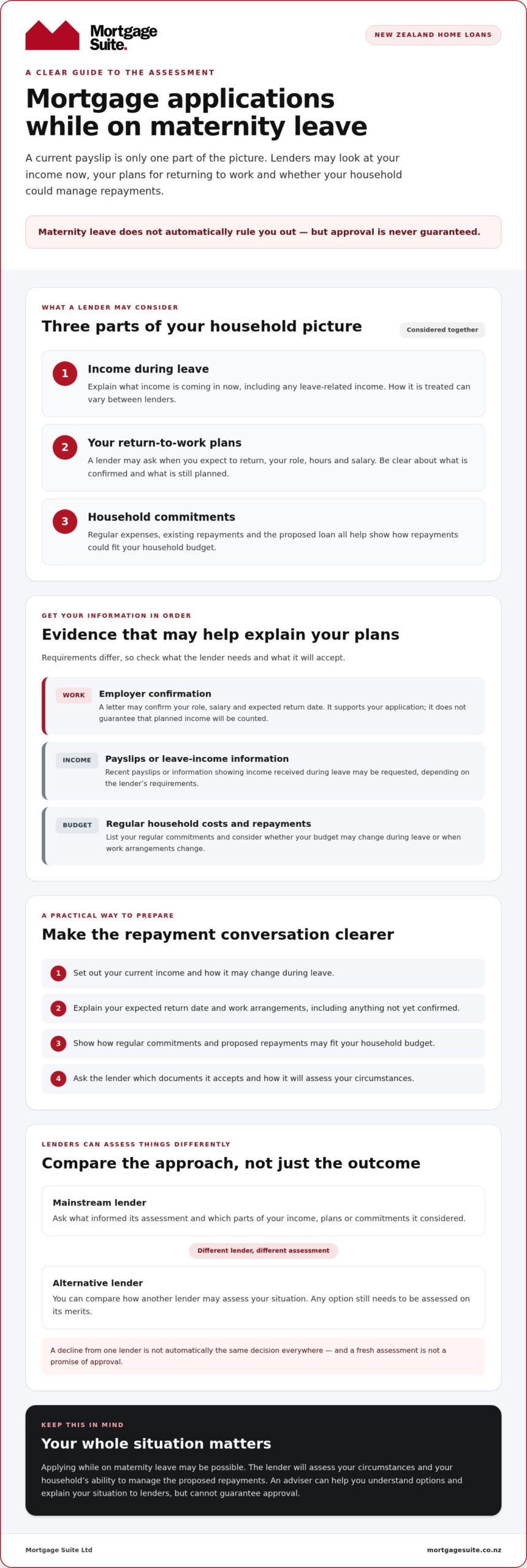
How to prepare a mortgage application while on maternity leave
Preparation can make an initial lending conversation clearer and help you identify missing information early. Start by mapping your household finances, confirming what you know about your employment and return-to-work plans, and gathering available evidence. Then ask which lending options may suit your circumstances. If you’re getting a mortgage while on maternity leave nz, explain changes to your income or work arrangements openly and consistently.
A practical document checklist to start with
Pull together what you already have. This is a starting point, not a list every lender will require. Check the exact document list with your chosen lender or adviser before relying on any particular item.
- Recent payslips or other available records showing your income during leave.
- Employment details, such as your role and any confirmed changes to your hours or working arrangements.
- Written confirmation of your expected return date and pay, if your employer has provided it.
- Details of regular household expenses, existing repayments and other income.
- Information about your current leave arrangements and any expected changes to your household budget.
If something hasn’t been confirmed, say so. Clear, consistent information helps the person reviewing your application understand what’s known and what’s still being planned.
How to make the first conversation more useful
Before speaking with a lender or adviser, note your property goal, preferred timing and questions about how your income during leave and return-to-work plans may be assessed. Include relevant changes to your household finances, such as a shift in work hours or expected childcare arrangements. You don’t need every answer ready. Being clear about what’s confirmed and what’s uncertain gives the conversation a useful starting point.
Review possible repayments against your household budget. Consider whether they look manageable with your current income and how your budget might change when work arrangements shift. An estimate can support your planning, but it isn’t a lending decision. Ask how a proposed loan might fit your longer-term plans if you’re unsure.
For plain-English help with lending basics, explore Mortgage Suite’s Mortgage School. When you’re ready to discuss your circumstances, talk with Mortgage Suite about your home loan. A lending professional can help you organise information and discuss possible options, but approval depends on the lender’s assessment.
Getting support with a maternity-leave mortgage application
You don’t have to work through every lending question on your own. Gather the evidence you have, note what’s confirmed about your return to work and ask lenders how they would assess your circumstances. If getting a mortgage while on maternity leave nz feels like a lot to manage, a mortgage adviser can help organise your questions and compare possible options.
An adviser can help explain your situation to lenders and clarify what further information may be useful. Mortgage Suite can present your circumstances and discuss possible options with lenders, including whether mainstream or alternative lending channels may be worth exploring. Any recommendation depends on a careful review of your circumstances, and no particular lending decision is assured.
What a mortgage adviser can help you work through
Start by discussing the parts of your application that may need context. Your current income may differ from your expected income after returning to work, or your return date may still be unconfirmed. An adviser can help identify what needs explaining, ask what supporting evidence a lender may accept and communicate the details clearly. They can also help compare potential lender fit, while making clear that each lender makes its own assessment.
Mortgage Suite supports borrowers through mainstream and alternative lending channels. Founder Krish Krishna established the business in 2000 and brings more than two decades of banking experience. That background can inform a practical conversation about your circumstances, but it can’t assure a particular lending decision.
Choose your next step with confidence
Before getting in touch, you may want to read about Mortgage Suite’s background and browse client reviews to learn about other borrowers’ experiences. Reviews are individual accounts, not a promise that your application will have the same outcome.
Bring the information you have and ask direct questions: what needs more evidence, how could your return-to-work plans be considered, and which lender options may suit your household? Take time to understand the answers and decide what feels sensible. A mainstream lender’s decline isn’t necessarily the end of your options, but any next route still needs to suit your circumstances and pass the lender’s assessment.
If you’d like to discuss your situation and explore possible next steps, talk through your home-loan options. You don’t need every detail sorted before starting the conversation.
Take a clear next step with your home-loan plans
Getting a mortgage while on maternity leave nz may be possible, but each lender will assess your circumstances. A clear picture of your current income, confirmed work plans and household commitments can help you explain your application and ask useful questions. Requirements differ between lenders, and approval is never guaranteed.
Gather the evidence you have, check what a lender needs and compare options that could suit your household now and longer term. A decline from one lender doesn’t necessarily mean every option is closed. Mortgage Suite Ltd has supported borrowers since 2000, and founder Krish Krishna brings more than two decades of banking experience. The team can discuss mainstream and alternative lending channels, subject to an assessment of your situation.
If you’d like to discuss your next step, talk through your home-loan options. Bring your questions and the information you have, and Mortgage Suite can help you explore possible lending options.
Frequently Asked Questions
Can I get a mortgage while on maternity leave in NZ?
It may be possible, but there’s no answer that applies to every borrower. For getting a mortgage while on maternity leave nz, lenders assess your income, employment, household commitments and proposed loan using their own criteria. Explain your leave arrangements and any confirmed return-to-work plans, then ask what evidence the lender needs. A mortgage adviser can help you understand which mainstream or alternative options may be worth exploring, subject to assessment.
Will a lender count my income while I am on maternity leave?
How a lender treats income during leave can vary, so don’t assume it will count your income in a particular way. Ask how it assesses your current income and any expected change when you return to work. You may need to provide employment details or confirmation of your work arrangements. Check the lender’s current requirements before applying, as policies and accepted evidence can differ.
What documents might I need for a mortgage application during maternity leave?
The documents requested depend on the lender and your circumstances. You may be asked for information about your income, employment, leave arrangements, regular household commitments and any confirmed return-to-work plan. Treat a checklist as a starting point, not a guaranteed list of requirements. Contact the lender or adviser early to confirm exactly what they need, including whether documents must be recent or supplied in a particular format.
Can I apply for a mortgage before I return to work?
You can ask a lender or adviser about applying before your planned return, but the timing and evidence needed depend on your circumstances and the lender’s criteria. Explain your current leave, employment status and any confirmed work arrangements. The lender may also want to understand how your household commitments fit alongside the proposed repayments. Ask what information could support an assessment now rather than assuming how planned income will be treated.
Does maternity leave affect mortgage pre-approval in New Zealand?
It can affect the information a lender asks for, but it doesn’t automatically decide the outcome. Pre-approval is based on the lender’s assessment at that time and may include conditions. Be upfront about your leave arrangements, income and expected work changes, and check what evidence is needed. If your circumstances change after pre-approval, contact the lender to ask whether it needs to review your application before you rely on it.
What if my bank declines my mortgage application while I am on maternity leave?
A decline from one lender isn’t necessarily a final judgement on your borrowing prospects. Ask for a clear explanation and whether further information could help. Lenders assess applications differently, but another option isn’t guaranteed. A mortgage adviser can help you understand the issues, compare possible mainstream and alternative lending channels, and decide whether to provide more evidence or make changes before approaching another lender. Any option remains subject to assessment.
Should I wait until I return to work before applying for a mortgage?
There’s no single best time for every borrower. Applying before you return may suit some circumstances, while waiting could give you clearer income evidence. Consider your property plans, household budget and the documents available now. Ask a lender or adviser how each timing option may be assessed before deciding. Don’t treat planned income as guaranteed, and check whether changes to your circumstances or work arrangements could affect the information the lender needs.