
OCR Meaning: How the Official Cash Rate Shapes Your Mortgage in 2026
If you feel like your bank account is at the mercy of a three-letter acronym you can’t quite define, you’re definitely not alone. Most homeowners find the constant news cycle about interest rates more stressful than helpful, especially when the terminology feels like a secret code designed to keep you in the dark. Understanding the ocr meaning is actually the simplest way to take back control of your mortgage strategy and find some peace of mind.
I know how unsettling it is to watch your hard-earned money shift because of decisions made behind closed doors at the Reserve Bank. This guide is here to clarify what the Official Cash Rate actually is and how its projected movements in 2026 will directly impact your wallet. With the OCR currently sitting at 2.25 per cent and forecasts suggesting a climb toward 3.010 per cent over the next year, staying informed is your best defence against rising costs. We will break down the latest June 2026 data and explore whether fixing or floating is the smartest way to organise your home loan today.
Key Takeaways
- Learn the simple ocr meaning and how this single number set by the Reserve Bank dictates the interest you pay on your home loan.
- Understand why bank interest rates move when the Official Cash Rate changes so you can stop being surprised by your monthly mortgage statements.
- Get a clear picture of the 2026 economic landscape to see how settling inflation might finally change your repayment strategy.
- Discover how to use OCR trends as a guide to decide whether fixing for a short term or staying on a floating rate is the right move for your budget.
- Find out how having a dedicated negotiator on your side can help you secure better terms from the big banks, regardless of what the market is doing.
What is the OCR? The Official Cash Rate Explained
If you’ve been searching for the ocr meaning lately, you might have found yourself looking at software that reads text from images. That is definitely not what we’re talking about here. In the world of New Zealand home loans, the OCR is the most powerful number in the country. It dictates how much you pay for your house, how much you can save, and the general cost of living for every Kiwi family.
Think of the OCR as the foundation of every interest rate in the country. When the Reserve Bank moves this lever, every other bank follows suit. At its simplest, the Official Cash Rate is the interest rate the Reserve Bank of New Zealand (RBNZ) charges on overnight loans to commercial banks. This is why we often call it the “wholesale price” of money. Just like a local bakery has to pay more for flour when global prices rise, your bank has to pay more for the money they lend you when the OCR goes up. The RBNZ uses this rate as their primary tool to manage price increases and ensure the New Zealand economy stays stable and doesn’t run too hot or too cold.
Who decides the OCR and when?
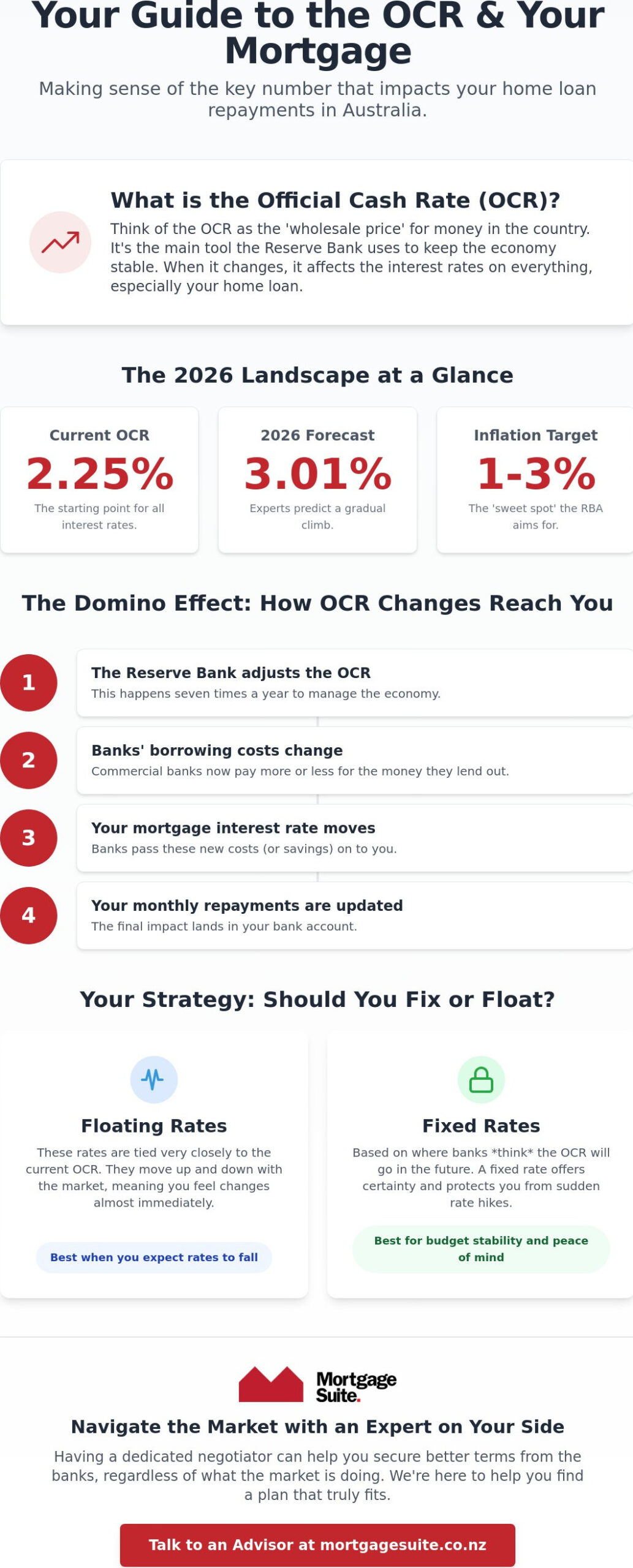
The Reserve Bank doesn’t just set a rate and forget it. A group of experts at the bank meets seven times a year to review the state of the nation and decide if the current settings are still right. These decisions aren’t made in a vacuum; these decision-makers look at a massive range of data including employment levels, global trade trends, and local price hikes. Their next scheduled review is on July 8, 2026. These announcement dates are a big deal because even a tiny shift can change your weekly budget. Understanding the ocr meaning helps you stay ahead of these announcements so you can prepare for potential changes to your mortgage repayments before they actually happen.
Why does the OCR exist?
The main job of the OCR is to keep the cost of living from rising too fast, ideally keeping it between 1 and 3 per cent. When prices for everyday items like groceries and petrol start climbing too quickly, the bank will often hike the OCR to slow down spending. This makes borrowing less attractive and encourages people to save instead. Conversely, if the economy feels a bit sluggish and needs a boost, they might lower the rate to make loans cheaper and encourage spending. Currently, with the rate at 2.25 per cent and prices predicted to rise at or above 3.0 per cent through the end of the year, the Reserve Bank is performing a delicate balancing act to keep our costs under control.
How the OCR review NZ affects your mortgage rates
When the Reserve Bank of New Zealand moves the rate, it sets off a chain reaction that eventually lands right in your letterbox or inbox. It’s helpful to think of this like a domino effect. Banks don’t just have vaults full of cash; they actually borrow money themselves to lend it to you. When the ocr meaning shifts, it changes the price banks pay for money. If that price goes up, the banks follow suit.
To ensure they are making enough money to stay in business, banks pass those extra costs directly on to you through higher interest rates. This is why your mortgage rate doesn’t stay still. It’s a bit of a cycle that starts with the experts at the Reserve Bank and ends with your monthly repayment. When their costs go down, they often lower your rate to stay competitive and attract new families looking for a home loan.
The link between the OCR and floating rates
Floating or variable rates are usually the first to move when things change. They are tied very closely to the current settings. For example, if the rate drops by 0.25 per cent, you can usually expect your floating rate to follow that lead pretty quickly. This immediate connection is why many people choose to keep a portion of their loan floating when they think the market is trending downwards, as it allows them to save money without waiting.
Fixed rates and “future expectations”
Fixed rates are a bit more complex because they are based on where the banks think the rate will go in the future. If the market expects a hike in six months, banks might raise their fixed rates today to prepare. Understanding this helps you decide if you should choose a fixed rate mortgage or stay flexible. If you’re feeling unsure about the best path forward, the team at Mortgage Suite Ltd can help you look at your specific budget and find a plan that fits.
The 2026 trend: What is happening with interest rates now?
As we move through 2026, the mood around the property market is starting to change. We are finally seeing a shift in how the Reserve Bank manages the cost of living, moving away from the constant pressure of the last few years. Because inflation is starting to settle, the “high-rate era” that caused so much stress for homeowners is beginning to evolve into something more manageable. This shift in the ocr meaning for families means that instead of just trying to keep your head above water, you can start looking at the future with a bit more clarity.
I believe 2026 will be a year of cautious optimism for those looking at switching to a better deal on their home loan. With the rate currently sitting at 2.25 per cent, there is more breathing room in household budgets than we have seen in quite some time. It is a period where you can stop worrying about sudden shocks and start making plans that actually help you get ahead. Understanding how mortgage rates NZ are shaped by these OCR movements is essential to making the most of the current environment.
Will rates go down further in 2026?
Many experts are waiting for signs that the rate will “normalise” or return to lower levels. While the Reserve Bank is always careful not to move too fast and risk making prices jump again, a steady environment makes it much easier to calculate a mortgage repayment that you can rely on. Even if forecasts like the one from CEIC suggest a slight climb toward 3.010 per cent over the next year, the predictability of the market is a huge win for anyone trying to organise their finances.
What this means for first-home buyers
Stability in the market makes it much easier to plan a budget for your very first home. We are noticing that banks are becoming more competitive again, often offering “special” fixed rates to attract new families. It is a fair dinkum opportunity to get into the market and secure a house before property prices potentially start to climb again. For those who have been waiting on the sidelines, the current trend offers a much clearer path to homeownership than we have seen in years.
Strategy: Should you fix or float based on the OCR?
Now that you’ve got a handle on the ocr meaning, the real question is how to use that knowledge to protect your bank account. There isn’t a single answer that works for every household, but the current market trends give us some very strong clues. When you understand the direction the Reserve Bank is heading, you can stop guessing and start planning with real confidence. Your choice usually comes down to whether you value immediate savings or long-term certainty.
If the trend shows the OCR is likely to stay low or drop, staying on a floating rate or choosing a short-term fix of six months can be a brilliant move. This allows you to stay nimble and potentially catch lower rates as they arrive. However, with the RBNZ forecasting the rate to reach 3.010 per cent by mid-2027, many homeowners are looking at locking in a rate for two or three years. This provides peace of mind, as you’ll know exactly what your repayments are even if the market gets a bit bumpy later in the year. A comprehensive look at mortgage rates NZ homeowners are navigating in 2026 can help you weigh up whether fixing or floating makes the most sense for your situation.
Keep in mind that interest rates are only half the story. You also need to check the debt to income ratio nz settings. These rules can limit how much you’re actually allowed to borrow, regardless of how low the interest rates might be. Balancing your rate strategy with these borrowing limits is the key to a healthy mortgage in 2026.
The “Split Loan” approach
You don’t have to put all your eggs in one basket. Many of our clients choose to organise their mortgage so one portion is fixed and the other is floating. This gives you the best of both worlds. You get the certainty of a fixed payment for your main budget, but the floating portion allows you to make extra repayments whenever you have some spare cash. It’s a smart way to hedge your bets against any sudden surprises from the Reserve Bank while still chipping away at your debt faster.
When to talk to a broker
A professional broker can see under the hood of what the different banks are planning before they make it public. We spend our days looking at the ocr meaning in practice, which means we can help you cut through the technical talk and find a rate that actually fits your life. Getting expert advice is spot on when you want to avoid the stress of second-guessing the market. If you’re ready to find a strategy that works for your specific situation, book a time to chat with our team at Mortgage Suite Ltd today. We love helping Kiwis take the guesswork out of their home loans.
How Mortgage Suite Ltd navigates the OCR for you
At Mortgage Suite Ltd, we have been guiding Kiwis through the ups and downs of the property market for over two decades. In that time, our team has seen dozens of OCR cycles and navigated through every kind of economic weather you can imagine. We know that when the news starts buzzing about interest rates, it can feel like a lot of noise that doesn’t actually help you make a decision. Krish and the team are here to act as your personal negotiators; we stand between you and the big banks to make sure you get a fair deal that reflects your hard work.
We take the stress out of every OCR review NZ goes through by translating the big headlines into a plan that works for your specific wallet. Instead of you having to decode a complex economic report, we do the heavy lifting and explain the ocr meaning in terms of your actual monthly repayments. Whether you are a first-home buyer trying to get a foot in the door or an investor looking to grow a residential investment portfolio, we centre our advice entirely on your personal goals and family needs. We pride ourselves on being a steady hand in a fluctuating market, ensuring you always feel like a priority rather than just a transaction.
Personalised rate reviews
One of the biggest mistakes many homeowners make is the “set and forget” approach. We don’t believe in leaving your financial future to chance. At Mortgage Suite Ltd, we keep a constant eye on the market and the Reserve Bank’s movements for you. If a better opportunity pops up because the RBNZ moved the needle, we will be the first to let you know so we can adjust your strategy together. Our service is designed to make the complex world of finance feel as easy as a chat over a cuppa. We want you to feel supported and prioritised, giving you the confidence to make big decisions without the typical anxiety.
Ready to secure your 2026 home loan?
Don’t let the loud headlines or conflicting reports about the ocr meaning confuse your strategy for the year ahead. The market is always moving, but with a seasoned expert to guide you, those movements become opportunities rather than obstacles. We are here to help you find clarity and confidence in your mortgage decisions, regardless of what is happening with global inflation or local interest rates. Let’s have a no-obligation chat about how we can get your home loan sorted properly for 2026. Reach out to the team at Mortgage Suite Ltd today and let’s start a partnership that puts your success first.
Take Control of Your Financial Future in 2026
Understanding the ocr meaning is the first step in moving from financial confusion to real confidence. We have explored how the Reserve Bank’s decisions trickle down to your family budget and why the current 2026 trends require a proactive approach to your home loan. Whether you decide to fix, float, or split your repayments, the most important thing is having a strategy that protects your lifestyle while the market evolves. You don’t have to guess what the next move should be when you have the right information at your fingertips.
With over 20 years of seasoned experience in banking and brokerage, Krish Krishna and the team at Mortgage Suite are here to provide the personalised service you need. We are specialists in navigating 2nd tier and alternative lending options that often provide a way forward when mainstream banks say no. Don’t let market headlines dictate your stress levels. Let’s chat about your 2026 mortgage strategy today to ensure your home loan is working as hard as you do. We are ready to help you secure a stable and successful path forward.
Common Questions About the OCR
How often does the OCR change in New Zealand?
The Reserve Bank of New Zealand reviews the Official Cash Rate seven times a year. These scheduled announcements happen roughly every six to eight weeks, allowing the bank to react quickly to changes in the economy. While the dates are set in advance, the bank does have the power to make unscheduled changes if a major global or local event occurs. The next major review for 2026 is locked in for July 8.
Does a lower OCR always mean my mortgage rate will drop?
A lower rate doesn’t guarantee an immediate drop in your mortgage interest because banks also have to account for their own costs and profit margins. While a reduction in the wholesale price of money usually leads to lower retail rates, banks might hold their ground if they expect the ocr meaning to shift back up in the near future. They also look at what their competitors are doing before deciding how much of the saving to pass on to you.
What happens to my fixed-rate mortgage if the OCR goes up?
Nothing happens to your repayments until your current fixed term comes to an end. Your fixed-rate agreement is a legal contract that protects you from any market increases during that period. The catch is that when your term expires, you will have to roll over onto the new, higher market rates. This is why many homeowners start chatting with a broker a few months before their fixed rate ends to plan for the jump.
Is the OCR the same as the interest rate I pay the bank?
No, the OCR is the “wholesale” rate banks pay each other, while your mortgage rate is the “retail” price you pay the bank. Because banks have to pay for their staff, technology, and branches, they add a margin on top of the Official Cash Rate. This is why you will see floating rates currently around 5.89 per cent even though the OCR itself is much lower at 2.25 per cent.
Can I change my mortgage type if the OCR review NZ is bad news?
You can usually switch from a floating rate to a fixed rate instantly to lock in some certainty for your budget. If you are already on a fixed rate and want to change because the ocr meaning has shifted, you might have to pay a “break fee” to the bank. It is often a good idea to have a professional check if the potential savings of a new rate are bigger than the cost of the fee before you make the move.
How much can a 0.25% OCR change actually cost me each month?
A 0.25 per cent increase on a $500,000 mortgage can add approximately $80 to your monthly interest bill. While that might feel manageable on its own, several small increases over a year can quickly add up to an extra $1,000 or more out of your pocket. Tracking these small shifts is vital because they have a compounding effect on your long-term wealth and your ability to pay off your home faster.