

What if fixing your mortgage makes repayments easier to plan, but leaves you less room to change course? That’s the trade-off many Kiwis are weighing up. If rate forecasts have you second-guessing what to do, you’re not alone. The pros and cons of fixing your mortgage NZ homeowners need to consider go beyond choosing a rate: they include how well the loan fits your budget and plans.
A fixed interest rate can give you a clearer idea of your repayments for an agreed period, which can make household budgeting more manageable. In return, you may have less flexibility to make changes, such as increasing repayments or restructuring your loan. Changing a fixed loan early may also be subject to conditions in your loan agreement. Those details can be hard to compare, especially if your income or plans may change.
This guide explains the practical benefits and trade-offs, what to consider when choosing a fixed term, and how a fixed, floating or split structure might suit your circumstances. Rather than trying to predict the next rate move, you’ll be better placed to weigh up your options and understand what to look for in your loan terms.
Key Takeaways
- See how a fixed interest rate keeps your rate unchanged for an agreed period, and why that can help with household budgeting.
- Weigh the pros and cons of fixing your mortgage nz, including the balance between repayment certainty and flexibility.
- Compare fixed, floating and split loan structures to see how each can suit different needs and plans.
- Use a practical framework to assess your budget, upcoming plans and current loan terms before choosing a fixed term.
- Gather your repayment details and loan information so Mortgage Suite can help you compare bank and private lender options.
Pros and cons of fixing your mortgage in NZ: what a fixed rate means
Knowing what your home loan repayments are likely to be can make it easier to plan your household budget. That reassurance matters when rates are moving and you’re trying to work out what you can comfortably manage. A fixed interest rate offers some predictability, but it doesn’t tell you what interest rates will do next or guarantee that fixing is the right move for you.
A fixed interest rate is an interest rate that remains unchanged for an agreed period.
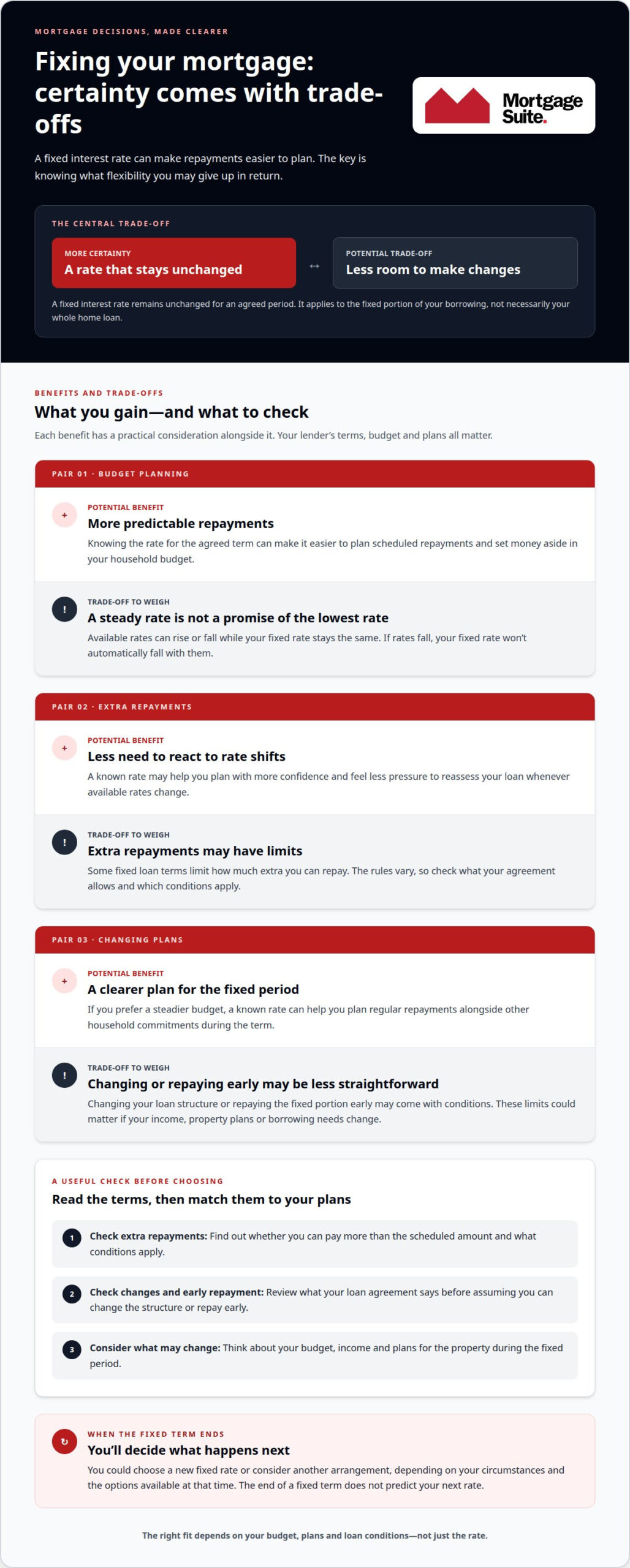
That agreed period gives you a clearer view of the rate on the fixed portion of your borrowing during the term. It doesn’t freeze market rates: rates available to borrowers can rise or fall while yours stays the same. This is the central trade-off behind the pros and cons of fixing your mortgage nz: more repayment certainty during the term, potentially less flexibility to make changes.
What does fixing a mortgage actually mean?
You and your lender agree to an interest rate for a set term. This is separate from the full length of your home loan, which may continue well beyond the fixed term. The fixed rate only applies for the agreed period, rather than for the entire time you owe money on the mortgage.
When the term ends, you’ll need to decide what happens next. You could choose a new fixed rate or consider another arrangement, depending on your circumstances and the options available at that time. The decision comes around again because the end of a fixed term doesn’t predict what your next rate will be. For background, you can read more about fixed-rate mortgage structures.
Why do borrowers consider a fixed interest rate?
Predictability can make day-to-day budgeting feel more manageable. If you prefer knowing the rate that applies during the agreed term, a fixed option may make it easier to plan regular repayments alongside other household commitments. It can also provide a sense of stability when you don’t want every change in market rates to affect your decisions.
That preference isn’t the same as knowing you’ll get the lowest rate. A fixed rate may feel reassuring even if rates later fall, while borrowers who value the ability to adapt may prefer more flexibility. The right fit depends on what matters most to you, your budget and how likely your plans are to change.
For example, if you’re planning around a steady household budget, a set rate may help you feel more settled about repayments during the term. If you expect your income or circumstances to shift, the limits on changing your loan could matter just as much as that certainty. A fixed rate doesn’t remove uncertainty altogether; it narrows it for a set period. Look beyond the rate itself and weigh the loan structure against your plans.
The main pros and cons of fixing your mortgage
Once you understand what a fixed term does, weigh up how it may affect your everyday finances. A fixed interest rate can offer a steadier basis for planning, but the same agreement may make changes harder while the term is in place. The balance depends on your loan conditions and what you expect your household needs to look like during that time.
Potential benefits: certainty and easier budgeting
A rate that stays unchanged during the agreed term can help you plan scheduled repayments with more confidence. That can be reassuring if your budget has little room for surprises or you prefer to know what to set aside for your home loan. It also means market rate changes won’t alter the fixed rate on that portion of your borrowing during the term.
- More predictable planning: You can build regular repayments into your household budget without having to respond to each market rate movement.
- Greater short-term confidence: A known rate may make it easier to plan around other commitments during the fixed period.
- Less focus on rate shifts: You may feel less pressure to keep reassessing your loan whenever available rates change.
These are practical benefits, not a promise that fixing will be cheaper or suit every borrower. Your repayment arrangement, loan conditions and personal circumstances all matter. A steady rate can be valuable even if the market later moves in a direction you didn’t expect, but that certainty comes with a trade-off.
Potential drawbacks: less room to change course
Some fixed loan terms limit extra repayments or changes to the loan while the rate is in place. The rules vary by lender and agreement, so don’t assume every fixed loan offers the same flexibility. If your income may change, you’re considering a property move or you might want to restructure your borrowing, these limits could affect how easily you act on those plans.
- Extra repayments may be restricted: Review whether you can pay more than the scheduled amount and what conditions apply.
- Changing your loan may be less straightforward: Check what your agreement says about changing the structure or repaying the fixed portion early.
- Market movements can cut both ways: Your fixed rate won’t automatically fall if available rates drop during the term.
Before committing, read the loan agreement and make sure you understand the conditions for extra repayments, changes and early repayment. Don’t make a change based on an assumption about what’s allowed. Mortgage Suite Ltd can help you understand how the terms may apply to your loan and circumstances.
The pros and cons of fixing your mortgage nz are best weighed against your budget and likely plans, not a guess about future rates. If you’d value support comparing the whole loan structure, Mortgage Suite Ltd can help you consider your options without pressure.
Fixed mortgage terms and flexibility: how to weigh your options
Choosing between fixed, floating and split borrowing isn’t about finding one structure that’s best for every Kiwi household. It’s about matching repayment certainty and room to adjust with your budget and likely plans. A split arrangement divides borrowing across different loan arrangements, subject to the lender’s terms. Compare the conditions for the whole loan, not just one portion.
| Structure | Repayment certainty | Flexibility | May suit |
|---|---|---|---|
| Fixed | The rate on the fixed portion stays unchanged for the agreed term. | Changes or extra repayments may be restricted by the loan conditions. | Borrowers who value predictable repayments during the term. |
| Floating | The rate can change, so repayments may change too. | May allow more room to adjust, depending on the lender’s conditions. | Borrowers who place a higher value on flexibility. |
| Split | Part of the borrowing can have a fixed rate. | The floating portion may offer a different level of flexibility; terms apply to each part. | Borrowers who want to balance certainty and flexibility. |
When might repayment certainty matter most?
If your income is steady and regular household commitments leave little room for repayment changes, knowing the rate on a fixed portion may help you plan with more confidence. It can also suit borrowers who would rather not make frequent decisions in response to rate movements. That certainty applies only to the agreed rate and term, though. It doesn’t protect your household from changes to income, expenses or other circumstances.
When might flexibility matter more?
Think about what could change before the fixed term ends. You might expect a change in income, want to pay your loan down faster, or be considering a move. A floating structure may offer different options for making changes, while a split loan can leave some borrowing fixed and some floating. What you can do depends on the lender’s conditions, so compare the rules as well as the headline rate.
For instance, a household with steady income and no expected changes to its property plans may put more weight on predictable repayments. Someone expecting a job change or planning to sell may care more about how easily they can adjust the loan. Neither situation points automatically to one structure. Consider how each option fits your circumstances and whether the terms give you the room you need.
The pros and cons of fixing your mortgage nz become clearer when you picture your own next few years, rather than trying to predict where rates will go. Compare the options against your likely plans, then read the conditions for each part of the loan. If you’re considering a split, make sure you understand how the fixed and floating portions work together and what choices you’ll have as each term changes.
How to decide whether fixing your mortgage suits your plans
Start with your own household, not a prediction about where interest rates might go. The pros and cons of fixing your mortgage nz are easier to weigh when you know what repayment level feels manageable, what may change in your life and what your current loan allows. Use this framework to organise your decision before reviewing your options.
A practical checklist before choosing a fixed term
Gather your loan details and set out what you need the structure to do. Your notes can help you compare certainty, flexibility and loan conditions together, rather than making a decision based on one feature alone.
- Set your budget first. Work out what repayment level fits your regular household commitments and how much room you have if repayments change.
- Think through your plans. Consider whether an income change, extra repayments, a property move or another loan change could be likely during the term.
- Review your current loan. Note the existing rate arrangement, repayment details, relevant conditions and the date any fixed term ends. If that date is coming up, allow time to consider your options before making a new choice.
- Write down what you need to clarify. Note the limits on repayments or changes, what happens when the term ends, and which fixed, floating or split structures may fit your circumstances.
This gives you a useful starting point for a conversation with a mortgage adviser. If your plans are uncertain, be specific about what might change and when. That can help you focus on the loan conditions that matter most, rather than trying to solve every possible future scenario at once.
Why rate predictions shouldn’t make the decision for you
Rate forecasts can shift, and a forecast can’t guarantee what rates will be when you choose or when your fixed term ends. Your budget and plans matter in different rate environments: a structure that feels manageable now should also make sense alongside the changes you can reasonably anticipate.
To compare possible repayments, try Mortgage Suite’s mortgage calculator. Treat the results as estimates for exploring scenarios, not as a lender’s offer or a promise of what your repayments will be. Your actual loan terms and lender assessment determine the available options.
Once you’ve gathered your loan details and questions, a mortgage adviser can help you look at the full structure, not just the headline rate. Mortgage Suite can compare bank and private lender options, with its brokerage service free of charge and with no obligation. Discuss your mortgage options with Mortgage Suite when you’re ready to get sorted.
Reviewing a fixed mortgage in NZ: your next steps
A mortgage review can help turn a difficult choice into a clearer set of options. Bring together your current loan details and what you expect may change, then consider how each possible structure fits your priorities. The pros and cons of fixing your mortgage nz will look different depending on your repayments, lender conditions and plans, so the aim is to understand the choices, not to predict the market.
What to bring to a mortgage review
A few notes can make a conversation more useful. Gather your loan information, mark when your current fixed interest rate term ends, and write down what you want your next arrangement to do. You don’t need to have a preferred option already. Clear questions are a good place to start.
- Current loan details: Note your lender, loan structure, repayment frequency and current repayment arrangements, along with any conditions that affect changes.
- Fixed-term timing: Record the end date of any fixed term so you can plan for the decision rather than leaving it until the last moment.
- Household priorities: Write down how much repayment certainty matters and whether you may need room for extra repayments or other changes.
- Questions for your review: Note renewal choices, conditions on changing the loan and how fixed, floating or split structures could fit your situation.
Include plans that could affect your borrowing during the next term, such as a change in income or a possible property move. Even if those plans aren’t certain, noting them helps keep the review grounded in your life rather than just a headline rate.
How Mortgage Suite can help you compare lending options
Mortgage Suite helps borrowers compare options from banks and private lenders, considering the wider loan structure alongside the rate. Founder Krish Krishna began the business in 2000 after 18 years in banking and has arranged well over a billion dollars in residential, commercial and business loans. That experience informs a personal, practical approach, without promising a particular rate or outcome.
The brokerage service is free of charge and comes with no obligation. You can talk through your current terms, priorities and questions, then consider possible next steps without pressure to choose a structure on the spot. If your bank’s first option doesn’t seem to fit, Mortgage Suite can help you understand other lending routes that may be worth considering.
Before you get in touch, gather the details you have and be ready to explain what you want your repayments and loan structure to support. You don’t need to have every answer sorted. Get in touch with Mortgage Suite for a no-obligation discussion about your mortgage options.
Take the next step with a plan that fits
You don’t have to settle on a fixed term just because rates are in the headlines or a renewal date is getting closer. Give yourself room to make a considered choice: bring together your loan details, think about what may change in your household, and compare the options against the repayments and flexibility you need.
The pros and cons of fixing your mortgage nz are personal. A useful next step is to talk through how the loan structure could fit your plans, including which questions matter and what alternatives may be worth considering. You can have that conversation without needing to arrive with a decision already made.
Discuss your mortgage options with Mortgage Suite in a free-of-charge, no-obligation conversation. A clearer view of your choices can help you move forward with confidence and get sorted on terms that make sense for you.
Frequently Asked Questions
Is fixing your mortgage always cheaper than a floating rate?
No. The better-value option depends on the rates and loan conditions available to you, as well as how long you keep that arrangement. Compare offers on the same basis: check the rate, repayment setup, eligibility conditions and any limits that matter to you. A headline rate alone doesn’t show how well a loan fits. Written loan terms make it easier to compare like with like.
Can I make extra repayments while my mortgage is fixed?
Possibly, depending on the conditions for your specific loan. Before making an extra payment, check which loan portion it would go towards, whether the agreement requires a request first and what limits apply. If the agreement isn’t clear, Mortgage Suite can help you understand the wording and how it relates to your plans. That helps you avoid assuming an extra payment will be treated the way you intend.
What happens when my fixed mortgage term ends?
Your lender can set out the arrangements available for the next period, but don’t assume the existing terms will continue unchanged. Check the term’s end date and review when a decision is needed, what information is required and when any new arrangement would take effect. Having those details ready gives you time to review the paperwork and avoid a rushed choice close to the end date.
Can I change my mortgage before the fixed term ends?
You can consider a change, but the effect depends on your agreement and what you’re planning to do. Before committing to selling, refinancing or restructuring, review the terms for early repayment and how any adjustment would be worked out. Also consider whether the change affects other parts of your lending. With those details, you can weigh the proposed change against your plans before taking action.
Does a fixed interest rate protect me from every change in repayments?
No. A fixed interest rate applies to the agreed loan portion, but your repayment amount can also depend on the balance and repayment arrangement. If you change the loan or have other portions with different terms, the total you pay may be affected. Check your statement and loan documents to see which portions each repayment covers. If the figures don’t match your expectations, Mortgage Suite can help you understand the calculation.
Can I split my mortgage between fixed and floating rates?
Yes, if your lender offers a structure that allows it. Before choosing a split, understand how the portions will be set up, how repayments will be allocated and whether the portions can have different end dates. Keeping a simple record of each portion’s rate, balance and key dates can make future reviews easier. The lender’s terms determine which arrangements are available and how they operate.
Should I fix my mortgage based on what the OCR might do?
It’s better not to make the decision on an OCR prediction alone. Use rate news as a prompt to review your loan, not as a signal that a particular mortgage rate will follow. A useful exercise is to compare your budget under more than one repayment scenario, then decide which arrangement you could manage if events don’t unfold as expected. That keeps the choice tied to your circumstances.