
Fixed Rate Mortgage vs Floating: Which is Right for You in 2026?

If you could lock in your financial peace of mind today, would you choose the long term security of a five year fix or the short term flexibility of a one year rate? It is a question that keeps many Kiwis awake at night, especially when you are deciding if a fixed rate mortgage is the right tool to shield your home from rising costs. You likely want a plan that lets you sleep easy, knowing your budget is protected from the whims of the market without being trapped in a structure that does not suit your family’s future.

We understand the stress that comes with bank rejections or the confusion of choosing between various terms while rates fluctuate. This guide will show you exactly how these loans work in the 2026 New Zealand market and help you find the best strategy to protect your wallet. We will explore how to organise your debt to lower your monthly repayments and why “splitting the difference” might be the smartest move for your lifestyle and your long term goals.

Key Takeaways

  • Understand how a fixed rate mortgage provides repayment certainty, ensuring your budget stays steady regardless of what the Reserve Bank decides.
  • Compare the high security of fixed terms against the flexibility of floating rates to decide which priority fits your current lifestyle.
  • Discover the “sweet spot” for loan terms that balances the hope of lower future rates with the need for immediate financial protection.
  • Learn how to use a split loan strategy to get the best of both worlds, keeping most of your debt safe while leaving room for extra repayments.
  • Find out how an expert can help you access a wider range of lenders if the main banks are not a good fit for your situation.

What is a Fixed Rate Mortgage and How Does it Work?

A fixed rate mortgage is a contract for financial certainty during market fluctuations. It is an agreement where you lock in your interest rate for a specific period, usually ranging from six months to five years. This agreement acts as a vital anchor for your finances, providing a sense of stability even when the wider economy feels a bit shaky. If you are looking for a formal deep dive into the history and mechanics of these loans, you can read more about What is a Fixed-Rate Mortgage? on Wikipedia. It is a straightforward way to ensure that your home loan remains manageable, no matter what happens in the global financial world.

When you choose to fix, your monthly repayments stay exactly the same for the duration of that term. It doesn’t matter if the Reserve Bank of New Zealand decides to hike the Official Cash Rate (OCR) or if global markets take a sudden turn; your bank cannot touch your rate until your fixed term expires. This creates a powerful shield against sudden cost-of-living spikes. It means you won’t be blindsided by a sudden increase in your mortgage bill just because interest rates rose while you were busy with work and family life. You can plan your household budget months or even years in advance with absolute confidence.

The difference between fixed and floating

Think of the difference like choosing between a set-menu meal and ordering a-la-carte. A fixed rate mortgage is your set menu; you know exactly what it costs before you sit down, and there are no surprises when the bill arrives. A floating (or variable) rate is like ordering a-la-carte. The price can change depending on the day’s market conditions. While floating rates offer the flexibility to make large extra payments or pay off the loan early without any penalties, they often come with a higher interest rate. Most people find that the lower interest rates typically offered by a fixed rate are worth the trade-off in flexibility.

Why Kiwis usually prefer to fix

Historically, New Zealanders have a strong preference for fixing their loans. Most of us value that budgeting security above all else. It is a practical way to avoid “mortgage stress” when interest rates are climbing. For many, especially those just starting out, understanding these options is just as important as knowing the home loan deposit requirements NZ lenders expect for first-time buyers. By locking in a rate, families can ensure their biggest monthly expense is predictable. This stability is often the difference between a comfortable lifestyle and a stressful one, especially during those early years of home ownership when every dollar counts.

Fixed vs Floating: A Side-by-Side Comparison

Deciding between a fixed or floating rate isn’t just a financial choice; it’s a lifestyle one. When you opt for a fixed rate mortgage, your “certainty factor” is at its peak. You can organise your monthly budget with total confidence, knowing your repayments won’t budge for years. On the flip side, floating rates offer very low certainty but high flexibility. If you’re the kind of person who values freedom over a strict plan, the differences between a fixed-rate and adjustable-rate mortgage (which is what we call floating rates here) are worth a closer look.

Cost is another big player in this decision. In the short term, fixed rates are usually cheaper than floating ones. Banks often offer these lower rates to entice you into a long-term commitment. However, this commitment comes with a catch called “break fees.” If you decide to sell your house or switch lenders before your fixed term ends, your bank might charge you a significant fee to cover their loss. It is a bit like breaking a mobile phone contract early. You need to be sure about your plans before you sign on the dotted line.

The Pros and Cons of Locking it In

The biggest pro is protection from the “OCR rollercoaster” we have seen throughout 2026. With a fixed rate, you’re safe in your own little bubble while the rest of the market reacts to every Reserve Bank announcement. The main con is that you’re stuck. If interest rates drop significantly, you can’t take advantage of those savings without paying those pesky break fees. It’s about weighing up that peace of mind against the potential to save if the market dips. If you’re feeling unsure about which path to take, chatting with a professional about home loans can help clarify your best move.

When Floating Actually Makes Sense

Floating isn’t for everyone, but it has its moments. It makes perfect sense if you’re planning to sell your property in the next few months. You stay nimble and avoid break fees entirely. It is also a brilliant option if you’re expecting a windfall, like a work bonus or an inheritance. Floating loans let you pay down as much debt as you want, whenever you want. For those who hate the idea of being “locked in” to a bank contract, that extra bit of freedom is often worth the slightly higher interest rate.

Choosing Your Term: Should You Fix for 1 Year or 5?

Picking the right term for your fixed rate mortgage is less about outsmarting the bank and more about understanding your own life. Banks spend millions trying to predict where rates will go, but their guesses are often as good as yours. Ultimately, the “best” term for you depends far more on your personal job security and future plans than on any spreadsheet from a bank economist. You need to decide how long you want that “peace of mind” window to stay open.

If you reckon interest rates are on a downward slide, a short-term fix of six months to one year might be your best bet. This keeps you on a short leash, allowing you to re-fix at a lower rate sooner if the market moves in your favour. However, if you crave stability, a medium-term fix of two to three years is often the “sweet spot” for many Kiwi families. It offers a solid block of time where you don’t have to worry about your repayments changing, usually at a more competitive price than the longer options.

For those who want to set their budget and forget about it, long-term fixes of four to five years provide the ultimate certainty. You might pay a small premium for this extra protection, but for some, the ability to ignore the news for half a decade is worth every cent. It is essentially an insurance policy against future rate hikes.

The 2026 Economic Outlook and Your Mortgage

Understanding the ocr meaning is crucial because it directly influences what the banks charge you. In 2026, we are seeing a shift in how banks price their terms. They are reacting to global signals that might make long-term rates look quite different compared to short-term ones. Don’t fall into the trap of trying to time the market perfectly. Instead, aim for a term that lets you live your life comfortably within your means without constantly checking the headlines.

Addressing the fear of missing out (FOMO)

It is easy to get a case of “rate envy” when you hear a mate bragging about their 5% rate while you are locked in at 6%. If rates drop after you have signed your fixed rate mortgage contract, don’t panic. You made a decision based on the protection you needed at the time. Focus on your own debt-to-income health rather than market gossip. A slightly higher rate with absolute certainty is often better for your mental health than a lower rate that leaves you constantly stressed about the next move.

Fixed Rate Mortgage vs Floating: Which is Right for You in 2026?

The Split Loan Strategy: The Best of Both Worlds

Most people think they have to choose between a fixed or floating rate, but you don’t actually have to put all your eggs in one basket. A split loan strategy allows you to divide your debt into different portions. You can have the majority of your debt in a fixed rate mortgage for that essential budget security while keeping a smaller slice on a floating rate for flexibility. This approach is a brilliant way to manage the debt to income ratio NZ rules, as it keeps your core repayments predictable while giving you room to move.

One popular method is the 80/20 split. You lock in 80% of your loan to protect yourself from rate hikes and leave 20% floating. This 20% portion is your “flexibility zone” where you can make extra repayments without any penalties. Another smart move is the staggered fix. This involves splitting your loan into two fixed portions, for example, half for one year and half for three years. It ensures that you’re never faced with the prospect of your entire loan coming up for renewal at the same time during a period of high interest.

Hedging your bets

Staggering your fixed dates is all about reducing “sticker shock.” If interest rates have jumped significantly by the time your one year term ends, only half of your loan is affected by the higher cost. The other half remains safely tucked away at your original lower rate for another two years. This gives you a chance to re-evaluate your household budget every year and adjust your spending without your entire financial world being turned upside down at once. It is a methodical way to stay in control of your debt.

Using the floating portion for “Offsetting”

If you have some savings sitting in the bank, you can use them to “offset” the interest on the floating part of your loan. Essentially, the bank only charges you interest on the difference between your loan balance and your savings balance. This is a fair dinkum way to pay off your house years earlier because every dollar you save is effectively working to reduce your mortgage. You keep the safety of your fixed rate shield on the main loan while using your cash to chip away at the floating portion. If you want to see how this could work for your specific numbers, reach out to us for a chat about your home loan options.

How a Broker Helps You Navigate Fixed Rates in 2026

When you go straight to a bank, you’re only seeing one small slice of what’s actually available. Banks are in the business of selling their own products, which means they won’t tell you if a competitor down the road has a much better deal. A broker works differently. We scan the entire market to find the fixed rate mortgage that truly fits your life, not just the one a single bank wants to push this month. We handle the hard yakka of the negotiation process, dealing with the endless paperwork and the back-and-forth phone calls so you can focus on your move. Having a mentor like Krish Krishna on your side means you get years of industry experience and a steady hand to guide you. That personal connection and advocacy beat a faceless, automated banking app every single time.

Negotiating a mortgage isn’t just about the interest rate itself. It’s about the fine print, the flexibility for extra repayments, and even the cash-back offers that banks use to entice new customers. We know which levers to pull to get you a better result. We act as your bridge between the rigid world of institutional banking and your personal financial goals. You aren’t just another application number to us; you’re a partner whose success is our priority.

Beyond the “Big Four” Banks

Sometimes your financial profile is a bit unique. Perhaps you’re self-employed, have a fluctuating income, or maybe you’re just starting a new business venture. In these cases, the “Big Four” banks might be quick to say no because you don’t fit into their standard boxes. This is where 2nd tier lenders can be an absolute lifesaver. These lenders are often more flexible and willing to look at the bigger picture of your financial health. We specialise in finding funding for people who don’t fit the standard criteria. Don’t let a “no” from a mainstream bank stop your home-owning dreams. There is almost always a path forward if you know where to look.

Your Next Steps to Financial Freedom

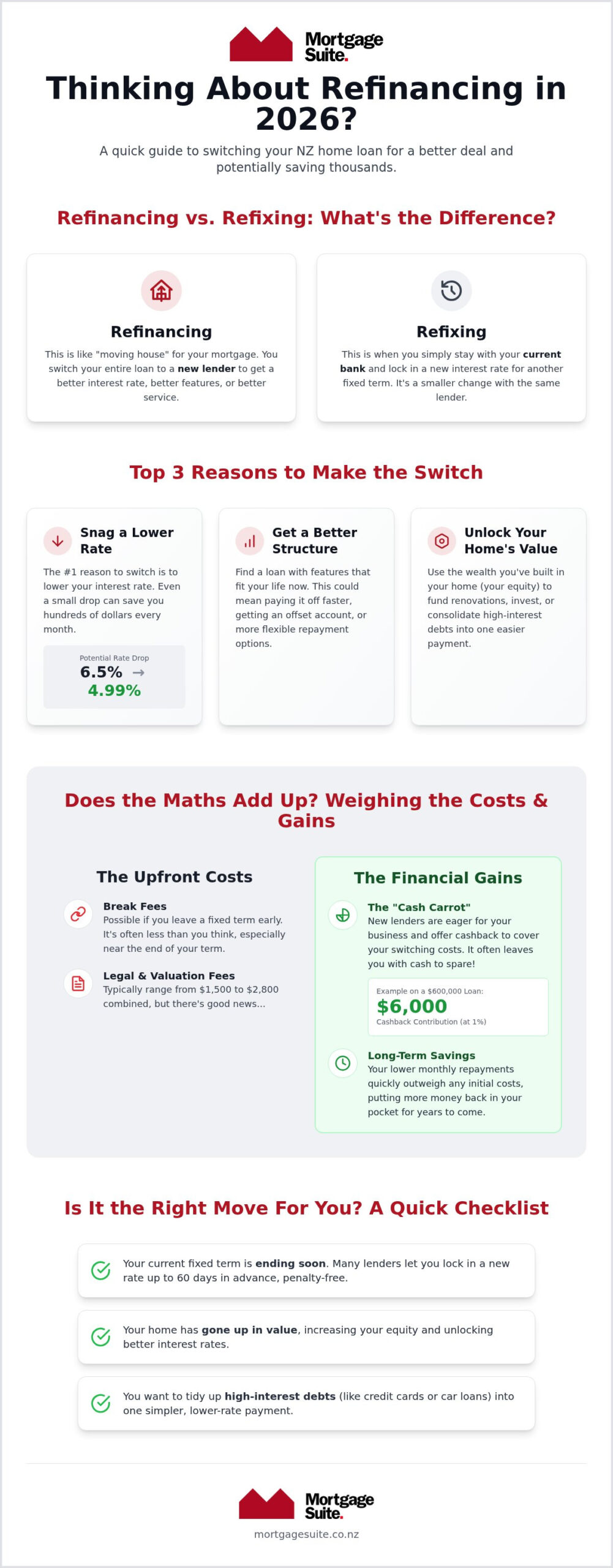
Don’t wait until the last minute to think about your next move. We recommend reviewing your current rate at least 60 days before it expires. This window gives us enough time to scan the market, compare new fixed rate mortgage options, and lock in a rate before they potentially climb higher. A quick “Home Loan Check-in” is a great way to see if your current loan structure still matches your lifestyle and your goals for the coming year. It’s a simple step that could save you thousands in the long run. Let’s have a chat about your mortgage strategy today and make sure your home loan is working as hard as you do.

Secure Your Financial Future Today

Choosing between a fixed rate mortgage and a floating one doesn’t have to be a gamble. By now, you’ve seen how a well-structured split loan can offer both the safety of a fixed rate and the flexibility to pay down debt faster. Whether you are leaning towards a short term fix to see where the market goes or a long term anchor for your budget, the right choice always aligns with your personal life goals rather than just bank forecasts.

With over 20 years of banking and brokerage experience, we are here to ensure you never feel processed or ignored. We specialise in finding solutions through 2nd tier and alternative lending for those who don’t fit the standard bank mould, providing nationwide service for all Kiwis. Don’t leave your biggest financial decision to an automated app. Book a free consultation with Mortgage Suite Ltd today to build a mortgage structure that truly fits your lifestyle. You’ve got this, and we’re ready to help you every step of the way.

Frequently Asked Questions

Is it better to fix for 1 year or 2 years right now?

The better choice between a one year or two year term depends entirely on whether you value immediate flexibility or a longer period of budget certainty. If you believe interest rates will drop soon, a one year fix allows you to re-evaluate your options earlier. However, if you prefer to set your budget and forget about it, a two year term often provides a better balance of security and value without the stress of frequent renewals.

What happens when my fixed rate term ends?

When your fixed term expires, your loan will automatically roll onto the bank’s floating interest rate. This floating rate is usually higher than most fixed options, so it is important to organise a new fixed term at least 60 days before your current one ends. We can help you compare the latest market offers to ensure you don’t end up paying more than you should by default.

Can I pay extra on a fixed rate mortgage?

Most banks allow you to make a limited amount of extra repayments on your fixed rate mortgage each year without penalty. This is often capped at a certain percentage of the loan balance or a specific dollar amount, such as $10,000. If you plan to pay off a large chunk of your debt quickly, keeping a portion of your loan on a floating rate is usually a much more flexible strategy.

What are break fees and how are they calculated?

Break fees are charges you pay to the bank if you end your fixed contract before the agreed date. They are calculated based on how much interest rates have changed since you first locked in your fixed rate mortgage and the bank’s potential loss. If current market rates are lower than your fixed rate, the bank will likely charge you a fee to cover the difference for the remainder of your term.

Can I change from a fixed to a floating rate mid-term?

You can certainly change from a fixed to a floating rate before your term is up, but it usually comes with a cost. Because you are breaking a legal contract with the bank, they will likely charge you a break fee. It is always worth asking for a quote first so you can decide if the flexibility of a floating rate outweighs the immediate expense of the penalty.

How much deposit do I need for a fixed rate mortgage in NZ?

In New Zealand, most lenders prefer a 20% deposit for a standard home loan, though some first home buyer programs allow for as little as 10%. The amount you need can also depend on whether you are buying an existing home or building a new one. Having a larger deposit generally gives you access to better interest rates and more choices when it comes to selecting a lender.

Will mortgage rates go down in 2026?

Predicting exactly if rates will drop in 2026 is tricky, as it depends on inflation and the Reserve Bank’s Official Cash Rate decisions. While some global markets have seen rates stabilise, the local outlook is always subject to change based on the wider economy. We focus on building a mortgage structure that you can afford comfortably today, rather than relying on guesses about what might happen tomorrow.

What is the “reserve rate agreement” ANZ and others talk about?

A reserve rate agreement is essentially a rate lock that guarantees your interest rate for a specific period, usually up to 60 days, before your loan actually settles. This protects you from any sudden rate hikes that might occur while your property purchase is being finalised. It provides a vital layer of security, ensuring the repayments you budgeted for are the ones you actually end up with.

Article by

Krish Krishna

Experienced Financial Adviser with over 46 years of Banking and Mortgage broking experience and over $2.0 Billion in loan settlements.

Debt to Income Ratio NZ: What the 2026 DTI Rules Mean for Your Mortgage

What if the size of your deposit isn’t actually the biggest hurdle to your next home loan anymore? It often feels like every time you get close to the finish line, the Reserve Bank shifts the goalposts; you’ve saved the deposit and found the house, only to worry that new regulations might stop you in your tracks. Understanding the debt to income ratio nz rules is now just as vital as having a solid credit score, especially as we navigate the 2026 property market.

We know how stressful it is to feel like your financial future is being decided by a complex spreadsheet. That’s why we’re here to clear up the confusion. You’ll learn exactly how these DTI limits affect your borrowing power and how to navigate them to secure your dream home or next investment. We’ll break down the specific maths behind the 6x and 7x thresholds, identify who qualifies for a “speed limit” exemption, and look at the path forward if your current bank says no. Whether you’re a first home buyer or a seasoned investor, there is always a way through the red tape when you have the right plan and a steady hand to guide you.

Key Takeaways

  • Get a clear grip on how the debt to income ratio nz measures what you owe against what you earn, and why it’s now a top priority for lenders.
  • Discover the specific 2026 borrowing limits for owner-occupiers and investors, so you know exactly where you stand before you start house hunting.
  • Learn about the “speed limit” and new build exemptions that could help you secure a loan even if you don’t fit the standard RBNZ box.
  • Find out how simple moves, like closing unused credit cards, can significantly improve your profile and increase your chances of a successful application.
  • Explore why a rejection from a big bank doesn’t have to be the end of the road, especially when looking at 2nd tier options that offer more flexibility.

What is the Debt to Income (DTI) ratio in NZ?

Think of the debt to income ratio nz as a financial health check that lenders use to see if you’re biting off more than you can chew. While we used to focus almost entirely on the size of your deposit, the rules have changed. Now, the banks are looking just as closely at the relationship between what you earn and what you owe. It isn’t just about your mortgage either. Lenders bundle in every bit of debt you have, from that credit card you keep for emergencies to the car loan you took out last year. If you’re curious about the global concept, you can read up on what the debt-to-income ratio is, but in the local context, it’s a strict guardrail designed to keep you and the economy safe.

In 2026, this ratio has become just as vital as your deposit size when you’re applying for a mortgage. It serves as a reality check for both you and the bank, making sure that your lifestyle isn’t entirely consumed by debt repayments. Living with a high ratio can be incredibly stressful, as it leaves very little room for error if your circumstances change. By understanding this number early on, you can take control of your financial story rather than letting the bank’s spreadsheet dictate your future. It’s about ensuring that you don’t end up taking on way too much debt, which can quickly turn the excitement of a new home into a constant worry about making ends meet.

The simple maths behind the ratio

Calculating this number is actually quite straightforward. To find your ratio, divide your total debt by your annual income before tax. For a practical example, let’s say your household brings in $100,000 a year before the taxman takes his share. If you’re looking to take on a $600,000 loan, your DTI would be 6. Banks prefer using your “gross” income, which is just the amount you earn before tax, because it provides a consistent starting point. It gives them a clear, standardised view of your total earning power before other expenses come into play.

Why the Reserve Bank brought these rules in

The Reserve Bank of New Zealand (RBNZ) introduced these limits to keep the housing market stable and prevent people from getting into too much hot water. By capping how much you can borrow relative to your income, they’re trying to stop the market from overheating and prevent people from getting in over their heads with repayments. These rules work alongside the existing Loan-to-Value (LVR) settings, which look at how much deposit you have. While LVR looks at your ownership stake, the DTI rules focus on your ability to actually live your life while paying back the debt. The ultimate goal is to make sure that even if interest rates wiggle or life throws you a surprise, you still have enough cash left over to keep the lights on and the fridge full. It’s about building a bit of a buffer so that a small change in your circumstances doesn’t become a massive financial headache.

The RBNZ rules: How much can you borrow in 2026?

The Reserve Bank doesn’t apply a one-size-fits-all approach to lending. Instead, they’ve set different benchmarks based on how you intend to use the property. If you’re looking for a place to call home, the standard debt to income ratio nz limit is 6. This means that for every dollar you earn before tax, the bank generally won’t let you borrow more than six dollars in total debt. It sounds strict, but it’s designed to ensure you aren’t stretched too thin when life happens.

For those looking to grow a portfolio, the rules are slightly more flexible. Investors generally have a DTI limit of 7. This extra wiggle room exists because rental income helps service the loan, providing a bit more security for the lender. However, even these limits aren’t set in stone. Banks have what we call “speed limits.” The Reserve Bank allows banks to allocate 20% of their new lending to borrowers who sit outside these standard ratios. If your case is strong, there’s still a chance to secure a “yes” even if the numbers are a bit tight.

Owner-occupier vs Investor limits

The gap between a DTI of 6 and 7 might seem small, but it makes a massive difference to your buying power. If you’re a first home buyer with a small deposit, you’ll likely need to stick closely to that 6x limit unless you qualify for a specific exemption. We’ve put together a quick guide to show how these limits translate into actual loan amounts based on your household income.

Gross Annual Income Max Loan (Owner-Occupier, DTI 6) Max Loan (Investor, DTI 7)
$120,000 $720,000 $840,000
$160,000 $960,000 $1,120,000
$200,000 $1,200,000 $1,400,000

What counts as “Debt” in the eyes of a lender?

This is where many people get caught out. When a bank calculates your ratio, they don’t just look at the mortgage you’re asking for. They include everything. Your student loan, that car finance from last year, and even personal loans are added to the pile. One of the biggest traps is credit card limits. Even if you have a zero balance, the bank counts the entire limit as potential debt because you could spend it tomorrow. “Buy Now, Pay Later” commitments are also under the microscope now. These small weekly payments can bloat your ratio and eat into your borrowing power faster than you’d think. If you’re worried about how your current setup looks, it’s a great idea to chat with a professional who can help you tidy things up before you apply.

Exemptions and speed limits: When the rules don’t apply

It’s easy to feel a bit overwhelmed when you hear about new lending restrictions, but here is a bit of a silver lining: the debt to income ratio nz rules aren’t a brick wall for everyone. In fact, the Reserve Bank has deliberately left some doors open to ensure the housing market keeps moving and that people can still get into homes. One of the most important things to realise is that these strict RBNZ regulations primarily apply to registered banks. If you are looking at non-bank lenders or 2nd tier options, you might find a lot more flexibility than you’d get at a traditional high-street branch because they don’t always have to play by the same rigid rulebook.

Specific types of lending are also carved out of the rules to help the country grow. For example, if you are planning to build a new home, you’ll often find that the DTI limits are much more relaxed. The government wants to encourage more housing supply, so they don’t want to penalise people who are adding to the total number of houses in NZ. Similarly, if you are just looking at moving your mortgage to another bank without borrowing any extra cash, you usually won’t have to go through a fresh DTI check. Even those temporary loans to cover the gap between houses, which help you manage the time between selling one place and buying another, are treated as a special case to keep the process as smooth as possible.

First Home Loan exemptions

If you’re just starting out, there is a massive advantage available through Kāinga Ora. Loans supported under the First Home Loan scheme are officially exempt from these DTI restrictions. This is a total game-changer for young Kiwis who might have a smaller deposit or are just starting to climb the career ladder. Because these loans are designed to help people get onto the property ladder, they focus more on your potential and your ability to meet repayments rather than a rigid multiple of your current salary. For a deeper look at how to navigate your first purchase, check out our Home Loans for First Home Buyers in New Zealand: The 2026 Comprehensive Guide.

The “Speed Limit” loophole

Even for standard bank loans, there’s a bit of a safety valve known as the “speed limit.” The Reserve Bank allows banks to give 20% of their new mortgage money to people who sit outside the standard 6x or 7x limits discussed earlier. This is where having a professional in your corner really pays off. A mortgage broker knows how to present your case so you’re seen as a high-quality borrower who deserves to be part of that lucky 20%. Lenders don’t just look at the raw numbers; they look at your overall financial character, your spending habits, and your career path. If you’ve got a clean record and a solid plan, we can often help you find a way through the red tape.

Debt to Income Ratio NZ: What the 2026 DTI Rules Mean for Your Mortgage

How to tidy up your finances before you apply

If you’ve crunched the numbers and your debt to income ratio nz looks a bit higher than you’d like, don’t throw in the towel just yet. We see this all the time. The good news is that your current ratio isn’t a permanent mark; it is just a snapshot of where you are today. With a bit of a tidy-up and some smart moves, you can often shift those numbers into a much better position before you even sit down with a lender. It is all about presenting the cleanest possible version of your financial life to the bank.

One of the most effective ways to lower your ratio is by putting all your small, high-interest debts into one manageable payment. Those little store cards and personal loans might not seem like much on their own, but they add up quickly when a bank is looking at your profile. By combining these, you simplify your outgoings and show that you have a disciplined grip on your money. It is also worth looking at your income from a fresh perspective. Improving your ratio isn’t only about cutting what you owe; it’s also about making sure the bank sees every cent you earn. Once you’ve tidied up your debt profile, you’ll also want to think carefully about your loan structure — understanding whether a fixed rate mortgage or a floating rate suits your situation can make a significant difference to your monthly repayments and overall financial comfort.

The “Credit Card Cleanse”

Lenders don’t just care about what you’ve spent; they care about what you could spend. If you have a credit card with a $10,000 limit sitting in your drawer, the bank treats that as $10,000 of potential debt, even if you haven’t spent a cent. They have to assume you might go out and max it out tomorrow. Dropping that limit or closing the account entirely can give your borrowing power a massive boost. We usually recommend doing this at least three months before you apply. This gives the credit reporting systems plenty of time to update and ensures the bank sees a nice, clean slate when they run their checks.

Boosting your income figure

When we talk about income, we’re looking at more than just your base salary. If you’ve been consistently earning overtime, bonuses, or commissions, we can often work with the bank to include these in your total figure. For those looking to grow their portfolio, the bank will also factor in the potential rental income from the property you’re buying. You can see how these numbers stack up by using our Investment Property Mortgage Calculator NZ. Don’t forget about boarder income either. If you plan to have a flatmate in your new home, many lenders will let us add a portion of that expected rent to your total income, which can make a huge difference to your final ratio. If you’re unsure which debts to tackle first or how to best show off your income, reach out to our team for a bit of a strategy session.

How Mortgage Suite Ltd navigates the DTI maze for you

We reckon that getting a “no” from a main bank is often just the start of the conversation, not the final word. It’s easy to feel like the goalposts have moved permanently when you’re faced with the current debt to income ratio nz rules. However, our job at Mortgage Suite Ltd is to act as your dedicated negotiator, looking past the rigid spreadsheets of institutional banking to find a path that works for your unique situation. We don’t just see a ratio; we see your potential and your hard work.

With over two decades of industry experience, our founder Krish Krishna has seen every market cycle and regulatory shift imaginable. This deep institutional knowledge means we don’t just guess which lenders might say yes. We know exactly how to present your case to the right people. We take the weight off your shoulders by handling the complex discussions with lenders, ensuring your application highlights your financial strengths and addresses any debt concerns head-on. We focus on building a partnership with you, making sure you feel supported rather than just processed by a system.

Beyond the Big Four: The power of 2nd Tier lending

One of the biggest advantages of working with our team is our access to 2nd tier loans. These non-bank lenders are often more flexible because they don’t always have to follow the same RBNZ bank rules that restrict the major players. If your DTI ratio is a bit high for a traditional bank, an alternative lender might be the perfect solution. We often use these loans as a strategic “stepping stone.” They get you into your dream home or investment property now, and as your equity grows or your income increases, we can help you transition back to a traditional mortgage later. We take the time to match your unique profile to the lender that offers the best fit for your long-term goals.

Expert negotiation for complex cases

With 20 years in the game, we know which lenders are currently under their DTI speed limits and are looking for quality borrowers. This isn’t just about filling out forms; it’s about expert packaging. We know how to frame your application to mitigate concerns about existing debt while shining a light on your career trajectory and overall stability. Our goal is to take the anxiety out of the process, giving you the confidence to focus on finding the right property while we handle the red tape. When you partner with Mortgage Suite Ltd, you’re not just getting a loan; you’re getting a steady hand to guide you through a fluctuating market. We’re committed to removing the obstacles that stand between you and your dream home.

Securing your future in a changing market

The 2026 lending landscape might feel more restrictive, but it is certainly not impossible to navigate. While the debt to income ratio nz rules have changed how banks view your borrowing power, you now have a clear roadmap to move forward. By tidying up your existing debts and understanding how to maximise your gross income, you put yourself in the best possible position for a “yes”. Remember, the big banks are only one part of the story; flexibility often lies with alternative lenders who value your overall potential.

With over 20 years of banking and brokerage experience, we specialise in finding those 2nd tier and non-bank solutions that mainstream lenders might miss. We provide national coverage across all of New Zealand, ensuring that no matter where you are looking to buy, you have a steady hand to guide you. If you’re ready to take the next step without the stress of rigid spreadsheets, we’re here to help. Book a chat with our expert team today to see how we can help you beat the DTI blues. Your dream home is still within reach; you just need the right plan to get there.

Common Questions About the 2026 DTI Rules

Does the DTI ratio apply to new builds in 2026?

No, construction loans for new builds are officially exempt from the RBNZ’s DTI restrictions. This is a deliberate move by the government to encourage more housing supply across New Zealand. If you’re building from scratch or buying a home off the plans, you won’t have to worry about the standard 6x or 7x limits. This gives you significantly more flexibility when planning your project and choosing your finishes.

Will my student loan affect my debt to income ratio?

Yes, your student loan is absolutely included when the bank calculates your debt to income ratio nz. Lenders look at your total debt obligations, which includes student loans, car finance, and personal loans. Even though your repayments are automatically deducted from your pay, the total balance still sits on the “debt” side of the ledger. It’s a good idea to factor this in early when working out your borrowing power.

Can I get a mortgage if my DTI is over 6?

Yes, you can still secure a mortgage even if your ratio sits above the standard limit of 6 for owner-occupiers. Banks are allowed a “speed limit” where 20% of their new lending can go to borrowers with higher ratios. Alternatively, we can look at 2nd tier lenders who don’t have to follow these specific Reserve Bank rules. This provides a clear path forward even when a big bank’s spreadsheet says no.

Do non-bank lenders have to follow the RBNZ DTI rules?

No, the Reserve Bank’s DTI restrictions primarily apply to registered banks. Non-bank or 2nd tier lenders often have their own internal criteria and aren’t bound by the same 6x or 7x caps. This makes them an excellent option if your income doesn’t quite stretch far enough for a traditional bank’s requirements but you have a solid plan and the ability to manage your repayments comfortably.

How is rental income counted towards my DTI ratio?

Rental income is added to your total gross annual income, though banks usually “shade” it by about 20% to account for vacancies and maintenance costs. This boosted income figure is what allows investors to have a higher debt to income ratio nz limit of 7. It’s a vital part of the calculation that helps reflect the true servicing power of an investment property and your ability to grow a portfolio.

What is the difference between DTI and LVR?

While they work together, they measure two different things. LVR (Loan-to-Value Ratio) looks at the size of your deposit compared to the property’s value. DTI (Debt-to-Income) looks at your total debt compared to what you earn before tax. Think of LVR as your “entry ticket” to get the loan and DTI as the bank’s way of checking you have enough left over each month to live your life.

Can I use boarder income to improve my DTI ratio?

Yes, many lenders will let us include a portion of your expected boarder income to boost your total earnings figure. This can be a real lifesaver for first home buyers trying to stay under the 6x limit. We’ll just need to show the bank that the property has enough space and that the income is realistic for your area. It’s a simple way to make the numbers work in your favour.

What happens to my DTI if interest rates go up?

Your actual DTI ratio won’t change just because interest rates move, as it’s based on the total debt amount rather than the interest cost. However, the bank’s “test rates” usually get tougher when market rates rise. This means that while you might technically fit the DTI box, the bank will look even closer at your ability to manage higher weekly repayments. Choosing the right loan structure — for example, deciding between a fixed rate mortgage versus a floating rate — becomes especially important in this environment, as locking in a rate can provide certainty around your repayments. It’s all about ensuring you have a safe financial buffer.

Article by

Krish Krishna

Experienced Financial Adviser with over 46 years of Banking and Mortgage broking experience and over $2.0 Billion in loan settlements.

Home Loans for Self Employed: 2026 Guide to Getting Approved

Imagine sitting across from a bank manager, presenting a thriving business you have built from the ground up, only to be told your "paper income" isn’t enough to buy a house. It is incredibly disheartening when mainstream lenders ignore your legitimate business add-backs or penalise you for the very expenses your accountant organised to reduce your tax bill. If you are searching for a home loan and are self employed, you have likely realised that traditional banks often view your entrepreneurial drive as a risk. They see inconsistent income "bursts" and mountains of paperwork, while we see a dedicated professional who deserves a steady hand to guide them through the finance process.

This 2026 guide provides the clear path to pre-approval you need, even with the Official Cash Rate at 2.25% and debt-to-income ratios capped at six times your earnings. You will learn exactly how to bypass rigid bank criteria by exploring non-bank lenders who offer flexible "alt-doc" solutions using GST returns or business bank statements. We will detail how to secure competitive interest rates and navigate the latest LVR restrictions, ensuring your business structure is properly understood so you can move forward with confidence.

Key Takeaways

  • Understand how lenders apply “safety margins” to your income and how to navigate the 2026 Debt-to-Income (DTI) restrictions.
  • Discover the documentation hierarchy and why alternative “Alt-Doc” methods like GST returns might be the key to proving your true earning power.
  • Learn why 2nd Tier lenders are a strategic choice for a self employed home loan nz rather than a last resort when mainstream banks decline your application.
  • Master a simple “pre-audit” process to organise your business drawings and personal expenses for maximum lender appeal.
  • Explore how professional advocacy and veteran negotiation can translate your complex business structure into a clear path for approval.

Table of Contents

The Reality of Self-Employed Home Loans

For many business owners, the dream of home ownership feels like it is being held hostage by a spreadsheet. Getting a **self employed home loan ** in 2026 requires more than just a profitable business; it requires a deep understanding of how lenders interpret your financial health. While an employee with a standard salary provides a predictable data point for a bank, your income is often viewed through a lens of skepticism. Mainstream banks are currently operating with a conservative risk appetite, and they often struggle to reconcile the fluctuations of a growing business with their rigid lending criteria.

The lending environment in mid-2026 is heavily influenced by the Debt-to-Income (DTI) restrictions that became a permanent fixture in recent years. For owner-occupiers, the limit is generally six times your gross annual income, while investors are capped at seven times. When defining self-employment for a loan application, the bank does not just look at your turnover. They look at your drawings, your net profit, and your ability to service debt when the Official Cash Rate (OCR) is at 2.25%. If your income arrives in "bursts" rather than a steady drip, a traditional bank might simply put you in the "too hard" basket. However, being declined by a major bank is rarely the end of the road; it is often just the signal that you need a more sophisticated lending partner.

Understanding Your Income

Banks are notoriously cautious with business owners.

To overcome this, we focus on "add-backs." These are legitimate business expenses that don’t actually impact your ability to pay a mortgage, such as:

  • One-off capital purchases or equipment upgrades.

  • Non-cash expenses like depreciation.

  • Excessive home office claims or personal expenses run through the business.

  • Rent or interest payments that will cease once you buy your own property.

Regulatory Changes and DTI Ratios in 2026

The 2026 regulatory framework treats business debt and personal debt with equal scrutiny. Under the current Credit Contracts and Consumer Finance Act (CCCFA) requirements, lenders must be certain that your business debt—such as vehicle finance or an overdraft—does not compromise your home loan repayments. If your business carries significant debt, it can quickly eat into your DTI allowance, making it harder to reach the 80% LVR threshold required for standard owner-occupier loans. We work with you to clean up your debt profile, ensuring your personal and business liabilities are structured to maximise your approval chances without sacrificing your business’s cash flow.

Proving Your Income: Documentation That Actually Works

Securing a self employed home loan requires a strategic approach to your paperwork. While an employee simply hands over three months of payslips, your application must build a narrative of stability and growth. Many business owners find that their IRD Summary of Earnings tells a story of tax efficiency rather than true mortgage affordability. To bridge this gap, we look beyond the basic tax return to find the documents that reflect your business’s actual momentum.

The hierarchy of proof has shifted significantly in 2026. Traditional "Low-Doc" loans, which once required minimal evidence, have largely been replaced by "Alt-Doc" (alternative documentation) solutions. This is a direct result of the Credit Contracts and Consumer Finance Act (CCCFA), which mandates a robust assessment of affordability. If you have two years of clean financial accounts, you’ll likely qualify for "Full-Doc" rates. However, if your business has recently scaled or you have "bursty" income from project-based contracts, Alt-Doc allows us to use more recent data, such as GST returns, to prove you can comfortably service the debt.

The Essential Self-Employed Paperwork Checklist

Lenders want to see that your business is a reliable vehicle for income. Before submitting an application, ensure you have the following documents organised:

  • Financial Statements: Full Profit & Loss and Balance Sheets for the last two financial years.

  • Bank Statements: Six months of personal and business statements. Lenders look for regular drawings that match your stated income.

  • Tax Verification: Your most recent personal and business tax assessments, along with proof that all IRD obligations are being met.

  • Add-back Schedule: A clear list of non-cash or one-off expenses that shouldn’t count against your borrowing power.

If your business income is seasonal, we frame your application by showing a 12-month average rather than focusing on a quiet month. This context is vital for preventing a "decline" based on a temporary dip in cash flow. If you are unsure which documents best represent your current position, exploring tailored home loan options can help clarify your strategy before you approach a lender.

Alt-Doc Solutions for Newer Businesses

For those who have been trading for 12 to 18 months, or whose most recent tax return doesn’t reflect a recent surge in turnover, Alt-Doc is a game changer. Instead of waiting for the next financial year to end, some specialist lenders will accept an accountant’s declaration of your earnings or use your last six months of GST returns to verify your current capacity. This approach focuses on where your business is today, not where it was two years ago, providing a vital pathway for self employed home loan applicants who are currently in a high-growth phase.

Many business owners view 2nd tier lenders with a sense of hesitation, fearing they are only for those with significant financial trouble. This is a misconception that often prevents entrepreneurs from securing a self employed home loan when they are perfectly capable of servicing a mortgage. In the current 2026 market, non-bank lenders like Avanti Finance or Pepper Money act as sophisticated specialists. They fill the gap left by mainstream banks that rely on rigid automated systems. While a bank might see a complex trust structure or a single year of trading as a red flag, a 2nd tier lender employs human underwriters who look at the bigger picture.

The primary trade-off involves cost. Non-bank "Near Prime" rates typically start around 5.65% to 7.35%, which is higher than the special rates offered by ANZ or Westpac. You should also expect higher establishment fees, often ranging between 1% to 1.5% of the loan value. However, for a business owner, the value lies in the approval probability. These lenders aren’t bound by the Reserve Bank’s strict Debt-to-Income (DTI) thresholds in the same way as registered banks. This flexibility allows us to secure a **self employed home loan **for clients who have the cash flow but don’t fit the traditional "box."

When to Choose a Non-Bank Lender

Choosing a non-bank option is often the most strategic move if your business has undergone a recent transition. If you have moved from a sole trader to a company structure, or if a one-off capital investment skewed your net profit last year, traditional bank software will likely trigger an automatic decline. Specialist lenders are far more accommodating of short trading histories, sometimes considering applications with as little as 6 to 12 months of data if you have a strong industry background. They specialise in "Alt-Doc" solutions, allowing us to use recent GST returns to prove your current earning capacity rather than relying on outdated tax returns.

The Long-Term Strategy: Refinancing Back to a Bank

We often treat a 2nd tier loan as a temporary bridge rather than a forever home for your mortgage. By securing a loan now and maintaining a clean repayment history for 12 to 24 months, you "prime" yourself for a future bank application. This period allows your business to mature on paper and demonstrates your reliability as a borrower. Understanding how to qualify for a home loan in NZ involves planning this exit strategy from the start. Once your financial statements show two years of solid growth, we can assist you in refinancing back to a mainstream bank at a lower interest rate, having already secured the property you wanted.

Home Loans for Self Employed: 2026 Guide to Getting Approved

A Step-by-Step Guide to Polishing Your Mortgage Application

Successful lending outcomes are rarely the result of luck. They are the product of a disciplined staging process that begins months before you even attend an open home. When you apply for a self employed home loan, the bank isn’t just looking for profitability; they are searching for evidence of financial discipline. Think of your application like a house you are preparing for sale. You need to declutter the noise, fix the small leaks in your spending, and highlight the structural strengths of your business.

The first step is a rigorous pre-audit. Scour your business accounts for personal expenses that might look like high living costs to a lender. Second, ensure your drawings are regular. A bank prefers to see $1,500 transferred every week rather than a $20,000 lump sum once a quarter. Third, slash your credit limits. In the 2026 DTI environment, an unused $10,000 credit card or an active Buy Now, Pay Later (BNPL) account can reduce your borrowing power by tens of thousands of dollars. Finally, prepare a formal business commentary and engage a specialist who understands the nuances of business structures.

Framing Your Business Narrative

Lenders hate mystery. If your profit dipped recently because you invested in a new fleet of vehicles or a high-end server array, you must tell them. A written explanation transforms a "loss" on paper into a strategic investment in future growth. Highlight recurring revenue models or long-term contracts that prove your income isn’t just a series of lucky breaks. If you are a contractor in a niche field like IT or engineering, including a professional CV helps the underwriter understand your employability if your current contract ends. This narrative provides the context that raw numbers often lack.

Cleaning Up Your Personal Financial Conduct

You must adhere to the "three-month rule" of flawless account behaviour. Under the CCCFA, any unarranged overdraft or missed payment on a utility bill is a massive red flag. Banks interpret these as a lack of financial control, regardless of how much money is sitting in your business account. You also need a clear "deposit story." Be ready to prove exactly where your savings came from to satisfy Anti-Money Laundering (AML) requirements. If your deposit includes a gift from family or a business dividend, document the paper trail early. To ensure your application is truly bank-ready, you can apply for a home loan assessment to identify any potential hurdles before they become problems.

Why Mortgage Suite is Your Best Advocate for Approval

When you work for yourself, you don’t just need a loan; you need a dedicated negotiator who understands the intricacies of your business. Securing a **self employed home loan ** is often a battle of interpretation. It’s about how your depreciation is viewed, how your "bursty" income is averaged, and how your future potential is weighed against historical tax returns. We provide the steady hand and the institutional knowledge required to bridge the gap between your entrepreneurial success and the rigid requirements of a bank’s credit department.

We work with the mainstream banks in the first instance but our reach extends beyond the big four banks. We provide access to a comprehensive range of 2nd tier and alternative capital, allowing us to find solutions even when traditional lenders have said no. Our partnership approach includes:

  • Access to residential investment property loans and business finance.

  • Strategic planning to move from 2nd tier loans back to mainstream banks.

  • Proactive management of commercial and property development loans.

  • Expert structuring for first-home buyers with non-standard income.

The Advantage of a Seasoned Negotiator

Krish Krishna brings over 20 years of banking experience and 26 years as Financial Adviser to your side of the table. This isn’t about simply submitting a form; it’s about expert negotiation. Krish uses his deep understanding of credit policy to challenge rejections and present your financial story in a way that resonates with underwriters. We specialise in structuring complex deals that mainstream banks often overlook, ensuring your business structure is viewed as a strength rather than a liability. You aren’t just another file to us; you are a partner whose success is our priority.

We understand that as a business owner, your time is your most valuable asset. By utilising our veteran expertise, you gain an advocate who knows exactly which "add-backs" to fight for and which lenders have the highest risk appetite for your specific industry. This high-standard service is designed to remove obstacles and create a seamless bridge to your property goals.

Ready to Get Moving?

We simplify the process so you can stay focused on running your business. Instead of you spending hours chasing paperwork and deciphering banking jargon, we handle the heavy lifting. The first steps involve a consultative conversation where we identify your needs and outline a clear path to pre-approval. There is no need to feel overwhelmed by the volume of paperwork when you have a veteran expert managing the details. Enquire about your self-employed home loan today and take the first step toward a successful approval.

Your Path to Home Ownership Starts Here

Securing a self employed home loan in 2026 doesn’t have to be a source of constant anxiety. While the DTI restrictions and rigid bank criteria create hurdles, they are far from insurmountable when you have the right documentation and a strategic narrative to tackle the mainstream banks. Whether you are using Alt-Doc solutions to prove your recent momentum or utilising a 2nd tier lender as a tactical stepping stone, the goal remains the same: securing a home that reflects your hard work.

At Mortgage Suite, we leverage over two decades of banking and lending expertise to ensure your business structure is understood, not just processed. If you dont fit the mainstream banks lending criteris, we specialise in 2nd tier loans that mainstream banks often decline, providing a tailored, NZ-wide service for business owners and contractors alike. You have built your business with passion and discipline; we are here to apply that same dedication to your mortgage approval.

If you are ready to move past the frustration of bank rejections, book a consultation with our self-employed lending specialists today. Let us turn your complex financial profile into a clear path forward. Your entrepreneurial journey deserves a partner who values your vision as much as you do.

Frequently Asked Questions

Can I get a home loan if I’ve only been self-employed for one year?

Yes, you can secure a home loan with only one year of trading, though you will likely need to look beyond the major banks. While traditional lenders typically require two years of financial statements, many specialist lenders offer "Alt-Doc" solutions for those with 12 months of history. These lenders focus on your recent GST returns and industry background to assess your current earning capacity properly.

How much deposit do I need as a self-employed borrower in NZ?

Most self-employed borrowers need a 20% deposit for an owner-occupied property or 30% for an investment. If you are a first-home buyer, you may qualify for the Kāinga Ora First Home Loan, which allows for a deposit as low as 5%. Having a larger deposit often helps offset the perceived risk of variable income and can lead to more competitive interest rates from mainstream lenders.

Will my interest rate be higher because I work for myself?

Your interest rate won’t necessarily be higher if you meet the standard lending criteria of a mainstream bank. However, if you require a specialist or 2nd tier lender due to a short trading history or complex accounts, you should expect a margin above standard bank rates. These "Near Prime" rates often start from 5.85% and serve as a strategic bridge until you can refinance to a major bank.

What are "add-backs" and how do they help my mortgage application?

Add-backs are legitimate business expenses that we "add back" to your net profit to demonstrate your true mortgage repayment capacity. Common examples include depreciation, one-off equipment purchases, or interest on loans that will be repaid. By identifying these non-cash or non-recurring costs, we can significantly increase the income figure used for your **self employed home loan **application and improve your approval chances.

Can I use my KiwiSaver for a deposit if I am self-employed?

Yes, you can certainly use your KiwiSaver for a deposit, provided you have been a member for at least three years and are purchasing your first home. Being self-employed does not change your eligibility for a first-home withdrawal. It is essential to request your withdrawal pack early to ensure the funds are ready for settlement, especially if your business income fluctuates and documentation takes longer to organise.

What happens if my latest tax return shows a low profit due to expenses?

If your latest tax return shows a low profit due to high business expenses, we can often use alternative documentation to prove your actual income. Specialist lenders may look at your last six months of GST returns or bank statements to see your current cash flow. This approach helps bypass the "paper loss" created by tax-minimisation strategies, allowing your true earning power to be recognised by the lender.

Do I need a clean credit history to get a self-employed home loan?

You don’t necessarily need a perfect credit history to get approved for a self employed home loan. While mainstream banks are very strict about missed payments or defaults, 2nd tier lenders are more flexible and will often listen to the story behind a credit impairment. A clean record for the last 12 months is usually sufficient to access a wide range of alternative lending options that banks often overlook.

How do DTI ratios affect my ability to borrow for a home?

Debt-to-Income (DTI) ratios limit your total borrowing to a multiple of your gross annual income, typically set at six times for owner-occupiers. For business owners, this means your personal and business debts are weighed against your verified drawings and profit. If your DTI is too high for a major bank, we can often find non-bank solutions that aren’t bound by these specific Reserve Bank restrictions in 2026.

Article by

Krish Krishna

Experienced Financial Adviser with over 46 years of Banking and Mortgage broking experience and over $2.0 Billion in loan settlements.

The Ultimate First Home Buyer Guide for New Zealanders in 2026

What if the biggest barrier to your first home isn’t actually the size of your deposit, but the rigid "yes or no" box of a mainstream bank? With the average New Zealand house price reaching NZ$912,406 in early 2026, it’s easy to feel like the goalposts are constantly shifting. This first home buyer guide New Zealand is designed to help you cut through that uncertainty and regain control of your property journey. You likely feel the pressure of rising interest rates and the confusion surrounding KiwiSaver withdrawal rules, especially since the First Home Grant was abolished in 2024.

We understand that the path to homeownership often feels more like a maze than a straight line. We promise to provide a clear, strategy-led roadmap that moves you from the initial savings phase to the moment you turn the key in your front door. You’ll discover how to navigate the latest debt-to-income restrictions, explore alternative lending options when the big banks decline your application, and gain the expert insights needed to bid at auction with absolute confidence. Let’s turn your homeownership goals into a practical, achievable reality through professional advocacy and seasoned expertise.

Key Takeaways

  • Master your financial foundation by understanding debt-to-income ratios and the precise timing required for a successful KiwiSaver first-home withdrawal.
  • Gain the confidence to explore 2nd tier loans and alternative lending options if your application doesn’t fit the rigid requirements of mainstream banks.
  • Use this first home buyer guide New Zealand to assemble a dedicated team of experts, including solicitors and lending specialists, who advocate for your success.
  • Navigate high-pressure auctions and the offer process with a clear strategy, including how to determine your maximum walk-away price before the bidding starts.
  • Protect your investment beyond settlement by learning how to conduct a thorough pre-move inspection and structure your loan for long-term stability.

Table of Contents

Organising Your Finances: The Foundation of Your First Home

Before you start scrolling through property listings, you need a crystal-clear picture of your financial standing. The state of the New Zealand housing market in 2026 requires a more strategic approach than simply "saving a bit extra" each month. Lenders today look closely at your debt-to-income (DTI) ratio, which became a formal restriction in July 2024. This calculation compares your total debt to your gross income, and staying within these limits is just as vital as your deposit size. This first home buyer guide New Zealand helps you understand that a healthy credit score is your most valuable asset, so pay down high-interest short-term debts like car loans or buy-now-pay-later accounts before applying.

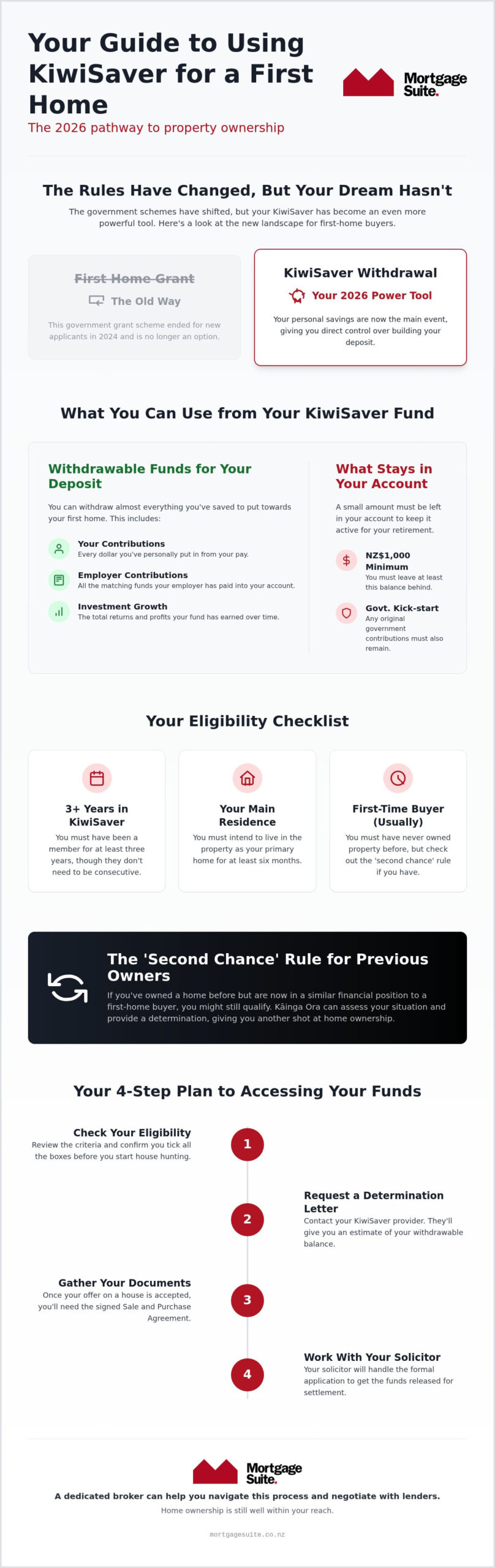
Your KiwiSaver is likely the engine room of your deposit. To make a withdrawal, you must have been a member for at least three years and intend to live in the property as your primary residence. You’ll need to leave a minimum of NZ$1,000 in your account. Timing is everything here; you should apply for your withdrawal early in the process so the funds are ready for the deposit payment upon going unconditional. While the First Home Grant was abolished in May 2024, the Kāinga Ora First Home Loan remains a powerful tool, allowing eligible buyers with specific income caps to purchase with just a 5% deposit.

If a mainstream bank says "no," don’t assume your homeownership dreams are over. Big banks often have rigid criteria that don’t account for self-employed income or slightly lower deposits. In many cases, a 2nd tier loan or alternative lending option can provide the bridge you need. These lenders often look at the bigger picture of your financial health rather than just ticking a box, making them a viable path for those who don’t fit the traditional banking mould.

Maximising Your Deposit Beyond Savings

Building a deposit often involves a "patchwork" strategy. You might combine your KiwiSaver withdrawal with a gifted deposit from family and your personal savings. It’s essential to budget for more than just the purchase price. You’ll need a "buffer" of at least NZ$5,000 to NZ$10,000 to cover legal fees, building inspections, and registered valuations. Serviceability is the lender’s assessment of whether your income can handle mortgage repayments if interest rates were to rise to a "stress test" level of 8% or 9%.

Getting Pre-Approved: Your Golden Ticket

Pre-approval gives you the confidence to make an offer the moment you find the right place. It typically lasts for 90 days, though it can be revoked if your financial circumstances change significantly, such as losing your job or taking on new debt. In New Zealand, most lenders perform a "hard" credit check during this stage, which leaves a footprint on your credit report. Having this "golden ticket" in hand shows vendors you’re a serious, qualified buyer who is ready to act.

Assembling Your A-Team: Why Expert Advocacy Matters

Surrounding yourself with the right professionals is the difference between a stressful ordeal and a smooth transition into your new home. While many resources offer a step-by-step guide to buying a home, they often miss the vital synergy between your experts. Think of your lending specialist as the conductor of an orchestra; they ensure your finance, legal, and insurance requirements all hit the right notes at the right time. This first home buyer guide New Zealand emphasises that your team should be advocates for your success, not just service providers ticking boxes.

You also need to consult your insurer before you sign a sale and purchase agreement. Banks won’t release funds without proof of insurance, and in a market where some older homes or those in high-risk zones face coverage challenges, getting an early "yes" from an insurer is non-negotiable. Similarly, a building inspector’s report is your best defence against structural failures. While a cheap, surface-level report might save you a few hundred dollars today, a comprehensive inspection can save you tens of thousands in future repairs. Trusting a veteran professional to crawl through the subfloor and check the roof cavity is an investment in your peace of mind.

Mainstream Banks vs. 2nd Tier Lenders

The "Big Four" banks have strict appetites that don’t always cater to the modern Kiwi worker. If you’re self-employed, have a smaller deposit, or possess a unique credit history, alternative lenders provide a fair go that mainstream institutions might decline. Many buyers worry that 2nd tier options are prohibitively expensive, but the interest rate gap is often smaller than you’d expect. These loans offer a pathway to homeownership when traditional doors are closed, providing a flexible solution tailored to your specific life scenario. If you’ve felt discouraged by a bank’s rejection, exploring tailored home loans could be your next logical step.

The Solicitor and the Fine Print

Your solicitor is your primary legal shield. They must review the Sale and Purchase Agreement before you put pen to paper, ensuring you aren’t caught out by restrictive clauses. Beyond the contract, they’ll help you understand the differences between freehold, cross-lease, and unit titles, which each carry different rights and responsibilities. A solicitor must meticulously check the "Title" of the property to ensure there are no hidden easements, land claims, or encumbrances that could restrict how you use your land. Their expertise prevents expensive legal headaches down the track, making them an indispensable part of your property journey.

The Property Hunt: Navigating Open Homes and Due Diligence

Walking into an open home is an emotional experience, but you must remain a clinical observer to protect your future. It’s easy to fall in love with a designer kitchen while overlooking a sagging roofline or a damp smell in the bedrooms. This first home buyer guide New Zealand recommends creating a strict "Must-Have" versus "Nice-to-Have" list before you step onto a single driveway. Your must-haves should focus on structural integrity, location, and the number of bedrooms, while cosmetics like carpet colour or light fittings stay firmly in the "nice-to-have" category. Staying focused prevents you from overpaying for a property that doesn’t actually meet your long-term needs.

The "sniff test" is your first line of defence during a walk-through. Pay close attention to fresh patches of paint that might hide mould, or a musty scent that suggests poor ventilation. Beyond the physical structure, remember that your bank is just as interested in the property type as they are in your income. Banks view the house as security for their loan. If a property is a "leaky" era build or located in a known flood zone, they may refuse to lend against it, regardless of how much you earn. Understanding the Land Information Memorandum (LIM) report is vital here, as it details everything the council knows about the land, including drainage issues and building permits.

For a deeper look into the technicalities of the process, the New Zealand government’s guide to buying a home provides an excellent framework for what to expect. However, a generic guide can’t replace the sharp eye of a seasoned professional who knows how to spot a "lemon" before you spend thousands on a full building report.

Due Diligence: Protecting Your Investment

A builders report is your most critical tool for uncovering "deal-breakers" like structural rot or unconsented additions. While toxicology and meth testing remain relevant in 2026 for peace of mind, the focus has shifted toward checking council files for unauthorised works. If a previous owner added a deck or converted a garage without consent, you could be liable for the costs of bringing it up to code or removing it entirely. Always verify that every structure on the site matches the official council records.

Property Types and Lending Restrictions

Lending rules vary significantly depending on the asset type. Apartments under 40 or 50 square metres often require a much higher deposit, sometimes up to 50%, because banks view them as higher risk. Tiny homes and off-the-plan purchases also come with unique challenges; off-the-plan buyers must be wary of sunset clauses and the risk of the property’s value dropping before completion. A lending specialist can help you vet a property’s "bankability" early, ensuring you don’t waste time on a home you can’t actually finance.

The Ultimate First Home Buyer Guide for New Zealanders in 2026

Sealing the Deal: Offers, Auctions, and Negotiations

The moment you decide to put pen to paper is when the property journey truly intensifies. It’s a high-stakes environment where emotions can cloud judgement, making it essential to have a firm strategy in place. This first home buyer guide New Zealand helps you manage these final hurdles with the poise of a seasoned investor. Your first step is to determine a maximum "walk-away" price. This is the absolute limit of what you are willing, or able, to pay. Having this figure written down prevents you from being swept up in the heat of a negotiation or the adrenaline of an auction room.

Once your price is set, you must choose between a conditional or unconditional offer strategy. A conditional offer allows you time to finalise finance or review a building report, while an unconditional offer is often more attractive to vendors because it provides certainty. If you find yourself in a multi-offer situation, remember that you usually only get one chance to put your best foot forward. There is usually no back-and-forth; you submit your highest price and best terms, then wait for the vendor to choose. Signing the agreement is just the beginning; you only reach "unconditional" status once all your specific conditions are met and confirmed in writing by your solicitor.

The Art of the Negotiation

Negotiation isn’t just about the purchase price; it’s about the entire package. If your building inspector uncovered minor issues in the previous stage of your due diligence, use those findings to justify a lower offer or request that the vendor fixes the faults before settlement. You can also use the settlement date as a bargaining chip; a vendor who has already bought another home might value a quick move-in date over a slightly higher price. For those looking at new builds, a sunset clause is a vital protection that allows either the buyer or the developer to cancel the contract if the project isn’t completed by a specific date. To ensure your offer is backed by a solid financial strategy, contact our expert lending team for professional guidance.

Winning at Auction

Auctions are inherently unconditional, so your due diligence and finance must be 100% sorted before the hammer falls. When bidding, maintain a "poker face" to keep your competitors guessing about your remaining budget. If the property is "passed in" because it didn’t meet the reserve, the highest bidder usually gets the first right to negotiate with the vendor. Ensure your deposit funds, typically 10% of the purchase price, are ready for immediate payment via electronic transfer the moment the contract is signed. This level of preparation ensures you remain in control, even in the most fast-paced environments.

Settlement and Beyond: Your Long-Term Financial Health

The journey to homeownership doesn’t end when the hammer falls; it simply shifts into a new phase of strategic management. While previous chapters of this first home buyer guide New Zealand focused on the acquisition, this final stage is about protecting your equity and ensuring your debt works for you. We believe in a partnership that extends far beyond the initial transaction. The Mortgage Suite Ltd commitment means providing advocacy that lasts the entire life of your loan, ensuring you’re never left to navigate the complexities of interest rate cycles or refinancing alone.

The Final Handover

Your pre-settlement inspection, typically conducted 48 hours before you move, is your last line of defence. This is when you verify that the vendor has met all their obligations. Check every light switch, run the taps to ensure no new leaks have developed, and confirm that all chattels, from the garage door remotes to the dishwasher, are exactly as described in the contract. Your solicitor will coordinate the transfer of funds on settlement day, usually via a secure electronic bank transfer. If the property isn’t in the agreed-upon state, your solicitor can negotiate a retention of funds to ensure repairs or cleaning are completed before the money is fully released. Ensure your insurance is active from the very start of this day to meet your lender’s requirements.

Refinancing and Future Planning

Structuring your loan is where you truly start building long-term wealth. Rather than fixing your entire balance at a single rate, consider a split structure that offers both stability and flexibility. You might fix a large portion for two years to provide budget certainty, while keeping a smaller amount in an offset account. An offset account is a powerful tool where every dollar in your linked savings account reduces the interest charged on your mortgage, effectively "paying yourself" rather than the bank. This first home buyer guide New Zealand highlights that your first house is often the springboard for a larger portfolio. By reviewing your structure annually with a professional, you can harness equity for future renovations or even your first residential investment property.

If you’re ready to move from the planning phase to a successful purchase, Talk to our experts at Mortgage Suite Ltd today. We are here to ensure your transition into homeownership is as rewarding as it is seamless, providing the steady hand you need in a fluctuating market.

Your Path to Homeownership Starts Here

Entering the property market in 2026 requires more than just a deposit; it demands a shift in mindset from fitting into a bank’s box to building a strategy around your life. This first home buyer guide New Zealand has mapped the journey from those first financial health checks to the final pre-settlement inspection. By assembling a dedicated A-team and mastering the nuances of property vetting and negotiation, you’ve moved from uncertainty to empowerment. You now understand that a "no" from a mainstream lender is often just the beginning of a more creative, 2nd tier solution tailored to your unique profile.

At Mortgage Suite Ltd, we bring over 20 years of banking and negotiation experience to your corner. As specialists in alternative lending and nationwide advocates for Kiwi buyers, we ensure your interests are protected at every turn. Secure your first home with a tailored lending strategy from Mortgage Suite Ltd. The door to your first home is waiting to be opened; let’s work together to turn that key and begin your property journey with confidence.

Frequently Asked Questions

Can I buy a house in NZ with a 5% or 10% deposit?

Yes, you can certainly purchase a home with a 5% deposit if you qualify for the Kāinga Ora First Home Loan, which is designed for eligible buyers within specific income caps. If you don’t meet those criteria, a 10% deposit is often acceptable through various 2nd tier lenders or specific bank windows. These options allow you to enter the market sooner, though you should factor in the cost of Lender’s Mortgage Insurance or low equity premiums.

How long does the KiwiSaver first-home withdrawal process take?

The KiwiSaver first-home withdrawal process typically takes between 10 and 15 working days from the moment your provider receives your completed application. It’s vital to get your paperwork in order as soon as you start looking at properties. You must ensure the funds are requested well before your settlement date, as your solicitor will need the cleared funds to complete the transaction on your behalf.

What is the difference between a mortgage broker and a lending specialist?

A lending specialist provides a direct approach to securing your home
loan offered by its lender. While both professionals help you find finance, a Mortgage
Broker often has deeper expertise in navigating complex lending options for
unique borrower profiles. They also have access to multiple lenders that your
lending specialists doesn’t have. This partnership focuses on long-term
financial health and professional negotiation rather than just a simple
transactional interaction.

What happens if my home loan application is declined by a mainstream bank?

If a mainstream bank declines your application, it’s often a sign that you need to look beyond traditional lending criteria rather than a final "no" to your homeownership dreams. We specialise in 2nd tier loans that offer a fair go for self-employed individuals or those with smaller deposits. These alternative lenders are fully regulated and provide the flexibility needed to bridge the gap when big banks’ rigid boxes don’t fit your situation.

How much do I need to budget for legal and inspection fees in NZ?

You should budget between NZ$1,500 and NZ$2,500 for legal fees and approximately NZ$500 to NZ$800 for a professional building inspection. This first home buyer guide New Zealand also recommends setting aside NZ$600 to NZ$900 for a registered valuation if your lender requires one. Having a total "purchase buffer" of at least NZ$5,000 ensures you can cover these essential due diligence costs without dipping into your actual deposit funds.

Is it better to have a fixed or floating mortgage rate as a first home buyer?

Most first-home buyers find that a fixed mortgage rate is better for the majority of their loan because it provides certainty for their weekly or fortnightly budget. However, a "split" structure that keeps a small portion on a floating or offset account can be highly effective. This allows you to make extra repayments without penalties while protecting you from the immediate stress of fluctuating interest rates on your main balance.

Can I use the First Home Grant for an existing house or only new builds?

The First Home Grant was officially abolished in May 2024, so it’s no longer available for either existing houses or new builds. While this cash grant is gone, you can still utilise the Kāinga Ora First Home Loan and your KiwiSaver withdrawal to reach your goals. These remaining tools are the primary ways the government supports Kiwis in overcoming the deposit barrier in the current property market.

What is a 2nd tier lender and are they safe to use in New Zealand?

2nd tier lenders are non-bank financial institutions that are safe, reputable, and strictly regulated under New Zealand law. They’re an excellent alternative for borrowers who don’t fit the standard "PAYE employee" mould or those who have been declined by mainstream banks. Because they have different appetites for risk, they can often provide a pathway to homeownership through more personalised assessment and flexible lending terms.

Article by

Krish Krishna

Experienced Financial Adviser with over 46 years of Banking and Mortgage broking experience and over $2.0 Billion in loan settlements.