

Can Permanent Residents Get a Mortgage in NZ? Your 2026 Guide

What if the only thing standing between you and your first New Zealand home isn’t your savings, but a simple misunderstanding of your visa status? We know how stressful it feels to have your deposit ready while worrying that a lender might decline you just because of your residency category. One of the most common questions we’re asked is, can permanent residents get a mortgage in nz? The short answer is a resounding yes, but the path to approval depends on proving your life is firmly planted here.

You’ve worked hard to build a future in Aotearoa, and you deserve a clear way forward. This guide will show you exactly how to secure a home loan as a permanent resident, including the latest 2026 deposit rules and how to pass the “ordinarily resident” test. We’ll explain why you might qualify for a 5% deposit under current schemes and how to manage overseas funds under the latest AML rules. Whether you’re facing a flat market or a cautious bank, we’ll outline the steps to get your keys, even if the mainstream lenders haven’t been helpful.

Key Takeaways

  • Confirm your legal right to buy property and understand the “ordinarily resident” test that lenders use to assess your application.
  • Discover if you qualify for a low 5% deposit and find out how the answer to “can permanent residents get a mortgage in nz” changes based on how long you’ve lived here.
  • Learn why passing your work probation period is a critical milestone for bank approval and how your employment history impacts your borrowing power.
  • Get a clear checklist for using overseas savings so you can meet the latest anti-money laundering requirements without any unexpected delays.
  • Master the “KiwiSaver Catch” by confirming you’ve met the three-year membership rule before you start making offers on houses.

Yes, You Can Get a Mortgage as a Permanent Resident

You’ve done the hard work of settling in Aotearoa, and now you’re looking for a place to call your own. The great news is that yes, you can. Under the law, permanent residents have the same rights to buy property as citizens. However, while the government says you’re allowed to buy, the real question is often: can permanent residents get a mortgage in nz as easily as everyone else? The answer depends on how well you meet the banks’ specific criteria for stability and residency.

The legal framework governing this is the Overseas Investment Act. Historically, this act put up barriers for non-citizens, but as of 2026, we’ve seen updates that make the process smoother, especially for those on newer investor visa categories. These changes signal a more open market, reflecting the evolving landscape of Housing in New Zealand. Even with these legal paths open, you still need to bridge the gap between having permission to buy and getting a bank to lend you the money. Banks are in the business of managing risk, and they use your residency status as a key indicator of how likely you are to stay in the country long-term.

The “Ordinarily Resident” Rule Explained

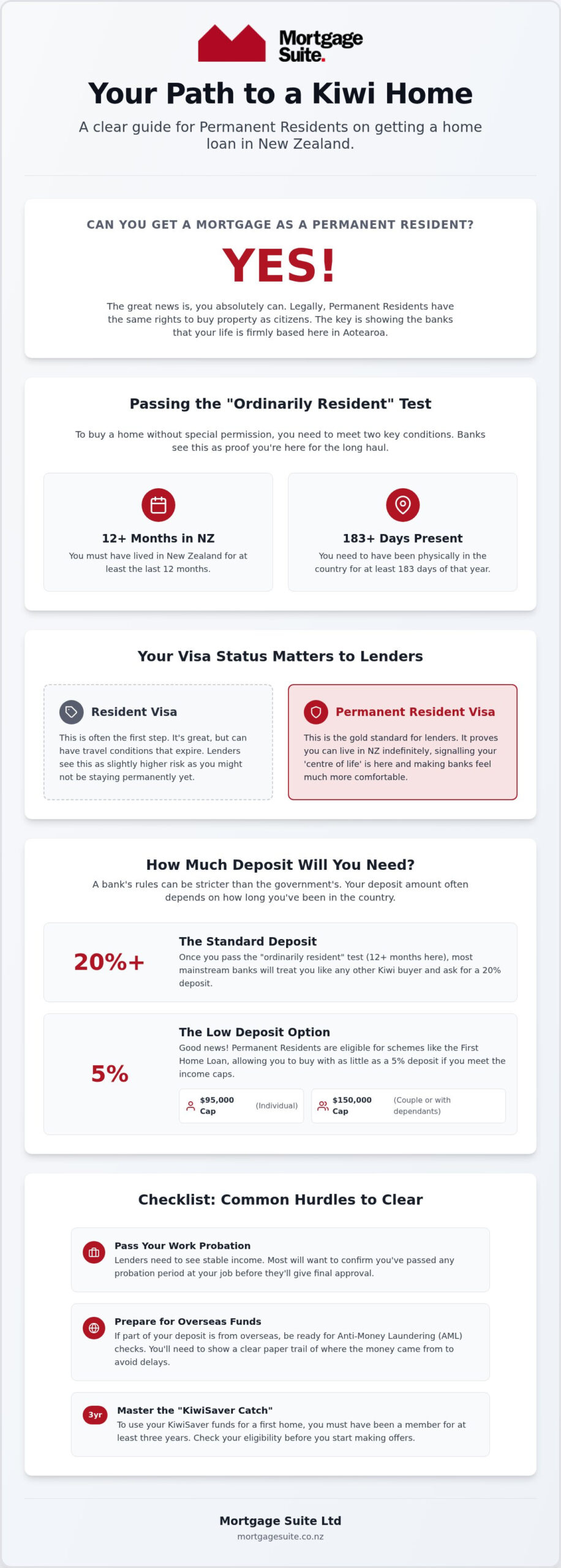
To buy a home without seeking special government permission, you need to be “ordinarily resident.” This means you’ve lived in the country for at least the last 12 months and have been physically present here for at least 183 days during that time. Banks love the 12-month mark because it proves you’re here for the long haul. If you’ve been here for less than a year, you might find mainstream banks a bit hesitant, often asking for a much larger deposit. In those cases, looking at 2nd tier lenders who understand the migrant journey is often the best path forward.

Resident Visa vs. Permanent Resident Visa

There’s a subtle but vital difference between a Resident Visa and a Permanent Resident Visa. Most people start on a Resident Visa, which usually has travel conditions that expire after two years. A Permanent Resident Visa is the “gold standard” for lenders because it allows you to stay indefinitely with no strings attached. While you can still get a mortgage on a standard Resident Visa, having that “Permanent” status makes banks feel much more relaxed. It tells them your centre of life is here, reducing their perceived risk and potentially opening up better interest rates.

Bank Rules vs. Government Rules: The Deposit Gap

It’s a common frustration. You’ve checked the official government rules and confirmed that your visa status allows you to buy property without a hitch. But when you walk into a local bank branch, you’re suddenly told you need a 35% or 40% deposit. This happens because there’s a significant difference between your legal right to own a home and a bank’s internal credit policy. While the law might see you as a resident, a bank might still view you as a “new arrival” until you’ve proven your roots are deep enough.

When asking can permanent residents get a mortgage in nz with a standard 20% deposit, the answer often hinges on the “centre of life” test. Lenders want to see that you aren’t just here for a short stint. They look at whether your family is here, if your children are enrolled in local schools, and how long you’ve been paying tax in the country. If you can show this stability, you’re much more likely to be treated like a citizen, opening the door to much lower deposit requirements.

Why Some Banks Ask for a 20% Deposit

Mainstream banks are naturally cautious. Their biggest fear is “flight risk,” the idea that a borrower might leave the country and stop making payments. If your visa has an expiry date, many lenders will try to match your loan term to that date, which makes the monthly repayments impossible. Even with a Permanent Resident visa, if you haven’t been here for the full 12 months required to be “ordinarily resident,” banks often stick to a strict 20% minimum to hedge their bets. However, we’ve seen cases where these rules are waived if your career is in a high-demand industry or you have a significant history of local savings.

Low Deposit Options for Permanent Residents

The good news is that you don’t always need a massive pile of cash. If you meet the income caps, which as of July 2026 are $95,000 for individuals without dependants or $150,000 for couples and those with dependants, you may be eligible for a First Home Loan. This scheme allows you to buy with just a 5% deposit, and permanent residents are absolutely eligible. You can find more details on these schemes in our first home buyer guide New Zealand. If the big banks are still saying no, we often look at 2nd tier lenders who have more flexible policies for those who are still building their local credit history. If you’re feeling stuck, getting professional advice can help you find a lender that sees your potential rather than just your visa date.

Proving Your Stability: Income and Employment

Once you’ve confirmed your legal standing, the next big hurdle isn’t about your visa. It’s about your paycheck. When banks ask can permanent residents get a mortgage in nz, they’re looking for proof that your income is as permanent as your residency. Your job title and the industry you work in carry a lot of weight. If you’re in a high-demand field like healthcare or IT, lenders often feel more confident about your future earning potential. However, if you’ve recently switched careers or started a new role, you might run into a few speed bumps.

Another vital piece of the puzzle is your local credit history. Even if you had a perfect credit score back home, you’re essentially starting from scratch here. Banks want to see a clean NZ credit profile. A simple way to start is by having a utility bill or a phone contract in your name and ensuring every payment is made on time. This helps build a “paper trail” of reliability that makes you look much better on paper. For a broader look at the steps involved, the government’s guide to buying property provides an excellent starting point for new arrivals.

The 90-Day Trial and Your Mortgage

Most mainstream banks have a strict rule about trial periods. If you’re currently on a 90-day trial or a probation period, they’ll usually ask you to wait until that period is over before they’ll approve a loan. They want to know your job is secure. If you’ve just moved to a new role in the same industry, we can sometimes argue for an exception by showing “continuous employment” proof from your previous country. It’s all about telling a story of stability that makes the bank feel safe.

Self-Employed Residents

If you’ve started your own business as a permanent resident, things get a bit more complex. Standard banks typically want to see at least two years of full New Zealand tax returns to prove your income is steady. This can be a massive roadblock for talented people who have just gone out on their own. We specialise in helping self-employed residents prove their “fair dinkum” income through other means, such as GST returns or bank statements. If the big banks aren’t willing to look at your current situation, exploring a 2nd tier lender New Zealand can often provide the flexibility you need to get into your home sooner.
Can Permanent Residents Get a Mortgage in NZ? Your 2026 Guide

Common Hurdles: KiwiSaver, AML, and Overseas Funds

Even when your income is steady and your visa is sorted, the actual cash you’re using for a deposit can trigger a fresh set of questions from lenders. When people ask can permanent residents get a mortgage in nz, they often forget that where the money comes from is just as important as how much you have. Banks and lawyers are now under strict rules to verify the source of every dollar. As of July 1, 2026, the Department of Internal Affairs has become the sole supervisor for these checks, making the process more centralised but also very thorough. You’ll need to show a clear path for your savings, especially if they’ve travelled across borders.

If your family back home is helping you out, you’ll need more than just a bank transfer. Lenders require a “gifting letter” to confirm the money isn’t a loan that needs to be repaid. This protects your ability to service your mortgage without extra debt hiding in the background. You should also keep the Bright-line property rule in mind. While it usually affects investors, it’s a good idea to talk to a professional about tax implications if there’s any chance you might sell the property within a few years of buying it.

Using Overseas Savings for Your Deposit

Proving the “origin of wealth” is a major part of the modern home-buying journey. You’ll need to provide bank statements from your overseas accounts, and potentially tax returns or sale agreements if the money came from selling a property abroad. It’s wise to move your funds into a New Zealand bank account as early as possible. This doesn’t just help with the paperwork; it also protects you from sudden exchange rate shifts that could shrink your home loan deposit right before you make an offer.

KiwiSaver for New Residents

KiwiSaver is a fantastic tool, but it has a specific “three-year rule.” You must be a member for at least three years before you can withdraw funds for your first home. If you’ve only been a resident for a year, you won’t be able to tap into those savings yet. The workaround is to focus on building your deposit through other savings or gifted funds while your KiwiSaver matures in the background. For those who have hit the three-year mark, you might also be eligible for the First Home Grant in 2026, provided you meet the latest income and residency criteria. If you’re unsure how to piece your deposit together, let’s chat about your options and find a path that works for your timeline.

How to Get Your NZ Home Loan Sorted

So, you’re ready to make your move. While the question of can permanent residents get a mortgage in nz has a clear ‘yes’, the actual process involves a bit of legwork to ensure you get the best deal. It isn’t just about showing a deposit; it’s about presenting a bulletproof case to the bank that shows you are here to stay. Following a structured plan will save you from the heartache of having an offer rejected because your residency paperwork wasn’t quite what the lender expected. To get started, follow these four essential steps:

  • Step 1: Check your residency clock. Confirm you meet the “ordinarily resident” test of 12 months in the country and 183 days present. This is the baseline for most standard bank offers.
  • Step 2: Secure a pre-approval. Don’t go house hunting and fall in love with a property before you know exactly what a lender will give you. A pre-approval gives you the confidence to bid when the right place pops up.
  • Step 3: Build your “centre of life” file. Gather local utility bills, set up your New Zealand bank accounts, and ensure your employment contract is finalised. These small details prove your commitment to Aotearoa.
  • Step 4: Partner with a specialist. Talk to a broker who understands the migrant journey and has access to loans that do not fit bank criteria.

Why a Mortgage Broker is Essential for PRs

Mainstream banks often have rigid, “one size fits all” checklists that don’t always account for the nuances of moving to a new country. We know which banks are migrant-friendly and which ones will put your application in the “too hard” basket. Our job is to package your application so it highlights your stability and career success rather than just your visa date. If you haven’t hit that 12-month residency mark yet, we can look at non-bank lenders who are more flexible with new arrivals, ensuring you don’t have to wait another year to start your life here.

Your Next Steps to Home Ownership

Getting your documents in order early is the best way to avoid stress later on. You’ll need your passport, your visa details, and at least six months of bank statements to show your saving habits. It’s also a good idea to keep an eye on the latest mortgage rates NZ for 2026 so you can factor the current interest environment into your budget. If you’re feeling overwhelmed by the rules or just want a straight-up assessment of your situation, book a chat with Krish Krishna. We’ll give you a clear path to approval and help you navigate the system with confidence.

Take the Next Step Toward Your New Zealand Home

Owning a home in Aotearoa is a milestone that’s well within your reach. We’ve explored how your status as a permanent resident gives you the legal right to buy, and why proving your “centre of life” through stable employment and local credit history is the key to unlocking bank approval. Whether you’re navigating the three-year KiwiSaver rule or organising a paper trail for overseas savings, the process is much smoother when you have an expert in your corner. If you’ve been asking can permanent residents get a mortgage in nz, you now have the clear roadmap you need to move forward with certainty.

At Mortgage Suite, we bring over 20 years of expert banking experience to your application. We specialise in 2nd tier and alternative lending, which means we can often find a path to approval even when the big banks say no. You’ll receive personalised service directly from our founder, Krish Krishna, who understands the unique challenges of the migrant journey. Talk to Mortgage Suite about your PR home loan today and let’s turn your residency into a permanent home. We’re here to make the complex simple and help you get those keys sooner than you think.

Frequently Asked Questions

Do I need to be a New Zealand citizen to buy a house?

No, you don’t need to be a citizen to buy property here. Permanent residents have the same legal rights to purchase a home as New Zealand citizens. The main thing to remember is that you must meet the “ordinarily resident” test to buy without restrictions. This involves living in the country for the preceding 12 months and being physically present for at least 183 days during that period.

Can I get a mortgage with only 12 months on my resident visa?

Yes, you can definitely secure a home loan once you’ve hit the 12-month mark. This one-year milestone is often the “magic number” for mainstream banks. It’s the point where lenders stop viewing you as a temporary arrival and start feeling confident that your life is firmly centred in New Zealand. Reaching this stage often makes the application process much smoother and more predictable.

What is the minimum deposit for a permanent resident in NZ?

You can potentially buy a home with as little as a 5% deposit through the First Home Loan scheme if you meet the 2026 income caps. While many banks prefer a 20% deposit for standard applications, the answer to can permanent residents get a mortgage in nz with less often depends on your specific visa and how long you’ve been working in your current industry.

Can I use my overseas income to qualify for an NZ mortgage?

Most New Zealand banks prefer to see income earned locally in New Zealand dollars. While it’s possible for some lenders to consider overseas earnings if you’re a high-net-worth individual, the majority of standard home loans are based on your NZ salary. Lenders want to be certain you can comfortably afford your repayments using the money landing in your local bank account every fortnight.

Does the Overseas Investment Act (OIA) affect permanent residents?

Yes, the Act sets the rules, but it actually protects your right to buy if you’re a permanent resident. If you meet the “ordinarily resident” criteria, you’re generally exempt from the restrictions that prevent non-residents from purchasing sensitive land or existing homes. The 2026 updates have further clarified these rules, making it easier for residents to understand their path to home ownership without needing special government consent.

What happens if a mainstream bank declines my resident mortgage application?

You still have plenty of options if a big bank says no. We specialise in 2nd tier and alternative loans for residents who don’t quite fit the standard “box” due to their time in the country or self-employment status. These lenders often take a more common-sense approach to your application, looking at your overall stability and career history rather than just following a rigid checklist.

How long does the mortgage pre-approval process take for residents?

You should allow roughly five to ten working days for a pre-approval to be finalised. Because residency-based applications require extra checks for anti-money laundering and visa verification, the paperwork can be a bit more intensive. It’s a great idea to get this sorted at least two weeks before you start visiting open homes so you can bid with absolute confidence.

Can I buy a house in NZ on a Work Visa?

Buying on a work visa is significantly more difficult than buying as a permanent resident. Under the current law, most work visa holders are restricted from buying existing homes unless they’re purchasing with a partner who is a citizen or PR. Banks are also very cautious about lending to those on temporary visas because they need to be sure you’ll be staying in the country long-term.

Article by

Krish Krishna

Experienced Financial Adviser with over 46 years of Banking and Mortgage broking experience and over $2.0 Billion in loan settlements.

Buying an Apartment Deposit NZ: How Much Do You Really Need in 2026?

What if the “standard” 20% deposit isn’t actually the only way to secure your first home in the city? When you are looking at buying an apartment deposit nz rules can often feel like they are written in a different language, especially when banks start talking about floor sizes and leasehold titles. It is a common frustration to feel like the goalposts keep moving just as you get close to your savings target. You might even worry that because apartments are viewed differently than houses, you are stuck in the rental cycle forever.

We understand that the path to ownership should be clear, not confusing. That is why we have put together this guide to show you exactly how much you need to save in 2026 and the clever strategies we use to help clients get their foot in the door, even with a smaller stash. We will break down the specific deposit percentages required for different property types, explain the “size trap” that catches many buyers out, and outline a clear plan to get you mortgage-ready. You will discover which government grants actually apply to apartments and how to avoid the common pitfalls that trip up even the most diligent savers.

Key Takeaways

  • Learn why the floor area of your apartment is just as important as your savings and how the 40 to 50 square metre mark affects your bank’s decision.
  • Discover the specific government grants and schemes that can help you secure your home with as little as a 5% or 10% deposit.
  • Understand the unique criteria for buying an apartment deposit nz and why banks view these properties differently than a standard house.
  • Find out how to work with non-bank lenders if you have fallen in love with a “quirky” or smaller property that doesn’t fit the usual rules.
  • Get a clear, step-by-step plan for 2026 to ensure your Body Corporate and building checks are sorted before you sign any contracts.

Buying an Apartment? Why Your NZ Deposit Might Be Different to a House

You might have heard that you need a massive pile of cash to buy property, but when you’re looking at buying an apartment deposit nz requirements aren’t always a one-size-fits-all deal. Many people think the 20% rule is a strict law. It isn’t. It is more of a benchmark that banks use to decide how much they’re willing to lend. In the current 2026 market, with a significant increase in apartment supply and stabilising rents, banks are looking at these properties with a fresh pair of eyes. However, they still treat them differently than a standard house on a quarter-acre block.

The main reason for this difference is risk. A bank sees a standalone house as a safe bet because the land usually holds its value over time. With an apartment, you’re buying into a shared building. This means the bank has to consider things like the health of the building’s structure and how well the complex is managed. It is a trade-off. You might get a much lower purchase price than a house, but you might need a higher percentage of that price upfront to satisfy the lender’s nerves.

The Standard Bank Perspective

Banks love it when you have a decent amount of your own money in the deal. They look at the size of the loan compared to what the property is worth to measure their risk. If you buy a $500,000 apartment with a $100,000 deposit, your loan is 80% of the value. This is the “sweet spot” where you get the best interest rates. If you have less than 20%, you aren’t necessarily out of the race. You might just have to pay a small extra fee to cover the bank’s risk. In New Zealand’s housing market, the Reserve Bank currently allows a certain percentage of bank lending to go to people with smaller deposits, so there is definitely room to move if your income is steady.

Apartment vs House: The Deposit Divergence

Why does a bank care if you’re buying a studio in the city or a house in the suburbs? It often comes down to how easy it is to sell the place later. If things go wrong and you can’t pay the mortgage, the bank wants to know they can sell the property quickly to get their money back. High-density living can be more volatile in terms of price. They also look closely at your “borrowing power” after you’ve paid your building management fees. These annual costs cover insurance and maintenance, but they also eat into your weekly budget. A bank will factor these costs into your application, which is why buying an apartment deposit nz can sometimes feel like a more complex puzzle than buying a traditional house.

Ultimately, 2026 is a unique time to buy. With more choice on the market, you have more leverage as a buyer, provided you understand these banking quirks before you start your search.

The Size Trap: How Square Metres Change Your Deposit Requirements

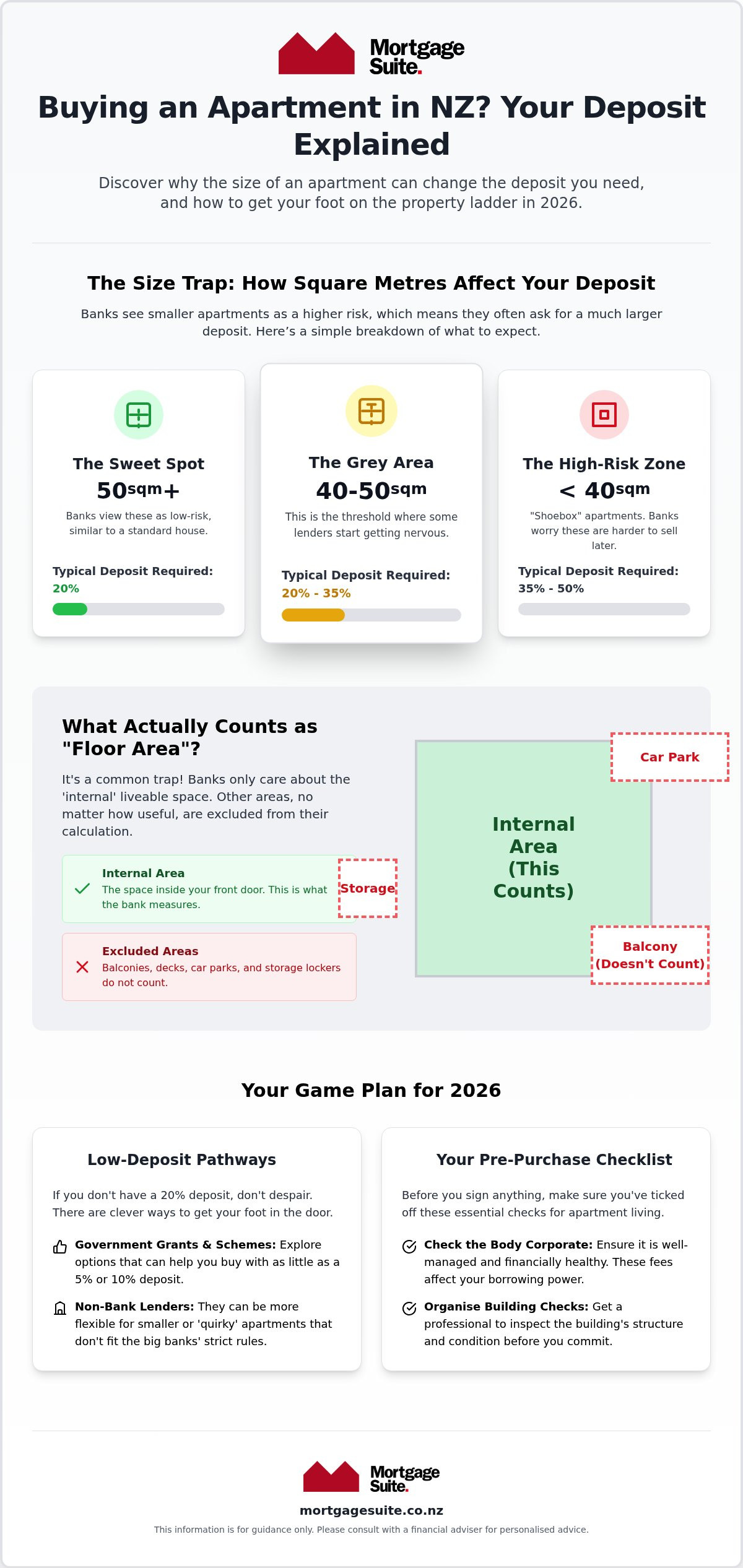
Size matters in the apartment world. You might find a sleek studio in the city centre that fits your budget perfectly, but your bank might see things differently. Most lenders have a specific set of criteria they use to judge whether a property is “liveable” or “bankable”. The Small Apartment Rule used by most NZ banks dictates that any unit with an internal floor area below a specific threshold, usually 40 to 50 square metres, is classified as a high-risk security and requires a much larger deposit.

When you are looking at buying an apartment deposit nz lenders will look at the “internal area” of the property. This is a crucial distinction. Your internal area includes the space inside your front door, but it strictly excludes your balcony, any storage lockers, and your car park. If your apartment is 42 square metres inside but has a massive 15 square metre deck, the bank still treats it as a 42 square metre property. If that number falls below their magic threshold, your required deposit could suddenly jump from 20% to as much as 50%.

The Studio Struggle

Banks are often nervous about tiny homes and “shoebox” apartments because they view them as a niche market. They worry that if the market takes a dip, these smaller units will be the hardest to sell. For properties under 40 square metres, expect the bank to ask for a deposit of at least 35%. In some cases, they might even demand 50% upfront. There are exceptions, of course. If a small apartment is in a premium building with high demand or if it’s a new build with a high-spec finish, some lenders might be more flexible. If you are struggling to get a traditional bank to look at a smaller unit, it helps to talk to a specialist about 2nd tier loans that are designed for these non-standard properties.

Freehold vs Leasehold: The Title Trouble

What you actually own can be just as important as the size of the rooms. Most New Zealand apartments are “Unit Titles”, which are a form of freehold ownership. You own your unit and a share of the common areas. However, leasehold apartments are a different story. In a leasehold arrangement, you own the building but not the land it sits on. You have to pay “ground rent” to the landowner, which can increase significantly every few years. Because of this ongoing cost and the risk of the land lease expiring, lenders often require a much larger deposit, sometimes 30% to 50%, to protect themselves from the potential drop in the property’s value.

Low-Deposit Options: Getting Your Foot in the Door with 5% or 10%

Saving a full 20% can feel like an impossible mountain to climb, especially when property prices are on the move. The good news is that you don’t always have to reach that peak before you start looking at properties. For many people buying an apartment deposit nz, the solution lies in a mix of personal savings, government help, and clever lending structures. While big banks might lead with their strictest rules, there are several pathways that let you start your ownership journey with much less cash upfront.

One of the most common ways to bridge the gap is by looking at new builds. Buying “off the plans” often comes with a significant advantage because these properties are frequently exempt from standard lending restrictions. This means many banks are happy to accept a 10% deposit for a brand-new apartment. If you’re still coming up short, a “Family Springboard” might be an option. This isn’t about your parents giving you a suitcase of cash; instead, they use the equity in their own home to guarantee a portion of your loan. It is a powerful way to get into the market years earlier than you otherwise could.

KiwiSaver Mechanics for Apartments

Your KiwiSaver is often the biggest piece of the puzzle. You can generally withdraw almost all your funds, including your employer contributions and investment returns, provided you’ve been a member for at least three years. In 2026, the First Home Grant remains a vital boost for those buying within specific price caps. Timing is everything here. You need to get your withdrawal paperwork started well before you attend an auction or sign a sale and purchase agreement. The funds need to be ready for the settlement date, and leaving it to the last minute can cause unnecessary stress during the final stages of the purchase.

The 5% Deposit Path

The First Home Loan scheme, backed by Kāinga Ora, is a genuine game-changer if you only have a 5% deposit. To qualify in 2026, your before-tax income over the last 12 months must be $95,000 or less for a single buyer, or $150,000 for a couple or single buyer with dependents. However, remember the “size trap” we mentioned earlier. For a First Home Loan, the apartment must usually be at least 45 square metres. Not every bank plays ball with this scheme, so it is crucial to work with a specialist who knows which lenders are currently participating and how to package your application for success. You can find more detail in our guide to Home Loans for First Home Buyers in New Zealand.

Buying an Apartment Deposit NZ: How Much Do You Really Need in 2026?

When the Bank Says No: Alternative Funding for Non-Standard Apartments

It is a gut-wrenching feeling when you find the perfect city pad, only for your bank to decline the loan because the place is a few square metres too small or the building is “too old”. This is where many buyers give up, thinking their dream of owning is over. But the truth is that mainstream banks have very narrow boxes they need you to fit into. If your property is considered one of those properties that don’t fit the standard rules, you simply need a different kind of lender who sees the value that the big banks miss.

Alternative lenders are the hidden engine of the New Zealand property market. They don’t have the same rigid rules as the big four banks. When you are looking at buying an apartment deposit nz, these lenders are often more interested in your ability to pay the mortgage than the exact dimensions of your balcony. Yes, there is a trade-off. You might pay a slightly higher interest rate initially, but many buyers use these loans as a stepping stone. Once you have built up some equity or the market shifts, you can often move your mortgage back to a mainstream bank at a lower rate.

The Alternative Lender Advantage

Alternative lenders often look at the person behind the application rather than just a checklist of property stats. If you have a solid career and a clear plan, they are far more likely to approve a loan for a studio or a quirky heritage conversion that a traditional bank would reject. These lenders provide a vital path for those who don’t fit the standard mould. You can learn more about how these flexible options work in our 2nd Tier Lender New Zealand guide.

Self-Employed or “Difficult” Income

Being self-employed while trying to buy an apartment can feel like a double-whammy. Big banks often demand years of perfect, predictable tax returns, which doesn’t always reflect the reality of running a successful business. When you combine that with a property that doesn’t fit the standard rules, the computer says “no” almost instantly. This is where having an advocate makes all the difference. Krish Krishna uses 20 years of banking experience to negotiate directly with lenders, proving your financial strength through other means. We know how to present your case so that lenders see your actual success, not just a spreadsheet.

If you’ve been told your dream apartment is “unbankable” by the big banks, don’t walk away just yet. Contact Mortgage Suite Ltd today to see which alternative funding options can help you secure your property in 2026.

Your Game Plan: Organising Your Deposit and Getting Sorted for 2026

Ready to stop scrolling through listings and actually start signing? You have already seen how property size and different types of lenders play a massive role in your journey. Now, it is time to put that knowledge into a practical plan for 2026. When you are buying an apartment deposit nz savings are only the first hurdle. You need a solid game plan to ensure you are “offer-ready” and protected from any hidden surprises that could trip up your application at the last minute.

At Mortgage Suite Ltd, we believe the final stretch should be the most exciting part of the process, not the most stressful. We take the lead on the mountains of paperwork, from coordinating with your solicitor to making sure your KiwiSaver funds are ready for settlement day. Our goal is to make the entire process feel like a helpful dialogue rather than a complex lecture, ensuring you understand every step before you commit your hard-earned savings.

The Pre-Approval Power Move

Before you fall in love with a city view, you need a pre-approval that actually fits your specific goal. It is a common trap to assume a standard house pre-approval works for an apartment. In reality, banks often approve you as a borrower but keep the property itself “subject to bank approval”. They will want to vet the specific building, its insurance status, and its maintenance history before they give the final nod. This is also the best time to look at our Mortgage Rates NZ guide to see how current interest levels will impact your weekly budget. Knowing these numbers early prevents you from overextending yourself.

Hidden Costs to Budget For

Your deposit isn’t the only cash you will need to have ready in your accounts. There are several “entry costs” that can catch you off guard if you haven’t planned for them. To ensure you don’t buy a “lemon”, you need to budget for the following essentials:

  • Valuation fees: Because apartments carry unique risks, banks almost always require a professional valuer to check the property before they release the funds.
  • Solicitor fees: Your lawyer will need to spend extra time checking the building management rules and disclosure statements to ensure the complex is financially healthy.
  • Council property report: This essential check (often known as a LIM) tells you everything the local council knows about the building’s history and any past issues.
  • Moving costs and levies: You will need cash for the move itself and often the first instalment of your building management fees upon settlement.

By organising these details early and working with a veteran broker, you ensure that you are making a secure investment in your future city lifestyle.

Take the First Step Toward Your City Lifestyle

Securing your own slice of the city is an achievable goal, even in a shifting market. Throughout this guide, we have explored how the 2026 landscape offers unique opportunities for those who understand the specific rules around property size, titles, and lending criteria. The process of buying an apartment deposit nz doesn’t have to be a source of stress when you have a clear plan and the right expertise to guide you through the “size traps” and banking hurdles we have discussed.

Krish Krishna offers over 20 years of banking experience, providing the seasoned professionalism needed to navigate both mainstream and alternative lending paths. As specialists in 2nd tier loans and non-standard properties, we offer a personalised service that focuses on your individual success rather than just a rigid set of criteria. Ready to get sorted? Chat with Krish at Mortgage Suite Ltd today for a no-obligation chat about your apartment goals. We are here to act as your advocate and steady hand, helping you move into your new home with total confidence.

Frequently Asked Questions

Can I buy an apartment with a 5% deposit in NZ?

Yes, you can buy an apartment with a 5% deposit through the Kāinga Ora First Home Loan scheme. To qualify in 2026, you must meet specific income caps and the apartment must usually be at least 45 square metres in size. Not every lender participates in this program, so it is important to check which banks are currently accepting these low-deposit applications for high-density properties.

What is the minimum size for an apartment to get a bank loan?

Most New Zealand banks prefer a minimum internal floor area of 40 to 50 square metres to approve a standard mortgage. If the unit is smaller than this, it is often classified as a “shoebox” or a small studio. While you can still get finance for smaller spaces, you will likely need a much larger deposit, often between 35% and 50% of the purchase price.

Can I use my KiwiSaver for an apartment deposit?

You can certainly use your KiwiSaver savings to help with buying an apartment deposit nz. As long as you have been a member for at least three years, you can typically withdraw your own contributions, your employer’s contributions, and any investment returns. You just need to leave a minimum of $1,000 in your account to keep the fund open for the future.

Why do banks ask for a bigger deposit on some apartments?

Banks ask for a larger deposit when they believe a property carries a higher risk for resale. This is common with very small studios, leasehold titles, or buildings that have a history of maintenance issues. By requiring 30% or 40% upfront, the lender protects themselves against potential price drops or a limited pool of buyers if they ever need to sell the property.

What are Body Corporate levies and do they affect my loan?

Body Corporate levies are annual fees that cover the building’s insurance, shared utilities, and long-term maintenance funds. These costs do affect your loan because banks subtract the levy amount from your disposable income when calculating your “borrowing power”. If the annual levies are particularly high, it could slightly reduce the total amount the bank is willing to lend you for your mortgage.

Is it harder to get a mortgage for a leasehold apartment?

It is generally more difficult to secure a mortgage for a leasehold apartment because you do not own the land beneath the building. Lenders are often wary of ground rent increases and the uncertainty of what happens when the land lease expires. Because of these factors, most mainstream banks will demand a significantly higher deposit and may impose stricter repayment terms on the loan.

Do I need a lawyer before I pay my deposit?

You should always have a lawyer review the sale and purchase agreement and the Body Corporate documents before you pay a deposit. Apartment contracts include specific disclosure statements that outline the building’s financial health and any planned repairs. A lawyer ensures you aren’t signing up for a property with hidden legal issues or a massive bill for upcoming building maintenance.

How long does it take to get an apartment loan approved?

You should allow between five and ten working days for an apartment loan to be fully approved. While your personal financial check happens quickly, the bank also needs time to review the building’s specific details and a professional valuation report. Because the bank is lending on a shared building rather than just land, the process involves a few extra steps compared to a standard house.

Article by

Krish Krishna

Experienced Financial Adviser with over 46 years of Banking and Mortgage broking experience and over $2.0 Billion in loan settlements.