
Commercial Mortgage New Zealand: Comparing Mainstream Banks vs 2nd Tier Lenders in 2026

You might assume that the lowest advertised interest rate from a major bank is the gold standard for your next commercial mortgage New Zealand, but for many savvy investors in 2026, the obvious choice is no longer the most profitable one. While the Official Cash Rate has held steady at 2.25 per cent, the reality of securing finance has become a hurdle of rigid serviceability tests and opaque rate structures. We understand how exhausting it is to present a strong business case only to be met with a clinical checklist that ignores your true commercial potential.

This expert comparison is designed to help you master the complexities of the current lending environment. You’ll learn how to weigh the stability of mainstream institutions against the agility of second-tier lenders who often prioritise business vision over historical paperwork. We’ll break down the critical LVR differences between asset types and show you how to structure a deal that secures flexible terms. By the end of this guide, you’ll have the clarity needed to choose a partner that supports your long-term success rather than just processing another transaction.

Key Takeaways

  • Learn how to select a commercial mortgage New Zealand that balances competitive rates with the flexibility your business needs to thrive.
  • Evaluate the hidden costs of mainstream bank criteria and see how second-tier lenders offer a faster path to settlement.
  • Grasp the specific documentation requirements, including the Information Memorandum, to present a professional case that credit managers can’t ignore.
  • Identify the structural differences between owner-occupied and investment loans to maximise your borrowing capacity and long-term capital growth.
  • Gain insights into how seasoned banking expertise can help you find a clear path forward even when traditional lenders say no.

Understanding the Commercial Mortgage Landscape in New Zealand

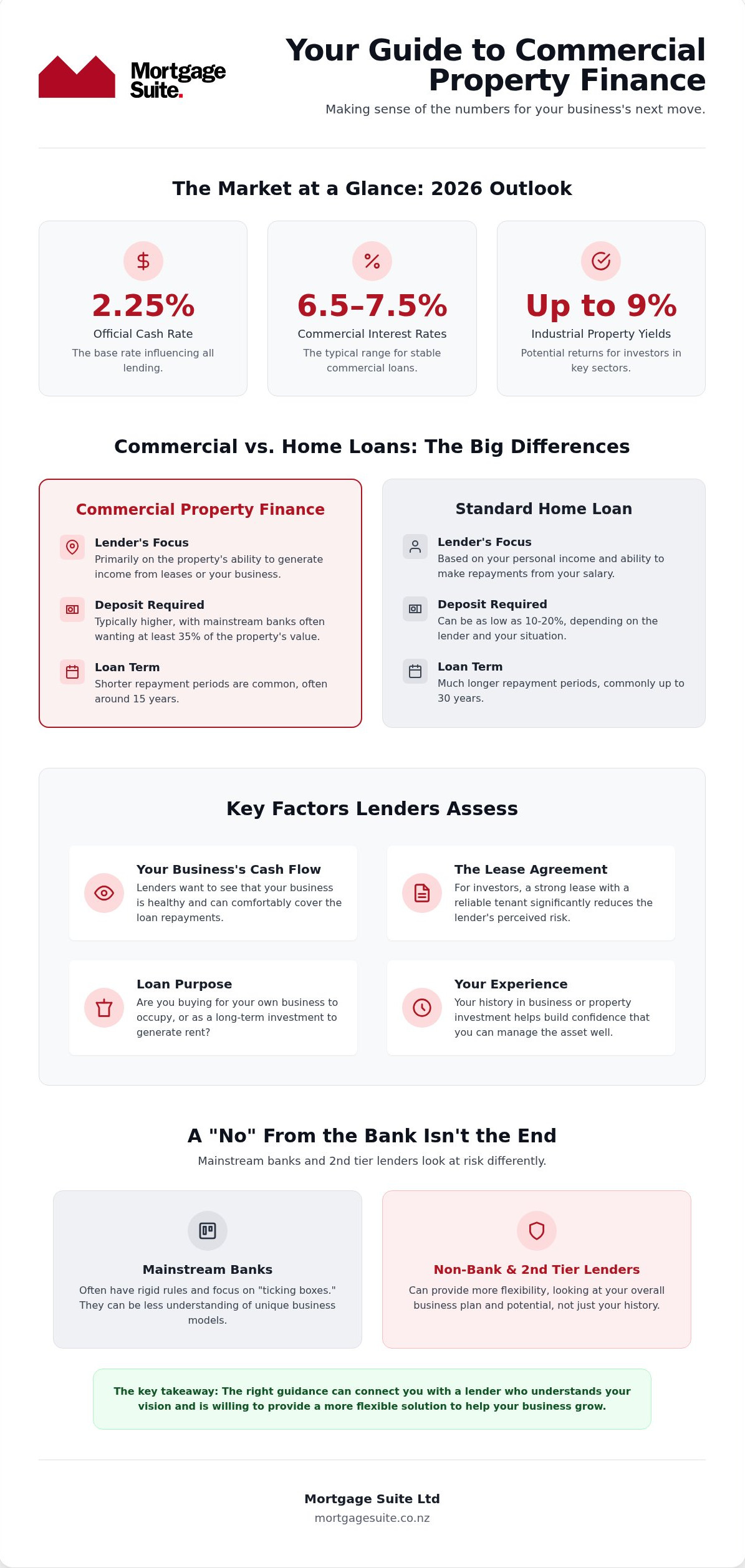
A What is a Commercial Mortgage? is fundamentally a loan secured by non-residential real estate, but the mechanics differ vastly from the home loan you might have for your family residence. While residential lending focuses on your personal ability to meet repayments from your salary, a commercial mortgage New Zealand is judged on the property’s capacity to generate income. In 2026, the lending environment has become more sophisticated. With the Reserve Bank holding the Official Cash Rate at 2.25 per cent and inflation projected to reach 4.2 per cent by mid-year, banks are looking beyond historical data to assess future serviceability. They want to see a clear “intended use” that aligns with current market strengths, such as the robust industrial sector.

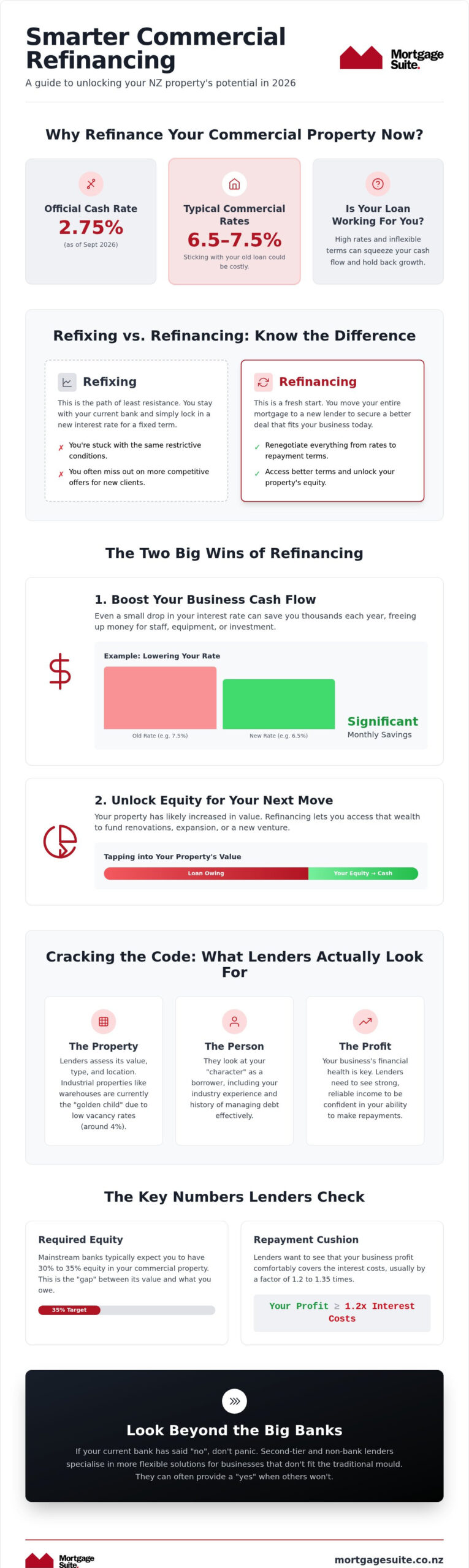
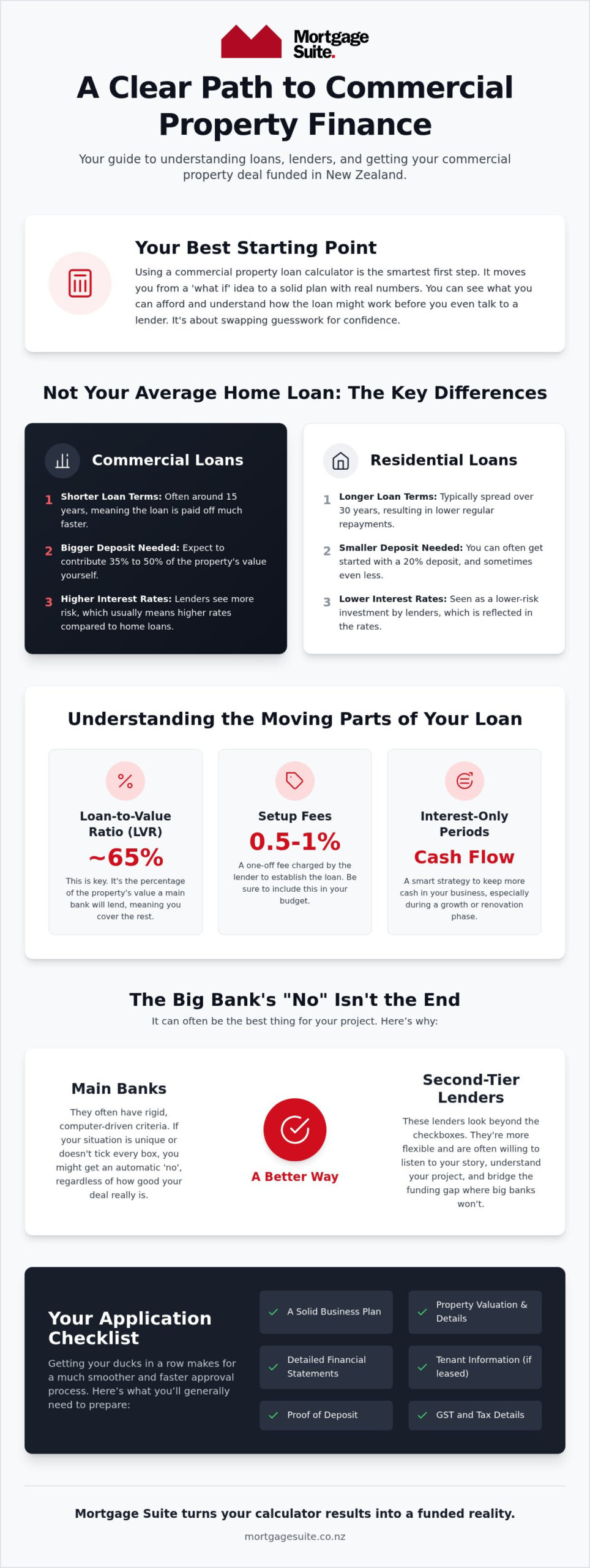
The structural differences are significant. Unlike residential loans where you might see Loan-to-Value Ratios (LVR) of 80 per cent, commercial deals usually sit between 50 and 65 per cent. Interest rate margins are also wider, reflecting the higher risk profile of business-related assets. Term lengths are typically shorter, often requiring a refinance or “roll-over” every three to five years. This requires a proactive approach to your portfolio management and a steady hand to navigate the fluctuating margins offered by different institutions.

Asset Types Covered Under Commercial Finance

Lenders categorise risk based on the specific asset you’re purchasing. For retail spaces and shopping centres, credit managers scrutinise foot traffic and the reliability of anchor tenants. Industrial warehouses and factories are currently the most favoured assets in the New Zealand market because of their steady growth and low vacancy rates. If you’re eyeing professional offices or medical suites, be prepared for a “flight to quality” assessment. Lenders in 2026 prioritise modern buildings with high seismic resilience and sustainability credentials, often offering better terms for high-yield, high-quality assets.

Why Residential and Commercial Loans Don’t Mix

The biggest mistake investors make is assuming their residential equity will easily bridge the gap to a commercial purchase. Commercial lending uses a “weighted lease” analysis, where the length and strength of the tenant’s lease are more important than your personal salary. You must also account for GST, which can significantly impact your initial deposit requirements and borrowing power. We often advise against cross-collateralisation, where your home is used as security for a commercial loan. This creates unnecessary risk and can limit your future flexibility if the commercial market fluctuates. Keeping these two worlds separate ensures your personal assets remain protected while your business ventures grow.

Mainstream Banks vs. 2nd Tier Lenders: A Direct Comparison

In the New Zealand market, the “Big Four” (ANZ, ASB, BNZ, and Westpac) traditionally dominate the landscape. However, choosing a commercial mortgage New Zealand based purely on the lowest headline interest rate can be a trap. While a major bank might offer a floating base rate around 4.14 per cent, the rigid serviceability tests often mean your application stalls for weeks. This is where the concept of “opportunity cost” becomes vital. If a bank takes three months to approve a loan while a competitor snaps up a prime industrial site, that lower interest rate hasn’t saved you money; it’s cost you the entire investment.

According to the Property Council New Zealand, the commercial sector is a massive driver of the local economy, yet bank “credit appetite” remains highly selective. Mainstream lenders often shy away from buildings with lower seismic ratings or industries they deem “high risk,” such as hospitality or specific retail niches. Second-tier lenders, by contrast, use common-sense underwriting. They are far more likely to support self-employed borrowers who have strong cash flow but don’t necessarily fit the “perfect” historical tax profile that a major bank demands. Business owners in this position may also benefit from exploring a small business loan NZ to understand the full range of funding options available alongside commercial property finance.

When to Choose a Mainstream Bank

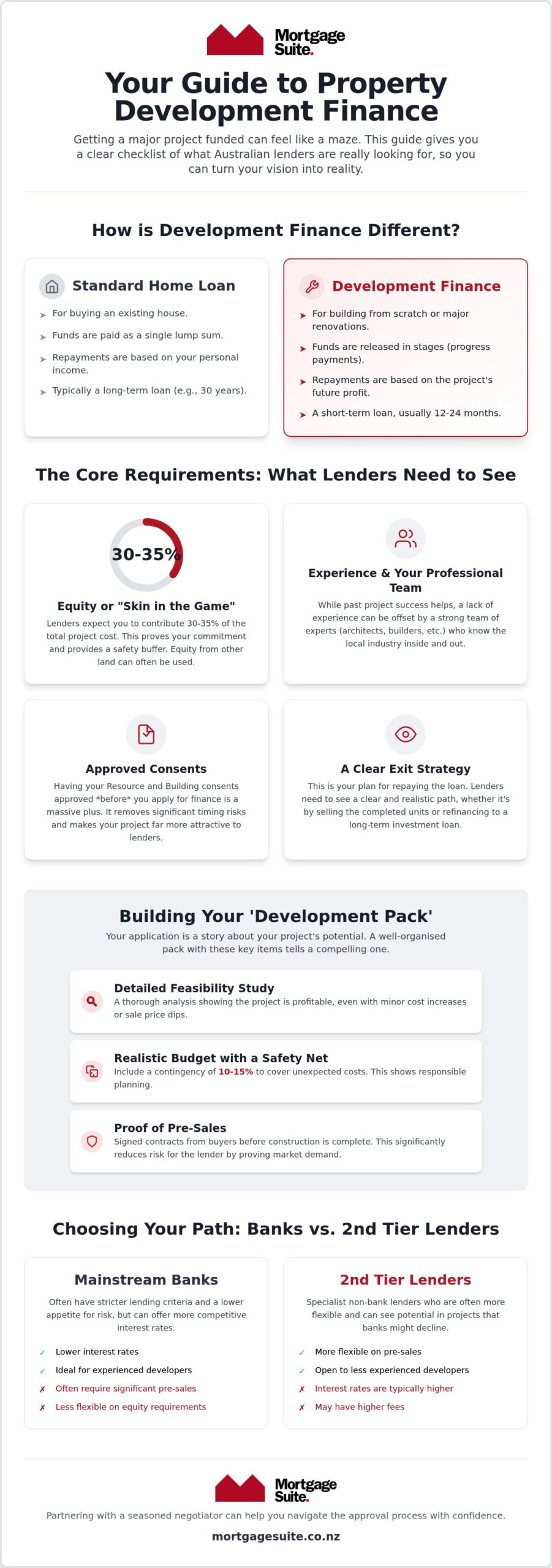
Mainstream banks are the ideal choice for “Gold Standard” borrowers. If you have a clean credit history, two years of strong financial statements, and a property with a long-term lease to a reputable tenant, you should prioritise these institutions. You’ll benefit from lower margins and a full suite of integrated business banking tools. Banks love “Vanilla” assets, which are modern, well-located buildings in major centres like Auckland or Christchurch. If your deal fits this neat box, the major banks offer the stability you need.

The 2nd Tier Advantage: Flexibility and Speed

Second-tier lenders excel where the majors hesitate. They are the go-to for “Vacant Possession” purchases or properties with short-term leases where a bank sees too much risk. These lenders often provide interest-only options or capitalised interest for development projects, allowing you to preserve cash flow during the critical early stages of a project. Second-tier lending serves as the essential bridge for borrowers who do not fit into the rigid boxes of institutional banking. If you find yourself in a complex situation, exploring non-mainstream options can often be the difference between a rejected application and a successful settlement.

Owner-Occupied vs. Investment Commercial Mortgages

The strategy behind your commercial mortgage New Zealand depends entirely on who will be occupying the four walls of your property. Lenders categorise these applications into two distinct buckets: owner-occupied and investment. While they may look similar on a title deed, the credit assessment behind them is world’s apart. If you’re buying a premise to run your own engineering firm or retail boutique, the lender is essentially backing your business’s ability to pay rent to itself. If you’re an investor, they’re backing the strength of your tenants and the lease agreements they’ve signed.

Risk assessment often hinges on the “single-tenant” versus “multi-tenant” factor. Multi-tenant assets, like a block of five shops, are generally viewed as lower risk because a single vacancy won’t stop the mortgage repayments. However, a single-tenant building with a high Weighted Average Lease Expiry (WALE) can be just as attractive. In the 2026 market, a WALE of five years or more is often the “magic number” that unlocks more competitive interest rate margins and longer interest-only periods. Lenders want to see that your income stream is secured well into the future before they commit to a long-term facility.

Financing for Owner-Occupiers

When you buy for your own business, the lender will scrutinise your company’s P&L and balance sheets rather than just the property’s market rent. One significant advantage here is the potential for higher LVRs. Some lenders are willing to stretch beyond the standard 65 per cent if the business is exceptionally robust and has a long history of profitable trading. Owning your own premises also provides significant tax advantages in New Zealand, such as the ability to claim depreciation on certain fit-outs and the deductibility of interest costs, which can turn a monthly expense into a long-term wealth-building tool.

The Investor’s Perspective: Yield and Security

For investors, the focus shifts to “Net” versus “Gross” lease income. A Net lease, where the tenant pays for outgoings like rates and insurance, is far more favourable for loan serviceability than a Gross lease. Lenders also place immense value on “tenant covenant.” A property leased to a government department or a national supermarket chain is viewed as “bankable” security, whereas a lease to a brand-new startup may require a larger deposit or a lower LVR. You must also forecast for “Capex” (capital expenditure) and potential vacancy periods, as lenders will often “stress test” your ability to cover the mortgage even if the building sits empty for six months.

Commercial Mortgage New Zealand: Comparing Mainstream Banks vs 2nd Tier Lenders in 2026

The Application Process: Organising Your Commercial Case

Securing a commercial mortgage New Zealand requires more than just a decent credit score and a deposit. It demands a narrative that convinces a credit manager your project is a calculated success rather than a speculative risk. The centrepiece of this process is the Information Memorandum (IM). Think of the IM as a professional pitch deck for your loan. It should clearly outline the property’s merits, the strength of the tenants, and your own experience as an operator or investor. When a credit manager receives a messy pile of bank statements, they see work; when they receive a polished IM, they see a professional partner.

Your financial documentation must go deeper than basic year-end accounts. Lenders in 2026 expect to see up-to-date GST returns and detailed Debtors and Creditors lists to verify the real-time health of your cash flow. They also want to see a clear “Exit Strategy.” Whether you plan to refinance with a mainstream bank after three years or sell the asset once the lease is renewed, the lender needs to know exactly how they’ll be repaid. A vague plan is a fast track to a declined application.

Technical Reports You Cannot Ignore

In the New Zealand market, the “IEP” or earthquake rating is often the factor that makes or breaks a deal. Most mainstream banks won’t touch a building with an Initial Evaluation Procedure rating below 34 per cent of the New Building Standard (NBS), as these are deemed “earthquake prone.” If you’re eyeing an industrial site, environmental reports are equally non-negotiable. You must prove the land isn’t contaminated from previous heavy use. Finally, remember that your Loan-to-Value Ratio is always determined by a Registered Valuation from a lender-approved panel valuer, not the purchase price or the CV.

Navigating the Credit Committee

The credit committee evaluates your case based on the “Three Cs”: Character, Capacity, and Collateral. They want to know who you are, your ability to service the debt, and the quality of the asset itself. A well-organised application can reduce your interest margin by 0.5% or more. This is where an expert hand is invaluable; we don’t just submit paperwork, we “shop” your deal to multiple tiers to find the lender whose current appetite matches your specific scenario. If you’re ready to present your strongest possible case, reach out to us today and let’s get your application moving.

Why Mortgage Suite is Your Commercial Finance Partner

Choosing the right partner for your commercial mortgage New Zealand often comes down to who has the deepest understanding of the credit committee’s mindset. At Mortgage Suite, we leverage over 20 years of institutional banking experience to give our clients a distinct advantage in every negotiation. We don’t just act as a middleman; we act as your dedicated advocate. Krish Krishna personally handles complex commercial files, ensuring that your business potential is communicated with the same level of authority that the banks themselves use. This high-level expertise allows us to anticipate the concerns of lenders before they even arise, smoothing the path to a successful settlement.

Whether you are looking at an industrial site in Christchurch or a retail block in Auckland, our national reach ensures we understand the local nuances of the diverse New Zealand property market. We specialise in finding a clear path forward when mainstream banks say no. Our experience has taught us that a “decline” from a major bank is rarely the end of the road. It is often just a sign that your scenario requires a more tailored, non-mainstream approach. We pride ourselves on being a steady hand in a fluctuating market, prioritising long-term partnerships over simple transactional lending. This commitment to your success means we stay involved long after the initial loan is approved, helping you navigate future refinances and portfolio growth.

Expertise in 2nd Tier and Structured Finance

Our clients gain access to a wide panel of alternative lenders that you simply won’t find on the high street. These second-tier institutions offer structured finance solutions that are essential for large-scale property developments and complex business acquisitions. We understand how to piece together these intricate deals, ensuring that the terms align with your project’s specific cash flow requirements and timelines. If your project involves interest-only periods or capitalised interest, we know exactly which lenders have the appetite for that level of flexibility and how to present your case to secure those terms.

Take the Next Step in Your Commercial Journey

A bank decline shouldn’t be the roadblock that stops your business growth or investment plans. We have a proven track record of turning “no” into “yes” by restructuring deals and finding the right lender tier for each unique situation. We have spent years helping first home buyers enter the residential market, and we apply those same principles of tireless advocacy to our commercial clients. We understand the stress that comes with large-scale financial decisions, and our goal is to alleviate that pressure through clear communication and reliable results. Contact us today for a confidential review of your commercial financing needs and let us help you secure the future of your business.

Securing Your Commercial Future in 2026

Your journey toward a successful commercial mortgage New Zealand shouldn’t be defined by the rigid boxes of institutional banking. We’ve explored how the right lender tier can determine your project’s viability, from the stability of the Big Four to the common-sense flexibility of second-tier options. Success in this market requires more than just a property; it requires a professional presentation that anticipates credit hurdles before they become roadblocks.

With over 20 years of institutional banking experience and national coverage, we specialise in navigating the complexities of 2nd tier lending and structured finance. We’re here to act as your dedicated advocate, ensuring your business potential is seen and valued by the right financial partners. Don’t let a complex scenario or a traditional bank decline slow your momentum. Contact Mortgage Suite for a specialised commercial finance consultation today and let’s build a clear path forward for your next acquisition or development. We’re ready to help you turn your commercial vision into a reality.

Frequently Asked Questions

What is the typical LVR for a commercial mortgage in New Zealand?

Most lenders provide a Loan-to-Value Ratio (LVR) between 50 and 65 per cent for a commercial mortgage New Zealand. While residential loans often reach 80 per cent or higher, commercial assets require a larger deposit to offset the increased risk and potential for longer vacancy periods. Some second-tier lenders may stretch these limits slightly for high-quality industrial assets or exceptionally strong owner-occupied business cases.

How do commercial interest rates compare to residential rates?

Commercial interest rates are almost always higher than residential rates because they include a wider risk margin. In 2026, while home loans might hover at lower levels, commercial floating rates can range from 4 per cent to over 10 per cent depending on the lender tier. Banks charge this premium to account for the complexity of the security and the shorter term of the facility.

Can I use KiwiSaver for a commercial property purchase?

No, you generally cannot use KiwiSaver funds to purchase a commercial property. KiwiSaver withdrawal rules are strictly designed for first-home residential purchases or retirement. If you’re looking to fund a commercial venture, you’ll need to rely on business capital, personal savings, or equity from existing residential property rather than your retirement savings. This ensures the funds remain dedicated to their intended purpose.

What is an IEP rating and why does it affect my commercial loan?

An Initial Evaluation Procedure (IEP) rating measures a building’s seismic strength relative to the New Building Standard (NBS). Lenders are extremely cautious about buildings rated below 34 per cent NBS because they’re legally classified as earthquake-prone. A low rating can make a property unbankable or require significant capital expenditure to upgrade before a loan is approved, as it represents a major collateral risk.

How long is the term for a typical commercial mortgage?

Commercial loan terms are significantly shorter than the 30-year terms common in residential lending. Most commercial facilities are structured for three to five years. At the end of this period, the loan is usually reviewed and rolled over or refinanced based on the current market value of the property and the strength of the existing leases. This allows lenders to adjust their exposure periodically.

Do I need a business plan to get a commercial mortgage approved?

Yes, a clear business plan or an Information Memorandum is essential for most commercial applications. Lenders want to understand your operational experience, the property’s income potential, and your long-term strategy for the asset. A well-structured plan demonstrates to the credit committee that you’ve accounted for risks like tenant vacancy or rising maintenance costs, making your case much more compelling for approval.

What happens if my business has a “bad credit” history but strong assets?

Strong assets can often bridge the gap if your historical credit is less than perfect. While mainstream banks might decline the application, second-tier lenders specialise in these non-mainstream scenarios. They often prioritise the value of the collateral and your current cash flow over past credit events, providing a pathway to secure a commercial mortgage New Zealand when traditional institutions are unable to help.

Are there specialised loans for property development in NZ?

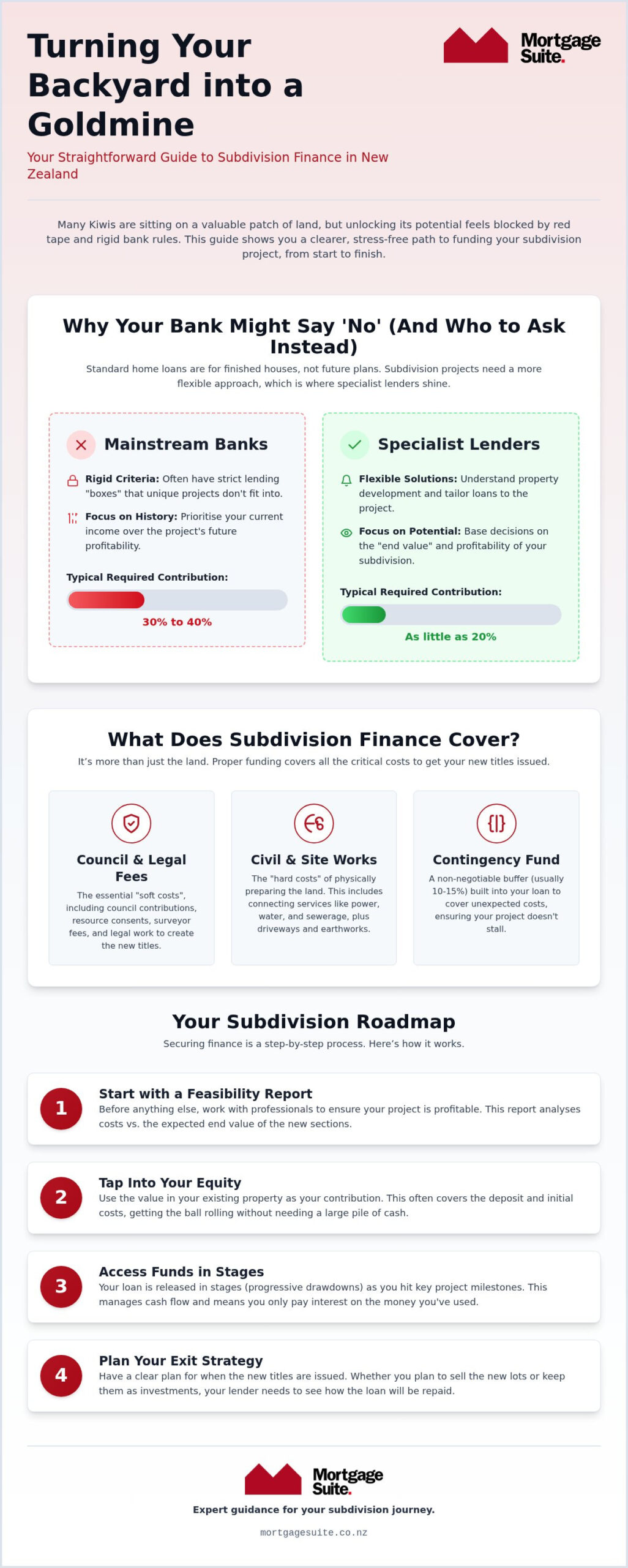
Yes, property development loans are specific facilities designed for construction or major renovations. These loans often feature drawdowns where funds are released in stages as work is completed and verified. They may also allow for capitalised interest, meaning you don’t make repayments until the project is finished or the units are sold, which preserves your cash flow during the critical building phase.

Article by

Krish Krishna

Experienced Financial Adviser with over 46 years of Banking and Mortgage broking experience and over $2.0 Billion in loan settlements.

Non-Bank Investment Property Loans : A Strategic Guide for Investors in 2026

What if the bank’s "no" isn’t the end of your investment journey, but actually the signal to start scaling your portfolio with more precision? Many New Zealand investors feel sidelined by the RBNZ’s strict 70% LVR requirements and the DTI limit of 7, which often makes it feel like the big banks are working against your growth. It’s incredibly frustrating when a high-yield opportunity is right in front of you, yet rigid, one-size-fits-all criteria stop you in your tracks. Exploring **non bank investment property loans ** provides a strategic path forward for those who refuse to let traditional restrictions dictate their financial future.

We understand that you’re looking for more than just a loan; you’re looking for a way to secure your next property without the slow processing times and restrictive hurdles of the main street lenders. This guide will show you how to bypass these barriers to grow your portfolio faster and more flexibly. You’ll learn to weigh the total cost versus the benefit of 2nd tier lending and find a reliable finance partner who views your success as a priority. We will examine how these tailored solutions work in the 2026 market, ensuring you have the tools to make confident, informed decisions.

Key Takeaways

  • Understand how 2nd tier lenders utilise private capital to provide flexible funding options that bypass traditional bank constraints.
  • Discover how to overcome restrictive Debt-to-Income (DTI) ratios by partnering with lenders who recognise diverse income streams, including self-employed or overseas earnings.
  • Learn why the realistic serviceability stress tests used for non bank investment property loans can unlock significant borrowing capacity for your next acquisition.
  • Master the strategic preparation required to secure a loan, including how to present rental yields and property potential to satisfy alternative criteria.
  • Explore the benefits of professional advocacy to ensure you find a reliable finance partner who understands the nuances of the New Zealand property market.

Table of Contents

What Are Non-Bank Investment Property Loans in the NZ Market?

To understand the current market, we first need to define the terminology. Unlike retail banks that rely on customer deposits to fund their lending, non-bank lenders use private capital or wholesale funding. What Are Non-Bank Investment Property Loans basically refers to a robust sector of financial institutions that provide credit without holding a full banking licence. In the local context, these are frequently called 2nd tier lenders. They serve as a critical alternative for investors who find themselves restricted by the rigid frameworks of the big four banks.

Safety is a primary concern for many, but the "non-bank" label is often misunderstood by retail investors. These lenders aren’t operating in a regulatory vacuum. They are strictly governed by the Credit Contracts and Consumer Finance Act (CCCFA). This legislation ensures borrower protection and mandates responsible lending practices. Choosing this route doesn’t mean sacrificing security; it means gaining a partner who can look past the standard "tick-box" approach to finance. We see this as a bridge between rigid institutional rules and the personal needs of a growing portfolio.

The Rise of Alternative Lending in New Zealand

The demand for **non bank investment property loans ** have surged as RBNZ regulations have become more complex. With the OCR held at 2.25% in mid-2026, mainstream banks have become increasingly risk-averse. This shift has transformed the 2nd tier sector from a "last resort" into a strategic tool for professional portfolio scaling. Investors now utilise these lenders to bypass the slow, cumbersome application processes that often lead to missed opportunities in a fast-moving market. It’s about agility and the ability to act when a high-yield property hits the market.

Key Differences in Funding Sources

The flexibility of **non bank investment property loans **stems directly from their funding models. Because they don’t have the same RBNZ capital restrictions as traditional banks, they can recognise diverse income sources, such as self-employed earnings or overseas income. This stability is a hallmark of the NZ sector in 2026. Common myths about non-bank reliability are easily debunked when you look at the institutional backing behind these firms. They offer a steady, reliable source of capital that allows for realistic serviceability testing, focusing on the actual performance of your investment property rather than just a standardised stress-test rate.

Why Savvy Investors Choose 2nd Tier Lending for Portfolio Growth

If you’ve ever felt like you’ve hit a ‘lending wall’ with your current bank, you aren’t alone. Mainstream banks often rely on rigid Debt-to-Income (DTI) ratios that can stifle even the most promising expansion plans. Since the introduction of the DTI ratio of 7 in mid-2024, many seasoned investors have found their borrowing capacity suddenly capped. This is where non bank investment property loans offer a distinct tactical advantage. These lenders provide the flexibility and faster approval turnarounds needed to move quickly when high-demand listings appear; they ensure you don’t miss out while waiting for a bank’s slow bureaucracy.

Unlike the big four, 2nd tier lenders are often more willing to recognise diverse income sources. If you’re self-employed or receive overseas income, you’ve likely experienced the frustration of a bank ‘haircutting’ your earnings until they no longer support the loan you need. Non-bank lenders tend to take a more holistic view of your financial position. They prioritise the actual performance and potential of the security property rather than just sticking to a standardised formula. This pragmatic approach is supported by the Reserve Bank of New Zealand’s definition of non-bank lenders, which highlights their role in providing credit to sectors that might not fit the narrow criteria of registered banks.

Bypassing the ‘Lending Wall’

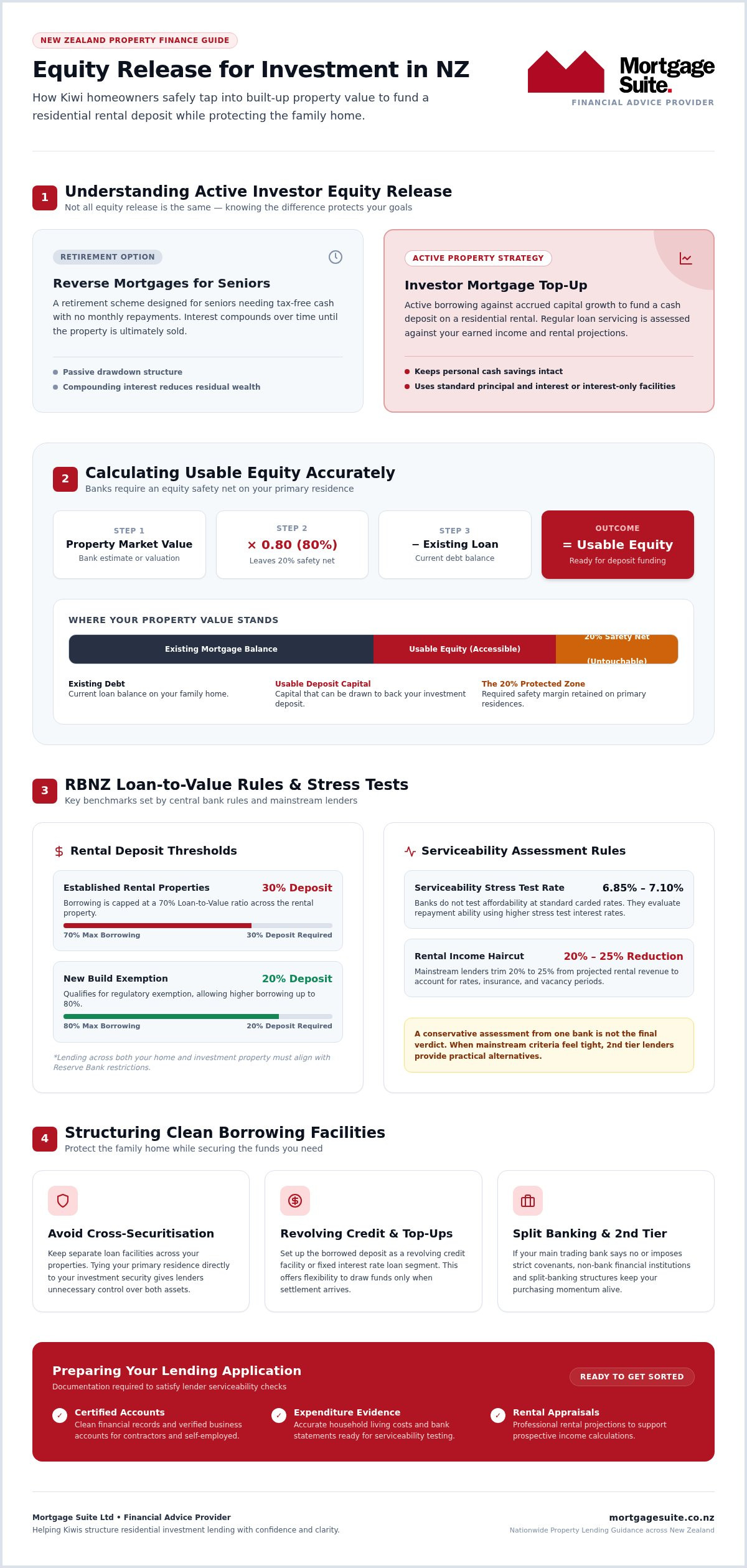
The big four banks often focus heavily on your income-to-debt ratio, but non-banks often view equity as a more significant lever for growth. We’ve helped clients who were stuck with two properties and a ‘no’ from their bank successfully scale to five properties by restructuring their debt through alternative finance. This strategy bridges the gap between your current portfolio and your long-term goals. It allows you to use existing equity to fund new acquisitions without being penalised by restrictive DTI caps that don’t account for the true value of your assets. For investors who are asset-rich but want to unlock that value more strategically, understanding how a Home Equity Loan works can open up additional pathways to fund your next acquisition. If you want to explore this approach in greater depth, our comprehensive guide on using home equity for investment NZ walks through exactly how to identify your usable equity and navigate the 2026 lending landscape.

Interest-Only and Cashflow Advantages

Cashflow is the lifeblood of any property portfolio, especially as rates remain a key focus for the RBNZ. Non-bank lenders are typically more investor-friendly regarding repayment structures, often offering longer interest-only terms than retail banks. This helps preserve your liquidity and can maximise tax deductibility benefits. If you’re looking for residential investment property loans that offer this level of customisation, it’s vital to partner with a lender that understands the nuances of investor cashflow. These tailored terms ensure your portfolio remains sustainable while you wait for the next market cycle to drive capital gains.

Mainstream Banks vs. Non-Bank Lenders: Comparing Investment Criteria

When you sit down with a traditional bank, you’re essentially being measured against a rigid, automated checklist. Mainstream lenders in New Zealand are currently bound by strict RBNZ capital requirements, which forces them to maintain a conservative stance on risk. For most investors, this means a mandatory 30% deposit for existing properties. If your application doesn’t fit their specific mould, the answer is a quick "no". In contrast, non bank investment property loans are assessed with a more human touch. These lenders have the autonomy to look at the "why" behind your numbers, offering a pragmatic alternative when the big banks’ tick-box exercise fails you.

Transparency is vital when stepping away from the big four. While banks are overseen by the RBNZ, many non-bank deposit takers operate under Financial Markets Authority (FMA) regulations, providing a structured layer of protection for Kiwis who step outside the traditional banking system. You’ll find that while interest rates for 2nd tier lending can be slightly higher, often starting around 5.65% for near-prime borrowers, the real cost of finance must be weighed against the opportunity cost of a lost deal. The fee structures are different, usually involving an establishment fee, but the flexibility you gain often outweighs these initial costs.

The Serviceability Gap

The biggest hurdle at a mainstream bank isn’t always the deposit; it’s the "stress test". Banks often test your ability to pay at rates of 7% or 8%, even if the actual rate is much lower. Non-bank lenders use more realistic serviceability buffers that reflect the actual market conditions of 2026. In the 2026 NZ market, serviceability stress tests are the hypothetical interest rates lenders use to ensure a borrower can still afford repayments if market rates climb significantly higher than their current fixed term. By using a lower, more realistic test rate, 2nd tier lenders can often approve a loan that a bank would reject purely on paper.

LVR and Deposit Flexibility

Can you still secure a loan with a 20% deposit in 2026? At a mainstream bank, it’s nearly impossible for an existing investment property. However, **non bank investment property loans **often allow for higher Loan-to-Value Ratios (LVR), sometimes accepting a 20% deposit if the overall deal is strong. They’re also far more adept at recognising "unburnished" income, such as seasonal bonuses or secondary business earnings that banks might ignore. For investors with significant equity in other assets, non-banks can even facilitate second mortgages to unlock that capital, providing the bridge you need to fund your next acquisition without selling down your current portfolio. This approach to leveraging existing property wealth shares similarities with how an equity release home loan can help New Zealand homeowners access the value tied up in their property.

Non-Bank Investment Property Loans : A Strategic Guide for Investors in 2026

Strategic Structuring: How to Secure a Non-Bank Loan for Your Next Rental

Securing non bank investment property loans requires a shift in mindset. You aren’t just applying for a mortgage; you’re presenting a professional business case for a property asset. The process begins with a thorough cleanup of your personal credit profile. Even small, overlooked debts can influence the interest rate you’re offered, so ensure your accounts are in perfect order. From there, you must gather robust evidence of the property’s potential. This involves more than a basic rental appraisal. You need to demonstrate the yield and the long-term viability of the investment to show the lender that the property is a self-sustaining asset.

Once your data is ready, you need to work with a specialist who understands the nuances of the 2nd tier market. Not all non-bank lenders are the same; some specialise in near-prime residential deals while others focus on more complex, specialist scenarios. Identifying the right fit for your specific niche is the difference between a frustrating decline and a swift approval. Finally, you must design a clear ‘Exit Strategy’. This is the roadmap that outlines how you will eventually transition the loan back to a mainstream bank when your circumstances or market conditions align with their criteria.

The Importance of the Exit Strategy

A common mistake is viewing 2nd tier lending as a permanent home for your debt. For most savvy investors, it’s a tactical bridge used to secure an asset that would otherwise be out of reach. You shouldn’t stay with a non-bank lender forever if your goal is to minimise interest costs over thirty years. We recommend setting firm 12-month and 24-month financial goals. Your 12-month goal might be to increase equity through a minor renovation, while your 24-month goal focuses on stabilising business income. Meeting these milestones allows you to ‘graduate’ back to a mainstream bank interest rate once you fit their standard box.

Organising Your Application for Success

Your application needs to include documents that retail banks often overlook, such as detailed cashflow forecasts or proof of secondary income streams. Presenting your investment as a business case to a private lender requires transparency and a proactive attitude. We take the stress out of this process by pre-vetting your application before it ever reaches a lender’s desk. This ensures that every potential hurdle is addressed early. If you want to ensure your portfolio growth doesn’t stall, you can apply for residential investment property loans through our seasoned team to get your application right the first time.

Partnering with Mortgage Suite: Your Steerage Through Alternative Finance

Success in property investment often hinges on the quality of your financial advocacy. While a big bank might treat you as just another number in a processing queue, we view our relationship as a professional partnership. Krish Krishna brings over 20 years of deep-seated banking experience to every deal, giving you a distinct advantage when approaching 2nd tier lenders. This insider knowledge allows us to anticipate a lender’s concerns before they arise, ensuring your application for **non bank investment property loans **is positioned for a "yes" from the outset.

We’ve earned a reputation as a dedicated negotiator with New Zealand’s top non-bank lenders. We don’t just pass on a rate; we fight for the terms that will best serve your portfolio’s growth. Having a steady hand to guide you through complex 2nd tier structures is invaluable, especially when you’re trying to move quickly on a high-yield opportunity. This personalised approach beats a transactional bank relationship every time, as we focus on the nuances of your specific financial goals rather than a rigid, one-size-fits-all policy.

Seasoned Professionalism in a Fluctuating Market

Navigating the 2026 property market requires a level of confidence that only comes from having seen every possible market cycle. With the OCR currently sitting at 2.25%, the environment for non bank investment property loans is fierce but requires careful navigation to avoid hidden costs. We specialise in removing the obstacles that stop other investors in their tracks, whether that’s a restrictive DTI limit or a complex income structure. Our commitment to your long-term success and portfolio stability always takes precedence over quick commissions.

Your Next Step Toward Portfolio Growth

Our consultative process is designed for ease and transparency, moving you seamlessly from an initial chat through to final settlement. Investors across the country trust Mortgage Suite Ltd because we handle the intricate details of alternative finance, allowing them to focus on finding their next property. We act as the bridge between the rigid world of institutional banking and your personal need for flexibility. If you’re ready to bypass traditional restrictions and scale your holdings, Book a consultation with our investment specialists today and let’s get your portfolio moving again.

Take the Next Step in Scaling Your Property Portfolio

The New Zealand property market in 2026 demands agility and a departure from traditional "tick-box" banking. You’ve seen how 2nd tier lenders provide the necessary flexibility to bypass restrictive DTI caps and realistic serviceability buffers that retail banks simply cannot match. By focusing on strategic structuring and a robust exit strategy, you can use non bank investment property loans to secure high-yield assets and keep your growth momentum moving forward. It’s about looking beyond the standard constraints to find a path that actually fits your long-term vision.

At Mortgage Suite, we provide the steady hand and seasoned professionalism you need to navigate these complex financial structures. With over two decades of institutional banking experience and national coverage across all of New Zealand, we are specialists in 2nd tier lending for complex portfolios. We act as your dedicated negotiator, ensuring you find a reliable finance partner who understands the nuances of the local market. Don’t let a "no" from a mainstream bank be the end of your investment journey.

Secure your next investment property with Mortgage Suite’s expert non-bank solutions. We look forward to helping you build a legacy of success through personalised, expert guidance and a proactive approach to your financial future.

Frequently Asked Questions

Are non-bank investment property loans safe in New Zealand?

Yes, non-bank loans are safe and strictly regulated under the Credit Contracts and Consumer Finance Act (CCCFA). These lenders must adhere to the same responsible lending codes as traditional banks, ensuring borrower protection. They are professional financial institutions, often backed by significant private capital or wholesale funding, providing a secure and legitimate alternative to the big four banks for your property portfolio.

How much higher are non-bank interest rates compared to mainstream banks?

Non-bank interest rates typically sit between 1% and 3% higher than mainstream bank rates, depending on your specific risk profile and the complexity of the deal. While the headline rate is higher, the flexibility they offer often offsets this cost. It allows you to secure high-yield properties that banks might reject, making it a strategic trade-off where you pay for agility and realistic serviceability testing.

Can I get a non-bank loan if I have bad credit?

Yes, many 2nd tier lenders specialise in "near-prime" or specialist loans for borrowers with imperfect credit histories. Unlike mainstream banks that often have a zero-tolerance policy for credit issues, non-bank lenders take a more holistic view of your current financial position. They focus on the quality of the property and your current ability to service the debt rather than being restricted by past financial hurdles.

Do non-bank lenders require a 40% deposit for investment properties?

No, non-bank lenders are not directly bound by the RBNZ’s LVR restrictions, which often allows for much lower deposit requirements. While mainstream banks generally require a 30% deposit for existing investment properties, **non bank investment property loans **can sometimes be secured with a 20% deposit. This flexibility is a primary reason why many savvy investors use these lenders to bridge the gap during rapid portfolio expansion.

How long does it take to get a non-bank loan approved?

Approval times for non bank investment property loans are significantly faster than mainstream banks, often taking just 48 to 72 hours for an initial assessment. Because these lenders have streamlined decision-making processes and aren’t bogged down by retail banking bureaucracy, you can move from application to settlement much faster. This speed is crucial when you’re competing for high-demand listings in a fast-moving market.

Can I use a non-bank lender for a property development project?

Yes, non-bank lenders are a preferred choice for property development loans because they offer more flexible terms than traditional banks. They are often more willing to fund projects based on the gross realisation value (GRV) rather than just the cost of construction. This allows developers to manage cashflow more effectively and take on projects that might not meet the rigid pre-sale or equity criteria of retail banks.

What happens if I want to switch back to a mainstream bank later?

Switching back to a mainstream bank is a common exit strategy that we help our clients manage through careful planning. Once your financial situation stabilises or the property’s equity increases, you can refinance your debt back to a Tier 1 lender to secure lower interest rates. This "graduation" process is a key part of long-term portfolio management and ensures you aren’t paying a premium rate for longer than necessary.

Is a non-bank loan the same as a ‘loan shark’?

No, non-bank lenders are professional financial institutions, not unregulated "loan sharks." They are legitimate businesses that must adhere to the Responsible Lending Code and Financial Markets Authority (FMA) guidelines. While their rates are higher than retail banks to reflect the increased risk or flexibility provided, they offer a transparent and legal service that serves as a vital alternative for borrowers who don’t fit narrow bank criteria.

Article by

Krish Krishna

Experienced Financial Adviser with over 46 years of Banking and Mortgage broking experience and over $2.0 Billion in loan settlements.

The Ultimate First Home Buyer Guide for New Zealanders in 2026

What if the biggest barrier to your first home isn’t actually the size of your deposit, but the rigid "yes or no" box of a mainstream bank? With the average New Zealand house price reaching NZ$912,406 in early 2026, it’s easy to feel like the goalposts are constantly shifting. This first home buyer guide New Zealand is designed to help you cut through that uncertainty and regain control of your property journey. You likely feel the pressure of rising interest rates and the confusion surrounding KiwiSaver withdrawal rules, especially since the First Home Grant was abolished in 2024.

We understand that the path to homeownership often feels more like a maze than a straight line. We promise to provide a clear, strategy-led roadmap that moves you from the initial savings phase to the moment you turn the key in your front door. You’ll discover how to navigate the latest debt-to-income restrictions, explore alternative lending options when the big banks decline your application, and gain the expert insights needed to bid at auction with absolute confidence. Let’s turn your homeownership goals into a practical, achievable reality through professional advocacy and seasoned expertise.

Key Takeaways

  • Master your financial foundation by understanding debt-to-income ratios and the precise timing required for a successful KiwiSaver first-home withdrawal.
  • Gain the confidence to explore 2nd tier loans and alternative lending options if your application doesn’t fit the rigid requirements of mainstream banks.
  • Use this first home buyer guide New Zealand to assemble a dedicated team of experts, including solicitors and lending specialists, who advocate for your success.
  • Navigate high-pressure auctions and the offer process with a clear strategy, including how to determine your maximum walk-away price before the bidding starts.
  • Protect your investment beyond settlement by learning how to conduct a thorough pre-move inspection and structure your loan for long-term stability.

Table of Contents

Organising Your Finances: The Foundation of Your First Home

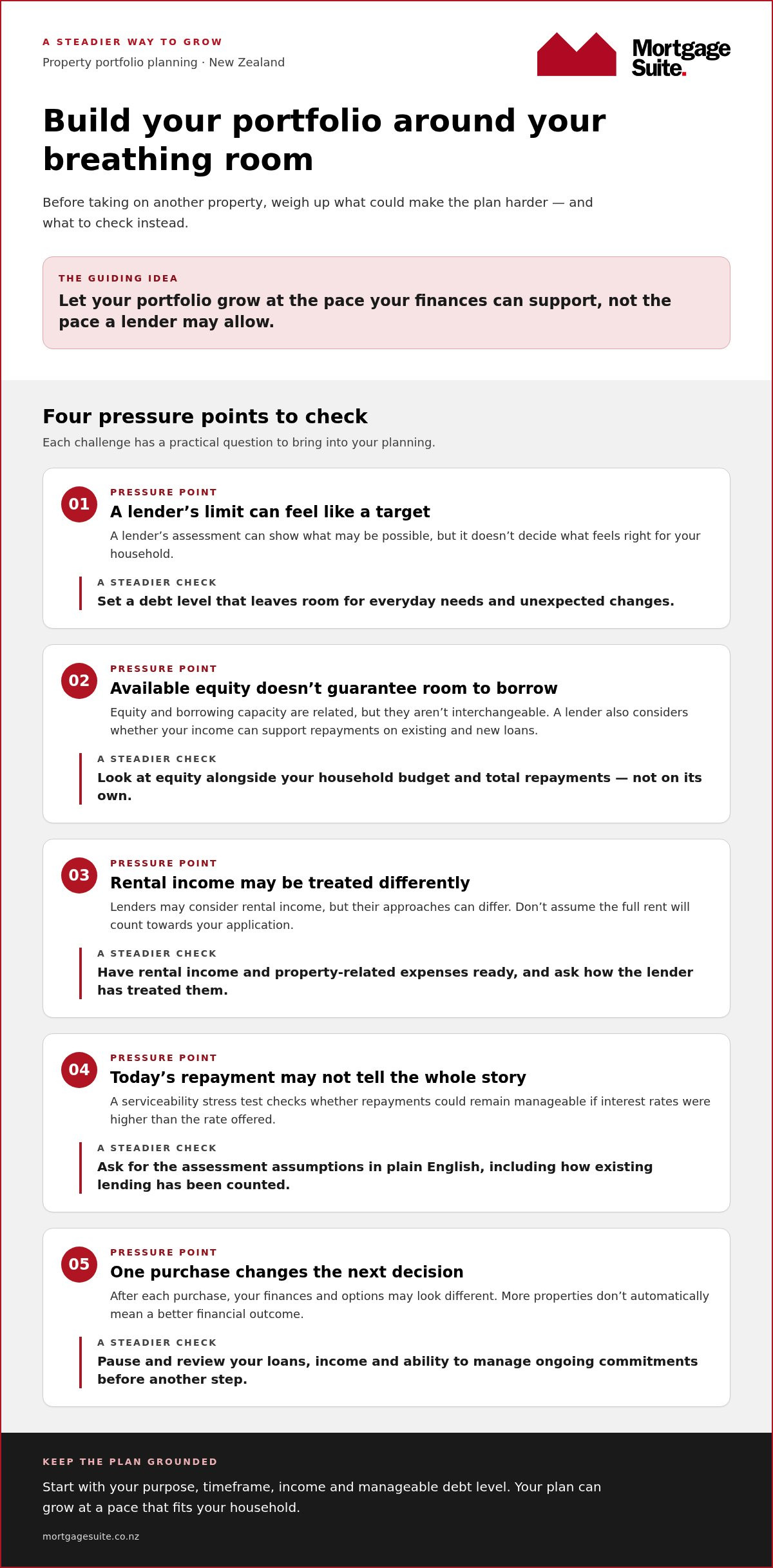
Before you start scrolling through property listings, you need a crystal-clear picture of your financial standing. The state of the New Zealand housing market in 2026 requires a more strategic approach than simply "saving a bit extra" each month. Lenders today look closely at your debt-to-income (DTI) ratio, which became a formal restriction in July 2024. This calculation compares your total debt to your gross income, and staying within these limits is just as vital as your deposit size. This first home buyer guide New Zealand helps you understand that a healthy credit score is your most valuable asset, so pay down high-interest short-term debts like car loans or buy-now-pay-later accounts before applying.

Your KiwiSaver is likely the engine room of your deposit. To make a withdrawal, you must have been a member for at least three years and intend to live in the property as your primary residence. You’ll need to leave a minimum of NZ$1,000 in your account. Timing is everything here; you should apply for your withdrawal early in the process so the funds are ready for the deposit payment upon going unconditional. While the First Home Grant was abolished in May 2024, the Kāinga Ora First Home Loan remains a powerful tool, allowing eligible buyers with specific income caps to purchase with just a 5% deposit.

If a mainstream bank says "no," don’t assume your homeownership dreams are over. Big banks often have rigid criteria that don’t account for self-employed income or slightly lower deposits. In many cases, a 2nd tier loan or alternative lending option can provide the bridge you need. These lenders often look at the bigger picture of your financial health rather than just ticking a box, making them a viable path for those who don’t fit the traditional banking mould.

Maximising Your Deposit Beyond Savings

Building a deposit often involves a "patchwork" strategy. You might combine your KiwiSaver withdrawal with a gifted deposit from family and your personal savings. It’s essential to budget for more than just the purchase price. You’ll need a "buffer" of at least NZ$5,000 to NZ$10,000 to cover legal fees, building inspections, and registered valuations. Serviceability is the lender’s assessment of whether your income can handle mortgage repayments if interest rates were to rise to a "stress test" level of 8% or 9%.

Getting Pre-Approved: Your Golden Ticket

Pre-approval gives you the confidence to make an offer the moment you find the right place. It typically lasts for 90 days, though it can be revoked if your financial circumstances change significantly, such as losing your job or taking on new debt. In New Zealand, most lenders perform a "hard" credit check during this stage, which leaves a footprint on your credit report. Having this "golden ticket" in hand shows vendors you’re a serious, qualified buyer who is ready to act.

Assembling Your A-Team: Why Expert Advocacy Matters

Surrounding yourself with the right professionals is the difference between a stressful ordeal and a smooth transition into your new home. While many resources offer a step-by-step guide to buying a home, they often miss the vital synergy between your experts. Think of your lending specialist as the conductor of an orchestra; they ensure your finance, legal, and insurance requirements all hit the right notes at the right time. This first home buyer guide New Zealand emphasises that your team should be advocates for your success, not just service providers ticking boxes.

You also need to consult your insurer before you sign a sale and purchase agreement. Banks won’t release funds without proof of insurance, and in a market where some older homes or those in high-risk zones face coverage challenges, getting an early "yes" from an insurer is non-negotiable. Similarly, a building inspector’s report is your best defence against structural failures. While a cheap, surface-level report might save you a few hundred dollars today, a comprehensive inspection can save you tens of thousands in future repairs. Trusting a veteran professional to crawl through the subfloor and check the roof cavity is an investment in your peace of mind.

Mainstream Banks vs. 2nd Tier Lenders

The "Big Four" banks have strict appetites that don’t always cater to the modern Kiwi worker. If you’re self-employed, have a smaller deposit, or possess a unique credit history, alternative lenders provide a fair go that mainstream institutions might decline. Many buyers worry that 2nd tier options are prohibitively expensive, but the interest rate gap is often smaller than you’d expect. These loans offer a pathway to homeownership when traditional doors are closed, providing a flexible solution tailored to your specific life scenario. If you’ve felt discouraged by a bank’s rejection, exploring tailored home loans could be your next logical step.

The Solicitor and the Fine Print

Your solicitor is your primary legal shield. They must review the Sale and Purchase Agreement before you put pen to paper, ensuring you aren’t caught out by restrictive clauses. Beyond the contract, they’ll help you understand the differences between freehold, cross-lease, and unit titles, which each carry different rights and responsibilities. A solicitor must meticulously check the "Title" of the property to ensure there are no hidden easements, land claims, or encumbrances that could restrict how you use your land. Their expertise prevents expensive legal headaches down the track, making them an indispensable part of your property journey.

The Property Hunt: Navigating Open Homes and Due Diligence

Walking into an open home is an emotional experience, but you must remain a clinical observer to protect your future. It’s easy to fall in love with a designer kitchen while overlooking a sagging roofline or a damp smell in the bedrooms. This first home buyer guide New Zealand recommends creating a strict "Must-Have" versus "Nice-to-Have" list before you step onto a single driveway. Your must-haves should focus on structural integrity, location, and the number of bedrooms, while cosmetics like carpet colour or light fittings stay firmly in the "nice-to-have" category. Staying focused prevents you from overpaying for a property that doesn’t actually meet your long-term needs.

The "sniff test" is your first line of defence during a walk-through. Pay close attention to fresh patches of paint that might hide mould, or a musty scent that suggests poor ventilation. Beyond the physical structure, remember that your bank is just as interested in the property type as they are in your income. Banks view the house as security for their loan. If a property is a "leaky" era build or located in a known flood zone, they may refuse to lend against it, regardless of how much you earn. Understanding the Land Information Memorandum (LIM) report is vital here, as it details everything the council knows about the land, including drainage issues and building permits.

For a deeper look into the technicalities of the process, the New Zealand government’s guide to buying a home provides an excellent framework for what to expect. However, a generic guide can’t replace the sharp eye of a seasoned professional who knows how to spot a "lemon" before you spend thousands on a full building report.

Due Diligence: Protecting Your Investment

A builders report is your most critical tool for uncovering "deal-breakers" like structural rot or unconsented additions. While toxicology and meth testing remain relevant in 2026 for peace of mind, the focus has shifted toward checking council files for unauthorised works. If a previous owner added a deck or converted a garage without consent, you could be liable for the costs of bringing it up to code or removing it entirely. Always verify that every structure on the site matches the official council records.

Property Types and Lending Restrictions

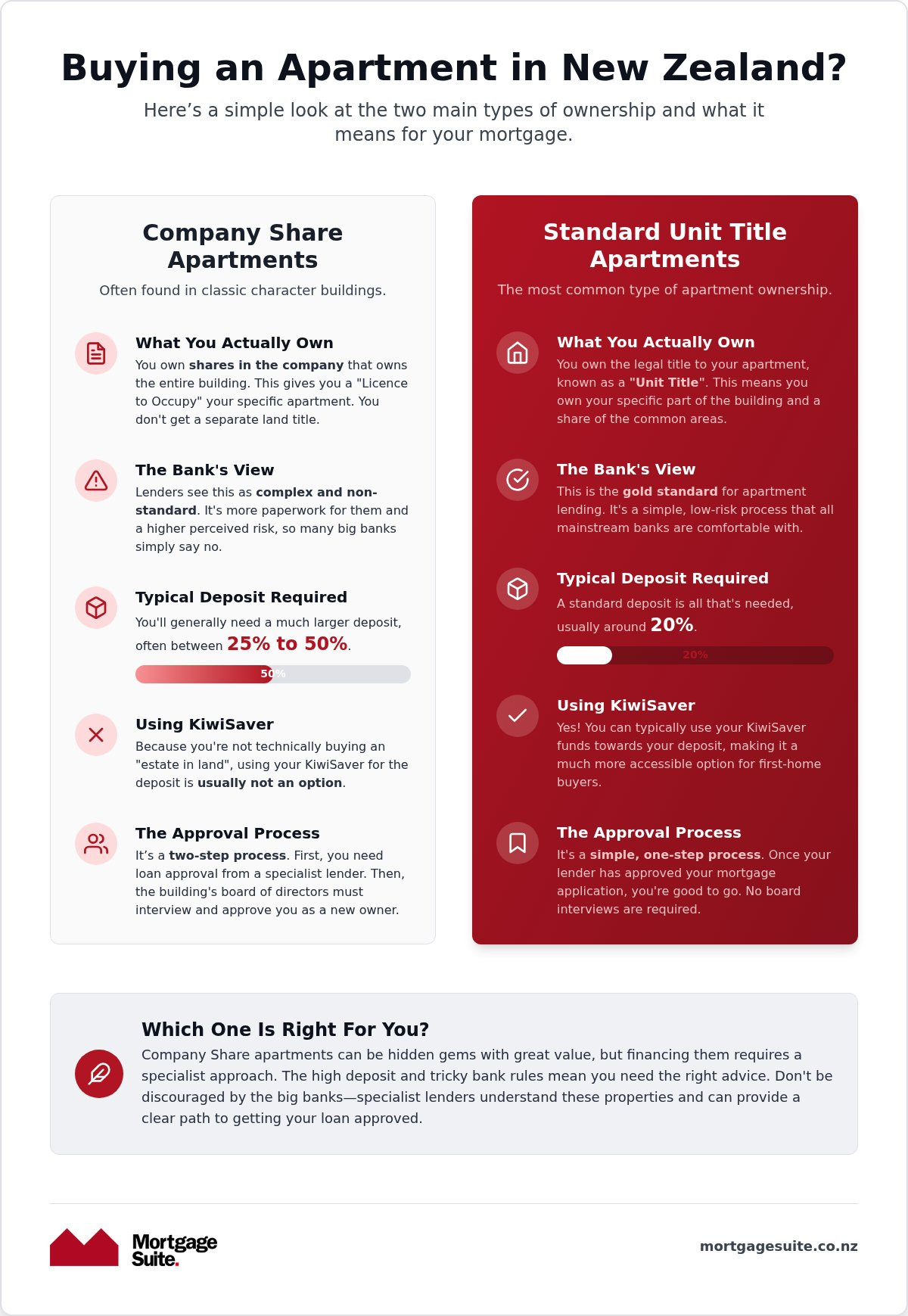
Lending rules vary significantly depending on the asset type. Apartments under 40 or 50 square metres often require a much higher deposit, sometimes up to 50%, because banks view them as higher risk. Tiny homes and off-the-plan purchases also come with unique challenges; off-the-plan buyers must be wary of sunset clauses and the risk of the property’s value dropping before completion. A lending specialist can help you vet a property’s "bankability" early, ensuring you don’t waste time on a home you can’t actually finance.

The Ultimate First Home Buyer Guide for New Zealanders in 2026

Sealing the Deal: Offers, Auctions, and Negotiations

The moment you decide to put pen to paper is when the property journey truly intensifies. It’s a high-stakes environment where emotions can cloud judgement, making it essential to have a firm strategy in place. This first home buyer guide New Zealand helps you manage these final hurdles with the poise of a seasoned investor. Your first step is to determine a maximum "walk-away" price. This is the absolute limit of what you are willing, or able, to pay. Having this figure written down prevents you from being swept up in the heat of a negotiation or the adrenaline of an auction room.

Once your price is set, you must choose between a conditional or unconditional offer strategy. A conditional offer allows you time to finalise finance or review a building report, while an unconditional offer is often more attractive to vendors because it provides certainty. If you find yourself in a multi-offer situation, remember that you usually only get one chance to put your best foot forward. There is usually no back-and-forth; you submit your highest price and best terms, then wait for the vendor to choose. Signing the agreement is just the beginning; you only reach "unconditional" status once all your specific conditions are met and confirmed in writing by your solicitor.

The Art of the Negotiation

Negotiation isn’t just about the purchase price; it’s about the entire package. If your building inspector uncovered minor issues in the previous stage of your due diligence, use those findings to justify a lower offer or request that the vendor fixes the faults before settlement. You can also use the settlement date as a bargaining chip; a vendor who has already bought another home might value a quick move-in date over a slightly higher price. For those looking at new builds, a sunset clause is a vital protection that allows either the buyer or the developer to cancel the contract if the project isn’t completed by a specific date. To ensure your offer is backed by a solid financial strategy, contact our expert lending team for professional guidance.

Winning at Auction

Auctions are inherently unconditional, so your due diligence and finance must be 100% sorted before the hammer falls. When bidding, maintain a "poker face" to keep your competitors guessing about your remaining budget. If the property is "passed in" because it didn’t meet the reserve, the highest bidder usually gets the first right to negotiate with the vendor. Ensure your deposit funds, typically 10% of the purchase price, are ready for immediate payment via electronic transfer the moment the contract is signed. This level of preparation ensures you remain in control, even in the most fast-paced environments.

Settlement and Beyond: Your Long-Term Financial Health

The journey to homeownership doesn’t end when the hammer falls; it simply shifts into a new phase of strategic management. While previous chapters of this first home buyer guide New Zealand focused on the acquisition, this final stage is about protecting your equity and ensuring your debt works for you. We believe in a partnership that extends far beyond the initial transaction. The Mortgage Suite Ltd commitment means providing advocacy that lasts the entire life of your loan, ensuring you’re never left to navigate the complexities of interest rate cycles or refinancing alone.

The Final Handover

Your pre-settlement inspection, typically conducted 48 hours before you move, is your last line of defence. This is when you verify that the vendor has met all their obligations. Check every light switch, run the taps to ensure no new leaks have developed, and confirm that all chattels, from the garage door remotes to the dishwasher, are exactly as described in the contract. Your solicitor will coordinate the transfer of funds on settlement day, usually via a secure electronic bank transfer. If the property isn’t in the agreed-upon state, your solicitor can negotiate a retention of funds to ensure repairs or cleaning are completed before the money is fully released. Ensure your insurance is active from the very start of this day to meet your lender’s requirements.

Refinancing and Future Planning

Structuring your loan is where you truly start building long-term wealth. Rather than fixing your entire balance at a single rate, consider a split structure that offers both stability and flexibility. You might fix a large portion for two years to provide budget certainty, while keeping a smaller amount in an offset account. An offset account is a powerful tool where every dollar in your linked savings account reduces the interest charged on your mortgage, effectively "paying yourself" rather than the bank. This first home buyer guide New Zealand highlights that your first house is often the springboard for a larger portfolio. By reviewing your structure annually with a professional, you can harness equity for future renovations or even your first residential investment property.

If you’re ready to move from the planning phase to a successful purchase, Talk to our experts at Mortgage Suite Ltd today. We are here to ensure your transition into homeownership is as rewarding as it is seamless, providing the steady hand you need in a fluctuating market.

Your Path to Homeownership Starts Here

Entering the property market in 2026 requires more than just a deposit; it demands a shift in mindset from fitting into a bank’s box to building a strategy around your life. This first home buyer guide New Zealand has mapped the journey from those first financial health checks to the final pre-settlement inspection. By assembling a dedicated A-team and mastering the nuances of property vetting and negotiation, you’ve moved from uncertainty to empowerment. You now understand that a "no" from a mainstream lender is often just the beginning of a more creative, 2nd tier solution tailored to your unique profile.

At Mortgage Suite Ltd, we bring over 20 years of banking and negotiation experience to your corner. As specialists in alternative lending and nationwide advocates for Kiwi buyers, we ensure your interests are protected at every turn. Secure your first home with a tailored lending strategy from Mortgage Suite Ltd. The door to your first home is waiting to be opened; let’s work together to turn that key and begin your property journey with confidence.

Frequently Asked Questions

Can I buy a house in NZ with a 5% or 10% deposit?

Yes, you can certainly purchase a home with a 5% deposit if you qualify for the Kāinga Ora First Home Loan, which is designed for eligible buyers within specific income caps. If you don’t meet those criteria, a 10% deposit is often acceptable through various 2nd tier lenders or specific bank windows. These options allow you to enter the market sooner, though you should factor in the cost of Lender’s Mortgage Insurance or low equity premiums.

How long does the KiwiSaver first-home withdrawal process take?

The KiwiSaver first-home withdrawal process typically takes between 10 and 15 working days from the moment your provider receives your completed application. It’s vital to get your paperwork in order as soon as you start looking at properties. You must ensure the funds are requested well before your settlement date, as your solicitor will need the cleared funds to complete the transaction on your behalf.

What is the difference between a mortgage broker and a lending specialist?

A lending specialist provides a direct approach to securing your home
loan offered by its lender. While both professionals help you find finance, a Mortgage
Broker often has deeper expertise in navigating complex lending options for
unique borrower profiles. They also have access to multiple lenders that your
lending specialists doesn’t have. This partnership focuses on long-term
financial health and professional negotiation rather than just a simple
transactional interaction.

What happens if my home loan application is declined by a mainstream bank?

If a mainstream bank declines your application, it’s often a sign that you need to look beyond traditional lending criteria rather than a final "no" to your homeownership dreams. We specialise in 2nd tier loans that offer a fair go for self-employed individuals or those with smaller deposits. These alternative lenders are fully regulated and provide the flexibility needed to bridge the gap when big banks’ rigid boxes don’t fit your situation.

How much do I need to budget for legal and inspection fees in NZ?

You should budget between NZ$1,500 and NZ$2,500 for legal fees and approximately NZ$500 to NZ$800 for a professional building inspection. This first home buyer guide New Zealand also recommends setting aside NZ$600 to NZ$900 for a registered valuation if your lender requires one. Having a total "purchase buffer" of at least NZ$5,000 ensures you can cover these essential due diligence costs without dipping into your actual deposit funds.

Is it better to have a fixed or floating mortgage rate as a first home buyer?

Most first-home buyers find that a fixed mortgage rate is better for the majority of their loan because it provides certainty for their weekly or fortnightly budget. However, a "split" structure that keeps a small portion on a floating or offset account can be highly effective. This allows you to make extra repayments without penalties while protecting you from the immediate stress of fluctuating interest rates on your main balance.

Can I use the First Home Grant for an existing house or only new builds?

The First Home Grant was officially abolished in May 2024, so it’s no longer available for either existing houses or new builds. While this cash grant is gone, you can still utilise the Kāinga Ora First Home Loan and your KiwiSaver withdrawal to reach your goals. These remaining tools are the primary ways the government supports Kiwis in overcoming the deposit barrier in the current property market.

What is a 2nd tier lender and are they safe to use in New Zealand?

2nd tier lenders are non-bank financial institutions that are safe, reputable, and strictly regulated under New Zealand law. They’re an excellent alternative for borrowers who don’t fit the standard "PAYE employee" mould or those who have been declined by mainstream banks. Because they have different appetites for risk, they can often provide a pathway to homeownership through more personalised assessment and flexible lending terms.

Article by

Krish Krishna

Experienced Financial Adviser with over 46 years of Banking and Mortgage broking experience and over $2.0 Billion in loan settlements.