
Gifting a Deposit for a House in NZ: How It Affects Buying

A gifted deposit can help you buy a home in New Zealand: lenders accept gifts, usually with a signed declaration that the money doesn’t need to be repaid. Gifting a deposit for a house in NZ may help you reach the common 20 per cent deposit target, but it won’t increase your income or change how a lender assesses your ability to manage repayments.

It’s understandable to feel unsure about the paperwork and what family support means for your application. A gift, a family loan and a guarantee are treated differently, so be clear about which arrangement applies before relying on the funds.

This guide explains how lenders assess each option, what documents they may request and how relationship property rules can affect a family contribution. You’ll also learn how a gifted deposit differs from borrowed money, why lenders need to know where the funds came from, and what to consider if a mainstream bank’s criteria don’t fit your circumstances.

Key Takeaways

  • A family gift may help bridge a deposit shortfall, but lenders still assess your income and ability to manage repayments.
  • Be prepared for the lender to trace the gifted funds and ask for a signed declaration confirming they don’t need to be repaid.
  • Whether family money is a gift, a loan or a guarantee affects your application in different ways, especially when repayments or family property are involved.
  • Gift duty was abolished in New Zealand for gifts made on or after 1 October 2011, but relationship property and asset testing may still matter.
  • If a mainstream bank’s criteria don’t suit your circumstances, another lending option may be worth exploring.

Deposit, debt-to-income and affordability limits

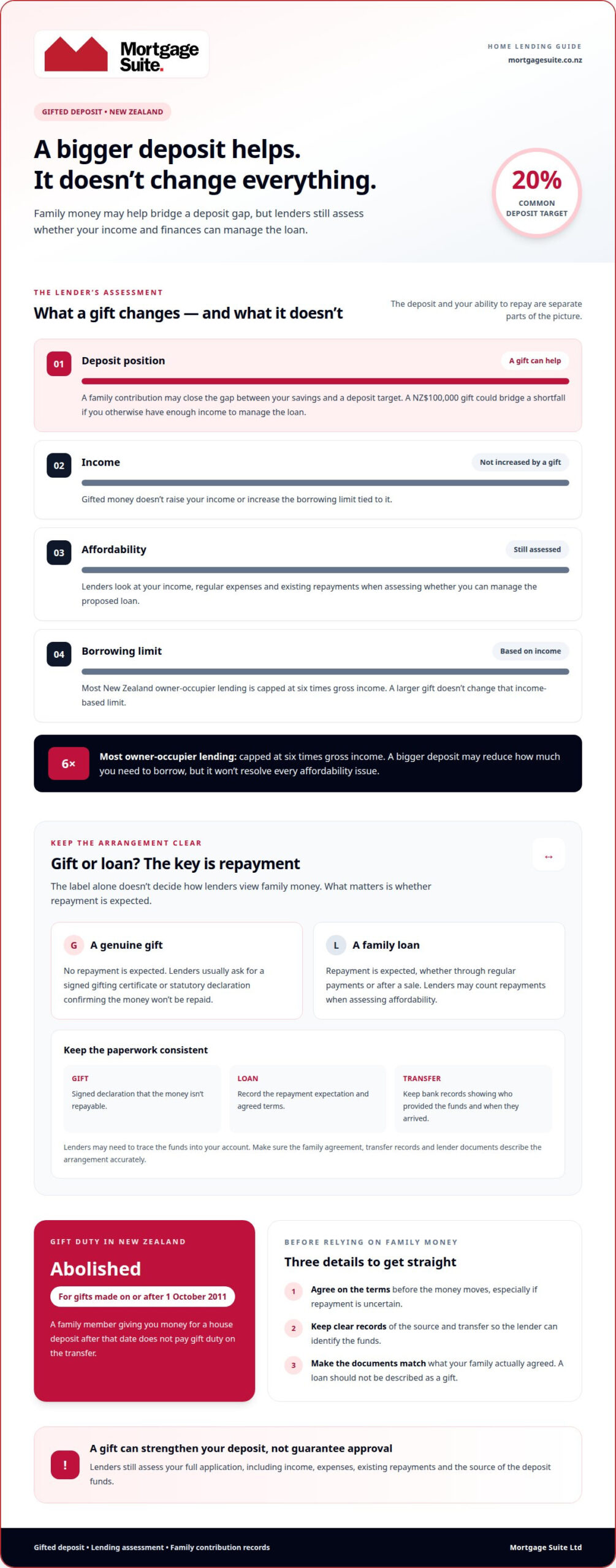
A family contribution can help close the gap between your savings and a deposit target. In New Zealand, 20 per cent is a common deposit target, but lenders assess each application against their own criteria. A NZ$100,000 gift, for example, could bridge a shortfall for a buyer who otherwise has enough income to manage the loan. It doesn’t automatically mean the lender will approve the full amount you hope to borrow.

Your deposit and your ability to repay are separate parts of a lender’s assessment. Most New Zealand owner-occupier lending is capped at six times gross income. A larger gift may improve your deposit position, but it doesn’t raise your income or increase the borrowing limit tied to it. Lenders also assess affordability, including your income, regular expenses and existing repayments. A gift can help with the upfront contribution without changing these other parts of your application.

For example, a lender may see a buyer with a larger deposit but still assess the proposed repayments against their income and commitments. If your deposit includes family money, the lender needs to trace the funds into your account. Keep the transfer record and details of its source so the contribution is easy to identify during the application. Some lenders may also expect you to contribute savings of your own. Requirements can vary depending on the lender and the size of the gift.

Before relying on a gifted deposit, separate the deposit question from the affordability question. A mortgage repayment calculator can help you explore how different loan amounts affect estimated repayments. Treat the result as a planning aid, not a lender’s assessment. Your actual borrowing capacity depends on the full application, including income and financial commitments. A bigger deposit may reduce the amount you need to borrow, but it cannot resolve every affordability issue.

Family arrangements can change after money has been advanced. If parents later expect repayment, the contribution may need to be recorded as a debt rather than described as a gift. In New Zealand, a deed of acknowledgement of debt or a section 21 agreement can be made after parental money has been advanced, provided the relationship is still intact. The document should reflect what the family actually agreed, including whether repayment is expected. That distinction matters because a genuine debt can affect the lender’s view of your commitments.

Talk through the arrangement before the funds move, especially if there’s any uncertainty about repayment. Clear records help the lender understand the deposit’s source and nature, and help family members avoid different assumptions later. The practical distinction is simple: a gift isn’t expected to be repaid, while a loan creates an obligation. Make sure the transfer record and agreement match the arrangement.

Is there gift duty in New Zealand?

No. New Zealand gift duty was abolished for gifts made on or after 1 October 2011. A family member giving you money for a house deposit after that date does not pay gift duty on the transfer.

That answers the tax question, but it doesn’t establish whether the money is genuinely a gift. The key difference is whether the recipient is expected to repay it. If a parent transfers money with no repayment expected, it’s a gift. If the parent expects repayments, it’s a loan, even if the family calls it a gift.

For a home loan application, describe the arrangement accurately. New Zealand lenders usually ask for a signed gifting certificate or statutory declaration confirming the money won’t be repaid. This helps distinguish a deposit contribution from another debt that could affect your ability to meet repayments.

For example, imagine a parent transfers funds on the understanding that the buyer will repay them after selling another asset. That expectation makes it a loan, not a gift. By contrast, a transfer with no repayment arrangement is a gift. A written record can prevent confusion if family members later remember the agreement differently.

Before the transfer, agree on the terms and keep the supporting records together. These may include:

  • Gift: a signed declaration that the money is not repayable.
  • Loan: a record of the repayment expectation and agreed terms.
  • Transfer: bank records showing who provided the funds and when they reached the buyer.

These records matter even though gift duty no longer applies. A lender may need to trace the deposit funds and assess any repayments as part of your financial commitments. If the paperwork says “gift” but the family expects repayment, the mismatch may raise questions during the application.

Keep the description consistent across the family agreement, bank transfer records and lender documents. If the money is a loan, describe it as one rather than signing a declaration saying it won’t be repaid. A clear distinction helps everyone understand the arrangement and gives the lender an accurate picture of your deposit and debts.

Was it a gift or a loan, and why does it matter?

A genuine gift can strengthen your deposit without adding a repayment to your monthly budget. A family loan is different: New Zealand lenders may count its repayments when assessing affordability, potentially reducing the amount they’re willing to lend. The label alone doesn’t determine the arrangement. What matters is whether repayment is expected.

For example, if a parent transfers money for the buyer to keep, with no repayment expected, that’s a gift. If the parent expects regular payments or repayment after a sale, it’s a loan. A gift may increase the deposit available, but it doesn’t increase your income or change the lender’s assessment of whether you can afford the repayments.

That distinction affects both the loan application and the family’s expectations. If a contribution is repayable, the lender needs to account for that obligation alongside the proposed mortgage and other commitments. A family loan used to acquire the family home is also a relationship debt under section 20 of New Zealand’s Property (Relationships) Act 1976. The arrangement can therefore matter if the couple later separates.

The home itself has separate relationship-property rules. Under section 8 of the Property (Relationships) Act 1976, the family home is relationship property regardless of when it was acquired or who paid for it. Section 10(4) treats the family home and family chattels as relationship property unless a Part 6 agreement provides otherwise. So, a parent’s gift towards the deposit doesn’t automatically make the home the recipient’s separate property.

Section 10 of the same Act generally treats property gifted to one partner by a third person as separate property. But that treatment can change if the gift becomes intermingled with relationship property so extensively that keeping it separate would be unreasonable. In practice, money used to buy a shared family home can raise different questions from a gift kept separately.

Consider a parent gifting funds to one adult child, who then uses them to purchase a home with their partner. The gift may be separate property, while the family home remains relationship property under section 8. The gift’s source and the property’s legal status are not necessarily the same thing.

If parents intend the contribution to be repaid or protected, the family should record that intention clearly. A section 21 agreement under the Property (Relationships) Act 1976 can set out how property is treated between partners. Clear terms help distinguish a gift from a loan and explain how the family expects the contribution to be treated.

Can you use a gifted deposit to buy a house in NZ?

Yes, New Zealand lenders accept gifted deposits, but a family contribution can have effects beyond your mortgage application. How it’s transferred, recorded and used may matter for relationship property and Residential Care Subsidy asset testing.

Gifts and relationship property

A parental gift is money given without an expectation of repayment, but using it for a family home doesn’t automatically make the home separate property. Under section 10 of the Property (Relationships) Act 1976, a third-party gift to one partner is generally separate property unless it becomes intermingled with relationship property so extensively that treating it separately would be unreasonable.

This distinction matters because section 8 treats the family home as relationship property, regardless of when it was acquired or who paid. For example, a parent might give money to one adult child, who then uses it to buy a home with their partner. The gift and the home can be treated differently under the Act.

Transferring and sourcing the deposit

For lending checks, tracing a gift means showing where the funds came from and how they reached your account. Use a traceable bank transfer from the family member’s account into yours, and keep the transfer records and gift declaration.

A cash deposit or several unexplained transfers can make the source harder to follow. A clear record linking the giver, transfer and amount helps the lender understand where the deposit came from. The lender may also ask for a signed declaration confirming the money isn’t expected to be repaid.

Residential Care Subsidy asset testing is separate from mortgage approval, and gifts may be assessed differently depending on when they were made. For gifts made more than five years before applying, the Ministry of Social Development – Work and Income will not count up to NZ$27,000 per year.

For gifts made during the five years before an application, Work and Income will not count up to NZ$8,500 in assets gifted each year. The stated allowance across that period between a person and their partner is NZ$42,500. These asset-testing allowances don’t determine whether a lender accepts the gift as a deposit.

Keep the gift’s purpose and transfer records together, especially if you’re also considering a Residential Care Subsidy application. For instance, a bank statement showing the transfer, alongside a declaration describing it as a non-repayable gift, provides a clearer record than an unexplained deposit. If the funds were actually lent, describing them as a gift could misrepresent the family arrangement.

Clear records help distinguish the deposit’s source from how it may be treated under relationship property or subsidy rules. A gift can support a home purchase, but it doesn’t by itself determine who owns the home or how a future asset assessment will treat the transferred money.
Gifting a Deposit for a House in NZ: How It Affects Buying

Differences between a gift, family loan and guarantee

If you’re gifting a deposit for a house in NZ, first decide whether your family is giving you money, lending it or offering property as security. A gift adds money to the deposit, a family loan must be repaid, and a guarantee supports the lending without transferring cash to the buyer.

A gift is money given without an expectation of repayment. It can help bridge a deposit shortfall, but it doesn’t increase your income or change the lender’s assessment of whether you can afford the repayments. For example, a parent may transfer savings to their child, who then puts them towards the purchase. A lender may ask for a signed declaration confirming the contribution isn’t repayable.

A family loan provides funds that the buyer agrees to repay. The lender may include those repayments in its affordability assessment, which can reduce the amount it’s prepared to lend. If parents expect regular payments after helping with the deposit, those payments sit alongside the proposed home loan repayments. Calling the transfer a gift won’t change the debt if repayment is expected.

A family guarantee works differently. A family member offers property as additional security for the home loan instead of giving the buyer cash. This may remove the low equity margin on a small deposit, but it doesn’t increase the buyer’s income or provide extra deposit money. The supporting family member’s property is involved, so the arrangement has implications beyond the buyer’s own finances.

These options can all involve family support, but they create different obligations:

  • Gift: money contributes to the deposit and isn’t expected to be repaid.
  • Family loan: the buyer receives money but has an obligation to repay it.
  • Guarantee: family property supports the lending, with no deposit cash transferred.

Consider a buyer whose family can help but whose deposit is short. A gift may increase the deposit contribution. If the family needs its money returned, a loan may be more accurate, although repayments can affect borrowing capacity. If the family has property but can’t provide cash, a guarantee may be worth discussing with the lender.

Before gifting a deposit for a house in NZ, make sure the arrangement reflects what everyone intends. The paperwork, transfer and lender assessment should consistently show whether the funds are repayable or property is being offered as security. A mismatch can confuse the application and strain family relationships later.

If you’re weighing these options against your borrowing plans, talk through your home-loan options before settling on an arrangement.

Mortgage Suite Ltd

Mortgage Suite Ltd can help you understand how a family gift, loan or guarantee fits your home-buying plans. If you’re buying your first home, its home loans for first-home buyers can be considered alongside your deposit and borrowing needs. Mortgage Suite Ltd also offers residential investment property loans, business loans and property development loans.

If you’re unsure how to describe family support to a lender, or a mainstream bank’s criteria don’t fit your circumstances, Mortgage Suite Ltd can help you consider suitable lending options. A decline from one bank doesn’t automatically close off every path, although each lender assesses applications differently. Talk through your plans, the family contribution and any repayment expectations with Mortgage Suite Ltd.

Contact Mortgage Suite Ltd to discuss your situation and possible next steps.

Plan your next move with confidence

Before making an offer on a home, include the family contribution in your wider plan. Talk openly about what everyone expects, how the arrangement fits with your future repayments and whether it leaves room for changes in your circumstances. A clear conversation now can help you make decisions with less pressure later.

If you’re considering gifting a deposit for a house in NZ, focus on finding a lending approach that fits your goals, not just putting the deposit together. Mortgage Suite Ltd can help you work through your options and consider how family support fits your borrowing plans. If your situation feels complicated, a mainstream bank’s response doesn’t have to be the final word.

Contact Mortgage Suite Ltd to discuss your home-buying plans. A considered next step can help you move towards a home that works for you.

Frequently Asked Questions

What does it mean for the parents later?

If parents expect repayment, that debt may affect how relationship property is calculated later. Section 20D of New Zealand’s Property (Relationships) Act 1976 provides for relationship debts to be deducted before the net relationship property pool is divided. This means the family’s records can matter beyond the mortgage application. For instance, a parent’s documented claim may be relevant if the couple separates and their property is divided.

What if the money has already gone into the house?

There may still be options for documenting the arrangement, but timing and the couple’s circumstances matter. A section 21 agreement can set out how partners intend property to be treated. However, a New Zealand court may set aside such an agreement if giving effect to it would cause serious injustice. That makes independent legal advice useful before signing, particularly where the home has already been bought or family money has been used.

What counts as a gifted house deposit in New Zealand?

It’s money provided towards a home purchase without an obligation to repay it. The giver might contribute funds for a particular purchase rather than provide money for general spending. For example, parents might provide a sum specifically for their child’s share of a home bought with a partner. Make the purpose and terms clear, especially if the buyer’s circumstances change before the purchase is completed.

What gift letter does a New Zealand bank require for a home loan deposit?

There isn’t one universal letter format for every lender. A clear letter can identify the giver and recipient, state the amount and purpose of the contribution, and explain whether the giver expects anything in return. Keep the wording consistent with the family’s actual agreement. If the buyer’s plans change, such as deciding to purchase with a partner, the original letter may no longer fully describe the arrangement.

Can gifted funds count toward the minimum deposit for an NZ mortgage?

Gifted funds can contribute to the deposit, but the lender’s requirements determine how they’re treated in a particular application. Before committing to a purchase, consider whether the lender’s conditions fit the timing and form of the family contribution. For example, a gift intended for one buyer may need a different explanation if that buyer later purchases jointly. The stated source of the deposit should fit the purchase being financed.

Do NZ banks accept gifted deposits from parents, relatives, or non-family members?

New Zealand banks accept gifted deposits, but the giver’s relationship to the buyer may be relevant to how the lender reviews the application. Be accurate about who provided the funds, particularly if they came from a family friend or someone outside the immediate family. For example, don’t describe a contribution as parental support if someone else supplied it. Clear, consistent details help avoid confusion about the transaction.

How does a gifted deposit affect mortgage approval and servicing checks in NZ?

A gift can increase the deposit available, but it doesn’t answer every question in a mortgage application. The lender also considers whether the proposed purchase fits the buyer’s wider financial position. If the gift comes with conditions, such as an expectation that the buyer will repay it after a future event, those terms may affect how the lender assesses the arrangement. Make any conditions explicit rather than relying on family assumptions.

Are there tax, gift duty, or benefit implications when gifting money for a house deposit in New Zealand?

Gift duty no longer applies to gifts made on or after 1 October 2011, but a transfer can still matter for benefit-related asset assessments. If the giver may apply for a Residential Care Subsidy, the timing and records of earlier gifts can be relevant. Keep a dated record of the transfer and its purpose. That gives the giver clearer information when considering how a future application could treat their assets.

Article by

Krish Krishna

Experienced Financial Adviser with over 46 years of Banking and Mortgage broking experience and over $2.0 Billion in loan settlements.

Getting on the Property Ladder with a Low Income in NZ

Could a lower income still be enough to buy your first home? If you’re thinking about getting on the property ladder with low income nz, it’s understandable to worry that repayments will stretch your budget too far. A modest deposit or a declined application can add to that uncertainty, but neither tells the whole story.

Lenders consider more than your income. They’ll look at your regular spending, existing debts and whether you could manage repayments if interest rates rose. Their criteria can differ, so a “no” from one bank isn’t necessarily the end of your options.

This guide explains how lenders assess affordability and what practical steps could strengthen your application. You’ll learn how to review spending and debt, compare deposit and co-borrowing pathways, and consider how your property choice may affect a lender’s decision. Mortgage Suite can help you understand lender fit and negotiate on your behalf. There’s no promise of an outcome, but a clearer picture of your options can make your next move feel more manageable.

Key Takeaways

  • Getting on the property ladder with low income nz depends on more than your pay. Lenders also consider debts, spending and whether repayments look manageable.
  • A serviceability stress test checks how your budget might cope if lending conditions change. Plan around repayments you could sustain.
  • Compare the trade-offs of a larger deposit, low-deposit lending, family support or buying with another borrower before choosing a pathway.
  • Organise your financial records, review regular commitments and build a realistic budget to present a clearer home loan application.
  • A broker can help you understand lender fit and compare bank and private lender options, without guaranteeing approval.

Getting on the property ladder with a low income in NZ: what makes it possible?

Saving a deposit while paying rent, bills and everyday expenses can feel like a tough balancing act. Your first home doesn’t have to be perfect or permanent. The aim is to find a property you can afford to maintain and repay over time, without leaving your household stretched to breaking point.

For Kiwis, getting on the property ladder with low income nz isn’t decided by one salary figure. Lenders consider your income alongside your deposit, regular spending, debts and the property you want to buy. The wider context of housing affordability in New Zealand helps explain why the process can feel challenging, but your application is assessed on its full financial picture.

What lenders look at beyond your income

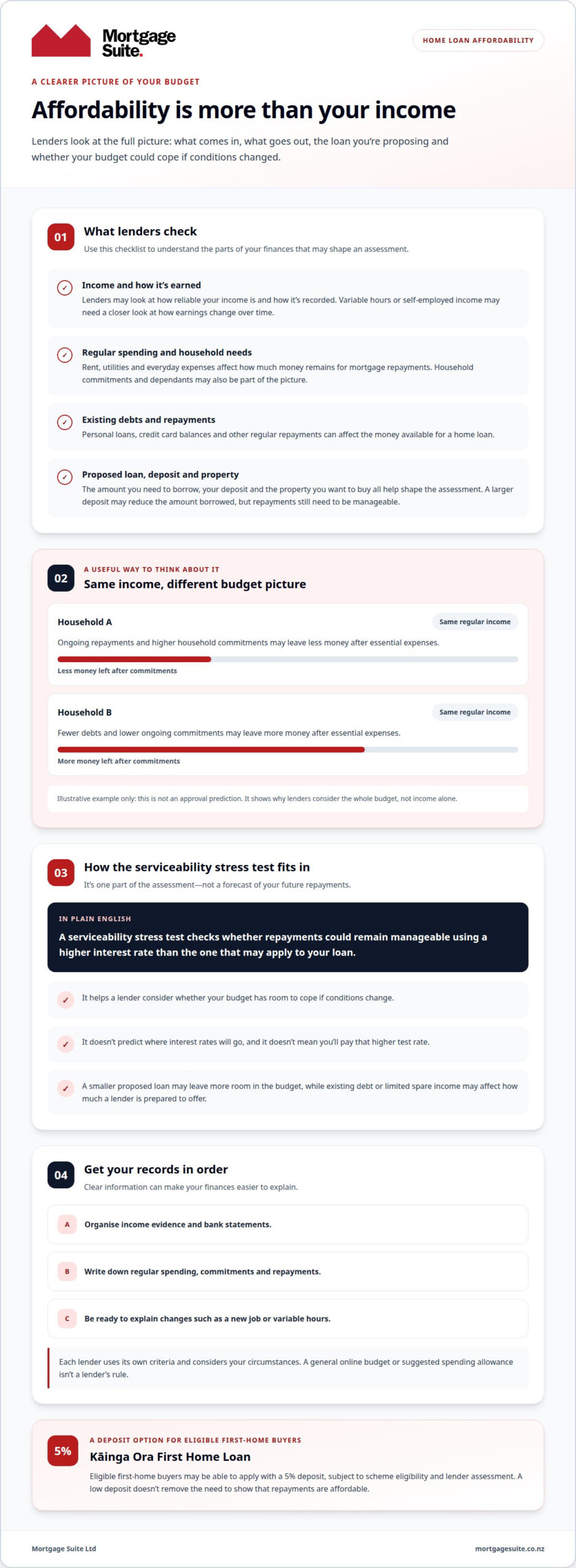
Lenders want to understand how reliable your income is and how much of it is already committed. They may look at your employment pattern, regular household expenses, debt repayments and the loan repayments you’re proposing. A steady salary is one part of the picture. Variable hours or self-employed income may need a closer look at how earnings are recorded and how they change over time.

Two households with the same income can receive different affordability assessments. One may have fewer debts and lower ongoing commitments, while the other supports dependants or has regular repayments to manage. The property matters too, because the amount you need to borrow and the lender’s view of the property affect the application. No single income level guarantees approval or rules it out.

Why a smaller deposit is only part of the picture

Your deposit and your ability to manage repayments answer different questions. The deposit affects how much you need to borrow and whether the lender’s criteria allow the proposed loan. Repayment affordability is about whether your income can support that loan alongside your other commitments. A larger deposit may reduce the amount borrowed, but you’ll still need to show that repayments are manageable.

Low-deposit lending may suit some first-home buyers, depending on the lender’s criteria, the property and your circumstances. A modest deposit doesn’t automatically close the door, but it doesn’t mean every option will fit. Consider the purchase as a whole: the loan size, ongoing repayments and room in your budget for everyday needs. Mortgage Suite’s mortgage calculator can help you explore how different repayment settings may affect your budget, though it can’t determine a lender’s decision.

For a closer look at first-home lending and deposit pathways, see Home Loans for First Home Buyers in New Zealand: 2026 Guide. Rather than asking whether your income is “high enough” on its own, start by working out what you could sustainably afford and which lender may assess your circumstances fairly.

How lenders assess affordability when your income is limited

A lender’s assessment goes beyond whether your income looks steady on paper. The lender considers what comes in, what regularly goes out, what you already owe and what repayments a new home loan would add. This gives them a fuller picture of whether the proposed loan could fit your circumstances.

Income, spending and existing commitments

Lenders may consider how your income is earned and recorded, along with regular household spending and debt repayments. Rent, utilities and everyday needs affect the money left for a mortgage. Existing commitments, such as personal loans or credit card balances, may also shape the assessment. The aim is to understand your actual financial position, not judge your spending choices.

Clear records make your finances easier to explain. Keep income evidence, bank statements and details of regular repayments organised. Be ready to explain changes such as a new job or variable hours. Don’t assume a general online budget or suggested spending allowance is a lender’s rule. Each lender assesses applications using its own criteria and your circumstances.

Illustrative household example: Imagine two households earning the same regular income. One has ongoing repayments and higher household commitments; the other has fewer debts and more money left after essential expenses. Their borrowing assessments may differ, even though their incomes match. This isn’t an approval prediction. It shows why a lender looks at the whole budget.

How a serviceability stress test affects borrowing

A serviceability stress test is a hypothetical repayment assessment using a higher interest rate than the one that may apply to your loan. It helps the lender consider whether repayments could remain manageable if conditions changed. It doesn’t predict where interest rates will go or mean you’ll pay that higher test rate. It’s one way to check whether your budget has room to cope with a change.

For a lower-income household, the proposed loan size can be particularly relevant. A smaller loan may leave more room in the budget, while existing debt or limited spare income may affect how much a lender is prepared to offer. The lender also considers the deposit and property, so the stress test isn’t the only factor.

Eligible first-home buyers may be able to apply for a low-deposit loan through the Kāinga Ora First Home Loan, which allows a 5% deposit subject to scheme eligibility and lender assessment. That deposit option doesn’t remove the need to show that repayments are affordable.

Before discussing lender fit, organise your income and debt records and write down your regular commitments. The How to Qualify for a Home Loan in NZ guide offers a useful qualification checklist. Understanding these moving parts can help you plan for getting on the property ladder with low income nz without treating one lender’s decision as the final word.

Which first-home pathways may suit a lower income in NZ?

There isn’t one route that suits every first-home buyer. A larger deposit, low-deposit lending, help from family or buying with another person can each change what’s possible, but they also bring different responsibilities. The right fit depends on your household budget, the property you’re considering and the lender’s criteria. Compare each option as part of a plan you could manage over time, not just by how quickly it might lead to a purchase.

Low-deposit lending and the First Home Loan

Saving a larger deposit can reduce how much you need to borrow, but it may take longer and requires balancing saving with everyday commitments. Low-deposit lending may offer another route for eligible buyers, although lenders still assess repayment affordability and the property. A smaller deposit doesn’t guarantee a loan or mean every property will be suitable security.

The Kāinga Ora First Home Loan is a scheme administered by Kāinga Ora – Homes and Communities, with its own eligibility requirements. Check the current criteria before planning around it, as they may change. Compare the likely repayments and your budget as carefully as the deposit requirement. Getting into a home only helps if the loan remains manageable.

Family support and buying with another person

Family help can take different forms, such as a gift or a loan. Agree clearly on whether the money must be repaid, when repayment is expected and how it could affect the family member’s own plans. A shared understanding can help protect relationships and make the source of funds clear during an application. Family support isn’t essential to exploring other pathways.

Buying with a partner, relative or friend can bring more income and savings into the application. It also means making decisions together about the property, repayments and what happens if one person wants to sell or can no longer contribute. Put your agreement in writing and get independent legal advice about ownership arrangements before committing.

Some shared loans involve joint and several liability. In plain English, each borrower can be responsible for the full debt, not only their agreed share. If another borrower misses repayments, the lender may still expect you to meet the loan obligations. Make sure you both understand this responsibility and can discuss difficult scenarios openly.

A sensible plan for getting on the property ladder with low income nz starts with comparing trade-offs, not assuming one option is automatically best. Saving more may mean waiting; family support needs clear terms; and co-buying requires trust and careful agreements. Low-deposit schemes have eligibility rules, and lenders assess each application on its circumstances. Choose a pathway that fits your financial position and leaves room for everyday needs, rather than stretching your budget to reach a deposit or purchase sooner.

Getting on the Property Ladder with a Low Income in NZ

How to strengthen a low-income home loan application

A stronger application starts with a clear picture of what you earn, what you owe and what you could comfortably repay. You don’t need to make your finances look perfect. Present them accurately so the lender can assess your situation and discuss suitable options.

Work through these steps before applying:

  1. Map your finances. List your regular income, household spending, debt repayments and savings. Include everyday needs such as food, transport and bills, and leave some room for changing circumstances.
  2. Gather your records. Put recent income information, bank statements and details of regular commitments in one place. A clear, consistent set of records can help explain your position.
  3. Review what you owe. Check that your records reflect current balances and repayments. If you spot an error or an unclear transaction, find out what it relates to before the lender assesses your application.
  4. Discuss lender fit. Share your goals and financial position before settling on a borrowing target. Different lenders may assess an application differently, and a mainstream-bank decline isn’t necessarily the end of the conversation.

Get your income and financial records organised

Bring together evidence that reflects how you’re actually paid, such as payslips or records of contract and self-employed income. If your hours or earnings vary, describe that pattern plainly and provide records that show it. Don’t present a strong month as guaranteed income. If your work or income has changed, explain when and how, rather than leaving the lender to guess.

Check that your stated commitments match your records. A missed payment, an unfamiliar transaction or a debt that has been repaid may need context. Clear information won’t guarantee approval, but it can help the lender assess your application accurately.

Choose a realistic next step before applying

Think about repayments that would fit your actual household budget, not just the largest borrowing figure you might be offered. Include regular bills and everyday spending, and leave breathing room for unexpected household needs. Mortgage Suite’s mortgage calculator can help you estimate repayments and compare different loan amounts. Treat the result as a planning guide, not a lender decision.

A headline interest rate is only one part of a home loan. The loan structure, repayment settings and fit with your plans matter too. Before making an offer or choosing a loan, discuss how your income pattern, deposit and preferred property may affect lender options. This can help you set a sensible borrowing goal and identify what information to prepare next.

If you’d like support weighing up those details, talk through your home loan options with Mortgage Suite. A personal discussion can help you understand lender fit and possible next steps, without promising a particular outcome. Preparation won’t remove every hurdle, but it can make getting on the property ladder with low income nz feel more considered and manageable.

How Mortgage Suite can help you explore a home loan on a lower income

Working out which lender may suit your circumstances can be difficult when your income is modest or varies. Mortgage Suite starts by understanding what you want to achieve and how your finances work, then discusses lender options that may fit. You’ll get a clearer view of borrowing capacity, deposit requirements and property suitability, so you can consider a practical next step without feeling judged.

What a mortgage broker can do when income is tight

A broker can help you understand how different lenders may view your income, commitments and deposit. Mortgage Suite works with bank and private lenders, including non-bank options, so you can consider lender fit beyond a single bank’s assessment. That doesn’t mean every lender will be suitable or that an application will be approved.

Mortgage Suite can negotiate with lenders on your behalf, presenting your circumstances and seeking terms that may suit your needs. Negotiation is support, not a promise of approval. Founder Krish Krishna began Mortgage Suite in 2000 after 18 years in banking, bringing experience across lending decisions and borrower situations to the conversation.

A straightforward way to get started

You don’t need every detail sorted before discussing your options. Share your goal, income pattern, deposit position and regular commitments as clearly as you can. If something has changed or feels complicated, explain it openly. A useful discussion starts with your real circumstances, not an assumption that every borrower has the same path.

Together, you can talk through a manageable borrowing goal, the sort of property that could fit and which bank or non-bank lending options may be worth considering. For Kiwis, getting on the property ladder with low income nz isn’t about chasing the largest possible loan. It’s about understanding your choices and weighing them against repayments and household needs.

Mortgage Suite’s service is free of charge with no obligation. You can also read Mortgage Suite reviews to learn about other clients’ experiences. A mainstream-bank decline doesn’t necessarily end the conversation, though no broker can guarantee a lending outcome.

If you’re ready to talk through your circumstances and possible next steps, Discuss your home loan options with Mortgage Suite.

Take your next step with a clear plan

Your first step doesn’t have to be a mortgage application. It could be deciding what kind of home would work for your household, setting a repayment amount you’re comfortable with or listing what you’d like to understand before speaking with a lender. A clear goal can make the choices ahead feel less daunting.

Getting on the property ladder with low income nz is a process, not a test you have to pass in one go. If you’re not quite ready to apply, use what you’ve learned to shape a plan and revisit it as things change. If you’re ready to explore your options, a conversation can help you understand what information to prepare and what a sensible next move could look like.

Discuss your home loan options with Mortgage Suite and take the next step at a pace that feels right for you. Your path may take time, but you don’t have to work it out alone.

Frequently Asked Questions

Can I buy a house in NZ on a low income?

It may be possible, but your income alone doesn’t decide whether a lender will consider your application. They’ll look at your regular commitments, existing debt, deposit and proposed repayments. Criteria differ between lenders and can change. Start by mapping your household budget, then consider what type of property and loan size may fit it. A smaller first-home goal could be worth exploring if it supports more manageable repayments.

What is a low-deposit home loan in New Zealand?

A low-deposit home loan lets a buyer contribute a smaller share of the property’s value than a lender may usually expect. It isn’t automatically available to every buyer. Lender criteria, the property and your ability to manage repayments all count. Before planning around a particular option, understand its current requirements and how the deposit could affect loan terms and repayments, not just whether it helps you make an offer sooner.

Can I get a Kāinga Ora First Home Loan if I have a low income?

A low income alone doesn’t confirm eligibility or rule you out. The Kāinga Ora First Home Loan has specific requirements, and the lender still considers whether repayments appear manageable for your circumstances. Check the current scheme information on the Kāinga Ora website before making plans around it, as eligibility rules can change. You can then discuss your income, household situation and intended property with Mortgage Suite to consider whether it may be a suitable route.

Does a small deposit mean I cannot get a home loan?

Not necessarily. Some lending pathways may consider buyers with a smaller deposit, but the lender’s current criteria and your overall financial position matter. The property and loan structure can also affect the decision. Rather than assuming one deposit rule applies to everyone, work out what repayments could fit your budget and compare how different deposit levels might change the options available. A smaller deposit doesn’t guarantee approval.

Can my family help me get onto the property ladder?

Family support may help, but agree on the arrangement before including it in a home-buying plan. Clarify whether support is a gift or must be repaid, and what expectations come with it. The lender may need to understand the arrangement, so explain it accurately. Talk through how it could affect everyone’s finances and future plans. Family assistance can support an application, but it doesn’t guarantee a loan.

Can I buy my first home with another person if my income is low?

Buying with someone else may make a joint application possible, but the lender assesses the applicants’ combined circumstances and commitments. Before applying, agree how you’ll handle ownership, repayments, household responsibilities and a change in plans, such as one person wanting to sell. Get legal advice about documenting ownership. Also understand whether each borrower could be responsible for the full loan, not only their intended share.

How can I improve my chances of getting a home loan on a low income?

Start by setting out your income, regular spending, debts and savings, then gather records that support what you’ve listed. Check that the information is accurate, especially if your income varies or a commitment has recently changed. Choose a borrowing goal that leaves room for household needs. Getting on the property ladder with low income nz may involve comparing lenders, but preparation can’t guarantee approval. Mortgage Suite can help you discuss options that fit your circumstances.

Article by

Krish Krishna

Experienced Financial Adviser with over 46 years of Banking and Mortgage broking experience and over $2.0 Billion in loan settlements.

Property valuation for a mortgage in NZ: who values your home

A council rating valuation and a property valuation for a mortgage in NZ serve different purposes. Registered valuers carry out property valuations, and a lender may require one when it needs a full market valuation.

It’s understandable to want a clear answer before moving ahead with a home loan. The type of valuation depends on what the lender needs to assess, so knowing who carries it out can help you understand the process.

This article explains who completes valuations in New Zealand, how council rating valuations fit in, and when a lender may require a full market valuation. You’ll also learn how Mortgage Suite Ltd can support your home loan application and help you find a lending option suited to your circumstances.

Key Takeaways

  • Property valuations in New Zealand are carried out by registered valuers. Find out why an independent valuation may be useful before buying.
  • Councils carry out rating valuations at least every three years, and may use contracted valuation providers.
  • A council rating valuation and a full market valuation serve different purposes. Learn when a lender may require a full valuation for a home loan.
  • The valuation a lender accepts can depend on the requirements of the lending application.
  • Mortgage support may help you consider lending options that fit your circumstances.

Who does property valuations in New Zealand?

Registered valuers carry out property valuations in New Zealand. A registered valuer may be needed when a lender requires a full market valuation.

Registered valuers for mortgage assessments

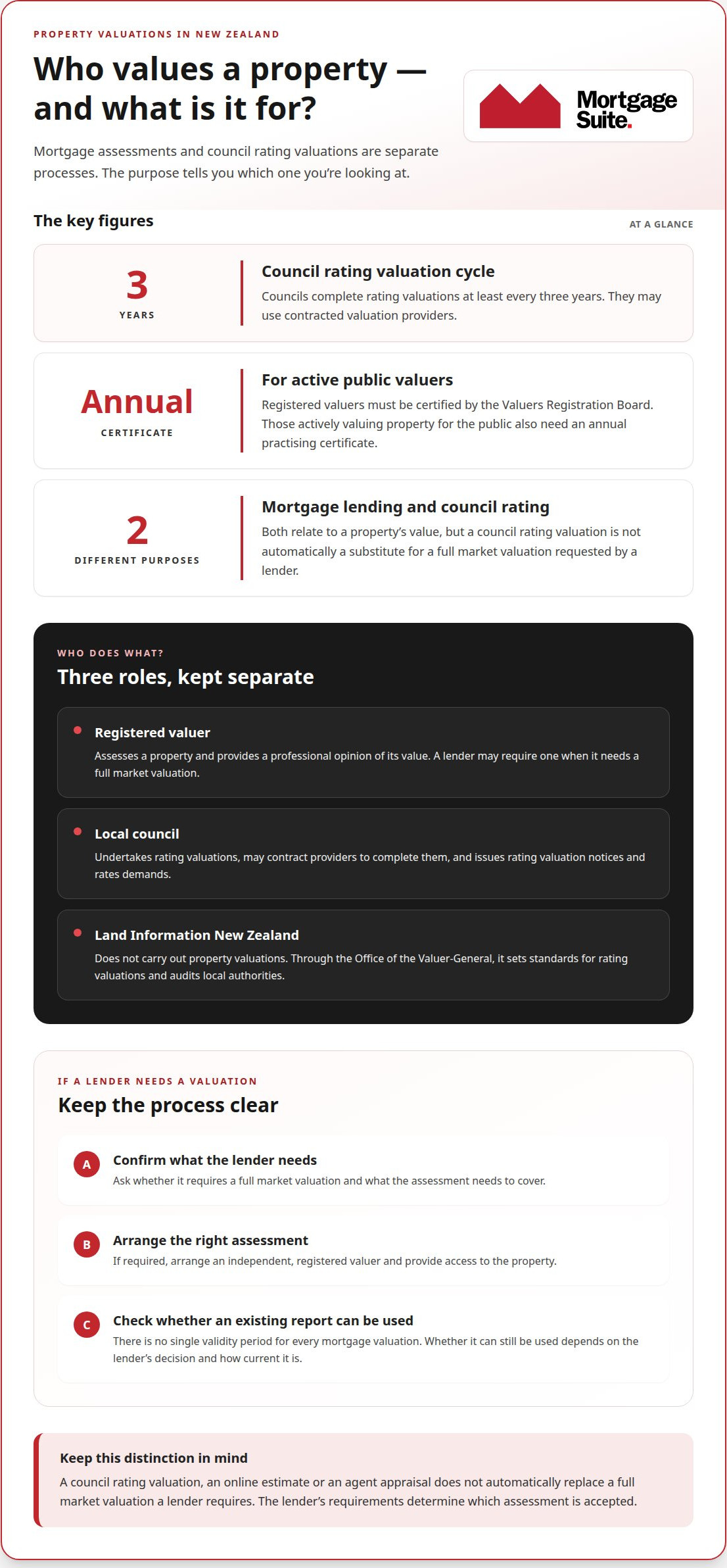
A registered valuer assesses a property and provides a professional opinion of its value. If your lender requires a full market valuation, clarify the required assessment before arranging one. Registered valuers must be certified by the Valuers Registration Board. Those actively valuing property for the public also need an annual practising certificate. These requirements help identify the professional role involved.

A valuer considers the property’s features and relevant market evidence to reach an opinion of its value. Timing depends on the property, access arrangements and report requirements. There is no single validity period for every mortgage valuation. Whether an assessment can still be used depends on the lender’s decision and how current it is.

Local councils undertake rating valuations and may contract valuation providers to complete them. Councils issue rating valuation notices and rates demands, and complete rating valuations at least every three years. These assessments serve a different purpose from a full market valuation for mortgage lending.

Land Information New Zealand does not carry out property valuations. Through the Office of the Valuer-General, it sets standards for rating valuations and audits local authorities. This distinction helps clarify who produced a council valuation, as opposed to one prepared for a lending decision.

Independent valuations before buying

An independent valuation gives a buyer a professional view of a property’s value before purchase. People buying property in New Zealand are advised to obtain one from an independent, registered valuer. It can help you compare the proposed purchase price with the valuer’s findings. It is a separate assessment, not a guarantee that a lender will accept it for mortgage purposes.

A free online estimate, council rating valuation or real estate agent appraisal does not automatically replace a full market valuation required by a lender. Apartments, rural properties, new builds and investment properties may raise different questions about what is being assessed. The lender’s requirements, not the property type alone, determine whether a full market valuation is needed.

To arrange a mortgage valuation, first ask your lender whether it requires a full market valuation and what the assessment needs to cover. Then arrange an independent, registered valuer and provide access to the property. Clarifying the lender’s requirements first can help you avoid relying on an assessment that does not meet them.

If the valuation is below the agreed purchase price, the lender may assess its proposed lending against the lower figure. This can leave a gap between the loan and the purchase price. A lower assessed value can also increase the loan-to-value ratio, meaning the loan is larger relative to the property’s value. The deposit required and approval outcome depend on the lender’s assessment.

If you disagree with a valuation, raise specific concerns about the report’s evidence or property details with the valuer. You can formally complain to the Valuation Board about a registered valuer’s conduct. Keep the concern precise, such as identifying an incorrect property detail.

Who carries out property valuations

In New Zealand, registered valuers carry out property valuations. Who is responsible depends on the purpose: mortgage lending and council rating valuations are separate processes. Knowing which applies helps you understand who prepared an assessment and what it is intended to do.

A registered valuer must be certified by the Valuers Registration Board. Registered valuers who actively value property for the public also need an annual practising certificate. These requirements distinguish registered valuers from people who may offer a different kind of property assessment, such as an agent appraisal.

For a mortgage, a registered valuer may be involved when a full market valuation is needed. The lender’s request sets the purpose of the assessment. It is useful to distinguish the person who assesses the property from the lender, which considers the assessment as part of its lending decision.

Local councils have a separate role. They undertake rating valuations and may contract valuation providers to complete them. Councils also issue rating valuation notices and rates demands. A council rating valuation relates to local authority rating and is not automatically a substitute for a valuation required for mortgage lending.

Land Information New Zealand does not carry out property valuations. Through the Office of the Valuer-General, it sets standards for rating valuations and audits local authorities. This role concerns the framework and oversight for council rating valuations, not valuing an individual home for a mortgage.

These roles can be easy to confuse because each involves a property’s value. If your paperwork is a council rating valuation notice, the council is responsible for the rating process. If a lender needs a full market valuation, a registered valuer may be required. The assessment’s name and stated purpose help clarify which process applies.

When arranging a mortgage assessment, start by identifying what the lender has requested. A request for a full market valuation points to a registered valuer; a council rates demand relates to a local authority rating valuation. Keeping these purposes separate helps you follow the right process without assuming one document meets every lending need.

Registered valuers, councils, contracted valuation providers and Land Information New Zealand each have distinct roles. The key difference is whether the assessment is prepared for mortgage lending or council rating.

When do New Zealand banks require a property valuation for a home loan?

A New Zealand lender may require a registered valuer when it needs a full market valuation. The valuation helps the lender assess the property as security for the proposed home loan. It is one part of the lending decision, not an assessment of your income or ability to make repayments.

The request depends on what the lender needs to assess. A lender may seek a full market valuation rather than rely on another estimate when it needs a professional opinion of the property’s market value. The exact requirement depends on the application and the lender’s assessment. No single property type or purchase situation automatically triggers the need for one.

That distinction matters when you’re buying a home and preparing your loan application. The purchase price is the amount agreed with the seller; the valuation is the valuer’s opinion of the property’s value. The figures may differ. A lender may use the valuation to assess the property’s worth as security, alongside other information relevant to lending.

For example, if a full market valuation is requested, an online estimate or council rating valuation may not meet that requirement. The lender needs the type of assessment it specified. Before arranging a report, establish whether a full market valuation is required and what the lender’s request says. This helps ensure the assessment relates to the lending decision.

The requirement may also arise during an application, rather than being clear from the first conversation. A lender may need a fuller view of the property before assessing it as security. If a request arrives after you have provided other property information, treat it as a specific step in the lender’s assessment, not a replacement for the rest of your application.

A valuation does not determine the entire mortgage application. The lender still considers the loan request and the information supporting it. A value below the agreed purchase price may affect how the lender views the property as security, but it does not, by itself, explain every part of the lending decision.

For a property valuation for a mortgage in NZ, read the lender’s request closely. Confirm that it calls for a full market valuation, then follow the stated requirements. If you’re unsure what the request means, ask the lender to explain the type of valuation it needs before proceeding. This keeps the valuation step aligned with your home loan application.

Property valuation for a mortgage in NZ: who values your home

What types of property valuations do NZ mortgage lenders accept?

For a home loan, the valuation type needs to match the lender’s request. A registered valuer may be required when a full market valuation is needed. Other figures, such as a council rating valuation or online estimate, describe the property differently. Don’t assume one assessment can replace another for a mortgage application.

Full market valuation: This is the relevant assessment when a lender requests a full market valuation. A registered valuer prepares the report, and the lender considers it as part of the application. Before arranging one, read the lender’s request and confirm the assessment type it requires. This helps align the valuation with the mortgage decision.

Council rating valuation: A local council undertakes rating valuations, sometimes using a contracted valuation provider. Councils use these valuations in their rating process, including issuing rating valuation notices and rates demands. For example, a figure on a council notice is a rating valuation, not automatically the full market valuation a lender requests.

Online estimates and agent appraisals: These can provide a general indication, but they are not the same as a full market valuation by a registered valuer. An online estimate is not prepared following a registered valuer’s assessment. An agent appraisal serves a different purpose. Treat either as background information, not proof that the lender’s requirement has been met.

The property itself can shape what the valuation needs to cover. An apartment, rural home, new build or investment property may involve different details. These examples do not determine which valuation a lender will accept. The lender’s stated requirement remains the practical guide, and a full market valuation may be needed when requested.

Acceptance depends on more than the report’s label. The assessment needs to match the purpose and type specified by the lender. For instance, supplying a council rating valuation when the request calls for a full market valuation could leave the lender without the assessment it needs. Clarify the request before arranging a report.

Keep the lender’s instructions with your property documents. If the wording is unclear, ask the lender what type of valuation it requires and whether the proposed assessment meets that request. A registered valuer is relevant when a full market valuation is needed; the lender’s instructions help distinguish this from rating information or an informal estimate.

In short, a registered valuer’s full market valuation is the relevant assessment when a lender requires one. Council rating valuations, online estimates and agent appraisals serve different purposes. Match the report to the lender’s request, rather than relying on the purchase price or another property figure to determine whether it will be accepted.

Preparing for a mortgage valuation in New Zealand

To help the valuation process suit your mortgage application, start with the lender’s instructions. They identify the type of assessment needed and its purpose. A report prepared for another reason may not address the property questions the lender needs answered.

Before the valuation, gather the property information available to you. Details such as the address, property type, layout and any known changes can help the valuer understand what is being assessed. For a new build, relevant plans or building documents may explain the proposed property. For an apartment, information about the unit and its place within the building can clarify what is being valued.

Access also affects how the assessment can be completed. Arrange a suitable time for the valuer to view the property and ensure the relevant areas are accessible. If parts of the home or site are unavailable, tell the person arranging the visit. Clear access helps the valuer understand the property rather than rely on incomplete observations.

Keep the lender’s instructions and valuation request together. If property details change, such as through agreed work before settlement, make sure the information provided reflects the current situation. The valuer needs to assess the property described in the request. Clear, consistent details help connect the report to your home loan application.

Once the assessment is complete, check the report’s basic property details and stated purpose. If you notice a factual error, such as an incorrect address or inaccurately described feature, raise that specific point with the relevant person. A clear correction request is more useful than a general disagreement with the assessed value.

For a purchase, keep the valuation with your property and lending documents. This makes it easier to refer to the report if the lender asks about a property detail or the assessment’s scope. If the lender’s original request and the completed report appear to describe different requirements, ask the lender what further information it needs.

Good preparation centres on clarity: the assessment requested by the lender, accurate property details, access for the valuer and a report that matches its purpose. These steps help connect the valuation to the mortgage application, whether the property is an established home, an apartment, a rural property or a new build.

Mortgage Suite

Mortgage Suite Ltd can help you understand how a property valuation fits into your borrowing plans. A registered valuer carries out the valuation; Mortgage Suite Ltd can personally advocate for you with lenders, explaining how the assessed value may affect your application and negotiating on your behalf. Approval isn’t guaranteed, but you won’t have to work through the lending questions alone.

Whether you’re buying your first home, considering a residential investment property loan, or seeking business or property development finance, the right lending approach depends on your circumstances and goals. Mortgage Suite Ltd can help you consider suitable options, prepare your case and negotiate with a lender, without treating a valuation as a guarantee of approval.

If you’d like support with your lending plans, contact Mortgage Suite Ltd to discuss your situation.

Plan your next lending move

As you plan a property valuation for a mortgage in NZ, consider how the purchase fits your wider financial priorities. A home loan can affect more than the immediate purchase, so think about your future plans and the lending structure that could support them. A clear view of your priorities can make the next conversation more focused.

If the process feels like a lot to manage, you don’t have to work through the lending questions alone. Mortgage Suite Ltd can act as your personal advocate, discuss your circumstances and negotiate with lenders on your behalf. They can help you consider suitable lending options and understand what to raise with a lender as you weigh up a purchase or plan your next move.

Discuss your lending next steps with Mortgage Suite Ltd and take the next step at a pace that feels right. With a clearer plan and a dedicated negotiator on your side, you can move forward with greater confidence.

Frequently Asked Questions

What is a property valuation for a mortgage in New Zealand?

It’s a professional assessment of a property’s value for a home loan application. The lender uses it to understand the property offered as security, rather than treating the agreed purchase price as the only measure. For example, if the valuation differs from the contract price, the lender can consider that difference when assessing the application. A valuation supports the lending decision but does not assess your income or ability to repay.

How is a New Zealand mortgage property valuation calculated?

A registered valuer considers the property’s features and relevant market evidence to provide a professional opinion of its value.

Article by

Krish Krishna

Experienced Financial Adviser with over 46 years of Banking and Mortgage broking experience and over $2.0 Billion in loan settlements.