

Construction Loan Process NZ: Your 2026 Step-by-Step Guide

What if the most stressful part of building your new home wasn’t the weather or the council permits, but the constant worry that the money might run out before the roof goes on? It is a common fear for many Kiwis, especially when you are trying to understand the construction loan process nz for the first time. The complex language used by big banks can make you feel like you are trying to learn a new language while simultaneously managing the biggest investment of your life.

We know you want more than just a mortgage; you want the confidence that your builder will be paid on time and your project will stay on track. This guide takes the mystery out of the journey, from securing that initial deposit to managing those crucial progress payments. We will show you exactly how to navigate the 2026 lending landscape, how to choose a builder that banks trust, and why having an expert advocate helps you secure finance even when mainstream lenders say no. By the end, you will have a clear timeline and the peace of mind to focus on the exciting parts of your new build.

Key Takeaways

  • Understand why these loans release money in stages as your home grows, rather than giving you a lump sum upfront.
  • Get a clear roadmap of the five essential stages of the construction loan process nz, ensuring you never miss a critical deadline or document.
  • Find out why choosing the right building contract is the secret to getting your bank’s “yes” and how to avoid common paperwork traps.
  • Explore your deposit options for 2026, including how some first-home buyers can get started with as little as 5% of the total cost.
  • Discover how to keep your project moving with a dedicated advocate who can find alternative lending solutions when big banks say no.

What Exactly is a Construction Loan and Why is it Different?

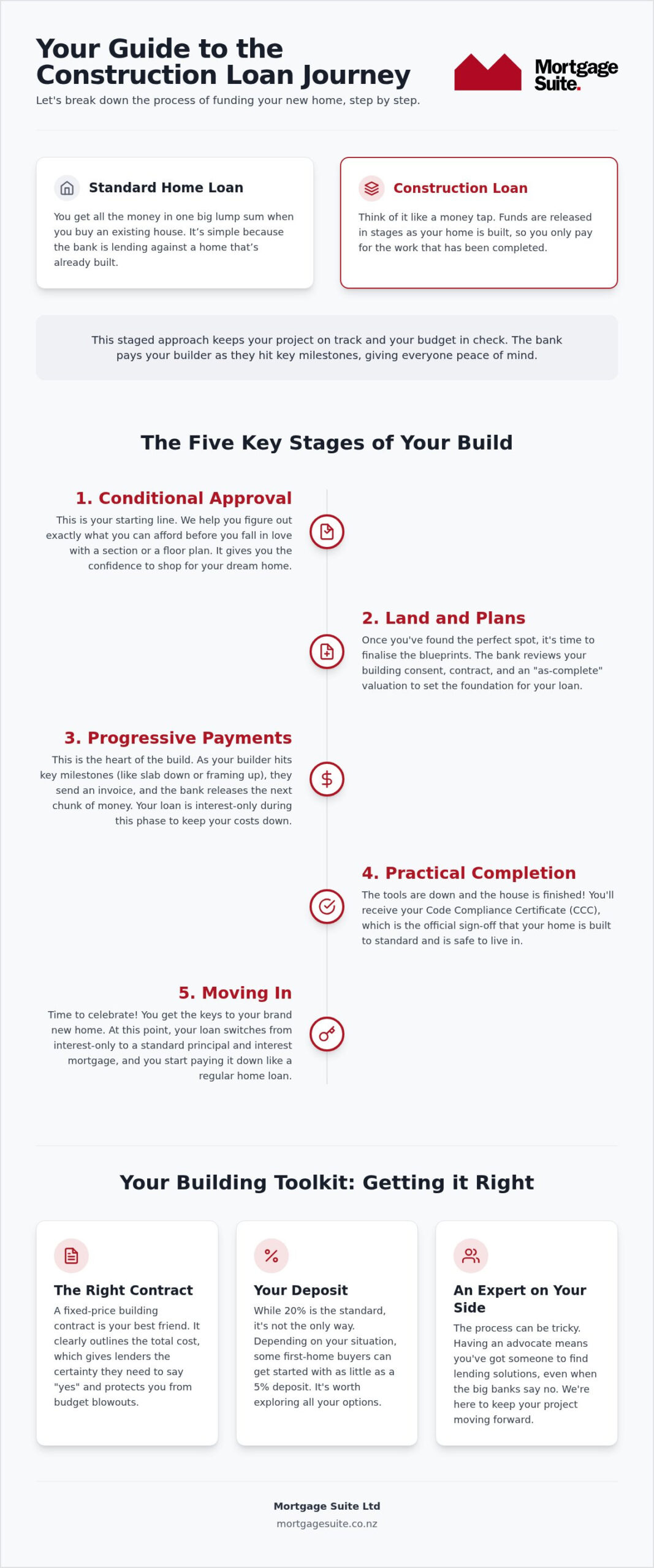
Think of a construction loan as a staged payment mortgage designed to fund a property from a bare section to a finished home. Unlike a standard home loan where the bank hands over a lump sum to buy an existing house, the construction loan process nz works more like a flexible credit limit. You have a total approved amount, but you only dip into that pot of money as your house actually grows. It is a dynamic way of borrowing that matches the physical progress on your building site.

The biggest difference lies in what the bank is actually lending against. When you buy an established home, the bank knows exactly what it is worth today. With a new build, they are lending based on the “future value” of a house that does not exist yet. Because of this, the rules are naturally a bit stricter. They need to be sure the finished product will be worth the investment, which is why your plans and builder choice matter so much. If you want to dive deeper into these concepts, our Mortgage School is a fantastic resource for first-time builders.

Why You Cannot Just Use a Standard Mortgage

Standard mortgages are built for certainty. Banks release the full amount on settlement day because the security, the house itself, is already there. In a build, the bank’s security starts as a bare patch of dirt and slowly becomes a valuable asset. They won’t release more cash until they can see the value has increased at every step. This protects them, but it also protects you from overpaying before the work is done. While the hammers are swinging and the site is a mess, your loan is usually interest-only. This means you aren’t paying down the principal yet, which is a massive help when you are likely still paying for your current place.

The Benefit of Paying in Stages

This staged approach is a huge win for your monthly budget. Your repayments start very small because you are only paying interest on the initial land purchase or the first slab of concrete. As the build progresses, your repayments grow alongside the house. It also acts as a built-in safety net. Your bank won’t pay the builder for the next stage until specific milestones are met, such as the roof being on or the house being closed in. This ensures the work is actually completed to a high standard before any more money leaves the account. It keeps the builder accountable and ensures you aren’t paying for a finished home while you are still living in a rental.

The Five Key Stages of the NZ Construction Loan Process

The journey from a sketch on a napkin to a set of keys in your hand follows a very specific path. Understanding the construction loan process nz is the best way to keep your stress levels low while the builders are busy on site. It isn’t just about the money; it is about hitting specific milestones that give the bank the confidence to keep the project moving. Most builds follow these five essential steps:

  • Stage 1: Conditional Approval. This is your starting line. You will know exactly what you can afford before you fall in love with a section or a floor plan.
  • Stage 2: Land and Plans. Once you have found the spot, you will finalise your building plans and buy the land if you haven’t already.
  • Stage 3: Progressive Payments. This is the heart of the build. The bank releases money in chunks as parts of the house are finished.
  • Stage 4: Practical Completion. The house is done, and you receive your Code Compliance Certificate (CCC).
  • Stage 5: Moving In. You move in, and the loan converts from interest-only to a standard principal and interest mortgage.

From Plans to “Slab Down”

Banks look for specific details in your documentation before they give the green light. They will review your building consent and fixed-price contract to ensure everything is above board. It is also the point where they order an “as-complete” valuation. This report tells the bank what the property should be worth once the last nail is driven in. Getting this right is a big part of the construction loan process nz, as it sets the foundation for your whole project. You will also need to have your deposit ready to cover the land and the initial build payment. To make sure your contract meets the necessary standards, check the consumer protection measures outlined by the government.

Navigating the Build Milestones

The bank doesn’t just take the builder’s word that things are progressing. They release money at specific stages: slab, frame, enclosed, internal linings, and final completion. When the builder reaches one of these points, they will send you an invoice. You then pass this to the bank to request a payment, which is often called a drawdown. A registered valuer usually visits the site to confirm the work is actually finished before any cash is released. This process keeps everyone honest and ensures the builder is paid fairly for the work completed. If you want a hand managing these back-and-forth bank requests, you can meet the team who can act as your advocate. If you are feeling a bit stuck at the starting line, we can help you navigate the build journey with confidence.

Choosing Your Building Contract: What Lenders Prefer

When you are looking at the construction loan process nz, the type of contract you sign with your builder is often the deciding factor in whether a bank says yes or no. Lenders are naturally cautious; they want to know exactly how much the project will cost before they commit a single dollar. This is why mainstream banks have a strong preference for “Fixed Price” contracts. These agreements give the bank certainty that the price won’t suddenly balloon halfway through the build because of rising material costs or unexpected delays.

On the other hand, “Cost Plus” or “Labour Only” contracts are often viewed as high risk. In these scenarios, the final price is moving target, which makes banks nervous. If you are planning a more complex project that doesn’t fit the standard fixed-price mould, you might need to look at Property Development Loans NZ to find a funding solution that matches your specific needs.

The “Turn-key” Advantage

A turn-key package is often the simplest path for first-home buyers, especially if you have a smaller deposit. With this setup, you typically pay a 10% deposit upfront and the remaining 90% only once the house is finished and you have the keys in your hand. It is incredibly popular because it removes the need to manage stage payments or “drawdowns” while the house is being built. You get the peace of mind that comes with a set move-in date and a locked-in price, making it much easier to plan your move and manage your current living costs.

Managing a “Full Build” Contract

If you aren’t going down the turn-key route, you will likely sign a “Full Build” contract. This is where the bank pays the builder in stages as milestones are reached. Because there is more room for surprises in a full build, most banks will require a “contingency sum” as part of your loan. This is an extra pot of money, usually around 5% to 10% of the build cost, set aside specifically for those “just in case” moments.

To keep the bank happy, your builder also needs to provide a Master Builders or Certified Builders guarantee. This acts as an insurance policy for both you and the lender, ensuring the home will be finished even if the building company runs into trouble. It is vital to have your mortgage expert review the contract before you put pen to paper. We check for any hidden clauses that might trip up the construction loan process nz or cause issues with your lender later on. Getting the contract right from day one saves a massive amount of stress once the hammers start swinging.
Construction Loan Process NZ: Your 2026 Step-by-Step Guide

Getting Your Ducks in a Row: Deposit and Documentation

Once you have a handle on how the money flows, it is time to gather the paperwork that makes the construction loan process nz actually happen. Banks are naturally more cautious with new builds, so they will look closely at both your financial stability and the project’s feasibility. Generally, you will need a deposit of between 10% and 20% of the total project cost. However, there is good news for first-home buyers: some specific “New Build” schemes allow you to get started with as little as a 5% deposit.

The bank will also perform a thorough income assessment. They don’t just want to know if you can afford the interest-only payments while the house is a skeleton; they need to be certain you can manage the full principal and interest repayments once you move in. To get a head start on your budgeting, you can use our Mortgage Calculator to estimate what those future repayments might look like based on current 2026 interest rates.

Using KiwiSaver for Your Build

Navigating the construction loan process nz often starts with a look at your KiwiSaver balance. You can usually withdraw your funds to put toward the purchase of your land or to help cover those initial build costs. If you are a first-home buyer, you might also be eligible for government grants specifically designed for new builds, which can provide a significant boost to your deposit. It is important to get your KiwiSaver “first home withdrawal” pre-approval sorted early so there are no delays when it comes time to pay the builder’s first invoice. For a deeper look at different deposit types and how they affect your borrowing power, our Mortgage School has all the details you need.

The Paperwork Banks Actually Care About

Before a lender signs off on your loan, they will insist on seeing a specific set of documents. The most critical is a registered valuation. This isn’t just a quick look at the plans; it is a professional report that confirms the “as-complete” value of the home. Without this, the bank has no way to measure their risk. You will also need to provide proof of Contract Works Insurance, which protects the site against fire, theft, or damage while it is under construction.

Finally, be prepared to show that your “own contribution” is ready to go. Banks typically require you to spend your own cash deposit first before they begin releasing any of the loan funds. This ensures you are fully committed to the project from day one. If you are ready to see if your paperwork is up to scratch, you can get in touch with us to start your application today and move one step closer to your new front door.

How a Mortgage Expert Navigates the Build Journey With You

Building a home is a massive team effort. You have the builder, the valuer, and the bank, but you also need someone who is purely looking out for your interests. We act as the essential bridge between all these parties to keep your project moving forward without unnecessary delays. The construction loan process nz involves a significant amount of admin, from verifying builder invoices to ensuring the bank releases funds exactly when they are needed. By taking that burden off your shoulders, we let you focus on the exciting parts of the build, like choosing your kitchen tiles or picking out the perfect carpet for the lounge.

We also dive deep into the fine print of your building contract. Small clauses that might seem minor can have a huge impact on how a bank views your loan. We make sure your lender is happy with every detail before you commit, protecting you from nasty surprises later on. It is about providing a steady hand and seasoned advice throughout the entire journey.

When the Bank Says No: Alternative Solutions

Sometimes, the big mainstream banks just aren’t the right fit for your specific situation. If you have a non-standard income, a complex project, or a unique building site, they might hesitate to offer finance. This is where we look at 2nd tier lenders. These non-bank options can provide a vital “stepping stone” to get your house finished when others say no. Once the build is complete and the value of your asset is locked in, we can often help you move back to a standard bank loan. With over 20 years of industry experience, we know exactly how to present your case to these lenders to get the best result. You can learn more about our background and why we are so passionate about helping Kiwis build on our About Us page.

Your Advocate from Foundation to Roof

The construction loan process nz rarely follows a perfectly straight line. Material costs might shift, or the classic Kiwi weather might cause a few delays on site. Having a dedicated negotiator in your corner means you don’t have to spend your lunch break arguing with the bank yourself. We manage the communication and ensure the transition from interest-only payments to full principal and interest repayments is seamless once you move in. We have seen every possible scenario and know how to keep things on track. If you want to see how we have helped other Kiwis navigate this journey from the first shovel in the ground to the final inspection, feel free to check out our Reviews and see the results for yourself.

Start Your Building Journey with Confidence

Building your own home is one of the most rewarding projects you can take on, but it shouldn’t feel like a second full-time job. By understanding the construction loan process nz, you have already taken the biggest step toward a successful build. Success lies in the details: choosing a bank-friendly contract, getting your deposit organised, and having a clear plan for those essential progress payments.

You don’t have to navigate the fine print alone. With 20+ years of banking experience and a track record of funding hundreds of successful builds, we are here to act as your steady hand. Even if the mainstream banks have said no, our expertise in 2nd tier and alternative lending means we can often find a path forward that others miss.

Ready to start your build journey? Chat with our experts today and let’s get those foundations poured. You have the vision; we have the financial roadmap to make it happen. You are closer to your new front door than you think.

Frequently Asked Questions

How much deposit do I really need for a construction loan in NZ?

You generally need a deposit of 10% to 20% of the total project cost for a new build in New Zealand. However, if you are an eligible first-home buyer, you might be able to secure a loan with as little as a 5% deposit through the Kāinga Ora First Home Loan scheme. Having a larger deposit can help you avoid low equity margins, which some major banks apply if your contribution is under 20%.

Can I use my KiwiSaver to build a house?

Yes, you can withdraw your KiwiSaver funds to put toward the purchase of land or the initial stages of your build. It is a popular way for first-time builders to boost their deposit. You will need to apply for a first-home withdrawal through your provider early in the piece. This ensures the funds are ready when the first builder’s invoice arrives, keeping your project moving without any financial hiccups.

What happens if the building costs go up during the project?

If costs increase, you will usually need to cover the difference from your own savings or a pre-approved contingency fund. Most lenders require a contingency of 5% to 10% for full build contracts to handle these surprises. This is why banks have a strong preference for fixed-price contracts; they provide certainty that the price won’t balloon mid-build. Having an expert advocate helps you negotiate these cost changes with your lender.

When do I start making mortgage repayments on a new build?

You typically start making interest-only repayments as soon as the first part of the loan is released, such as for the land purchase. During the construction phase, you only pay interest on the amount that has actually been paid out to your builder. Once the build is finished and you have your Code Compliance Certificate, the loan usually switches to a standard principal and interest mortgage, and your full repayments begin.

What is a “drawdown” and how do I request one?

A drawdown is the process of releasing a portion of your loan to pay for a completed stage of the build. To request one, you simply send your builder’s invoice to the bank. A valuer often visits the site to confirm the work is finished before the cash is released. Managing these requests is a key part of the construction loan process nz, and we can handle the back-and-forth for you.

Can I get a construction loan if I am self-employed?

Yes, self-employed Kiwis can certainly secure construction finance, though the documentation requirements are often more detailed. You will generally need to provide two years of financial accounts to prove your income stability. If your business structure is complex and the big banks say no, we specialise in finding 2nd tier lending solutions. These alternative lenders are often more flexible with how they assess self-employed income for a new build.

What is a Code Compliance Certificate (CCC) and why does the bank need it?

A Code Compliance Certificate is the final sign-off from your local council confirming the build meets the New Zealand Building Code. The bank requires this document before they release the final payment to your builder and switch your loan to a standard mortgage. It proves the home is safe, legal, and fully insured. Without a CCC, the bank’s security is technically an unfinished project rather than a completed, valuable asset.

What if I already own the land but want to start building now?

If you already own the land, you can often use the equity you have in that section as your deposit for the build. This can significantly simplify the construction loan process nz because you may not need to contribute as much cash upfront. The bank will look at the current value of the land and the projected value of the finished home to determine how much you can borrow for the construction phase.

Article by

Krish Krishna

Experienced Financial Adviser with over 46 years of Banking and Mortgage broking experience and over $2.0 Billion in loan settlements.

Construction Loan Interest Rates NZ: Your 2026 Guide to Building Success

What if the lowest headline rate you see on a billboard actually ends up costing you more during your build? It’s a common trap for many New Zealanders who focus only on the number rather than the flexibility of the loan structure. Building your own home is an incredible milestone, but it’s no secret that the financial side can feel like a maze. You might be feeling the pressure of strict bank rules or worrying about how cost overruns will affect your monthly payments. We understand that you need more than just a loan; you need a plan that works when things get complicated.

This guide will help you understand how construction loan interest rates nz lenders set can be managed to your advantage. You’ll discover how to secure a deal that fits your specific project and keeps your cash flow steady from the first slab pour to the day you get your keys. We’re going to look at how interest is charged during the build, why some lenders are more flexible than others, and how to stay ahead of your budget so you can focus on your new home rather than the paperwork.

Key Takeaways

  • Understand that construction loans work on a pay-as-you-go basis, meaning you only pay interest on the funds you have actually used for the build.
  • Discover how to compare construction loan interest rates nz lenders offer and why a floating rate strategy often provides the most flexibility during the building process.
  • Learn why a “no” from a mainstream bank isn’t the end of your project, as 2nd tier lenders often provide the specialised support needed for unique builds.
  • Master the art of managing progress payments stage-by-stage to keep your monthly interest costs as low as possible while your home takes shape.
  • Find out how partnering with an experienced mentor can help you navigate complex bank criteria and secure a smoother path from land purchase to moving in.

What Are Construction Loan Interest Rates and How Do They Work in NZ?

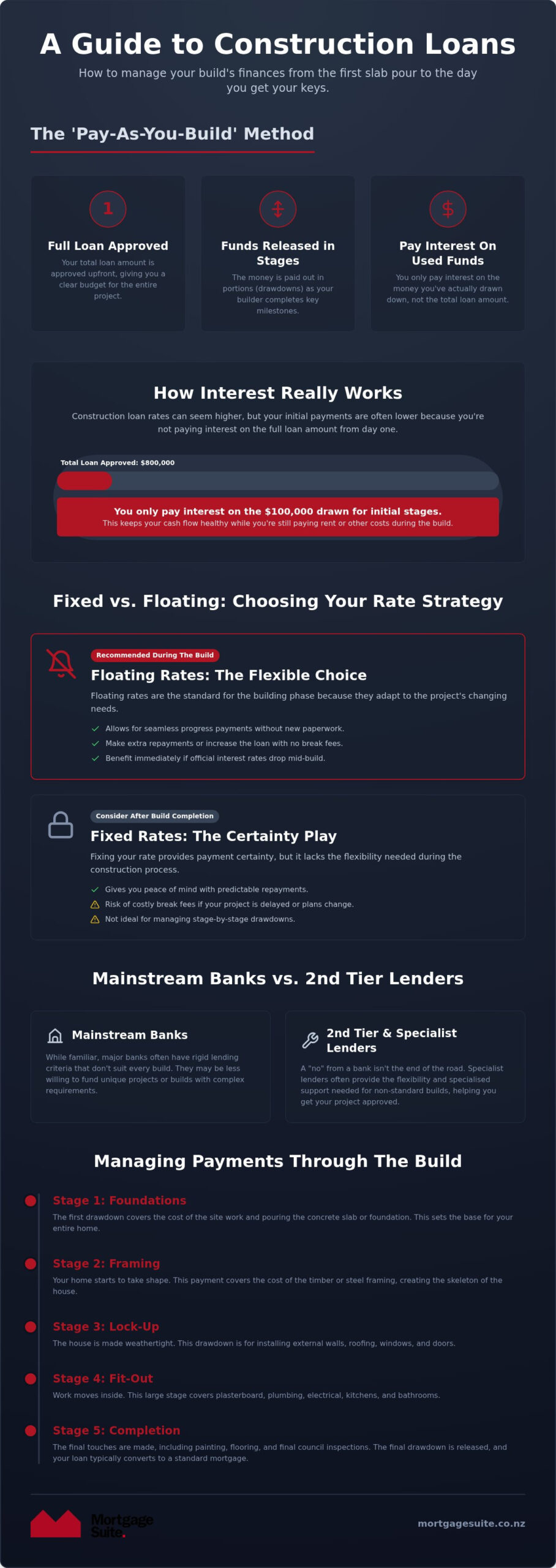
Imagine you’re at a restaurant. You wouldn’t pay for the entire menu before you’ve even seen the starter, would you? A construction loan works in a very similar way. Instead of receiving a massive lump sum of cash on day one, your lender releases the money in stages as your house is actually built. This pay-as-you-go approach is designed to protect both you and the bank, ensuring that the funds match the value of the work completed on the ground.

In 2026, construction loan interest rates nz lenders offer are heavily influenced by the base interest rate set by the Reserve Bank and how much banks want to fund new projects. When the Reserve Bank moves the dial, your floating rate usually follows. Most people choose a floating rate during the build because it gives you the flexibility to make changes or increase the loan if costs go up without facing heavy exit fees. It’s all about maintaining a steady hand while your project is in motion.

The Difference Between Standard Mortgages and Construction Loans

A standard mortgage is straightforward; the bank hands over the money, you buy the house, and you start paying back the debt and interest immediately. Construction loans are different. They drip-feed the funds through stage payments at specific milestones like foundations, framing, and getting the house sealed up. This means you aren’t paying for the roof while the builders are still digging the holes for the piles.

While the builders are on-site, you typically only pay the interest on the money that’s been drawn down. This keeps your costs manageable during the most stressful part of the project. Once your local council issues the final sign-off, the loan usually converts into a standard mortgage where you start paying off the actual debt. You can use a mortgage calculator to see how these payments might change once the build is finished.

Why Construction Rates Can Feel Higher (And Why They Actually Aren’t)

You might notice that the interest rate on a construction loan looks a bit higher than a standard fixed-rate mortgage. This is because lenders see an unfinished house as a higher risk. If something goes wrong halfway through, they can’t sell a half-built shell as easily as a finished home. They compensate for this risk with a slightly higher floating rate.

However, you aren’t paying that rate on the full loan amount from the start. You might have an $800,000 loan approved, but if you’ve only spent $50,000 on the concrete floor, you only pay interest on that $50,000. An interest-only period is a way to keep your cash flow healthy while you’re still paying rent elsewhere. This trade-off often means your monthly outgoings are actually lower during the build than they’ll be once you finally move in.

Fixed vs. Floating: Choosing Your Interest Rate Strategy

Deciding between a fixed or floating rate is one of the biggest hurdles you’ll face when looking at construction loan interest rates nz offers. It’s a bit like choosing between a set menu and an à la carte experience. One gives you price certainty, while the other lets you adjust your order as you go. In 2026, many New Zealanders find that a hybrid approach often works best, but it pays to understand the mechanics of each before you sign on the dotted line.

Floating Rates: The Flexible Choice

Floating rates are the primary choice for the building phase. Because your loan balance grows every time your builder sends an invoice, you need a structure that can handle these constant changes. Floating rates allow for seamless drawdowns without the paperwork headache of re-fixing a portion of your debt every few weeks. They also give you the freedom to put extra cash into the loan if you come in under budget on certain stages, which helps you save on interest over the long run. Since these rates react instantly to market shifts, you’ll benefit immediately if the OCR drops mid-build.

Fixed Rates: The Certainty Play

Locking in a fixed rate might seem tempting for the peace of mind it offers. This strategy is usually most effective for turn-key contracts where you pay a deposit at the start and the balance at the very end. However, for a standard build, fixing too early can lead to the ‘break fees’ trap. If your project is delayed by a few months, you could end up paying penalties to extend your fixed term or change your drawdown schedule. It’s often wiser to wait until you have your final certificate before you commit to a long-term fixed rate. You can use our mortgage calculator to model how different rates will impact your repayments once the house is finished.

In 2026, we’re seeing more lenders offer ‘Blueprint’ style packages. These often feature discounted floating rates specifically for energy-efficient new builds. It’s a great way to keep costs down while maintaining the flexibility you need. If you’re feeling overwhelmed by the options, it helps to have a mentor in your corner who knows the market inside out. You can read more about our approach to find out how we can help you secure the right fit for your project.

Mainstream Banks vs. 2nd Tier Lenders: Finding Your Best Fit

When you first start looking at construction loan interest rates nz banks advertise, you’ll likely head straight to the household names. These mainstream lenders often have shiny packages for new builds, but they also have very rigid boxes you need to fit into. If your situation is even slightly outside the norm; perhaps you’re self-employed or have a smaller deposit; you might find the door closes quickly. It’s a frustrating experience, but it doesn’t mean your building project is over.

There’s a common myth that alternative lenders are always much more expensive. While their rates can be slightly higher to reflect the extra flexibility they offer, the gap is often smaller than you’d think. In 2026, the value of a 2nd tier lender isn’t just the rate; it’s the fact that they actually say “yes” when others say “no.” We specialise in helping Kiwis secure 2nd tier loans that are tailored to complex builds that the big banks simply won’t touch.

When the Big Banks Might Say ‘No’

The Big Four banks in New Zealand operate on strict computer-generated scores. They often decline applications for reasons that have nothing to do with your ability to pay. Common roadblocks include:

  • Having less than a 20% deposit for certain project types.
  • Being self-employed with less than two years of perfect financial records.
  • Building on unique land types, such as lifestyle blocks or off-grid sections.

2nd tier lenders take a more human approach. They look at the person and the project rather than just a credit score. Having a negotiator like Krish Krishna, who has over two decades of banking experience, means you have someone who knows how to present your case to the right people in those back-room offices.

The Benefits of Alternative Construction Finance

Alternative finance is often much faster. When you’ve found the perfect section and need to move quickly, a mainstream bank’s six-week processing time can cost you the deal. A 2nd tier lender can often provide a “yes” in a fraction of that time. They’re also far more relaxed about how you manage the build. If you want to manage some of the labour yourself or use a smaller, local builder who isn’t on a bank’s “approved” list, alternative lenders are usually happy to support you.

Our goal at Mortgage Suite is to act as your bridge. We can help you get the build started with an alternative lender and then, once the house is finished and the risk is lower, we can help you move back to a mainstream bank. It’s a strategic way to get your dream home built without being held back by a bank’s checklist. If you want to see how we’ve helped others in similar spots, you can read our client reviews here.

Construction Loan Interest Rates NZ: Your 2026 Guide to Building Success

How to Manage Your Progress Payments to Save on Interest

Managing a build is all about timing. Every day your project drags on is another day you’re paying interest on money already spent. Since construction loan interest rates nz lenders provide apply only to the funds you’ve actually used, your goal is to keep those stage payments as small and as late as possible without stalling the builders. Understanding how construction loan interest rates nz providers calculate your monthly bill helps you see why staying organised is so important for your back pocket.

This requires a bit of a balancing act. You want to pay for work done, but you don’t want the bank’s meter running on funds that aren’t yet sitting in the structure of your home. Keeping the project on a tight schedule ensures you move into your finished house sooner, effectively cutting months of interest-only payments from your total cost.

The Five Typical Stages of a New Zealand Build

Most builds follow a standard path. First is the deposit and site works, followed by the foundations and floor. This is a major milestone because it anchors the project. Next comes the framing and the lock-up stage, which is when the roof and windows are installed. This is often the point where you feel the most progress. After that, internal linings and fittings are completed before the final completion stage. At this last step, you get your keys, and the loan usually switches to a standard mortgage. Keeping these stages on schedule is the single best way to keep your interest costs from spiralling.

Working with Your Mortgage Mentor

A Registered Valuer plays a quiet but vital role here. They visit the site to confirm that the work the builder says is finished actually matches the value added to the property. It’s a safety net for you. You should never pay for a stage before it’s finished; if a builder asks for framing money while the slab is still wet, that’s a red flag. Mortgage Suite takes the weight off your shoulders by handling the constant flow of paperwork between you, the bank, and your builder.

We ensure that invoices are processed quickly so the build doesn’t stop, but we also verify that everything is in order before the bank releases a cent. An expert broker can often get admin fees waived on stage payments. This saves you a small fortune in “payment fees” that banks often charge every time they hit the pay button. If you’re looking for a steady hand to guide your project from the first slab pour to moving day, partner with Mortgage Suite to ensure your finance is as solid as your new home.

Why Partnering with Mortgage Suite Makes Building Easier

Building a home is one of the most significant financial moves you will ever make. It is a process filled with milestones, from the first slab pour to the final coat of paint. However, the paperwork and finance behind the scenes can often feel like a second job. This is where we step in. Partnering with Mortgage Suite means you aren’t just getting a mortgage; you are gaining a mentor who understands the nuances of the New Zealand building industry.

Krish Krishna leads our team with over two decades of deep banking experience. He has seen the industry from the inside out and knows how to navigate the hurdles that often trip up even the most prepared borrowers. We act as a professional bridge between you and the lenders, ensuring that your project is presented in the best possible light. Whether you are dealing with mainstream banks or looking for more flexible 2nd tier options, we make sure the construction loan interest rates nz providers offer are working for you, not against you.

Your Personal Construction Finance Advocate

We don’t believe in a one-size-fits-all approach. Every building project is unique, and every borrower has a different story. Our job is to find a lender that actually likes your specific project, rather than trying to force you into a box that doesn’t fit. We take particular pride in helping First Home Buyers navigate the build process, which can often feel twice as daunting when it is your first time.

Our commitment to you is simple: jargon-free, honest advice that puts your needs first. We take the time to explain the “why” behind every decision, so you feel confident and in control of your finances. You can see how this personal touch has helped other Kiwis by visiting our reviews page, where our clients share their own success stories from across the country.

Ready to Start Your Build Journey?

The best time to talk to us is before you even sign a contract for land. Getting a pre-approval gives you the confidence to shop for sections or house-and-land packages knowing exactly what you can afford. It removes the guesswork and helps you move quickly when you find the right spot. In a fluctuating market, having that certainty is worth its weight in gold.

Getting started is easy. We offer a no-obligation conversation to look at your project and see which path is right for you. We handle the heavy lifting of the application so you can stay focused on the exciting parts of building your home. Contact Mortgage Suite today to discuss your construction loan options and let’s turn those blueprints into a reality.

Build Your Future with Confidence

Building your own home is a journey that requires both vision and a solid financial plan. We have explored how construction loan interest rates nz lenders set can be managed by choosing the right structure and keeping your progress payments on a tight schedule. Whether you are navigating the strict rules of a mainstream bank or need the flexibility of a 2nd tier lender, the key is having an expert who understands the inner workings of the banking world.

With over 20 years of expertise, Mortgage Suite specialises in securing finance for those who don’t fit the standard bank boxes. We provide personalised service from a dedicated mortgage mentor to ensure your build stays on track from the first slab pour to final inspection. You don’t have to navigate this maze alone; we are here to act as your advocate and negotiator every step of the way.

Book a consultation with Mortgage Suite to secure your construction finance and take the first step toward moving into your new home. We are ready to help you turn those blueprints into reality with a steady hand and honest, jargon-free advice. Your dream project deserves a financial foundation that is just as solid as the walls you are about to build.

Frequently Asked Questions

Are construction loan interest rates higher than standard mortgage rates?

Yes, construction loan interest rates nz lenders offer are typically slightly higher than standard rates because a half-finished house is considered a higher risk for the bank. However, it is important to remember that you aren’t paying that rate on the full loan amount from day one. You only pay for the money you’ve actually spent. This means your monthly interest costs often start very low and only increase as your home takes shape.

Can I get a construction loan with a 10% deposit in NZ?

Yes, securing a construction loan with a 10% deposit is achievable in New Zealand, though mainstream banks can be quite strict about it. You might need to meet specific criteria or look at 2nd tier lenders who have more flexible rules for smaller deposits. We often help clients who have been turned away by their own bank for not having a full 20% deposit, finding alternative paths to get their build started.

What is a ‘turn-key’ contract and how does it affect my interest rate?

A turn-key contract is an agreement where you pay a small deposit at the start and the remaining balance only when the house is fully finished. Because there are no progress payments, many lenders allow you to lock in a fixed interest rate right from the beginning. This provides excellent price certainty, though these contracts can sometimes have a higher total purchase price to cover the builder’s own financing costs during the build phase.

Do I have to pay interest on the whole loan amount from day one?

No, you definitely don’t pay interest on the entire loan amount from the start. You only pay interest on the money that has been released to your builder for completed stages. If your total loan is $700,000 but you’ve only used $100,000 for the foundations, your interest is calculated only on that $100,000. This structure is why construction loan interest rates nz lenders provide can be more affordable than they first appear on paper.

What happens if my building costs go over the original budget?

If your costs increase, you can usually tap into a contingency fund that is built into your original loan approval, typically around 10% of the build cost. If you exceed this amount, you may need to apply for a loan top-up or contribute your own savings. Having a mortgage mentor in your corner helps because we can negotiate with the lender to ensure your project doesn’t stall due to unexpected budget changes.

Can I use my existing home equity to fund a new build?

Yes, using existing home equity is a very common way to fund a new build. Instead of saving a cash deposit, you can use the value built up in your current property as security for the new construction loan. This can often cover the entire deposit and even the initial land purchase. It’s a strategic move that allows you to stay in your current home until the new one is ready for you to move in.

When do I switch from interest-only payments to principal and interest?

You generally switch to principal and interest payments once the build is fully completed and the local council has issued the Code Compliance Certificate. At this point, the lender considers the house a finished asset and converts the loan into a standard mortgage. This is usually the best time to look at fixing your rate for a longer term to give yourself some repayment certainty as you settle into your new home.

Do 2nd tier lenders offer construction loans for first home builders?

Yes, 2nd tier lenders are often a fantastic option for first home builders who don’t fit the rigid criteria of mainstream banks. These lenders are more interested in the project’s viability and your overall situation than just a computer-generated credit score. Mortgage Suite specialises in connecting first-time builders with these alternative lenders, ensuring that a “no” from a big bank doesn’t have to be the end of your home ownership dream.

Article by

Krish Krishna

Experienced Financial Adviser with over 46 years of Banking and Mortgage broking experience and over $2.0 Billion in loan settlements.