
Breaking a Fixed Term Mortgage in NZ: Your 2026 Strategy Guide

What if the fee your bank calls a penalty is actually the price of admission to a much better financial future? When you’re considering breaking a fixed term mortgage nz, it’s easy to feel overwhelmed by technical talk and the fear of hidden costs. You might be watching the Reserve Bank’s July 2026 move to a 2.50% OCR and wondering if your current setup still serves your long-term goals. It’s a stressful spot to be in, especially when terms like “wholesale rates” feel like a mystery designed to keep you in the dark.

I understand that anxiety because I’ve seen how these calculations work from the inside for over two decades. This guide will help you understand those break fees so you can decide if restructuring is a smart tactical move or a costly mistake. We’ll look at the 2026 market trends, provide a clear framework for your decision, and show you how to align your home loan with your actual needs. You’ll walk away with a clear strategy that focuses on your cash flow rather than just the bank’s bottom line.

Key Takeaways

  • Understand that ending your contract early isn’t just a penalty; it’s often a strategic move to secure a better rate or prepare for a property sale.
  • Learn how banks use wholesale rates to calculate the cost of breaking a fixed term mortgage nz so you can avoid any nasty surprises.
  • Discover a simple “yes or no” framework to help you decide if the long-term savings of a new loan outweigh the upfront break fee.
  • Explore practical ways to lower your fees, such as using your annual repayment allowance to reduce your balance before you officially switch.
  • See how a seasoned expert can do the heavy lifting for you, comparing different lenders to find a path that fits your unique situation.

What Does Breaking a Fixed Term Mortgage Actually Mean?

Breaking a mortgage is essentially ending your fixed-rate contract before the date you and the bank originally agreed upon. Most of us sign these deals for one, two, or even five years to get a bit of peace of mind. However, life doesn’t always stay in a straight line. You might see interest rates dropping and want to grab a better deal, or perhaps you’ve decided to sell your home and move on. When you pull the pin early, the bank charges you what is technically known as a prepayment cost or a break fee.

In the broader financial world, this is a type of early termination fee designed to protect the lender from losing out on a deal they’ve already budgeted for. Think of it this way: the break fee is simply the bank recovering the interest they expected to earn from you over the remaining life of your fixed term. It isn’t a “fine” for doing something wrong, but rather a way for the bank to balance their books when the contract they counted on suddenly disappears.

Fixed vs Floating: The Basics

Most Kiwis choose fixed rates because they provide a sense of certainty. You know exactly what your repayments will be every fortnight, which makes your family budgeting much easier. The downside is that these contracts are quite rigid. Floating rates, on the other hand, give you total freedom to pay off as much as you want whenever you like, but the rates are usually higher and can change at any time. Many homeowners find themselves feeling “stuck” in a fixed term when market rates start to fall, as they’re locked into yesterday’s higher prices while seeing better deals on the horizon.

Why Banks Charge You to Leave

It helps to understand that banks don’t just have a giant vault of cash sitting in the back room to lend out. To provide you with a mortgage, they often borrow money themselves on the wholesale market. When you decide on breaking a fixed term mortgage nz, the bank is left with that borrowed money and nowhere to put it. If current interest rates have dropped since you first signed your contract, the bank can’t lend that money to someone else for the same high return they were getting from you.

Legally, banks in New Zealand are only allowed to recover their actual losses. They aren’t supposed to use these fees to make an extra profit or punish you for leaving. They are simply trying to get back to the position they would have been in if you had stayed for the full term. Understanding this “wholesale” side of the fence is the first step in breaking a fixed term mortgage nz with confidence, as it takes the mystery out of why that final bill can sometimes look quite high.

How Banks Calculate Your Break Fee

Calculating the cost of breaking a fixed term mortgage nz often feels like trying to solve a puzzle where the bank holds all the pieces. While every lender has a slightly different formula, the total cost usually comes down to three main things: how much you owe, how much time is left on your deal, and what’s happening with interest rates in the background. It’s a bit like a see-saw; when market rates go down, your break fee typically goes up.

The scale of the fee is directly tied to your loan balance. A $800,000 mortgage will naturally attract a much higher fee than a $200,000 one because the bank’s loss is calculated on every dollar you owe. Similarly, if you have three years left on your term, you’re paying for three years of the bank’s missed interest. If you only have three months left, the fee is often small enough that it shouldn’t stop you from making a move.

The Wholesale Rate Gap

To understand the maths, you have to look at the bank’s “cost of goods.” Banks borrow money on the wholesale market to lend to you. If you locked in a rate of 6% and now market rates have dropped to 4%, the bank can’t just lend your money to someone else at that original 6%. They’ll ask you to cover that 2% gap for the rest of your term. It’s helpful to look at how mortgage rates nz are trending in 2026 to get a sense of this. Interestingly, with the Reserve Bank raising the OCR to 2.50% in July 2026, many homeowners who fixed when rates were at their lowest are finding their break fees are actually zero. This happens because the bank can now “sell” that money to a new customer at a higher rate than what you were paying.

Administrative and Discharge Fees

Don’t confuse the main break fee with the smaller administrative costs. When you leave, you’ll usually see a flat “discharge fee” to cover the legal paperwork and the bank’s time to process the exit. While the break fee can be thousands of dollars, these admin fees are usually a set amount, often around $150 to $400 depending on the lender. Always ask your bank for a formal “break fee quote” before making a final decision. These quotes are typically only valid for a couple of business days because the wholesale market moves so quickly. If you’re feeling unsure about the numbers the bank is giving you, it’s a good idea to have an expert review your quote to ensure you’re not paying more than you should.

Strategic Reasons to Break Your Fixed Rate Early

While the word “penalty” usually sounds negative, breaking a fixed term mortgage nz is often a calculated tactical move for your long-term wealth. It isn’t just about escaping a rate you’ve outgrown; it’s about positioning yourself for your next big financial step. For many homeowners, this means moving from a basic home loan into a more sophisticated structure. You might be looking to unlock equity to jump into the rental market with residential investment property loans NZ. By breaking your current deal, you can reset your finances to support a growing portfolio rather than just paying off the roof over your head.

Another common reason to pull the pin early is to improve your monthly cash flow. If you’re currently carrying high-interest debt like car loans or credit cards, folding those into a lower-interest mortgage can save you hundreds of dollars every month. Even after you account for the break fee, the total interest you pay across all your debts usually drops significantly. Of course, selling your home is the most common reason to break. In a moving market, you’ll often need to “break and re-fix” to align your new mortgage with your new property’s value and your updated budget.

Is the Maths Spot On? The Break-Even Point

Deciding to break comes down to a simple comparison. You need to look at the total interest you’ll pay if you stay versus the cost of the break fee plus the interest at the new, lower rate. We usually suggest looking at your savings over a 12-month and 24-month period. If the interest you save in the first year is more than the fee you paid to get there, you’ve reached your break-even point. There is also an “opportunity cost” to think about. If keeping your current rate prevents you from investing or clearing other expensive debt, that hidden cost might be much higher than the bank’s one-off fee.

Breaking for Flexibility

Life doesn’t always wait for your fixed term to end. Whether it’s a marriage, a new addition to the family, or a job offer in a different city, your mortgage needs to be as flexible as your life is. Sometimes, breaking a fixed term mortgage nz allows you to move a portion of your debt to a floating rate. This gives you the freedom to make large lump-sum repayments without further penalties whenever you have extra cash. It’s also the perfect time to check if a 2nd tier lender New Zealand might be a better fit. These lenders often provide more flexible terms for people whose situations don’t quite fit the rigid boxes of the major banks.

Breaking a Fixed Term Mortgage in NZ: Your 2026 Strategy Guide

Ways to Minimise or Avoid Break Fees Altogether

Many homeowners assume that once they’ve signed on the dotted line, the break fee the bank quotes is final. However, there are several clever ways to chip away at that cost or even sidestep it entirely. When you’re considering breaking a fixed term mortgage nz, the goal is to be as tactical as possible. By understanding the small print in your contract, you can often turn a heavy financial blow into a manageable step toward a better deal.

Timing is perhaps your most powerful tool in 2026. Since the Reserve Bank raised the OCR to 2.50% in July, wholesale rates have been on the move. As we discussed earlier, if market rates are rising, the gap between your fixed rate and the current market rate shrinks. This can lead to a much lower fee, or sometimes no fee at all. Another strategy is to look for “cash-back” offers from a new lender. Many banks are currently offering thousands of dollars in cash incentives to win your business; these funds can be used to cover your exit costs from your old bank.

The 5% Rule and Partial Repayments

Most major New Zealand banks allow you to pay off a certain percentage of your loan balance every year without any penalty. This is often around 5% of your original loan amount. If you have some savings tucked away, making a lump sum payment just before you officially break the contract can significantly reduce the final fee. It’s all about timing. You need to check your “anniversary date” to see when your next allowance resets. If you’re close to that date, you might even be able to make two 5% payments in a short space of time, which makes a massive dent in the bank’s calculation.

Negotiating with Your Current Bank

It’s a common mistake to think that banks are rigid machines that never budge. In reality, they are businesses that want to keep reliable customers. While the actual break fee is usually tied to a strict formula, other costs like admin and discharge fees can sometimes be waived if you’re staying with the same bank but just restructuring. This is where having an advocate makes all the difference. We can often negotiate on your behalf to organise a better outcome and ensure the bank is exploring every option to keep your costs down. If you want to see if your current quote can be improved, reach out to us for a professional review of your mortgage strategy.

If you’re selling your home to buy another, don’t forget to ask about “porting.” This allows you to carry your current interest rate and fixed term over to your new property. It’s a fantastic way to avoid the whole “break and re-fix” process. It is especially useful if you’re already on a great rate that you don’t want to lose in the current market.

How Mortgage Suite Ltd Helps You Navigate the Break Process

When you’re faced with the prospect of breaking a fixed term mortgage nz, the paperwork and the numbers can feel like a mountain to climb. That’s where we step in to do the heavy lifting. We don’t just look at the fee the bank gives you; we calculate the real-world savings over the next few years to see if the move actually puts more money back in your pocket. Our founder, Krish Krishna, spent 20 years working within the banking system, which means Mortgage Suite Ltd knows exactly how the “big four” banks think and where they might be willing to budge.

Our approach at Mortgage Suite Ltd is built on a deep commitment to your long-term wealth. We aren’t interested in a quick, one-off transaction. Instead, we want to ensure your loan structure supports your future, whether that’s paying off your family home faster or building a property portfolio. If your current bank is making things difficult, we have the expertise to look beyond the mainstream options. We work with a range of alternative lenders who often provide a better path for people who don’t fit into a standard bank box.

Personalised Advice vs. Online Calculators

You’ve probably tried a few online calculators already. While they’re a good starting point, they are often quite blunt instruments. They don’t know about your specific tax requirements, your plans for a residential investment, or your career goals. Mortgage Suite Ltd provides a tailored plan that looks at your entire financial world. Our conversations are straightforward and conversational because we believe that complex finance shouldn’t be hidden behind confusing language. We’re here to be your steady hand and your advocate in a market that is constantly shifting.

Ready to Restructure?

Don’t let the fear of a hidden fee or the complexity of the process stop you from making a smart financial move. If your current mortgage isn’t working as hard as it should be, it’s time to take a closer look. Mortgage Suite Ltd can provide a fair dinkum assessment of your current situation and help you decide if breaking a fixed term mortgage nz is the right tactical play for you. It’s about giving you the confidence to move forward with a strategy that actually fits your life. If you’re ready to see where you stand, get in touch with Mortgage Suite Ltd for a mortgage review and let’s start the conversation.

Take Control of Your Mortgage Strategy

Deciding on breaking a fixed term mortgage nz is a significant financial choice, but it doesn’t have to be a stressful one. We’ve explored how these fees are calculated and why the 2026 market shifts might actually work in your favour. It’s important to remember that these costs are simply a calculation of interest, not a penalty for moving forward. With the right strategy, you can often transition into a loan that provides better cash flow or unlocks the equity you need for your next investment.

You don’t have to tackle the big banks on your own. With over 20 years of local banking expertise, Mortgage Suite Ltd specialises in finding paths that others might miss, particularly for 2nd tier and alternative loans. We provide national service for all New Zealanders, acting as your dedicated advocate to ensure you get a fair deal. Let’s look at your numbers together and see if we can put you in a much stronger position for the years ahead.

Ready to see what’s possible for your home loan? Talk to Mortgage Suite Ltd about breaking your fixed rate today. We’re here to help you make your next move with total confidence.

Frequently Asked Questions

How much does it cost to break a fixed-term mortgage in NZ?

The cost depends on how much you owe and how far market interest rates have dropped since you locked in your deal. Because banks are only legally allowed to recover their actual losses, the fee isn’t a fixed amount. If you have a large balance and a long time left on your term, the cost will naturally be higher than if you were just a few months away from finishing.

Can I avoid mortgage break fees if I sell my house?

You can often dodge these fees by “porting” your current loan to your new property or by timing your sale to coincide with the end of your fixed term. If you know a sale is coming up, switching to a floating rate early can also help you avoid breaking a fixed term mortgage nz penalties at the final settlement. It’s all about planning your exit strategy well before the “sold” sign goes up.

Is it worth breaking my mortgage to get a lower interest rate?

It is worth it if your total interest savings over the next year or two are greater than the upfront fee you pay to exit. You need to look at your “break-even” point to see how many months it takes for the lower rate to pay for the initial cost. If you’re planning to keep the property for a long time, even a small drop in interest can save you thousands in the long run.

How do I calculate my own mortgage break fee?

You cannot calculate the exact figure yourself because the formula relies on daily wholesale market movements that aren’t public. The only way to get a reliable number is to ask your bank for a formal “break fee quote.” These quotes are usually only valid for two or three days, so you need to be ready to make a decision quickly once the numbers land in your inbox.

What is the “wholesale rate” and why does it affect my fee?

The wholesale rate is essentially the “buy price” the bank pays for the money they lend to you. If that price has dropped since you fixed your loan, the bank stands to lose money when you leave early because they can’t lend your money out at the same high rate. The break fee is simply the way you cover that gap so the bank doesn’t take a loss on your contract.

Will a new bank pay my break fee if I switch to them?

New lenders won’t usually pay your fee directly, but they often provide a “cash-back” payment when you switch your mortgage to them. Depending on the size of your new loan, this cash payment can be enough to cover most or all of your exit costs. It’s a common way for Kiwis to move to a better deal without feeling the sting of the initial break cost.

Does a mortgage broker charge a fee to help me break my mortgage?

Most mortgage brokers are paid by the lender, so they usually won’t charge you a fee for a standard mortgage review. Their job is to act as your advocate, doing the math to see if a restructure actually makes sense for your wallet. It’s a great way to get a professional opinion on your strategy without having to pay for a consultation out of your own pocket.

Can I break my mortgage if I have a bad credit history?

Breaking your mortgage is always possible, but moving to a new bank depends on your current credit standing. If your history isn’t perfect, the mainstream banks might be hesitant to take on the loan. However, we specialise in finding paths with alternative lenders who look at the bigger picture, helping you restructure your debt even when breaking a fixed term mortgage nz feels like your only option.

Article by

Krish Krishna

Experienced Financial Adviser with over 46 years of Banking and Mortgage broking experience and over $2.0 Billion in loan settlements.

Obtaining Low Equity Loans

What if you could stop paying your landlord’s mortgage and move into your own place next month, even without a massive six-figure deposit tucked away? Many Kiwis feel stuck in the rent trap, fearing that a “no” from the big banks or confusing income caps will keep them from securing a 5 percent deposit home loan nz for years to come. It’s a common worry, but the path to your first home is often closer than it looks when you have a seasoned professional in your corner.

We know how frustrating it is to feel like you’re falling behind while trying to navigate complex banking criteria on your own. You’re about to discover exactly how to secure a home loan with just a 5% deposit and move into your first home sooner than you thought possible. We’ll break down the latest eligibility rules, explore how new builds can bypass traditional restrictions, and show you how professional advocacy can help you organise the paperwork to turn a complex process into a successful move.

Key Takeaways

  • Learn why you don’t need a massive 20% deposit to get started and how a smaller entry point can get you into your home years earlier.
  • Understand the specific income and eligibility criteria needed to qualify for a 5 percent deposit home loan nz through the First Home Loan scheme.
  • Discover why choosing a new build property could be your fastest route to home ownership thanks to special exemptions on deposit requirements.
  • Get practical tips on how to organise your bank statements and KiwiSaver details so the banks see you as a reliable, low-risk borrower.
  • Find out how an expert negotiator with over 20 years of experience can help you find alternative paths when the big banks say no.

Breaking the 20% Rule: How a 5% Deposit Works in NZ

You’ve likely heard that 20% is the magic number for a house deposit. It’s often talked about as if it’s a law, but in reality, it’s just a standard guideline that banks prefer. For many first-time buyers, saving that much cash feels like trying to catch a moving train while you’re still standing on the platform. A 5 percent deposit home loan nz acts as a vital bridge, allowing you to cross over from renting to owning much sooner than you ever thought possible. By only requiring a small portion of the purchase price upfront, these loans help you bypass the years of extra saving that usually keep people stuck in the rent trap.

To understand why banks usually ask for more, we need to look at Loan-to-Value (LVR) restrictions. These are essentially rules that govern how much a bank can lend compared to the value of the property you’re buying. Usually, lenders want a 20% buffer to protect themselves if the market shifts. However, the government often steps in to help by underwriting these low-deposit loans. This means they provide a guarantee that reduces the risk for the bank. When the risk is lower, the bank feels much more comfortable saying “yes” to your application, even with a smaller deposit in your bank account.

What is Lender’s Mortgage Insurance (LMI)?

LMI is essentially a bank safety fee. It’s a one-off cost that protects the lender in case you can’t keep up with your repayments; it doesn’t actually provide any cover for you as the borrower. While it might sound like an extra hurdle, it’s the price of admission for entering the market early. The best part is that you don’t usually need to find this cash on top of your deposit. Most lenders are happy to add this fee to your total loan amount, so it’s paid off gradually over the life of your mortgage rather than all at once.

Why the 2026 Market Favourably Views Low Deposits

In early 2026, the median price for properties bought by first-home buyers reached approximately $720,000. If you were strictly following the 20% rule, you’d need $144,000, which is a massive mountain to climb while living costs are high. Recent data shows that first-home buyers now make up about 27.5% of the market, and over half of them are using deposits of less than 20%. Banks have become more flexible, particularly for buyers who are ordinarily resident in New Zealand and have a stable work history. Getting into a home now with a 5% deposit allows you to start building your own equity through capital gains rather than spending another five years chasing a savings goal that keeps moving further away.

The First Home Loan Scheme: Are You Eligible?

The First Home Loan scheme is the heavy lifter for most low-deposit entries in New Zealand. It’s a partnership between Kāinga Ora and specific lenders designed to help people who can manage mortgage repayments but struggle to save a massive upfront sum. To qualify, you must be a first-home buyer or a “second-chance” buyer who is in a similar financial position to a first-time purchaser. A strict requirement is that you must intend to live in the property as your primary home. This scheme isn’t for people looking to flip houses for a quick profit or build a rental portfolio. If you happen to own Māori land, you might still be eligible, as this usually doesn’t count against you in the same way as owning a standard residential property would.

Income and Savings Requirements

The 2026 criteria for a 5 percent deposit home loan nz are quite specific about what you can earn. If you’re buying on your own with no dependants, your income for the last 12 months must be $95,000 or less before tax. For couples or solo parents with dependants, that combined limit is $150,000. When banks assess your application, they’ll look at your total income package. This includes your base salary, regular bonuses, and even consistent earnings from side hustles. Your 5% deposit can be pulled together from several sources, such as your KiwiSaver withdrawal, personal savings, or even a financial gift from family members. Having these different streams makes the entry point much more accessible for many Kiwi families.

Property Criteria and Regional Differences

There are also rules about the type of property you can buy. The land size is generally limited to one hectare, which fits most standard suburban sections. One significant advantage in the current market is that house price caps were removed back in 2022, meaning you have more freedom to choose a home that fits your needs without being restricted by a specific regional price ceiling. However, you still need to meet the bank’s own lending criteria for the specific property type. For a deeper look at how these rules apply to different regions, you can read The Ultimate First Home Buyer Guide for New Zealanders.

Navigating these various rules and requirements can feel like a lot to handle on your own. If you’re unsure how your specific income or deposit source fits into the scheme, speaking with a professional mortgage broker can help you organise your application with confidence. We can help you determine exactly where you stand before you start visiting open homes.

Comparing Your Options: 5% vs 10% vs New Build Deposits

While a 5 percent deposit home loan nz is a fantastic way to jump into the market, it’s not the only path available. Choosing between a 5% and a 10% deposit often comes down to a trade-off between time and cost. If you wait until you have a 10% deposit, you might secure a slightly better interest rate or reduce your bank safety fees. However, if house prices rise while you’re saving that extra 5%, you could end up needing a much larger loan anyway. It’s a bit of a balancing act. You’ll also find that mortgage rates NZ lenders offer can vary depending on exactly how much skin you have in the game. Generally, the more you can put down, the more “special” rates become available to you.

For those who can’t quite reach that 5% mark on their own, there’s the “Family Springboard” or guarantor model. This is where a family member uses the equity in their own home to help secure yours. It can sometimes allow you to buy with a very small cash deposit, or even none at all, though it requires a high level of trust and clear legal advice for everyone involved. If you don’t have that family support, the First Home Loan scheme remains your strongest bet for a low-deposit entry into an existing home.

The New Build Advantage

New builds are currently the “golden ticket” in the Kiwi property market. Because new homes are exempt from standard lending restrictions, banks are much more relaxed about deposit sizes. You can often secure a “turnkey” property with just a 10% deposit, where you pay a small amount upfront and the rest when the house is finished. The best part is that these 10% new build loans usually don’t have the same strict income caps as government-backed schemes. This makes them a great option for professional couples who earn too much for the 5% scheme but haven’t saved a full 20% yet.

10% Deposits with Mainstream Banks

Mainstream banks do offer 10% deposit loans on existing houses, but they have “speed limits” on how many of these they can approve each month. These are internal quotas set to keep their overall risk in check. This is why you might get a “no” from your own bank even if you have a perfect credit score. They might simply have run out of space for low-deposit borrowers that month. An expert broker knows exactly which bank has “room” in their quota, helping you find a path forward when your local branch can’t help.

Obtaining Low Equity Loans

Step-by-Step: How to Organise Your 5% Deposit Application

Moving from the research phase to an actual application is where the real work begins. Organising a 5 percent deposit home loan nz is about more than just having the cash; it’s about proving to a lender that you are a reliable partner for the next thirty years. Because you’re asking for a higher level of lending, the bank will look at your life through a magnifying glass. Following a clear, logical plan will help you avoid the common pitfalls that lead to a “no” from mainstream lenders.

  • Step 1: Sort your KiwiSaver. Contact your provider early to get a letter confirming your withdrawal eligibility. This is often the biggest chunk of your deposit, so you need the exact figure before you start visiting open homes.
  • Step 2: Clean up your bank statements. Banks really dislike seeing “buy now pay later” payments or frequent gambling on your recent records; these suggest a lack of financial discipline.
  • Step 3: Gather your evidence. You’ll need your last six months of pay slips and a letter from your employer confirming your status. If family members are helping you, you’ll also need a formal gift letter stating the money does not need to be repaid.
  • Step 4: Partner with a broker. Instead of guessing which bank might say yes, a broker can shop your application to the specific lenders most likely to approve a low-deposit loan based on your unique income.
  • Step 5: Confirm your deposit makeup. Since the First Home Grant was discontinued in May 2024, you’ll need to ensure your full 5% is sourced entirely from your savings, KiwiSaver, or family gifts.

Polishing Your Financial Profile

The “three-month rule” is a standard you should live by before you even think about applying. Banks want to see that you can manage your money without relying on credit cards or overdrafts for at least ninety days. If you have car loans or other personal debts, try to pay them down as much as possible because these directly reduce your borrowing power. Uncommitted monthly income is simply the cash you have left over after all your bills and living costs are paid each month. This is the bank’s favourite metric because it shows them exactly how much “breathing room” you have to make mortgage repayments comfortably.

The Role of Pre-Approval

You should never walk into an auction or sign a sale and purchase agreement without a pre-approval in your pocket. For a 5% loan, this process is much more rigorous than a standard application because there is less room for error. Lenders will often put specific conditions on a pre-approval, such as requiring a registered valuation of the property you want to buy. Most approvals last for about sixty to ninety days. If you haven’t found a home by then, you’ll need to refresh the application with your latest pay slips and bank statements. To get your application ready for the bank’s scrutiny, contact Mortgage Suite Ltd today to start the process.

Why a Mortgage Broker is Your Secret Weapon for Low-Deposit Loans

Walking into your local bank branch only gives you one set of options. If that particular bank has already hit its monthly quota for low-deposit lending, they’ll likely tell you “no,” even if your finances are in great shape. A broker works differently by looking at the whole market rather than just one set of products. When you’re aiming for a 5 percent deposit home loan nz, you need an advocate who knows which lenders are currently hungry for new business and which ones have the most flexible criteria for first-time buyers.

At Mortgage Suite, we bring a level of expertise that goes beyond just filling out forms. Krish Krishna offers over 20 years of “insider” banking experience, which means he knows exactly how bank managers think and what they need to see to approve a loan. We do the heavy lifting for you, from organising the initial paperwork to negotiating the best possible terms. This professional advocacy is often the difference between staying in the rent trap and finally getting the keys to your own front door.

When the Mainstream Banks Say ‘No’

There are many reasons why a big bank might turn down an application. Perhaps you’re self-employed and don’t have two years of perfect tax returns yet, or maybe your income comes from several different “side hustles” that don’t fit a standard box. If the big four banks aren’t an option, a 2nd tier lender New Zealand can be a fantastic stepping stone. These lenders often look at the bigger picture and are more willing to help “outside the box” cases. We specialise in these alternative paths, helping you get into a home now so you can start building equity immediately rather than waiting years to fit a traditional bank’s rigid profile.

The Cost of a Broker (Hint: It’s Usually Free for You)

Many first-home buyers are surprised to learn that our services are usually at no cost to them. Brokers are typically paid by the banks, which means you get a professional negotiator and mentor in your corner for free. This is incredibly valuable when you’re dealing with the stress of auctions or making a fast offer on a property. We make sure your finance is robust and ready to go, giving you the confidence to bid when you find a place you love. To see how we can help you navigate the process and find a way forward, get your 5% deposit journey started with a quick chat today.

Move Into Your First Home Sooner Than You Planned

Owning your own home in New Zealand doesn’t have to be a distant dream that’s five or ten years away. By understanding how a 5 percent deposit home loan nz works, you can stop paying rent and start building your own future right now. Whether you’re looking at an existing property through the government’s scheme or exploring the flexibility of a new build, the path to home ownership is much wider than the big banks often lead you to believe.

The key is preparation and professional advocacy. From cleaning up your bank statements to finding the right lender for your specific income, every step you take today brings you closer to your first set of keys. At Mortgage Suite, our founder Krish Krishna uses over 20 years of banking experience to help you navigate the paperwork and negotiate with lenders. We specialise in finding alternative paths for those who have been declined by mainstream banks, providing a steady hand to ensure your application stands out.

Ready to secure your first home with a 5% deposit? Let’s get the ball rolling with Mortgage Suite today.

You’ve got the drive to own your own place; now you just need the right team to cross the finish line. We’re here to help you move in sooner than you thought possible.

Frequently Asked Questions

Is a 5% deposit enough to buy a house in NZ in 2026?

Yes, a 5% deposit is absolutely enough to buy a home in 2026, especially through the government-backed First Home Loan scheme. With the median purchase price for first-home buyers sitting around $720,000, you would only need to have $36,000 saved to get started. This makes entering the market much more realistic than trying to save a massive 20% chunk while property prices continue to shift.

Can I use my KiwiSaver as part of my 5% deposit?

You can definitely use your KiwiSaver funds to make up part or even all of your 5% deposit. Most first-home buyers find that their KiwiSaver is their biggest asset when it comes to buying. Just make sure you get your withdrawal pre-approval sorted early so you know exactly how much cash you have to play with when you start house hunting. This ensures there are no surprises when it comes time to pay the deposit.

What are the income limits for the First Home Loan scheme?

The income limits for a 5 percent deposit home loan nz are currently set at $95,000 for a single buyer without dependants. If you’re buying as a couple or a solo parent with children, that combined limit is $150,000. These figures are based on your total before-tax income over the last 12 months; this includes any regular bonuses or extra earnings you’ve made from side jobs.

Do I have to pay a higher interest rate with a 5% deposit?

While you might not always get the “special” rates reserved for people with 20% equity, many lenders offer competitive rates for first-home buyers. You will usually need to pay a 1.2% bank safety fee, which is often called Lender’s Mortgage Insurance. This fee can often be added to your total loan amount so you don’t have to find extra cash upfront when you’re already stretching your savings.

Can my parents gift me the 5% deposit?

Yes, your parents or family members can gift you the money for your deposit. This is a very common way for Kiwis to get onto the property ladder sooner. The bank will just need a signed letter from them stating that the money is a genuine gift and doesn’t need to be paid back. This keeps your financial records clear and shows the bank that you don’t have extra debt to worry about.

What happens if I earn more than the Kāinga Ora income cap?

If your income is above the government caps, you still have several great options for buying with a low deposit. New build properties are often exempt from standard rules, which means you might only need a 10% deposit regardless of what you earn. We can also look at 2nd tier lenders who have more flexible criteria for people with higher incomes but smaller savings; they often provide the perfect stepping stone.

How long does it take to get a 5% deposit home loan approved?

You should generally allow about five to ten working days for a low-deposit loan to be approved. Because these applications are more detailed, the bank needs extra time to check your spending habits and income evidence. Working with a broker can speed this up because we make sure your application is perfect before it even hits the bank manager’s desk, which reduces the chance of delays.

Are there any hidden fees with low-deposit home loans?

There aren’t really any “hidden” fees, but there are standard costs you should plan for. These include the 1.2% bank safety fee, a professional valuation of the house, and a building inspection report. It’s also a good idea to have some cash set aside for your lawyer’s fees and moving costs. Having these costs organised early means you won’t be caught short when you’re ready to settle on your new home.

Article by

Krish Krishna

Experienced Financial Adviser with over 46 years of Banking and Mortgage broking experience and over $2.0 Billion in loan settlements.

Declined by the Bank for a Home Loan in NZ? Your 2026 Recovery Guide

You’ve spent months skipping the extras and watching your savings grow, only to have a single email turn your home-buying dreams upside down. It’s a gut-wrenching moment when you realise you’ve been declined by bank home loan NZ lenders, especially when the Reserve Bank’s 2.50% OCR hike and strict debt-to-income limits make the goalposts feel like they’re constantly moving. The big banks are operating with more “computer says no” logic than ever before, leaving many great borrowers feeling stuck in the dark.

We know how confusing and unfair this feels, but a rejection from a main bank isn’t a dead end. This guide will show you exactly how to navigate the current market, from understanding why the banks are so rigid to finding alternative lenders who look at your real-life situation rather than just a spreadsheet. You’ll discover a clear path to approval and the confidence to try again with a much stronger strategy that works for the 2026 landscape.

Key Takeaways

  • Understand why automated bank systems might reject you and how to move past a “computer says no” decision.
  • Pinpoint the exact reasons why you were declined by bank home loan NZ lenders so you can fix the issues before applying again.
  • Discover how second-tier lenders provide a flexible alternative for those who don’t meet the rigid criteria of the big mainstream banks.
  • Learn the steps to perform an honest audit of your finances and credit history to build a much stronger case for your next application.
  • See how professional guidance and insider knowledge can help you re-frame your story and negotiate a better outcome with the right lender.

Understanding Why the Mainstream Banks Said No

Getting that email from your bank can feel like a personal rejection of your whole financial history. It’s heart-breaking when you’ve spent years saving and sacrificing, only to find yourself declined by bank home loan NZ lenders at the final hurdle. Most of the time, this isn’t actually about you as a person. It’s about a rigid set of rules that banks use to filter out anyone who doesn’t fit a very specific, narrow mould. In 2026, those rules have become tighter than ever.

Banks today rely heavily on automated systems that make decisions in seconds. These systems are designed to find “perfect” profiles, which usually means a steady salary and zero debt. If your life is even slightly different, like being self-employed or having a small blemish on your record, the computer often triggers a “no” before a human even looks at your paperwork. When you are declined by bank home loan NZ staff, it feels like a final verdict, but it’s usually just a sign that their specific checklist doesn’t match your life.

There is also a big difference between a “Hard No” and a “Soft No.” A hard no usually comes from serious money issues in the past. A soft no is often just a mismatch with the bank’s current rules. Maybe your debt is slightly too high compared to your income, or the bank has already given out too many low-deposit loans for that month. These are hurdles, but they don’t have to be the end of the road.

The “Black Box” of Bank Rules

Banks use a “black box” approach to decide who gets a loan. They use internal scorecards that don’t account for the human story behind your bank statements. In July 2026, with the official interest rate sitting at 2.50%, banks are checking if you can handle higher payments if rates climb even further. They want to be absolutely certain you can manage if interest rates go well above the current 5% range.

Your internal scorecard is also affected by your history. If you’re wondering What is a credit score?, it’s essentially a number that tells a lender how reliable you’ve been with money in the past. Even a clean record can fail if the bank decides they have enough loans in your specific job industry or suburb. It’s not about you; it’s about their own balance sheet and their current appetite for risk.

The Impact of Strict Lending Laws

New Zealand’s lending laws have changed the game for anyone wanting a home. Even with a new regulator taking over in July 2026, the rules remain very strict. Banks are legally required to make sure you won’t struggle to pay. This is why they look at every single transaction, flagging things like your daily coffee or a gym membership. They are forced to be ultra-conservative to protect themselves.

Krish Krishna, who has spent over twenty years in the banking world, has seen this shift first-hand. Lending used to be based on your character and a handshake. Today, it’s almost entirely based on data and algorithms. The bank doesn’t see your potential; they only see the numbers on the screen. Understanding this shift is the first step to moving away from the big banks and finding a lender who will actually listen to your story.

The 4 Biggest Reasons for a Declined Home Loan Application

If you’ve been declined by bank home loan NZ lenders, it usually comes down to four specific areas where the bank feels the risk is just too high. While the bank’s decision might feel like a mystery, it almost always relates to how your current financial life fits into their strict 2026 rulebook. Understanding these reasons is the first step toward fixing them.

The first major hurdle is your affordability. This isn’t just about whether you can pay the mortgage today; it’s about whether you’ll have enough money left over after all your other expenses are paid. Banks want to see a comfortable “buffer” in your budget. Second, your past history with money plays a huge role. Even a tiny missed bill from a few years ago can be a red flag. It is well worth checking how your credit score impacts borrowing because banks often use automated systems that reject anything less than a perfect record.

The third reason involves your deposit size. While there are special programmes for first-home buyers with a 5% deposit, the standard 20% requirement is still the benchmark for most. If the property value has shifted or your savings aren’t quite enough to satisfy the bank’s “loan-to-value” rules, they may decline the application. Finally, your account conduct is under the microscope. Lenders look at your bank statements to see if you frequently go into unarranged overdraft or have too many small debts. If your statements are looking a bit messy, you might want to chat with us at Mortgage Suite Ltd to see how we can help you tidy things up.

Debt-to-Income Limits and Hidden Costs

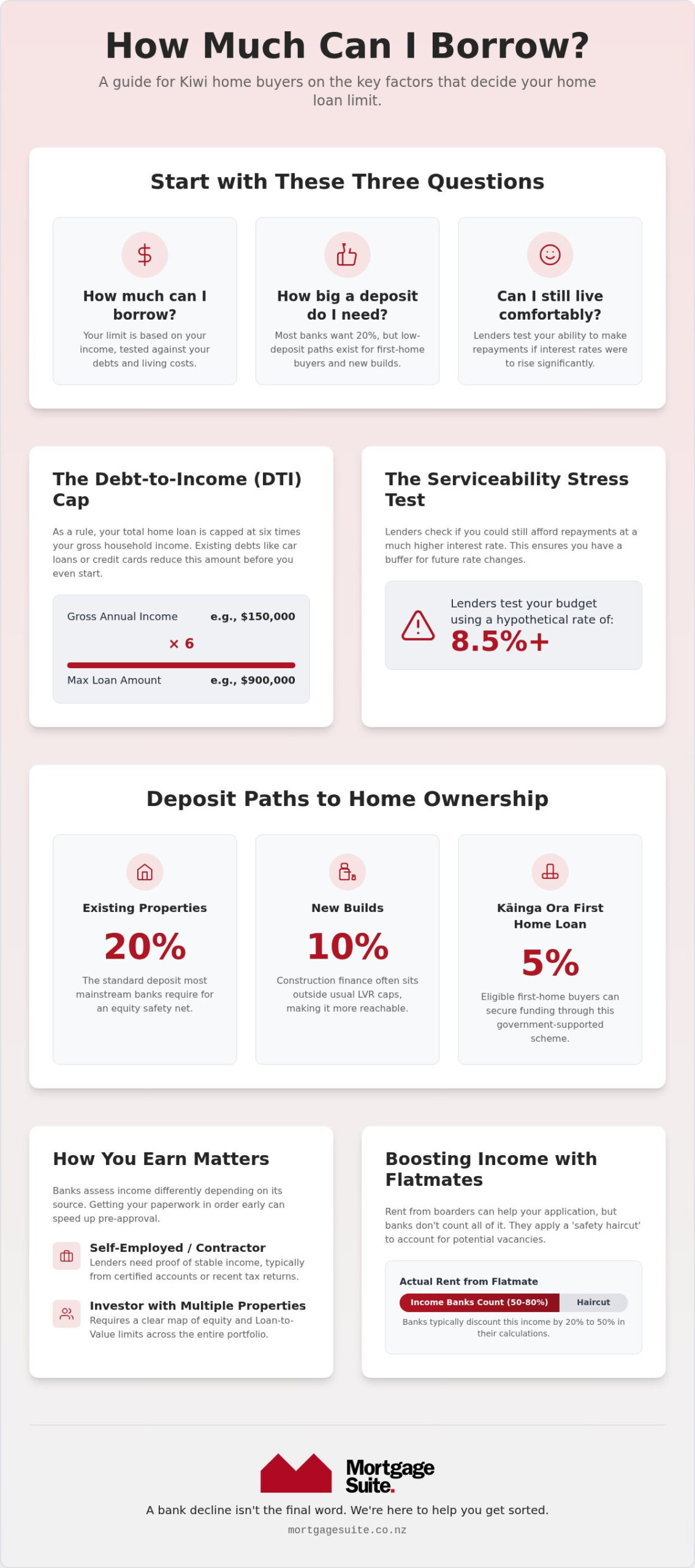
In 2026, the debt-to-income limits set by the Reserve Bank are a primary reason for rejections. For most people buying a home to live in, banks are restricted from lending more than six times your gross yearly income. This includes all your debts, not just the new mortgage. “Hidden” costs like Buy Now Pay Later schemes or interest-free store cards can drastically reduce how much you can borrow. Even a small $50 weekly payment to one of these services can knock thousands of dollars off your total loan amount.

Property Type and Location Restrictions

Sometimes the bank says no because of the house itself rather than your money. Mainstream lenders are often wary of very small apartments, homes with potential structural risks, or properties in certain rural areas. An un-lendable property is any dwelling that doesn’t meet a bank’s security criteria. If you have your heart set on a unique home or an “as-is” sale, the big banks might not be the right fit for that specific property.

Comparing Your Options: Mainstream Banks vs. 2nd Tier Lenders

When you’ve been declined by bank home loan NZ lenders, it’s easy to feel like you’ve run out of road. But the New Zealand lending market is much broader than just the big household names you see on the high street. If the mainstream banks have said no, it’s often because your life doesn’t fit into their very specific, automated box. This is where alternative or “non-bank” lenders come into play. These are established, professional financial companies that operate with more flexibility than traditional banks.

The main trade-off here is between flexibility and cost. Mainstream banks usually offer the lowest interest rates, but they demand a perfect application. Alternative lenders might charge a slightly higher rate or a one-off fee, but they are far more willing to listen to your actual circumstances. They don’t just look at a score; they look at your potential. For a deeper look at who these providers are, check out our guide on non-bank lenders NZ.

Think of these lenders as a strategic bridge. Instead of waiting years for a small credit issue to disappear or for your business to show several years of perfect records, an alternative loan gets you into your home now. You can start building your own equity and benefit from any house price growth while you prove your reliability to the market over the next year or two.

The Human Element in Alternative Lending

The biggest benefit of these lenders is that they don’t rely on a computer to make the final call. Instead of an automated system that rejects you for one minor mistake, you benefit from having a real person review your application. They want to know the “why” behind your situation. For example, if your deposit was slightly lower than 20%, they might look at your strong career history as a way to balance that risk.

We recently helped a self-employed tradie who was in this exact position. He had plenty of work and a great income, but because he’d only been in business for 18 months, the big banks wouldn’t even open his file. By using an alternative lender, Mortgage Suite Ltd showed a human assessor his actual bank statements and current contracts. He got his approval in days, proving that being declined by bank home loan NZ lenders doesn’t have to stop you from buying a house.

Stepping Stones: The Long-Term Strategy

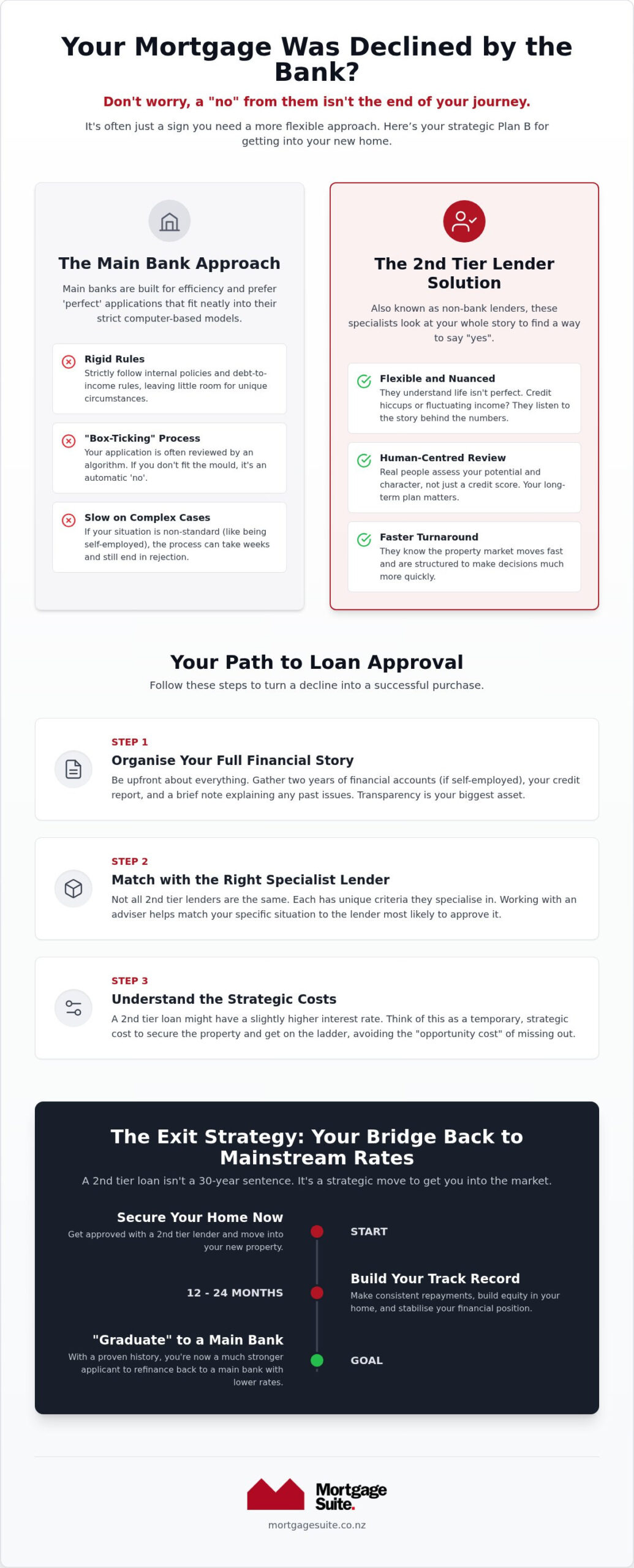
We usually suggest using these alternative lenders for about 12 to 24 months. During this time, you make every payment on time and build up your equity as the property value grows. Once your situation has stabilised and your records are up to date, Mortgage Suite Ltd can then help you move back to a mainstream bank at a lower interest rate. You can read more about this transition in our 2nd tier lender New Zealand guide.

Declined by the Bank for a Home Loan in NZ? Your 2026 Recovery Guide

Your Step-by-Step Recovery Plan After a Loan Rejection

Getting the news that you’ve been declined by bank home loan NZ lenders is a shock, but it’s not the end of the road. You need a calm, methodical plan to turn things around. Instead of letting frustration take over, follow these steps to rebuild your application and get back on track. The goal is to move from a “no” to a “yes” by addressing the specific hurdles the bank identified.

The first step is to get the specific reason for the decline in writing. Don’t just accept a vague explanation over the phone. You need to know if the issue was your income, your deposit, or perhaps a blemish on your credit report. Once you have this, conduct an honest audit of your finances. Look at your bank statements and credit file through the eyes of a lender. If you see frequent “buy now, pay later” payments or small overdraft fees, you’ve found your starting point for improvement.

It’s also vital to pause all new credit applications immediately. Every time you apply for a new limit or a store card, it leaves a footprint on your file that can look like credit stress to a bank. Instead, consult a specialist broker who understands the alternative lending market. They can help you organise a pivot strategy. This might involve staying with your current bank and fixing your spending habits, or it might mean switching to a lender that is more comfortable with your specific situation. If you’re ready to stop the guesswork, reach out to us today to get a clear plan for your next move.

Cleaning Up Your Financial Act

To win over a new lender, you need to prove you are a reliable borrower. This often requires a period of what we call clean spending. Clean spending is a three-month period of zero unarranged overdrafts or missed payments. It shows a lender that you are in total control of your money. You should also look at closing down any unused credit cards or “zombie” accounts. Even if you don’t use the balance, the bank counts that entire credit limit as a potential debt, which can significantly lower your borrowing power under the current DTI rules.

Protecting Your Credit File

Many people make the mistake of “shopping around” by applying at multiple banks directly after being declined by bank home loan NZ lenders. This is a recipe for disaster. Each application can lower your credit score further. A specialist broker acts as a firewall for your credit file. We only submit your application to the lender most likely to approve it, saving your score from unnecessary hits. For those who have more complex credit issues, our guide on non-conforming home loans New Zealand provides a detailed look at how to secure a mortgage even when your history isn’t perfect.

How Mortgage Suite Ltd Turns a ‘No’ Into a ‘Yes’

Rejection from a main bank doesn’t have to be the end of your property journey. It’s often just a sign that your application needs a different approach. When you’ve been declined by bank home loan NZ lenders, the team at Mortgage Suite Ltd steps in to bridge the gap between rigid bank rules and your personal goals. We don’t see you as a credit score; we see you as a partner who deserves a fair go in a tough 2026 market.

Our strength lies in Krish Krishna’s 20 plus years of insider banking experience. Krish understands the “black box” of bank credit policies because he’s spent decades on the other side of the desk. This deep institutional knowledge allows Mortgage Suite Ltd to “re-frame” your story. We know how to present your finances in a way that addresses a lender’s specific fears, turning a potential rejection into a confident approval. It’s about more than just filling out forms; it’s about high-level negotiation and advocacy.

One of the biggest advantages of working with Mortgage Suite Ltd is our access to the 2nd tier market. Many of the most flexible alternative lenders in New Zealand don’t deal with the public directly. They only work through trusted brokers. This means we can open doors that are otherwise locked, giving you access to home loans that main banks simply can’t offer. We fight for your approval by manually pitching your case to the right person, ensuring your human story isn’t lost in an automated system.

Specialist Solutions for Unique Situations

We realise that everyone’s financial path looks different. If you’re a business owner or a contractor, you might find our help with low doc home loans nz particularly useful. Mainstream banks often struggle with self-employed income, but we know which lenders appreciate your entrepreneurial drive.

Mortgage Suite Ltd also handles “Bad Credit” scenarios with zero judgement. Whether it’s an old default or a temporary setback, we focus on the solution rather than the mistake. Our expertise also extends to more complex needs, such as property development and commercial pivots. When a bank pulls back on a project, we have the connections to find alternative funding that keeps your development moving forward.

Ready to Get Your Property Dreams Back on Track?

Many people think they need to wait six or twelve months after being declined by bank home loan NZ lenders to try again. In reality, waiting can sometimes be the wrong move, especially if property prices are rising or your current living situation is costing you money. A strategic pivot to an alternative lender could get you into your home today, allowing you to build equity right now.

We offer a “No Worries” consultation where we’ll give you an honest assessment of your options. No jargon, no judgement, just a clear path forward. If you’re tired of the “computer says no” routine, it’s time to talk to a veteran who knows how to get a “yes.” Book a strategy session with Krish at Mortgage Suite Ltd today and let’s get you sorted.

Take the Next Step Toward Your New Home

Being declined by bank home loan NZ lenders is a significant hurdle, but it’s certainly not a dead end for your property dreams. You’ve now seen that a rejection is often just a sign that your financial profile doesn’t fit a specific bank’s automated rules for 2026. By tidying up your account conduct and considering the flexible options offered by second-tier lenders, you can bridge the gap and secure your property much sooner than you think.

Success in today’s complex market requires more than just a decent deposit; it needs a dedicated negotiator who understands how the system works from the inside. Mortgage Suite Ltd brings over two decades of banking and brokerage experience to your side. Krish Krishna specialises in alternative lending solutions that mainstream banks often overlook, acting as a steady hand to guide you through the process.

Don’t let a single “no” stop you from reaching your goals. Talk to Krish at Mortgage Suite Ltd—Let’s turn that “No” into a “Yes”. We are ready to help you find a clear path forward and get your plans back on track with confidence.

Frequently Asked Questions

Why did the bank decline my home loan if I have a 20% deposit?

Banks look at more than just the size of your deposit. Even with 20% equity, they need to be certain your income can cover the repayments if interest rates go up. They use a higher “test rate” to see if you have enough money left over after all your usual bills and debts are paid. If your monthly surplus is too low, the deposit size doesn’t matter to their automated systems.

How long should I wait to apply again after being declined by a bank in NZ?

There is no set rule, but waiting three months is often wise if you need to show better spending habits. If the decline was simply because that specific bank didn’t like your property type, you could potentially apply elsewhere straight away. The key is to fix the underlying issue first so you don’t end up with another rejection on your record.

Can a mortgage broker help if I’ve already been declined?

A mortgage broker is often the first person you should call after being declined by bank home loan NZ lenders. We can look at the bank’s feedback and determine if it was a “soft no” based on their internal policy or a “hard no” due to credit issues. From there, we can match you with a lender that values your specific financial profile and understands your story.

Is a 2nd tier lender safe for a New Zealand home loan?

Yes, these lenders are safe and highly regulated in New Zealand. They provide a vital service for people who don’t fit the narrow criteria of mainstream banks. While they might not have branches on every corner, they are professional organisations that must follow the same consumer protection laws as any other lender. They are a legitimate path to home ownership for many Kiwis.

Will being declined for a mortgage hurt my credit score?

A rejection doesn’t show up on your credit report, but the fact that you applied does. Each application creates a “hard enquiry,” and having too many of these in a short period can lower your score. It suggests to other lenders that you might be struggling financially. This is why it is much safer to let a broker handle the enquiries for you to protect your file.

What is the most common reason for a mortgage decline in 2026?

The introduction of Debt-to-Income (DTI) ratios is currently the biggest hurdle. As of July 2026, most banks won’t lend more than six times your gross annual income if you are buying a home to live in. When you combine this with high interest rates and strict spending checks, it’s becoming much harder for the average Kiwi to meet the mainstream bank’s rigid criteria.

Can I get a home loan if I am self-employed and have been declined?

You certainly can, as being declined by bank home loan NZ institutions is a common experience for business owners. Mainstream banks often want two years of perfect financial records. Alternative lenders are much more flexible. They can often use your recent bank statements or a shorter history of financial accounts to prove you can afford the loan. We specialise in finding these common-sense solutions.

How much more does a non-bank home loan cost compared to a bank?

Non-bank lenders generally have slightly higher interest rates and may charge an establishment fee. This reflects the fact that they are taking on more risk or doing more manual work to assess your application. Most of our clients see this as a temporary cost; it’s a way to get into a home now and build equity before eventually moving back to a bank later.

Article by

Krish Krishna

Experienced Financial Adviser with over 46 years of Banking and Mortgage broking experience and over $2.0 Billion in loan settlements.

2nd Tier Lender New Zealand: Your 2026 Guide to Alternative Home Loans

What if the bank’s “no” isn’t actually the end of your home-buying journey, but just a sign you’re looking in the wrong place? It is incredibly disheartening to feel like a mere tick-box on a spreadsheet, especially when a slightly messy credit history or self-employed income makes you “too hard” for traditional lenders. Finding a 2nd tier lender New Zealand wide can be the breakthrough you need, offering a common-sense approach that looks at your whole financial picture rather than just a computer-generated score.

We understand the anxiety that comes with being turned away, but these alternative options are designed for people who need a partner, not just a processor. This guide explores how to secure a flexible home loan that respects your unique situation, providing a fair go when the big banks won’t budge. You will discover exactly how these lenders operate in 2026, the specific benefits they offer for non-standard financial profiles, and how to create a clear strategy for eventually refinancing back to a mainstream bank once your circumstances settle.

Key Takeaways

  • Understand that 2nd tier lenders are professional, legitimate institutions that offer a genuine alternative when big banks won’t help.
  • Discover how a 2nd tier lender New Zealand wide uses a common-sense approach to look at your whole financial picture rather than just ticking boxes.
  • Learn why flexibility often comes with a slightly higher interest rate and how the speed of these lenders can save your property deal.
  • Find out how to organise a professional paper trail and why being upfront about your history helps secure a faster approval.
  • Explore how seasoned expertise can bridge the gap between rigid banking rules and your personal goal of home ownership.

What is a 2nd Tier Lender in New Zealand?

Think of a 2nd tier lender as a specialised financial institution that focuses purely on helping people secure property. Unlike the big banks you see on every street corner, these organisations don’t offer everyday savings accounts, credit cards, or travel insurance. They aren’t “retail banks” in the traditional sense; instead, they are professional lenders who use their own capital or institutional funds to provide mortgages. This narrow focus is actually their greatest strength because it allows them to be far more flexible than a bank that’s trying to be everything to everyone.

The main difference you’ll notice is the way they look at your application. While big banks often rely on rigid computer algorithms that spit out a “yes” or “no” based on strict “tick-box” criteria, a 2nd tier lender New Zealand homeowners use often applies a common-sense approach. They’re interested in the “why” behind your financial situation. If you’re self-employed and your income fluctuates, or if you had a minor credit hiccup a few years ago, these lenders are more likely to look at the big picture rather than just the numbers on a screen. They provide a vital alternative for Kiwis who have the ability to pay a mortgage but don’t quite fit the narrow mould of mainstream banking.

Non-Bank vs. 2nd Tier: Is there a difference?

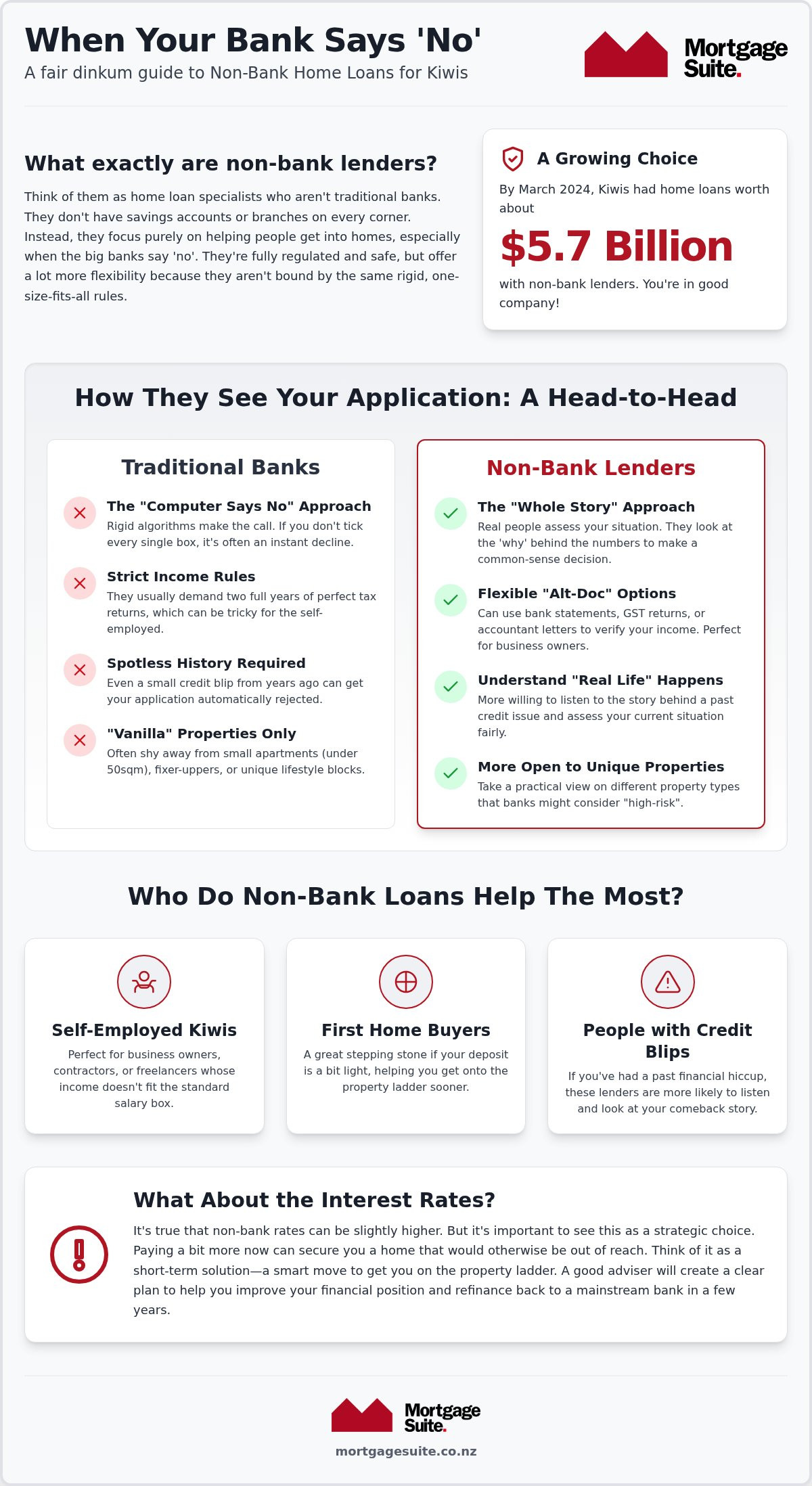
No worries if you’re a bit confused by the different names; they basically mean the same thing in our local market. “Non-bank” describes their legal structure, meaning they are a non-bank financial institution that doesn’t hold a full banking licence from the Reserve Bank. “2nd tier” describes their position as a secondary option to the “Big Four” banks. Whether you call them non-banks or 2nd tier, the result is the same: a professional lender that offers a different path to home ownership.

Why they are a safe bet for Kiwis

Some people worry that stepping away from a big bank means less protection, but that isn’t the case. Every 2nd tier lender New Zealand has must follow the Credit Contracts and Consumer Finance Act (CCCFA). This means they are legally required to be responsible lenders, just like the household names. These institutions have been a solid part of our property market for decades. Many are backed by massive global investment firms or well-known local institutions, ensuring they have the stability and reputation to support your long-term goals. They aren’t “last resorts” but rather strategic partners for those who need a more personalised touch.

Why the Mainstream Banks Might Say ‘No’

It’s a sinking feeling when you’ve done everything right, saved your deposit, and found the perfect home, only to have a bank manager shake their head. The reality is that the Big Four banks are massive machines built for speed and volume. To keep things moving, they rely on rigid, one-size-fits-all rules. If your financial situation has even a tiny bit of “colour” or complexity, you often fall outside their very narrow appetite for risk. A “no” from a mainstream lender usually isn’t a reflection of your ability to pay; it’s simply a sign that you don’t fit their specific, pre-programmed mould.

This is where a 2nd tier lender New Zealand wide provides a much-needed alternative. While banks look for reasons to say no to protect their high-volume systems, 2nd tier lenders look for reasons to say yes. They take the time to understand the story behind the numbers. They recognise that modern lives are rarely tidy, and they’re willing to look at the big picture of your financial health rather than just a computer-generated score.

Common hurdles for the ‘Big Four’

There are several reasons why a perfectly capable borrower might get a “thanks, but no thanks” from a traditional bank. These hurdles are often non-negotiable for mainstream lenders:

  • Self-employed income: Banks usually demand two full years of perfect financial records. If you’ve been in business for 12 months and are doing well, a bank might still decline you simply because you haven’t reached that two-year mark.
  • Deposit size: With government rules often requiring a 20% deposit for owner-occupiers, many Kiwis find themselves just a few thousand dollars short.
  • Credit history: A forgotten power bill from three years ago or a minor credit card dispute can stay on your file and trigger an automatic decline in a bank’s system.
  • Property types: Banks are often wary of apartments under a certain size, tiny homes, or lifestyle blocks with unusual titles.

The ‘Tick-Box’ trap

Modern banking relies heavily on automated software. When you submit an application, an algorithm scans for specific data points. If one “box” isn’t ticked, the system can auto-decline the application before a person even looks at it. In contrast, the 2nd tier space relies on a human-led decision-making process. These are experienced professionals who can see that a past credit hiccup was a one-off event or that your self-employment income is stable and growing. This approach is the foundation for non-conforming loans, which are specialised products designed specifically for “out-of-the-box” situations that don’t meet standard bank criteria. If you’re feeling stuck in this tick-box trap, it might be time to talk to an expert who knows how to present your case to the right people.

Comparing 2nd Tier Lenders vs. Mainstream Banks

Choosing between a big bank and a 2nd tier option isn’t about finding a “better” lender, but rather the right lender for your current situation. Mainstream banks are great for people who fit a very specific profile and want the lowest possible interest rate. However, that low rate often comes with a lack of flexibility and a slow, complicated process. If you need a lender who can look past a messy bank statement or move quickly to secure a property, a 2nd tier lender New Zealand wide offers a level of service the big banks simply aren’t built to provide.

One of the biggest advantages is the personalised approach. You won’t find yourself stuck in a massive call centre queue or waiting weeks for a computer to process your paperwork. Instead, you’re working with people who understand that every borrower has a unique story. They can be far more creative with loan structures, such as offering longer periods where you only pay the interest. This can help with your cash flow while you’re getting established or finishing a renovation. It’s about finding a solution that fits your life, not forcing your life to fit their rules. For property investors in particular, this flexibility extends to residential investment property loans NZ borrowers use to grow their portfolios when mainstream banks won’t budge on LVR restrictions.

Interest rates and fees: The real story

Let’s be upfront about the trade-offs. Because these lenders take on more complex cases, their interest rates are generally higher than the “special” rates advertised by the Big Four. For many Kiwis, the slightly higher cost is a small price to pay for the value of actually getting the keys to their home. It’s often a short-term strategy to get into the market now rather than waiting years to save a larger deposit. To help with the initial costs, many of these lenders allow you to add the setup fees to your total loan balance, meaning you don’t need even more cash upfront to get the deal across the line.

Flexibility and Speed

Speed is where these lenders truly shine. While a big bank might take weeks to give you a definitive answer, a 2nd tier lender can often organise a conditional approval in as little as 48 hours. This is a game-changer if you’re trying to secure a property at auction or need a short-term loan to cover the gap between selling one home and buying another. They are experts in providing non-conforming home loans New Zealand families use to navigate tricky transitions. Whether it’s a short-term fix or a long-term plan, their ability to move fast ensures you don’t miss out on the right opportunity just because a bank’s internal rules changed overnight. This same speed and flexibility makes them a natural fit for those seeking property development loans NZ wide, where tight project timelines and complex income structures often rule out the big banks entirely.

2nd Tier Lender New Zealand: Your 2026 Guide to Alternative Home Loans

How to Prepare a Solid 2nd Tier Loan Application

Getting your ducks in a row before you talk to a lender makes a world of difference. When you apply with a 2nd tier lender New Zealand wide, you aren’t just submitting a pile of numbers; you’re telling a story. These lenders are looking for a reason to say yes, but they need to see that you’re professional and organised. Gathering a clear paper trail is the first step to proving you’re a reliable partner who takes their finances seriously. It shows you’ve moved past the “too hard” basket and are ready to take control of your property journey.

Honesty is your best policy here. We always tell our clients that lenders hate surprises but they love honesty. If you have a bit of a colourful credit history or a period of low income, it’s much better to be upfront about it. When you explain the “why” behind a past mistake, it allows the lender to focus on your current ability to afford the repayments. They want to see that you have a stable income now and a clear plan for the future. This is where a mortgage broker becomes your best mate. We know exactly which lenders are comfortable with your specific situation and how to present your case so it stands out for the right reasons.

The ‘Exit Strategy’: Planning your return to the bank

Think of this loan as a bridge, not a destination. You don’t necessarily need a 2nd tier loan for a full 30-year term. Instead, many Kiwis use these products for 12 to 24 months to “clean up” their financial profile. During this time, you can prove a stable income or wait for old credit marks to fall off your record. Once your situation has settled, Mortgage Suite Ltd can help you refinance back to a mainstream bank with a lower rate. You can learn more about how this transition works in our guide to non-bank lenders nz.

The documentation you’ll need

To give yourself the best chance of a fast approval, you’ll need to have your paperwork ready to go. Lenders will look closely at your recent bank statements to check how you manage your bank accounts. They want to see that you’re handling your money well, without unarranged overdrafts or missed payments. You’ll also need to prepare:

  • Proof of deposit: This could be your savings, a gift from family, or equity you’ve built up in another property.
  • Income verification: For those who work for themselves, this might include recent sets of accounts or GST returns to show your business is healthy.
  • A written explanation: A short, honest note explaining any past credit issues helps you get ahead of the lender’s questions and shows you’re proactive.

If you’re ready to stop guessing and start moving forward with a plan tailored to you, the best next step is to get in touch for a personalised chat about your options.

How Mortgage Suite Ltd Connects You to Alternative Funding

At Mortgage Suite Ltd, we believe everyone deserves a fair go at owning a home. Our founder, Krish Krishna, brings more than 20 years of deep banking experience to your side of the table. This isn’t just a number on a CV; it’s your secret weapon. Because Krish has spent two decades understanding the inner workings of the financial world, he knows exactly how to navigate the systems that often feel like a maze to everyday Kiwis. He has seen the process from both sides and knows what it takes to get a deal across the line.

Our role is to act as a bridge between you and the right 2nd tier lender New Zealand has available. We take your complex situation, whether you’re self-employed, have a non-standard income, or a few credit marks, and ‘translate’ it into a language that lenders understand and respect. We don’t just pass on your paperwork. Mortgage Suite Ltd builds a professional case for you, highlighting your strengths and providing clear context for any past hurdles. This hands-on approach often makes the difference between a quick decline and a solid approval. Our process is built on several key advantages:

  • Direct access to a wide range of lenders you won’t find on the high street.
  • Deep knowledge of “hidden” lending criteria that changes from month to month.
  • A proactive attitude toward overcoming obstacles that stop big banks in their tracks.
  • A long-term commitment to your financial success, not just a one-off transaction.

Expert negotiation on your behalf

We don’t just stop at the first “yes” we receive. Our goal is to fight for the best possible terms for your specific needs. Because Mortgage Suite Ltd has established relationships with a huge range of lenders across the country, we have access to options that the general public cannot reach directly. Every lender has its own unique appetite for risk at any given time. We know which ones are looking for your type of deal right now. From the top of the North Island to the bottom of the South, we provide national reach for all types of property loans, including residential investment property loans NZ investors need to unlock equity and grow their portfolios in 2026, ensuring you get a solution that works for your long-term goals.

Ready for a fair go?

If you’ve been turned away by your bank, please remember that it’s just a detour, not the end of the road. We invite you to reach out for a confidential, judgment-free chat about your situation. Mortgage Suite Ltd has seen every possible scenario and we know how to find a path forward. Our commitment is to partner with you for your long-term financial success, helping you get into your home now while planning for your eventual return to a mainstream bank. When you’re ready to explore what’s possible, you can book a consultation with our team. Let’s get to work on making your home ownership goals a reality.

Your Path to Home Ownership Starts Here

Securing a mortgage doesn’t have to be a stressful battle against a bank’s rigid computer system. Alternative options provide the flexibility and common-sense approach that modern Kiwis need to move forward. Whether you’re navigating self-employment income or a non-standard credit history, finding the right 2nd tier lender New Zealand wide can be the bridge that gets you into your home sooner rather than later. By focusing on a clear exit strategy and preparing a professional application, you can turn a bank’s decline into a successful new beginning.

With over 20 years of banking and mortgage expertise, Mortgage Suite Ltd specialises in these complex, non-conforming loans. Our founder-led service ensures you receive personalised attention from someone who truly knows how to negotiate with alternative lenders to get the best possible result for your situation. You don’t have to figure this out on your own. Chat with Mortgage Suite Ltd about your 2nd tier loan options today and let us help you find a fair go in the property market. Your dream home is still within reach, and we’re here to help you secure it.

Frequently Asked Questions

Is a 2nd tier lender safe to use in New Zealand?

Yes, they are completely safe and professional organisations. Every 2nd tier lender New Zealand has must comply with the Credit Contracts and Consumer Finance Act (CCCFA). This ensures they follow strict responsible lending rules just like the big banks. Many are backed by large investment firms; providing a secure and regulated environment for your home loan. You can feel confident that your rights are protected under New Zealand law.

Will my interest rate be much higher with a 2nd tier lender?

Generally, yes, the interest rates are slightly higher than those offered by mainstream banks. This reflects the extra flexibility they provide and the higher risk they take on. However, for many people, the small increase in cost is a fair trade for actually getting into a home. It is often a short-term solution while you work toward qualifying for a standard bank rate in the future.

Can I move back to a mainstream bank later on?

Absolutely, and for most clients, this is the ultimate goal. We often set up these loans with a 12 to 24 month plan in mind. Once you have built up more equity or cleaned up your credit history, we can help you refinance back to a mainstream bank. This “exit strategy” ensures you aren’t paying a higher rate for any longer than you actually need to.

Do 2nd tier lenders require a bigger deposit?

Not necessarily. In some cases, a 2nd tier lender New Zealand wide might actually be more flexible with deposit sizes than a big bank. While banks are often restricted by tight government rules on low-deposit lending, alternative lenders have more freedom to look at your individual situation. They focus more on your ability to make the repayments rather than just the cash you have upfront.

How long does it take to get a 2nd tier loan approved?

These lenders are typically much faster than traditional banks. You can often get a conditional approval within 48 hours, whereas a big bank might take two weeks or more. Because they are smaller and more focused, they don’t have the same layers of bureaucracy. This speed is a huge advantage if you are trying to buy a property at auction or have a tight deadline.

Can I get a 2nd tier loan if I’m self-employed?

Yes, they are often the best option for business owners and contractors. Banks often demand two years of perfect financial records, which many self-employed Kiwis don’t have. Alternative lenders are happy to look at other proof of income, such as GST returns or recent bank statements. They understand how business income works and won’t penalise you for having a complex financial structure.

What happens if I have bad credit history?

They take a common-sense approach to your past. Instead of an automatic “no” from a computer, a human will look at why the credit issue happened and what has changed since then. If you can show that you are back on track and can afford the loan now, they are often willing to help. It’s about your current character and ability to pay, not just a past mistake.

Are 2nd tier lenders the same as ‘payday’ lenders?

No, they are completely different. Payday lenders offer very small, high-interest loans for a few weeks. In contrast, 2nd tier lenders provide long-term property finance and mortgages. They are professional financial institutions that offer competitive alternatives to the big banks. They are a legitimate part of the New Zealand property market and help thousands of families secure their own homes every year.

Article by

Krish Krishna

Experienced Financial Adviser with over 46 years of Banking and Mortgage broking experience and over $2.0 Billion in loan settlements.

Low Deposit Home Loan NZ: How to Buy Your First Home in 2026

What if the “magic” 20% deposit isn’t actually a requirement, but just a preference for the big banks? If you’ve been stuck in the rent trap, watching house prices climb while you struggle to save a massive lump sum, you’re definitely not alone. The truth is that securing a low deposit home loan nz is entirely possible in 2026, even if you don’t have a six-figure savings account or a perfect financial history. You don’t need to let the fear of being judged or the weight of complex bank jargon stop you from making a move toward your own front door.

We understand how discouraging it feels to be declined by a lender or feel like you’re just another number in a massive corporate queue. It’s frustrating when you’re ready to commit to a home but the traditional gates seem locked. This article will show you exactly how to bypass those hurdles and secure your first home with as little as a 5% deposit. We’ll walk you through the current government schemes, explain why choosing a new build offers a unique shortcut, and explore how alternative lending pathways can help you find a solution that respects your unique financial story and gets you into your own home sooner.

Key Takeaways

  • The 20% deposit rule is a bank preference, not a law, meaning you can often secure a property with a much smaller contribution.
  • See how combining government schemes with your KiwiSaver could allow you to secure a low deposit home loan nz with as little as 5% upfront.
  • Explore why buying a brand-new home can bypass strict lending limits and lower your required deposit to just 10%.
  • Understand how non-bank lenders provide a secure, professional alternative for borrowers who don’t fit the rigid boxes of major banks.
  • Learn the simple steps to tidy your bank accounts and manage small debts so your home loan application is ready for success.

Breaking the 20% Myth: What a Low Deposit Home Loan Really Means in NZ

You’ve probably been told that unless you’ve saved a massive 20% deposit, you’re out of the running for a house. That’s simply not true. While banks love a big deposit because it lowers their risk, it isn’t a legal requirement for you to have one. In the real world, a low deposit home loan nz is generally defined as any loan where you’ve saved between 5% and 19.9% of the property’s value. Having a smaller slice of the pie upfront doesn’t mean you have a low chance of success. It just means you need a smarter strategy and a steady hand to guide you through the process.

Lenders are governed by rules set by the Reserve Bank of New Zealand. These Loan-to-Value (LVR) restrictions act like a speed limit, controlling how many low-deposit loans a bank can give out each month. As of late 2025, banks are allowed to give up to 25% of their new owner-occupier loans to people with less than a 20% deposit. This means the door is wide open for thousands of Kiwis every year who don’t have a massive pile of cash but do have a solid income and a clear plan.

Why does the 20% rule exist anyway?

The Reserve Bank uses these rules to keep the New Zealand housing market stable. If everyone borrowed too much and house prices fell, the whole system could get shaky. By encouraging a 20% deposit, they create a safety net for both you and the bank. However, this doesn’t mean you’re stuck in the rent trap forever. Even with these restrictions, lenders are actively looking for reliable borrowers who fit their criteria. You just need to show them that you’re a safe bet through good spending habits and a stable job.

The trade-off: Low deposit vs. higher interest

When you buy with less than 20%, you’ll likely face a “Low Equity Margin” or LEM. This is a small extra interest cost the bank adds to your mortgage because they’re taking on a bit more risk. While a higher rate sounds daunting, you have to weigh it up against the cost of waiting. If house prices rise while you’re busy saving that extra 10%, that increase could be far more expensive than the extra interest you’d pay on a low deposit home loan nz today. Equity is the portion of the home you actually own, representing the difference between the property’s market value and the amount you still owe the bank.

Choosing to get in early with a smaller deposit can be a brilliant move if it gets you out of the rent cycle and into a home that is growing in value. It’s all about looking at your unique financial story and deciding if the trade-off helps you reach your long-term goals faster. For a detailed breakdown of exactly how much you need to save under different scenarios, our guide to home loan deposit requirements NZ covers every option available to you in 2026.

Government-Backed Wins: Using the First Home Loan and KiwiSaver

If you’re feeling a bit stuck, there’s good news. The government has pathways designed specifically to help you bridge the gap between renting and owning. These aren’t handouts, but they do make it much easier to qualify for a low deposit home loan nz when your savings haven’t quite reached that 20% mark yet. By using these tools, you can stop focusing on what you lack and start looking at the options actually available to you.

The 5% First Home Loan explained

The First Home Loan scheme is one of the most powerful tools in your kit. It’s important to understand that the government isn’t actually lending you the money; a bank or a participating lender does that. However, Kāinga Ora “underwrites” the loan. This means they tell the bank that if things go wrong, they’ll help cover the risk. Because of this extra security, lenders are happy to accept a tiny 5% deposit.

To qualify for the First Home Loan, you’ll generally need to meet these markers:

  • Be a New Zealand citizen, permanent resident, or a resident visa holder who has lived here for at least two years.
  • Have a total before-tax income of $95,000 or less for a single buyer, or $150,000 or less for a couple or single buyer with dependents.
  • Be buying the home to live in it yourself, rather than as an investment.
  • Have a 5% deposit ready, which can include your KiwiSaver and any gifted funds.

The truth is that even if you’ve owned a home before, you might still qualify as a “second chance” buyer if your financial position is back at square one. Before you apply, it’s also worth understanding First Home Grant NZ eligibility and whether any additional government support applies to your situation. For a full breakdown of how these rules work in practice, our first home buyer guide New Zealand is a great place to start.

Maxing out your KiwiSaver withdrawal

Your KiwiSaver is likely your biggest asset when it comes to a deposit. If you’ve been a member for at least three years, you can generally withdraw almost everything to put toward your first home. The only catch is that you must leave a $1,000 kickstart balance in your account. This money can make up the bulk of your 5% requirement, which takes a huge weight off your shoulders.

Don’t wait until you’ve found a house to check this. You should apply for a “letter of entitlement” from your provider early on. This document tells lenders exactly how much cash you have ready to go. Many buyers also find that combining their KiwiSaver with a small gift from family is the secret to reaching their goal. If you’re unsure how these different funds can work together, reaching out to a professional who understands home loans for first home buyers can make the whole process feel much smoother and more organised.

The New Build Advantage: Why Buying Brand New Lowers the Bar

If you’re looking for a shortcut to home ownership, buying a brand-new property might be your best bet. While we’ve talked about how banks generally prefer a 20% deposit, they have a bit of a “soft spot” for new builds. This is because the Reserve Bank provides specific exemptions for houses that have just been built or are still under construction. For you, this means securing a low deposit home loan nz becomes significantly easier when you look at properties that are fresh off the plans.

Banks are often happy to accept a 10% deposit for a brand-new home, even without a government guarantee. Because these properties meet the latest building codes and are generally more valuable to the bank as security, they’re willing to be more flexible with their lending limits. It’s a proactive way to get ahead of the market while ensuring you’re moving into a home that won’t require expensive repairs or weekend DIY projects for years to come.

Exemptions from LVR restrictions

The government is eager to see more houses on the ground to ease the housing shortage, so they give banks a lot more freedom to lend on properties that haven’t been lived in before. These rules are designed to encourage construction, making this often the most direct path to a low deposit home loan nz for those who want to skip the competition of the existing market. In most cases, a “new build” is defined as a property bought within six months of its completion date. When you combine this flexibility with the First Home Loan scheme, the entry bar drops even lower, potentially allowing you to start your journey with just 5% down.

Turnkey vs. Progressive Payments

When you’re looking at new builds, you’ll likely hear the term “turnkey.” This is a fantastic option for first-home buyers because it’s incredibly straightforward. You pay a small deposit upfront, and you don’t pay the rest until the house is finished and you’ve got the keys in your hand. This is usually far less stressful than a “progressive payment” loan, where you’d have to pay the builder in stages as they reach certain milestones. With a turnkey contract, your price is often fixed, protecting you from the rising costs of building materials while your home is being constructed. It allows you to keep saving while the builders do the hard work, giving you a steady and predictable path to moving day.

Low Deposit Home Loan NZ: How to Buy Your First Home in 2026

When the Big Banks Say No: Exploring Alternative Lending Options

Getting a “no” from a major bank can feel like a punch in the gut. You’ve saved hard, done your research, and then a computer algorithm decides you don’t quite fit the standard box. But here’s a secret from someone who’s spent decades in this industry: the big banks don’t have the final word on your future. If your situation is a bit different, perhaps because you’re self-employed or your income doesn’t follow a standard pattern, a low deposit home loan nz is still within reach through alternative pathways. A decline isn’t the end of the road; it’s often just a sign that you need a more flexible map.

Who are second-tier lenders?

These are reputable, professional financial institutions that simply operate outside the “Big Four” bank structure. They aren’t some mysterious backyard operations; they are well-funded, regulated, and often much more agile than their larger competitors. The main difference is their approach to risk. While a big bank might decline you for having a small blemish on your credit history or for being in a new job, second-tier lenders often use common sense rules. They look at the person behind the application, not just the spreadsheet. At Mortgage Suite Ltd, we specialise in 2nd tier loans because we know that a “non-standard” life doesn’t mean you’re a risky borrower. It just means you need a lender who is willing to listen to your story and look at the bigger picture.

The ‘Bridge’ Strategy

Think of an alternative lender as a bridge. The goal isn’t necessarily to stay with them for the next thirty years. Instead, you use their flexibility to get into the property market right now. Once you’re in, you stop paying someone else’s mortgage through rent and start building your own equity. As house prices grow and you pay down the loan, your ownership stake increases. After a year or two, you’ll often find you have enough equity to refinance and move back to a mainstream bank with a lower interest rate. This is where seasoned experience really counts. Krish Krishna brings over 20 years of banking experience to the table, knowing exactly how to negotiate these deals so they serve as a stepping stone rather than a permanent fixture. It’s about getting your foot in the door today so you can enjoy the capital gains of tomorrow.

You don’t have to navigate these complex waters alone. If the traditional route has hit a dead end, it’s time to explore a more personalised approach that respects your unique financial journey. We can help you find a path that the big banks simply aren’t equipped to see. If you’re ready to stop waiting and start owning your future, talk to our team at Mortgage Suite Ltd about your options today.

Getting Your Application Sorted: How to Prepare for Success

Once you’ve identified the right path—whether that involves the government-backed schemes or the new build exemptions we’ve explored—it’s time to ensure your application is as strong as your ambition. When you’re applying for a low deposit home loan nz, lenders will look at your financial life through a microscope. They aren’t just checking your savings balance; they’re looking for proof that you’re a reliable and organised borrower. Preparation is the secret to moving from a “maybe” to a firm “yes.”

You don’t need to be a financial expert to succeed, but you do need to show the bank that you’re ready for the responsibility. Lenders want to see a pattern of stability. By tidying up your accounts now, you’re proving that you can handle a mortgage just as well as you handle your daily expenses.

Cleaning up your ‘financial CV’

Think of your bank statements from the last three months as your financial resume. Lenders will scan every transaction to check your “account conduct,” which is simply their way of seeing if you’re responsible with your cash. Unarranged overdrafts are a red flag for any lender as they suggest you aren’t quite in control of your daily spending. It’s a good idea to keep your accounts tidy and stay well within your limits for at least 90 days before you apply.

They also look at your discretionary spending. While you don’t need to cut out every treat, showing that you can manage your lifestyle spending proves you have the discipline for a mortgage. To make sure you haven’t missed a beat, it’s worth using this how to qualify for a home loan NZ checklist to get your ducks in a row.

Why a broker makes the difference

Applying for a mortgage can feel like a full-time job, especially when you’re trying to compare different lenders and their specific rules. This is where Mortgage Suite Ltd changes the game. Instead of you visiting multiple banks and repeating your story, we act as your dedicated negotiator. We use our industry relationships to find the best fit for your unique situation, knowing which lenders are currently friendly toward a low deposit home loan nz and which ones might be a waste of your time. Understanding the full picture of home loan deposit requirements NZ across different lender types is something a good broker will walk you through from the very start.

The best part is that for home loans for first home buyers New Zealand, our expert advice is usually free for the borrower. Mortgage Suite Ltd helps you clear “dumb debt” like credit cards or buy-now-pay-later schemes, which can seriously drag down your borrowing power. By clearing these small debts and presenting a clean financial history, you’re not just asking for a loan; you’re proving you’re the perfect candidate for your first home.

Ready to Step into Your Own Home?

You now know that the 20% deposit requirement isn’t a brick wall; it’s a hurdle you can clear with the right strategy. Whether you’re using government support, choosing a modern new build, or exploring alternative lenders, the path to your first home is wider than it looks. By tidying up your financial habits and seeking expert guidance, you can move from the rent trap into a space that’s truly yours. Securing a low deposit home loan nz is about finding the right fit for your unique story, not just fitting into a bank’s rigid box.

With over 20 years of banking and mortgage experience, we act as dedicated negotiators who have seen every scenario. We specialise in 2nd tier and non-bank lending, ensuring that even if the big banks have said no, you still have a powerful advocate in your corner. Let’s get your first home sorted; talk to the experts at Mortgage Suite Ltd today.

Your goal of home ownership is closer than you think. Take that first step with confidence. It’s time to start building your future together.

Frequently Asked Questions

Can I buy a house with a 5% deposit in NZ?

Yes, you can buy a house with a 5% deposit through the First Home Loan scheme or by choosing certain new build options. This scheme is underwritten by the government, which allows participating lenders to accept a much smaller upfront payment than the standard 20%. It is a fantastic way to secure a low deposit home loan nz and get onto the property ladder years earlier than you might have expected.

What is the First Home Loan income cap for 2026?

As of June 2026, the income cap for a single borrower without dependents is $95,000 for the previous 12 months. If you are a single borrower with dependents or you are buying with someone else, the combined income cap is $150,000. These limits ensure the support is targeted toward those who need a helping hand to move from renting to owning their first home.

Do I have to pay Lenders Mortgage Insurance (LMI) with a low deposit?

Yes, a 1.2% LMI premium usually applies to a First Home Loan, but you don’t necessarily have to pay it all upfront. Most lenders allow you to add this cost to your total loan amount, so it is paid off gradually over time. While this insurance protects the lender, it is the key that unlocks the door to a home with such a small deposit.

Can I use my KiwiSaver for a 10% deposit on a new build?

Absolutely, your KiwiSaver funds can be used for your deposit on both new and existing properties as long as you have been a member for three years. Since new builds are exempt from some of the stricter lending rules, a 10% deposit is often all you need. Just remember to leave at least $1,000 in your KiwiSaver account after your withdrawal.

What happens if my bank declines my low deposit application?

If a big bank says no, it isn’t the end of your journey because there are professional non-bank lenders with more flexible rules. These lenders often look at your specific situation with a common sense approach rather than just following a rigid checklist. We often help clients use these lenders as a bridge, getting them into a home now and moving them back to a main bank later.

Is it better to save for a 20% deposit or buy now with 5%?

The answer depends on your goals, but buying now with 5% allows you to stop paying rent and start building equity immediately. If house prices rise faster than you can save, waiting for a 20% deposit might actually leave you further behind. Many people find that getting in early with a low deposit home loan nz is a smarter long-term move for their financial future.

Can my parents help me with a low deposit home loan?

Yes, your parents can help by providing a gifted deposit to top up your own savings or KiwiSaver funds. Banks generally require a letter confirming the money is a gift and doesn’t need to be repaid. This is a very common way for Kiwis to reach the 5% or 10% mark needed to secure their first home.

What is a ‘Low Equity Margin’ and how long do I pay it?

A Low Equity Margin is a small extra interest rate added to your mortgage because you have less than 20% equity in the property. You don’t have to pay it forever; once your home’s value increases or you have paid down enough of the loan to reach 20% equity, you can ask the bank to remove it. It is a temporary cost for the benefit of owning your home sooner.

Article by

Krish Krishna

Experienced Financial Adviser with over 46 years of Banking and Mortgage broking experience and over $2.0 Billion in loan settlements.

Non-Bank Lenders NZ: Your 2026 Guide to Alternative Home Loans

What if a “no” from your local bank wasn’t the end of your home ownership dream, but actually the start of a smarter, more flexible path? If you’ve been turned away because you’re self-employed, have a smaller deposit, or just don’t fit into a tidy little box, it’s easy to feel like the door is locked for good. You might even worry that looking at non bank lenders nz means dealing with “loan sharks” or unregulated companies. It’s a common concern, but the reality in 2026 is far more professional and helpful than the old myths suggest.

We understand that your financial situation is unique, and you deserve a partner who sees the person behind the paperwork. In this guide, we’ll show you how alternative lenders provide a genuine fair go for Kiwis and how to pick the right one for your specific goals. You’ll learn about the “stepping stone” strategy that helps you build equity now so you can move to a mainstream bank later. We’ll also compare the latest 2nd tier options to help you find a clear, safe pathway to your new front door.

Key Takeaways

  • Understand why these lenders don’t need a full banking licence to provide a secure and professional home loan.
  • Discover how non bank lenders nz use a much larger “box” to assess applications, giving hope to those who don’t fit the standard bank criteria.
  • Learn how to get your paperwork in order, including how to handle “alt-doc” evidence if you’re self-employed or run your own business.
  • See why these institutions are often the first choice for investors who need to move fast on a property deal without the usual red tape.
  • Find out how having a dedicated advocate can help you navigate the 2nd tier market and negotiate a deal that actually fits your life.

What Exactly is a Non-Bank Lender in the NZ Market?

Most Kiwis grow up thinking that if you want a home loan, you have to talk to one of the big banks. But the market has changed. A non-bank financial institution is essentially a company that provides mortgages without being a registered bank. They don’t have a full banking licence from the Reserve Bank; this means they operate differently from the household names you see on every street corner. While they might not be as famous as the “Big Four,” they play a massive role in helping people get onto the property ladder.

The biggest difference is that non bank lenders nz don’t take deposits from the public. You can’t open a savings account or set up a term deposit with them. Because they aren’t managing your everyday transaction accounts, they can focus entirely on being specialist providers for unique situations. They provide a vital alternative for people who don’t fit the standard criteria that mainstream banks demand. It’s about looking at the person, not just a computer program or a rigid set of numbers.

When you look at the landscape of non bank lenders nz, you’ll find they are still strictly regulated and must follow the same responsible lending laws as any other financial institution. They have to be registered on the Financial Service Providers Register; and they are overseen by the Financial Markets Authority. They aren’t “loan sharks” or unregulated outfits. They’re professional organisations that offer a steady hand when the big banks say no.

The Difference Between 2nd Tier and Non-Bank

In the industry, we often use the term “2nd tier” to describe these lenders. It’s just a way of saying they sit in the category right below the main banks. While “non-bank” is the technical term, your mortgage broker might use them interchangeably. Don’t let the “2nd tier” label fool you into thinking they’re small. Many of these lenders are huge, well-funded organisations that have helped thousands of Kiwis into homes over several decades. They simply choose to operate as specialists rather than trying to be everything to everyone. If you want a deeper understanding of how these options work in practice, our guide to 2nd tier lender New Zealand alternatives in 2026 covers the full landscape of flexible home loan solutions available to Kiwis today.

Where the Money Comes From

If they don’t take your savings, where does the cash for your mortgage come from? Instead of using money from a neighbour’s savings account, non-banks get their funds from wholesale investors, credit lines, or large investment funds. This funding structure is actually a benefit for you. It gives them more freedom to create flexible rules because they aren’t tied to the same rigid deposit-taking regulations as the big banks. A non-bank lender is a private finance company that specialises in flexible mortgage solutions.

Non-Bank Lenders vs Mainstream Banks: Spotting the Differences

Imagine the big four banks, ANZ, Westpac, BNZ, and ASB, as a very small, rigid box. If your financial situation doesn’t fit perfectly inside, the lid won’t close, and you’ll likely receive a “no.” In contrast, non bank lenders nz operate with a much larger box. They aren’t just looking for the perfect applicant; they’re looking for a way to make the deal work. While a big bank might take three weeks just to look at your paperwork, a non-bank often makes a decision in a matter of days. This speed is vital for property investors or anyone trying to secure a home in a fast-moving market.

There’s also a significant difference in how they view you as a person. Big banks rely heavily on automated systems and algorithms. If the computer says no, that’s usually the end of the conversation. This is why non bank lenders nz are often the go-to for people who need a decision that isn’t just based on a computer score. They still value the human element and want to hear the story behind the numbers. If you had a rough patch a few years ago but things are steady now, they’ll actually listen to your explanation and look at the progress you’ve made since then.

Lending Criteria: Why the “No” Becomes a “Yes”

This flexibility is most obvious for self-employed Kiwis. Banks usually want two years of perfect tax returns, which isn’t always realistic for a growing business. Non-banks offer loans that use alternative income documents, which let you prove your income using bank statements or GST returns instead. They also take a more common-sense approach to minor credit issues or “black marks” from the past. Even if you’re looking at a property type that banks find “risky,” such as a small apartment or a home in a rural area; a non-bank is often more willing to take a look. If you’re unsure where you stand, it’s worth having a chat with an expert to explore your options across different lenders.

Interest Rates and Fees

We have to be straight with you: these loans usually come with higher interest rates than what you’ll see on a bank’s billboard. This is called a “risk premium.” Because the lender is being more flexible with their rules, they charge a bit more to cover that extra risk. You’ll also likely see an “application fee” or “establishment fee.” While big banks often waive these, they are a standard part of the process with 2nd tier lenders. It’s the price of getting a “yes” when everyone else said “no,” and for many, it’s a small price to pay to get into their own home sooner.

Why You Might Reckon a Non-Bank Loan is the Right Move

Deciding to look beyond the big banks is often about reclaiming control of your financial future. If you’ve ever felt like your application was unfairly judged by a cold algorithm, you’ll appreciate what we call the “Fair Go” approach. While mainstream banks are bound by rigid rules, non bank lenders nz have the freedom to look at the person behind the paperwork. They understand that life isn’t always a straight line. Maybe you’ve changed careers recently, or perhaps your income fluctuates because you’re a contractor. These lenders see the potential in your situation where a big bank might only see a risk. For borrowers with non-standard income or a unique financial background, non-conforming home loans in New Zealand offer a tailored pathway that mainstream banks simply can’t provide.

This flexibility is a game changer for property investors. In a market where great deals don’t wait around, the ability to move quickly is your greatest asset. Non-banks are also far more practical with how they view the total amount you owe compared to what you earn. While the big institutions have tightened their belts significantly in 2026, alternative lenders often provide more wiggle room for those with solid equity. They are also the masters of bridging finance. If you’ve found your next dream home but haven’t quite settled the sale on your current one, these lenders can bridge that gap and keep your plans on track. Working with a specialist who understands the full range of 2nd tier lender New Zealand options can help you identify which alternative lender is best suited to your investment strategy and timeline.

The Pros: Flexibility and Speed

The most obvious benefit is the lack of red tape. You won’t find yourself trapped in a loop of endless branch appointments or repetitive phone calls. These organisations are built for efficiency. They are particularly good at handling income that doesn’t come from a standard salary, such as large annual bonuses or commission-based pay, which big banks often discount or ignore entirely. Because their systems are streamlined, non-bank lenders can often approve a loan in as little as 48 hours. This allows you to bid with confidence at auctions or make unconditional offers while others are still waiting for a callback.

The Cons: What to Watch Out For

It’s important to be realistic about the trade-offs. The primary drawback is the cost; interest rates are higher because the lender is taking on a situation the big banks won’t touch. These higher rates will increase your monthly repayments, so your budget needs to be robust. Some smaller finance houses might also offer shorter loan terms, perhaps only two or three years, rather than the standard thirty. We always suggest viewing a non-bank loan as a “stepping stone.” The goal is usually to secure the property now, build up your equity, and then move back to a mainstream bank once your situation fits their smaller box again.

Non-Bank Lenders NZ: Your 2026 Guide to Alternative Home Loans

How to Get Your Ducks in a Row for a Non-Bank Application

Preparing for a home loan application can feel like a big task, especially if you’ve already had a knock-back from a major bank. The good news is that non bank lenders nz have a different set of rules, but they still want to see that you’re a responsible borrower. Taking a few proactive steps now will make the whole process much smoother and increase your chances of a “yes.” It’s all about showing that while you might not fit the bank’s current box, you’re a reliable person with a solid plan.

The first thing you should do is get a “health check” on your credit file. You need to know exactly what’s on there before a lender sees it. If there are any small errors or old bills you’ve forgotten about, now is the time to tidy them up. If you’re self-employed, start gathering your “Alt-Doc” evidence. This usually includes things like GST returns or six months of business bank statements. Because you aren’t providing standard tax returns, these documents are your best way to prove your business is healthy and your income is steady. If your situation involves a complex income structure or past credit issues, it’s also worth reading up on how non-conforming home loans work in New Zealand to understand all the options available to you.

The “Stepping Stone” Strategy

One of the biggest secrets to success in this market is understanding that a non-bank loan doesn’t have to be a thirty-year commitment. We often use these loans as a “stepping stone” to get you where you want to go. The goal is to use twelve to twenty-four months of perfect repayment history to “clean up” your profile. By showing a mainstream bank that you can handle a mortgage at a slightly higher rate without ever missing a payment, you become a much more attractive customer to them later. Mortgage Suite specialises in these transition plans, helping you map out exactly how to move from a 2nd tier lender back to a big bank once your equity has grown or your credit has improved.

Common Paperwork Requirements

Your bank statements are incredibly important when dealing with non bank lenders nz. They aren’t just looking at the numbers; they’re looking at your character. Consistent saving habits or a history of on-time rent payments speak volumes. They want to see that you can manage your day-to-day cash flow responsibly. You should also expect to provide a registered valuation for the property you’re buying. Since these lenders are taking on a bit more risk, they need to be 100% certain about the value of the asset they’re lending against. If you’re ready to get started, it’s a good idea to chat with a specialist broker who can guide you through each step.

Partnering with Mortgage Suite to Navigate the 2nd Tier Landscape

Finding the right path through the alternative lending market is much easier when you have a seasoned expert in your corner. Krish Krishna brings over 20 years of banking experience to the table, giving you a genuine “inside edge” that most borrowers simply don’t have access to. Because he understands exactly how the big banks think and where their limits lie, he can position your application to get the best possible result from non bank lenders nz. This isn’t just about filling out forms; it’s about having a veteran negotiator who knows how to tell your story in a way that lenders respect.

At Mortgage Suite, we act as your personal advocate throughout the entire process. We don’t just work for one lender; we have the freedom to compare options across the entire 2nd tier landscape to find the one that truly fits your life. Whether you are a first-home buyer trying to break into the market or an experienced investor with a complex portfolio, our goal is always your long-term financial health. We aren’t interested in just getting you a quick loan and moving on. We want to ensure that every move you make today sets you up for a stronger financial position tomorrow.

Why a Broker is Essential for Non-Bank Loans

It’s a little-known fact in the industry that many non bank lenders nz actually prefer to work exclusively through brokers. They don’t have large branch networks, so they rely on specialists like us to ensure an application is professional and complete. We take the time to compare the fine print that you might easily miss on your own, such as hidden fees or restrictive terms that could make it harder to switch back to a bank later. If you are just starting your journey, our Home Loans for First Home Buyers guide provides a fantastic foundation for understanding your options in the current market.

Taking the First Step

If you’ve been feeling the weight of a recent bank rejection, remember that it’s often just the start of a new conversation. We’ve helped countless Kiwis who thought their home ownership dreams were over simply because they didn’t fit a standard bank profile. We encourage you to reach out for a no-obligation chat so we can look at your situation with a fresh, professional perspective. We’ll help you map out a clear strategy, whether that’s a short-term bridging loan or a longer-term “stepping stone” plan. Book a consultation with Mortgage Suite today and let’s find the right way forward for you.

Ready to Unlock Your Home Ownership Future?

Finding a way forward when the big banks have said no is all about looking at the bigger picture. You’ve seen how non bank lenders nz provide a genuine alternative by focusing on your unique story rather than just a computer score. By using these flexible options as a stepping stone, you can secure your property today and build the perfect profile to move back to a mainstream bank in the future. It’s a tactical approach that puts you back in the driver’s seat of your financial journey.

With over 20 years of banking expertise, Mortgage Suite acts as your dedicated advocate across all of New Zealand. We specialise in 2nd tier lending solutions and know exactly how to navigate the fine print to find a deal that actually works for you. Don’t let a “no” from a branch manager be the final word on your dreams. Talk to Mortgage Suite about your non-bank loan options today and let’s start planning your next move. We’re here to help you turn that property goal into a reality with a clear, professional path forward.

Frequently Asked Questions

Are non-bank lenders in NZ safe to use?

Yes, they are absolutely safe as long as they are registered on the Financial Service Providers Register. While they don’t have a full banking licence, they must still follow the same responsible lending laws as the big banks. This means they are legally required to ensure you can afford the loan without undue hardship. They are professional institutions overseen by the Financial Markets Authority, not unregulated private individuals.

Do non-bank lenders always have higher interest rates?

Most of the time, yes, interest rates from non bank lenders nz are higher than what you’ll find at a mainstream bank. This extra cost reflects the “risk premium” the lender takes on by being more flexible with their rules. However, the gap between bank and non-bank rates can fluctuate depending on the market and your specific situation. It’s the trade-off for getting a “yes” when a bank says “no.”

Can I use my KiwiSaver with a non-bank lender?

You can certainly use your KiwiSaver first-home withdrawal with most non-bank lenders. The process for withdrawing your funds is handled by your KiwiSaver provider and your lawyer; it doesn’t actually depend on who your mortgage is with. As long as you meet the standard criteria for a first-home withdrawal, those funds can be used as part of your deposit for an alternative home loan just like a bank loan.

What is the difference between a 2nd tier lender and a loan shark?

The difference is entirely about regulation and professional standards. A 2nd tier lender is a legitimate, registered financial institution that follows strict government rules and responsible lending laws. A “loan shark” is typically an unregulated person or business that charges illegal interest rates and uses predatory tactics. Non-bank lenders are reputable companies often funded by large wholesale investors and operate with complete transparency and legal oversight.

Can I move my mortgage from a non-bank to a main bank later?

Moving your mortgage back to a main bank is actually the goal for many of our clients. We call this the “stepping stone” strategy. Once you’ve built up more equity in your home or cleaned up your credit history with twelve to twenty-four months of perfect repayments, you’ll find that the big banks are much more likely to welcome you back. It’s a great way to secure a house now while planning for lower rates later.

Do non-bank lenders require a 20% deposit?

Not necessarily, as non bank lenders nz are often much more flexible with deposit sizes than the big four. While some might still look for 20 percent, others have options for those with smaller deposits, especially for first-home buyers. The exact amount you’ll need depends on the specific lender’s rules and the type of property you’re buying. They look at your overall financial health rather than just a single percentage.

What happens if a non-bank lender goes out of business?

If a lender closes down, your mortgage doesn’t just disappear, but it also doesn’t mean you have to pay it back instantly. Usually, your loan contract is simply sold to another financial institution. You would continue making your repayments as normal, just to a different company under the same terms you originally agreed to. Your home remains secure as long as you keep up with your regular mortgage payments.

Why was I declined by a bank but approved by a non-bank?

Banks use very rigid, automated systems that automatically decline anyone who doesn’t fit a perfect profile. If you have a unique income source, like being self-employed, or a small mark on your credit file, the bank’s computer often just says “no.” Non-bank lenders use human judgement to look at the story behind your numbers. They are willing to consider the context of your situation and find ways to make the loan work.

Article by

Krish Krishna

Experienced Financial Adviser with over 46 years of Banking and Mortgage broking experience and over $2.0 Billion in loan settlements.

Mainstream vs Second Tier Lenders in NZ: The 2026 Professional Guide

Getting a “no” from a major bank often has more to do with their rigid, automated algorithms than your actual ability to manage a mortgage. It is a common frustration in 2026, especially as debt-to-income restrictions and strict “box-ticking” criteria make it harder for self-employed Kiwis or those with unique financial stories to secure a home loan. You might feel like you’re being penalised for not fitting a narrow mould, but the reality is that the traditional banking system simply isn’t designed to read between the lines of a non-standard application.

We understand the hesitation that comes with looking beyond the big four banks. You want to ensure you aren’t being exploited by high interest rates or caught in a loan that doesn’t serve your long-term goals. This guide clarifies the landscape of mainstream vs second tier lenders nz, helping you decide which path actually supports your property ambitions. We’ll show you why a second-tier lender can be a powerful, regulated stepping stone that builds the equity you need to eventually return to a mainstream bank. From understanding the new 2026 FMA regulations to comparing current near-prime rates, you’ll gain the confidence to choose a lender that treats you as a partner, not just a transaction.

Key Takeaways

  • Learn to distinguish between the “Big Four” banks and reputable institutional non-bank lenders to find a partner that suits your unique financial situation.
  • Understand the regulatory protections under the CCCFA that ensure alternative lending is a safe, professional choice rather than a risky last resort.
  • Evaluate the practical trade-offs of mainstream vs second tier lenders nz, including how a small interest rate premium provides the flexibility needed for non-standard applications.
  • Discover why self-employed status or minor credit issues needn’t stall your property journey when working with lenders who look beyond automated tick-boxes.
  • Develop a clear 12-to-24-month roadmap to use second-tier lending as a strategic bridge, allowing you to build the equity required to transition back to a mainstream bank.

Defining the Landscape: Mainstream Banks vs Second Tier Lenders

To understand the choice between mainstream vs second tier lenders nz, we must first look at how the market is structured. In the top tier, we have the registered banks. These are the household names like ANZ, ASB, BNZ, and Westpac, often referred to as the “Big Four,” alongside the locally owned Kiwibank. These institutions are the backbone of Banking in New Zealand, operating under strict prudential supervision from the Reserve Bank. They are designed for high-volume, low-risk lending, which makes them efficient for “standard” borrowers but often inaccessible for everyone else.

Second-tier lenders, such as Avanti Finance, Resimac, and Pepper Money, aren’t registered banks but are sophisticated financial institutions. The primary difference lies in their engine room. While mainstream banks fund their lending largely through customer deposits, second-tier lenders access wholesale capital markets. This distinction is crucial because it gives non-bank lenders the flexibility to design products that don’t have to fit the rigid regulatory moulds imposed on traditional banks. Calling them “Tier 2” is often a misnomer; these are institutional-grade organisations with robust balance sheets and professional management that offer a viable alternative within the landscape of mainstream vs second tier lenders nz.

The “Mainstream” Philosophy: Why Banks Say No

Banks are built for efficiency and volume. They rely on automated algorithms to process thousands of applications, which means if your situation doesn’t fit a pre-defined “box,” the computer often says no. This isn’t a reflection of your financial character. It’s frequently a result of the Reserve Bank’s LVR (Loan-to-Value Ratio) restrictions. For instance, banks can only allocate 25% of their new owner-occupier lending to those with less than a 20% deposit. If a bank has already reached this quota for the quarter, they’ll decline even the strongest applications simply because they don’t have the regulatory room to say yes.

The Second Tier Spectrum: Near-Prime to Specialist

The non-bank sector is not a monolith. It’s a broad spectrum designed to catch what the banks miss. It includes:

  • Near-Prime: These loans are for borrowers who are almost “bank-ready” but might have a slightly lower deposit or a very minor credit hiccup from years ago.
  • Specialist: This category serves complex scenarios, such as self-employed individuals with only one year of financial accounts or those with non-standard income streams.
  • Private Lending: These are typically short-term, asset-based solutions for property development or urgent business needs where speed is more important than the long-term interest rate.

This variety ensures that even if the mainstream path is blocked, there’s usually a professional alternative available that views your application with a human eye rather than an automated script.

The Safety Factor: Are Non-Bank Lenders Regulated in New Zealand?

A common concern when comparing mainstream vs second tier lenders nz is the perceived risk of leaving the big banks. Some borrowers worry that stepping away from a household name means entering an unregulated “wild west” of finance. This is a misconception. The New Zealand non-bank sector has undergone a period of intense professionalisation, moving far beyond the “loan shark” tropes of the past. Today, these institutions are sophisticated, highly capitalised, and subject to stringent legal frameworks.

Your consumer rights do not change based on who provides your mortgage. Whether you’re with a multi-national bank or a specialist provider, you’re protected by the same legislation. From 1 July 2026, the Financial Markets Authority (FMA) takes over the administration and enforcement of the Credit Contracts and Consumer Finance Act (CCCFA). This shift brings consumer credit under a unified conduct regime, ensuring that fairness and transparency are non-negotiable standards across the entire industry.

The CCCFA and Responsible Lending Obligations

The law is very clear about the duties of a lender. Every provider must follow strict responsible lending principles, which include a legal requirement to verify that you can afford the loan without suffering substantial hardship. If you’re exploring 2nd tier loans, you can be certain that the lender is legally bound to assess your income and expenses just as rigorously as a mainstream bank. In 2026, the CCCFA serves as the primary legislative shield that mandates transparency, prohibits oppressive conduct, and ensures all borrowers are treated with a high standard of care throughout the life of their mortgage.

Hardship protections are also universal. If your circumstances change, every lender in New Zealand is required to have clear processes for managing financial difficulty. This provides a safety net that ensures you aren’t left vulnerable if life takes an unexpected turn.

Institutional Backing and Stability

Stability is often a point of confusion. While mainstream banks are “Registered Banks” subject to Reserve Bank prudential supervision, many second-tier lenders are either NZX-listed entities or backed by massive global investment firms. Their business models are built on long-term reputation and reliability. It’s helpful to remember that while a bank is a “Deposit Taker” (they hold your money), a non-bank lender is a “Lender Only.” In this relationship, the lender’s stability matters far less to you than your stability matters to them. They’ve already provided the capital; your only job is to manage the repayments. This structure makes mainstream vs second tier lenders nz a comparison of two equally professional, yet differently funded, paths to home ownership.

Side-by-Side: Comparing Interest Rates, Fees, and Lending Criteria

When weighing up mainstream vs second tier lenders nz, the conversation usually starts with the interest rate. It’s a natural focus for any borrower. In the current 2026 market, you’ll notice a gap between bank “specials” and the rates offered by institutional non-bank lenders. This gap is known as the risk premium. It isn’t a penalty for having a non-standard profile; it’s a reflection of the specialised manual underwriting required to approve your loan and the higher cost of wholesale funding. While mainstream 1-year fixed rates might sit between 4.49% and 4.79%, near-prime alternatives often start slightly higher, reflecting the added flexibility they provide.

Fee structures also differ between the two tiers. Mainstream banks might waive application fees for standard residential loans to attract volume. In contrast, second-tier lenders typically charge an establishment fee. These fees often range from $2,000 to $5,000 depending on the complexity of the application. While this is an upfront cost, it’s often the price of admission for a bespoke solution that a bank simply cannot offer. You are essentially paying for a human to look at your story rather than a computer rejecting your data.

The Cost of Flexibility: Is it Worth It?

Don’t let a small interest rate premium deter you from your property goals. Consider a comparison between a 6.5% bank rate and a 7.5% second-tier rate over a 24-month horizon. On a $500,000 mortgage, the difference is roughly $5,000 a year. If national house prices have risen 5.1% year-to-date in 2026, the “opportunity cost” of waiting two years for a bank to say “yes” far outweighs the extra interest. You’re buying time and entry into the market. Additionally, non-bank lenders usually have fewer “strings attached” regarding your broader finances. They won’t demand you move your credit cards or insurance to them, giving you greater control over your financial life.

Servicing and Uncommitted Income

Banks are notorious for “shading” income. They might only count 80% of your bonuses or commissions, which can significantly reduce your borrowing power. Second-tier lenders take a more realistic approach. They often look at the full picture of your earnings, which is a key advantage when comparing mainstream vs second tier lenders nz for self-employed borrowers. By using a more generous Uncommitted Monthly Income (UMI) threshold, a non-bank lender might qualify you for a loan amount that is $100,000 higher than a mainstream bank would allow. While mainstream banks often apply a servicing sensitivity rate of 2% to 3% above their floating rate, second-tier lenders frequently use a lower buffer or a more nuanced assessment of your actual living expenses.

Mainstream vs Second Tier Lenders in NZ: The 2026 Professional Guide

Identifying the Right Fit: When to Move Beyond the Big Four

Banks are designed for the “vanilla” borrower. If you have a steady PAYE job, a 20% deposit, and a flawless credit history, the major banks will welcome you with open arms. However, life rarely follows such a straight line. Choosing between mainstream vs second tier lenders nz becomes a critical decision when your financial profile has a few more “flavours” than the banks are comfortable with. Whether it’s the way you earn your living or a minor stumble in your past, there are specific scenarios where moving beyond the Big Four isn’t just an option; it’s a strategic necessity.

Property type also plays a massive role in a bank’s appetite for risk. If you are looking at a tiny apartment under 40 square metres, a leasehold property, or a remote rural block, you might find bank criteria suddenly tighten or disappear entirely. Mainstream lenders often have rigid “red zones” for certain postcodes or construction types. Second-tier lenders tend to be more pragmatic, assessing the specific asset and its value rather than applying a blanket rejection to anything non-standard.

Self-Employed and Business Owner Solutions

Banks love predictability. For a business owner, predictability is often a luxury that doesn’t show up on a standard tax return. Most mainstream banks demand at least two years of perfect financial statements before they’ll even consider an application. This creates a massive hurdle for entrepreneurs who are growing rapidly or have legitimate tax-effective accounting structures. Second-tier underwriters provide a “manual touch” that banks lack. They are often happy to verify income using GST returns or a letter from your accountant. This flexibility is essential when you need residential investment property loans NZ to help expand your portfolio while your business capital is tied up in operations.

Credit Impairment and the Path to Recovery

A missed power bill from five years ago shouldn’t be a life sentence for your mortgage aspirations. Unfortunately, bank algorithms often see any credit “blip” as an automatic decline. Specialist lenders distinguish between active defaults and historical mishaps. They want to hear the story behind the score. Was the default due to a genuine dispute or a period of illness that has since been resolved? By understanding the context, they can offer home loans for first home buyers New Zealand even when the applicant’s history isn’t perfect. This approach allows you to secure your home now, build a clean repayment history, and prepare for a future move back to a mainstream bank.

If you have been told “no” by your bank because you don’t fit their narrow criteria, talk to us about a tailored solution that recognises your true financial potential.

The Strategic Exit: Transitioning from Second Tier Back to Mainstream

One of the most significant misunderstandings about mainstream vs second tier lenders nz is the idea that once you step outside the big banks, you are “stuck” there forever. In reality, a second-tier loan should often be viewed as a strategic bridge rather than a final destination. For many Kiwis, these lenders provide the essential entry point into the property market, allowing them to build equity and establish a track record while they prepare for a future transition back to Tier 1 banking.

A successful exit strategy usually operates on a 12-to-24 month roadmap. During this period, your primary focus is “conduct.” While a second-tier lender might have been more flexible with your initial application, a mainstream bank will eventually scrutinise your recent history with an uncompromising eye. To be bank-ready, you must demonstrate 100% on-time repayments across all facilities, including your mortgage, credit cards, and utility bills. Banks typically look at the most recent six to twelve months of account behaviour; even a single unarranged overdraft can reset your progress.

Equity growth is the second pillar of your transition. With national house prices having risen 5.1% year-to-date in 2026, many borrowers find that the combination of market growth and their own principal repayments helps them reach the 20% LVR “sweet spot” faster than anticipated. When your equity improves and your financial conduct is spotless, you gain the leverage needed to refinance. We keep a close watch on the Official Cash Rate (OCR), which sits at 3.25% as of Q2 2026, to help you time your move when bank appetite and interest rate cycles align in your favour.

Building the “Bank-Ready” Profile

Organising your finances for a mainstream bank requires a disciplined approach. This involves more than just paying bills on time. It means cleaning up discretionary spending and ensuring your income is documented exactly how a bank underwriter expects to see it. Working with a specialist advisor is vital here; we help you identify the specific triggers that will make a mainstream bank say “yes.” Remember that while second-tier lenders provide an invaluable service, “loyalty” in the lending world can be expensive. Staying with a higher-interest provider longer than necessary can cost you thousands in potential savings.

Consulting a Seasoned Expert

Navigating the nuances of mainstream vs second tier lenders nz requires a guide who understands both worlds intimately. Krish Krishna brings 20 years of deep banking experience to your side, acting as a dedicated negotiator who speaks the language of both institutional banks and non-bank providers. This high-level consultancy ensures your transition is seamless, proactive, and focused on your long-term wealth. We don’t just help you get a loan; we help you manage a lifecycle of lending that evolves with your success.

Ready to find your best path? Book a consultation with Mortgage Suite Ltd today and let’s map out your journey back to mainstream banking.

Take Control of Your Property Journey

A bank rejection isn’t the end of your home ownership dreams; it’s simply a sign that you need a more sophisticated approach. Understanding the nuances of mainstream vs second tier lenders nz allows you to stop trying to fit into a bank’s rigid box and start using the specialised tools available in the 2026 market. By viewing a non-bank loan as a regulated, strategic bridge, you can secure your property now and build the clean repayment record needed to return to a major bank on your own terms.

With over 20 years of banking and lending expertise, we specialise in 2nd tier loans that banks often decline. We provide personalised advocacy and expert negotiation for every client, ensuring you aren’t just getting a loan, but a clear, long-term financial roadmap. You don’t have to navigate these complex decisions alone when you have a seasoned partner ready to champion your success.

Secure your financial future with a tailored lending strategy from Mortgage Suite. Your property goals are within reach, and we are here to help you bridge the gap with absolute confidence.

Frequently Asked Questions

Are second-tier lenders safe to use in New Zealand?

Yes, they are entirely safe and professional. In New Zealand, all non-bank lenders must adhere to the same responsible lending principles as major banks. They are regulated under the CCCFA and overseen by the Financial Markets Authority. Because they don’t take deposits from the public, your primary relationship is as a borrower; this means your focus is simply on meeting your repayment obligations under a legally binding contract.

How much higher are the interest rates with a non-bank lender?

You can generally expect to pay a premium of between 1% and 2% above standard bank rates. This difference reflects the specialised nature of the lending and the higher cost of wholesale funding. When comparing mainstream vs second tier lenders nz, it’s vital to view this extra cost as an investment in market entry rather than a permanent expense, especially if it allows you to secure a property in a rising market.

Can I move back to a mainstream bank if my credit improves?

Absolutely, and for many of our clients, this is the ultimate goal. Once you have established a clean repayment history and your credit score or equity has improved, you can look to refinance. This transition usually takes between one and two years of flawless financial conduct. We work with you to ensure your profile meets the stricter “box-ticking” requirements of the major banks when the time is right to move.

Do second-tier lenders require a larger deposit?

Second-tier lenders often provide more flexibility regarding your deposit size. While mainstream banks are heavily restricted by Reserve Bank LVR rules, non-bank providers can sometimes consider applications with lower equity if the overall security and income are strong. This makes them an excellent option for those who are close to a 20% deposit but aren’t quite there yet, helping them avoid the rigid “no” from traditional institutions.

What happens if a second-tier lender goes out of business?

Your mortgage contract and its terms remain legally protected. If a lender ceases operations, their “loan book” is typically sold to another reputable financial institution. You will simply continue making your repayments to the new provider under your original agreement. Because the lender has already advanced you the capital, their internal business changes don’t negatively impact your right to remain in your home as long as you meet your obligations.

Why would my mortgage broker suggest a second-tier lender over a bank?

A specialist advisor suggests these lenders when they provide the only viable path to a “yes.” If you are self-employed or have a non-standard income, a bank’s automated system might reject you instantly. Second-tier lenders use manual underwriting to understand your specific story. They are often the best tool for bridging the gap between a bank decline and successful home ownership, providing a bespoke solution that traditional banks aren’t built to handle.

Are there hidden fees associated with non-bank mortgages?

There are no “hidden” fees; all costs must be clearly disclosed upfront under New Zealand law. You will likely encounter an establishment or application fee, which covers the cost of the manual assessment. While these fees are higher than what a bank might charge for a standard loan, they are transparently listed in your loan offer. We ensure you understand every dollar involved before you sign any documentation.

Can I get a first home grant if I use a second-tier lender?

Yes, using a non-bank lender does not prevent you from accessing government assistance. As long as you and the property meet the standard Kainga Ora requirements, you can still utilise the First Home Grant or other support schemes. The choice of mainstream vs second tier lenders nz is separate from your eligibility for these grants, meaning you can still benefit from government help while using a more flexible lending provider.

Article by

Krish Krishna

Experienced Financial Adviser with over 46 years of Banking and Mortgage broking experience and over $2.0 Billion in loan settlements.

Low Doc Home Loans NZ: The 2026 Guide for Self-Employed & Non-Standard Borrowers

Why should a thriving business and a healthy bank balance result in a flat "no" from your bank manager? If you’re self-employed or have a non-standard income, you’ve likely felt the sting of rejection from mainstream lenders recently. It’s incredibly frustrating to feel penalised for your success, especially as strict debt-to-income (DTI) ratios, currently capped at 6 for most owner-occupiers, make traditional lending feel like an impossible hurdle. However, securing low doc home loans isn’t about settling for a "last resort" option; it’s a strategic move to help you secure property while the OCR remains at 2.25%.

We understand that your financial story is much more than a series of pay slips. You deserve a professional partner who recognises the value of your GST returns and business bank statements rather than just your annual tax assessments. This guide will show you exactly how to leverage specialised alt-doc lending to buy or refinance your home in 2026. We’ll break down the specific documents you need, explain current risk-based interest rates from non-bank lenders, and outline a clear path to transition back to mainstream banking when the time is right for your business.

Key Takeaways

  • Understand the evolution of alternative lending and how modern “alt doc” solutions meet current CCCFA requirements for non-standard borrowers.
  • Identify your eligibility for low doc home loans, whether you are an established business owner or a contractor with only six months of trading history.
  • Evaluate the financial trade-offs between 2nd tier interest rates and the potential opportunity cost of missing out on property growth while waiting for bank approval.
  • Master the documentation process by learning how to present business bank statements and GST filings to demonstrate your true serviceability.
  • Learn how to leverage professional advocacy to bridge the gap between rigid institutional criteria and your unique financial situation.

Table of Contents

Understanding Low Doc Home Loans in the NZ Market

For many New Zealanders, the dream of property ownership shouldn’t be sidelined just because their income doesn’t fit into a tidy, PAYE-shaped box. Modern low doc home loans have evolved significantly to meet the needs of a more dynamic workforce, including entrepreneurs, contractors, and those with complex company structures. While the term "low doc" is still widely used, the reality in 2026 is a sophisticated system of "Alt Doc" (alternative documentation) lending that provides a vital bridge to finance when mainstream banks hesitate.

The landscape changed fundamentally with the tightening of the Credit Contracts and Consumer Finance Act (CCCFA). Historically, Understanding Low Doc Home Loans often meant very little oversight, but today’s version is built on the foundation of responsible lending. Lenders still have a professional obligation to ensure you can afford the mortgage; they just use different tools to verify your financial health. This shift ensures you’re protected while still allowing you to access the capital needed for residential or investment purposes. Second-tier lenders have stepped into this space, offering the flexibility that institutional banks often lack.

The Shift from Low Doc to Alt Doc

In 2026, professional lenders prefer the term "Alt Doc" because it accurately describes the process of using alternative evidence to confirm income. Instead of traditional IRD summaries or two years of audited accounts, we look at GST returns, business bank statements, or even an accountant’s declaration. Having an active NZBN (New Zealand Business Number) is a crucial part of this process, as it verifies the legitimacy and longevity of your enterprise. This method ensures serviceability without the bureaucratic red tape that often entangles self-employed borrowers.

Why Traditional Banks Often Say No

Mainstream banks are designed for predictability. They typically enforce a "two-year rule," requiring at least 24 months of consistent financial statements before they’ll even consider an application. This rigid approach often excludes profitable new businesses or those that have recently scaled. Additionally, banks often struggle to distinguish between business reinvestment and actual disposable income. If you’ve legally minimised your taxable income through business expenses, a bank’s automated credit scoring might flag you as high risk. Seasonal fluctuations also create "lumpy" income streams that don’t align with standard bank algorithms, making low doc home loans nz from 2nd tier lenders a much more logical fit for your reality.

Eligibility Criteria: Who Can Benefit from Alt-Doc Solutions?

Identifying whether you qualify for alternative finance is the first step toward property ownership. While mainstream banks often focus on a narrow set of criteria, **low doc home loans **are designed for those with more complex financial lives. The primary candidates include self-employed business owners, independent contractors, and commission-based professionals who may have high earnings but lack the two years of financial history banks demand. Property developers and investors also frequently use these structures to move quickly on opportunities without waiting for a tax year to end.

Longevity requirements are a major point of difference. Most registered banks require 24 months of trading. In contrast, many 2nd tier lenders will consider applications from businesses that have been trading for as little as six months, provided the owner has significant previous experience in the same industry. This flexibility is a game changer for many, especially considering the well-documented challenges for self-employed borrowers in the current regulatory environment. A clean credit history and active GST registration are typically essential, as they demonstrate business legitimacy and reliable financial behaviour.

Documentation You Will Actually Need

The "low doc" label doesn’t mean "no doc". It means alternative proof of income. You’ll likely need to provide 6 to 12 months of business bank statements to show consistent cash flow. An accountant-signed declaration of income is often the cornerstone of a successful application. This document confirms your financial position and ability to service the loan. If your business is newer, a "Declaration of Financial Position" can help bridge the gap, allowing you to explain your current earnings and growth trajectory to the lender. If you’re unsure how to present your figures, it’s often worth discussing your situation with a specialist who understands residential investment property loans and how to structure them for success.

Property Types and LVR Limits

The type of property you intend to buy also influences eligibility. Standard residential homes in urban centres are the easiest to finance. Lifestyle blocks or rural properties can be more complex, as lenders often view them as higher risk. This risk profile affects your Loan-to-Value Ratio (LVR). While owner-occupiers might secure up to 80% LVR, low doc applicants should generally prepare for a larger deposit, often around 20% to 30%. This equity acts as a buffer for the lender, offsetting the perceived risk of non-standard income verification. For investors, the DTI limit of 7 remains a factor, but alt-doc lenders often have more nuanced ways of calculating serviceability compared to the rigid models used by the big four banks.

Low Doc vs. Standard Mortgages: Weighing the Costs and Benefits

Choosing between a standard bank mortgage and low doc home loans nz often feels like a choice between price and possibility. While mainstream banks offer lower headline interest rates, they also demand a level of documentation that many successful entrepreneurs simply can’t provide. As of June 2026, mainstream fixed rates start around 4.65%, while non-bank lenders start from  6.35%pa and gets to as much as 9.5%pa. This gap represents the "risk premium" lenders charge for the flexibility of assessing your income through alternative means, such as GST returns rather than audited accounts.

It’s vital to look beyond the interest rate alone. Non-bank lenders often charge establishment fees ranging from 1-2%, which are significantly higher than traditional bank fees. However, the true cost of waiting two years to fit a bank’s rigid criteria can be much higher. If the property market grows while you’re sidelined, the increase in purchase price could far outweigh the extra interest paid on a specialised loan. We view these 2nd tier loans as a strategic tool rather than a permanent solution; they’re designed to get you into the market today.

Risk fees and Lenders Mortgage Insurance (LMI) are also common features in the non-bank sector. Unlike mainstream banks that might waive LMI with a 20% deposit, 2nd tier lenders often apply a risk fee regardless of your equity level. This fee compensates the lender for the intensive manual underwriting required to assess non-standard income. While it adds to the initial cost, it’s often the key that unlocks the door to a property purchase that would otherwise be impossible under current DTI restrictions.

Interest Rates and Fee Structures

Current market data shows a clear divide. While the OCR sits at 2.25%, mainstream floating rates average around 5.76%. In contrast, low doc home loans nz are priced based on your specific risk profile. A larger deposit or a pristine credit history can often help us negotiate a more favourable rate on your behalf. Beyond the rate, you’ll need to account for valuation costs and legal requirements, which can be more involved for non-standard applications. Professional negotiation is your best tool for minimising these upfront costs.

The Strategy of "Rate vs. Result"

Consider the scenario of an Auckland business owner looking to buy a $1 million property. Waiting two years to satisfy a bank might save 4% in interest, but if property values rise by even 3% annually, the buyer loses $60,000 in equity gains. By securing a loan now, you’re building wealth immediately. These loans are also incredibly effective for tax debt consolidation or funding a business expansion that will eventually make your profile "bankable" again. The Risk Premium is a temporary cost of entry into the property market.

Low Doc Home Loans NZ: The 2026 Guide for Self-Employed & Non-Standard Borrowers

Preparing Your Application: A Strategic Approach to Non-Bank Lending

Preparation is the defining factor between a swift approval and a frustrating decline. Unlike the automated "tick-box" systems at mainstream banks, 2nd tier lenders employ human underwriters who look for a coherent, professional narrative. To secure low doc home loans nz, you must present a transparent view of your financial health. Start by organising your business financials; ensure your GST filings are up to date and your business bank statements reflect consistent cash flow. Eliminating "lumpy" personal spending from your business accounts before applying can significantly enhance a lender’s perception of your serviceability.

Consulting with a specialist who understands non-bank criteria is your next move. They’ll help you assess serviceability based on actual earnings rather than just taxable profit. You’ll also need a clear "purpose statement" for the loan. Whether you’re purchasing a primary residence or using equity for business growth, the lender needs to understand the logic behind the transaction. Don’t overlook the "low-hanging fruit" on your credit file either. Small, unresolved utility bills or minor defaults can be cleared up relatively quickly, often moving your application from a "high risk" category to a much more favourable one. Finally, prepare for an independent valuation. Non-bank lenders typically require a full physical inspection of the property to accurately assess their security margin.

Organising Your "Alt-Doc" Portfolio

Your NZBN acts as a badge of business longevity. Lenders look for consistency in your trading history, so any gaps in activity should be explained upfront. Collaborating with your accountant is essential here; they need to ensure that any declarations of income align perfectly with your GST returns and bank statements. Discrepancies are a major red flag for credit managers, so a unified front is vital. Presentation matters; a well-organised portfolio suggests a well-run business, which builds the trust necessary for a successful negotiation.

Developing a Refinance Exit Strategy

A low doc loan is rarely intended to be a forever mortgage. We view these products as a strategic bridge designed to get you into the property market today while you prepare for a mainstream bank in the future. Our goal is typically to set a 12-to-24 month window to transition you back to Tier 1 rates. To achieve this, you must "season" your loan with a flawless repayment history. Every on-time payment builds a track record that mainstream banks will eventually find hard to ignore. Once your business has reached the required two years of trading history, we can leverage your equity and clean record to move you back to traditional lending. If you’re ready to start building your pathway back to traditional banking, explore our home loan solutions today and see how Mortgage Suite Ltd can assist.

How Mortgage Suite Ltd Facilitates Your Path to Property Ownership

Mortgage Suite Ltd isn’t just about finding a loan; it’s about building a bridge between your current business reality and your long-term property goals. Leveraging Krish Krishna’s 20+ years of institutional banking experience, we approach every application with the precision of a veteran insider. This deep understanding of how credit decisions are actually made allows us to act as your dedicated advocate and negotiator. We don’t just submit paperwork; we craft a narrative that recognises the strength of your enterprise, even when a mainstream bank’s automated systems cannot.

Our commitment to you extends far beyond a single transaction. We view our relationship with every client as a long-term partnership, guiding you through the complexities of non-standard lending until you’re ready to return to traditional banking. Whether you’re navigating high-DTI hurdles or managing the "lumpy" income common in self-employment, we provide the steady hand needed to secure low doc home loans nz in a fluctuating market. Mortgage Suite Ltd specialises in finding the "yes" when the big four banks have already said "no."

Beyond the Bank: Accessing Alternative Capital

Finding the right capital requires more than a simple search; it requires access to a robust network of non-bank and private lending channels across New Zealand. We specialise in structuring 2nd tier loans that don’t fit the rigid templates of mainstream institutions. This might involve using equity from an existing commercial property or leveraging business bank statements to prove serviceability for a new residential purchase. Our background in banking allows us to speak the lender’s language to secure better terms for our clients. By presenting your financial story in a way that addresses a lender’s specific risk concerns, Mortgage Suite Ltd opens doors that others often find closed.

Specialised Support for First Home Buyers and Investors

Self-employed New Zealanders often feel locked out of the property market, especially when they’re trying to secure their very first home. We provide tailored support to help you navigate this process, ensuring your business success is viewed as an asset rather than a liability. You can learn more about these specific pathways in our guide to home loans for first home buyers New Zealand.

For seasoned investors, we offer sophisticated advice on residential investment property loans using alt-doc methods. We understand how to structure debt to facilitate portfolio growth, even when your personal tax returns don’t tell the full story of your business’s success. By combining institutional knowledge with a client-first philosophy, Mortgage Suite Ltd ensures that low doc home loans nz serve as a powerful tool for your financial future. Whether you are buying, refinancing, or expanding, we are here to advocate for your success at every step.

Secure Your Future Beyond Mainstream Banking

Securing property in 2026 shouldn’t be an uphill battle just because you’ve chosen the path of self-employment. As we’ve explored, low doc home loans nz provide a sophisticated financial bridge for those who don’t fit the rigid criteria of traditional institutions. By leveraging alternative documentation like GST returns and business bank statements, you can bypass mainstream rejection and start building equity today. These specialised solutions are strategic tools designed to help you buy or refinance now while preparing your business for a future transition back to Tier 1 rates.

With over two decades of institutional banking and finance experience, we pride ourselves on being the steady hand you need in a fluctuating market. Mortgage Suite Ltd provides the seasoned expertise necessary to navigate 2nd tier and non-mainstream lending, maintaining a proven track record of securing loans when banks say no. You don’t have to navigate this complex landscape alone. Speak with a specialised lending expert at Mortgage Suite Ltd today to discover how we can advocate for your success. Your financial story deserves a partner who understands your value and is committed to your long-term growth.

Frequently Asked Questions

Can I get a low doc home loan in NZ with bad credit?

Yes, you can often secure finance even with a less than perfect credit history. Non-bank lenders are typically more interested in the circumstances surrounding your credit score than the number itself. We look for a logical explanation for past issues and focus on your current ability to service the debt. This approach provides a second chance for those the mainstream banks have simply written off.

How much deposit do I need for a low doc loan?

You will generally require a deposit of at least 20% to 30% for these types of applications. Because the lender is relying on alternative income verification, they require a higher level of equity to mitigate their risk. While some owner-occupier exceptions exist, having a larger deposit significantly improves your chances of approval and can help us negotiate a more competitive interest rate on your behalf.

Is a low doc loan the same as a non-bank loan?

These terms are related but distinct. "Low doc" describes the type of loan product and the alternative documentation used to prove your income. "Non-bank" refers to the type of lender, such as a finance company or private funder, that operates outside the traditional registered bank system. Most low doc home loans nz are provided by non-bank lenders because they have the flexibility to assess non-standard applications.

How long do I need to be self-employed before I can apply?

Many specialised lenders will consider your application once you have been trading for as little as six months. This is a significant departure from mainstream banks, which almost universally require two full years of financial statements. If you have significant previous experience in your industry, we can often use that expertise to strengthen your case, even if your current business is relatively new.

Are interest rates for low doc loans always higher?

Yes, interest rates for alternative documentation loans are typically higher than standard bank rates. This is known as a risk premium, which compensates the lender for the extra manual work and perceived risk involved in the application. However, this cost is often temporary. We view these loans as a strategic bridge to get you into a property while you build the history needed for a bank mortgage.

Can I use a low doc loan to buy an investment property?

Definitely. Using alternative documentation is a very common strategy for property investors who want to expand their portfolios. Since mainstream banks have strict DTI limits and LVR restrictions, 2nd tier lenders provide the necessary capital to move on opportunities quickly. We can structure these loans to focus on the rental yield and your business cash flow rather than just your personal taxable income.

What happens if the bank has already declined my application?

A bank decline isn’t the end of the road; it’s often where our work begins. Traditional banks use automated systems that don’t always handle the nuances of self-employment well. We take a hands-on approach, using our institutional banking background to present your application to lenders who value manual underwriting. We focus on finding the "yes" by highlighting the strengths that the bank’s software might have missed.

How do I eventually switch from a low doc loan to a standard bank mortgage?

Transitioning back to a mainstream bank usually takes between 12 and 24 months of "seasoning." During this time, it’s vital to maintain a perfect repayment history and keep your business financials organised. Once you have reached the two-year trading mark and can show consistent GST returns, we can look at refinancing your low doc home loans nz back to a Tier 1 lender with lower interest rates.

Article by

Krish Krishna

Experienced Financial Adviser with over 46 years of Banking and Mortgage broking experience and over $2.0 Billion in loan settlements.

Bad Credit Home Loans NZ: The 2026 Guide to Securing a Mortgage When Banks Say No

What if a “no” from your local bank manager wasn’t actually the final word on your home ownership dreams, but simply a signpost pointing you toward a more flexible path? It’s incredibly disheartening to feel the sting of a rejection letter, especially when you’re trying to secure bad credit home loans nz while worrying that a past financial hiccup has locked you out of the property market forever. You’re certainly not alone in this struggle. By early 2026, consumer credit demand had jumped by 9.4 per cent, even as tens of thousands of households navigated the challenges of payment arrears.

Finding a way forward requires a strategic shift. This guide shows you how to approach the robust 2nd tier lending market with confidence. We’ll help you understand how non-bank lenders evaluate your current ability to pay rather than just your past credit history, providing a clear path to home ownership through expert guidance. We will explore the latest interest rate trends, explain the 2026 regulatory shifts under the Financial Markets Authority, and show you how to find a dedicated advocate to handle the tough negotiations on your behalf.

Key Takeaways

  • Discover why a credit setback is simply a shift in strategy, allowing you to access specialised mortgage products designed for those who fall outside standard bank criteria.
  • Learn how to navigate the 2nd tier lending market to find competitive bad credit home loans nz that prioritise your current repayment ability over past mistakes.
  • Master the “financial fast” technique to organise your bank statements and present a winning application that non-bank lenders find hard to ignore.
  • Uncover the critical difference between various credit hurdles, including why the reason for a default matters just as much as the amount to a specialist lender.
  • Gain access to exclusive lending channels and the seasoned negotiation skills of Mortgage Suite Ltd to bridge the gap between rigid institutional banking and your personal property goals.

What Are Bad Credit Home Loans in NZ and How Do They Work?

Essentially, bad credit home loans nz are specialised mortgage products designed for Kiwis who find themselves outside the rigid criteria of mainstream banks. In 2026, the lending environment has shifted significantly. With the Official Cash Rate (OCR) holding steady at 2.25 per cent, some lenders are becoming more selective, while others see opportunity in the current buyer’s market. This means your ability to pay today often carries more weight than a mistake from several years ago. Lenders look closely at whether a credit event is active, such as an outstanding utility bill, or historic, like a default that was settled years ago. A bad credit home loan acts as a strategic bridge, providing immediate access to the property market while you work toward long-term financial stability.

The Three Pillars of NZ Credit Reporting

Your financial reputation is managed by three primary agencies: Centrix, Equifax, and Illion. It’s common to see slightly different scores across these platforms because each uses its own proprietary algorithm for understanding your credit score. Thanks to Comprehensive Credit Reporting (CCR), these agencies now track your positive habits, such as making your power and internet payments on time, alongside any negatives. This transparency helps 2nd tier lenders see a more complete picture of your reliability. Before you apply, it’s wise to request your own credit report for free from all three providers to ensure there are no errors lurking in your file.

Why Mainstream Banks Say No (And Why It’s Not the End)

Mainstream banks often rely on a “computer says no” approach. Their algorithms are designed for high-volume efficiency, which means they frequently overlook the human story behind a temporary financial setback. This rigid culture was intensified by the Credit Contracts and Consumer Finance Act (CCCFA), which forced banks into highly restrictive lending practices to avoid regulatory penalties. Even with the regulatory transfer to the Financial Markets Authority (FMA) in July 2026, the big banks remain risk-averse. A rejection letter from a big bank isn’t a dead end; it’s a clear signal that you need a specialist facilitator who understands how to package your application for the 2nd tier market. These lenders are often more interested in your future than your past.

Mainstream vs. 2nd Tier Lending: Understanding Your Options

Mainstream banks are essentially high-volume retailers. They thrive on the “perfect” borrower who fits a specific, pre-defined box. If your application has a smudge on the credit report or your income is slightly unconventional, the bank’s automated systems will likely trigger a rejection. Specialist lenders, however, operate on a philosophy of solution-based lending. They look beyond the automated score to understand the context of your situation. This fundamental shift in risk assessment is what makes bad credit home loans nz a viable reality for those who have been turned away elsewhere.

Honesty regarding the cost is essential. When you step outside the mainstream, you should expect a “risk premium” on your interest rate. For context, while ANZ’s special one-year fixed rates sat at 4.79 per cent in June 2026 for those with high equity, non-bank lenders like Pepper Money offered rates ranging from 6.84 per cent to over 11 per cent. This higher rate is the price of entry; it allows you to secure the property now rather than waiting years for a credit score to repair itself. Think of it as a temporary tool to optimise your financial reputation. If you are unsure where you fit, a quick chat about tailored home loans can clarify your position.

The goal is never to stay with a 2nd tier lender indefinitely. These loans are almost always designed with a clear “exit strategy” in mind. Typically, we look at a two to three-year horizon. During this time, you demonstrate impeccable repayment history, which allows you to eventually refinance back to a mainstream bank at lower rates once your credit file has cleared.

The Role of Non-Bank and 2nd Tier Lenders

Lenders such as Resimac, Pepper Money, and Avanti Finance fill the gap left by traditional retail banks. Unlike banks that rely on customer deposits, these entities often secure their funding through wholesale markets. This independence gives them the latitude to offer “Alt-Doc” or alternative documentation loans. These are particularly helpful for self-employed Kiwis who may not have two years of perfect financial statements but can prove their income through bank statements or GST returns. Consulting official guidance on mortgage advice can help you understand the protections available to you as a consumer in this specialised market.

Key Differences in Loan Terms

While a 20 per cent deposit is the standard benchmark for non-bank lending, some providers may consider a 10 per cent deposit depending on the overall strength of the application. You should also be prepared for different fee structures. Establishment or application fees in the non-bank sector commonly range between $2,000 and $5,000. To help with short-term cash flow, many 2nd tier lenders offer interest-only periods. This can be a useful bridge while you settle into your new home and focus on cleaning up historic credit issues.

Common Credit Hurdles and How Lenders View Them

When you’re exploring bad credit home loans nz, it’s vital to remember that a credit report is a snapshot, not a life sentence. While a mainstream bank might see a default as a permanent “no”, a specialist lender sees it as a point of discussion. The context surrounding your credit history often carries more weight than the raw numbers on the page. In the current market, specialist lenders in 2026 prioritise ‘conduct’ over ‘history’ when assessing your suitability for a loan. This means your recent financial behaviour is the most powerful tool in your arsenal.

A common mistake many Kiwis make is “shopping around” by submitting multiple online applications in a short period. Each time you apply for credit, a “hard enquiry” is recorded on your file. If a lender sees six enquiries in two months, it signals financial desperation or a series of rejections. This can inadvertently lower your score further. Similarly, if you’ve been through a Part 5 proposal or a bankruptcy, the date of your discharge is your new starting line. 2nd tier lenders are often willing to look at your application as soon as you’re discharged, provided you can demonstrate a stable income and a clear plan forward.

Dealing with Defaults and Missed Payments

Not all defaults are created equal. A $150 unpaid power bill from a previous flat is viewed very differently from a missed mortgage payment. The former is often seen as an administrative oversight; the latter is a red flag regarding your commitment to home ownership. Paying off any outstanding defaults before you apply is a must-do for most 2nd tier lenders. It shows you’re taking responsibility for your past. We often help clients craft a “Letter of Explanation” to accompany their application. This document shouldn’t be an excuse. Instead, it should be a factual, concise summary of what happened, why it happened, and the specific steps you’ve taken to ensure it won’t happen again.

Life Events: Separation, Illness, and Business Failure

Life doesn’t always go to plan. 2nd tier lenders understand that credit events are often triggered by genuine hardship, such as a relationship split, a health scare, or the closure of a business. Their assessment process is more holistic than a bank’s rigid algorithm. The key is showing a “clean” six-month history following the major event. If you can prove that your banking has been tidy and your bills have been paid on time for the last half-year, you’re in a much stronger position to negotiate. Being open and honest from the start is your best tactic. Hiding a credit issue only leads to a decline later in the process; disclosing it early allows us to build a case for your approval.

Bad Credit Home Loans NZ: The 2026 Guide to Securing a Mortgage When Banks Say No

Your Roadmap to Approval: How to Organise a Winning Application

Securing bad credit home loans nz is as much about your current preparation as it is about the lender you choose. While your past credit history is fixed, your future financial conduct is entirely within your control. Success in the 2nd tier market requires a methodical approach to how you present your life on paper. By following a structured roadmap, you move from being a “risky” applicant to a “managed” one. This process isn’t just about getting a “yes” today; it’s about positioning yourself for a return to mainstream banking in the near future.

The first step is what we call a three month “financial fast”. Lenders will scrutinise your most recent 90 days of bank statements with incredible detail. During this period, you must eliminate unarranged overdrafts, late fees, or any evidence of financial stress. Simultaneously, you should gather your “Alt-Doc” evidence. For self-employed Kiwis, this means organising GST returns and bank statements that prove your true earning capacity. Once your data is ready, we craft a narrative that explains your past setbacks while highlighting your current stability. We then select the specific 2nd tier channel that fits your profile and, most importantly, map out a clear refinance plan to return to a mainstream bank within 24 months.

Proving Your Income Without a Standard Payslip

If you don’t have a traditional salary, 2nd tier lenders offer the flexibility you need. They often rely on GST returns or a series of bank statements to verify affordability. In many cases, an accountant’s certificate can serve as a powerful endorsement of your business’s health. It is a common misconception that you need a massive income to qualify. In reality, lenders prioritise “stable” income over “high” income. They want to see that you can comfortably meet the 2026 stress test rates, which generally sit between 6.5 per cent and 7.0 per cent, regardless of your credit score. You can learn more about these requirements in our guide on how to qualify for a home loan in NZ.

The “Clean Slate” Period: What Lenders Want to See

The 90-day rule is the golden standard in specialist lending. Your last three months of banking behaviour serve as a “clean slate” that proves you’ve moved past previous hurdles. One of the most effective ways to boost your appeal is to eliminate “buy now, pay later” habits. Services like Afterpay or Laybuy are often viewed as a sign of discretionary spending that could be redirected toward mortgage repayments. By clearing these small debts and showing disciplined savings, you demonstrate the exact “conduct” that 2nd tier lenders are looking for. If you’re ready to start this journey, you can explore our home loan options to see which path fits your current situation.

Why Partnering with Mortgage Suite Ltd Makes the Difference

Choosing the right partner is the final, most critical step in your journey toward home ownership. When you are navigating the complexities of bad credit home loans nz, you need more than just a middleman; you need a dedicated advocate who understands the intricate machinery of the lending world. Mortgage Suite Ltd provides that bridge, offering a national service that helps Kiwis from Invercargill to Auckland secure their property future. We don’t simply “submit” your application to a computer and hope for the best. Instead, we use our deep industry connections to access 2nd tier lending channels that are often unavailable to the general public. This ensures your story is heard by actual people who value your current ability to pay over a rigid credit score.

Our role is to handle the heavy lifting of negotiation on your behalf. We know which lenders are currently active in the market and which ones have an appetite for specific types of credit hurdles. By acting as your professional representative, Mortgage Suite Ltd removes the stress of the application process and provides a steady hand in what can often feel like a fluctuating and uncertain market. This personalised attention is what separates a transactional interaction from a true partnership.

Krish Krishna’s Veteran Perspective

The core of our success lies in over 20 years of direct banking experience. This veteran perspective allows us to see your application through the eyes of a bank’s credit committee, anticipating their questions and addressing their concerns before they even arise. In a 2026 market where the Official Cash Rate is expected to hold steady at 2.25 per cent, having a seasoned mentor to guide you is invaluable. Mortgage Suite Ltd specialises in structuring loans that “don’t fit the box,” turning complex financial histories into clear, manageable lending solutions. This proactive approach is particularly vital as regulatory oversight of the CCCFA transitions to the Financial Markets Authority in July 2026. We understand these shifting requirements and use that knowledge to remove the obstacles that typically lead to a bank rejection.

Beyond the Approval: Your Long-Term Financial Partner

Our commitment to your success does not end once you receive your keys. Mortgage Suite Ltd views our relationship as a long-term partnership focused on your total financial health. As we discussed in the roadmap section, the 2nd tier loan is a strategic tool, not a permanent destination. We work with you to plan the transition back to mainstream interest rates as your credit score repairs and your equity grows. This methodical planning ensures you aren’t paying a “risk premium” for a day longer than necessary. Whether you eventually need support for residential investment or commercial property loans, we are here to ensure your borrowing remains efficient and cost-effective. If you’re ready for a fair go, Contact Mortgage Suite Ltd today for a confidential chat.

Take Control of Your Property Future Today

You’ve seen that a bank rejection is often just the start of a more tailored journey toward home ownership. By understanding the distinction between historic credit events and your current ability to pay, you can leverage bad credit home loans nz to enter the market now. This strategic move allows you to build equity and secure your home while you work through a “clean slate” period, eventually positioning you for a return to mainstream banking.

Finding the right path requires a partner who understands the “other side” of the lending desk. Founded by Krish Krishna with over 20 years of banking experience, Mortgage Suite Ltd acts as a steady hand for Kiwis across the country. We specialise in 2nd tier and non-bank lending solutions that mainstream banks simply cannot offer, providing national coverage for all New Zealanders regardless of their location.

Ready to see what’s possible? Get a Confidential Assessment of Your Loan Options and let us advocate for your story. Your path to owning a home is still open; it just needs the right guide to help you navigate the way with confidence.

Frequently Asked Questions

Can I get a bad credit home loan with a 10% deposit in NZ?

Yes, securing a mortgage with a 10 per cent deposit is achievable through certain 2nd tier lenders, although a 20 per cent deposit remains the standard benchmark. Success depends heavily on the stability of your current income and the nature of your past credit issues. Lenders will assess the property’s location and your overall repayment capacity to decide if a lower equity position is a manageable risk for their portfolio.

How much higher are the interest rates for 2nd tier lenders?

You should generally expect a “risk premium” of 1 per cent to 3 per cent above mainstream bank rates. In June 2026, while ANZ’s special rates were around 4.79 per cent, non-bank providers like Pepper Money offered rates between 6.84 per cent and 11.20 per cent depending on the severity of the credit history. This higher rate serves as a temporary bridge, allowing you to buy now rather than waiting years for a score to recover.

How long does a default stay on my NZ credit report?

A default stays on your credit file for five years from the date it was recorded. While the entry remains for the full term, paying the debt changes its status to “settled” or “paid,” which is a critical detail for specialist lenders. Demonstrating that you’ve cleared past debts is one of the most effective ways to improve your chances when applying for bad credit home loans nz.

Will a bank ever give me a mortgage again after a bad credit event?

Banks will certainly consider you again once you’ve proven your reliability through a “clean” period of two to three years. The strategy we employ involves using a 2nd tier loan as a stepping stone. By maintaining impeccable repayment conduct with a specialist lender, you build the necessary evidence to refinance back to a mainstream bank at much lower interest rates once your credit file has cleared.

Can I use my KiwiSaver as a deposit for a bad credit home loan?

Yes, you can use your KiwiSaver first-home withdrawal as part of your deposit for a non-bank loan. 2nd tier lenders treat these funds the same way mainstream banks do, provided you meet the standard Kainga Ora eligibility requirements. Combining your KiwiSaver with personal savings or a gifted deposit can help you reach the equity levels needed to offset a less-than-perfect credit score.

Do I need to be discharged from bankruptcy before I can apply for a mortgage?

Yes, you must be officially discharged before any lender in New Zealand will consider your application. Once your discharge is finalised, several specialist lenders are willing to review your case immediately. The focus will be on your financial behaviour since the bankruptcy ended, so it’s vital to show at least six months of tidy bank statements and a stable, verifiable income.

How long does the application process take for a non-bank loan?

The process is typically quite efficient, often taking between five and ten working days for a formal decision. Because 2nd tier lenders aren’t restricted by the same rigid bureaucracy as retail banks, they can move quickly once they have your full documentation. Having your bank statements and GST returns organised before you start will ensure the assessment moves through the credit team without unnecessary delays.

Is it better to fix my credit score before applying or apply now?

If the property market is moving, waiting years to repair a score might cost you more in lost capital gains than the extra interest paid on bad credit home loans nz. Applying now allows you to secure a home in the current buyer’s market. You can then use the loan itself as a tool to repair your credit score by demonstrating a consistent, perfect repayment history over the next 24 months.

Article by

Krish Krishna

Experienced Financial Adviser with over 46 years of Banking and Mortgage broking experience and over $2.0 Billion in loan settlements.

Home Loans for First Home Buyers in New Zealand: The 2026 Comprehensive Guide

What if the traditional 20% deposit isn’t the immovable barrier you’ve been led to believe? For many Kiwis, the path to home ownership feels like a maze of shifting interest rates and rigid bank policies that often seem designed to keep you out. It’s frustrating to watch your savings grow while the goalposts move, especially when you’re trying to secure home loans for first home buyers New Zealand in a market that demands both precision and persistence. We understand that the fear of being declined by a mainstream bank is real, and the confusion surrounding KiwiSaver rules only adds to the pressure.

You deserve a clear, professional roadmap that turns that uncertainty into a concrete plan. This guide provides the seasoned expertise you need to navigate the 2026 lending landscape with confidence. We’ll break down the current income caps for the First Home Loan scheme, explain the mid-2026 KiwiSaver legislation changes, and show you how alternative lenders can offer the flexibility that big banks often lack. By the end of this article, you’ll have a thorough understanding of the support schemes available and the strategic steps required to finally unlock your own front door.

Key Takeaways

  • Gain a professional perspective on the 2026 property market to help alleviate anxiety and approach your purchase with seasoned confidence.
  • Navigate the updated 2026 criteria for KiwiSaver withdrawals and government-backed home loans for first home buyers New Zealand to maximise your available deposit.
  • Explore the benefits of 2nd tier lenders as a viable, flexible alternative to the rigid lending criteria often found at mainstream banks.
  • Learn how to accurately calculate your uncommitted monthly income and organise your financial history to present the strongest possible case to lenders.
  • Understand the value of having a dedicated negotiator with deep institutional knowledge to advocate for your success and remove common obstacles.

Entering the 2026 property market requires a steady hand and a clear head. It’s perfectly natural to feel a sense of “ladder anxiety” when you see interest rates like ANZ’s 4.79% for a one-year fixed term or Kiwibank’s 4.49% for six months. While the market has shifted significantly since 2024, the fundamental challenge remains the same: finding a way in. Navigating the New Zealand Property Market involves understanding that the headlines don’t always tell the full story of your personal borrowing potential. You aren’t just a number in a spreadsheet. You’re a future homeowner who needs a partner to translate complex banking jargon into a successful application. The standard bank path is often narrow, but it isn’t the only route available to you.

The Reality of Deposits in 2026

The old rule of a 20% deposit still exists, but it isn’t the only gatekeeper. Many buyers now aim for 10% or even 5% through specific schemes. If you’re looking at home loans for first home buyers New Zealand, you need to account for the Lender’s Mortgage Insurance (LMI). As of July 2025, the premium for the First Home Loan scheme sits at 1.2% of the loan amount. This is a cost for the lender’s security, but it’s often the key that unlocks the door when you haven’t yet built up massive equity. Equity is simply the difference between what your home is worth and what you owe the bank. Starting from scratch is hard, but it’s achievable with the right structure. For a comprehensive overview of every step involved, our first home buyer guide New Zealand walks you through the entire journey from savings to settlement.

Why a “No” from a Mainstream Bank Isn’t the End

Mainstream banks rely on rigid algorithms. If your profile doesn’t fit their specific “box” for risk appetite, their system triggers an automatic decline. This doesn’t mean you’re a bad borrower. It just means that particular institution isn’t the right fit for your current financial snapshot. Different lenders have different appetites for risk. Where a big bank might see a hurdle in your deposit structure or employment history, a 2nd tier lender might see a viable opportunity. We specialise in finding these openings, acting as a bridge between the institutional “no” and your eventual “yes.” Specialised financing can often provide the necessary bridge to get you into your first home when the traditional path feels blocked.

Maximising Government Assistance: KiwiSaver and First Home Loans

While the landscape for government support shifted when the First Home Grant closed in May 2024, several powerful tools remain available to help you bridge the gap. Understanding these first home buyer assistance schemes is vital for anyone looking to secure home loans for first home buyers New Zealand. We see many clients who feel discouraged by the loss of direct grants, but the reality is that your own savings and government-backed lending criteria can still provide a significant advantage if managed correctly. It’s about knowing which levers to pull and when to pull them to ensure your application is as strong as possible.

KiwiSaver: Your Secret Weapon

Your KiwiSaver is likely your most substantial asset in this journey. To utilise it for a withdrawal, you must have been a member for at least three years. You’re permitted to withdraw almost your entire balance, provided you leave a minimum of NZ$1,000 in your account. It’s a common misconception that you can take everything; the “kickstart” or its equivalent must stay behind. Additionally, funds transferred from an Australian superannuation scheme aren’t eligible for withdrawal. Mid-2026 brings even more flexibility, with new legislation allowing those in service tenancies to buy their first home without the immediate requirement to occupy it. This is a game-changer for workers in employer-provided housing. Getting a “letter of entitlement” from your provider early in the process ensures you know exactly what you’re working with before you start making offers.

The Kāinga Ora First Home Loan Advantage

The First Home Loan scheme remains a cornerstone for those with a smaller deposit. Underwritten by Kāinga Ora, it allows eligible buyers to purchase with just a 5% deposit. While some major institutions don’t participate, the options have expanded significantly. ASB joined the programme in February 2026, joining Westpac, Kiwibank, and several building societies. This scheme is particularly effective because house price caps were removed back in 2022, meaning you aren’t restricted by the price of the property, only by your ability to service the debt. However, income caps do apply:

  • Single buyers without dependents: NZ$95,000 or less (before tax) over the last 12 months.
  • Single buyers with dependents: NZ$150,000 or less.
  • Two or more buyers: A combined income of NZ$150,000 or less.

For those looking to build on Māori land, the Kāinga Whenua Loan provides a specific pathway that doesn’t require a traditional land mortgage, acknowledging the unique legal structures involved. Navigating these requirements can feel like a full-time job, but you don’t have to do it alone. If you’re feeling overwhelmed by the criteria, reaching out to the team at Mortgage Suite Ltd can help you determine exactly which scheme fits your financial profile.

Mainstream Banks vs. 2nd Tier Lenders: Finding Your Best Fit

In the New Zealand mortgage market, the “Big Four” often dominate the conversation. However, for many seeking home loans for first home buyers New Zealand, these institutions aren’t always the most accommodating partners. This is where 2nd tier lenders come in. These are non-bank financial institutions that provide residential loans but don’t hold a full banking license. They operate with different funding structures and, crucially, different sets of rules. While a mainstream bank might rely on a rigid “black or white” credit score, a 2nd tier lender often takes a more holistic view of your financial situation.

The core difference lies in flexibility. Mainstream banks are built for volume and speed, which means they use automated systems to filter out anything that looks slightly unusual. If you don’t fit their pre-defined box, you’re out. 2nd tier lenders are generally more human-centric. They’re willing to listen to the story behind a credit blemish or look at the potential of a property that a bank might deem too small or too unique. It’s a partnership based on individual merit rather than a cold algorithm.

When Mainstream Banks Make Sense

Mainstream banks are ideal if you have a “clean” application. This usually means a 20% deposit, stable PAYE income, and a flawless credit history. They offer the most competitive interest rates, such as ANZ’s 4.79% one-year fixed rate as of June 2026. You’ll also find enticing cash-back offers that can assist with moving costs or legal fees. If you fit their narrow criteria, the convenience of having your everyday accounts and mortgage in one place is a significant drawcard.

When to Consider a 2nd Tier Lender

If you’re self-employed with only a year of accounts, or if you’re looking at a small apartment, 2nd tier lenders are often your only path forward. They are also a lifeline for those with a minor credit blemish that triggers a “no” from mainstream institutions. While the interest rate might be higher than the 4.49% to 4.79% range currently offered by major banks, the trade-off is property ownership. We often view these loans as a strategic, short-term move. You pay a slightly higher rate for 12 to 24 months to get into the market, build equity, and then we execute a “pathway back to mainstream” strategy. Once your equity reaches the 20% threshold mentioned earlier, we can look to refinance you back to a bank for long-term savings.

Home Loans for First Home Buyers in New Zealand: The 2026 Comprehensive Guide

Preparing Your Application: A Step-by-Step Guide to Approval

Securing a mortgage isn’t just about having the money; it’s about proving to a lender that you’re a safe bet. In the current 2026 environment, where banks are scrutinising every dollar, your preparation needs to be flawless. We often see eager buyers rush into open homes before they’ve even looked at their own bank statements through a lender’s eyes. This leads to heartbreak when a “dream home” is snatched away because the finance wasn’t ready. To avoid this, you need a methodical approach that addresses the five pillars of a successful application.

  • Step 1: Organise your financial history. Lenders typically require three to six months of bank statements. They’re looking for consistent savings and “clean” spending habits.
  • Step 2: Calculate your true uncommitted monthly income. This is the surplus cash you have left after all fixed expenses, tax, and living costs are deducted from your pay.
  • Step 3: Understand the DTI (Debt-to-Income) ratios. By June 2026, DTI limits have become a standard tool for the Reserve Bank to manage risk. If your total debt is too high relative to your gross income, even a large deposit might not save the deal.
  • Step 4: Get your “Pre-Approval” sorted. This is your license to hunt. It tells real estate agents you’re a serious buyer with the backing of a lender.
  • Step 5: Engage a negotiator. Don’t just walk into your local branch. A professional negotiator presents your case to multiple lenders simultaneously to find the best fit for your goals.

The “Paperwork” Heavy Lifting

Clean spending habits for at least 90 days are non-negotiable. Banks look for red flags like excessive “Buy Now Pay Later” (BNPL) transactions or unarranged overdrafts. Even if you pay your Afterpay off on time, the total credit limit is often viewed as a potential debt by the bank’s algorithm. If you’re a contractor or business owner, the burden of proof is higher. You’ll need at least two years of certified accounts or tax summaries to prove your income is stable. Disclosing all credit card limits, even those with a zero balance, is essential because the bank calculates your borrowing power based on the limit, not what you currently owe.

Understanding Your Borrowing Power

Your borrowing power isn’t determined by the current interest rates you see advertised, such as ANZ’s 4.69% six-month special. Instead, banks use a “stress test” rate, which is often 2% to 3% higher than the market rate. This ensures you can still afford the property if rates rise in the future. Dependants also play a massive role; the bank allocates a fixed “cost per child” that reduces your uncommitted income. Remember, the cheapest rate isn’t always the best loan for your goals. A slightly higher rate with a lender who allows for a smaller deposit or offers more flexible terms might be the strategic choice that actually gets you the keys. If you’re ready to see how your profile stacks up against current criteria, the experts at Mortgage Suite Ltd can review your position before you talk to the banks.

How Mortgage Suite Negotiates Your Way into a First Home

Negotiation is the often-overlooked stage of the mortgage process. While many buyers assume their application is simply a matter of data entry, the way your financial story is presented to a lender matters immensely. Krish Krishna brings more than 20 years of seasoned banking experience to every negotiation, acting as a bridge between your personal goals and the rigid requirements of institutional lending. We don’t just process paperwork; we advocate for your success by speaking the “banker’s language” to credit managers who are looking for reasons to say no. Having an expert who knows the internal credit policies of various institutions is essential when you’re searching for home loans for first home buyers New Zealand.

This level of advocacy is particularly vital for “out of the box” clients. If you’re self-employed, have a non-standard income stream, or are working with a smaller deposit, a standard application might trigger an automatic decline. We specialise in identifying the strengths in your profile that an algorithm might miss. Our reputation for tenacity and industry knowledge allows us to secure home loans for first home buyers New Zealand even when the path seems blocked. Wherever you are in New Zealand, our national service scope ensures every Kiwi has access to high-level negotiation expertise.

A Personalised Approach to Lending

We’ve moved away from the cold, transactional nature of modern banking to a relationship-based model. Every application we handle is structured to highlight your specific financial strengths. This might involve explaining a temporary dip in income or detailing the growth potential of your business. The Mortgage Suite Ltd difference is built on a foundation of reliability and trust; we treat your first home purchase with the same priority and passion as if it were our own. We understand that this isn’t just a loan; it’s the foundation of your future.

Your Long-Term Property Partner

Our commitment to you doesn’t end when you get the keys to your first home. We view ourselves as your long-term property partner. As your equity grows and market conditions shift, we provide ongoing support to help you manage interest rate changes or plan for your first residential investment property. We’re here to ensure your mortgage remains a tool for wealth creation rather than just a monthly expense. If you’re ready to move beyond automated calculators and experience a professional, hands-on approach, Speak with Krish and the team about your first home today and let us start the negotiation for you.

Taking the First Step Toward Your New Front Door

Owning your first home in 2026 is an achievable reality when you have the right strategy and a seasoned advocate in your corner. We’ve explored how to leverage KiwiSaver, navigate updated income caps, and use 2nd tier lenders as a vital bridge to property ownership. Success in this market isn’t just about finding the lowest interest rate; it’s about professional preparation and expert negotiation that speaks the language of the banks. By organising your financial history and understanding your true borrowing power, you position yourself as a priority candidate for lenders.

With over two decades of banking and negotiation experience, our team specialises in finding solutions for “out of the box” profiles and navigating the complex world of non-bank lending. We provide a dedicated, national service that supports Kiwis across all of New Zealand, ensuring you’re never just a number in a system. If you’re ready to move past the automated calculators and secure a partnership built on trust and results, it’s time to act. Secure your first home loan with Mortgage Suite and let us help you find the right home loans for first home buyers New Zealand. Your journey to home ownership starts with a single, confident conversation.

Frequently Asked Questions

How much deposit do I really need for a first home in New Zealand in 2026?

You need as little as a 5% deposit if you qualify for the First Home Loan scheme underwritten by Kāinga Ora. While mainstream banks typically prefer a 20% deposit to avoid low equity margins, many buyers successfully enter the market with 10% by using a 2nd tier lender. If you have less than 20%, you should account for the Lender’s Mortgage Insurance (LMI) premium, which currently sits at 1.2% for government-backed loans.

Can I use my KiwiSaver for a deposit if I have owned a home before?

Yes, you can potentially use your KiwiSaver as a “previous home owner” if Kāinga Ora determines you are in a similar financial position to a first-home buyer. You must still meet the standard withdrawal criteria, such as being a member for at least three years and leaving a minimum balance of NZ$1,000 in your account. This is a vital pathway for those looking to re-enter the market after a significant life change or financial setback.

What is the difference between a bank and a 2nd tier lender?

A mainstream bank is a large institution with rigid, automated criteria, whereas a 2nd tier lender is a non-bank provider that often offers more human-centric flexibility. 2nd tier lenders are a strategic choice for self-employed Kiwis or those with “non-standard” income who don’t fit the narrow algorithms of the major banks. They provide an essential alternative when securing home loans for first home buyers New Zealand in a tight credit environment.

How does the First Home Grant work and am I eligible?

The First Home Grant is no longer available as the government closed the scheme to new applicants in May 2024. Instead, you should focus on the First Home Loan scheme, which still provides a pathway to ownership with a 5% deposit for eligible buyers. We recommend focusing on your KiwiSaver withdrawal and exploring alternative lending structures to bridge any remaining gap in your deposit requirements.

What happens if the bank declines my home loan application?

A decline from a mainstream bank is simply a sign that your profile didn’t fit their specific risk “box,” not the end of your home-owning dreams. We often review these declined applications and find solutions through 2nd tier lenders who take a more holistic view of your financial situation. It’s about finding a lender whose appetite for risk matches your current profile and restructuring your debt to meet modern DTI requirements.

Is it better to have a fixed or floating interest rate as a first-home buyer?

Most first-home buyers opt for a fixed rate to gain certainty over their repayments, especially with 2026 rates like ANZ’s 4.79% for a one-year term. Floating rates are currently higher, often around 5.79%, but they offer the flexibility to make unlimited extra repayments without penalty. Many of our clients choose a “split” mortgage, fixing the bulk of the loan for stability while keeping a small portion floating to pay down faster.

Do I need to pay for the services of a lending expert?

In the majority of standard residential applications, the lender pays a commission to the expert for presenting a high-quality application, meaning there is no direct cost to you. If your situation is particularly complex or requires a specialised 2nd tier lending structure that involves a fee, this will always be discussed with total transparency upfront. Our goal is to act as your advocate and ensure the process is as cost-effective as possible.

How long does the pre-approval process usually take in NZ?

A standard pre-approval usually takes between three to five working days once your full documentation is submitted to the lender. This timeframe can stretch slightly longer for complex applications involving self-employment or 2nd tier lenders that require manual assessment by a credit manager. Having your financial history and income proof organised before you start the process is the most effective way to secure home loans for first home buyers New Zealand quickly.

Article by

Krish Krishna

Experienced Financial Adviser with over 46 years of Banking and Mortgage broking experience and over $2.0 Billion in loan settlements.