
Subdivision Finance NZ: How to Fund Your Property Development in 2026

What if the only thing standing between your backyard and a profitable development isn’t the land itself, but a bank’s rigid checklist? For many Kiwis, the dream of splitting a block and building for the future feels stuck behind a wall of high upfront costs and strict equity rules. You likely already know that your property holds untapped potential, but the sheer volume of council fees and consultant costs can feel overwhelming when the big banks won’t budge on their criteria. This is where understanding the nuances of subdivision finance NZ becomes your biggest advantage.

I agree that the current financial climate, with the OCR sitting at 2.75 per cent and new planning laws like the Natural Environment Bill coming into effect, makes the process feel more complex than ever. This guide promises to clear the fog by showing you how to fund your project from start to finish. We will explore why non-bank lenders are often the better partner for these builds and how you can secure a loan that covers both your land and development costs. By the end, you will have a clear, stress-free path to making your subdivision a reality.

Key Takeaways

  • Learn how to cover every expense, from initial council fees to the final physical construction, by choosing a loan specifically designed for splitting property titles.
  • Discover why 2nd tier lenders offer more flexibility for subdivision finance NZ by prioritising the potential of your deal over the strict income rules used by mainstream banks.
  • Find out how to keep your project moving smoothly by accessing your funding in stages as you reach important development milestones.
  • Understand the essential steps to prepare your application, including how to get a valuation based on what your finished project will be worth.
  • Gain the confidence to navigate a changing market by partnering with an expert who acts as your personal advocate and negotiator with alternative lenders.

What Exactly is Subdivision Finance in NZ?

Think of subdivision finance as a specialised type of borrowing that focuses on the potential of your land rather than just its current state. While a normal mortgage covers the house you live in, this finance covers the journey of splitting one title into two or more. It’s a strategic way to fund the gaps between having a large backyard and having two or more saleable sections. This type of funding is unique because it needs to cover “soft costs” like council fees and “hard costs” such as the physical civil works required to prepare the land.

In its simplest form, subdivision finance is a flexible funding tool designed to help you unlock the true value of your land by turning one property into several.

Mid-2026 is a pivotal time for property owners in New Zealand. The old Resource Management Act has officially been replaced by the Natural Environment Bill and the Planning Bill, which became law earlier this year. These changes have shifted the rules for land use, making subdivision finance NZ more relevant than ever. With these new regulations in place, the path to gaining consent has changed, and having the right funding structure is the only way to move quickly before local rules shift again.

Why a Standard Home Loan Usually Isn’t Enough

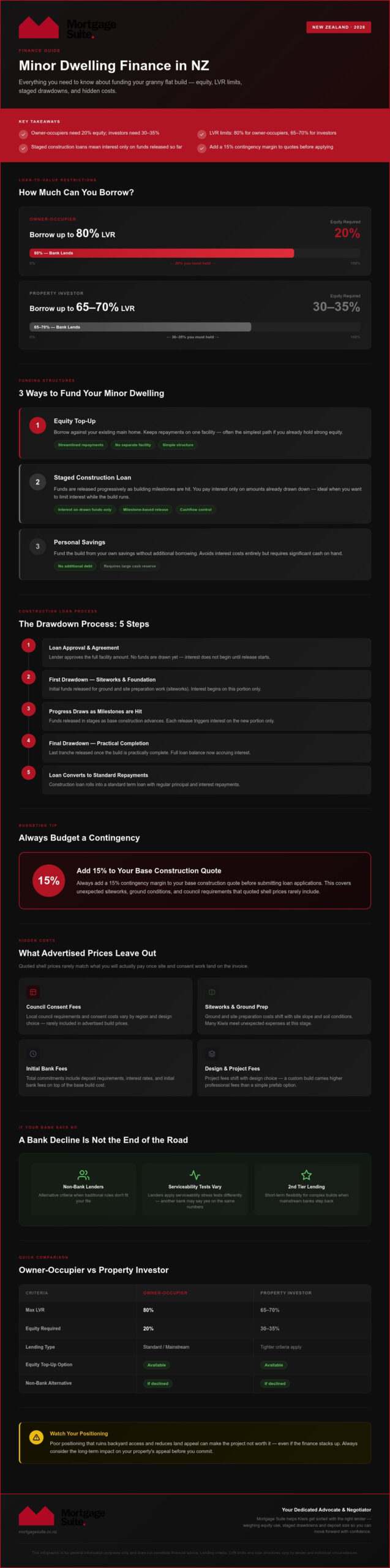
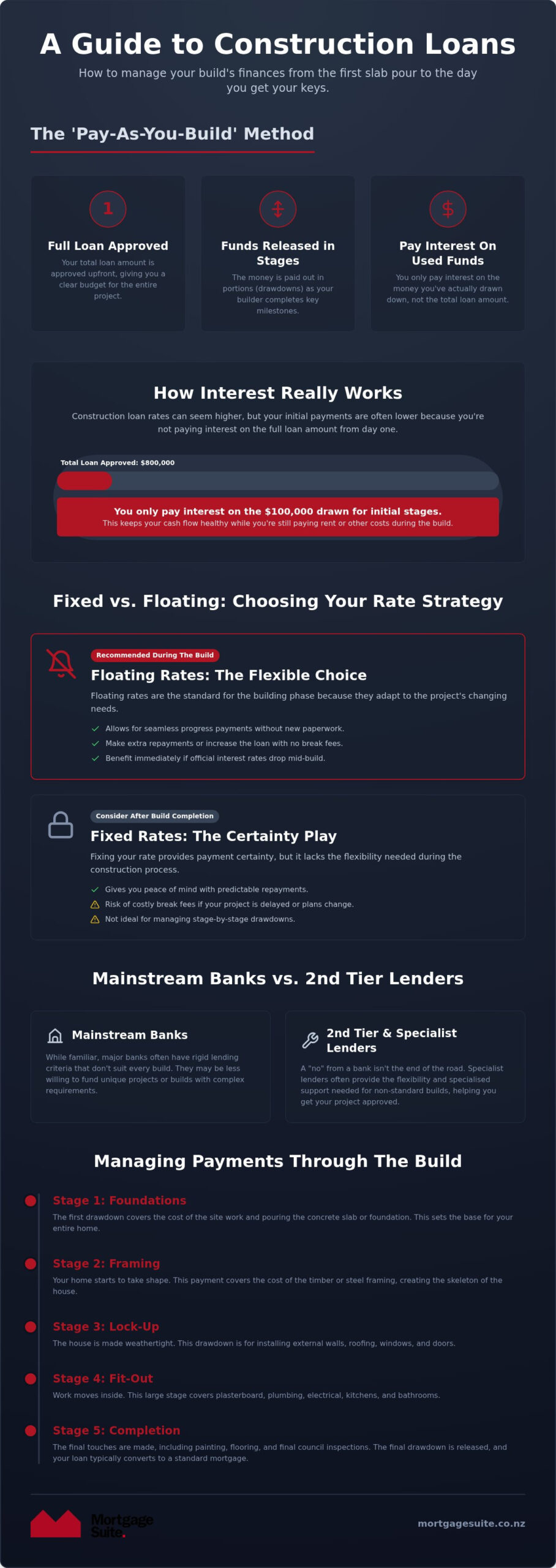
Traditional banks usually prefer to see a finished home and a steady paycheck before they’re comfortable lending the full amount. They aren’t always fond of the uncertainty that comes with a construction site. Subdivisions require a loan that allows for “progressive drawdowns”. This means your lender releases money in stages, allowing you to pay your surveyors, drainlayers, and builders as they complete specific milestones. You will also need to use the equity in your existing property as a foundation to secure the project, something a standard home loan isn’t always flexible enough to handle.

Common Costs You Need to Fund

When you’re planning your budget, you have to look beyond the visible construction. You’ll face three major categories of expense. First are the council contributions, which in areas like Auckland can range from $20,400 to $49,000 per new lot. Second are the civil engineering costs, including pipes, driveways, and connections. Finally, you have legal and surveying fees to finalise the new titles. Because surprises are common in development, a professional finance package always includes a contingency fund to keep the project from stalling. To get a sense of your current position, you can use our mortgage calculator to see how much equity you can put toward these initial costs.

How Subdivision Funding Works: The Practical Side

The process usually kicks off with either a site acquisition or a refinance of your existing land. If you already own the property, we look at how much value is sitting there to see if it can jumpstart the project. Unlike a standard loan where you get the whole amount at once, subdivision finance NZ is released in stages. These milestones ensure that as you clear one hurdle, like getting your drainage sorted or your driveway poured, the money is ready for the next step. It’s a structured way to keep the project moving without you having to front all the cash at once.

Lenders in 2026 are particularly focused on the “end value” of your project. This is simply what the new sections will be worth once the titles are issued and the fences are up. Because they are looking at the future value of the land, they also need to see a rock-solid exit strategy. They want to know exactly how you plan to pay the loan back, whether that’s by selling the new lots or moving to a long-term mortgage once the work is done.

Equity vs. Cash: What Do You Need to Bring?

In the current market, most traditional lenders expect you to have a decent amount of “skin in the game,” often requiring equity contributions of 30 to 40 per cent. However, you don’t always need a pile of cash sitting in your savings account. Many developers use the built-up value in their own homes to cover these requirements. If your plan is to build on the new sections and keep them as rentals, you might want to look at Residential Investment Property Loans NZ to see how that fits into your long-term wealth strategy.

Interest Rates and Fees in the Subdivision Space

It’s natural to notice that interest rates for development are higher than what you see on the news for standard home loans. In 2026, total interest costs for private funding can range between 9 and 16 per cent annually. While that sounds high, remember this is a short-term tool to get you to the finish line. A key feature here is “capitalised interest.” This allows you to add the interest costs to the total loan balance instead of making monthly payments, which keeps your cash flow healthy while you’re busy with construction. The goal is to focus on the total profit of the project rather than just the cost of the money. If you’re feeling unsure about the numbers, it’s a good idea to talk to a specialist who can help you weigh up the costs against the potential gains.

Mainstream Banks vs. 2nd Tier Lenders: Why the Bank Might Say No

Mainstream banks have a very specific way of looking at the world. They prioritise what they call serviceability, which is really just a way of saying they want to see a high, regular income right now. If your income is complex or you’re self-employed, a bank’s rigid checklist can quickly become a dead end. This is one of the most common reasons people struggle to secure subdivision finance NZ. They have the land and a great plan, but they don’t fit the bank’s cookie-cutter mold for a standard borrower.

2nd tier lenders, on the other hand, operate differently. They focus on the asset and the strength of the deal itself. While a bank might take weeks to process an application, an alternative lender can often give you an answer in just a few days. There’s also a common myth that non-bank lenders are only for people with poor credit history. In reality, many of the most successful developers in the country use non-bank options because they value speed, flexibility, and a lender who understands the potential of their project.

The Flexibility of 2nd Tier Lending

These lenders are often willing to look at the future value of your land once the subdivision is complete. This makes them a perfect fit if you’re looking for a 2nd Tier Lender New Zealand who can handle complex scenarios that traditional banks won’t touch. My background with over 20 years in the banking industry allows me to act as a translator. I know how to package your deal so these lenders see the same potential that you do, ensuring your application doesn’t just sit in a pile.

When to Stick with a Bank (and When to Move)

If you have a very simple project with a low loan-to-value ratio, a mainstream bank might still be a good option because of their lower interest rates. However, many developers find success with a hybrid approach. This involves using a flexible 2nd tier lender to fund the active development phase and the civil works. Once the new titles are issued and the risk is lower, you can then refinance back to a mainstream bank. Having a broker who understands both of these worlds is your biggest advantage, as we can plan your move back to a bank before you even sign the first loan document.

Subdivision Finance NZ: How to Fund Your Property Development in 2026

Steps to Secure Your Subdivision Finance in 2026

Getting your project off the ground requires more than just a good piece of land. In the 2026 market, lenders are looking for precision and a clear roadmap. Following a logical sequence not only makes the process smoother but also significantly increases your chances of a “yes” from the right lender. When you’re looking for subdivision finance NZ, think of these steps as your foundation.

  • Step 1: The Feasibility Report. This is your reality check. You need to prove that after all the costs are paid, the project actually makes a profit. Lenders won’t touch a deal that looks too tight on the margins.
  • Step 2: The Registered Valuation. You’ll need a professional to look at the “as-if-complete” value. This tells the lender what the new sections will be worth once the titles are issued.
  • Step 3: Your Loan Story. This is about more than just numbers. You need to explain who you are, your experience, what you’re building, and exactly how you’ll pay the money back.
  • Step 4: Engage a Specialist. A broker who understands the 2nd tier market can find the specific lender whose criteria match your project.
  • Step 5: The Letter of Offer. Once you have this in hand, you can finally sign contracts and start the physical civil works.

The Importance of a Registered Valuation

A standard online estimate from a website won’t cut it when it comes to development. For subdivision finance NZ, lenders require a formal registered valuation. This report is detailed and looks specifically at the local zoning rules and the development potential of your specific block. A valuer who understands the 2026 planning laws can often identify hidden value that an algorithm would miss. Having the right valuation can significantly increase your borrowing power because it gives the lender confidence in the future value of the asset.

Preparing Your Documentation

Lenders want to see that you’ve done your homework. They’ll ask for your resource consents, fixed-price contracts from civil contractors, and a realistic timeline for the build. Keeping this paperwork organised from day one prevents the back-and-forth emails that often delay a project. If you’re feeling a bit unsure about what makes a project “loan-ready,” you can explore our Mortgage School for more tips on preparing your application. Being organised shows the lender that you’re a professional who can be trusted with their capital. If you’re ready to see which lending options fit your project, reach out to Mortgage Suite today for a straightforward conversation about your goals.

Partnering with Mortgage Suite for Your Subdivision Journey

When you’re dealing with the complexities of property development, having a steady hand to guide you makes all the difference. Krish Krishna brings over 20 years of banking experience to the table, providing the calm and seasoned professionalism needed to navigate a fluctuating market. We don’t just see ourselves as brokers who shuffle documents; we are your dedicated negotiators and advocates. Our goal is to take the weight of the application process off your shoulders so you can focus on the actual project. Whether you’re working on a small two-lot split or a more involved development, our national expertise helps Kiwis across New Zealand find the right subdivision finance NZ to unlock their land’s potential.

We understand that the financial side of a subdivision can be the most stressful part of the entire process. There are council fees to worry about, civil contractors to pay, and the constant pressure of interest rates. By acting as your proactive partner, we aim to remove these obstacles. We handle the difficult conversations with lenders and ensure your “loan story” is presented in the best possible light. This client-centric focus means you aren’t just another number in a system; you’re a partner whose success is our priority. We take the time to listen to your specific needs and build a funding strategy that fits your unique situation.

Experience That Counts

Two decades in the industry means we’ve seen almost every possible loan scenario. We know exactly how to bridge the gap between the rigid world of institutional banking and your personal needs as a borrower. Our approach is grounded in a philosophy of educating our clients, ensuring you understand every step of the journey rather than feeling left in the dark. If you want to see how this commitment to partnership works in practice, our reviews show a long history of prioritising client success over simple transactions. We take pride in being the bridge that helps you cross from a “no” at a mainstream bank to a “yes” with a specialist lender who sees the value in your deal.

Ready to Chat About Your Land?

Every piece of land is unique, and every developer has a different goal. We invite you to have a no-obligation conversation with us to see what’s possible for your property. It’s often the case that a quick chat can reveal funding pathways you hadn’t considered, especially in the 2nd tier lending space where flexibility is key. If you’re looking for a deeper dive into the specifics of construction funding beyond the initial split, you might find our guide on Property Development Loans NZ helpful for your next steps. Subdividing your land is a big decision and a significant financial step, but you don’t have to do it alone. We are here to provide the expertise and the advocacy you need to turn your property’s hidden value into a successful reality.

Ready to Unlock Your Land’s Full Potential?

The path to a successful property development doesn’t have to be blocked by rigid bank rules. We have explored how 2nd tier lenders prioritise the asset over your current salary, providing the breakthrough you need when traditional doors close. By focusing on a solid feasibility report and a professional valuation, you’re setting yourself up for a project that actually makes sense on paper and in reality. Securing subdivision finance NZ is about finding the right partner who knows how to navigate the 2026 planning laws and negotiate on your behalf.

At Mortgage Suite, we bring over 20 years of banking and brokerage experience to every project. We specialise in those 2nd tier and non-bank lending options that mainstream banks often decline, providing expert national coverage across the country. You don’t have to tackle the stress of council fees and civil work funding alone. When you have a seasoned advocate in your corner, the complex world of development finance becomes a clear, manageable journey toward your goals. It is time to turn your backyard into a building site with confidence.

Talk to Krish Krishna about your subdivision project today

Frequently Asked Questions

Can I get subdivision finance if the bank has already said no?

Yes, you certainly can. Mainstream banks have strict income and serviceability rules that often don’t fit the reality of property development. We specialise in 2nd tier loans and non-bank options that look at the potential of the land and the strength of the deal rather than just your current salary. If your project is viable and has a clear plan, there is likely a specialist lender ready to help you move forward.

How much deposit do I need for a subdivision loan in NZ?

Generally, you will need a contribution of 30 to 40 per cent of the total project cost. While traditional banks are quite rigid about this requirement, some alternative lenders can be more flexible if the finished value of the project is high. You don’t always need this in cash; building equity in your existing land often counts as your “skin in the game” for subdivision finance NZ.

What is the difference between a 2nd tier lender and a traditional bank?

The main difference lies in their lending criteria and what they prioritising. Traditional banks focus heavily on your regular income and your ability to make monthly repayments from your salary. 2nd tier lenders are more interested in the asset itself and your strategy for paying the loan back. They are often much faster to approve deals and are more comfortable with the risks associated with active construction sites.

Can I use the equity in my current home to fund the subdivision?

Yes, using the built-up value in your existing property is a very common way to jumpstart a project. This equity can often cover the initial costs like council contributions and surveying fees without you needing to dip into your personal savings. It acts as security for the new loan, allowing you to leverage the hidden value already sitting in your land to create new titles and profit.

How long does it take to get subdivision finance approved?

Approval times vary, but non-bank lenders can often provide a firm answer within a few business days. While a mainstream bank might take weeks to work through their complex internal committees, specialist lenders are designed for speed and efficiency. Having your documentation, such as feasibility reports and valuations, ready to go will ensure the process moves as quickly as possible so you can start your civil works.

Do I need resource consent before I can apply for funding?

You can often get a conditional approval before your consent is finalised, but most lenders won’t release the full funds until it is officially granted. Having your resource consent already in place makes your application much stronger and reduces the perceived risk for the lender. It shows that the council has approved your plan and that the project is ready to move into the physical construction phase without delay.

What happens if my subdivision project faces delays?

Delays are common in development, which is why we always recommend including a contingency fund in your finance package. If your project takes longer than expected, you can often negotiate an extension with your lender. Because many development loans use capitalised interest, you won’t have to worry about making monthly repayments while you are waiting for council sign-offs or for contractors to finish their physical work on the site.

Is subdivision finance more expensive than a regular mortgage?

Yes, interest rates for subdivision finance NZ are typically higher because the lender is taking on more risk during the construction phase. In the 2026 market, private rates can sit several percentage points above standard bank rates. However, these are short-term tools designed to be paid back once the project is finished. The focus should always be on the total profit of the deal rather than just the interest rate.

Article by

Krish Krishna

Experienced Financial Adviser with over 46 years of Banking and Mortgage broking experience and over $2.0 Billion in loan settlements.

Financing a Townhouse Development in NZ: Your 2026 Exit Strategy Guide

Your exit strategy is actually the most important part of your loan application, often carrying more weight than the architectural plans themselves. When you are organising financing a townhouse development nz, lenders aren’t just interested in the bricks and mortar; they want to see a foolproof plan for how they get their money back. It’s easy to feel unsettled when residential building costs continue to climb or when mainstream banks stick to rigid rules that don’t fit your project. You deserve to know that your profit is protected and that you won’t be left holding unsold stock.

This guide will show you how to map out a project finish line that satisfies lenders and secures your margins. We’ll look at how to create a solid exit plan and why 2nd tier finance is a brilliant tool for flexibility when the big banks say no. You’ll gain the confidence to handle the 2026 market, knowing exactly how to protect your investment and move straight onto your next big venture with total certainty.

Key Takeaways

  • Learn why a clear plan to repay your lender is the most important part of getting your project approved in today’s market.
  • Understand the flexible options for financing a townhouse development nz that let you bypass the rigid rules of the big banks.
  • See how non-bank lenders can act as a strategic safety net to protect your profit if building costs or timelines change.
  • Compare the benefits of selling your units for an immediate profit against switching to a long-term loan to keep them as rentals.
  • Gain the tools to build a solid backup plan so you can realise your gains and organise your next project with total confidence.

What is a Property Development Exit Strategy and Why Does it Matter?

Simply put, an exit strategy is your roadmap for paying back the money you borrowed once the building work is done. It’s a vital part of the real estate development process, acting as the final chapter that proves your project is a success. When you’re looking at financing a townhouse development nz, the start is exciting, but the finish is what keeps the bank happy. Lenders aren’t just looking at your architectural plans; they’re looking at how you’ll get their money back into their hands.

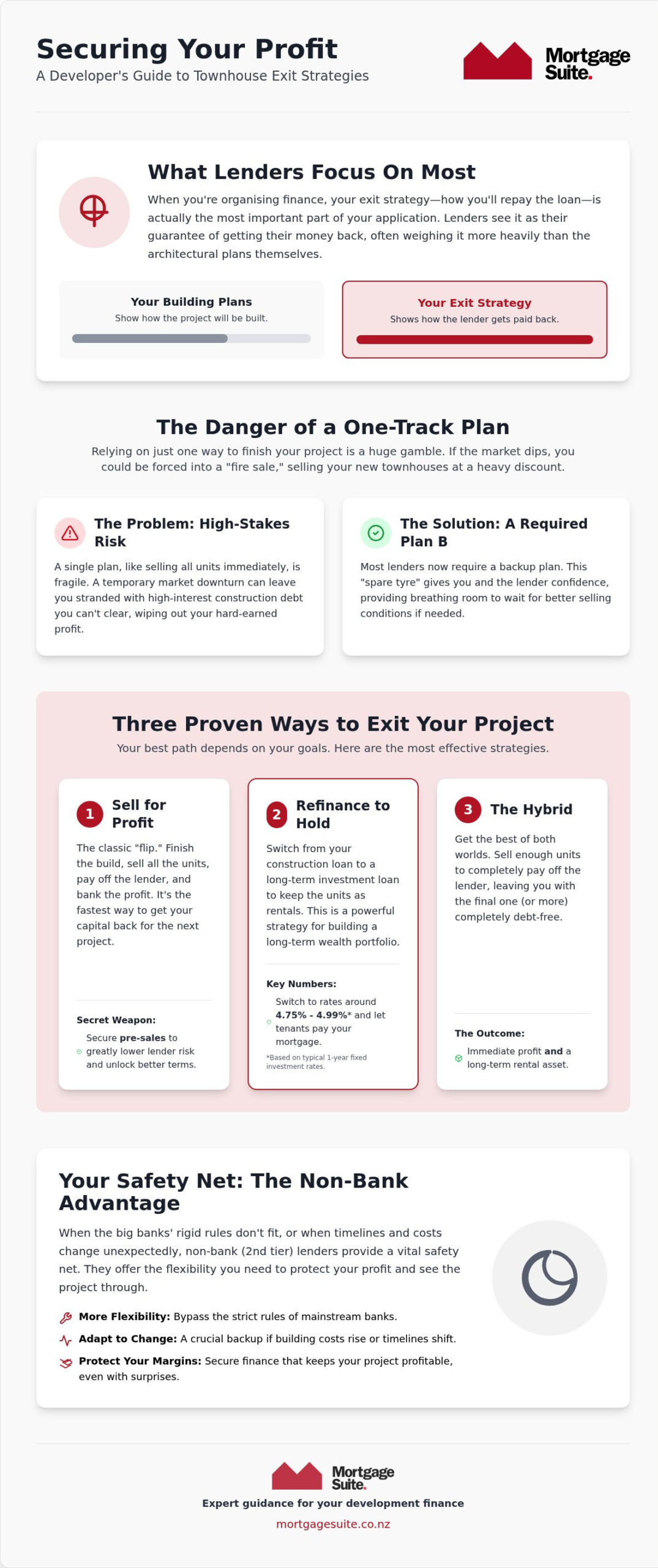
Lenders often care more about your exit than your entry because that’s where the actual risk lives. If you don’t have a clear way to settle the debt at the end, you might find yourself stuck in a “fire sale.” This is a stressful spot where you’re forced to sell your units at a heavy discount just to pay back the lender. It’s a quick way to see years of planning and hard work vanish. In the 2026 market, where residential building costs rose 1.1% in the June quarter, having a solid exit plan is your best tool for protecting your profit.

The Lender’s Perspective: What They Are Looking For

Lenders want to see that your numbers add up for the current environment. They look for what we call “credible exits,” which are paths to repayment grounded in reality rather than hope. A credible exit is a clear, documented route to paying off the debt that doesn’t rely on luck or a perfect market. This might include confirmed pre-sales where buyers have already signed on the dotted line, or a formal letter from a bank promising to take over the debt with a long-term loan once the units are finished. They want to know that even if the market shifts slightly, the project remains a safe bet for their capital.

Why a “Single Plan” Approach is Risky

Relying on just one way to finish your project is a massive gamble. If your only plan is to sell every unit the moment they’re built, a temporary market dip can leave you stranded with high-interest debt and no way to clear it. Most lenders now require a secondary fallback option before they’ll even consider financing a townhouse development nz. Think of this backup like a spare tyre; you hope you don’t need it, but you can’t realistically start the journey without it. Having a Plan B, such as keeping the units as rentals, gives you the breathing room to wait for a better selling window while still meeting your financial obligations.

The Three Most Effective Ways to Exit Your Townhouse Project

Choosing your path forward depends entirely on your long-term goals and the temperature of the 2026 market. Once your townhouses are finished, you need a clear route to transition from high-interest construction debt to your final financial outcome. Whether you want a quick cash injection or a lifelong stream of rental income, your choice will dictate how you structure the project from day one. Financing a townhouse development nz requires looking past the construction phase to ensure you aren’t left with a debt you can’t service when the hammer falls on the final nail.

Strategy 1: Selling for a Profit (The Clean Break)

The most common goal for many developers is the “flip.” You finish the build, sell the units, pay off the lender, and pocket the remaining profit. This is the fastest way to get your capital back so you can jump into your next venture. Pre-sales are the secret weapon here. By securing buyers before the first sod is turned, you significantly lower the lender’s risk. When you’re organising financing a townhouse development nz, having pre-sales in place can often unlock better terms and smoother approvals because the bank sees a guaranteed exit. It removes the stress of wondering if the units will sell once they’re finally on the market.

Strategy 2: Refinancing to Hold (The Wealth Builder)

If you prefer building long-term wealth, you might choose to keep the units as rentals. This involves switching from a construction loan to a lower-rate residential investment loan. With one-year fixed rates for investment properties in August 2026 sitting around 4.75% to 4.99%, this move allows you to benefit from capital growth while the tenants pay down your mortgage. It’s a great way to build a portfolio, but you need to make sure the numbers work. You can use our mortgage calculator to check if the expected rental income will comfortably cover your new loan repayments. This strategy is particularly effective when the rental market is strong and property values are steadily rising.

Strategy 3: The “Keep and Sell” Hybrid

A hybrid approach offers the best of both worlds and is increasingly popular among savvy New Zealand developers. You might sell three out of four townhouses to clear all your debt with the lender, leaving the final unit completely debt-free. This “pure profit” unit becomes a high-yield asset in your portfolio without you needing to tip in more of your own cash. It’s a brilliant way to grow your net worth while maintaining excellent cash flow. This method provides a safety net; if the market isn’t quite right for selling all units, you can pivot and keep more of them as rentals. If you’re unsure which path fits your specific project, we can help you explore the most profitable options for your situation.

Contingency Planning: What to Do When Plan A Hits a Snag

The reality of building in New Zealand is that time is your biggest variable. It usually takes between 12 and 18 months to take a project from the first shovel in the ground to the final code compliance certificate. A lot can happen in that window. When you started financing a townhouse development nz, the market might have been soaring, but by the time you’re ready to sell, things could look different. Unexpected building delays or the 3.5% annual rise in construction costs can quickly eat into the profit you worked so hard to calculate.

A solid fallback strategy isn’t about being pessimistic. It’s about staying in control of the situation even when things get a bit hairy. Without a Plan B, you risk losing the property to the bank during a temporary dip or being forced into a deal that doesn’t serve you. By preparing for the “what-ifs” now, you ensure that a single snag doesn’t derail your entire financial future. It’s much easier to make calm decisions when you already have a secondary path mapped out.

Market Shifts and Price Adjustments

Imagine your townhouses are finished, but the market has shifted and they’re worth 10% less than your initial appraisal. This is where your “equity cushion” becomes your best friend. This cushion is the gap between what you owe the lender and what the property is worth, often made up of your own cash or the value in the land. In the 2026 market, a 20% margin of error is a standard safety net that most successful developers use to protect themselves. It means that even if prices soften, you still have enough room to pay back the loan without dipping into your personal savings or facing a shortfall.

Bridging the Gap with Short-Term Finance

Sometimes, the units are perfect and the price is right, but the buyers are just taking a little longer to show up. If your construction loan is nearing its end and the lender is knocking, you can use bridging finance to take the pressure off. This short-term option lets you pay off the original construction lender, giving you an extra few months to find the right buyer. When you are looking at financing a townhouse development nz, remember that bridging finance is a strategic tool rather than a last resort. It means you don’t have to accept a low-ball offer just because you’re in a hurry to settle the debt. You can learn more about how these structures work in our guide to property development loans. This breathing room is often the difference between a project that just breaks even and one that delivers a healthy return.

Financing a Townhouse Development in NZ: Your 2026 Exit Strategy Guide

The 2nd Tier Advantage: How Non-Bank Lenders Save the Day

Mainstream banks have really tightened their belts lately. In August 2026, many developers are finding that the big banks stick to rigid rules that don’t always suit the reality of a busy building site. If you are organising financing a townhouse development nz, you might find that traditional lenders demand a level of pre-sales that feels out of reach before you’ve even broken ground. This is where 2nd tier lenders become your most valuable asset. They aren’t just a backup plan; they’re a strategic tool that looks at the common sense of your project rather than just ticking boxes on a corporate form.

At Mortgage Suite Ltd, we specialise in finding these alternative paths when the big banks say no. We don’t just find you a loan; we help you see how these lenders can actually save your project if things stall or if your original bank pulls back. Using a non-bank lender gives you the flexibility to keep moving without being held hostage by a bank’s changing appetite for risk. We act as your expert negotiator to ensure you get a deal that keeps your profit margins intact.

Why 2nd Tier Lenders are More Flexible

The biggest advantage of a 2nd tier lender is their focus on the big picture. While a mainstream bank might demand that every single unit is sold before they release a cent, non-bank lenders often require far fewer pre-sales. They look closely at the value of the finished project and your own track record as a developer. If you have a solid plan and a great site, they’re often willing to back you even if you don’t fit the standard bank profile. This is a fair dinkum solution for projects that are fundamentally sound but need a lender who can think outside the square.

Using Non-Bank Loans to “Bridge to Bank”

Many successful developers use a 2nd tier loan as a temporary bridge to get the build finished. Even though the interest rates are higher, usually starting from 9.5% in early 2026, the flexibility they offer can be worth every cent. Once the townhouses are built and you have your code compliance certificate, the risk for a mainstream bank drops significantly. At that point, you can often refinance back to a traditional bank at a lower rate. This strategic move allows you to keep the momentum going on financing a townhouse development nz even if your primary bank has had a change of heart about your project. It’s a clever way to keep your capital moving and ensure you don’t miss out on the next big opportunity.

If you’re feeling stuck with a bank that doesn’t understand your vision, we can help you explore a more flexible path forward with a lender who sees the value in your project.

How to Execute Your Exit Strategy with Mortgage Suite

At Mortgage Suite, we believe that financing a townhouse development nz is about much more than just signing a loan agreement. It’s about building a comprehensive plan that carries you from the first site visit through to the day you settle your debt. Krish Krishna brings over 20 years of banking experience to the table, which means he understands the inner workings of both mainstream banks and 2nd tier lenders. He knows exactly what makes a credit manager say “yes” and, more importantly, how to structure your application so it stands out for all the right reasons from the very start.

We act as your dedicated advocate and negotiator throughout the entire process. If a mainstream bank offers a deal that feels too restrictive or demands too many pre-sales, we don’t just accept it as the only option. We look for alternative paths or negotiate better terms that protect your profit and your sanity. Our goal is to ensure you aren’t just getting across the finish line, but doing so with the financial reward you deserve for all your hard work and investment. We bridge the gap between the rigid world of institutional banking and your personal needs as a developer.

Our Consultative Approach

Our process starts with a simple, honest conversation about your goals. We want to know if you’re looking for a quick clean break by selling the units or if you’re building a long-term rental portfolio to secure your future. Once we know where you’re headed, we help you organise your documentation so it’s “bank-ready” before you even apply. This proactive step saves weeks of back-and-forth and shows lenders that you’re a professional who understands the 2026 market. You can see how this personal approach has helped other developers by reading our client reviews.

Ready to Get Sorted?

The best time to plan your way out of a loan is before you even put a shovel in the ground. Many people wait until the build is nearly finished to think about their exit, but that often leaves you with fewer options and much more stress if the market shifts. By sorting your strategy early, you can build with total confidence, knowing exactly how you’ll move on to your next venture. Don’t let the paperwork or bank rules slow you down. Reach out to us for a chat about your next townhouse project; we’re here to help you get the result you’re after.

Secure Your Project’s Future Today

Your project’s success isn’t just about the build; it’s about the finish line. By planning your exit strategy before you even break ground, you protect your hard-earned profit and ensure you’re ready for whatever the 2026 market throws your way. Whether you choose to sell immediately, hold for long-term growth, or use a hybrid approach, having a solid Plan B is your greatest asset. It gives you the freedom to make decisions based on profit rather than pressure.

When you’re organising financing a townhouse development nz, you don’t have to go it alone. With over 20 years of banking expertise, we act as your dedicated negotiators to find the best terms possible. We are specialists in 2nd tier lending solutions, providing the essential flexibility you need when mainstream banks feel too rigid. We’ll help you navigate every challenge so you can move on to your next venture with total confidence. Let’s map out your project’s finish line together; contact Mortgage Suite today.

We’re ready to help you turn your townhouse vision into a profitable reality.

Frequently Asked Questions

What is the most common exit strategy for small townhouse developments?

The most common way to finish a project is selling the completed townhouses to pay off the construction debt. This allows you to realise your profit quickly and move on to your next build. While keeping units as rentals is growing in popularity, most small-scale developers prefer the clean break of a sale. It clears the books and provides the capital needed for the next site acquisition without carrying long-term debt.

Do I really need pre-sales to get a development loan in 2026?

In 2026, mainstream banks almost always require pre-sales to cover a significant portion of the loan. However, if you are organising financing a townhouse development nz through a 2nd tier lender, they often have much more relaxed rules. They might allow you to start building with few or even no pre-sales if the project’s value and your experience are strong. This flexibility is why many developers choose non-bank options to get moving faster.

Can I change my exit strategy halfway through the project?

You can certainly pivot your plan, but it’s vital to keep your lender in the loop. If you originally planned to sell but decide to keep the units as rentals, you’ll need to arrange a new long-term loan to pay off the construction finance. This is a common move when the market softens. Just ensure your new loan is approved before the construction debt is due to avoid any stressful gaps in your funding.

What happens if my townhouse doesn’t sell by the time the loan is due?

If your units don’t sell by the time the loan is due, you have a few options to avoid a forced sale. You could look at bridging finance to give you more time or a residual stock loan to lower your interest costs while you wait for buyers. These tools act as a safety net, ensuring you don’t have to accept a low offer just because the clock is ticking on your original loan.

Is 2nd tier lending much more expensive than a big bank?

Non-bank lenders do charge higher interest rates, often starting from 9.5% in early 2026, compared to mainstream bank rates of 6% to 8%. While the interest is higher, the total cost might be lower when you consider the smaller pre-sale requirements and faster approval times. For many projects, the extra interest is a fair trade for the flexibility and speed that allows the development to actually go ahead.

How much deposit do I usually need for a property development loan in NZ?

Most New Zealand development lenders require you to contribute between 25% and 40% of the total project cost as equity. This can be in the form of cash or the value already held in the land. Having a larger deposit of 30% to 35% generally makes it much easier to secure competitive financing a townhouse development nz. It shows the lender you have skin in the game and provides a safety buffer for everyone involved.

Can I use the equity in my own home as part of my exit strategy?

Using the equity in your family home is a very common way to fund the deposit for a townhouse project. Instead of needing a massive pile of cash, you can use the value built up in your current property to secure the new loan. This is a strategic way to get started, but it’s important to understand how it affects your total debt. We can help you calculate how much equity you can safely tap into.

What is a “residual stock loan” and how does it help with exits?

A residual stock loan is a specific type of finance used for units that are finished but haven’t sold yet. It allows you to pay off the expensive construction loan and replace it with a cheaper, more flexible facility. This is a brilliant exit tool because it lowers your monthly interest costs while you wait for the right buyers. It takes the pressure off your cash flow and protects your final profit margins.

Article by

Krish Krishna

Experienced Financial Adviser with over 46 years of Banking and Mortgage broking experience and over $2.0 Billion in loan settlements.

Property Development Funding

What if the secret to getting your next project off the ground isn’t actually the land itself, but the story you tell about it? It’s a common frustration to feel that your plans are solid, yet find yourself hitting a wall with mainstream banks that seem more interested in ticking boxes than seeing your vision. In the current New Zealand market, where lending criteria can shift quickly, these complexities often make terms like feasibility studies or drawdowns feel like genuine barriers to your success. Learning exactly how to obain development funding is the first step toward turning those obstacles into opportunities.

We believe every developer deserves a steady hand to guide them through these financial hurdles. In this article, we explain the process of preparing your project so it’s ready for a “yes” from the right lender. You’ll gain a clear roadmap to securing capital, whether you’re looking at traditional banks or more flexible second-tier lenders. We’ll help you understand the different options available so you can lower your project risk and move forward with the confidence that your venture is supported by experts who prioritise your success.

Key Takeaways

  • Understand why development loans are structured as short-term, interest-only facilities to help you manage your project’s cash flow more effectively.
  • Get a clear, step-by-step guide on how to obain development funding by creating a professional feasibility study that proves your project’s value.
  • Learn the differences between mainstream banks and second-tier lenders to find the right balance of competitive interest rates and flexible terms.
  • Discover why choosing an experienced builder and architect is essential for giving lenders the confidence they need to approve your application.
  • Gain a complete overview of the application journey, from your very first consultation through to receiving your initial funds to start the work.

What Exactly is Property Development Funding?

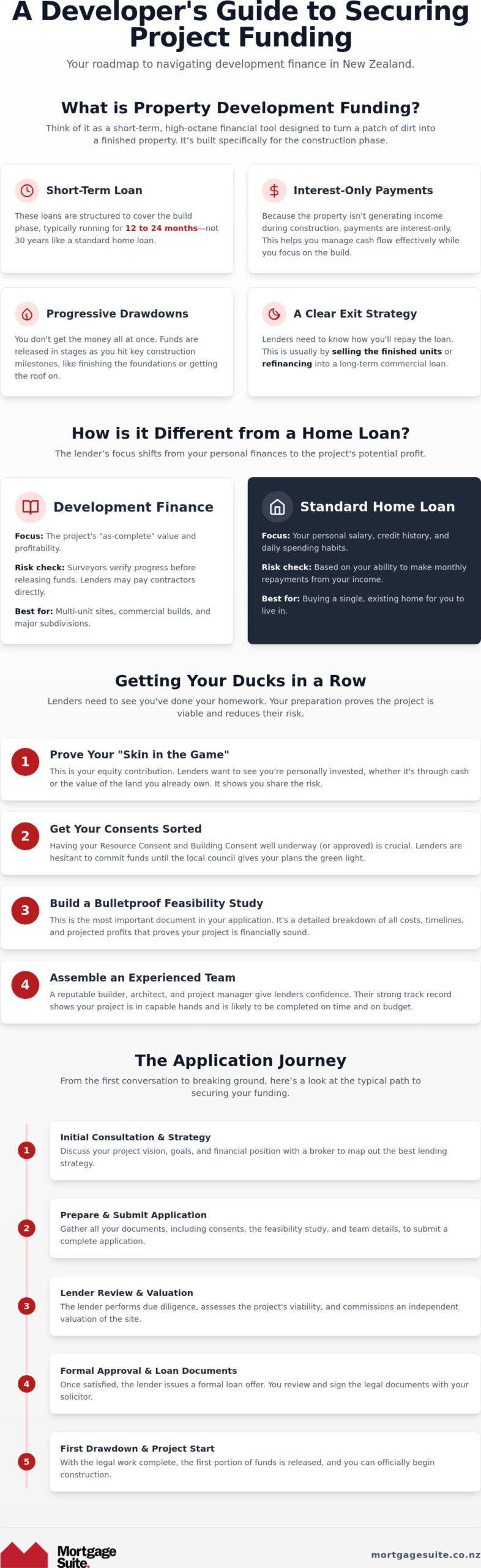
Think of property development funding as the engine room of your project. It isn’t like a standard mortgage where you buy a house and pay it off over thirty years. Instead, it’s a short-term, high-octane financial tool designed to get a project from a patch of dirt to a finished set of titles. Most of these loans run for a limited time, typically between 12 to 24 months. Because the property isn’t making any money while it’s a construction site, these loans are almost always interest-only. This structure helps you keep your cash flow steady while you focus on the actual Real estate development process.

When you are researching how to obain development funding, you’ll find that you don’t receive all the money in one lump sum. Instead, the lender releases funds through “progressive drawdowns”. This means you get chunks of capital as you hit specific milestones, such as finishing the foundations or getting the roof on. It is a system that protects both you and the lender, ensuring the budget stays on track. Before a lender even considers your application, they will want to see a rock-solid “exit strategy”. This is simply your plan for how you’ll pay the loan back, which usually involves selling the finished units or refinancing into a long-term loan once the build is complete.

The Difference Between a Home Loan and Development Finance

A standard home loan is quite personal. The bank looks closely at your salary and your daily spending to see if you can afford the monthly repayments. Development finance is different; it’s focused on the project’s profit and the “as-complete” value of the site. If you’re planning a multi-unit site, a basic construction loan NZ won’t usually work because those products are generally designed for single residential homes. Development lenders manage their risk by often paying your builders and contractors directly after a surveyor has checked the progress. This ensures the money is used exactly where it should be.

Common Projects That Require This Funding

This type of finance covers a broad range of property ambitions. You might be looking at a relatively simple subdivision finance NZ project where you’re splitting a backyard to build a minor dwelling. Other common projects include:

  • Medium-density residential: Building blocks of townhouses or several units on a single title.
  • Commercial builds: Constructing new warehouses, office spaces, or retail centres.
  • Major renovations: Significant structural changes or repurposing of existing business premises.

Understanding how to obain development funding for these specific scenarios is the first step toward a successful build. Each project type has its own set of requirements, but the core focus remains on the profitability and the strength of your planning.

Getting Your Ducks in a Row: The Pre-Approval Checklist

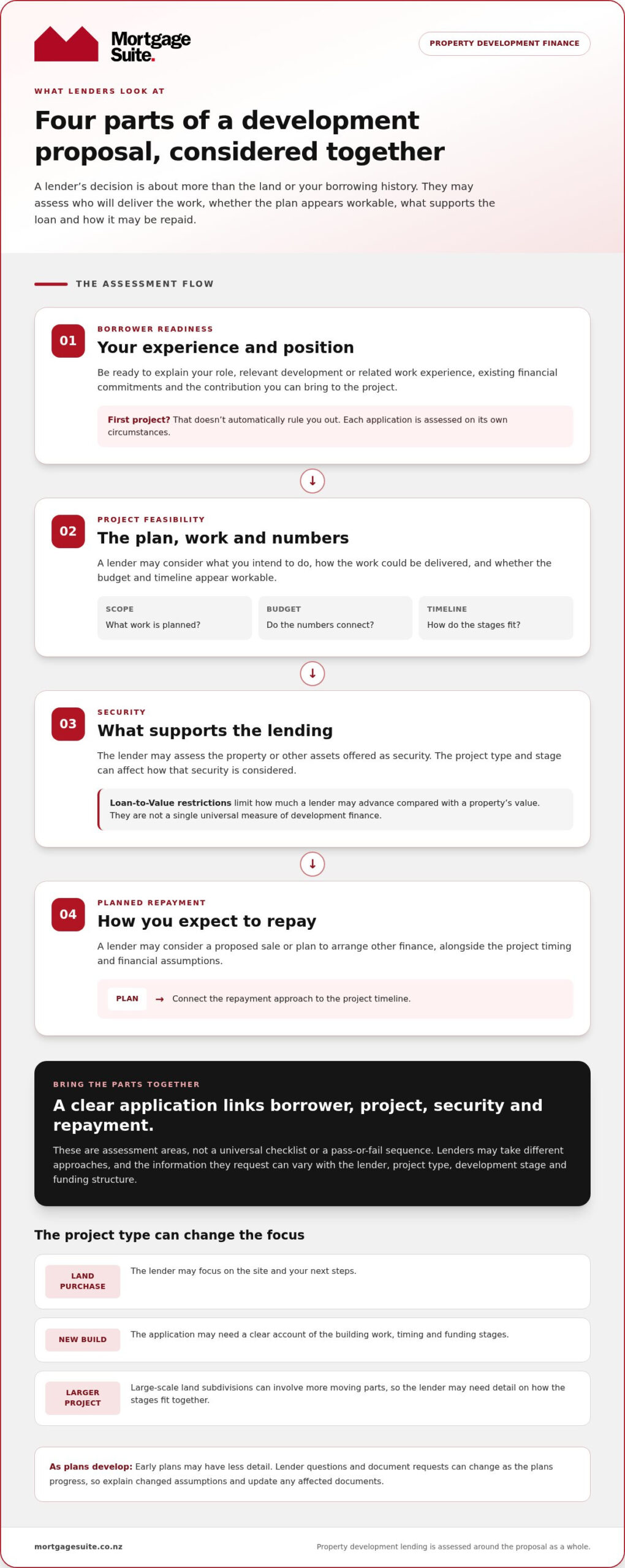
Before you approach a lender, you need to show that you have done your homework. Lenders aren’t just looking at the land or the potential profit; they’re looking at your level of preparation. Knowing how to obain development funding starts with a checklist that proves your project is viable and that you have a team capable of delivering it. This isn’t just about having a good idea; it’s about having the paperwork to back it up and showing that you’ve considered every possible hurdle.

One of the first things a lender will ask for is proof of your “skin in the game”. This is your equity, which is the amount of your own capital or land value you’re bringing to the table. Lenders want to see that you’re personally invested in the outcome. While there are various property financing options available, most will require you to cover a specific percentage of the total project cost. You’ll also need to have your Resource Consents and, ideally, your Building Consents well underway. Lenders are often hesitant to commit funds until they know the local council has given the green light for your specific plans.

Building a Bulletproof Feasibility Study

The feasibility study is the most important document in your application. It’s a detailed breakdown that proves the numbers actually work. You need to account for everything: land acquisition, actual build costs, professional fees for architects and surveyors, and GST. A crucial element here is the “Contingency Fund”. This is a buffer for unexpected costs, such as a sudden rise in material prices or site delays. Finally, you must calculate the Projected Gross Realisation Value (GRV). This is what the project is worth once it’s finished and sold, which helps the lender understand their total risk.

Proving Your Experience

Lenders feel much more comfortable when they know the project is in safe hands. If this is your first development, you can strengthen your application by “borrowing” the experience of others. By partnering with an established builder who has a solid track record or hiring a professional project manager, you show the lender that the build is being handled by experts. If you’re feeling overwhelmed by the paperwork, it’s often helpful to talk to a professional advocate who can help you organise your team and your application before you present it to a bank.

Having a professional team doesn’t just help with the loan approval; it ensures the project stays on schedule. A seasoned architect and a reliable builder can help you avoid common pitfalls that lead to budget blowouts. When you show a lender that you’ve surrounded yourself with talent, you’re telling them that your project is a calculated success rather than a risky gamble.

Choosing Your Capital: Mainstream Banks vs. 2nd Tier Lenders

Deciding where to source your money is just as important as the design of the building itself. Most developers start by looking at mainstream banks because they offer the lowest interest rates and the most familiar terms. However, the reality of how to obain development funding through a bank is that the rules are incredibly strict. Banks are risk-averse; they want to see that you’ve already sold a significant portion of the project before they release a single dollar. If your project doesn’t meet their rigid criteria, you don’t have to give up on your plans. There are other paths to success that offer the flexibility a growing developer needs.

This is why we’ve seen a significant rise in 2nd tier lender New Zealand options. These lenders fill the gap for projects that are commercially sound but don’t quite fit the traditional bank box. While you might pay a slightly higher interest rate, the trade-off is a much faster approval process and far fewer hoops to jump through. For many, the ability to start a build months earlier is worth the extra cost in interest.

The Pros and Cons of Bank Funding

Banks are excellent if you have a massive amount of experience and plenty of time to wait for approvals. The main benefits are the lower interest rates and lower setup fees, which can help keep your total project costs down. But the challenges are real. Banks almost always demand “pre-sales”, meaning you must have signed contracts for several units before the loan is finalised. They also look closely at your personal income to ensure you can “service” the debt, which can be a major hurdle for self-employed developers or those with complex financial setups.

When to Consider a 2nd Tier or Non-Bank Loan

If you’re looking for speed and flexibility, a non-bank lender is often the better choice. These lenders focus more on the project’s value and your exit strategy than your weekly paycheck. Here is why they are becoming a popular choice:

  • No Pre-sales Required: Many second-tier lenders will fund a project without you having to sell a single unit upfront, allowing you to sell at the end of the build for a potentially higher price.
  • Rapid Approvals: You can often get an indicative offer in just a few days, compared to the weeks or months a mainstream bank might take.
  • Flexible Terms: They are more willing to look at unique projects, such as major renovations or builds in regional areas that banks might consider too risky.

Choosing the right path depends on your timeline and your cash flow. If you have the equity and the patience for a bank, it’s a great way to save on costs. But if you need to move quickly to secure a site or want to keep your units until the market peaks, a second-tier lender provides the breathing room you need to succeed. Understanding how to obain development funding from both sides of the market ensures you aren’t left stranded if your first choice says no.

Property Development Funding

The Application Journey: From First Chat to First Drawdown

The path from your first idea to actually seeing builders on site can feel like a long road. It usually starts with a simple conversation where we sit down to discuss what you’re trying to achieve. During this initial chat, we look at your project scope and figure out which funding paths might suit your needs best. This is the stage where you really start to understand how to obain development funding that aligns with your specific goals. We focus on making the process as transparent as possible so you never feel left in the dark about the next step.

Once we have a handle on the project, the next step is getting an “indicative offer”. Think of this as a ballpark figure. It’s not a final guarantee, but it gives you a clear idea of what a lender might be willing to provide based on the numbers you’ve presented. If that ballpark figure works for you, we move into full underwriting. This is the deep dive where the lender looks at every detail of your finances and the feasibility of the project to ensure everything is above board. Learning how to obain development funding is often about navigating this deep dive with the right expert support.

Finally, we reach settlement and the “first drawdown”. This is the exciting part where the initial funds are released so you can pay for the land or start the early site works. It’s the moment your project officially moves from paper to reality. The journey from that first chat to the first drawdown is much smoother when you have a steady hand guiding the way. Start your application journey with an expert advocate today.

Navigating the Valuation Process

Valuations for developments are a bit different to a standard house appraisal. You’ll need a specialised registered valuer who understands the “as-is” value, which is what the land is worth now, and the “as-complete” value, which is what the finished project will be worth. These figures are vital because they directly impact how much you can borrow. A strong “as-complete” valuation can often be the key to unlocking the capital you need to finish the build without stress.

Managing the Build Phase

During the construction, you won’t just get a pile of cash to spend as you please. A Quantity Surveyor will visit the site each month to check the progress and approve your payments. This ensures the build stays on budget and that everyone is getting paid for the work they’ve actually done. If you hit a delay or need to move quickly between stages, you might even consider bridging finance NZ to keep the project’s momentum going.

Why an Expert Broker is Your Best Bet for Development Success

The difference between a project that stalls and one that succeeds often comes down to who is representing you in the boardroom. While you focus on the site works and managing your contractors, we act as your dedicated advocate. Negotiating with multiple lenders at once is a full-time job, and having a veteran in your corner ensures you don’t just take the first offer that comes along. We understand the nuances of the market and how to present your project so lenders see the opportunity rather than just the risk. This level of advocacy is a core part of how to obain development funding that actually fits your project’s unique needs.

One of the biggest advantages of working with an expert is the power of choice. Many of the most flexible and competitive lenders in the country do not deal directly with the public. They prefer to work through trusted brokers who can package an application correctly from the start. This gives you access to a “hidden” market of capital that you simply wouldn’t find on your own. We also take the mountain of paperwork off your desk. By handling the back-and-forth with banks and second-tier lenders, we free up your time so you can stay on the tools or manage the build phase without distraction.

Our support doesn’t end once the first drawdown is approved. We view our work as a long-term partnership. Once your project is complete and you’ve reached the “as-complete” stage, we can help you refinance. Whether you want to hold the units as long-term investments or move quickly onto your next site, we ensure your financial structure remains solid. Knowing how to obain development funding is only half the battle; having a plan for what comes after the build is just as vital for your long-term success.

Our Approach at Mortgage Suite Ltd

We bring over 20 years of banking experience to your project. This background means we know exactly how a lender’s credit team thinks and what they need to see to say “yes”. We don’t just pass on your documents; we package them into a professional proposal that highlights the strengths of your project team. At Mortgage Suite Ltd, we actually enjoy the “tough” deals that mainstream banks often turn away. If your situation is a bit complex or you’re a self-employed developer, we pride ourselves on finding a path forward. Throughout the whole process, we promise clear, jargon-free communication so you always know where you stand.

Ready to Start Your Project?

The best time to get us involved is before you sign a sale and purchase agreement. Talking to us early allows us to give you a clear idea of your borrowing capacity, which can save you months of frustration and potentially thousands in lost deposits. A quick phone call is often all it takes to get the ball rolling and give you the confidence to move forward. For a deeper look at the specific types of capital available, you can also read our parent guide on property development loans NZ. We are here to be the steady hand that guides your project from a simple plan to a successful reality.

Your Path to a Successful Build

Getting your project funded is about more than just having a great piece of land; it requires a solid feasibility study and the right team to back you up. We’ve explored how the choice between a mainstream bank and a second-tier lender can change your project timeline, especially when you need flexibility around pre-sales or quick approvals. By understanding how to obain development funding through a structured application, you can lower your risks and focus on what you do best: building.

With over 20 years of banking and lending expertise, we specialise in complex and non-standard loan applications that others might find too difficult. We give you the power of choice by accessing both mainstream banks and second-tier lenders that don’t deal with the general public. It’s our mission to ensure you have a steady hand guiding you from that first consultation to the final refinance. Book a free, no-obligation chat with our development finance experts today and let’s get your project moving. We’re excited to help you turn your vision into a reality.

Frequently Asked Questions

How much deposit do I need for a property development in NZ?

You typically need a deposit of 20% to 30% of the total project costs, though this can vary depending on the lender you choose. If you’re working with a mainstream bank, they often require a higher contribution compared to a second-tier lender. Your deposit doesn’t always have to be cash; it can often be the equity you already hold in the land or other properties you own.

Can I get development funding if I have never done a project before?

Yes, you can absolutely get funding as a first-time developer if you have a professional team around you. Lenders look for what we call “borrowed experience,” so having a registered builder and an experienced project manager on your side is vital. Showing a lender that you have experts managing the build phase makes them much more comfortable with your application even if it’s your first time.

What are pre-sales and are they always required for funding?

Pre-sales are contracts to buy the property before it’s finished, and while mainstream banks usually require them, many second-tier lenders do not. Banks often want enough pre-sales to cover the entire loan amount before they release any funds. If you want to hold your units to sell for a higher price once they’re built, looking into how to obain development funding through alternative lenders is a smart move.

What is the difference between a registered valuation and a market appraisal?

A registered valuation is a formal, legal document used by lenders, whereas a market appraisal is just an estimate from a real estate agent. Lenders will only ever base their funding on a formal valuation from a qualified professional. This document provides a deep analysis of the “as-is” and “as-complete” values to determine exactly how much you can borrow for the project.

How long does it take to get a development loan approved?

You can often get a ballpark figure within 48 hours, but the full process usually takes between six to ten weeks. This time is needed for the lender to do their due diligence, which includes reviewing your feasibility study and getting the formal valuation back. It’s best to start the conversation early so you aren’t rushing when you find the perfect site and need to move quickly.

Can I use the equity in my family home to fund a development project?

Using the equity in your family home is a very common way to get your project started. By using the value built up in your home, you can provide the “skin in the game” that lenders require without needing a massive pile of cash upfront. This is one of the most effective ways to understand how to obain development funding when you are just starting out or growing your portfolio.

What happens if my project costs more than the original budget?

If your costs go over budget, you’ll first tap into your “contingency fund,” which is a buffer usually set at 10% to 15% of the build cost. If the costs exceed that buffer, you may need to provide more of your own cash or talk to the lender about increasing the loan amount. This is why having a detailed and realistic budget from the very start is so important for your success.

Is interest on a development loan paid monthly or added to the loan?

Interest is almost always “rolled up” into the loan, meaning you don’t make monthly payments during the construction phase. The total interest is simply paid back at the very end when the project is sold or refinanced into a long-term loan. This structure is designed to help your cash flow so you can focus all your capital on getting the building finished without extra stress.

Article by

Krish Krishna

Experienced Financial Adviser with over 46 years of Banking and Mortgage broking experience and over $2.0 Billion in loan settlements.