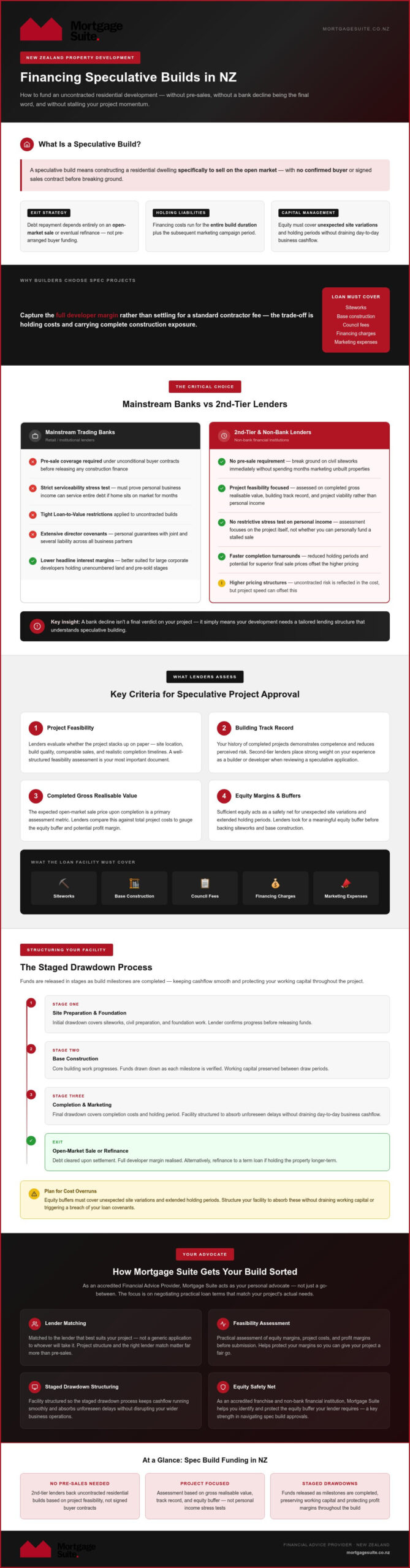

What if the biggest roadblock to getting your townhouses built isn’t council consent, but finding a lender willing to give you a fair go? Securing multi-unit development finance NZ wide has become a real test of patience, especially when mainstream banks take months to respond and demand heavy pre-sales before releasing funds. You already know how frustrating it is to watch strong building opportunities slip away while waiting on credit teams who speak entirely in rigid corporate jargon.
A slow response or a bank decline isn’t the end of your project. This guide shows you how to secure the right funding for your townhouse or apartment development without the stress of confusing bank terms or impossible conditions. We will map out flexible funding options, explain how to protect your timeline, and show you how Kiwis can get sorted with an experienced lending partner who genuinely backs their build.
Key Takeaways
- Discover why building three or more dwellings shifts lender assessments from your personal salary to the project’s overall commercial value.
- Understand how lenders evaluate your build through your track record, equity safety net, and a clear exit strategy.
- Compare mainstream trading banks with non-bank options to secure multi-unit development finance NZ wide without unrealistic pre-sale demands.
- Follow a practical checklist to organise your consents, plans, and costings so you can avoid costly funding delays.
- Learn how having a seasoned finance mentor in your corner simplifies lender negotiations and keeps your build moving forward.
Scaling up to multi-unit projects: Why the finance rules change
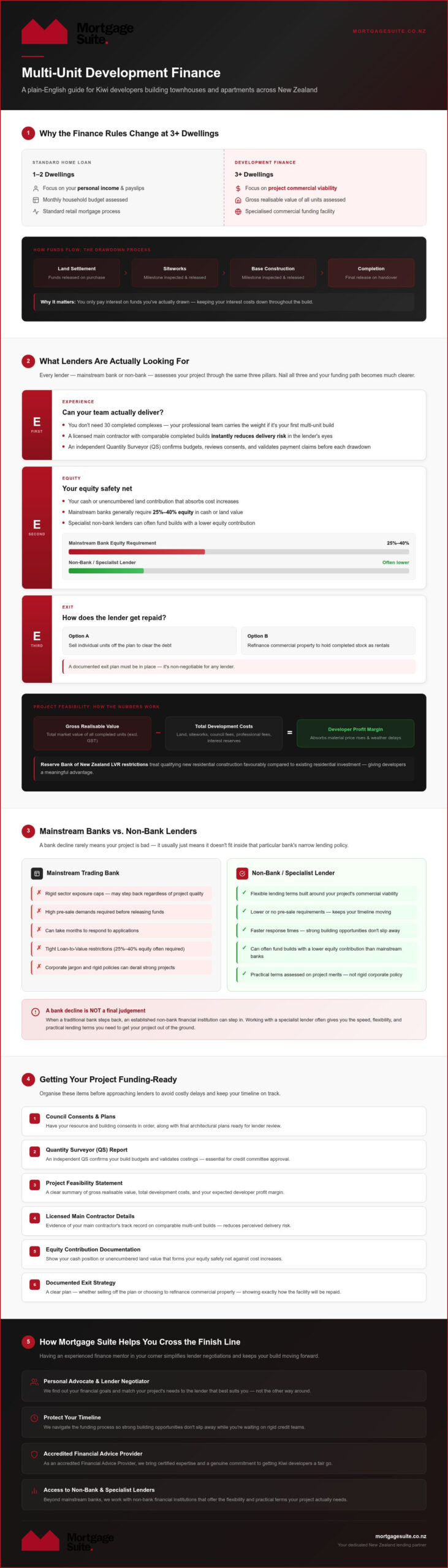
Moving from a single-house renovation to building a row of townhouses changes the funding playing field entirely. If you have built or renovated a standalone house before, you know the bank focused almost entirely on your personal payslips or business profit. Once your plans expand to three or more dwellings on a single title, that familiar retail mortgage rulebook goes out the window.
Lenders stop looking at whether your personal income can pay down the loan month by month. Instead, securing multi-unit development finance NZ wide means proving that the project makes commercial sense on its own merits. The focus shifts from your household budget to overall project feasibility, gross realisable value, and whether your end sales will clear the debt.
What exactly is multi-unit development finance?
Put simply, this is a specialised commercial funding facility that supports the wider real estate development process from empty dirt to finished homes. It is structured to fund distinct phases of your build, including land settlement, civil works, and vertical construction.
Unlike a standard home loan, you do not receive the money in a lump sum. The funds flow through a structured drawdown process. As you hit specific milestones, such as completing siteworks or finishing the base construction, your lender inspects progress and releases payments. This staged approach keeps interest costs down, because you only pay interest on the money you have actually drawn.
Why your local bank might say “no” (and why that is okay)
Many developers feel completely deflated when their everyday bank manager turns them down. However, a bank decline rarely means your project is bad. It usually just means your project does not fit inside that particular bank’s narrow lending policy.
Mainstream trading banks have rigid rules around commercial property development funding. They frequently cap how much exposure they want in specific sectors, demand high levels of pre-sales, or place tight limits on loan-to-value restrictions. When a traditional bank steps back, an established non-bank financial institution can step in. Working with a specialist 2nd tier lender often gives you the speed, flexibility, and practical lending terms you need to get your project out of the ground.
What lenders are actually looking for in your project
When you sit across from a credit assessor, they evaluate your proposal through a framework commonly called “The Three Es”: Experience, Equity, and Exit. While retail mortgages hinge on your monthly household spending, securing multi-unit development finance NZ wide depends on showing that your project team can build on budget and repay the debt safely.
Trading banks and non-bank lenders weigh these three pillars slightly differently, but every funder needs confidence across the whole trio:
- Experience: Evidence that your team can deliver multiple dwellings without costly mistakes.
- Equity: Your cash or unencumbered land contribution that forms an equity safety net against cost increases.
- Exit: A documented plan to repay the facility, whether by selling individual units off the plan or choosing to refinance commercial property to hold the completed stock as rentals.
Your experience and the project team
You do not need thirty completed townhouse complexes under your belt to get funded. However, if this is your first multi-unit build, your wider professional team carries the weight. Partnering with a licensed main contractor who has completed comparable builds instantly reduces project delivery risk in the lender’s eyes.
Independent oversight also protects your funding. An independent Quantity Surveyor (QS) confirms initial build budgets, reviews council consents, and validates contractor payment claims before each drawdown. Having qualified professionals on board reassures credit committees that your project will stay on track.
Project feasibility: Does the story make sense?
Feasibility simply measures whether the project makes commercial sense. Lenders evaluate the gross realisable value, which is the total market value of all completed units, minus goods and services tax. From that figure, they subtract total development costs, including land purchase, siteworks, council contributions, professional fees, and interest reserves, to calculate your developer profit margin.
Lenders insist on a healthy developer profit margin because it absorbs unexpected costs, such as material price fluctuations or bad weather delays. Crucially, official policies like the Reserve Bank of New Zealand LVR restrictions and exemptions treat qualifying new residential construction favourably compared to existing residential investment. While mainstream banks generally demand 25% to 40% equity in cash or land value, specialist non-bank lenders can often fund builds with an equity contribution of 20% to 30% of total project costs.
If you want to run through the numbers on your land or sense-check your numbers before submitting a formal funding application, the team at Mortgage Suite can review your feasibility details and point you toward the most practical lending structure for your build.
Mainstream banks vs. non-bank lenders: Finding your fit
Choosing between a mainstream bank and a non-bank lender usually comes down to a clear trade-off: lowest funding cost versus speed and practical flexibility. Mainstream trading banks offer lower headline interest rates, but their red tape can delay project progress. Non-bank lenders charge slightly more, yet they remove the procedural bottlenecks that cause missed building deadlines. Finding the right fit for your multi-unit development finance NZ wide depends on your equity position, build timeline, and tolerance for lender conditions.
The “presale” hurdle explained
Mainstream banks manage their risk by requiring unconditional pre-sales before construction starts. They typically demand contracts covering 50% to 70% of the project’s gross value, or roughly 100% of the total loan facility, before clearing your first drawdown.
Selling off the plan in a flat market is not always straightforward. Forcing early sales can mean offering discounts to entice buyers, which eats directly into your development profit. In contrast, specialist non-bank lenders frequently fund builds with minimal or even zero pre-sales. This flexibility allows you to build unencumbered and sell finished townhouses directly to owner-occupiers who prefer walking through completed homes.
Speed and flexibility in decision making
Timing makes or breaks property development. Waiting eight weeks for a bank credit committee to debate your application can cost you a land option or push earthworks into winter. Non-bank lenders make decisions swiftly, often reviewing feasibility models and approving terms in just a few days.
Non-bank lenders also tailor loan terms around your actual timeline. Aligning finance milestones directly with your contractor contracts and official planning and building consent guidelines keeps your site running without interruption. If you have plenty of time, strong equity, and buyers already lined up, a mainstream bank works well. If you value agility, fast turnaround, and fewer upfront hurdles, non-bank finance serves as an effective springboard to scale your building business.
Getting your project funding-ready: A simple checklist
Preparing a funding application does not have to feel like an interrogation or an impossible pile of paperwork. When seeking multi-unit development finance NZ wide, lenders simply want to see that you understand the moving parts of your site. Having your key details ready from day one prevents weeks of frustrating back-and-forth communication and keeps momentum firmly on your side.
Before approaching lenders, make sure you can tick off these fundamental items:
- Executive project summary: A straightforward overview covering the site address, proposed unit mix, head contractor details, and target build timetable.
- Consents and plans: Approved resource consent documents and current status updates on your building consent applications.
- Financial vitals: Verified proof of your cash contribution, unencumbered land equity, and certified accounts if borrowing through an existing company.
The essential documents you will need
Your feasibility study sits right at the heart of your proposal. In plain English, this document tallies your land purchase, civil works, vertical construction costs, council contributions, professional fees, and your realistic sale figures upon completion. You will also need clear proof of equity, such as a recent registered valuation showing your land value or statements confirming your cash reserves. If you want to learn more about how lenders view construction paperwork, our Mortgage School provides practical guides to help Kiwis understand the lending process.
Presenting your case for the best rates
Presenting your build clearly helps lenders see the safety margin in your numbers, which can directly improve the loan terms you are offered. Working with an experienced advocate like Krish Krishna gives you a seasoned mentor who knows how institutional credit teams think and how to pitch non-standard scenarios effectively. You can run initial estimates using our Mortgage Calculator to get a feel for your numbers before submitting formal applications.
If you have a site lined up and want a partner who can negotiate directly with lenders on your behalf, contact Mortgage Suite today to get your multi-unit development funded without the stress.
How Mortgage Suite helps you cross the finish line
Securing project funding should never feel like a high-stakes gamble. Drawing on over 20 years of banking and finance experience, Krish Krishna and the team at Mortgage Suite know how to bridge the gap between rigid institutional credit criteria and real-world building ambitions. We do not simply lodge paperwork and hope for the best; we actively negotiate with credit managers on your behalf, freeing you to focus entirely on the construction site.
Every development has unique moving parts. Because Mortgage Suite is a licensed Financial Advice Provider operating nationwide, we maintain direct relationships across mainstream banks and trusted non-bank lending institutions. That broad network lets us structure practical solutions tailored to your build, including:
- Property development loans designed specifically for phased townhouse or apartment builds.
- Second-tier facilities when traditional banks demand unrealistic pre-sale commitments.
- Sensible exit strategies, from construction sell-downs to long-term commercial property loans.
Why experience matters in a fluctuating market
Lending appetites shift quickly, and securing multi-unit development finance NZ wide requires an insider understanding of how credit committees assess risk. Krish acts as a seasoned mentor throughout your development, helping you anticipate lender queries before they become roadblocks. Having a steady hand in your corner keeps the project moving smoothly even when market conditions fluctuate. Take a look at our client reviews to see how we have helped other Kiwi builders navigate tricky funding hurdles.
Your next steps to getting funded
Getting started does not have to be a daunting process. Whether you have already secured land or are still firming up your feasibility numbers, having an early conversation can save months of wasted effort. You can learn more about us and how our client-centric approach protects your project from start to finish. Reach out today for a straightforward, no-obligation discussion, and let us get your multi-unit development sorted.
Taking the next confident step with your build
Scaling into townhouse or apartment construction is an exciting milestone, but rigid bank policies should never stall your progress. A decline from a traditional trading bank isn’t the final word on your site. Once your project reaches three or more dwellings, funding success comes down to solid commercial feasibility, a capable team, and partnering with lenders who genuinely understand construction timelines.
Whether you need to bypass heavy pre-sale conditions or want flexible terms without the corporate red tape, you don’t have to tackle credit assessors alone. Backed by over 20 years of finance experience, Mortgage Suite provides nationwide support as specialists in 2nd tier and non-bank lending. We act as your dedicated advocate, securing the right multi-unit development finance NZ wide so your project keeps moving forward.
Ready to turn your plans into finished homes? Book a conversational chat about your development project with Krish today, and let’s get your build sorted.
Frequently Asked Questions
What is the difference between a residential loan and multi-unit development finance?
A residential loan relies on your household income and personal debt-to-income ratios, whereas multi-unit development finance NZ is evaluated on the commercial viability of the project itself. Residential mortgages fund single homes or minor alterations. Multi-unit facilities fund site acquisition, earthworks, and construction across several dwellings, releasing money progressively through staged drawdown inspections as building milestones are certified.
How many units count as a “multi-unit” development in NZ?
In New Zealand, building three or more dwellings on a single title generally triggers commercial development criteria. While standard retail mortgages can sometimes cover a single house plus a minor dwelling or a duplex, scaling to three townhouses, terraced units, or walk-up apartments shifts the deal into commercial territory. Lenders assess overall project feasibility, gross realisable value, and construction risks rather than standard consumer credit rules.
Do I always need presales to get funding for my project?
No, you do not always need pre-sales to fund your project. While mainstream trading banks usually require qualifying unconditional contracts covering 50% to 70% of gross project value before releasing funds, specialist non-bank lenders frequently provide zero-presale options. This approach allows developers to build without discounting off-the-plan stock, leaving them free to sell completed homes to owner-occupiers once construction finishes.
What is the typical interest rate for non-bank development finance in 2026?
Interest rates for non-bank development funding depend on the risk profile, location, and equity position of your build rather than a single fixed carded rate. Non-bank pricing reflects the extra flexibility they provide, such as zero pre-sales, faster approvals, and higher funding limits. Instead of focusing solely on headline rates, experienced builders look at the total facility structure, including how capitalised interest and staged drawdowns minimise holding charges across the build cycle.
Can I use my existing home equity to fund a multi-unit project?
Yes, you can use existing property equity as part of your deposit or equity safety net. Many developers use unencumbered land or substantial equity in an existing home or commercial asset to satisfy lender equity requirements. Instead of contributing physical cash, your lender can take a registered mortgage over your existing property, allowing you to get your multi-unit development finance NZ application approved without selling assets prematurely.
How long does it take to get a development loan approved?
Approval timeframes depend entirely on whether you apply through a mainstream trading bank or a specialist non-bank funder. Mainstream banks often take six to eight weeks because applications must pass multiple credit committees and policy checks. In contrast, non-bank lenders can often review a well-documented feasibility study, assess site consents, and issue indicative loan terms within several days, keeping your project moving without costly delays.
What happens if my construction costs go over budget?
Cost overruns are covered by the project’s contingency allowance or the developer’s equity buffer. Lenders require a mandatory cost contingency in your initial budget to absorb price rises, council variations, or ground delays. If unforeseen expenses exceed that buffer, you will need to inject additional developer equity or negotiate a facility extension with your lender before further construction funds are released.
Do I need a Quantity Surveyor for every multi-unit project?
Yes, nearly all commercial development lenders require an independent Quantity Surveyor for projects of three or more units. The QS protects both you and the funder by reviewing the building contract, validating realistic construction costs before work starts, and certifying monthly site progress. Their sign-off confirms that completed stages match the invoices submitted, ensuring funds release smoothly across each milestone of your build.