

Financing Speculative Builds in NZ: The 2026 Builder and Developer Guide

Getting turned down by a mainstream bank doesn’t mean your residential project is dead in the water. For years, trading banks have insisted on pre-sales before releasing a single dollar of construction debt. When you’re looking at financing speculative builds nz wide, waiting months for off-the-plan buyers can stall your momentum and tie up valuable working capital.

We know how frustrating it feels when traditional lenders treat a viable project like an unacceptable risk simply because you haven’t locked in unconditional contracts. You shouldn’t have to put your business on hold while stressing over Loan-to-Value restrictions or juggling cashflow across each build stage. The reality is that project structure and the right lender match matter far more than pre-sales.

In this guide, you’ll discover how to secure competitive funding through second-tier lenders and non-bank alternatives that back uncontracted residential builds. We explore practical ways to assess feasibility, manage equity buffers, and protect your profit margins so you can give your project a fair go and get sorted with confidence.

Key Takeaways

  • Understand how financing speculative builds nz wide is achievable without pre-sales by partnering with flexible second-tier lenders.
  • Compare mainstream bank criteria against alternative funding paths that evaluate project feasibility rather than personal income stress tests.
  • Learn the equity margins and project checks lenders expect before backing your siteworks and base construction.
  • Keep your build cashflow running smoothly by structuring the staged drawdown process to absorb unforeseen delays.
  • Discover how an experienced financial adviser acts as your personal advocate to negotiate practical loan terms and get sorted quickly.

Understanding Speculative Builds and Construction Finance in New Zealand

Most online guides discuss construction lending as if every project is a family building their dream home. That advice doesn’t help commercial builders and developers. A speculative build involves constructing a residential dwelling specifically to sell on the open market, without a confirmed buyer or signed sales contract before breaking ground.

Undertaking a spec build means you carry complete construction exposure. While an owner-occupier project relies on progress payments funded by the eventual homeowner, financing speculative builds nz wide requires facilities tailored to an unsold asset. You need a lending structure that preserves your working capital and protects your equity from ground breaking through to final settlement.

The Mechanics of a Speculative Residential Development

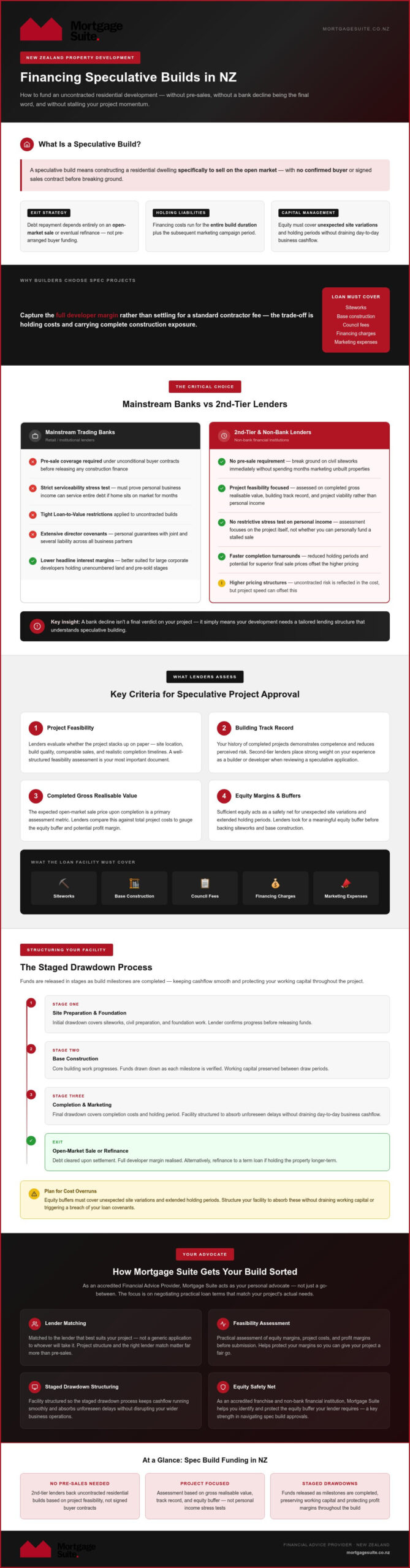
Builders choose speculative projects to capture the full developer margin rather than settling for a standard contractor fee. The trade-off is holding costs. Your loan facility must carry everything from initial siteworks through to completed base construction, while factoring in financing charges, council fees, and marketing expenses until the property sells.

Key differences from standard residential builds include:

  • Exit strategy: Debt repayment depends entirely on an open-market sale or eventual refinance rather than pre-arranged buyer funding.
  • Holding liabilities: Financing costs run for the entire duration of the build and the subsequent marketing campaign.
  • Capital management: Equity must cover unexpected site variations and holding periods without draining your day-to-day business cashflow.

Why Traditional Banks Restrict Speculative Building Loans

Mainstream retail banks treat uncontracted builds with hesitation. From an institutional credit perspective, an uncontracted house represents elevated credit risk. Without pre-sales, there is no unconditional proof that the debt will clear immediately upon completion.

To offset this, trading banks impose tight Loan-to-Value restrictions and run every applicant through a strict serviceability stress test. They often demand proof that your personal business income can service the entire debt facility if the home sits on the market for several months. When conditions shift, retail lenders pull back even further, leaving viable projects stalled. Getting turned down by a bank manager isn’t a final verdict on your project; it simply indicates that your development needs a tailored lending structure that understands speculative building.

Mainstream Banks vs 2nd Tier Lenders for Speculative Construction

Selecting your funding partner dictates whether your project starts next month or sits in limbo. When looking at financing speculative builds nz builders quickly discover a fundamental split in the lending environment: traditional retail trading banks versus second-tier lenders. Understanding how these two groups approach risk is critical for protecting your margins and maintaining momentum on site.

Mainstream Bank Facilities: Strict Hurdles and Pre-Sale Rules

Trading banks offer lower headline interest margins, but their entry criteria are tough. Mainstream institutions typically mandate that a developer achieves substantial pre-sale coverage under unconditional buyer contracts before releasing any construction finance. For an independent builder aiming to build and sell at full completion value, this requirement stalls the entire process.

Banks also impose extensive director covenants, routinely demanding personal guarantees with joint and several liability across business partners. While bank funding works well for large corporate developers holding unencumbered land and pre-sold stages, it leaves little room to move for independent builders who want to capitalise on open-market demand.

2Nd Tier and Non-Bank Lending: Agility Without Pre-Sale Demands

A non-bank financial institution operates under a different commercial philosophy. Rather than running your business income through a restrictive serviceability stress test, second-tier lenders focus primarily on project feasibility, your building track record, and the completed gross realisable value of the asset.

This approach allows you to break ground on civil siteworks immediately without spending months marketing unbuilt properties. While alternative lenders account for the uncontracted risk in their pricing structures, builders often offset this cost through faster completion turnarounds, reduced holding periods, and superior final sale prices. Reviewing our guide on 2nd tier lender New Zealand options explains how these alternative pathways keep construction moving. If you want to explore funding options suited to your specific build timeline, you can connect with the team at Mortgage Suite to get sorted with a workable development package.

Key Criteria Lenders Assess Before Approving Speculative Project Finance

When you apply for financing speculative builds nz lenders look beyond standard payslips. Because there is no unconditional sales contract locked in, credit teams evaluate your project as a commercial venture. They need clear evidence that you can complete the build on schedule, handle unforeseen site variations, and sell the finished dwelling profitably.

Equity Contribution, Security Margin, and Loan-to-Cost

Lenders evaluate your financial commitment through loan-to-cost calculations alongside the completed market valuation. Your equity acts as a safety margin against market swings, whether contributed via cash, unencumbered land, or secondary residential property. Holding an equity safety net reassures underwriters that your business can absorb holding costs if marketing takes longer than planned.

Builder Qualifications, Consents, and Planning Approvals

Securing project finance requires verified trade credentials and complete regulatory approvals. Lenders examine your track record, preferring Licensed Building Practitioners with established delivery histories. They also review consented plans and an independent building report where applicable. If you are developing subdivided land, providing a council Statement of Compliance confirms all infrastructure conditions are met before drawing down funds.

Feasibility Appraisals and Clear Exit Strategies

A workable feasibility study demonstrates that your build remains profitable even if material costs rise or sales timelines stretch out. Lenders scrutinise your projected sales price against independent valuations to verify realistic returns.

Every proposal also requires a viable fallback strategy. If open-market buyer demand cools upon completion, transitioning the property onto residential investment property loans NZ wide allows you to tenant the home, generate immediate cashflow, and sell when the market recovers.
Financing Speculative Builds in NZ: The 2026 Builder and Developer Guide

Structuring Your Facility: Drawdowns, Cost Overruns, and Working Capital

Cashflow management makes or breaks a residential development. Securing approval for financing speculative builds nz wide is only half the battle. How your loan facility is structured across each construction milestone determines whether sub-trades get paid on time and whether work keeps moving on site.

Navigating the Construction Drawdown Process

Lenders do not hand over construction funding in a single lump sum. Instead, the drawdown process releases money in staged tranches as your project hits agreed physical milestones: foundation completion, framing, lock-up, interior linings, and practical completion.

Before releasing each payment, the lender usually requires a progress inspection from an independent valuer or quantity surveyor. Administrative holdups often happen when site paperwork falls behind. Savvy builders keep invoices, subcontractor declarations, and council inspection records organised so the surveyor can sign off the claim quickly, helping you get sorted without stalling progress on site.

Protecting Cashflow Across Siteworks and Base Construction

Managing cashflow requires dividing early civil siteworks from above-ground base construction. Lenders view earthworks, retaining walls, and underground drainage as higher financial risks because unexpected soil conditions or weather disruptions can quickly create cost variations.

To guard against these surprises, lenders mandate a contingency buffer built directly into your facility. This capital reserve acts as a financial shock absorber. It ensures unexpected variations don’t swallow your working capital or force you to halt trades halfway through framing. Exploring our guide on property development loans NZ outlines how tailored capital structures keep builders moving forward.

If you are planning your next project and want to structure funding that keeps your cashflow intact, reach out to Mortgage Suite to negotiate a facility tailored to your building timeline.

Securing Your Speculative Build Loan with Mortgage Suite

Arranging development debt is rarely straightforward, especially when trading banks pull back from uncontracted residential projects. For builders financing speculative builds nz wide, having a seasoned professional in your corner transforms borrowing from an uphill battle into an organised, clear pathway. Mortgage Suite operates as your personal advocate and dedicated negotiator across both traditional retail banks and alternative credit markets.

Founder Krish Krishna brings over two decades of institutional banking and property finance experience to every deal. Our team understands how credit committees evaluate risk, and we know how to present your feasibility numbers, builder credentials, and costings so underwriters see the true strength of your project.

The Advantage of an Accredited Financial Advice Provider

A mainstream bank decline is simply a prompt to explore more agile lending structures. As an accredited Financial Advice Provider, Mortgage Suite connects you directly to non-bank lenders who actively back speculative developments without pre-sale hurdles. We match your project timeline with institutions suited to your build stage, ensuring you receive competitive terms that support your profit margins. Take a moment to read our client reviews page to see how we assist property developers across the country.

Preparing Your Application and Taking the Next Step

Assembling a complete submission package early prevents unnecessary delays and keeps your siteworks on schedule. We help you gather the key elements credit teams require:

  • Consented architectural plans and engineering specifications.
  • Itemised construction budgets including allocated contingency buffers.
  • Independent registered valuations detailing the completed open-market value.
  • Proof of past building projects confirming trade reliability.

Every Kiwi developer deserves a fair go when creating quality new housing. Connect with Mortgage Suite today to discuss your next residential development, review your funding options, and get sorted with a lender who backs your vision.

Bring Your Next Speculative Build to Life

Building without pre-sales gives you full control over your developer margins, but retail bank hesitation shouldn’t slow your progress. Second-tier lenders evaluate real project feasibility and completed asset values rather than rigid personal serviceability tests. By structuring staged drawdowns with sensible contingency buffers, you can protect your equity and keep sub-trades moving smoothly from initial siteworks through to completion.

When you are financing speculative builds nz wide, having an experienced lending advocate in your corner makes all the difference. Founder Krish Krishna brings over two decades of institutional banking and property finance experience to every deal. As an authorised Financial Advice Provider with direct access to leading nationwide non-bank channels, Mortgage Suite works to secure the practical terms and flexible structures your project needs to succeed.

You don’t have to navigate development finance alone. Discuss your speculative build project with Mortgage Suite today to get your funding sorted and give your build a fair go.

Frequently Asked Questions

Can I get financing for a speculative build in New Zealand without pre-sales?

Yes, securing construction finance without pre-sales is entirely achievable through second-tier and non-bank lenders. While mainstream trading banks demand pre-sales to eliminate repayment risk, alternative lenders assess project feasibility, builder track record, and the completed gross realisable value. When financing speculative builds nz wide, partnering with flexible lenders allows you to break ground without waiting for off-the-plan purchasers.

How much equity do I need to secure finance for a speculative residential build?

Most development lenders require an equity contribution between 20% and 30% of total project costs. You can provide this equity through cash, unencumbered land, or equity secured against existing property. Holding a solid equity buffer reassures underwriters that your business can absorb unexpected holding periods or site adjustments without placing the project under financial strain.

What is the main difference between a standard construction loan and a speculative build loan?

A standard construction loan finances a dwelling for an owner-occupier who services the mortgage through personal income. In contrast, a speculative build loan is a commercial facility designed for an uncontracted asset intended for open-market sale. Speculative facilities rely on the final sale or refinance to clear the debt rather than regular PAYE income assessments.

Will a mainstream bank decline prevent me from getting speculative build finance?

No, a bank decline does not stop you from securing development funding. Mainstream institutions follow rigid underwriting models that routinely turn away uncontracted projects. Second-tier lenders take a commercial approach, evaluating the strength of the development rather than strict retail stress tests. Working with an experienced financial adviser ensures your proposal is presented to lenders willing to give you a fair go.

How does the drawdown process work during a speculative construction project?

The drawdown process releases funds in stages as your build reaches agreed physical milestones. Typical stages include completed earthworks, framing, lock-up, interior linings, and practical completion. Before releasing each tranche, an independent valuer or quantity surveyor inspects the site to certify completed work, ensuring your sub-trades get paid on time while keeping construction moving forward smoothly.

What happens if my speculative build does not sell immediately upon completion?

If your property does not sell immediately, you can refinance the short-term construction facility onto a residential investment property loan. This exit strategy allows you to tenant the property, generate rental income, and service the debt comfortably. Transitioning the debt prevents forced price reductions and gives you the flexibility to wait for optimal market conditions.

Why do lenders require contingency funds for speculative building projects?

Lenders mandate contingency allocations to absorb unexpected variations during construction. Unforeseen ground conditions during siteworks, supply delays, and minor trade variations can quickly push costs above initial estimates. When financing speculative builds nz wide, maintaining a dedicated contingency reserve protects your working capital and ensures work does not stop if unexpected expenses arise.


Article by

Krish Krishna

Experienced Financial Adviser with over 46 years of Banking and Mortgage broking experience and over $2.0 Billion in loan settlements.

Investment Property Mortgage Calculator NZ: How to Calculate Repayments for Your 2026 Portfolio

What if your next property investment approval didn’t depend on a bank’s rigid checklist, but on your ability to master the numbers before you even apply? With the Official Cash Rate sitting at 2.25% and DTI limits of seven times your gross income now firmly in place, using an investment property mortgage calculator nz is no longer just about checking repayments. It is about understanding how your total debt profile fits within the Reserve Bank’s 2026 framework to ensure your portfolio remains viable.

We understand the frustration of finding a perfect property only to be met with confusion over 2nd tier lending rates or the complexities of the current dual-constraint system. It is natural to feel a bit of pressure when trying to organise your cash flow while floating rates sit as high as 8.61%. This guide promises to clear that fog, providing you with a clear understanding of your monthly costs and a path to approval even if mainstream lenders hesitate. We will preview the latest LVR restrictions, explain the impact of 100% interest deductibility, and give you the confidence to execute a property strategy that works for your specific financial goals.

Key Takeaways

  • Identify the five core variables, including interest rates and repayment frequency, to accurately forecast your portfolio’s monthly cash flow.
  • Master the dual-constraint system of LVR and DTI limits by using an investment property mortgage calculator nz to determine your true borrowing capacity in the 2026 market.
  • Learn why calculating for investment requires a focus on yield and serviceability rather than just simple home loan affordability.
  • Discover how 2nd tier loans provide a vital alternative for investors who find themselves outside the strict lending criteria of the major banks.
  • Follow our step-by-step template to account for often-overlooked costs like legal fees and building reports when establishing your total loan requirement.

Successful property investment in New Zealand starts long before you visit an open home. It begins at your desk, crunching numbers to ensure a deal actually stacks up in the current 2026 economic environment. While many people use a basic tool to see what they can borrow, a dedicated investment property mortgage calculator nz serves a much more strategic purpose. It acts as your first line of defence against over-leveraging. It is about moving beyond "can I afford this?" to "does this asset work for me?"

In 2026, the landscape has shifted. With the Official Cash Rate at 2.25%, banks are looking closer than ever at your total debt-to-income (DTI) ratio. Calculating your repayments isn’t just about finding a monthly figure; it is about stress testing your strategy against potential interest rate hikes. If you can’t show a clear path to serviceability when banks apply their "test" rates, which often exceed 8.5%, your application will likely end up in the declined pile. Accurate preparation ensures you present a professional, viable case to lenders from the outset.

The Difference Between Yield and Cash Flow

Gross yield is a helpful starting point, but it’s often a vanity metric that can lead investors astray. It simply measures the annual rent against the purchase price. To build a sustainable portfolio, you must focus on net cash flow. This is where your mortgage repayment is just one piece of the puzzle. You need to account for the fact that 100% of your interest is now deductible, which significantly aids your bottom line compared to previous years. However, savvy investors also calculate a "buffer" for maintenance, property management, and potential vacancies. Understanding how mortgage calculators work helps you see how these variables interact with your loan principal to create a true picture of your weekly outgoings.

Why ‘Big Bank’ Calculators Often Fall Short

Most mainstream banking tools are designed for the average home buyer with a standard salary and a perfect credit score. They rarely account for the complexities of an investment portfolio, such as the nuances of 2nd tier lending or the specific 70% LVR requirements for investors. If your situation doesn’t fit the rigid "Big Four" criteria, their automated algorithms might suggest you’re at a dead end. We believe in personalised advocacy over automated results. 2nd tier lenders often offer different repayment maths that can turn a "no" into a "yes," provided you have organised your figures correctly using an investment property mortgage calculator nz that reflects the real-world market.

Understanding the Variables: What Actually Goes Into Your Repayment Calculation?

Calculating repayments isn’t a guessing game; it’s a precise exercise in financial forecasting. To get a reliable result from an investment property mortgage calculator nz, you must look beyond the sticker price of the house. There are five core variables that dictate your success: the loan amount, the loan term, the interest rate, the payment frequency, and the repayment type. Your deposit size is the first hurdle. While the Reserve Bank generally requires a 30% deposit for investors, having a larger equity stake can often unlock more competitive interest rate tiers. If you find the big banks are being too restrictive with their terms, exploring residential investment property loans can provide the tailored approach you need to keep your portfolio growing.

Local investors have the choice of weekly, fortnightly, or monthly instalments. Matching your repayment frequency to your rental income cycle can make your cash flow much easier to organise. Principal and Interest is the standard method for building equity over a 30-year term. However, the type of debt you choose significantly shifts the math. For example, a 30-year term is standard, but some 2nd tier lenders might offer different structures that suit a short-term development or a rapid equity-build strategy.

Fixed vs. Floating Rates: Which Number Should You Use?

Choosing an interest rate for your calculation requires a balanced view of the 2026 market. Fixed rate mortgage options currently range from approximately 4.65% for a one-year term to 5.86% for three years, providing the budget certainty many investors crave. Floating rates, while averaging around 6.15%, offer the flexibility to make extra payments without penalty. When using an investment property mortgage calculator nz, don’t just use today’s advertised specials. It’s wise to use a "test rate" of around 8.5% to ensure your portfolio remains robust even if the Reserve Bank raises the OCR again.

The Interest-Only Strategy for Investors

Interest-only repayments remain a popular choice for Kiwi investors looking to maximise tax efficiency. With 100% interest deductibility fully restored as of April 2025, this strategy helps keep immediate outgoings low while you focus on capital growth or paying down your non-deductible home loan. While this improves your short-term cash flow, it’s vital to calculate the "cliff"; the moment your interest-only period ends and your repayments jump to include principal. Planning for this transition ensures you aren’t caught off guard by a sudden increase in your weekly commitments.

The LVR and DTI Hurdle: Calculating Your Real Borrowing Power

Having a healthy deposit is only half the battle in the 2026 lending environment. While earlier sections focused on the mechanics of repayments, you must also clear the dual hurdles of Loan-to-Value Ratio (LVR) and Debt-to-Income (DTI) restrictions. Currently, the Reserve Bank requires most investors to provide a 30% deposit, meaning your LVR cannot exceed 70%. However, even with a massive pile of cash, your "real" borrowing power is now firmly capped by DTI limits. For most mainstream banks, your total debt cannot exceed seven times your gross annual income. This creates a hard ceiling that an investment property mortgage calculator nz can help you identify before you spend money on building reports or valuations.

Many investors feel the sting of "rental shading" during the application process. Banks rarely count 100% of your projected rental income when calculating serviceability. Instead, they typically recognise only 75% to 80% of the rent to account for costs like rates, insurance, and property management. If you have plenty of equity but the bank says your income is too low, this shading is often the culprit. It’s a common point of frustration, but understanding these internal bank formulas allows you to adjust your strategy and look for properties with higher yields that can offset the income gap. To fully understand how the 6x and 7x thresholds affect your specific situation, our detailed guide on the debt to income ratio NZ rules and what they mean for your 2026 mortgage breaks down the exact maths lenders use.

Unlocking Equity in Your Existing Portfolio

You don’t always need cash in the bank to fund your next move. Usable equity is the secret weapon for growing a portfolio, calculated as the difference between your current mortgage and 80% of your property’s value. For those who have seen significant capital gains since they first secured home loans for first home buyers New Zealand, this equity can often cover the entire 30% deposit for an investment. It’s a methodical way to leverage your existing assets without draining your personal savings, provided you maintain a steady hand on your total debt levels.

When the Mainstream Banks Say No

If your DTI ratio sits slightly above the "Big Four" threshold of seven, it doesn’t mean your investment journey is over. 2nd tier lenders often provide a vital alternative, as they can be more flexible with complex income structures or higher debt levels. When you use an investment property mortgage calculator nz to model these scenarios, you should account for slightly higher interest rates, often 0.5% to 1.5% above standard bank rates. This is where professional advocacy becomes essential. We specialise in finding the bridge between a rigid bank "no" and a structured approval that keeps your 2026 portfolio on track.

Investment Property Mortgage Calculator NZ: How to Calculate Repayments for Your 2026 Portfolio

A Step-by-Step Template to Forecast Your Investment Cash Flow

While an investment property mortgage calculator nz provides a quick answer, knowing the manual steps behind the math gives you true control over your strategy. It allows you to spot a bad deal before you ever talk to a bank. Follow this template to organise your forecast for any 2026 acquisition.

  • Step 1: Determine the total entry cost. Start with the purchase price and add an allowance for legal fees, building inspections, and valuations. These often total between $3,000 and $6,000 depending on the property’s complexity.
  • Step 2: Establish your loan requirement. Subtract your cash deposit or the usable equity you’ve unlocked from your home. This leaves you with the core debt figure.
  • Step 3: Select your structure. Decide if you’ll use an interest-only period to maximise immediate cash flow or start with principal and interest to build equity from day one.
  • Step 4: Use realistic rates. Don’t just use the lowest rate on the market. Apply a standard 2026 fixed rate, such as the 5.19% two-year average, to keep your figures grounded in reality.
  • Step 5: Run the serviceability check. Calculate your monthly repayment and compare it against 80% of your projected gross rent. If the rent doesn’t cover the mortgage at this "shaded" level, you’ll need to contribute from your personal income.

If these steps feel overwhelming or the numbers aren’t quite stacking up, we can help you find a path forward. Our team specialises in securing residential investment property loans that align with your long-term wealth goals.

The ‘Stress Test’ Calculation

Bank managers don’t look at what you can pay today; they look at what you can pay if the market shifts. You should do the same. Recalculate your repayments with an interest rate that is 1% or 2% higher than current offers. This "worst-case" figure is the most vital number in your entire spreadsheet because it defines your safety margin. A robust investment plan should survive a 2% interest rate hike without requiring external capital. If your portfolio can’t weather that storm, it might be time to reconsider the purchase price or your deposit size. Understanding the difference between fixed rate mortgage vs floating rate options is essential when stress testing your portfolio against potential rate movements.

Accounting for the ‘Hidden’ Costs

Many novice investors make the mistake of thinking the mortgage is their only expense. In reality, rates, insurance, and property management fees usually consume about 20% of your gross rental income. These are the "forgotten" costs that can turn a cash-flow positive property into a monthly liability. When you’re using an investment property mortgage calculator nz, always deduct these outgoings from your rental income before comparing it to your loan repayments. Remember that "set and forget" is a myth in property investment. Staying on top of these shifting costs ensures your portfolio remains a source of wealth rather than a source of stress.

Beyond the Calculator: How Tailored Financing Secures Your Portfolio

While an investment property mortgage calculator nz provides the essential coordinates for your journey, it cannot navigate the roadblocks that often appear during a bank’s assessment process. Think of the calculator as your map; it shows you the destination, but a seasoned advocate acts as your guide through the terrain. At Mortgage Suite Ltd, we specialise in residential investment property loans that don’t always fit the rigid, automated criteria of the "Big Four" banks. We understand that your financial story is more than just a credit score or a debt-to-income ratio.

Securing a "fair go" from lenders in 2026 requires more than just submitting an application. It involves presenting a case that highlights the strength of your strategy. For many investors, 2nd tier lending serves as a strategic bridge. It allows you to secure a property and build equity today, rather than waiting for mainstream banks to ease their restrictions. This proactive approach turns a potential "no" into a structured path toward long-term wealth, ensuring you don’t miss out on opportunities while waiting for the perfect market conditions.

The Power of a Specialised Advocate

Krish Krishna brings over two decades of banking experience to your corner, ensuring your application is seen by human eyes rather than just an algorithm. There is a profound difference between a "computer says no" interaction at a local branch and a solution brokered through deep institutional knowledge. When your finances are non-standard or your portfolio is complex, personal connection and a reputation for integrity matter. We act as your dedicated negotiator, removing obstacles and finding the bridge between institutional requirements and your personal goals. Our experience allows us to anticipate lender objections before they arise, saving you time and reducing the stress of the approval process.

Next Steps: From Calculation to Pre-Approval

To move from a theoretical calculation to a formal pre-approval, you’ll need to organise your documentation. This typically includes recent payslips, bank statements, and rental appraisals for your existing or prospective properties. Having these ready allows for a much smoother transition from the research phase to the acquisition phase. We also recommend a "health check" on your current portfolio equity to ensure you are leveraging your assets as efficiently as possible. When you’re ready to turn your data into a concrete offer, organise a consultation with Mortgage Suite Ltd to find the right loan for your next investment. We are here to ensure your 2026 strategy is built on a foundation of professional certainty and personalised care.

Mastering Your Path to Property Success

Mastering the numbers is the first step toward building a resilient property portfolio. By now, you understand that an investment property mortgage calculator nz is a powerful starting point for assessing yield and cash flow. However, clearing the high bars of DTI limits and LVR restrictions requires more than just a digital tool. It demands a strategic approach that accounts for 2026 market realities and the nuances of non-bank lending. Success in this environment comes from preparing for the transition of interest-only periods and ensuring your strategy can weather potential interest rate shifts with a calculated safety margin.

With over 20 years of banking and brokerage experience, Mortgage Suite Ltd provides the seasoned advocacy needed to turn complex financial scenarios into approvals. We specialise in 2nd tier and non-bank lending, offering a nationwide service for all New Zealand investors who want a steady hand in a fluctuating market. You don’t have to navigate these hurdles alone. Secure your investment future with a tailored mortgage strategy from Mortgage Suite Ltd. We are ready to help you move beyond the spreadsheet and into your next successful acquisition with absolute confidence.

Frequently Asked Questions

How much deposit do I need for an investment property in NZ in 2026?

You generally need a 30% deposit for an existing residential investment property in 2026. This requirement aligns with the Reserve Bank’s LVR restrictions, which limit most investor lending to a 70% threshold. If you are purchasing a new build, you may be able to secure a loan with as little as a 20% deposit. Using an investment property mortgage calculator nz helps you determine the exact amount of cash or equity required to meet these criteria.

Can I use my KiwiSaver to buy an investment property?

No, you cannot withdraw KiwiSaver funds to purchase a property intended solely for investment. KiwiSaver withdrawals are strictly reserved for buying your first home to live in, or for cases of significant financial hardship. However, once you have used KiwiSaver to secure your first home, the equity you build in that property can eventually be leveraged to fund a deposit for a future investment property.

What is a ‘good’ DTI ratio for a property investor?

A healthy DTI ratio for an investor is typically considered to be below six. As of mid-2024, the Reserve Bank implemented a formal DTI cap of seven for most investor lending. If your total debt exceeds seven times your gross annual income, mainstream banks will likely decline your application. Maintaining a lower ratio ensures your portfolio remains resilient and gives you more flexibility when interest rates fluctuate.

Are interest rates higher for investment properties than for my own home?

No Interest rates are generally the same. For investors up to 6 investment properties, you can obtain the rate as normal housing rates. For investors with more than 6 properties, some lenders will view you as commercial investors and may apply a slightly higer rate.

What happens if my investment property is vacant for a month?

If your property is vacant, you must be able to cover the full mortgage repayment from your other income sources. This is why banks "shade" your rental income, often only counting 80% of the projected rent in their serviceability tests. We always recommend keeping a cash buffer equivalent to at least four weeks of rent to manage these inevitable vacancy periods without putting undue stress on your personal finances.

Should I choose a 2nd tier lender if my bank declines my application?

Choosing a 2nd tier lender is a very effective strategy if a mainstream bank declines your application due to rigid DTI or LVR rules. These lenders often provide a vital bridge for investors with complex income structures or those who sit just outside the "Big Four" criteria. While the interest rates may be slightly higher, the flexibility they offer can be the difference between growing your portfolio or stalling your investment journey.

How do I calculate the equity in my current home?

To calculate your usable equity, take 80% of your home’s current market value and subtract your remaining mortgage balance. For example, if your home is worth $1,000,000 and your mortgage is $500,000, your usable equity is $300,000. This is calculated as $800,000 minus $500,000. This figure represents the maximum amount you can potentially borrow against to fund a deposit for a new investment property without needing extra cash.

Is interest-only always better for rental properties?

Interest-only is not always the best choice; it depends on your specific financial goals. Many investors prefer interest-only to maximise tax deductibility and keep monthly outgoings low, which is excellent for immediate cash flow. However, Principal and Interest repayments are better if your goal is to build equity and pay off the debt over a 30-year term. It’s about balancing your immediate flexibility against your long-term debt reduction strategy.

Article by

Krish Krishna

Experienced Financial Adviser with over 46 years of Banking and Mortgage broking experience and over $2.0 Billion in loan settlements.