

Home loan pre-approval declined? What to do next

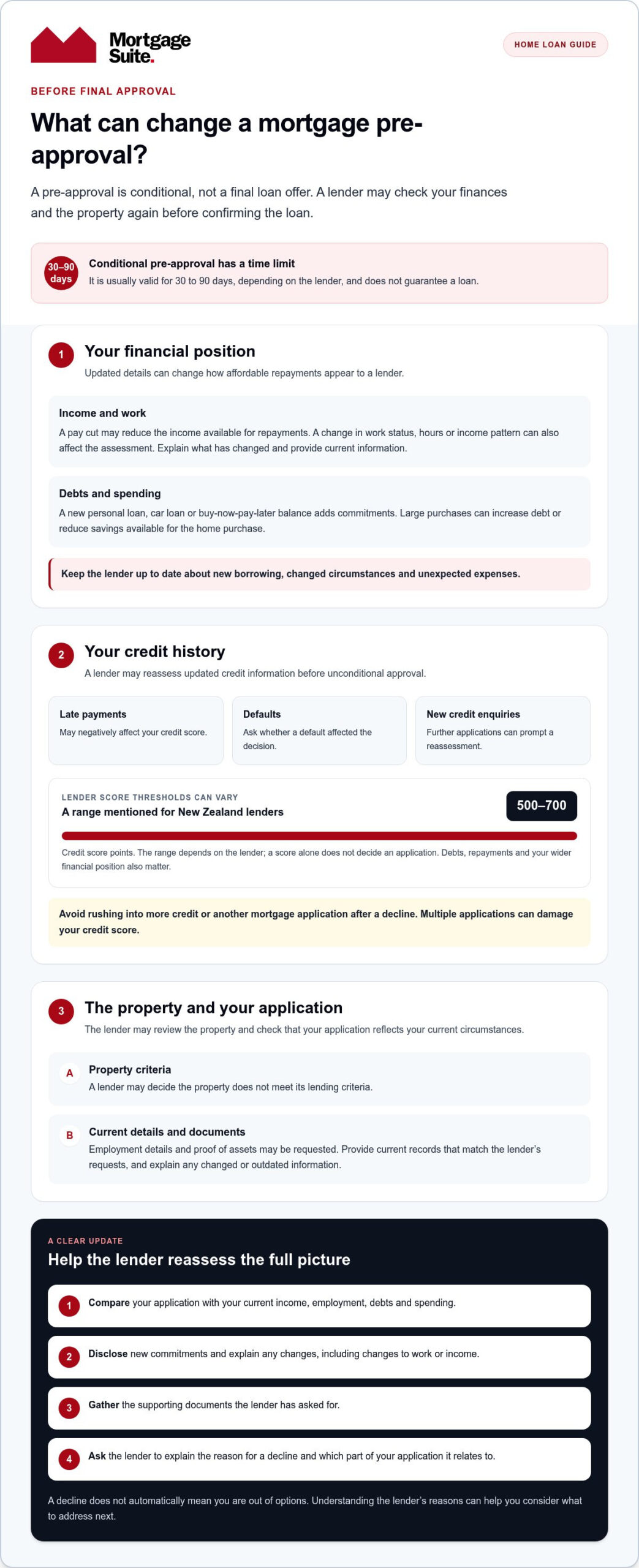
A pre-approval isn’t a final yes: a lender can still decline your home loan after reviewing your finances and the property. Conditional pre-approvals are usually valid for 30 to 90 days, depending on the lender, and don’t guarantee a loan. If your mortgage pre-approval is rejected, it doesn’t automatically mean you’re out of options.

It’s understandable to feel unsettled, especially if you thought the main hurdle was behind you. A lender may reassess your income, spending, debts or credit history, or decide the property doesn’t meet its lending criteria. This article explains why mortgage pre-approval can be rejected, what financial changes may affect your application, and how a mortgage broker may help you understand the decision and consider a suitable next step.

Key Takeaways

  • Pre-approval is conditional, not a final loan offer. A lender may reassess your finances and the property before confirming the loan.
  • Changes to your income, employment, debts or spending can affect how affordable the repayments appear to a lender.
  • Late payments and new credit applications may affect your credit history, so avoid taking on extra debt while your application is being assessed.
  • Ask the lender to explain the reason for a decline. The issue may relate to your finances, the property, or information in your application.
  • A mortgage broker can help you understand the lender’s decision and consider whether a different loan approach may suit your circumstances.

Changes in income, employment, debt and spending

Pre-approval reflects the information assessed when you applied, not every change that follows. Before final approval, updated income, employment or spending details can affect how a lender views your ability to repay.

Income and debt changes

Income and debt changes are shifts in what you earn or owe after applying for a home loan. For example, a pay cut can reduce the income available for repayments, while a new personal loan adds another commitment. These changes can alter the picture the lender assessed at pre-approval, so tell the lender if your circumstances change instead of relying on figures that are no longer accurate.

Changes don’t always mean your application has to stop. A pay rise, reduced debt or change in regular work hours can affect the assessment differently, depending on the full picture. Give the lender current details and explain what changed. If your income varies, describe the pattern clearly. Leaving out a recent change can create a mismatch between your application and your current finances.

New debt matters because repayments reduce the money left for a mortgage. A car loan, personal loan or buy-now-pay-later balance can change your regular commitments, even if you’ve kept up with payments. Before taking on new debt during the home-loan process, consider how its repayments could affect your application. Tell the lender about any new borrowing instead of assuming it won’t appear in the assessment.

Employment details and supporting documents

Employment details describe your current work and income arrangements, while supporting documents show the financial information behind your application. A lender may require employment details and proof of assets for pre-approval. If you move from salaried work to contracting, for example, update your work status and provide the information requested to support the new arrangement.

Keep relevant records together, including documents that show your current income, employment and assets. The lender’s requests depend on your circumstances, so match each document to the information they ask for. If a record is out of date or a detail has changed, explain that clearly when you submit updated information. This helps avoid confusion between your original application and your current position.

Spending changes can also affect the lender’s view of affordability. A large purchase, such as new furniture bought on credit, can increase debt or reduce savings available for the home purchase. Avoid taking on more debt or making large purchases while seeking final approval. If an unexpected expense changes your finances, record what happened and update the lender with accurate details.

Before sending an update, compare your application with your current income, employment, debts and spending. Correct outdated details, disclose new commitments and gather the requested supporting documents. For example, if your work arrangement changed and you also opened a credit account, explain both changes together. A complete, up-to-date account gives the lender a clearer basis for reassessing your application.

Credit score changes and new credit applications

Your credit score can change between pre-approval and final assessment. Late payments, defaults and new credit enquiries may negatively affect your score before unconditional approval. That matters because a lender may reassess your application using updated credit information. If your score has changed since applying, ask what part of your credit history affected the decision and what information the lender considered.

There’s no single credit-score threshold for every New Zealand home loan. The minimum scores used by lenders can range from 500 to 700 credit score points, depending on the lender. A score within that range doesn’t decide the application by itself. The lender also considers your wider financial position, including debts and repayments, so a higher score alone may not resolve other concerns.

New credit applications can add uncertainty while a lender assesses your mortgage. For example, applying for a credit card and a car loan after receiving pre-approval may prompt the lender to reassess your commitments. Opening more lines of credit can also affect your application. Avoid rushing into another mortgage application after a decline: multiple applications can damage your credit score.

If a lender declines your application, first ask for a clear explanation. Find out whether the concern involved late payments, a default, a recent credit enquiry or another part of your application. Then review your credit records and compare them with your own payment history. If an entry appears incorrect, gather the relevant account information before discussing it with the organisation that recorded it.

For a New Zealand home loan, deposit requirements and Loan-to-Value restrictions depend on the lender’s criteria and property assessment. The Loan-to-Value ratio compares the loan with the property’s value, so a larger deposit means borrowing a smaller proportion of that value. Deposit size is one part of the assessment, alongside credit history, income and existing debts.

Before applying again, pause and make a clear record of any credit applications, repayments or missed payments since pre-approval. Avoid taking on new credit while the lender reviews your position. If you’ve recently applied for finance, explain why and whether the application led to a new debt. Accurate details help the lender assess your current commitments rather than an incomplete picture.

A decline doesn’t tell you which change mattered most unless you get the lender’s reasons. For example, a recent enquiry may be less significant than an unpaid default, depending on the lender’s assessment. Use the explanation to decide what to address first, then discuss another application once you understand how your credit history and deposit affect the overall picture.

Can I be denied after a pre-approval?

Yes. A lender can decline after pre-approval if updated financial checks or the specific property change its assessment. Ask for the lender’s reasons before deciding what to do next.

Reasons for decline after pre-approval

A decline after pre-approval means the lender’s final assessment no longer supports the loan. The lender may reassess your finances and the property, including its valuation. If the valuation is below the purchase price, the lender may decide the security does not support the requested amount. Changed credit information, incorrect application details or a property that fails a condition can also affect the decision.

The property itself can be the issue. A lender may view a flood-zone property, a home in a mining town or a property needing substantial renovation as higher risk. A rise in interest rates or a change to lending policy may also prompt reassessment. These factors mean pre-approval is not final approval for every home you might choose.

Steps after a loan decline

Start by asking the lender to explain the decline clearly. Identify whether the main concern was your finances, an application error, a property condition or its valuation. Then compare that explanation with your documents and purchase details. This gives you a specific issue to address, rather than guessing or sending another application with the same problem.

If the property is the obstacle, consider whether another property may meet the lender’s criteria. If a valuation came in below the purchase price, discuss how that figure affected the requested loan. If details were missing or incorrect, prepare accurate information before reapplying. Keep the lender’s explanation and supporting documents together so the next assessment addresses the actual concern.

Applying to another lender

You can consider another New Zealand lender after a decline, but first understand why the original application failed. There is no set waiting period in the available guidance. The practical next step is to address the reason before applying again. Rushing into several mortgage applications can damage your credit score, so avoid sending multiple applications at once.

A different lender may assess your circumstances or the property differently, but the same unresolved issue can still matter. For example, a lower valuation remains relevant if you apply for the same property and loan amount. Before approaching another lender, gather the decline explanation, update any incorrect details and decide whether the property or requested borrowing needs to change.

Use the lender’s decision as a guide to what needs attention. If your mortgage pre-approval is rejected because of a property condition, changing your finances alone may not solve it. If the concern relates to your application information, correct that first. A clear reason helps you decide whether to revisit the property, update your application or seek another assessment.
Home loan pre-approval declined? What to do next

Conditional approval and approval in principle

Conditional approval, also called approval in principle, is an early indication that a lender may lend if its conditions are met. In New Zealand, it’s provisional, not a final loan offer, so the lender can still review your finances and the property before confirming the loan.

Pre-approval letters commonly include conditions that need to be satisfied before the lender proceeds. These may relate to information the lender still needs or to the property you intend to buy. For example, the lender may need to assess a specific home after you make an offer. Approval in principle therefore gives you an early guide, not confirmation that every property will qualify.

Check the letter carefully when it arrives. Note the date, the stated expiry and each condition that applies to your application. Home-loan pre-approvals are usually valid for 30 to 90 days, depending on the lender. If your search takes longer, the approval may expire, and the lender may need to reassess your circumstances before you rely on it.

That reassessment can matter if your finances change during the approval period. New debt, a change in employment or a credit-history change could affect the lender’s view of your application. Keep the information you provided accurate and current. If something changes, tell the lender rather than treating the original pre-approval as an unchanged decision.

The property is another part of the final assessment. A lender may assess the specific home and obtain a valuation before issuing unconditional approval. For example, if the valuation comes in below the agreed purchase price, the lender may reconsider the loan amount. Pre-approval for your finances does not mean the lender has accepted every property you might choose.

Unconditional approval is formal approval issued after all conditions are met and both you and the specific property have been assessed. Until then, don’t treat a conditional letter as confirmation that settlement funding is ready. Read the conditions, respond to requests for information and track the approval period. These steps help you understand what remains outstanding.

If a conditional approval expires or the lender changes its assessment, ask which condition remains unmet and what information is needed. For instance, clarify whether the issue concerns an updated financial detail or the property’s valuation. A precise explanation helps you decide whether to provide further information, revisit the property choice or discuss a revised application.

Approval in principle can help you understand your borrowing position while you look for a home, but it has limits. Treat the lender’s conditions and expiry date as part of your planning. Before making commitments based on the letter, understand that final approval depends on the lender completing its assessment of your finances and the particular property.

Using a mortgage broker

A mortgage adviser can review the lender’s reasons, help prepare a request for reconsideration and discuss other lending options. Their value lies in turning a decline into a clearer plan, not simply sending the same application again.

Broker support after rejection

A broker’s support after rejection means reviewing the decision and helping you present relevant information clearly. This matters when, for example, the lender misunderstood a change in income or overlooked a document. Share the decline explanation and application details so the adviser can identify the concern and help shape a focused response.

If the lender may reconsider, a broker can help organise supporting documents and explain how they address the issue. For example, an updated employment record may clarify a recent work change. If the property valuation is the concern, the response needs to address the property assessment, not rely only on documents about your income.

A broker can also discuss whether another lender’s criteria may better fit your circumstances. Start that comparison with the reason for the decline, not a fresh application sent everywhere. If the issue is an incorrect detail, correct it first. If the property is the obstacle, consider whether another property could change the assessment.

Working with a mortgage broker

Working with a mortgage broker means sharing your financial picture so they can help assess suitable lending options. Provide accurate information about income, existing debts, deposit and the property you’re considering. For instance, if you’re self-employed, explain how your income is recorded and supply the documents requested for assessment.

Use the lender’s decline explanation as the starting point for a practical discussion. Ask the broker to clarify which parts of your application need attention and what evidence could address them. A clear account of the issue helps avoid repeating an application without meaningful changes.

A broker can help communicate with lenders and present your circumstances in context. For example, if a mainstream bank’s criteria don’t suit your situation, discuss whether another lending approach may fit. The lender still assesses the application, so focus on a realistic plan, clear documents and loan terms that match your goals.

Before proceeding, agree on what the next application needs to show. That could mean correcting information, documenting a change or reconsidering the property. A mortgage adviser can help you weigh those options and prepare for the next conversation with a lender, rather than treating a decline as a final judgement on your borrowing plans.

Mortgage Suite: Home Loans to First Home Buyers

Mortgage Suite Ltd provides home loans to first home buyers, helping you consider your next move after a lender’s decision. If your pre-approval was declined, bring the lender’s explanation and your updated financial details to discuss possible lending options. Understanding whether the concern relates to your circumstances or the property can help shape a more suitable application.

Mortgage Suite Ltd also provides residential investment property loans, business loans and property development loans. For a first-home buyer, the focus is understanding your goals and borrowing situation, then considering a path that fits. A decline can be discouraging, but it isn’t a judgement on you as a borrower. Contact Mortgage Suite Ltd to talk through your circumstances and possible next steps.

Choose your next move with confidence

If your mortgage pre-approval has been rejected, take time to understand the lender’s reasons before deciding what to do next. You don’t need to treat the decline as a judgement on your plans. Focus on what you want to achieve, what needs to change and what information will help a lender assess your situation fairly.

A useful conversation can turn uncertainty into a practical direction. Mortgage Suite can talk through your circumstances and help you consider the next step, whether that means revisiting your application or exploring another lending path. You don’t need to have every answer ready before you start. A clear account of what happened is a helpful beginning.

Contact Mortgage Suite to discuss your next step. With a considered plan and the right support, you can keep moving towards your property goals.

Frequently Asked Questions

What is home loan pre-approval?

It’s an early indication of how much a lender may be willing to lend, based on the details you’ve supplied. Use it as a planning guide, not a spending target: consider whether the repayments and other homeownership commitments fit your budget. Before making an offer, read the lender’s letter closely and note what it says about the amount, property and any remaining conditions.

Why might a mortgage pre-approval be rejected in New Zealand?

A lender may decline if its assessment finds a concern it can’t accept or needs more evidence to resolve. Ask whether the decision reflects a lending policy, missing information or a specific part of your application. That distinction helps you work out whether to provide further documents, correct a detail or reconsider your plans, instead of making another application without knowing what needs to change.

What credit score and credit history issues can prevent mortgage pre-approval in NZ?

Review your credit history for accounts you don’t recognise, incorrect balances or payment entries that don’t match your records. If something looks wrong, gather statements or other relevant records and raise the specific entry with the organisation that recorded it. A lender can also explain whether its concern relates to your overall credit profile or a particular item, helping you focus on the right issue.

How do income, expenses, debt, and affordability affect NZ mortgage pre-approval?

Prepare a realistic household budget that captures regular bills as well as less frequent expenses, such as vehicle maintenance or annual charges. Compare that spending with the income you can reliably count on, then account for your existing financial commitments. This gives you a clearer view of what repayment level may fit your day-to-day life and helps you discuss your budget with the lender using specific figures from your own records.

Can a bank reject pre-approval because of the property, its valuation, or its location?

Yes. To clarify a property-related concern, keep the purchase documents and any available property reports together. Ask the lender which feature affected its assessment and whether the concern relates to value, condition or suitability. For example, if the issue is the valuation, ask how the lender’s assessed value affects the proposed loan, rather than assuming the purchase price will determine the amount it is prepared to lend.

What should I do after my NZ mortgage pre-approval is declined?

Keep the lender’s decision and related correspondence together, then ask what evidence could change the assessment. Find out whether the lender would reconsider the existing application with further information or expects a new application. If you’re working with a mortgage adviser, share the decision and your supporting records so they can help you consider the next approach without sending an application that leaves the original concern unanswered.

Does a rejected mortgage pre-approval affect my credit score in New Zealand?

The declined decision and a credit enquiry are different things. A lender’s enquiry may be recorded when it assesses an application, and new enquiries can negatively affect your score. Check your credit history for enquiries you don’t recognise, and keep track of applications you’ve made. If you’re unsure which enquiry relates to the declined application, ask the lender or the organisation holding your credit information for clarification.

What documents do NZ lenders require to assess a mortgage pre-approval?

New Zealand lenders may require employment details and proof of assets. They may also request supporting documents showing your current income and financial position.

Article by

Krish Krishna

Experienced Financial Adviser with over 46 years of Banking and Mortgage broking experience and over $2.0 Billion in loan settlements.

Mortgage approval with bad credit in NZ: what lenders assess

Bad credit doesn’t automatically prevent a mortgage application in New Zealand. For mortgage approval with bad credit in NZ, lenders assess your full application, including whether the borrowing fits your financial position. A past credit issue matters, but it is not the whole story.

If you’ve been declined or feel uneasy about applying, it’s natural to wonder whether trying again is worthwhile. The uncertainty can feel heavy, especially when buying a home matters to you. Understanding how lenders assess applications can help you decide what to prepare and which questions to ask.

This guide explains the factors lenders consider and practical ways to present your circumstances clearly. You’ll learn how to prepare for a lender’s review, weigh your options and choose a sensible next step. The aim is to help you approach the process with confidence, without treating a credit setback as a personal judgement or assuming the outcome in advance.

Key Takeaways

  • Lenders assess whether your income can cover regular expenses, existing debt and likely mortgage repayments, not just your credit history.
  • A paid, older default may be viewed differently from a recent unpaid one, so explain the circumstances and show how your finances have changed.
  • Your property’s assessed value and the equity available can affect how a lender views the application and the security for the loan.
  • Review your credit report for errors, avoid unnecessary credit applications and organise clear records of your income and spending.
  • A decline from a mainstream bank doesn’t automatically close off other options; different lenders have different criteria for home loans.

Income, expenses and existing debt

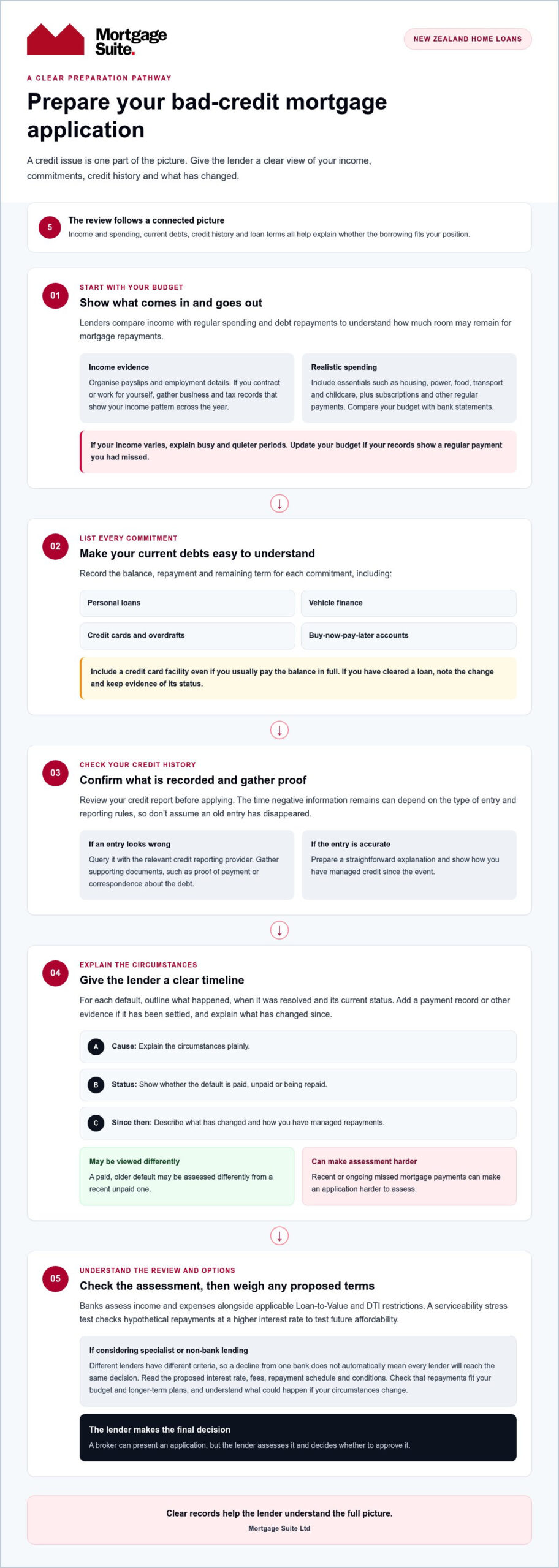
A lender compares your income with regular spending and debt repayments to assess how much room remains for a mortgage. The aim is to understand your household budget, not just your salary. For example, two applicants with similar incomes may have different borrowing capacity if one supports dependants or has higher regular commitments.

Show where your income comes from and how reliably it arrives. Employed applicants can organise payslips and employment details. If you earn through contracting or self-employment, gather business and tax records that show your income pattern across the year. A seasonal earner, for example, can distinguish a busy period from quieter months, helping the lender understand typical income rather than an unusually strong week.

Build a realistic record of household spending before applying. Include regular essentials such as housing, power, food, transport and childcare, as well as subscriptions and other recurring payments. Compare your bank statements with your budget. If your records show a sports fee or childcare payment you left out, update the budget rather than relying on an estimate that understates your commitments.

List every current credit commitment, including personal loans, vehicle finance, credit cards, overdrafts and buy-now-pay-later accounts. Record each balance, repayment and remaining term. A credit card limit can matter even if you usually pay the balance in full, so include the facility, not just the amount currently owed. If you’ve recently cleared a loan, note the change and keep evidence of its status.

The Reserve Bank’s current Loan-to-Value and DTI restrictions apply to banks’ residential lending in New Zealand. These restrictions sit alongside a bank’s assessment of your income and expenses. A serviceability stress test assesses hypothetical repayments at a higher interest rate to test future affordability. It considers how the proposed repayments fit your budget under that assessment.

Before applying, prepare a simple monthly budget and compare it with your account activity. Highlight variable income, one-off expenses and debts nearing repayment. If you’re already struggling to meet mortgage payments, contact your lender as early as possible. A clear summary of what you can afford and where you’re under pressure gives the lender useful context for discussing your position.

Lender assessment of credit history and defaults

For a bad-credit application, prepare identification, income evidence, bank statements, debt details and records showing the status of any default. How long negative information remains on a New Zealand credit report depends on the type of entry and reporting rules.

Lender options for bad-credit borrowers

Mainstream banks and non-bank lenders assess home loan applications against their own criteria. A decline from one bank doesn’t automatically mean every lender will reach the same decision. A lender may look closely at the cause of a default, whether it has been paid, your recent repayment history and the strength of the rest of your application.

A paid, older default may be assessed differently from a recent unpaid default. Recent or ongoing missed mortgage payments can make an application harder to assess. Explain clearly what happened, when you resolved it and what has changed since. Where applicable, include a payment record or other evidence that the default is settled.

Non-bank or specialist lending may provide another route when a mainstream bank’s criteria don’t fit your circumstances. Read the proposed loan terms carefully, including the interest rate, fees, repayment schedule and any conditions. Consider whether repayments remain manageable and how the loan fits your longer-term plans. A mortgage broker can present an application, but the lender makes the final decision after assessing it.

How long negative credit information remains

There isn’t one timeframe for every type of negative entry on a New Zealand credit report. The entry type and reporting rules affect how long information remains visible, while lenders may weigh an older paid default differently from a recent unpaid one. Don’t assume an old entry has disappeared; review your report before applying.

If you believe an entry on your credit report is wrong, contact the relevant credit reporting provider to query it. Gather supporting documents, such as proof of payment or correspondence about the debt. If the information is accurate, prepare a straightforward explanation and show how you’ve managed credit since the event. This gives the lender context instead of leaving a negative entry unexplained.

Organise your application documents into clear groups: identity, income, regular spending, current debts and credit history. Include a short timeline for each default, covering the original issue, any repayment arrangement and its current status. If circumstances contributed to missed payments, explain them plainly and show what has changed. Consistent records help the lender compare your explanation with the information in your application.

With specialist lending, consider the whole arrangement, not only whether an application can proceed. Check how repayments are structured, whether the terms suit your income pattern and what could happen if your circumstances change. Make sure you understand all fees and conditions before committing. Comparing proposed repayments with your household budget can help you judge whether the loan is sustainable.

Property value and home equity

There isn’t one deposit amount that suits every bad-credit home loan application. The deposit depends on the property value, the amount borrowed and the lender’s assessment of your application. A larger contribution can reduce the amount you need to borrow, but lenders also consider whether repayments fit your finances and how your credit history affects the application.

The property matters because it secures the mortgage. The lender considers its value alongside the loan amount, rather than relying only on the price you hope to pay. If the lender’s valuation is below the purchase price, you may need to reconsider your contribution or the property you’re considering.

Home equity is the property’s value minus the debt secured against it. For example, a New Zealand property worth NZ$800,000 with a NZ$500,000 mortgage has approximately NZ$300,000 in equity before other costs or secured debts. This is an estimate, not necessarily money you can freely use for another purpose.

Other lending secured against the property can reduce the equity available. If you’re relying on an existing home, list each secured debt and use current balances, not the original loan amounts. For example, a separate loan secured against the same property must be considered alongside the mortgage when assessing the overall position.

A lender’s valuation can differ from your estimate. The property’s condition, features and sale evidence may affect its assessed value. If the valuation is lower than expected, you may need to adjust the loan request. That can affect the deposit you need to contribute, so leave room to revisit your figures before committing to a purchase.

The Reserve Bank’s current Loan-to-Value restrictions apply to banks’ residential lending in New Zealand. These restrictions limit how much a bank can lend compared with a property’s value. They form one part of the assessment, alongside the bank’s own criteria and your financial position. Non-bank lenders assess applications under their own criteria.

Before applying, write down the property’s estimated value, proposed mortgage, deposit or available equity, and any debts secured against the property. Keep the figures separate and identify which funds are available for the purchase. If your credit history includes a default, explain it accurately. Equity can support the security assessment, but it doesn’t replace the lender’s review of your finances.

Mortgage approval with bad credit in NZ: what lenders assess

Steps to improve a mortgage application

A clear application helps lenders understand your finances and credit history. Focus on accurate records, manageable debt and a straightforward explanation of past issues.

Strengthening a mortgage application

Strengthening an application means making your financial position easier to assess before you apply. Complete, consistent information helps a lender understand your current repayment habits alongside earlier credit problems.

  • Avoid unnecessary credit applications, which can add new enquiries to your credit history.
  • Pay existing bills and debt repayments on time, and keep records showing your payment history.
  • List every debt and credit facility accurately, including balances and repayment commitments.
  • Explain any default clearly, including whether it has been paid and what changed afterwards.

Check that your application, bank statements and supporting documents tell the same story. If you’ve cleared a debt, for example, include evidence of its current status rather than relying on memory. If your income or spending has changed, explain when and why. A short, factual explanation is more useful than leaving a lender to interpret a gap or mismatch.

Review your recent account activity before applying. Regular unarranged overdraft use or missed payments may prompt questions about how you manage repayments. Avoid taking on new debt while preparing your application, and keep your spending records up to date. These steps won’t erase past credit events, but they can show how you manage your finances now.

Checking and correcting a credit report

Reviewing your credit report means checking the information held about your borrowing and repayment history. Before applying, look for errors, unfamiliar accounts and debts recorded with the wrong status. If you believe an entry is incorrect, contact the relevant credit reporting provider to query it.

Compare each entry with your records, such as account statements, payment confirmations and correspondence about a debt. Note the creditor, account details and what you believe is wrong. Send the provider evidence supporting your query, and keep copies of your request and any response.

If the entry is accurate, prepare a brief explanation for the lender rather than disputing it. Include the circumstances, whether the debt has been paid and any steps taken to prevent a repeat. For example, explain how a repayment arrangement brought an overdue account up to date, if applicable. Keep your explanation consistent with the dates and documents in your application.

After reviewing your report, update your application documents to reflect any corrected information. Keep the provider’s response with your records so you can explain a change if the lender asks about it. Avoid applying for several new credit facilities while you prepare. A tidy, consistent file gives a clearer picture of your current position.

Which New Zealand banks and non-bank lenders offer home loans to borrowers with bad credit?

There isn’t one fixed list of New Zealand lenders that accepts every bad-credit application. Banks and non-bank lenders assess applications using their own criteria, so the decision depends on your full financial picture, not just the type of lender.

A mainstream bank may assess your income, debts, credit history, deposit and property security together. If one bank declines, that doesn’t automatically determine how another lender will view your circumstances. For example, an older paid default and a recent unpaid default may be assessed differently.

Non-bank lenders may be another option when a bank’s criteria don’t suit your application. They still assess whether repayments are manageable and whether the property supports the lending. Their criteria and loan terms can differ, so compare the whole arrangement rather than focusing only on whether an application can proceed.

Before approaching a lender, organise a clear summary of:

  • Your income sources and regular household spending.
  • Every current debt, repayment and credit facility.
  • Any default, including its status and what has changed since.
  • The property value, deposit or available equity.

This helps show how your current position addresses the concerns behind an earlier decline. If the issue was a default, include evidence of payment where relevant. If existing debt affected affordability, show the current balances and repayments. The lender can then assess your application against its criteria using up-to-date information.

Compare the proposed interest rate, fees, repayment structure and loan conditions. A lower advertised rate doesn’t necessarily mean refinancing will reduce the overall cost. Refinancing expenses can include interest, loan fees, legal costs, valuation costs and break costs on an existing fixed-rate loan. Include these in your comparison before deciding whether a new loan suits your plans.

A non-bank or specialist loan may have different terms from a mainstream bank’s offer. Read the repayment schedule and conditions, and consider whether payments remain manageable if your income or expenses change. A repayment that fits today’s budget, for example, may feel different after a change in work hours or household costs.

To narrow your options, prepare one complete, accurate application rather than making unnecessary credit applications to several lenders. Explain the reason for the credit issue, what has improved and how the proposed repayments fit your budget. Different criteria may offer another route, but each lender makes its own assessment.

Mainstream banks and non-bank lenders may both consider home loan applications from borrowers with bad credit. Which lender may suit you depends on its criteria and your full financial picture.

Mortgage Suite: Home Loans to First Home Buyers

Mortgage Suite Ltd can help you explore Home Loans to First Home Buyers if your credit history has made the next step feel uncertain. A mainstream bank’s decision isn’t the whole picture: your income, debts, deposit and property plans all help shape an application.

Bring together your credit report, details of any defaults, income records and a clear summary of your current debts. Mortgage Suite Ltd can help you understand how these pieces fit together and discuss home loan options suited to your circumstances. The aim is to clarify your position and help you consider the lending structure, repayments and longer-term plans, rather than focusing on one headline rate.

If you’re ready to discuss your first-home application, contact Mortgage Suite Ltd to talk through your next steps.

Take your next step with a clear plan

A credit setback can make planning a home purchase feel daunting, but it doesn’t define every future lending conversation. Use your next step to understand what a lender may need to see and whether your plans fit your current financial position.

For mortgage approval with bad credit in NZ, focus on presenting your circumstances clearly and choosing a loan structure that remains workable over time. Mortgage Suite Ltd can discuss Home Loans to First Home Buyers, Residential Investment property loans and Business Loans, depending on the purpose of your borrowing.

A lender makes the final decision after assessing your application, so approval isn’t guaranteed. A thoughtful conversation can still help you identify what to prepare and which questions matter for your next move.

Contact Mortgage Suite Ltd to discuss your borrowing plans and take the next step with a clearer picture of your options.

Frequently Asked Questions

Can you get mortgage approval in New Zealand with bad credit?

Yes, it may be possible, because lenders assess applications using their own criteria and consider more than a credit entry. They may weigh the type and status of the issue alongside your current finances and the property securing the loan. A recent unpaid default differs from an older paid one. The lender makes the final decision after reviewing your application, so approval isn’t assured.

What credit score do NZ mortgage lenders require?

There isn’t one credit-score number that guarantees mortgage approval in New Zealand. Lenders use their own criteria, and a score is only one part of the information they may consider. They also assess the details behind negative entries, your current financial position and the property. If you’re unsure what appears on your file, review your credit report before applying and query any information you believe is incorrect.

How do missed payments, defaults, debt collection, and bankruptcy affect a NZ mortgage application?

Missed mortgage payments, defaults, collection activity and bankruptcy can all prompt closer scrutiny of your credit history. Recent or ongoing missed mortgage payments can make refinancing more difficult. A lender may assess an older paid default differently from a recent unpaid one. For debt collection or bankruptcy, be ready to explain the circumstances and provide accurate records of the current status. Don’t leave unresolved entries unexplained.

How can you improve your chances of mortgage approval with bad credit in New Zealand?

Prepare before applying: review your credit report, query any incorrect entry with the relevant reporting provider and avoid unnecessary credit applications. Make sure your explanation of past problems matches the dates and status in your documents. If your situation has changed, describe how, such as a debt being paid or income becoming more consistent. A complete, accurate application helps lenders assess your current position.

Article by

Krish Krishna

Experienced Financial Adviser with over 46 years of Banking and Mortgage broking experience and over $2.0 Billion in loan settlements.

Bad Credit Home Loans NZ: The 2026 Guide to Securing a Mortgage When Banks Say No

What if a “no” from your local bank manager wasn’t actually the final word on your home ownership dreams, but simply a signpost pointing you toward a more flexible path? It’s incredibly disheartening to feel the sting of a rejection letter, especially when you’re trying to secure bad credit home loans nz while worrying that a past financial hiccup has locked you out of the property market forever. You’re certainly not alone in this struggle. By early 2026, consumer credit demand had jumped by 9.4 per cent, even as tens of thousands of households navigated the challenges of payment arrears.

Finding a way forward requires a strategic shift. This guide shows you how to approach the robust 2nd tier lending market with confidence. We’ll help you understand how non-bank lenders evaluate your current ability to pay rather than just your past credit history, providing a clear path to home ownership through expert guidance. We will explore the latest interest rate trends, explain the 2026 regulatory shifts under the Financial Markets Authority, and show you how to find a dedicated advocate to handle the tough negotiations on your behalf.

Key Takeaways

  • Discover why a credit setback is simply a shift in strategy, allowing you to access specialised mortgage products designed for those who fall outside standard bank criteria.
  • Learn how to navigate the 2nd tier lending market to find competitive bad credit home loans nz that prioritise your current repayment ability over past mistakes.
  • Master the “financial fast” technique to organise your bank statements and present a winning application that non-bank lenders find hard to ignore.
  • Uncover the critical difference between various credit hurdles, including why the reason for a default matters just as much as the amount to a specialist lender.
  • Gain access to exclusive lending channels and the seasoned negotiation skills of Mortgage Suite Ltd to bridge the gap between rigid institutional banking and your personal property goals.

What Are Bad Credit Home Loans in NZ and How Do They Work?

Essentially, bad credit home loans nz are specialised mortgage products designed for Kiwis who find themselves outside the rigid criteria of mainstream banks. In 2026, the lending environment has shifted significantly. With the Official Cash Rate (OCR) holding steady at 2.25 per cent, some lenders are becoming more selective, while others see opportunity in the current buyer’s market. This means your ability to pay today often carries more weight than a mistake from several years ago. Lenders look closely at whether a credit event is active, such as an outstanding utility bill, or historic, like a default that was settled years ago. A bad credit home loan acts as a strategic bridge, providing immediate access to the property market while you work toward long-term financial stability.

The Three Pillars of NZ Credit Reporting

Your financial reputation is managed by three primary agencies: Centrix, Equifax, and Illion. It’s common to see slightly different scores across these platforms because each uses its own proprietary algorithm for understanding your credit score. Thanks to Comprehensive Credit Reporting (CCR), these agencies now track your positive habits, such as making your power and internet payments on time, alongside any negatives. This transparency helps 2nd tier lenders see a more complete picture of your reliability. Before you apply, it’s wise to request your own credit report for free from all three providers to ensure there are no errors lurking in your file.

Why Mainstream Banks Say No (And Why It’s Not the End)

Mainstream banks often rely on a “computer says no” approach. Their algorithms are designed for high-volume efficiency, which means they frequently overlook the human story behind a temporary financial setback. This rigid culture was intensified by the Credit Contracts and Consumer Finance Act (CCCFA), which forced banks into highly restrictive lending practices to avoid regulatory penalties. Even with the regulatory transfer to the Financial Markets Authority (FMA) in July 2026, the big banks remain risk-averse. A rejection letter from a big bank isn’t a dead end; it’s a clear signal that you need a specialist facilitator who understands how to package your application for the 2nd tier market. These lenders are often more interested in your future than your past.

Mainstream vs. 2nd Tier Lending: Understanding Your Options

Mainstream banks are essentially high-volume retailers. They thrive on the “perfect” borrower who fits a specific, pre-defined box. If your application has a smudge on the credit report or your income is slightly unconventional, the bank’s automated systems will likely trigger a rejection. Specialist lenders, however, operate on a philosophy of solution-based lending. They look beyond the automated score to understand the context of your situation. This fundamental shift in risk assessment is what makes bad credit home loans nz a viable reality for those who have been turned away elsewhere.

Honesty regarding the cost is essential. When you step outside the mainstream, you should expect a “risk premium” on your interest rate. For context, while ANZ’s special one-year fixed rates sat at 4.79 per cent in June 2026 for those with high equity, non-bank lenders like Pepper Money offered rates ranging from 6.84 per cent to over 11 per cent. This higher rate is the price of entry; it allows you to secure the property now rather than waiting years for a credit score to repair itself. Think of it as a temporary tool to optimise your financial reputation. If you are unsure where you fit, a quick chat about tailored home loans can clarify your position.

The goal is never to stay with a 2nd tier lender indefinitely. These loans are almost always designed with a clear “exit strategy” in mind. Typically, we look at a two to three-year horizon. During this time, you demonstrate impeccable repayment history, which allows you to eventually refinance back to a mainstream bank at lower rates once your credit file has cleared.

The Role of Non-Bank and 2nd Tier Lenders

Lenders such as Resimac, Pepper Money, and Avanti Finance fill the gap left by traditional retail banks. Unlike banks that rely on customer deposits, these entities often secure their funding through wholesale markets. This independence gives them the latitude to offer “Alt-Doc” or alternative documentation loans. These are particularly helpful for self-employed Kiwis who may not have two years of perfect financial statements but can prove their income through bank statements or GST returns. Consulting official guidance on mortgage advice can help you understand the protections available to you as a consumer in this specialised market.

Key Differences in Loan Terms

While a 20 per cent deposit is the standard benchmark for non-bank lending, some providers may consider a 10 per cent deposit depending on the overall strength of the application. You should also be prepared for different fee structures. Establishment or application fees in the non-bank sector commonly range between $2,000 and $5,000. To help with short-term cash flow, many 2nd tier lenders offer interest-only periods. This can be a useful bridge while you settle into your new home and focus on cleaning up historic credit issues.

Common Credit Hurdles and How Lenders View Them

When you’re exploring bad credit home loans nz, it’s vital to remember that a credit report is a snapshot, not a life sentence. While a mainstream bank might see a default as a permanent “no”, a specialist lender sees it as a point of discussion. The context surrounding your credit history often carries more weight than the raw numbers on the page. In the current market, specialist lenders in 2026 prioritise ‘conduct’ over ‘history’ when assessing your suitability for a loan. This means your recent financial behaviour is the most powerful tool in your arsenal.

A common mistake many Kiwis make is “shopping around” by submitting multiple online applications in a short period. Each time you apply for credit, a “hard enquiry” is recorded on your file. If a lender sees six enquiries in two months, it signals financial desperation or a series of rejections. This can inadvertently lower your score further. Similarly, if you’ve been through a Part 5 proposal or a bankruptcy, the date of your discharge is your new starting line. 2nd tier lenders are often willing to look at your application as soon as you’re discharged, provided you can demonstrate a stable income and a clear plan forward.

Dealing with Defaults and Missed Payments

Not all defaults are created equal. A $150 unpaid power bill from a previous flat is viewed very differently from a missed mortgage payment. The former is often seen as an administrative oversight; the latter is a red flag regarding your commitment to home ownership. Paying off any outstanding defaults before you apply is a must-do for most 2nd tier lenders. It shows you’re taking responsibility for your past. We often help clients craft a “Letter of Explanation” to accompany their application. This document shouldn’t be an excuse. Instead, it should be a factual, concise summary of what happened, why it happened, and the specific steps you’ve taken to ensure it won’t happen again.

Life Events: Separation, Illness, and Business Failure

Life doesn’t always go to plan. 2nd tier lenders understand that credit events are often triggered by genuine hardship, such as a relationship split, a health scare, or the closure of a business. Their assessment process is more holistic than a bank’s rigid algorithm. The key is showing a “clean” six-month history following the major event. If you can prove that your banking has been tidy and your bills have been paid on time for the last half-year, you’re in a much stronger position to negotiate. Being open and honest from the start is your best tactic. Hiding a credit issue only leads to a decline later in the process; disclosing it early allows us to build a case for your approval.

Bad Credit Home Loans NZ: The 2026 Guide to Securing a Mortgage When Banks Say No

Your Roadmap to Approval: How to Organise a Winning Application

Securing bad credit home loans nz is as much about your current preparation as it is about the lender you choose. While your past credit history is fixed, your future financial conduct is entirely within your control. Success in the 2nd tier market requires a methodical approach to how you present your life on paper. By following a structured roadmap, you move from being a “risky” applicant to a “managed” one. This process isn’t just about getting a “yes” today; it’s about positioning yourself for a return to mainstream banking in the near future.

The first step is what we call a three month “financial fast”. Lenders will scrutinise your most recent 90 days of bank statements with incredible detail. During this period, you must eliminate unarranged overdrafts, late fees, or any evidence of financial stress. Simultaneously, you should gather your “Alt-Doc” evidence. For self-employed Kiwis, this means organising GST returns and bank statements that prove your true earning capacity. Once your data is ready, we craft a narrative that explains your past setbacks while highlighting your current stability. We then select the specific 2nd tier channel that fits your profile and, most importantly, map out a clear refinance plan to return to a mainstream bank within 24 months.

Proving Your Income Without a Standard Payslip

If you don’t have a traditional salary, 2nd tier lenders offer the flexibility you need. They often rely on GST returns or a series of bank statements to verify affordability. In many cases, an accountant’s certificate can serve as a powerful endorsement of your business’s health. It is a common misconception that you need a massive income to qualify. In reality, lenders prioritise “stable” income over “high” income. They want to see that you can comfortably meet the 2026 stress test rates, which generally sit between 6.5 per cent and 7.0 per cent, regardless of your credit score. You can learn more about these requirements in our guide on how to qualify for a home loan in NZ.

The “Clean Slate” Period: What Lenders Want to See

The 90-day rule is the golden standard in specialist lending. Your last three months of banking behaviour serve as a “clean slate” that proves you’ve moved past previous hurdles. One of the most effective ways to boost your appeal is to eliminate “buy now, pay later” habits. Services like Afterpay or Laybuy are often viewed as a sign of discretionary spending that could be redirected toward mortgage repayments. By clearing these small debts and showing disciplined savings, you demonstrate the exact “conduct” that 2nd tier lenders are looking for. If you’re ready to start this journey, you can explore our home loan options to see which path fits your current situation.

Why Partnering with Mortgage Suite Ltd Makes the Difference

Choosing the right partner is the final, most critical step in your journey toward home ownership. When you are navigating the complexities of bad credit home loans nz, you need more than just a middleman; you need a dedicated advocate who understands the intricate machinery of the lending world. Mortgage Suite Ltd provides that bridge, offering a national service that helps Kiwis from Invercargill to Auckland secure their property future. We don’t simply “submit” your application to a computer and hope for the best. Instead, we use our deep industry connections to access 2nd tier lending channels that are often unavailable to the general public. This ensures your story is heard by actual people who value your current ability to pay over a rigid credit score.

Our role is to handle the heavy lifting of negotiation on your behalf. We know which lenders are currently active in the market and which ones have an appetite for specific types of credit hurdles. By acting as your professional representative, Mortgage Suite Ltd removes the stress of the application process and provides a steady hand in what can often feel like a fluctuating and uncertain market. This personalised attention is what separates a transactional interaction from a true partnership.

Krish Krishna’s Veteran Perspective

The core of our success lies in over 20 years of direct banking experience. This veteran perspective allows us to see your application through the eyes of a bank’s credit committee, anticipating their questions and addressing their concerns before they even arise. In a 2026 market where the Official Cash Rate is expected to hold steady at 2.25 per cent, having a seasoned mentor to guide you is invaluable. Mortgage Suite Ltd specialises in structuring loans that “don’t fit the box,” turning complex financial histories into clear, manageable lending solutions. This proactive approach is particularly vital as regulatory oversight of the CCCFA transitions to the Financial Markets Authority in July 2026. We understand these shifting requirements and use that knowledge to remove the obstacles that typically lead to a bank rejection.

Beyond the Approval: Your Long-Term Financial Partner

Our commitment to your success does not end once you receive your keys. Mortgage Suite Ltd views our relationship as a long-term partnership focused on your total financial health. As we discussed in the roadmap section, the 2nd tier loan is a strategic tool, not a permanent destination. We work with you to plan the transition back to mainstream interest rates as your credit score repairs and your equity grows. This methodical planning ensures you aren’t paying a “risk premium” for a day longer than necessary. Whether you eventually need support for residential investment or commercial property loans, we are here to ensure your borrowing remains efficient and cost-effective. If you’re ready for a fair go, Contact Mortgage Suite Ltd today for a confidential chat.

Take Control of Your Property Future Today

You’ve seen that a bank rejection is often just the start of a more tailored journey toward home ownership. By understanding the distinction between historic credit events and your current ability to pay, you can leverage bad credit home loans nz to enter the market now. This strategic move allows you to build equity and secure your home while you work through a “clean slate” period, eventually positioning you for a return to mainstream banking.

Finding the right path requires a partner who understands the “other side” of the lending desk. Founded by Krish Krishna with over 20 years of banking experience, Mortgage Suite Ltd acts as a steady hand for Kiwis across the country. We specialise in 2nd tier and non-bank lending solutions that mainstream banks simply cannot offer, providing national coverage for all New Zealanders regardless of their location.

Ready to see what’s possible? Get a Confidential Assessment of Your Loan Options and let us advocate for your story. Your path to owning a home is still open; it just needs the right guide to help you navigate the way with confidence.

Frequently Asked Questions

Can I get a bad credit home loan with a 10% deposit in NZ?

Yes, securing a mortgage with a 10 per cent deposit is achievable through certain 2nd tier lenders, although a 20 per cent deposit remains the standard benchmark. Success depends heavily on the stability of your current income and the nature of your past credit issues. Lenders will assess the property’s location and your overall repayment capacity to decide if a lower equity position is a manageable risk for their portfolio.

How much higher are the interest rates for 2nd tier lenders?

You should generally expect a “risk premium” of 1 per cent to 3 per cent above mainstream bank rates. In June 2026, while ANZ’s special rates were around 4.79 per cent, non-bank providers like Pepper Money offered rates between 6.84 per cent and 11.20 per cent depending on the severity of the credit history. This higher rate serves as a temporary bridge, allowing you to buy now rather than waiting years for a score to recover.

How long does a default stay on my NZ credit report?

A default stays on your credit file for five years from the date it was recorded. While the entry remains for the full term, paying the debt changes its status to “settled” or “paid,” which is a critical detail for specialist lenders. Demonstrating that you’ve cleared past debts is one of the most effective ways to improve your chances when applying for bad credit home loans nz.

Will a bank ever give me a mortgage again after a bad credit event?

Banks will certainly consider you again once you’ve proven your reliability through a “clean” period of two to three years. The strategy we employ involves using a 2nd tier loan as a stepping stone. By maintaining impeccable repayment conduct with a specialist lender, you build the necessary evidence to refinance back to a mainstream bank at much lower interest rates once your credit file has cleared.

Can I use my KiwiSaver as a deposit for a bad credit home loan?

Yes, you can use your KiwiSaver first-home withdrawal as part of your deposit for a non-bank loan. 2nd tier lenders treat these funds the same way mainstream banks do, provided you meet the standard Kainga Ora eligibility requirements. Combining your KiwiSaver with personal savings or a gifted deposit can help you reach the equity levels needed to offset a less-than-perfect credit score.

Do I need to be discharged from bankruptcy before I can apply for a mortgage?

Yes, you must be officially discharged before any lender in New Zealand will consider your application. Once your discharge is finalised, several specialist lenders are willing to review your case immediately. The focus will be on your financial behaviour since the bankruptcy ended, so it’s vital to show at least six months of tidy bank statements and a stable, verifiable income.

How long does the application process take for a non-bank loan?

The process is typically quite efficient, often taking between five and ten working days for a formal decision. Because 2nd tier lenders aren’t restricted by the same rigid bureaucracy as retail banks, they can move quickly once they have your full documentation. Having your bank statements and GST returns organised before you start will ensure the assessment moves through the credit team without unnecessary delays.

Is it better to fix my credit score before applying or apply now?

If the property market is moving, waiting years to repair a score might cost you more in lost capital gains than the extra interest paid on bad credit home loans nz. Applying now allows you to secure a home in the current buyer’s market. You can then use the loan itself as a tool to repair your credit score by demonstrating a consistent, perfect repayment history over the next 24 months.

Article by

Krish Krishna

Experienced Financial Adviser with over 46 years of Banking and Mortgage broking experience and over $2.0 Billion in loan settlements.