
How to Qualify for a Home Loan in NZ: The 2026 Comprehensive Checklist

What if a "no" from a mainstream bank wasn’t a closed door, but a sign that you simply needed a more tailored approach to your finances? Many Kiwis feel a sense of dread when looking at their bank balance, especially with the 2024 debt-to-income (DTI) restrictions still making things difficult for first home buyers and investors alike. You’re likely searching for exactly how to qualify for a home loan NZ lenders will approve in 2026. With the Official Cash Rate at 2.25 percent and standard one-year rates sitting near 4.89 percent, the financial landscape requires a steady hand and a clear strategy.

It’s completely natural to feel anxious about your credit score or confused by the difference between a 5 percent and 20 percent deposit requirement. We believe that every borrower deserves a transparent path to home ownership. This comprehensive checklist will help you master the financial requirements and documentation needed to secure your New Zealand home loan with confidence. We’ll examine everything from modern servicing requirements to the 2nd tier lending options that provide a vital lifeline when mainstream banks hesitate.

Key Takeaways

  • Learn how the 2026 lending benchmarks, including the 2.25 per cent OCR and DTI restrictions, define your current borrowing power.
  • Discover how to qualify for a home loan NZ lenders will approve by mastering the “uncommitted monthly income” test and optimising your debt-to-income ratio.
  • Understand why a rejection from a mainstream bank isn’t the end of the road and how 2nd tier lenders offer flexible paths for non-conforming borrowers.
  • Secure a seamless application process by using our master checklist to gather “Golden Documents” and proactively fix credit report errors.
  • Gain the confidence of having a seasoned advocate to negotiate complex bank policies and ensure your financial readiness is presented in the best possible light.

Table of Contents

The Fundamental Pillars of Home Loan Qualification in New Zealand

Home Loan Qualification is the process of proving both financial stability and collateral security to a lender. In the 2026 market, this proof is measured against three specific benchmarks: the Official Cash Rate (OCR), Loan-to-Value Ratios (LVR), and Debt-to-Income (DTI) caps. With the OCR currently at 2.25 percent, banks have maintained a cautious approach to lending, making it essential to understand how to qualify for a home loan NZ lenders will actually approve. Understanding New_Zealand’s property market dynamics helps explain why these hurdles exist; they act as a safeguard for both the borrower and the financial system against future economic volatility.

The deposit you bring to the table remains the primary factor in determining your interest rate and lender options. While a 20 percent deposit is the gold standard for avoiding low equity margins and securing the best carded rates, many first-time buyers aim for the 10 percent or 5 percent thresholds. If you’re looking at a 5 percent deposit through the Kāinga Ora First Home Loan, you’ll need to stay within the income caps of $95,000 for a single buyer or $150,000 for couples or those with dependents. If your income exceeds these limits but your deposit is small, you aren’t necessarily out of options, but you’ll likely need to explore 2nd tier lenders who offer more flexibility.

Residency and Legal Status Requirements

Before you start visiting open homes, you must confirm your legal eligibility to purchase property. New Zealand citizens and permanent residents face the fewest obstacles. To be considered "ordinarily resident", you typically need to have lived in New Zealand for the preceding 12 months and held a valid residence class visa during that entire period. Australians and Singaporeans enjoy specific rights due to trade agreements, but most other visa holders will find the path more complex. If you’re on a work visa, banks often require a minimum 20 percent deposit and proof of your long-term intent to remain in the country.

The Deposit: KiwiSaver, Grants, and Savings

Your KiwiSaver account is likely to be your most significant tool for building a deposit. In 2026, you can withdraw your total balance, excluding the initial $1,000 government contribution, as long as you’ve been a member for at least three years. Don’t forget that the First Home Grant was discontinued on 22 May 2024, so it’s no longer a source of funding for new applicants. If you’re receiving financial help from family, lenders will require a formal gifting certificate. This document confirms the funds are a non-repayable gift, ensuring the bank doesn’t view the contribution as an undisclosed debt that would negatively impact your DTI ratio.

Assessing Your Financial Fitness: Income, Expenses, and DTI

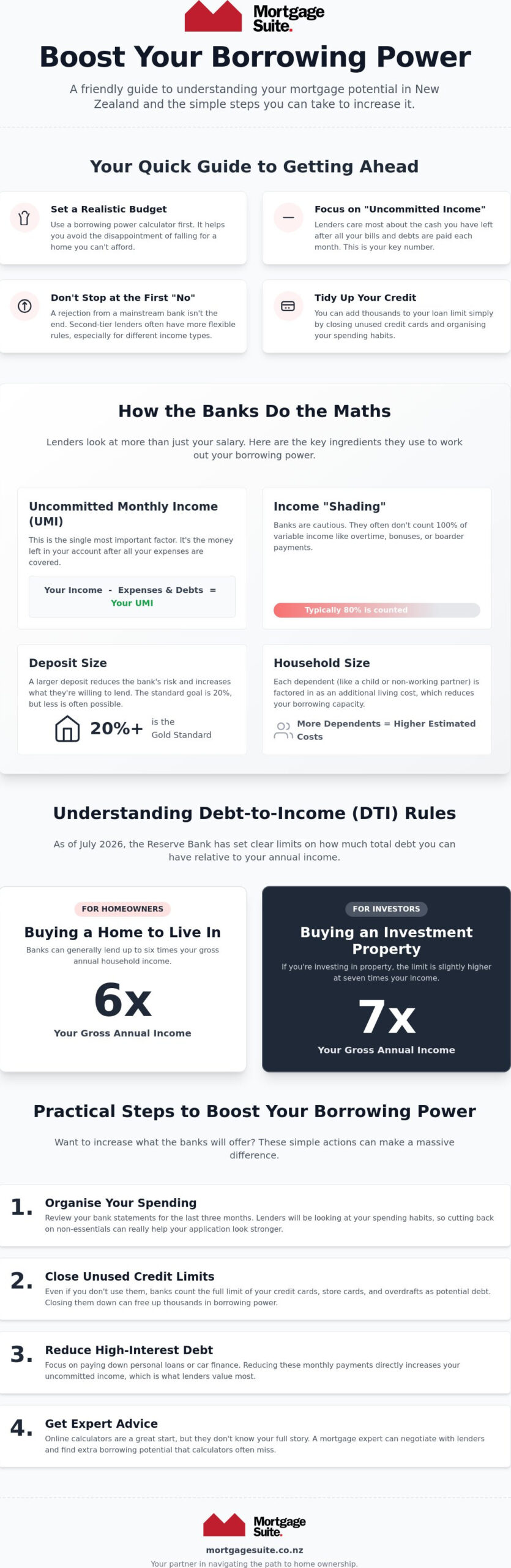
Securing a deposit is only half the battle. In 2026, understanding how to qualify for a home loan NZ lenders will sign off on requires a deep dive into your Debt-to-Income (DTI) ratio. Since the regulations introduced in mid-2024, banks are strictly limited in how much high-DTI lending they can provide. For most owner-occupiers, this means your total debt, including your new mortgage, should not exceed six times your gross annual income. If you’re looking at First Home Loan eligibility criteria, you’ll see that income caps and DTI limits work together to define your maximum borrowing ceiling.

Beyond the raw numbers of your salary, credit officers now scrutinise your "uncommitted monthly income". This is what remains after all your essential costs, existing debts, and a buffer for life’s surprises are deducted. It’s why your daily latte habit or frequent Uber Eats orders actually matter; they represent discretionary spending that could, in the bank’s eyes, be redirected toward mortgage repayments. Lenders stress-test your ability to pay at interest rates 2-3% higher than current market rates. This ensures that even if the OCR climbs further, your household budget won’t collapse under the weight of rising repayments.

Income Verification for Different Employment Types

The way you earn your living dictates the paperwork you’ll need to provide. PAYE employees usually have the simplest path, requiring three months of consecutive payslips and a summary of earnings from the IRD. If you’re self-employed, the requirements are more stringent. You’ll need at least two years of certified accounts and IRD tax summaries to prove your business is stable and profitable. Contractors and those in the gig economy often face more scrutiny due to irregular income. Lenders will look for a consistent history of contracts and a healthy "buffer" in your savings to offset periods between jobs. If your income structure is complex, speaking with a specialist can help you present your earnings in the most favourable light.

The Expense Audit: Cleaning Up Your Transaction History

Banks will typically request three to six months of transaction history to look for "red flag" behaviours. Frequent gambling transactions, heavy reliance on Buy Now Pay Later (BNPL) services, or a long list of unused subscriptions can signal poor financial discipline. We recommend "grooming" your accounts at least 90 days before you apply. This means clearing small debts and ensuring your bank statements reflect a disciplined, organised lifestyle. Existing liabilities like car loans or high credit card limits also reduce your borrowing power. Even if you don’t use your full credit limit, the bank calculates your DTI based on the total limit available to you, not just the balance you owe.

Mainstream Banks vs. 2nd Tier Lenders: Finding Your Best Path

Receiving a rejection letter from a major bank can be disheartening, but it certainly isn’t the end of your home ownership journey. The New Zealand financial market is more diverse than many realise. While mainstream banks have rigid, automated systems, 2nd tier lenders often take a more holistic, manual approach to assessing risk. If you are struggling with how to qualify for a home loan NZ banks have declined, these alternative lenders provide a vital pathway. They are often willing to look at the story behind the numbers, providing solutions for those who don’t fit the traditional "cookie-cutter" borrower profile.

The trade-off for this increased flexibility is typically a slightly higher interest rate and potentially different fee structures. However, this cost should be viewed as a strategic investment. At Mortgage Suite Ltd, we specialise in acting as the bridge between you and these alternative capital sources. We understand which lenders have an appetite for specific scenarios, ensuring you don’t waste time on applications destined for another decline. Our role is to negotiate the best possible terms, ensuring your path to property is as smooth and cost-effective as possible.

When to Consider a Non-Bank Lender

Non-bank lenders are an excellent option if your credit history has a few old marks, such as a past default that has since been resolved. They are also far more pragmatic when it comes to non-standard property types, including tiny homes, small inner-city apartments, or leasehold titles that mainstream banks often avoid. Additionally, self-employed individuals who have been trading for less than two years often find a much warmer reception here. These lenders focus on your current ability to service the debt rather than just your historical tax returns.

The Path Back to Mainstream Banking

We often recommend using 2nd tier lending as a short-term stepping stone, typically for a period of one to three years. During this time, your main goal is to build equity and maintain a flawless repayment history. This period allows you to "season" your financial profile and move past any previous credit issues. Once you have reached a stronger equity position or have established a consistent track record, we can then help you refinance back to a mainstream lender. This transition allows you to benefit from lower interest rates while having already secured the property you want.

How to Qualify for a Home Loan in NZ: The 2026 Comprehensive Checklist

Your Step-by-Step Home Loan Qualification Checklist

Securing a pre-approval is your most powerful tool when entering the 2026 property market. It transforms you from a casual browser into a serious buyer, giving you the confidence to bid at auction or make unconditional offers. Understanding how to qualify for a home loan NZ lenders will prioritise involves more than just a healthy savings account; it requires a disciplined approach to paperwork. Before you approach any lender, we strongly advise checking your credit report. You can access your report for free from major providers like Centrix or Equifax. Reviewing this early allows you to fix any administrative errors or old disputes before a credit officer sees them.

Organise your documents in a digital folder for instant access during negotiations.

This proactive step ensures that when a property catches your eye, you aren’t scrambling for old payslips while another buyer swoops in. Having your files ready also demonstrates to the bank that you are a reliable, low-risk borrower who manages their affairs with professional precision. It reflects a level of financial readiness that can often sway a lender’s decision in your favour.

The Documentation Master List

  • Identification: A current passport or New Zealand driver’s licence, along with a recent utility bill or bank statement as proof of address.

  • Financials: Three to six months of consecutive bank statements for every account you hold, including credit cards and savings.

  • Proof of Deposit: Latest KiwiSaver statements, a formal gift letter if family is assisting, or receipts for term deposits.

  • Employment Proof: Your three most recent payslips or a signed employment contract if you have recently started a new role.

The Final "Ready to Buy" Sanity Check

Before you sign a Sale and Purchase Agreement, perform a final audit of your timeline. If you are using KiwiSaver for your deposit, initiate the withdrawal process early, as it typically takes 10 to 15 working days for funds to clear. While the First Home Grant was discontinued on 22 May 2024, you should verify that any other scheme approvals, such as the First Home Loan, remain current and valid for your intended purchase. Finally, ensure you have maintained a strict "spending freeze" for at least 90 days. This means no new debt, no large luxury purchases, and no changes to your credit limits. If you’re ready to take the next step, you can apply for a home loan with our team to get your pre-approval underway.

The 2026 lending environment is a complex machine with many moving parts. Between the 2.25 percent OCR and the rigid DTI caps, simply walking into your local branch often leads to a dead end. Going direct to a single bank limits your options to their specific, often inflexible, criteria. We believe that understanding how to qualify for a home loan NZ lenders will back requires a more sophisticated approach. At Mortgage Suite Ltd, we leverage over 20 years of deep institutional banking experience to act as your dedicated advocate. We don’t just process applications; we negotiate on your behalf to find a solution that fits your unique financial reality.

Our consultative method ensures that your home loan is a foundation for long-term wealth, not just a monthly expense. We look beyond the immediate approval to see how your debt structure will perform over the next decade. Whether you are seeking a standard residential loan or require the flexibility of 2nd tier capital, our team is committed to the removal of obstacles. This seasoned perspective is particularly valuable for those who have been told "no" elsewhere. We know exactly how to present your case to the right people to get to "yes".

Why Expertise Matters in a Volatile Market

A home loan is more than just an interest rate. The fine print often contains the most significant risks and opportunities. We help you understand the long-term impact of interest-only periods, the benefits of offset accounts, and the potential sting of break fees if you need to refinance. If your situation is non-conforming, our access to 2nd tier loans ensures you aren’t left behind by the mainstream banking system. For those just starting out, our Home Loans for First Home Buyers in New Zealand: The 2026 Comprehensive Guide provides an even deeper look at the specific grants and schemes available this year.

Your Partnership for Success

Our relationship with you doesn’t end when you get the keys. We view ourselves as your long-term partners in success. As your equity grows, we can help you plan the transition from first-home buyer to property investor. We provide ongoing support, reviewing your rates and structure as the OCR shifts or your life circumstances change. This proactive management ensures you are always in the best possible position to build equity. Booking a no-obligation strategy session is the first step toward financial readiness. Contact Mortgage Suite Ltd to start your qualification journey today and take control of your property future with a steady hand by your side.

Take the Next Step Toward Your New Zealand Home

Mastering the details of your debt-to-income ratio and maintaining a disciplined expense audit are the true keys to success in today’s market. While the 2026 lending environment remains complex, you don’t have to face it alone. We’ve explored the necessity of digital document readiness and the strategic advantage of looking toward 2nd tier lenders when mainstream banks say no. Understanding how to qualify for a home loan NZ lenders will approve is about more than just numbers; it’s about presenting a story of financial reliability.

With over 20 years of banking and lending expertise, our team acts as dedicated negotiators for both first-home buyers and seasoned investors. We are specialists in 2nd tier and non-bank solutions, ensuring that every client has a viable path forward regardless of their initial bank feedback. Secure your financial future with a tailored home loan strategy from Mortgage Suite. Your property goals are within reach, and with the right advocate, you can navigate this market with absolute confidence.

Frequently Asked Questions

How much deposit do I really need for a home loan in NZ in 2026?

You generally need a 20 per cent deposit to access the best interest rates and avoid low equity margins in the current market. However, eligible first-home buyers can still secure a loan with as little as a 5 per cent deposit through the Kāinga Ora First Home Loan scheme. For those who don’t meet those specific income caps, a 10 per cent deposit is often the minimum required by mainstream banks, though lending at this level remains restricted.

Can I qualify for a home loan if I am self-employed with only one year of accounts?

Most mainstream banks require at least two years of certified accounts to prove income stability and business longevity. If you have only been trading for one year, banks can still consider your application if you can provide with a 12 months Profit & Loss projection and Cash Flow forecast. If your forecasts are consistent with your historical trading and or larger projections can be mitigated, then you are in the game. Failing, this then there are 2nd Tier Lenders that can assist you. These lenders take a more manual approach to your application, focusing on your current business performance and future potential rather than just a long historical track record.

What is the maximum Debt-to-Income (DTI) ratio NZ banks allow?

For owner-occupiers, the standard maximum DTI ratio is six, meaning your total debt cannot exceed six times your gross annual income. For property investors, the limit is slightly higher at seven. Banks are required to limit high-DTI lending to 20 per cent of their new loans, so staying below these thresholds is a critical part of how to qualify for a home loan NZ lenders will readily approve.

How does my credit score affect my ability to qualify for a mortgage?

Your credit score acts as a financial reputation check that lenders use to gauge your reliability and risk profile. A high score suggests disciplined financial habits, which can help you secure lower interest rates and faster approvals. If your score is lower due to past defaults, it won’t necessarily stop your journey, but it may mean you need to work with alternative lenders who are more comfortable with credit-impaired applications.

Can I use my KiwiSaver for a deposit if I have owned a home before?

Yes, you may be able to withdraw your KiwiSaver funds as a "second-chance" buyer if your financial position is deemed similar to that of a first-home buyer. You will need to apply to Kāinga Ora for a determination of your status before your provider can release the funds. This is a vital lifeline for those looking to re-enter the property market after a significant life change or a financial setback.

What happens if my home loan application is declined by a mainstream bank?

A decline from a mainstream bank is often just the start of a more tailored conversation about your options. We first review the specific reasons for the decline, such as a high DTI ratio or recent discretionary spending habits. From there, we can look toward 2nd tier lenders who offer more flexible criteria. This allows you to secure your property now while working on a plan to refinance back to a bank later.

How long does the home loan pre-approval process take in NZ?

You should typically allow between two and five working days for a standard pre-approval, though complex applications can take longer. Having your "Golden Documents" organised in a digital folder beforehand is the best way to speed up this process. Once issued, a pre-approval is usually valid for 90 days, giving you the breathing room to attend auctions and negotiate with sellers with total confidence.

Do banks count student loans as debt when qualifying for a mortgage?

Banks definitely include student loans in their assessment because the mandatory repayments reduce your "uncommitted monthly income". While the loan itself is interest-free, the deductions from your salary lower your ability to service a mortgage. When we calculate how to qualify for a home loan NZ, we factor these repayments into your DTI ratio to ensure your borrowing level remains sustainable and within current regulatory limits.

Article by

Krish Krishna

Experienced Financial Adviser with over 46 years of Banking and Mortgage broking experience and over $2.0 Billion in loan settlements.

Bad Credit Home Loans NZ: The 2026 Guide to Securing a Mortgage When Banks Say No

What if a “no” from your local bank manager wasn’t actually the final word on your home ownership dreams, but simply a signpost pointing you toward a more flexible path? It’s incredibly disheartening to feel the sting of a rejection letter, especially when you’re trying to secure bad credit home loans nz while worrying that a past financial hiccup has locked you out of the property market forever. You’re certainly not alone in this struggle. By early 2026, consumer credit demand had jumped by 9.4 per cent, even as tens of thousands of households navigated the challenges of payment arrears.

Finding a way forward requires a strategic shift. This guide shows you how to approach the robust 2nd tier lending market with confidence. We’ll help you understand how non-bank lenders evaluate your current ability to pay rather than just your past credit history, providing a clear path to home ownership through expert guidance. We will explore the latest interest rate trends, explain the 2026 regulatory shifts under the Financial Markets Authority, and show you how to find a dedicated advocate to handle the tough negotiations on your behalf.

Key Takeaways

  • Discover why a credit setback is simply a shift in strategy, allowing you to access specialised mortgage products designed for those who fall outside standard bank criteria.
  • Learn how to navigate the 2nd tier lending market to find competitive bad credit home loans nz that prioritise your current repayment ability over past mistakes.
  • Master the “financial fast” technique to organise your bank statements and present a winning application that non-bank lenders find hard to ignore.
  • Uncover the critical difference between various credit hurdles, including why the reason for a default matters just as much as the amount to a specialist lender.
  • Gain access to exclusive lending channels and the seasoned negotiation skills of Mortgage Suite Ltd to bridge the gap between rigid institutional banking and your personal property goals.

What Are Bad Credit Home Loans in NZ and How Do They Work?

Essentially, bad credit home loans nz are specialised mortgage products designed for Kiwis who find themselves outside the rigid criteria of mainstream banks. In 2026, the lending environment has shifted significantly. With the Official Cash Rate (OCR) holding steady at 2.25 per cent, some lenders are becoming more selective, while others see opportunity in the current buyer’s market. This means your ability to pay today often carries more weight than a mistake from several years ago. Lenders look closely at whether a credit event is active, such as an outstanding utility bill, or historic, like a default that was settled years ago. A bad credit home loan acts as a strategic bridge, providing immediate access to the property market while you work toward long-term financial stability.

The Three Pillars of NZ Credit Reporting

Your financial reputation is managed by three primary agencies: Centrix, Equifax, and Illion. It’s common to see slightly different scores across these platforms because each uses its own proprietary algorithm for understanding your credit score. Thanks to Comprehensive Credit Reporting (CCR), these agencies now track your positive habits, such as making your power and internet payments on time, alongside any negatives. This transparency helps 2nd tier lenders see a more complete picture of your reliability. Before you apply, it’s wise to request your own credit report for free from all three providers to ensure there are no errors lurking in your file.

Why Mainstream Banks Say No (And Why It’s Not the End)

Mainstream banks often rely on a “computer says no” approach. Their algorithms are designed for high-volume efficiency, which means they frequently overlook the human story behind a temporary financial setback. This rigid culture was intensified by the Credit Contracts and Consumer Finance Act (CCCFA), which forced banks into highly restrictive lending practices to avoid regulatory penalties. Even with the regulatory transfer to the Financial Markets Authority (FMA) in July 2026, the big banks remain risk-averse. A rejection letter from a big bank isn’t a dead end; it’s a clear signal that you need a specialist facilitator who understands how to package your application for the 2nd tier market. These lenders are often more interested in your future than your past.

Mainstream vs. 2nd Tier Lending: Understanding Your Options

Mainstream banks are essentially high-volume retailers. They thrive on the “perfect” borrower who fits a specific, pre-defined box. If your application has a smudge on the credit report or your income is slightly unconventional, the bank’s automated systems will likely trigger a rejection. Specialist lenders, however, operate on a philosophy of solution-based lending. They look beyond the automated score to understand the context of your situation. This fundamental shift in risk assessment is what makes bad credit home loans nz a viable reality for those who have been turned away elsewhere.

Honesty regarding the cost is essential. When you step outside the mainstream, you should expect a “risk premium” on your interest rate. For context, while ANZ’s special one-year fixed rates sat at 4.79 per cent in June 2026 for those with high equity, non-bank lenders like Pepper Money offered rates ranging from 6.84 per cent to over 11 per cent. This higher rate is the price of entry; it allows you to secure the property now rather than waiting years for a credit score to repair itself. Think of it as a temporary tool to optimise your financial reputation. If you are unsure where you fit, a quick chat about tailored home loans can clarify your position.

The goal is never to stay with a 2nd tier lender indefinitely. These loans are almost always designed with a clear “exit strategy” in mind. Typically, we look at a two to three-year horizon. During this time, you demonstrate impeccable repayment history, which allows you to eventually refinance back to a mainstream bank at lower rates once your credit file has cleared.

The Role of Non-Bank and 2nd Tier Lenders

Lenders such as Resimac, Pepper Money, and Avanti Finance fill the gap left by traditional retail banks. Unlike banks that rely on customer deposits, these entities often secure their funding through wholesale markets. This independence gives them the latitude to offer “Alt-Doc” or alternative documentation loans. These are particularly helpful for self-employed Kiwis who may not have two years of perfect financial statements but can prove their income through bank statements or GST returns. Consulting official guidance on mortgage advice can help you understand the protections available to you as a consumer in this specialised market.

Key Differences in Loan Terms

While a 20 per cent deposit is the standard benchmark for non-bank lending, some providers may consider a 10 per cent deposit depending on the overall strength of the application. You should also be prepared for different fee structures. Establishment or application fees in the non-bank sector commonly range between $2,000 and $5,000. To help with short-term cash flow, many 2nd tier lenders offer interest-only periods. This can be a useful bridge while you settle into your new home and focus on cleaning up historic credit issues.

Common Credit Hurdles and How Lenders View Them

When you’re exploring bad credit home loans nz, it’s vital to remember that a credit report is a snapshot, not a life sentence. While a mainstream bank might see a default as a permanent “no”, a specialist lender sees it as a point of discussion. The context surrounding your credit history often carries more weight than the raw numbers on the page. In the current market, specialist lenders in 2026 prioritise ‘conduct’ over ‘history’ when assessing your suitability for a loan. This means your recent financial behaviour is the most powerful tool in your arsenal.

A common mistake many Kiwis make is “shopping around” by submitting multiple online applications in a short period. Each time you apply for credit, a “hard enquiry” is recorded on your file. If a lender sees six enquiries in two months, it signals financial desperation or a series of rejections. This can inadvertently lower your score further. Similarly, if you’ve been through a Part 5 proposal or a bankruptcy, the date of your discharge is your new starting line. 2nd tier lenders are often willing to look at your application as soon as you’re discharged, provided you can demonstrate a stable income and a clear plan forward.

Dealing with Defaults and Missed Payments

Not all defaults are created equal. A $150 unpaid power bill from a previous flat is viewed very differently from a missed mortgage payment. The former is often seen as an administrative oversight; the latter is a red flag regarding your commitment to home ownership. Paying off any outstanding defaults before you apply is a must-do for most 2nd tier lenders. It shows you’re taking responsibility for your past. We often help clients craft a “Letter of Explanation” to accompany their application. This document shouldn’t be an excuse. Instead, it should be a factual, concise summary of what happened, why it happened, and the specific steps you’ve taken to ensure it won’t happen again.

Life Events: Separation, Illness, and Business Failure

Life doesn’t always go to plan. 2nd tier lenders understand that credit events are often triggered by genuine hardship, such as a relationship split, a health scare, or the closure of a business. Their assessment process is more holistic than a bank’s rigid algorithm. The key is showing a “clean” six-month history following the major event. If you can prove that your banking has been tidy and your bills have been paid on time for the last half-year, you’re in a much stronger position to negotiate. Being open and honest from the start is your best tactic. Hiding a credit issue only leads to a decline later in the process; disclosing it early allows us to build a case for your approval.

Bad Credit Home Loans NZ: The 2026 Guide to Securing a Mortgage When Banks Say No

Your Roadmap to Approval: How to Organise a Winning Application

Securing bad credit home loans nz is as much about your current preparation as it is about the lender you choose. While your past credit history is fixed, your future financial conduct is entirely within your control. Success in the 2nd tier market requires a methodical approach to how you present your life on paper. By following a structured roadmap, you move from being a “risky” applicant to a “managed” one. This process isn’t just about getting a “yes” today; it’s about positioning yourself for a return to mainstream banking in the near future.

The first step is what we call a three month “financial fast”. Lenders will scrutinise your most recent 90 days of bank statements with incredible detail. During this period, you must eliminate unarranged overdrafts, late fees, or any evidence of financial stress. Simultaneously, you should gather your “Alt-Doc” evidence. For self-employed Kiwis, this means organising GST returns and bank statements that prove your true earning capacity. Once your data is ready, we craft a narrative that explains your past setbacks while highlighting your current stability. We then select the specific 2nd tier channel that fits your profile and, most importantly, map out a clear refinance plan to return to a mainstream bank within 24 months.

Proving Your Income Without a Standard Payslip

If you don’t have a traditional salary, 2nd tier lenders offer the flexibility you need. They often rely on GST returns or a series of bank statements to verify affordability. In many cases, an accountant’s certificate can serve as a powerful endorsement of your business’s health. It is a common misconception that you need a massive income to qualify. In reality, lenders prioritise “stable” income over “high” income. They want to see that you can comfortably meet the 2026 stress test rates, which generally sit between 6.5 per cent and 7.0 per cent, regardless of your credit score. You can learn more about these requirements in our guide on how to qualify for a home loan in NZ.

The “Clean Slate” Period: What Lenders Want to See

The 90-day rule is the golden standard in specialist lending. Your last three months of banking behaviour serve as a “clean slate” that proves you’ve moved past previous hurdles. One of the most effective ways to boost your appeal is to eliminate “buy now, pay later” habits. Services like Afterpay or Laybuy are often viewed as a sign of discretionary spending that could be redirected toward mortgage repayments. By clearing these small debts and showing disciplined savings, you demonstrate the exact “conduct” that 2nd tier lenders are looking for. If you’re ready to start this journey, you can explore our home loan options to see which path fits your current situation.

Why Partnering with Mortgage Suite Ltd Makes the Difference

Choosing the right partner is the final, most critical step in your journey toward home ownership. When you are navigating the complexities of bad credit home loans nz, you need more than just a middleman; you need a dedicated advocate who understands the intricate machinery of the lending world. Mortgage Suite Ltd provides that bridge, offering a national service that helps Kiwis from Invercargill to Auckland secure their property future. We don’t simply “submit” your application to a computer and hope for the best. Instead, we use our deep industry connections to access 2nd tier lending channels that are often unavailable to the general public. This ensures your story is heard by actual people who value your current ability to pay over a rigid credit score.

Our role is to handle the heavy lifting of negotiation on your behalf. We know which lenders are currently active in the market and which ones have an appetite for specific types of credit hurdles. By acting as your professional representative, Mortgage Suite Ltd removes the stress of the application process and provides a steady hand in what can often feel like a fluctuating and uncertain market. This personalised attention is what separates a transactional interaction from a true partnership.

Krish Krishna’s Veteran Perspective

The core of our success lies in over 20 years of direct banking experience. This veteran perspective allows us to see your application through the eyes of a bank’s credit committee, anticipating their questions and addressing their concerns before they even arise. In a 2026 market where the Official Cash Rate is expected to hold steady at 2.25 per cent, having a seasoned mentor to guide you is invaluable. Mortgage Suite Ltd specialises in structuring loans that “don’t fit the box,” turning complex financial histories into clear, manageable lending solutions. This proactive approach is particularly vital as regulatory oversight of the CCCFA transitions to the Financial Markets Authority in July 2026. We understand these shifting requirements and use that knowledge to remove the obstacles that typically lead to a bank rejection.

Beyond the Approval: Your Long-Term Financial Partner

Our commitment to your success does not end once you receive your keys. Mortgage Suite Ltd views our relationship as a long-term partnership focused on your total financial health. As we discussed in the roadmap section, the 2nd tier loan is a strategic tool, not a permanent destination. We work with you to plan the transition back to mainstream interest rates as your credit score repairs and your equity grows. This methodical planning ensures you aren’t paying a “risk premium” for a day longer than necessary. Whether you eventually need support for residential investment or commercial property loans, we are here to ensure your borrowing remains efficient and cost-effective. If you’re ready for a fair go, Contact Mortgage Suite Ltd today for a confidential chat.

Take Control of Your Property Future Today

You’ve seen that a bank rejection is often just the start of a more tailored journey toward home ownership. By understanding the distinction between historic credit events and your current ability to pay, you can leverage bad credit home loans nz to enter the market now. This strategic move allows you to build equity and secure your home while you work through a “clean slate” period, eventually positioning you for a return to mainstream banking.

Finding the right path requires a partner who understands the “other side” of the lending desk. Founded by Krish Krishna with over 20 years of banking experience, Mortgage Suite Ltd acts as a steady hand for Kiwis across the country. We specialise in 2nd tier and non-bank lending solutions that mainstream banks simply cannot offer, providing national coverage for all New Zealanders regardless of their location.

Ready to see what’s possible? Get a Confidential Assessment of Your Loan Options and let us advocate for your story. Your path to owning a home is still open; it just needs the right guide to help you navigate the way with confidence.

Frequently Asked Questions

Can I get a bad credit home loan with a 10% deposit in NZ?

Yes, securing a mortgage with a 10 per cent deposit is achievable through certain 2nd tier lenders, although a 20 per cent deposit remains the standard benchmark. Success depends heavily on the stability of your current income and the nature of your past credit issues. Lenders will assess the property’s location and your overall repayment capacity to decide if a lower equity position is a manageable risk for their portfolio.

How much higher are the interest rates for 2nd tier lenders?

You should generally expect a “risk premium” of 1 per cent to 3 per cent above mainstream bank rates. In June 2026, while ANZ’s special rates were around 4.79 per cent, non-bank providers like Pepper Money offered rates between 6.84 per cent and 11.20 per cent depending on the severity of the credit history. This higher rate serves as a temporary bridge, allowing you to buy now rather than waiting years for a score to recover.

How long does a default stay on my NZ credit report?

A default stays on your credit file for five years from the date it was recorded. While the entry remains for the full term, paying the debt changes its status to “settled” or “paid,” which is a critical detail for specialist lenders. Demonstrating that you’ve cleared past debts is one of the most effective ways to improve your chances when applying for bad credit home loans nz.

Will a bank ever give me a mortgage again after a bad credit event?

Banks will certainly consider you again once you’ve proven your reliability through a “clean” period of two to three years. The strategy we employ involves using a 2nd tier loan as a stepping stone. By maintaining impeccable repayment conduct with a specialist lender, you build the necessary evidence to refinance back to a mainstream bank at much lower interest rates once your credit file has cleared.

Can I use my KiwiSaver as a deposit for a bad credit home loan?

Yes, you can use your KiwiSaver first-home withdrawal as part of your deposit for a non-bank loan. 2nd tier lenders treat these funds the same way mainstream banks do, provided you meet the standard Kainga Ora eligibility requirements. Combining your KiwiSaver with personal savings or a gifted deposit can help you reach the equity levels needed to offset a less-than-perfect credit score.

Do I need to be discharged from bankruptcy before I can apply for a mortgage?

Yes, you must be officially discharged before any lender in New Zealand will consider your application. Once your discharge is finalised, several specialist lenders are willing to review your case immediately. The focus will be on your financial behaviour since the bankruptcy ended, so it’s vital to show at least six months of tidy bank statements and a stable, verifiable income.

How long does the application process take for a non-bank loan?

The process is typically quite efficient, often taking between five and ten working days for a formal decision. Because 2nd tier lenders aren’t restricted by the same rigid bureaucracy as retail banks, they can move quickly once they have your full documentation. Having your bank statements and GST returns organised before you start will ensure the assessment moves through the credit team without unnecessary delays.

Is it better to fix my credit score before applying or apply now?

If the property market is moving, waiting years to repair a score might cost you more in lost capital gains than the extra interest paid on bad credit home loans nz. Applying now allows you to secure a home in the current buyer’s market. You can then use the loan itself as a tool to repair your credit score by demonstrating a consistent, perfect repayment history over the next 24 months.

Article by

Krish Krishna

Experienced Financial Adviser with over 46 years of Banking and Mortgage broking experience and over $2.0 Billion in loan settlements.