

A bank’s “no” doesn’t have to end your property plans. If you’re wondering how to get a 2nd tier loan, start by finding out why your application didn’t fit a mainstream lender’s criteria and what a specialist lender may assess differently. A decline can feel personal, but it isn’t a final judgement on you or your plans.
It’s also fair to be cautious about higher interest rates. A 2nd tier loan may cost more, so it should have a clear purpose and a realistic plan for what comes next. This guide covers how to prepare your finances, choose a suitable lending pathway, present your application and work towards a future application to a main bank if your circumstances allow.
Mortgage Suite specialises in loans for borrowers who don’t fit mainstream bank criteria. Founder Krish Krishna brings more than two decades of banking experience and helps borrowers understand their options and present their case clearly. You’ll get practical guidance without treating a bank rejection as the end of the road.
Key Takeaways
- Learn how to get a 2nd tier loan by preparing a clear application that explains your finances and the context behind them.
- Match your borrowing challenge, such as a small deposit or credit history, with a lender whose approach may suit your circumstances.
- Review the loan terms and any fees before deciding whether the offer fits your plans.
- Set a realistic goal for applying to a main bank in the future, and understand what may need to change first.
- Use a 12-to-24-month review point to check your progress and adjust your next steps if needed.
What is a 2nd Tier Loan and Why Consider One?
A decline from a main bank can be frustrating, especially when your plans make sense to you. It may reflect how that bank assesses applications, not a final judgement on your ability to borrow. A 2nd tier loan is an alternative for people whose financial situation or property doesn’t fit a mainstream lender’s usual criteria.
These loans are offered by lenders outside the major banks, including specialist non-bank financial institutions. The Non-bank financial institution overview explains the broader category. In practice, a specialist lender may look more closely at the circumstances behind your application, rather than relying only on standard measures.
The Difference Between Main Banks and Alternative Lenders
Main banks often assess applications against set criteria. That can be difficult if your income is irregular, your deposit is smaller than expected or your credit history has a few bumps. Alternative lenders may consider the wider picture, including how you earn your income, the reason for a past issue and whether repayments look manageable now. Flexibility isn’t automatic, though. Each lender has its own rules and will still assess your ability to repay.
Some alternative lenders may be set up to assess individual cases in a different way. The timing depends on the lender and how complete your information is, so don’t assume a quick decision is guaranteed. Interest rates and loan terms can also differ from a main bank’s offer. Look beyond the approval and consider whether the repayments and conditions fit your plans.
Dispelling the Myths About Non-Bank Lending
Non-bank doesn’t mean unregulated or informal. Lenders providing consumer credit in New Zealand must meet responsible lending requirements under the Credit Contracts and Consumer Finance Act. From 1 July 2026, conduct oversight for the Act transferred to the Financial Markets Authority. A lender still needs to assess whether the loan is suitable and affordable for you.
A specialist loan isn’t automatically a last resort. Kiwis may consider one when self-employment makes income harder to show in a standard format, when they have a smaller deposit or when a past credit issue needs explaining. A different lender’s approach may offer a route to a property purchase if the application works for both borrower and lender.
Think of it as a possible step in a longer plan, not a shortcut around affordability. Before deciding how to get a 2nd tier loan, be clear about what makes your application unusual and what you can comfortably repay. Mortgage Suite specialises in lending for situations that fall outside mainstream bank criteria. Founder Krish Krishna brings more than two decades of banking experience and can help present your circumstances clearly and negotiate on your behalf.
How to Prepare Your 2nd Tier Loan Application
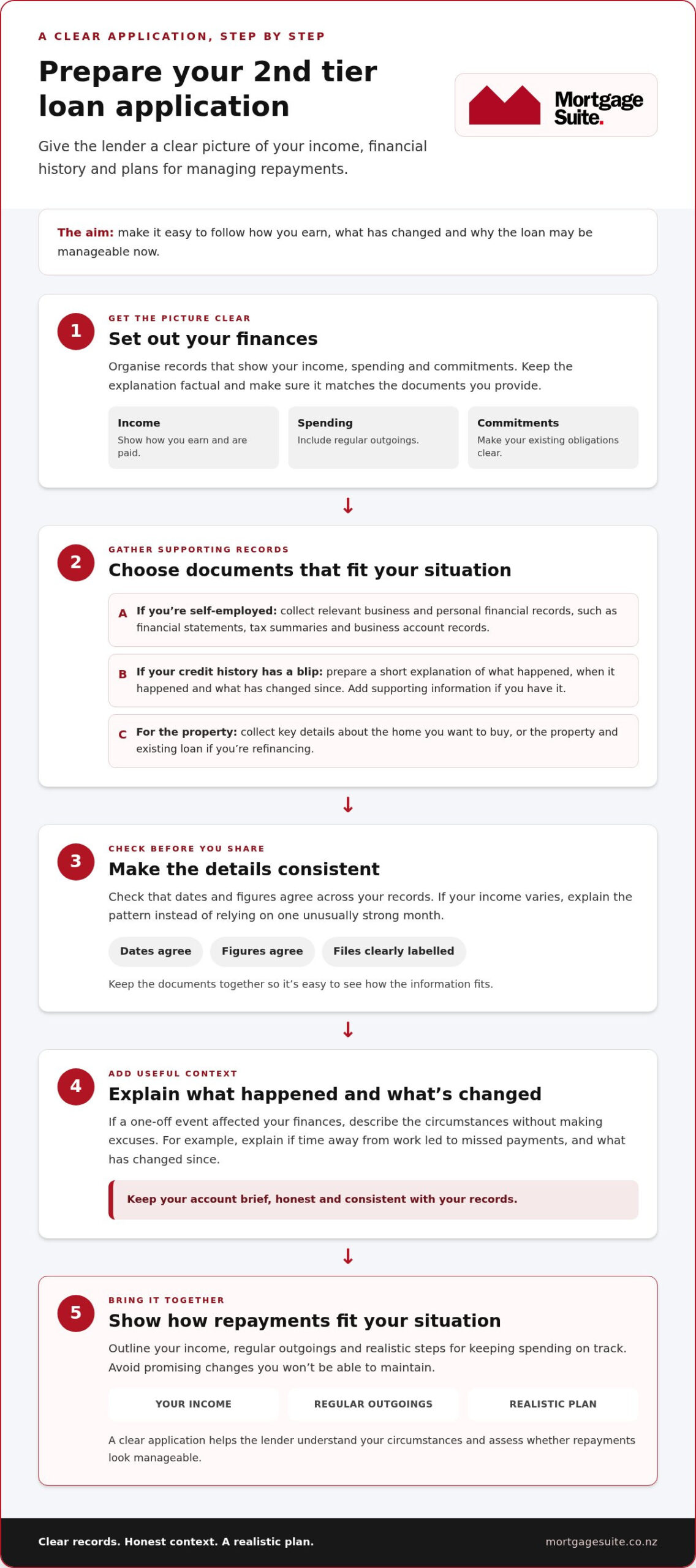
A clear application does more than gather figures. It helps the lender understand how you earn, what has changed and why the loan may be manageable now. Be upfront about your financial history. If there are gaps or late payments, explain them rather than leaving the lender to draw its own conclusions. Clear, consistent information makes it easier to assess your circumstances.
Your explanation can add context to your bank statements. The figures show what’s happened; your account helps make sense of them. Keep it factual and focused, and make sure your documents support what you say.
The Essential Paperwork You Will Need
Before applying, organise records that show your income, spending and commitments. The documents you need will depend on how you earn and what you plan to borrow for, but a tidy file helps the lender follow your application.
- If you’re self-employed: Gather relevant business and personal financial records, such as financial statements, tax summaries and business account records. These can show how your business earns and pays you when a standard payslip doesn’t tell the whole story.
- If your credit history has a blip: Prepare a short explanation of what happened, when it happened and what has changed since. Include supporting information if you have it.
- For the property: Collect key details about the home you want to buy, or the property and existing loan if you’re refinancing. This gives the lender context for the purpose of the borrowing.
Check that dates and figures agree across your records. If your income varies, explain the pattern instead of relying on one unusually strong month. Label files clearly and keep them together so it’s easy to see how the information fits.
Telling Your Story to the Lender
If a one-off event affected your finances, explain what happened without making excuses. For example, if time away from work led to missed payments, describe the circumstances and what has changed since. Keep your account brief, honest and consistent with your records.
Then show how you plan to manage your finances from here. A clear outline of your income, regular outgoings and realistic steps for keeping spending on track can help explain how repayments fit your situation. Avoid promising changes you won’t be able to maintain.
A broker can help turn a complex financial picture into a clear application and explain your circumstances to a lender. Mortgage Suite works with borrowers whose situations don’t fit mainstream bank criteria. The team focuses on understanding your goals and presenting your case with care.
The Reserve Bank of New Zealand’s oversight of non-bank deposit takers explains its role for institutions in that category. Not every specialist lender is necessarily a deposit taker, so the information doesn’t describe every lender’s status.
Choosing the Right Lender for Your Situation
There isn’t one second-tier lender that suits every borrower. Some are more familiar with assessing self-employed income, while others may consider applications involving a smaller deposit or a past credit issue. The aim is to match your main hurdle with a lender whose criteria fit your circumstances, not to send the same application everywhere.
Start by identifying what made a mainstream bank hesitate. Is your income difficult to show through payslips, is your deposit limited, or does your credit history need context? Each situation calls for a different conversation with a lender. A specialist broker can compare potential pathways, explain how lenders may view your application and negotiate on your behalf, without promising approval.
Lenders for the Self-Employed
Some lenders are more used to assessing income that doesn’t arrive as a regular salary. They may look at business records and other evidence to understand whether your earnings can support repayments. “Low-doc” generally refers to an application that uses a different or smaller set of traditional income documents, not a loan with no checks. You’ll still need to show how you earn and demonstrate that repayments are affordable.
For example, a contractor with changing monthly income may need to explain the pattern across their records rather than rely on a single payslip. The right lender depends on the details of your work, income and existing commitments.
Lenders for Credit Issues or Small Deposits
If your deposit is smaller than a bank wants, a specialist lender may assess the whole application differently. That doesn’t mean every lender will accept a lower deposit, or that the deposit is the only factor. Your income, commitments and the property matter too. If a past financial setback affected your credit history, some lenders may consider an explanation and evidence that your situation has since changed.
You may also hear the term “risk grade”. Lenders can use their own methods to assess the risk of an application. A higher perceived risk may affect the offer’s conditions or terms, so ask for a plain-English explanation of what the assessment means for your loan. There isn’t one scale shared by every lender.
Choosing between these options can be hard when each lender has different rules. Mortgage Suite helps match your situation to a suitable lending pathway and present your case clearly. You can learn about the people and experience behind that support on the Mortgage Suite About Us page.
Understanding the Costs: Rates, Fees, and Terms
A second-tier loan may help you move ahead with a property purchase when a main bank can’t offer a suitable option. But look beyond the approval and understand how the interest rate, repayments and loan conditions fit your plans. Specialist lenders may offer more flexibility for some applications, and their interest rates are often higher than those of main banks. The rate and terms will depend on the lender and your circumstances.
Don’t decide based on the rate alone. Think about how long you expect to keep the loan, what repayments you can manage and what you’ll do if your plans change. Buying sooner isn’t automatically the right choice, and property values can rise or fall. Your loan should remain manageable even if your circumstances don’t improve as quickly as you hope.
Interest Rates and Your Plans
Consider how repayments would fit your budget over time, not just at the start. A calculator can help you compare repayment scenarios at different interest rates. Use the Mortgage Suite mortgage calculator to see how a rate change may affect repayments. Then consider whether those repayments leave enough room for your other regular commitments.
There’s no standard period for staying with a second-tier lender. Some borrowers use this kind of loan as a temporary step while they work towards meeting a main bank’s criteria. You could review your position over a 12-to-24-month period, but treat that as a planning guide, not a promise that you’ll be ready to switch. Your financial position and a future lender’s assessment will determine what’s possible.
Terms to Check Before You Commit
Read the loan offer carefully and make sure you understand how it works. Check the repayment schedule, how the interest rate is set and whether the loan has conditions that could affect your plans. If you may want to change lenders or repay sooner, review the relevant terms before signing so you know what steps may apply.
- Understand the repayments: Check when payments are due and whether the amount could change during the loan term.
- Review the conditions: Make sure you understand any requirements attached to the loan and what you need to do to meet them.
- Think ahead: Consider how the loan would fit if your income, property plans or timing changed.
Choosing a loan is about more than securing approval. Take time to understand the offer and whether it supports your next step. Mortgage Suite can help you compare lending options and negotiate with the lender on your behalf. Use the calculator to test different repayment scenarios before deciding what feels manageable.
The Exit Strategy: Moving Back to a Main Bank
A 2nd tier loan is often best treated as a stepping stone, not a permanent arrangement. Before taking one out, think about what would need to change for a main bank to consider your application later. A 12-to-24-month goal can give you a useful review point, but it isn’t a promise that you’ll be ready to switch by then. Your income, repayment history, credit record, equity and the bank’s criteria will all matter.
Make a plan you can act on from the start. Keep track of what held up your original application and set practical steps to address it. If the hurdle was showing self-employed income, for example, keep your financial records organised over time. If it was limited equity, review your loan balance and property value during regular check-ins.
Cleaning Up Your Financial Profile
Build a steady record of making your loan repayments on time. A consistent repayment history can help show a future lender that you’re managing your commitments. Keep other debts under control too. Paying down a car loan or credit card balance may reduce your regular outgoings, which can help when a bank reviews whether you can afford the mortgage.
Your equity may change as you repay the loan or if the property’s value rises. More equity can help with a future application, but property values can also fall, and a lender will assess the property and your finances at the time. A main bank will also consider your income, credit history and ability to manage repayments.
Working with Your Broker on the Move
Raise the possibility of switching lenders early, rather than waiting until you think you’re ready. Your broker can help you review whether the original hurdle has improved, what evidence you may need and whether it makes sense to prepare a new application. If a past credit issue contributed to the decline, be ready to show how your circumstances have changed since.
Moving lenders means applying again, and approval isn’t automatic. A main bank will assess your current position at that time, rather than relying only on the fact that another lender approved you previously. Your broker can help prepare and present the updated application, and talk through the options if you’re not yet ready to move.
Keep your longer-term goal in view, whether that’s improving your financial position, building equity or refinancing. Mortgage Suite can support you as your circumstances change and help you consider the next step when the time is right. A well-planned move back to a main bank takes preparation, but you can work towards it one practical step at a time.
Take the Next Step with a Clear Plan
A bank decline can leave you unsure where to turn, but it doesn’t have to define what happens next. Use what you’ve learned about how to get a 2nd tier loan to start a thoughtful conversation about your options, what a lender would need to see and how borrowing could fit your longer-term plans.
Every borrower’s situation is different, so the right next step depends on your goals and financial circumstances. Mortgage Suite can help you explore a suitable lending pathway and put your case forward. You can also read our client reviews to hear about other Kiwis’ experiences.
Book a chat with Mortgage Suite to find your path forward. You don’t need to have every answer before you begin. A clear conversation can help you work out what to do next, one step at a time.
Frequently Asked Questions
Is it harder to get a 2nd tier loan than a bank loan?
Not necessarily, but the assessment may work differently. A specialist lender may be more open to considering an application that falls outside a main bank’s usual criteria, while still checking whether the loan is affordable and suitable. For example, a lender may look closely at how a recent change in work affects your income. Approval isn’t guaranteed, and each lender sets its own requirements.
How much deposit do I need for a 2nd tier lender in NZ?
There isn’t one deposit amount that applies to every 2nd tier loan. The amount a lender may require can depend on the property, your finances and how the lender assesses the overall application. A smaller deposit doesn’t automatically rule you out, but it may affect the options available. Before making an offer, check that your expected deposit and other funds fit the proposed lending terms.
Can I get a 2nd tier loan if I have bad credit?
Possibly. A credit issue doesn’t automatically mean every lender will decline your application, but the details matter. A lender may consider what caused the issue, whether it’s resolved and how you’ve managed your commitments since. For example, a paid account in dispute may be viewed differently from ongoing missed payments. Be open about your credit history and provide a clear explanation rather than leaving the lender to guess.
What are the interest rates like for non-bank lenders?
Non-bank loan rates are generally higher than main bank rates, but the difference depends on the lender and your application. The rate is only one part of the offer: repayment terms, fees and conditions can also affect whether it suits your plans. Compare written offers on the same basis, and check what happens to repayments if the rate changes. Avoid relying on claims about a typical rate without a specific offer to review.
How long does the 2nd tier loan process take?
There’s no guaranteed turnaround time. The process can depend on how quickly you provide the requested information, how complex your income is and whether the lender needs a property valuation or further checks. You can help avoid preventable delays by sending complete, consistent documents and responding promptly to questions. If you’re working towards a purchase date, allow time for assessment and legal steps rather than assuming approval will arrive immediately.
Do I need a mortgage broker to get a 2nd tier loan?
You don’t necessarily need a broker, but a specialist can help you understand which lenders may suit your circumstances and present your application clearly. If you’re weighing up how to get a 2nd tier loan after a bank decline, a broker can also help explain the lender’s questions and talk through the offer with you. Mortgage Suite supports borrowers whose applications don’t fit mainstream bank criteria, but no broker can promise approval.
Can I use a 2nd tier loan to buy an investment property?
A 2nd tier loan may be an option for a residential investment property if the lender’s criteria fit your circumstances and the property. The lender will assess your finances, existing commitments and the property as part of the application. Mortgage Suite helps borrowers explore residential investment property lending as well as other specialist loan options.
What happens if I want to pay off my 2nd tier loan early?
Check your loan agreement before making an early repayment, as the terms may set out notice requirements or charges. The details can differ between loans and may depend on whether you’re paying off the full balance or making an extra repayment. If you’re planning to refinance, ask for a current payout figure and factor in any applicable charges and legal steps before setting a completion date.