
Mortgage for a Tiny Home NZ: Costs, Rates and Land Rules

Owning land isn’t always essential to borrowing, but a movable tiny home can be harder to use as mortgage security. A mortgage for a tiny home in NZ may depend on whether you own land, have other assets to support the loan and can comfortably manage the repayments.

It’s understandable to feel unsure when a tiny home doesn’t fit the usual home-loan picture. The home’s design, where it will sit and what security you can offer all affect which finance options may suit.

This guide explains how land ownership and other assets may affect an application, how to set a repayment budget and where specialist finance may fit. You’ll get a clearer picture of what lenders assess and the practical details to prepare before deciding what to do next.

Key Takeaways

  • Land ownership isn’t the only factor in borrowing; the lender will also consider what security you can offer and how the tiny home is set up.
  • Build a repayment budget around your regular income and expenses, and test how it feels alongside your usual spending before committing.
  • Compare interest rates alongside repayment terms and loan structure, as specialist finance can work differently from a standard home loan.
  • Clarify who owns the land and how the tiny home will be placed there, as these details can affect the finance assessment.
  • If mainstream lending doesn’t suit your situation, specialist finance may be another avenue to explore.

Do I need to own land or other assets?

Owning the section beneath a tiny home can strengthen a borrowing application, but it isn’t the only possible security. A lender may also consider other property you own and how the home is attached to its site.

Using land or property as security

Security is property a lender can rely on if a borrower can’t repay a loan. For a tiny-home application, land or another property may provide stronger security than the home alone, particularly if the home can be moved.

Consider a house-and-land valuation of NZ$800,000. In this example, banks might lend 80% or even 90% of the combined valuation, depending on the application. That example concerns land and a house together, not a promise that a tiny home will be assessed the same way.

If you own a section, the lender can assess its value alongside the proposed home and your ability to make repayments. If you don’t own land, another property may be relevant security. The key question is what property supports the loan, not whether the tiny home looks like a conventional house.

Before applying, list what you own and how it relates to your tiny-home plans. For example, distinguish land you own from a site where you have permission to place the home. This helps show what security is available and clarifies the arrangement behind the application.

Assessing fixed and movable tiny homes

A tiny home fixed to land may be assessed together with the land, while a movable home may be considered separately. This matters because a home that can be moved may be harder for a lender to rely on as security.

A tiny home on wheels doesn’t automatically qualify for a standard home loan as a house secured by land. A lender may instead assess land or another property offered as security, alongside your ability to make repayments.

For a fixed home, explain how it is attached to the site and what land supports the application. For a movable home, describe where it will be kept and whether you own that land. These details help clarify what the lender could assess if you can’t repay.

Consider the whole arrangement, not just the build. A home on wheels placed on a section you own presents a different security picture from one parked on land you don’t own. If a bank mortgage isn’t suited to the movable home itself, other property may still be relevant to the lending discussion.

Land ownership can help, but it isn’t the only factor. A lender weighs the security available, whether the tiny home is fixed or movable, and whether the repayments fit your finances.

Budgeting for loan repayments

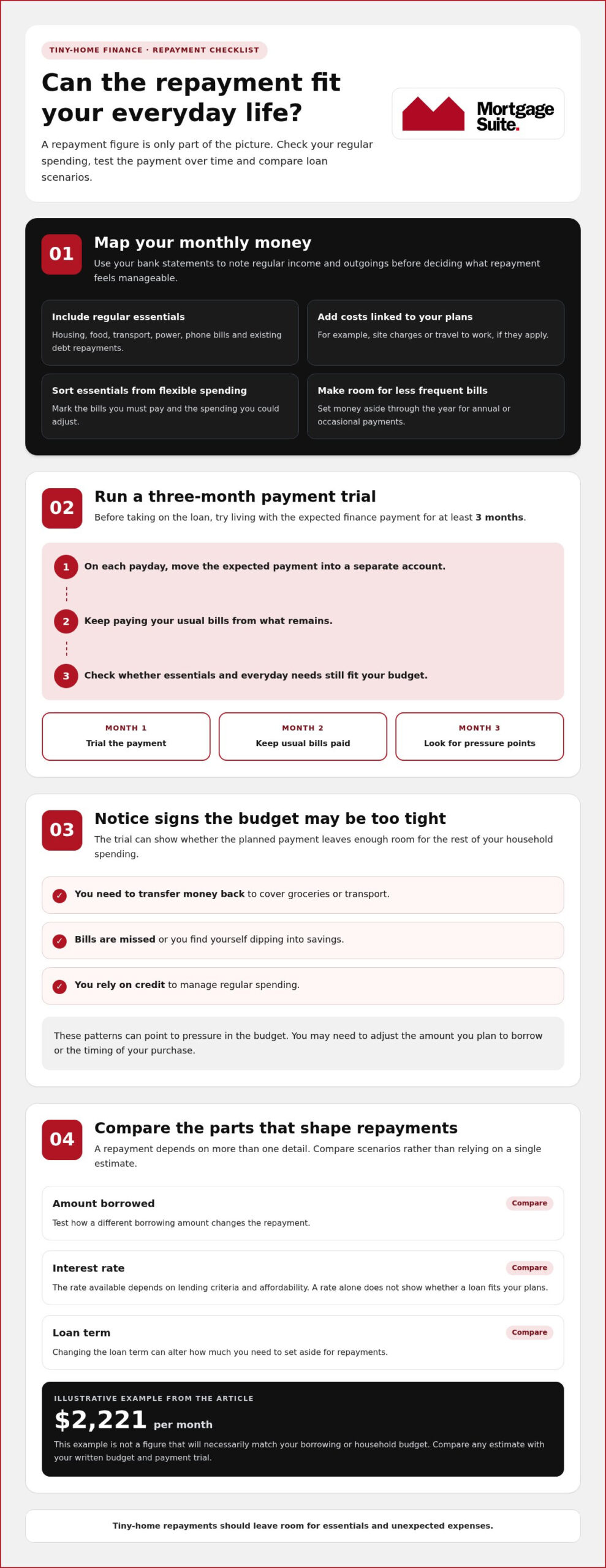
A repayment figure tells only part of the story. Your budget also needs to cover regular household spending, tiny-home upkeep and the income left after bills. Mapping out your monthly finances helps you judge whether a loan fits daily life, not just a lender’s assessment.

There’s no single repayment amount that suits every tiny-home loan. Repayments depend on the amount borrowed, the interest rate and the loan term. Changing any of these can alter what you need to set aside, so compare scenarios rather than relying on one estimate.

Start with your bank statements and record your regular income and outgoings. Include housing, food, transport, power, phone bills and existing debt repayments. Then add expenses linked to your plans, such as site charges or travel to work, if they apply.

  • Separate essentials from flexible spending: Identify bills you must pay and spending you could adjust.
  • Include irregular bills: Set money aside throughout the year for annual or occasional payments.
  • Allow for changes: Consider how your budget would cope if household income fell or another bill increased.
  • Compare scenarios: Test how a different borrowing amount or loan term changes the repayment.

Next, try living with the expected finance payment for at least 3 months before taking on the loan. Move that amount into a separate account on each payday, as though repayments have already started. Keep paying your usual bills from what remains. This practical test shows whether the planned payment leaves room for essentials and everyday needs.

If you need to transfer money back to cover groceries or transport, your repayment plan may be too tight. If you test a budget over time, look for missed bills, dipping into savings or relying on credit. These patterns can reveal pressure points. You may need to adjust the amount you plan to borrow or the timing of your purchase.

A repayment calculator can help you compare scenarios using different borrowing amounts, rates and terms. The mortgage calculator can help show how changing the amount borrowed affects repayments. Compare any result with your written budget and the three-month payment trial before deciding what feels manageable for your household.

An example tiny home finance repayment in New Zealand is $2,221 per month. Treat it as an illustration, not a figure that will necessarily match your borrowing or household budget. Your own estimate should reflect the amount you need, the available loan terms and your regular costs. Check that the repayment leaves enough room for essentials and unexpected expenses, and revisit your budget if your income or spending changes.

What are the interest rates?

Specialist tiny-home finance in New Zealand may have interest rates from 9.99% p.a. Lending criteria and affordability affect the rate available, so treat that figure as a starting point, not a universal offer. A rate alone doesn’t show whether a loan fits your plans. The repayment amount, loan term and conditions also shape the overall commitment.

Compare the loan structure as well as the headline rate. A fixed interest rate stays unchanged for an agreed period, making repayments more predictable during that time. Other structures work differently. Ask how the rate applies, when it can change and how the repayment schedule would affect your budget.

For a fair comparison, line up offers using the same borrowing amount and repayment period. Then check:

  • Interest rate: Note whether the quoted rate is fixed or can change.
  • Repayment schedule: Understand how often payments are due and how long they continue.
  • Loan conditions: Read the terms alongside the rate, including any requirements attached to the finance.
  • Affordability: Compare the proposed payment with your household budget, not just another lender’s rate.

A lower rate can look appealing, but it may not suit you if the loan structure doesn’t match your plans. For example, consider whether repayments remain manageable alongside your regular bills and tiny-home expenses. Comparing the rate, term and repayments together gives you a more useful basis for deciding.

Approval timing depends on the lender receiving the information needed to assess the application. Tiny-home finance approvals in New Zealand are often available within 24 hours after the lender has all the information. That timeframe begins once the application details are complete; preparing clear information about your income, existing commitments, the home and its intended location helps the assessment proceed.

Keep your application details consistent. If your purchase or build plans change, update the information provided, as the lender assesses the application presented. A prompt decision is useful, but speed shouldn’t replace a careful review of repayments and loan terms.

Before accepting an offer, write down the rate, how long it applies, the repayment schedule and the conditions. Compare these details with your budget and the home’s intended use. This helps you assess the whole borrowing arrangement rather than choosing on the interest rate alone.
Mortgage for a Tiny Home NZ: Costs, Rates and Land Rules

Land ownership requirements

Owning the land isn’t automatically a requirement for every tiny-home finance application. In New Zealand, the land arrangement still matters because it shows where the home will sit and what property may support the borrowing.

Separate three parts of your plan: owning a section, having an arrangement to place a home there, and offering land as loan security. These are distinct. You might own the tiny home but not the site, or own both the home and section. Each arrangement gives a lender different information to assess.

If you own the land, gather details showing who owns it and how the tiny home will be placed. If someone else owns the site, explain the arrangement and how long you expect to use it. A lender needs to understand whether the home’s location is stable and how the land relates to the borrowing. Details about site access, services and planned use can also help explain the setup.

Prepare these details before discussing finance:

  • Land ownership: Record whether the section is yours, jointly owned or owned by someone else.
  • Placement arrangement: Explain where the tiny home will sit and what agreement supports that plan.
  • Home setup: Describe whether it will be fixed in place or remain movable.
  • Security: Identify whether the land or another property is being offered to support the loan.

For example, you might own a section and plan to place a movable tiny home there. That doesn’t make the home and land the same asset. Explain each separately, including who owns them and how they’re connected. If the home will sit on a family member’s land, describe that arrangement clearly rather than presenting the site as your own property.

Land ownership can affect what a lender considers as security. A section you own may be assessed differently from land you can use but don’t own. The lender considers the available property, the tiny home’s placement and your ability to repay. Clear information helps distinguish the home’s location from property that can support the borrowing.

Before committing, compare the land arrangement with the loan structure you’re considering. If you’re buying land and a tiny home together, explain both parts of the purchase. If you already own a section, outline how the proposed home will fit the site. Clear details about ownership, placement and security help frame the application around your actual plans.

Specialist tiny home finance

Specialist finance can be another option when a tiny home doesn’t fit a standard mortgage. The loan type, security and repayment plan still need to suit your circumstances.

Lender eligibility criteria

Eligibility criteria are the lender’s requirements for deciding whether an application and its security fit a loan. Specialist lenders in New Zealand may consider tiny-home finance, but their criteria vary. There isn’t one lender list or rule that applies to every borrower.

Lenders assess factors such as income, existing commitments, repayment capacity, the home’s value and whether it can be moved. These factors shape possible loan terms, but they don’t determine an automatic approval amount or term.

A strong application explains the full arrangement: who owns the home, where it will sit, what security is available and how repayments fit your budget. If a mainstream bank declines, that doesn’t settle whether another lender’s criteria may suit your circumstances.

Mortgage eligibility for tiny homes

A mortgage may be possible, but the lender’s assessment depends on the tiny home, the land arrangement, available security and your ability to repay. A home on wheels may be treated differently from one fixed to land, so describe its setup clearly.

Planning and building requirements depend on the site and proposed home. Before committing, identify the relevant local council and ask how its planning rules, building consent process and site requirements apply to your proposal. Don’t assume a tiny home has the same requirements on every section.

There isn’t one total cost for every tiny-home project. Your overall budget depends on the home, land, site preparation and connections such as power or water. List each part separately, then compare the project budget with the borrowing you can manage.

Lenders may also consider whether the home can be valued as security and how readily it could be resold. A movable home’s location, condition and saleability can affect its usefulness as security. Include clear details about the home and site in your finance information.

Application steps and documents

An application brings together your financial position and tiny-home plans, helping a lender assess your repayment ability and available security. Prepare proof of income, a record of regular commitments, details of the home and a clear account of where it will be placed.

Include purchase or build information, the proposed site, land ownership details and any documents describing the placement arrangement. If you own other property, note whether it may support the borrowing. Keep the figures and project details consistent across your budget and application.

Before applying, organise these records and identify any missing project details. Then compare the lender’s proposed amount, term, repayments and conditions against your budget. For help exploring a finance path that fits your circumstances, discuss tiny-home finance options.

Mortgage Suite: Home Loans to First Home Buyers

Mortgage Suite can help you explore home-loan options, including Home Loans to First Home Buyers, when a tiny-home purchase forms part of your first-home plans. If a mainstream bank’s criteria don’t fit your circumstances, its 2nd Tier Loans may offer another lending pathway to discuss.

Bring together your income details, regular commitments, tiny-home plans and information about the land or other security. Mortgage Suite can help you consider how these factors fit together and discuss a suitable next step, without treating one lender’s decision as the final word.

If you’re a first-home buyer considering a tiny home, contact Mortgage Suite to discuss your borrowing situation and possible options.

Take the next step with a clear borrowing plan

Your tiny-home plans don’t have to follow a standard property path. Shape the finance conversation around your goals, how you’ll use the home and what you can comfortably repay. This gives you a clearer basis for deciding whether a mortgage for a tiny home in NZ suits your wider plans.

Mortgage Suite can help you talk through your circumstances and consider which lending pathway may fit. If a mainstream bank’s criteria don’t suit your situation, that doesn’t necessarily end the conversation. The next step is to look at your plans and finances together.

Before getting in touch, bring together an outline of your plans, income and regular commitments. You don’t need every detail sorted to start a useful conversation. A clear starting point can help you work out what to explore next.

Contact Mortgage Suite about your options and take a confident next step towards your tiny-home plans.

Frequently Asked Questions

How much can I get?

There’s no single borrowing amount for a mortgage for a tiny home in NZ. The amount a lender may offer depends on your income, existing commitments, repayment capacity and available security. Separate your borrowing goal from the full project budget, then work out how you’d fund any gap.

What financing options are out there?

For a mortgage for a tiny home in NZ, options may include a home loan supported by land or other property, or specialist finance for tiny homes. The suitable path depends on whether the home is fixed or movable, what security you can offer and how you plan to repay. Buying a tiny home and land together creates a different borrowing structure from purchasing a wheeled home without owning the site.

Can first-home support help fund a tiny home in NZ?

First-home support has its own eligibility rules, and whether it can contribute depends on the buyer and property arrangement. A wheeled tiny home, a home fixed to land and a land-and-home purchase may be treated differently. Keep your borrowing plan workable without relying on support until you know it applies to your purchase. Include any eligible assistance separately in your deposit plan, not as guaranteed funding.

What insurance, valuation, and resale risks affect tiny-home finance in NZ?

A movable tiny home can be harder for a lender to rely on as security and may be assessed separately from the land. The lender may assess the land or another property as security, alongside your ability to repay.

Article by

Krish Krishna

Experienced Financial Adviser with over 46 years of Banking and Mortgage broking experience and over $2.0 Billion in loan settlements.

How to Get a 2nd Tier Loan in NZ: A Step-by-Step Guide for 2026

A bank’s “no” doesn’t have to end your property plans. If you’re wondering how to get a 2nd tier loan, start by finding out why your application didn’t fit a mainstream lender’s criteria and what a specialist lender may assess differently. A decline can feel personal, but it isn’t a final judgement on you or your plans.

It’s also fair to be cautious about higher interest rates. A 2nd tier loan may cost more, so it should have a clear purpose and a realistic plan for what comes next. This guide covers how to prepare your finances, choose a suitable lending pathway, present your application and work towards a future application to a main bank if your circumstances allow.

Mortgage Suite specialises in loans for borrowers who don’t fit mainstream bank criteria. Founder Krish Krishna brings more than two decades of banking experience and helps borrowers understand their options and present their case clearly. You’ll get practical guidance without treating a bank rejection as the end of the road.

Key Takeaways

  • Learn how to get a 2nd tier loan by preparing a clear application that explains your finances and the context behind them.
  • Match your borrowing challenge, such as a small deposit or credit history, with a lender whose approach may suit your circumstances.
  • Review the loan terms and any fees before deciding whether the offer fits your plans.
  • Set a realistic goal for applying to a main bank in the future, and understand what may need to change first.
  • Use a 12-to-24-month review point to check your progress and adjust your next steps if needed.

What is a 2nd Tier Loan and Why Consider One?

A decline from a main bank can be frustrating, especially when your plans make sense to you. It may reflect how that bank assesses applications, not a final judgement on your ability to borrow. A 2nd tier loan is an alternative for people whose financial situation or property doesn’t fit a mainstream lender’s usual criteria.

These loans are offered by lenders outside the major banks, including specialist non-bank financial institutions. The Non-bank financial institution overview explains the broader category. In practice, a specialist lender may look more closely at the circumstances behind your application, rather than relying only on standard measures.

The Difference Between Main Banks and Alternative Lenders

Main banks often assess applications against set criteria. That can be difficult if your income is irregular, your deposit is smaller than expected or your credit history has a few bumps. Alternative lenders may consider the wider picture, including how you earn your income, the reason for a past issue and whether repayments look manageable now. Flexibility isn’t automatic, though. Each lender has its own rules and will still assess your ability to repay.

Some alternative lenders may be set up to assess individual cases in a different way. The timing depends on the lender and how complete your information is, so don’t assume a quick decision is guaranteed. Interest rates and loan terms can also differ from a main bank’s offer. Look beyond the approval and consider whether the repayments and conditions fit your plans.

Dispelling the Myths About Non-Bank Lending

Non-bank doesn’t mean unregulated or informal. Lenders providing consumer credit in New Zealand must meet responsible lending requirements under the Credit Contracts and Consumer Finance Act. From 1 July 2026, conduct oversight for the Act transferred to the Financial Markets Authority. A lender still needs to assess whether the loan is suitable and affordable for you.

A specialist loan isn’t automatically a last resort. Kiwis may consider one when self-employment makes income harder to show in a standard format, when they have a smaller deposit or when a past credit issue needs explaining. A different lender’s approach may offer a route to a property purchase if the application works for both borrower and lender.

Think of it as a possible step in a longer plan, not a shortcut around affordability. Before deciding how to get a 2nd tier loan, be clear about what makes your application unusual and what you can comfortably repay. Mortgage Suite specialises in lending for situations that fall outside mainstream bank criteria. Founder Krish Krishna brings more than two decades of banking experience and can help present your circumstances clearly and negotiate on your behalf.

How to Prepare Your 2nd Tier Loan Application

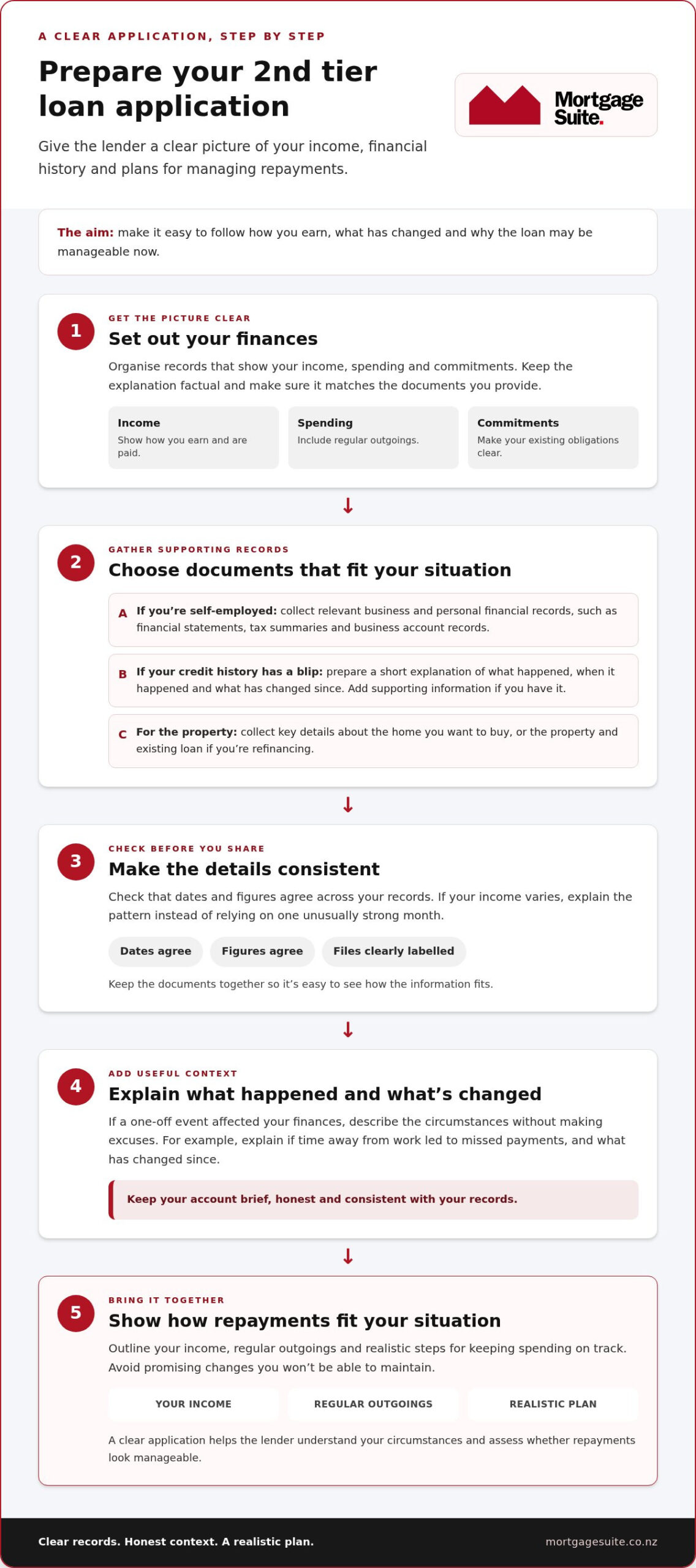
A clear application does more than gather figures. It helps the lender understand how you earn, what has changed and why the loan may be manageable now. Be upfront about your financial history. If there are gaps or late payments, explain them rather than leaving the lender to draw its own conclusions. Clear, consistent information makes it easier to assess your circumstances.

Your explanation can add context to your bank statements. The figures show what’s happened; your account helps make sense of them. Keep it factual and focused, and make sure your documents support what you say.

The Essential Paperwork You Will Need

Before applying, organise records that show your income, spending and commitments. The documents you need will depend on how you earn and what you plan to borrow for, but a tidy file helps the lender follow your application.

  • If you’re self-employed: Gather relevant business and personal financial records, such as financial statements, tax summaries and business account records. These can show how your business earns and pays you when a standard payslip doesn’t tell the whole story.
  • If your credit history has a blip: Prepare a short explanation of what happened, when it happened and what has changed since. Include supporting information if you have it.
  • For the property: Collect key details about the home you want to buy, or the property and existing loan if you’re refinancing. This gives the lender context for the purpose of the borrowing.

Check that dates and figures agree across your records. If your income varies, explain the pattern instead of relying on one unusually strong month. Label files clearly and keep them together so it’s easy to see how the information fits.

Telling Your Story to the Lender

If a one-off event affected your finances, explain what happened without making excuses. For example, if time away from work led to missed payments, describe the circumstances and what has changed since. Keep your account brief, honest and consistent with your records.

Then show how you plan to manage your finances from here. A clear outline of your income, regular outgoings and realistic steps for keeping spending on track can help explain how repayments fit your situation. Avoid promising changes you won’t be able to maintain.

A broker can help turn a complex financial picture into a clear application and explain your circumstances to a lender. Mortgage Suite works with borrowers whose situations don’t fit mainstream bank criteria. The team focuses on understanding your goals and presenting your case with care.

The Reserve Bank of New Zealand’s oversight of non-bank deposit takers explains its role for institutions in that category. Not every specialist lender is necessarily a deposit taker, so the information doesn’t describe every lender’s status.

Choosing the Right Lender for Your Situation

There isn’t one second-tier lender that suits every borrower. Some are more familiar with assessing self-employed income, while others may consider applications involving a smaller deposit or a past credit issue. The aim is to match your main hurdle with a lender whose criteria fit your circumstances, not to send the same application everywhere.

Start by identifying what made a mainstream bank hesitate. Is your income difficult to show through payslips, is your deposit limited, or does your credit history need context? Each situation calls for a different conversation with a lender. A specialist broker can compare potential pathways, explain how lenders may view your application and negotiate on your behalf, without promising approval.

Lenders for the Self-Employed

Some lenders are more used to assessing income that doesn’t arrive as a regular salary. They may look at business records and other evidence to understand whether your earnings can support repayments. “Low-doc” generally refers to an application that uses a different or smaller set of traditional income documents, not a loan with no checks. You’ll still need to show how you earn and demonstrate that repayments are affordable.

For example, a contractor with changing monthly income may need to explain the pattern across their records rather than rely on a single payslip. The right lender depends on the details of your work, income and existing commitments.

Lenders for Credit Issues or Small Deposits

If your deposit is smaller than a bank wants, a specialist lender may assess the whole application differently. That doesn’t mean every lender will accept a lower deposit, or that the deposit is the only factor. Your income, commitments and the property matter too. If a past financial setback affected your credit history, some lenders may consider an explanation and evidence that your situation has since changed.

You may also hear the term “risk grade”. Lenders can use their own methods to assess the risk of an application. A higher perceived risk may affect the offer’s conditions or terms, so ask for a plain-English explanation of what the assessment means for your loan. There isn’t one scale shared by every lender.

Choosing between these options can be hard when each lender has different rules. Mortgage Suite helps match your situation to a suitable lending pathway and present your case clearly. You can learn about the people and experience behind that support on the Mortgage Suite About Us page.

How to Get a 2nd Tier Loan in NZ: A Step-by-Step Guide for 2026

Understanding the Costs: Rates, Fees, and Terms

A second-tier loan may help you move ahead with a property purchase when a main bank can’t offer a suitable option. But look beyond the approval and understand how the interest rate, repayments and loan conditions fit your plans. Specialist lenders may offer more flexibility for some applications, and their interest rates are often higher than those of main banks. The rate and terms will depend on the lender and your circumstances.

Don’t decide based on the rate alone. Think about how long you expect to keep the loan, what repayments you can manage and what you’ll do if your plans change. Buying sooner isn’t automatically the right choice, and property values can rise or fall. Your loan should remain manageable even if your circumstances don’t improve as quickly as you hope.

Interest Rates and Your Plans

Consider how repayments would fit your budget over time, not just at the start. A calculator can help you compare repayment scenarios at different interest rates. Use the Mortgage Suite mortgage calculator to see how a rate change may affect repayments. Then consider whether those repayments leave enough room for your other regular commitments.

There’s no standard period for staying with a second-tier lender. Some borrowers use this kind of loan as a temporary step while they work towards meeting a main bank’s criteria. You could review your position over a 12-to-24-month period, but treat that as a planning guide, not a promise that you’ll be ready to switch. Your financial position and a future lender’s assessment will determine what’s possible.

Terms to Check Before You Commit

Read the loan offer carefully and make sure you understand how it works. Check the repayment schedule, how the interest rate is set and whether the loan has conditions that could affect your plans. If you may want to change lenders or repay sooner, review the relevant terms before signing so you know what steps may apply.

  • Understand the repayments: Check when payments are due and whether the amount could change during the loan term.
  • Review the conditions: Make sure you understand any requirements attached to the loan and what you need to do to meet them.
  • Think ahead: Consider how the loan would fit if your income, property plans or timing changed.

Choosing a loan is about more than securing approval. Take time to understand the offer and whether it supports your next step. Mortgage Suite can help you compare lending options and negotiate with the lender on your behalf. Use the calculator to test different repayment scenarios before deciding what feels manageable.

The Exit Strategy: Moving Back to a Main Bank

A 2nd tier loan is often best treated as a stepping stone, not a permanent arrangement. Before taking one out, think about what would need to change for a main bank to consider your application later. A 12-to-24-month goal can give you a useful review point, but it isn’t a promise that you’ll be ready to switch by then. Your income, repayment history, credit record, equity and the bank’s criteria will all matter.

Make a plan you can act on from the start. Keep track of what held up your original application and set practical steps to address it. If the hurdle was showing self-employed income, for example, keep your financial records organised over time. If it was limited equity, review your loan balance and property value during regular check-ins.

Cleaning Up Your Financial Profile

Build a steady record of making your loan repayments on time. A consistent repayment history can help show a future lender that you’re managing your commitments. Keep other debts under control too. Paying down a car loan or credit card balance may reduce your regular outgoings, which can help when a bank reviews whether you can afford the mortgage.

Your equity may change as you repay the loan or if the property’s value rises. More equity can help with a future application, but property values can also fall, and a lender will assess the property and your finances at the time. A main bank will also consider your income, credit history and ability to manage repayments.

Working with Your Broker on the Move

Raise the possibility of switching lenders early, rather than waiting until you think you’re ready. Your broker can help you review whether the original hurdle has improved, what evidence you may need and whether it makes sense to prepare a new application. If a past credit issue contributed to the decline, be ready to show how your circumstances have changed since.

Moving lenders means applying again, and approval isn’t automatic. A main bank will assess your current position at that time, rather than relying only on the fact that another lender approved you previously. Your broker can help prepare and present the updated application, and talk through the options if you’re not yet ready to move.

Keep your longer-term goal in view, whether that’s improving your financial position, building equity or refinancing. Mortgage Suite can support you as your circumstances change and help you consider the next step when the time is right. A well-planned move back to a main bank takes preparation, but you can work towards it one practical step at a time.

Take the Next Step with a Clear Plan

A bank decline can leave you unsure where to turn, but it doesn’t have to define what happens next. Use what you’ve learned about how to get a 2nd tier loan to start a thoughtful conversation about your options, what a lender would need to see and how borrowing could fit your longer-term plans.

Every borrower’s situation is different, so the right next step depends on your goals and financial circumstances. Mortgage Suite can help you explore a suitable lending pathway and put your case forward. You can also read our client reviews to hear about other Kiwis’ experiences.

Book a chat with Mortgage Suite to find your path forward. You don’t need to have every answer before you begin. A clear conversation can help you work out what to do next, one step at a time.

Frequently Asked Questions

Is it harder to get a 2nd tier loan than a bank loan?

Not necessarily, but the assessment may work differently. A specialist lender may be more open to considering an application that falls outside a main bank’s usual criteria, while still checking whether the loan is affordable and suitable. For example, a lender may look closely at how a recent change in work affects your income. Approval isn’t guaranteed, and each lender sets its own requirements.

How much deposit do I need for a 2nd tier lender in NZ?

There isn’t one deposit amount that applies to every 2nd tier loan. The amount a lender may require can depend on the property, your finances and how the lender assesses the overall application. A smaller deposit doesn’t automatically rule you out, but it may affect the options available. Before making an offer, check that your expected deposit and other funds fit the proposed lending terms.

Can I get a 2nd tier loan if I have bad credit?

Possibly. A credit issue doesn’t automatically mean every lender will decline your application, but the details matter. A lender may consider what caused the issue, whether it’s resolved and how you’ve managed your commitments since. For example, a paid account in dispute may be viewed differently from ongoing missed payments. Be open about your credit history and provide a clear explanation rather than leaving the lender to guess.

What are the interest rates like for non-bank lenders?

Non-bank loan rates are generally higher than main bank rates, but the difference depends on the lender and your application. The rate is only one part of the offer: repayment terms, fees and conditions can also affect whether it suits your plans. Compare written offers on the same basis, and check what happens to repayments if the rate changes. Avoid relying on claims about a typical rate without a specific offer to review.

How long does the 2nd tier loan process take?

There’s no guaranteed turnaround time. The process can depend on how quickly you provide the requested information, how complex your income is and whether the lender needs a property valuation or further checks. You can help avoid preventable delays by sending complete, consistent documents and responding promptly to questions. If you’re working towards a purchase date, allow time for assessment and legal steps rather than assuming approval will arrive immediately.

Do I need a mortgage broker to get a 2nd tier loan?

You don’t necessarily need a broker, but a specialist can help you understand which lenders may suit your circumstances and present your application clearly. If you’re weighing up how to get a 2nd tier loan after a bank decline, a broker can also help explain the lender’s questions and talk through the offer with you. Mortgage Suite supports borrowers whose applications don’t fit mainstream bank criteria, but no broker can promise approval.

Can I use a 2nd tier loan to buy an investment property?

A 2nd tier loan may be an option for a residential investment property if the lender’s criteria fit your circumstances and the property. The lender will assess your finances, existing commitments and the property as part of the application. Mortgage Suite helps borrowers explore residential investment property lending as well as other specialist loan options.

What happens if I want to pay off my 2nd tier loan early?

Check your loan agreement before making an early repayment, as the terms may set out notice requirements or charges. The details can differ between loans and may depend on whether you’re paying off the full balance or making an extra repayment. If you’re planning to refinance, ask for a current payout figure and factor in any applicable charges and legal steps before setting a completion date.

Article by

Krish Krishna

Experienced Financial Adviser with over 46 years of Banking and Mortgage broking experience and over $2.0 Billion in loan settlements.

Non-Conforming Home Loans in New Zealand: A 2026 Guide for When the Bank Says No

What if a “no” from your bank wasn’t a dead end, but actually a signpost pointing you toward a more tailored way to buy your home? It’s incredibly disheartening to feel like you’ve failed just because you don’t fit a specific box, especially when you’ve worked hard to build a successful business or establish yourself as a contractor. You’re certainly not alone in feeling frustrated by complex lending rules that seem designed to keep you out of the market. The reality is that mainstream banks often overlook capable borrowers, which is why non-conforming home loans New Zealand have become such a vital tool for Kiwis in 2026.

In this guide, you’ll discover how these flexible loans provide a legitimate pathway to homeownership for those with non-standard income or unique financial backgrounds. We’ll show you how to move past the stress of rejection and build a clear plan to secure a property now, with a view to refinancing later as your situation evolves. You will gain the confidence to stop waiting on the sidelines and start your journey toward owning your own home today.

Key Takeaways

  • Understand that “non-conforming” simply means your situation doesn’t fit a standard bank’s checklist, and these loans are fully regulated and safe options.
  • See how non-conforming home loans New Zealand provide a vital path forward for self-employed Kiwis or those with minor credit issues.
  • Learn how to use a “bridge strategy” to buy your home now and plan for a move back to a mainstream lender in a few years.
  • Get the facts on interest rates and fees so you can weigh the cost of the loan against the long-term benefit of getting onto the property ladder.
  • Discover how working with a specialist gives you access to lenders who don’t work directly with the public, opening doors that often seem closed.

What exactly is a non-conforming home loan in New Zealand?

Think of the major banks like a high-end tailor who only makes one size of suit. If you happen to be a bit taller or broader than their standard template, you’re out of luck. Mainstream lenders like ANZ or ASB have very rigid checklists. If you miss a single tick, even for something small, they often can’t help you. This is why non-conforming home loans New Zealand have become a vital alternative for many Kiwis whose lives don’t fit a standard spreadsheet.

Essentially, “non-conforming” is just a term for a mortgage that sits outside the traditional lending rules. If you are asking, What is a non-conforming loan?, it’s a financial tool designed for people who are actually great borrowers but have non-standard circumstances. In 2026, the “big four” banks have tightened their belts even further. With debt-to-income ratios capped at 6 and a more cautious approach to self-employed income, more people are finding themselves looking for these alternative options.

It’s important to understand that these aren’t “shadowy” or unregulated products. They are perfectly legal and must comply with the Credit Contracts and Consumer Finance Act (CCCFA). You get the same level of legal protection as you would with any other mortgage. The main difference is that these lenders are willing to look at your whole story, not just the last three months of your bank statements.

The difference between “Non-Bank” and “Non-Conforming”

Many people use these terms interchangeably, but they mean different things. A “non-bank” is the type of institution, it’s a lender that isn’t a traditional registered bank. “Non-conforming” describes the type of loan criteria being used. Non-conforming loans are flexible financial solutions designed for people whose income or credit history doesn’t match the rigid templates used by traditional banks. You might even find that a non-bank lender is the best fit even if you have a perfect credit score, simply because they can be more creative with how they structure your debt.

Who are the 2nd tier lenders in NZ?

In the New Zealand market, 2nd tier lender New Zealand options include building societies, credit unions, and specialist finance companies. They are often funded by wholesale investment markets rather than customer deposits, which gives them the freedom to be more flexible with their approvals. While they have more room to say “yes,” they are still committed to responsible lending. They want to ensure you can comfortably manage your repayments, making non-conforming home loans New Zealand a safe and strategic way to enter the property market when the big banks won’t budge.

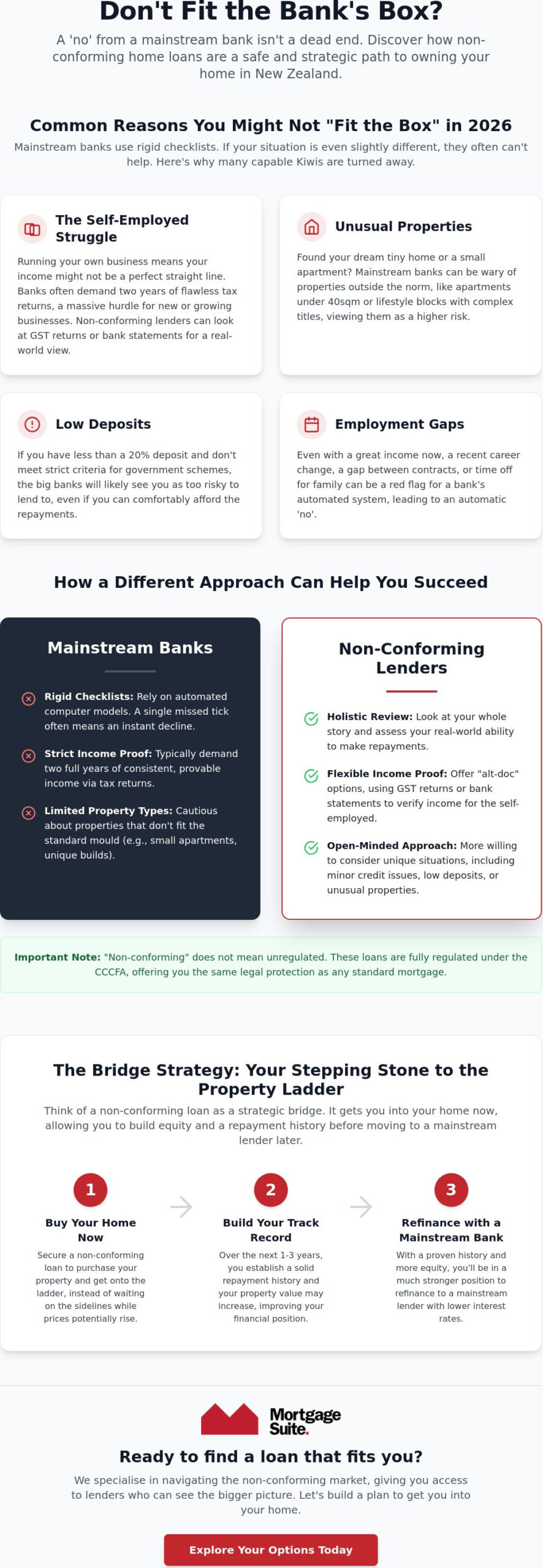
Common reasons you might not “fit the box” in 2026

It feels personal when a bank says no. You’ve worked hard, saved your deposit, and found a place you love, only to be told you don’t meet a specific requirement. Often, a rejection isn’t about your ability to pay back a loan. It’s usually because your life doesn’t align with the rigid computer models the big banks use. Since the introduction of tighter lending rules, many Kiwis have been declined for things as small as their personal spending habits or the type of house they want to buy. This is where non-conforming home loans New Zealand provide a much-needed alternative.

There are several common reasons why a mainstream bank might turn you away in 2026:

  • Unusual Properties: Banks are often wary of tiny homes, apartments smaller than 40sqm, or lifestyle blocks with complex titles.
  • Low Deposits: If you have less than a 20% deposit and don’t qualify for specific government grants, the “big four” might see you as too high a risk.
  • Employment Gaps: Even if you’re earning well now, a recent career change or a few months between jobs can trigger a “no” from traditional lenders.

The self-employed struggle

If you run your own business, you know that profit isn’t always a straight line. Banks usually demand two full years of perfect tax returns to prove your income. This requirement is a massive hurdle for new business owners or those who have recently scaled up. Many 2nd tier lenders offer “alt-doc” options instead. This means they can look at your GST returns or recent bank statements to get a real-world picture of what you can afford. If you’re a contractor or freelancer, your income is valid, and our detailed guide on low doc home loans NZ explains exactly how to use alternative documentation to secure approval. We can help you find a lender who understands your business model.

Credit history: It’s not always a deal-breaker

A forgotten power bill from three years ago or a past default shouldn’t end your home-buying dreams forever. Mainstream banks tend to see any credit “blip” as a major red flag. In contrast, 2nd tier lenders are often willing to listen to the story behind the numbers. They look at why a default happened and what you’ve done since then to stay on track. Many non-conforming home loans New Zealand are actually designed to help you repair your credit over time, acting as a bridge until you’re ready to switch back to a standard bank. It’s about looking at your future potential, not just your past mistakes.

Mainstream Banks vs. Non-Conforming Lenders: A fair comparison

When you compare mainstream banks to alternative lenders, it’s a bit like comparing a mass-market retail chain to a specialist consultant. The big banks have the lowest rates, but they also have the least flexibility. If you don’t fit their specific mould, the low rate doesn’t actually help you because you can’t get the loan. This is where non-conforming home loans New Zealand come into play. They fill the gap for people who have the income and the drive to own a home but fall outside the standard banking criteria.

Let’s look at the numbers. In June 2026, mainstream bank fixed rates are sitting around 4.65% to 4.79%. In contrast, rates for non-conforming home loans New Zealand are higher because they are risk-based. You should also expect establishment fees to be more significant than what you’d find at a big bank. While the upfront cost is higher, the value lies in getting an approval when everyone else has said no. These lenders look at the common sense of a deal rather than just following a rigid computer algorithm.

Speed is another area where alternative lenders often shine. When you’re trying to secure a property at auction, you don’t have weeks to wait for a bank’s head office to review your file. Because 2nd tier lenders have shorter chains of command, they can often provide a firm answer in a fraction of the time. This agility allows you to bid with confidence, knowing your finance is already sorted and you won’t miss out on the right property.

Understanding the “Risk Premium”

Lenders charge a higher rate because they are taking a chance on a borrower that a big bank won’t touch. We call this a risk premium. While the interest is higher, it’s often a better financial move than waiting three years to save a larger deposit. If house prices rise during that time, the cost of waiting can easily exceed the extra interest you’d pay now. Many of these loans also allow you to step down to a lower rate once you’ve proven your reliability over a year or two.

Flexibility in lending criteria

Alternative lenders look at your situation with a human eye. For instance, they might be more generous with their Loan-to-Value Ratio (LVR), allowing you to borrow more against the property’s value than a traditional bank would. They also look at your income differently, often counting more of your overtime, commissions, or bonuses. You can learn more about these differences in our non-bank lenders NZ guide. If you have a smaller deposit, you might also want to check if you qualify for the First Home Loan scheme, which helps people who don’t fit the standard 20% deposit box.

Non-Conforming Home Loans in New Zealand: A 2026 Guide for When the Bank Says No

The Bridge Strategy: Using a non-conforming loan as a stepping stone

Too many people view these mortgages as a final destination or a “last resort.” In reality, they are a powerful tool to get you across the gap between where you are now and where the bank wants you to be. This is what we call the Bridge Strategy. It’s a deliberate 2-to-3-year plan designed to get you into the property market today, rather than sitting on the sidelines for years while house prices potentially climb. By choosing non-conforming home loans New Zealand, you aren’t just getting a mortgage; you’re buying time to fix the very things that caused the bank to say no in the first place.

While you are on this bridge, your home is hopefully growing in value. Every repayment you make reduces your debt, and every month that passes helps “clean up” your financial profile. This is the time to perfect your tax returns if you’re self-employed or ensure your credit history is spotless. The goal is simple: stay with an alternative lender for a few years, build your equity, and then refinance back to a mainstream bank for those lower rates once you finally “conform” to their rules.

Step 1: Get in the door

The biggest mistake many Kiwis make is waiting for the “perfect” time to buy. They wait for interest rates to drop or for their deposit to hit exactly 20%. History shows us that time in the market almost always beats timing the market in New Zealand. By securing the property you want today, you start building equity immediately. A non-conforming loan is often a temporary solution to a long-term goal, giving you the leverage to act when the right house appears.

Step 2: Prove your reliability

Once you have the keys, the real work begins. This stage is all about demonstrating to future lenders that you are a low-risk borrower. You need to make every single repayment on time, without exception. This builds a “bank-ready” history that is far more convincing than any spreadsheet or letter of explanation. If you’re just starting out, our guide on home loans for first home buyers New Zealand can help you map out these early steps. We keep a close eye on your progress and can tell you exactly when your profile is strong enough to make the move back to a mainstream lender. If you’re ready to start building your own bridge, talk to our team about your options today.

How Mortgage Suite navigates the non-conforming market for you

Getting a “no” from a bank can feel like a personal rejection, but at Mortgage Suite Ltd, we see it as the start of a more tailored conversation. With Krish Krishna’s 20 plus years of banking experience, we know exactly how the “other side” thinks. We understand the hidden levers that mainstream lenders pull and, more importantly, we know how to present your case to the lenders who are actually willing to listen. Securing non-conforming home loans New Zealand requires more than just filling out a form; it requires a dedicated advocate who can translate your financial life into a compelling story.

We have established deep relationships with 2nd tier lender New Zealand options that simply don’t deal directly with the public. These institutions rely on trusted brokers to bring them quality borrowers who just happen to have non-standard situations. Because we’ve spent decades in the industry, our reputation carries weight. When we tell a lender that a client is reliable despite a past credit blip or a complex business structure, they listen. We handle all the paperwork and the tough conversations, removing the stress so you can focus on moving into your new home.

Tailored solutions, not “cookie-cutter” loans

Every person who walks through our door has a unique story. We don’t believe in one-size-fits-all mortgages. We take the time to sit down and truly listen to your situation before we even think about suggesting a lender. This personal connection is what sets us apart from the automated systems at the big banks. By specialising in loans that don’t fit the standard box, we can identify opportunities that others might miss. Whether you’re a new business owner or a contractor, we ensure your non-conforming home loans New Zealand are as unique as your circumstances.

Your partner for the long haul

Our job doesn’t end when you get your home loan. We are your partners for the entire journey. As we discussed earlier regarding the exit strategy, the goal is often to move back to a mainstream bank eventually. Mortgage Suite Ltd stays in touch and helps you plan that transition, ensuring you’re always on the best possible path. You’ll get friendly, jargon-free advice that treats you like a priority, not just another number in a database. Ready for a fair go? Get in touch with Mortgage Suite Ltd today.

Take the next step toward your new home

A bank rejection doesn’t have to be the end of your property dreams. As we’ve explored, non-conforming home loans New Zealand serve as a strategic bridge, allowing you to secure a property now while you work toward a mainstream mortgage. By focusing on building equity and proving your reliability, you can turn a temporary setback into a long-term win.

At Mortgage Suite Ltd, our team brings over 20 years of banking and brokerage experience to your corner. We specialise in alternative lending and act as your dedicated advocate, ensuring your story is heard by lenders who value common sense over rigid checklists. We don’t just process applications; we build partnerships focused on your success.

Book a conversational chat with Krish to explore your options and see how we can help you move forward with confidence. You deserve a fair go at owning your own home, and we’re here to help you make it happen.

Frequently Asked Questions

Are non-conforming home loans safe in New Zealand?

Yes, these loans are perfectly safe and must comply with the Credit Contracts and Consumer Finance Act (CCCFA) just like any big bank mortgage. This means you have the same legal protections and rights as any other borrower in New Zealand. These lenders are professional financial institutions that are simply more flexible with their rules than the household names you see on the high street.

How much higher are the interest rates for non-conforming loans?

Rates are typically higher than mainstream bank offers because the lender is taking on a situation that the big banks won’t touch. While a major bank might offer a rate under 5% in 2026, alternative lenders often range between 10% and 14.5% depending on your specific profile and risk level. It’s best to view this extra cost as a temporary fee for getting into the property market now rather than waiting years.

Can I get a non-conforming loan if I am self-employed with only one year of accounts?

Yes, you can often secure a loan with just one year of accounts by using alternative documentation like bank statements or GST returns. Mainstream banks usually demand two full years of perfect tax returns, but 2nd tier lenders specialise in helping new business owners who are already turning a good profit. This flexibility allows you to buy your home now rather than waiting for another financial year to pass. For a full breakdown of how this works, see our guide on low doc home loans NZ for self-employed Kiwis.

What is the minimum deposit for a non-conforming home loan?

Most alternative lenders look for a deposit of at least 20%, though some may consider 10% depending on the property type and your overall income. Because these lenders aren’t always bound by the same strict speed limits as the big banks, they have more room to move on deposit requirements. We can look at your specific savings and income to see which lender’s rules fit your current situation.

How long does it take to get approval for a 2nd tier loan?

Approval for 2nd tier loans is often much faster than the big banks, sometimes taking only two to three working days once all your paperwork is submitted. These lenders have smaller teams and less red tape, which makes them an excellent option if you need to move quickly for an auction or a short settlement. Having your bank statements and ID ready to go is the best way to speed up the process even further.

Can I move back to a big bank later if I start with a non-conforming loan?

Yes, moving back to a mainstream bank is the ultimate goal for most people who start with non-conforming home loans New Zealand. Once you have built up some equity and established a clean repayment history over two or three years, your profile becomes much more attractive to traditional lenders. We specialise in helping you plan this transition so you can eventually secure those lower mainstream rates when you are ready.

What happens if I have a default on my credit record?

A credit default isn’t an automatic “no” with alternative lenders, as they are more interested in the story behind the issue than just the score itself. They will want to see that the debt has been settled and that you’ve been reliable with your other payments since that time. We help you explain these past blips to the lender so they can see your current financial strength and future potential.

Do I need a mortgage broker to access non-conforming lenders?

Yes, many 2nd tier and specialist lenders in New Zealand do not deal directly with the general public and only accept applications through accredited mortgage brokers. Working with a broker also ensures your application is presented in the best possible light to the right people. We know which lenders are currently active and which ones are most likely to say “yes” to your specific needs and financial background.

Article by

Krish Krishna

Experienced Financial Adviser with over 46 years of Banking and Mortgage broking experience and over $2.0 Billion in loan settlements.