

Working Capital Loans NZ: Your 2026 Guide to Boosting Business Cash Flow

Imagine it’s Friday afternoon and you’re staring at a stack of unpaid invoices while the clock ticks down toward your staff’s payday. You’ve been waiting over 60 days for a major client to settle their account, and your local bank branch just gave you a cold “no” because you don’t fit their rigid rules. It’s a frustrating spot to be in, but you aren’t alone. Most Kiwi business owners know that feeling of having a healthy order book but a temporary gap in the bank account. This is where working capital loans become the essential fuel for your business engine, providing the cash you need to keep things moving while you wait for those payments to land.

We understand that you need a partner who looks at your industry expertise rather than just a spreadsheet. In this 2026 guide, you’ll learn how to bridge the gap between your mounting bills and your future growth with the right financial solution. We’ll explore how to access fast cash that respects your specific trading cycle and why 2nd tier lenders might be the breakthrough your business deserves. From managing seasonal dips to seizing sudden opportunities, we’re going to show you how to take the stress out of your cash flow for good.

Key Takeaways

  • Learn how working capital loans act as a bridge between your outgoing bills and the time it takes for customers to settle their invoices.
  • Discover whether a flexible safety net you can dip into or a one-off lump sum of cash is the better fit for your specific business cycle.
  • Understand why a “no” from a mainstream bank doesn’t mean your plans are over, especially when exploring 2nd tier lending options for Kiwi businesses.
  • Learn how to organise your financial numbers to create a solid plan that gives lenders the confidence to back your vision.
  • Find out how having a seasoned negotiator in your corner helps you connect with lenders who’re actively looking to support businesses like yours.

What exactly is a working capital loan and how does it help your business?

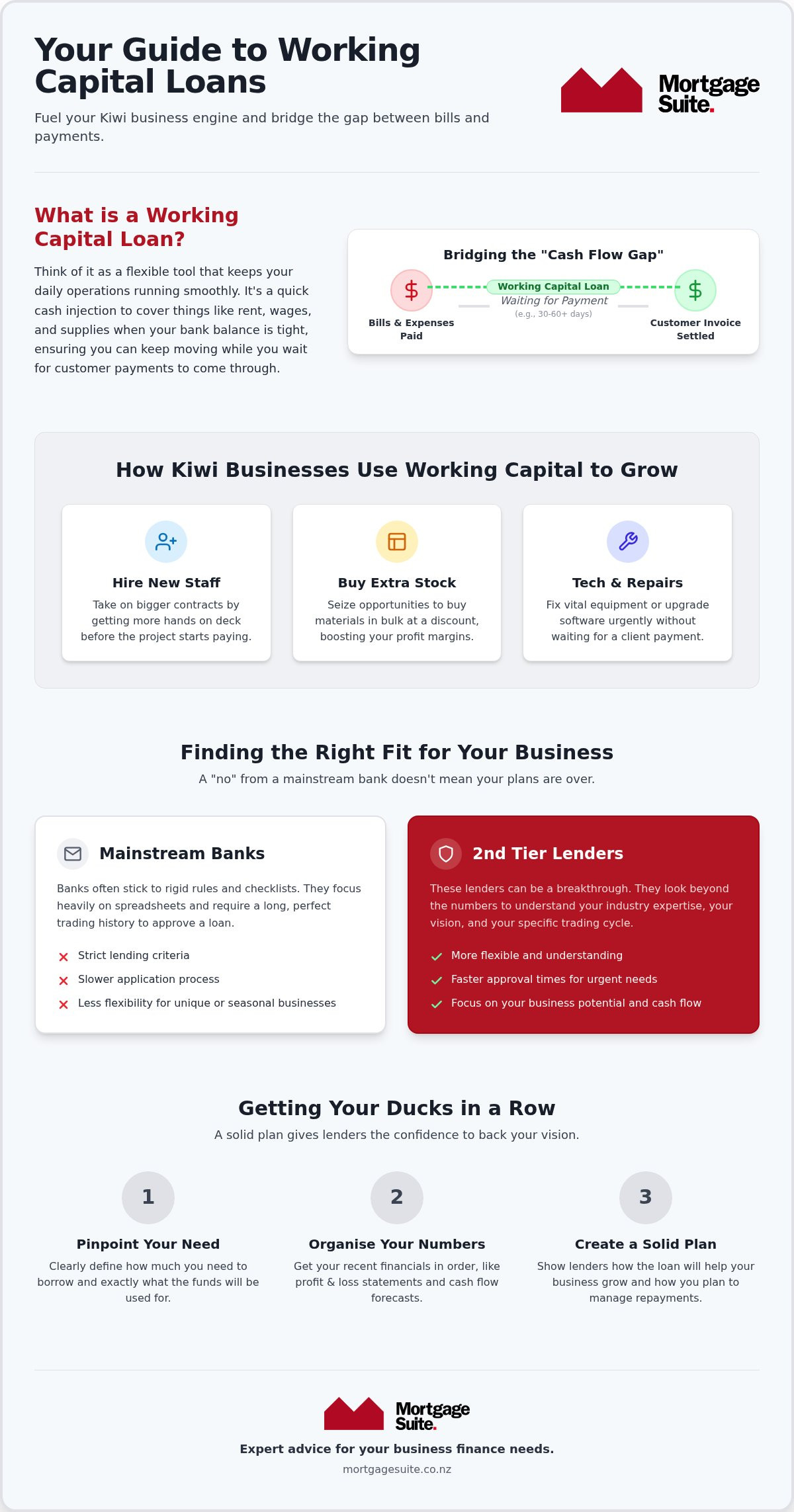
Think of a working capital loan as a flexible tool that keeps your daily operations running smoothly. Unlike a mortgage paid over decades, these are designed for the here and now. They provide a quick injection of ready cash to cover things like rent, utilities, and payroll when your bank balance isn’t quite matching your current workload. It’s a professional way to keep the engine running without having to dip into your own back pocket or use the family’s personal savings.

The primary purpose of working capital loans is to bridge the timing difference between your outgoings and your income. In a perfect world, every customer would pay the moment you finish a job. In the real world, you’re often paying for materials and labour weeks before the final invoice is settled. This finance acts as a safety net, ensuring you can meet your obligations today while waiting for the rewards of your hard work tomorrow.

The “Cash Flow Gap”: Why even healthy businesses need extra funds

It’s a common myth that only struggling businesses need extra help. In reality, some of the fastest-growing companies in New Zealand face the tightest cash flow. This happens because high growth requires upfront investment. You might have a massive pipeline of work lined up, but if you don’t have the cash to buy the supplies or pay the team, that growth stalls. Having a lot of work on doesn’t always mean you have a lot of cash in the bank.

New Zealand’s unique market also plays a role. Many Kiwi industries are seasonal, such as a retail shop in a tourist town or a landscaping crew during a wet winter. During these quiet patches, your fixed costs don’t go away. Working capital loans allow you to maintain your momentum during slow months so you’re ready to hit the ground running when the busy season returns. It prevents your next big project from stalling just because you’re waiting on a large client to pay.

Common ways Kiwis use working capital to grow

Having access to available funds isn’t just about survival; it’s about being proactive and seizing opportunities. Here are a few ways local businesses use this funding to get ahead:

  • Hiring new staff: Taking on a new contract often means you need more hands on deck before that contract starts paying.
  • Buying extra stock at a discount: If a supplier offers a significant discount for a large order, having the cash to buy upfront can boost your profit margins.
  • Technology and repairs: If a vital piece of equipment breaks or your software needs an urgent upgrade, you can’t always wait for a client payment to fix it.

Exploring the different ways to fund your day-to-day operations

Choosing the right way to fund your business is a bit like picking the right vehicle for a trip. You wouldn’t take a heavy truck for a quick run to the shops, and you wouldn’t use a small car to move a house. In the world of business finance, the structure you choose matters just as much as the amount you borrow. Working capital loans come in various shapes, and the best fit depends entirely on whether you need a permanent safety net or a one-off boost.

One of the first decisions you’ll face is whether to go with a secured or unsecured option. A secured loan uses an asset, such as a property, as a guarantee for the lender. This often results in more competitive terms because the risk is lower for the bank. Unsecured loans don’t require that same security, which can make the application process faster, though lenders will look much more closely at your trading history and cash flow to ensure you’re a safe bet.

Repayment terms also play a huge role in your daily stress levels. A shorter loan term might mean higher weekly repayments, but you’ll pay far less in interest over the life of the loan. Spreading the cost over a longer period keeps your weekly outgoings lower, which is often easier on the budget during the early stages of a growth push. It’s all about finding that sweet spot where the debt feels manageable within your normal trading cycle.

Business Overdrafts and Lines of Credit

A business overdraft is the ultimate “just in case” fund. It sits quietly in the background of your business bank account, ready for those moments when a bill arrives before a customer payment does. The best part is that you only pay interest on the money you actually use. If you have a limit of NZ$20,000 but only spend NZ$2,000 to cover a quiet week, you aren’t paying for the other NZ$18,000. It’s a perfect way to manage the natural ups and downs of a standard trading month without any fuss.

Term Loans for specific business goals

When you have a specific goal in mind, a term loan is usually the better path. This provides a lump sum of cash upfront, which you then pay back over a fixed period. It’s the ideal choice for one-off costs like launching a new website, funding a major marketing push, or upgrading essential equipment. Because the repayments are fixed, you can plan your budget with total certainty. We often help clients structure these repayments to match their specific business income, ensuring the debt supports your growth rather than hindering it. If you want to see how we’ve helped others navigate these choices, you can read more about our approach to business lending.

Working capital loans shouldn’t be a burden. By choosing the right structure, you ensure that the extra funds act as a springboard for your Kiwi business rather than just another bill to worry about.

Mainstream banks vs. 2nd tier lenders: Finding the right fit

Many Kiwi business owners walk into their local branch expecting a partnership and walk out feeling like just another number on a spreadsheet. The big banks have rigid, “cookie-cutter” rules that don’t always cater to the unique reality of running a business in 2026. If your situation doesn’t fit their exact mould, they’re often quick to shut the door. This can be incredibly disheartening, but it’s important to remember that a bank’s “no” is usually about their own internal policy, not the quality of your business.

The main difference lies in how a lender views risk. Mainstream banks are built for stability and high-volume, low-risk lending. They prefer businesses that look exactly like the one they funded yesterday. When you’re looking for working capital loans, you need someone who sees the potential in your future contracts and your industry expertise, rather than just staring at your past tax returns. Alternative lenders fill this gap by looking at the big picture of your business health.

When the big banks say “no”

Banks usually want to see at least two years of perfect trading history and often require physical assets, like a commercial building or residential property, as security. If you’re a service-based business or you’ve recently pivoted your strategy, you might find them incredibly nervous about lending. Being declined by a major bank isn’t the end of your plans; it’s simply a sign that you need a different type of partner. This is where a 2nd Tier Lender New Zealand can provide a lifeline. These lenders specialise in non-standard scenarios and are often more comfortable with complex credit or shorter trading histories.

The flexibility of alternative business financing

While banks focus on what happened in the past, alternative lenders often prioritise where your business is going. They’re willing to customise working capital loans to fit your specific industry needs, whether you’re in construction, retail, or professional services. The trade-off is often a slightly higher interest rate, but you gain much higher flexibility and, most importantly, speed. When a sudden opportunity arrives, like a chance to buy a competitor’s stock at a discount or hire a key team member to land a big contract, you can’t afford to wait six weeks for a bank committee to meet. Speed is the biggest advantage of non-bank lending, often getting cash into your account in a fraction of the time a traditional bank would take.

Navigating these alternative options alone can be overwhelming. This is why having a dedicated negotiator who knows the “inside track” of the banking world makes all the difference. We help you compare different deals to ensure you’re getting a fair price and terms that won’t cause stress during a slow month. We focus on finding a lender who understands your industry, ensuring your finance supports your growth rather than holding it back.
Working Capital Loans NZ: Your 2026 Guide to Boosting Business Cash Flow

Getting your ducks in a row: How to apply for a business loan in NZ

Applying for a loan shouldn’t feel like you’re being interrogated. It’s really just a consultative conversation about where your business is now and where you want it to go. When you’re looking for working capital loans, the goal is to show a lender that you’re a safe pair of hands. They want to see that you have a plan and that you’re in total control of your numbers. Being prepared makes the difference between a quick approval and a long, drawn-out process.

Being honest about your history is vital. If you’ve had some “bumps in the road” like a slow trading year or a credit hiccup, tell us early. It’s much easier to explain a situation upfront than to have a lender discover it later. A veteran broker acts as your advocate; we do the heavy lifting of presenting your case to the right people in a way that highlights your strengths. We know which lenders are more comfortable with your specific industry and who will see the value in your reputation.

The paperwork you will actually need

You don’t need a mountain of files to get started. Most lenders just want to see your recent financial statements. These show your profit and any current debts you’re managing. They’ll also look at your bank statements to understand the daily health of your business cash flow. This gives them a clear picture of how money moves through your accounts. If you want to brush up on how to get your finances ready, visit our Mortgage School for more practical tips.

Telling the story of your business

Numbers tell part of the story, but your vision fills in the gaps. A simple one-page business plan is often more powerful than a complex spreadsheet. When you use working capital loans to grow, show the lender exactly how the cash will help you make more money. Maybe it’s hiring a new lead generator or buying stock to fulfil a big contract. Don’t forget to highlight the experience of your team and your solid reputation in the local market. Lenders love to see that you’ve been in the game for a while and have a loyal customer base.

We know how to navigate this process because we’ve seen every scenario over the last two decades. If you’re ready to get started, you can talk to us about your business goals today.

Why having an expert in your corner makes all the difference

Finance isn’t just a series of calculations performed by an algorithm. It’s a deeply human industry built on relationships, trust, and the art of negotiation. While working capital loans offer the immediate liquidity your business needs, the real value lies in how those funds are sourced and structured. A veteran broker acts as your steady hand, ensuring you don’t just get any loan, but the right one for your specific goals.

Lender appetite changes constantly. One month a bank might be eager to support retail businesses, and the next, they’ve reached their limit for that sector and tightened their criteria. We stay on top of these shifts so you don’t have to. We know which lenders are “hungry” for your type of business right now, which saves you from the frustration of multiple declines that can hurt your credit score.

Personalised service over “computer says no”

Krish Krishna brings over two decades of banking experience to your side of the table. This deep institutional knowledge means he understands the “inside track” of how credit committees think. When a computer algorithm says “no” because of a minor technicality, a dedicated negotiator knows how to reframe the conversation and speak the bank’s language to unlock doors that seemed shut. This personalised approach removes the stress from your shoulders, allowing you to focus on running your business while we handle the complex paperwork and follow-ups. You can see how this has made a difference for others by visiting our reviews page.

Planning for the long term

We view our clients as partners, not transactions. Your first working capital loans are often just the beginning of a long-term relationship. As your business matures and your needs change, we’re here to help you evolve your financial strategy. This might eventually lead to exploring a Commercial Property Refinance NZ to unlock equity for even larger projects.

Having a mentor who has seen every possible scenario gives you the confidence to make bold moves. We’re committed to your success over the long haul, acting as a bridge between the rigid world of traditional banking and your personal business needs. If you’re ready to see what’s possible for your Kiwi business, get in touch with the team at Mortgage Suite Ltd today.

Take the next step toward a stronger cash flow

Managing your daily finances doesn’t have to be a source of constant pressure. By now, you’ve seen how the right funding can bridge the gap between your hard work and your bank balance. Whether you’re navigating a seasonal dip or gearing up for a major expansion, working capital loans provide the liquidity needed to keep your business engine running smoothly without risking your personal savings. It’s about having the freedom to say “yes” to new opportunities when they arrive.

Success in business finance often comes down to who you have in your corner. With over 20 years of banking experience, we specialise in 2nd tier lending solutions that look at the big picture of your success rather than just a credit score. We provide national coverage for all New Zealand businesses, ensuring that even if the big banks have said no, you still have a clear path forward. Our role is to act as your dedicated negotiator, finding a repayment plan that fits your specific trading cycle.

Ready to secure the future of your Kiwi business? Talk to Krish and the team at Mortgage Suite Ltd about your business goals today. Let’s turn your growth plans into a reality with a professional partner you can trust.

Frequently Asked Questions

How much can I borrow for my business in New Zealand?

The amount you can borrow depends largely on your business turnover and the health of your monthly cash flow. Most lenders want to see that your repayments won’t put undue stress on your daily operations. While some unsecured options start small for minor repairs or stock, larger amounts usually require some form of security. We look at your specific trading history to find a limit that supports your growth without becoming a heavy burden.

Do I always need to use my house as security for a business loan?

You don’t always have to put your family home on the line to get funding. While mainstream banks often demand residential property as security, many alternative lenders offer unsecured working capital loans based on your business’s performance. You might also use business assets like vehicles or heavy machinery as collateral instead. This flexibility is a key reason why many Kiwi business owners are moving away from traditional bank branches toward more specialised 2nd tier lenders.

How fast can I get the money once I apply?

Speed is one of the biggest advantages of working with non-bank lenders. In many cases, you can have an answer within 24 to 48 hours of submitting your paperwork. If your documentation is organised and your plan is clear, the funds can often be in your account just a few days later. This is significantly faster than the weeks or months it can take to move through a traditional bank’s rigid committee process.

Can I get a working capital loan if I have bad credit?

Yes, a less-than-perfect credit score doesn’t have to be a deal-breaker for your business plans. While a big bank might give an automatic “no” for past credit hiccups, 2nd tier lenders are often more interested in your current cash flow and future potential. They look at the “big picture” of why those issues happened and how your business is performing today. We specialise in presenting these scenarios to lenders who value your industry experience over a computer score.

What is the difference between a business loan and a commercial mortgage?

The main difference is the length of the commitment and what the money is used for. A commercial mortgage is a long-term loan, often over 15 to 25 years, specifically for buying property. In contrast, working capital loans are shorter-term solutions designed to cover day-to-day costs like payroll or stock. They’re built for speed and flexibility rather than long-term property investment, helping you manage the natural peaks and troughs of your trading cycle.

How do repayments work for a seasonal business?

We can help you find a lender who understands that your income isn’t the same every month. Some specialised lenders offer flexible repayment structures where you pay more during your peak season and less during the quiet months. This prevents the stress of high repayments when cash flow is naturally lower. It’s all about matching the debt to your specific business cycle so the loan remains a helpful tool rather than a source of worry.

What happens if I want to pay the loan back early?

Many modern business loans are designed to be flexible, but it’s important to check the fine print for early repayment fees. Some lenders encourage you to pay back the debt as soon as your customers settle their invoices, while others might charge a small fee to cover their lost interest. We always look for options that give you the freedom to clear your balance early without being penalised, ensuring you only pay for the money while you actually need it.

Do I need a full business plan to get a small loan?

You don’t necessarily need a 50-page document to secure a small amount of funding. For most working capital loans, a simple one-page summary explaining how the money will be used and how it will help you grow is often enough. Lenders mainly want to see that you understand your numbers and have a clear strategy for repayment. We can help you pull this information together so it’s presented professionally to the right people.

Article by

Krish Krishna

Experienced Financial Adviser with over 46 years of Banking and Mortgage broking experience and over $2.0 Billion in loan settlements.

Cash Flow Loans for Small Business NZ: 2026 Funding Guide

What if the bank’s “no” isn’t actually the end of your growth plans, but just a sign that you’re looking in the wrong place for capital? Most Kiwi business owners know the frustration of waiting weeks for a loan approval while GST deadlines loom or seasonal dips make it hard to pay the team. You might feel like your only option is a traditional business loan against property nz, yet the 2026 lending market offers far more flexibility than the rigid systems of the past. It’s stressful when complex forms and jargon stand between you and the working capital you need to keep things moving.

We understand that your business doesn’t operate on a tidy, predictable schedule. This guide will show you how to bridge financial gaps and fuel your growth with the right cash flow loan tailored for the New Zealand market. You’ll learn how to secure fast access to funds without the fear of losing personal assets as security. We’ll also walk through the latest 2026 regulations, flexible repayment terms that match your specific revenue cycle, and how to get a crystal clear understanding of the total cost of borrowing before you sign anything.

Key Takeaways

  • Understand why cash flow loans are the essential tool for managing seasonal dips and keeping your daily operations running smoothly.
  • Compare your options between secured and unsecured funding, including how a business loan against property nz can unlock lower interest rates.
  • Navigate the shift from government-backed schemes to the 2026 private lending market with confidence and clarity.
  • Learn the simple list of documents you need to prepare to ensure your application is processed without the usual bank delays.
  • Discover how a seasoned negotiator can help you find flexible lending solutions that mainstream banks typically don’t offer.

What exactly are cash flow loans for small business in NZ?

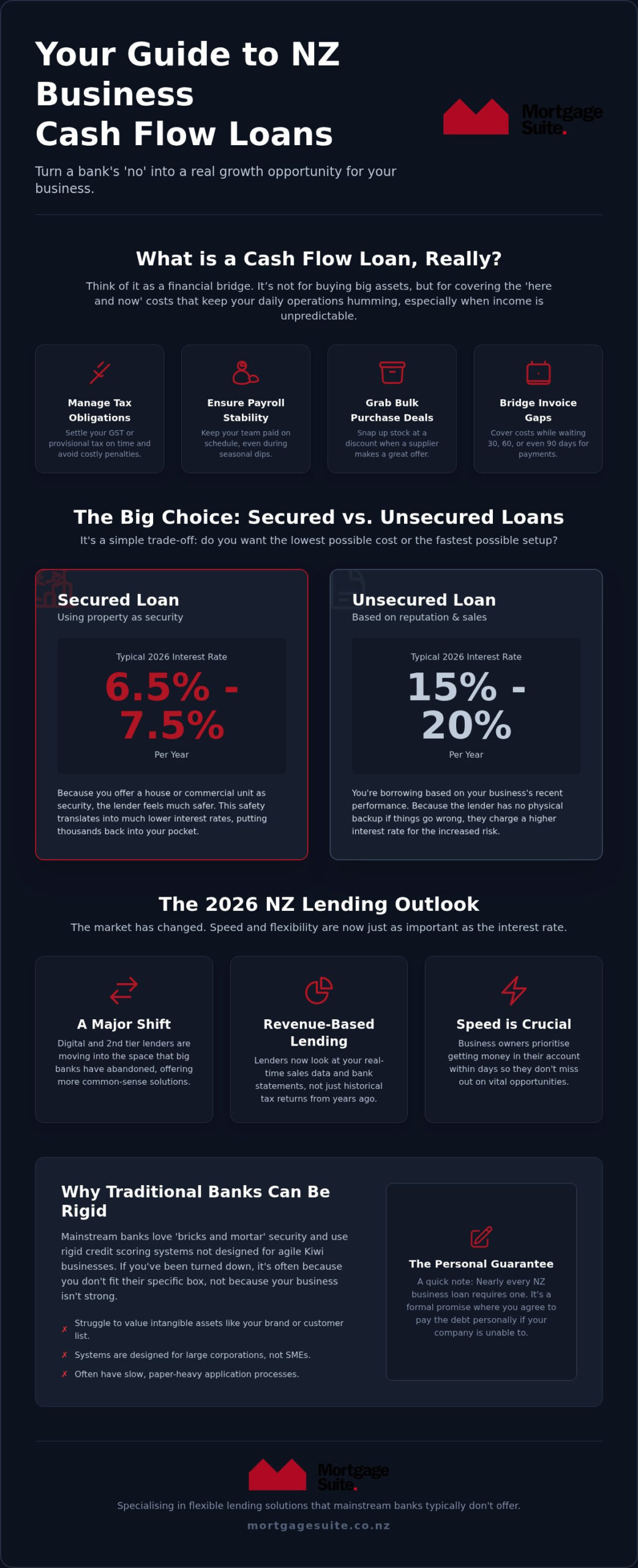
Think of a cash flow loan as a financial bridge that helps you get from one side of a busy month to the other. While a typical business loan is often used to buy big, long-term things like a new warehouse or a fleet of delivery vans, a cash flow loan is designed to keep your daily operations humming. It is money specifically meant to cover the “here and now” costs that keep a business alive. For many Kiwi business owners, money doesn’t always arrive in a perfectly straight line. You might experience busy periods followed by quieter months, or have large invoices that take time to clear. This is where flexible funding steps in to ensure you aren’t caught short when bills arrive.

These loans act as the lifeblood for small and medium businesses during growth spurts. When you’re expanding, you often have to spend money on staff and stock long before the new sales actually hit your bank account. Common ways our clients use these funds include:

  • Managing Tax Obligations: Settling your GST or provisional tax on time to avoid Inland Revenue penalties.
  • Payroll Stability: Ensuring your team is paid on time during seasonal dips or while waiting for large invoices to be cleared.
  • Bulk Purchasing: Snapping up stock at a discount when a supplier offers a limited-time deal.
  • Bridging Gaps: Covering the 30, 60, or 90-day wait periods common in commercial contracts.

It is different from a standard bank overdraft, which can often be reduced or cancelled by the bank at short notice. It also differs from a long-term commercial mortgage because the focus is on having enough cash on hand rather than decades of debt. If you have equity in your home or a commercial unit, a business loan against property nz can often provide a much more cost-effective solution than a high-interest loan that doesn’t use any security.

Why traditional banks often say no to cash flow

Mainstream banks love “bricks and mortar” security. They often struggle to see the value in things they can’t touch, like the value of your brand or reputation, your customer list, or your future contract pipeline. Their rigid credit scoring systems are designed for big corporations, not for agile Kiwi businesses that might have a fluctuating balance sheet. If you’ve been turned down because you don’t fit a specific bank box, it isn’t the end of the road. Using a business loan against property nz through a 2nd tier lender allows for a more common-sense approach where your property equity supports your business’s potential.

The 2026 outlook for NZ business lending

The lending environment in 2026 has changed significantly. Digital lenders and 2nd tier options have moved into the space that banks have abandoned. We are seeing a major shift toward revenue-based lending, where lenders look at your real-time sales data and bank statements rather than just historical tax returns. In this fast-paced market, speed and flexibility are becoming just as important as the interest rate. Business owners now prioritise getting the money in their account within days so they don’t miss out on vital opportunities.

Secured vs unsecured: Is a business loan against property right for you?

Deciding between a secured and unsecured loan usually comes down to a simple trade-off: do you want the lowest possible cost or the fastest possible setup? Borrowing money for your business means looking at how much you’re willing to pay for convenience. If you go for an unsecured loan, you are borrowing based on your reputation and your recent sales. Because the lender has no physical backup if things go wrong, they charge more. In 2026, these interest rates often sit between 15% and 20% per year.

If you choose a business loan against property nz, the picture changes. Because you are offering a house or commercial unit as security, the lender feels much safer. This safety translates into much lower interest rates, often around 6.5% to 7.5%. It’s a significant saving that can put thousands of dollars back into your pocket every month. It’s a big step to put an asset on the line, but for many Kiwi owners, the lower monthly repayments are what allow the business to grow sustainably.

You should also be aware of the Personal Guarantee. In the New Zealand lending world, almost every business loan requires one. It’s a document where you promise to pay the debt personally if your company can’t. It effectively means your personal assets are still connected to the loan, even if you don’t formally register a mortgage against them. It is a standard part of the process that ensures you are just as committed to the loan as the lender is.

Secured loans: Using your assets to grow

Security isn’t limited to your family home. Lenders in 2026 are often happy to look at commercial units, vehicles, or even heavy machinery. Sometimes, property development loans NZ can be used alongside cash flow funding to keep a project moving. The real benefit here is the borrowing limit. If you need more than NZ$250,000, having an asset to back the loan is usually the only way to get the green light from a lender.

Unsecured loans: Fast capital without the assets

If you’re in a service industry like consulting or trade work, you might not have big assets to pledge. Unsecured loans are perfect for these situations. Lenders check your bank statements and GST filings to see your sales volume. It’s a quick process with less paperwork, though you’ll pay those higher interest rates for the speed. If you’re weighing up which path is right for your current situation, exploring your options with an expert can help you find the best balance for your goals.

Moving beyond the Government SBC scheme: Private lending options

For many Kiwi businesses, the Small Business Cashflow Scheme (SBCS) provided a much-needed safety net during a time of total uncertainty. However, as we move through 2026, the landscape has shifted from government support to a focus on debt collection. Those five-year terms are reaching their final deadlines. If you still have an outstanding balance with the Inland Revenue, you’re likely facing the reality of fixed repayment schedules that don’t care about your seasonal dips. The IRD isn’t a bank; they don’t have the tools to offer the flexible, revenue-matched terms that a modern business needs to thrive.

This year is the perfect time to look at moving that debt into a private commercial facility. While the government scheme was a “one size fits all” fix, private lenders offer a much more tailored approach. For example, moving your existing debt into a business loan against property nz can drastically simplify your monthly outgoings. By using the equity in your home or commercial unit, you can secure a loan that fits your current business reality rather than sticking with a rigid government plan. It’s about taking control of your debt and ensuring your repayments work for you, not against you.

What to do if your SBC loan is expiring

The worst thing you can do is wait for the final deadline or a default notice. if your term is ending, start looking at your options now. Bundling your government debt along with any other high-interest business loans into one manageable payment makes your accounting much cleaner. It also gives you a chance to reset your cash flow. A broker can help you navigate this transition, acting as your advocate to find a lender that values your business’s future potential. We can help you move from government reliance to a more sustainable commercial independence.

The rise of 2nd tier lenders for Kiwi SMEs

Many business owners are surprised to find that a 2nd tier lender New Zealand can often be more helpful than a mainstream bank. These lenders are special because of the way they look at your business. Instead of a computer algorithm deciding your fate, a real person listens to your story and looks at your current bank statements. There’s a common myth that 2nd tier lending is only for businesses with bad credit, but that isn’t the case in 2026. Many of our most successful clients choose these lenders because they offer speed, flexibility, and a business loan against property nz that fits their specific sales cycle. It’s about finding a partner who understands the reality of running a business in the local market.

Cash Flow Loans for Small Business NZ: 2026 Funding Guide

How to get your business ready for a cash flow loan application

Preparing for a loan isn’t just about filling in a form and hoping for the best. It’s about showing a lender that you’re a safe pair of hands with a clear plan for the future. In 2026, lenders are faster than ever, but they’re also smarter. They use sophisticated software to scan your data in seconds, so your financials need to be sharp from the moment you hit submit. If you’re looking to secure a business loan against property nz, the first thing a lender will want to see is that your business has the “heartbeat” of consistent revenue to support the repayments.

Lenders generally focus on what we call the “Big Three” documents. These provide a transparent window into your business health without the need for hundreds of pages of jargon-filled reports. You will need:

  • Bank Statements: Usually the last six months of trading to show your daily cash ins and outs.
  • GST Returns: This proves to the lender that you’re meeting your obligations with the Inland Revenue.
  • A Simple Profit and Loss: A basic summary of your income and expenses over the last year.

Beyond the numbers, you need to be able to tell your story. Don’t just say you need “working capital.” Be specific. If you need NZ$80,000 to buy bulk inventory for the summer rush or to hire two new tradies for a large contract, say so. Lenders love a clear purpose because it shows you’re thinking like a strategist, not just someone trying to keep the lights on.

Cleaning up your financial house

Messy bank statements are a common reason for a fast “no.” If your business account is full of personal spending or small, unexplained transfers, it makes you look unorganised. Before you apply, take a month to keep things strictly business. It’s also vital to ensure you aren’t behind on any IRD payment plans. If you have a temporary dip in revenue or a one-off big expense, like a major equipment repair, be upfront about it. Explaining the “why” behind a dip is always better than letting a lender guess the reason. You can get a head start on your application by chatting with us about your current financial position.

The broker’s role in the application process

Many business owners make the mistake of applying to five different lenders at once. In the NZ market, every time a lender does a hard credit check, it leaves a mark on your file. Too many marks in a short time make you look desperate for cash, which can hurt your chances of approval. A broker acts as your advocate and negotiator. We take your “Big Three” documents and package them in a way that highlights your strengths. Because we know which 2nd tier lenders are currently looking for businesses in your specific industry, we can find the right business loan against property nz without damaging your credit score. We do the hard work so you can stay focused on running your business.

How Mortgage Suite helps you secure the best business finance

Navigating the finance market alone can feel like a full-time job. With over 20 years of banking experience, we’ve seen how the big banks operate from the inside. This insider knowledge is what we use to act as your dedicated negotiator. We don’t just look at a spreadsheet; we look at the person behind the business. Our approach is built on finding the lenders that the general public often misses. While a single bank will only ever show you their own products, we provide a market-wide view that includes 2nd tier options and private funds specifically designed for Kiwi SMEs.

When you’re looking for a business loan against property nz, you need more than just an interest rate. You need a structure that won’t cripple your growth. We take the stress out of the process by providing jargon-free, honest advice. There are no hidden fees or complex financial shorthand here. We speak your language and focus on the result: getting the capital you need to move forward without the usual bank headaches.

More than just a loan: a financial partnership

We believe in looking at your entire financial world. This means considering how your personal debt and mortgage rates NZ might impact your business borrowing capacity. Often, there’s a gap between where your business is today and where you want it to be in twelve months. We help you bridge that gap by acting as your advocate. When we deal with 2nd tier lenders on your behalf, we aren’t just submitting a form. We are presenting a case for why your business is a sound investment, ensuring you get terms that reflect your true potential and current market conditions.

Your next steps to better cash flow

Getting started is as simple as a phone call. We don’t believe in high-pressure sales tactics or making you wait for weeks just to get an initial answer. When you call us, you’ll get a conversational, helpful partner who listens first. We’ll discuss your goals, look at your options for a business loan against property nz, and map out a clear path forward. From that first chat to having funds in your account, the process is designed to be as seamless as possible. You’ve done the hard work of building your business; let us do the hard work of funding it. Contact Mortgage Suite Ltd today for a no-obligation chat about your business goals.

Take control of your business cash flow today

Managing the ups and downs of business revenue doesn’t have to be a solo struggle. Whether you’re transitioning away from the expiring government scheme or looking to fund a major new contract, the right capital structure makes all the difference. Remember that speed and flexibility often outweigh a slightly lower bank rate, especially when a growth opportunity is waiting. Using a business loan against property nz remains one of the most effective ways to secure lower interest rates and higher limits for your enterprise.

At Mortgage Suite, we bring over 20 years of banking expertise to the table as a 100% Kiwi owned and operated team. We specialise in 2nd tier and alternative lending, finding the solutions that mainstream banks simply can’t offer. You don’t have to navigate the jargon or the complex applications alone. We are here to act as your dedicated advocate and negotiator. If you’re ready to stop worrying about the next GST bill and start focusing on your long-term goals, book a free, no-obligation chat with our business lending experts. Your next stage of growth is closer than you think.

Frequently Asked Questions

What is the typical interest rate for a small business cash flow loan in NZ?

Interest rates depend largely on whether the loan is secured or unsecured. For a business loan against property nz, you can currently expect rates between 6.5% and 7.5% p.a. in the 2026 market. If you choose an unsecured option, rates are higher to reflect the increased risk to the lender, typically ranging from 15% to 20% p.a. based on your trading history.

Can I get a business loan if I’ve been declined by my main bank?

Yes, you certainly can. Mainstream banks often have very rigid criteria that don’t account for the unique way Kiwi SMEs operate. We specialise in 2nd tier lending, where providers use human-led underwriting to look at your current bank statements and future potential. A “no” from a big bank is often just a sign that you need a more flexible lender who understands your industry.

Do I need to provide my house as security for a cash flow loan?

Not necessarily. While a business loan against property nz offers the lowest interest rates, you can also use commercial units, vehicles, or heavy machinery as collateral. If you don’t want to use any physical assets, you can opt for an unsecured loan. These are faster to set up but usually come with higher interest rates and lower borrowing limits.

How long does it take to get the money once the loan is approved?

Speed is a major benefit of modern business lending. Once your loan is approved, funds are often transferred to your bank account within 24 to 48 hours. If your loan is secured against property, the process can take a few extra days for valuations and legal paperwork, but it is still significantly faster than the weeks of waiting often required by traditional banks.

What is the difference between a cash flow loan and a business line of credit?

A cash flow loan provides a lump sum of money upfront which you repay over a set term with fixed payments. A business line of credit works more like a credit card; you have a pre-approved limit and you only draw down funds when you need them. You only pay interest on the amount you actually use, making it a flexible tool for managing ongoing daily expenses.

Can I use a cash flow loan to pay my GST or tax bill?

Yes, this is one of the most common reasons New Zealand business owners seek short-term funding. Using a loan to settle GST or provisional tax helps you avoid the high interest and late payment penalties charged by the Inland Revenue. It allows you to spread the cost of your tax obligations over several months, keeping your daily working capital intact for growth.

Is there a penalty for paying back my business loan early?

Most 2nd tier and non-bank lenders in the current market do not charge penalties for early repayment. In many cases, paying the loan back early can actually save you a significant amount in interest. However, it is important to check the specific terms of your agreement, as some older or more traditional contracts may still include early exit fees.

What documents do I need to provide for an unsecured business loan?

Lenders typically require what we call the “Big Three” documents to assess an unsecured application. You will need to provide your last six months of bank statements, your most recent GST returns, and a basic profit and loss statement. These documents give the lender a clear picture of your recent revenue and help them confirm that the repayments are affordable for your business.

Article by

Krish Krishna

Experienced Financial Adviser with over 46 years of Banking and Mortgage broking experience and over $2.0 Billion in loan settlements.