
Refinancing Commercial Property NZ: Your 2026 Guide to Getting a Better Deal

What if your commercial mortgage didn’t feel like a weight around your business’s neck? Many Kiwi owners feel stuck with high interest rates and banks that just don’t get their vision. With the OCR at 2.75 percent as of September 2026 and commercial rates hovering between 6.5 and 7.5 percent, sticking with your current lender out of habit could be a costly mistake. If you’re looking into refinancing commercial property NZ, you’ve likely realised that the traditional banks aren’t always the most flexible partners for growing businesses.

We understand how frustrating it is when your cash flow is squeezed by restrictive terms and confusing financial talk. You deserve a lending partner who sees the person behind the balance sheet and values your potential. This guide will show you how to unlock the equity in your building, slash those monthly repayments, and find a lender who actually understands your goals. We’ll walk you through the 2026 lending landscape, from non-bank options to the latest tax changes, so you can secure a deal that finally supports your growth.

Key Takeaways

  • Identify the right time to move your mortgage to take advantage of shifting market trends and improve your daily cash flow.
  • Navigate the process of refinancing commercial property NZ without the stress by following a clear, step-by-step plan.
  • Explore flexible alternatives beyond the big banks that can offer solutions even if your current lender has said “no”.
  • Learn how to present your business and property in the best light to secure the lowest possible interest rates.
  • Discover how to unlock hidden equity in your building to fund your next big project or business expansion.

Why Refinancing Your Commercial Property in New Zealand Makes Sense Right Now

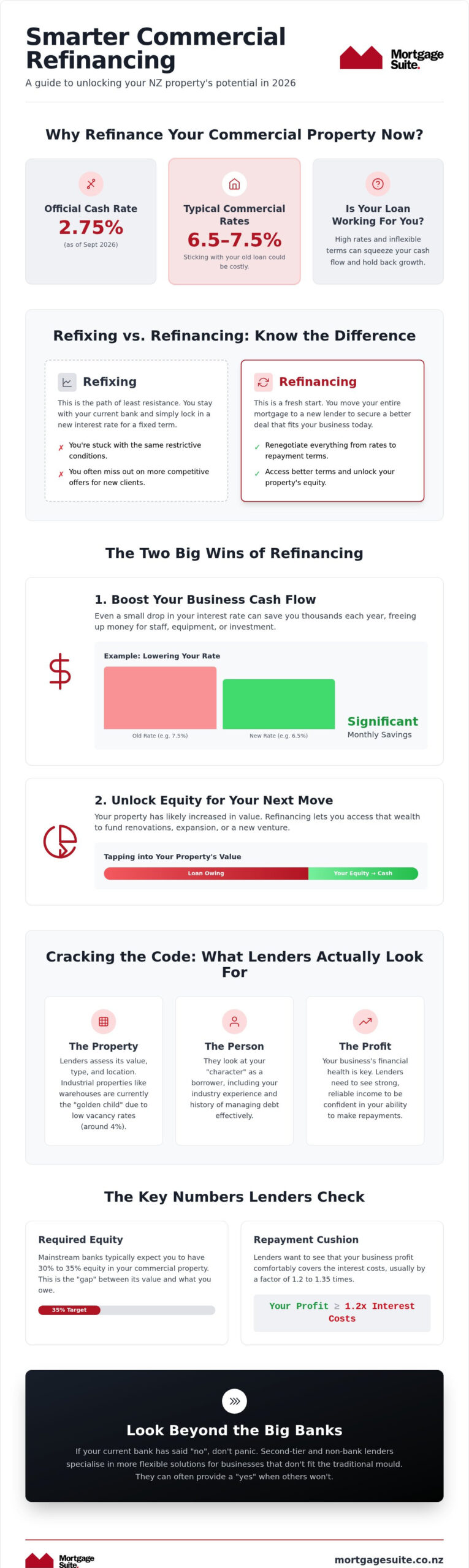
The financial market has shifted significantly as we move through late 2026. With the Official Cash Rate sitting at 2.75 percent, many property owners are finding that the loan structures they set up a few years ago no longer serve their best interests. If you have been with the same lender for a long time, you might be surprised by how much the market has moved without you. Refinancing commercial property NZ isn’t just about chasing a slightly lower number; it’s about ensuring your debt structure actually supports your business goals rather than hindering them.

It is vital to understand the difference between simply refixing and a full refinance. Refixing is when you stay with your current bank and just sign up for a new interest rate term. It’s the path of least resistance, but it often leaves you stuck with the same restrictive conditions and “faceless” service. A full refinance involves moving your commercial mortgage to a different lender. This process allows you to renegotiate everything, from how much you can borrow to the way you make repayments, providing a fresh start that fits your current financial reality.

Boosting Your Cash Flow and Reducing Costs

Commercial loans are typically large, which means even a small reduction in your interest rate can put heaps of money back into your business every month. With current commercial rates ranging between 6.5 and 7.5 percent, moving from a high rate down to the lower end of that scale can save you thousands. Sticking with one bank for a decade might feel loyal, but banks often reserve their most competitive offers for new clients. By switching, you can lower your monthly overheads and use that extra cash to hire new staff or buy better equipment. You can use a mortgage calculator to see exactly how a lower rate changes your monthly commitments.

Unlocking Equity for Your Next Move

Equity is the difference between what your property is worth today and the amount you still owe. Since property values have changed, 2026 is a fair dinkum time to check what your warehouse, office, or shop is actually worth. If your property value has grown, a refinance allows you to “unlock” that value. Instead of that wealth sitting idle in the building, you can access it as cash to fund a new business venture or a major renovation. It’s a proactive way to use your existing assets to fuel future growth without needing to find a separate source of capital.

Cracking the Code: What NZ Lenders Actually Look for When You Refinance

Lenders in New Zealand don’t just look at your bank balance. They focus on what I call the “Big Three”: the property, the person, and the profit. While home loans are mostly about your salary, commercial refinancing is a different beast altogether. Lenders want to see a clear “gap” between what you owe and what the property is worth. In 2026, most mainstream banks expect you to have at least 30 to 35 percent equity in the building. If your property value has climbed, that gap becomes your ticket to a better deal. They also look at your “character” as a borrower, including your experience in the industry and your history of managing debt effectively over the years.

Your Business Health and Income

When you apply to refinance, the lender needs to know you have the “ability to pay” without breaking a sweat. They look for a repayment cushion, usually wanting to see that your profit covers your interest costs by at least 1.2 to 1.35 times. It’s essential to have your books organised and up to date before you start the conversation. If your income is a bit lumpy or seasonal, don’t panic. Specialist lenders are often more comfortable with businesses that don’t have a perfectly flat income line every month, provided the overall annual profit is solid. Understanding the tax implications for commercial property is also part of this prep, as it affects your bottom line and how much cash you actually have available. If you’re unsure where your numbers stand, you can always check in with our team for a quick review of your position.

The Property Value and Type

Not all buildings are treated equally in the eyes of a bank manager. Currently, industrial properties like warehouses are the “golden child” for lenders because vacancy rates remain low, sitting around 4 percent in major hubs. These are often easier to finance than a highly specialised shop because a warehouse can be used by almost any business if the current tenant leaves. Retail spaces can be a bit more challenging, especially if they are designed for a very specific type of tenant. Lenders also look closely at your lease terms. A long-term lease with a reliable tenant makes your application much stronger and can often secure you a better interest rate. You will almost certainly need a fresh independent valuation as part of the process. This ensures the lender is working with current 2026 market values rather than what you paid for the place years ago. Having a recent valuation can often reveal that you have more equity than you thought, opening doors to better lending products.

Beyond the Big Banks: Exploring 2nd Tier and Non-Bank Options

Many Kiwis think the big four banks are the only game in town. But there is a whole world of “2nd tier” lenders that operate right across New Zealand. Simply put, these are financial institutions that aren’t registered banks but still provide substantial loans for business and property. They don’t have the same rigid “box-ticking” culture that you find at a main bank. If your current bank has said no, it is often just because you don’t fit their very specific, narrow criteria. It is rarely the end of the road. In fact, many successful business owners find that refinancing commercial property NZ with a non-bank lender is the smartest move they’ve ever made.

The Pros and Cons of Alternative Lenders

Approval times with these lenders are often much faster. While a big bank might take weeks to shuffle your paperwork between departments, a non-bank lender can often give you a “yes” in a matter of days. This speed is vital if you need to move quickly on a new opportunity. They are also far more flexible for self-employed people or those with seasonal income. As of mid-2026, interest rates for these loans typically range from 6.65 percent to 8.99 percent. While this is higher than a main bank, you have to weigh that cost against the cost of doing nothing. If a slightly higher rate allows you to grow your business or fix a cash flow crisis, it is a small price to pay for progress.

Is a 2nd Tier Loan Right for You?

These lenders shine when you have a short-term gap to fill or perhaps a few credit hiccups from the past that the big banks won’t forgive. They look at the “big picture” of your business rather than just a computer-generated score. At Mortgage Suite, we spend our time finding the hidden gems in the market that most people never hear about. We act as your advocate, negotiating with these lenders to get you the best possible terms for refinancing commercial property NZ. For a deeper look at how these options work, you can read our 2nd Tier Lender New Zealand guide. We help you bridge the gap between where you are now and where you want to be, ensuring you aren’t held back by rigid banking rules.
Refinancing Commercial Property NZ: Your 2026 Guide to Getting a Better Deal

Your Step-by-Step Plan to Getting Your Commercial Refinance Sorted

Refinancing commercial property NZ doesn’t need to be a confusing maze of forms and phone calls. While big banks might make it feel like you’re just another number in their system, a structured approach makes the whole thing much more manageable. It starts with a clear look at your current position and ends with a loan that actually serves your business. The first thing you should do is get a clear picture of what you currently owe and exactly what you’re paying in interest and fees. You can use our mortgage calculator to run some quick numbers and see how a lower rate might change your monthly commitments.

Once you know where you stand, it’s time to have a yarn with an expert broker. This is where we look at the strategy and see what’s possible in the current market. We’ll help you decide if a traditional bank or a more flexible alternative lender is the right fit for your specific goals. After that, we move into the application and approval phase. We handle the “bank-speak” and the back-and-forth negotiations, so you can stay focused on running your business. Finally, we reach settlement, where your old, expensive loan is paid off and your new, better deal begins.

Gathering the Right Paperwork

Collecting your documents is often the part people dread most, but it’s not as bad as you think when you have a clear list. To get started, your broker will typically need:

  • Your last two years of financial statements.
  • Current lease agreements for your tenants.
  • A recent mortgage statement showing your current balance.
  • Personal identification and proof of address.

Having a good accountant in your corner helps heaps during this stage. They can quickly pull the reports we need and ensure your numbers are presented in the best possible light for the lender. When your books are organised, the approval process moves much faster.

The Role of Your Mortgage Broker

We act as the bridge between you and the rigid world of institutional banking. Because we have over 20 years of experience, we know exactly how to package your application to get a “yes”. We often secure deals that you simply can’t get by walking into a local branch because we have access to different departments and a wider range of lenders. We do the heavy lifting, the negotiating, and the problem-solving on your behalf. You can meet the team to see the experts who will be advocating for your business throughout this journey.

If you’re ready to see how much you could save by moving your loan, reach out to Mortgage Suite today for a straightforward chat about your options.

Why Mortgage Suite is Your Secret Weapon for Commercial Refinancing

When you decide on refinancing commercial property NZ, you aren’t just looking for a new set of numbers on a page. You’re looking for a partner who can navigate the corridors of the big banks and the alternative lenders with their eyes closed. Krish Krishna brings over 20 years of deep banking experience to your side of the table. Having spent decades on the inside, he knows exactly how lenders think, what they’re afraid of, and what they need to see to say “yes”. This isn’t just about filling out forms; it’s about having a dedicated negotiator who knows how to push back when a bank tries to offer a sub-par deal.

We don’t just find loans. We find solutions that fit your actual life and your long-term business strategy. Whether you’re dealing with a bank that has become too restrictive or you need to access equity for a new project, we act as your advocate. We’ve helped countless Kiwis move away from faceless bank managers who don’t understand their industry. Our reputation is built on being tough but fair negotiators who don’t take “no” for an answer when we know a deal makes sense for the client.

A Personal Approach in a Corporate World

In a world where banking has become increasingly clinical and automated, we choose to keep things personal. We treat your business like it’s our own because we know how much is on the line for you. You won’t hear any confusing jargon or feel any judgment from us, regardless of your current financial situation. We offer honest, straightforward advice that focuses on your success. If you want to see how we’ve helped others in similar spots, you can check out our Reviews to see what other property owners reckon about working with us.

Ready to See What You Could Save?

Getting started doesn’t involve a mountain of paperwork or a formal commitment right away. It begins with a simple, no-obligation chat. When you first speak with Krish, you’ll find a mentor who listens more than he talks. He’ll take the time to understand your goals, your challenges, and your vision for the future. By the end of that first conversation, you’ll have a much clearer idea of what’s possible for refinancing commercial property NZ and how we can help you get there. If you’re ready to stop overpaying and start growing, Get in touch with Mortgage Suite today and let’s get your refinance sorted.

Take Control of Your Business’s Financial Future

Refinancing is more than just a paperwork exercise; it’s a strategic move to protect your cash flow and fuel your next big venture. By now, you should have a clearer understanding of how refinancing commercial property NZ can lower your costs and why looking beyond the big banks often leads to the most flexible solutions. Whether you’re dealing with restrictive bank terms or just want to see what your equity can actually do for you, you don’t have to navigate these complex decisions alone.

With over 20 years of banking expertise and a reputation as specialists in 2nd tier lending, we’re here to ensure you get a deal that actually fits your life. We’re proud to be highly rated by New Zealand business owners who value a personal touch over a faceless corporate process. You’ve worked hard to build your business, so make sure your mortgage is working just as hard for you. Talk to Krish about your commercial refinance today and let’s find the right path forward together.

Frequently Asked Questions

How much does it cost to refinance commercial property in NZ?

Refinancing involves several standard costs such as legal fees for discharging your old mortgage and registering the new one. You will also likely need to pay for an independent valuation to confirm the building’s current worth. If you are leaving a fixed-term contract early, your current bank might charge break fees. We help you calculate these expenses beforehand to ensure the move actually saves you money in the long run.

Can I refinance if my commercial property is currently vacant?

You can certainly refinance a vacant building, though main banks often find this risky because there is no immediate rental income. Specialist 2nd tier lenders are usually more flexible in these scenarios. They will look at the property’s location, its seismic rating, and your plan for finding a new tenant. Having a solid business track record helps heaps when the building is currently empty and you need a fresh start.

Do I need a new valuation to refinance my business property?

Most lenders will require a fresh, independent valuation as part of the process. They need to know the current 2026 market value to determine how much they can safely lend. Since property values have shifted recently, a new report often reveals you have more equity than you thought. This extra equity can be a powerful tool when you are looking into refinancing commercial property NZ for a better interest rate.

How long does the commercial refinancing process usually take?

The timeframe depends heavily on which lender you choose for your business. Traditional banks can take anywhere from four to eight weeks to process everything through their various departments. If you are in a rush to secure a deal, non-bank lenders are much faster and can often provide a “yes” within a few days. We manage the back-and-forth communication to keep things moving as quickly as possible for you.

What is the maximum I can borrow against my commercial property?

For most commercial properties in New Zealand, mainstream banks will typically lend up to 65 or 70 percent of the property’s value. Some non-bank lenders are willing to go slightly higher, potentially up to 75 percent for high-quality industrial buildings. The exact amount depends on the property type, the strength of your lease, and your business’s ability to cover the interest repayments comfortably without any financial stress.

Can I consolidate other business debts into my commercial mortgage?

Consolidating business debts into your commercial mortgage is a very common and effective strategy. It allows you to move high-interest debt, like equipment finance or business credit cards, into a single loan with a much lower interest rate. This move can significantly improve your monthly cash flow. It simplifies your finances by leaving you with just one manageable payment instead of juggling multiple different lenders every month.

What happens if I have a bad credit history but own a commercial property?

Having a credit hiccup from the past doesn’t automatically mean you can’t refinance your property. While main banks are very strict about credit history, 2nd tier lenders focus more on the value of the property and your plan to move forward. As specialists in these alternative loans, we know which lenders look past the computer-generated score to see the real potential in your business and your assets.


Article by

Krish Krishna

Experienced Financial Adviser with over 46 years of Banking and Mortgage broking experience and over $2.0 Billion in loan settlements.

Business Loan Requirements NZ: Your 2026 Guide to Getting Funded

What if the reason your funding feels out of reach isn’t your bank balance, but simply the way you’ve packaged your story? Most Kiwi business owners feel a sense of dread when they start looking into business loan requirements NZ, fearing that a single slip-up in their paperwork will lead to an instant decline. It’s exhausting to feel like you’re speaking a different language than the person sitting across the desk at a big bank.

We understand that your business is more than just a set of numbers on a page. You deserve a clear path to the capital you need to grow, whether you’re looking for a standard bank loan or a more flexible second-tier option. This guide is here to give you back your confidence by laying out exactly what lenders are looking for in 2026. We’ll help you tick every box, from preparing financials that tell the right story to finding a lender that actually values your hard work.

You’ll find a straightforward checklist of the documents you need, tips on valuing your assets for security, and a look at alternative funding sources that might be the perfect partner for your next big move.

Key Takeaways

  • Learn why lenders care most about your ability to repay comfortably rather than just your current bank balance.
  • Discover the three main business loan requirements NZ lenders check, including how to use your assets as a solid backup plan.
  • Understand why being turned down by a big bank isn’t the end of the road and how flexible lenders look at your whole story.
  • Find out how to tidy up your credit score and tax records to make your application look professional and ready for approval.
  • See how having a mentor with 20 years of banking experience can act as a shortcut to getting your funding secured.

Understanding the Basics of Business Loan Requirements in NZ

Think of business loan requirements NZ as a professional introduction. These aren’t just boxes to tick to make life difficult; they’re a set of standards that prove your venture is a safe bet for a lender. Lenders aren’t looking for reasons to say no. They’re searching for evidence that you can pay the money back comfortably without putting your business under stress. With business lending showing a 3.4% annual growth in 2026, the money is certainly available for those who can present a solid case.

These rules aren’t the same across the board. They shift depending on your situation. If you’re buying an existing company, the lender wants to see the previous owner’s numbers. If you’re starting fresh, they’ll look at your vision and your personal financial habits. Every lender has their own ‘rule book’ too. A big bank might follow a strict, rigid checklist, while a non-bank lender might be more interested in your cash flow and future potential.

Why Do Lenders Ask for So Much Information?

It often feels like a hurdle, but this process is actually about building a partnership. Lenders take on risk when they fund you, so they need to understand the full picture to feel confident. Your character as a business owner matters just as much as your bank balance. They want to see that you’re organised, honest, and capable of handling challenges. When you’re well-prepared, you look like a professional partner rather than a risky gamble. Given that the non-performing loan ratio for business loans sits at 1.1% in 2026, lenders are naturally careful about who they trust. Having a mentor who understands the ‘inside secrets’ of bank approvals can make this whole process feel much less daunting.

New Business vs. Established Business Requirements

Startups have a different mountain to climb. Since there’s no history to look at, lenders rely heavily on your business plan and financial forecasts. They need to see that you’ve done your homework and understand your market. For established businesses, the focus shifts to your track record. They’ll want to see steady earnings and solid tax records from the last few years. Regardless of your stage, you must have a clear goal for the money. Lenders want to know exactly how those funds will help you grow or improve your operations. If you want to dive deeper into how these processes work, you can check out our mortgage school for more insights.

The Three Pillars of Your Loan Application: Financials, Security, and Strategy

Success with a lender usually comes down to three main areas. These form the backbone of most business loan requirements NZ banks or private lenders look for. It’s not just about having a high turnover; it’s about showing that you have a clear grip on your money, a backup plan for the unexpected, and a sharp vision for the future. When you can present these three pillars clearly, you move from being just another applicant to being a professional partner worth investing in.

Sorting Your Financial Paperwork

Your financials are the hard evidence of how your business is actually doing. Lenders will typically ask for a Profit and Loss statement, which is a simple summary of what you made versus what you spent over a set period. They will also want to see a Balance Sheet. Think of this as a snapshot of what you own and what you owe at a specific point in time. A cash flow forecast is a prediction of the money coming in and out over the next year. This is vital because it proves you can afford the loan repayments even during slower months. To get a better handle on your potential numbers, try using the Mortgage Suite calculator to see how different loan amounts might fit your budget.

Understanding Security and Collateral

Think of security as a safety net for the lender. It is something of value they can fall back on if things don’t go to plan. Many Kiwi business owners use the equity in their home or specific business equipment to secure a loan. This often helps you get a better interest rate because the lender feels more protected. While some lenders offer unsecured options where you don’t need to put up a physical asset, these often come with different terms or higher interest rates to balance the risk. If you’re unsure how to value your assets, our team can help you look at the options that best suit your situation.

Crafting a Strategy That Wins Approvals

Your strategy is your roadmap. Lenders want to know what you do, who you sell to, and exactly how you’ll use the borrowed money to grow. They also want to see your “Plan B” for tough times. This shows them you’re a proactive leader who thinks ahead. Remember, the person behind the business is just as important as the numbers. Your experience and reputation act like a professional CV that builds trust. If you want more tips on how to present your case effectively, our Mortgage School is a great place to start learning the ropes.

Mainstream Banks vs. Alternative Lenders: Choosing the Right Path

Selecting the right lender is often the most critical decision you’ll make in your funding journey. Mainstream banks generally operate with a one-size-fits-all approach. They have rigid checklists, and if your situation doesn’t perfectly align with their internal rules, you might find your application stalled. In contrast, alternative or non-bank lenders are often more flexible. They tend to look at the bigger picture, focusing on your current cash flow and future potential rather than just your past paperwork. This flexibility is a key part of why understanding the full range of business loan requirements NZ has to offer is so important.

At Mortgage Suite, we specialise in 2nd tier lenders in New Zealand. We know that every business has a unique story, and sometimes that story needs a different type of listener than a traditional bank manager. Having a guide who knows the inside secrets of how different lenders think can save you months of frustration.

When the Bank Says “No”: Why It’s Not the End

Being turned down by a big bank can feel like a major setback, but it’s rarely the end of the road. Banks often decline applications for reasons that have nothing to do with the quality of your business. Common hurdles include having a trading history shorter than two years, using security that doesn’t involve a family home, or having a recent period of lower profit due to expansion costs. A “no” from a mainstream bank is often just a “not here” rather than a “not ever.” An expert mentor can often re-package your application to highlight your strengths to a lender that values your specific industry or growth stage.

The Pros and Cons of Non-Bank Funding

Alternative funding is a powerful tool, but it’s important to be clear about the trade-offs. The biggest advantage is speed. While a bank might take weeks to process a file, some alternative lenders can offer a decision within 24 to 48 hours. This speed allows you to jump on opportunities that won’t wait. However, you should expect different fee structures or higher interest rates. For many Kiwis, these loans act as a stepping stone. You use the funds to reach your next milestone, improve your financial position, and eventually move back to a mainstream bank when your business meets their more traditional business loan requirements NZ criteria.

Business Loan Requirements NZ: Your 2026 Guide to Getting Funded

How to Organise Your Application for the Best Chance of Approval

Preparing your application is often where the real work happens. It is not just about gathering papers; it is about presenting a clear, professional story that makes a lender want to say yes. When you approach business loan requirements NZ with an organised mindset, you demonstrate that you are a reliable partner who takes their finances seriously. A well-prepared file can be the difference between a quick approval and a long, drawn-out decline.

Follow these five practical steps to get your application ready for a lender’s desk:

  • Step 1: Check your credit score. Surprises are for birthdays, not loan applications. Knowing your score early allows you to fix any errors before a lender sees them.
  • Step 2: Tidy your tax and GST filings. Lenders look for stability. If your tax records are messy or behind, it suggests your business might be under pressure.
  • Step 3: Separate your bank accounts. Mixing personal and business money makes it difficult for a lender to see your true profit. Keep things clean and distinct.
  • Step 4: Explain the “why” in plain English. You don’t need fancy words. Just explain exactly how the money will help your business grow or become more efficient.
  • Step 5: Let a broker review it first. We act as a second pair of eyes to catch small mistakes that could lead to a decline.

Cleaning Up Your Financial Habits

Lenders love consistent, clean bank statements. In the months leading up to your application, try to avoid “buy now, pay later” schemes. While these are convenient, some lenders view them as a sign that your cash flow is tight. Reducing unnecessary personal spending and paying down small personal debts can also significantly boost your borrowing power. It shows you have the discipline to manage your money well, which gives the lender confidence that you’ll handle their funds with the same care.

The Power of a Professional Presentation

First impressions matter in the world of lending. A tidy, well-organised folder of documents shows that you are prepared and professional. If you have had a bad credit patch or a difficult trading period in the past, be honest about it. Lenders appreciate transparency, and explaining how you’ve moved past those challenges is far better than trying to hide them. You can read our Mortgage Suite reviews to see how other Kiwi business owners have successfully shared their stories to get the funding they needed. If you are ready to start your journey, contact our team to discuss how we can help you package your application for success.

Partnering with a Specialist to Secure Your Business Funding

Meeting the various business loan requirements NZ lenders set out can feel like a full-time job. This is where having a seasoned mentor makes all the difference. Krish Krishna brings over two decades of banking and brokerage experience to your side of the table. This isn’t just about filling out forms; it’s about using those years of “inside secrets” to act as a shortcut for your application. Instead of guessing what a credit manager wants to see, you have someone who has been in that seat and knows exactly how to frame your story for success.

A specialist broker acts as your advocate and negotiator. We don’t just pass on your papers; we fight for the best possible terms on your behalf. One of the biggest advantages is the sheer breadth of choice. With just one application, you gain access to dozens of different lenders, from the big name banks to flexible 2nd tier options. This saves you from having to repeat your story over and over again to different institutions, letting you stay focused on what really matters: running your company.

Why Experience Matters in a Fluctuating Market

The financial world doesn’t stand still. With the Official Cash Rate held at 2.25% in late 2026, interest rates and lending rules are constantly shifting. Navigating these changes requires a steady hand and deep institutional knowledge. A broker knows which lenders are “hungry” for new business in your specific industry at any given time. This real-time insight is invaluable when you’re looking for competitive rates or more flexible terms. You can learn more about our background and how we support Kiwi businesses on our About Us page.

Taking the Next Step with Confidence

Getting started doesn’t have to be a daunting process. It usually begins with a quick, no-obligation chat where we look at where your business stands today. From there, we build a tailored plan that matches your goals with the right lender. We handle the heavy lifting, the follow-up calls, and the complex negotiations so you don’t have to. Our goal is to move you through the process with ease and transparency. Your business has a bright future, and we’re here to help you secure the capital needed to reach that next milestone. Let’s work together to turn those growth plans into a reality.

Take the Next Step Toward Your Business Goals

Securing the capital you need to grow shouldn’t feel like an uphill battle. By focusing on clear financials and a sharp strategy, you have already laid the groundwork for a successful application. It is important to remember that meeting the business loan requirements NZ lenders expect is often about how you tell your story. If a mainstream bank isn’t the right fit, alternative and 2nd tier lenders offer the flexibility and speed that many Kiwi businesses need to thrive in a changing market.

With over 20 years of banking expertise, we act as your steady hand and dedicated negotiator. We specialise in 2nd tier and alternative lending, ensuring you have access to a wide range of options with just one conversation. You deserve a personalised service that removes the hurdles and focuses on your success. Talk to Krish and the team about your business loan today to see exactly where you stand. We are here to help you move forward with confidence and look forward to being part of your growth journey.

Frequently Asked Questions

What are the minimum requirements for a business loan in NZ?

Minimum business loan requirements NZ usually include a solid business plan, financial statements from the last two years, and proof that your cash flow can cover repayments. Lenders want to see that you understand your market and have a clear goal for the money. While mainstream banks have rigid checklists, alternative lenders might focus more on your current turnover and future potential. Being prepared with tidy records is always the best way to start.

Can I get a business loan if I have bad credit?

You can certainly secure funding with a less than perfect credit history by looking beyond mainstream banks. We specialise in 2nd tier loans for those who don’t fit standard criteria, focusing on your business’s current performance rather than past mistakes. A dedicated negotiator can help explain the context of your credit score to a lender. This approach often helps you get the capital you need while you work on rebuilding your financial reputation.

How much deposit do I need for a business loan in New Zealand?

Most lenders in New Zealand look for a deposit or equity contribution between 20% and 50% of the total loan value. The exact amount depends on the type of asset you’re buying and the level of risk the lender sees in your industry. If you are using existing property as security, you might not need a cash deposit at all. Every situation is unique, so it’s best to discuss your specific assets with a specialist.

Do I have to use my house as security for a business loan?

You don’t always have to use your family home as a backup for a business loan. While banks often prefer the security of residential property, many alternative lenders allow you to use business equipment, vehicles, or commercial property instead. Some even offer unsecured loans based on your revenue trends and cash flow. Choosing the right security depends on your comfort level and the specific terms offered by different lenders across the market.

How long does it take to get a business loan approved?

The time it takes to get an answer depends entirely on the type of lender you choose. Mainstream banks are often thorough and can take several weeks to process an application. On the other hand, many non-bank lenders specialise in speed and can provide an approval within 24 to 48 hours. Having all your documents organised and ready to go before you apply is the most effective way to speed up the entire process.

What documents do I need to show my lender?

You will generally need to provide your latest profit and loss statement, a balance sheet, and at least six months of bank statements. Lenders also want to see your recent GST and income tax filings to ensure your records are up to date. A clear business plan and a cash flow forecast are vital for showing how the loan will be repaid. Keeping these documents in a tidy, digital folder makes the application much smoother.

Is it better to go to a bank or a broker for a business loan?

A broker is often the better choice because they offer you access to dozens of lenders with just one application. While a bank can only sell you its own products, a broker acts as your advocate and negotiator to find a deal that actually fits your business needs. With over 20 years of experience, we know which lenders are most likely to say yes to your specific scenario, saving you time and stress.

Can I get a loan for a startup business with no trading history?

Getting a loan for a startup is possible, but the focus shifts from your history to your future potential. Since you don’t have past trading figures, you’ll need a very strong business plan and detailed financial forecasts. Lenders will also look closely at your personal credit history and professional experience in the industry. You might need to provide some form of security or a personal guarantee to give the lender the confidence they need.

Article by

Krish Krishna

Experienced Financial Adviser with over 46 years of Banking and Mortgage broking experience and over $2.0 Billion in loan settlements.

Cash Flow Loans for Small Business NZ: 2026 Funding Guide

What if the bank’s “no” isn’t actually the end of your growth plans, but just a sign that you’re looking in the wrong place for capital? Most Kiwi business owners know the frustration of waiting weeks for a loan approval while GST deadlines loom or seasonal dips make it hard to pay the team. You might feel like your only option is a traditional business loan against property nz, yet the 2026 lending market offers far more flexibility than the rigid systems of the past. It’s stressful when complex forms and jargon stand between you and the working capital you need to keep things moving.

We understand that your business doesn’t operate on a tidy, predictable schedule. This guide will show you how to bridge financial gaps and fuel your growth with the right cash flow loan tailored for the New Zealand market. You’ll learn how to secure fast access to funds without the fear of losing personal assets as security. We’ll also walk through the latest 2026 regulations, flexible repayment terms that match your specific revenue cycle, and how to get a crystal clear understanding of the total cost of borrowing before you sign anything.

Key Takeaways

  • Understand why cash flow loans are the essential tool for managing seasonal dips and keeping your daily operations running smoothly.
  • Compare your options between secured and unsecured funding, including how a business loan against property nz can unlock lower interest rates.
  • Navigate the shift from government-backed schemes to the 2026 private lending market with confidence and clarity.
  • Learn the simple list of documents you need to prepare to ensure your application is processed without the usual bank delays.
  • Discover how a seasoned negotiator can help you find flexible lending solutions that mainstream banks typically don’t offer.

What exactly are cash flow loans for small business in NZ?

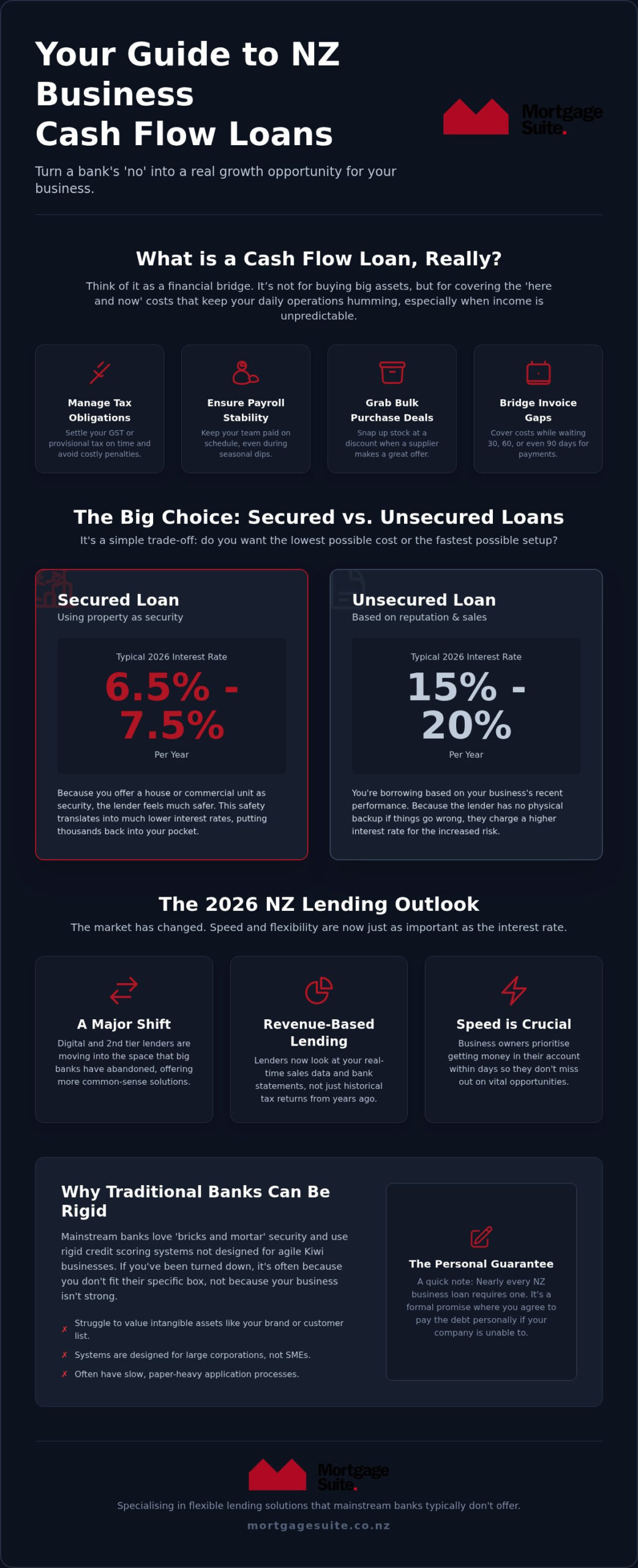
Think of a cash flow loan as a financial bridge that helps you get from one side of a busy month to the other. While a typical business loan is often used to buy big, long-term things like a new warehouse or a fleet of delivery vans, a cash flow loan is designed to keep your daily operations humming. It is money specifically meant to cover the “here and now” costs that keep a business alive. For many Kiwi business owners, money doesn’t always arrive in a perfectly straight line. You might experience busy periods followed by quieter months, or have large invoices that take time to clear. This is where flexible funding steps in to ensure you aren’t caught short when bills arrive.

These loans act as the lifeblood for small and medium businesses during growth spurts. When you’re expanding, you often have to spend money on staff and stock long before the new sales actually hit your bank account. Common ways our clients use these funds include:

  • Managing Tax Obligations: Settling your GST or provisional tax on time to avoid Inland Revenue penalties.
  • Payroll Stability: Ensuring your team is paid on time during seasonal dips or while waiting for large invoices to be cleared.
  • Bulk Purchasing: Snapping up stock at a discount when a supplier offers a limited-time deal.
  • Bridging Gaps: Covering the 30, 60, or 90-day wait periods common in commercial contracts.

It is different from a standard bank overdraft, which can often be reduced or cancelled by the bank at short notice. It also differs from a long-term commercial mortgage because the focus is on having enough cash on hand rather than decades of debt. If you have equity in your home or a commercial unit, a business loan against property nz can often provide a much more cost-effective solution than a high-interest loan that doesn’t use any security.

Why traditional banks often say no to cash flow

Mainstream banks love “bricks and mortar” security. They often struggle to see the value in things they can’t touch, like the value of your brand or reputation, your customer list, or your future contract pipeline. Their rigid credit scoring systems are designed for big corporations, not for agile Kiwi businesses that might have a fluctuating balance sheet. If you’ve been turned down because you don’t fit a specific bank box, it isn’t the end of the road. Using a business loan against property nz through a 2nd tier lender allows for a more common-sense approach where your property equity supports your business’s potential.

The 2026 outlook for NZ business lending

The lending environment in 2026 has changed significantly. Digital lenders and 2nd tier options have moved into the space that banks have abandoned. We are seeing a major shift toward revenue-based lending, where lenders look at your real-time sales data and bank statements rather than just historical tax returns. In this fast-paced market, speed and flexibility are becoming just as important as the interest rate. Business owners now prioritise getting the money in their account within days so they don’t miss out on vital opportunities.

Secured vs unsecured: Is a business loan against property right for you?

Deciding between a secured and unsecured loan usually comes down to a simple trade-off: do you want the lowest possible cost or the fastest possible setup? Borrowing money for your business means looking at how much you’re willing to pay for convenience. If you go for an unsecured loan, you are borrowing based on your reputation and your recent sales. Because the lender has no physical backup if things go wrong, they charge more. In 2026, these interest rates often sit between 15% and 20% per year.

If you choose a business loan against property nz, the picture changes. Because you are offering a house or commercial unit as security, the lender feels much safer. This safety translates into much lower interest rates, often around 6.5% to 7.5%. It’s a significant saving that can put thousands of dollars back into your pocket every month. It’s a big step to put an asset on the line, but for many Kiwi owners, the lower monthly repayments are what allow the business to grow sustainably.

You should also be aware of the Personal Guarantee. In the New Zealand lending world, almost every business loan requires one. It’s a document where you promise to pay the debt personally if your company can’t. It effectively means your personal assets are still connected to the loan, even if you don’t formally register a mortgage against them. It is a standard part of the process that ensures you are just as committed to the loan as the lender is.

Secured loans: Using your assets to grow

Security isn’t limited to your family home. Lenders in 2026 are often happy to look at commercial units, vehicles, or even heavy machinery. Sometimes, property development loans NZ can be used alongside cash flow funding to keep a project moving. The real benefit here is the borrowing limit. If you need more than NZ$250,000, having an asset to back the loan is usually the only way to get the green light from a lender.

Unsecured loans: Fast capital without the assets

If you’re in a service industry like consulting or trade work, you might not have big assets to pledge. Unsecured loans are perfect for these situations. Lenders check your bank statements and GST filings to see your sales volume. It’s a quick process with less paperwork, though you’ll pay those higher interest rates for the speed. If you’re weighing up which path is right for your current situation, exploring your options with an expert can help you find the best balance for your goals.

Moving beyond the Government SBC scheme: Private lending options

For many Kiwi businesses, the Small Business Cashflow Scheme (SBCS) provided a much-needed safety net during a time of total uncertainty. However, as we move through 2026, the landscape has shifted from government support to a focus on debt collection. Those five-year terms are reaching their final deadlines. If you still have an outstanding balance with the Inland Revenue, you’re likely facing the reality of fixed repayment schedules that don’t care about your seasonal dips. The IRD isn’t a bank; they don’t have the tools to offer the flexible, revenue-matched terms that a modern business needs to thrive.

This year is the perfect time to look at moving that debt into a private commercial facility. While the government scheme was a “one size fits all” fix, private lenders offer a much more tailored approach. For example, moving your existing debt into a business loan against property nz can drastically simplify your monthly outgoings. By using the equity in your home or commercial unit, you can secure a loan that fits your current business reality rather than sticking with a rigid government plan. It’s about taking control of your debt and ensuring your repayments work for you, not against you.

What to do if your SBC loan is expiring

The worst thing you can do is wait for the final deadline or a default notice. if your term is ending, start looking at your options now. Bundling your government debt along with any other high-interest business loans into one manageable payment makes your accounting much cleaner. It also gives you a chance to reset your cash flow. A broker can help you navigate this transition, acting as your advocate to find a lender that values your business’s future potential. We can help you move from government reliance to a more sustainable commercial independence.

The rise of 2nd tier lenders for Kiwi SMEs

Many business owners are surprised to find that a 2nd tier lender New Zealand can often be more helpful than a mainstream bank. These lenders are special because of the way they look at your business. Instead of a computer algorithm deciding your fate, a real person listens to your story and looks at your current bank statements. There’s a common myth that 2nd tier lending is only for businesses with bad credit, but that isn’t the case in 2026. Many of our most successful clients choose these lenders because they offer speed, flexibility, and a business loan against property nz that fits their specific sales cycle. It’s about finding a partner who understands the reality of running a business in the local market.

Cash Flow Loans for Small Business NZ: 2026 Funding Guide

How to get your business ready for a cash flow loan application

Preparing for a loan isn’t just about filling in a form and hoping for the best. It’s about showing a lender that you’re a safe pair of hands with a clear plan for the future. In 2026, lenders are faster than ever, but they’re also smarter. They use sophisticated software to scan your data in seconds, so your financials need to be sharp from the moment you hit submit. If you’re looking to secure a business loan against property nz, the first thing a lender will want to see is that your business has the “heartbeat” of consistent revenue to support the repayments.

Lenders generally focus on what we call the “Big Three” documents. These provide a transparent window into your business health without the need for hundreds of pages of jargon-filled reports. You will need:

  • Bank Statements: Usually the last six months of trading to show your daily cash ins and outs.
  • GST Returns: This proves to the lender that you’re meeting your obligations with the Inland Revenue.
  • A Simple Profit and Loss: A basic summary of your income and expenses over the last year.

Beyond the numbers, you need to be able to tell your story. Don’t just say you need “working capital.” Be specific. If you need NZ$80,000 to buy bulk inventory for the summer rush or to hire two new tradies for a large contract, say so. Lenders love a clear purpose because it shows you’re thinking like a strategist, not just someone trying to keep the lights on.

Cleaning up your financial house

Messy bank statements are a common reason for a fast “no.” If your business account is full of personal spending or small, unexplained transfers, it makes you look unorganised. Before you apply, take a month to keep things strictly business. It’s also vital to ensure you aren’t behind on any IRD payment plans. If you have a temporary dip in revenue or a one-off big expense, like a major equipment repair, be upfront about it. Explaining the “why” behind a dip is always better than letting a lender guess the reason. You can get a head start on your application by chatting with us about your current financial position.

The broker’s role in the application process

Many business owners make the mistake of applying to five different lenders at once. In the NZ market, every time a lender does a hard credit check, it leaves a mark on your file. Too many marks in a short time make you look desperate for cash, which can hurt your chances of approval. A broker acts as your advocate and negotiator. We take your “Big Three” documents and package them in a way that highlights your strengths. Because we know which 2nd tier lenders are currently looking for businesses in your specific industry, we can find the right business loan against property nz without damaging your credit score. We do the hard work so you can stay focused on running your business.

How Mortgage Suite helps you secure the best business finance

Navigating the finance market alone can feel like a full-time job. With over 20 years of banking experience, we’ve seen how the big banks operate from the inside. This insider knowledge is what we use to act as your dedicated negotiator. We don’t just look at a spreadsheet; we look at the person behind the business. Our approach is built on finding the lenders that the general public often misses. While a single bank will only ever show you their own products, we provide a market-wide view that includes 2nd tier options and private funds specifically designed for Kiwi SMEs.

When you’re looking for a business loan against property nz, you need more than just an interest rate. You need a structure that won’t cripple your growth. We take the stress out of the process by providing jargon-free, honest advice. There are no hidden fees or complex financial shorthand here. We speak your language and focus on the result: getting the capital you need to move forward without the usual bank headaches.

More than just a loan: a financial partnership

We believe in looking at your entire financial world. This means considering how your personal debt and mortgage rates NZ might impact your business borrowing capacity. Often, there’s a gap between where your business is today and where you want it to be in twelve months. We help you bridge that gap by acting as your advocate. When we deal with 2nd tier lenders on your behalf, we aren’t just submitting a form. We are presenting a case for why your business is a sound investment, ensuring you get terms that reflect your true potential and current market conditions.

Your next steps to better cash flow

Getting started is as simple as a phone call. We don’t believe in high-pressure sales tactics or making you wait for weeks just to get an initial answer. When you call us, you’ll get a conversational, helpful partner who listens first. We’ll discuss your goals, look at your options for a business loan against property nz, and map out a clear path forward. From that first chat to having funds in your account, the process is designed to be as seamless as possible. You’ve done the hard work of building your business; let us do the hard work of funding it. Contact Mortgage Suite Ltd today for a no-obligation chat about your business goals.

Take control of your business cash flow today

Managing the ups and downs of business revenue doesn’t have to be a solo struggle. Whether you’re transitioning away from the expiring government scheme or looking to fund a major new contract, the right capital structure makes all the difference. Remember that speed and flexibility often outweigh a slightly lower bank rate, especially when a growth opportunity is waiting. Using a business loan against property nz remains one of the most effective ways to secure lower interest rates and higher limits for your enterprise.

At Mortgage Suite, we bring over 20 years of banking expertise to the table as a 100% Kiwi owned and operated team. We specialise in 2nd tier and alternative lending, finding the solutions that mainstream banks simply can’t offer. You don’t have to navigate the jargon or the complex applications alone. We are here to act as your dedicated advocate and negotiator. If you’re ready to stop worrying about the next GST bill and start focusing on your long-term goals, book a free, no-obligation chat with our business lending experts. Your next stage of growth is closer than you think.

Frequently Asked Questions

What is the typical interest rate for a small business cash flow loan in NZ?

Interest rates depend largely on whether the loan is secured or unsecured. For a business loan against property nz, you can currently expect rates between 6.5% and 7.5% p.a. in the 2026 market. If you choose an unsecured option, rates are higher to reflect the increased risk to the lender, typically ranging from 15% to 20% p.a. based on your trading history.

Can I get a business loan if I’ve been declined by my main bank?

Yes, you certainly can. Mainstream banks often have very rigid criteria that don’t account for the unique way Kiwi SMEs operate. We specialise in 2nd tier lending, where providers use human-led underwriting to look at your current bank statements and future potential. A “no” from a big bank is often just a sign that you need a more flexible lender who understands your industry.

Do I need to provide my house as security for a cash flow loan?

Not necessarily. While a business loan against property nz offers the lowest interest rates, you can also use commercial units, vehicles, or heavy machinery as collateral. If you don’t want to use any physical assets, you can opt for an unsecured loan. These are faster to set up but usually come with higher interest rates and lower borrowing limits.

How long does it take to get the money once the loan is approved?

Speed is a major benefit of modern business lending. Once your loan is approved, funds are often transferred to your bank account within 24 to 48 hours. If your loan is secured against property, the process can take a few extra days for valuations and legal paperwork, but it is still significantly faster than the weeks of waiting often required by traditional banks.

What is the difference between a cash flow loan and a business line of credit?

A cash flow loan provides a lump sum of money upfront which you repay over a set term with fixed payments. A business line of credit works more like a credit card; you have a pre-approved limit and you only draw down funds when you need them. You only pay interest on the amount you actually use, making it a flexible tool for managing ongoing daily expenses.

Can I use a cash flow loan to pay my GST or tax bill?

Yes, this is one of the most common reasons New Zealand business owners seek short-term funding. Using a loan to settle GST or provisional tax helps you avoid the high interest and late payment penalties charged by the Inland Revenue. It allows you to spread the cost of your tax obligations over several months, keeping your daily working capital intact for growth.

Is there a penalty for paying back my business loan early?

Most 2nd tier and non-bank lenders in the current market do not charge penalties for early repayment. In many cases, paying the loan back early can actually save you a significant amount in interest. However, it is important to check the specific terms of your agreement, as some older or more traditional contracts may still include early exit fees.

What documents do I need to provide for an unsecured business loan?

Lenders typically require what we call the “Big Three” documents to assess an unsecured application. You will need to provide your last six months of bank statements, your most recent GST returns, and a basic profit and loss statement. These documents give the lender a clear picture of your recent revenue and help them confirm that the repayments are affordable for your business.

Article by

Krish Krishna

Experienced Financial Adviser with over 46 years of Banking and Mortgage broking experience and over $2.0 Billion in loan settlements.