
Property Development Finance Requirements NZ: Your 2026 Guide to Getting Funded

The difference between a multi-million dollar development getting the green light and a flat “no” from the bank often has nothing to do with the land itself. It’s about how you package your proposal to meet the specific property development finance requirements nz lenders demand in 2026. If you’ve ever felt like the big banks are constantly moving the goalposts, you’re not alone. It’s a common frustration for many Kiwi developers, whether you’re worried about having enough “skin in the game” or fearing that a lack of past experience will kill the deal before it even starts.

We understand that the path to funding can feel like a maze, but it doesn’t have to be a source of stress. This guide is designed to give you total clarity on what’s actually required to get your project across the line. We’ll walk you through a clear checklist of expectations, explaining the vital differences between mainstream banks and the more flexible 2nd tier lenders who often see the potential that others miss. By the time you’ve finished reading, you’ll have the confidence to present your project to a broker, knowing exactly how to bridge the gap between your vision and the capital you need.

Key Takeaways

  • Learn why development funding is paid out in stages rather than a lump sum and how this structure supports your construction timeline.
  • Discover why you typically need 30-35% equity and how to meet the property development finance requirements nz lenders look for by leveraging your professional team’s experience.
  • Understand the differences between mainstream banks and 2nd tier lenders so you can choose the right path for your specific project and pre-sale levels.
  • Find out how to build a professional “Development Pack” that tells a compelling story and includes a realistic budget with a 10-15% safety net.
  • See how partnering with a seasoned negotiator can take the pressure off and help you move through the bank approval process with confidence.

What is Property Development Finance and How is it Different?

Property development finance isn’t just a standard mortgage with a fancy name. While a home loan helps you buy an existing house, development finance is specifically designed for those who want to build from scratch or undertake a major renovation. To understand What is Property Development and how it’s funded, you have to look at the project as a business venture rather than a personal purchase. It’s a specialised tool that bridges the gap between a vacant lot and a finished set of titles.

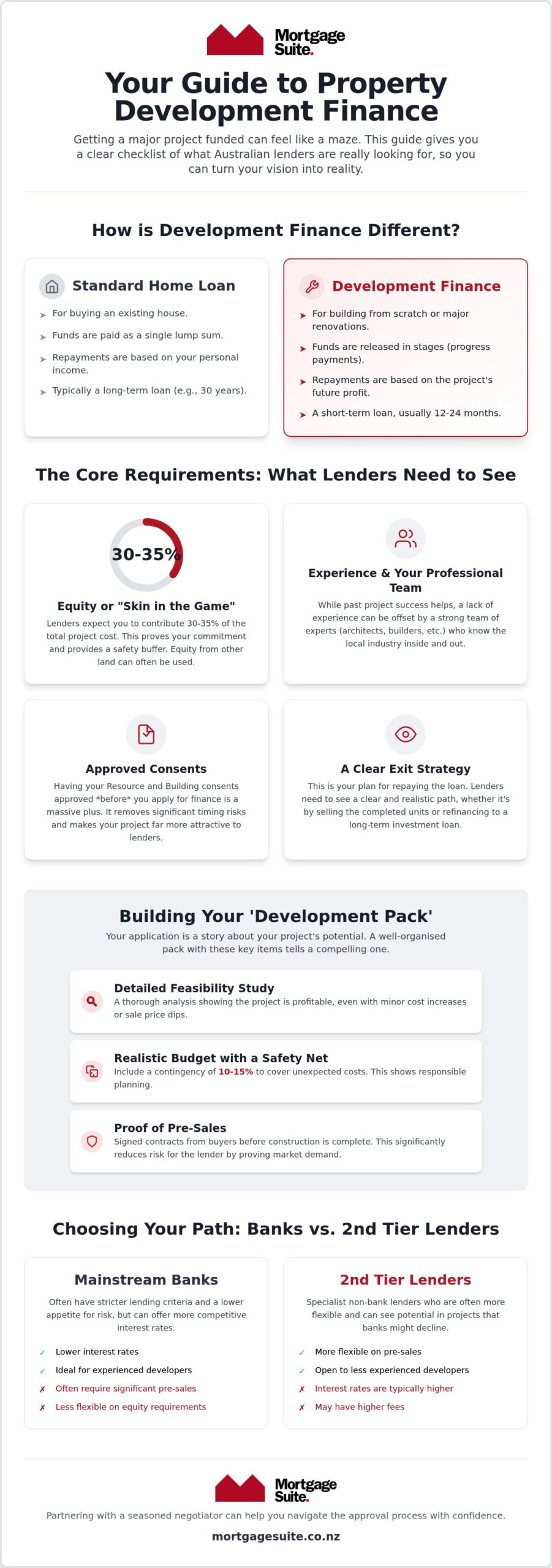
One of the biggest differences is how you receive the money. Unlike a standard loan where you get the cash in one lump sum at settlement, development funding is released in stages, often called progress payments. This keeps the lender safe because they only release funds once a specific part of the build, such as the foundations or the roof, is signed off by a professional. Lenders also focus heavily on what the project is worth when finished, rather than just what the land is worth today. Because you aren’t living in the property and making repayments from a weekly salary, the interest is usually added to the loan balance. This means you don’t have to worry about finding the cash for monthly payments while the builders are on site, as the total cost is settled at the very end.

Standard Home Loan vs. Development Finance

A standard home loan relies on your personal income to prove you can afford the mortgage. However, the property development finance requirements nz lenders set focus much more on the project’s potential profit. These loans are also much shorter, usually lasting between 12 and 24 months. Because there are more moving parts and risks involved in a construction project, the requirements are naturally a bit stricter than a simple house purchase. At Mortgage Suite Ltd, we help you navigate these differences so you can focus on the build itself. If you want to dive deeper into these structures, our Mortgage School provides a great breakdown of how they work.

Why the ‘Exit Strategy’ is Your Most Important Detail

Lenders are primarily interested in one thing: how they get their money back. This is where your exit strategy comes in. An exit strategy is the pre-planned method of clearing the debt once the project finishes. Most developers do this by selling the completed units or moving the debt into a long-term investment loan. Banks especially love seeing you sell units before they are finished, which involves buyers signing contracts before the building is even complete. It proves there is a market for your project and reduces the lender’s risk. Meeting the property development finance requirements nz banks have in place often starts with proving that your plan to pay them back is solid and realistic.

The Core Property Development Finance Requirements in NZ

Securing funding for a project in Aotearoa involves more than just a firm handshake and a set of blueprints. Lenders look for specific markers of stability before they’ll commit to a deal. The most critical of the property development finance requirements nz lenders focus on is your equity. While a first home buyer might get away with a 20% deposit, developers usually need to bring 30% to 35% of the total project costs to the table. This “skin in the game” acts as a buffer against market shifts and ensures you’re fully committed to the outcome. If your equity is tied up in other land, we can often look at using that as security, provided the valuations are current and robust.

Beyond the cash, your experience level is under the microscope. If you don’t have a long list of successful projects, you can offset this by surrounding yourself with a top-tier professional team. Banks want to see that you’re working with experts who understand the nuances of New Zealand’s property industry. A detailed profitability check, or feasibility study, is also non-negotiable; it must prove that the project remains profitable even if costs rise or sale prices dip slightly. Having your resource and building consents already approved makes you far more attractive to a lender because it removes a massive layer of timing risk that could otherwise stall the build.

The Financial ‘Must-Haves’

Lenders need to see that you have enough “rainy day” funds to cover unexpected cost overruns. To satisfy the property development finance requirements nz banks have in place, you’ll need to provide a transparent breakdown of your project costs, including:

  • Actual building costs: This covers the physical materials and labour required to get the building off the ground.
  • Other expenses like fees and interest: These are the “invisible” costs like council fees, architect bills, and the interest on your loan.
  • GST handling: A clear plan for how GST will be managed throughout the build is vital for your cash flow.

If you aren’t sure how these figures should look on your application, you can learn more about us and how we help package these financials for a bank’s approval.

Your Development Team Matters

A bank’s best friend is a reputable builder who provides a fixed-price contract. This gives the lender certainty that the project won’t suddenly double in cost halfway through. They’ll also likely require a Quantity Surveyor to monitor the spend and sign off on those progress payments we discussed. This professional acts as an independent auditor, ensuring that the money being drawn down matches the work actually completed on-site. At Mortgage Suite Ltd, we act as the bridge between you and the capital. We help you organise these complex details into a professional pitch that speaks the bank’s language and highlights the strength of your team. If you’re ready to see how your proposal stacks up, a quick chat with the experts at mortgagesuite.co.nz can help you identify any gaps in your application before you present it to a lender.

Mainstream Banks vs. 2nd Tier Lenders: Choosing Your Path

Choosing your lender is one of the most significant decisions you will make in your development journey. It is about finding a partner who understands your vision and your timeline. In New Zealand, the landscape is broadly split into two camps: the mainstream banks and the 2nd tier, or non-bank, lenders. While the property development finance requirements nz banks set usually come with the lowest interest rates, they also come with the most paperwork and “hoops” to jump through. Banks are naturally very careful. They want to see absolute compliance with New Zealand’s building regulatory system and a spotless financial history before they even think about opening the vault.

However, being declined by a major bank isn’t the end of the road for your project. In fact, for many developers we work with at Mortgage Suite Ltd, a 2nd tier lender is actually a better fit for their specific situation. These lenders often focus on the common sense of a project. They look at the profit potential and the quality of the build rather than just ticking boxes on a computer algorithm. While their rates might be a bit higher, the speed and flexibility they offer can be the difference between securing a prime piece of land and losing it to a competitor.

When to Stick with a Major Bank

Mainstream banks are the best fit for experienced developers who have plenty of cash to put in and a significant number of pre-sales already locked in. If you have a long, proven track record and your personal financial history is clean, the lower interest rates of a major bank can save you a lot of money. They typically require a very high level of financial stability, which means you’ll spend more time proving you can afford the repayments even if things don’t go perfectly. To understand how these big institutions view your application, you can Check our Mortgage School for more on bank criteria.

The Benefits of 2nd Tier Lending

Speed is usually the biggest reason people choose a 2nd tier lender. Sometimes you need to settle on a land purchase quickly, and these lenders can often move much faster than a big bank can finish their morning coffee. They are also far more flexible when it comes to pre-sales. While a bank might demand a very high level of pre-sales to show how much of the loan is covered by sales, a non-bank lender might fund the project with far fewer, or even none at all, if your equity position is strong enough. This allows you to start building sooner and potentially sell the finished units for a higher price later. We often act as the bridge to these alternative paths, ensuring your project doesn’t stall just because a traditional bank isn’t the right fit for the property development finance requirements nz you are currently meeting.

Property Development Finance Requirements NZ: Your 2026 Guide to Getting Funded

How to Build Your ‘Development Pack’ for a Successful Application

Think of your development pack as a professional business plan for your project. Lenders aren’t just looking at a pile of numbers; they’re looking for a narrative that proves you have control over every detail. To meet the property development finance requirements nz lenders expect, your application needs to be organised and transparent. Start with a one-page Executive Summary. This is your chance to tell the “story” of the build, explaining what you’re creating and why that specific location will succeed. It sets the tone for the entire proposal and helps the lender see the vision behind the blueprints.

Next, you’ll need to provide a detailed budget. This shouldn’t just be a rough estimate; it needs to be a line-by-line breakdown of every cost, from the initial earthworks to the final landscaping. You must include a 10-15% contingency for those unexpected surprises that always pop up on a building site. Following this, include a market analysis. You need to prove that there is genuine demand for your finished product, whether you plan to sell the units or rent them out. Finally, lenders will require a personal financial statement. Even though the loan is for a project, they still need to see that you are a safe pair of hands with a stable financial background.

The Feasibility Spreadsheet

The feasibility spreadsheet is where the rubber meets the road for any lender. It should clearly outline the land purchase price, estimated build costs, professional fees, and your plans for handling GST. Most lenders look for a net profit margin of at least 15-20% to ensure the project can withstand a few bumps in the road. A contingency fund is a non-negotiable requirement for any NZ construction project. If your margins are too thin, the bank will likely see the project as too risky, regardless of how beautiful the designs are.

Getting the Right Advice Early

One of the biggest mistakes developers make is waiting too long to seek professional financial advice. Talking to a broker before you sign a Sale and Purchase agreement is vital. At Mortgage Suite Ltd, we can “pre-vet” your project, identifying potential red flags before you’re legally committed to the land. This saves you significant time and potentially thousands of dollars in lost deposits. You can even calculate your potential repayments with our tool to get an early sense of how the interest costs will impact your bottom line. If you want to ensure your application hits the mark the first time, reach out to the team at mortgagesuite.co.nz for a confidential chat about your next project.

Why Partnering with Mortgage Suite Ltd Makes the Difference

When you’re staring down the complex property development finance requirements nz lenders demand, it’s easy to feel like just another file in a giant machine. That’s where we step in. Our founder, Krish Krishna, brings over two decades of banking experience to your side of the table. He’s seen how the big banks operate from the inside, which means he knows exactly how they think and what they need to see to say “yes”. We don’t just pass on your paperwork; we act as your dedicated negotiator, taking the stress out of the constant back-and-forth that usually defines the funding process.

One of the biggest advantages of working with Mortgage Suite Ltd is our reach. While most people only think of the big four banks, we have access to a wide range of lenders, including those 2nd tier options you won’t find on the high street. As we’ve discussed, these alternative paths are often the key to getting a project off the ground when traditional banks are being too cautious. We’re with you from the very first shovelful of dirt until the final sale is settled, providing a steady hand in what can often be a fluctuating market. We pride ourselves on being the bridge between your vision and the capital needed to build it.

A Personalised Approach to Finance

We believe that successful development is built on strong partnerships. We don’t just “process” applications; we take the time to build relationships and truly understand what you want to achieve with your build. Whether you’re a seasoned pro or tackling your first project, we tailor our advice to your specific goals. You can See what our clients say about us to get a feel for how we work, or Learn more about our team and history to see the depth of expertise we bring to every deal. Our mission is to make the property development finance requirements nz process feel like a collaborative journey rather than a hurdle.

Ready to Get Started?

It doesn’t matter if you have a full set of council-approved plans or you’re just starting to sketch ideas on a napkin. We’re always happy to have a chat and provide some initial guidance. You don’t need to have everything figured out before you call us; that’s what we’re here for. Let’s see if we can get your project off the drawing board and into reality. We’ll handle the heavy lifting of the finance requirements so you can focus on what you do best: building the future of New Zealand’s housing. Reach out to the team at mortgagesuite.co.nz today and let’s start the conversation.

Turning Your Vision into a Completed Project

Success in the New Zealand property market often comes down to how well you can navigate the fine print before the first brick is laid. By now, you should have a clearer understanding of how to build a robust feasibility study and why your choice of lender can make or break your project’s timeline. Whether you’re dealing with a major bank or a more flexible non-bank provider, the secret is in the preparation of your development pack.

Meeting the property development finance requirements nz lenders expect doesn’t have to be a solo mission. With over 20 years of professional banking expertise, we specialise in finding solutions even when the traditional banks say no. We provide national service for developers across the country, acting as your mentor and negotiator to ensure you get the best possible terms for your build. If you’re ready to move from the planning phase to the construction site, book a chat with Krish to discuss your project today. We’re here to help you turn those blueprints into a profitable reality.

Frequently Asked Questions

How much deposit do I need for a property development in NZ?

You generally need a deposit of 30% to 35% of the total project costs to meet the property development finance requirements nz lenders set. While home buyers often look at a 20% deposit, development is seen as higher risk. Banks typically require more cash upfront, but some non-bank lenders might allow you to use the increased value of the land if you have already secured resource consent.

Can I get a development loan with no previous experience?

You can certainly get funding without a personal track record if you surround yourself with a professional team. Lenders look for a reputable builder with a fixed-price contract, a qualified architect, and a quantity surveyor. By leveraging their experience, you prove to the bank that the project is in safe hands. This collective expertise often matters more than your individual history as a first-time developer.

What is the typical interest rate for property development finance in 2026?

In 2026, interest rates for non-bank development finance typically start from 9.5% and go up depending on the project’s risk. Mainstream banks offer lower rates, often between 6% and 8%, but their criteria are much harder to meet. You should also budget for establishment fees, which usually range from 1.5% to 3% of the total loan amount, alongside your monthly interest costs.

Do I need pre-sales to get my development loan approved?

Mainstream banks usually demand enough pre-sales to cover the entire loan amount before they’ll release any funds. However, 2nd tier lenders are much more flexible. They might require only a few pre-sales or even none at all if you have a high level of equity in the land. This allows you to start building sooner and potentially sell for a higher price once the project is finished.

How long does it take to get development finance approved?

The timeframe depends entirely on the type of lender you choose. Non-bank lenders can often provide an initial offer within a few days and settle the loan in under two weeks. Mainstream banks move much more slowly, often taking four to eight weeks to process the mountain of paperwork required. Having a complete development pack ready to go is the best way to speed up the process.

What happens if my construction costs go over budget?

If your costs exceed the budget, you’ll first dip into the 10% to 15% contingency fund that lenders require you to set aside. If the overruns go beyond that, you will usually need to provide more of your own cash to cover the gap. Lenders are very hesitant to increase a loan mid-build, so having a realistic, professional budget from the start is absolutely vital for success.

Can I use the equity in my family home as a deposit for a development?

Yes, using the equity in your family home is a very common way to fund a project. You can often take out a separate loan against your home to provide the cash deposit needed for the development. This is a great way to get started if you have plenty of equity but limited cash savings, provided you can still meet the lender’s overall servicing requirements for both loans.

What is a Quantity Surveyor and do I really need one?

A Quantity Surveyor (QS) is a professional who manages the construction budget and signs off on progress payments. Most lenders in New Zealand will insist on a QS for any project involving multiple units or significant costs. They act as an independent set of eyes, ensuring that the work claimed by the builder has actually been completed before the bank releases more of your funding.

Article by

Krish Krishna

Experienced Financial Adviser with over 46 years of Banking and Mortgage broking experience and over $2.0 Billion in loan settlements.

Cash Flow Loans for Small Business NZ: 2026 Funding Guide

What if the bank’s “no” isn’t actually the end of your growth plans, but just a sign that you’re looking in the wrong place for capital? Most Kiwi business owners know the frustration of waiting weeks for a loan approval while GST deadlines loom or seasonal dips make it hard to pay the team. You might feel like your only option is a traditional business loan against property nz, yet the 2026 lending market offers far more flexibility than the rigid systems of the past. It’s stressful when complex forms and jargon stand between you and the working capital you need to keep things moving.

We understand that your business doesn’t operate on a tidy, predictable schedule. This guide will show you how to bridge financial gaps and fuel your growth with the right cash flow loan tailored for the New Zealand market. You’ll learn how to secure fast access to funds without the fear of losing personal assets as security. We’ll also walk through the latest 2026 regulations, flexible repayment terms that match your specific revenue cycle, and how to get a crystal clear understanding of the total cost of borrowing before you sign anything.

Key Takeaways

  • Understand why cash flow loans are the essential tool for managing seasonal dips and keeping your daily operations running smoothly.
  • Compare your options between secured and unsecured funding, including how a business loan against property nz can unlock lower interest rates.
  • Navigate the shift from government-backed schemes to the 2026 private lending market with confidence and clarity.
  • Learn the simple list of documents you need to prepare to ensure your application is processed without the usual bank delays.
  • Discover how a seasoned negotiator can help you find flexible lending solutions that mainstream banks typically don’t offer.

What exactly are cash flow loans for small business in NZ?

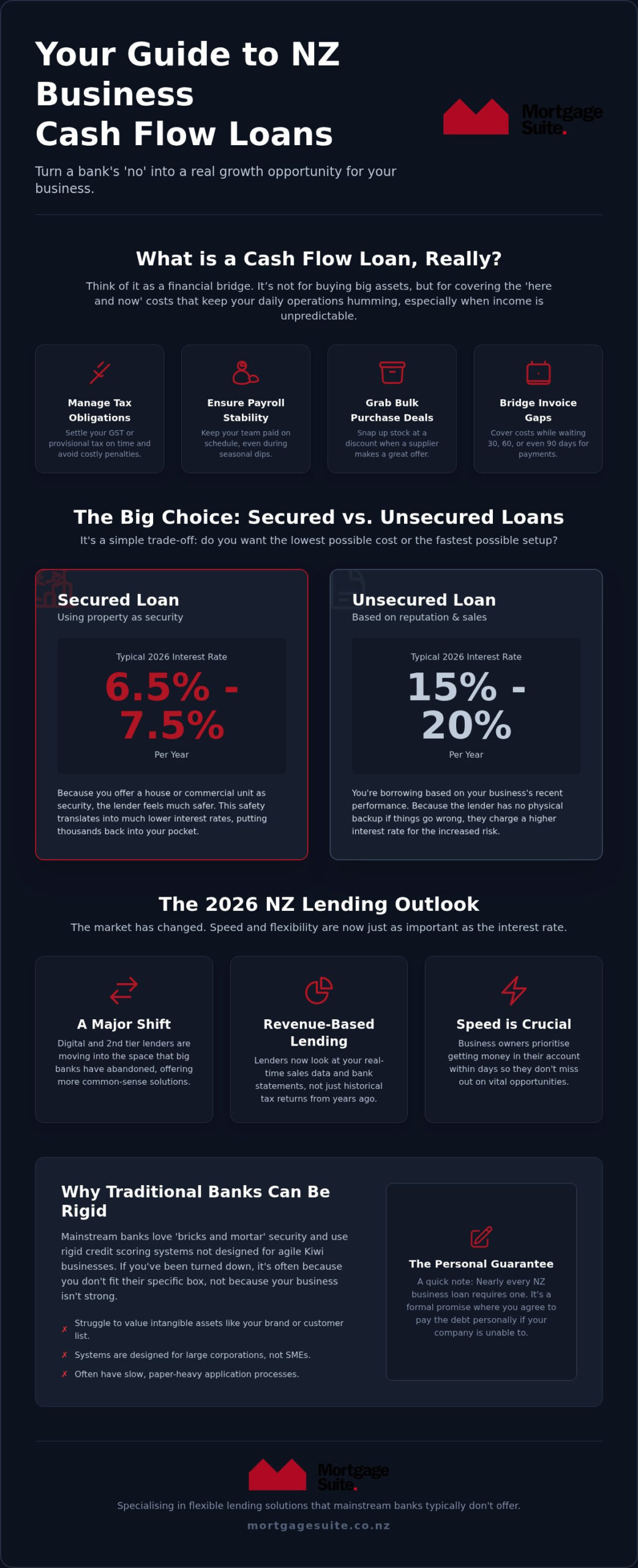
Think of a cash flow loan as a financial bridge that helps you get from one side of a busy month to the other. While a typical business loan is often used to buy big, long-term things like a new warehouse or a fleet of delivery vans, a cash flow loan is designed to keep your daily operations humming. It is money specifically meant to cover the “here and now” costs that keep a business alive. For many Kiwi business owners, money doesn’t always arrive in a perfectly straight line. You might experience busy periods followed by quieter months, or have large invoices that take time to clear. This is where flexible funding steps in to ensure you aren’t caught short when bills arrive.

These loans act as the lifeblood for small and medium businesses during growth spurts. When you’re expanding, you often have to spend money on staff and stock long before the new sales actually hit your bank account. Common ways our clients use these funds include:

  • Managing Tax Obligations: Settling your GST or provisional tax on time to avoid Inland Revenue penalties.
  • Payroll Stability: Ensuring your team is paid on time during seasonal dips or while waiting for large invoices to be cleared.
  • Bulk Purchasing: Snapping up stock at a discount when a supplier offers a limited-time deal.
  • Bridging Gaps: Covering the 30, 60, or 90-day wait periods common in commercial contracts.

It is different from a standard bank overdraft, which can often be reduced or cancelled by the bank at short notice. It also differs from a long-term commercial mortgage because the focus is on having enough cash on hand rather than decades of debt. If you have equity in your home or a commercial unit, a business loan against property nz can often provide a much more cost-effective solution than a high-interest loan that doesn’t use any security.

Why traditional banks often say no to cash flow

Mainstream banks love “bricks and mortar” security. They often struggle to see the value in things they can’t touch, like the value of your brand or reputation, your customer list, or your future contract pipeline. Their rigid credit scoring systems are designed for big corporations, not for agile Kiwi businesses that might have a fluctuating balance sheet. If you’ve been turned down because you don’t fit a specific bank box, it isn’t the end of the road. Using a business loan against property nz through a 2nd tier lender allows for a more common-sense approach where your property equity supports your business’s potential.

The 2026 outlook for NZ business lending

The lending environment in 2026 has changed significantly. Digital lenders and 2nd tier options have moved into the space that banks have abandoned. We are seeing a major shift toward revenue-based lending, where lenders look at your real-time sales data and bank statements rather than just historical tax returns. In this fast-paced market, speed and flexibility are becoming just as important as the interest rate. Business owners now prioritise getting the money in their account within days so they don’t miss out on vital opportunities.

Secured vs unsecured: Is a business loan against property right for you?

Deciding between a secured and unsecured loan usually comes down to a simple trade-off: do you want the lowest possible cost or the fastest possible setup? Borrowing money for your business means looking at how much you’re willing to pay for convenience. If you go for an unsecured loan, you are borrowing based on your reputation and your recent sales. Because the lender has no physical backup if things go wrong, they charge more. In 2026, these interest rates often sit between 15% and 20% per year.

If you choose a business loan against property nz, the picture changes. Because you are offering a house or commercial unit as security, the lender feels much safer. This safety translates into much lower interest rates, often around 6.5% to 7.5%. It’s a significant saving that can put thousands of dollars back into your pocket every month. It’s a big step to put an asset on the line, but for many Kiwi owners, the lower monthly repayments are what allow the business to grow sustainably.

You should also be aware of the Personal Guarantee. In the New Zealand lending world, almost every business loan requires one. It’s a document where you promise to pay the debt personally if your company can’t. It effectively means your personal assets are still connected to the loan, even if you don’t formally register a mortgage against them. It is a standard part of the process that ensures you are just as committed to the loan as the lender is.

Secured loans: Using your assets to grow

Security isn’t limited to your family home. Lenders in 2026 are often happy to look at commercial units, vehicles, or even heavy machinery. Sometimes, property development loans NZ can be used alongside cash flow funding to keep a project moving. The real benefit here is the borrowing limit. If you need more than NZ$250,000, having an asset to back the loan is usually the only way to get the green light from a lender.

Unsecured loans: Fast capital without the assets

If you’re in a service industry like consulting or trade work, you might not have big assets to pledge. Unsecured loans are perfect for these situations. Lenders check your bank statements and GST filings to see your sales volume. It’s a quick process with less paperwork, though you’ll pay those higher interest rates for the speed. If you’re weighing up which path is right for your current situation, exploring your options with an expert can help you find the best balance for your goals.

Moving beyond the Government SBC scheme: Private lending options

For many Kiwi businesses, the Small Business Cashflow Scheme (SBCS) provided a much-needed safety net during a time of total uncertainty. However, as we move through 2026, the landscape has shifted from government support to a focus on debt collection. Those five-year terms are reaching their final deadlines. If you still have an outstanding balance with the Inland Revenue, you’re likely facing the reality of fixed repayment schedules that don’t care about your seasonal dips. The IRD isn’t a bank; they don’t have the tools to offer the flexible, revenue-matched terms that a modern business needs to thrive.

This year is the perfect time to look at moving that debt into a private commercial facility. While the government scheme was a “one size fits all” fix, private lenders offer a much more tailored approach. For example, moving your existing debt into a business loan against property nz can drastically simplify your monthly outgoings. By using the equity in your home or commercial unit, you can secure a loan that fits your current business reality rather than sticking with a rigid government plan. It’s about taking control of your debt and ensuring your repayments work for you, not against you.

What to do if your SBC loan is expiring

The worst thing you can do is wait for the final deadline or a default notice. if your term is ending, start looking at your options now. Bundling your government debt along with any other high-interest business loans into one manageable payment makes your accounting much cleaner. It also gives you a chance to reset your cash flow. A broker can help you navigate this transition, acting as your advocate to find a lender that values your business’s future potential. We can help you move from government reliance to a more sustainable commercial independence.

The rise of 2nd tier lenders for Kiwi SMEs

Many business owners are surprised to find that a 2nd tier lender New Zealand can often be more helpful than a mainstream bank. These lenders are special because of the way they look at your business. Instead of a computer algorithm deciding your fate, a real person listens to your story and looks at your current bank statements. There’s a common myth that 2nd tier lending is only for businesses with bad credit, but that isn’t the case in 2026. Many of our most successful clients choose these lenders because they offer speed, flexibility, and a business loan against property nz that fits their specific sales cycle. It’s about finding a partner who understands the reality of running a business in the local market.

Cash Flow Loans for Small Business NZ: 2026 Funding Guide

How to get your business ready for a cash flow loan application

Preparing for a loan isn’t just about filling in a form and hoping for the best. It’s about showing a lender that you’re a safe pair of hands with a clear plan for the future. In 2026, lenders are faster than ever, but they’re also smarter. They use sophisticated software to scan your data in seconds, so your financials need to be sharp from the moment you hit submit. If you’re looking to secure a business loan against property nz, the first thing a lender will want to see is that your business has the “heartbeat” of consistent revenue to support the repayments.

Lenders generally focus on what we call the “Big Three” documents. These provide a transparent window into your business health without the need for hundreds of pages of jargon-filled reports. You will need:

  • Bank Statements: Usually the last six months of trading to show your daily cash ins and outs.
  • GST Returns: This proves to the lender that you’re meeting your obligations with the Inland Revenue.
  • A Simple Profit and Loss: A basic summary of your income and expenses over the last year.

Beyond the numbers, you need to be able to tell your story. Don’t just say you need “working capital.” Be specific. If you need NZ$80,000 to buy bulk inventory for the summer rush or to hire two new tradies for a large contract, say so. Lenders love a clear purpose because it shows you’re thinking like a strategist, not just someone trying to keep the lights on.

Cleaning up your financial house

Messy bank statements are a common reason for a fast “no.” If your business account is full of personal spending or small, unexplained transfers, it makes you look unorganised. Before you apply, take a month to keep things strictly business. It’s also vital to ensure you aren’t behind on any IRD payment plans. If you have a temporary dip in revenue or a one-off big expense, like a major equipment repair, be upfront about it. Explaining the “why” behind a dip is always better than letting a lender guess the reason. You can get a head start on your application by chatting with us about your current financial position.

The broker’s role in the application process

Many business owners make the mistake of applying to five different lenders at once. In the NZ market, every time a lender does a hard credit check, it leaves a mark on your file. Too many marks in a short time make you look desperate for cash, which can hurt your chances of approval. A broker acts as your advocate and negotiator. We take your “Big Three” documents and package them in a way that highlights your strengths. Because we know which 2nd tier lenders are currently looking for businesses in your specific industry, we can find the right business loan against property nz without damaging your credit score. We do the hard work so you can stay focused on running your business.

How Mortgage Suite helps you secure the best business finance

Navigating the finance market alone can feel like a full-time job. With over 20 years of banking experience, we’ve seen how the big banks operate from the inside. This insider knowledge is what we use to act as your dedicated negotiator. We don’t just look at a spreadsheet; we look at the person behind the business. Our approach is built on finding the lenders that the general public often misses. While a single bank will only ever show you their own products, we provide a market-wide view that includes 2nd tier options and private funds specifically designed for Kiwi SMEs.

When you’re looking for a business loan against property nz, you need more than just an interest rate. You need a structure that won’t cripple your growth. We take the stress out of the process by providing jargon-free, honest advice. There are no hidden fees or complex financial shorthand here. We speak your language and focus on the result: getting the capital you need to move forward without the usual bank headaches.

More than just a loan: a financial partnership

We believe in looking at your entire financial world. This means considering how your personal debt and mortgage rates NZ might impact your business borrowing capacity. Often, there’s a gap between where your business is today and where you want it to be in twelve months. We help you bridge that gap by acting as your advocate. When we deal with 2nd tier lenders on your behalf, we aren’t just submitting a form. We are presenting a case for why your business is a sound investment, ensuring you get terms that reflect your true potential and current market conditions.

Your next steps to better cash flow

Getting started is as simple as a phone call. We don’t believe in high-pressure sales tactics or making you wait for weeks just to get an initial answer. When you call us, you’ll get a conversational, helpful partner who listens first. We’ll discuss your goals, look at your options for a business loan against property nz, and map out a clear path forward. From that first chat to having funds in your account, the process is designed to be as seamless as possible. You’ve done the hard work of building your business; let us do the hard work of funding it. Contact Mortgage Suite Ltd today for a no-obligation chat about your business goals.

Take control of your business cash flow today

Managing the ups and downs of business revenue doesn’t have to be a solo struggle. Whether you’re transitioning away from the expiring government scheme or looking to fund a major new contract, the right capital structure makes all the difference. Remember that speed and flexibility often outweigh a slightly lower bank rate, especially when a growth opportunity is waiting. Using a business loan against property nz remains one of the most effective ways to secure lower interest rates and higher limits for your enterprise.

At Mortgage Suite, we bring over 20 years of banking expertise to the table as a 100% Kiwi owned and operated team. We specialise in 2nd tier and alternative lending, finding the solutions that mainstream banks simply can’t offer. You don’t have to navigate the jargon or the complex applications alone. We are here to act as your dedicated advocate and negotiator. If you’re ready to stop worrying about the next GST bill and start focusing on your long-term goals, book a free, no-obligation chat with our business lending experts. Your next stage of growth is closer than you think.

Frequently Asked Questions

What is the typical interest rate for a small business cash flow loan in NZ?

Interest rates depend largely on whether the loan is secured or unsecured. For a business loan against property nz, you can currently expect rates between 6.5% and 7.5% p.a. in the 2026 market. If you choose an unsecured option, rates are higher to reflect the increased risk to the lender, typically ranging from 15% to 20% p.a. based on your trading history.

Can I get a business loan if I’ve been declined by my main bank?

Yes, you certainly can. Mainstream banks often have very rigid criteria that don’t account for the unique way Kiwi SMEs operate. We specialise in 2nd tier lending, where providers use human-led underwriting to look at your current bank statements and future potential. A “no” from a big bank is often just a sign that you need a more flexible lender who understands your industry.

Do I need to provide my house as security for a cash flow loan?

Not necessarily. While a business loan against property nz offers the lowest interest rates, you can also use commercial units, vehicles, or heavy machinery as collateral. If you don’t want to use any physical assets, you can opt for an unsecured loan. These are faster to set up but usually come with higher interest rates and lower borrowing limits.

How long does it take to get the money once the loan is approved?

Speed is a major benefit of modern business lending. Once your loan is approved, funds are often transferred to your bank account within 24 to 48 hours. If your loan is secured against property, the process can take a few extra days for valuations and legal paperwork, but it is still significantly faster than the weeks of waiting often required by traditional banks.

What is the difference between a cash flow loan and a business line of credit?

A cash flow loan provides a lump sum of money upfront which you repay over a set term with fixed payments. A business line of credit works more like a credit card; you have a pre-approved limit and you only draw down funds when you need them. You only pay interest on the amount you actually use, making it a flexible tool for managing ongoing daily expenses.

Can I use a cash flow loan to pay my GST or tax bill?

Yes, this is one of the most common reasons New Zealand business owners seek short-term funding. Using a loan to settle GST or provisional tax helps you avoid the high interest and late payment penalties charged by the Inland Revenue. It allows you to spread the cost of your tax obligations over several months, keeping your daily working capital intact for growth.

Is there a penalty for paying back my business loan early?

Most 2nd tier and non-bank lenders in the current market do not charge penalties for early repayment. In many cases, paying the loan back early can actually save you a significant amount in interest. However, it is important to check the specific terms of your agreement, as some older or more traditional contracts may still include early exit fees.

What documents do I need to provide for an unsecured business loan?

Lenders typically require what we call the “Big Three” documents to assess an unsecured application. You will need to provide your last six months of bank statements, your most recent GST returns, and a basic profit and loss statement. These documents give the lender a clear picture of your recent revenue and help them confirm that the repayments are affordable for your business.

Article by

Krish Krishna

Experienced Financial Adviser with over 46 years of Banking and Mortgage broking experience and over $2.0 Billion in loan settlements.