

Rental Property Loan Requirements NZ: Your 2026 Guide to Getting Sorted

What if the biggest barrier to growing your portfolio isn’t the size of your bank balance, but simply knowing which door to knock on? It is a common hurdle in 2026, where lending rules seem to change just as you are getting comfortable. Many Kiwis feel stuck between confusing LVR limits and those strict debt-to-income ratios that can make mainstream banks feel out of reach. It is exhausting trying to keep up with interest deductibility changes while worrying if your cash flow can handle a 9% stress test. We understand that behind every application is a goal for your family’s future, not just a set of numbers on a spreadsheet.

This guide clears the air by detailing the specific rental property loan requirements nz lenders expect right now. You will discover how to use existing equity instead of cash, the difference between buying new versus existing properties, and the checklist you need to apply with total confidence. Whether you are looking at a 30% deposit for an existing home or a 20% deposit for a new build, we provide the professional roadmap to help you get your investment plans sorted.

Key Takeaways

  • Understand why a 30% deposit is the standard starting point for existing homes and how new builds might offer a path with just 20% down.
  • Learn how lenders “shade” your rental income and what you need to meet the rental property loan requirements nz banks use to test your serviceability.
  • Identify which property types are on the bank’s “black list” to ensure the home you choose is actually one they are willing to fund.
  • Discover how 2nd tier lenders can provide a lifeline if a mainstream bank says no, giving you a second chance at securing your investment.
  • Use our practical checklist to tidy up your personal spending and gather the “paperwork powerhouse” needed for a stress-free application.

The 2026 Deposit and Equity Rules for NZ Landlords

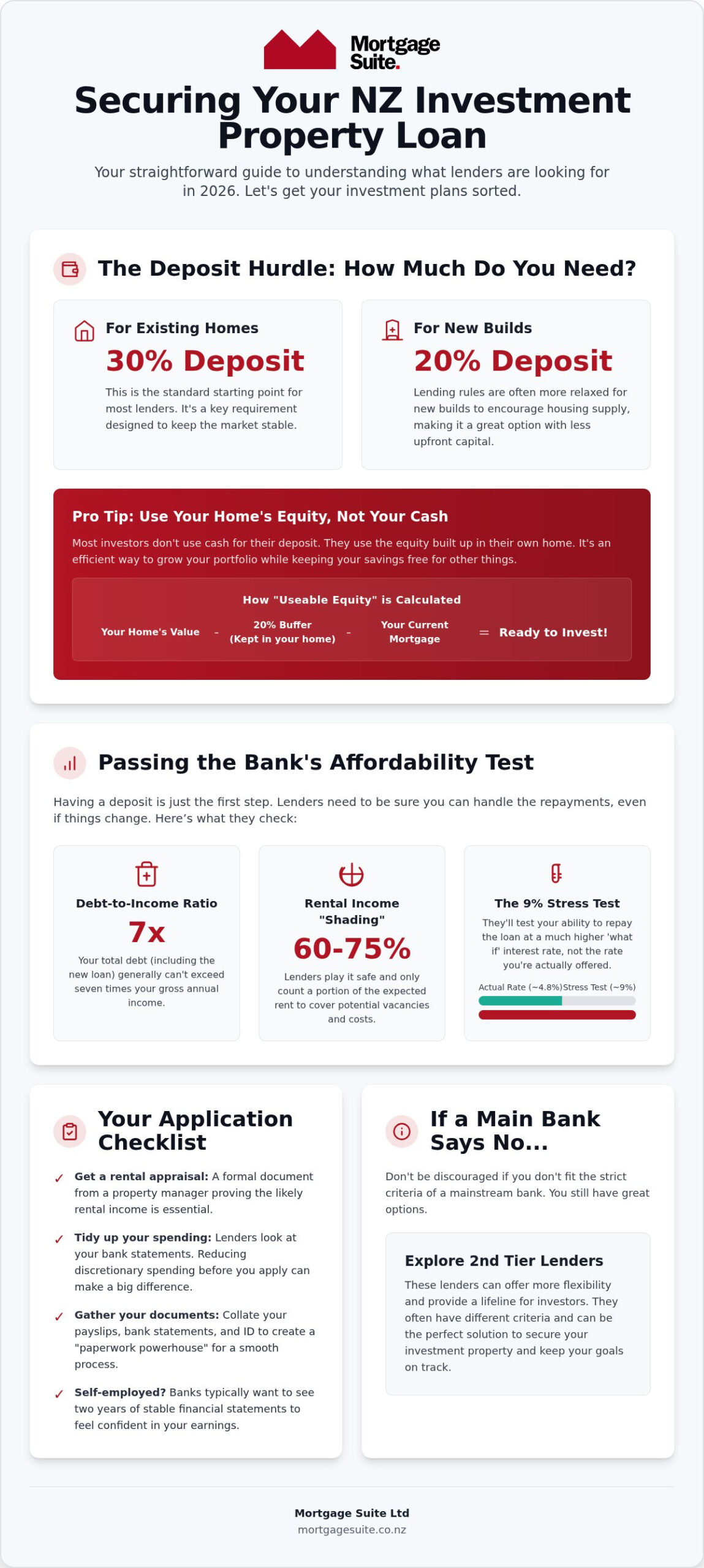
Standard bank policy for an existing investment property usually starts with a 30% deposit. While this might feel like a high bar to clear, it is designed to ensure the market remains stable. If you are looking at a brand-new build, the rules are often more relaxed; many lenders only require a 20% deposit. This exemption is a strategic way to encourage more supply in the market, making it a popular choice for those looking to meet the rental property loan requirements nz lenders set with less upfront capital.

We are also seeing a rise in “rentvesting” across the country. This is where first-home buyers choose to rent where they want to live while buying a rental property in a more affordable area. Because the Housing in New Zealand market has become so varied, this strategy allows people to get a foot on the ladder without sacrificing their lifestyle. It is a clever way to build wealth while the 2026 market continues to evolve.

Calculating Your Useable Equity

Most of our clients do not actually use cash for their deposit. Instead, they use the equity built up in their own home. Banks generally want you to leave a 20% buffer in your primary residence. Anything above that 20% mark is what we call “lendable equity.” For example, if your home is worth NZ$1,000,000 and your mortgage is NZ$500,000, your lendable equity isn’t the full NZ$500,000. It is the amount above the NZ$200,000 buffer, which is 20% of the value. To find your specific “magic number” and see how much you could potentially borrow, our mortgage calculator is an excellent place to start your planning.

Cash vs. Equity: Which is Better?

Choosing between using cash or equity often comes down to your long-term goals and tax structure. Since 1 April 2025, property investors can claim 100% of their mortgage interest as a tax-deductible expense. This makes borrowing for an investment property quite efficient. Many seasoned investors prefer to keep their cash in an offset account or a high-interest savings fund for emergencies, while using home equity to fund the rental purchase. This approach keeps your personal and investment debt separate and easy to manage. With property values shifting, 2026 is the perfect time to get a fresh valuation. You might find you have more “house power” than you realised a year ago.

Income and Serviceability: Proving You Can Handle the Repayments

Serviceability is essentially the bank’s way of asking, “Can you still afford this loan if life gets expensive?” While having a deposit is a great start, proving you can handle the ongoing repayments is often the biggest hurdle for investors. In 2026, meeting the rental property loan requirements nz lenders demand involves more than just showing a decent salary. Banks are now looking closely at your Debt-to-Income (DTI) ratio. For most investors, your total debt cannot exceed seven times your gross annual income. It is a firm boundary that has changed how many Kiwis approach their next purchase.

Lenders are also very cautious about how they calculate your potential earnings. They don’t just take your expected rent at face value. Instead, they “shade” the income, usually only counting between 60% and 75% of the total rent. This buffer accounts for times when the property might be empty, or when you have to pay for unexpected repairs and rates. On top of that, even if you secure a fixed rate around 4.8%, the bank will stress-test your application at a much higher rate, currently around 9%. They want to be absolutely certain you are protected if interest rates climb in the future.

Rental Yield and Appraisals

Before a bank gives you the green light, they will require a formal rental appraisal from a registered property manager. This document proves what the property is likely to earn in the current market. Choosing a property with a high rental yield is vital because it directly supports your serviceability calculation. You need to look beyond the purchase price and consider the net income after insurance, maintenance, and council rates are paid. If the numbers are tight, the bank may see the property as a risk rather than an asset. If you are unsure how your specific income will be viewed, you can learn more about our approach at Mortgage Suite Ltd.

Self-Employed and Unique Income

If you work for yourself, the paperwork trail is a bit more involved. Banks typically want to see two years of stable financial statements to feel confident in your earning power. We often help clients present their “business story” to lenders, highlighting growth and consistency that a simple tax return might miss. For those whose situations don’t fit the rigid boxes of mainstream banks, 2nd tier lenders can be a fantastic alternative. They often offer more flexibility for self-employed individuals or those with unique income streams, ensuring your investment goals don’t stall just because of a complex payslip.

Property Requirements: What Kind of House Will the Bank Fund?

When you apply for a loan, the bank isn’t just looking at your bank statements; they are looking at the house itself. If a property is hard to sell, it is hard to finance. This is why the physical state and legal title of the house are central to rental property loan requirements nz. Some properties are on a “black list” for major lenders. This includes tiny homes under 40 square metres, properties with monolithic cladding and no cavity system, or the notorious “leaky buildings.” If a house has structural issues or significant unconsented work, most banks will simply walk away. They want security that holds its value, not a project that might become a liability.

Title types also play a huge role in your success. A fee simple title is the gold standard because you own the land and the building outright. Cross-lease and unit titles are common in our major centres, but they require extra homework. For unit titles, the bank will want to see the last few years of body corporate minutes and proof of full replacement insurance. If the body corporate has a poor maintenance history or a low sinking fund, the bank might see it as a risk. It is about ensuring there are no hidden costs that could sink your ability to pay the mortgage.

The New Build Advantage

Buying brand new has become a popular strategy for meeting the rental property loan requirements nz because of the LVR exemptions. As we mentioned earlier, you can often get in with a 20% deposit instead of the usual 30%. The government and banks prefer these because they increase the housing stock for all Kiwis. However, 2026 has taught us to be cautious with sunset clauses. If a project is delayed or a builder runs into financial trouble, you need to ensure your contract protects your deposit and gives you an out if things go south.

Healthy Homes and Compliance

Since 1 July 2025, every private rental in New Zealand must comply with the Healthy Homes Standards. If a property doesn’t meet these rules for heating, insulation, or ventilation, it is a massive red flag for a lender. They may even withhold part of the loan until you prove the work is finished. We always recommend checking the council’s Land Information Memorandum (LIM) for unconsented works before you sign a sale and purchase agreement. If you are planning a “fixer-upper,” talk to us early. We can often help you structure the loan to include those renovation costs from day one, making the process much smoother.
Rental Property Loan Requirements NZ: Your 2026 Guide to Getting Sorted

When the Big Banks Say No: Exploring 2nd Tier Lending

Getting a decline from a mainstream bank can feel like a dead end. But in the 2026 property market, it is often just a sign that you don’t fit a very narrow, rigid set of rules. The “Big Four” banks are heavily restricted by debt-to-income (DTI) ratios and aggressive stress testing. If your situation is even slightly outside the norm, you might struggle to meet the standard rental property loan requirements nz banks demand. This is exactly why 2nd tier lenders exist. They offer a lifeline to investors who have a strong strategy but don’t quite match the high-street profile. For a deeper look at these options, check out our guide on 2nd tier lenders in New Zealand.

Non-bank lenders are particularly helpful if you have a “credit blip” from the past, a complex income structure as a contractor, or if you are slightly short on the standard 30% deposit for an existing home. They don’t just look at a computer-generated score; they look at the person behind the application. They understand that a temporary dip in income or a missed bill three years ago doesn’t necessarily make you a high-risk borrower today.

The Pros and Cons of Non-Bank Loans

The main trade-off with a non-bank lender is cost versus flexibility. You will likely pay a higher interest rate than the 4.79% or 4.99% fixed rates currently offered by major banks. However, the benefits often outweigh the extra interest. Non-bank lenders can move much faster, sometimes providing an answer in days rather than weeks. They are also more willing to look at the “big picture” of your finances. We often use these loans as a bridge; you secure the property now, and once you have a year of clean accounts or the property value increases, we help you refinance back to a mainstream bank at a lower rate.

How Mortgage Suite Negotiates for You

We specialise in loans that do not fit standard bank criteria. With over 20 years of banking experience, we know exactly how to package your application to show a lender why you are a good bet. We act as your advocate, negotiating with both banks and private lenders to find the best possible fit for your goals. We have helped many investors get “sorted” after being turned away elsewhere. If you have been told “no” by your bank, reach out to us today to explore your alternative options and get your investment plans back on track.

How to Get Your Loan Approved: A Practical Checklist

Once you understand the deposit rules and property types, it’s time to get your own house in order. Meeting the rental property loan requirements nz lenders set is much easier when you present a clean, organised financial profile. Banks don’t just look at what you earn; they look at how you spend. Preparation is the difference between a quick “yes” and a frustrating “we need more information” email. By taking a few intentional steps before you submit your application, you can significantly increase your chances of success.

Getting a pre-approval is your most powerful tool. It allows you to hunt for properties with confidence, knowing exactly what your budget is. In a competitive market, being able to make an unconditional offer because your finance is already sorted gives you a massive edge over other buyers. It turns you from a “maybe” into a serious contender in the eyes of real estate agents and sellers.

Your 30-Day Pre-Application Plan

In the month leading up to your application, you should enter a “clean up” phase. Banks typically look at your last three to six months of bank statements to gauge your spending habits. Small changes can make a big impact on your serviceability. We recommend focusing on these key areas:

  • Reduce credit limits: Even if you don’t use your credit cards, the bank counts the full limit as a potential debt. Lowering a NZ$10,000 limit to NZ$2,000 can boost your borrowing power.
  • Close BNPL accounts: Accounts like Afterpay or Zip are viewed as debt. It is best to close these and show you can manage your lifestyle without them.
  • Show consistent savings: Ensure your statements show that you are living within your means and, ideally, still adding to your equity or savings.

Booking a chat with Krish early in this process is a smart move. We can help you map out your long-term goals and identify any potential red flags before the bank sees them. You can see how we have helped other Kiwis navigate this journey by reading our reviews.

The Power of a Mortgage Broker

Going directly to your local bank branch limits you to just one set of rules. If you don’t fit their specific criteria, they will simply say no. As your broker, we compare dozens of different lenders, from the big high-street names to specialised 2nd tier providers. We know which lenders are currently “hungry” for investment business and which ones have the most flexible rental property loan requirements nz investors can benefit from. We take the stress out of the back-and-forth negotiations, using 20 years of banking experience to advocate for your best interests. We don’t just find you a loan; we find you the right strategy for your future.

Ready to Grow Your Property Portfolio?

Getting your investment property sorted in 2026 doesn’t have to be a source of stress. While the rental property loan requirements nz banks use are strict, they are much easier to manage when you have a clear plan. Remember that a 30% deposit is standard for existing homes, but new builds offer a faster path with only 20% down. Most importantly, don’t let a “no” from a mainstream bank stop you. There are flexible 2nd tier options available that can bridge the gap while you build equity and clean up your accounts.

With over 20 years of banking experience, we have seen every scenario and know how to negotiate on your behalf. We provide national coverage to help Kiwis secure residential investment loans that actually fit their unique situation. Our team specialise in complex approvals and 2nd tier lending, acting as your mentor through the entire process. Talk to Krish and the team at Mortgage Suite about your investment goals today and let’s get your next property purchase across the line. Your future portfolio is waiting.

Frequently Asked Questions

Do I really need a 30% deposit for a rental property in NZ?

A 30% deposit is the standard requirement for existing properties, but you can often secure a new build with just 20% down. This difference exists because the government wants to encourage more housing supply. If you don’t have the cash, we can look at using the equity in your current home to meet these rental property loan requirements nz lenders have in place. It’s a common strategy that lets you grow your portfolio without touching your savings.

Can I use my KiwiSaver to buy an investment property?

No, you cannot use your KiwiSaver funds to purchase an investment property. KiwiSaver is strictly designed for your first home, which you must live in, or your retirement. While it is a great tool for getting on the ladder initially, once you move into the world of residential investment, you will need to rely on your own cash savings or the equity built up in your current home instead.

What is the Bright-line test and does it affect my loan?

The Bright-line test is a tax on any profit you make if you sell a residential property within a specific timeframe. While it doesn’t directly change your mortgage approval, lenders consider it part of your overall financial strategy. If you plan to sell quickly, you need to account for the tax hit on your capital gains. Always talk to an accountant to see how this fits with your long-term investment goals.

How does interest deductibility work for landlords in 2026?

From 1 April 2025, property investors can claim 100% of their mortgage interest as a tax-deductible expense. This is a significant change that has improved cash flow for many Kiwi landlords in 2026. When we assess your rental property loan requirements nz, this deductibility makes the property’s income look much stronger on paper. It essentially reduces your taxable income, making the investment more sustainable over the long term.

Will the bank consider the potential rent as part of my income?

Yes, banks will certainly count your potential rental income, but they won’t use the full amount. Most lenders “shade” the rent, typically only counting 60% to 75% of what the property manager’s appraisal suggests. This buffer covers costs like insurance, rates, and maintenance. They want to ensure you can still meet your repayments even if the property is empty for a few weeks or costs more to run than expected.

What happens if my rental property sits vacant for a few weeks?

Lenders expect your property to be vacant occasionally, which is why they only count a portion of the rental income during your application. Having a small “rainy day” fund is essential for covering the mortgage during these gaps. If a property sits empty for longer than expected, it can impact your cash flow, but a well-structured loan with a bit of a buffer will keep your investment safe while you find new tenants.

Is it harder to get a loan for an apartment than a house?

It can be slightly more complex to finance an apartment than a standalone house. Lenders have strict rules about size, often requiring the apartment to be at least 40 square metres excluding balconies. They also look closely at the body corporate minutes and the building’s maintenance history. If the apartment is too small or the building has structural issues, mainstream banks might decline the loan, though 2nd tier lenders can sometimes help.

Can I get an interest-only loan for my rental property?

Yes, interest-only loans are a popular choice for many New Zealand investors. They allow you to keep your monthly repayments lower, which can help with your initial cash flow. Most banks will offer an interest-only period of one to five years before requiring you to switch to principal and interest. It’s a strategic way to manage your finances, especially if you are focusing on capital growth rather than paying down debt immediately.

Article by

Krish Krishna

Experienced Financial Adviser with over 46 years of Banking and Mortgage broking experience and over $2.0 Billion in loan settlements.

Buying a Tenanted Property in NZ: 2026 Buyer Guide

Imagine finding your dream home at the perfect price, only to realise someone else is already calling it home. It is a common scenario when buying tenanted property nz buyers often face, and it usually brings a wave of “what ifs.” You might be worried that an existing lease will block your KiwiSaver withdrawal or that you will be stuck in a legal tug-of-war over move-in dates. It is completely natural to feel a bit of floor-shaking anxiety when the phrase “vacant possession” starts appearing in your sale and purchase agreement.

We have spent years helping Kiwis navigate these exact hurdles, and we know that a tenanted property does not have to be a deal-breaker. This guide is designed to take the stress out of the process by showing you how to handle the legal and financial maze with confidence. You will learn about the latest 2026 notice periods, how to structure your loan so the bank stays happy, and exactly what you need to do to ensure your transition to either landlord or homeowner is seamless. From Healthy Homes compliance to the nitty-gritty of the Residential Tenancies Act, we have mapped out a clear path forward for your next move.

Key Takeaways

  • Get clear on the 2026 notice periods, such as the 42-day requirement for periodic tenancies when you need the home for yourself.
  • Learn how buying tenanted property nz changes your deposit needs, as banks often look for a 30-35% stake if you aren’t moving in straight away.
  • Master the “vacant possession” clause in your sale and purchase agreement to ensure you don’t end up with unexpected delays on settlement day.
  • Verify that the home meets the full Healthy Homes Standards to protect yourself from heavy fines and ensure your investment is up to scratch.
  • Discover how to structure your finance correctly so you can secure a loan even when a property already has tenants.

The Basics of Buying a Tenanted Property in NZ

When you’re browsing property listings, you’ll often see phrases like “tenanted” or “ideal investment opportunity” popping up. A tenanted property purchase is a sale where an existing rental agreement remains in place at the time of the offer. This means you aren’t just buying bricks and mortar; you’re stepping into the middle of a legal relationship between a landlord and a tenant. It’s a unique path that requires a bit more homework than a standard house hunt.

For some buyers, this setup is a huge plus. If you’re looking for a residential investment, having a tenant already paying rent from day one is a dream. For others who want to move in themselves, it can feel like a bit of a hurdle. These properties sometimes have a different vibe because the presentation depends on the tenant rather than a professional staging company. You might even find the price point is slightly more attractive because the pool of buyers is smaller; many first home buyers shy away from the perceived complexity of Landlord-tenant law and the extra paperwork involved.

Fixed-Term vs. Periodic Tenancies: Why It Matters

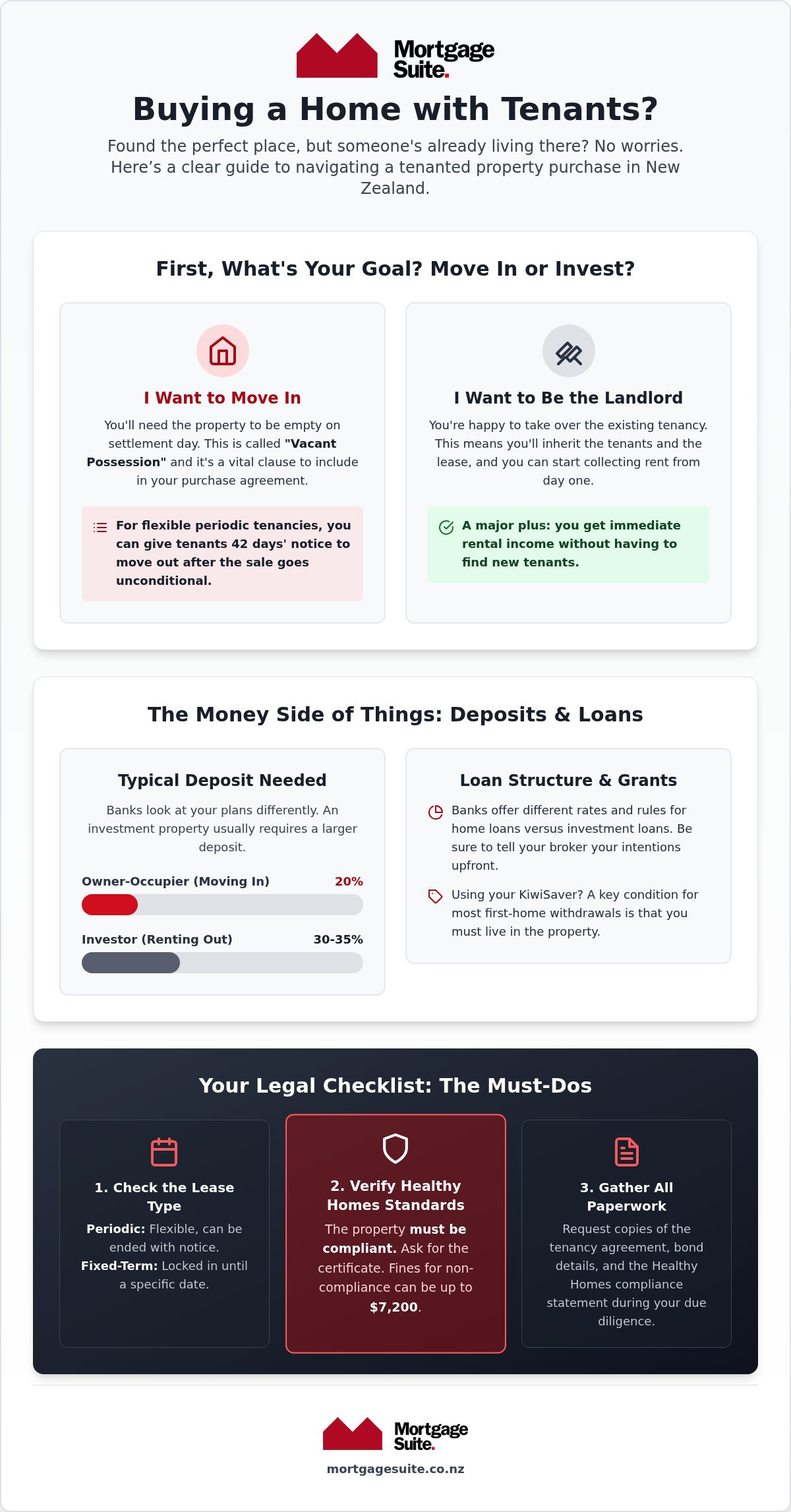
The type of tenancy agreement in place is the most important detail you need to uncover. A periodic tenancy is quite flexible. If you want to move in, you can usually give the tenants 42 days’ notice once the sale goes unconditional. However, a fixed-term tenancy is a different beast altogether. These are locked in until a specific date. Unless the tenant agrees to leave early in writing, you can’t ask them to move out just because you bought the house. You can usually spot the difference by checking the “Tenancy” section of the sale and purchase agreement or asking the agent for a copy of the lease before you make an offer.

Understanding Your Rights as a Prospective Buyer

You have a right to know exactly what you’re taking on, but you must respect the tenant’s privacy. The seller is required to provide details about the current lease, including the rent amount and the bond status. It’s also vital to ask for the Healthy Homes compliance certificate early in your due diligence. Since July 2025, all private rentals must meet these standards without exception. If the property isn’t compliant, you could be looking at a $7,200 fine from the Tenancy Tribunal shortly after you take over. When buying tenanted property nz regulations require total transparency from the seller, so don’t be afraid to ask for every scrap of paperwork before you commit your hard-earned deposit.

The “Vacant Possession” Clause: Your Most Important Decision

When you’re looking at the sale and purchase agreement, “vacant possession” is the most important phrase you’ll encounter. In plain English, it’s a legal promise from the seller that the property will be empty and ready for you to walk into on settlement day. If you’re buying tenanted property nz for your own home, this clause is your safety net. Without it, you are essentially agreeing to take over the existing rental arrangement, which could leave you with a moving truck full of furniture and nowhere to put it if the tenants are still there.

The risks of a messy settlement are real. If the tenants haven’t moved out by the agreed time, the seller hasn’t met their contract obligations. This can lead to expensive delays, penalty interest, and a lot of unnecessary stress. This is why your lawyer and mortgage broker need to be perfectly aligned. Your broker needs to know your move-in plans because banks view a home loan differently than an investment loan. If you’re unsure how this affects your borrowing power, chatting with a specialist from Mortgage Suite Ltd who understands residential investment property loans is a smart first step to keep your finance on track.

Moving In: How to Ensure the House is Empty

According to the Residential Tenancies Act 1986, the rules for ending a tenancy during a sale are quite specific. If the tenants are on a periodic agreement, the landlord must give them at least 42 days’ notice to leave once the sale goes unconditional. Timing is everything here. You’ll want to ensure your settlement date is set far enough in the future to allow for this notice period. On move-in day, do a final inspection early. Check that the house is empty and clean before the money changes hands to avoid any “surprises” after you’ve already paid.

Becoming a Landlord: Taking Over the Tenancy

If you’ve decided to keep the tenants on, the transition is usually quite straightforward. You don’t necessarily need to sign a brand-new agreement the moment you take over, as the existing one remains valid. However, you and the seller must complete a “Change of Landlord” form to transfer the bond over to your name with Tenancy Services. It’s also a great time to review the current rent. If it hasn’t been adjusted for a while, you might find it’s sitting below the current market rate, which could impact your return on investment. Just remember that you’ll need to follow the proper legal steps if you decide to increase the rent later on.

How Existing Tenants Affect Your Mortgage and Grants

When you’re buying tenanted property nz, the bank doesn’t just look at the price tag; they look at who is going to be sleeping in the bedrooms. This is where your financial plan can get a bit tricky. If you intend to keep the tenants and run the property as a rental, most mainstream banks will ask for a significantly larger deposit. Usually, you’ll need between 30% and 35% of the property’s value upfront. This is a big jump from the 20% deposit often required for a home you plan to live in yourself. The bank sees investment properties as a slightly higher risk, so they want more of your own skin in the game.

There is a silver lining, though. If you are keeping the tenants, you can often use a portion of that rental income to help you qualify for a larger loan. The bank will “shade” the rent, usually counting about 75% of it towards your income, which can give your borrowing power a helpful boost. Because these details can change your budget overnight, a conditional offer is your best friend. It gives you the breathing room to talk to your broker and ensure the bank is happy with the tenancy setup before you’re legally locked in.

KiwiSaver and First Home Grant Hurdles

If you’re a first home buyer, having tenants in the house can create some serious roadblocks for your grants and KiwiSaver withdrawals. To use these funds, you generally have to follow the “owner-occupier” rule, which means you must intend to live in the home as your primary residence for at least six months. If the property has a fixed-term tenant who isn’t leaving for another year, you might find yourself disqualified from using your KiwiSaver altogether. First Home Grant recipients must move into the property within a specific timeframe after settlement. If a long notice period or a stubborn lease prevents you from moving in quickly, you could be asked to pay that grant money back.

Meeting Bank Criteria for “Owner-Occupied” Loans

Banks can be quite particular about proving your intent to move in. If you’re buying tenanted property nz with the goal of making it your home, the bank will want to see a clear plan for when the tenants are leaving. They may even ask to see the “vacant possession” clause we talked about earlier. If there’s any doubt, the bank might re-classify your loan as a residential investment deal. This could mean a higher interest rate and a requirement for that much larger deposit. It’s vital to get a pre-approval that covers both scenarios so you aren’t caught off guard if the tenancy status complicates your application.

Buying a Tenanted Property in NZ: 2026 Buyer Guide

Once you have sorted your finance, it is time to roll up your sleeves and look at the paperwork. Getting the legal details right is what separates a smooth move from a settlement day disaster. When you are buying tenanted property nz, you need a clear checklist to ensure nothing slips through the cracks during the due diligence phase. Following these five steps will help you stay in control of the process.

  • Step 1: Verify the tenancy type. Do not just take the agent’s word for it. Request a copy of the signed tenancy agreement to confirm if it is periodic or fixed-term.
  • Step 2: Tick the right box. Ensure your lawyer checks that the “vacant possession” box is definitely ticked in the sale and purchase agreement if you plan to move in.
  • Step 3: Confirm the notice. Ask for written proof that the vendor has issued the legal notice to the tenants. The clock only starts ticking once this is officially served.
  • Step 4: The final walk-through. Conduct your pre-settlement inspection as close to the big day as possible. You want to see an empty, tidy house that matches the condition it was in when you signed.
  • Step 5: Organise your insurance. You are responsible for the property the moment the deal is done. Make sure your insurance policy is active and specifically covers your situation, whether you are a homeowner or a landlord.

If you feel overwhelmed by these steps, remember that you do not have to do it alone. You can apply for a home loan with Mortgage Suite Ltd, a team that knows exactly how to guide you through these legal requirements so you can focus on the excitement of your new purchase.

The 90-Day Notice Period Explained

Under the rules in 2026, there are two main notice periods you need to know about for periodic tenancies. If you have bought the house and want to move in yourself, the landlord only needs to give 42 days’ notice once the sale is unconditional. However, if you just want the tenants to leave without a specific reason, such as to start major renovations, the notice period is 90 days. You can sometimes negotiate a shorter timeframe if the tenants find a new place earlier, but they aren’t legally required to leave a day before their notice expires. If they do find a “perfect” new flat and want to head off early, it’s usually best to be flexible to ensure a friendly handover.

Healthy Homes Standards and Your Liability

By July 2026, the grace period for Healthy Homes compliance is long gone. Every private rental in New Zealand must now meet strict standards for heating, insulation, and ventilation. The moment you settle on the property, any non-compliance becomes your problem. If the house doesn’t meet the grade, you could be facing a fine of up to $7,200 from the Tenancy Tribunal. Use your due diligence period to check the compliance statement thoroughly. If the property is lacking, this is a powerful negotiation point to ask for a price reduction to cover the cost of the necessary upgrades.

How Mortgage Suite Ltd Helps You Secure a Tenanted Property

Purchasing a home with people already living in it adds a layer of complexity that can make even the most confident buyer feel a bit wobbly. That is where we step in. Mortgage Suite Ltd looks at your entire financial picture, from your KiwiSaver withdrawal eligibility to your twenty-year investment goals. Our role is to act as your advocate, ensuring that buying tenanted property nz becomes a straightforward step toward your future rather than a source of late-night worry. We believe in building a partnership with you, providing a steady hand as you move through the fluctuating 2026 market.

Sometimes, the big mainstream banks can get a bit “cold feet” when a tenancy agreement doesn’t fit their standard boxes. If a property is perfect but the lease is slightly unusual or the Healthy Homes paperwork is still being finalised, we have the expertise to access 2nd tier loans. These options are designed for clients who don’t fit the rigid criteria of the major banks. This flexibility means we can often find a professional path forward where others see a dead end. Mortgage Suite Ltd takes the stress out of the mountain of paperwork so you can focus on the practicalities of your move.

Why a Seasoned Broker is Your Best Mate

We do more than just find a rate; we negotiate with lenders to ensure your loan is coded correctly from the start. This is vital because a loan misclassified as “investment” when you intend to move in can cost you thousands in higher interest or deposit requirements. Our team deeply understands the fine print of residential investment property loans NZ buyers need to master. If your move-in date gets delayed due to tenant notice periods, we can help you bridge that gap with the bank so your finance remains secure and your settlement stays on track.

Organising Your Finance for a Stress-Free Settlement

Acting fast is the key to success in the current environment. Getting your pre-approval sorted early means you can walk into a tenanted property viewing knowing exactly what you can afford to bid. Mortgage Suite Ltd provides clear, jargon-free advice on mortgage rates nz banks are currently offering, helping you weigh up the costs against the potential rental return. Our goal is to help you decide if a specific property is a “fair go” for your financial health. We give you the confidence to sign that agreement knowing your back is covered, because we believe buying tenanted property nz should be a reward, not a burden.

Ready to Turn That Tenanted Listing into Your Next Home

Buying tenanted property nz doesn’t have to be a legal headache or a financial mystery. By now, you know that getting the “vacant possession” clause right and understanding the 2026 notice periods are the keys to a successful settlement. Whether you’re planning to move in yourself or you’re ready to start your journey as a landlord, the secret is in the preparation. You need to ensure your deposit is structured correctly and that your KiwiSaver eligibility stays protected throughout the process.

We have spent over 20 years navigating the banking world to help Kiwis just like you secure their future. As specialists in home loans for first home buyers New Zealand, we know how to handle the fine print that often trips up others. We’re here to act as your mentor and advocate, making sure you get a fair go with the lenders. Talk to the team at Mortgage Suite about your property goals today and let’s get your next move sorted with confidence. You’ve got this, and we’ve got your back.

Frequently Asked Questions

Can I use my KiwiSaver to buy a house that currently has tenants?

Yes, you can use your KiwiSaver, but you must intend to live in the property as your primary home for at least six months. The main challenge when buying tenanted property nz with KiwiSaver funds is the timing. You need to ensure the tenants can legally move out so you can move in within a reasonable timeframe after settlement. If the tenants are on a fixed-term lease that lasts for months, you might not meet the “owner-occupier” criteria required by your provider.

How much notice do I have to give tenants if I want to move in?

You must give the tenants at least 42 days’ notice to move out if they are on a periodic tenancy and you have an unconditional sale agreement. This notice is specifically for when the owner or a family member needs to move into the home. If you aren’t moving in but want to end the tenancy for another reason, such as starting major renovations, the notice period increases to 90 days. Always ensure this notice is provided in writing to keep everything above board.

Do I need a bigger deposit for a tenanted property in NZ?

Your deposit size depends on whether you plan to be a homeowner or a landlord. If you intend to move in as soon as the tenants leave, most banks will treat it as a standard home loan, which usually requires a 20% deposit. However, if you are keeping the tenants and using the house as an investment, banks typically require a 30% to 35% deposit. It is a good idea to have your finance structured correctly from the start to avoid any surprises with the bank’s lending limits.

What happens if the tenants refuse to move out on settlement day?

If your contract specifies “vacant possession” and the tenants are still there, the seller has breached the agreement. You should never feel pressured to settle if the house isn’t empty as promised. Your lawyer will usually advise you to delay the final payment or set aside a portion of the funds until the property is vacant. In some cases, you may even be entitled to penalty interest from the seller to cover your extra storage or accommodation costs while you wait for the keys.

Is the rent I receive from tenants considered income for my mortgage application?

Yes, banks will generally count a portion of the rental income toward your total earnings. Most lenders use about 75% of the gross rent to account for costs like rates, maintenance, and potential vacancies. This extra income can be a massive help in proving you can afford the loan. When buying tenanted property nz, providing a current tenancy agreement or a rental appraisal to the bank can often boost your borrowing power significantly.

Can I increase the rent as soon as I buy the property?

No, you must follow the existing legal requirements for rent increases. You can only increase the rent once every 12 months, and you must provide the tenants with at least 60 days’ written notice. If the previous owner increased the rent four months before you bought the place, you’ll have to wait another eight months before you can make any changes. It is worth checking the rent history during your due diligence so you know exactly where you stand.

What if the tenants are on a fixed-term lease that doesn’t end for six months?

You will inherit that lease and the tenants until the fixed term expires. Unlike a periodic tenancy, a fixed-term agreement cannot be ended early just because the house has been sold. You’ll become the new landlord and must honour the existing terms until the end date. If you really need to move in earlier, you can try to negotiate a “mutual exit” with the tenants, but they are under no legal obligation to agree to leave before the term is up.

Do I have to pay GST when buying a tenanted residential property?

Generally, you won’t have to pay GST on a residential property purchase in New Zealand. The sale of a private dwelling is usually exempt from GST, even if it has tenants living in it at the time of the sale. This is different from commercial properties, which often involve GST considerations. However, because every financial situation is unique, it is always a smart move to have your accountant or solicitor double-check the tax status of the deal before you sign.

Article by

Krish Krishna

Experienced Financial Adviser with over 46 years of Banking and Mortgage broking experience and over $2.0 Billion in loan settlements.