Interest Only Investment Property Loan NZ: A Strategic Guide for 2026

What if the smartest way to build your wealth wasn’t actually paying off your debt as fast as possible? Most people think an interest only investment property loan nz is just a temporary fix to keep your head above water, but in 2026, it’s actually a clever strategy to help you grow your portfolio faster. You’ve probably noticed that even with the latest tax rules that let you claim back interest, low rental returns can make it really tough to cover both the loan repayments and the interest every month. It’s discouraging when your big plans are held back by banks with strict rules that don’t seem to care about your personal goals.

We understand that frustration, and we’re here to show you a better path forward by using interest-only periods to free up your cash for your next move. This guide will walk you through how to boost your monthly cash flow, make the most of current tax rules, and create a solid plan for securing your second or third property. You’ll discover how to look beyond the big banks and build a long-term strategy that actually works in today’s New Zealand market. By the time you’ve finished reading, you’ll have a clear, simple roadmap to grow your portfolio and your wealth with total confidence.

Key Takeaways

  • See how switching to interest-only payments can immediately improve your monthly cash flow, giving you more room to manage costs or save for your next move.
  • Explore how an interest only investment property loan nz works with the latest tax changes to help you keep more of your rental income.
  • Learn the truth about “payment shock” and how to use smart refinancing to extend your interest-only periods safely.
  • Discover why looking beyond the big banks can give you the flexibility needed to grow a larger property portfolio.
  • Follow our simple two-step process to audit your current equity and map out a clear path toward your financial goals.

What is an interest only investment property loan in the NZ market?

At its heart, an interest-only loan is a setup where your regular repayments only cover the interest charges on the money you’ve borrowed. You aren’t actually chipping away at the original loan amount during this time. It’s a bit like paying “rent” to the bank for the use of their money while you wait for the property to grow in value or for your rental income to increase. Choosing an interest only investment property loan nz is a deliberate choice for many people who want to keep their monthly outgoings as low as possible.

In the 2026 New Zealand market, this approach has become a go-to strategy for those looking to build a portfolio. With the full restoration of interest tax claims that started back in 2025, the financial landscape for landlords has shifted. Investors are moving away from traditional repayment structures to better manage their rental returns. While the amount you owe stays the same, the extra cash in your pocket provides a safety net or a springboard for your next purchase. Most big banks offer these periods for one to five years, though some specialist lenders are now providing much longer terms if you have the right strategy in place.

The difference between traditional loans and interest-only

The main difference is how your money is used each month. With a standard loan, your payment is split between the interest and a small portion that reduces your debt. With an interest-only loan, you skip that debt reduction part entirely. On a standard Auckland-priced property, this can be a real game changer for your bank balance. Based on current 2026 interest rates, your monthly repayments could be $600 to $1,000 lower than they would be on a traditional loan. It’s important to remember that this isn’t about avoiding your debt forever. It’s a strategic cash-flow management tool rather than a permanent debt state.

Why 2026 is the year of “Refining” your portfolio

We’ve seen plenty of change lately. With the Official Cash Rate sitting at 2.25% as of late 2025, mortgage rates have stabilised, but they still require careful management to stay profitable. Using interest-only periods allows you to stay in the game even during high-interest cycles without feeling the squeeze on your lifestyle. This year is all about refining investment property NZ portfolios. By structuring your debt more intelligently, you can ensure your existing properties aren’t just sitting there, but are actually working to fund your next move. This interest only investment property loan nz strategy ensures you have the cash ready to jump on new opportunities as they come up.

The top 4 reasons NZ investors choose interest-only loans

Deciding how to pay back your bank is a huge part of your financial strategy. For many, an interest only investment property loan nz isn’t just about making life easier today; it’s a smart way to build wealth much faster. There are four big reasons why this works so well in the current market. First, it keeps your monthly cash flow high. By not paying down the original loan amount, you keep more money in your pocket to cover maintenance, unexpected repairs, or to build a healthy emergency buffer. Second, it’s very tax-efficient. Since you can now claim back 100% of your interest, keeping that loan amount steady can actually help you when it’s time to talk to your accountant.

Growing your portfolio is often a race against time and how much cash you have available. This brings us to the third reason: helping you grow. You can save the extra cash you aren’t giving to the bank to reach your next deposit goal much quicker. Finally, it lets you focus on your personal debt. It makes very little sense to pay off a tax-friendly investment loan while you still have a mortgage on your own family home. Pausing the repayments on your rental debt lets you smash your own home loan first, which is a much more effective way to use your income.

Boosting your actual return

The logic here is quite simple: when your outgoings are lower, your actual return on the money you’ve put into the property goes up. In a market where rental income can be tight, this structure often makes the difference between a property that pays for itself and one that costs you money every week. It also means you aren’t tying up your cash in a low-interest debt when you could be using that money to invest elsewhere for a better result.

The “Home First” strategy

We often talk to clients who feel a bit guilty about not paying off their investment debt, but the “Home First” strategy is a total game changer. Your family home loan isn’t tax-deductible, so it should always be the first thing you try to get rid of. By using the extra cash from your interest-only period, you can make significant extra payments on your own home mortgage. If you’re currently using home equity for investment NZ, this ensures you’re clearing your most expensive debt first while your rental property potentially grows in value. If you want to see how these numbers look for your own situation, our team would love to help you check your lending options and find a plan that puts your home first.

Is an interest-only loan risky? Addressing the big objections

It’s natural to feel a bit of hesitation when considering an interest only investment property loan nz. We often hear the same concern from clients: “What happens when the five-year term is up?” The fear of a “payment shock” — where your repayments suddenly jump because you’re forced onto a principal and interest structure — is a common worry. However, for most proactive investors, this is more of a myth than a reality. You aren’t simply at the mercy of the clock; you’re in the driver’s seat of a strategic financial plan. Most investors don’t wait for the term to end; they’re already looking at their next move well before the deadline hits.

In New Zealand, wealth is traditionally built through capital gains rather than the slow grind of debt reduction. By choosing not to pay down the principal, you’re making a deliberate choice to prioritise your cash flow today. This allows you to hold your property through market cycles, like the current stabilisation phase we’re seeing in 2026. If the property value increases while your debt stays the same, your equity still grows. It’s about understanding that an interest-only period is a tool for a specific phase of your investment journey, not a permanent state of debt.

Managing the “End of Term” transition

When your interest-only period approaches its end, you generally have three paths: refinance with a new lender to start a fresh interest-only term, extend the current arrangement with your existing bank, or transition into principal and interest repayments if your cash flow allows it. This is where having an expert broker becomes vital. We recommend starting these conversations at least six months before your term expires. This gives us enough time to negotiate with lenders or look at second-tier options if the mainstream banks have become too rigid. Every property in your portfolio needs a clear exit strategy or a plan for this transition to ensure you’re never caught off guard.

The impact of DTI and LVR restrictions

The lending environment has changed significantly with the Reserve Bank of NZ’s latest rules. While the 70% LVR restriction for investors is a known factor, the Debt-to-Income (DTI) restrictions introduced in 2026 have added a new layer of assessment. These rules can sometimes limit your ability to simply “roll over” an interest-only loan if your total debt levels are high relative to your earnings. As of 2026, DTI limits have forced non-bank lenders to scrutinise interest-only applications through a much tighter lens, focusing heavily on a borrower’s total debt across their entire portfolio rather than just the individual property’s yield. Structuring your loans correctly from the start is the best way to ensure you remain flexible as regulations evolve.

Interest Only Investment Property Loan NZ: A Strategic Guide for 2026

Mainstream banks vs. 2nd tier lenders: Where to get your IO loan

Most investors start their journey with one of the big four banks, but many eventually run into what we call “bank fatigue”. It’s a common hurdle where mainstream lenders often cap an interest only investment property loan nz at a total of five years. Once you hit that limit, the bank will typically insist you switch to principal and interest repayments. For a growing portfolio, this sudden increase in monthly outgoings can be a massive blow to your strategy. This is exactly why we look for “hidden” lenders that the big banks don’t want you to know about, ensuring your plans aren’t cut short by rigid internal policies.

You might notice that interest rates at non-bank lenders are sometimes a fraction higher than the “special” rates advertised by the big banks. However, it’s vital to look at the bigger picture of your cash flow. A slightly higher interest rate on an interest-only basis often results in much lower monthly payments than a lower rate on a principal and interest basis. We help you crunch these numbers to see which option actually keeps more money in your pocket each month. It’s about finding the right balance between the cost of the money and the flexibility it gives you to keep moving forward.

When to look beyond the “Big Four”

If your bank has recently declined your application due to high DTI levels or what they call “unserviceable” debt, it’s time to look elsewhere. Non-bank lenders are often much more accommodating for self-employed borrowers or those with complex income structures. Many of our clients also choose a “split banking” strategy to keep their personal home and their investments with different lenders. This protects your family home from being tied up in the same security net as your rentals. You can learn more about these options in our guide to non-bank investment property loans NZ.

The flexibility of 2nd tier loan structures

The real advantage of 2nd tier lenders is their investor-friendly mindset. While a retail bank might have a strict five-year limit, some non-banks are willing to offer longer interest-only periods, sometimes even for the life of the loan in specific cases. This flexibility is a game changer for anyone focused on long-term wealth rather than just paying down debt. With over 20 years of banking experience, Krish Krishna knows exactly how to pitch your case to these lenders to get the best possible outcome. If you feel like your bank is holding you back, contact us today to explore a lending structure that actually fits your goals.

How to set up your interest-only strategy with Mortgage Suite

Setting up an interest only investment property loan nz requires more than just filling out a form; it demands a clear, long-term vision. We’ve refined a four-step process that takes the guesswork out of your lending. It begins with Step 1: The Portfolio Audit. We take a look at your current equity and debt structure to see if your money is working as hard as it should be. Many investors have “lazy” equity sitting in their homes that could be better utilised. Step 2 is all about Defining the Goal. We need to know if your priority is boosting your weekly cash flow or if you’re trying to stockpile a deposit for a new build by the end of 2026.

Once we have your roadmap, we move to Step 3: The Lender Match. This is where our deep institutional knowledge comes into play. We don’t just look at the big banks like ANZ or Westpac; we also scan the second-tier market to find a lender whose criteria match your specific profile. Step 4 is The Application. We handle the heavy lifting, the phone calls, and the complex negotiations on your behalf. Our goal is to remove the obstacles that often stand between an investor and their next property, ensuring the process is as smooth as possible. We make sure the bank understands your strategy so they see you as a professional investor rather than just another borrower.

Why a specialist broker makes the difference

Having a dedicated negotiator in your corner is a massive advantage in today’s shifting market. We understand the nuances of the non-bank landscape and how to present your case to get a “yes” when others might say “no”. We take great pride in helping first-home buyers transition into the world of property investment, guiding them through that first crucial purchase. Because Mortgage Suite serves clients nationally across NZ, we can help you organise your finance regardless of where you are located. You get the benefit of our 20 plus years of experience, combined with a personal touch that the big banks often lack.

Your next steps for 2026

If you’re ready to refine your strategy, the best place to start is with a no-obligation chat. We can review your current interest rates and see if there is a more efficient way to structure your repayments. It is also worth checking our latest guide on equity release home loan NZ to see how you can unlock the value in your existing home to fund your next move. We aren’t just here for a single transaction; we’re here to be your partners in long-term wealth creation. Let’s work together to ensure your portfolio is robust, profitable, and ready for whatever the market brings next.

Take control of your property investment future

An interest only investment property loan nz is more than just a way to lower your monthly outgoings; it’s a tactical choice that gives you the flexibility to grow your portfolio with confidence. We’ve seen how smart debt structuring and choosing the right lender can help you manage your cash flow while staying ahead of changing regulations. Whether you’re looking to clear your personal mortgage faster or secure your next rental, having a clear plan is what separates a successful investor from the rest.

At Mortgage Suite, we bring over 20 years of banking and brokerage experience to the table. We specialise in complex investment structures and have deep connections with both mainstream and second-tier non-bank lenders. We’ll handle the heavy lifting and act as your dedicated negotiator to ensure you get the best possible outcome for your personal situation. Book a strategy session with Krish and the Mortgage Suite team today to start refining your strategy for 2026. We’re excited to partner with you on your journey toward long-term wealth and success.

Frequently Asked Questions

Can I get an interest-only loan for my own home in NZ?

Yes, it is possible, but banks are generally much stricter with home loans for owner-occupiers. They usually only grant these for a short period, typically one to two years, for specific reasons like a temporary drop in income or during major renovations. Mainstream lenders prefer you to pay down the debt on your own home to build equity rather than just paying the interest.

How long can an interest-only period last on an investment property?

Most mainstream banks in New Zealand offer interest-only terms between one and five years. However, there are exceptions, such as ANZ, which currently offers up to ten years for property investors. If you need a longer period to suit your strategy, we often look at non-bank lenders who can provide more flexibility with their timeframes and extension options.

Will an interest-only loan cost me more in the long run?

You will pay more total interest over the life of the loan because you aren’t reducing the principal balance. Since the debt stays the same, the bank charges interest on the full amount for a longer period. While the monthly outgoings are lower, you need to weigh this up against the long-term cost, though many investors find the improved cash flow is worth the trade-off.

Do I need a bigger deposit for an interest-only investment loan?

The deposit requirements are usually the same as a standard loan, which is typically 30% for investors under current 2026 LVR rules. The main difference lies in the bank’s assessment of your ability to pay. They will check your income more rigorously to ensure you can still afford the repayments once the interest-only period ends and you’re required to pay back the principal.

Can I switch from principal and interest to interest-only midway through my loan?

You can certainly ask to switch, but the bank will treat this as a fresh application. They’ll perform a full credit assessment to make sure you meet their current 2026 lending standards. This includes checking your income against the latest debt-to-income (DTI) restrictions to ensure the new repayment structure is sustainable for your personal situation and doesn’t put you at risk.

What happens if the property value drops during my interest-only period?

If the property value falls, your equity decreases because your loan balance remains exactly the same. This doesn’t usually impact your daily life unless you need to sell the property or refinance with a different lender. It’s a reminder of why we always recommend keeping a healthy equity buffer and taking a long-term view of the New Zealand property market.

Are interest-only loans still tax-deductible in New Zealand?

Yes, 100% of the interest on residential investment loans is deductible for the 2025/2026 tax year. This full restoration of deductibility makes an interest only investment property loan nz a highly effective tool for landlords. It allows you to maximise your tax claims while keeping your monthly costs low, which is a significant shift from the rules we saw a few years ago.

Why would a non-bank lender be better for an interest-only loan?

Non-bank lenders often provide a level of flexibility that the big retail banks simply can’t match. They are frequently more willing to offer longer interest-only terms or work with borrowers who have complex income, such as being self-employed. If you’ve hit a wall with your current bank’s internal limits, a second-tier lender can often provide the breathing room you need to keep growing.

Article by

Krish Krishna

Experienced Financial Adviser with over 46 years of Banking and Mortgage broking experience and over $2.0 Billion in loan settlements.

Debt to Income Ratio NZ: What the 2026 DTI Rules Mean for Your Mortgage

What if the size of your deposit isn’t actually the biggest hurdle to your next home loan anymore? It often feels like every time you get close to the finish line, the Reserve Bank shifts the goalposts; you’ve saved the deposit and found the house, only to worry that new regulations might stop you in your tracks. Understanding the debt to income ratio nz rules is now just as vital as having a solid credit score, especially as we navigate the 2026 property market.

We know how stressful it is to feel like your financial future is being decided by a complex spreadsheet. That’s why we’re here to clear up the confusion. You’ll learn exactly how these DTI limits affect your borrowing power and how to navigate them to secure your dream home or next investment. We’ll break down the specific maths behind the 6x and 7x thresholds, identify who qualifies for a “speed limit” exemption, and look at the path forward if your current bank says no. Whether you’re a first home buyer or a seasoned investor, there is always a way through the red tape when you have the right plan and a steady hand to guide you.

Key Takeaways

  • Get a clear grip on how the debt to income ratio nz measures what you owe against what you earn, and why it’s now a top priority for lenders.
  • Discover the specific 2026 borrowing limits for owner-occupiers and investors, so you know exactly where you stand before you start house hunting.
  • Learn about the “speed limit” and new build exemptions that could help you secure a loan even if you don’t fit the standard RBNZ box.
  • Find out how simple moves, like closing unused credit cards, can significantly improve your profile and increase your chances of a successful application.
  • Explore why a rejection from a big bank doesn’t have to be the end of the road, especially when looking at 2nd tier options that offer more flexibility.

What is the Debt to Income (DTI) ratio in NZ?

Think of the debt to income ratio nz as a financial health check that lenders use to see if you’re biting off more than you can chew. While we used to focus almost entirely on the size of your deposit, the rules have changed. Now, the banks are looking just as closely at the relationship between what you earn and what you owe. It isn’t just about your mortgage either. Lenders bundle in every bit of debt you have, from that credit card you keep for emergencies to the car loan you took out last year. If you’re curious about the global concept, you can read up on what the debt-to-income ratio is, but in the local context, it’s a strict guardrail designed to keep you and the economy safe.

In 2026, this ratio has become just as vital as your deposit size when you’re applying for a mortgage. It serves as a reality check for both you and the bank, making sure that your lifestyle isn’t entirely consumed by debt repayments. Living with a high ratio can be incredibly stressful, as it leaves very little room for error if your circumstances change. By understanding this number early on, you can take control of your financial story rather than letting the bank’s spreadsheet dictate your future. It’s about ensuring that you don’t end up taking on way too much debt, which can quickly turn the excitement of a new home into a constant worry about making ends meet.

The simple maths behind the ratio

Calculating this number is actually quite straightforward. To find your ratio, divide your total debt by your annual income before tax. For a practical example, let’s say your household brings in $100,000 a year before the taxman takes his share. If you’re looking to take on a $600,000 loan, your DTI would be 6. Banks prefer using your “gross” income, which is just the amount you earn before tax, because it provides a consistent starting point. It gives them a clear, standardised view of your total earning power before other expenses come into play.

Why the Reserve Bank brought these rules in

The Reserve Bank of New Zealand (RBNZ) introduced these limits to keep the housing market stable and prevent people from getting into too much hot water. By capping how much you can borrow relative to your income, they’re trying to stop the market from overheating and prevent people from getting in over their heads with repayments. These rules work alongside the existing Loan-to-Value (LVR) settings, which look at how much deposit you have. While LVR looks at your ownership stake, the DTI rules focus on your ability to actually live your life while paying back the debt. The ultimate goal is to make sure that even if interest rates wiggle or life throws you a surprise, you still have enough cash left over to keep the lights on and the fridge full. It’s about building a bit of a buffer so that a small change in your circumstances doesn’t become a massive financial headache.

The RBNZ rules: How much can you borrow in 2026?

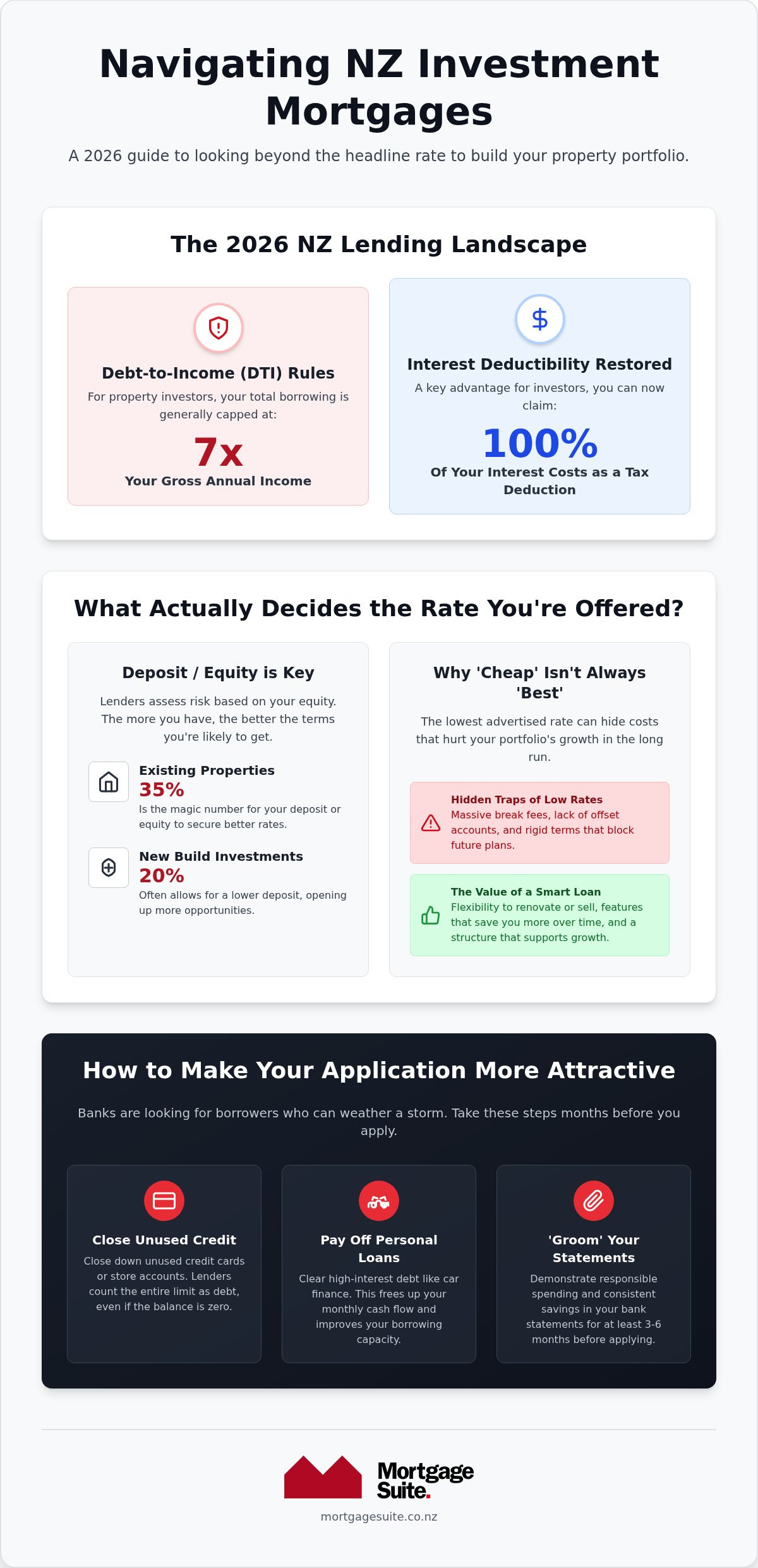
The Reserve Bank doesn’t apply a one-size-fits-all approach to lending. Instead, they’ve set different benchmarks based on how you intend to use the property. If you’re looking for a place to call home, the standard debt to income ratio nz limit is 6. This means that for every dollar you earn before tax, the bank generally won’t let you borrow more than six dollars in total debt. It sounds strict, but it’s designed to ensure you aren’t stretched too thin when life happens.

For those looking to grow a portfolio, the rules are slightly more flexible. Investors generally have a DTI limit of 7. This extra wiggle room exists because rental income helps service the loan, providing a bit more security for the lender. However, even these limits aren’t set in stone. Banks have what we call “speed limits.” The Reserve Bank allows banks to allocate 20% of their new lending to borrowers who sit outside these standard ratios. If your case is strong, there’s still a chance to secure a “yes” even if the numbers are a bit tight.

Owner-occupier vs Investor limits

The gap between a DTI of 6 and 7 might seem small, but it makes a massive difference to your buying power. If you’re a first home buyer with a small deposit, you’ll likely need to stick closely to that 6x limit unless you qualify for a specific exemption. We’ve put together a quick guide to show how these limits translate into actual loan amounts based on your household income.

Gross Annual Income Max Loan (Owner-Occupier, DTI 6) Max Loan (Investor, DTI 7)
$120,000 $720,000 $840,000
$160,000 $960,000 $1,120,000
$200,000 $1,200,000 $1,400,000

What counts as “Debt” in the eyes of a lender?

This is where many people get caught out. When a bank calculates your ratio, they don’t just look at the mortgage you’re asking for. They include everything. Your student loan, that car finance from last year, and even personal loans are added to the pile. One of the biggest traps is credit card limits. Even if you have a zero balance, the bank counts the entire limit as potential debt because you could spend it tomorrow. “Buy Now, Pay Later” commitments are also under the microscope now. These small weekly payments can bloat your ratio and eat into your borrowing power faster than you’d think. If you’re worried about how your current setup looks, it’s a great idea to chat with a professional who can help you tidy things up before you apply.

Exemptions and speed limits: When the rules don’t apply

It’s easy to feel a bit overwhelmed when you hear about new lending restrictions, but here is a bit of a silver lining: the debt to income ratio nz rules aren’t a brick wall for everyone. In fact, the Reserve Bank has deliberately left some doors open to ensure the housing market keeps moving and that people can still get into homes. One of the most important things to realise is that these strict RBNZ regulations primarily apply to registered banks. If you are looking at non-bank lenders or 2nd tier options, you might find a lot more flexibility than you’d get at a traditional high-street branch because they don’t always have to play by the same rigid rulebook.

Specific types of lending are also carved out of the rules to help the country grow. For example, if you are planning to build a new home, you’ll often find that the DTI limits are much more relaxed. The government wants to encourage more housing supply, so they don’t want to penalise people who are adding to the total number of houses in NZ. Similarly, if you are just looking at moving your mortgage to another bank without borrowing any extra cash, you usually won’t have to go through a fresh DTI check. Even those temporary loans to cover the gap between houses, which help you manage the time between selling one place and buying another, are treated as a special case to keep the process as smooth as possible.

First Home Loan exemptions

If you’re just starting out, there is a massive advantage available through Kāinga Ora. Loans supported under the First Home Loan scheme are officially exempt from these DTI restrictions. This is a total game-changer for young Kiwis who might have a smaller deposit or are just starting to climb the career ladder. Because these loans are designed to help people get onto the property ladder, they focus more on your potential and your ability to meet repayments rather than a rigid multiple of your current salary. For a deeper look at how to navigate your first purchase, check out our Home Loans for First Home Buyers in New Zealand: The 2026 Comprehensive Guide.

The “Speed Limit” loophole

Even for standard bank loans, there’s a bit of a safety valve known as the “speed limit.” The Reserve Bank allows banks to give 20% of their new mortgage money to people who sit outside the standard 6x or 7x limits discussed earlier. This is where having a professional in your corner really pays off. A mortgage broker knows how to present your case so you’re seen as a high-quality borrower who deserves to be part of that lucky 20%. Lenders don’t just look at the raw numbers; they look at your overall financial character, your spending habits, and your career path. If you’ve got a clean record and a solid plan, we can often help you find a way through the red tape.

Debt to Income Ratio NZ: What the 2026 DTI Rules Mean for Your Mortgage

How to tidy up your finances before you apply

If you’ve crunched the numbers and your debt to income ratio nz looks a bit higher than you’d like, don’t throw in the towel just yet. We see this all the time. The good news is that your current ratio isn’t a permanent mark; it is just a snapshot of where you are today. With a bit of a tidy-up and some smart moves, you can often shift those numbers into a much better position before you even sit down with a lender. It is all about presenting the cleanest possible version of your financial life to the bank.

One of the most effective ways to lower your ratio is by putting all your small, high-interest debts into one manageable payment. Those little store cards and personal loans might not seem like much on their own, but they add up quickly when a bank is looking at your profile. By combining these, you simplify your outgoings and show that you have a disciplined grip on your money. It is also worth looking at your income from a fresh perspective. Improving your ratio isn’t only about cutting what you owe; it’s also about making sure the bank sees every cent you earn. Once you’ve tidied up your debt profile, you’ll also want to think carefully about your loan structure — understanding whether a fixed rate mortgage or a floating rate suits your situation can make a significant difference to your monthly repayments and overall financial comfort.

The “Credit Card Cleanse”

Lenders don’t just care about what you’ve spent; they care about what you could spend. If you have a credit card with a $10,000 limit sitting in your drawer, the bank treats that as $10,000 of potential debt, even if you haven’t spent a cent. They have to assume you might go out and max it out tomorrow. Dropping that limit or closing the account entirely can give your borrowing power a massive boost. We usually recommend doing this at least three months before you apply. This gives the credit reporting systems plenty of time to update and ensures the bank sees a nice, clean slate when they run their checks.

Boosting your income figure

When we talk about income, we’re looking at more than just your base salary. If you’ve been consistently earning overtime, bonuses, or commissions, we can often work with the bank to include these in your total figure. For those looking to grow their portfolio, the bank will also factor in the potential rental income from the property you’re buying. You can see how these numbers stack up by using our Investment Property Mortgage Calculator NZ. Don’t forget about boarder income either. If you plan to have a flatmate in your new home, many lenders will let us add a portion of that expected rent to your total income, which can make a huge difference to your final ratio. If you’re unsure which debts to tackle first or how to best show off your income, reach out to our team for a bit of a strategy session.

How Mortgage Suite Ltd navigates the DTI maze for you

We reckon that getting a “no” from a main bank is often just the start of the conversation, not the final word. It’s easy to feel like the goalposts have moved permanently when you’re faced with the current debt to income ratio nz rules. However, our job at Mortgage Suite Ltd is to act as your dedicated negotiator, looking past the rigid spreadsheets of institutional banking to find a path that works for your unique situation. We don’t just see a ratio; we see your potential and your hard work.

With over two decades of industry experience, our founder Krish Krishna has seen every market cycle and regulatory shift imaginable. This deep institutional knowledge means we don’t just guess which lenders might say yes. We know exactly how to present your case to the right people. We take the weight off your shoulders by handling the complex discussions with lenders, ensuring your application highlights your financial strengths and addresses any debt concerns head-on. We focus on building a partnership with you, making sure you feel supported rather than just processed by a system.

Beyond the Big Four: The power of 2nd Tier lending

One of the biggest advantages of working with our team is our access to 2nd tier loans. These non-bank lenders are often more flexible because they don’t always have to follow the same RBNZ bank rules that restrict the major players. If your DTI ratio is a bit high for a traditional bank, an alternative lender might be the perfect solution. We often use these loans as a strategic “stepping stone.” They get you into your dream home or investment property now, and as your equity grows or your income increases, we can help you transition back to a traditional mortgage later. We take the time to match your unique profile to the lender that offers the best fit for your long-term goals.

Expert negotiation for complex cases

With 20 years in the game, we know which lenders are currently under their DTI speed limits and are looking for quality borrowers. This isn’t just about filling out forms; it’s about expert packaging. We know how to frame your application to mitigate concerns about existing debt while shining a light on your career trajectory and overall stability. Our goal is to take the anxiety out of the process, giving you the confidence to focus on finding the right property while we handle the red tape. When you partner with Mortgage Suite Ltd, you’re not just getting a loan; you’re getting a steady hand to guide you through a fluctuating market. We’re committed to removing the obstacles that stand between you and your dream home.

Securing your future in a changing market

The 2026 lending landscape might feel more restrictive, but it is certainly not impossible to navigate. While the debt to income ratio nz rules have changed how banks view your borrowing power, you now have a clear roadmap to move forward. By tidying up your existing debts and understanding how to maximise your gross income, you put yourself in the best possible position for a “yes”. Remember, the big banks are only one part of the story; flexibility often lies with alternative lenders who value your overall potential.

With over 20 years of banking and brokerage experience, we specialise in finding those 2nd tier and non-bank solutions that mainstream lenders might miss. We provide national coverage across all of New Zealand, ensuring that no matter where you are looking to buy, you have a steady hand to guide you. If you’re ready to take the next step without the stress of rigid spreadsheets, we’re here to help. Book a chat with our expert team today to see how we can help you beat the DTI blues. Your dream home is still within reach; you just need the right plan to get there.

Common Questions About the 2026 DTI Rules

Does the DTI ratio apply to new builds in 2026?

No, construction loans for new builds are officially exempt from the RBNZ’s DTI restrictions. This is a deliberate move by the government to encourage more housing supply across New Zealand. If you’re building from scratch or buying a home off the plans, you won’t have to worry about the standard 6x or 7x limits. This gives you significantly more flexibility when planning your project and choosing your finishes.

Will my student loan affect my debt to income ratio?

Yes, your student loan is absolutely included when the bank calculates your debt to income ratio nz. Lenders look at your total debt obligations, which includes student loans, car finance, and personal loans. Even though your repayments are automatically deducted from your pay, the total balance still sits on the “debt” side of the ledger. It’s a good idea to factor this in early when working out your borrowing power.

Can I get a mortgage if my DTI is over 6?

Yes, you can still secure a mortgage even if your ratio sits above the standard limit of 6 for owner-occupiers. Banks are allowed a “speed limit” where 20% of their new lending can go to borrowers with higher ratios. Alternatively, we can look at 2nd tier lenders who don’t have to follow these specific Reserve Bank rules. This provides a clear path forward even when a big bank’s spreadsheet says no.

Do non-bank lenders have to follow the RBNZ DTI rules?

No, the Reserve Bank’s DTI restrictions primarily apply to registered banks. Non-bank or 2nd tier lenders often have their own internal criteria and aren’t bound by the same 6x or 7x caps. This makes them an excellent option if your income doesn’t quite stretch far enough for a traditional bank’s requirements but you have a solid plan and the ability to manage your repayments comfortably.

How is rental income counted towards my DTI ratio?

Rental income is added to your total gross annual income, though banks usually “shade” it by about 20% to account for vacancies and maintenance costs. This boosted income figure is what allows investors to have a higher debt to income ratio nz limit of 7. It’s a vital part of the calculation that helps reflect the true servicing power of an investment property and your ability to grow a portfolio.

What is the difference between DTI and LVR?

While they work together, they measure two different things. LVR (Loan-to-Value Ratio) looks at the size of your deposit compared to the property’s value. DTI (Debt-to-Income) looks at your total debt compared to what you earn before tax. Think of LVR as your “entry ticket” to get the loan and DTI as the bank’s way of checking you have enough left over each month to live your life.

Can I use boarder income to improve my DTI ratio?

Yes, many lenders will let us include a portion of your expected boarder income to boost your total earnings figure. This can be a real lifesaver for first home buyers trying to stay under the 6x limit. We’ll just need to show the bank that the property has enough space and that the income is realistic for your area. It’s a simple way to make the numbers work in your favour.

What happens to my DTI if interest rates go up?

Your actual DTI ratio won’t change just because interest rates move, as it’s based on the total debt amount rather than the interest cost. However, the bank’s “test rates” usually get tougher when market rates rise. This means that while you might technically fit the DTI box, the bank will look even closer at your ability to manage higher weekly repayments. Choosing the right loan structure — for example, deciding between a fixed rate mortgage versus a floating rate — becomes especially important in this environment, as locking in a rate can provide certainty around your repayments. It’s all about ensuring you have a safe financial buffer.

Article by

Krish Krishna

Experienced Financial Adviser with over 46 years of Banking and Mortgage broking experience and over $2.0 Billion in loan settlements.

Using Home Equity for Investment in NZ: A 2026 Guide to Growing Your Wealth

What if your most valuable asset is currently sitting idle while you wait years to save up a massive cash deposit? For many Kiwis, the dream of building wealth feels blocked by strict bank rules and the confusing maze of LVR limits. It’s completely normal to feel a bit hesitant about over-leveraging, especially with interest rates shifting and the latest debt-to-income rules in play.

The good news is that you don’t necessarily need a pile of cash to get started. By using home equity for investment NZ, you can unlock the value already tied up in your bricks and mortar to fuel your next move. This guide will walk you through the process of identifying your “usable equity” and show you how to work through the 2026 lending landscape with confidence. We’ll look at how to bypass common roadblocks, understand the current 70% LVR rules for investors, and find a lender that fits your specific situation so you can grow your portfolio without the stress.

Key Takeaways

  • Learn how to identify the portion of your home you truly own and how market changes can speed up your wealth-building journey.
  • Discover the simple two-step process for using home equity for investment NZ to calculate exactly how much you can borrow.
  • Explore why using your home’s value can help you start investing years earlier than waiting to save a traditional cash deposit.
  • Understand your options if a big bank turns you down, including how non-bank lenders can provide a path forward.
  • Get a practical checklist for organising your documents so you’re ready to chat with a specialist and take the next step.

What is home equity and how does it work for NZ investors?

Equity is essentially the share of your home that belongs to you rather than the bank. Think of it as the cash you’d have left over if you sold your house today and paid back every cent you owe on your mortgage. It isn’t just a number on a statement; it’s a powerful financial tool. Many people wonder, what is home equity? and how can it help them build a future. In New Zealand, this value grows in two main ways. First, every time you make a mortgage repayment, you’re slowly buying back your house from the bank. Second, if the market value of your property increases, your equity gets a natural boost without you lifting a finger.

In 2026, we’re seeing a unique shift in the market. With the Reserve Bank holding the Official Cash Rate at 2.25% as of May 2026 and signalling potential hikes, understanding how to use what you already have is more important than ever. Instead of waiting years to save a massive pile of cash, using home equity for investment NZ allows you to treat that value like a virtual deposit. It’s a way to jumpstart your portfolio while your current home does the heavy lifting.

The difference between total equity and usable equity

It’s a common mistake to think you can spend every dollar of equity you have. Banks are cautious; they want a safety buffer to protect themselves if property prices take a sudden dip. Because of this, they won’t let you borrow against 100% of your home’s value. Generally, for your own home, banks prefer you to keep at least 20% of the value as a “hands-off” zone. Your usable equity is the amount above that 20% mark. This is the only figure that really matters when you’re planning your next move.

How your home becomes the deposit for a rental

You might have heard the term “cross-collateralisation.” It sounds like a mouthful, but it just means the bank uses your current home as security for a new loan on an investment property. Under the rules set in December 2025, investors usually need a 30% deposit for a rental property. By using home equity for investment NZ, you can cover that 30% using the value in your existing home instead of cash. This removes the massive hurdle of saving for years. It gives you the freedom to act when the right opportunity comes along, using the house you already live in to secure your family’s financial future.

Calculating your usable equity: The 2026 NZ rules

Figuring out your actual borrowing power starts with a bit of simple arithmetic. While your bank statement shows your current balance, it doesn’t tell the full story of your potential. To get a clear picture of using home equity for investment NZ, you first need a realistic appraisal of what your home would sell for in the current market. Once you have that number and your exact mortgage balance, you can start applying the 2026 rules that banks use to decide how much they’ll lend you.

The process follows four logical steps. First, get that professional appraisal. Second, confirm your remaining mortgage balance down to the cent. Third, apply the 80% rule to your home; banks generally want you to keep 20% of the value as a safety net. Finally, you must factor in the current limits for the new property you want to buy. Following the NZ government house buying process is essential here, as it ensures you’re across the latest tax and compliance requirements while you crunch these numbers.

Understanding RBNZ LVR (Loan-to-Value Ratio) limits

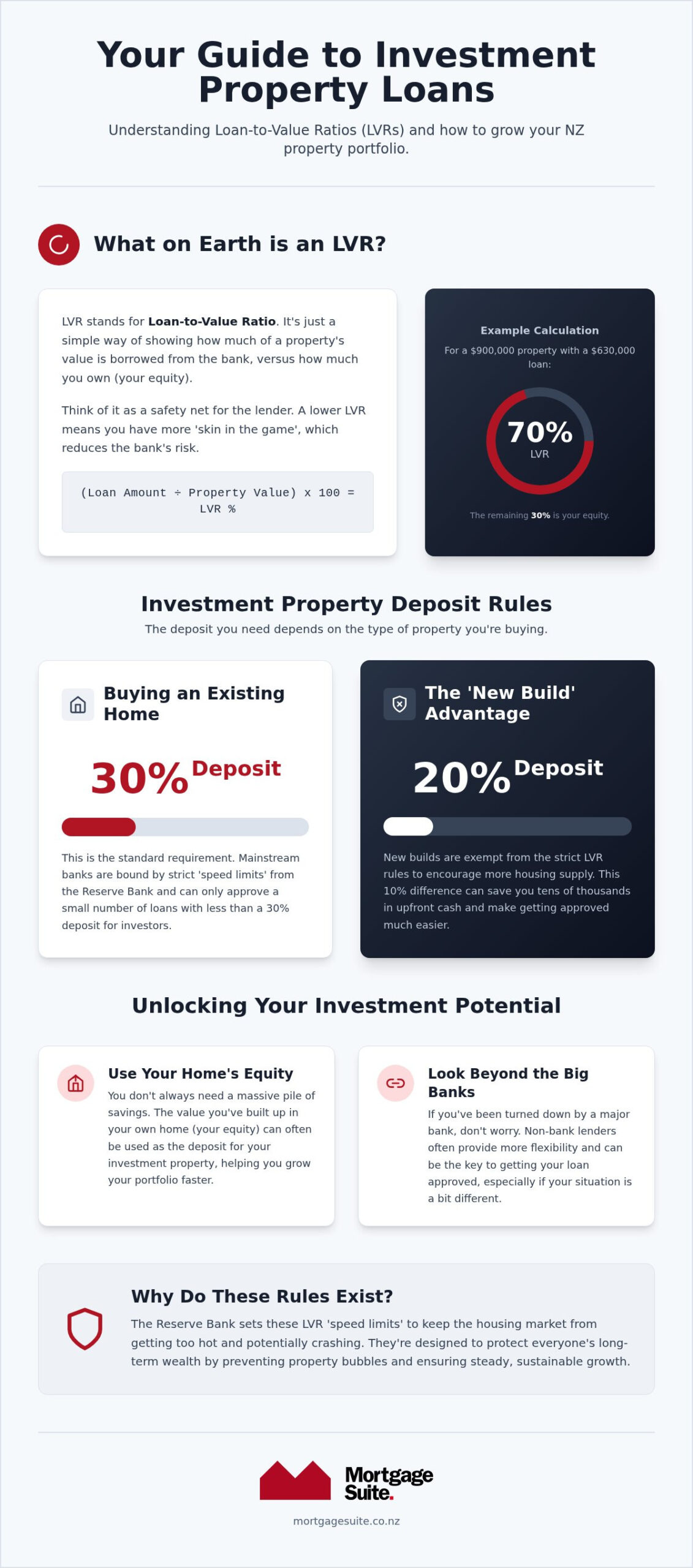
As of the latest updates in December 2025, the Reserve Bank has set clear boundaries for investors. For most existing homes, you’ll need a 30% deposit, meaning the bank will lend up to a 70% LVR. LVR is simply the relationship between the money you owe and the property’s value as determined by the bank. If you’re looking at a new build, the rules are often more relaxed, sometimes requiring a much smaller deposit. You also need to keep the Debt-to-Income (DTI) rules in mind, which since July 2024, generally limit investor lending to seven times your annual income.

A quick example of the maths in action

Let’s look at how this works in the real world. Imagine you own a home worth $1 million with a $400,000 mortgage. The bank allows you to borrow up to 80% of your home’s value, which is $800,000. Subtract your $400,000 mortgage, and you have $400,000 in “usable” equity. If you want to buy an investment flat for $1 million, the 30% deposit requirement is $300,000. Because you have $400,000 available, your equity completely covers the deposit. You could potentially buy that investment property without touching your savings. If these numbers feel a bit overwhelming, a quick chat with the team at Mortgage Suite Ltd can help clear up exactly where you stand.

The pros and cons of using equity for property investment

Deciding to tap into your home’s value is a big step. It’s a bit of a balancing act between the excitement of growing your wealth and the reality of taking on more responsibility. One of the biggest wins is speed. In a market where prices can shift quickly, waiting to save a 30% cash deposit can mean you’re stuck on the sidelines for years. By using home equity for investment NZ, you can jump in as soon as the numbers make sense. Plus, since April 2025, you can once again claim 100% of your interest costs as a tax deduction on residential rentals, which makes the maths much friendlier than it was a few years ago.

On the flip side, you’re signing up for a bigger mortgage. That means your monthly repayments will increase, and you need to be sure your income can handle it. There’s also the risk of negative equity. If the market takes a breather and property values drop, you could end up owing more than the properties are worth. It’s a rare scenario for long-term investors who buy well, but it is something you should always keep in the back of your mind before signing on the dotted line.

Why using equity beats a personal loan every time

If you need funds for a deposit, a personal loan might seem like a quick fix, but it’s usually a poor choice for property. Mortgage rates are significantly lower than unsecured debt rates, which can save you thousands in interest over the life of the loan. You also have the luxury of spreading those repayments over 25 or 30 years, which keeps your weekly cash flow much healthier. Keeping everything organised under one lending umbrella also makes your life a lot simpler when it comes to tax time and your annual financial reviews.

Managing the risks of a bigger mortgage

Success in property isn’t just about buying; it’s about staying in the game. Banks focus heavily on your ability to meet repayments, especially with the 2024 DTI rules in place. Even with the OCR sitting at 2.25% as of May 2026, the Reserve Bank has hinted that rate hikes are likely. You should always test your budget against higher interest rates to ensure you aren’t caught out if your fixed term ends and rates have moved up. One strategy worth exploring is an interest only investment property loan NZ investors are increasingly using to free up monthly cash flow and keep their portfolio growing during uncertain rate environments. A solid “rainy day” fund is also a must. Rentals have a habit of needing urgent repairs at the worst possible time, and you don’t want to be scrambling for cash when the hot water cylinder gives up. Being prepared for these moments is what separates a stressed landlord from a successful investor.

Using Home Equity for Investment in NZ: A 2026 Guide to Growing Your Wealth

The step-by-step process to unlock your equity

Once you’ve crunched the numbers and seen the potential in your own home, it’s time to move from theory into action. The actual process of using home equity for investment NZ starts with a conversation with a specialist broker who knows the 2026 lending landscape inside out. They’ll help you look past the standard bank calculators to see what’s truly possible for your situation. Your first job is to get your paperwork sorted. This means gathering recent bank statements and proof of income to show the bank that you aren’t just asset-rich, but also a reliable borrower who handles their day-to-day cash flow with discipline.

Sometimes, the bank’s automated valuation system might give you a figure that feels a bit low. If that’s the case, a registered valuation from an independent professional can often reveal the true market value of your property, potentially unlocking more funds for your deposit. Once your value is confirmed and your application is reviewed, the goal is to secure a pre-approval. This is a game-changer. It gives you the confidence to walk into an auction or make an offer on a rental property knowing exactly where you stand, without the stress of a last-minute scramble for finance.

Preparing your finances for the bank’s “stress test”

Banks are incredibly thorough when they review your spending habits. They aren’t just looking at your salary; they’re checking your discretionary spending to see how a new loan will affect your lifestyle. Those daily flat whites or frequent takeaway meals might seem small, but they’re factored into the bank’s “stress test” of your finances. One of the smartest things you can do before applying is to “clean up” any short-term debt, like car loans or credit cards. Reducing these monthly obligations makes your application look much healthier and can significantly boost your borrowing power when you’re eyeing up a rental property.

Sticking with your bank vs. looking elsewhere

It’s easy to stay with your current bank because it feels simple, but simplicity can sometimes come at a cost. While your own bank knows your history, a different lender might offer more flexible terms or a lower interest rate that saves you thousands over time. For example, non-bank investment property loans NZ can often provide the breathing room that traditional institutions can’t, especially if your income situation is a little unique. A broker is essential here to compare the fine print and find the best fit for your long-term goals. If you’re ready to start the journey, chat with the experts at Mortgage Suite Ltd to see which path is right for you.

When the bank says “No”: Alternative equity solutions

It’s a frustrating moment when you’ve done the maths, found the perfect property, and your long-term bank turns you down. Mainstream banks are often bound by rigid “box-ticking” exercises that don’t always account for the complexities of real life. They might decline an application because of your age, a small blemish on your credit history, or because your income doesn’t fit their standard template. This is especially common for self-employed Kiwis or those with multiple income streams. However, a “no” from a big bank isn’t the end of your journey toward using home equity for investment NZ.

There is a whole world of 2nd tier and non-bank lenders in the New Zealand market that operate with more flexibility. These lenders often look at the bigger picture, focusing on the quality of the property and your overall strategy rather than just a computer-generated credit score. At Mortgage Suite Ltd, we specialise in finding a “yes” when others have said “no.” We don’t believe in a one-size-fits-all approach. Instead, we focus on tailoring a solution that fits your specific life stage and your long-term wealth goals, ensuring you aren’t held back by institutional red tape.

The power of 2nd tier lending for property investors

2nd tier lenders provide a vital alternative for investors who need a more common-sense approach to borrowing. These lenders often place more weight on the property’s value and its potential rental return than on a perfect financial history. If you’re looking to bridge a gap, a Home Equity Loan can be a powerful tool to get your project moving. These solutions are often used as a short-term stepping stone. You can get into the market now, start growing your equity, and then look to move back to a mainstream bank once you’ve built up a track record or your circumstances change. It’s about keeping your momentum alive when the traditional path is blocked.

Why a veteran broker is your best negotiator

When you’re dealing with non-bank lenders, having a seasoned professional in your corner makes all the difference. Krish Krishna brings over 20 years of banking experience to the table, which means he knows exactly how to frame your story so lenders see the value in your application. Mortgage Suite Ltd acts as a bridge between the rigid world of finance and your personal needs, advocating for you to get the best possible terms rather than just the easiest ones. We take the stress out of the mountain of paperwork and the back-and-forth negotiations. This leaves you free to focus on what really matters: finding the right house and growing your family’s wealth. If you’ve hit a brick wall with your bank, let us help you find the way around it.

Take the first step toward your investment future

Your home is more than just a place to live; it’s a powerful financial engine that can help you grow your wealth. We’ve seen how using home equity for investment NZ allows you to bypass the long wait for a cash deposit and get into the market sooner. By understanding the 2026 lending rules and preparing your finances for the bank’s stress tests, you can turn your existing property value into a thriving portfolio.

Success in property investment often comes down to having the right expert in your corner. With over 20 years of banking expertise and a focus on personalised negotiation, Krish Krishna and the team are here to help you navigate every hurdle. We specialise in finding creative solutions through 2nd tier and non-bank lenders when mainstream banks aren’t the right fit. It’s about more than just a loan; it’s about building a partnership that supports your long-term goals.

Ready to see how much usable equity you have? Book a free equity strategy session with Krish today and get the clarity you need to move forward. Your next investment property could be closer than you think, and we’re excited to help you make it happen.

Frequently Asked Questions

How much equity do I need to buy an investment property in NZ?

You generally need enough equity to cover a 30% deposit for an existing investment property while keeping a 20% safety buffer in your own home. For a $1 million rental, you’d need to unlock $300,000 in usable equity. If you are looking at a new build, the deposit requirements are often lower, so it’s worth checking with a professional to see how the current LVR rules apply to your specific target property.

Can I use equity to buy an investment property with no cash deposit?

Yes, you can buy an investment property with zero cash by using home equity for investment NZ to secure the entire deposit. The bank uses the value in your current home as security for the new loan, meaning you don’t need to dip into your savings. As long as your “usable equity” covers the 30% requirement for an existing house, you can start your investment journey without needing a massive cash pile.

What are the risks of using my home equity for investment?

The main risks include increasing your total debt and the potential for property values to fall. If the market takes a dip, you could end up with negative equity, where you owe the bank more than the properties are worth. You also need to be sure your income can handle higher repayments if interest rates move up, especially since the Reserve Bank signalled in May 2026 that rate hikes are likely.

Do I need a registered valuation to use my home equity?

You will often need a registered valuation if the bank’s automated system doesn’t quite capture the true value of your home. While banks use their own data first, a professional valuer provides a detailed report that can often reveal more equity, especially if you’ve renovated. It’s a small upfront cost that can be the difference between getting a “yes” or a “no” on your investment loan application.

How does the bright-line test affect my investment if I use equity?

The bright-line test means you’ll pay tax on any profit if you sell your investment property within two years of buying it. As of July 1, 2024, the period was shortened to this two-year timeframe for residential property. While your family home is exempt, any rental property you buy using your equity will be subject to these rules. It’s a vital factor to consider when planning your long-term exit strategy.

Can I use equity for a business loan instead of a rental property?

Yes, you can certainly use your home’s equity to secure a business loan. Many Kiwis choose this path because mortgage rates are typically much lower than the rates for unsecured business lending. It’s a cost-effective way to find the capital you need to start a new venture or expand an existing one. Just remember that your home is acting as security, so you need a solid plan to manage the repayments.

What happens to my equity if house prices in NZ drop?

If house prices drop, your total and usable equity will decrease because your home is worth less on paper. While this doesn’t change your mortgage repayments, it does reduce your safety buffer and your ability to borrow more in the future. This is exactly why banks insist on leaving a 20% equity cushion in your own home; it protects both you and the lender if the property market takes a breather.

Is interest on an equity-funded investment loan tax-deductible?

Yes, full interest deductibility for residential investment properties was restored starting from the 2025/2026 income year. This means you can once again claim 100% of the interest you pay on your investment loan against your rental income. This change makes using home equity for investment NZ a much more attractive strategy for building wealth than it was a few years ago, as it significantly improves your weekly cash flow. For investors looking to maximise this benefit, exploring an interest only investment property loan NZ lenders offer can further boost your monthly returns by reducing your required repayments during the investment phase.

Article by

Krish Krishna

Experienced Financial Adviser with over 46 years of Banking and Mortgage broking experience and over $2.0 Billion in loan settlements.

Investment Property Mortgage Calculator NZ: How to Calculate Repayments for Your 2026 Portfolio

What if your next property investment approval didn’t depend on a bank’s rigid checklist, but on your ability to master the numbers before you even apply? With the Official Cash Rate sitting at 2.25% and DTI limits of seven times your gross income now firmly in place, using an investment property mortgage calculator nz is no longer just about checking repayments. It is about understanding how your total debt profile fits within the Reserve Bank’s 2026 framework to ensure your portfolio remains viable.

We understand the frustration of finding a perfect property only to be met with confusion over 2nd tier lending rates or the complexities of the current dual-constraint system. It is natural to feel a bit of pressure when trying to organise your cash flow while floating rates sit as high as 8.61%. This guide promises to clear that fog, providing you with a clear understanding of your monthly costs and a path to approval even if mainstream lenders hesitate. We will preview the latest LVR restrictions, explain the impact of 100% interest deductibility, and give you the confidence to execute a property strategy that works for your specific financial goals.

Key Takeaways

  • Identify the five core variables, including interest rates and repayment frequency, to accurately forecast your portfolio’s monthly cash flow.
  • Master the dual-constraint system of LVR and DTI limits by using an investment property mortgage calculator nz to determine your true borrowing capacity in the 2026 market.
  • Learn why calculating for investment requires a focus on yield and serviceability rather than just simple home loan affordability.
  • Discover how 2nd tier loans provide a vital alternative for investors who find themselves outside the strict lending criteria of the major banks.
  • Follow our step-by-step template to account for often-overlooked costs like legal fees and building reports when establishing your total loan requirement.

Table of Contents

Successful property investment in New Zealand starts long before you visit an open home. It begins at your desk, crunching numbers to ensure a deal actually stacks up in the current 2026 economic environment. While many people use a basic tool to see what they can borrow, a dedicated investment property mortgage calculator nz serves a much more strategic purpose. It acts as your first line of defence against over-leveraging. It is about moving beyond "can I afford this?" to "does this asset work for me?"

In 2026, the landscape has shifted. With the Official Cash Rate at 2.25%, banks are looking closer than ever at your total debt-to-income (DTI) ratio. Calculating your repayments isn’t just about finding a monthly figure; it is about stress testing your strategy against potential interest rate hikes. If you can’t show a clear path to serviceability when banks apply their "test" rates, which often exceed 8.5%, your application will likely end up in the declined pile. Accurate preparation ensures you present a professional, viable case to lenders from the outset.

The Difference Between Yield and Cash Flow

Gross yield is a helpful starting point, but it’s often a vanity metric that can lead investors astray. It simply measures the annual rent against the purchase price. To build a sustainable portfolio, you must focus on net cash flow. This is where your mortgage repayment is just one piece of the puzzle. You need to account for the fact that 100% of your interest is now deductible, which significantly aids your bottom line compared to previous years. However, savvy investors also calculate a "buffer" for maintenance, property management, and potential vacancies. Understanding how mortgage calculators work helps you see how these variables interact with your loan principal to create a true picture of your weekly outgoings.

Why ‘Big Bank’ Calculators Often Fall Short

Most mainstream banking tools are designed for the average home buyer with a standard salary and a perfect credit score. They rarely account for the complexities of an investment portfolio, such as the nuances of 2nd tier lending or the specific 70% LVR requirements for investors. If your situation doesn’t fit the rigid "Big Four" criteria, their automated algorithms might suggest you’re at a dead end. We believe in personalised advocacy over automated results. 2nd tier lenders often offer different repayment maths that can turn a "no" into a "yes," provided you have organised your figures correctly using an investment property mortgage calculator nz that reflects the real-world market.

Understanding the Variables: What Actually Goes Into Your Repayment Calculation?

Calculating repayments isn’t a guessing game; it’s a precise exercise in financial forecasting. To get a reliable result from an investment property mortgage calculator nz, you must look beyond the sticker price of the house. There are five core variables that dictate your success: the loan amount, the loan term, the interest rate, the payment frequency, and the repayment type. Your deposit size is the first hurdle. While the Reserve Bank generally requires a 30% deposit for investors, having a larger equity stake can often unlock more competitive interest rate tiers. If you find the big banks are being too restrictive with their terms, exploring residential investment property loans can provide the tailored approach you need to keep your portfolio growing.

Local investors have the choice of weekly, fortnightly, or monthly instalments. Matching your repayment frequency to your rental income cycle can make your cash flow much easier to organise. Principal and Interest is the standard method for building equity over a 30-year term. However, the type of debt you choose significantly shifts the math. For example, a 30-year term is standard, but some 2nd tier lenders might offer different structures that suit a short-term development or a rapid equity-build strategy.

Fixed vs. Floating Rates: Which Number Should You Use?

Choosing an interest rate for your calculation requires a balanced view of the 2026 market. Fixed rate mortgage options currently range from approximately 4.65% for a one-year term to 5.86% for three years, providing the budget certainty many investors crave. Floating rates, while averaging around 6.15%, offer the flexibility to make extra payments without penalty. When using an investment property mortgage calculator nz, don’t just use today’s advertised specials. It’s wise to use a "test rate" of around 8.5% to ensure your portfolio remains robust even if the Reserve Bank raises the OCR again.

The Interest-Only Strategy for Investors

Interest-only repayments remain a popular choice for Kiwi investors looking to maximise tax efficiency. With 100% interest deductibility fully restored as of April 2025, this strategy helps keep immediate outgoings low while you focus on capital growth or paying down your non-deductible home loan. While this improves your short-term cash flow, it’s vital to calculate the "cliff"; the moment your interest-only period ends and your repayments jump to include principal. Planning for this transition ensures you aren’t caught off guard by a sudden increase in your weekly commitments.

The LVR and DTI Hurdle: Calculating Your Real Borrowing Power

Having a healthy deposit is only half the battle in the 2026 lending environment. While earlier sections focused on the mechanics of repayments, you must also clear the dual hurdles of Loan-to-Value Ratio (LVR) and Debt-to-Income (DTI) restrictions. Currently, the Reserve Bank requires most investors to provide a 30% deposit, meaning your LVR cannot exceed 70%. However, even with a massive pile of cash, your "real" borrowing power is now firmly capped by DTI limits. For most mainstream banks, your total debt cannot exceed seven times your gross annual income. This creates a hard ceiling that an investment property mortgage calculator nz can help you identify before you spend money on building reports or valuations.

Many investors feel the sting of "rental shading" during the application process. Banks rarely count 100% of your projected rental income when calculating serviceability. Instead, they typically recognise only 75% to 80% of the rent to account for costs like rates, insurance, and property management. If you have plenty of equity but the bank says your income is too low, this shading is often the culprit. It’s a common point of frustration, but understanding these internal bank formulas allows you to adjust your strategy and look for properties with higher yields that can offset the income gap. To fully understand how the 6x and 7x thresholds affect your specific situation, our detailed guide on the debt to income ratio NZ rules and what they mean for your 2026 mortgage breaks down the exact maths lenders use.

Unlocking Equity in Your Existing Portfolio

You don’t always need cash in the bank to fund your next move. Usable equity is the secret weapon for growing a portfolio, calculated as the difference between your current mortgage and 80% of your property’s value. For those who have seen significant capital gains since they first secured home loans for first home buyers New Zealand, this equity can often cover the entire 30% deposit for an investment. It’s a methodical way to leverage your existing assets without draining your personal savings, provided you maintain a steady hand on your total debt levels.

When the Mainstream Banks Say No

If your DTI ratio sits slightly above the "Big Four" threshold of seven, it doesn’t mean your investment journey is over. 2nd tier lenders often provide a vital alternative, as they can be more flexible with complex income structures or higher debt levels. When you use an investment property mortgage calculator nz to model these scenarios, you should account for slightly higher interest rates, often 0.5% to 1.5% above standard bank rates. This is where professional advocacy becomes essential. We specialise in finding the bridge between a rigid bank "no" and a structured approval that keeps your 2026 portfolio on track.

Investment Property Mortgage Calculator NZ: How to Calculate Repayments for Your 2026 Portfolio

A Step-by-Step Template to Forecast Your Investment Cash Flow

While an investment property mortgage calculator nz provides a quick answer, knowing the manual steps behind the math gives you true control over your strategy. It allows you to spot a bad deal before you ever talk to a bank. Follow this template to organise your forecast for any 2026 acquisition.

  • Step 1: Determine the total entry cost. Start with the purchase price and add an allowance for legal fees, building inspections, and valuations. These often total between $3,000 and $6,000 depending on the property’s complexity.

  • Step 2: Establish your loan requirement. Subtract your cash deposit or the usable equity you’ve unlocked from your home. This leaves you with the core debt figure.

  • Step 3: Select your structure. Decide if you’ll use an interest-only period to maximise immediate cash flow or start with principal and interest to build equity from day one.

  • Step 4: Use realistic rates. Don’t just use the lowest rate on the market. Apply a standard 2026 fixed rate, such as the 5.19% two-year average, to keep your figures grounded in reality.

  • Step 5: Run the serviceability check. Calculate your monthly repayment and compare it against 80% of your projected gross rent. If the rent doesn’t cover the mortgage at this "shaded" level, you’ll need to contribute from your personal income.

If these steps feel overwhelming or the numbers aren’t quite stacking up, we can help you find a path forward. Our team specialises in securing residential investment property loans that align with your long-term wealth goals.

The ‘Stress Test’ Calculation

Bank managers don’t look at what you can pay today; they look at what you can pay if the market shifts. You should do the same. Recalculate your repayments with an interest rate that is 1% or 2% higher than current offers. This "worst-case" figure is the most vital number in your entire spreadsheet because it defines your safety margin. A robust investment plan should survive a 2% interest rate hike without requiring external capital. If your portfolio can’t weather that storm, it might be time to reconsider the purchase price or your deposit size. Understanding the difference between fixed rate mortgage vs floating rate options is essential when stress testing your portfolio against potential rate movements.

Accounting for the ‘Hidden’ Costs

Many novice investors make the mistake of thinking the mortgage is their only expense. In reality, rates, insurance, and property management fees usually consume about 20% of your gross rental income. These are the "forgotten" costs that can turn a cash-flow positive property into a monthly liability. When you’re using an investment property mortgage calculator nz, always deduct these outgoings from your rental income before comparing it to your loan repayments. Remember that "set and forget" is a myth in property investment. Staying on top of these shifting costs ensures your portfolio remains a source of wealth rather than a source of stress.

Beyond the Calculator: How Tailored Financing Secures Your Portfolio

While an investment property mortgage calculator nz provides the essential coordinates for your journey, it cannot navigate the roadblocks that often appear during a bank’s assessment process. Think of the calculator as your map; it shows you the destination, but a seasoned advocate acts as your guide through the terrain. At Mortgage Suite Ltd, we specialise in residential investment property loans that don’t always fit the rigid, automated criteria of the "Big Four" banks. We understand that your financial story is more than just a credit score or a debt-to-income ratio.

Securing a "fair go" from lenders in 2026 requires more than just submitting an application. It involves presenting a case that highlights the strength of your strategy. For many investors, 2nd tier lending serves as a strategic bridge. It allows you to secure a property and build equity today, rather than waiting for mainstream banks to ease their restrictions. This proactive approach turns a potential "no" into a structured path toward long-term wealth, ensuring you don’t miss out on opportunities while waiting for the perfect market conditions.

The Power of a Specialised Advocate

Krish Krishna brings over two decades of banking experience to your corner, ensuring your application is seen by human eyes rather than just an algorithm. There is a profound difference between a "computer says no" interaction at a local branch and a solution brokered through deep institutional knowledge. When your finances are non-standard or your portfolio is complex, personal connection and a reputation for integrity matter. We act as your dedicated negotiator, removing obstacles and finding the bridge between institutional requirements and your personal goals. Our experience allows us to anticipate lender objections before they arise, saving you time and reducing the stress of the approval process.

Next Steps: From Calculation to Pre-Approval

To move from a theoretical calculation to a formal pre-approval, you’ll need to organise your documentation. This typically includes recent payslips, bank statements, and rental appraisals for your existing or prospective properties. Having these ready allows for a much smoother transition from the research phase to the acquisition phase. We also recommend a "health check" on your current portfolio equity to ensure you are leveraging your assets as efficiently as possible. When you’re ready to turn your data into a concrete offer, organise a consultation with Mortgage Suite Ltd to find the right loan for your next investment. We are here to ensure your 2026 strategy is built on a foundation of professional certainty and personalised care.

Mastering Your Path to Property Success

Mastering the numbers is the first step toward building a resilient property portfolio. By now, you understand that an investment property mortgage calculator nz is a powerful starting point for assessing yield and cash flow. However, clearing the high bars of DTI limits and LVR restrictions requires more than just a digital tool. It demands a strategic approach that accounts for 2026 market realities and the nuances of non-bank lending. Success in this environment comes from preparing for the transition of interest-only periods and ensuring your strategy can weather potential interest rate shifts with a calculated safety margin.

With over 20 years of banking and brokerage experience, Mortgage Suite Ltd provides the seasoned advocacy needed to turn complex financial scenarios into approvals. We specialise in 2nd tier and non-bank lending, offering a nationwide service for all New Zealand investors who want a steady hand in a fluctuating market. You don’t have to navigate these hurdles alone. Secure your investment future with a tailored mortgage strategy from Mortgage Suite Ltd. We are ready to help you move beyond the spreadsheet and into your next successful acquisition with absolute confidence.

Frequently Asked Questions

How much deposit do I need for an investment property in NZ in 2026?

You generally need a 30% deposit for an existing residential investment property in 2026. This requirement aligns with the Reserve Bank’s LVR restrictions, which limit most investor lending to a 70% threshold. If you are purchasing a new build, you may be able to secure a loan with as little as a 20% deposit. Using an investment property mortgage calculator nz helps you determine the exact amount of cash or equity required to meet these criteria.

Can I use my KiwiSaver to buy an investment property?

No, you cannot withdraw KiwiSaver funds to purchase a property intended solely for investment. KiwiSaver withdrawals are strictly reserved for buying your first home to live in, or for cases of significant financial hardship. However, once you have used KiwiSaver to secure your first home, the equity you build in that property can eventually be leveraged to fund a deposit for a future investment property.

What is a ‘good’ DTI ratio for a property investor?

A healthy DTI ratio for an investor is typically considered to be below six. As of mid-2024, the Reserve Bank implemented a formal DTI cap of seven for most investor lending. If your total debt exceeds seven times your gross annual income, mainstream banks will likely decline your application. Maintaining a lower ratio ensures your portfolio remains resilient and gives you more flexibility when interest rates fluctuate.

Are interest rates higher for investment properties than for my own home?

No Interest rates are generally the same. For investors up to 6 investment properties, you can obtain the rate as normal housing rates. For investors with more than 6 properties, some lenders will view you as commercial investors and may apply a slightly higer rate.

What happens if my investment property is vacant for a month?

If your property is vacant, you must be able to cover the full mortgage repayment from your other income sources. This is why banks "shade" your rental income, often only counting 80% of the projected rent in their serviceability tests. We always recommend keeping a cash buffer equivalent to at least four weeks of rent to manage these inevitable vacancy periods without putting undue stress on your personal finances.

Should I choose a 2nd tier lender if my bank declines my application?

Choosing a 2nd tier lender is a very effective strategy if a mainstream bank declines your application due to rigid DTI or LVR rules. These lenders often provide a vital bridge for investors with complex income structures or those who sit just outside the "Big Four" criteria. While the interest rates may be slightly higher, the flexibility they offer can be the difference between growing your portfolio or stalling your investment journey.

How do I calculate the equity in my current home?

To calculate your usable equity, take 80% of your home’s current market value and subtract your remaining mortgage balance. For example, if your home is worth $1,000,000 and your mortgage is $500,000, your usable equity is $300,000. This is calculated as $800,000 minus $500,000. This figure represents the maximum amount you can potentially borrow against to fund a deposit for a new investment property without needing extra cash.

Is interest-only always better for rental properties?

Interest-only is not always the best choice; it depends on your specific financial goals. Many investors prefer interest-only to maximise tax deductibility and keep monthly outgoings low, which is excellent for immediate cash flow. However, Principal and Interest repayments are better if your goal is to build equity and pay off the debt over a 30-year term. It’s about balancing your immediate flexibility against your long-term debt reduction strategy.

Article by

Krish Krishna

Experienced Financial Adviser with over 46 years of Banking and Mortgage broking experience and over $2.0 Billion in loan settlements.

Home Loans for Self Employed: 2026 Guide to Getting Approved

Imagine sitting across from a bank manager, presenting a thriving business you have built from the ground up, only to be told your "paper income" isn’t enough to buy a house. It is incredibly disheartening when mainstream lenders ignore your legitimate business add-backs or penalise you for the very expenses your accountant organised to reduce your tax bill. If you are searching for a home loan and are self employed, you have likely realised that traditional banks often view your entrepreneurial drive as a risk. They see inconsistent income "bursts" and mountains of paperwork, while we see a dedicated professional who deserves a steady hand to guide them through the finance process.

This 2026 guide provides the clear path to pre-approval you need, even with the Official Cash Rate at 2.25% and debt-to-income ratios capped at six times your earnings. You will learn exactly how to bypass rigid bank criteria by exploring non-bank lenders who offer flexible "alt-doc" solutions using GST returns or business bank statements. We will detail how to secure competitive interest rates and navigate the latest LVR restrictions, ensuring your business structure is properly understood so you can move forward with confidence.

Key Takeaways

  • Understand how lenders apply “safety margins” to your income and how to navigate the 2026 Debt-to-Income (DTI) restrictions.
  • Discover the documentation hierarchy and why alternative “Alt-Doc” methods like GST returns might be the key to proving your true earning power.
  • Learn why 2nd Tier lenders are a strategic choice for a self employed home loan nz rather than a last resort when mainstream banks decline your application.
  • Master a simple “pre-audit” process to organise your business drawings and personal expenses for maximum lender appeal.
  • Explore how professional advocacy and veteran negotiation can translate your complex business structure into a clear path for approval.

Table of Contents

The Reality of Self-Employed Home Loans

For many business owners, the dream of home ownership feels like it is being held hostage by a spreadsheet. Getting a **self employed home loan ** in 2026 requires more than just a profitable business; it requires a deep understanding of how lenders interpret your financial health. While an employee with a standard salary provides a predictable data point for a bank, your income is often viewed through a lens of skepticism. Mainstream banks are currently operating with a conservative risk appetite, and they often struggle to reconcile the fluctuations of a growing business with their rigid lending criteria.

The lending environment in mid-2026 is heavily influenced by the Debt-to-Income (DTI) restrictions that became a permanent fixture in recent years. For owner-occupiers, the limit is generally six times your gross annual income, while investors are capped at seven times. When defining self-employment for a loan application, the bank does not just look at your turnover. They look at your drawings, your net profit, and your ability to service debt when the Official Cash Rate (OCR) is at 2.25%. If your income arrives in "bursts" rather than a steady drip, a traditional bank might simply put you in the "too hard" basket. However, being declined by a major bank is rarely the end of the road; it is often just the signal that you need a more sophisticated lending partner.

Understanding Your Income

Banks are notoriously cautious with business owners.

To overcome this, we focus on "add-backs." These are legitimate business expenses that don’t actually impact your ability to pay a mortgage, such as:

  • One-off capital purchases or equipment upgrades.

  • Non-cash expenses like depreciation.

  • Excessive home office claims or personal expenses run through the business.

  • Rent or interest payments that will cease once you buy your own property.

Regulatory Changes and DTI Ratios in 2026

The 2026 regulatory framework treats business debt and personal debt with equal scrutiny. Under the current Credit Contracts and Consumer Finance Act (CCCFA) requirements, lenders must be certain that your business debt—such as vehicle finance or an overdraft—does not compromise your home loan repayments. If your business carries significant debt, it can quickly eat into your DTI allowance, making it harder to reach the 80% LVR threshold required for standard owner-occupier loans. We work with you to clean up your debt profile, ensuring your personal and business liabilities are structured to maximise your approval chances without sacrificing your business’s cash flow.

Proving Your Income: Documentation That Actually Works

Securing a self employed home loan requires a strategic approach to your paperwork. While an employee simply hands over three months of payslips, your application must build a narrative of stability and growth. Many business owners find that their IRD Summary of Earnings tells a story of tax efficiency rather than true mortgage affordability. To bridge this gap, we look beyond the basic tax return to find the documents that reflect your business’s actual momentum.

The hierarchy of proof has shifted significantly in 2026. Traditional "Low-Doc" loans, which once required minimal evidence, have largely been replaced by "Alt-Doc" (alternative documentation) solutions. This is a direct result of the Credit Contracts and Consumer Finance Act (CCCFA), which mandates a robust assessment of affordability. If you have two years of clean financial accounts, you’ll likely qualify for "Full-Doc" rates. However, if your business has recently scaled or you have "bursty" income from project-based contracts, Alt-Doc allows us to use more recent data, such as GST returns, to prove you can comfortably service the debt.

The Essential Self-Employed Paperwork Checklist

Lenders want to see that your business is a reliable vehicle for income. Before submitting an application, ensure you have the following documents organised:

  • Financial Statements: Full Profit & Loss and Balance Sheets for the last two financial years.

  • Bank Statements: Six months of personal and business statements. Lenders look for regular drawings that match your stated income.

  • Tax Verification: Your most recent personal and business tax assessments, along with proof that all IRD obligations are being met.

  • Add-back Schedule: A clear list of non-cash or one-off expenses that shouldn’t count against your borrowing power.

If your business income is seasonal, we frame your application by showing a 12-month average rather than focusing on a quiet month. This context is vital for preventing a "decline" based on a temporary dip in cash flow. If you are unsure which documents best represent your current position, exploring tailored home loan options can help clarify your strategy before you approach a lender.

Alt-Doc Solutions for Newer Businesses

For those who have been trading for 12 to 18 months, or whose most recent tax return doesn’t reflect a recent surge in turnover, Alt-Doc is a game changer. Instead of waiting for the next financial year to end, some specialist lenders will accept an accountant’s declaration of your earnings or use your last six months of GST returns to verify your current capacity. This approach focuses on where your business is today, not where it was two years ago, providing a vital pathway for self employed home loan applicants who are currently in a high-growth phase.

Many business owners view 2nd tier lenders with a sense of hesitation, fearing they are only for those with significant financial trouble. This is a misconception that often prevents entrepreneurs from securing a self employed home loan when they are perfectly capable of servicing a mortgage. In the current 2026 market, non-bank lenders like Avanti Finance or Pepper Money act as sophisticated specialists. They fill the gap left by mainstream banks that rely on rigid automated systems. While a bank might see a complex trust structure or a single year of trading as a red flag, a 2nd tier lender employs human underwriters who look at the bigger picture.

The primary trade-off involves cost. Non-bank "Near Prime" rates typically start around 5.65% to 7.35%, which is higher than the special rates offered by ANZ or Westpac. You should also expect higher establishment fees, often ranging between 1% to 1.5% of the loan value. However, for a business owner, the value lies in the approval probability. These lenders aren’t bound by the Reserve Bank’s strict Debt-to-Income (DTI) thresholds in the same way as registered banks. This flexibility allows us to secure a **self employed home loan **for clients who have the cash flow but don’t fit the traditional "box."

When to Choose a Non-Bank Lender

Choosing a non-bank option is often the most strategic move if your business has undergone a recent transition. If you have moved from a sole trader to a company structure, or if a one-off capital investment skewed your net profit last year, traditional bank software will likely trigger an automatic decline. Specialist lenders are far more accommodating of short trading histories, sometimes considering applications with as little as 6 to 12 months of data if you have a strong industry background. They specialise in "Alt-Doc" solutions, allowing us to use recent GST returns to prove your current earning capacity rather than relying on outdated tax returns.

The Long-Term Strategy: Refinancing Back to a Bank

We often treat a 2nd tier loan as a temporary bridge rather than a forever home for your mortgage. By securing a loan now and maintaining a clean repayment history for 12 to 24 months, you "prime" yourself for a future bank application. This period allows your business to mature on paper and demonstrates your reliability as a borrower. Understanding how to qualify for a home loan in NZ involves planning this exit strategy from the start. Once your financial statements show two years of solid growth, we can assist you in refinancing back to a mainstream bank at a lower interest rate, having already secured the property you wanted.

Home Loans for Self Employed: 2026 Guide to Getting Approved

A Step-by-Step Guide to Polishing Your Mortgage Application

Successful lending outcomes are rarely the result of luck. They are the product of a disciplined staging process that begins months before you even attend an open home. When you apply for a self employed home loan, the bank isn’t just looking for profitability; they are searching for evidence of financial discipline. Think of your application like a house you are preparing for sale. You need to declutter the noise, fix the small leaks in your spending, and highlight the structural strengths of your business.

The first step is a rigorous pre-audit. Scour your business accounts for personal expenses that might look like high living costs to a lender. Second, ensure your drawings are regular. A bank prefers to see $1,500 transferred every week rather than a $20,000 lump sum once a quarter. Third, slash your credit limits. In the 2026 DTI environment, an unused $10,000 credit card or an active Buy Now, Pay Later (BNPL) account can reduce your borrowing power by tens of thousands of dollars. Finally, prepare a formal business commentary and engage a specialist who understands the nuances of business structures.

Framing Your Business Narrative

Lenders hate mystery. If your profit dipped recently because you invested in a new fleet of vehicles or a high-end server array, you must tell them. A written explanation transforms a "loss" on paper into a strategic investment in future growth. Highlight recurring revenue models or long-term contracts that prove your income isn’t just a series of lucky breaks. If you are a contractor in a niche field like IT or engineering, including a professional CV helps the underwriter understand your employability if your current contract ends. This narrative provides the context that raw numbers often lack.

Cleaning Up Your Personal Financial Conduct

You must adhere to the "three-month rule" of flawless account behaviour. Under the CCCFA, any unarranged overdraft or missed payment on a utility bill is a massive red flag. Banks interpret these as a lack of financial control, regardless of how much money is sitting in your business account. You also need a clear "deposit story." Be ready to prove exactly where your savings came from to satisfy Anti-Money Laundering (AML) requirements. If your deposit includes a gift from family or a business dividend, document the paper trail early. To ensure your application is truly bank-ready, you can apply for a home loan assessment to identify any potential hurdles before they become problems.

Why Mortgage Suite is Your Best Advocate for Approval

When you work for yourself, you don’t just need a loan; you need a dedicated negotiator who understands the intricacies of your business. Securing a **self employed home loan ** is often a battle of interpretation. It’s about how your depreciation is viewed, how your "bursty" income is averaged, and how your future potential is weighed against historical tax returns. We provide the steady hand and the institutional knowledge required to bridge the gap between your entrepreneurial success and the rigid requirements of a bank’s credit department.

We work with the mainstream banks in the first instance but our reach extends beyond the big four banks. We provide access to a comprehensive range of 2nd tier and alternative capital, allowing us to find solutions even when traditional lenders have said no. Our partnership approach includes:

  • Access to residential investment property loans and business finance.

  • Strategic planning to move from 2nd tier loans back to mainstream banks.

  • Proactive management of commercial and property development loans.

  • Expert structuring for first-home buyers with non-standard income.

The Advantage of a Seasoned Negotiator

Krish Krishna brings over 20 years of banking experience and 26 years as Financial Adviser to your side of the table. This isn’t about simply submitting a form; it’s about expert negotiation. Krish uses his deep understanding of credit policy to challenge rejections and present your financial story in a way that resonates with underwriters. We specialise in structuring complex deals that mainstream banks often overlook, ensuring your business structure is viewed as a strength rather than a liability. You aren’t just another file to us; you are a partner whose success is our priority.

We understand that as a business owner, your time is your most valuable asset. By utilising our veteran expertise, you gain an advocate who knows exactly which "add-backs" to fight for and which lenders have the highest risk appetite for your specific industry. This high-standard service is designed to remove obstacles and create a seamless bridge to your property goals.

Ready to Get Moving?

We simplify the process so you can stay focused on running your business. Instead of you spending hours chasing paperwork and deciphering banking jargon, we handle the heavy lifting. The first steps involve a consultative conversation where we identify your needs and outline a clear path to pre-approval. There is no need to feel overwhelmed by the volume of paperwork when you have a veteran expert managing the details. Enquire about your self-employed home loan today and take the first step toward a successful approval.

Your Path to Home Ownership Starts Here

Securing a self employed home loan in 2026 doesn’t have to be a source of constant anxiety. While the DTI restrictions and rigid bank criteria create hurdles, they are far from insurmountable when you have the right documentation and a strategic narrative to tackle the mainstream banks. Whether you are using Alt-Doc solutions to prove your recent momentum or utilising a 2nd tier lender as a tactical stepping stone, the goal remains the same: securing a home that reflects your hard work.

At Mortgage Suite, we leverage over two decades of banking and lending expertise to ensure your business structure is understood, not just processed. If you dont fit the mainstream banks lending criteris, we specialise in 2nd tier loans that mainstream banks often decline, providing a tailored, NZ-wide service for business owners and contractors alike. You have built your business with passion and discipline; we are here to apply that same dedication to your mortgage approval.

If you are ready to move past the frustration of bank rejections, book a consultation with our self-employed lending specialists today. Let us turn your complex financial profile into a clear path forward. Your entrepreneurial journey deserves a partner who values your vision as much as you do.

Frequently Asked Questions

Can I get a home loan if I’ve only been self-employed for one year?

Yes, you can secure a home loan with only one year of trading, though you will likely need to look beyond the major banks. While traditional lenders typically require two years of financial statements, many specialist lenders offer "Alt-Doc" solutions for those with 12 months of history. These lenders focus on your recent GST returns and industry background to assess your current earning capacity properly.

How much deposit do I need as a self-employed borrower in NZ?

Most self-employed borrowers need a 20% deposit for an owner-occupied property or 30% for an investment. If you are a first-home buyer, you may qualify for the Kāinga Ora First Home Loan, which allows for a deposit as low as 5%. Having a larger deposit often helps offset the perceived risk of variable income and can lead to more competitive interest rates from mainstream lenders.

Will my interest rate be higher because I work for myself?

Your interest rate won’t necessarily be higher if you meet the standard lending criteria of a mainstream bank. However, if you require a specialist or 2nd tier lender due to a short trading history or complex accounts, you should expect a margin above standard bank rates. These "Near Prime" rates often start from 5.85% and serve as a strategic bridge until you can refinance to a major bank.

What are "add-backs" and how do they help my mortgage application?

Add-backs are legitimate business expenses that we "add back" to your net profit to demonstrate your true mortgage repayment capacity. Common examples include depreciation, one-off equipment purchases, or interest on loans that will be repaid. By identifying these non-cash or non-recurring costs, we can significantly increase the income figure used for your **self employed home loan **application and improve your approval chances.

Can I use my KiwiSaver for a deposit if I am self-employed?

Yes, you can certainly use your KiwiSaver for a deposit, provided you have been a member for at least three years and are purchasing your first home. Being self-employed does not change your eligibility for a first-home withdrawal. It is essential to request your withdrawal pack early to ensure the funds are ready for settlement, especially if your business income fluctuates and documentation takes longer to organise.

What happens if my latest tax return shows a low profit due to expenses?

If your latest tax return shows a low profit due to high business expenses, we can often use alternative documentation to prove your actual income. Specialist lenders may look at your last six months of GST returns or bank statements to see your current cash flow. This approach helps bypass the "paper loss" created by tax-minimisation strategies, allowing your true earning power to be recognised by the lender.

Do I need a clean credit history to get a self-employed home loan?

You don’t necessarily need a perfect credit history to get approved for a self employed home loan. While mainstream banks are very strict about missed payments or defaults, 2nd tier lenders are more flexible and will often listen to the story behind a credit impairment. A clean record for the last 12 months is usually sufficient to access a wide range of alternative lending options that banks often overlook.

How do DTI ratios affect my ability to borrow for a home?

Debt-to-Income (DTI) ratios limit your total borrowing to a multiple of your gross annual income, typically set at six times for owner-occupiers. For business owners, this means your personal and business debts are weighed against your verified drawings and profit. If your DTI is too high for a major bank, we can often find non-bank solutions that aren’t bound by these specific Reserve Bank restrictions in 2026.

Article by

Krish Krishna

Experienced Financial Adviser with over 46 years of Banking and Mortgage broking experience and over $2.0 Billion in loan settlements.