

Land Development Loans: Your 2026 Guide to Funding Your NZ Project

What if a bank’s “no” isn’t the end of your subdivision plans? If you’re looking for a land development loan, it can be hard to know where to turn when a mainstream lender isn’t comfortable with your project. The process can feel complicated, especially when you’re working out how to fund the land, the site preparation and the work needed to create new sections.

You deserve a clear explanation of your options, not a pile of lending jargon. This guide explains how lenders may assess a project, how funds can be released as work progresses, and what to plan for, from council requirements to site preparation and services.

Mortgage Suite’s Krish Krishna brings more than 20 years of banking experience to property development lending. He understands how lenders assess proposals and can advocate for you when your plans don’t fit a bank’s usual approach. We’ll walk through how to prepare your project, compare funding options and present a practical plan, so you can make informed decisions with greater confidence.

Key Takeaways

  • A land development loan can help fund more than the land itself, including work to prepare it for subdivision.
  • Break your funding needs into stages, from buying the land to completing the work and deciding what happens next.
  • If a mainstream bank says no, second-tier lenders may offer another path, depending on your project and circumstances.
  • Prepare a clear plan showing how the development could work, and bring together a capable team to support it.
  • An experienced lending guide can help you understand your options and present your project clearly to potential lenders.

What is a land development loan and how does it actually work?

A land development loan can fund a subdivision and the work needed to turn undeveloped land into prepared sections or a site ready for building. It’s different from a loan to buy a home, because the project centres on improving land rather than purchasing a finished place to live.

Depending on the project, funding may cover earthworks, pipes, roads and other work needed to make the land usable. Civil works means preparing the site and putting essential connections and access in place. The specific work depends on the land and the subdivision plan.

Land development usually involves several steps, from planning and preparing the site through to creating new sections. For a simple overview of the process, see What is land development? A development loan is generally intended to support a project over a shorter period than a typical home loan, with the aim of completing the work so you can sell the sections or build on them. The repayment plan needs to match that goal.

Why a standard home loan usually will not cut it

A standard home loan is designed around buying a home. A bare block has no finished house to live in, and its value may depend on work that hasn’t happened yet. That can make undeveloped land more difficult for a mainstream bank to assess.

Development funding needs to account for the plan as well as the land’s current value. A lender may consider what you intend to do, the work required and how the completed project could be sold or used. The funding and repayment plan may also be structured around the project rather than a standard home-loan setup.

The difference between “buying” and “developing”

Buying the land is the acquisition stage: ownership changes hands, but the site may still be untouched. Developing is the work that follows, such as preparing the ground, installing pipes and creating roads so the land can be divided or built on.

Because these stages have different funding needs, one arrangement may not suit the whole journey. You might need funds to secure the block first, followed by suitable finance for the work. Mapping out each stage helps show a lender what the money is for and how the project is expected to progress.

Be clear about your end goal from the start. Selling prepared sections and building homes are different plans, and your funding approach should reflect the one you’re pursuing. You don’t need every detail finalised before discussing finance, but it helps to have a clear picture of the land, the work ahead and what you hope to achieve.

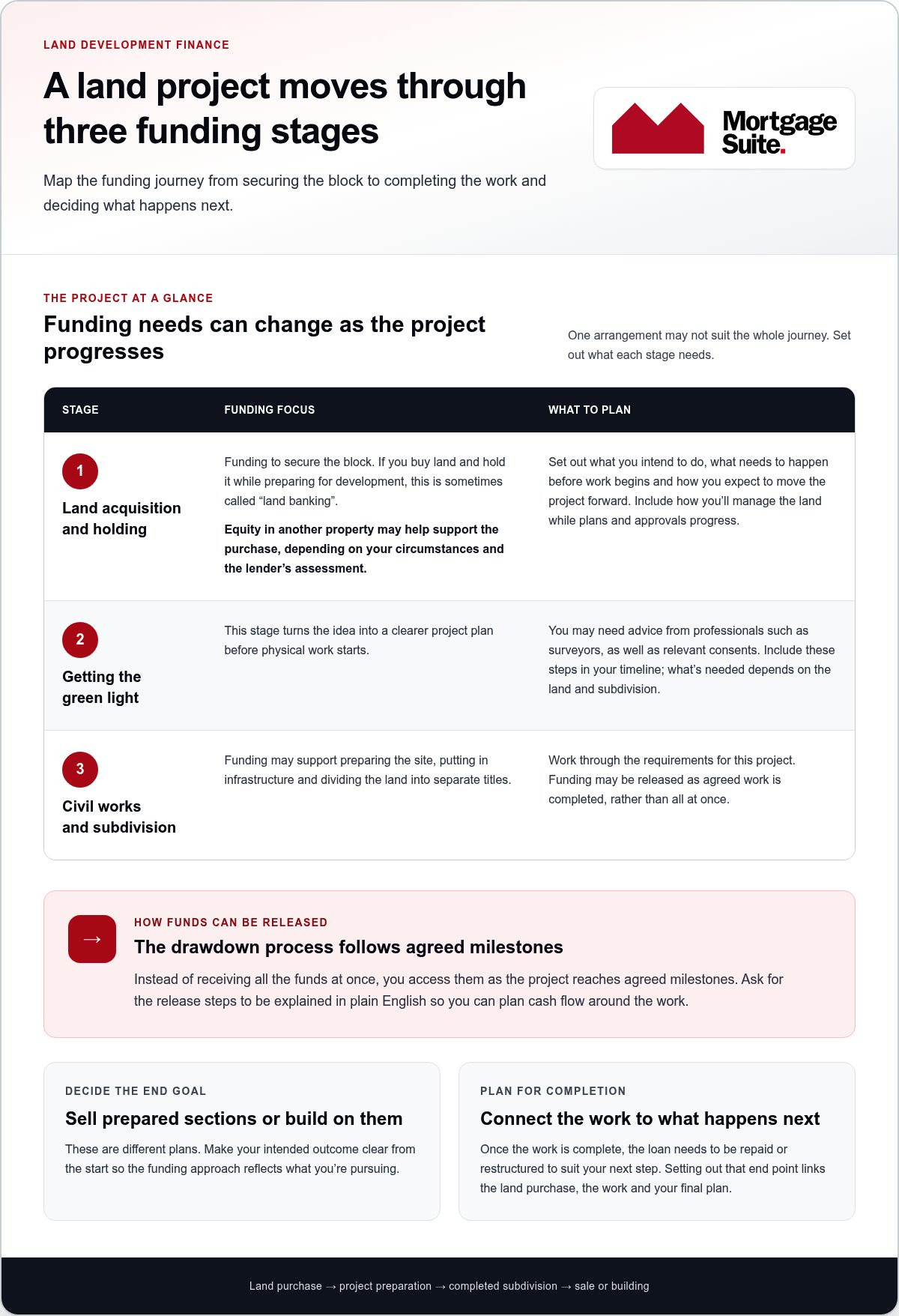
The three main stages of funding your land project

A subdivision usually moves from buying the land to preparing it, completing the work and then selling or building. Your funding needs can change at each step, so map the whole journey early rather than focusing only on the purchase.

Stage 1: Land acquisition and holding

First, you need funding to secure the block. If you buy land and hold it while preparing for development, this is sometimes called “land banking”. Even if the diggers aren’t on site yet, set out what you intend to do, what needs to happen before work can begin and how you expect to move the project forward.

Equity in another property may help support the purchase, depending on your circumstances and how a lender assesses the overall plan. It isn’t an automatic solution, but it can be part of the funding picture. Include the holding period in your plan too, so you understand how you’ll manage the land while plans and approvals progress.

Stage 2: Getting the green light

Before physical work starts, you may need advice from professionals such as surveyors, as well as relevant consents for your proposal. This stage turns an idea into a clearer project plan. The steps depend on the land and the subdivision, so include them in your timeline rather than assuming everything can happen at once. New Zealand’s planning framework is changing; the Government’s update on planning laws for land development is useful context as you consider how planning rules may affect a project.

Stage 3: Civil works and subdivision

Once the project is ready to proceed, the work may include preparing the site, putting in infrastructure and dividing the land into separate titles. This is where one block can become several sections, but progress depends on completing the work required for that particular project.

Funding may be released in stages as agreed work is completed. This is called the drawdown process: instead of receiving all the funds at once, you access them as the project reaches agreed milestones. Ask for the release steps to be explained in plain English, so you can plan cash flow around the work.

At the finish: once the work is complete, you may plan to sell the new sections or build on them. The loan then needs to be repaid or restructured to suit what happens next. Setting out that end point early connects the land purchase, the work and your final plan into one funding story.

Banks vs Non-bank lenders: Finding the right fit for your land

A mainstream bank’s “no” can be discouraging, but it doesn’t automatically mean your project has no way forward. Banks often use set lending rules designed for more straightforward proposals. A subdivision can be harder to assess because the land still needs work before it can be sold or built on, and the outcome depends on several steps being completed.

Non-bank, or second-tier, lenders are professional lending organisations, not simply a last resort. They may assess the project plan and how it could reach completion alongside your personal finances. Their approach and terms can differ from a bank’s, so the right fit depends on your proposal and circumstances. Flexibility may help a project proceed, but it’s still important to understand the repayment plan and how the loan fits your wider goals.

When a mainstream bank may fit

A bank may suit a straightforward project if you have a clear plan, a sound financial position and enough funds available to manage the work. Banks may offer lower interest rates, but their assessment can involve detailed paperwork and firm requirements. A strong credit history may help, though lenders consider the full application. The key is whether the bank’s criteria suit your project, not just whether its rate looks appealing.

For example, a simple subdivision with a well-prepared plan and resources to manage changes may fit a bank’s usual approach. If the project has unusual features or your circumstances fall outside its standard checks, the application may be more difficult to assess. That’s a reason to understand the bank’s decision, not to assume the project itself has no merit.

The second-tier option for developers

A second-tier lender may assess a land development loan by considering the project’s purpose and expected outcome, as well as your personal finances. This can help if your proposal has a clear plan but doesn’t fit a bank’s usual approach. Terms may differ, including the interest rate, so weigh any added flexibility against the full repayment arrangement.

Timing can matter if contractors are booked or work is ready to begin. Non-bank lenders may assess proposals differently, but approval timeframes vary. A clear plan and organised information can help explain what you need funding for and how the project is expected to progress.

Mortgage Suite specialises in property development and second-tier lending. Krish Krishna brings more than 20 years of banking experience and can help you understand lender expectations and present your proposal clearly. If your application has been declined, reviewing the reasons and considering a suitable alternative funding approach can help you decide what to do next.
Land Development Loans: Your 2026 Guide to Funding Your NZ Project

Getting your ducks in a row: How to qualify for a land loan

A clear, well-prepared application helps a lender understand what you want to do and how the project could work. Before applying for a land development loan, set out the plan, the people supporting it and how you expect the project to reach its end goal. A past development can strengthen your case, but a capable team, such as surveyors and other relevant specialists, can also show that you’ve thought through the work.

Be clear about your equity, meaning the money or property value you’re contributing yourself. It shows how much of your own resources are going into the project. The amount and type of contribution a lender expects will depend on your circumstances and proposal, so explain what you can bring to the table without assuming one formula applies to every project.

What to prepare for your application

Get your paperwork together early, before the right block appears and the pressure is on. A lender may want to understand whether the numbers add up, what permissions or consents apply, and how the borrowing will be repaid. A useful preparation list includes:

  • A feasibility study: Does the plan make financial sense? Set out the expected project steps and how the figures support them.
  • Planning and consent information: Include relevant council information for your proposal, such as resource consent details where applicable. Requirements can vary by project.
  • A clear exit plan: Explain how you expect to repay the lending, for example by selling completed sections or moving on to the next stage of the project.
  • Supporting documents: Gather the land details, project plans and information from the professionals helping you prepare the development.

You don’t need to present yourself as a developer who has done it all before. A realistic plan and a team with relevant experience can help explain how the project will be managed. Be upfront about any parts still in progress, too. That gives the lender a clearer picture than leaving gaps for them to fill in.

How a mortgage adviser can help you prepare

Krish Krishna brings more than 20 years of banking experience to property development lending. He can help organise your application so the purpose, figures and proposed repayment plan are clear before it reaches a lender. That means explaining the project in a way lenders can assess and helping you compare options that may suit your circumstances.

To get a starting view of your figures, use our mortgage calculator. It’s one part of preparation, not a decision on whether a lender will approve development funding. Your application still needs to show how the project fits together. Getting organised early can make it easier to act when a suitable block comes along.

Why a seasoned expert makes all the difference for your development

A development project has a lot of moving parts, and explaining them to a lender can feel like a job in itself. Krish Krishna brings more than 20 years of banking experience to Mortgage Suite, helping make sense of lender expectations and how they relate to your plans.

Think of Mortgage Suite as a bridge between the lending process and what you want to achieve with your land. We can help present your project clearly, discuss suitable funding options and negotiate with lenders on your behalf. That can be useful when your proposal doesn’t fit a bank’s usual approach. A decline can be discouraging, but it isn’t a judgement on your goals or necessarily the end of the road.

Our approach is about working alongside you, not treating your land development loan as a one-off transaction. The right funding needs to fit the project and your wider plans, not just look good on paper at the start. We’ll explain the options in plain English, so you can make decisions with a clearer picture of what each path involves.

The Mortgage Suite approach

Preparing a development application takes planning and follow-through. We help with lender conversations and explain what information may be needed, so you’re not left trying to piece together unfamiliar requirements on your own. You can read our client reviews to hear about other people’s experiences. Our About Us page also shares more about the people and approach behind Mortgage Suite.

We believe Kiwis deserve a fair go at developing their land, even if a mainstream bank has been tough to deal with. That doesn’t mean every application will be approved. It means taking the time to understand your circumstances, look at the project carefully and explore a way forward where one may be available.

Taking the next step

Start by setting out what you want to do, where you are in the process and what’s making the funding feel difficult. This gives you a useful basis for understanding what lenders may want to see and which options could suit your circumstances. No jargon, no pressure, just a clearer discussion about the next steps.

If you’re weighing up a subdivision or have already had a lender say no, Mortgage Suite can help you talk through your plans and funding options. A considered conversation can help you see what may be possible and decide how you’d like to proceed.

Take the next step with a clear plan

Funding a subdivision is easier to approach when you break it into stages, understand what lenders may look for and prepare a clear plan for the work and the end goal. The right land development loan depends on your project and circumstances, so a bank’s decision isn’t the only factor to consider.

Mortgage Suite specialises in property development and non-bank, second-tier lending across New Zealand. Krish Krishna brings more than 20 years of banking experience and can help you understand lender expectations, present your project clearly and explore suitable options. No lender can promise approval, but you can get a clearer view of possible next steps.

Ready to discuss your project? Talk with Mortgage Suite about your plans and funding options. A well-prepared project can have a way forward, and you don’t have to work through the lending questions alone.

Frequently Asked Questions

How much deposit do I need for a land development loan in NZ?

There isn’t one deposit amount that applies to every project. A lender may consider the land, the work planned, your financial position and how much of your own money or property value you can contribute. This contribution is often called equity. Prepare a clear project plan and details of your available funds so a lender can assess your circumstances and explain what may be needed.

Can I get a loan if I have never developed land before?

Yes, a lack of development experience doesn’t automatically rule you out. You can strengthen your application by showing a clear plan and bringing together a capable team, such as surveyors and other professionals who understand the work. A lender will still assess the project and your circumstances, so be upfront about your experience and how you’ll manage parts that are new to you.

What happens if the bank has already declined my application?

A bank’s decision isn’t necessarily the end of your options. Find out what made the application unsuitable, then consider whether a different lender may assess your project another way. Mortgage Suite specialises in property development and second-tier lending for borrowers who don’t fit mainstream bank criteria. Krish Krishna can help you understand the feedback and present your plans clearly, though no lender can guarantee approval.

How long does it typically take to get a land development loan approved?

There’s no set timeframe for every application. The time needed can depend on the project’s complexity, the information available and the lender’s assessment process. A straightforward proposal with organised documents may be easier to assess than one with unanswered questions about the work or repayment plan. Gather your land details, project plans and supporting information early, and allow time for the lender to review them.

Do I need to have resource consent before I apply for funding?

Not always. The right timing can depend on the project and the lender. Some funding discussions may begin while plans or consent steps are still underway, but a lender will want to understand what approvals are relevant and where you are in the process. Be clear about what’s been completed and what remains. Don’t present a proposed subdivision as approved if it isn’t.

What is the difference between a land loan and a construction loan?

A land loan generally helps fund the purchase or holding of a block, while a construction loan is used for building work. A subdivision may also need funding for site preparation and infrastructure, such as roads and pipes. The right arrangement depends on what you’re doing and when. Explain each project stage so the proposed funding matches the work, rather than assuming one loan type covers everything.

Is it more expensive to use a non-bank lender for my subdivision?

A non-bank lender may have a higher interest rate or different terms than a mainstream bank, but the right comparison goes beyond the rate alone. Look at how the funding is structured, what flexibility it offers and whether it fits your project timeline and repayment plan. Non-bank lending isn’t automatically the right choice, but it may be an option if a bank’s standard criteria don’t fit your proposal.

Can I use the equity in my family home to fund a land development?

It may be possible to use equity in your home as part of the funding plan, depending on your finances and the lender’s assessment. Equity is the portion of your home’s value that isn’t covered by lending against it. Using your home this way can put it at risk if repayments aren’t met, so consider the impact on your household and get clear advice before deciding.

Article by

Krish Krishna

Experienced Financial Adviser with over 46 years of Banking and Mortgage broking experience and over $2.0 Billion in loan settlements.

Business Finance Options NZ: The 2026 Comprehensive Guide to Funding

What if the “no” you received from a mainstream bank was actually the best thing to happen to your 2026 expansion plans? It’s a common frustration for Kiwi business owners who find themselves hitting a brick wall of rigid lending criteria just when they’re ready to scale. You’ve likely felt the stress of complex applications and the uncertainty of whether your industry even fits a lender’s current appetite. Understanding the various business finance options nz offers is about more than just finding a rate. It’s about finding a partner who values your vision as much as your balance sheet.

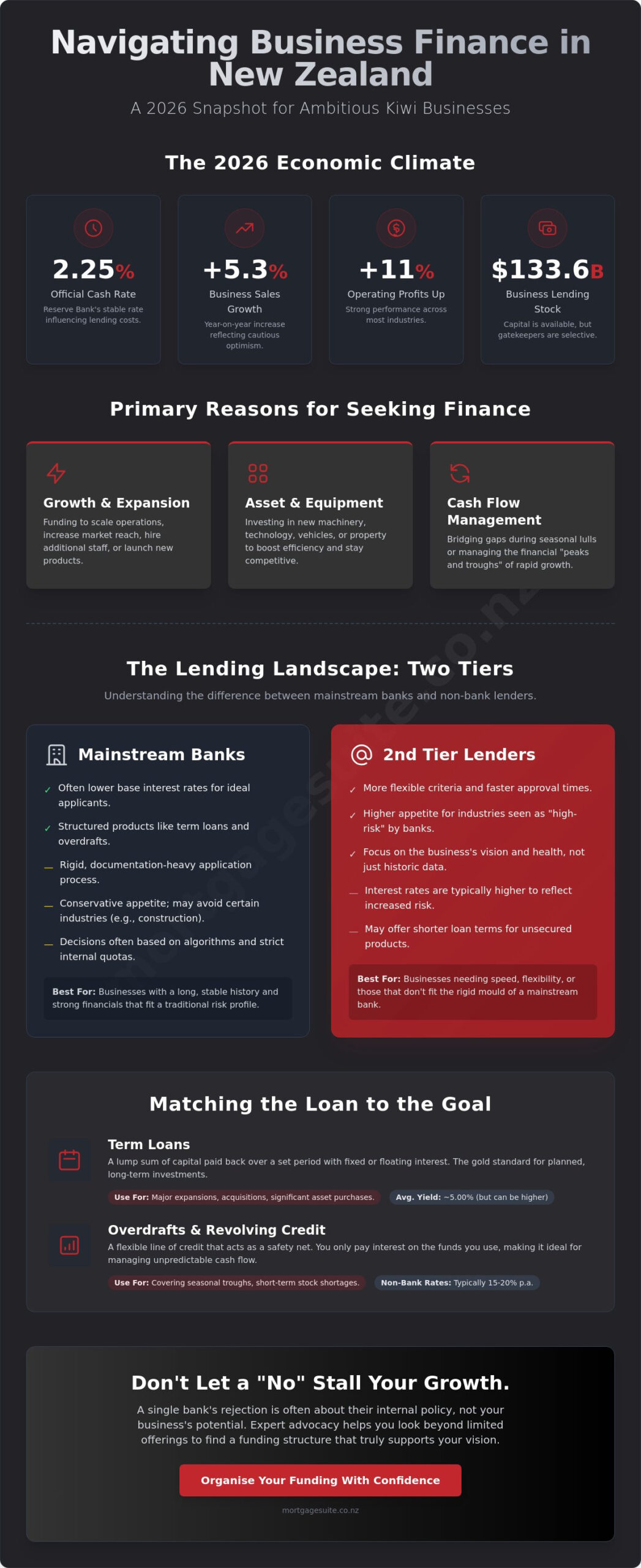
We agree that the traditional path shouldn’t be the only way to fuel your ambitions. This guide promises to demystify the lending landscape, helping you distinguish between secured and unsecured options while highlighting the rise of 2nd tier finance. We’ll preview the latest market shifts, including the impact of the 2.25% Official Cash Rate and the 3.4% annual growth in business lending stock, so you can make an informed choice that protects your cash flow and supports long-term growth. We’re here to help you organise your funding with confidence and clarity.

Key Takeaways

  • Learn how the 2026 economic climate and the 2.25% Official Cash Rate influence bank appetite and your ability to secure capital.
  • Explore the full range of business finance options nz offers, from flexible overdrafts for seasonal cash flow to structured term loans for major acquisitions.
  • Discover why “Tier 2” non-bank lenders are a vital alternative for businesses that don’t fit the rigid, documentation-heavy criteria of mainstream banks.
  • Identify the specific requirements for property development finance and commercial mortgages to ensure your expansion plans remain on track.
  • Understand how professional advocacy helps you look beyond a single bank’s limited offerings to negotiate a loan structure that truly supports your growth.

The economic pulse of New Zealand in 2026 reflects a period of disciplined growth and cautious optimism. With the Reserve Bank holding the Official Cash Rate at 2.25 percent, we’ve seen business sales climb by 5.3 percent compared to last year. This stability is encouraging, yet it doesn’t mean the path to capital is paved with gold. While operating profits are up 11 percent across most industries, the traditional “one-size-fits-all” approach from major banks often fails to recognise the nuances of a modern SME. You need more than a generic product; you need a strategy that aligns with your specific trajectory.

Securing the right funding requires an understanding of business finance options nz that go beyond the local branch. Most Kiwi entrepreneurs seek funding for three primary reasons:

  • Growth and Expansion: Scaling operations often requires a significant upfront investment in market reach or additional staff.
  • Asset and Equipment: Upgrading technology or machinery to maintain a competitive edge and operational efficiency.
  • Cash Flow Management: Bridging the gap during seasonal lulls or managing the “peaks and troughs” of rapid growth.

A specialised finance partner acts as a steady hand in this fluctuating market. We apply fundamental Corporate Finance Principles to your unique situation, ensuring your capital structure supports value maximisation rather than just creating a debt burden. With total business loans from registered banks reaching $133,601 million in April 2026, the capital is available, but the gatekeepers have become more selective.

The Shift Towards Alternative Lending

The regulatory environment changed significantly on July 1, 2026, as the Financial Markets Authority took over responsibility for the CCCFA. This shift, along with the established Conduct of Financial Institutions (CoFI) regime, has encouraged a more diverse range of “Tier 2” lenders. These non-bank providers often have a higher appetite for industries that mainstream banks might currently avoid, such as construction or niche retail. If you’ve been met with a “computer says no” response from a traditional institution, it’s often a reflection of their current internal quotas rather than your business’s actual health.

Identifying Your Funding Purpose

It’s vital to differentiate between working capital and long-term capital expenditure. A short-term cash flow gap shouldn’t be solved with a ten-year term loan; conversely, major equipment shouldn’t be funded by a high-interest overdraft. Your purpose dictates the security required. While “unsecured” business finance options nz are popular for their speed, they often come with higher rates and shorter terms. We help you evaluate whether providing security could unlock more sustainable funding that protects your long-term margins and allows for future scale.

Comparing Business Loan Types: From Overdrafts to Asset Finance

Selecting the right financial tool is just as vital as the funding itself. If you use a high-interest overdraft to buy a long-term asset, you’re essentially strangling your profit margins before the project even begins. Conversely, taking out a five-year term loan to cover a two-week stock shortage is equally inefficient. Navigating the various business finance options nz provides requires a clear-eyed look at your balance sheet and a deep understanding of how different debt structures interact with your cash flow.

Term loans remain the gold standard for major expansions or business acquisitions. These provide a lump sum with a fixed or floating interest rate, allowing you to plan your repayments with certainty. In March 2026, the weighted average yield on total business loans sat at 5.00 percent, but individual rates vary significantly based on your risk profile. For instance, ASB’s business base rate was 10.97 percent p.a. in June 2026. These loans are designed for longevity, providing the stability needed to see a long-term project through to completion.

Business overdrafts and revolving credit facilities offer a safety net for seasonal “peaks and troughs.” They are flexible, meaning you only pay interest on what you use. While mainstream banks offer lower base rates, non-bank lenders like Prospa provide accessibility for established businesses with rates typically ranging from 15 to 20 percent p.a. as of June 2026. These facilities are excellent for liquidity, but they can be expensive if you rely on them as a permanent debt solution.

Working Capital vs. Growth Capital

Understanding the “cost of capital” is essential for sustainable success. Working capital keeps the lights on and the staff paid during lean months, while growth capital is an investment in your future earning potential. You can explore a broader range of NZGCP funding options to see how different stages of business maturity require different financial tools. If your current structure feels like it’s stifling your progress, it might be time to review your business loan strategy with an expert who understands the nuances of the NZ market.

Specialised Asset and Equipment Funding

Asset finance is a powerful tool for tradies and manufacturers who need to upgrade vehicles or machinery without depleting their cash reserves. By securing the loan against the asset itself, you often unlock more competitive rates than a standard unsecured loan. You also need to consider the tax implications; a chattel mortgage allows you to claim GST upfront and depreciation, whereas a lease might offer different benefits depending on your accounting structure. This specialised path preserves your cash for day-to-day operations while ensuring your team has the best technology available to get the job done.

Mainstream Banks vs. 2nd Tier Lenders: Finding Your Best Fit

Deciding between a household-name bank and a specialised non-bank lender is a pivotal moment for any Kiwi entrepreneur. Mainstream banks, or Tier 1 lenders, typically offer the most attractive interest rates, but they demand a high level of compliance and a near-perfect financial history. If your business doesn’t fit their specific mould, perhaps due to a complex trust structure or a recent period of rapid expansion, the application process can feel like an uphill battle. With the non-performing loan ratio for all business loans sitting at a healthy 1.1 percent in April 2026, the market is stable, yet bank criteria remain incredibly tight.

The rise of Tier 2 lenders has transformed the variety of business finance options nz available to modern companies. These aren’t “lenders of last resort” for failing firms; they’re flexible alternatives for successful businesses that need speed and common-sense underwriting. While bank establishment fees can reach 1.00 percent of the loan amount, 2nd tier lenders might charge higher interest rates to compensate for their increased flexibility. For instance, Prospa rates for established businesses were between 15 and 20 percent p.a. in June 2026. Many owners use these loans as a strategic stepping stone, securing the capital needed to hit a growth milestone before eventually refinancing back to a mainstream bank.

When the Bank Says No: The Non-Bank Advantage

Banks often retreat from certain industries or require two years of pristine trading history before they’ll even consider an application. If you’re managing a newer venture or have a deposit that falls below traditional thresholds, a 2nd tier lender provides a viable path forward. They look at the “big picture,” including your current contracts and future earning potential, rather than just your past tax returns. The trade-off for a higher rate is the ability to act quickly on a commercial opportunity that a slow bank approval would surely miss.

The Role of Security and Collateral

A major point of difference lies in what you’re asked to put on the line. Tier 1 lenders almost always require residential property as security, which can be a source of significant stress for your family. 2nd tier business finance options nz frequently offer more creative solutions, such as using the specific business assets or equipment being funded as collateral. This approach allows you to separate your personal life from your professional risks while still accessing the capital necessary to drive your business forward.

Business Finance Options NZ: The 2026 Comprehensive Guide to Funding

Financing Growth: Commercial Property and Development Loans

Transitioning from a tenant to an owner-occupier is a landmark achievement for any Kiwi business. It represents a shift from paying off someone else’s mortgage to building equity in your own future. However, the path to acquiring commercial real estate or embarking on a new build involves a distinct set of hurdles compared to standard term lending. As of April 2026, commercial property lending has shown a robust annual growth rate of 5.8 percent, reflecting a “flight to quality” where businesses are increasingly seeking well-located, A-grade premises to anchor their operations.

Property development finance requires a much more sophisticated “pitch” than a simple working capital request. Lenders aren’t just looking at your current cash flow; they’re scrutinising the viability of the project, the strength of your build contract, and your track record in the industry. Bridging finance often plays a critical role here, providing the necessary liquidity to manage the gap between site acquisition and the commencement of construction. Without the right advice, this phase can become a bottleneck that stalls your expansion before the first sod is turned.

Structured Finance for Property Development

Success in development hinges on understanding key metrics like Gross Development Value (GDV) and Loan-to-Cost (LTC) ratios. Most mainstream banks will lend up to 65 percent of a commercial property’s value, while non-bank lenders may extend this to 70 percent for the right project. We focus on securing approvals by highlighting your pre-sales and developer experience, ensuring the lender sees a de-risked path to completion. Mortgage Suite Ltd specialises in facilitating these complex arrangements, acting as the bridge between your vision and the rigid world of institutional credit. If you are ready to break ground, you can apply for property development loans through Mortgage Suite Ltd today.

Commercial Property Acquisitions

For those looking to buy existing premises, the 2026 interest rate environment for commercial debt has stabilised between 6.5 percent and 7.5 percent. While this is typically 1 to 2 percent higher than residential rates, the long-term benefits of an owner-occupied loan are significant. You gain control over your operational environment and protect yourself from the volatility of the commercial rental market. Whether you’re targeting industrial centres or boutique retail hubs, we help you evaluate the various business finance options nz provides to ensure your mortgage structure aligns with your company’s tax strategy and growth targets. Understanding these business finance options nz is the first step toward turning a monthly expense into a permanent asset.

Securing Your Business Future with Expert Advocacy

Approaching a single bank often feels like trying to fit a square peg into a round hole. Each institution has its own “flavour of the month” lending appetite, which can change without notice based on their internal risk quotas. If you go direct, you’re limited to that one lender’s specific box. Expert advocacy changes the power dynamic. By exploring the full range of business finance options nz offers through a seasoned negotiator, you ensure that lenders compete for your business, rather than the other way around. It’s about finding the structure that fits your goals, not forcing your goals to fit a bank’s policy.

The Mortgage Suite Ltd advantage is built on more than 20 years of deep institutional banking experience. We’ve sat on the other side of the desk and know exactly what credit managers look for when they review a file. This insider knowledge allows us to prepare a “bank-ready” proposal that anticipates questions before they’re asked, significantly speeding up the path to a “yes.” When your application is presented with professional polish and a clear strategic narrative, you’re no longer just a number in a queue; you’re a high-quality prospect with a compelling case for capital.

A Consultation, Not a Transaction

Krish Krishna and the team at Mortgage Suite Ltd act as your dedicated advocates in the boardroom. We don’t just process paperwork; we partner with you to review existing debt and identify refinancing opportunities that could save you thousands in interest. This holistic approach ensures that your commercial debt and your home loans for first home buyers New Zealand are structured to complement each other, protecting your total wealth. We believe in building long-term relationships where we understand your business evolution, allowing us to pivot your finance strategy as your company grows and market conditions shift.

Next Steps: Your Path to Funding

Starting the conversation early is the most effective way to seize market opportunities when they arise. To speed up your 2026 application, begin gathering your latest financial statements, a clear business plan, and updated cash flow forecasts today. These documents form the foundation of your “bank-ready” pitch. Mortgage Suite Ltd offers a confidential business finance health check to help you understand where you stand and which business finance options nz are most viable for your current stage. Don’t wait for a cash flow crunch to look for funding. Proactive planning ensures you have the capital you need to scale with confidence and maintain your competitive edge in a fast-moving economy.

Empowering Your Business Growth in 2026

The 2026 financial landscape offers more flexibility than ever for those who know where to look. We’ve explored how the shift toward alternative lending and the strategic use of asset finance can protect your cash flow while fuelling expansion. Success isn’t just about finding the lowest rate; it’s about matching the right debt structure to your specific growth stage. Whether you’re navigating mainstream bank requirements or exploring 2nd tier alternatives, understanding the full breadth of business finance options nz provides is your greatest competitive advantage.

With over 20 years of banking and lending expertise, we specialise in 2nd tier and non-bank solutions that mainstream institutions often overlook. Our national coverage ensures that Kiwi businesses across all industries receive the dedicated advocacy they deserve. If you’re ready to move beyond the “one-size-fits-all” approach, it’s time to book a confidential business finance strategy session with Krish Krishna. We look forward to helping you turn your vision into a sustainable reality.

Frequently Asked Questions

How do I qualify for a business loan in NZ if I am self-employed?

Self-employed borrowers qualify by providing proof of consistent income, typically through two years of finalised IRD tax returns and recent bank statements. While mainstream banks have rigid documentation requirements, 2nd tier business finance options nz can often look at alternative data, such as your GST returns or current contracts, to assess your serviceability. We help you organise your financials to present a professional, bank-ready case that highlights your business’s true earning potential.

What is the difference between a secured and an unsecured business loan?

A secured loan is backed by an asset, such as commercial property or heavy machinery, which reduces the lender’s risk and typically results in lower interest rates. An unsecured loan doesn’t require physical collateral but relies on your company’s cash flow and credit history. These are often faster to approve but carry higher rates to reflect the increased risk. Choosing the right path depends on your specific growth stage and the level of personal risk you’re comfortable with.

How much can I borrow for a commercial property development project?

For a commercial property development project, banks generally lend up to 65 percent of the completed value, while non-bank lenders may extend this to 70 percent. The actual amount you can borrow is determined by your project’s Gross Development Value (GDV) and your ability to cover the remaining equity. Lenders also scrutinise your industry experience and the strength of your pre-sales to ensure the project is financially viable from site acquisition through to construction.

Why was my business loan declined by a mainstream bank?

Mainstream banks often decline applications due to their rigid “one-size-fits-all” lending criteria or a temporary lack of appetite for specific industries like construction or retail. Common reasons include a short trading history, complex income structures, or a deposit that doesn’t meet their strict thresholds. If your application was rejected, it’s often a sign that your needs don’t fit the bank’s current internal quotas rather than a reflection of your business’s actual health or future potential.

Can I get a business loan without using my home as security?

Yes, you can secure funding without using your family home as collateral. Many 2nd tier business finance options nz allow you to secure a loan against specific business assets, vehicles, or equipment. Alternatively, unsecured facilities rely on your business’s turnover and cash flow rather than physical property. This approach protects your personal assets and provides a clear separation between your family’s security and your professional expansion goals.

What are the current business loan interest rates in NZ for 2026?

In 2026, interest rates vary based on the lender and the level of security provided. With the OCR at 2.25 percent, ASB’s business base rate is 10.97 percent p.a., while commercial property rates typically range from 6.5 to 7.5 percent. Non-bank lenders like Prospa offer rates starting from 14.99 percent p.a. for established businesses. We help you navigate these rates to find a structure that balances cost with the flexibility your business needs to scale.

How long does it take to get a business loan approved in New Zealand?

The approval timeframe depends heavily on the type of lender you choose. Mainstream banks are notoriously methodical, often taking several weeks or even months to process complex commercial applications. In contrast, 2nd tier lenders can provide an initial approval within 24 to 48 hours, with funds often settled in less than a week. We work with you to gather the necessary documentation early, ensuring your application moves through the system as efficiently as possible.

Do I need a business plan to apply for 2nd tier finance?

While not always mandatory for smaller, unsecured facilities, a clear business plan is essential for larger 2nd tier expansion or development loans. It allows the lender to see the “big picture” and understand your strategy for generating a return on the capital. A well-prepared plan demonstrates your professionalism and commitment, making it much easier for an advocate to negotiate a favourable deal on your behalf. We assist in refining your plan to ensure it meets lender expectations.

Article by

Krish Krishna

Experienced Financial Adviser with over 46 years of Banking and Mortgage broking experience and over $2.0 Billion in loan settlements.