
Subdivision Finance NZ: How to Fund Your Property Development in 2026

What if the only thing standing between your backyard and a profitable development isn’t the land itself, but a bank’s rigid checklist? For many Kiwis, the dream of splitting a block and building for the future feels stuck behind a wall of high upfront costs and strict equity rules. You likely already know that your property holds untapped potential, but the sheer volume of council fees and consultant costs can feel overwhelming when the big banks won’t budge on their criteria. This is where understanding the nuances of subdivision finance NZ becomes your biggest advantage.

I agree that the current financial climate, with the OCR sitting at 2.75 per cent and new planning laws like the Natural Environment Bill coming into effect, makes the process feel more complex than ever. This guide promises to clear the fog by showing you how to fund your project from start to finish. We will explore why non-bank lenders are often the better partner for these builds and how you can secure a loan that covers both your land and development costs. By the end, you will have a clear, stress-free path to making your subdivision a reality.

Key Takeaways

  • Learn how to cover every expense, from initial council fees to the final physical construction, by choosing a loan specifically designed for splitting property titles.
  • Discover why 2nd tier lenders offer more flexibility for subdivision finance NZ by prioritising the potential of your deal over the strict income rules used by mainstream banks.
  • Find out how to keep your project moving smoothly by accessing your funding in stages as you reach important development milestones.
  • Understand the essential steps to prepare your application, including how to get a valuation based on what your finished project will be worth.
  • Gain the confidence to navigate a changing market by partnering with an expert who acts as your personal advocate and negotiator with alternative lenders.

What Exactly is Subdivision Finance in NZ?

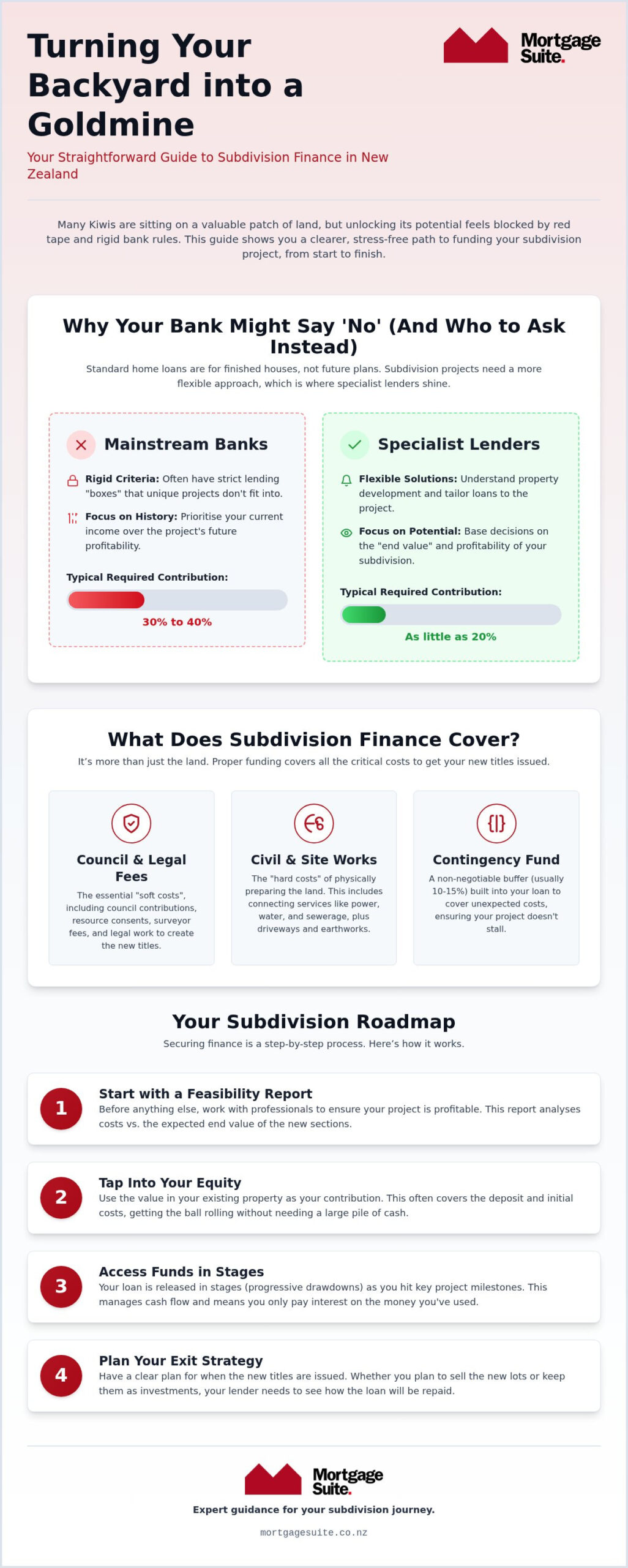
Think of subdivision finance as a specialised type of borrowing that focuses on the potential of your land rather than just its current state. While a normal mortgage covers the house you live in, this finance covers the journey of splitting one title into two or more. It’s a strategic way to fund the gaps between having a large backyard and having two or more saleable sections. This type of funding is unique because it needs to cover “soft costs” like council fees and “hard costs” such as the physical civil works required to prepare the land.

In its simplest form, subdivision finance is a flexible funding tool designed to help you unlock the true value of your land by turning one property into several.

Mid-2026 is a pivotal time for property owners in New Zealand. The old Resource Management Act has officially been replaced by the Natural Environment Bill and the Planning Bill, which became law earlier this year. These changes have shifted the rules for land use, making subdivision finance NZ more relevant than ever. With these new regulations in place, the path to gaining consent has changed, and having the right funding structure is the only way to move quickly before local rules shift again.

Why a Standard Home Loan Usually Isn’t Enough

Traditional banks usually prefer to see a finished home and a steady paycheck before they’re comfortable lending the full amount. They aren’t always fond of the uncertainty that comes with a construction site. Subdivisions require a loan that allows for “progressive drawdowns”. This means your lender releases money in stages, allowing you to pay your surveyors, drainlayers, and builders as they complete specific milestones. You will also need to use the equity in your existing property as a foundation to secure the project, something a standard home loan isn’t always flexible enough to handle.

Common Costs You Need to Fund

When you’re planning your budget, you have to look beyond the visible construction. You’ll face three major categories of expense. First are the council contributions, which in areas like Auckland can range from $20,400 to $49,000 per new lot. Second are the civil engineering costs, including pipes, driveways, and connections. Finally, you have legal and surveying fees to finalise the new titles. Because surprises are common in development, a professional finance package always includes a contingency fund to keep the project from stalling. To get a sense of your current position, you can use our mortgage calculator to see how much equity you can put toward these initial costs.

How Subdivision Funding Works: The Practical Side

The process usually kicks off with either a site acquisition or a refinance of your existing land. If you already own the property, we look at how much value is sitting there to see if it can jumpstart the project. Unlike a standard loan where you get the whole amount at once, subdivision finance NZ is released in stages. These milestones ensure that as you clear one hurdle, like getting your drainage sorted or your driveway poured, the money is ready for the next step. It’s a structured way to keep the project moving without you having to front all the cash at once.

Lenders in 2026 are particularly focused on the “end value” of your project. This is simply what the new sections will be worth once the titles are issued and the fences are up. Because they are looking at the future value of the land, they also need to see a rock-solid exit strategy. They want to know exactly how you plan to pay the loan back, whether that’s by selling the new lots or moving to a long-term mortgage once the work is done.

Equity vs. Cash: What Do You Need to Bring?

In the current market, most traditional lenders expect you to have a decent amount of “skin in the game,” often requiring equity contributions of 30 to 40 per cent. However, you don’t always need a pile of cash sitting in your savings account. Many developers use the built-up value in their own homes to cover these requirements. If your plan is to build on the new sections and keep them as rentals, you might want to look at Residential Investment Property Loans NZ to see how that fits into your long-term wealth strategy.

Interest Rates and Fees in the Subdivision Space

It’s natural to notice that interest rates for development are higher than what you see on the news for standard home loans. In 2026, total interest costs for private funding can range between 9 and 16 per cent annually. While that sounds high, remember this is a short-term tool to get you to the finish line. A key feature here is “capitalised interest.” This allows you to add the interest costs to the total loan balance instead of making monthly payments, which keeps your cash flow healthy while you’re busy with construction. The goal is to focus on the total profit of the project rather than just the cost of the money. If you’re feeling unsure about the numbers, it’s a good idea to talk to a specialist who can help you weigh up the costs against the potential gains.

Mainstream Banks vs. 2nd Tier Lenders: Why the Bank Might Say No

Mainstream banks have a very specific way of looking at the world. They prioritise what they call serviceability, which is really just a way of saying they want to see a high, regular income right now. If your income is complex or you’re self-employed, a bank’s rigid checklist can quickly become a dead end. This is one of the most common reasons people struggle to secure subdivision finance NZ. They have the land and a great plan, but they don’t fit the bank’s cookie-cutter mold for a standard borrower.

2nd tier lenders, on the other hand, operate differently. They focus on the asset and the strength of the deal itself. While a bank might take weeks to process an application, an alternative lender can often give you an answer in just a few days. There’s also a common myth that non-bank lenders are only for people with poor credit history. In reality, many of the most successful developers in the country use non-bank options because they value speed, flexibility, and a lender who understands the potential of their project.

The Flexibility of 2nd Tier Lending

These lenders are often willing to look at the future value of your land once the subdivision is complete. This makes them a perfect fit if you’re looking for a 2nd Tier Lender New Zealand who can handle complex scenarios that traditional banks won’t touch. My background with over 20 years in the banking industry allows me to act as a translator. I know how to package your deal so these lenders see the same potential that you do, ensuring your application doesn’t just sit in a pile.

When to Stick with a Bank (and When to Move)

If you have a very simple project with a low loan-to-value ratio, a mainstream bank might still be a good option because of their lower interest rates. However, many developers find success with a hybrid approach. This involves using a flexible 2nd tier lender to fund the active development phase and the civil works. Once the new titles are issued and the risk is lower, you can then refinance back to a mainstream bank. Having a broker who understands both of these worlds is your biggest advantage, as we can plan your move back to a bank before you even sign the first loan document.

Subdivision Finance NZ: How to Fund Your Property Development in 2026

Steps to Secure Your Subdivision Finance in 2026

Getting your project off the ground requires more than just a good piece of land. In the 2026 market, lenders are looking for precision and a clear roadmap. Following a logical sequence not only makes the process smoother but also significantly increases your chances of a “yes” from the right lender. When you’re looking for subdivision finance NZ, think of these steps as your foundation.

  • Step 1: The Feasibility Report. This is your reality check. You need to prove that after all the costs are paid, the project actually makes a profit. Lenders won’t touch a deal that looks too tight on the margins.
  • Step 2: The Registered Valuation. You’ll need a professional to look at the “as-if-complete” value. This tells the lender what the new sections will be worth once the titles are issued.
  • Step 3: Your Loan Story. This is about more than just numbers. You need to explain who you are, your experience, what you’re building, and exactly how you’ll pay the money back.
  • Step 4: Engage a Specialist. A broker who understands the 2nd tier market can find the specific lender whose criteria match your project.
  • Step 5: The Letter of Offer. Once you have this in hand, you can finally sign contracts and start the physical civil works.

The Importance of a Registered Valuation

A standard online estimate from a website won’t cut it when it comes to development. For subdivision finance NZ, lenders require a formal registered valuation. This report is detailed and looks specifically at the local zoning rules and the development potential of your specific block. A valuer who understands the 2026 planning laws can often identify hidden value that an algorithm would miss. Having the right valuation can significantly increase your borrowing power because it gives the lender confidence in the future value of the asset.

Preparing Your Documentation

Lenders want to see that you’ve done your homework. They’ll ask for your resource consents, fixed-price contracts from civil contractors, and a realistic timeline for the build. Keeping this paperwork organised from day one prevents the back-and-forth emails that often delay a project. If you’re feeling a bit unsure about what makes a project “loan-ready,” you can explore our Mortgage School for more tips on preparing your application. Being organised shows the lender that you’re a professional who can be trusted with their capital. If you’re ready to see which lending options fit your project, reach out to Mortgage Suite today for a straightforward conversation about your goals.

Partnering with Mortgage Suite for Your Subdivision Journey

When you’re dealing with the complexities of property development, having a steady hand to guide you makes all the difference. Krish Krishna brings over 20 years of banking experience to the table, providing the calm and seasoned professionalism needed to navigate a fluctuating market. We don’t just see ourselves as brokers who shuffle documents; we are your dedicated negotiators and advocates. Our goal is to take the weight of the application process off your shoulders so you can focus on the actual project. Whether you’re working on a small two-lot split or a more involved development, our national expertise helps Kiwis across New Zealand find the right subdivision finance NZ to unlock their land’s potential.

We understand that the financial side of a subdivision can be the most stressful part of the entire process. There are council fees to worry about, civil contractors to pay, and the constant pressure of interest rates. By acting as your proactive partner, we aim to remove these obstacles. We handle the difficult conversations with lenders and ensure your “loan story” is presented in the best possible light. This client-centric focus means you aren’t just another number in a system; you’re a partner whose success is our priority. We take the time to listen to your specific needs and build a funding strategy that fits your unique situation.

Experience That Counts

Two decades in the industry means we’ve seen almost every possible loan scenario. We know exactly how to bridge the gap between the rigid world of institutional banking and your personal needs as a borrower. Our approach is grounded in a philosophy of educating our clients, ensuring you understand every step of the journey rather than feeling left in the dark. If you want to see how this commitment to partnership works in practice, our reviews show a long history of prioritising client success over simple transactions. We take pride in being the bridge that helps you cross from a “no” at a mainstream bank to a “yes” with a specialist lender who sees the value in your deal.

Ready to Chat About Your Land?

Every piece of land is unique, and every developer has a different goal. We invite you to have a no-obligation conversation with us to see what’s possible for your property. It’s often the case that a quick chat can reveal funding pathways you hadn’t considered, especially in the 2nd tier lending space where flexibility is key. If you’re looking for a deeper dive into the specifics of construction funding beyond the initial split, you might find our guide on Property Development Loans NZ helpful for your next steps. Subdividing your land is a big decision and a significant financial step, but you don’t have to do it alone. We are here to provide the expertise and the advocacy you need to turn your property’s hidden value into a successful reality.

Ready to Unlock Your Land’s Full Potential?

The path to a successful property development doesn’t have to be blocked by rigid bank rules. We have explored how 2nd tier lenders prioritise the asset over your current salary, providing the breakthrough you need when traditional doors close. By focusing on a solid feasibility report and a professional valuation, you’re setting yourself up for a project that actually makes sense on paper and in reality. Securing subdivision finance NZ is about finding the right partner who knows how to navigate the 2026 planning laws and negotiate on your behalf.

At Mortgage Suite, we bring over 20 years of banking and brokerage experience to every project. We specialise in those 2nd tier and non-bank lending options that mainstream banks often decline, providing expert national coverage across the country. You don’t have to tackle the stress of council fees and civil work funding alone. When you have a seasoned advocate in your corner, the complex world of development finance becomes a clear, manageable journey toward your goals. It is time to turn your backyard into a building site with confidence.

Talk to Krish Krishna about your subdivision project today

Frequently Asked Questions

Can I get subdivision finance if the bank has already said no?

Yes, you certainly can. Mainstream banks have strict income and serviceability rules that often don’t fit the reality of property development. We specialise in 2nd tier loans and non-bank options that look at the potential of the land and the strength of the deal rather than just your current salary. If your project is viable and has a clear plan, there is likely a specialist lender ready to help you move forward.

How much deposit do I need for a subdivision loan in NZ?

Generally, you will need a contribution of 30 to 40 per cent of the total project cost. While traditional banks are quite rigid about this requirement, some alternative lenders can be more flexible if the finished value of the project is high. You don’t always need this in cash; building equity in your existing land often counts as your “skin in the game” for subdivision finance NZ.

What is the difference between a 2nd tier lender and a traditional bank?

The main difference lies in their lending criteria and what they prioritising. Traditional banks focus heavily on your regular income and your ability to make monthly repayments from your salary. 2nd tier lenders are more interested in the asset itself and your strategy for paying the loan back. They are often much faster to approve deals and are more comfortable with the risks associated with active construction sites.

Can I use the equity in my current home to fund the subdivision?

Yes, using the built-up value in your existing property is a very common way to jumpstart a project. This equity can often cover the initial costs like council contributions and surveying fees without you needing to dip into your personal savings. It acts as security for the new loan, allowing you to leverage the hidden value already sitting in your land to create new titles and profit.

How long does it take to get subdivision finance approved?

Approval times vary, but non-bank lenders can often provide a firm answer within a few business days. While a mainstream bank might take weeks to work through their complex internal committees, specialist lenders are designed for speed and efficiency. Having your documentation, such as feasibility reports and valuations, ready to go will ensure the process moves as quickly as possible so you can start your civil works.

Do I need resource consent before I can apply for funding?

You can often get a conditional approval before your consent is finalised, but most lenders won’t release the full funds until it is officially granted. Having your resource consent already in place makes your application much stronger and reduces the perceived risk for the lender. It shows that the council has approved your plan and that the project is ready to move into the physical construction phase without delay.

What happens if my subdivision project faces delays?

Delays are common in development, which is why we always recommend including a contingency fund in your finance package. If your project takes longer than expected, you can often negotiate an extension with your lender. Because many development loans use capitalised interest, you won’t have to worry about making monthly repayments while you are waiting for council sign-offs or for contractors to finish their physical work on the site.

Is subdivision finance more expensive than a regular mortgage?

Yes, interest rates for subdivision finance NZ are typically higher because the lender is taking on more risk during the construction phase. In the 2026 market, private rates can sit several percentage points above standard bank rates. However, these are short-term tools designed to be paid back once the project is finished. The focus should always be on the total profit of the deal rather than just the interest rate.

Article by

Krish Krishna

Experienced Financial Adviser with over 46 years of Banking and Mortgage broking experience and over $2.0 Billion in loan settlements.

Subdivision Finance NZ: Your 2026 Guide to Funding Your Land Project

What if the “No” you just received from your bank is actually the best thing that could happen to your development? It’s a common story in the 2026 market. You have the land and the vision, but the big banks are tightening their belts and drowning you in talk of pre-sales and drawdowns. Securing subdivision finance nz doesn’t have to be a roadblock that stops your project before the first spade hits the dirt.

Most landowners find the process of funding a project incredibly stressful, especially when faced with hidden civil costs and confusing council fees. We agree that it’s a lot to handle on your own. This guide promises to give you the clarity you need to move forward with confidence. You’ll discover how to bypass mainstream bank hurdles, understand the non-bank options available to you, and learn the best ways to maximise your profit in this changing regulatory environment. We will walk you through the entire path from your initial application to the final settlement, ensuring you have a steady hand to guide you.

Key Takeaways

  • Understand why a standard home loan won’t work for development and how the right funding structure turns one piece of land into multiple titles.
  • Compare the major banks with private lenders to find a path that avoids endless red tape and keeps your project moving.
  • Uncover the hidden costs like council fees and civil works that you must account for when securing subdivision finance nz.
  • Learn how to build a rock-solid case for approval by focusing on the one document every lender considers a “must-have.”
  • Discover how professional negotiation and years of banking experience can help you bridge the gap between a “no” and a successful project.

What is Subdivision Finance and Why Does it Matter?

Think of subdivision finance nz as the specialised engine that powers your project from a simple idea to a profitable reality. It isn’t just a standard mortgage with a different name. This is a specific type of funding designed to handle the transition of one piece of land into multiple legal titles. While your everyday home loan is great for buying a finished house, it isn’t built to handle the complexities of a development site. You need money that works as hard as you do, covering everything from the first survey to the final council sign-off.

The goal here is simple: you want to unlock the equity sitting in your land. By dividing the property, you create new assets that didn’t exist before. This process, formally known as Subdivision (land), requires a lender who understands that you aren’t just buying a home; you’re running a business venture. The right subdivision finance nz package stays with you through the “dirt” phase, the civil works, and right up until you receive your Statement of Compliance from the local council.

The Two Main Ways to Profit from Your Land

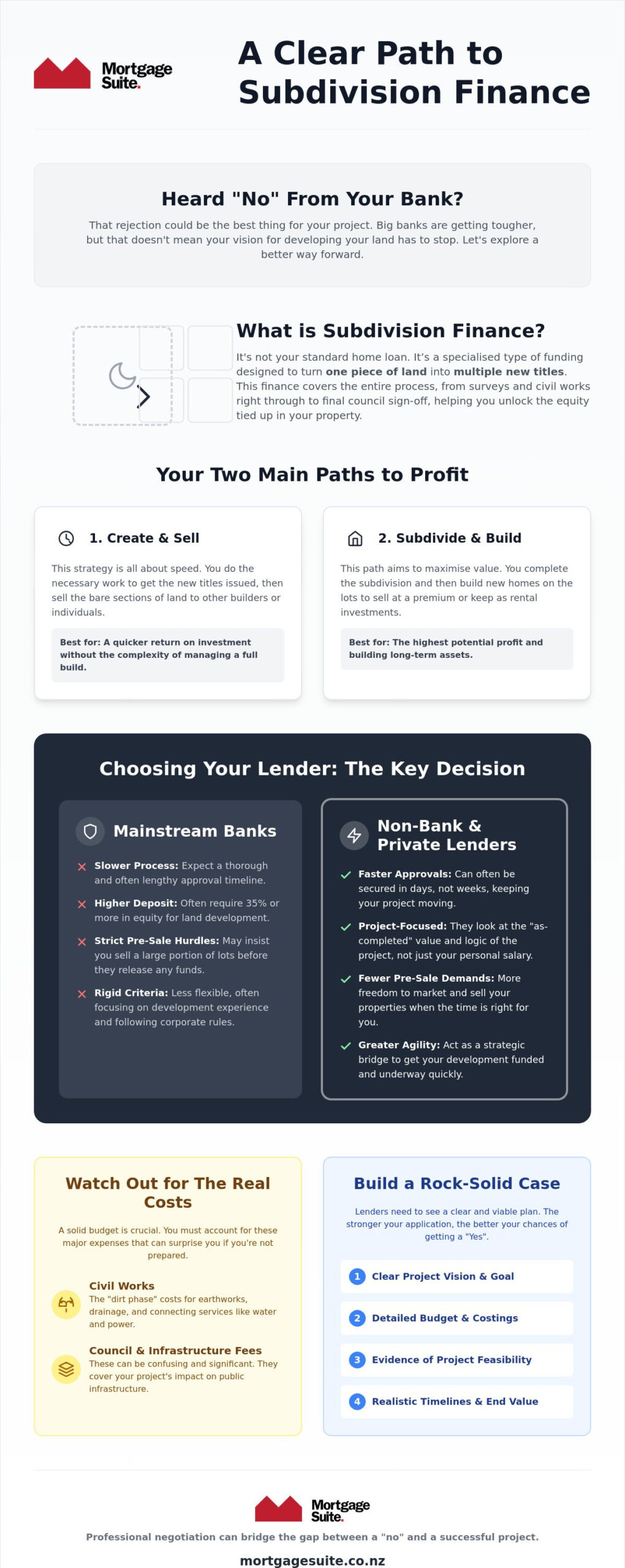
Most of our clients choose one of two paths. The “Create and Sell” strategy is popular because it’s often faster. You do the work to get the new titles and then sell the bare land to someone else. It’s a great way to get a quick return without the stress of a full build. On the other hand, the “Subdivide and Build” strategy offers the most long-term value. You keep the land, build new homes, and either sell them for a premium or keep them as rentals. Because these paths have different risks and timelines, the type of loan you need will change depending on your final goal. If you plan to build on your new lots, understanding how a construction loan NZ works alongside your subdivision funding is an essential next step.

Why Your Current Bank Might Say No

It’s incredibly frustrating to be turned down by a bank you’ve been with for years. Mainstream banks often see vacant or “unimproved” land as a high-risk gamble. They might demand that you have years of development experience or insist on pre-sales before they’ll even look at your application. If you find yourself hitting a brick wall, it’s time to look at 2nd tier lender New Zealand options. These lenders are often more interested in the actual feasibility of your project than just following a rigid set of corporate rules. Having this backup plan ensures your project doesn’t stall just because a big bank didn’t see the potential you do.

Bank Loans vs. Non-Bank Lenders: Choosing Your Path

Deciding where to source your capital is the most critical choice you’ll make for your development. While many Kiwis naturally head to the “Big Four” banks first, the 2026 lending landscape for subdivision finance nz is much broader than it used to be. The right choice depends entirely on your timeline, your cash flow, and how much “red tape” you’re willing to handle. While banks offer the most attractive interest rates on paper, their rigid criteria can often stall a promising project before it even gets off the ground.

Non-bank lenders, on the other hand, operate with a different level of flexibility. They tend to focus on the logic of the project itself rather than just your personal salary or background. This shift in focus is why many successful developers use alternative funding to keep their projects moving when a traditional bank says no. 2nd tier lending acts as a strategic bridge for developers who need speed and fewer pre-sale hurdles to reach their goals.

The Mainstream Bank Approach

If you choose a traditional bank, you should expect a thorough and often slow process. Banks typically demand significantly higher deposits for land development, often asking for 35% or more in equity. Their biggest hurdle is the “pre-sale” requirement. A bank might insist that you sell a large portion of your lots before they release any funds. This cautiousness stems from the complex legal requirements found in the Resource Management Act 1991, as banks want to be certain the project is financially viable before they take on the risk.

The Non-Bank and Private Advantage

Non-bank and private lenders offer a level of agility that mainstream banks simply can’t match. Approvals can often be secured in a matter of days rather than weeks, which is vital when you’re trying to settle on a property or start civil works. These lenders often look at the “as-completed” value of your project. Instead of just looking at what the dirt is worth today, they consider the value of the new titles you’re creating. This approach, combined with fewer pre-sale requirements, allows you to market your property when the timing is right for you, not just when the bank says so. If you’re unsure which route fits your specific project, the team at Mortgage Suite Ltd can help you weigh up these options to find the most profitable path forward.

The Real Costs: Infrastructure, Fees, and the ‘Money Pit’

On paper, turning one lot into two or three looks like a guaranteed win. However, the reality of subdivision finance nz is that the most significant costs often hide beneath the surface. It isn’t just about the purchase price; it’s about the “hard costs” that turn a piece of dirt into a buildable site. Many first-time developers are caught off guard by the sheer scale of investment required before a single house frame even goes up. This is where a project can easily become a “money pit” if you haven’t planned for the specific expenses that councils and contractors will demand.

Because these costs are so front-heavy, property development loans NZ are structured differently than a standard mortgage. Instead of getting all the money at once, you use “progressive drawdowns.” This means your lender releases funds in stages as you hit specific milestones, such as completing the drainage or finishing the roading. We always recommend setting aside a contingency fund of at least 10% to 15% of your total budget. Whether it’s hitting unexpected rock during excavation or a sudden change in council requirements, having that buffer prevents your project from grinding to a halt.

Council Fees and Civil Works

In 2026, council fees remain a major hurdle. In Auckland, for example, development contributions can range from approximately $20,400 to $49,000 per new lot depending on the area. You also have to account for the Watercare infrastructure growth charge, which is now roughly $29,300 per unit. These “entry fees” simply give you the right to subdivide. On top of that, you must pay for the physical work to connect every new lot to power, water, and sewage. These civil works are often the biggest drain on your cash flow, but they are essential for creating a valuable asset.

Managing Your Cash Flow During the Build

One of the best ways to protect your sanity during a project is through “capitalised interest.” This is a common feature in subdivision finance nz where the interest payments are added to the loan balance instead of you paying them out of your pocket every month. It keeps your cash free for the actual work. To make sure everything stays on track, lenders often use a Quantity Surveyor (QS) to check the progress. The QS visits the site, confirms the work is done, and gives the green light for the next drawdown. If you find a perfect new site while your current project is still finishing, you might consider bridging finance nz to secure the next opportunity without waiting for your current lots to settle.

Subdivision Finance NZ: Your 2026 Guide to Funding Your Land Project

The Approval Checklist: What Lenders Need to See

Getting a “yes” for subdivision finance nz isn’t just about owning a great piece of land. It’s about showing you have a solid plan to turn that dirt into a profit. Lenders are naturally a bit cautious, and they want to see that you have done your homework before they hand over any money. You need to put together a professional package that shows you understand the risks and have a clear way to handle them. A lender’s confidence is built on the strength of your planning, not just the size of your property.

Before you pick up the phone to talk to a broker, start gathering your essential papers. This includes your personal money statements, a clear copy of your ownership papers, and any letters you’ve had from the council about planning permission. Having these ready to go shows that you are a serious developer who understands the process. It makes the whole conversation much smoother from the very first day.

Proving the Project Works (The Feasibility)

Your feasibility study is the most important part of your toolkit. It is basically the story of how your project will actually make money. It needs to break down every single cost, what you expect to sell the new lots for, and your final profit. One common mistake is being a bit too optimistic about those final sale prices. If your numbers look too high compared to what’s actually selling nearby, a lender will lose trust in your whole plan. You also need to account for GST, which can take a big bite out of your budget if you haven’t planned for it properly. Understanding exactly how to obtain development funding from the right lender starts with getting this feasibility document right.

Your Experience and Your Team

If this is your first time doing a project like this, don’t worry. You can use the experience of your team to reassure the lender. Having a seasoned planner or a project manager with a great track record makes a massive difference to your application. Lenders also look much more favourably on projects that have fixed-price contracts for the work in the ground. This locks in your costs and prevents the “money pit” scenario we talked about earlier. Securing subdivision finance nz is much easier when you have a specialist broker to help package your story. If you’re ready to get moving, reach out to the team at Mortgage Suite Ltd to see how we can help you secure the funding you need.

How Mortgage Suite Ltd Navigates the Subdivision Maze

Krish Krishna brings over 20 years of big bank experience to your side of the table. It is your secret weapon when you are talking to lenders. When you are dealing with the tricky world of subdivision finance nz, you don’t just need someone to fill out forms. You need a veteran who knows exactly how those big banks think and what they want to see in a successful plan. Mortgage Suite Ltd acts as a bridge between your vision and the money needed to build it. Our goal is to take the stress out of the money side of things, especially when the usual banks make it feel like you are hitting a brick wall.

We believe in a partnership that stays away from confusing business talk. You won’t find us using complex terms that make your head spin. Instead, we focus on clear, honest chats about what your project needs to get across the finish line. Because we have built strong connections all over New Zealand, we can find private funding options that you won’t find by just walking into a local branch. We know which lenders are actually looking for development projects right now, which saves you a lot of time and hassle. Our team can also walk you through property development funding strategies that match your specific project goals and timeline.

A Personal Approach to Complex Finance

At Mortgage Suite Ltd, we don’t just “process” paperwork. We mentor you through the whole process of getting your loan. Whether you are in a big city or a smaller regional centre, our national reach means we help Kiwis everywhere unlock what their land is worth. We handle those tough talks with lenders so you don’t have to. If a lender has questions about your timeline, we are the ones who step in and stick up for you. We use our reputation to find solutions that keep your project moving and protect your profit. You are never just a number to us; you are a partner whose success is our priority.

Getting Started with Mortgage Suite Ltd

The first step is always the easiest. It starts with a simple, friendly chat to see if your project has “legs.” We will listen to your goals and help you decide which path makes the most sense for you. From there, we help you get your plan and your team organised so you have the best shot at getting a “yes.” We know exactly what lenders need to see to feel good about your project. Ready to see what your land is really worth? Let’s chat about your subdivision goals today.

Ready to Unlock Your Land’s Potential?

Turning a single plot of land into multiple titles is a major project, but it remains one of the most effective ways to build wealth in the 2026 market. Success depends on choosing the right path between traditional banks and more agile non-bank lenders. You now understand the need to account for those hidden infrastructure costs and why a rock-solid feasibility study is your best tool for approval. Getting the right subdivision finance nz is the foundation for your entire project.

With over two decades of banking and brokerage experience, Krish Krishna and the team are ready to help you move forward. We specialise in 2nd tier and non-bank lending solutions that often provide the flexibility you won’t find on the high street. Our national service covers all of New Zealand, ensuring you have a seasoned mentor by your side regardless of where your land is located. We handle the tough negotiations so you can focus on the build.

Don’t let red tape or a bank’s “no” stop your progress. Book a consultation with Krish and the team at Mortgage Suite today. We are here to help you turn your vision into a profitable reality.

Frequently Asked Questions

Can I get a land development loan if I’ve been declined by my bank?

Yes, you absolutely can. Traditional banks often have very narrow “boxes” that many profitable projects simply don’t fit into. We specialise in connecting developers with 2nd tier and private lenders who prioritise the actual feasibility and logic of your project over a rigid computer-generated credit score. If your land has value and your plan is solid, there is almost always a funding path available.

How much deposit do I need for a subdivision in New Zealand?

While mainstream banks typically ask for a deposit of 35% or more, non-bank options can be much more flexible. These lenders often look at the “as-completed” value of your project rather than just the current price of the land. This means if you already own the property, the equity you’ve built up over time could potentially cover the entire deposit for your civil works.

What are ‘pre-sales’ and do I always need them to get funding?

Pre-sales involve selling your new lots to buyers before the final titles have been issued. Big banks often demand these to prove there is a market for your project before they release any funds. However, many private lenders don’t require them at all. This gives you the freedom to finish the project first and sell when the market is stronger, potentially increasing your final profit margin.

Can I use the equity in my current home to fund a subdivision?

Yes, using the equity in your existing property is one of the most common ways to kickstart a development. By securing your subdivision finance nz against your home, you can often access the cash needed for those early council fees and civil works. It’s a smart way to get the project moving without needing to have a large amount of cash sitting in the bank.

How long does it usually take to get subdivision finance approved?

If you are working with a non-bank or private lender, you can often get an approval in just a few days. Mainstream banks are much slower and can take several weeks to process the same application because of their internal red tape. Speed is often vital when you are trying to secure a site or book a contractor who has a limited window of availability.

Is it better to subdivide and sell bare land or build houses first?

The best choice depends on your personal goals and your tolerance for risk. Selling bare land is generally faster and requires less capital, which makes it a lower-risk option. Building houses on the new lots involves more work and a longer timeline, but it usually offers a significantly higher profit. If you decide to build, exploring your construction loan NZ options early will help you understand the full funding picture. We can help you look at the numbers for both strategies to see which fits your situation.

What happens if my infrastructure costs go over budget?

If you hit an unexpected hurdle that pushes costs up, the first step is to talk to your lender immediately. This is why we build a contingency buffer into your initial budget. If you’ve already used that buffer, we can often negotiate a “top-up” or look at alternative subdivision finance nz options to ensure the project reaches completion. The key is having a specialist who can manage those tough conversations for you.

Do I need to pay the loan back monthly while the subdivision is happening?

Not necessarily. Many development loans offer “capitalised interest,” which means you don’t have to make monthly repayments while the work is being done. The interest is simply added to the total loan balance and paid back in full once the new lots are sold and settled. This is a huge help for your cash flow, as it keeps your money free for the actual development costs.

Article by

Krish Krishna

Experienced Financial Adviser with over 46 years of Banking and Mortgage broking experience and over $2.0 Billion in loan settlements.