
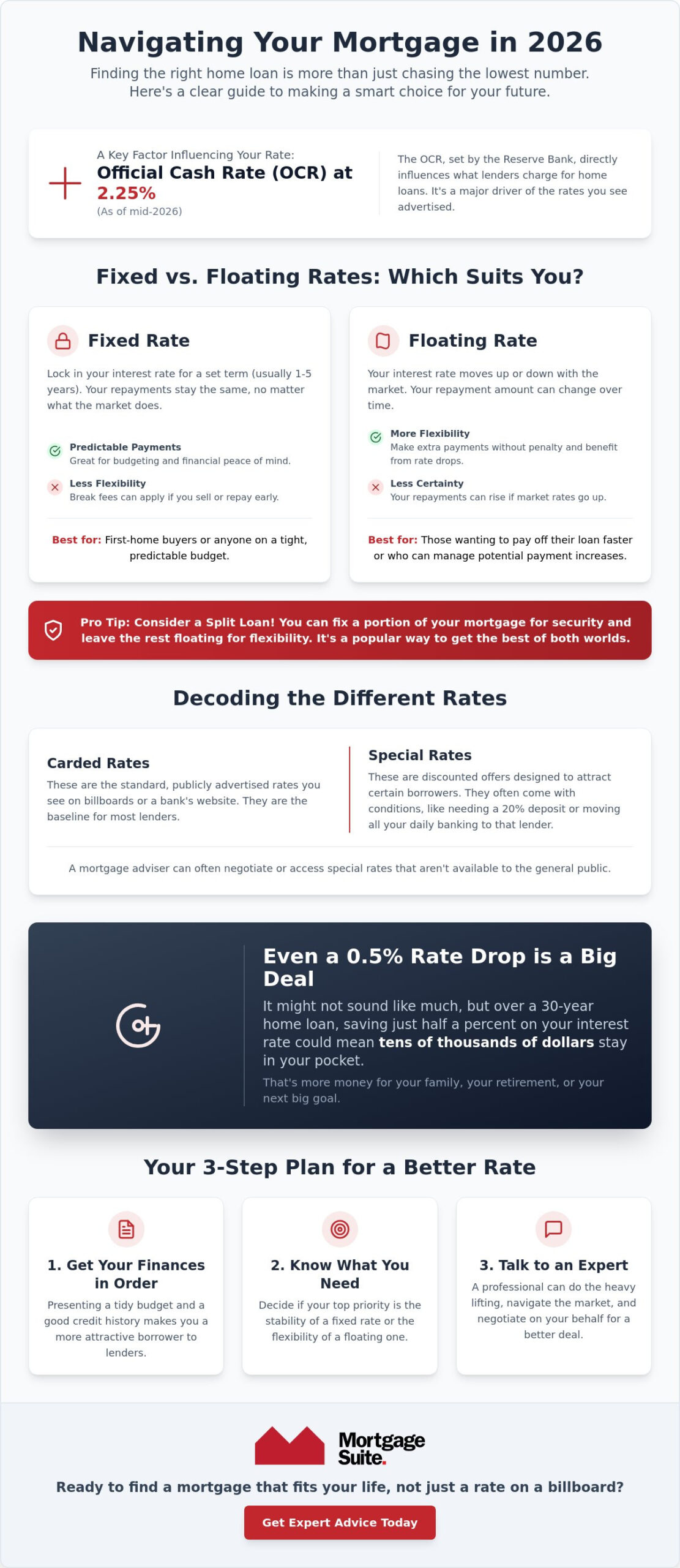
What if the lowest interest rate you see on a billboard actually ends up costing you more over the life of your loan? It’s easy to get caught up in the race for the smallest number, but the truth is that mortgage rates nz are about strategy as much as they are about price. With the Official Cash Rate sitting at 2.25% as of mid-2026, you might feel like the window for a good deal is closing or that the big banks aren’t really listening to what you actually need.
We understand that the constant talk of debt-to-income ratios and shifting lending laws can feel like a lot of noise. You want a home loan that provides stability without the confusing financial talk that usually comes with it. This guide will show you how to navigate the 2026 market with confidence. You’ll learn the real difference between fixed and floating rates, how current regulations like debt-to-income limits impact your borrowing power, and why the right lender is the one who treats you like a partner rather than just another file. By the end, you’ll have a clear, simple path forward to secure your home and manage your wallet with ease.
Key Takeaways
- Learn how mortgage rates nz are shaped by the wider economy and what that actually means for your monthly budget.
- Understand the difference between locking in your repayments with a fixed rate or staying flexible with a floating option.
- Discover how the Reserve Bank’s decisions on the Official Cash Rate directly influence the interest you pay on your home loan.
- Explore why professional second-tier lenders might be the right fit if the big mainstream banks aren’t meeting your specific needs.
- Gain the confidence to negotiate a better deal by getting your finances in order and using expert help to do the heavy lifting.
Understanding Mortgage Rates in NZ: The Basics for 2026
When you’re comparing mortgage rates nz, it’s helpful to view them simply as the fee you pay the bank to use their money to buy your property. You can think of it as the “cost of borrowing”. In 2026, these rates are influenced by a mix of local factors, such as the Reserve Bank’s inflation targets, and global economic shifts that change how much it costs New Zealand banks to get the funds they eventually lend to you.
While the headline number is often what grabs your attention, the best rate for your situation isn’t always the lowest one on the screen. The right deal is the one that aligns with your life goals. This might mean having the flexibility to make extra payments without being charged or choosing a structure that gives you peace of mind while you grow your family.
How Interest is Calculated on Your Home Loan
Understanding how your monthly payments are split can be quite eye-opening. Every time you make a repayment, part of it goes toward paying back the original amount you borrowed. The rest is the fee for using the bank’s money.
You can think of this fee like renting the bank’s cash. Just as you might pay rent to live in someone else’s house, you pay this fee to use their capital to buy your own home. It’s a straightforward exchange, but the numbers add up quickly over time.
Even a tiny change in your interest rate can have a massive impact on your long-term wealth. Saving just 0.5% on your rate might look small on paper today, but over a 30-year term, it could save you tens of thousands of dollars. That’s money that stays in your pocket for your retirement or your children’s education rather than going to the bank’s profits.
The Difference Between Carded and Special Rates
If you’ve been browsing bank websites recently, you’ve likely noticed two different sets of numbers. “Carded” rates are the standard, advertised prices that everyone sees on billboards or in the branch. They are the baseline starting point for most lenders.
On the other hand, “special” rates are the discounted offers banks use to attract specific types of borrowers. These lower rates usually come with strict conditions. For instance, you might need a 20% deposit or be required to move all your daily banking and credit cards to that specific provider.
This environment of strict lending rules and tiered pricing grew out of the historical New Zealand property bubble, which led to much tighter controls around how banks manage their risks. Because of these complexities, a professional can be a huge asset. They often have access to special rates that aren’t even listed publicly, using their industry relationships to negotiate a deal that fits your unique financial situation.
Fixed vs Floating Rates: Finding the Right Fit for Your Budget
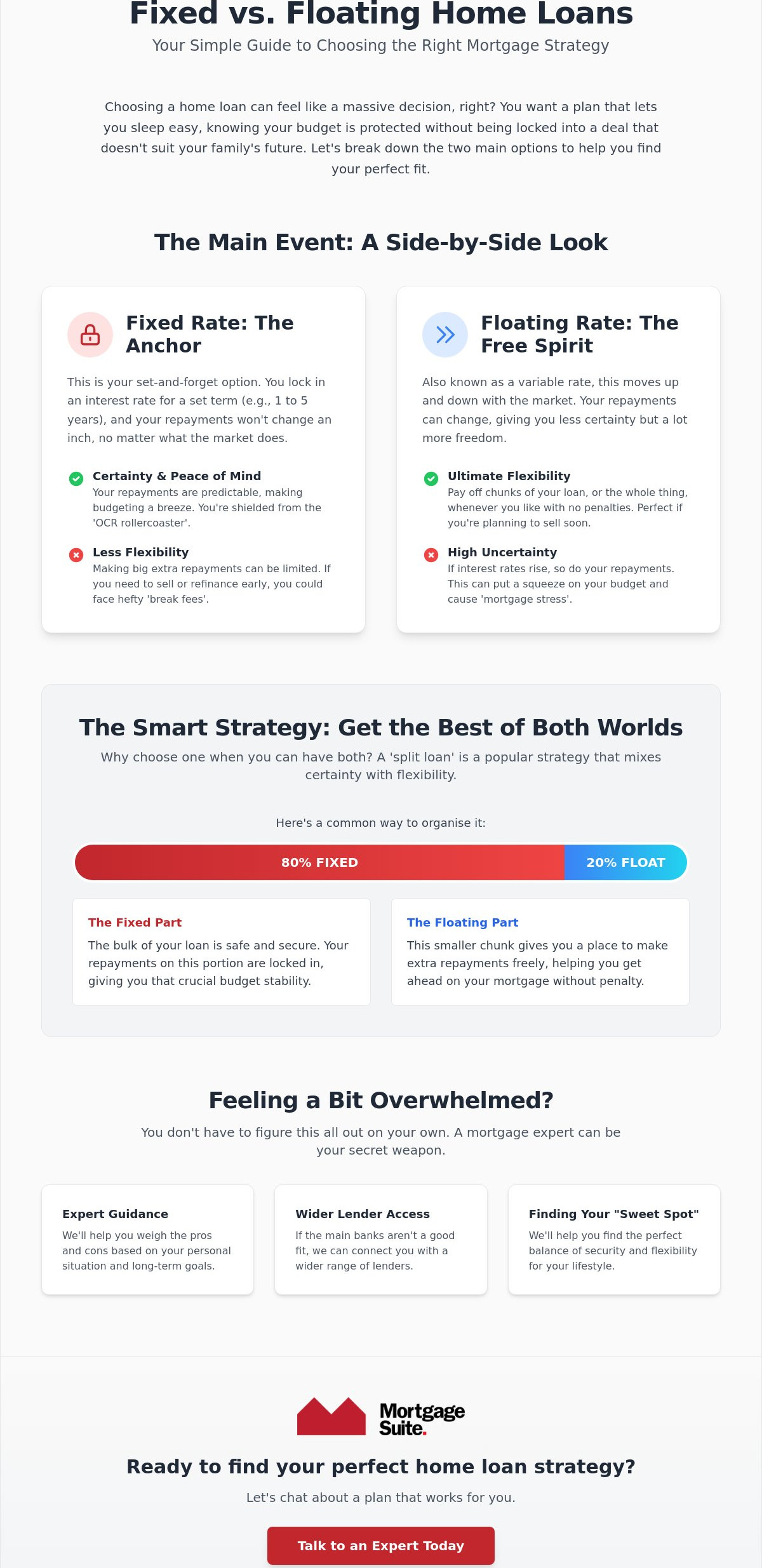
Deciding between a fixed or floating rate is one of the most important choices you’ll make when looking at mortgage rates nz. It isn’t just about chasing the lowest number you see on a website. It’s about how you want to manage your household stress and your long-term financial goals. Many Kiwis choose a “split” loan structure, where they keep a small portion on a floating rate and lock the rest into a fixed term. This approach lets you hedge your bets, giving you the security of a set payment while still allowing you to pay off bits of your debt faster if you have some extra cash.
A fixed rate mortgage is a tool for financial peace of mind because it removes the guesswork from your monthly bank statement for a set period, usually between one and five years.
When to Choose a Fixed Rate
If you’re a first-home buyer or a family running on a tight budget, a fixed rate is often the most sensible path. When you lock in your rate, your repayments stay exactly the same regardless of what happens with the economy. This certainty is vital when you consider that housing costs are a major part of most people’s weekly outgoings. Data from the Housing in Aotearoa New Zealand: 2025 report shows that managing these costs is a top priority for most households, and a fixed rate helps you plan your future with confidence.
There are a couple of trade-offs to keep in mind. If mortgage rates nz happen to drop while you’re locked in, you won’t benefit from those lower interest costs. You also need to be aware that banks usually charge “break fees” if you decide to sell your house or pay off the loan before the fixed term ends. It’s a commitment to a specific path, so it’s best for those who value stability over total freedom.
The Flexibility of Floating Rates
Floating rates, which are sometimes called variable rates, move up and down as the market shifts. While these rates often start a bit higher than the best fixed deals, they offer a level of freedom that fixed terms simply can’t match. You can usually make extra payments or pay off the entire loan whenever you like without being hit with any penalties. This makes them a brilliant choice if you’re expecting a pay rise, a lump sum of money, or if you’re planning to sell the property soon. If you’re still weighing up which path is right for you, looking into different home loans with a professional can help you see which structure fits your life best.
Why NZ Mortgage Rates Move: The OCR and Economic Drivers
It can feel a bit mysterious when you see mortgage rates nz change overnight. One day they are steady, and the next, every major bank has updated their website with new numbers. These movements aren’t random. They are mostly driven by the Official Cash Rate (OCR), which you can think of as the “wholesale price” of money. Just like a shop buys goods at a wholesale price and adds a bit extra before selling them to you, banks buy money at the OCR and then add their own costs and profit margins to create your mortgage rate.
The Reserve Bank uses this tool to keep the New Zealand economy stable. If things are moving too fast and prices are rising too quickly, they might hike the rate to cool things down. If the economy needs a bit of a boost, they might lower it. It is a balancing act that affects every homeowner in the country.
How the Reserve Bank Influences Your Wallet
When the Official Cash Rate (OCR) goes up, it becomes more expensive for banks to borrow money. Naturally, they pass those costs on to you by raising their mortgage rates. What is interesting is that banks don’t always wait for an official announcement. They employ teams of experts who watch the economy closely. If they expect a rate hike is coming in a few months, they might start nudging their fixed rates up early to stay ahead of the curve.
These cycles of rising and falling rates are a normal part of the financial landscape. While the headlines can sometimes sound alarming, they are just part of a larger pattern. Having a seasoned professional in your corner helps you see through the noise. We can help you decide whether to lock in a rate now or wait for the next cycle to begin.
DTI and LVR: The Rules of the Game
Beyond the OCR, banks also look at your personal scorecard to decide what rate they can offer you. The first part of this is your Loan to Value Ratio (LVR). This is just a simple way of looking at how much you want to borrow compared to what the house is actually worth. Generally, if you have a larger deposit, you are seen as a lower risk, which often unlocks those special rates we mentioned earlier.
The second part is the Debt to Income (DTI) ratios. This is a check to see how much you earn versus how much total debt you will be carrying. DTI rules are designed to protect both you and the bank from future stress by ensuring you don’t take on more than you can realistically handle if life takes an unexpected turn. It is about making sure your home remains a sanctuary rather than a financial burden.
Beyond the Big Banks: Exploring 2nd Tier Lending Rates
If you’ve ever walked into a major bank and felt like just another number on a spreadsheet, you’re not alone. Many New Zealanders assume that the big four banks are the only game in town, but there is a whole world of professional, reputable alternatives known as second-tier lenders. These providers often offer mortgage rates nz that look a bit different from the ones on the high street billboards. This isn’t because they are less secure; it’s simply because they have a different way of looking at risk and a different set of rules to follow than the mainstream institutions.
A broker is often the only way to access these “hidden” options. You can’t usually just walk into a branch for these lenders because they prefer to work through experts who can package your application correctly. They are particularly brilliant for people who don’t fit the standard bank mould, such as the self-employed, contractors, or those with non-standard income that the big banks find too difficult to process. These 2nd tier lenders provide a vital service that keeps the market competitive and inclusive.
Why Consider a Non-Bank Lender?
One of the biggest benefits of looking beyond the big banks is the human element. Mainstream lenders often use rigid computer algorithms to decide your fate. If you don’t tick every single box, your application is often declined without a second thought. Second-tier lenders tend to look at your whole story. They might see that while your income was lower last year due to a business startup, your current contracts are solid. They can act as a vital stepping stone. You might start with them to get into your house now, then move back to a mainstream bank in a few years once your financial history is more traditional. You can feel confident knowing they are still strictly regulated and safe to use.
Tailored Rates for Unique Situations
There are times when the absolute lowest interest rate isn’t the most important factor in your decision. If you’re involved in property development or complex investment scenarios, you need a lender who understands the nuances of the project. In these cases, having a loan that is approved quickly and offers flexible terms is worth far more than saving a tiny fraction on mortgage rates nz. Property investors in particular may also benefit from exploring a commercial property refinance NZ strategy to unlock equity and align their debt with current market conditions. If you’ve been declined by a bank, don’t lose heart. It’s often just a sign that you need a more tailored approach rather than a “no” to your home-buying dreams. We specialise in finding these solutions for our clients, so if you’re ready to see what’s possible, you can explore our home loan options today.
Securing the Best Mortgage Rate for Your Situation
Getting the best deal on your home loan involves more than just refreshing a webpage to see the latest numbers. To truly secure the most competitive mortgage rates nz, you need to present yourself to the bank as a low-risk, high-quality borrower. This starts with getting your “financial house in order” well before you fill out an application. Banks aren’t just looking at your income. They are looking at your habits, your debts, and how you handle the money you already have.
It’s also vital to look at the total cost of the loan rather than just the interest rate. Sometimes a bank might offer a slightly higher rate but include a generous cash-back offer or waive their application fees, which could leave you better off in the first few years. Taking a long-term view of your mortgage journey allows you to see these opportunities. Your mortgage isn’t a “set and forget” product; it’s a living part of your financial life that should be reviewed as your circumstances change. If your portfolio has grown over the years, it may also be worth considering whether a commercial property refinance NZ wide could help you restructure your debt and release equity for your next move.
Tips for a Successful Application
One of the most effective ways to boost your borrowing power is to reduce or close high-interest debts before you apply. Credit cards, store cards, and personal loans are often viewed unfavourably by bank systems because they represent a high committed monthly cost. Even if you don’t owe much on a credit card, the bank often assesses you based on the total limit available to you, not just the balance.
Showing a consistent savings history is another way to score a better deal. It proves to the lender that you have the discipline to live within your means. When you have a professional advocate like Krish in your corner, the bank often takes your application more seriously. We know how to highlight the strengths in your financial story, ensuring the person on the other end of the desk sees you as a partner they want to invest in.
How Mortgage Suite Helps You Win
At Mortgage Suite, we believe that the right loan is about far more than just a percentage point. It’s about finding a structure that gives you the freedom to live your life while you pay off your home. Krish Krishna brings over 20 years of deep banking experience to the table, acting as a “secret weapon” for our clients. Having spent two decades inside the system, Krish knows exactly how banks think, how they price their loans, and where there is room to move.
Our service focuses on negotiation and advocacy. We do the heavy lifting for you, talking to multiple lenders to find the one that fits your specific needs. Whether you are a first-home buyer or a seasoned investor, we ensure you aren’t just processed by a machine. We build a bridge between your personal goals and the rigid world of institutional banking. Ready to see what rates you could qualify for? Chat with us today!
Take Control of Your Financial Future Today
Navigating the landscape of mortgage rates nz in 2026 doesn’t have to be a source of stress. Whether you’re deciding between the certainty of a fixed term or the freedom of a floating rate, the most important thing is having a strategy that fits your life. You now know that the Official Cash Rate is just one piece of the puzzle and that there are excellent options available beyond the big banks if your situation is a bit unique.
At Mortgage Suite, we bring over 20 years of banking and lending expertise to ensure you find the right path. We have access to both mainstream banks and professional second-tier lenders, providing specialised support for everyone from first-home buyers to seasoned investors. You don’t have to do the heavy lifting alone. We’re here to act as your advocate and negotiator to get the deal done. Talk to Mortgage Suite about finding the right rate for your home loan. We look forward to helping you move into your next home with total confidence.
Frequently Asked Questions
How often do mortgage rates change in New Zealand?
Mortgage rates in New Zealand can technically change every single day, although major shifts usually happen in cycles. Banks typically adjust their pricing following the Reserve Bank’s eight scheduled reviews of the economy each year. They also watch international money markets closely, so you might see rates move even when there hasn’t been an official local announcement. It’s a fast-moving environment that requires regular check-ins.
Is it better to fix my mortgage for 1 year or 5 years in 2026?
Choosing between a one-year or five-year fix depends on your need for certainty versus your desire for flexibility. In 2026, many borrowers prefer shorter terms like one or two years to see if the market cools further. A five-year fix provides absolute peace of mind for your household budget, but you might find yourself locked into a higher rate if the general market drops significantly during that time.
What is a “cash-back” offer and is it worth taking a higher rate for it?
A cash-back offer is a lump sum of money the bank gives you when your loan settles, which is often used to cover legal fees or moving costs. Whether it’s worth a slightly higher rate depends on the maths. You need to calculate if the extra interest you’ll pay over the fixed term is more than the cash you receive upfront. Often, the upfront cash is a massive help for first-home buyers.
Can I negotiate my mortgage rate directly with the bank?
You can try to negotiate with your bank, but they often reserve their best deals for those who have professional representation. Banks know that brokers have access to the pricing of all their competitors, which creates a much stronger negotiating position. Having an expert handle these conversations usually results in a better outcome than trying to manage the back-and-forth on your own while you’re busy with life.
What happens to my rate if the OCR goes down?
If the Official Cash Rate goes down, you’ll usually see an immediate drop in floating mortgage rates nz. However, if you are currently on a fixed-rate term, your repayments won’t change until that term ends. This is why some people choose to keep a portion of their loan on a floating rate. It allows them to benefit from these downward shifts in the economy as soon as they happen.
Why are 2nd tier lender rates sometimes higher than bank rates?
Second-tier lenders often charge slightly more because they are willing to take on different types of risk that mainstream banks won’t touch. They might help someone who is self-employed or has a unique income structure that doesn’t fit a standard bank algorithm. The slightly higher rate reflects the extra work and flexibility they provide to get your loan approved when a big bank has already said no.
Do I need a 20% deposit to get the best interest rates?
Generally, you do need a 20% deposit to unlock the “special” advertised rates you see on billboards. Borrowers with smaller deposits are often charged a low equity margin, which is an extra fee or a higher interest rate to cover the bank’s risk. However, there are specific schemes available in 2026 for first-home buyers that allow for a 5% deposit while still keeping your overall costs manageable.
How much does a mortgage broker charge to find me a rate?
For most standard residential home loans, a mortgage broker doesn’t charge you a fee for their service. Instead, they are paid a commission by the lender once your loan is settled. This means you get professional advice, expert negotiation, and access to a wide range of mortgage rates nz without having to pay anything out of your own pocket for the consultation and application process.