
Finance for Lifestyle Blocks and Lifestyle Purchases in NZ: Your 2026 Guide

You have finally found that perfect five-hectare slice of paradise in the Waikato, but your bank just sent a “no” because the land is apparently too big for a standard mortgage. It is a common hurdle in 2026, especially when nearly 2,000 lifestyle blocks are changing hands every three months across New Zealand. We know that securing Finance for Lifestyle Purchases / Refinancing can feel like a maze when mainstream lenders treat your dream home like a complex commercial farm just because you want a bit of extra space for the kids or a few sheep.

You shouldn’t have to settle for high interest rates on personal loans or feel stuck by strict debt-to-income caps. We are here to show you how to use your home equity to lower your borrowing costs and find a lender that actually understands the value of a rural-residential property. This guide covers everything from the July 2026 OCR changes to the specific ways we can package your application to get a “yes” from the right people. You’ll discover exactly what you need for a deposit and how to bridge the gap between the bank’s rigid rules and the life you want to lead.

Key Takeaways

  • Understand why land size changes your deposit requirements and how to tell if your property counts as a lifestyle block or a farm in the eyes of a lender.
  • See how Finance for Lifestyle Purchases / Refinancing allows you to use your home equity to buy things like boats or horse floats at home loan interest rates.
  • Learn the essential standards for access and living conditions your property must meet to ensure your loan gets approved without any fuss.
  • Discover how working with a specialist to package your application can open doors to lenders that are happy to look at deals the big banks find too hard.

What exactly is a lifestyle block and why is the finance different?

Many Kiwis dream of trading the city grind for a few acres where the kids can roam and there’s space for a massive vegetable garden. However, from a lender’s perspective, that dream can look quite different. A lifestyle block is essentially a residential property that has enough land for a hobby, not a primary income. While you might see it as just a bigger backyard, a bank sees a complex asset that doesn’t fit the standard suburban house box. Understanding what is a lifestyle block is the first step toward getting your loan approved, as the term describes a property where the value comes from the home rather than any commercial farming activity.

Finance for Lifestyle Purchases / Refinancing is trickier because of the “main source of value” rule. Most mainstream banks want to see that the house is the primary asset they are lending against. If the value of the dirt or the outbuildings starts to outweigh the value of the dwelling, the bank begins to worry. They prefer lending on assets that are easy to sell if things go wrong. A three-bedroom home in a quiet suburb has thousands of potential buyers; a specialised lifestyle block with specific farming infrastructure has a much smaller pool. This perceived risk is why the rules change the moment you move past the city limits.

The land size ‘tipping point’

Banks usually have a specific cut-off point where a standard home loan suddenly becomes a rural loan. For many lenders, this “tipping point” is 10 hectares. If your slice of paradise exceeds this limit, don’t be surprised if the bank asks for a much larger deposit, often between 20% and 30%. They want to ensure you have enough skin in the game to cover the extra risk associated with larger parcels of land that might be harder to offload quickly. This is where we step in to help package your application so the lender sees the home, not just the hectares.

Zoning and ‘Highest and Best Use’

Council zoning can change your loan requirements overnight. If a property is zoned Rural Residential, lenders are generally more relaxed because they know the land is intended for living. However, if it’s General Rural, they might view it as a commercial farm. Ironically, having highly productive land can sometimes make a loan harder to get. If the property is capable of generating a significant income, the bank may insist on a commercial or rural loan structure. These often come with higher interest rates and stricter terms than a standard residential mortgage, which is why getting the zoning right in your application is vital.

Understanding the LVR and deposit rules for rural living

Getting the keys to your rural retreat usually starts with a conversation about the deposit. For most standard lifestyle blocks under 10 hectares, mainstream banks generally look for a 20% deposit. However, the moment that land size creeps higher, the rules tighten. If you’re eyeing up a property over 10 hectares, don’t be surprised if your lender asks for 30% or even 40% upfront. They do this because larger blocks are considered higher risk and can be harder to sell quickly if things go pear-shaped.

Lenders also look closely at the ‘curtilage’ of the property. This is just a simple way of describing the house and the immediate garden area. They’ll often put a higher value on this section while being quite conservative about the back paddocks or extra land. If you’re struggling to find the cash for a deposit, one of the smartest moves is using the equity in your current suburban home. By tapping into the value you’ve already built up, you can often secure Finance for Lifestyle Purchases / Refinancing without needing to clear out your savings account. This strategy is particularly effective for those looking to upgrade their lifestyle while keeping their existing property as an investment.

Why the ‘Big 4’ banks might say no

Mainstream banks love predictability. In a suburb, they can find ten similar houses sold in the last month to prove what a property is worth. In rural areas, ‘comparable sales’ are often thin on the ground. A bank might worry that a unique property will sit on the market for months if they ever need to sell it. This lack of data often leads to a very conservative registered valuation, which can leave you with a funding gap that you didn’t expect.

Alternative options when the bank isn’t playing ball

If your local branch says no because the land is too big or the house is too old, you aren’t out of luck. This is where a 2nd tier lender New Zealand wide can make all the difference. These lenders often focus on the person and the overall quality of the property rather than just ticking boxes on a rigid checklist. It’s an excellent way to secure Finance for Lifestyle Purchases / Refinancing when the big banks aren’t interested in the nuances of rural living. While the interest rate might be slightly higher, it’s often a small price to pay to get onto your dream patch of dirt. If you’re feeling stuck, you should have a chat with a specialist who can help you find a lender that actually sees the potential in your rural move.

Refinancing your home to fund lifestyle purchases

Living the dream in New Zealand often means more than just having a nice house. It’s about the boat for the weekend, the caravan for summer trips, or the horse float for the kids’ events. When you’re looking at Finance for Lifestyle Purchases / Refinancing, the most powerful tool you have is likely sitting right under your feet: your home equity. Equity is simply the difference between what your house is worth and what you still owe the bank. If your property value has grown, you can often “pull” that value out to fund the things that make life enjoyable.

The biggest advantage of this approach is the cost of borrowing. In mid-2026, major bank floating rates are sitting around 6.04% to 6.15%, while some special fixed rates are even lower. Compare that to a standard personal loan or vehicle finance, which can easily sting you with interest rates between 12% and 15%. By refinancing your mortgage to include these lifestyle “toys,” you could effectively halve your interest costs. However, you need to be smart about the term. While it’s tempting to put a boat on a 30-year mortgage, you don’t want to be paying for a vessel that hit the scrap heap two decades ago. We always suggest carving that portion of the loan into a separate, shorter repayment structure.

Using equity for renovations and ‘lifestyle’ upgrades

Sometimes the best lifestyle purchase is an upgrade to your current patch of dirt. Adding a swimming pool or a large multi-bay shed can significantly improve your quality of life and often adds tangible value to the property. When you structure a “top-up” for these projects, we look at the projected end value of the home to ensure the bank stays happy. If you’re planning these upgrades for a property you intend to rent out later, it’s worth checking out our guide on residential investment property loans NZ wide to see how the tax and equity rules might differ.

Consolidating debt to free up lifestyle cash

If you’re already juggling a couple of high-interest car loans or credit cards, your weekly cash flow is probably taking a hit. Rolling those debts into your mortgage can give you a lot more breathing room. The key here is disciplined repayments. Because the interest rate is lower, you have a golden opportunity to pay the principal off faster than the bank requires. This keeps your total interest bill down and ensures you’re actually building wealth while enjoying your lifestyle. It’s about making your debt work for you, rather than letting it dictate how you spend your weekends.

Finance for Lifestyle Blocks and Lifestyle Purchases in NZ: Your 2026 Guide

Checklist: What you need to get your lifestyle loan approved

Before a lender hands over the cash for your rural retreat, they need to be certain they aren’t buying into a headache. Unlike a standard city house, a lifestyle block comes with unique moving parts that can stall an application if you aren’t prepared. Banks primarily want to see that the property is both habitable and accessible. If the driveway is a legal mess or the house isn’t technically finished, your Finance for Lifestyle Purchases / Refinancing application will likely hit a brick wall.

You also need to factor in the “unseen” costs that banks look for. They’ll want to see that you’ve considered the price of boundary fencing, water tank maintenance, and even the cost of a ride-on mower. These aren’t just lifestyle choices; they are essential for keeping the property in a state that protects the bank’s investment. Having a clear plan for the land—whether you’re running a few head of cattle or just keeping the grass down—shows the lender that you’re a responsible borrower who understands the reality of rural life.

The ‘Rural Essentials’ document list

Your paperwork needs to be spotless. A LIM report is your best friend here, as it reveals any flood risks or missing building consents on those big outbuildings. Lenders also demand proof of a reliable water source and a functioning septic system. If the property relies on tank water, they might ask for a report on the tank’s condition. Finally, check your legal access. It’s surprisingly common for rural driveways to be “paper roads” or shared tracks without proper legal easements, which is a major red flag for any bank.

Proving your ‘serviceability’

When it comes to the money, banks are quite conservative. They will almost always ignore any potential income from your “hobby” farming when calculating your loan. You need to prove that your primary job or business can cover the mortgage, the rates, and the higher maintenance costs of a larger block. In 2026, Debt-to-Income (DTI) ratios are a major factor, with borrowing generally capped at six times your annual income for owner-occupiers. Presenting your finances clearly is the key to showing you’re a safe bet. If you’re feeling overwhelmed by the requirements, we can organise your application to ensure it meets every lender’s standard before we hit submit.

Why Mortgage Suite Ltd makes securing lifestyle finance easy

Securing Finance for Lifestyle Purchases / Refinancing shouldn’t feel like a second job. At Mortgage Suite Ltd, we don’t just fill out a standard form and hope for the best. We take the time to package your story so lenders see the true value of your property and your financial position. Most mainstream banks have a very narrow view of what a “good” loan looks like, but our background allows us to speak their language while advocating for your specific needs. We understand that your lifestyle dream is personal, and we treat your application with the same level of care.

If the big banks find your specific block size a bit too hard to handle, we have direct access to 2nd tier lenders who specialise in these exact scenarios. These alternative options are a lifesaver for Kiwis who have the income and the equity but don’t fit into a standard suburban box. With Krish Krishna’s 20-plus years of industry experience, he knows exactly what credit managers are looking for. He knows how to handle the heavy lifting during negotiations, ensuring you get a fair deal without the usual stress of dealing with a rigid institutional system.

A veteran hand in a shifting market

With the Reserve Bank raising the OCR to 2.50% in July 2026, the lending environment is moving quickly. Having a broker who has seen multiple market cycles is vital when things feel uncertain. We help you make sense of how these shifts affect mortgage rates nz wide, ensuring you aren’t caught out by sudden changes. Our commitment at Mortgage Suite Ltd is simple; we work to find a “yes” even when your local branch has already said “no.”

Taking the next step without the stress

Our conversational approach means we skip the scary jargon and focus on clear paths forward. We help coordinate the necessary valuations and legal checks mentioned earlier, making sure everything is spot on from the moment you find your dream block to the day you settle. We want you to focus on picking out your first set of gumboots while we manage the bank. If you’re ready to make your move, you can Chat with Mortgage Suite Ltd today about your lifestyle dream and let us handle the rest of the process for you.

Ready to make your rural dream a reality?

Your move to the country should be about fresh air and open spaces, not battling with bank paperwork. We have looked at how land size impacts your deposit and why using your home equity is often the smartest way to fund your lifestyle upgrades at lower interest rates. Securing the right Finance for Lifestyle Purchases / Refinancing comes down to how you package your application and which lender you choose to partner with.

With over 20 years of banking expertise, Krish Krishna understands how to manage the hurdles that typically trip up rural buyers. Mortgage Suite Ltd specialises in non-bank and 2nd tier lending, providing the personalised service needed to get your loan across the line even when mainstream banks say no. You don’t have to handle the shifting 2026 market alone; having a veteran hand to guide the process makes all the difference.

Book a friendly chat with Mortgage Suite Ltd to organise your lifestyle finance and let us take the stress out of the process. Your new life on the block is closer than you think.

Frequently Asked Questions

Can I buy a lifestyle block with a 10% deposit in NZ?

You generally cannot buy an existing lifestyle block with a 10% deposit. Most mainstream banks require a minimum 20% deposit for owner-occupiers, and this can rise to 30% or more if the land size exceeds 10 hectares. While some new build exemptions exist, lenders usually view rural land as a higher risk than a standard suburban home and stick to stricter deposit rules.

What is the difference between a lifestyle block and a farm for a mortgage?

The main difference lies in where the value of the property comes from. A lifestyle block is viewed as a residential home where the land is for pleasure, meaning the house is the primary asset. A farm is considered a business where the land is expected to produce a primary income. Lenders use different sets of rules and interest rates for each category.

Is it cheaper to refinance my home for a boat than taking a boat loan?

It is almost always cheaper to use your home equity. By choosing Finance for Lifestyle Purchases / Refinancing, you can access interest rates around 6.04% to 6.15%, which is significantly lower than the 12% to 15% often charged for personal or boat loans. This strategy can save you thousands in interest over the life of the loan as long as you pay it off quickly.

Will the bank count my income from selling sheep on my lifestyle block?

Banks will almost never include income from hobby farming when they calculate how much you can borrow. They want to see that your regular salary or business profit can cover the mortgage without relying on the land. Because hobby income is often unpredictable, lenders treat it as a bonus rather than a reliable source of funds for making your repayments.

What happens if the lifestyle block has a business running on it?

If the property has a significant business operating from it, the bank might classify your application as a commercial or rural loan. This can change your deposit requirements and the interest rates you are offered. Lenders look at the “highest and best use” of the land, so a property with a large commercial orchard or a trucking yard will be treated differently than a simple home.

Do I need a special valuation for a rural property in New Zealand?

You will definitely need a registered valuation from a professional who specialises in lifestyle or rural properties. A standard computer-generated estimate or a suburban valuer won’t suffice. The bank needs a detailed report that considers things like land quality, water rights, and outbuildings to ensure the property provides enough security for the amount of money you want to borrow.

Can I use my KiwiSaver to buy a lifestyle block if it’s my first home?

You can use your KiwiSaver for a lifestyle block provided you intend to live in the house as your primary residence. The standard first-home withdrawal rules apply, but you must still meet the bank’s specific deposit requirements for lifestyle land. It is a great way to boost your deposit, but you should check with your provider early to ensure the property type is eligible.

What are the common traps to avoid when financing a rural property?

The biggest traps are legal access issues and non-compliant septic or water systems. Many buyers also get caught out by Finance for Lifestyle Purchases / Refinancing when they realise the bank won’t lend on the full land size at standard rates. Always check the LIM report for unconsented sheds and ensure the driveway has proper legal easements before you commit to the purchase.

Article by

Krish Krishna

Experienced Financial Adviser with over 46 years of Banking and Mortgage broking experience and over $2.0 Billion in loan settlements.

Buying a House on a Single Income in NZ: Your 2026 Step-by-Step Guide

Does it feel like the New Zealand property market has a “couples only” sign hanging on the front gate? If you’ve been scrolling through listings and feeling like the dream of home ownership is out of reach, you aren’t alone. Many people believe that buying a house on a single income nz is impossible in 2026, especially with the national median house price sitting at $770,000. It’s exhausting to deal with strict rules at big banks about how much you owe compared to what you earn, but your journey doesn’t have to end at a “no” from a mainstream lender.

We understand how frustrating it is to be told you don’t fit the box when you’re ready to settle down. This guide is here to change that narrative. You’ll discover how to navigate the current market and secure a home loan on your own; we’ll show you the paths that the big banks often fail to mention. We are going to provide a clear roadmap to ownership, explaining friendly ways to borrow money and giving you the confidence to start your application with a steady hand guiding you through the process.

Key Takeaways

  • Learn why solo home ownership is still a realistic goal in 2026 and how to move past the common hurdles that big banks often put in your way.
  • Discover practical ways to boost your borrowing power, ensuring that buying a house on a single income nz remains a realistic and achievable goal.
  • Find out why non-bank and 2nd tier lenders are often the best choice for solo buyers who don’t fit the strict criteria of mainstream institutions.
  • Follow a clear, five-step roadmap to organise your finances and maximise your deposit using tools like your KiwiSaver savings.
  • Understand the value of having a dedicated expert act as your personal negotiator to open doors to loan options that aren’t usually available to the general public.

Can You Really Buy a House on a Single Income in NZ?

Let’s be honest about the situation. If you’ve spent any time looking at the history of Housing in New Zealand, you’ve probably felt that sinking feeling that the system isn’t built for you. Banks often view a solo applicant as a “single point of failure.” They worry that if you lose your job or get sick, there isn’t a second person to pick up the financial slack. But here is the good news: buying a house on a single income nz is absolutely achievable in 2026 if you have the right strategy and a bit of expert advocacy on your side.

You actually have a secret weapon that couples often lack; total financial control. When you’re on your own, you don’t have to negotiate lifestyle choices or manage a partner’s hidden debts. You decide exactly how much goes into your savings and how much is allocated to your future mortgage. This level of discipline is incredibly attractive to lenders. It shows you’re a responsible borrower who can manage a tight budget without the complications of a second person’s spending habits. By proving you can live comfortably on your own terms, you demonstrate a level of stability that many dual-income households struggle to maintain.

The Reality of the 2026 NZ Property Market

The market right now is showing some interesting shifts that favour the patient buyer. The national median house price was $770,000 in June 2026, which represents a 1.3% drop from the previous month. While major banks like ANZ and ASB increased their floating rates by 0.25% to reach 6.04% in July, fixed rates have remained more competitive for those with a solid deposit. For a solo buyer, a “softer” market in cities like Auckland and Wellington means you have more room to breathe. You aren’t being outbid at every auction by frantic couples, which makes this a unique window to secure an entry-level home while prices are relatively flat.

Breaking the “Double Income” Myth

You don’t need a partner’s salary to prove you’re a safe bet for a home loan. Lenders are increasingly focused on your “character” as a borrower. If you have stable employment and a clean credit history, you’re already ahead of the pack. Banks want to see that you’ve been consistent with your savings and that you’ve minimised your personal debts like credit cards or car loans. It’s not just about the total figure on your payslip; it’s about how much of that income is left over once your weekly bills are paid. Showing a clear, disciplined track record of living within your means is the best way to prove that you can handle the responsibility of a mortgage alone.

Maximising Your Borrowing Power as a Solo Buyer

When you’re the only one signing on the dotted line, every dollar of your income needs to work twice as hard. Banks aren’t just looking at your total salary; they’re obsessed with your spare cash after bills. This is the money left over after you’ve paid for your groceries, your gym membership, and your Friday night takeaways. If you want to succeed at buying a house on a single income nz, you need to show the bank that you have plenty of breathing room in your budget. It’s about presenting a polished financial version of yourself that says you’re a low-risk, high-reliability borrower who isn’t living paycheque to paycheque.

One of the fastest ways to boost your borrowing limit is to clear away small debts. You might think a $2,000 credit card limit or a small Buy Now Pay Later balance isn’t a big deal, but lenders see it differently. They often calculate your borrowing power as if those credit limits are fully spent, which can slash tens of thousands off your maximum loan amount. Closing these accounts six months before you apply can make a massive difference to your application’s strength. You can find more detail on preparing your finances in the New Zealand Government’s guide to buying a house, which outlines the standard steps for any buyer.

Using KiwiSaver and Government Schemes

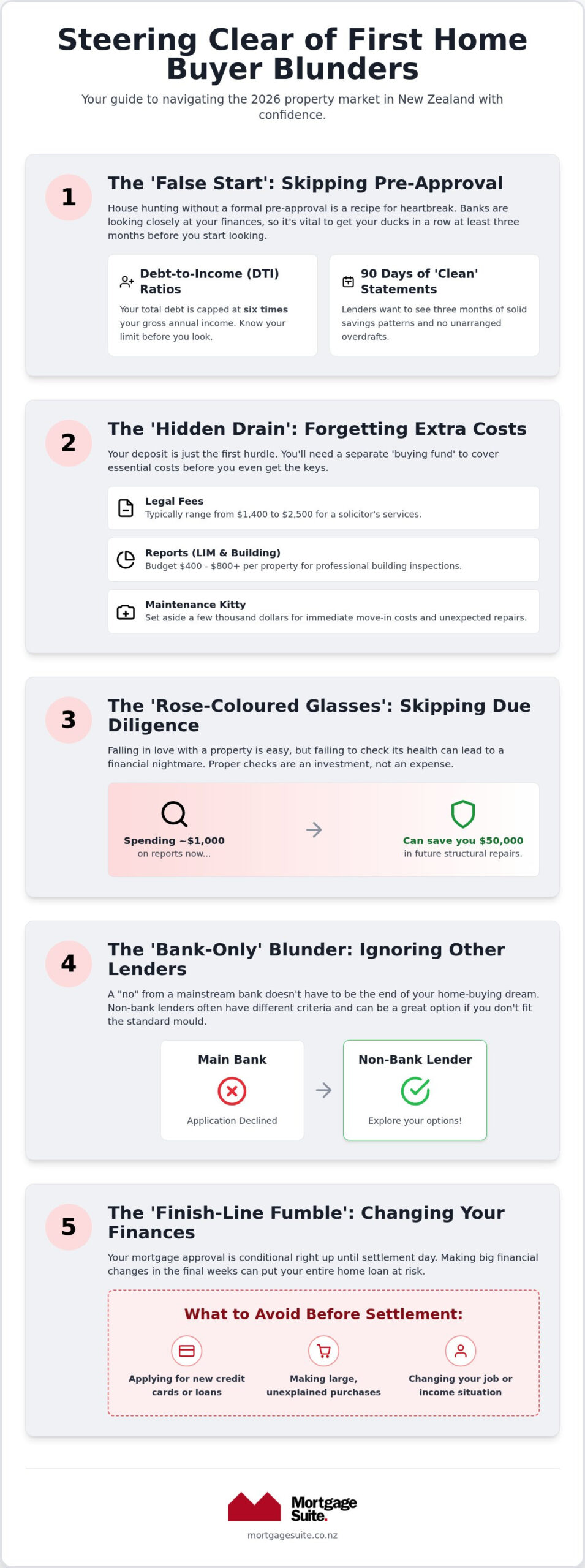
Your KiwiSaver is likely your biggest asset right now. If you’ve been a member for at least three years, you can usually access a KiwiSaver first home withdrawal NZ to put towards your deposit. While the First Home Grant was discontinued in May 2024, you should still check your First Home Grant NZ eligibility only to confirm that you should instead be looking at the First Home Loan scheme. This scheme is a lifesaver for solo buyers in 2026, allowing you to buy with just a 5% deposit if your income is $95,000 or less (or $150,000 if you have dependents). This significantly lowers the barrier to entry for those who are saving on their own.

The Balance Between Your Debt and Earnings

In 2026, banks are keeping a very close eye on the balance between your debt and earnings. This is a simple sum where the lender compares your total debt to your gross yearly income. Most mainstream banks have a limit on how high this can go, which can be a hurdle for single earners with even moderate personal debt. To improve your position, focus on reducing any existing car loans or personal debts before you approach a bank. If the big banks’ rules are too tight for your specific situation, working with an expert at Mortgage Suite Ltd can help you find alternative lenders who offer more flexibility for your specific income level and financial goals.

Finding the Right Mortgage: Bank vs. Non-Bank Options

Most of us feel a sense of loyalty to the bank where we opened our first savings account as a kid. It’s a common trap. When you’re focused on buying a house on a single income nz, that loyalty isn’t always returned. Mainstream banks are massive institutions with rigid rules. They use computer models to decide if you’re a safe bet, and these models are often skewed toward dual-income couples. If your situation doesn’t fit their perfect little box, the computer simply says no. This is why looking beyond the “Big Four” is often the smartest move a solo buyer can make.

Alternative lenders, often called non-banks, operate differently. They don’t just look at a spreadsheet; they look at the person behind the application. While a mainstream bank might see your single salary as a risk, a non-bank lender often sees a disciplined professional with a clear financial history. They are willing to be more flexible because they aren’t bound by the same internal red tape as the major banks. You might find that while their interest rates are slightly different, the “yes” they provide is the key that finally opens your front door.

When the Big Banks Say No

It’s incredibly disheartening to be declined by your own bank. Usually, they’ll cite those strict rules about debt balances we talked about earlier, or they might be worried about your ability to pay back the loan on a single cheque. Don’t let one rejection stop you. A “no” from a big bank is often just an invitation to find a more innovative partner. This is where a 2nd tier lender New Zealand becomes your greatest asset. These lenders specialise in situations that mainstream banks find too “complex,” providing a vital lifeline for solo buyers who have a solid deposit but don’t meet the standard bank criteria.

The Flexibility of Non-Bank Lenders

Non-bank lenders are particularly helpful if you’re self-employed or have a non-standard income like commissions or bonuses. They are more likely to recognise the true value of your earnings. They also offer more wiggle room for buyers with a smaller deposit, which is a frequent hurdle when buying a house on a single income nz. You can find independent advice on how these different lending structures work at Settled.govt.nz. Remember, a 2nd tier loan doesn’t have to be forever. Many of our clients use these loans as a stepping stone, getting into their home now and then moving back to a mainstream bank once they’ve built up more equity in a few years.

Buying a House on a Single Income in NZ: Your 2026 Step-by-Step Guide

Your 5-Step Roadmap to Solo Home Ownership

If you’re serious about buying a house on a single income nz, you need a plan that doesn’t rely on luck. It’s easy to feel overwhelmed by the process, but breaking it down into manageable steps turns a massive goal into a series of small wins. You aren’t just looking for a house; you’re building a foundation for your future, and that requires a methodical approach that big banks will respect. Here is the path we recommend for our solo clients to ensure they stay on track and avoid common pitfalls.

  • Step 1: Get a clear picture of your financial health. Beyond just your bank balance, look at your “surplus” income. Lenders want to see exactly what’s left over after your life is paid for each week.
  • Step 2: Maximise your deposit. This involves consolidating your savings and ensuring your KiwiSaver is ready for withdrawal. Every extra thousand dollars in your deposit reduces the risk the bank perceives.
  • Step 3: Organise a pre-approval. Knowing your true budget before you start visiting open homes is a superpower. It stops you from falling in love with a property you can’t actually afford.
  • Step 4: Target properties that fit your solo lifestyle. Focus on homes that offer low maintenance and high security, which are often easier for a single person to manage and insure.
  • Step 5: Work with a broker to negotiate. A broker acts as your advocate, presenting your case to lenders in the best possible light and finding terms that a standard bank manager might overlook.

Getting Your Paperwork in Order

Lenders are going to look at your life through a magnifying glass. As a single applicant, you’ll need to provide at least three to six months of “clean” bank statements. This means avoiding excessive Buy Now Pay Later transactions or large, unexplained cash withdrawals. You’ll also need your latest payslips and a letter from your employer confirming your permanent status. Proving your “serviceability” is about showing that your income is stable and that you’re a disciplined manager of your own money. If you can show a consistent history of living within your means, you’re halfway to a “yes.”

Shopping for the Right Property

When you’re the sole decision-maker, “buying for now” is a brilliant strategy. You don’t necessarily need a four-bedroom family home right away. Modern townhouses or well-located apartments are often more affordable and require far less weekend maintenance. This gets your foot in the door of the property market sooner, allowing you to build equity while living in a space that actually suits your current life. Always prioritise a professional building report. Since you won’t have a partner to help spot potential issues, having an expert’s eyes on the property’s structure is essential for protecting your investment. If you’re ready to see what’s possible for your specific budget, getting professional home loan advice is the best next step you can take.

Why a Mortgage Broker is a Solo Buyer’s Best Friend

Buying a home on your own is a massive milestone, but it’s often a lonely road. When you don’t have a partner to share the paperwork or the stress, a mortgage broker becomes your most valuable ally. For those buying a house on a single income nz, we act as the bridge between your personal goals and the rigid requirements of the banking system. We aren’t just looking for a loan; we are looking for the right fit for your specific life. Finding a path to buying a house on a single income nz is much easier when you have a seasoned negotiator fighting your corner.

Our approach at Mortgage Suite is built on over twenty years of direct banking experience. We’ve seen the industry from both sides of the desk, which gives us a unique perspective on how to get results. This background means we know exactly how to present your story to a lender to get a “yes.” We also have access to “wholesale” products and non-public loan options that aren’t available to the general public. This gives you a significant advantage in a competitive market where every detail counts.

Expert Negotiation for Unique Situations

We specialise in “packaging” applications to highlight your financial discipline. If a big bank sees a single income as a risk, we show them a borrower with total control over their budget. We handle the negotiation and the fine print, removing the obstacles that usually slow people down. Most importantly, our service is typically free for you; the lender pays us for the work we do in setting up the loan. This means you get professional advocacy without adding another cost to your house-hunting budget.

Long-Term Support Beyond the Settlement

Getting the keys is just the beginning of your journey. We stay in your corner to help you manage your debt and review your mortgage rates NZ whenever the market changes. Whether it’s planning for future renovations or using your growing equity to build wealth, we’re here for the long haul. We aim to be your partner in property for the next twenty years, providing the steady hand you need in an ever-changing market. You don’t have to do this alone when you have an expert mentor by your side.

Your Future Home is Within Reach

The dream of owning your own place doesn’t have to wait for a partner or a second salary. By focusing on your uncommitted income, exploring flexible non-bank lenders, and following a disciplined roadmap, the path to ownership becomes clear. It’s about looking past the standard bank rejection and finding a partner that values your individual financial strength and stability over a rigid checklist.

Successfully buying a house on a single income nz requires more than just a good deposit; it needs a dedicated advocate who knows how the system works from the inside. With over 20 years of banking expertise, we are specialists in 2nd tier lending solutions that help you move forward when the big banks aren’t an option. Talk to Krish and the team at Mortgage Suite today to start your solo home journey. We are here to act as your mentor and negotiator, ensuring you have the expert support needed to finally secure your own front door keys. You already have the drive and the financial control; now let’s work together to get you the home you deserve.

Frequently Asked Questions

How much deposit do I need to buy a house on a single income in NZ?

You generally need a 20% deposit for most standard bank loans, but you can secure a home with as little as 5% through the First Home Loan scheme. This is a massive help for anyone buying a house on a single income nz because saving $154,000 alone, which is 20% of the $770,000 national median price, is a huge mountain to climb. Low-deposit options make the dream much more accessible for solo buyers.

Can I use my KiwiSaver if I am buying a house by myself?

Yes, you can withdraw your KiwiSaver savings to put toward your first home as long as you’ve been a member for at least three years. You’ll need to leave at least $1,000 in your account; however, the rest of your contributions, employer contributions, and government top-ups can all go toward your deposit. It’s often the biggest financial boost a solo buyer has when starting out.

What is the First Home Grant and am I eligible as a single person?

The First Home Grant was officially discontinued on 22 May 2024, so it is no longer available for new applications. Instead, you should focus on the First Home Loan scheme, which remains active in 2026. This scheme helps solo buyers with an income of $95,000 or less get into the market with a 5% deposit, provided they meet the standard lending criteria.

Will a bank decline my mortgage if I have a student loan?

A student loan won’t automatically lead to a decline, but it does reduce your “take-home” pay, which banks use to calculate how much you can afford. Because a portion of your salary goes toward repayments, the lender will see you have less uncommitted income to put toward a mortgage each month. It’s just one factor they’ll consider when looking at your overall debt-to-income ratio.

Is it better to buy a new build or an existing home on a single income?

New builds are often easier for solo buyers because they are exempt from standard LVR restrictions, meaning you might only need a 5% or 10% deposit. Banks are often more willing to lend higher amounts for new properties. Existing homes usually require a larger upfront deposit, but they might offer a lower purchase price depending on the location and the condition of the property.

How do lenders calculate how much I can borrow on one salary?

Lenders look at your gross annual income and then subtract your fixed costs, like student loans, car payments, and living expenses. They use a “test rate” higher than the actual interest rate to make sure you can still pay if rates go up. This is why buying a house on a single income nz requires such a clean budget; every dollar of your salary needs to be accounted for.

What happens if I lose my job and I have a solo mortgage?

If you lose your job, the first step is to talk to your lender immediately to discuss hardship options or a temporary change to your payment schedule. Having a solid emergency fund is vital for solo owners, as you don’t have a second salary to fall back on. Banks are usually willing to work with you if you’re proactive and honest about your situation.

Can a family member help me with my deposit (gifted deposit)?

Yes, family members can certainly help by providing a gifted deposit to boost your equity. Most lenders will require a signed “gift letter” stating that the money doesn’t need to be paid back and that the family member has no claim on the property. This is a very common way for solo buyers to bridge the gap and reach that 20% equity mark sooner.

Article by

Krish Krishna

Experienced Financial Adviser with over 46 years of Banking and Mortgage broking experience and over $2.0 Billion in loan settlements.

First Home Grant NZ Eligibility: What’s the Story in 2026?

Did you know that first home buyers accounted for nearly 28% of all property purchases in New Zealand during the first half of 2026? It’s a striking figure when you consider how challenging the market can feel. You’re likely feeling the pressure of trying to save a massive 20% deposit while rent prices continue to climb. There’s also plenty of conflicting information floating around regarding First Home Grant NZ eligibility and whether that financial boost is still an option for your situation.

We understand that the fear of being declined by a major bank is a significant hurdle, but the reality is more encouraging than you might think. We’re here to clear up the confusion surrounding government support so you can stop guessing and start making moves. This article explains the current status of the Grant, outlines the 5% deposit requirements for the First Home Loan, and provides a clear path to help you finally get hold of your first set of keys.

Key Takeaways

  • Discover why the First Home Grant was discontinued in 2024 and what this means for your buying strategy today.
  • Learn how the First Home Loan allows you to enter the property market with just a 5% deposit by meeting specific income requirements.
  • Understand the essential KiwiSaver rules, including the three-year membership requirement, to ensure your deposit funds are ready when you are.
  • Explore how second-tier lenders provide a lifeline if you have been turned away by mainstream banks due to strict lending criteria.
  • See how a professional broker can help you navigate First Home Grant NZ eligibility myths and find a path to homeownership that suits your unique financial situation.

The 2026 Reality Check: Is the First Home Grant Still Around?

Let’s be completely straight with you: if you’re looking for the First Home Grant in 2026, you’re chasing a ghost. The government officially axed the scheme on 22 May 2024, which means no new applications have been accepted for over two years. It is a bit of a shock for many who grew up hearing that the state would give them a fair go with a cash gift to help with a house deposit. This is why many buyers are still searching for First Home Grant NZ eligibility today; they are hoping the old rules still apply or that a similar scheme has taken its place.

While the grant itself is history, the dream of owning your own home isn’t. The focus has simply shifted. Instead of a small cash payment, the support system now prioritises helping you get through the door with a much smaller deposit. It is a different approach, but for many New Zealanders, it is actually more effective in the long run. Understanding this shift is the first step toward getting your finance organised and moving away from the rental trap.

Grant vs. Loan: Clearing up the Confusion

It’s easy to get into a muddle with the terminology. The old Grant was basically “free money” given to you at settlement, usually capped at five or ten thousand dollars. In contrast, the First Home Loan is a specific type of mortgage that allows you to buy a house with just a 5% deposit. You don’t need the Grant to buy your first home in 2026. In fact, the First Home Loan is a much more powerful tool because it tackles the biggest hurdle: saving that massive 20% deposit while you are still paying rent. While you don’t get a cash gift anymore, you get the ability to stop renting years earlier than you would otherwise.

Why the Government Changed the Rules

The decision to end the grant wasn’t just a random budget cut. It was part of a larger shift in how the government manages Kāinga Ora’s role in New Zealand housing. The funds that used to go toward these individual cash grants were redirected toward broader social housing projects and other support channels. While this might feel like a loss, the market has evolved to support low-deposit buyers through different avenues. This change is your prompt to look at modern financing options rather than relying on outdated schemes. The pathways are still there; they just look a little different now.

First Home Loan Eligibility: The Requirements You Need to Meet

Since the cash grant was retired, the First Home Loan has stepped up as the primary pathway for Kiwis. While many people still search for First Home Grant NZ eligibility out of habit, it is the loan requirements you really need to focus on now. The biggest win here is the deposit size. Instead of the standard 20% that most banks demand, this scheme allows you to get started with just a 5% deposit. On a $700,000 home, that is the difference between needing $140,000 and just $35,000. It is a total game-changer for anyone currently paying off someone else’s mortgage through rent.

There is a catch, though. You must intend to live in the house yourself. This support is designed to help families and individuals get into their own homes, so you cannot use it to buy an investment property or a holiday bach. You also need to be a New Zealand citizen, a permanent resident, or a resident visa holder who is “ordinarily resident” here. In plain English, this usually means you’ve lived in New Zealand for the last 12 months and it is your main home. If you are unsure if you tick these boxes, it is worth chatting with a mortgage expert to see where you stand.

Income Caps and Residency Rules

To keep the support focused on those who need it most, there are strict income thresholds. For the 12 months before you apply, your before-tax income must be within these limits:

  • $95,000 or less for a single buyer without dependents.
  • $150,000 or less for a single buyer with one or more dependents.
  • $150,000 or less for two or more buyers, regardless of whether you have children.

Keep in mind that “income” isn’t just your base salary. The banks will look at your total earnings, including regular overtime, bonuses, or even a side hustle. When checking First Home Loan eligibility, you will need to provide solid proof of this income, usually through tax summaries or payslips, to show you can comfortably manage the repayments.

The 5% Deposit Rule and Property Criteria

Your 5% deposit doesn’t have to come solely from your bank account. It can be a mix of your KiwiSaver withdrawal, personal savings, or even a genuine gift from the folks. While the government has removed the price caps on properties, the house itself still needs to meet certain criteria. For instance, the land size is generally limited to about one hectare. You also need to remember that while Kāinga Ora provides the insurance to the bank, you still have to meet the specific bank’s own lending rules. They will look at your spending habits and existing debts to ensure you are a reliable borrower.

Maximising Your KiwiSaver for a First Home Purchase

For most Kiwis, KiwiSaver is the heavy lifter for pulling together a deposit. Since we know the 5% deposit for a First Home Loan is the current target, your retirement savings often provide the bulk of that cash. However, you can’t just dip into it whenever you feel like it. You must have been a member for at least three years (36 months) before you can apply for a withdrawal. This is a non-negotiable rule that catches some people out, especially if they have had gaps in their contributions or recently switched providers.

While you might still be thinking about First Home Grant NZ eligibility, the reality is that your KiwiSaver withdrawal is a separate process with its own set of hoops to jump through. To get started, you will need to contact your provider for a “letter of determination.” This document tells you exactly how much you can withdraw, which is vital for knowing your budget before you start looking at open homes. It is best to get this organised early so you aren’t scrambling when you find a place you love.

Withdrawal Rules and Timelines

The process of getting your hands on that money takes time. You apply through your specific KiwiSaver provider, not the government. One rule that often surprises people is that you must leave a minimum balance of $1,000 in your account; you can’t drain it to zero. This is a legal requirement to keep your account active for the future. A common mistake is leaving the application until the last minute. You generally need the funds ready for the deposit payment when the contract goes unconditional, so give your provider at least 15 working days to process everything. For more details on the mechanics, you can check the official guide on KiwiSaver first-home withdrawal rules.

Second Chance Buyers: Can You Use KiwiSaver Again?

Life doesn’t always go in a straight line. If you have owned a home before but find yourself back at square one due to a relationship split or financial setback, you might still be able to use your KiwiSaver. This is known as being a “second chance” buyer. You will need to undergo a financial position test to prove that the value of things you own that can be sold is worth less than 20% of the house price cap for your area. Essentially, the government wants to see that you are in a similar spot to a first-timer. If you are wondering how this fits into your overall plan, take a look at our How to Qualify for a Home Loan in NZ: The 2026 Comprehensive Checklist for a full breakdown of the steps involved.

First Home Grant NZ Eligibility: What’s the Story in 2026?

When the Standard Banks Say No: Exploring Other Options

Standard banks can be incredibly picky. They often use a “one size fits all” approach that doesn’t always account for the complexities of real life. If you don’t fit their perfect little box, you might get a “no” even if you’re a hard worker with a solid deposit. It’s a frustrating spot to be in, especially when you’ve spent weeks researching things like First Home Grant NZ eligibility only to find out the grant is gone and the bank doesn’t want your business anyway. Knowing the First Home Grant NZ eligibility rules have changed is one thing, but finding a lender who actually says “yes” is quite another.

But here is the good news. Getting a “no” from a mainstream bank is not the end of the road. There are other ways to get into your first home that don’t involve the traditional big players. Alternative lenders are often much more willing to look at the person behind the paperwork rather than just a computer-generated credit score. They understand that a temporary setback or a non-traditional career path shouldn’t keep you out of the market forever.

2nd Tier Lenders and Non-Bank Mortgages

Think of 2nd tier lenders as the flexible cousins of the big banks. They are still safe and strictly regulated in New Zealand, but they have different rules for who they will lend to. These lenders are perfect for people who are self-employed, have a bit of a “colourful” credit history, or want to buy a property that doesn’t meet standard bank criteria. While they might charge a slightly higher interest rate initially, you have to weigh that against the cost of waiting. If house prices rise or you spend another two years paying $700 a week in rent, that slightly higher rate starts to look like a very smart investment. It’s often just a stepping stone; you get into the market now, build up some equity, and then move back to a mainstream bank once your situation has stabilised. For a deeper dive into these options, take a look at our 2nd Tier Lender New Zealand: Your 2026 Guide to Alternative Home Loans.

Shared Ownership and Family Assistance

If your income is the main sticking point, shared ownership or family assistance might be the answer. Shared ownership involves a third party buying a portion of the house with you. This reduces the size of the mortgage you need to take out, making the repayments much more manageable. Then there is the “Bank of Mum and Dad.” This doesn’t always mean your parents have to hand over a suitcase of cash. A guarantor loan allows them to use the equity in their own home to back your application. It’s a big commitment, so everyone needs to understand the risks. This is where having a professional negotiator in your corner makes a world of difference. We can help you navigate these conversations and find a structure that protects everyone. If you’re ready to explore a path the big banks didn’t tell you about, get in touch with us to discuss your unique situation.

Buying a home is a massive deal, and there is no reason you should have to do all the hard yakka alone. While the internet is full of outdated advice about First Home Grant NZ eligibility, a professional broker acts as your steady hand in a market that never seems to stop moving. One of the best parts about using a broker is that our service is usually free for you. We get paid by the lenders, which means you get expert advice and a dedicated negotiator in your corner without adding another bill to your pile. It is about making sure you get a fair go from the start.

Each bank has its own secret set of rules. You might spend hours filling out forms only to be told “no” because of a tiny detail you didn’t even know mattered. We take that stress off your shoulders. We know exactly what each lender is looking for and can guide you toward the ones most likely to say “yes” to your specific situation. We understand that the shift in First Home Grant NZ eligibility has left many feeling uncertain, but we are here to show you that the dream of homeownership is still very much alive through the right channels.

Putting Your Application Together

We help you dress up your application so it looks perfect before a lender even sees it. This might mean looking at your bank statements and suggesting a few months of “clean” spending to show you are a reliable borrower. Getting your pre-approval organised is another vital step; it gives you the confidence to bid at auctions or make an offer the moment you find the right place. Our founder, Krish Krishna, has over 20 years of experience in the industry. He has seen every possible scenario and knows exactly how to navigate the obstacles that often trip up first-time buyers.

Finding the Right Lender for Your Situation

If you walk into a big bank, they will only tell you about their own products. They aren’t going to mention that the bank across the street has a better interest rate or more flexible rules for 5% deposits. We compare the big banks against non-bank lenders to find the best fit for your life. One bank might decline you because you are self-employed, while another might welcome you with open arms. For a deeper look at how this all fits together, check out our Home Loans for First Home Buyers in New Zealand: The 2026 Comprehensive Guide. We handle the paperwork and the back-and-forth so you can focus on the fun part: finding your new home.

Ready to Trade Your Rent for a Mortgage?

While the old First Home Grant NZ eligibility rules are no longer part of the landscape, the path to owning your first home in 2026 is clearer than you might think. By focusing on the First Home Loan and its 5% deposit requirement, you can bypass the struggle of saving a massive 20% deposit. Remember that your KiwiSaver is a vital tool, and even if the big banks are being difficult, there are always alternative lenders who look at your potential rather than just your past.

We have over 20 years of banking and brokerage experience, and we specialise in finding solutions for unique situations that others might turn away. We treat you like a partner, not just another number on a spreadsheet. Let’s get your first home sorted—book a chat with the Mortgage Suite team today. You’ve done the research; now let’s put that knowledge into action and get those keys in your hand. Your first home is closer than it feels.

Frequently Asked Questions

Is the First Home Grant still available in New Zealand in 2026?

No, the First Home Grant is no longer available. The government officially discontinued the scheme on 22 May 2024 and stopped accepting new applications at that time. While many buyers still search for First Home Grant NZ eligibility, the focus of government support has now shifted entirely to the First Home Loan and KiwiSaver withdrawal options.

What replaced the First Home Grant for new buyers?

The First Home Loan is the primary alternative for buyers who previously would have looked for a grant. Instead of a cash payment, this scheme allows you to purchase a property with just a 5% deposit. It is a powerful tool because it removes the massive hurdle of saving a standard 20% deposit while you are still paying rent.

Can I use my KiwiSaver for a deposit if I have owned a home before?

Yes, you can apply for what is known as a “second chance” KiwiSaver withdrawal if you have owned a home in the past. To qualify, you must be in a similar financial position to a first-time buyer. Specifically, the value of things you own that can be sold must be no more than 20% of the house price cap for an existing property in the area where you are buying.

How much income can I earn and still get a First Home Loan?

Your total before-tax income for the last 12 months must be within specific limits to qualify. For a single buyer without dependents, the cap is $95,000. For a single parent or a couple buying together, the income limit is $150,000. These figures include your base salary plus any regular bonuses, overtime, or extra earnings.

What is the minimum deposit I need for a first home in NZ?

The minimum deposit required for a First Home Loan is 5% of the total purchase price. On a $700,000 property, this means you only need to provide $35,000. This deposit can come from your KiwiSaver funds, personal savings, or a gift from family, provided you meet the lender’s other criteria for the mortgage.

Do I have to pay the First Home Grant back if I sell my house?

Since the grant ended in 2024, new buyers don’t have this concern, but old rules usually required you to live in the home for at least three years. If you received a grant before it was axed and sold your home early, you might have been required to pay it back. Current First Home Grant NZ eligibility discussions are mostly historical, as the focus is now on the 5% deposit loan.

Can I get a First Home Loan with a bad credit history?

It is possible, but mainstream banks are often very hesitant if your credit history isn’t perfect. If the big banks say no, we often look at 2nd tier lenders who are more flexible with their rules. They tend to look at your current financial behaviour and ability to repay the loan rather than just focusing on past credit mistakes.

How long does it take to get a First Home Loan approved?

You should generally allow between 10 and 15 working days for a full approval, provided all your paperwork is ready. The process can be faster if you have already organised your KiwiSaver “letter of determination” and have your bank statements in order. Getting a pre-approval early is the best way to ensure you can act quickly when you find the right home.

Article by

Krish Krishna

Experienced Financial Adviser with over 46 years of Banking and Mortgage broking experience and over $2.0 Billion in loan settlements.

OCR Meaning: How the Official Cash Rate Shapes Your Mortgage in 2026

If you feel like your bank account is at the mercy of a three-letter acronym you can’t quite define, you’re definitely not alone. Most homeowners find the constant news cycle about interest rates more stressful than helpful, especially when the terminology feels like a secret code designed to keep you in the dark. Understanding the ocr meaning is actually the simplest way to take back control of your mortgage strategy and find some peace of mind.

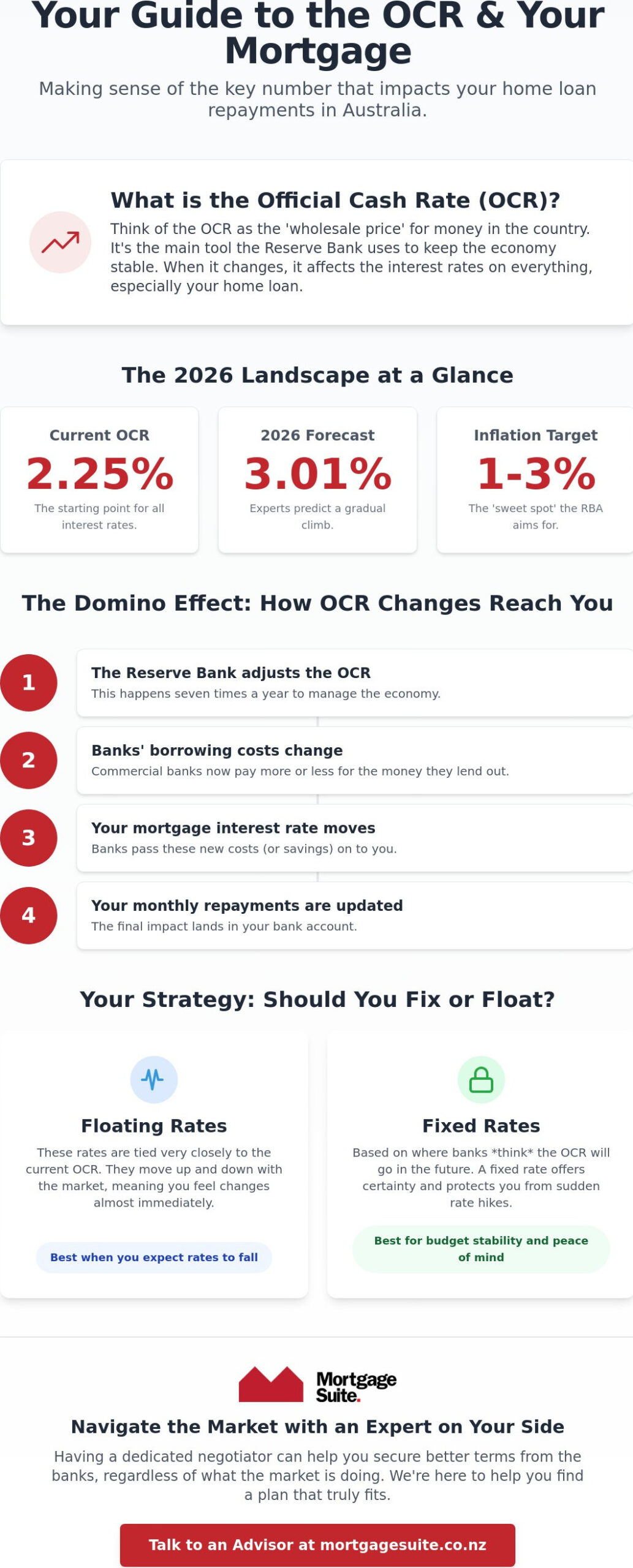
I know how unsettling it is to watch your hard-earned money shift because of decisions made behind closed doors at the Reserve Bank. This guide is here to clarify what the Official Cash Rate actually is and how its projected movements in 2026 will directly impact your wallet. With the OCR currently sitting at 2.25 per cent and forecasts suggesting a climb toward 3.010 per cent over the next year, staying informed is your best defence against rising costs. We will break down the latest June 2026 data and explore whether fixing or floating is the smartest way to organise your home loan today.

Key Takeaways

  • Learn the simple ocr meaning and how this single number set by the Reserve Bank dictates the interest you pay on your home loan.
  • Understand why bank interest rates move when the Official Cash Rate changes so you can stop being surprised by your monthly mortgage statements.
  • Get a clear picture of the 2026 economic landscape to see how settling inflation might finally change your repayment strategy.
  • Discover how to use OCR trends as a guide to decide whether fixing for a short term or staying on a floating rate is the right move for your budget.
  • Find out how having a dedicated negotiator on your side can help you secure better terms from the big banks, regardless of what the market is doing.

What is the OCR? The Official Cash Rate Explained

If you’ve been searching for the ocr meaning lately, you might have found yourself looking at software that reads text from images. That is definitely not what we’re talking about here. In the world of New Zealand home loans, the OCR is the most powerful number in the country. It dictates how much you pay for your house, how much you can save, and the general cost of living for every Kiwi family.

Think of the OCR as the foundation of every interest rate in the country. When the Reserve Bank moves this lever, every other bank follows suit. At its simplest, the Official Cash Rate is the interest rate the Reserve Bank of New Zealand (RBNZ) charges on overnight loans to commercial banks. This is why we often call it the “wholesale price” of money. Just like a local bakery has to pay more for flour when global prices rise, your bank has to pay more for the money they lend you when the OCR goes up. The RBNZ uses this rate as their primary tool to manage price increases and ensure the New Zealand economy stays stable and doesn’t run too hot or too cold.

Who decides the OCR and when?

The Reserve Bank doesn’t just set a rate and forget it. A group of experts at the bank meets seven times a year to review the state of the nation and decide if the current settings are still right. These decisions aren’t made in a vacuum; these decision-makers look at a massive range of data including employment levels, global trade trends, and local price hikes. Their next scheduled review is on July 8, 2026. These announcement dates are a big deal because even a tiny shift can change your weekly budget. Understanding the ocr meaning helps you stay ahead of these announcements so you can prepare for potential changes to your mortgage repayments before they actually happen.

Why does the OCR exist?

The main job of the OCR is to keep the cost of living from rising too fast, ideally keeping it between 1 and 3 per cent. When prices for everyday items like groceries and petrol start climbing too quickly, the bank will often hike the OCR to slow down spending. This makes borrowing less attractive and encourages people to save instead. Conversely, if the economy feels a bit sluggish and needs a boost, they might lower the rate to make loans cheaper and encourage spending. Currently, with the rate at 2.25 per cent and prices predicted to rise at or above 3.0 per cent through the end of the year, the Reserve Bank is performing a delicate balancing act to keep our costs under control.

How the OCR review NZ affects your mortgage rates

When the Reserve Bank of New Zealand moves the rate, it sets off a chain reaction that eventually lands right in your letterbox or inbox. It’s helpful to think of this like a domino effect. Banks don’t just have vaults full of cash; they actually borrow money themselves to lend it to you. When the ocr meaning shifts, it changes the price banks pay for money. If that price goes up, the banks follow suit.

To ensure they are making enough money to stay in business, banks pass those extra costs directly on to you through higher interest rates. This is why your mortgage rate doesn’t stay still. It’s a bit of a cycle that starts with the experts at the Reserve Bank and ends with your monthly repayment. When their costs go down, they often lower your rate to stay competitive and attract new families looking for a home loan.

The link between the OCR and floating rates

Floating or variable rates are usually the first to move when things change. They are tied very closely to the current settings. For example, if the rate drops by 0.25 per cent, you can usually expect your floating rate to follow that lead pretty quickly. This immediate connection is why many people choose to keep a portion of their loan floating when they think the market is trending downwards, as it allows them to save money without waiting.

Fixed rates and “future expectations”

Fixed rates are a bit more complex because they are based on where the banks think the rate will go in the future. If the market expects a hike in six months, banks might raise their fixed rates today to prepare. Understanding this helps you decide if you should choose a fixed rate mortgage or stay flexible. If you’re feeling unsure about the best path forward, the team at Mortgage Suite Ltd can help you look at your specific budget and find a plan that fits.

The 2026 trend: What is happening with interest rates now?

As we move through 2026, the mood around the property market is starting to change. We are finally seeing a shift in how the Reserve Bank manages the cost of living, moving away from the constant pressure of the last few years. Because inflation is starting to settle, the “high-rate era” that caused so much stress for homeowners is beginning to evolve into something more manageable. This shift in the ocr meaning for families means that instead of just trying to keep your head above water, you can start looking at the future with a bit more clarity.

I believe 2026 will be a year of cautious optimism for those looking at switching to a better deal on their home loan. With the rate currently sitting at 2.25 per cent, there is more breathing room in household budgets than we have seen in quite some time. It is a period where you can stop worrying about sudden shocks and start making plans that actually help you get ahead. Understanding how mortgage rates NZ are shaped by these OCR movements is essential to making the most of the current environment.

Will rates go down further in 2026?

Many experts are waiting for signs that the rate will “normalise” or return to lower levels. While the Reserve Bank is always careful not to move too fast and risk making prices jump again, a steady environment makes it much easier to calculate a mortgage repayment that you can rely on. Even if forecasts like the one from CEIC suggest a slight climb toward 3.010 per cent over the next year, the predictability of the market is a huge win for anyone trying to organise their finances.

What this means for first-home buyers

Stability in the market makes it much easier to plan a budget for your very first home. We are noticing that banks are becoming more competitive again, often offering “special” fixed rates to attract new families. It is a fair dinkum opportunity to get into the market and secure a house before property prices potentially start to climb again. For those who have been waiting on the sidelines, the current trend offers a much clearer path to homeownership than we have seen in years.

OCR Meaning: How the Official Cash Rate Shapes Your Mortgage in 2026

Strategy: Should you fix or float based on the OCR?

Now that you’ve got a handle on the ocr meaning, the real question is how to use that knowledge to protect your bank account. There isn’t a single answer that works for every household, but the current market trends give us some very strong clues. When you understand the direction the Reserve Bank is heading, you can stop guessing and start planning with real confidence. Your choice usually comes down to whether you value immediate savings or long-term certainty.

If the trend shows the OCR is likely to stay low or drop, staying on a floating rate or choosing a short-term fix of six months can be a brilliant move. This allows you to stay nimble and potentially catch lower rates as they arrive. However, with the RBNZ forecasting the rate to reach 3.010 per cent by mid-2027, many homeowners are looking at locking in a rate for two or three years. This provides peace of mind, as you’ll know exactly what your repayments are even if the market gets a bit bumpy later in the year. A comprehensive look at mortgage rates NZ homeowners are navigating in 2026 can help you weigh up whether fixing or floating makes the most sense for your situation.

Keep in mind that interest rates are only half the story. You also need to check the debt to income ratio nz settings. These rules can limit how much you’re actually allowed to borrow, regardless of how low the interest rates might be. Balancing your rate strategy with these borrowing limits is the key to a healthy mortgage in 2026.

The “Split Loan” approach

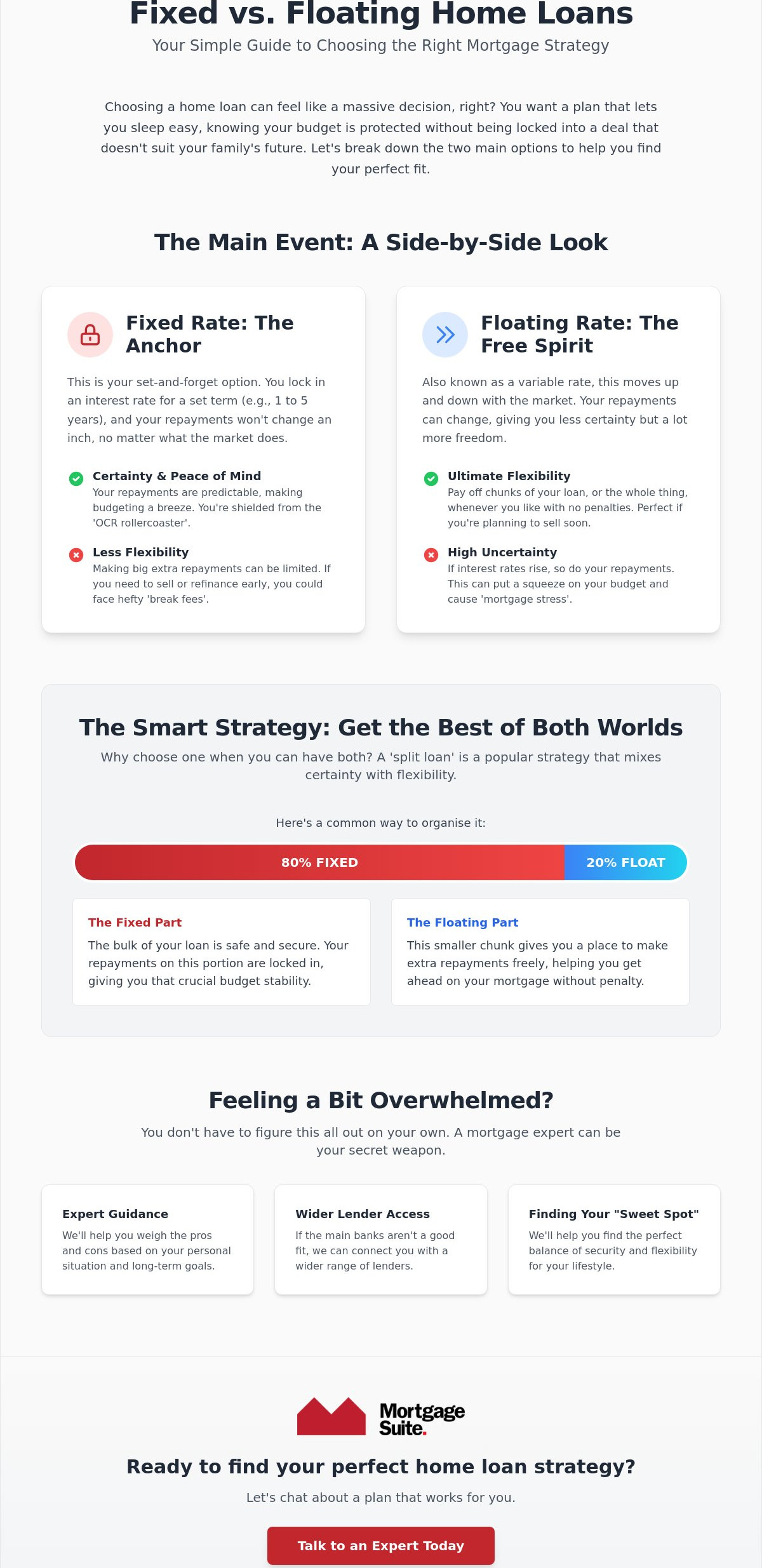
You don’t have to put all your eggs in one basket. Many of our clients choose to organise their mortgage so one portion is fixed and the other is floating. This gives you the best of both worlds. You get the certainty of a fixed payment for your main budget, but the floating portion allows you to make extra repayments whenever you have some spare cash. It’s a smart way to hedge your bets against any sudden surprises from the Reserve Bank while still chipping away at your debt faster.

When to talk to a broker

A professional broker can see under the hood of what the different banks are planning before they make it public. We spend our days looking at the ocr meaning in practice, which means we can help you cut through the technical talk and find a rate that actually fits your life. Getting expert advice is spot on when you want to avoid the stress of second-guessing the market. If you’re ready to find a strategy that works for your specific situation, book a time to chat with our team at Mortgage Suite Ltd today. We love helping Kiwis take the guesswork out of their home loans.

How Mortgage Suite Ltd navigates the OCR for you

At Mortgage Suite Ltd, we have been guiding Kiwis through the ups and downs of the property market for over two decades. In that time, our team has seen dozens of OCR cycles and navigated through every kind of economic weather you can imagine. We know that when the news starts buzzing about interest rates, it can feel like a lot of noise that doesn’t actually help you make a decision. Krish and the team are here to act as your personal negotiators; we stand between you and the big banks to make sure you get a fair deal that reflects your hard work.

We take the stress out of every OCR review NZ goes through by translating the big headlines into a plan that works for your specific wallet. Instead of you having to decode a complex economic report, we do the heavy lifting and explain the ocr meaning in terms of your actual monthly repayments. Whether you are a first-home buyer trying to get a foot in the door or an investor looking to grow a residential investment portfolio, we centre our advice entirely on your personal goals and family needs. We pride ourselves on being a steady hand in a fluctuating market, ensuring you always feel like a priority rather than just a transaction.

Personalised rate reviews

One of the biggest mistakes many homeowners make is the “set and forget” approach. We don’t believe in leaving your financial future to chance. At Mortgage Suite Ltd, we keep a constant eye on the market and the Reserve Bank’s movements for you. If a better opportunity pops up because the RBNZ moved the needle, we will be the first to let you know so we can adjust your strategy together. Our service is designed to make the complex world of finance feel as easy as a chat over a cuppa. We want you to feel supported and prioritised, giving you the confidence to make big decisions without the typical anxiety.

Ready to secure your 2026 home loan?

Don’t let the loud headlines or conflicting reports about the ocr meaning confuse your strategy for the year ahead. The market is always moving, but with a seasoned expert to guide you, those movements become opportunities rather than obstacles. We are here to help you find clarity and confidence in your mortgage decisions, regardless of what is happening with global inflation or local interest rates. Let’s have a no-obligation chat about how we can get your home loan sorted properly for 2026. Reach out to the team at Mortgage Suite Ltd today and let’s start a partnership that puts your success first.

Take Control of Your Financial Future in 2026

Understanding the ocr meaning is the first step in moving from financial confusion to real confidence. We have explored how the Reserve Bank’s decisions trickle down to your family budget and why the current 2026 trends require a proactive approach to your home loan. Whether you decide to fix, float, or split your repayments, the most important thing is having a strategy that protects your lifestyle while the market evolves. You don’t have to guess what the next move should be when you have the right information at your fingertips.

With over 20 years of seasoned experience in banking and brokerage, Krish Krishna and the team at Mortgage Suite are here to provide the personalised service you need. We are specialists in navigating 2nd tier and alternative lending options that often provide a way forward when mainstream banks say no. Don’t let market headlines dictate your stress levels. Let’s chat about your 2026 mortgage strategy today to ensure your home loan is working as hard as you do. We are ready to help you secure a stable and successful path forward.

Common Questions About the OCR

How often does the OCR change in New Zealand?

The Reserve Bank of New Zealand reviews the Official Cash Rate seven times a year. These scheduled announcements happen roughly every six to eight weeks, allowing the bank to react quickly to changes in the economy. While the dates are set in advance, the bank does have the power to make unscheduled changes if a major global or local event occurs. The next major review for 2026 is locked in for July 8.

Does a lower OCR always mean my mortgage rate will drop?

A lower rate doesn’t guarantee an immediate drop in your mortgage interest because banks also have to account for their own costs and profit margins. While a reduction in the wholesale price of money usually leads to lower retail rates, banks might hold their ground if they expect the ocr meaning to shift back up in the near future. They also look at what their competitors are doing before deciding how much of the saving to pass on to you.

What happens to my fixed-rate mortgage if the OCR goes up?

Nothing happens to your repayments until your current fixed term comes to an end. Your fixed-rate agreement is a legal contract that protects you from any market increases during that period. The catch is that when your term expires, you will have to roll over onto the new, higher market rates. This is why many homeowners start chatting with a broker a few months before their fixed rate ends to plan for the jump.

Is the OCR the same as the interest rate I pay the bank?

No, the OCR is the “wholesale” rate banks pay each other, while your mortgage rate is the “retail” price you pay the bank. Because banks have to pay for their staff, technology, and branches, they add a margin on top of the Official Cash Rate. This is why you will see floating rates currently around 5.89 per cent even though the OCR itself is much lower at 2.25 per cent.

Can I change my mortgage type if the OCR review NZ is bad news?

You can usually switch from a floating rate to a fixed rate instantly to lock in some certainty for your budget. If you are already on a fixed rate and want to change because the ocr meaning has shifted, you might have to pay a “break fee” to the bank. It is often a good idea to have a professional check if the potential savings of a new rate are bigger than the cost of the fee before you make the move.

How much can a 0.25% OCR change actually cost me each month?

A 0.25 per cent increase on a $500,000 mortgage can add approximately $80 to your monthly interest bill. While that might feel manageable on its own, several small increases over a year can quickly add up to an extra $1,000 or more out of your pocket. Tracking these small shifts is vital because they have a compounding effect on your long-term wealth and your ability to pay off your home faster.

Article by

Krish Krishna

Experienced Financial Adviser with over 46 years of Banking and Mortgage broking experience and over $2.0 Billion in loan settlements.

Fixed Rate Mortgage vs Floating: Which is Right for You in 2026?

If you could lock in your financial peace of mind today, would you choose the long term security of a five year fix or the short term flexibility of a one year rate? It is a question that keeps many Kiwis awake at night, especially when you are deciding if a fixed rate mortgage is the right tool to shield your home from rising costs. You likely want a plan that lets you sleep easy, knowing your budget is protected from the whims of the market without being trapped in a structure that does not suit your family’s future.

We understand the stress that comes with bank rejections or the confusion of choosing between various terms while rates fluctuate. This guide will show you exactly how these loans work in the 2026 New Zealand market and help you find the best strategy to protect your wallet. We will explore how to organise your debt to lower your monthly repayments and why “splitting the difference” might be the smartest move for your lifestyle and your long term goals.

Key Takeaways

  • Understand how a fixed rate mortgage provides repayment certainty, ensuring your budget stays steady regardless of what the Reserve Bank decides.
  • Compare the high security of fixed terms against the flexibility of floating rates to decide which priority fits your current lifestyle.
  • Discover the “sweet spot” for loan terms that balances the hope of lower future rates with the need for immediate financial protection.
  • Learn how to use a split loan strategy to get the best of both worlds, keeping most of your debt safe while leaving room for extra repayments.
  • Find out how an expert can help you access a wider range of lenders if the main banks are not a good fit for your situation.

What is a Fixed Rate Mortgage and How Does it Work?

A fixed rate mortgage is a contract for financial certainty during market fluctuations. It is an agreement where you lock in your interest rate for a specific period, usually ranging from six months to five years. This agreement acts as a vital anchor for your finances, providing a sense of stability even when the wider economy feels a bit shaky. If you are looking for a formal deep dive into the history and mechanics of these loans, you can read more about What is a Fixed-Rate Mortgage? on Wikipedia. It is a straightforward way to ensure that your home loan remains manageable, no matter what happens in the global financial world.

When you choose to fix, your monthly repayments stay exactly the same for the duration of that term. It doesn’t matter if the Reserve Bank of New Zealand decides to hike the Official Cash Rate (OCR) or if global markets take a sudden turn; your bank cannot touch your rate until your fixed term expires. This creates a powerful shield against sudden cost-of-living spikes. It means you won’t be blindsided by a sudden increase in your mortgage bill just because interest rates rose while you were busy with work and family life. You can plan your household budget months or even years in advance with absolute confidence.

The difference between fixed and floating

Think of the difference like choosing between a set-menu meal and ordering a-la-carte. A fixed rate mortgage is your set menu; you know exactly what it costs before you sit down, and there are no surprises when the bill arrives. A floating (or variable) rate is like ordering a-la-carte. The price can change depending on the day’s market conditions. While floating rates offer the flexibility to make large extra payments or pay off the loan early without any penalties, they often come with a higher interest rate. Most people find that the lower interest rates typically offered by a fixed rate are worth the trade-off in flexibility.

Why Kiwis usually prefer to fix

Historically, New Zealanders have a strong preference for fixing their loans. Most of us value that budgeting security above all else. It is a practical way to avoid “mortgage stress” when interest rates are climbing. For many, especially those just starting out, understanding these options is just as important as knowing the home loan deposit requirements NZ lenders expect for first-time buyers. By locking in a rate, families can ensure their biggest monthly expense is predictable. This stability is often the difference between a comfortable lifestyle and a stressful one, especially during those early years of home ownership when every dollar counts.

Fixed vs Floating: A Side-by-Side Comparison

Deciding between a fixed or floating rate isn’t just a financial choice; it’s a lifestyle one. When you opt for a fixed rate mortgage, your “certainty factor” is at its peak. You can organise your monthly budget with total confidence, knowing your repayments won’t budge for years. On the flip side, floating rates offer very low certainty but high flexibility. If you’re the kind of person who values freedom over a strict plan, the differences between a fixed-rate and adjustable-rate mortgage (which is what we call floating rates here) are worth a closer look.

Cost is another big player in this decision. In the short term, fixed rates are usually cheaper than floating ones. Banks often offer these lower rates to entice you into a long-term commitment. However, this commitment comes with a catch called “break fees.” If you decide to sell your house or switch lenders before your fixed term ends, your bank might charge you a significant fee to cover their loss. It is a bit like breaking a mobile phone contract early. You need to be sure about your plans before you sign on the dotted line.

The Pros and Cons of Locking it In

The biggest pro is protection from the “OCR rollercoaster” we have seen throughout 2026. With a fixed rate, you’re safe in your own little bubble while the rest of the market reacts to every Reserve Bank announcement. The main con is that you’re stuck. If interest rates drop significantly, you can’t take advantage of those savings without paying those pesky break fees. It’s about weighing up that peace of mind against the potential to save if the market dips. If you’re feeling unsure about which path to take, chatting with a professional about home loans can help clarify your best move.

When Floating Actually Makes Sense

Floating isn’t for everyone, but it has its moments. It makes perfect sense if you’re planning to sell your property in the next few months. You stay nimble and avoid break fees entirely. It is also a brilliant option if you’re expecting a windfall, like a work bonus or an inheritance. Floating loans let you pay down as much debt as you want, whenever you want. For those who hate the idea of being “locked in” to a bank contract, that extra bit of freedom is often worth the slightly higher interest rate.

Choosing Your Term: Should You Fix for 1 Year or 5?

Picking the right term for your fixed rate mortgage is less about outsmarting the bank and more about understanding your own life. Banks spend millions trying to predict where rates will go, but their guesses are often as good as yours. Ultimately, the “best” term for you depends far more on your personal job security and future plans than on any spreadsheet from a bank economist. You need to decide how long you want that “peace of mind” window to stay open.

If you reckon interest rates are on a downward slide, a short-term fix of six months to one year might be your best bet. This keeps you on a short leash, allowing you to re-fix at a lower rate sooner if the market moves in your favour. However, if you crave stability, a medium-term fix of two to three years is often the “sweet spot” for many Kiwi families. It offers a solid block of time where you don’t have to worry about your repayments changing, usually at a more competitive price than the longer options.

For those who want to set their budget and forget about it, long-term fixes of four to five years provide the ultimate certainty. You might pay a small premium for this extra protection, but for some, the ability to ignore the news for half a decade is worth every cent. It is essentially an insurance policy against future rate hikes.

The 2026 Economic Outlook and Your Mortgage

Understanding the ocr meaning is crucial because it directly influences what the banks charge you. In 2026, we are seeing a shift in how banks price their terms. They are reacting to global signals that might make long-term rates look quite different compared to short-term ones. Don’t fall into the trap of trying to time the market perfectly. Instead, aim for a term that lets you live your life comfortably within your means without constantly checking the headlines.

Addressing the fear of missing out (FOMO)

It is easy to get a case of “rate envy” when you hear a mate bragging about their 5% rate while you are locked in at 6%. If rates drop after you have signed your fixed rate mortgage contract, don’t panic. You made a decision based on the protection you needed at the time. Focus on your own debt-to-income health rather than market gossip. A slightly higher rate with absolute certainty is often better for your mental health than a lower rate that leaves you constantly stressed about the next move.

Fixed Rate Mortgage vs Floating: Which is Right for You in 2026?

The Split Loan Strategy: The Best of Both Worlds

Most people think they have to choose between a fixed or floating rate, but you don’t actually have to put all your eggs in one basket. A split loan strategy allows you to divide your debt into different portions. You can have the majority of your debt in a fixed rate mortgage for that essential budget security while keeping a smaller slice on a floating rate for flexibility. This approach is a brilliant way to manage the debt to income ratio NZ rules, as it keeps your core repayments predictable while giving you room to move.

One popular method is the 80/20 split. You lock in 80% of your loan to protect yourself from rate hikes and leave 20% floating. This 20% portion is your “flexibility zone” where you can make extra repayments without any penalties. Another smart move is the staggered fix. This involves splitting your loan into two fixed portions, for example, half for one year and half for three years. It ensures that you’re never faced with the prospect of your entire loan coming up for renewal at the same time during a period of high interest.

Hedging your bets

Staggering your fixed dates is all about reducing “sticker shock.” If interest rates have jumped significantly by the time your one year term ends, only half of your loan is affected by the higher cost. The other half remains safely tucked away at your original lower rate for another two years. This gives you a chance to re-evaluate your household budget every year and adjust your spending without your entire financial world being turned upside down at once. It is a methodical way to stay in control of your debt.

Using the floating portion for “Offsetting”

If you have some savings sitting in the bank, you can use them to “offset” the interest on the floating part of your loan. Essentially, the bank only charges you interest on the difference between your loan balance and your savings balance. This is a fair dinkum way to pay off your house years earlier because every dollar you save is effectively working to reduce your mortgage. You keep the safety of your fixed rate shield on the main loan while using your cash to chip away at the floating portion. If you want to see how this could work for your specific numbers, reach out to us for a chat about your home loan options.

How a Broker Helps You Navigate Fixed Rates in 2026

When you go straight to a bank, you’re only seeing one small slice of what’s actually available. Banks are in the business of selling their own products, which means they won’t tell you if a competitor down the road has a much better deal. A broker works differently. We scan the entire market to find the fixed rate mortgage that truly fits your life, not just the one a single bank wants to push this month. We handle the hard yakka of the negotiation process, dealing with the endless paperwork and the back-and-forth phone calls so you can focus on your move. Having a mentor like Krish Krishna on your side means you get years of industry experience and a steady hand to guide you. That personal connection and advocacy beat a faceless, automated banking app every single time.

Negotiating a mortgage isn’t just about the interest rate itself. It’s about the fine print, the flexibility for extra repayments, and even the cash-back offers that banks use to entice new customers. We know which levers to pull to get you a better result. We act as your bridge between the rigid world of institutional banking and your personal financial goals. You aren’t just another application number to us; you’re a partner whose success is our priority.

Beyond the “Big Four” Banks

Sometimes your financial profile is a bit unique. Perhaps you’re self-employed, have a fluctuating income, or maybe you’re just starting a new business venture. In these cases, the “Big Four” banks might be quick to say no because you don’t fit into their standard boxes. This is where 2nd tier lenders can be an absolute lifesaver. These lenders are often more flexible and willing to look at the bigger picture of your financial health. We specialise in finding funding for people who don’t fit the standard criteria. Don’t let a “no” from a mainstream bank stop your home-owning dreams. There is almost always a path forward if you know where to look.

Your Next Steps to Financial Freedom

Don’t wait until the last minute to think about your next move. We recommend reviewing your current rate at least 60 days before it expires. This window gives us enough time to scan the market, compare new fixed rate mortgage options, and lock in a rate before they potentially climb higher. A quick “Home Loan Check-in” is a great way to see if your current loan structure still matches your lifestyle and your goals for the coming year. It’s a simple step that could save you thousands in the long run. Let’s have a chat about your mortgage strategy today and make sure your home loan is working as hard as you do.

Secure Your Financial Future Today

Choosing between a fixed rate mortgage and a floating one doesn’t have to be a gamble. By now, you’ve seen how a well-structured split loan can offer both the safety of a fixed rate and the flexibility to pay down debt faster. Whether you are leaning towards a short term fix to see where the market goes or a long term anchor for your budget, the right choice always aligns with your personal life goals rather than just bank forecasts.

With over 20 years of banking and brokerage experience, we are here to ensure you never feel processed or ignored. We specialise in finding solutions through 2nd tier and alternative lending for those who don’t fit the standard bank mould, providing nationwide service for all Kiwis. Don’t leave your biggest financial decision to an automated app. Book a free consultation with Mortgage Suite Ltd today to build a mortgage structure that truly fits your lifestyle. You’ve got this, and we’re ready to help you every step of the way.

Frequently Asked Questions

Is it better to fix for 1 year or 2 years right now?

The better choice between a one year or two year term depends entirely on whether you value immediate flexibility or a longer period of budget certainty. If you believe interest rates will drop soon, a one year fix allows you to re-evaluate your options earlier. However, if you prefer to set your budget and forget about it, a two year term often provides a better balance of security and value without the stress of frequent renewals.

What happens when my fixed rate term ends?

When your fixed term expires, your loan will automatically roll onto the bank’s floating interest rate. This floating rate is usually higher than most fixed options, so it is important to organise a new fixed term at least 60 days before your current one ends. We can help you compare the latest market offers to ensure you don’t end up paying more than you should by default.

Can I pay extra on a fixed rate mortgage?

Most banks allow you to make a limited amount of extra repayments on your fixed rate mortgage each year without penalty. This is often capped at a certain percentage of the loan balance or a specific dollar amount, such as $10,000. If you plan to pay off a large chunk of your debt quickly, keeping a portion of your loan on a floating rate is usually a much more flexible strategy.

What are break fees and how are they calculated?

Break fees are charges you pay to the bank if you end your fixed contract before the agreed date. They are calculated based on how much interest rates have changed since you first locked in your fixed rate mortgage and the bank’s potential loss. If current market rates are lower than your fixed rate, the bank will likely charge you a fee to cover the difference for the remainder of your term.

Can I change from a fixed to a floating rate mid-term?

You can certainly change from a fixed to a floating rate before your term is up, but it usually comes with a cost. Because you are breaking a legal contract with the bank, they will likely charge you a break fee. It is always worth asking for a quote first so you can decide if the flexibility of a floating rate outweighs the immediate expense of the penalty.

How much deposit do I need for a fixed rate mortgage in NZ?

In New Zealand, most lenders prefer a 20% deposit for a standard home loan, though some first home buyer programs allow for as little as 10%. The amount you need can also depend on whether you are buying an existing home or building a new one. Having a larger deposit generally gives you access to better interest rates and more choices when it comes to selecting a lender.

Will mortgage rates go down in 2026?

Predicting exactly if rates will drop in 2026 is tricky, as it depends on inflation and the Reserve Bank’s Official Cash Rate decisions and what the OCR meaning is for your mortgage. While some global markets have seen rates stabilise, the local outlook is always subject to change based on the wider economy. We focus on building a mortgage structure that you can afford comfortably today, rather than relying on guesses about what might happen tomorrow.

What is the “reserve rate agreement” ANZ and others talk about?

A reserve rate agreement is essentially a rate lock that guarantees your interest rate for a specific period, usually up to 60 days, before your loan actually settles. This protects you from any sudden rate hikes that might occur while your property purchase is being finalised. It provides a vital layer of security, ensuring the repayments you budgeted for are the ones you actually end up with.

Article by

Krish Krishna

Experienced Financial Adviser with over 46 years of Banking and Mortgage broking experience and over $2.0 Billion in loan settlements.