

Best Way to Structure Your Mortgage in NZ: A 2026 Guide to Saving Thousands

What if the “standard” home loan your bank offered is actually the slowest possible way to own your home? It’s a common frustration for Kiwis who feel trapped by rising interest rates, especially with the OCR sitting at 2.50% and floating rates climbing above 6%. You might worry you’re missing out on a better deal or feel buried under terms like “offsetting” and “revolving credit.” Finding the best way to structure mortgage nz isn’t about picking a single product; it’s about creating a personalised mix that works for your specific lifestyle.

I understand that looking at your mortgage can feel overwhelming, but you don’t have to just accept the status quo. In this guide, I’ll show you exactly how to organise your loan to slash interest costs and pay off your debt years sooner using proven Kiwi strategies. We will look at how to balance the safety of fixed rates with the flexibility of floating accounts, giving you a clear plan to reduce interest and the freedom to make extra payments whenever you want. By the end, you will have the peace of mind that your mortgage is finally working as hard as you do.

Key Takeaways

  • Understand why finding the best way to structure mortgage nz can save you tens of thousands of dollars more than just hunting for the lowest advertised interest rate.
  • Master the “split loan” strategy to enjoy the security of fixed repayments while keeping the flexibility to smash your debt whenever you have extra cash.
  • Learn how to customise your home loan based on your current life stage, from first-home buyer budget safety to investor-focused tax benefits.
  • Explore how 2nd tier lenders can provide a path forward if mainstream banks have declined your application due to self-employment or complex finances.

Why the Way You Organise Your Mortgage Matters

Most people start their home loan journey by hunting for the lowest interest rate they can find on a bank’s website. While a low rate is great, it’s only one piece of the puzzle. The best way to structure mortgage nz involves looking at the big picture of your finances rather than just the number on the front page. If your loan isn’t set up correctly, you could end up paying far more in interest over thirty years than someone with a slightly higher rate but a smarter structure.

A well-set-up loan can save you tens of thousands of dollars over the life of your mortgage. Think about it this way: even a small change in how you split your debt can shave years off your repayment term. It gives you the freedom to throw extra cash at your debt when you have a good month, without getting hit by nasty bank penalties. At the same time, it acts as a safety net. If interest rates suddenly jump, a solid structure protects you from “bill shock” by ensuring your repayments don’t all skyrocket at once. When you find the best way to structure mortgage nz for your specific situation, you gain genuine control over your financial future.

The Tug-of-War: Certainty vs. Flexibility

Choosing between fixed and floating rates often feels like a tug-of-war. Fixed rates are your safety blanket; they give you a predictable budget so you can sleep easy at night knowing exactly what’s going out of your account. Floating rates, on the other hand, give you the power to make extra repayments whenever you like without fees. This is where the role of a mortgage broker becomes so valuable, as they help you find the “sweet spot” between these two worlds. Finding that balance ensures you aren’t paying for flexibility you don’t use or getting locked into a rigid plan that doesn’t allow for life’s surprises.

How Structuring Affects Your Daily Life

Your mortgage should fit around your life, not the other way around. Simple moves like matching your repayments to your payday, whether that’s weekly or fortnightly, can make budgeting feel effortless. It’s also about making sure you have access to funds for emergencies without needing to go through a stressful new loan application. A great structure keeps your cash flow smooth and your stress levels low. Your mortgage structure is the blueprint for your financial freedom.

The Building Blocks of a Kiwi Mortgage

Think of your mortgage as a set of building blocks. You don’t have to use just one type of loan for your entire debt. In fact, the best way to structure mortgage nz often involves stacking different “blocks” together to get the right balance of safety and speed. Most Kiwis start with a table loan, which is the standard way to pay off a house. With a table loan, your repayments stay the same, but the mix of interest and principal changes over time. At the start, you’re mostly paying interest, but as the years go by, you start smashing the actual debt much faster.

To keep things predictable, you might choose a fixed-rate loan. This locks in your interest rate for a set time, usually between one and five years. With ASB recently offering a one year fixed rate of 4.65% p.a., many people find this a great way to keep their budget steady. On the flip side, floating or variable loans move up and down with the market. While Westpac’s floating rates currently sit around 6.14%, they offer total flexibility. You can pay off as much as you want, whenever you want, without any nasty break fees. If you’re unsure which combo fits your lifestyle, it’s worth having a chat about your home loan options with someone who knows the ropes.

The Power of Offsetting Your Savings

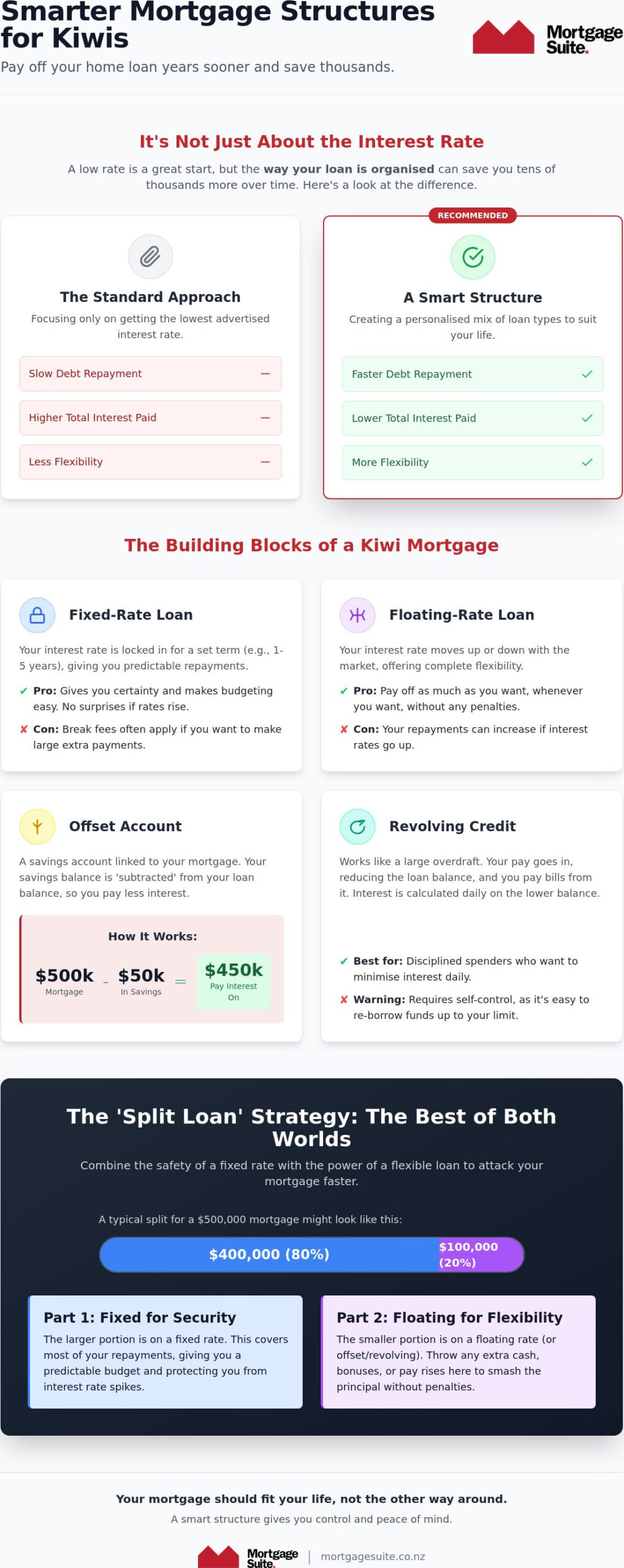
Offsetting is one of the smartest moves you can make if you have a bit of cash sitting in the bank. Instead of the bank paying you a tiny amount of interest on your savings (which then gets taxed), they “cancel out” that portion of your mortgage. If you have a $500,000 mortgage and $50,000 in savings, you only pay interest on $450,000. It’s essentially like earning a tax-free return on your savings at whatever your mortgage interest rate happens to be. It’s almost always better than a standard savings account because the interest you save on your debt is usually higher than the interest you’d earn on your deposits.

Revolving Credit: The Giant Overdraft

A revolving credit account works like a giant, flexible bucket of money. Your whole pay cheque goes into the account, which keeps the balance as low as possible for as long as possible, reducing the interest you pay every single day. You then draw money out for your groceries and bills as needed. It’s a brilliant tool for people who are disciplined with their spending or those who want an emergency buffer for things like home renovations. However, it does require a bit of self-control. Since you can “re-borrow” the money up to your limit at any time, it’s not the best choice if you’re tempted to spend every cent in your account.

The ‘Split Loan’ Strategy: A Step-by-Step Guide

Most savvy borrowers don’t put all their eggs in one basket. They know that the best way to structure mortgage nz is to split the debt into different parts. This strategy allows you to hedge your bets against interest rate changes while giving you a clear path to pay down debt aggressively. You won’t have to worry about “breaking” a fixed term and paying expensive fees just because you had a good month and want to make an extra payment. This method works regardless of which bank you’re with; it’s simply about how you choose to slice the pie.

Splitting your loan gives you the best of both worlds. You get the peace of mind that comes with fixed repayments and the freedom that comes with a floating account. It’s a proactive way to manage your money that puts you in the driver’s seat rather than leaving you at the mercy of market fluctuations. Let’s look at how to set this up in three simple steps.

Step 1: Determine Your ‘Safety’ Portion

Decide how much of your loan needs to be fixed for total budget certainty. For many, this is about 80% of the total debt. Rather than fixing that whole amount for a single term, consider “laddering” it. You might fix one portion for one year and another for three. This prevents your entire mortgage from coming up for renewal at the same time, which is vital if rates have climbed. To get a feel for what might work for you, take a look at our latest guide on mortgage rates NZ to see the current trends and where things might be heading.

Step 2: Calculate Your ‘Flexi’ Portion

Work out how much you can realistically pay off in the next year or two. This amount becomes your “flexi” portion, usually set up as a floating or revolving credit account. It’s a delicate balance. You don’t want to pay a higher floating rate on more money than you can actually pay down, but you also don’t want to be so restricted that you can’t use your extra savings to reduce your debt. It’s about finding that personal limit where your money works hardest for you.

Step 3: Review and Rebalance Annually

Your structure should never be “set and forget.” As your career grows or your family expands, your financial needs will shift. Treat your mortgage’s “anniversary” as a time for a quick check-up with your bank or broker. With the Reserve Bank recently lifting the Official Cash Rate to 2.50% in July 2026, staying on top of these changes ensures your structure still matches your lifestyle. A quick annual rebalance can often save you thousands in the long run.
Best Way to Structure Your Mortgage in NZ: A 2026 Guide to Saving Thousands

Matching Your Structure to Your Life Stage

Your financial needs don’t stay the same forever. The best way to structure mortgage nz when you’re just starting out is completely different from when you’re eyeing up retirement. Life happens; kids arrive, careers take off, or you might decide to build an investment portfolio. A structure that worked for you three years ago might be holding you back today. It is about making sure your debt fits your current lifestyle rather than forcing your life to fit a rigid bank product.

Stability is key for some, while others need every bit of flexibility they can get. As a seasoned expert, I’ve seen how a well-timed shift in your loan setup can alleviate the stress of a growing family or accelerate your path to being debt-free. It’s about being proactive. If your circumstances have changed, your mortgage should be the first thing you review to ensure it’s still helping you reach your goals.

Strategies for First-Home Buyers

For most first-home buyers, the priority is simple: keep the repayments manageable and ensure the budget stays predictable. Since the First Home Grant was discontinued on 22 May 2024, many buyers are now leaning on the Kāinga Ora First Home Loan scheme, which allows for a 5% deposit. In this stage, using a table loan is often the smartest move because it guarantees your debt actually goes down from day one. You want a structure that balances your deposit size with long-term certainty so you aren’t caught out by market shifts. You can dive deeper into these tactics in our First Home Buyer guide.

Structuring for Residential Investment

If you’re building a portfolio, your goals shift toward tax efficiency and cash flow. Interest-only terms are very common here because they keep your outgoings low, though they do come with the risk of not actually reducing your debt over time. It’s also vital to keep your investment debt separate from your personal home loan to make things much cleaner at tax time. For a full breakdown of how to set this up for success, check out our Investment Property Loans NZ guide.

Growing families often need a bit more “breathing room.” This might mean having a drawdown facility or a revolving credit portion to cover unexpected costs or that kitchen renovation you’ve been planning. On the other hand, if you’re nearing retirement, the focus usually shifts toward aggressive principal repayments. You want to enter those golden years with as little debt as possible. Whatever stage you’re in, I can help you find a tailored mortgage structure that fits your current life perfectly.

When the Banks Say No: Structuring for 2nd Tier Loans

It can be a real gut-punch when you’ve found your dream home only for your bank to say no. Mainstream banks have very rigid “boxes” for who they will lend to, and if you don’t fit their perfect profile, they often won’t budge. This is common for people who are self-employed, have complex income from multiple sources, or perhaps have a small mark on their credit history. Even in these situations, finding the best way to structure mortgage nz is still the key to your long-term success. You shouldn’t have to give up on your property goals just because a big bank’s computer system gave you a “no.”

Structuring a loan with a non-bank lender requires a different mindset. The interest rates and terms might not look exactly like the ones you see on the evening news, but the goal remains the same: getting you into your home with a plan to eventually move back to a mainstream bank. I see these situations as a puzzle that needs a specialised touch to solve. We focus on creating a structure that manages your current costs while building a clear path toward a more traditional loan in the future.

Why 2nd Tier Lending Isn’t ‘Second Best’

Many people worry that alternative lenders are a last resort, but they are often a smart “bridge” to get you where you want to be. These lenders have much more flexible criteria for those with non-standard financial histories. They look at the person and the property, not just a set of rigid checkboxes. Using these options allows you to secure your home now while you build up your “bank-ready” profile over a year or two. You can learn more about how we assist with 2nd tier lender NZ solutions to see if this path fits your needs.

The Role of a Seasoned Mortgage Broker

When you’re dealing with complex lending, you need an advocate who knows the “inside” of the industry. My 20 years of banking experience helps me navigate the “grey areas” that often confuse borrowers. A broker can see structures across multiple lenders that you simply can’t see on your own. I act as your negotiator, taking the stress out of the paperwork and the endless back-and-forth with lenders. It’s about finding a tailored solution that matches your unique financial profile, ensuring the best way to structure mortgage nz is working for you, no matter who is providing the funds. My job is to remove the obstacles so you can focus on moving into your new home.

Take Control of Your Financial Future

Owning your home sooner starts with a plan that fits your life, not just a bank’s generic product. We have explored how a “split loan” strategy can give you both budget certainty and the power to smash your debt with extra payments. Whether you are buying your first home or building an investment portfolio, the best way to structure mortgage nz is to ensure your loan setup evolves alongside your career and family. Even if the big banks have turned you away, there are still smart ways to organise your lending that keep your property goals on track.

With over 20 years of banking and brokerage expertise, I specialise in helping Kiwis find the right path through residential, investment, and 2nd tier loans. You don’t have to navigate the jargon or the stress of bank negotiations on your own. I provide a personalised service from founder Krish Krishna that puts your priorities first, ensuring you have a steady hand to guide you through a changing market. Let’s organise a chat about your mortgage structure today and start saving you thousands in interest. You’ve got this, and I am here to help you every step of the way.

Frequently Asked Questions

What is the most common way to structure a mortgage in New Zealand?

Table loans are the most common way Kiwis set up their debt, featuring set repayments over the life of the loan. However, many people now choose a “split loan” as the best way to structure mortgage nz. This involves dividing the debt between fixed and floating portions to get a mix of budget certainty and the freedom to pay off debt faster.

Is it better to fix my mortgage for 1 year or 5 years in 2026?

Choosing between a 1 year or 5 year term depends on your need for certainty versus cost. In July 2026, shorter terms like one year are sitting around 4.65% p.a., which is lower than the 5.59% p.a. offered for five years. While the shorter term saves you money now, the longer term protects you if the Reserve Bank continues to lift the OCR beyond its current 2.50%.

Can I change my mortgage structure if I’m already in a fixed term?

Yes, you can change your structure, but you will likely have to pay a “break fee” to the bank. These fees cover the bank’s loss when you end a contract early and can be quite expensive. It is usually best to wait until your fixed term is within 60 days of expiring, though we can help you calculate if breaking early actually saves you money in the long run.

How does an offset mortgage actually save me money on interest?

An offset mortgage links your savings and everyday accounts to your loan so you only pay interest on the difference. If you have a $500,000 loan and $50,000 in total savings, the bank only charges interest on $450,000. This is a brilliant way to use your cash to reduce interest costs without losing access to your money for emergencies.

What happens if I can’t afford my repayments under my current structure?

You should contact your broker or lender immediately to discuss a “hardship” variation or a temporary move to interest-only repayments. These options can lower your weekly outgoings while you get your finances back on track. Being proactive is vital; it’s much easier to adjust your structure before you miss a payment and protect your credit profile for the future.

Should I use a revolving credit account for my entire mortgage?

Using revolving credit for your entire mortgage is generally not the best way to structure mortgage nz because it requires extreme financial discipline. Since the account acts like a giant overdraft, it is very easy to spend your principal instead of paying it down. Most borrowers find it safer to fix the majority of their debt and keep a smaller portion as revolving credit.

How often should I review my home loan structure with a professional?

You should review your mortgage structure at least once a year or whenever your life circumstances change significantly. A new job, a growing family, or even a shift in the property market can mean your current setup is no longer the most efficient. An annual check-up ensures you are always using the most effective “mix” of loan types to save on interest.

Is it worth having a small floating portion if I don’t have much extra savings?

It is still worth having a small floating portion if you have the capacity to make extra repayments from your regular income. Even without a lump sum of savings, a floating portion gives you the flexibility to put an extra $50 or $100 toward your debt whenever you have a good month. Over twenty years, these small extra payments can shave years off your mortgage.

Article by

Krish Krishna

Experienced Financial Adviser with over 46 years of Banking and Mortgage broking experience and over $2.0 Billion in loan settlements.

Fixed Rate Mortgage vs Floating: Which is Right for You in 2026?

If you could lock in your financial peace of mind today, would you choose the long term security of a five year fix or the short term flexibility of a one year rate? It is a question that keeps many Kiwis awake at night, especially when you are deciding if a fixed rate mortgage is the right tool to shield your home from rising costs. You likely want a plan that lets you sleep easy, knowing your budget is protected from the whims of the market without being trapped in a structure that does not suit your family’s future.

We understand the stress that comes with bank rejections or the confusion of choosing between various terms while rates fluctuate. This guide will show you exactly how these loans work in the 2026 New Zealand market and help you find the best strategy to protect your wallet. We will explore how to organise your debt to lower your monthly repayments and why “splitting the difference” might be the smartest move for your lifestyle and your long term goals.

Key Takeaways

  • Understand how a fixed rate mortgage provides repayment certainty, ensuring your budget stays steady regardless of what the Reserve Bank decides.
  • Compare the high security of fixed terms against the flexibility of floating rates to decide which priority fits your current lifestyle.
  • Discover the “sweet spot” for loan terms that balances the hope of lower future rates with the need for immediate financial protection.
  • Learn how to use a split loan strategy to get the best of both worlds, keeping most of your debt safe while leaving room for extra repayments.
  • Find out how an expert can help you access a wider range of lenders if the main banks are not a good fit for your situation.

What is a Fixed Rate Mortgage and How Does it Work?

A fixed rate mortgage is a contract for financial certainty during market fluctuations. It is an agreement where you lock in your interest rate for a specific period, usually ranging from six months to five years. This agreement acts as a vital anchor for your finances, providing a sense of stability even when the wider economy feels a bit shaky. If you are looking for a formal deep dive into the history and mechanics of these loans, you can read more about What is a Fixed-Rate Mortgage? on Wikipedia. It is a straightforward way to ensure that your home loan remains manageable, no matter what happens in the global financial world.

When you choose to fix, your monthly repayments stay exactly the same for the duration of that term. It doesn’t matter if the Reserve Bank of New Zealand decides to hike the Official Cash Rate (OCR) or if global markets take a sudden turn; your bank cannot touch your rate until your fixed term expires. This creates a powerful shield against sudden cost-of-living spikes. It means you won’t be blindsided by a sudden increase in your mortgage bill just because interest rates rose while you were busy with work and family life. You can plan your household budget months or even years in advance with absolute confidence.

The difference between fixed and floating

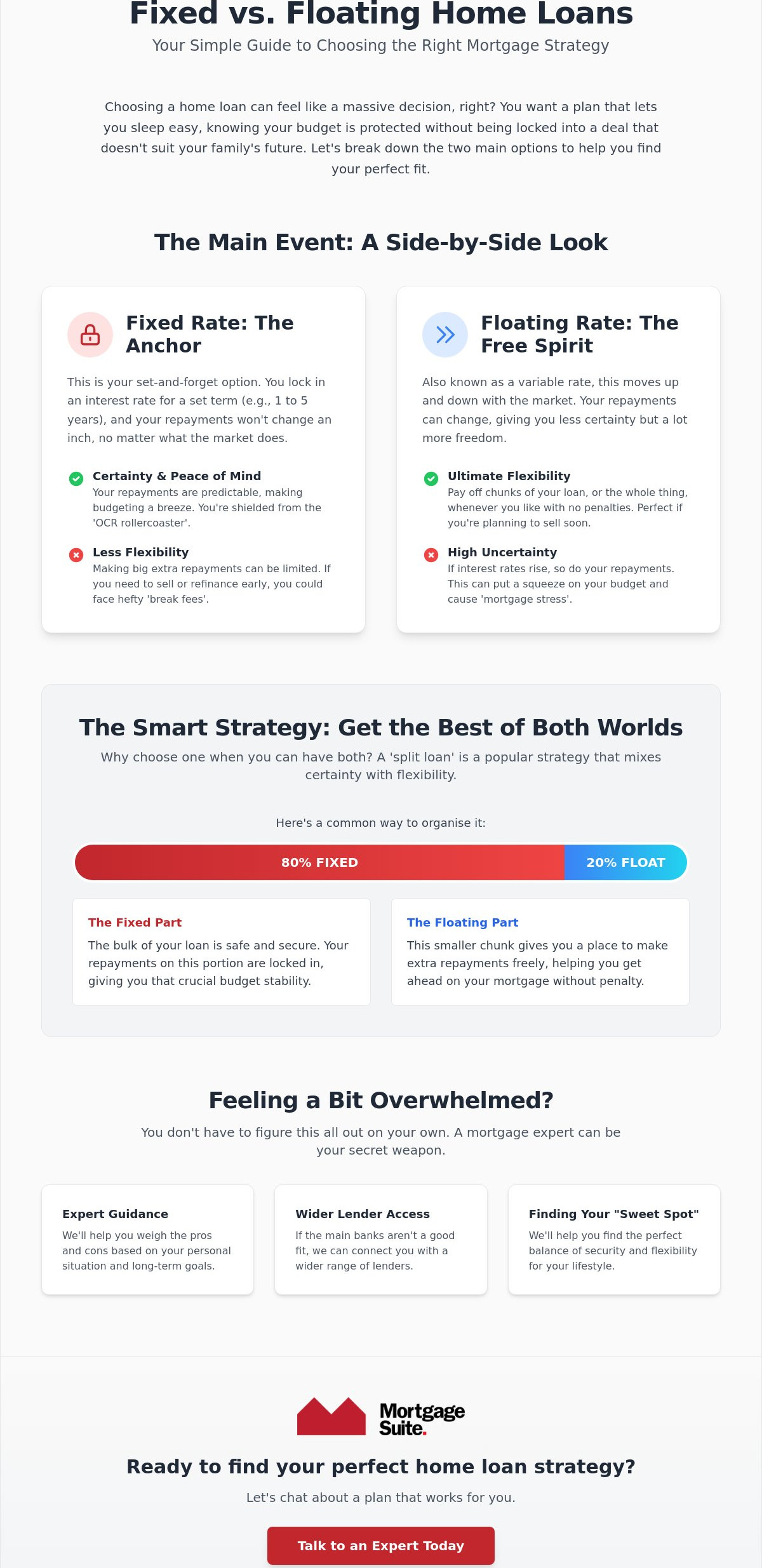
Think of the difference like choosing between a set-menu meal and ordering a-la-carte. A fixed rate mortgage is your set menu; you know exactly what it costs before you sit down, and there are no surprises when the bill arrives. A floating (or variable) rate is like ordering a-la-carte. The price can change depending on the day’s market conditions. While floating rates offer the flexibility to make large extra payments or pay off the loan early without any penalties, they often come with a higher interest rate. Most people find that the lower interest rates typically offered by a fixed rate are worth the trade-off in flexibility.

Why Kiwis usually prefer to fix

Historically, New Zealanders have a strong preference for fixing their loans. Most of us value that budgeting security above all else. It is a practical way to avoid “mortgage stress” when interest rates are climbing. For many, especially those just starting out, understanding these options is just as important as knowing the home loan deposit requirements NZ lenders expect for first-time buyers. By locking in a rate, families can ensure their biggest monthly expense is predictable. This stability is often the difference between a comfortable lifestyle and a stressful one, especially during those early years of home ownership when every dollar counts.

Fixed vs Floating: A Side-by-Side Comparison

Deciding between a fixed or floating rate isn’t just a financial choice; it’s a lifestyle one. When you opt for a fixed rate mortgage, your “certainty factor” is at its peak. You can organise your monthly budget with total confidence, knowing your repayments won’t budge for years. On the flip side, floating rates offer very low certainty but high flexibility. If you’re the kind of person who values freedom over a strict plan, the differences between a fixed-rate and adjustable-rate mortgage (which is what we call floating rates here) are worth a closer look.

Cost is another big player in this decision. In the short term, fixed rates are usually cheaper than floating ones. Banks often offer these lower rates to entice you into a long-term commitment. However, this commitment comes with a catch called “break fees.” If you decide to sell your house or switch lenders before your fixed term ends, your bank might charge you a significant fee to cover their loss. It is a bit like breaking a mobile phone contract early. You need to be sure about your plans before you sign on the dotted line.

The Pros and Cons of Locking it In

The biggest pro is protection from the “OCR rollercoaster” we have seen throughout 2026. With a fixed rate, you’re safe in your own little bubble while the rest of the market reacts to every Reserve Bank announcement. The main con is that you’re stuck. If interest rates drop significantly, you can’t take advantage of those savings without paying those pesky break fees. It’s about weighing up that peace of mind against the potential to save if the market dips. If you’re feeling unsure about which path to take, chatting with a professional about home loans can help clarify your best move.

When Floating Actually Makes Sense

Floating isn’t for everyone, but it has its moments. It makes perfect sense if you’re planning to sell your property in the next few months. You stay nimble and avoid break fees entirely. It is also a brilliant option if you’re expecting a windfall, like a work bonus or an inheritance. Floating loans let you pay down as much debt as you want, whenever you want. For those who hate the idea of being “locked in” to a bank contract, that extra bit of freedom is often worth the slightly higher interest rate.

Choosing Your Term: Should You Fix for 1 Year or 5?

Picking the right term for your fixed rate mortgage is less about outsmarting the bank and more about understanding your own life. Banks spend millions trying to predict where rates will go, but their guesses are often as good as yours. Ultimately, the “best” term for you depends far more on your personal job security and future plans than on any spreadsheet from a bank economist. You need to decide how long you want that “peace of mind” window to stay open.

If you reckon interest rates are on a downward slide, a short-term fix of six months to one year might be your best bet. This keeps you on a short leash, allowing you to re-fix at a lower rate sooner if the market moves in your favour. However, if you crave stability, a medium-term fix of two to three years is often the “sweet spot” for many Kiwi families. It offers a solid block of time where you don’t have to worry about your repayments changing, usually at a more competitive price than the longer options.

For those who want to set their budget and forget about it, long-term fixes of four to five years provide the ultimate certainty. You might pay a small premium for this extra protection, but for some, the ability to ignore the news for half a decade is worth every cent. It is essentially an insurance policy against future rate hikes.

The 2026 Economic Outlook and Your Mortgage

Understanding the ocr meaning is crucial because it directly influences what the banks charge you. In 2026, we are seeing a shift in how banks price their terms. They are reacting to global signals that might make long-term rates look quite different compared to short-term ones. Don’t fall into the trap of trying to time the market perfectly. Instead, aim for a term that lets you live your life comfortably within your means without constantly checking the headlines.

Addressing the fear of missing out (FOMO)

It is easy to get a case of “rate envy” when you hear a mate bragging about their 5% rate while you are locked in at 6%. If rates drop after you have signed your fixed rate mortgage contract, don’t panic. You made a decision based on the protection you needed at the time. Focus on your own debt-to-income health rather than market gossip. A slightly higher rate with absolute certainty is often better for your mental health than a lower rate that leaves you constantly stressed about the next move.

Fixed Rate Mortgage vs Floating: Which is Right for You in 2026?

The Split Loan Strategy: The Best of Both Worlds

Most people think they have to choose between a fixed or floating rate, but you don’t actually have to put all your eggs in one basket. A split loan strategy allows you to divide your debt into different portions. You can have the majority of your debt in a fixed rate mortgage for that essential budget security while keeping a smaller slice on a floating rate for flexibility. This approach is a brilliant way to manage the debt to income ratio NZ rules, as it keeps your core repayments predictable while giving you room to move.

One popular method is the 80/20 split. You lock in 80% of your loan to protect yourself from rate hikes and leave 20% floating. This 20% portion is your “flexibility zone” where you can make extra repayments without any penalties. Another smart move is the staggered fix. This involves splitting your loan into two fixed portions, for example, half for one year and half for three years. It ensures that you’re never faced with the prospect of your entire loan coming up for renewal at the same time during a period of high interest.

Hedging your bets

Staggering your fixed dates is all about reducing “sticker shock.” If interest rates have jumped significantly by the time your one year term ends, only half of your loan is affected by the higher cost. The other half remains safely tucked away at your original lower rate for another two years. This gives you a chance to re-evaluate your household budget every year and adjust your spending without your entire financial world being turned upside down at once. It is a methodical way to stay in control of your debt.

Using the floating portion for “Offsetting”

If you have some savings sitting in the bank, you can use them to “offset” the interest on the floating part of your loan. Essentially, the bank only charges you interest on the difference between your loan balance and your savings balance. This is a fair dinkum way to pay off your house years earlier because every dollar you save is effectively working to reduce your mortgage. You keep the safety of your fixed rate shield on the main loan while using your cash to chip away at the floating portion. If you want to see how this could work for your specific numbers, reach out to us for a chat about your home loan options.

How a Broker Helps You Navigate Fixed Rates in 2026

When you go straight to a bank, you’re only seeing one small slice of what’s actually available. Banks are in the business of selling their own products, which means they won’t tell you if a competitor down the road has a much better deal. A broker works differently. We scan the entire market to find the fixed rate mortgage that truly fits your life, not just the one a single bank wants to push this month. We handle the hard yakka of the negotiation process, dealing with the endless paperwork and the back-and-forth phone calls so you can focus on your move. Having a mentor like Krish Krishna on your side means you get years of industry experience and a steady hand to guide you. That personal connection and advocacy beat a faceless, automated banking app every single time.

Negotiating a mortgage isn’t just about the interest rate itself. It’s about the fine print, the flexibility for extra repayments, and even the cash-back offers that banks use to entice new customers. We know which levers to pull to get you a better result. We act as your bridge between the rigid world of institutional banking and your personal financial goals. You aren’t just another application number to us; you’re a partner whose success is our priority.

Beyond the “Big Four” Banks

Sometimes your financial profile is a bit unique. Perhaps you’re self-employed, have a fluctuating income, or maybe you’re just starting a new business venture. In these cases, the “Big Four” banks might be quick to say no because you don’t fit into their standard boxes. This is where 2nd tier lenders can be an absolute lifesaver. These lenders are often more flexible and willing to look at the bigger picture of your financial health. We specialise in finding funding for people who don’t fit the standard criteria. Don’t let a “no” from a mainstream bank stop your home-owning dreams. There is almost always a path forward if you know where to look.

Your Next Steps to Financial Freedom

Don’t wait until the last minute to think about your next move. We recommend reviewing your current rate at least 60 days before it expires. This window gives us enough time to scan the market, compare new fixed rate mortgage options, and lock in a rate before they potentially climb higher. A quick “Home Loan Check-in” is a great way to see if your current loan structure still matches your lifestyle and your goals for the coming year. It’s a simple step that could save you thousands in the long run. Let’s have a chat about your mortgage strategy today and make sure your home loan is working as hard as you do.

Secure Your Financial Future Today

Choosing between a fixed rate mortgage and a floating one doesn’t have to be a gamble. By now, you’ve seen how a well-structured split loan can offer both the safety of a fixed rate and the flexibility to pay down debt faster. Whether you are leaning towards a short term fix to see where the market goes or a long term anchor for your budget, the right choice always aligns with your personal life goals rather than just bank forecasts.

With over 20 years of banking and brokerage experience, we are here to ensure you never feel processed or ignored. We specialise in finding solutions through 2nd tier and alternative lending for those who don’t fit the standard bank mould, providing nationwide service for all Kiwis. Don’t leave your biggest financial decision to an automated app. Book a free consultation with Mortgage Suite Ltd today to build a mortgage structure that truly fits your lifestyle. You’ve got this, and we’re ready to help you every step of the way.

Frequently Asked Questions

Is it better to fix for 1 year or 2 years right now?

The better choice between a one year or two year term depends entirely on whether you value immediate flexibility or a longer period of budget certainty. If you believe interest rates will drop soon, a one year fix allows you to re-evaluate your options earlier. However, if you prefer to set your budget and forget about it, a two year term often provides a better balance of security and value without the stress of frequent renewals.

What happens when my fixed rate term ends?

When your fixed term expires, your loan will automatically roll onto the bank’s floating interest rate. This floating rate is usually higher than most fixed options, so it is important to organise a new fixed term at least 60 days before your current one ends. We can help you compare the latest market offers to ensure you don’t end up paying more than you should by default.

Can I pay extra on a fixed rate mortgage?

Most banks allow you to make a limited amount of extra repayments on your fixed rate mortgage each year without penalty. This is often capped at a certain percentage of the loan balance or a specific dollar amount, such as $10,000. If you plan to pay off a large chunk of your debt quickly, keeping a portion of your loan on a floating rate is usually a much more flexible strategy.

What are break fees and how are they calculated?

Break fees are charges you pay to the bank if you end your fixed contract before the agreed date. They are calculated based on how much interest rates have changed since you first locked in your fixed rate mortgage and the bank’s potential loss. If current market rates are lower than your fixed rate, the bank will likely charge you a fee to cover the difference for the remainder of your term.

Can I change from a fixed to a floating rate mid-term?

You can certainly change from a fixed to a floating rate before your term is up, but it usually comes with a cost. Because you are breaking a legal contract with the bank, they will likely charge you a break fee. It is always worth asking for a quote first so you can decide if the flexibility of a floating rate outweighs the immediate expense of the penalty.

How much deposit do I need for a fixed rate mortgage in NZ?

In New Zealand, most lenders prefer a 20% deposit for a standard home loan, though some first home buyer programs allow for as little as 10%. The amount you need can also depend on whether you are buying an existing home or building a new one. Having a larger deposit generally gives you access to better interest rates and more choices when it comes to selecting a lender.

Will mortgage rates go down in 2026?

Predicting exactly if rates will drop in 2026 is tricky, as it depends on inflation and the Reserve Bank’s Official Cash Rate decisions and what the OCR meaning is for your mortgage. While some global markets have seen rates stabilise, the local outlook is always subject to change based on the wider economy. We focus on building a mortgage structure that you can afford comfortably today, rather than relying on guesses about what might happen tomorrow.

What is the “reserve rate agreement” ANZ and others talk about?

A reserve rate agreement is essentially a rate lock that guarantees your interest rate for a specific period, usually up to 60 days, before your loan actually settles. This protects you from any sudden rate hikes that might occur while your property purchase is being finalised. It provides a vital layer of security, ensuring the repayments you budgeted for are the ones you actually end up with.

Article by

Krish Krishna

Experienced Financial Adviser with over 46 years of Banking and Mortgage broking experience and over $2.0 Billion in loan settlements.