
Buying a House on a Single Income in NZ: Your 2026 Step-by-Step Guide

Does it feel like the New Zealand property market has a “couples only” sign hanging on the front gate? If you’ve been scrolling through listings and feeling like the dream of home ownership is out of reach, you aren’t alone. Many people believe that buying a house on a single income nz is impossible in 2026, especially with the national median house price sitting at $770,000. It’s exhausting to deal with strict rules at big banks about how much you owe compared to what you earn, but your journey doesn’t have to end at a “no” from a mainstream lender.

We understand how frustrating it is to be told you don’t fit the box when you’re ready to settle down. This guide is here to change that narrative. You’ll discover how to navigate the current market and secure a home loan on your own; we’ll show you the paths that the big banks often fail to mention. We are going to provide a clear roadmap to ownership, explaining friendly ways to borrow money and giving you the confidence to start your application with a steady hand guiding you through the process.

Key Takeaways

  • Learn why solo home ownership is still a realistic goal in 2026 and how to move past the common hurdles that big banks often put in your way.
  • Discover practical ways to boost your borrowing power, ensuring that buying a house on a single income nz remains a realistic and achievable goal.
  • Find out why non-bank and 2nd tier lenders are often the best choice for solo buyers who don’t fit the strict criteria of mainstream institutions.
  • Follow a clear, five-step roadmap to organise your finances and maximise your deposit using tools like your KiwiSaver savings.
  • Understand the value of having a dedicated expert act as your personal negotiator to open doors to loan options that aren’t usually available to the general public.

Can You Really Buy a House on a Single Income in NZ?

Let’s be honest about the situation. If you’ve spent any time looking at the history of Housing in New Zealand, you’ve probably felt that sinking feeling that the system isn’t built for you. Banks often view a solo applicant as a “single point of failure.” They worry that if you lose your job or get sick, there isn’t a second person to pick up the financial slack. But here is the good news: buying a house on a single income nz is absolutely achievable in 2026 if you have the right strategy and a bit of expert advocacy on your side.

You actually have a secret weapon that couples often lack; total financial control. When you’re on your own, you don’t have to negotiate lifestyle choices or manage a partner’s hidden debts. You decide exactly how much goes into your savings and how much is allocated to your future mortgage. This level of discipline is incredibly attractive to lenders. It shows you’re a responsible borrower who can manage a tight budget without the complications of a second person’s spending habits. By proving you can live comfortably on your own terms, you demonstrate a level of stability that many dual-income households struggle to maintain.

The Reality of the 2026 NZ Property Market

The market right now is showing some interesting shifts that favour the patient buyer. The national median house price was $770,000 in June 2026, which represents a 1.3% drop from the previous month. While major banks like ANZ and ASB increased their floating rates by 0.25% to reach 6.04% in July, fixed rates have remained more competitive for those with a solid deposit. For a solo buyer, a “softer” market in cities like Auckland and Wellington means you have more room to breathe. You aren’t being outbid at every auction by frantic couples, which makes this a unique window to secure an entry-level home while prices are relatively flat.

Breaking the “Double Income” Myth

You don’t need a partner’s salary to prove you’re a safe bet for a home loan. Lenders are increasingly focused on your “character” as a borrower. If you have stable employment and a clean credit history, you’re already ahead of the pack. Banks want to see that you’ve been consistent with your savings and that you’ve minimised your personal debts like credit cards or car loans. It’s not just about the total figure on your payslip; it’s about how much of that income is left over once your weekly bills are paid. Showing a clear, disciplined track record of living within your means is the best way to prove that you can handle the responsibility of a mortgage alone.

Maximising Your Borrowing Power as a Solo Buyer

When you’re the only one signing on the dotted line, every dollar of your income needs to work twice as hard. Banks aren’t just looking at your total salary; they’re obsessed with your spare cash after bills. This is the money left over after you’ve paid for your groceries, your gym membership, and your Friday night takeaways. If you want to succeed at buying a house on a single income nz, you need to show the bank that you have plenty of breathing room in your budget. It’s about presenting a polished financial version of yourself that says you’re a low-risk, high-reliability borrower who isn’t living paycheque to paycheque.

One of the fastest ways to boost your borrowing limit is to clear away small debts. You might think a $2,000 credit card limit or a small Buy Now Pay Later balance isn’t a big deal, but lenders see it differently. They often calculate your borrowing power as if those credit limits are fully spent, which can slash tens of thousands off your maximum loan amount. Closing these accounts six months before you apply can make a massive difference to your application’s strength. You can find more detail on preparing your finances in the New Zealand Government’s guide to buying a house, which outlines the standard steps for any buyer.

Using KiwiSaver and Government Schemes

Your KiwiSaver is likely your biggest asset right now. If you’ve been a member for at least three years, you can usually access a KiwiSaver first home withdrawal NZ to put towards your deposit. While the First Home Grant was discontinued in May 2024, you should still check your First Home Grant NZ eligibility only to confirm that you should instead be looking at the First Home Loan scheme. This scheme is a lifesaver for solo buyers in 2026, allowing you to buy with just a 5% deposit if your income is $95,000 or less (or $150,000 if you have dependents). This significantly lowers the barrier to entry for those who are saving on their own.

The Balance Between Your Debt and Earnings

In 2026, banks are keeping a very close eye on the balance between your debt and earnings. This is a simple sum where the lender compares your total debt to your gross yearly income. Most mainstream banks have a limit on how high this can go, which can be a hurdle for single earners with even moderate personal debt. To improve your position, focus on reducing any existing car loans or personal debts before you approach a bank. If the big banks’ rules are too tight for your specific situation, working with an expert at Mortgage Suite Ltd can help you find alternative lenders who offer more flexibility for your specific income level and financial goals.

Finding the Right Mortgage: Bank vs. Non-Bank Options

Most of us feel a sense of loyalty to the bank where we opened our first savings account as a kid. It’s a common trap. When you’re focused on buying a house on a single income nz, that loyalty isn’t always returned. Mainstream banks are massive institutions with rigid rules. They use computer models to decide if you’re a safe bet, and these models are often skewed toward dual-income couples. If your situation doesn’t fit their perfect little box, the computer simply says no. This is why looking beyond the “Big Four” is often the smartest move a solo buyer can make.

Alternative lenders, often called non-banks, operate differently. They don’t just look at a spreadsheet; they look at the person behind the application. While a mainstream bank might see your single salary as a risk, a non-bank lender often sees a disciplined professional with a clear financial history. They are willing to be more flexible because they aren’t bound by the same internal red tape as the major banks. You might find that while their interest rates are slightly different, the “yes” they provide is the key that finally opens your front door.

When the Big Banks Say No

It’s incredibly disheartening to be declined by your own bank. Usually, they’ll cite those strict rules about debt balances we talked about earlier, or they might be worried about your ability to pay back the loan on a single cheque. Don’t let one rejection stop you. A “no” from a big bank is often just an invitation to find a more innovative partner. This is where a 2nd tier lender New Zealand becomes your greatest asset. These lenders specialise in situations that mainstream banks find too “complex,” providing a vital lifeline for solo buyers who have a solid deposit but don’t meet the standard bank criteria.

The Flexibility of Non-Bank Lenders

Non-bank lenders are particularly helpful if you’re self-employed or have a non-standard income like commissions or bonuses. They are more likely to recognise the true value of your earnings. They also offer more wiggle room for buyers with a smaller deposit, which is a frequent hurdle when buying a house on a single income nz. You can find independent advice on how these different lending structures work at Settled.govt.nz. Remember, a 2nd tier loan doesn’t have to be forever. Many of our clients use these loans as a stepping stone, getting into their home now and then moving back to a mainstream bank once they’ve built up more equity in a few years.

Buying a House on a Single Income in NZ: Your 2026 Step-by-Step Guide

Your 5-Step Roadmap to Solo Home Ownership

If you’re serious about buying a house on a single income nz, you need a plan that doesn’t rely on luck. It’s easy to feel overwhelmed by the process, but breaking it down into manageable steps turns a massive goal into a series of small wins. You aren’t just looking for a house; you’re building a foundation for your future, and that requires a methodical approach that big banks will respect. Here is the path we recommend for our solo clients to ensure they stay on track and avoid common pitfalls.

  • Step 1: Get a clear picture of your financial health. Beyond just your bank balance, look at your “surplus” income. Lenders want to see exactly what’s left over after your life is paid for each week.
  • Step 2: Maximise your deposit. This involves consolidating your savings and ensuring your KiwiSaver is ready for withdrawal. Every extra thousand dollars in your deposit reduces the risk the bank perceives.
  • Step 3: Organise a pre-approval. Knowing your true budget before you start visiting open homes is a superpower. It stops you from falling in love with a property you can’t actually afford.
  • Step 4: Target properties that fit your solo lifestyle. Focus on homes that offer low maintenance and high security, which are often easier for a single person to manage and insure.
  • Step 5: Work with a broker to negotiate. A broker acts as your advocate, presenting your case to lenders in the best possible light and finding terms that a standard bank manager might overlook.

Getting Your Paperwork in Order

Lenders are going to look at your life through a magnifying glass. As a single applicant, you’ll need to provide at least three to six months of “clean” bank statements. This means avoiding excessive Buy Now Pay Later transactions or large, unexplained cash withdrawals. You’ll also need your latest payslips and a letter from your employer confirming your permanent status. Proving your “serviceability” is about showing that your income is stable and that you’re a disciplined manager of your own money. If you can show a consistent history of living within your means, you’re halfway to a “yes.”

Shopping for the Right Property

When you’re the sole decision-maker, “buying for now” is a brilliant strategy. You don’t necessarily need a four-bedroom family home right away. Modern townhouses or well-located apartments are often more affordable and require far less weekend maintenance. This gets your foot in the door of the property market sooner, allowing you to build equity while living in a space that actually suits your current life. Always prioritise a professional building report. Since you won’t have a partner to help spot potential issues, having an expert’s eyes on the property’s structure is essential for protecting your investment. If you’re ready to see what’s possible for your specific budget, getting professional home loan advice is the best next step you can take.

Why a Mortgage Broker is a Solo Buyer’s Best Friend

Buying a home on your own is a massive milestone, but it’s often a lonely road. When you don’t have a partner to share the paperwork or the stress, a mortgage broker becomes your most valuable ally. For those buying a house on a single income nz, we act as the bridge between your personal goals and the rigid requirements of the banking system. We aren’t just looking for a loan; we are looking for the right fit for your specific life. Finding a path to buying a house on a single income nz is much easier when you have a seasoned negotiator fighting your corner.

Our approach at Mortgage Suite is built on over twenty years of direct banking experience. We’ve seen the industry from both sides of the desk, which gives us a unique perspective on how to get results. This background means we know exactly how to present your story to a lender to get a “yes.” We also have access to “wholesale” products and non-public loan options that aren’t available to the general public. This gives you a significant advantage in a competitive market where every detail counts.

Expert Negotiation for Unique Situations

We specialise in “packaging” applications to highlight your financial discipline. If a big bank sees a single income as a risk, we show them a borrower with total control over their budget. We handle the negotiation and the fine print, removing the obstacles that usually slow people down. Most importantly, our service is typically free for you; the lender pays us for the work we do in setting up the loan. This means you get professional advocacy without adding another cost to your house-hunting budget.

Long-Term Support Beyond the Settlement

Getting the keys is just the beginning of your journey. We stay in your corner to help you manage your debt and review your mortgage rates NZ whenever the market changes. Whether it’s planning for future renovations or using your growing equity to build wealth, we’re here for the long haul. We aim to be your partner in property for the next twenty years, providing the steady hand you need in an ever-changing market. You don’t have to do this alone when you have an expert mentor by your side.

Your Future Home is Within Reach

The dream of owning your own place doesn’t have to wait for a partner or a second salary. By focusing on your uncommitted income, exploring flexible non-bank lenders, and following a disciplined roadmap, the path to ownership becomes clear. It’s about looking past the standard bank rejection and finding a partner that values your individual financial strength and stability over a rigid checklist.

Successfully buying a house on a single income nz requires more than just a good deposit; it needs a dedicated advocate who knows how the system works from the inside. With over 20 years of banking expertise, we are specialists in 2nd tier lending solutions that help you move forward when the big banks aren’t an option. Talk to Krish and the team at Mortgage Suite today to start your solo home journey. We are here to act as your mentor and negotiator, ensuring you have the expert support needed to finally secure your own front door keys. You already have the drive and the financial control; now let’s work together to get you the home you deserve.

Frequently Asked Questions

How much deposit do I need to buy a house on a single income in NZ?

You generally need a 20% deposit for most standard bank loans, but you can secure a home with as little as 5% through the First Home Loan scheme. This is a massive help for anyone buying a house on a single income nz because saving $154,000 alone, which is 20% of the $770,000 national median price, is a huge mountain to climb. Low-deposit options make the dream much more accessible for solo buyers.

Can I use my KiwiSaver if I am buying a house by myself?

Yes, you can withdraw your KiwiSaver savings to put toward your first home as long as you’ve been a member for at least three years. You’ll need to leave at least $1,000 in your account; however, the rest of your contributions, employer contributions, and government top-ups can all go toward your deposit. It’s often the biggest financial boost a solo buyer has when starting out.

What is the First Home Grant and am I eligible as a single person?

The First Home Grant was officially discontinued on 22 May 2024, so it is no longer available for new applications. Instead, you should focus on the First Home Loan scheme, which remains active in 2026. This scheme helps solo buyers with an income of $95,000 or less get into the market with a 5% deposit, provided they meet the standard lending criteria.

Will a bank decline my mortgage if I have a student loan?

A student loan won’t automatically lead to a decline, but it does reduce your “take-home” pay, which banks use to calculate how much you can afford. Because a portion of your salary goes toward repayments, the lender will see you have less uncommitted income to put toward a mortgage each month. It’s just one factor they’ll consider when looking at your overall debt-to-income ratio.

Is it better to buy a new build or an existing home on a single income?

New builds are often easier for solo buyers because they are exempt from standard LVR restrictions, meaning you might only need a 5% or 10% deposit. Banks are often more willing to lend higher amounts for new properties. Existing homes usually require a larger upfront deposit, but they might offer a lower purchase price depending on the location and the condition of the property.

How do lenders calculate how much I can borrow on one salary?

Lenders look at your gross annual income and then subtract your fixed costs, like student loans, car payments, and living expenses. They use a “test rate” higher than the actual interest rate to make sure you can still pay if rates go up. This is why buying a house on a single income nz requires such a clean budget; every dollar of your salary needs to be accounted for.

What happens if I lose my job and I have a solo mortgage?

If you lose your job, the first step is to talk to your lender immediately to discuss hardship options or a temporary change to your payment schedule. Having a solid emergency fund is vital for solo owners, as you don’t have a second salary to fall back on. Banks are usually willing to work with you if you’re proactive and honest about your situation.

Can a family member help me with my deposit (gifted deposit)?

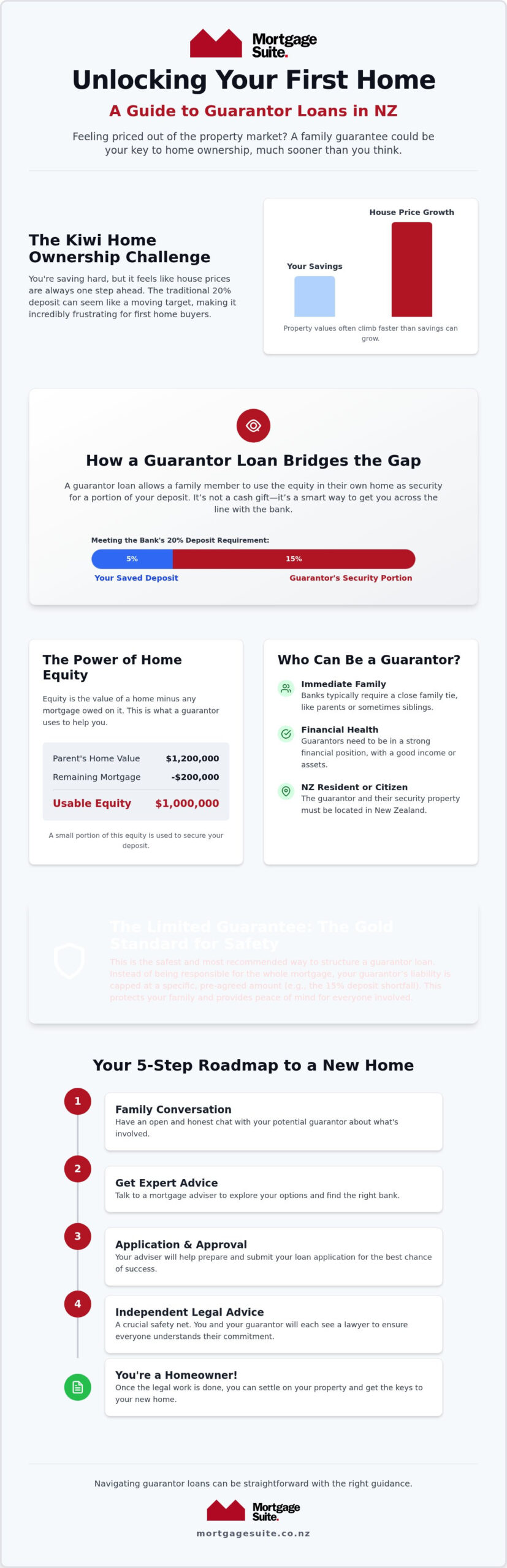
Yes, family members can certainly help by providing a gifted deposit to boost your equity. Most lenders will require a signed “gift letter” stating that the money doesn’t need to be paid back and that the family member has no claim on the property. This is a very common way for solo buyers to bridge the gap and reach that 20% equity mark sooner.

Article by

Krish Krishna

Experienced Financial Adviser with over 46 years of Banking and Mortgage broking experience and over $2.0 Billion in loan settlements.

Borrowing Power Calculator NZ: How Much Can You Really Afford in 2026?

What if the number you see on a standard borrowing power calculator nz is actually underselling your potential to buy a home? It is completely normal to feel a bit anxious about your mortgage prospects right now, especially with the Reserve Bank’s Debt-to-Income (DTI) rules and the rising cost of living making every dollar feel smaller. You might even worry that a “no” from a big bank means your home-ownership dreams are on ice for good.

I understand how frustrating it is to feel like you are doing everything right but still coming up short. That is why this guide is designed to help you discover how to accurately estimate your mortgage potential and the practical steps you can take to boost your borrowing limit before you submit an application. We will explore how to navigate the current 2026 lending landscape, including the impact of the OCR sitting at 2.50 per cent and why looking beyond mainstream lenders might be the key to your success. By the end, you will have a clear path toward finding a loan that actually fits your unique financial situation and goals.

Key Takeaways

  • Using a borrowing power calculator nz is the best way to set a realistic budget and avoid the heartbreak of falling in love with a home you cannot afford.
  • Lenders focus heavily on your “uncommitted income,” which is the amount of cash you have left over every month after all your bills and debts are paid.
  • A rejection from a mainstream bank does not mean your journey is over, as 2nd tier lenders often offer more flexible rules for different types of income.
  • You can often increase your loan limit by thousands of dollars just by closing unused credit cards and organising your spending three months before you apply.
  • While online tools provide a great starting point, a mortgage expert can often find extra borrowing potential through direct negotiation with lenders.

What is a Borrowing Power Calculator and Why Should You Use One?

A borrowing power calculator nz is essentially a digital health check for your finances. It takes a look at your income, your regular bills, and any debts you currently have to give you a rough idea of what a bank might be willing to lend you. Think of it as a helpful warm-up before you start the actual race of buying a home. Before you dive into the details, it helps to understand the basics of What is a mortgage and how these loans function as a long-term commitment. Using a tool like this early in the piece allows you to identify any spending habits that might look like red flags to a bank, such as high credit card limits or too many small “buy now, pay later” debts.

The main reason to use a calculator is to set a realistic budget for your property search. There is nothing more heartbreaking than falling in love with a beautiful home, only to find out later that your bank won’t even consider lending you that much. By getting an estimate first, you can narrow your search to houses you can actually afford. Fundamentally, your borrowing power is the balance between your gross income and your ability to service a loan comfortably. It is a measurement of how much breathing room you have in your budget after the mortgage is paid.

The Difference Between Borrowing Power and Affordability

It is vital to remember that there is a big difference between what a bank could give you and what you should take. Borrowing power is the maximum limit a lender sets based on their internal rules. Affordability, on the other hand, is about your daily life. Can you still afford a holiday, a new car, or even just the weekly grocery shop if you take that maximum loan? You should never aim for the absolute ceiling the calculator shows. Lenders also use interest rate “stress tests,” calculating your repayments at a much higher rate than the current market to ensure you can handle future changes without stress.

Why 2026 is a Unique Year for NZ Borrowers

This year has brought some specific challenges and opportunities for Kiwis. With the Official Cash Rate (OCR) sitting at 2.50 per cent as of July 2026, mortgage rates have shifted, directly impacting how much you can borrow. Before you start crunching numbers, take a look at the current Mortgage Rates NZ to see where the market stands. We are also seeing the full effect of Debt-to-Income (DTI) rules, which limit your total debt based on your yearly earnings. These changes mean the goalposts have shifted, making it more important than ever to have an accurate picture of your financial standing before you apply.

How the Math Works: The Key Factors Lenders Look At

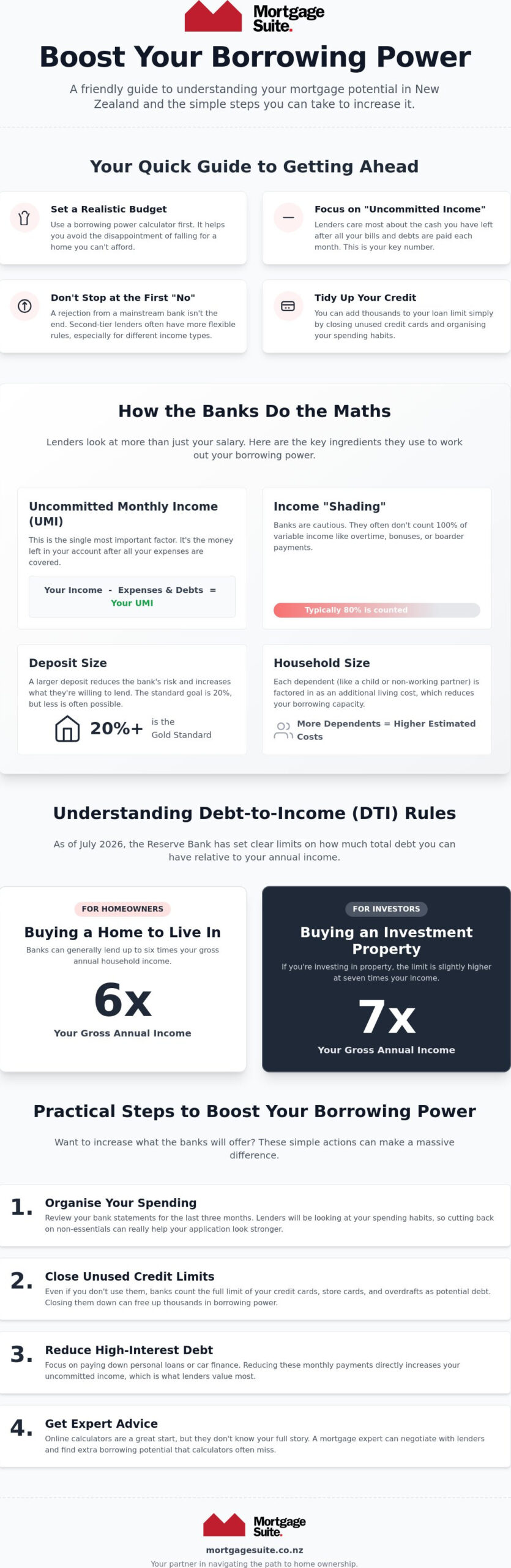
Lenders don’t just look at your total salary and call it a day. They are far more interested in what we call “uncommitted income.” This is the actual cash you have left over once every single bill, grocery shop, and debt repayment is settled. When you play around with a borrowing power calculator nz, it tries to mirror this logic, but banks add their own layers of caution. For example, lenders often “shade” certain types of income, such as boarder payments or overtime, by typically counting only 80 per cent of the total to stay on the safe side. This buffer protects the bank if your extra shifts dry up or a flatmate decides to move out unexpectedly.

Your deposit size is another heavy hitter in the calculation, especially for first-home buyers. While a 20 per cent deposit is the standard goal, banks can still lend to those with less, though they will usually add a “low equity margin” to your interest rate to cover the extra risk. You also need to account for your household size and your deposit-to-loan ratios. Each dependent, whether it is a child or a non-working adult, is seen as an additional cost. This naturally reduces the amount of money the bank believes you have available to pay back a loan each month.

Understanding Income-to-Debt Limits

As of July 2026, the Reserve Bank has set firm boundaries that every borrower needs to understand. For people buying a home to live in, banks generally limit new lending to six times your gross annual income. If you are a residential investor, that limit shifts to seven times your income. This means even a high salary won’t help you borrow more if you are already carrying significant debt from car loans or personal finance. To get a better feel for how these numbers fit into the wider home buying and selling process, it is worth checking out government resources that break down the practical steps of the journey. If you are finding that the standard tools aren’t giving you the full picture, a professional review of your numbers can often reveal options you might have missed.

The Impact of “Hidden” Expenses

Small habits can have a surprisingly large impact on your final loan offer. Lenders now look closely at buy now, pay later schemes, often treating your total available limit as an active debt, even if you don’t owe a cent at the moment. Your regular subscriptions, from Netflix to your local gym, also get added to your living cost declaration. Being accurate and honest about these costs is essential. If a bank spots a pattern of high spending that contradicts your application, it can lead to a quick decline. Taking the time to tidy up these small leaks in your budget three months before you apply can significantly boost your standing in the eyes of a lender.

Why Different Lenders Give You Different Numbers

It is a common source of frustration for many Kiwis. You sit down at night, open a borrowing power calculator nz on one bank’s website, and get a number that feels great. Then, you try another, and the limit drops by fifty thousand dollars. This happens because every lender in New Zealand has its own internal “risk appetite.” They don’t all use the same math to decide what you can afford. Some might be more generous with how they view your bonuses, while others might be much stricter about your childcare costs. Each bank has its own set of rules that act like a filter for your application.

Using a neutral tool like the Sorted mortgage calculator is a fantastic way to get a baseline. It gives you a clear, unbiased look at what your repayments might look like without the slant of a specific bank’s policy. However, even a great tool cannot tell you which lender is currently looking to grow its mortgage book by being more flexible with its criteria. A broker can compare multiple calculators at once to find the most generous offer, ensuring you don’t miss out on a property just because one bank’s “cookie-cutter” rules didn’t fit your life.

Mainstream Banks vs. Non-Bank Lenders

Mainstream banks are designed for regular salary earners. If you have been in your job for years and have a tidy 20 per cent deposit, they are usually your first port of call. But life isn’t always that tidy. If you are self-employed, working as a contractor, or trying to buy with a smaller deposit, you might find the big banks are quite quick to say no. This is when looking at a 2nd Tier Lender New Zealand becomes essential. These non-bank lenders often provide alternative paths for people with unique financial profiles. We focus on bridging this gap, using our 20 years of banking experience to find the options that a standard bank tool simply cannot see.

The Role of Credit Scores in Your Calculation

Your credit score is essentially your financial reputation. While a calculator asks for your income and expenses, it often doesn’t account for your credit history until you actually apply. A poor score can “lock” you out of certain tiers of lending, even if you earn a high salary. Some lenders will decline an application over a single minor credit hiccup from years ago; others are more pragmatic and will look at why it happened and how you have managed your money since. It is a smart move to check your credit report before you get too deep into the house-hunting process. Knowing your score allows us to target the right lenders from the start, saving you from unnecessary declines.

Borrowing Power Calculator NZ: How Much Can You Really Afford in 2026?

How to Boost Your Borrowing Power Before You Apply

The number you get from a borrowing power calculator nz is just the starting line. You actually have a lot of control over that final figure. To get the best result, you should start organising your finances at least three months before you plan to buy. Banks usually want to see your last 90 days of bank statements, so this is your window to show them you are a reliable borrower. If you can prove that you are disciplined with your cash, lenders are much more likely to trust you with a larger loan.

Presenting “clean” bank statements is one of the most effective things you can do. It requires a bit of planning, but it is a simple fix. Follow these steps to tidy up your records:

  • Cut back on the extras: You don’t need to live on bread and water, but reducing high-frequency spending like takeout or luxury subscriptions makes your living costs look much better on paper.
  • Avoid unarranged overdrafts: Even a small dip into the red can signal to a lender that you aren’t quite on top of your cash flow.
  • Clear your buy now, pay later services: Try to have all accounts for these services closed and cleared so they don’t appear as active credit limits.
  • Label your transfers: If you are moving money to savings, label it clearly so the bank sees it as a positive habit rather than a mystery expense.

Managing Your Income-to-Debt Ratio

Many Kiwis fall into the “credit card trap” without realising it. Even if you have a zero balance, a $10,000 credit card limit can slash your borrowing power by a massive amount. The bank assumes the worst. They calculate your ability to pay based on the possibility that you might max out that card tomorrow. Closing unused cards or lowering the limits is one of the fastest ways to see a jump in your potential loan amount. Often, focusing on increasing your deposit is more effective than trying to squeeze out a small pay rise, as it lowers the bank’s risk and improves your overall position.

Proving Your Income for Complex Situations

Self-employed Kiwis often struggle with standard applications because their income can look less predictable to a bank’s computer. You will generally need to show stability through at least two years of financial accounts, but we can help you present these in the best light. If you are a first-time buyer, you might also consider using rental income from a flatmate or boarder to tip the scales. This extra cash can be added to your ability to pay back the loan, which makes a significant difference to the final offer. For more specific tips on getting started, check out our Home Loans for First Home Buyers guide. If you want to know exactly how much these changes will help your specific case, you can request a professional review of your finances to see where you stand.

Moving Beyond the Tool: Why a Mortgage Broker is Essential

While a borrowing power calculator nz provides a useful snapshot, it is essentially a static tool. It cannot account for the fact that the lending market moves every single week. Banks change their internal policies, interest rates fluctuate, and new rules from the Reserve Bank can shift your potential loan limit overnight. This is where having a seasoned advocate like Krish Krishna makes the difference. With over 20 years of banking experience, we don’t just look at the numbers; we look at the story behind them. We know which lenders are currently open to negotiation and how to present your case to get exceptions that a computer program would simply ignore. Having a veteran industry expert on your side means you have someone who has seen every possible scenario and knows exactly how to navigate the hurdles.

Beyond just finding the maximum amount, we help you decide on the right structure for your loan. Choosing between fixed and floating rates is not just about the lowest number today. It is about your long-term goals and your comfort with risk. If you plan to pay off your debt quickly or if you need the stability of knowing exactly what your bills will be for the next few years, the right structure is vital. We act as your dedicated negotiator, bridging the gap between the rigid world of big banks and your personal needs as a borrower. This hands-on approach ensures that you aren’t just another file in a system, but a priority.

Personalised Strategy vs. Online Estimates

If an online tool gives you a “no,” it is not necessarily the end of the road. Online estimates are often based on the most conservative settings and “cookie-cutter” rules that don’t account for your unique situation. We take a different approach by tailoring your application to highlight your specific financial strengths, whether that is a solid career path or a history of disciplined saving. We also conduct a professional “stress test” of your budget. This gives you genuine peace of mind, knowing that you can comfortably afford your home even if life throws a curveball or interest rates rise in the future.

Your Next Steps to Home Ownership

Moving from an estimate to a real-world offer is a straightforward process when you have the right support. To get started, gather your last three months of bank statements and your most recent payslips. These documents tell the story of your financial health and are the first things any lender will want to see. Once you have those ready, reach out for a no-obligation chat. We can look at your real-world options and help you find a lender that fits your specific financial profile. Ready to see your true borrowing power? Contact Mortgage Suite today.

Take the Next Step Toward Your New Home

A borrowing power calculator nz is a fantastic first step, but it only tells part of the story. Your true potential depends on how you present your finances and which lender you choose to partner with. Whether you are a first-home buyer navigating the 2026 market or an investor looking for more flexible 2nd tier options, the right strategy can turn a “no” into a “yes.”

You don’t have to figure this out on your own. With over 20 years of banking and brokerage experience, we specialise in finding the “hidden” potential that standard tools often miss. We provide personalised advocacy for first-home buyers and expert guidance for those who don’t fit the standard bank criteria. If you are ready to move beyond estimates and get a real-world plan, book a free consultation with Krish to find your true borrowing power. Your home-ownership goals are within reach, and we are here to help you navigate every hurdle with confidence.

Frequently Asked Questions

How much can I borrow for a home loan in NZ?

You can generally borrow between five to six times your gross annual income, though this depends on your specific debts and expenses. A borrowing power calculator nz will give you a rough estimate, but lenders also apply “stress tests” using interest rates higher than the current market. These tests ensure you can still manage repayments if rates rise, which is why your final offer might be lower than your gross income suggests.

Does a student loan affect my borrowing power?

Yes, your student loan definitely has an impact because it reduces your take-home pay every fortnight. Lenders look at your “net” income to see what is left for mortgage repayments, so the 12 per cent deduction for student loan repayments lowers your servicing capacity. Clearing this debt before you apply can often boost the amount a bank is willing to lend you.

Can I use my KiwiSaver as part of my deposit calculation?

You certainly can use your KiwiSaver savings as part of your deposit, provided you have been a member for at least three years. This extra cash increases your total deposit, which improves your Loan-to-Value Ratio (LVR). A larger deposit often makes you a more attractive borrower to the banks and can sometimes help you avoid the extra costs associated with low-equity loans.

What is the current DTI limit for NZ mortgages in 2026?

As of July 2026, the Reserve Bank has set the Debt-to-Income (DTI) limit at six times your gross income for owner-occupiers. For residential investors, the limit is slightly higher at seven times your income. Banks are allowed to do a small amount of lending above these levels, but most applicants will need to stay within these boundaries to get their loan approved.

How do credit card limits affect my borrowing power?

Lenders look at the total credit limit on your cards, even if you never use them and the balance is zero. They assume you could spend that entire limit tomorrow, so they factor the potential repayments into your monthly costs. Closing down unused cards or reducing your limits to a couple of thousand dollars is a quick way to see your borrowing potential jump.

Can I still borrow if I am self-employed or have a “2nd tier” profile?

Absolutely, you can still borrow if you are self-employed or don’t fit the standard bank profile. While mainstream banks might be hesitant, 2nd tier lenders specialise in looking at the bigger picture for business owners and those with unique income types. We focus on finding these alternative paths to ensure you aren’t locked out of the market just because your paperwork looks a bit different.

How often should I re-run a borrowing power calculator?

It is a good idea to re-run a borrowing power calculator nz whenever your financial situation changes or interest rates shift. If you get a pay rise, pay off a car loan, or if the Reserve Bank changes the OCR, your borrowing limit will move. Keeping an eye on these numbers helps you stay realistic about which properties you should be looking at during your search.

Will a small deposit of 5% or 10% reduce how much I can borrow?

Having a smaller deposit of 5 or 10 per cent usually means you can borrow less than someone with a full 20 per cent deposit. This is because banks have strict “speed limits” on how many low-deposit loans they can give out. You will also likely face a “low equity margin,” which is an extra interest cost that reduces the total amount you can comfortably service.

Article by

Krish Krishna

Experienced Financial Adviser with over 46 years of Banking and Mortgage broking experience and over $2.0 Billion in loan settlements.

Mortgage Rates NZ: Your 2026 Guide to Understanding Home Loan Interest

What if the lowest interest rate you see on a billboard actually ends up costing you more over the life of your loan? It’s easy to get caught up in the race for the smallest number, but the truth is that mortgage rates nz are about strategy as much as they are about price. With the Official Cash Rate sitting at 2.25% as of mid-2026, you might feel like the window for a good deal is closing or that the big banks aren’t really listening to what you actually need.

We understand that the constant talk of debt-to-income ratios and shifting lending laws can feel like a lot of noise. You want a home loan that provides stability without the confusing financial talk that usually comes with it. This guide will show you how to navigate the 2026 market with confidence. You’ll learn the real difference between fixed and floating rates, how current regulations like debt-to-income limits impact your borrowing power, and why the right lender is the one who treats you like a partner rather than just another file. By the end, you’ll have a clear, simple path forward to secure your home and manage your wallet with ease.

Key Takeaways

  • Learn how mortgage rates nz are shaped by the wider economy and what that actually means for your monthly budget.
  • Understand the difference between locking in your repayments with a fixed rate or staying flexible with a floating option.
  • Discover how the Reserve Bank’s decisions on the Official Cash Rate directly influence the interest you pay on your home loan.
  • Explore why professional second-tier lenders might be the right fit if the big mainstream banks aren’t meeting your specific needs.
  • Gain the confidence to negotiate a better deal by getting your finances in order and using expert help to do the heavy lifting.

Understanding Mortgage Rates in NZ: The Basics for 2026

When you’re comparing mortgage rates nz, it’s helpful to view them simply as the fee you pay the bank to use their money to buy your property. You can think of it as the “cost of borrowing”. In 2026, these rates are influenced by a mix of local factors, such as the Reserve Bank’s inflation targets, and global economic shifts that change how much it costs New Zealand banks to get the funds they eventually lend to you.

While the headline number is often what grabs your attention, the best rate for your situation isn’t always the lowest one on the screen. The right deal is the one that aligns with your life goals. This might mean having the flexibility to make extra payments without being charged or choosing a structure that gives you peace of mind while you grow your family.

How Interest is Calculated on Your Home Loan

Understanding how your monthly payments are split can be quite eye-opening. Every time you make a repayment, part of it goes toward paying back the original amount you borrowed. The rest is the fee for using the bank’s money.

You can think of this fee like renting the bank’s cash. Just as you might pay rent to live in someone else’s house, you pay this fee to use their capital to buy your own home. It’s a straightforward exchange, but the numbers add up quickly over time.

Even a tiny change in your interest rate can have a massive impact on your long-term wealth. Saving just 0.5% on your rate might look small on paper today, but over a 30-year term, it could save you tens of thousands of dollars. That’s money that stays in your pocket for your retirement or your children’s education rather than going to the bank’s profits.

The Difference Between Carded and Special Rates

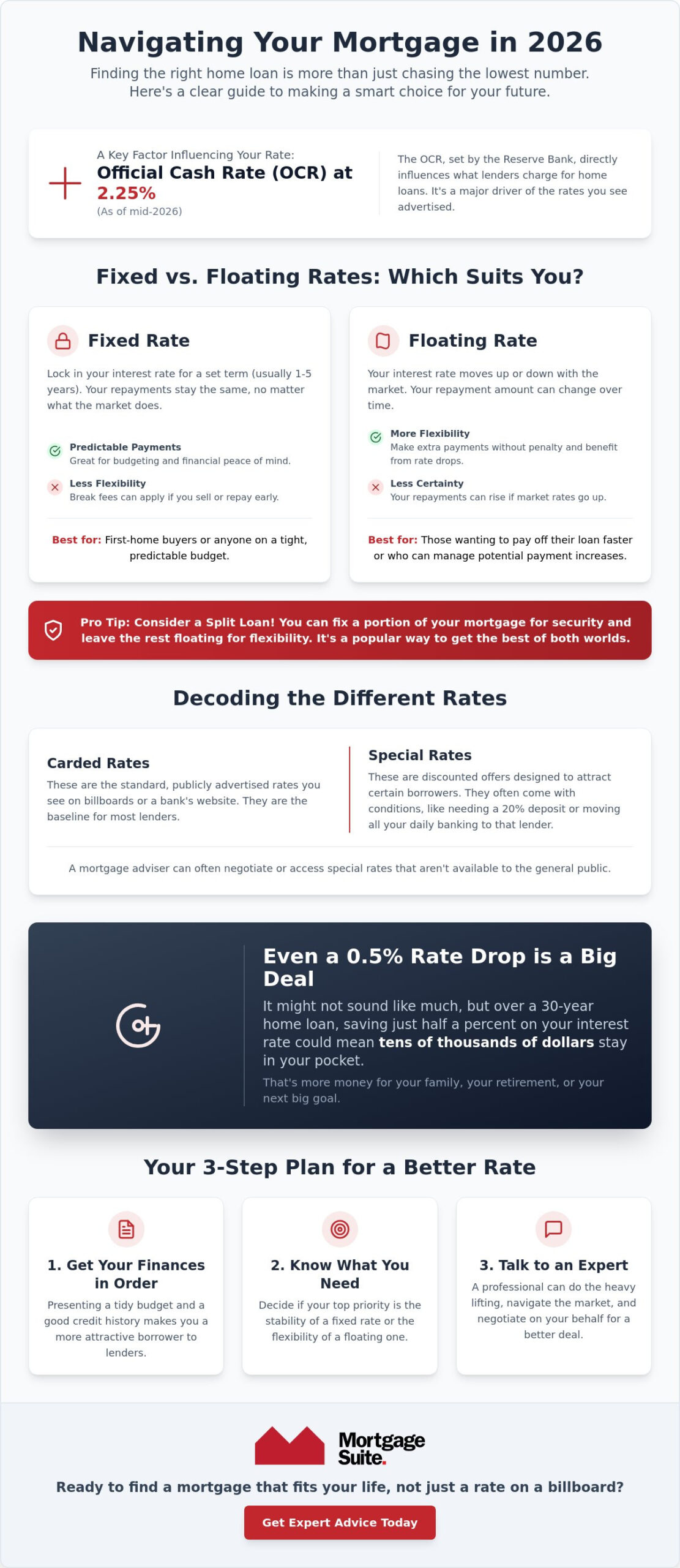
If you’ve been browsing bank websites recently, you’ve likely noticed two different sets of numbers. “Carded” rates are the standard, advertised prices that everyone sees on billboards or in the branch. They are the baseline starting point for most lenders.

On the other hand, “special” rates are the discounted offers banks use to attract specific types of borrowers. These lower rates usually come with strict conditions. For instance, you might need a 20% deposit or be required to move all your daily banking and credit cards to that specific provider.

This environment of strict lending rules and tiered pricing grew out of the historical New Zealand property bubble, which led to much tighter controls around how banks manage their risks. Because of these complexities, a professional can be a huge asset. They often have access to special rates that aren’t even listed publicly, using their industry relationships to negotiate a deal that fits your unique financial situation.

Fixed vs Floating Rates: Finding the Right Fit for Your Budget

Deciding between a fixed or floating rate is one of the most important choices you’ll make when looking at mortgage rates nz. It isn’t just about chasing the lowest number you see on a website. It’s about how you want to manage your household stress and your long-term financial goals. Many Kiwis choose a “split” loan structure, where they keep a small portion on a floating rate and lock the rest into a fixed term. This approach lets you hedge your bets, giving you the security of a set payment while still allowing you to pay off bits of your debt faster if you have some extra cash.

A fixed rate mortgage is a tool for financial peace of mind because it removes the guesswork from your monthly bank statement for a set period, usually between one and five years.

When to Choose a Fixed Rate

If you’re a first-home buyer or a family running on a tight budget, a fixed rate is often the most sensible path. When you lock in your rate, your repayments stay exactly the same regardless of what happens with the economy. This certainty is vital when you consider that housing costs are a major part of most people’s weekly outgoings. Data from the Housing in Aotearoa New Zealand: 2025 report shows that managing these costs is a top priority for most households, and a fixed rate helps you plan your future with confidence.

There are a couple of trade-offs to keep in mind. If mortgage rates nz happen to drop while you’re locked in, you won’t benefit from those lower interest costs. You also need to be aware that banks usually charge “break fees” if you decide to sell your house or pay off the loan before the fixed term ends. It’s a commitment to a specific path, so it’s best for those who value stability over total freedom.

The Flexibility of Floating Rates

Floating rates, which are sometimes called variable rates, move up and down as the market shifts. While these rates often start a bit higher than the best fixed deals, they offer a level of freedom that fixed terms simply can’t match. You can usually make extra payments or pay off the entire loan whenever you like without being hit with any penalties. This makes them a brilliant choice if you’re expecting a pay rise, a lump sum of money, or if you’re planning to sell the property soon. If you’re still weighing up which path is right for you, looking into different home loans with a professional can help you see which structure fits your life best.

Why NZ Mortgage Rates Move: The OCR and Economic Drivers

It can feel a bit mysterious when you see mortgage rates nz change overnight. One day they are steady, and the next, every major bank has updated their website with new numbers. These movements aren’t random. They are mostly driven by the Official Cash Rate (OCR), which you can think of as the “wholesale price” of money. Just like a shop buys goods at a wholesale price and adds a bit extra before selling them to you, banks buy money at the OCR and then add their own costs and profit margins to create your mortgage rate.

The Reserve Bank uses this tool to keep the New Zealand economy stable. If things are moving too fast and prices are rising too quickly, they might hike the rate to cool things down. If the economy needs a bit of a boost, they might lower it. It is a balancing act that affects every homeowner in the country.

How the Reserve Bank Influences Your Wallet

When the Official Cash Rate (OCR) goes up, it becomes more expensive for banks to borrow money. Naturally, they pass those costs on to you by raising their mortgage rates. What is interesting is that banks don’t always wait for an official announcement. They employ teams of experts who watch the economy closely. If they expect a rate hike is coming in a few months, they might start nudging their fixed rates up early to stay ahead of the curve.

These cycles of rising and falling rates are a normal part of the financial landscape. While the headlines can sometimes sound alarming, they are just part of a larger pattern. Having a seasoned professional in your corner helps you see through the noise. We can help you decide whether to lock in a rate now or wait for the next cycle to begin.

DTI and LVR: The Rules of the Game

Beyond the OCR, banks also look at your personal scorecard to decide what rate they can offer you. The first part of this is your Loan to Value Ratio (LVR). This is just a simple way of looking at how much you want to borrow compared to what the house is actually worth. Generally, if you have a larger deposit, you are seen as a lower risk, which often unlocks those special rates we mentioned earlier.

The second part is the Debt to Income (DTI) ratios. This is a check to see how much you earn versus how much total debt you will be carrying. DTI rules are designed to protect both you and the bank from future stress by ensuring you don’t take on more than you can realistically handle if life takes an unexpected turn. It is about making sure your home remains a sanctuary rather than a financial burden.

Mortgage Rates NZ: Your 2026 Guide to Understanding Home Loan Interest

Beyond the Big Banks: Exploring 2nd Tier Lending Rates

If you’ve ever walked into a major bank and felt like just another number on a spreadsheet, you’re not alone. Many New Zealanders assume that the big four banks are the only game in town, but there is a whole world of professional, reputable alternatives known as second-tier lenders. These providers often offer mortgage rates nz that look a bit different from the ones on the high street billboards. This isn’t because they are less secure; it’s simply because they have a different way of looking at risk and a different set of rules to follow than the mainstream institutions.

A broker is often the only way to access these “hidden” options. You can’t usually just walk into a branch for these lenders because they prefer to work through experts who can package your application correctly. They are particularly brilliant for people who don’t fit the standard bank mould, such as the self-employed, contractors, or those with non-standard income that the big banks find too difficult to process. These 2nd tier lenders provide a vital service that keeps the market competitive and inclusive.

Why Consider a Non-Bank Lender?

One of the biggest benefits of looking beyond the big banks is the human element. Mainstream lenders often use rigid computer algorithms to decide your fate. If you don’t tick every single box, your application is often declined without a second thought. Second-tier lenders tend to look at your whole story. They might see that while your income was lower last year due to a business startup, your current contracts are solid. They can act as a vital stepping stone. You might start with them to get into your house now, then move back to a mainstream bank in a few years once your financial history is more traditional. You can feel confident knowing they are still strictly regulated and safe to use.

Tailored Rates for Unique Situations

There are times when the absolute lowest interest rate isn’t the most important factor in your decision. If you’re involved in property development or complex investment scenarios, you need a lender who understands the nuances of the project. In these cases, having a loan that is approved quickly and offers flexible terms is worth far more than saving a tiny fraction on mortgage rates nz. Property investors in particular may also benefit from exploring a commercial property refinance NZ strategy to unlock equity and align their debt with current market conditions. If you’ve been declined by a bank, don’t lose heart. It’s often just a sign that you need a more tailored approach rather than a “no” to your home-buying dreams. We specialise in finding these solutions for our clients, so if you’re ready to see what’s possible, you can explore our home loan options today.

Securing the Best Mortgage Rate for Your Situation

Getting the best deal on your home loan involves more than just refreshing a webpage to see the latest numbers. To truly secure the most competitive mortgage rates nz, you need to present yourself to the bank as a low-risk, high-quality borrower. This starts with getting your “financial house in order” well before you fill out an application. Banks aren’t just looking at your income. They are looking at your habits, your debts, and how you handle the money you already have.

It’s also vital to look at the total cost of the loan rather than just the interest rate. Sometimes a bank might offer a slightly higher rate but include a generous cash-back offer or waive their application fees, which could leave you better off in the first few years. Taking a long-term view of your mortgage journey allows you to see these opportunities. Your mortgage isn’t a “set and forget” product; it’s a living part of your financial life that should be reviewed as your circumstances change. If your portfolio has grown over the years, it may also be worth considering whether a commercial property refinance NZ wide could help you restructure your debt and release equity for your next move.

Tips for a Successful Application

One of the most effective ways to boost your borrowing power is to reduce or close high-interest debts before you apply. Credit cards, store cards, and personal loans are often viewed unfavourably by bank systems because they represent a high committed monthly cost. Even if you don’t owe much on a credit card, the bank often assesses you based on the total limit available to you, not just the balance.

Showing a consistent savings history is another way to score a better deal. It proves to the lender that you have the discipline to live within your means. When you have a professional advocate like Krish in your corner, the bank often takes your application more seriously. We know how to highlight the strengths in your financial story, ensuring the person on the other end of the desk sees you as a partner they want to invest in.

How Mortgage Suite Helps You Win

At Mortgage Suite, we believe that the right loan is about far more than just a percentage point. It’s about finding a structure that gives you the freedom to live your life while you pay off your home. Krish Krishna brings over 20 years of deep banking experience to the table, acting as a “secret weapon” for our clients. Having spent two decades inside the system, Krish knows exactly how banks think, how they price their loans, and where there is room to move.

Our service focuses on negotiation and advocacy. We do the heavy lifting for you, talking to multiple lenders to find the one that fits your specific needs. Whether you are a first-home buyer or a seasoned investor, we ensure you aren’t just processed by a machine. We build a bridge between your personal goals and the rigid world of institutional banking. Ready to see what rates you could qualify for? Chat with us today!

Take Control of Your Financial Future Today

Navigating the landscape of mortgage rates nz in 2026 doesn’t have to be a source of stress. Whether you’re deciding between the certainty of a fixed term or the freedom of a floating rate, the most important thing is having a strategy that fits your life. You now know that the Official Cash Rate is just one piece of the puzzle and that there are excellent options available beyond the big banks if your situation is a bit unique.

At Mortgage Suite, we bring over 20 years of banking and lending expertise to ensure you find the right path. We have access to both mainstream banks and professional second-tier lenders, providing specialised support for everyone from first-home buyers to seasoned investors. You don’t have to do the heavy lifting alone. We’re here to act as your advocate and negotiator to get the deal done. Talk to Mortgage Suite about finding the right rate for your home loan. We look forward to helping you move into your next home with total confidence.

Frequently Asked Questions

How often do mortgage rates change in New Zealand?

Mortgage rates in New Zealand can technically change every single day, although major shifts usually happen in cycles. Banks typically adjust their pricing following the Reserve Bank’s eight scheduled reviews of the economy each year. They also watch international money markets closely, so you might see rates move even when there hasn’t been an official local announcement. It’s a fast-moving environment that requires regular check-ins.

Is it better to fix my mortgage for 1 year or 5 years in 2026?

Choosing between a one-year or five-year fix depends on your need for certainty versus your desire for flexibility. In 2026, many borrowers prefer shorter terms like one or two years to see if the market cools further. A five-year fix provides absolute peace of mind for your household budget, but you might find yourself locked into a higher rate if the general market drops significantly during that time.

What is a “cash-back” offer and is it worth taking a higher rate for it?

A cash-back offer is a lump sum of money the bank gives you when your loan settles, which is often used to cover legal fees or moving costs. Whether it’s worth a slightly higher rate depends on the maths. You need to calculate if the extra interest you’ll pay over the fixed term is more than the cash you receive upfront. Often, the upfront cash is a massive help for first-home buyers.

Can I negotiate my mortgage rate directly with the bank?

You can try to negotiate with your bank, but they often reserve their best deals for those who have professional representation. Banks know that brokers have access to the pricing of all their competitors, which creates a much stronger negotiating position. Having an expert handle these conversations usually results in a better outcome than trying to manage the back-and-forth on your own while you’re busy with life.

What happens to my rate if the OCR goes down?

If the Official Cash Rate goes down, you’ll usually see an immediate drop in floating mortgage rates nz. However, if you are currently on a fixed-rate term, your repayments won’t change until that term ends. This is why some people choose to keep a portion of their loan on a floating rate. It allows them to benefit from these downward shifts in the economy as soon as they happen.

Why are 2nd tier lender rates sometimes higher than bank rates?

Second-tier lenders often charge slightly more because they are willing to take on different types of risk that mainstream banks won’t touch. They might help someone who is self-employed or has a unique income structure that doesn’t fit a standard bank algorithm. The slightly higher rate reflects the extra work and flexibility they provide to get your loan approved when a big bank has already said no.

Do I need a 20% deposit to get the best interest rates?

Generally, you do need a 20% deposit to unlock the “special” advertised rates you see on billboards. Borrowers with smaller deposits are often charged a low equity margin, which is an extra fee or a higher interest rate to cover the bank’s risk. However, there are specific schemes available in 2026 for first-home buyers that allow for a 5% deposit while still keeping your overall costs manageable.

How much does a mortgage broker charge to find me a rate?

For most standard residential home loans, a mortgage broker doesn’t charge you a fee for their service. Instead, they are paid a commission by the lender once your loan is settled. This means you get professional advice, expert negotiation, and access to a wide range of mortgage rates nz without having to pay anything out of your own pocket for the consultation and application process.

Article by

Krish Krishna

Experienced Financial Adviser with over 46 years of Banking and Mortgage broking experience and over $2.0 Billion in loan settlements.

Non-Conforming Home Loans in New Zealand: A 2026 Guide for When the Bank Says No

What if a “no” from your bank wasn’t a dead end, but actually a signpost pointing you toward a more tailored way to buy your home? It’s incredibly disheartening to feel like you’ve failed just because you don’t fit a specific box, especially when you’ve worked hard to build a successful business or establish yourself as a contractor. You’re certainly not alone in feeling frustrated by complex lending rules that seem designed to keep you out of the market. The reality is that mainstream banks often overlook capable borrowers, which is why non-conforming home loans New Zealand have become such a vital tool for Kiwis in 2026.

In this guide, you’ll discover how these flexible loans provide a legitimate pathway to homeownership for those with non-standard income or unique financial backgrounds. We’ll show you how to move past the stress of rejection and build a clear plan to secure a property now, with a view to refinancing later as your situation evolves. You will gain the confidence to stop waiting on the sidelines and start your journey toward owning your own home today.

Key Takeaways

  • Understand that “non-conforming” simply means your situation doesn’t fit a standard bank’s checklist, and these loans are fully regulated and safe options.
  • See how non-conforming home loans New Zealand provide a vital path forward for self-employed Kiwis or those with minor credit issues.
  • Learn how to use a “bridge strategy” to buy your home now and plan for a move back to a mainstream lender in a few years.
  • Get the facts on interest rates and fees so you can weigh the cost of the loan against the long-term benefit of getting onto the property ladder.
  • Discover how working with a specialist gives you access to lenders who don’t work directly with the public, opening doors that often seem closed.

What exactly is a non-conforming home loan in New Zealand?

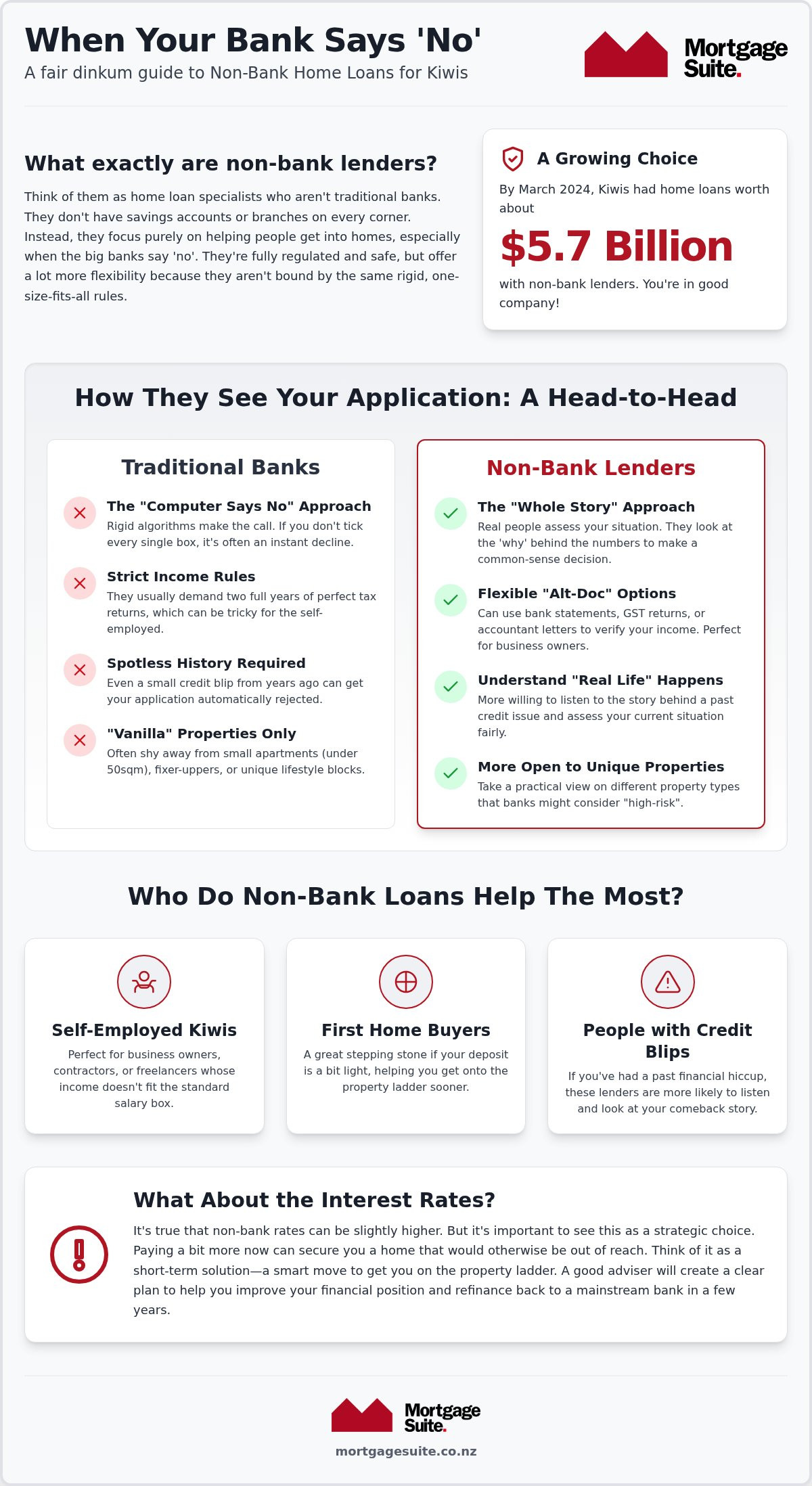
Think of the major banks like a high-end tailor who only makes one size of suit. If you happen to be a bit taller or broader than their standard template, you’re out of luck. Mainstream lenders like ANZ or ASB have very rigid checklists. If you miss a single tick, even for something small, they often can’t help you. This is why non-conforming home loans New Zealand have become a vital alternative for many Kiwis whose lives don’t fit a standard spreadsheet.

Essentially, “non-conforming” is just a term for a mortgage that sits outside the traditional lending rules. If you are asking, What is a non-conforming loan?, it’s a financial tool designed for people who are actually great borrowers but have non-standard circumstances. In 2026, the “big four” banks have tightened their belts even further. With debt-to-income ratios capped at 6 and a more cautious approach to self-employed income, more people are finding themselves looking for these alternative options.

It’s important to understand that these aren’t “shadowy” or unregulated products. They are perfectly legal and must comply with the Credit Contracts and Consumer Finance Act (CCCFA). You get the same level of legal protection as you would with any other mortgage. The main difference is that these lenders are willing to look at your whole story, not just the last three months of your bank statements.

The difference between “Non-Bank” and “Non-Conforming”

Many people use these terms interchangeably, but they mean different things. A “non-bank” is the type of institution, it’s a lender that isn’t a traditional registered bank. “Non-conforming” describes the type of loan criteria being used. Non-conforming loans are flexible financial solutions designed for people whose income or credit history doesn’t match the rigid templates used by traditional banks. You might even find that a non-bank lender is the best fit even if you have a perfect credit score, simply because they can be more creative with how they structure your debt.

Who are the 2nd tier lenders in NZ?

In the New Zealand market, 2nd tier lender New Zealand options include building societies, credit unions, and specialist finance companies. They are often funded by wholesale investment markets rather than customer deposits, which gives them the freedom to be more flexible with their approvals. While they have more room to say “yes,” they are still committed to responsible lending. They want to ensure you can comfortably manage your repayments, making non-conforming home loans New Zealand a safe and strategic way to enter the property market when the big banks won’t budge.

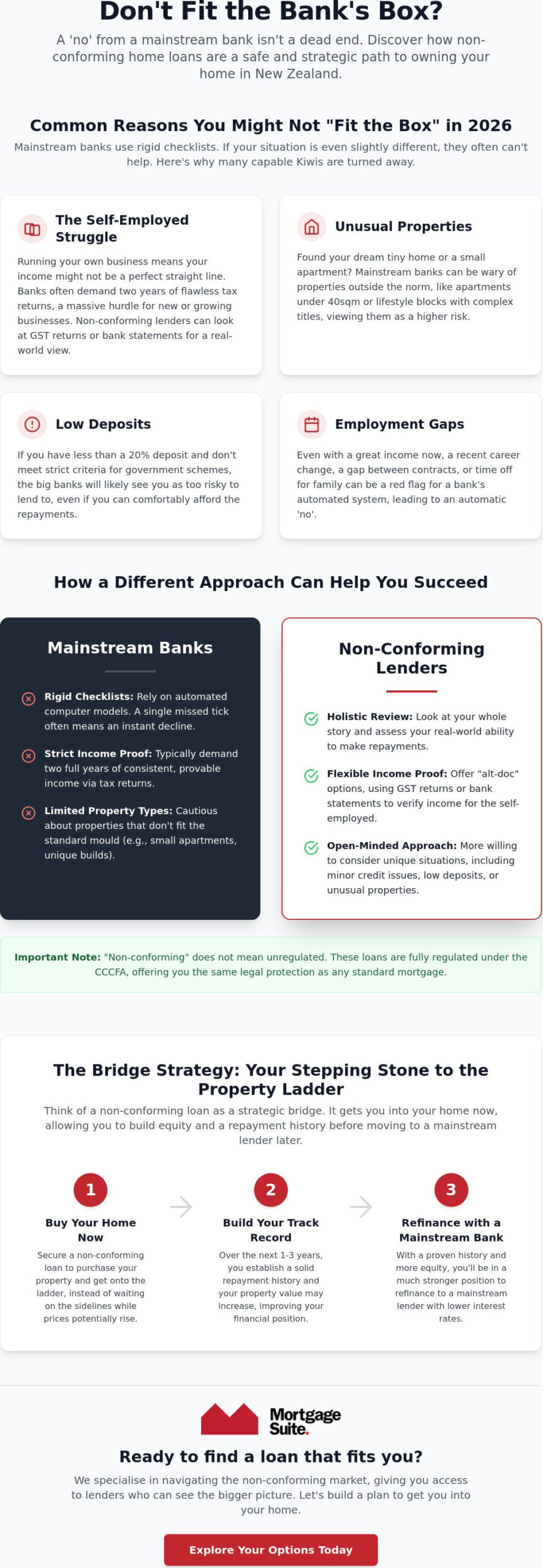
Common reasons you might not “fit the box” in 2026

It feels personal when a bank says no. You’ve worked hard, saved your deposit, and found a place you love, only to be told you don’t meet a specific requirement. Often, a rejection isn’t about your ability to pay back a loan. It’s usually because your life doesn’t align with the rigid computer models the big banks use. Since the introduction of tighter lending rules, many Kiwis have been declined for things as small as their personal spending habits or the type of house they want to buy. This is where non-conforming home loans New Zealand provide a much-needed alternative.

There are several common reasons why a mainstream bank might turn you away in 2026:

  • Unusual Properties: Banks are often wary of tiny homes, apartments smaller than 40sqm, or lifestyle blocks with complex titles.
  • Low Deposits: If you have less than a 20% deposit and don’t qualify for specific government grants, the “big four” might see you as too high a risk.
  • Employment Gaps: Even if you’re earning well now, a recent career change or a few months between jobs can trigger a “no” from traditional lenders.

The self-employed struggle

If you run your own business, you know that profit isn’t always a straight line. Banks usually demand two full years of perfect tax returns to prove your income. This requirement is a massive hurdle for new business owners or those who have recently scaled up. Many 2nd tier lenders offer “alt-doc” options instead. This means they can look at your GST returns or recent bank statements to get a real-world picture of what you can afford. If you’re a contractor or freelancer, your income is valid, and we can help you find a lender who understands your business model.

Credit history: It’s not always a deal-breaker

A forgotten power bill from three years ago or a past default shouldn’t end your home-buying dreams forever. Mainstream banks tend to see any credit “blip” as a major red flag. In contrast, 2nd tier lenders are often willing to listen to the story behind the numbers. They look at why a default happened and what you’ve done since then to stay on track. Many non-conforming home loans New Zealand are actually designed to help you repair your credit over time, acting as a bridge until you’re ready to switch back to a standard bank. It’s about looking at your future potential, not just your past mistakes.

Mainstream Banks vs. Non-Conforming Lenders: A fair comparison

When you compare mainstream banks to alternative lenders, it’s a bit like comparing a mass-market retail chain to a specialist consultant. The big banks have the lowest rates, but they also have the least flexibility. If you don’t fit their specific mould, the low rate doesn’t actually help you because you can’t get the loan. This is where non-conforming home loans New Zealand come into play. They fill the gap for people who have the income and the drive to own a home but fall outside the standard banking criteria.

Let’s look at the numbers. In June 2026, mainstream bank fixed rates are sitting around 4.65% to 4.79%. In contrast, rates for non-conforming home loans New Zealand are higher because they are risk-based. You should also expect establishment fees to be more significant than what you’d find at a big bank. While the upfront cost is higher, the value lies in getting an approval when everyone else has said no. These lenders look at the common sense of a deal rather than just following a rigid computer algorithm.

Speed is another area where alternative lenders often shine. When you’re trying to secure a property at auction, you don’t have weeks to wait for a bank’s head office to review your file. Because 2nd tier lenders have shorter chains of command, they can often provide a firm answer in a fraction of the time. This agility allows you to bid with confidence, knowing your finance is already sorted and you won’t miss out on the right property.

Understanding the “Risk Premium”

Lenders charge a higher rate because they are taking a chance on a borrower that a big bank won’t touch. We call this a risk premium. While the interest is higher, it’s often a better financial move than waiting three years to save a larger deposit. If house prices rise during that time, the cost of waiting can easily exceed the extra interest you’d pay now. Many of these loans also allow you to step down to a lower rate once you’ve proven your reliability over a year or two.

Flexibility in lending criteria

Alternative lenders look at your situation with a human eye. For instance, they might be more generous with their Loan-to-Value Ratio (LVR), allowing you to borrow more against the property’s value than a traditional bank would. They also look at your income differently, often counting more of your overtime, commissions, or bonuses. You can learn more about these differences in our non-bank lenders NZ guide. If you have a smaller deposit, you might also want to check if you qualify for the First Home Loan scheme, which helps people who don’t fit the standard 20% deposit box.

Non-Conforming Home Loans in New Zealand: A 2026 Guide for When the Bank Says No

The Bridge Strategy: Using a non-conforming loan as a stepping stone

Too many people view these mortgages as a final destination or a “last resort.” In reality, they are a powerful tool to get you across the gap between where you are now and where the bank wants you to be. This is what we call the Bridge Strategy. It’s a deliberate 2-to-3-year plan designed to get you into the property market today, rather than sitting on the sidelines for years while house prices potentially climb. By choosing non-conforming home loans New Zealand, you aren’t just getting a mortgage; you’re buying time to fix the very things that caused the bank to say no in the first place.

While you are on this bridge, your home is hopefully growing in value. Every repayment you make reduces your debt, and every month that passes helps “clean up” your financial profile. This is the time to perfect your tax returns if you’re self-employed or ensure your credit history is spotless. The goal is simple: stay with an alternative lender for a few years, build your equity, and then refinance back to a mainstream bank for those lower rates once you finally “conform” to their rules.

Step 1: Get in the door

The biggest mistake many Kiwis make is waiting for the “perfect” time to buy. They wait for interest rates to drop or for their deposit to hit exactly 20%. History shows us that time in the market almost always beats timing the market in New Zealand. By securing the property you want today, you start building equity immediately. A non-conforming loan is often a temporary solution to a long-term goal, giving you the leverage to act when the right house appears.

Step 2: Prove your reliability

Once you have the keys, the real work begins. This stage is all about demonstrating to future lenders that you are a low-risk borrower. You need to make every single repayment on time, without exception. This builds a “bank-ready” history that is far more convincing than any spreadsheet or letter of explanation. If you’re just starting out, our guide on home loans for first home buyers New Zealand can help you map out these early steps. We keep a close eye on your progress and can tell you exactly when your profile is strong enough to make the move back to a mainstream lender. If you’re ready to start building your own bridge, talk to our team about your options today.

How Mortgage Suite navigates the non-conforming market for you

Getting a “no” from a bank can feel like a personal rejection, but at Mortgage Suite Ltd, we see it as the start of a more tailored conversation. With Krish Krishna’s 20 plus years of banking experience, we know exactly how the “other side” thinks. We understand the hidden levers that mainstream lenders pull and, more importantly, we know how to present your case to the lenders who are actually willing to listen. Securing non-conforming home loans New Zealand requires more than just filling out a form; it requires a dedicated advocate who can translate your financial life into a compelling story.

We have established deep relationships with 2nd tier lender New Zealand options that simply don’t deal directly with the public. These institutions rely on trusted brokers to bring them quality borrowers who just happen to have non-standard situations. Because we’ve spent decades in the industry, our reputation carries weight. When we tell a lender that a client is reliable despite a past credit blip or a complex business structure, they listen. We handle all the paperwork and the tough conversations, removing the stress so you can focus on moving into your new home.

Tailored solutions, not “cookie-cutter” loans

Every person who walks through our door has a unique story. We don’t believe in one-size-fits-all mortgages. We take the time to sit down and truly listen to your situation before we even think about suggesting a lender. This personal connection is what sets us apart from the automated systems at the big banks. By specialising in loans that don’t fit the standard box, we can identify opportunities that others might miss. Whether you’re a new business owner or a contractor, we ensure your non-conforming home loans New Zealand are as unique as your circumstances.

Your partner for the long haul

Our job doesn’t end when you get your home loan. We are your partners for the entire journey. As we discussed earlier regarding the exit strategy, the goal is often to move back to a mainstream bank eventually. Mortgage Suite Ltd stays in touch and helps you plan that transition, ensuring you’re always on the best possible path. You’ll get friendly, jargon-free advice that treats you like a priority, not just another number in a database. Ready for a fair go? Get in touch with Mortgage Suite Ltd today.

Take the next step toward your new home

A bank rejection doesn’t have to be the end of your property dreams. As we’ve explored, non-conforming home loans New Zealand serve as a strategic bridge, allowing you to secure a property now while you work toward a mainstream mortgage. By focusing on building equity and proving your reliability, you can turn a temporary setback into a long-term win.

At Mortgage Suite Ltd, our team brings over 20 years of banking and brokerage experience to your corner. We specialise in alternative lending and act as your dedicated advocate, ensuring your story is heard by lenders who value common sense over rigid checklists. We don’t just process applications; we build partnerships focused on your success.

Book a conversational chat with Krish to explore your options and see how we can help you move forward with confidence. You deserve a fair go at owning your own home, and we’re here to help you make it happen.

Frequently Asked Questions

Are non-conforming home loans safe in New Zealand?

Yes, these loans are perfectly safe and must comply with the Credit Contracts and Consumer Finance Act (CCCFA) just like any big bank mortgage. This means you have the same legal protections and rights as any other borrower in New Zealand. These lenders are professional financial institutions that are simply more flexible with their rules than the household names you see on the high street.

How much higher are the interest rates for non-conforming loans?

Rates are typically higher than mainstream bank offers because the lender is taking on a situation that the big banks won’t touch. While a major bank might offer a rate under 5% in 2026, alternative lenders often range between 10% and 14.5% depending on your specific profile and risk level. It’s best to view this extra cost as a temporary fee for getting into the property market now rather than waiting years.

Can I get a non-conforming loan if I am self-employed with only one year of accounts?

Yes, you can often secure a loan with just one year of accounts by using alternative documentation like bank statements or GST returns. Mainstream banks usually demand two full years of perfect tax returns, but 2nd tier lenders specialise in helping new business owners who are already turning a good profit. This flexibility allows you to buy your home now rather than waiting for another financial year to pass.

What is the minimum deposit for a non-conforming home loan?

Most alternative lenders look for a deposit of at least 20%, though some may consider 10% depending on the property type and your overall income. Because these lenders aren’t always bound by the same strict speed limits as the big banks, they have more room to move on deposit requirements. We can look at your specific savings and income to see which lender’s rules fit your current situation.

How long does it take to get approval for a 2nd tier loan?

Approval for 2nd tier loans is often much faster than the big banks, sometimes taking only two to three working days once all your paperwork is submitted. These lenders have smaller teams and less red tape, which makes them an excellent option if you need to move quickly for an auction or a short settlement. Having your bank statements and ID ready to go is the best way to speed up the process even further.

Can I move back to a big bank later if I start with a non-conforming loan?

Yes, moving back to a mainstream bank is the ultimate goal for most people who start with non-conforming home loans New Zealand. Once you have built up some equity and established a clean repayment history over two or three years, your profile becomes much more attractive to traditional lenders. We specialise in helping you plan this transition so you can eventually secure those lower mainstream rates when you are ready.

What happens if I have a default on my credit record?

A credit default isn’t an automatic “no” with alternative lenders, as they are more interested in the story behind the issue than just the score itself. They will want to see that the debt has been settled and that you’ve been reliable with your other payments since that time. We help you explain these past blips to the lender so they can see your current financial strength and future potential.

Do I need a mortgage broker to access non-conforming lenders?

Yes, many 2nd tier and specialist lenders in New Zealand do not deal directly with the general public and only accept applications through accredited mortgage brokers. Working with a broker also ensures your application is presented in the best possible light to the right people. We know which lenders are currently active and which ones are most likely to say “yes” to your specific needs and financial background.

Article by

Krish Krishna

Experienced Financial Adviser with over 46 years of Banking and Mortgage broking experience and over $2.0 Billion in loan settlements.