

NZ Property Development Loan Requirements 2026

A lender’s decision on a development project depends on more than the land or your borrowing history. Lenders may also assess whether the plan can be delivered, whether the numbers make sense and how the loan will be repaid. That can make property development loan requirements nz feel unclear, especially if you’re unsure which documents to prepare or how your experience and project structure will be assessed.

It’s reasonable to want a clear picture before you apply. This guide explains the main areas lenders may assess and the project information that can support an application, including plans, budgets, building contracts and funding stages. You’ll also learn how project progress can affect the drawdown process and what options may be available if a mainstream bank’s criteria don’t fit. Mortgage Suite provides property development finance and helps organise project information and negotiate with lenders. Founder Krish Krishna brings more than two decades of banking experience to these discussions. A bank decline isn’t always the end of the conversation. Understanding what may suit your project is a practical next step.

Key Takeaways

  • Property development loan requirements nz can vary according to the lender, project type, stage and funding structure.
  • Lenders may consider your experience, finances, project feasibility, security and plan for repaying the loan.
  • Grouping supporting documents into clear categories can help you prepare a more organised application.
  • Review your project assumptions, timeline and repayment plan so you’re ready to discuss delays or changes.
  • A finance adviser can help present your project to lenders and explore suitable funding pathways if a mainstream bank isn’t the right fit.

Property development loan requirements in NZ: what lenders look at first

In brief: Lenders usually consider the borrower, project, available security and proposed repayment plan together. The property development loan requirements nz applicants face can vary with the lender, project type, development stage and funding structure. There isn’t one document or criterion that applies to every application.

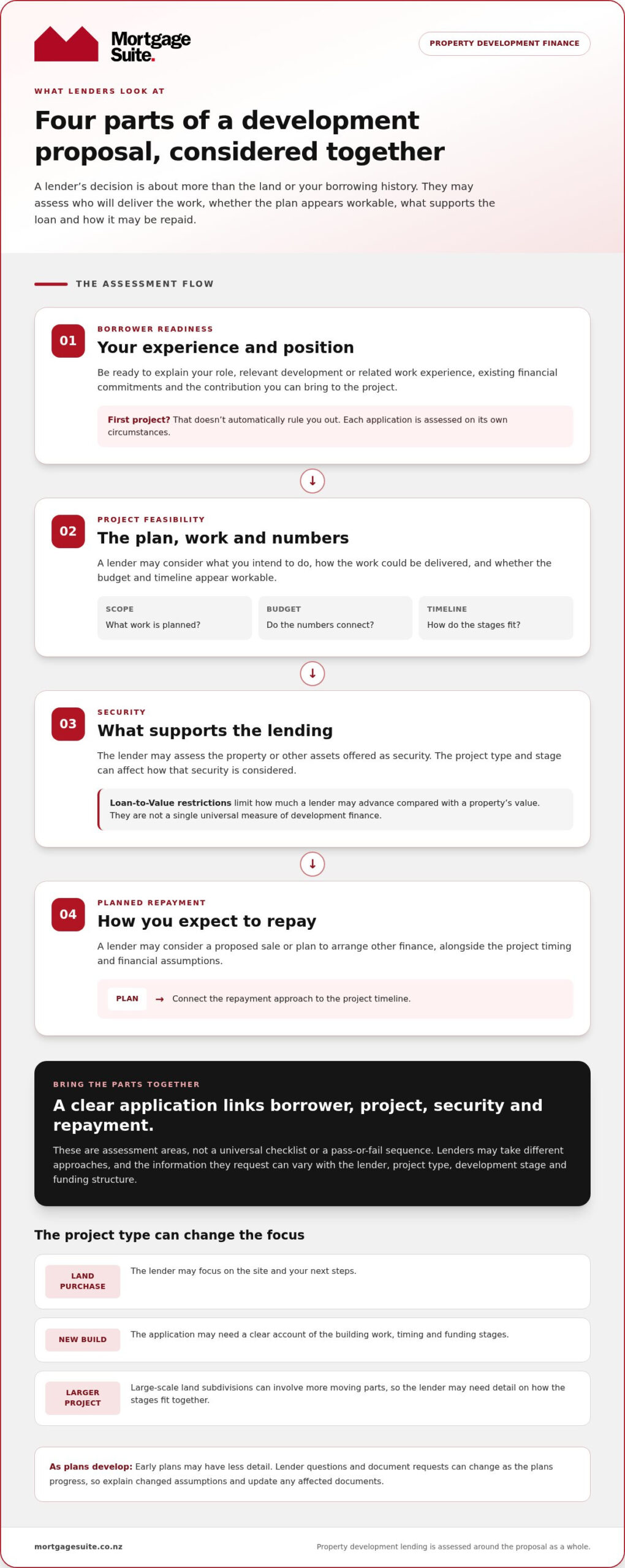
A lender is assessing the project’s risks as a whole: who will deliver it, whether the plan appears workable, what property supports the borrowing and how you intend to repay the loan. A clear application connects these elements and explains how the project is expected to progress.

What does a property development lender assess?

Four broad areas help a lender build a picture of your proposal:

  • Your experience and position: Your background may help explain your ability to manage the work. A lender may also consider your financial position and existing commitments.
  • The project plan: The lender needs to understand what you intend to do, how the work may be delivered and whether the project appears financially workable. Development can involve connected stages, from acquiring land through to construction, as outlined in this real estate development process.
  • Security: The property or other assets offered as security help the lender assess what supports the loan. The project type and stage may affect how that security is considered.
  • Repayment plan: The lender will want to understand how you propose to repay the borrowing, such as through planned sales or by arranging other finance. The plan should fit the project timeline.

These are assessment areas, not a universal checklist. The evidence a lender requests depends on the application. Organising your information around these points can help you explain the proposal clearly.

Why development loan requirements differ between projects

A request to fund a land purchase may focus on the site and your next steps. A new build may need a clear account of the building work, timing and funding stages. A larger project, such as large-scale land subdivisions, can involve more moving parts, so a lender may need detail on how the stages fit together.

Project stage matters too. Early plans may have less detail than a project that’s further along. Lender questions and document requests can change as the plans develop, and lenders may take different approaches. The phrase property development loans in NZ covers a range of funding situations rather than one standard application. Start by organising information around your specific project and what is known at its current stage.

How lenders assess your experience, finances and project plan

A lender looks at how your background and finances fit the project, not just whether the land appears suitable. Property development loan requirements nz can differ between lenders, so use these assessment areas as guideposts rather than a pass-or-fail checklist.

Borrower readiness: What experience, financial commitments and contribution do you bring? Relevant development experience can show how you’ve handled similar work and help a lender understand your role in delivering the project. If this is your first project, that doesn’t automatically rule you out. Each application is assessed on its own circumstances.

Project feasibility: Does the plan appear workable? A clear description of the work, budget and timeline helps explain what you intend to do, how the stages connect and what could affect delivery.

Security: What property or other assets are being offered to support the lending? Owning suitable land may form part of the picture, but it doesn’t guarantee finance. The lender also considers the borrower, proposed work and repayment plan.

Planned repayment: How do you expect to repay the loan? A lender may consider your proposed sale or refinancing plan alongside the project timing and financial assumptions.

How your background and financial position may be considered

Be ready to explain your role in the project and any relevant experience, whether from previous developments or related work. Lenders may also consider your existing commitments and the contribution you can bring to the project. Together, these details give a fuller picture of your borrowing position.

How a lender may review project feasibility and security

A joined-up plan makes it easier to see how the budget, timeline and intended work relate to each other. If an assumption changes, explain why and update any documents it affects. For general property-sector context, Property Council New Zealand shares information about the industry, while lender decisions depend on the individual proposal.

Loan-to-Value restrictions are limits on how much a lender may advance compared with a property’s value. They aren’t a single universal measure of development finance. The lender, project and funding structure can all affect how security is assessed. Mortgage Suite helps organise these parts into a clear application and discuss how to present your circumstances. You can also learn about Mortgage Suite’s approach to supporting borrowers through lending decisions.

Which documents can support a property development loan application?

A well-organised application connects your circumstances with the project plan. For property development loan requirements nz, requested documents vary by lender, project type and stage. Use this preparation checklist as a starting point, then tailor it to the information available for your project. Some items may not apply, and a lender may request other evidence.

Borrower and project information to organise

  • Borrower: Identification, details of your financial position and existing commitments, and information about the project’s ownership structure.
  • Experience: A summary of relevant project history, including your role and examples of completed work, if applicable. This helps explain who will manage delivery.
  • Land or property: Information about the site, its ownership and any existing lending secured against it. A valuation or other property report may also be requested.
  • Project: A short project summary, development plans, timeline, budget and proposed funding schedule. Make clear what work is planned and when funding may be needed.
  • Repayment plan: An outline of how you expect to repay the borrowing, supported by relevant sale plans or proposed arrangements for refinancing, where applicable.

Planning, building and technical documents

Depending on the project, supporting material may include council information, consent documents, architectural or engineering plans, building reports, contractor details and building contracts. For construction, show the costs and timing for siteworks separately from base construction where that distinction helps explain the budget. A staged funding schedule can also show how these items relate to the drawdown process, the release of funds as agreed milestones are completed.

Council requirements and available evidence can differ by project and current council processes. The NZ Government Building Process guide offers information about building a home, including consents and building stages. Documents relevant to a subdivision may differ from those for a single new build.

Check that figures and dates match across your plans, contractor quotes, reports and funding schedule. If a quote changes, update the budget and timeline, or clearly explain the difference. Consistent information gives the lender a clearer view of the proposal and makes questions easier to answer. For more plain-English guidance, explore Mortgage Suite’s Mortgage School lending guides.
NZ Property Development Loan Requirements 2026

How to prepare for lender questions about risk and repayment

Lenders may ask what could change during the project and how you’d respond. Clear answers won’t guarantee approval, but they can show how your budget, timeline and repayment plan fit together.

  • 1. Review your assumptions. Check that your budget reflects the planned work, including expected changes in scope. Note what each estimate is based on and which figures are still provisional.
  • 2. Test the timeline. Set out the main project stages and consider what a delay at each point could mean for later work, funding needs or a planned sale. Record key dates and dependencies rather than relying only on a best-case schedule.
  • 3. Organise your evidence. Keep plans, quotes, reports and funding schedules together, and make sure the figures and dates agree. If an assumption changes, update related documents or explain the difference.
  • 4. Explain repayment. Describe how you expect to repay or restructure the lending and how that plan connects with project progress. Be ready to explain what could affect the timing.

How to present a clear project budget and timeline

Show how the budget lines up with project milestones and when funds may be needed. For example, if site preparation comes before building work, show those stages separately where that helps explain the funding schedule. Flag important assumptions, such as the timing of work, and explain how a change could affect the budget or completion date.

A quantity surveyor report may be useful for some projects, particularly where a lender needs more detail to understand building costs. It isn’t a universal requirement. The aim is to give a consistent, realistic picture of the work, not to suggest that every uncertainty has been removed.

How to explain the repayment or exit plan

An exit plan is how you expect to repay the development loan or restructure the lending. Depending on the project, this could involve selling completed property or arranging a Refinance. Explain the steps behind your proposal, the timing you’re working towards and the evidence that supports it. A lender may consider whether the plan fits the project’s progress, rather than treating a proposed sale or refinance as certain.

If your assumptions or timeline change, update your repayment plan too. Mortgage Suite helps organise project information and present your proposal to lenders. For general borrowing context, you can use the mortgage calculator, but remember that a calculator can’t assess a development project or predict a lender’s decision.

Getting development finance sorted with a clear application plan

Development finance can feel like a lot to pull together, especially when the project is still taking shape. A clear application plan helps you explain what you’re building, what’s already in place and how you expect to repay the borrowing. Property development loan requirements nz vary, so focus on presenting your project accurately rather than trying to fit a one-size-fits-all checklist.

What to prepare before discussing your project

Start with a short summary that gives a lender the essentials. Include:

  • Project type and stage: Explain whether you’re buying land, starting a build or progressing a subdivision, and what has happened so far.
  • Ownership structure: Set out who owns or will own the property and who is involved in the borrowing.
  • Objectives: Describe what you plan to complete and your intended repayment approach.
  • Supporting information: Bring together available financial details, property records, council or planning information, project plans, budgets, quotes and timelines.

Some details may still be developing. Mark estimates clearly and note what could change, so the application doesn’t present an assumption as a confirmed figure. You can read about Mortgage Suite and its approach to helping borrowers with lending decisions.

How Mortgage Suite can help you consider lender options

Mortgage Suite helps organise your information, identify gaps and present your project so its stages and funding needs are easy to follow. We act as your personal advocate, working with you to explain the proposal and negotiate with lenders. This can include mainstream and alternative lending channels, depending on the project and lender fit. Each lender makes its own decision, so finance can’t be guaranteed.

A mainstream-bank decline can be disappointing, but it isn’t necessarily a final judgement on your project or the end of your funding options. Another lender may assess the proposal differently, while still looking closely at its risks and repayment plan. You can read client reviews to learn about other borrowers’ experiences.

Mortgage Suite founder Krish Krishna brings more than two decades of banking experience to development finance discussions. If you’re preparing an application or reconsidering your options after a decline, Mortgage Suite can help you understand your project-specific funding needs and work out a sensible next step.

Take the next step with a clearer funding plan

Understanding property development loan requirements nz starts with seeing the whole picture. Lenders may assess your experience and financial position alongside the project plan, security and intended repayment. Clear supporting documents, consistent figures and a realistic timeline can help explain how the project fits together. Requirements vary between lenders and projects.

If a mainstream bank has declined your application, that doesn’t automatically mean the project has no funding options. Mortgage Suite helps organise development finance applications and consider mainstream and alternative lending pathways. Founder Krish Krishna brings more than two decades of banking experience to those discussions, with a focus on understanding your circumstances and presenting your project clearly. Approval can’t be guaranteed, but a thoughtful funding conversation can help you identify a practical next step.

Talk through your development finance options with Mortgage Suite. A clear plan can help you approach your next steps with greater confidence.

Frequently Asked Questions

What do lenders look for in a property development loan application in NZ?

Lenders usually assess your experience and financial position alongside the project plan, security and proposed repayment. They’ll want to understand who is managing the work, whether the budget and timeline make sense, what supports the lending and how you expect to repay it. The property development loan requirements nz applicants face vary by lender and project, so prepare clear information rather than relying on a universal checklist.

How much equity do I need for a property development loan?

There’s no single equity amount that applies to every development loan. The contribution a lender expects can depend on the project, its stage, the security available and the funding structure. A lender may consider how your contribution fits with the overall budget and project risks. Before committing to a plan, get guidance on which lender criteria may suit your circumstances.

Can I get a development loan if I have not completed a project before?

Possibly. Being new to development doesn’t automatically exclude you, but a lender may want to understand how the project will be delivered. Explain your role, the experience of others involved and how the work will be managed. A clear project plan, realistic timeline and well-organised supporting information can help a lender assess the application, though they can’t guarantee approval.

What documents do I need for a property development loan?

Documents may include identification and financial details, property and ownership information, project plans, a budget, timeline, contractor quotes and relevant council or planning information. You may also need to explain how you intend to repay the loan. The exact evidence varies by lender and project stage. Keep figures and dates consistent across your plans, reports, quotes and funding schedule.

Do I need council consent before applying for development finance?

Not necessarily in every case. The information a lender requests can depend on the project, its current stage and the relevant council process. You may be asked for council information, consent documents or an update on planning progress, but don’t assume every application follows the same sequence. Set out which approvals or information you have and what remains underway, so the project status is clear.

Can I get a property development loan after a bank declines my application?

Possibly. A decline from one bank doesn’t automatically mean your project has no funding options. The decision may reflect that lender’s criteria or how the application was presented. Reviewing the reasons, project details and available evidence can help clarify next steps. Mortgage Suite assists with development finance and alternative lending options, but each lender makes its own decision and approval isn’t guaranteed.

How are development loan funds released during a project?

Some development or construction finance uses a drawdown process, meaning funds are released in stages as agreed project milestones are completed. The lender’s terms explain how releases work and what evidence may be needed at each stage. The process can vary, so align your funding schedule with the work timeline and allow for the lender’s requirements when planning cash flow.

Article by

Krish Krishna

Experienced Financial Adviser with over 46 years of Banking and Mortgage broking experience and over $2.0 Billion in loan settlements.

Property Development Loans NZ: Your 2026 Guide to Funding Your Next Project

What if the success of your next build depended less on your bank balance and more on the way you pitch your story to a lender? If you’ve been trying to secure property development loans NZ wide lately, you’ve likely noticed that the big banks aren’t making things easy. With bank stress tests still sitting around 8.5% and pre-sale requirements feeling more like a mountain than a hurdle, it’s easy to feel like your project is stuck in the mud before the first shovel even hits the ground.

We know how draining it is to have a viable site ready to go, only to be held back by rigid lending criteria that doesn’t account for your track record. You deserve a financial partner who sees the potential in your plans rather than just a list of risks. This guide is here to give you a clear path forward, showing you how to secure the right development finance by looking at both mainstream banks and more flexible second-tier options that actually want to help you build.

We will walk through the specific documents you need to prepare to impress any lender and explain the key differences between bank and non-bank funding. By the end, you’ll know exactly how to navigate the 2026 market and which doors to knock on to get your project moving.

Key Takeaways

  • Understand how property development loans NZ work through staged payments to keep your build costs under control.
  • Compare the lower rates of big banks with the flexibility of second-tier lenders to see which one fits your project best.
  • Find out what lenders are really looking for, from your own track record to having a solid equity position.
  • Get a clear roadmap for organising your feasibility study so you can prove your project is a winner.
  • Discover how having a seasoned expert on your side can help translate your project into a plan that lenders love.

What Exactly Are Property Development Loans and How Do They Work?

Think of a property development loan as a specialised toolkit designed for one specific job: getting your project from a set of blueprints to a finished set of keys. These are specialised funds used for building new dwellings or tackling major renovations that go far beyond a simple kitchen refresh. Essentially, a property development loan is a short-term, interest-only facility designed specifically for the construction phase of a project. Whether you’re a first-timer building a duplex in your backyard or a seasoned pro doing a small townhouse block, these tools are built to handle the unique rhythm of a construction site.

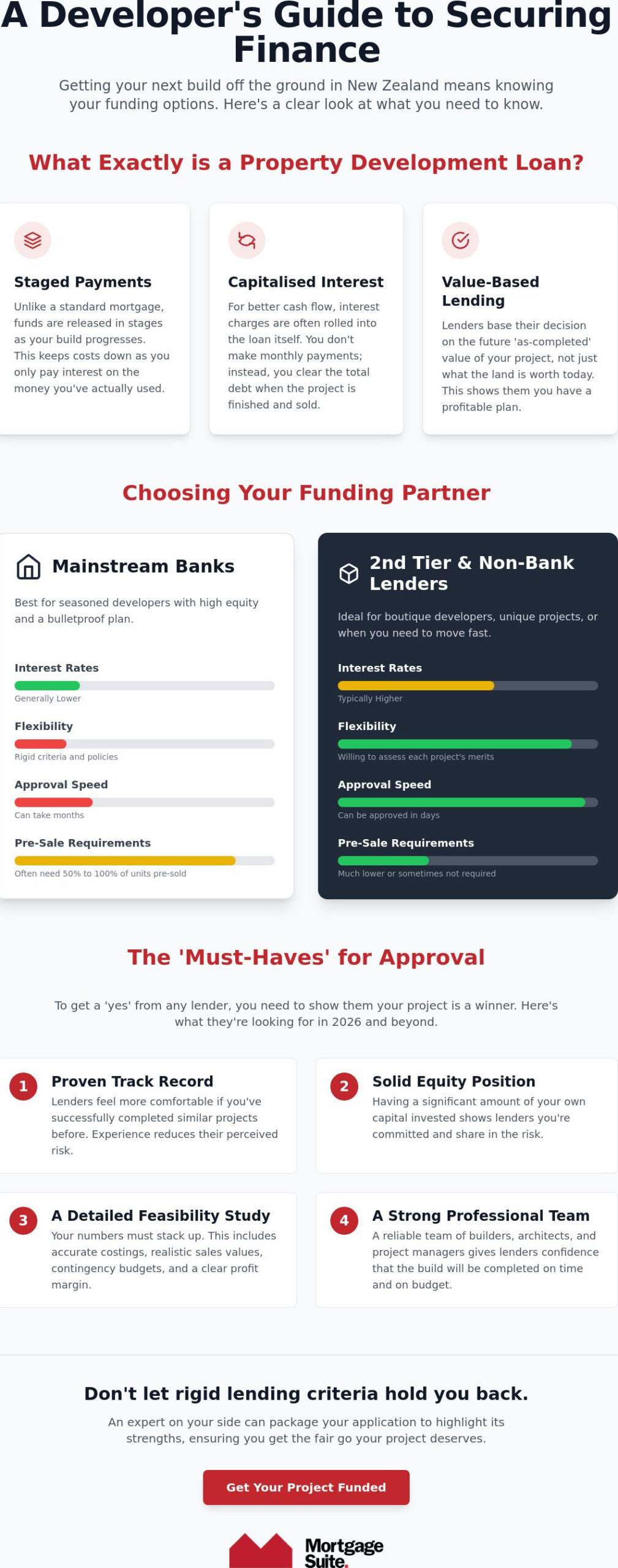
Unlike a standard home loan where you get the money upfront to buy an existing house, these loans are usually drawn down in stages, often called progress payments. This means you only pay interest on the money you’ve actually used at each point of the build, which helps keep your costs down while the foundations are being poured. To make this work, the lender doesn’t just look at what your patch of dirt is worth today. They base their lending on the “as-completed” value, which is what the finished project will likely sell for in the current market. Understanding the wider real estate development process is vital here, as it helps you see why lenders are so focused on your exit strategy and the final valuation before they’ll ever release a cent.

The Difference Between a Mortgage and Development Finance

A standard mortgage is all about you: your salary, your spending habits, and your ability to make monthly payments. Property development loans NZ lenders offer are different because they focus almost entirely on project feasibility. They want to know if the numbers actually stack up and if the project makes sense in the current climate. One of the best parts for your cash flow is a feature called capitalised interest. In plain English, this means the bank lets the interest bill grow alongside the building, and you clear the debt in one go at the finish line. You don’t have to worry about finding the cash for monthly interest payments while you’re still waiting for the roof to go on.

Why a “Fair Go” from a Bank Can Be Hard to Get

Banks are naturally cautious. They see a new build as a bundle of risks, from rising material costs to potential labour shortages. In 2026, with the Official Cash Rate at 2.25% and inflation sitting around 3.10%, banks have tightened their belts significantly. Even if your project is solid, you might find them asking for a high number of pre-sales or testing your ability to pay at rates as high as 9%. Understanding how mortgage rates NZ are structured in 2026 can help you anticipate exactly how lenders will stress-test your application and what benchmarks you need to meet. This is where having a professional broker becomes your secret weapon. We know how to package your application so it speaks the bank’s language, highlighting the strengths they might otherwise miss. We ensure you aren’t just another number in a spreadsheet but a developer with a plan that deserves a fair go.

Mainstream Banks vs. 2nd Tier Lenders: Choosing Your Funding Partner

Deciding who will fund your project is one of the biggest calls you’ll make. In the world of property development loans NZ, you’ve essentially got two paths: the big mainstream banks or the flexible non-bank lenders. While the big banks often have the flashiest offices and the lowest interest rates, they also come with the longest lists of demands. If you’re a boutique developer working on a smaller project, you might find that the “big four” aren’t actually the best fit for your needs. Most bank products are built for massive multi-million dollar schemes, leaving the smaller, high-quality projects feeling a bit left out in the cold.

The speed of approval is often the dealbreaker. Banks can take months to process a complex application, often getting bogged down in committee meetings and endless requests for more data. In contrast, a 2nd tier lender can often give you a green light in just a few days. This speed is crucial when you’re trying to secure a prime site in a competitive market before someone else snaps it up. When timing is everything and you need to move on a site before your existing property is sold, bridging finance NZ can be a powerful tool to bridge that gap and keep your development pipeline moving. This rapid pace of construction actually aligns with the goals of the NZ housing and urban development work programme, which aims to get more quality homes built faster across our communities to meet growing demand.

When to Stick with the Big Banks

Mainstream banks are perfect for developers who have plenty of runs on the board. If you’ve got high equity, a spotless credit history, and you’ve already secured pre-sales for 50% to 100% of your units, the bank’s lower interest rates make a lot of sense. You’ll pay less for your money, but you’ll pay for it in “red tape” and administrative hurdles. They’ll want to see every tiny detail of your professional team and your business before they say yes. It’s a low-cost option, but only if you’ve got the time and the patience to jump through every single hoop they hold up.

The Advantages of Non-Bank (2nd Tier) Funding

For many, especially those on their first or second project, a 2nd tier lender New Zealand offers a much smoother ride. They are far more flexible when it comes to pre-sales. In some cases, they might not require any at all. This allows you to start building sooner and potentially sell your units for a better price once they are finished and people can actually walk through them. While the interest rates are higher, usually 2-6% above bank rates, the trade-off is higher LVRs and interest-only periods that protect your cash flow. Many developers use this as a stepping stone, finishing the build with a non-bank lender and then refinancing to a cheaper bank loan once the project is finished. If you’re feeling stuck between these two worlds, chatting with an expert can help you see which path actually leads to a finished build.

The ‘Must-Haves’ for Approval: What NZ Lenders Are Looking For in 2026

When you apply for property development loans NZ lenders aren’t just looking at a patch of dirt or a set of drawings. They’re looking at you. Think of it like a job interview where the stakes are hundreds of thousands, or even millions, of dollars. Lenders fund the people behind the project as much as the project itself. They want to know that when things get tough, you’ve got the grit and the team to see the build through to the end. This means your personal track record and your financial “skin in the game” are the very first things they’ll check.

A clean credit history is non-negotiable for the big banks, and even second-tier lenders will look closely at any past hiccups. Beyond your credit, your equity position needs to be solid. Most lenders expect you to contribute at least 20% to 35% of the project’s total cost. They want to see that you’re just as committed to the success of the build as they are. Pre-sales remain the biggest hurdle for many developers in 2026. While some flexible lenders might let you start without them, mainstream banks often demand that 50% to 70% of the units are sold before they’ll release the first cent of funding. Managing this requirement often means working closely with a real estate agent early on to prove there’s genuine demand for what you’re building.

Organising Your Development Team

Lenders often care more about your builder than your architect. A beautiful design is great, but a builder with a reputation for finishing on time and within budget is what keeps a bank manager calm. You’ll also need a Quantity Surveyor (QS) on your side. The QS acts as the bank’s eyes and ears, verifying that the costs you’ve listed are realistic and that the work has actually been done before a progress payment is made. If this is your first project, don’t be afraid to bring in a mentor or a project manager with runs on the board. Citing resources like the Property Council New Zealand can help you stay up to date with industry standards and show lenders you’re serious about following best practices.

Financial Ratios You Need to Know

You’ll hear a lot of talk about LTC (Loan-to-Cost) and LVR (Loan-to-Value). LTC is simply how much the bank will lend against the total cost of the build, while LVR is the percentage they’ll lend against the final value of the completed project. Gross Realisation Value (GRV) is the total expected sales price of all units including GST. Lenders use this figure to work out their overall risk. It’s also vital to include a contingency fund in your budget. We always recommend planning for a 10-15% cost blowout. Having this buffer built-in doesn’t just protect you from surprises; it shows the lender you’re a professional who understands that construction rarely goes perfectly to plan.

Property Development Loans NZ: Your 2026 Guide to Funding Your Next Project

Your Roadmap to Funding: How to Organise Your Application

Getting your paperwork in order for property development loans NZ can feel like a project in itself. If you’ve ever felt overwhelmed by the sheer volume of documents requested, you aren’t alone. The secret is to stop thinking of it as a loan application and start viewing it as a business proposal. Lenders want to see that you’ve thought through every possible scenario, from the first digger on site to the final sale. Following a structured roadmap ensures you don’t miss the small details that could stall your funding.

The journey usually follows these five clear steps:

  • Step 1: The Feasibility Study. This is your foundation. You need to prove the numbers actually stack up before you even think about approaching a bank.
  • Step 2: Broker Consultation. Instead of knocking on every door yourself, we scout the market to find the lender whose current “appetite” matches your specific project.
  • Step 3: The Pitch Deck. You’ll need your resource consents, builder contracts, and professional bios ready to go. This is where you sell the “story” of your project.
  • Step 4: The Funding Offer. Once a lender says yes, you’ll get an offer with “conditions precedent.” These are things like a final valuation or reaching a certain number of pre-sales.
  • Step 5: Settlement and First Draw. This is the finish line. Your legal team handles the settlement, and you get your first progress payment to start the work.

The Power of a Feasibility Study

A good feasibility study is more than just a budget. It needs to account for the GST on your sales, council levies, and the marketing costs required to find buyers. If your plan is to keep the units once they’re built, you should use residential investment property loans NZ as a baseline for your long-term exit strategy. This shows the lender you’ve considered how you’ll move from a high-interest construction loan into a more sustainable long-term mortgage once the build is complete.

Avoiding Common Application Blunders

One of the biggest mistakes we see is underestimating “soft costs.” It’s easy to remember the timber and the concrete, but it’s the interest payments, legal fees, and professional consultants that often catch people out. You also need a rock-solid exit strategy. Lenders hate uncertainty, so you must be clear about whether you intend to sell the units or hold them as rentals. If your project involves splitting a larger block of land into separate titles, understanding your options for subdivision finance NZ can help you structure the funding for each stage of the land project correctly. If you’re planning to hold completed units as part of a growing portfolio, exploring a commercial property refinance NZ strategy can help you restructure your debt and unlock equity for your next development. Finally, always be honest about your credit history. It’s much easier for us to work through a past issue if we know about it upfront rather than having the lender discover it during their final checks. If you want to make sure your application is bulletproof from day one, let’s talk about your project today.

Securing property development loans NZ isn’t just about spreadsheets; it’s about the people who represent you. At Mortgage Suite, we don’t just pass your papers across a desk and hope for the best. Our director, Krish Krishna, brings over 20 years of deep banking experience to every project we handle. Having spent two decades on the other side of the lending fence, Krish knows exactly how credit managers think. He understands what makes them nervous and, more importantly, what gives them the confidence to say “yes.” This insider knowledge is your secret weapon when you’re trying to fund a project in a fluctuating market.

We act as your translator. Often, a great project gets rejected simply because it wasn’t presented in a language the bank understands. We take your vision, your numbers, and your track record, and we package them into a professional proposal that highlights the strengths of your deal. We specialise in those “tough” deals that mainstream banks might put in the “too hard” basket. Where a big bank might see a problem with a lack of pre-sales or a unique site, we see a solution through our network of flexible 2nd tier lenders. Our commitment is to a partnership that goes beyond just signing a loan document; we’re here to see your project through to completion.

From First Home to First Development

Many of the successful developers we work with didn’t start with a multi-unit block. They started with a single property and a dream. We love helping investors transition from being passive owners to active developers. By linking your current portfolio to new funding opportunities, we can help you unlock equity you might not even realise you have. Even if you’re just starting out, we can help first home buyers in New Zealand lay the groundwork today for a future in development. It’s about building a long-term plan where your success is our priority.

Ready to Get Cracking on Your Next Project?

With the Official Cash Rate sitting at 2.25% as of May 2026 and new housing targets always on the horizon, this year is full of opportunity for those who have their finance ready to go. Don’t let a “no” from a big bank be the end of your development dreams. The value of a no-obligation chat is that it gives you a clear picture of where you stand right now and what you need to do to get where you want to be. It’s about removing the obstacles so you can focus on what you do best: building.

We’re more than just brokers; we’re your advocates and negotiators. We stay with you from the first application until the final unit is sold and the loan is cleared. If you’re ready to get your project off the ground with a team that truly cares about your results, get in touch with us today. Let’s find the right path to fund your next build together.

Build Your Future with Confidence

Securing the right funding is the foundation of any successful build. Success in this market involves more than just finding a good site; it requires a bulletproof feasibility study and a development team that lenders can trust. Whether you’re aiming for the lower rates of a mainstream bank or the speed and flexibility of a second tier lender, the key is to present your project in a way that makes sense to the credit managers holding the purse strings.

Navigating the various property development loans NZ has to offer can feel complex, but you don’t have to do it alone. With over 20 years of banking and mortgage expertise, we specialise in handling the tough, complex commercial deals that others often avoid. We take pride in being your personal advocate, using our deep industry knowledge to negotiate directly with all NZ lenders on your behalf.

If you’re ready to get your project moving, talk to Krish Krishna about your property development funding today. We’re here to provide the steady hand and seasoned advice you need to see your project through to completion. Your next project is closer than you think, and we’re ready to help you make it happen.

Frequently Asked Questions

Can I get a property development loan with no experience?

Yes, you can, but you’ll need to surround yourself with a professional team that has plenty of runs on the board. Lenders look at the experience of your builder and project manager to offset your lack of history. If your team is solid and your feasibility study is airtight, a lender is much more likely to give you a fair go on your first project.

How much deposit do I need for a development loan in NZ?

Lenders generally expect you to contribute between 25% and 40% of the total project cost. While mainstream banks typically fund 60-75% of the build, some flexible 2nd tier lenders might allow a smaller deposit if the project shows a very strong profit margin. Using existing equity in other properties is a common way to cover this requirement without needing cash.

What are the current interest rates for property development loans?

Interest rates for property development loans NZ vary depending on the lender’s risk assessment. Mainstream banks usually charge between 1% and 4% above their standard mortgage rates. For 2nd tier or private lenders, you should expect total interest costs to range from 8% to 15% given the extra flexibility and speed they provide compared to traditional banks. Understanding how mortgage rates NZ are calculated across different lender types can help you budget more accurately for your total financing costs.

Do I need pre-sales to get a development loan?

It depends on which lender you approach. Mainstream banks often demand that 50% to 70% of the units are sold before they’ll release any funding for construction. However, many non-bank lenders don’t require any pre-sales at all. This allows you to start building immediately and potentially sell the finished units for a higher price once the project is complete.

How do progress payments work during construction?

Money is released in stages as your build hits specific milestones, such as the floor slab being poured or the roof being installed. A Quantity Surveyor will visit the site to check the work is done correctly before the bank releases the next payment. This ensures the funds are only used for actual progress, keeping both you and the lender protected throughout the build.

Can I use my existing home equity for a development project?

Yes, leveraging the equity in your current home or investment portfolio is one of the most effective ways to fund a project. By using the value you’ve already built up, you can often cover the required deposit without having to find a large amount of physical cash. This makes it much easier for established homeowners to transition into property development. If you need to act quickly on a new site before selling your existing property, a bridging finance NZ solution can help you access that equity and secure your next opportunity without delay.

What happens if my construction costs go over budget?

If your costs increase, you’ll first tap into your contingency fund, which we always recommend setting at 10% to 15% of the total build cost. If you go beyond this buffer, you’ll need to either provide more of your own cash or talk to us about negotiating a loan increase. Having a professional advocate helps when presenting these cost changes to your lender.

Is it better to use a bank or a non-bank lender for my first project?

For a first project, a non-bank lender is often the better choice despite the higher interest rates. Their flexibility and willingness to fund projects without pre-sales mean you can get started faster and build your track record. Once you’ve successfully finished a few projects, you’ll find it much easier to meet the stricter criteria and lower rates offered by mainstream banks.

Article by

Krish Krishna

Experienced Financial Adviser with over 46 years of Banking and Mortgage broking experience and over $2.0 Billion in loan settlements.