

Home loan for visa holders in NZ: your 2026 guide

Can your visa allow you to buy a home in New Zealand but still leave a lender unsure about your application? That can happen because eligibility to purchase and mortgage approval are separate decisions. If you’re looking at a home loan for visa holders nz, understanding that difference is a useful first step.

It’s understandable to feel uncertain. Property rules can affect whether you’re allowed to buy, while lenders may assess visa type, income, deposit and supporting documents in different ways. A decline from a mainstream bank isn’t necessarily the end of the road, but no lending pathway can promise approval.

This guide explains how the two decisions fit together, what lenders may look at, how mainstream and alternative lending pathways can differ, and which documents may help explain your circumstances. Mortgage Suite helps borrowers understand their options and present their situation to lenders, so you can have a clearer conversation about possible next steps.

Key Takeaways

  • Check your right to buy a property separately from a lender’s decision to approve a mortgage. They’re different assessments.
  • For a home loan for visa holders nz, be ready to explain your visa conditions, income, debts, deposit source and the property you’re considering.
  • Compare mainstream and alternative lending pathways against your circumstances, as lender criteria and flexibility can vary.
  • Organise your key documents before discussing an application, while allowing for lenders to request different information.
  • A broker can help present your circumstances clearly and negotiate with lenders, but approval depends on the details of your application.

Home loan for visa holders in NZ: separate property eligibility from loan approval

It can be hard to tell whether your visa lets you buy a home and whether a lender will support the purchase. Treat them as two separate questions. First, establish whether you’re eligible to buy the property. Then consider how a lender may assess your finances and circumstances for a home loan for visa holders nz.

Property-purchase eligibility is your legal ability to buy a particular property in New Zealand; loan approval is a lender’s decision about whether your finances can support the borrowing. Meeting one test doesn’t automatically mean you’ll meet the other.

Can visa holders buy residential property in New Zealand?

There isn’t one answer for every visa holder. Eligibility can depend on your visa category, residence history, citizenship, who you’re buying with and the property involved. New Zealand’s overseas investment rules restrict some purchases of residential land. The Overseas Investment Amendment Act 2018 provides background on changes to those rules, but your own circumstances matter.

For example, a residence class visa holder may need consent from the Overseas Investment Office (OIO), the government body that considers certain property purchases, if they haven’t yet met the “ordinarily resident” test. This generally means holding a residence class visa, living in New Zealand for the previous 12 months and being physically present here for at least 183 days during that period. OIO consent is official permission to buy or build a home in cases where the rules require it.

Temporary visa holders are generally restricted from buying a home to live in on their own, but some situations, including buying jointly with an eligible partner, can be treated differently. Australian and Singaporean citizens also have specific exemptions. Check current OIO guidance before making decisions, as eligibility depends on your circumstances.

Why property eligibility does not guarantee a home loan

Even if you’re allowed to buy, a lender makes a separate assessment of whether the loan appears affordable and suitable. It may consider your income and how steady it is, your existing debts, the size and source of your deposit, and the property you plan to buy. Your visa conditions may also affect how a lender views your circumstances. Policies differ, so one lender’s response may not predict another’s.

Keeping the two decisions separate can make the process feel more manageable. A lender’s decision isn’t a verdict on your future, and a decline from one mainstream bank doesn’t necessarily close every pathway. Review what the lender has assessed, identify any details that need explaining, and consider whether another lender’s criteria may fit your circumstances. Property eligibility and borrowing are connected, but each needs its own clear assessment.

What lenders may assess when a visa holder applies for a home loan

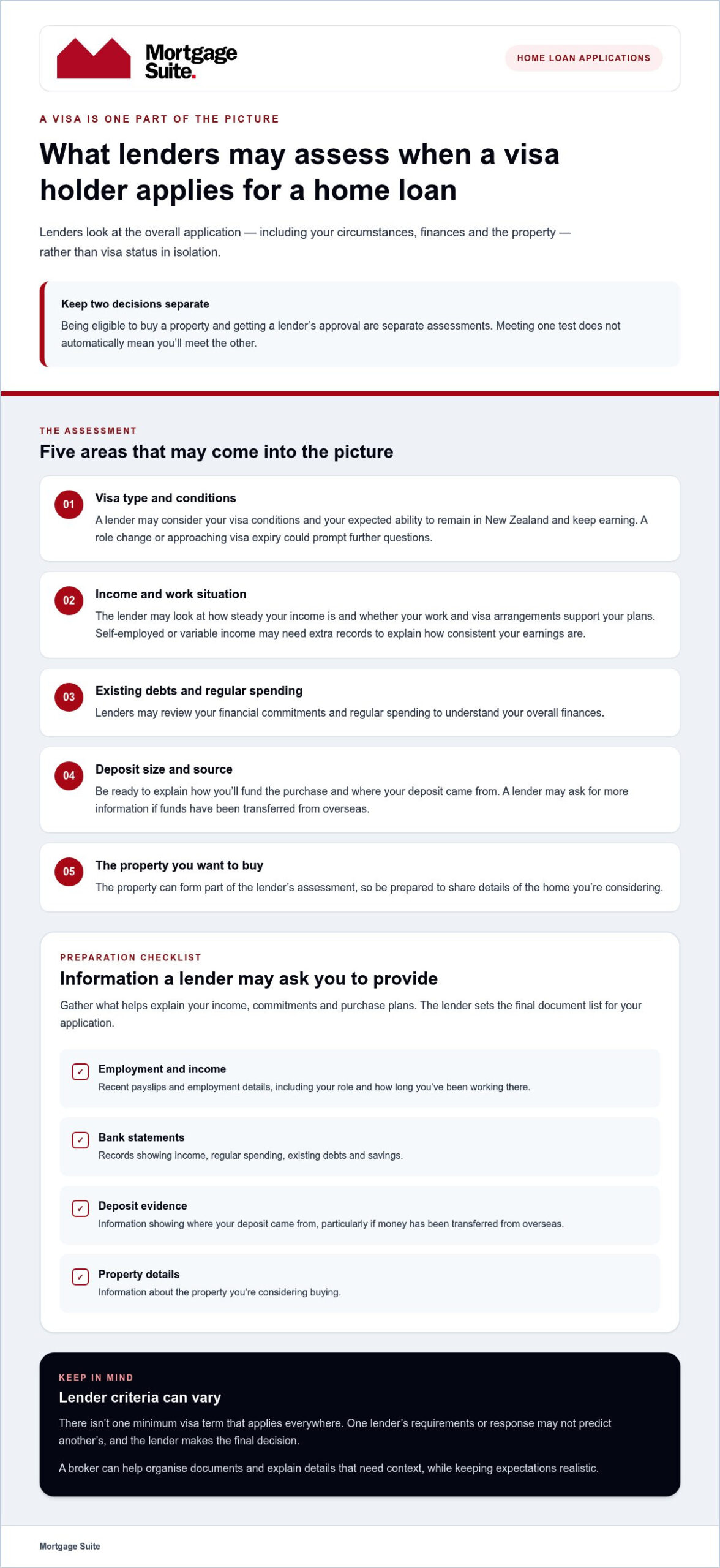
Your visa is one part of the picture, not the whole application. A lender assesses the overall application, not visa status in isolation. It may consider your visa type and conditions alongside your income, work situation, debts, deposit and the property you want to buy. Each lender sets its own criteria, so a requirement applied by one lender shouldn’t be treated as a universal rule.

This is why an application for a home loan for visa holders nz may need a clear explanation of your circumstances. A lender may want to understand how steady your income is and whether your work and visa arrangements support your plans. Questions are part of assessing the application as a whole and don’t automatically mean there’s a problem.

How visa type and remaining visa term may affect an application

Lenders may look at your visa conditions and expected ability to remain in New Zealand and keep earning. Work conditions, a role change or an approaching expiry could prompt further questions, but lender policies differ. Don’t assume there’s one minimum visa term that applies everywhere. The relevant lender’s current criteria determine what it will consider in your situation.

The same applies to named loan pathways. Kāinga Ora’s First Home Loan scheme has its own eligibility criteria, so check the current details rather than assuming a visa alone determines whether you qualify.

Income, deposit and financial records lenders may review

A lender needs a clear view of the money coming in, the commitments going out and how you’ll fund the purchase. Depending on your circumstances and the lender, you may be asked for records such as:

  • Recent payslips and details of your employment, including your role and how long you’ve been working there.
  • Bank statements showing income, regular spending, existing debts and savings.
  • Evidence showing where your deposit came from, particularly if funds have been transferred from overseas.
  • Details of the property you’re considering, as the property can form part of the lender’s assessment.

If you’re self-employed or your income varies, the lender may need extra records to understand how consistent your earnings are. Gather the documents that show your income and commitments clearly, but expect the lender to set the final list for your application. You can also explore plain-English mortgage guidance as you get your information together.

Clear information can make it easier for a lender to assess your application on its merits. A broker can help organise the documents and explain details that need context, while keeping expectations realistic: the lender makes the final decision.

Mainstream and alternative home loans for visa holders: how to compare pathways

There isn’t one lender pathway that suits every visa holder. Mainstream and alternative lenders may assess applications differently, and policies can vary within each group. When comparing a home loan for visa holders nz, look at how the lender’s criteria fit your circumstances, as well as the loan’s repayment structure and flexibility. A headline interest rate alone won’t show whether the overall arrangement suits your plans.

The 2nd tier and non-bank home loans guide explains more about alternative lending. This can be a pathway to explore if your circumstances don’t fit a mainstream lender’s criteria, though suitability depends on your application and the terms available.

What to compare Mainstream lender Alternative lender
Criteria and assessment May apply defined policies to visa status, income, deposit and property details. May consider applications that sit outside some mainstream criteria, with its own assessment requirements.
Flexibility Depends on the individual lender’s rules and how your application fits them. May offer a different way to assess some circumstances, but flexibility isn’t the same across all lenders.
Loan fit Compare repayments, structure and conditions against your needs and plans. Review the full loan terms and repayment commitments, not just the initial rate.

When a mainstream lender may be worth considering

A mainstream lender may be worth exploring if your visa, income, deposit and property plans fit its current criteria. That doesn’t guarantee acceptance. Find out how the lender treats your specific visa circumstances, what evidence it needs and whether the repayment arrangement fits your budget over time. Each lender sets its own requirements, so don’t assume one bank’s policy applies to all.

When an alternative lender may be another pathway

If a mainstream lender can’t assess your application under its usual criteria, an alternative lender may be another option to consider. It won’t suit everyone or guarantee approval, so weigh its assessment approach and loan conditions carefully. Mortgage Suite helps explain possible pathways and present more complex circumstances clearly to lenders. If you’d like support comparing options, talk with Mortgage Suite about your goals and situation.
Home loan for visa holders in NZ: your 2026 guide

How to prepare a home loan application as a visa holder

A little preparation can make a home loan conversation clearer and less stressful. Before comparing lenders, bring together the details that explain your visa, finances and property plans. This gives you a practical starting point for a home loan for visa holders nz, while allowing for lenders to request documents specific to your application.

Build a clear picture of your visa and financial position

Start by checking your property-purchase eligibility for your circumstances. Then organise your information so you can explain your situation consistently. A simple summary of your income, regular commitments, deposit source and intended property can help you spot gaps before you apply.

Depending on the lender and application, useful documents may include:

  • Current visa documents and relevant visa conditions.
  • Recent payslips, employment details or other evidence of income.
  • Bank statements showing regular income, expenses, debts and savings.
  • Information or records showing where your deposit funds came from.
  • Details of the property you’re considering, if you’ve chosen one.

If you’re self-employed or your income changes from month to month, gather records that help explain how you earn and how your income varies. Keep names, dates and other personal details consistent across forms and supporting documents. The lender may ask for more or different information, so use this as a starting checklist rather than a fixed list.

Prepare questions and compare lender fit

Use these steps to get sorted before discussing an application:

  • Clarify purchase eligibility. Understand whether your visa and circumstances allow you to buy the property you have in mind.
  • Map your finances. Note your income, work history, regular expenses, existing debts and deposit source.
  • Organise your records. Bring together relevant visa, employment, income and bank documents.
  • Discuss lender options. Ask how a lender may assess your visa and income circumstances, and what information it needs to consider your application.
  • Compare the whole loan. Look at eligibility, repayment structure, flexibility and communication, as well as the interest rate.

Useful questions can help you understand whether a lender may be a fit: Which parts of my visa or income history need explaining? What documents would help clarify them? How do the repayments and conditions match my plans? For plain-English explanations as you prepare, visit Mortgage Suite’s mortgage education resources.

Mortgage Suite can help you organise your information and discuss lender options without treating one lender’s response as the final word. Talk through your home loan options with a team that can present your circumstances clearly and negotiate with lenders.

How Mortgage Suite can help visa holders explore home loan options

Working out which lender may suit your visa and financial circumstances can feel like a lot to manage alone. Mortgage Suite takes a personal approach: we learn about your goals, understand the details of your situation and consider how your application may fit different lender criteria. This gives you a clearer view of possible next steps without treating a particular loan outcome as certain.

A personal advocate when lending criteria feel hard to navigate

Lender feedback can be difficult to interpret, especially if a decision focuses on one part of your application. A broker can help explain what the feedback means, identify information that may need more context and discuss whether another lending pathway could be worth exploring. A decline from one lender isn’t necessarily a final judgement, but it also doesn’t mean another lender will approve your application.

Mortgage Suite’s founder, Krish Krishna, brings more than two decades of banking experience to conversations about borrowing. That experience supports a practical understanding of how lenders assess applications and how a borrower’s circumstances can be presented clearly. It’s guidance and advocacy, not a promise of approval. You can read more about Mortgage Suite’s team and experience.

What to expect from an initial lending conversation

An initial conversation is a chance to explain what you’re hoping to do and get a clearer picture of the information lenders may need. You can talk through your visa conditions, income, deposit, existing commitments and property plans. If some details are still uncertain, say so. A clear, honest picture helps shape a useful discussion about lender options and what may need attention before an application is presented.

Mortgage Suite can help organise the key details, match your circumstances to potential lender criteria and present your application clearly. Where appropriate, the broker can also negotiate with lenders on your behalf. For a home loan for visa holders nz, this support can help you compare possible pathways and understand what each lender is asking for, while leaving the decision with the lender.

You don’t need to have every answer before starting a conversation. If you’d like to talk through your goals and possible next steps, discuss your home loan options with Mortgage Suite. There’s no pressure to have everything sorted first.

Take your next step with a clearer plan

Buying a home with a visa involves two separate questions: whether you’re eligible to purchase, and whether a lender is prepared to approve your borrowing. Once you understand that distinction, you can focus on the details that shape a home loan for visa holders nz, including your visa conditions, income, deposit and the lender’s own criteria.

Mainstream and alternative lending pathways may suit different circumstances, but neither guarantees approval. Preparing clear information and comparing the full loan structure can help you have a more informed conversation about your options.

Mortgage Suite supports borrowers through mainstream and alternative lending applications, with personal advocacy and lender negotiation. Founder Krish Krishna brings over two decades of banking experience to that work, helping you understand lender feedback and present your circumstances clearly.

Talk through your home loan options with Mortgage Suite and explore possible next steps at your pace. Getting started doesn’t have to be daunting.

Frequently Asked Questions

Can I get a home loan in New Zealand on a work visa?

You may be able to apply, but a lender’s decision depends on your circumstances and its current criteria. A work visa doesn’t automatically mean you can buy a home independently, so check purchase eligibility separately before making plans. Lenders may consider your visa conditions, income, employment history, deposit and other commitments. For a home loan for visa holders nz, both property rules and borrowing requirements need to be considered.

Can temporary visa holders buy a house in New Zealand?

Temporary visa holders are generally restricted from buying a home to live in on their own, but individual circumstances can affect the rules. For example, a temporary visa holder may be able to buy jointly with an eligible New Zealand partner if the property is treated as shared under relationship-property rules. This means it falls within the property-sharing rules for couples. Check current Overseas Investment Office guidance before entering a purchase agreement or assuming an exception applies.

Does a residence-class visa guarantee home loan approval?

No. A residence-class visa may affect whether you’re eligible to purchase, but it doesn’t require a lender to approve a mortgage. The lender will separately assess your income, debts, deposit, ability to manage repayments and the property. Some residence visa holders may also need Overseas Investment Office consent, depending on their circumstances. Confirm purchase eligibility and borrowing requirements as separate steps before committing to a property.

What documents might a visa holder need for a home loan application?

Possible documents include current visa details, payslips, employment information, bank statements and evidence showing where your deposit came from. If you’re self-employed or your income varies, a lender may ask for additional records to understand your earnings. You may also need to provide details of the property you’re considering. The exact documents depend on the lender and your application, so treat this as a starting list, not a universal requirement.

Do all New Zealand lenders assess visa holders in the same way?

No. Lenders set their own criteria, and they may differ in how they consider visa conditions, income, employment history, deposit and property details. One lender’s decision doesn’t necessarily tell you how another will assess your application. Compare more than the interest rate: consider eligibility, repayment structure, flexibility and the information each lender needs. A broker can help explain lender feedback and present your circumstances clearly.

Can I apply for a home loan if a bank has declined my application?

Yes, a decline from one bank doesn’t automatically rule out every other lending option. First, understand the reasons for the decision and whether anything in your application needs clarification or improvement. Lenders assess applications differently, and an alternative lender may consider circumstances outside some mainstream criteria. That isn’t a promise of approval or a suitable route for everyone, but a tailored review can help you understand possible next steps.

Article by

Krish Krishna

Experienced Financial Adviser with over 46 years of Banking and Mortgage broking experience and over $2.0 Billion in loan settlements.

Buying Property as a Contractor in NZ: Your 2026 Guide to Getting Sorted

Why should choosing a career with freedom and flexibility feel like a penalty when you walk into a bank? You’ve worked hard to build a high-earning career, yet many bank managers still treat your income like a guessing game. It’s incredibly frustrating to have a healthy bank balance but still face a wall of “no” because your paperwork doesn’t fit a standard 9-to-5 template. If you’ve been worried that buying property as a contractor nz is out of reach because you don’t have years of tidy tax returns, you’re certainly not alone.

We believe your contract structure is a sign of your expertise, not a financial weakness. You deserve a clear path to home ownership that recognises your actual earning power. This guide will show you how to secure a home loan as a contractor in New Zealand, even if the big banks have already turned you away. We’ll explore which lenders offer the most flexibility and how you can get into your new home without waiting years for a “perfect” set of books. It is time to stop waiting and start planning your move.

Key Takeaways

  • Learn why being a contractor is actually a career strength in the 2026 property market, provided you know which lenders to approach.
  • Discover the exact steps for buying property as a contractor nz by focusing on your total industry experience rather than just your most recent contract.
  • Understand why alternative lenders are often the perfect choice for contractors who need a flexible approach to income proof.
  • Find out how starting your preparation six months early can help you organise your finances to meet strict lending criteria.
  • See how professional negotiation can turn a bank’s “no” into a “yes” by presenting your financial history in a way that highlights your stability.

Can You Actually Buy a House as a Contractor in NZ?

The short answer is a resounding yes. Buying property as a contractor nz is entirely achievable in 2026, even if your local bank manager seemed a bit hesitant when you first mentioned your work status. While the landscape has changed, the core mortgage loan fundamentals remain the same; lenders simply want to know that you can afford the repayments over the long term. They aren’t necessarily looking for a reason to say no, but they are looking for proof of stability.

The old idea that you must have two years of perfect tax returns is a common myth that stops many people before they even start. In reality, your financial fitness is about your overall stability and industry experience. If you’ve done the same type of work for five years but only contracted for six months, many lenders will take that previous experience into account. It’s about the story your numbers tell, not just the length of time you’ve been your own boss.

Understanding the Different Types of Contracting

How a lender looks at you often depends on how you get paid. If you’re a PAYE contractor, you’re often in the strongest position. Since tax is taken out before the money hits your account, some banks may even treat you like a permanent employee if your contract has a decent amount of time left on it. This makes the application process feel much more like a standard home loan.

Sole traders have a slightly different path. Lenders will look closely at your tax records to understand your actual profit after all your expenses are paid. They want to see that there’s enough left over to live comfortably and pay a mortgage. For company directors, the situation is more layered. Banks will look at the salary you pay yourself plus any profit the business keeps. It’s a more complex calculation, but it provides a much fuller picture of your actual wealth and ability to handle a loan.

Why NZ Banks Are Often Cautious

Most big banks are designed for people with predictable, steady paycheques. When they see a contractor, they immediately worry about income gaps, those times between projects where you might not be earning. This perceived risk makes them cautious. They calculate how much the bank thinks you can afford to pay back by looking for the lowest common denominator, often averaging your income over a long period or applying factors to your earnings to account for potential downtime.

This traditional box-ticking exercise is where many highly skilled contractors get stuck. A bank’s computer system might see a three-week holiday between contracts as a red flag, whereas a human negotiator sees it as a well-deserved break for a successful professional. When you’re buying property as a contractor nz, you need a strategy that bypasses these rigid internal bank rules and focuses on your actual ability to manage the debt.

What NZ Lenders Really Want to See from Contractors

When you’re looking into buying property as a contractor nz, it’s easy to get fixated on your daily or hourly rate. While earning good money is great for your bank balance, lenders are actually hunting for something different: sustainable income. They want to see that your earnings aren’t just a temporary spike. A bank looks for a track record that suggests you’ll be able to keep meeting those mortgage repayments years down the track. They aren’t just buying into your current project; they’re buying into your long-term career stability.

This is where your industry experience before you started contracting becomes your secret weapon. If you’ve spent a decade in your field and only recently moved to contracting, that experience proves you’re highly employable. Another major factor is your actual profit after expenses versus the total money coming in before costs. Many contractors work hard to keep their taxable income low by claiming business expenses. While this is smart for tax, it can accidentally lower how much you can afford to repay in the eyes of a bank, as they generally only look at the “bottom line” profit on your tax returns.

The Magic Number: Is Two Years Still the Standard?

Most mainstream banks still treat 24 months of financial records as their default requirement. They like the neatness of two full years of tax summaries. However, this isn’t a brick wall. If you work in high-demand sectors like IT, healthcare, or engineering, many lenders are willing to look at a shorter history. If you have one year of strong accounts and a signed contract that extends into the future, we can often build a compelling case. Having a larger deposit, typically 20% or more, also goes a long way in giving the lender peace of mind.

Documenting Your Income Correctly

Your paperwork needs to tell a clear, honest story. You’ll need your tax summaries and GST returns ready to go, as these are the primary documents a lender will use to check your earnings. They will also look closely at your current contract end date. If your contract is due to finish shortly, having a renewal letter or a history of rolling contracts with the same client is incredibly helpful. It’s often a good idea to chat with a specialist to review your accounts before you approach a bank, ensuring your business expenses aren’t unfairly masking your true ability to repay a loan.

Your Step-by-Step Guide to Getting Mortgage-Ready

Success in buying property as a contractor nz often comes down to what you do months before you ever visit an open home. Think of your mortgage application as a story you’re telling the bank; you want that story to be one of stability and discipline. Starting your preparation at least six months ahead of time gives you the space to polish your financial profile and address any small issues that might otherwise cause a delay. It’s much easier to fix a paperwork gap now than it is when you’ve already found your dream house.

One of the most powerful things you can do is maintain a healthy cash buffer in your business account. Lenders love seeing that you don’t live hand-to-mouth. If you have enough cash set aside to cover a few months of expenses, it proves that a short gap between contracts won’t put your mortgage at risk. At the same time, you should strictly avoid taking on any major new debt. That shiny new work ute on finance might look great, but the monthly repayments will directly reduce how much a bank is willing to lend you for a home.

Step 1: Get Your Financial House in Order

The first step is to draw a clear line between your personal life and your business. You should have separate bank accounts for everything. When a lender sees personal grocery shops mixed in with business software subscriptions, it makes your income harder to verify and your spending habits look messy. You also need to ensure your relationship with the IRD is spotless. Being up to date with your GST and income tax payments is non-negotiable for a smooth approval.

A smart trick is to write a brief, one-sentence summary of your work history. Instead of just showing a few months of contracting, highlight your total years in the industry. This simple document helps the lender see your long-term expertise and reliability rather than just your current tax status. It shifts the conversation from “how long have you been a contractor” to “how long have you been an expert in your field.”

Step 2: Maximise Your Deposit and KiwiSaver

Your deposit is the ultimate lever for getting a “yes.” While some lenders accept less, hitting that 20% mark often unlocks lower interest rates and simpler approval processes at mainstream banks. If you’re a first-time buyer, you should definitely check your eligibility for a KiwiSaver first home withdrawal NZ. It’s often the biggest boost to a contractor’s deposit, especially if you’ve been contributing consistently over several years.

For those with high cash flow but lower savings, we often look at alternative ways to show your equity. This might include using existing property as security or receiving a gift from family. When buying property as a contractor nz, the goal is to show the lender that you have skin in the game, regardless of where those funds originated. The more equity you bring to the table, the more flexible a lender becomes with your income structure.

Banks vs. 2nd Tier Lenders: Choosing the Right Path

Choosing which lender to approach is a major decision when buying property as a contractor nz. Mainstream banks are like the big department stores of the financial world; they offer the lowest interest rates, but their rules are often set in stone. If your situation doesn’t fit their standard mould, you’ll likely get a quick rejection. This is where a 2nd tier lender New Zealand comes into play. These specialists are more like boutiques; they have the time to look at your actual bank statements and work out how much you can really afford to pay back, rather than just relying on an automated system.

Many people worry that choosing a non-bank lender means paying much higher interest. While the rates can be slightly higher, you need to weigh that against the cost of waiting. If you spend another two years trying to meet a big bank’s strict requirements, house prices could jump significantly during that time. In many cases, it makes more sense to get into your home now and plan on moving your loan to another bank later once you have a longer track record as a contractor. It’s a stepping stone strategy that gets you on the property ladder much sooner than the traditional route allows.

When to Stick with the Big Banks

If you have more than two years of solid, increasing income on your tax returns, a big bank is usually your best bet. You’re also in a strong position if you are applying with a partner who has a standard job. Having one person with a predictable paycheque acts as a safety net for the lender, making them much more comfortable with your contracting income. Lenders also tend to be more relaxed if you work in a high-demand industry where new contracts are easy to find and tend to last for long periods without gaps.

When 2nd Tier Lending Makes More Sense

If you’ve been working for yourself for less than a year, or if your latest tax return shows a lot of one-off business costs that make your actual profit look lower than it really is, a 2nd tier lender is often the only realistic path. These lenders are much more interested in your current cash flow and your future potential than your past tax history. At Mortgage Suite Ltd, we specialise in finding loans that don’t fit bank criteria NZ. If the big banks aren’t listening, reach out to our team to see how we can help you find a lender that actually understands how your business works.

How We Organise Your Contractor Home Loan Application

Getting a mortgage shouldn’t feel like a stressful audit or a high-stakes interrogation. When you’re buying property as a contractor nz, the biggest mistake is simply handing over a stack of bank statements and hoping the person on the other side understands them. We take a completely different approach. We don’t just submit papers; we translate your financial life into a story that makes sense to a lender. We focus on your expertise, your industry longevity, and your future earning potential, rather than just the latest figure on a tax bill.

Krish Krishna leads our team at Mortgage Suite Ltd with over two decades of banking and negotiation experience. He knows exactly how bank credit teams think because he has spent years on that side of the desk. This insider knowledge is vital because lending rules in New Zealand aren’t static. Some banks might be closed to contractors one month, while others are actively “hungry” to grow their business in that sector. We identify the lenders who are currently looking for clients exactly like you, so you don’t have to face unnecessary rejections.

The Mortgage Suite Ltd Advantage for Contractors

We provide a bridge to lenders that many people don’t even know exist. Our team has direct access to alternative capital and private lenders who operate with much more flexibility than the big four banks. This is a massive advantage if you’re looking into residential investment property loans NZ to build your long-term wealth. Whether you’re buying your first home or an investment, we’re personally committed to finding a “yes” even when other institutions have already said “no.”

Ready to Get Sorted?

Your first step shouldn’t be a cold appointment at a local bank branch where the manager might not grasp the nuances of contract structures. Instead, your journey should start with a relaxed conversation. In our initial consultation, we’ll look at your current contracts, your industry history, and your deposit goals. It’s a helpful dialogue designed to give you a clear roadmap without the corporate pressure. We want to remove the obstacles so you can focus on finding the right house.

When you’re ready to meet, try to have your latest tax summaries and current contract details ready. Don’t worry if your books aren’t “perfect” just yet; our job is to help you organise them so they look attractive to the right lender. If you’re serious about buying property as a contractor nz, it’s time to work with a team that actually understands your career path. Book a chat with the Mortgage Suite Ltd team today and let’s get your home loan sorted.

Take the Next Step Toward Your New Home

Buying property as a contractor nz doesn’t have to be a source of stress or a series of rejections. We’ve seen that the traditional two year rule is often more of a guideline than a brick wall, especially when you have a solid industry background and the right strategy in place. Whether you’re approaching a big bank with a hybrid application or using a 2nd tier lender as a strategic stepping stone, your career choice should be your greatest asset, not a hurdle.

You deserve a partner who understands the nuances of your income and knows how to present your story to the people who make the decisions. Krish Krishna brings over 20 years of banking and negotiation experience to your side, offering a personalised service that focuses on finding a solution when others only see problems. We specialise in 2nd tier and alternative lending, ensuring you can move into your new home without unnecessary delays. It’s time to stop letting rigid bank rules hold you back from your property goals.

Let us negotiate your contractor home loan for you and get your future sorted today. You’ve worked hard to build your career; now let’s make sure it works for your home ownership dreams.

Frequently Asked Questions

Can I buy a house if I have only been contracting for six months?

Yes, you can certainly buy a house with six months of contracting history, though you’ll likely need to look beyond the big mainstream banks. If you have a long history of working in the same industry before you started contracting, specialist lenders are often happy to consider your application. They focus on your overall career stability rather than just the length of your current contract.

Do contractors need a bigger deposit than permanent employees in NZ?

You don’t strictly need a bigger deposit, but having 20% saved makes the process much easier. While some lenders may accept a smaller deposit, hitting that 20% mark helps offset the bank’s concerns about fluctuating income. It often unlocks better interest rates and more flexible lending terms, making buying property as a contractor nz a much smoother experience.

What documents do I need to prove my income as a sole trader?

Lenders will primarily want to see your IR3 tax summaries, GST returns, and recent business bank statements. These documents provide a clear picture of your earnings and your ability to manage your tax obligations. It is also helpful to have your current contract handy to show your agreed rate and the expected length of your current project.

Will a bank look at my gross turnover or my net profit?

Banks almost always focus on your net profit, which is the amount you have left after all business expenses are paid. This is because your net profit represents the actual income available to meet your mortgage repayments. If you’ve worked hard to minimise your taxable income, it’s a good idea to chat with us about how that impacts your borrowing power.

Can I use my KiwiSaver if I am a self-employed contractor?

Yes, being a contractor doesn’t stop you from using your KiwiSaver for a first home deposit. As long as you’ve been a member for at least three years and meet the standard criteria, you can withdraw your funds. This remains one of the most effective ways to boost your deposit when buying property as a contractor nz.

What happens if my current contract is due to end soon?

A contract ending soon isn’t an automatic “no” if you can show a history of steady work. Lenders look for a track record of contract renewals or a high demand for your skills in the current market. Providing a letter of intent from your current client or showing a new signed contract can often solve this concern for the lender.

Are interest rates higher for contractor home loans?

Interest rates are generally the same as standard loans if you meet a mainstream bank’s criteria. If your application needs to go through a 2nd tier lender because of a shorter work history, the rate might be slightly higher. Many contractors use these lenders as a temporary solution for a year or two before moving back to a bank.

Is it better to apply for a home loan as a sole trader or a company director?

Neither structure is strictly better, as lenders are mostly interested in the total income you can prove. Whether you draw a salary as a director or take drawings as a sole trader, the lender will look at the underlying profit of the business. The most important factor is having clear, organised financial records that show your true earning potential.

Article by

Krish Krishna

Experienced Financial Adviser with over 46 years of Banking and Mortgage broking experience and over $2.0 Billion in loan settlements.