

LVR for NZ Investment Property: 2026 Deposit Rules

Most investors see a 30% deposit requirement as a brick wall, but the truth is that the latest rules are more like speed limits that can be navigated with the right guidance. It’s completely normal to feel a bit overwhelmed by the constant talk of 70% limits and those new debt-to-income ratios. Hearing that you might need a massive deposit or that your income might not stretch far enough is enough to make anyone second-guess their next move. Understanding the current LVR for investment property NZ is the first step toward taking back control of your financial future.

We know how frustrating it is to deal with confusing bank talk and the fear of being turned down. You deserve a clear path forward that doesn’t involve jumping through impossible hoops. In this guide, you’ll discover how to navigate the latest 2026 rules and use your existing equity to grow your property portfolio without the usual stress. We’ll look at how new builds can get you in the door with a smaller deposit and show you how a seasoned hand can help you find a way through, even if the big banks have said no.

Key Takeaways

  • Learn why a 30% deposit requirement doesn’t have to stop your plans and how to work around the standard bank limits.
  • Discover why non-bank lenders might be the key to getting your loan approved if the major banks are being too strict.
  • Find out how to put the value in your current home to work so you can grow your portfolio without needing a massive pile of savings.
  • Understand exactly how the 2026 rules for LVR for investment property NZ change what you can borrow and where you should look for a deal.
  • See how expert help can turn a “no” into a “yes” by navigating the complex world of lending rules on your behalf.

Understanding LVR: The “Speed Limit” for Your Investment Journey

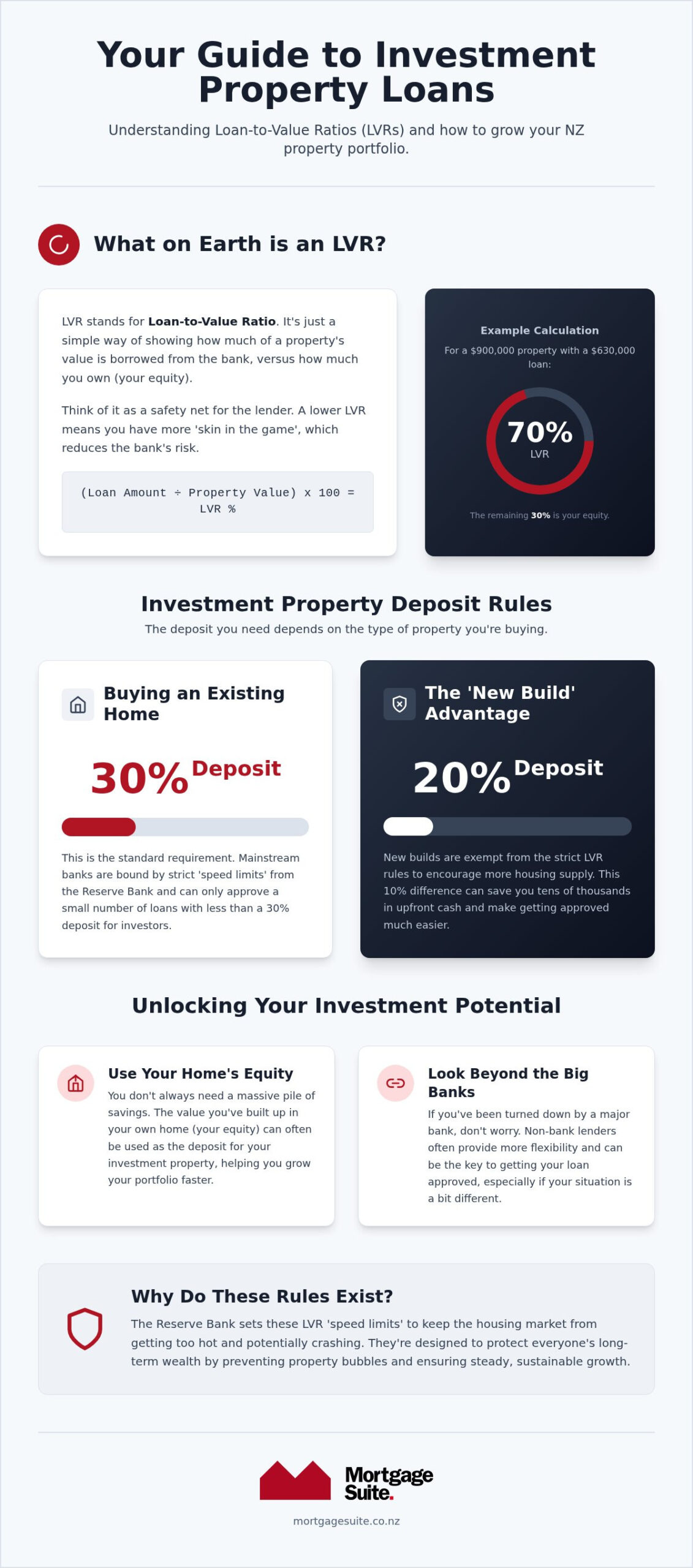
LVR is essentially a measure of how much risk the bank is taking compared to how much skin you have in the game. It stands for Loan-to-Value Ratio; it is just a simple way of saying how much of the property the bank owns versus you. If you have a property worth one million dollars and you owe seven hundred thousand, your LVR is 70%. The remaining 30% is your equity, which acts as a safety net for the lender. Understanding the LVR for investment property NZ is the foundation of building a successful portfolio.

Think of these rules as a speed limit set by the Reserve Bank. Their job is to keep the New Zealand housing market from over-cooking and potentially crashing. When the market gets too hot, the Reserve Bank steps in and tells the commercial banks they need to demand higher deposits. This slows down the flow of money and keeps the economy stable. It might feel like a hurdle when you are trying to buy, but it is actually designed to protect everyone’s long-term wealth. It ensures that the market doesn’t grow faster than people can actually afford.

Investors often face different limits than first-home buyers. This is because banks generally view investment properties as slightly higher risk. If the economy takes a turn, people usually fight harder to keep the roof over their own heads than they do for a rental property. Because of this, the LVR for investment property NZ is typically capped at a lower level, meaning you need a larger deposit to get the green light from a mainstream lender.

How to work out your LVR without a degree in maths

Calculating your position is much simpler than the banks make it sound. LVR is the percentage of a property’s value that is borrowed as debt. To find your number, just use this simple formula: (Loan Amount ÷ Property Value) x 100. For example, if you want to borrow $630,000 for a house valued at $900,000, your LVR is 70%.

In the current market, 70% LVR is the magic number for most Kiwi investors. This means you generally need a 30% deposit for an existing property. While we will chat about exceptions like new builds later on, aiming for that 30% mark puts you in a very strong position with almost any lender. It gives you the best chance of getting an approval quickly.

Why the Reserve Bank keeps changing the rules

The Reserve Bank isn’t trying to be difficult; they are trying to keep the economy on an even keel. By adjusting deposit restrictions, they can control how much debt is floating around the country. In 2026, we have seen a shift toward balancing these deposit rules with new income-to-debt rules. This double-layer of protection ensures that people aren’t just bringing enough cash to the table, but can also actually afford the weekly repayments if interest rates climb.

While these shifting goalposts can be frustrating, they are actually a good thing for property values. They prevent bubbles from forming, which means your investment is more likely to grow steadily over time rather than crashing overnight. Having a steady hand at Mortgage Suite Ltd to guide you through these changes makes all the difference when the rules feel like they are moving under your feet.

The 2026 LVR Landscape for NZ Residential Investors

The lending environment for 2026 is quite clear. If you are looking at an existing property, you will generally need to bring a 30% deposit to the table. This is the current standard for the LVR for investment property NZ as set by the Reserve Bank. It might feel like a high bar, but it is the reality most investors are working with right now. Even if you have a great income and a clean credit history, the banks are bound by these rules to ensure the market stays stable.

The 30% deposit hurdle for existing homes

Existing homes are often viewed as a higher risk because they don’t help solve the housing shortage. Banks are restricted by a “speed limit” which only allows about 10% of their new lending to go to investors with less than a 30% deposit. This creates a bit of a bank lottery. If you only have a 20% deposit, your chances depend on whether the bank has already used up its monthly quota for high-limit loans. If they have, you will likely be declined regardless of how good your application looks. It isn’t necessarily a reflection of your financial health; it is just a matter of timing and regulation.

The “New Build” loophole: Buying with just 20%

There is a clever way to get around the 30% rule. Buying a brand-new property is currently exempt from these strict LVR limits. The government wants to encourage more housing supply, so they allow investors to buy new builds with a lower deposit, typically 20%. This 10% difference can save you tens of thousands of dollars in upfront cash. Under the 2026 rules, new construction is exempt because it adds to the total number of homes available in New Zealand. It is a fantastic option for those who want to enter the market sooner rather than later without waiting to save a massive deposit.

If you already own a home, these rules still apply, but you might not need to save a pile of cash. You can often use the equity built up in your current house to cover that 30% requirement. This involves using the value of your own home as security for the new loan. It is a smart way to grow your portfolio without draining your bank account. You can use a mortgage calculator to see how much you might be able to borrow based on your current position. Understanding these nuances is exactly where a steady hand can help you find the right path forward.

Banks vs. Non-Bank Lenders: Finding the Flexibility You Need

Mainstream banks are like the strict teachers of the financial world. They have to follow the Reserve Bank’s rulebook exactly, which means they have very little room to move. If you don’t have that 30% deposit for an existing rental, they often can’t help you even if they wanted to. Non-bank lenders, or 2nd tier lenders, are different. They don’t have the same rigid shackles, which gives them the freedom to offer a “fair go” to investors who are doing well but don’t fit the standard bank mould. For many Kiwis, these alternative lenders are the key to breaking through the usual barriers.

When the bank says “no,” we look for a “yes”

It’s common to feel stuck when a big bank declines your application because of the strict LVR for investment property NZ limits or the new income-to-debt limits. Banks love a simple life; they want borrowers with a standard salary and a massive deposit. If your income comes from a business, commissions, or if you are simply bumping up against those new rules that cap how much you can borrow based on your earnings, the big banks might look the other way. Non-bank lenders take a more human approach. They look at the whole picture of what you own and what you earn rather than just scanning a checklist. While the interest rates might be a little higher, the flexibility they offer can be the difference between buying a property now or waiting years for the rules to change.

The non-bank advantage for portfolio growth

Many successful investors use a 2nd tier lender New Zealand as a strategic stepping stone. Instead of letting your growth stall because a bank won’t budge on their deposit rules, you can use a non-bank lender to secure the property and get your foot in the door. As your property value grows and you pay down the loan, your position improves. Once you meet the standard bank criteria, the team at Mortgage Suite Ltd can help you move that loan back to a mainstream bank to take advantage of lower rates. This path keeps your momentum going and ensures you aren’t left behind while the market continues to move. It’s about using the right tool for the right stage of your journey.
LVR for NZ Investment Property: 2026 Deposit Rules

Using Your Home Equity to Smash LVR Barriers

Many people believe they need to spend years saving a massive pile of cash before they can even think about buying a rental. In reality, your current home is likely your biggest financial asset, and it can do the heavy lifting for you. By tapping into the value already sitting in your house, you can often cover the deposit for a new purchase without touching your savings account. This is a common strategy when navigating the LVR for investment property NZ, as it allows you to use paper wealth to build real-world results.

It is vital to understand the difference between your total equity and your usable equity. While your total equity is the full value of your home minus what you owe, banks won’t let you borrow against every single dollar of it. They want a buffer to protect themselves. If you are looking for Residential Investment Property Loans NZ, knowing exactly how much you can actually touch is the first step in planning your next move.

Step-by-step: Calculating your usable equity

Calculating your position doesn’t have to be complicated. Follow these steps to see where you stand:

  • Step 1: Get an up-to-date valuation of your current home. Market prices change, so don’t rely on an old estimate.
  • Step 2: Calculate 80% of that value. This is the maximum amount most mainstream banks are willing to lend against your primary residence.
  • Step 3: Subtract your existing mortgage from that 80% figure.
  • Step 4: The leftover amount is your “usable equity.” This is the fund you can use as a deposit for your investment.

The trap of linking all your properties to one bank

One mistake many investors make is using one bank for everything and linking all their properties together. While it might seem convenient, it gives the bank a lot of power over your assets. If one property runs into trouble, the bank could potentially look at your family home to settle the debt. It also makes it much harder to sell one property without the bank demanding you pay down the loans on the others. This can severely limit your options when the LVR for investment property NZ rules change.

To keep your family home safe while growing your rentals, it is often better to use different lenders for different properties. This creates a “firewall” between your home and your investments. If you want to see how this strategy fits your specific goals, you can talk to the team at Mortgage Suite Ltd today for a personalised plan. Having a steady hand to manage these moving parts ensures you can grow your wealth without putting your most important asset at risk.

Trying to find the best way forward on your own often leads to missed opportunities or paying much more than you need to. The lending market is a bit of a maze, especially with the 2026 rules making things more complex for everyone. Having a veteran like Krish Krishna and the team at Mortgage Suite Ltd in your corner changes the game entirely. We take the weight off your shoulders by organising the paperwork and negotiating directly with lenders so you don’t have to. You shouldn’t have to spend your weekends stressed about bank criteria when you could be out looking for your next property. Ready to see what is possible? You can check out our mortgage calculator to start running the numbers on your next investment.

Why a seasoned broker beats a bank manager

A bank manager is naturally limited by what their specific employer allows. They can only sell you one brand, even if that brand’s current policy isn’t the best fit for your specific goals. At Mortgage Suite Ltd, we work differently because we have access to the whole market, from the big names to the flexible 2nd tier lenders we discussed earlier. Our team brings over 20 years of experience to the table, which means we have seen every type of rule change and market shift you can imagine. We know the shortcuts and the specific lender appetites that banks won’t tell you about.

This longevity in the industry means we aren’t just looking for a one-off transaction. We focus on building long-term partnerships that help you grow your portfolio year after year. We understand how a decision today affects your ability to borrow two or three years down the track. By managing the LVR for investment property NZ strategically across different lenders, we ensure you stay in the driver’s seat of your financial future.

Your next steps to property success

The first step is always a simple, jargon-free chat about where you are right now and where you want to go. We will help you get a clear handle on your position regarding the LVR for investment property NZ and your debt-to-income limits before you even start talking to a vendor. This preparation puts you in a much stronger position to negotiate because you’ll know exactly what you can afford and which lenders are likely to say yes. It removes the guesswork and the fear of being declined at the last minute.

If you want to keep learning at your own pace, our Mortgage School articles are packed with tips and insights to help you stay ahead of the curve. We believe that an informed investor is a successful one. Whether you are looking to buy your first rental or your tenth, having Mortgage Suite Ltd to guide you through the process makes all the difference. Being declined by a big bank isn’t the end of the road; it is often just the beginning of a much better, more personalised strategy.

Take the Next Step Toward Your Property Goals

Building a property portfolio in 2026 requires a smart strategy and a clear understanding of the latest rules. While the standard 30% deposit for existing homes feels like a high bar, we’ve seen how new builds and tapping into your usable equity can provide a much easier path forward. The key is to remember that the LVR for investment property NZ is a guideline for banks, not a brick wall for your ambitions. If the big banks have already used up their monthly lending limits or turned you away, there are still plenty of flexible options available.

With over 20 years of banking and brokerage expertise, Mortgage Suite Ltd specialises in finding the “yes” that the mainstream lenders might have missed. You can read our client reviews to see how we’ve helped Kiwis navigate these hurdles and come out on top. You don’t have to tackle this complex market alone. We are here to act as your steady hand and advocate every step of the way. If you’re ready to see what’s actually possible for your situation, book a jargon-free chat with the Mortgage Suite Ltd team today. Your next investment is closer than you think.

Frequently Asked Questions

What is the current LVR for investment property in NZ for 2026?

The current standard LVR for investment property NZ is 70% for existing houses, which means you will usually need a 30% deposit. This rule was confirmed by the Reserve Bank in their August 2026 review to help keep the housing market stable. However, if you are buying a brand-new home, the limit is generally 80%. This allows you to get started with a smaller 20% deposit while supporting the growth of new housing supply.

Can I buy an investment property with a 20% deposit?

You can certainly buy with a 20% deposit if you choose a new build, as these are exempt from the standard 30% requirement. Another option is to secure one of the high-limit loans that banks are allowed to offer each month under current speed limits. If the main banks say no, non-bank lenders often provide the flexibility needed to approve a 20% deposit loan for strong candidates who don’t fit the standard bank checklist.

What counts as a “new build” for LVR exemptions?

A new build is generally defined as a property that has been completed within the last six months and is bought directly from the developer. The main goal of this exemption is to encourage the construction of more homes across the country. By adding to the total housing supply, you are rewarded with a lower deposit requirement. This makes new builds a very popular choice for investors looking to grow their portfolios with less upfront cash.

How does the Debt-to-Income (DTI) ratio affect my LVR?

DTI ratios act as a second gatekeeper alongside your LVR. While LVR looks at the property’s value, the DTI ratio looks at your total debt compared to your gross annual income. For investors in 2026, the cap is seven times your income. This means even if you have a massive 50% deposit, a bank might still decline your application if your total debt exceeds that seven-times limit. It is about proving you can comfortably handle the repayments.

Can I use my KiwiSaver for an investment property deposit?

No, you cannot use your KiwiSaver funds to buy an investment property. These funds are strictly reserved for purchasing your very first home to live in or for your retirement. While it might be tempting to look at that balance as a potential deposit, you will need to use other sources like cash savings or the equity built up in your current home. We specialise in helping you find those alternative deposit sources to keep your plans moving forward.

What happens if the value of my investment property goes down?

If your property value drops, your LVR will naturally increase because your debt stays the same while the asset’s worth falls. Generally, banks won’t ask you to pay back the difference immediately as long as you keep up with your regular mortgage repayments. The main challenge arises if you want to sell the property or refinance to a different lender. In those cases, a higher LVR might make it harder to get a new deal or move your loan.

Do 2nd tier lenders have different LVR rules than banks?

Yes, 2nd tier lenders operate outside the strict Reserve Bank speed limits that bind the major banks. This means they can often be much more flexible with their deposit requirements and how they view your income. While they still want to see a solid plan, they are often a great solution for investors who have plenty of equity but don’t quite fit the rigid 2026 bank criteria. They look at the whole picture of your financial life rather than just a checklist.

Is it better to have a higher or lower LVR?

It depends on your personal goals. A lower LVR is generally safer and often gives you access to the very best interest rates because the bank sees you as a low-risk borrower. On the other hand, a higher LVR allows you to control a more expensive asset with less of your own cash. This can lead to faster portfolio growth if property values rise, but it also means your weekly repayments will be higher and you will have less of a safety net.

Article by

Krish Krishna

Experienced Financial Adviser with over 46 years of Banking and Mortgage broking experience and over $2.0 Billion in loan settlements.

Using Home Equity for Investment in NZ: A 2026 Guide to Growing Your Wealth

What if your most valuable asset is currently sitting idle while you wait years to save up a massive cash deposit? For many Kiwis, the dream of building wealth feels blocked by strict bank rules and the confusing maze of LVR limits. It’s completely normal to feel a bit hesitant about over-leveraging, especially with interest rates shifting and the latest debt-to-income rules in play.

The good news is that you don’t necessarily need a pile of cash to get started. By using home equity for investment NZ, you can unlock the value already tied up in your bricks and mortar to fuel your next move. This guide will walk you through the process of identifying your “usable equity” and show you how to work through the 2026 lending landscape with confidence. We’ll look at how to bypass common roadblocks, understand the current 70% LVR rules for investors, and find a lender that fits your specific situation so you can grow your portfolio without the stress.

Key Takeaways

  • Learn how to identify the portion of your home you truly own and how market changes can speed up your wealth-building journey.
  • Discover the simple two-step process for using home equity for investment NZ to calculate exactly how much you can borrow.
  • Explore why using your home’s value can help you start investing years earlier than waiting to save a traditional cash deposit.
  • Understand your options if a big bank turns you down, including how non-bank lenders can provide a path forward.
  • Get a practical checklist for organising your documents so you’re ready to chat with a specialist and take the next step.

What is home equity and how does it work for NZ investors?

Equity is essentially the share of your home that belongs to you rather than the bank. Think of it as the cash you’d have left over if you sold your house today and paid back every cent you owe on your mortgage. It isn’t just a number on a statement; it’s a powerful financial tool. Many people wonder, what is home equity? and how can it help them build a future. In New Zealand, this value grows in two main ways. First, every time you make a mortgage repayment, you’re slowly buying back your house from the bank. Second, if the market value of your property increases, your equity gets a natural boost without you lifting a finger.

In 2026, we’re seeing a unique shift in the market. With the Reserve Bank holding the Official Cash Rate at 2.25% as of May 2026 and signalling potential hikes, understanding how to use what you already have is more important than ever. Instead of waiting years to save a massive pile of cash, using home equity for investment NZ allows you to treat that value like a virtual deposit. It’s a way to jumpstart your portfolio while your current home does the heavy lifting.

The difference between total equity and usable equity

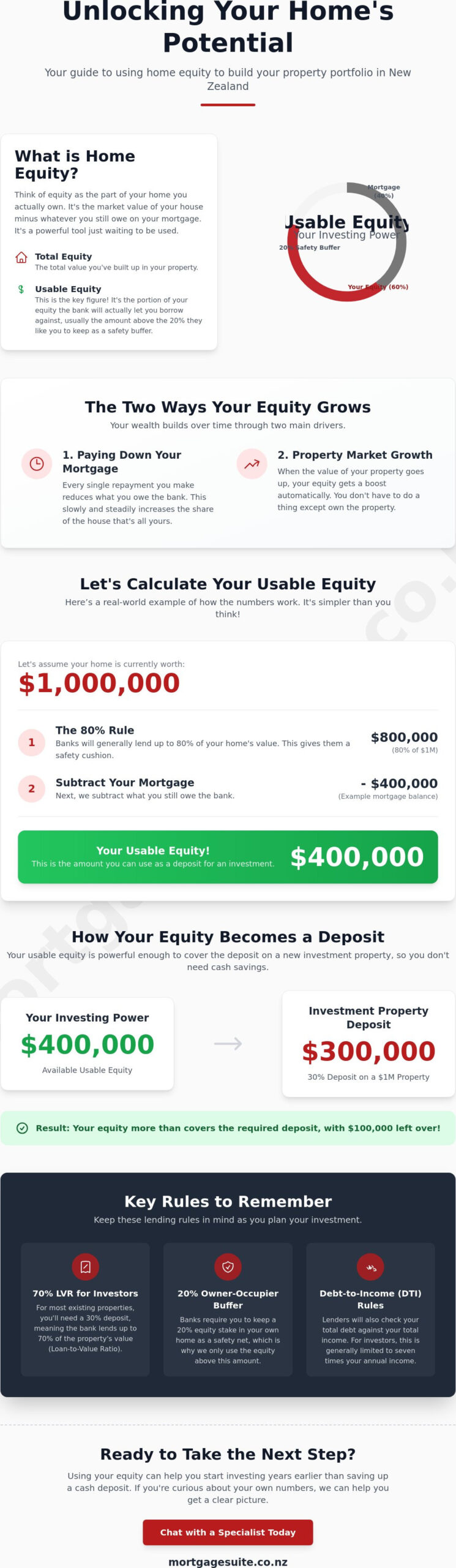
It’s a common mistake to think you can spend every dollar of equity you have. Banks are cautious; they want a safety buffer to protect themselves if property prices take a sudden dip. Because of this, they won’t let you borrow against 100% of your home’s value. Generally, for your own home, banks prefer you to keep at least 20% of the value as a “hands-off” zone. Your usable equity is the amount above that 20% mark. This is the only figure that really matters when you’re planning your next move.

How your home becomes the deposit for a rental

You might have heard the term “cross-collateralisation.” It sounds like a mouthful, but it just means the bank uses your current home as security for a new loan on an investment property. Under the rules set in December 2025, investors usually need a 30% deposit for a rental property. By using home equity for investment NZ, you can cover that 30% using the value in your existing home instead of cash. This removes the massive hurdle of saving for years. It gives you the freedom to act when the right opportunity comes along, using the house you already live in to secure your family’s financial future.

Calculating your usable equity: The 2026 NZ rules

Figuring out your actual borrowing power starts with a bit of simple arithmetic. While your bank statement shows your current balance, it doesn’t tell the full story of your potential. To get a clear picture of using home equity for investment NZ, you first need a realistic appraisal of what your home would sell for in the current market. Once you have that number and your exact mortgage balance, you can start applying the 2026 rules that banks use to decide how much they’ll lend you.

The process follows four logical steps. First, get that professional appraisal. Second, confirm your remaining mortgage balance down to the cent. Third, apply the 80% rule to your home; banks generally want you to keep 20% of the value as a safety net. Finally, you must factor in the current limits for the new property you want to buy. Following the NZ government house buying process is essential here, as it ensures you’re across the latest tax and compliance requirements while you crunch these numbers.

Understanding RBNZ LVR (Loan-to-Value Ratio) limits

As of the latest updates in December 2025, the Reserve Bank has set clear boundaries for investors. For most existing homes, you’ll need a 30% deposit, meaning the bank will lend up to a 70% LVR. LVR is simply the relationship between the money you owe and the property’s value as determined by the bank. If you’re looking at a new build, the rules are often more relaxed, sometimes requiring a much smaller deposit. You also need to keep the Debt-to-Income (DTI) rules in mind, which since July 2024, generally limit investor lending to seven times your annual income.

A quick example of the maths in action

Let’s look at how this works in the real world. Imagine you own a home worth $1 million with a $400,000 mortgage. The bank allows you to borrow up to 80% of your home’s value, which is $800,000. Subtract your $400,000 mortgage, and you have $400,000 in “usable” equity. If you want to buy an investment flat for $1 million, the 30% deposit requirement is $300,000. Because you have $400,000 available, your equity completely covers the deposit. You could potentially buy that investment property without touching your savings. If these numbers feel a bit overwhelming, a quick chat with the team at Mortgage Suite Ltd can help clear up exactly where you stand.

The pros and cons of using equity for property investment

Deciding to tap into your home’s value is a big step. It’s a bit of a balancing act between the excitement of growing your wealth and the reality of taking on more responsibility. One of the biggest wins is speed. In a market where prices can shift quickly, waiting to save a 30% cash deposit can mean you’re stuck on the sidelines for years. By using home equity for investment NZ, you can jump in as soon as the numbers make sense. Plus, since April 2025, you can once again claim 100% of your interest costs as a tax deduction on residential rentals, which makes the maths much friendlier than it was a few years ago.

On the flip side, you’re signing up for a bigger mortgage. That means your monthly repayments will increase, and you need to be sure your income can handle it. There’s also the risk of negative equity. If the market takes a breather and property values drop, you could end up owing more than the properties are worth. It’s a rare scenario for long-term investors who buy well, but it is something you should always keep in the back of your mind before signing on the dotted line.

Why using equity beats a personal loan every time

If you need funds for a deposit, a personal loan might seem like a quick fix, but it’s usually a poor choice for property. Mortgage rates are significantly lower than unsecured debt rates, which can save you thousands in interest over the life of the loan. You also have the luxury of spreading those repayments over 25 or 30 years, which keeps your weekly cash flow much healthier. Keeping everything organised under one lending umbrella also makes your life a lot simpler when it comes to tax time and your annual financial reviews.

Managing the risks of a bigger mortgage

Success in property isn’t just about buying; it’s about staying in the game. Banks focus heavily on your ability to meet repayments, especially with the 2024 DTI rules in place. Even with the OCR sitting at 2.25% as of May 2026, the Reserve Bank has hinted that rate hikes are likely. You should always test your budget against higher interest rates to ensure you aren’t caught out if your fixed term ends and rates have moved up. One strategy worth exploring is an interest only investment property loan NZ investors are increasingly using to free up monthly cash flow and keep their portfolio growing during uncertain rate environments. A solid “rainy day” fund is also a must. Rentals have a habit of needing urgent repairs at the worst possible time, and you don’t want to be scrambling for cash when the hot water cylinder gives up. Being prepared for these moments is what separates a stressed landlord from a successful investor.

Using Home Equity for Investment in NZ: A 2026 Guide to Growing Your Wealth

The step-by-step process to unlock your equity

Once you’ve crunched the numbers and seen the potential in your own home, it’s time to move from theory into action. The actual process of using home equity for investment NZ starts with a conversation with a specialist broker who knows the 2026 lending landscape inside out. They’ll help you look past the standard bank calculators to see what’s truly possible for your situation. Your first job is to get your paperwork sorted. This means gathering recent bank statements and proof of income to show the bank that you aren’t just asset-rich, but also a reliable borrower who handles their day-to-day cash flow with discipline.

Sometimes, the bank’s automated valuation system might give you a figure that feels a bit low. If that’s the case, a registered valuation from an independent professional can often reveal the true market value of your property, potentially unlocking more funds for your deposit. Once your value is confirmed and your application is reviewed, the goal is to secure a pre-approval. This is a game-changer. It gives you the confidence to walk into an auction or make an offer on a rental property knowing exactly where you stand, without the stress of a last-minute scramble for finance.

Preparing your finances for the bank’s “stress test”

Banks are incredibly thorough when they review your spending habits. They aren’t just looking at your salary; they’re checking your discretionary spending to see how a new loan will affect your lifestyle. Those daily flat whites or frequent takeaway meals might seem small, but they’re factored into the bank’s “stress test” of your finances. One of the smartest things you can do before applying is to “clean up” any short-term debt, like car loans or credit cards. Reducing these monthly obligations makes your application look much healthier and can significantly boost your borrowing power when you’re eyeing up a rental property.

Sticking with your bank vs. looking elsewhere

It’s easy to stay with your current bank because it feels simple, but simplicity can sometimes come at a cost. While your own bank knows your history, a different lender might offer more flexible terms or a lower interest rate that saves you thousands over time. For example, non-bank investment property loans NZ can often provide the breathing room that traditional institutions can’t, especially if your income situation is a little unique. A broker is essential here to compare the fine print and find the best fit for your long-term goals. If you’re ready to start the journey, chat with the experts at Mortgage Suite Ltd to see which path is right for you.

When the bank says “No”: Alternative equity solutions

It’s a frustrating moment when you’ve done the maths, found the perfect property, and your long-term bank turns you down. Mainstream banks are often bound by rigid “box-ticking” exercises that don’t always account for the complexities of real life. They might decline an application because of your age, a small blemish on your credit history, or because your income doesn’t fit their standard template. This is especially common for self-employed Kiwis or those with multiple income streams. However, a “no” from a big bank isn’t the end of your journey toward using home equity for investment NZ.

There is a whole world of 2nd tier and non-bank lenders in the New Zealand market that operate with more flexibility. These lenders often look at the bigger picture, focusing on the quality of the property and your overall strategy rather than just a computer-generated credit score. At Mortgage Suite Ltd, we specialise in finding a “yes” when others have said “no.” We don’t believe in a one-size-fits-all approach. Instead, we focus on tailoring a solution that fits your specific life stage and your long-term wealth goals, ensuring you aren’t held back by institutional red tape.

The power of 2nd tier lending for property investors

2nd tier lenders provide a vital alternative for investors who need a more common-sense approach to borrowing. These lenders often place more weight on the property’s value and its potential rental return than on a perfect financial history. If you’re looking to bridge a gap, a Home Equity Loan can be a powerful tool to get your project moving. These solutions are often used as a short-term stepping stone. You can get into the market now, start growing your equity, and then look to move back to a mainstream bank once you’ve built up a track record or your circumstances change. It’s about keeping your momentum alive when the traditional path is blocked.

Why a veteran broker is your best negotiator

When you’re dealing with non-bank lenders, having a seasoned professional in your corner makes all the difference. Krish Krishna brings over 20 years of banking experience to the table, which means he knows exactly how to frame your story so lenders see the value in your application. Mortgage Suite Ltd acts as a bridge between the rigid world of finance and your personal needs, advocating for you to get the best possible terms rather than just the easiest ones. We take the stress out of the mountain of paperwork and the back-and-forth negotiations. This leaves you free to focus on what really matters: finding the right house and growing your family’s wealth. If you’ve hit a brick wall with your bank, let us help you find the way around it.

Take the first step toward your investment future

Your home is more than just a place to live; it’s a powerful financial engine that can help you grow your wealth. We’ve seen how using home equity for investment NZ allows you to bypass the long wait for a cash deposit and get into the market sooner. By understanding the 2026 lending rules and preparing your finances for the bank’s stress tests, you can turn your existing property value into a thriving portfolio.

Success in property investment often comes down to having the right expert in your corner. With over 20 years of banking expertise and a focus on personalised negotiation, Krish Krishna and the team are here to help you navigate every hurdle. We specialise in finding creative solutions through 2nd tier and non-bank lenders when mainstream banks aren’t the right fit. It’s about more than just a loan; it’s about building a partnership that supports your long-term goals.

Ready to see how much usable equity you have? Book a free equity strategy session with Krish today and get the clarity you need to move forward. Your next investment property could be closer than you think, and we’re excited to help you make it happen.

Frequently Asked Questions

How much equity do I need to buy an investment property in NZ?

You generally need enough equity to cover a 30% deposit for an existing investment property while keeping a 20% safety buffer in your own home. For a $1 million rental, you’d need to unlock $300,000 in usable equity. If you are looking at a new build, the deposit requirements are often lower, so it’s worth checking with a professional to see how the current LVR rules apply to your specific target property.

Can I use equity to buy an investment property with no cash deposit?

Yes, you can buy an investment property with zero cash by using home equity for investment NZ to secure the entire deposit. The bank uses the value in your current home as security for the new loan, meaning you don’t need to dip into your savings. As long as your “usable equity” covers the 30% requirement for an existing house, you can start your investment journey without needing a massive cash pile.

What are the risks of using my home equity for investment?

The main risks include increasing your total debt and the potential for property values to fall. If the market takes a dip, you could end up with negative equity, where you owe the bank more than the properties are worth. You also need to be sure your income can handle higher repayments if interest rates move up, especially since the Reserve Bank signalled in May 2026 that rate hikes are likely.

Do I need a registered valuation to use my home equity?

You will often need a registered valuation if the bank’s automated system doesn’t quite capture the true value of your home. While banks use their own data first, a professional valuer provides a detailed report that can often reveal more equity, especially if you’ve renovated. It’s a small upfront cost that can be the difference between getting a “yes” or a “no” on your investment loan application.

How does the bright-line test affect my investment if I use equity?

The bright-line test means you’ll pay tax on any profit if you sell your investment property within two years of buying it. As of July 1, 2024, the period was shortened to this two-year timeframe for residential property. While your family home is exempt, any rental property you buy using your equity will be subject to these rules. It’s a vital factor to consider when planning your long-term exit strategy.

Can I use equity for a business loan instead of a rental property?

Yes, you can certainly use your home’s equity to secure a business loan. Many Kiwis choose this path because mortgage rates are typically much lower than the rates for unsecured business lending. It’s a cost-effective way to find the capital you need to start a new venture or expand an existing one. Just remember that your home is acting as security, so you need a solid plan to manage the repayments.

What happens to my equity if house prices in NZ drop?

If house prices drop, your total and usable equity will decrease because your home is worth less on paper. While this doesn’t change your mortgage repayments, it does reduce your safety buffer and your ability to borrow more in the future. This is exactly why banks insist on leaving a 20% equity cushion in your own home; it protects both you and the lender if the property market takes a breather.

Is interest on an equity-funded investment loan tax-deductible?

Yes, full interest deductibility for residential investment properties was restored starting from the 2025/2026 income year. This means you can once again claim 100% of the interest you pay on your investment loan against your rental income. This change makes using home equity for investment NZ a much more attractive strategy for building wealth than it was a few years ago, as it significantly improves your weekly cash flow. For investors looking to maximise this benefit, exploring an interest only investment property loan NZ lenders offer can further boost your monthly returns by reducing your required repayments during the investment phase.

Article by

Krish Krishna

Experienced Financial Adviser with over 46 years of Banking and Mortgage broking experience and over $2.0 Billion in loan settlements.