
Best NZ Investment Property Mortgage Rates: 2026 Guide

What if the bank offering you the lowest headline rate is actually the one most likely to stall your portfolio’s growth? It’s easy to feel overwhelmed by the constant stream of conflicting offers, especially when you’re also trying to figure out how the current Debt-to-Income (DTI) rules, capped at seven times your income for investors, affect your borrowing power. You probably feel frustrated when mainstream banks say no, even when you know your strategy is solid. Finding the best mortgage rates for investment property nz should be about more than just a lucky number; it’s about securing your financial future.

We agree that the current market feels like a maze of shifting regulations and “special” offers that don’t always apply to your specific situation. We’ll show you how to look past the flashy headlines to find an investment loan that actually helps you build wealth in today’s New Zealand market. In this 2026 guide, we’ll explore how to keep your property cash-flow positive, how to structure your loan to save on tax now that interest is fully deductible, and how to finally get that “yes” from a lender who understands your long-term goals.

Key Takeaways

  • Learn why the lowest advertised interest rate isn’t always the smartest choice for the long-term health of your property portfolio.
  • Understand how the latest Debt-to-Income limits and your deposit size directly influence the specific offers you’ll receive from lenders.
  • Discover how to secure the best mortgage rates for investment property nz by focusing on a loan structure that keeps your cash flow positive.
  • Master the art of “grooming” your bank statements months in advance to make your application look far more attractive to banks.
  • Find out how a professional partner can negotiate better terms on your behalf and take the stress out of the application process.

Finding the best mortgage rates for your NZ investment property in 2026

Let’s be honest: the NZ property market has seen a fair bit of change lately. We’ve moved through the highs of the New Zealand property bubble into a more calculated and cautious era. For anyone hunting for the best mortgage rates for investment property nz, the game has shifted significantly. It’s no longer just about which bank has the flashiest billboard or the most aggressive marketing campaign. Banks now look at investors through a much sharper lens than they do owner-occupiers. They view investment properties as higher risk because, if things go pear-shaped, people usually fight harder to keep the roof over their kids’ heads than they do for a rental property. This perceived risk is why investment rates often come with stricter equity requirements or slightly different pricing structures than a standard home loan.

Why ‘cheap’ isn’t always ‘best’

It’s incredibly tempting to grab the lowest number you see on a comparison website. However, that “cheap” rate often comes with strings attached that can trip you up later. You might find yourself locked into a contract with massive break fees or a total lack of offset facilities that could have saved you more in the long run. If you plan to renovate or sell the property in the next eighteen months, a rigid, low-rate fixed term could actually end up costing you thousands more than a slightly higher, more flexible option. Loan value is the total cost of ownership over the entire life of the debt, accounting for every fee and the price of lost flexibility. Don’t let a small saving today lead to a massive bill tomorrow when your circumstances change.

The 2026 New Zealand lending landscape

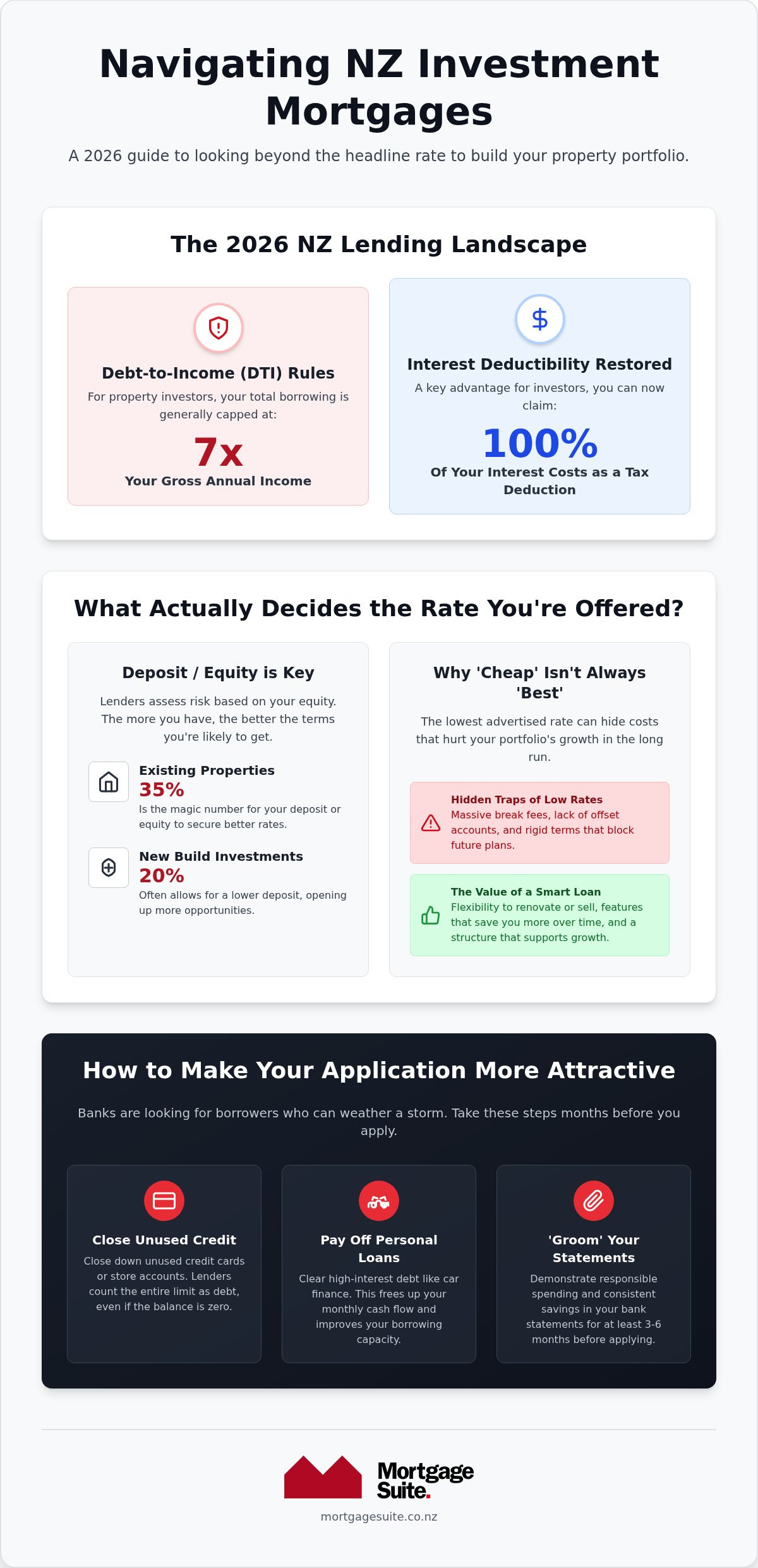
In 2026, the lending climate is defined by a renewed focus on stability. While interest deductibility is now fully back at 100 percent, the Reserve Bank’s Debt-to-Income (DTI) rules mean your income is under the microscope like never before. For investors, this limit is generally capped at seven times your annual income. The Official Cash Rate (OCR) continues to dictate what hits your hip pocket each month, making it vital to understand the mechanics behind these shifts. You can find a more detailed breakdown of these interest drivers in our guide to mortgage rates nz. Banks are being choosy because they have to be. They aren’t just looking for a 35 percent deposit on existing properties; they’re looking for a borrower who can weather a storm without missing a beat. Securing the best mortgage rates for investment property nz now requires a strategy that balances these regulatory hurdles with your personal financial goals.

What actually decides the rate you’re offered?

Lenders don’t just have one set rate that they hand out to everyone who walks through the door. Instead, they use their own ways of calculating how safe a loan is to decide how much they’ll charge you. Your personal financial health acts as a blueprint for the interest rate you’ll eventually pay. While you might be looking for the best mortgage rates for investment property nz, the bank is looking at how likely you are to pay them back without a struggle. Your ability to show you can afford the repayments is now often more important than the actual house you’re buying. If the bank’s stress test suggests you’d struggle if rates rose by another 2 percent, they’ll either decline the loan or offer less attractive terms.

Understanding LVR and DTI in 2026

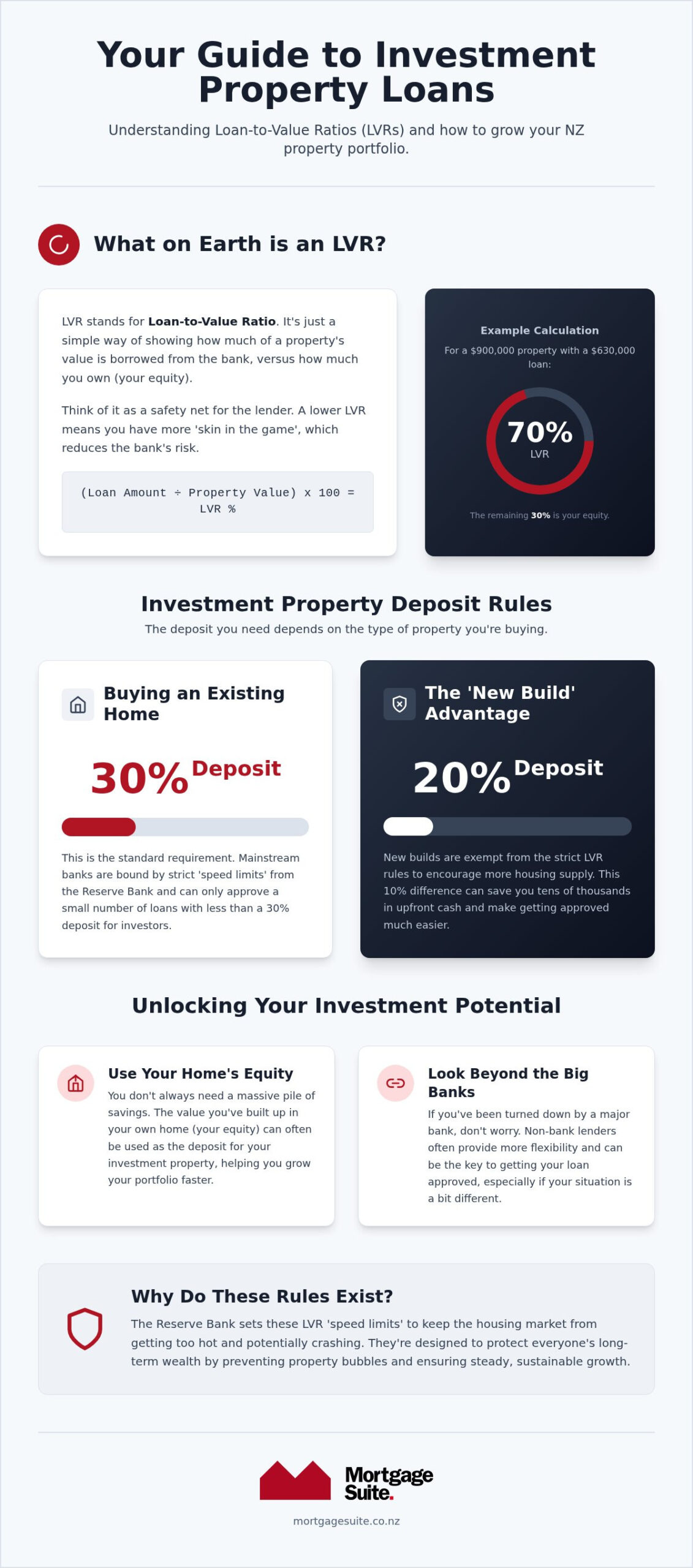
The factors that dictate your offer are your deposit size and your debt levels. For most existing investment properties in New Zealand, 35 percent equity is the magic number. If you have less than this, you’ll likely face higher interest costs or extra fees. You can find more details on these requirements in the official government guide to buying property.

The Debt-to-Income rules are the real game-changers for 2026. For investors, the limit is generally seven times your annual gross income. If you own several properties, this calculation includes the debt on every single one of them. To improve your position before you apply, consider these steps:

  • Close down unused credit cards or store limits. Banks count the full limit as debt even if you owe nothing.
  • Pay off high-interest car finance to free up your monthly cash flow.
  • Look into a new build investment, which often allows for a lower 20 percent deposit and different rules.

Mainstream banks vs. 2nd tier lenders

If a mainstream bank says no because your situation is a bit different, don’t worry. Mainstream banks love simple applications with a standard salary or wages. However, if you’re self-employed or have a more complex setup, a 2nd tier lender New Zealand might be a better fit. These alternative lenders are often more flexible with how they look at your money. For example, while a big bank might only count 75 percent of your rental income toward your ability to pay, an alternative lender might count the full 100 percent. This can be the difference between getting the green light or being stuck on the sidelines. If you’re unsure where you fit, reaching out to the team at Mortgage Suite Ltd can help you find the right path forward without the stress of multiple bank declines.

Comparing your options: Fixed, floating, and interest-only

Choosing the right structure for your loan is where the real money is made or lost in property investing. While everyone wants the absolute lowest number, the best mortgage rates for investment property nz are only as good as the flexibility they offer your portfolio. In a 2026 market where rates have shown some volatility, locking in a fixed rate provides a much-needed shield of certainty. For example, several major banks are currently offering one-year fixed terms around the 4.75 percent to 4.99 percent mark for those with enough equity. This allows you to forecast your expenses with precision, knowing exactly what your outgoings will be for the next twelve months regardless of what happens in the global economy.

Floating rates usually sit higher, often between 6.04 percent and 6.64 percent, but they serve a specific purpose. They’re perfect for investors who expect a lump sum of cash or want the freedom to make extra repayments without facing heavy fees for breaking a contract. If you’re looking for a balance between stability and freedom, interest-only terms can be a powerful tool. By only paying the interest, you lower your monthly commitment, which can be essential for keeping your rental income higher than your expenses while you’re growing your assets.

Fixed vs. Floating: Which way should you jump?

Many successful investors choose to split their loans into different fixed terms. You might put half on a one-year fixed rate and the other half on a two-year term. This strategy of staggering your loan end dates ensures that your entire debt doesn’t come up for renewal at the same time, protecting you from a sudden spike in market rates. Rate locking is simply the process of securing a specific interest rate for a set period so that your repayments stay the same even if market rates climb. Having a small floating portion is also a smart move if you want to use an offset account. This allows your rental income or personal savings to reduce the debt the bank charges interest on, meaning you only pay for the difference, which can save you thousands over the life of the loan.

The power of interest-only terms

Interest-only is often called the investor’s secret weapon because it helps your monthly cash flow. Since mortgage interest is now 100 percent deductible for tax purposes, many investors prefer to keep their debt levels higher on their rentals while using their spare cash to pay down the debt on their own family home. However, you need to be aware of the “sunset” period. This is the point where your interest-only term ends and the loan changes so you have to start paying back both the interest and the original amount borrowed. When this happens, your monthly costs can jump significantly. It’s vital to plan for this change well in advance. For a deeper look at how to manage these terms, check out our guide on residential investment property loans NZ. Securing the best mortgage rates for investment property nz is only the first step; the real success comes from a setup that supports your long-term growth.

Best NZ Investment Property Mortgage Rates: 2026 Guide

How to snag a better deal than the advertised rates

Reckon the rate on the website is the final word? Think again. Most banks treat those advertised numbers as a starting point for negotiation, especially for investors with a solid track record. To secure the best mortgage rates for investment property nz, you need to present an application that’s so clean the bank’s credit team can’t find a reason to say no. This process is often called “grooming” your accounts. For at least six months before you apply, you want your bank statements to show disciplined spending and consistent savings. It’s about making the bank’s job easy so they see you as a low-risk partner rather than just another file on their desk.

Step-by-step: Preparing your application

Getting your financial house in order before you approach a lender is essential. It’s not just about what you earn, but how you manage what you have. Follow these steps to make your application stand out:

  • Step 1: Minimise your ‘uncommitted’ credit. Banks look at the total limit on your credit cards and store accounts, not just what you owe. If you have a $15,000 limit but only use $500, they still factor in that full $15,000 as potential debt. Closing these unused accounts can instantly boost your borrowing power.
  • Step 2: Consolidate your debts. If you have a car loan and a separate personal loan, rolling them together can show better servicing ability by reducing your total monthly outgoings and simplifying your financial profile.
  • Step 3: Organise your rental appraisals and tax records early. Having your paperwork ready to go shows you’re a professional who knows the market. This builds trust with the lender from day one and ensures there are no dramas during the approval process.

The ‘Broker Advantage’ in rate negotiations

This is where having a veteran negotiator in your corner changes the game. We don’t just send an application to one bank and hope for the best. Instead, we pit the banks against each other to see who blinks first. Our 20 plus years of experience in the New Zealand market means we know which buttons to push and which lenders are currently hungry for investment business. Sometimes the absolute best mortgage rates for investment property nz aren’t with the big four, but with smaller lenders you might never have heard of.

We handle the hard yakka of the paperwork and the back and forth negotiation, ensuring you get a “yes” that actually helps you build wealth. We’ve seen every market cycle since 2000 and know how to navigate this one to your advantage. If you’re ready to see what’s possible beyond the standard bank offers, talk to our team of expert mortgage brokers today and let us do the heavy lifting for you.

Why Mortgage Suite makes the hard yakka easy

Finding the best mortgage rates for investment property nz shouldn’t feel like a second job. We know that the paperwork, the constant emails, and the worry about whether you’re getting a fair deal can be exhausting. That’s why we’ve built a service that takes the weight off your shoulders. We’ve seen every market cycle since 2000, from the boom times to the more challenging years. We know how to navigate the current 2026 landscape because we’ve been here before. Our approach isn’t about a quick transaction; it’s about building a long-term partnership where we help you grow your wealth property by property. We handle the tricky bits so you can focus on finding your next great investment.

We understand that every investor’s situation is unique, and we take the time to listen before we act. This isn’t just about a one-off loan; it’s about having a steady hand to guide you through the fluctuating New Zealand market. We speak plain English, not bank-talk. Our goal is to give you straightforward advice that gets results, ensuring there are no dramas along the way. Whether you’re looking for your very first rental or you’re a seasoned pro with a massive portfolio, we have the expertise to help you move forward with confidence.

Meet Krish and the team

Krish Krishna leads the team with over two decades of banking experience. This deep understanding of how banks operate is your secret weapon for securing the best mortgage rates for investment property nz. Because Krish has sat on the other side of the desk, he knows exactly how banks think and what they need to see to say “yes.” We’ve earned a reputation as dedicated negotiators who won’t take no for an answer. If a mainstream bank turns you down, we don’t just give up. We look at alternative options, including 2nd tier loans, to find a way forward that keeps your investment goals on track. We offer a national service across New Zealand, so no matter where your next property is, we’re here to help.

Ready to get your investment sorted?

Getting started is as easy as a quick, no-obligation chat. In our first conversation, we won’t just talk about numbers. We’ll talk about your strategy, your timeline, and what you’re hoping to achieve. It’s a consultative process designed to make you feel supported and confident. We’ll answer your questions, clear up any confusion about the current rules, and start mapping out a plan that works for you. There’s no pressure and no complex jargon; just professional guidance from people who genuinely care about your success. Let’s find the best rate for your investment property together and get your portfolio moving in the right direction.

Secure your property future today

Building a profitable property portfolio in 2026 requires more than just picking the lowest number on a bank’s website. Success comes from looking beyond the headline interest rate to find a structure that truly supports your specific goals. Whether that means using interest-only terms to maximise your cash flow or carefully grooming your accounts to impress a lender, a proactive strategy is your best asset. Finding the best mortgage rates for investment property nz is a journey that involves strategic positioning and expert negotiation.

Accessing both mainstream and 2nd tier lenders is much simpler when you have a partner who understands the nuances of complex investor portfolios. With 20+ years of industry experience, we handle the hard yakka and the paperwork to ensure the process is no dramas for you. We’ll do the heavy lifting. Book a free chat with our investment loan experts today and let’s get your next move sorted. You’ve done the research; now it’s time to take the next step toward building your wealth with confidence.

Frequently Asked Questions

What is the average interest rate for an investment property in NZ right now?

As of August 2026, one-year fixed rates for investment properties generally sit between 4.75 percent and 4.99 percent among the major banks. Variable or floating rates are significantly higher, often ranging from 6.04 percent to 6.64 percent. These figures change frequently based on wholesale funding costs, so it is always best to check the latest offers before making a final decision on your loan structure.

Can I use the equity in my own home to buy an investment property?

Yes, you can certainly use the equity built up in your family home to fund the deposit for an investment property. This is a common strategy for Kiwi investors to avoid using their own cash. By re-mortgaging a portion of your home’s value, you can create the 35 percent deposit required for an existing rental property without needing to save for years.

Do investment properties always have higher interest rates than home loans?

Investment properties do often have slightly higher rates because banks reserve their “special” discounts for owner-occupiers with at least 20 percent equity. While the base rates might look similar, investors sometimes face additional margins or fewer fee waivers. Securing the best mortgage rates for investment property nz requires looking past standard home loan advertisements to find products specifically designed for rental portfolios.

How much deposit do I really need for an investment property in 2026?

In 2026, you generally need a 35 percent deposit for an existing residential investment property. This means you can borrow up to 65 percent of the property’s value. However, if you are looking at a new build, the rules are often more relaxed, usually requiring only a 20 percent deposit. These limits are set by the Reserve Bank to manage risk in the housing market.

What happens if my bank declines my investment loan application?

If a mainstream bank declines your application, you still have several options through 2nd tier or alternative lenders. These lenders often have more flexible criteria and might look more favourably on self-employed income or complex financial situations. While their interest rates can be slightly higher, they provide a vital bridge for investors who don’t fit the rigid boxes of the major institutional banks.

Is it better to fix my investment loan for one year or five years?

Most investors in the current 2026 market are choosing shorter terms like one or two years to maintain flexibility. Fixing for five years provides long-term certainty but can be risky if market rates drop significantly during that time. A shorter term allows you to review your strategy more frequently and adjust your portfolio as the economy shifts or your personal circumstances change.

How do the new DTI rules affect my ability to get a good rate?

The Debt-to-Income (DTI) rules limit your total borrowing to seven times your annual gross income for investment purposes. This means that even if you have a massive deposit, your income might prevent you from getting the best mortgage rates for investment property nz if your total debt is too high. It forces a focus on your actual ability to pay the loan back comfortably.

Can a mortgage broker really get a better rate than I can get myself?

A mortgage broker can often secure a better deal because they have the power to negotiate with multiple lenders simultaneously. We know which banks are currently under quota and more likely to offer a discount to win your business. Beyond just the interest rate, we also negotiate for better terms and cash-back offers that you might not get by walking into a branch yourself.

Article by

Krish Krishna

Experienced Financial Adviser with over 46 years of Banking and Mortgage broking experience and over $2.0 Billion in loan settlements.

Interest Only Investment Property Loan NZ: A Strategic Guide for 2026

What if the smartest way to build your wealth wasn’t actually paying off your debt as fast as possible? Most people think an interest only investment property loan nz is just a temporary fix to keep your head above water, but in 2026, it’s actually a clever strategy to help you grow your portfolio faster. You’ve probably noticed that even with the latest tax rules that let you claim back interest, low rental returns can make it really tough to cover both the loan repayments and the interest every month. It’s discouraging when your big plans are held back by banks with strict rules that don’t seem to care about your personal goals.

We understand that frustration, and we’re here to show you a better path forward by using interest-only periods to free up your cash for your next move. This guide will walk you through how to boost your monthly cash flow, make the most of current tax rules, and create a solid plan for securing your second or third property. You’ll discover how to look beyond the big banks and build a long-term strategy that actually works in today’s New Zealand market. By the time you’ve finished reading, you’ll have a clear, simple roadmap to grow your portfolio and your wealth with total confidence.

Key Takeaways

  • See how switching to interest-only payments can immediately improve your monthly cash flow, giving you more room to manage costs or save for your next move.
  • Explore how an interest only investment property loan nz works with the latest tax changes to help you keep more of your rental income.
  • Learn the truth about “payment shock” and how to use smart refinancing to extend your interest-only periods safely.
  • Discover why looking beyond the big banks can give you the flexibility needed to grow a larger property portfolio.
  • Follow our simple two-step process to audit your current equity and map out a clear path toward your financial goals.

What is an interest only investment property loan in the NZ market?

At its heart, an interest-only loan is a setup where your regular repayments only cover the interest charges on the money you’ve borrowed. You aren’t actually chipping away at the original loan amount during this time. It’s a bit like paying “rent” to the bank for the use of their money while you wait for the property to grow in value or for your rental income to increase. Choosing an interest only investment property loan nz is a deliberate choice for many people who want to keep their monthly outgoings as low as possible.

In the 2026 New Zealand market, this approach has become a go-to strategy for those looking to build a portfolio. With the full restoration of interest tax claims that started back in 2025, the financial landscape for landlords has shifted. Investors are moving away from traditional repayment structures to better manage their rental returns. While the amount you owe stays the same, the extra cash in your pocket provides a safety net or a springboard for your next purchase. Most big banks offer these periods for one to five years, though some specialist lenders are now providing much longer terms if you have the right strategy in place. For a comprehensive overview of how residential investment property loans NZ work in today’s lending environment, our 2026 investor’s reference guide covers the full landscape in detail.

The difference between traditional loans and interest-only

The main difference is how your money is used each month. With a standard loan, your payment is split between the interest and a small portion that reduces your debt. With an interest-only loan, you skip that debt reduction part entirely. On a standard Auckland-priced property, this can be a real game changer for your bank balance. Based on current 2026 interest rates, your monthly repayments could be $600 to $1,000 lower than they would be on a traditional loan. It’s important to remember that this isn’t about avoiding your debt forever. It’s a strategic cash-flow management tool rather than a permanent debt state.

Why 2026 is the year of “Refining” your portfolio

We’ve seen plenty of change lately. With the Official Cash Rate sitting at 2.25% as of late 2025, mortgage rates have stabilised, but they still require careful management to stay profitable. Using interest-only periods allows you to stay in the game even during high-interest cycles without feeling the squeeze on your lifestyle. This year is all about refining investment property NZ portfolios. By structuring your debt more intelligently, you can ensure your existing properties aren’t just sitting there, but are actually working to fund your next move. This interest only investment property loan nz strategy ensures you have the cash ready to jump on new opportunities as they come up.

The top 4 reasons NZ investors choose interest-only loans

Deciding how to pay back your bank is a huge part of your financial strategy. For many, an interest only investment property loan nz isn’t just about making life easier today; it’s a smart way to build wealth much faster. There are four big reasons why this works so well in the current market. First, it keeps your monthly cash flow high. By not paying down the original loan amount, you keep more money in your pocket to cover maintenance, unexpected repairs, or to build a healthy emergency buffer. Second, it’s very tax-efficient. Since you can now claim back 100% of your interest, keeping that loan amount steady can actually help you when it’s time to talk to your accountant.

Growing your portfolio is often a race against time and how much cash you have available. This brings us to the third reason: helping you grow. You can save the extra cash you aren’t giving to the bank to reach your next deposit goal much quicker. Finally, it lets you focus on your personal debt. It makes very little sense to pay off a tax-friendly investment loan while you still have a mortgage on your own family home. Pausing the repayments on your rental debt lets you smash your own home loan first, which is a much more effective way to use your income.

Boosting your actual return

The logic here is quite simple: when your outgoings are lower, your actual return on the money you’ve put into the property goes up. In a market where rental income can be tight, this structure often makes the difference between a property that pays for itself and one that costs you money every week. It also means you aren’t tying up your cash in a low-interest debt when you could be using that money to invest elsewhere for a better result.

The “Home First” strategy

We often talk to clients who feel a bit guilty about not paying off their investment debt, but the “Home First” strategy is a total game changer. Your family home loan isn’t tax-deductible, so it should always be the first thing you try to get rid of. By using the extra cash from your interest-only period, you can make significant extra payments on your own home mortgage. If you’re currently using home equity for investment NZ, this ensures you’re clearing your most expensive debt first while your rental property potentially grows in value. If you want to see how these numbers look for your own situation, our team would love to help you check your lending options and find a plan that puts your home first.

Is an interest-only loan risky? Addressing the big objections

It’s natural to feel a bit of hesitation when considering an interest only investment property loan nz. We often hear the same concern from clients: “What happens when the five-year term is up?” The fear of a “payment shock” — where your repayments suddenly jump because you’re forced onto a principal and interest structure — is a common worry. However, for most proactive investors, this is more of a myth than a reality. You aren’t simply at the mercy of the clock; you’re in the driver’s seat of a strategic financial plan. Most investors don’t wait for the term to end; they’re already looking at their next move well before the deadline hits.

In New Zealand, wealth is traditionally built through capital gains rather than the slow grind of debt reduction. By choosing not to pay down the principal, you’re making a deliberate choice to prioritise your cash flow today. This allows you to hold your property through market cycles, like the current stabilisation phase we’re seeing in 2026. If the property value increases while your debt stays the same, your equity still grows. It’s about understanding that an interest-only period is a tool for a specific phase of your investment journey, not a permanent state of debt.

Managing the “End of Term” transition

When your interest-only period approaches its end, you generally have three paths: refinance with a new lender to start a fresh interest-only term, extend the current arrangement with your existing bank, or transition into principal and interest repayments if your cash flow allows it. This is where having an expert broker becomes vital. We recommend starting these conversations at least six months before your term expires. This gives us enough time to negotiate with lenders or look at second-tier options if the mainstream banks have become too rigid. Every property in your portfolio needs a clear exit strategy or a plan for this transition to ensure you’re never caught off guard.

The impact of DTI and LVR restrictions

The lending environment has changed significantly with the Reserve Bank of NZ’s latest rules. While the 70% LVR restriction for investors is a known factor, the Debt-to-Income (DTI) restrictions introduced in 2026 have added a new layer of assessment. These rules can sometimes limit your ability to simply “roll over” an interest-only loan if your total debt levels are high relative to your earnings. As of 2026, DTI limits have forced non-bank lenders to scrutinise interest-only applications through a much tighter lens, focusing heavily on a borrower’s total debt across their entire portfolio rather than just the individual property’s yield. Structuring your loans correctly from the start is the best way to ensure you remain flexible as regulations evolve. Our guide to residential investment property loans NZ explains exactly how to navigate these DTI and LVR rules when structuring your next application.

Interest Only Investment Property Loan NZ: A Strategic Guide for 2026

Mainstream banks vs. 2nd tier lenders: Where to get your IO loan

Most investors start their journey with one of the big four banks, but many eventually run into what we call “bank fatigue”. It’s a common hurdle where mainstream lenders often cap an interest only investment property loan nz at a total of five years. Once you hit that limit, the bank will typically insist you switch to principal and interest repayments. For a growing portfolio, this sudden increase in monthly outgoings can be a massive blow to your strategy. This is exactly why we look for “hidden” lenders that the big banks don’t want you to know about, ensuring your plans aren’t cut short by rigid internal policies.

You might notice that interest rates at non-bank lenders are sometimes a fraction higher than the “special” rates advertised by the big banks. However, it’s vital to look at the bigger picture of your cash flow. A slightly higher interest rate on an interest-only basis often results in much lower monthly payments than a lower rate on a principal and interest basis. We help you crunch these numbers to see which option actually keeps more money in your pocket each month. It’s about finding the right balance between the cost of the money and the flexibility it gives you to keep moving forward.

When to look beyond the “Big Four”

If your bank has recently declined your application due to high DTI levels or what they call “unserviceable” debt, it’s time to look elsewhere. Non-bank lenders are often much more accommodating for self-employed borrowers or those with complex income structures. Many of our clients also choose a “split banking” strategy to keep their personal home and their investments with different lenders. This protects your family home from being tied up in the same security net as your rentals. You can learn more about these options in our guide to non-bank investment property loans NZ.

The flexibility of 2nd tier loan structures

The real advantage of 2nd tier lenders is their investor-friendly mindset. While a retail bank might have a strict five-year limit, some non-banks are willing to offer longer interest-only periods, sometimes even for the life of the loan in specific cases. This flexibility is a game changer for anyone focused on long-term wealth rather than just paying down debt. With over 20 years of banking experience, Krish Krishna knows exactly how to pitch your case to these lenders to get the best possible outcome. If you feel like your bank is holding you back, contact us today to explore a lending structure that actually fits your goals.

How to set up your interest-only strategy with Mortgage Suite

Setting up an interest only investment property loan nz requires more than just filling out a form; it demands a clear, long-term vision. We’ve refined a four-step process that takes the guesswork out of your lending. It begins with Step 1: The Portfolio Audit. We take a look at your current equity and debt structure to see if your money is working as hard as it should be. Many investors have “lazy” equity sitting in their homes that could be better utilised. Step 2 is all about Defining the Goal. We need to know if your priority is boosting your weekly cash flow or if you’re trying to stockpile a deposit for a new build by the end of 2026.

Once we have your roadmap, we move to Step 3: The Lender Match. This is where our deep institutional knowledge comes into play. We don’t just look at the big banks like ANZ or Westpac; we also scan the second-tier market to find a lender whose criteria match your specific profile. Step 4 is The Application. We handle the heavy lifting, the phone calls, and the complex negotiations on your behalf. Our goal is to remove the obstacles that often stand between an investor and their next property, ensuring the process is as smooth as possible. We make sure the bank understands your strategy so they see you as a professional investor rather than just another borrower.

Why a specialist broker makes the difference

Having a dedicated negotiator in your corner is a massive advantage in today’s shifting market. We understand the nuances of the non-bank landscape and how to present your case to get a “yes” when others might say “no”. We take great pride in helping first-home buyers transition into the world of property investment, guiding them through that first crucial purchase. Because Mortgage Suite serves clients nationally across NZ, we can help you organise your finance regardless of where you are located. You get the benefit of our 20 plus years of experience, combined with a personal touch that the big banks often lack.

Your next steps for 2026

If you’re ready to refine your strategy, the best place to start is with a no-obligation chat. We can review your current interest rates and see if there is a more efficient way to structure your repayments. It is also worth checking our latest guide on equity release home loan NZ to see how you can unlock the value in your existing home to fund your next move. We aren’t just here for a single transaction; we’re here to be your partners in long-term wealth creation. Let’s work together to ensure your portfolio is robust, profitable, and ready for whatever the market brings next.

Take control of your property investment future

An interest only investment property loan nz is more than just a way to lower your monthly outgoings; it’s a tactical choice that gives you the flexibility to grow your portfolio with confidence. We’ve seen how smart debt structuring and choosing the right lender can help you manage your cash flow while staying ahead of changing regulations. Whether you’re looking to clear your personal mortgage faster or secure your next rental, having a clear plan is what separates a successful investor from the rest.

At Mortgage Suite, we bring over 20 years of banking and brokerage experience to the table. We specialise in complex investment structures and have deep connections with both mainstream and second-tier non-bank lenders. We’ll handle the heavy lifting and act as your dedicated negotiator to ensure you get the best possible outcome for your personal situation. Book a strategy session with Krish and the Mortgage Suite team today to start refining your strategy for 2026. We’re excited to partner with you on your journey toward long-term wealth and success.

Frequently Asked Questions

Can I get an interest-only loan for my own home in NZ?

Yes, it is possible, but banks are generally much stricter with home loans for owner-occupiers. They usually only grant these for a short period, typically one to two years, for specific reasons like a temporary drop in income or during major renovations. Mainstream lenders prefer you to pay down the debt on your own home to build equity rather than just paying the interest.

How long can an interest-only period last on an investment property?

Most mainstream banks in New Zealand offer interest-only terms between one and five years. However, there are exceptions, such as ANZ, which currently offers up to ten years for property investors. If you need a longer period to suit your strategy, we often look at non-bank lenders who can provide more flexibility with their timeframes and extension options.

Will an interest-only loan cost me more in the long run?

You will pay more total interest over the life of the loan because you aren’t reducing the principal balance. Since the debt stays the same, the bank charges interest on the full amount for a longer period. While the monthly outgoings are lower, you need to weigh this up against the long-term cost, though many investors find the improved cash flow is worth the trade-off.

Do I need a bigger deposit for an interest-only investment loan?

The deposit requirements are usually the same as a standard loan, which is typically 30% for investors under current 2026 LVR rules. The main difference lies in the bank’s assessment of your ability to pay. They will check your income more rigorously to ensure you can still afford the repayments once the interest-only period ends and you’re required to pay back the principal.

Can I switch from principal and interest to interest-only midway through my loan?

You can certainly ask to switch, but the bank will treat this as a fresh application. They’ll perform a full credit assessment to make sure you meet their current 2026 lending standards. This includes checking your income against the latest debt-to-income (DTI) restrictions to ensure the new repayment structure is sustainable for your personal situation and doesn’t put you at risk.

What happens if the property value drops during my interest-only period?

If the property value falls, your equity decreases because your loan balance remains exactly the same. This doesn’t usually impact your daily life unless you need to sell the property or refinance with a different lender. It’s a reminder of why we always recommend keeping a healthy equity buffer and taking a long-term view of the New Zealand property market.

Are interest-only loans still tax-deductible in New Zealand?

Yes, 100% of the interest on residential investment loans is deductible for the 2025/2026 tax year. This full restoration of deductibility makes an interest only investment property loan nz a highly effective tool for landlords. It allows you to maximise your tax claims while keeping your monthly costs low, which is a significant shift from the rules we saw a few years ago.

Why would a non-bank lender be better for an interest-only loan?

Non-bank lenders often provide a level of flexibility that the big retail banks simply can’t match. They are frequently more willing to offer longer interest-only terms or work with borrowers who have complex income, such as being self-employed. If you’ve hit a wall with your current bank’s internal limits, a second-tier lender can often provide the breathing room you need to keep growing.

Article by

Krish Krishna

Experienced Financial Adviser with over 46 years of Banking and Mortgage broking experience and over $2.0 Billion in loan settlements.