
How Much Deposit for an Investment Property in NZ? Your 2026 Guide

What if the biggest barrier to starting your rental portfolio isn’t actually a massive pile of cash, but simply knowing how to unlock the value you already own? Many Kiwis feel stuck behind a wall of confusing finance rules, worried that their local bank will say no because they don’t fit a perfect mould. It is completely natural to feel a bit uncertain when you’re trying to figure out how much deposit for investment property nz requires in today’s shifting market.

We understand that you want clear answers so you can move forward with confidence. In this 2026 guide, we promise to break down the exact percentages you need for both new builds and existing homes. You will discover how to use your current home as security, potentially removing the need for a cash deposit entirely. We will also explore reliable paths to getting a loan even if the mainstream banks aren’t being helpful, ensuring you have the support of a steady hand as you grow your property wealth.

Key Takeaways

  • Learn why the current rules often require a 35% deposit for existing homes, but how you can get started with just 20% if you choose a new build.
  • Discover how to figure out how much deposit for investment property nz is required by using the “hidden” value in your own home instead of your savings account.
  • Explore how 2nd tier lenders can help you secure a loan and provide a path forward even if the big banks have said no to your application.
  • Get a clear plan for organising your paperwork and “cleaning up” your bank statements to ensure your loan gets across the line.
  • Understand how to use your home equity as a steady bridge to help you grow your property portfolio faster and more reliably.

Understanding NZ Investment Deposit Requirements in 2026

When you’re trying to figure out how much deposit for investment property nz lenders require, it’s best to think of it as your entry fee into the market. A deposit is simply the portion of the property price you pay upfront, while the bank covers the rest. In 2026, the Reserve Bank of New Zealand (RBNZ) continues to use these rules as a way to keep the national economy stable. They want to ensure that if property prices move around, both you and the bank are protected by a solid buffer.

You don’t always need a pile of cash sitting in a savings account to get started. While a cash deposit is the most straightforward method, many successful Kiwis use the equity in their current home instead. Equity is the gap between what your house is worth today and what you still owe the bank. This year is particularly unique because while deposit percentages have stayed firm, the way banks look at your total debt has become much more detailed. It’s no longer just about the cash you have; it’s about your overall financial health.

Why do investment deposits differ from home loans?

Banks view investment loans through a different lens than the mortgage on your own home. It comes down to risk. If money gets tight, most people will do whatever it takes to keep the roof over their own heads, but they might let a rental property go first. Because of this, lenders ask for a larger safety net to protect their investment. To keep things simple, Loan-to-value (LVR) rules are basically the bank’s way of saying they’ll only lend you a specific percentage of what the property is actually worth.

The “standard” vs. “special” deposit requirements

For an existing house, most big banks will ask for a 35% deposit, though you may find some lenders accepting 30% in specific cases. However, if you’re looking at a new build, you might only need 20%. This is a significant difference that can change your entire investment strategy. Your income also plays a massive role. Even if you have a huge deposit, the bank will check if your earnings can cover the repayments if interest rates were to rise. If you’re just starting to explore these ideas, our Mortgage School is a great place to get a handle on the basics before you dive into the deep end.

Is it 20% or 35%? The LVR Rules Explained

LVR is simply the bank’s way of measuring how much they’re lending compared to what the house is worth. If you’re buying a property for $1 million and the bank lends you $650,000, your LVR is 65%. The remaining $350,000 is your deposit. The Banking Ombudsman Scheme provides helpful guidance on how these lending limits are applied to protect consumers across the country. These rules act as a safety net for the entire financial system, ensuring that both the borrower and the lender have a bit of breathing room if market prices change.

Deciding how much deposit for investment property nz banks expect depends largely on the age of the house you want to buy. For most existing homes, the standard rule is a 35% deposit, though some lenders may allow 30% depending on your overall financial position. However, this isn’t a one size fits all situation. Different lenders have different appetites for risk. Some non-bank options might offer more flexibility if your situation is a bit unique or if the big banks have already turned you away. Knowing how much deposit for investment property nz lenders will ask for is the first step in planning your next move.

The New Build advantage for NZ investors

A “New Build” is typically defined as a property bought from a developer within six months of being completed. The government and the Reserve Bank encourage these because they add to the total housing supply in New Zealand. Because of this, you usually only need a 20% deposit. This smaller entry point allows you to keep more cash in your pocket or spread your capital across more properties. It’s a popular strategy for those looking to grow a portfolio quickly without needing a massive upfront sum. Choosing a fresh build also means you often face fewer maintenance costs in those first few years, which helps your cash flow stay steady.

Existing properties: Navigating the 35% hurdle

If you’ve got your eye on a character villa or a standard suburban home that’s been around for a few years, the bank will likely ask for a 35% buffer. They see older homes as slightly higher risk because of potential maintenance issues or slower capital growth in some areas. Telling the difference is usually simple: if it’s already been lived in or was finished more than six months ago, it’s “existing” in the eyes of the bank. If you’re worried about how these numbers affect your budget, you can use our mortgage calculator to see what your repayments might look like. We are here to help you find the right path even when the rules seem rigid.

No Cash? How to Use Home Equity Instead

Imagine you’ve lived in your home for several years. During that time, the property market has likely climbed, and you’ve been diligently chipping away at your mortgage. That “gap” between what your house is worth today and the amount you still owe the bank is your equity. It is essentially wealth you’ve built up simply by owning your home. When people ask how much deposit for investment property nz requires, they are often surprised to learn they might not need to provide any physical cash at all. Instead, you can use that built-up value as your deposit.

A mortgage broker acts as a professional guide to help you unlock this value. We look at your current financial setup and find ways to tap into that equity to fund your next purchase. Most mainstream banks will let you borrow up to 80% of your current home’s value for this purpose. For example, if your house is worth $1 million and you owe $400,000, you aren’t just sitting on $600,000 of “free” money. The bank requires a safety buffer, so they look at that 80% mark ($800,000) and subtract your current debt ($400,000). That leaves you with $400,000 of usable equity to put towards a rental property.

Consider the case of Sarah. She had only $5,000 in her savings account but owned a home worth $900,000 with a $400,000 mortgage. By using her equity, she was able to secure a $180,000 deposit for a new build investment property without spending a single cent of her cash savings. She effectively started her portfolio with $0 cash out of pocket because her home did the heavy lifting for her.

Calculating your usable equity

Finding your investing power involves some simple maths. First, take your home’s current market value and multiply it by 0.8. Second, subtract your existing mortgage balance from that total. The resulting figure is the amount you can potentially use to figure out how much deposit for investment property nz lenders will allow you to contribute. Banks don’t let you use 100% of your equity because they need to ensure that if the market dips, you won’t end up owing more than the house is worth. To see how these numbers look for your specific situation, you can try our mortgage calculator to get a clearer picture of your potential.

The risks and rewards of cross-collateralisation

This is a professional term for linking your home and your investment property together as security for your loans. While it is a common way to get started, it does mean your family home is tied to your investment’s performance. To keep your own home safe, we often explore ways to structure your loans so there is a “firewall” between the two properties. Getting professional advice before you sign anything is vital. You want to grow your wealth, but you also want the peace of mind that your family’s front door is always protected. We focus on creating a steady plan that balances growth with long-term security.

How Much Deposit for an Investment Property in NZ? Your 2026 Guide

Alternative Options: When the Big Banks Say No

Walking into a local branch only to be told you don’t fit their mould can be incredibly disheartening. Perhaps your income fluctuates because you’re self-employed, or maybe you’re just a few percentage points short of the standard deposit. This is where 2nd tier or non-bank lenders become a vital part of your investment strategy. When you’re trying to figure out how much deposit for investment property nz requires, these alternative lenders often provide a more practical path forward. They aren’t bound by the same rigid internal policies as the big four banks, which allows them to look at your whole financial story rather than just a tick-box on a screen.

There are trade-offs to consider, of course. Non-bank lenders generally charge interest rates that are 1% to 3% higher than mainstream banks, according to data from MoneyBalance in May 2026. However, for many investors, the slightly higher cost is a small price to pay for actually getting a foot in the door. It’s about accessibility. If a non-bank loan allows you to secure a high-performing property today rather than waiting three years to save more cash, the capital growth you gain often far outweighs the extra interest paid in the short term. It is a strategic move that treats the loan as a tool rather than a permanent burden.

The benefits of 2nd tier lending for investors

The biggest advantage here is flexibility. These lenders are often more generous when testing your income, especially if you have multiple revenue streams or rental income that a big bank might partially ignore. They also tend to move much faster. While a mainstream bank might take weeks to process a complex application, a 2nd tier lender can often provide a decision in a matter of days. This speed can be the difference between winning a deal and missing out. For more detail on how these institutions work, you can check out our 2nd Tier Lender New Zealand guide.

Is a non-bank loan right for you?

Alternative lending makes the most sense as a stepping stone. You might use a non-bank loan to buy your property now, then plan to refinance back to a mainstream bank once you’ve built up more equity or “cleaned up” your financial profile. This is where having an expert negotiator like Krish Krishna on your side is vital. We don’t just find you a loan; we build a long-term plan to ensure you aren’t paying more than you need to for longer than necessary. We act as your advocate, bridging the gap between rigid institutional rules and your personal financial goals. If the big banks have said no, contact us today to see how we can find a way forward together.

How to Get Your Investment Loan Approved

Securing a loan for a rental property involves more than just having the right amount of money in the bank. While knowing how much deposit for investment property nz lenders require is a great first step, you also need to prove that you can handle the ongoing costs. Banks are currently very thorough, often stress-testing your ability to pay at interest rates as high as 8% or 9%. This means they want to see that your finances are tidy and that you have a clear plan for the future. It’s best to start this process at least three months before you intend to buy.

One of the most effective things you can do is “clean up” your personal spending. Lenders will look closely at your last three to six months of bank statements. They aren’t just looking at your income; they’re looking at your habits. Reducing unnecessary subscriptions or frequent luxury purchases can make a significant difference in how a bank views your application. When they calculate your borrowing power, they typically only consider between 65% and 80% of your projected rental income. Showing that you have a lean, well-managed budget helps offset this conservative calculation and proves you’re a reliable borrower.

The Investor’s Application Checklist

Organising your paperwork early saves time and reduces stress when the right property finally appears. You’ll need to provide clear proof of income, such as recent payslips or financial statements if you’re self-employed. A professional rental appraisal from a reputable property manager is also essential; the bank needs an expert’s opinion on what the property will earn, not just a guess. Finally, don’t overlook your credit score. Even small, forgotten bills can cause delays, so it’s a good idea to check your record and fix any errors before the bank sees them. Having these details ready shows the lender that you’re a serious, prepared investor.

Why Mortgage Suite is your best investment partner

With over 20 years of banking experience, we know exactly how to present your story to a lender so it gets the green light. We have access to a vast network of both mainstream and 2nd tier lenders, many of whom you can’t reach on your own. This is particularly helpful if you’re still figuring out how much deposit for investment property nz banks will accept for your specific situation. We act as your advocate and negotiator, finding the right fit for your goals rather than just trying to sell you a single product. You can read our client reviews to see how we’ve helped other Kiwis navigate these rules to build successful portfolios. We’re here to be the steady hand that guides you through every step of the process.

Take the Next Step Toward Your Investment Goals

Building a property portfolio in New Zealand is a journey that requires both a solid plan and the right people in your corner. We have seen that while the rules for existing homes often demand a 35% buffer, new builds and the clever use of your current home’s equity can provide a much smoother path forward. Even if the big banks have turned you away, alternative lending options remain a powerful tool for those with a clear vision. Understanding how much deposit for investment property nz requires is only the first step; the real magic happens when you structure your finance to protect your home while growing your wealth.

At Mortgage Suite, we provide more than just a mortgage. With over 20 years of banking experience, our founder Krish Krishna offers the personalised attention and expert negotiation skills needed for non-bank and complex loans. We pride ourselves on being a steady hand in a fluctuating market, ensuring you feel like a priority rather than just a number. Chat with our expert team about your investment goals today and let us help you navigate the path to success. Your property journey is unique, and with the right support, your goals are well within reach.

Frequently Asked Questions

Can I use my KiwiSaver for an investment property deposit?

No, you cannot use your KiwiSaver funds to buy an investment property. These savings are specifically reserved for your first home or your retirement. If you have owned a home before, you might be eligible for a second chance withdrawal, but only if you intend to live in the new property yourself. For a pure rental investment, you will need to look at using cash savings or home equity instead.

How much deposit do I need for a new build investment in NZ?

You typically need a 20% deposit for a new build investment. The Reserve Bank of New Zealand provides this exemption to encourage the construction of more homes across the country. This lower entry point makes new builds a popular choice for those wondering how much deposit for investment property nz lenders require. It allows you to enter the market with less upfront capital compared to buying an existing house.

What is the “usable equity” rule for investors?

The usable equity rule allows you to borrow against 80% of your current home’s value, minus what you still owe on your mortgage. For example, if your house is worth $1 million, the bank sees $800,000 as the total lending limit. If your current mortgage is $500,000, you have $300,000 in usable equity. This amount can then be used as the deposit for your next investment property without needing physical cash.

Can I buy a rental property with a 10% deposit?

It is very unlikely that a mainstream bank will accept a 10% deposit for a rental property. The standard requirement is usually 35% for existing homes and 20% for new builds. While some 2nd tier lenders offer more flexibility, they still generally require at least 20% to manage their risk. Buying with a very small deposit is usually reserved for first home buyers who intend to live in the property themselves.

Does the Bright-line test affect how much deposit I need?

The Bright-line test doesn’t directly change how much deposit for investment property nz banks require, but it does affect your tax obligations. As of July 2024, if you sell a residential property within two years of buying it, you may have to pay tax on any profit. While this doesn’t change your upfront deposit, it is a vital factor to consider when planning your long-term investment strategy and potential future resale.

What happens if the bank declines my investment loan application?

If a mainstream bank says no, it doesn’t mean your journey is over. Many investors find success by looking at 2nd tier or non-bank lenders who have different ways of assessing income and deposits. We specialise in helping clients who don’t fit the standard bank criteria. We can often find a path forward by presenting your application to a lender that values your specific financial situation and your long-term wealth goals.

Is it better to have a cash deposit or use equity?

Neither is strictly better, as it depends on your personal goals. Using equity is the most common way Kiwis grow their portfolios because it doesn’t require years of saving cash. However, using a cash deposit can keep your home and your investment loans completely separate, which some people prefer for security. We can help you look at both options to see which structure provides the most protection for your family home.

How do interest rates affect the deposit amount required?

Interest rates affect your ability to service a loan, which is the bank’s way of checking if you can afford the repayments. If rates are high, the bank might limit how much they will lend you, even if you have a large deposit. In some cases, you might need to provide a bigger deposit than the minimum 20% or 35% just to bring the loan size down to a level your income can support.

Article by

Krish Krishna

Experienced Financial Adviser with over 46 years of Banking and Mortgage broking experience and over $2.0 Billion in loan settlements.

LVR for NZ Investment Property: 2026 Deposit Rules

Most investors see a 30% deposit requirement as a brick wall, but the truth is that the latest rules are more like speed limits that can be navigated with the right guidance. It’s completely normal to feel a bit overwhelmed by the constant talk of 70% limits and those new debt-to-income ratios. Hearing that you might need a massive deposit or that your income might not stretch far enough is enough to make anyone second-guess their next move. Understanding the current LVR for investment property NZ is the first step toward taking back control of your financial future.

We know how frustrating it is to deal with confusing bank talk and the fear of being turned down. You deserve a clear path forward that doesn’t involve jumping through impossible hoops. In this guide, you’ll discover how to navigate the latest 2026 rules and use your existing equity to grow your property portfolio without the usual stress. We’ll look at how new builds can get you in the door with a smaller deposit and show you how a seasoned hand can help you find a way through, even if the big banks have said no.

Key Takeaways

  • Learn why a 30% deposit requirement doesn’t have to stop your plans and how to work around the standard bank limits.
  • Discover why non-bank lenders might be the key to getting your loan approved if the major banks are being too strict.
  • Find out how to put the value in your current home to work so you can grow your portfolio without needing a massive pile of savings.
  • Understand exactly how the 2026 rules for LVR for investment property NZ change what you can borrow and where you should look for a deal.
  • See how expert help can turn a “no” into a “yes” by navigating the complex world of lending rules on your behalf.

Understanding LVR: The “Speed Limit” for Your Investment Journey

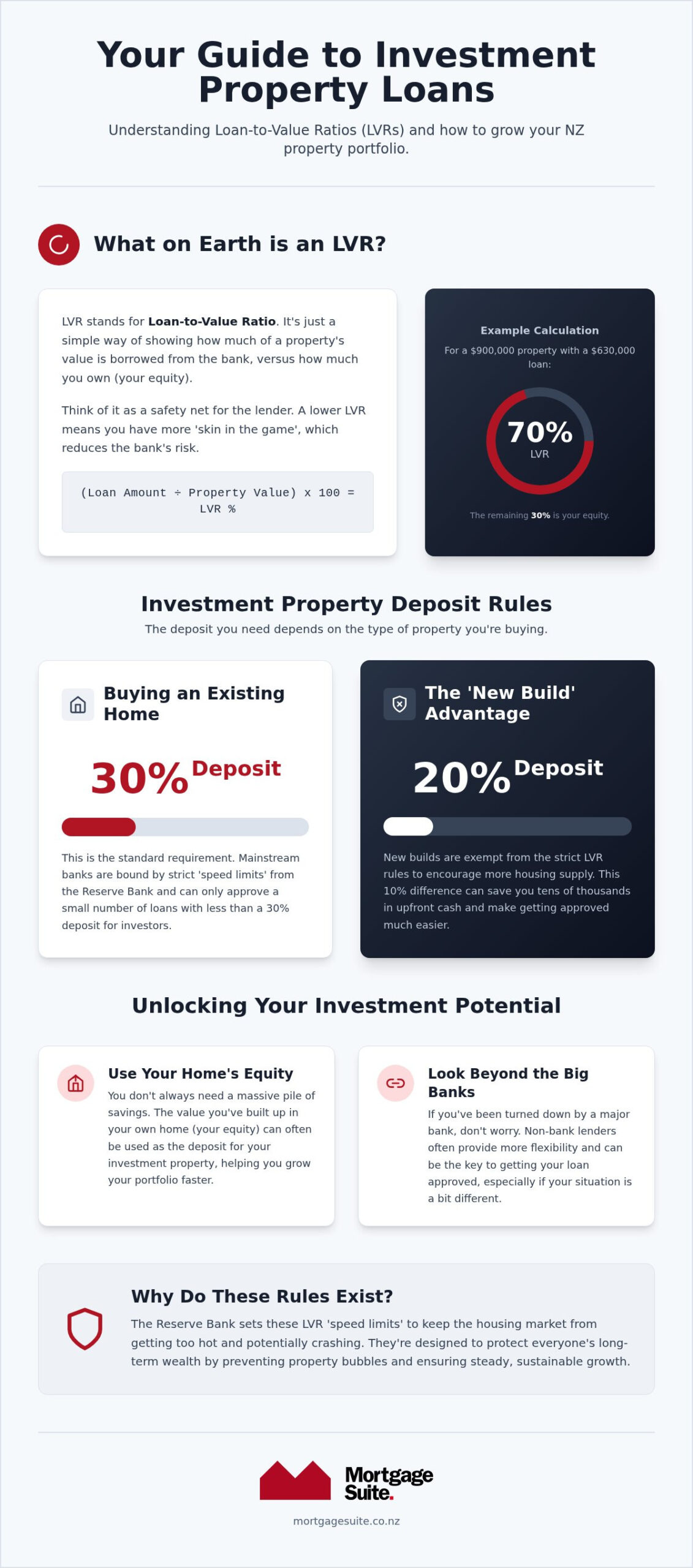
LVR is essentially a measure of how much risk the bank is taking compared to how much skin you have in the game. It stands for Loan-to-Value Ratio; it is just a simple way of saying how much of the property the bank owns versus you. If you have a property worth one million dollars and you owe seven hundred thousand, your LVR is 70%. The remaining 30% is your equity, which acts as a safety net for the lender. Understanding the LVR for investment property NZ is the foundation of building a successful portfolio.

Think of these rules as a speed limit set by the Reserve Bank. Their job is to keep the New Zealand housing market from over-cooking and potentially crashing. When the market gets too hot, the Reserve Bank steps in and tells the commercial banks they need to demand higher deposits. This slows down the flow of money and keeps the economy stable. It might feel like a hurdle when you are trying to buy, but it is actually designed to protect everyone’s long-term wealth. It ensures that the market doesn’t grow faster than people can actually afford.

Investors often face different limits than first-home buyers. This is because banks generally view investment properties as slightly higher risk. If the economy takes a turn, people usually fight harder to keep the roof over their own heads than they do for a rental property. Because of this, the LVR for investment property NZ is typically capped at a lower level, meaning you need a larger deposit to get the green light from a mainstream lender.

How to work out your LVR without a degree in maths

Calculating your position is much simpler than the banks make it sound. LVR is the percentage of a property’s value that is borrowed as debt. To find your number, just use this simple formula: (Loan Amount ÷ Property Value) x 100. For example, if you want to borrow $630,000 for a house valued at $900,000, your LVR is 70%.

In the current market, 70% LVR is the magic number for most Kiwi investors. This means you generally need a 30% deposit for an existing property. While we will chat about exceptions like new builds later on, aiming for that 30% mark puts you in a very strong position with almost any lender. It gives you the best chance of getting an approval quickly.

Why the Reserve Bank keeps changing the rules

The Reserve Bank isn’t trying to be difficult; they are trying to keep the economy on an even keel. By adjusting deposit restrictions, they can control how much debt is floating around the country. In 2026, we have seen a shift toward balancing these deposit rules with new income-to-debt rules. This double-layer of protection ensures that people aren’t just bringing enough cash to the table, but can also actually afford the weekly repayments if interest rates climb.

While these shifting goalposts can be frustrating, they are actually a good thing for property values. They prevent bubbles from forming, which means your investment is more likely to grow steadily over time rather than crashing overnight. Having a steady hand at Mortgage Suite Ltd to guide you through these changes makes all the difference when the rules feel like they are moving under your feet.

The 2026 LVR Landscape for NZ Residential Investors

The lending environment for 2026 is quite clear. If you are looking at an existing property, you will generally need to bring a 30% deposit to the table. This is the current standard for the LVR for investment property NZ as set by the Reserve Bank. It might feel like a high bar, but it is the reality most investors are working with right now. Even if you have a great income and a clean credit history, the banks are bound by these rules to ensure the market stays stable.

The 30% deposit hurdle for existing homes

Existing homes are often viewed as a higher risk because they don’t help solve the housing shortage. Banks are restricted by a “speed limit” which only allows about 10% of their new lending to go to investors with less than a 30% deposit. This creates a bit of a bank lottery. If you only have a 20% deposit, your chances depend on whether the bank has already used up its monthly quota for high-limit loans. If they have, you will likely be declined regardless of how good your application looks. It isn’t necessarily a reflection of your financial health; it is just a matter of timing and regulation.

The “New Build” loophole: Buying with just 20%

There is a clever way to get around the 30% rule. Buying a brand-new property is currently exempt from these strict LVR limits. The government wants to encourage more housing supply, so they allow investors to buy new builds with a lower deposit, typically 20%. This 10% difference can save you tens of thousands of dollars in upfront cash. Under the 2026 rules, new construction is exempt because it adds to the total number of homes available in New Zealand. It is a fantastic option for those who want to enter the market sooner rather than later without waiting to save a massive deposit.

If you already own a home, these rules still apply, but you might not need to save a pile of cash. You can often use the equity built up in your current house to cover that 30% requirement. This involves using the value of your own home as security for the new loan. It is a smart way to grow your portfolio without draining your bank account. You can use a mortgage calculator to see how much you might be able to borrow based on your current position. Understanding these nuances is exactly where a steady hand can help you find the right path forward.

Banks vs. Non-Bank Lenders: Finding the Flexibility You Need

Mainstream banks are like the strict teachers of the financial world. They have to follow the Reserve Bank’s rulebook exactly, which means they have very little room to move. If you don’t have that 30% deposit for an existing rental, they often can’t help you even if they wanted to. Non-bank lenders, or 2nd tier lenders, are different. They don’t have the same rigid shackles, which gives them the freedom to offer a “fair go” to investors who are doing well but don’t fit the standard bank mould. For many Kiwis, these alternative lenders are the key to breaking through the usual barriers.

When the bank says “no,” we look for a “yes”

It’s common to feel stuck when a big bank declines your application because of the strict LVR for investment property NZ limits or the new income-to-debt limits. Banks love a simple life; they want borrowers with a standard salary and a massive deposit. If your income comes from a business, commissions, or if you are simply bumping up against those new rules that cap how much you can borrow based on your earnings, the big banks might look the other way. Non-bank lenders take a more human approach. They look at the whole picture of what you own and what you earn rather than just scanning a checklist. While the interest rates might be a little higher, the flexibility they offer can be the difference between buying a property now or waiting years for the rules to change.

The non-bank advantage for portfolio growth

Many successful investors use a 2nd tier lender New Zealand as a strategic stepping stone. Instead of letting your growth stall because a bank won’t budge on their deposit rules, you can use a non-bank lender to secure the property and get your foot in the door. As your property value grows and you pay down the loan, your position improves. Once you meet the standard bank criteria, the team at Mortgage Suite Ltd can help you move that loan back to a mainstream bank to take advantage of lower rates. This path keeps your momentum going and ensures you aren’t left behind while the market continues to move. It’s about using the right tool for the right stage of your journey.

LVR for NZ Investment Property: 2026 Deposit Rules

Using Your Home Equity to Smash LVR Barriers

Many people believe they need to spend years saving a massive pile of cash before they can even think about buying a rental. In reality, your current home is likely your biggest financial asset, and it can do the heavy lifting for you. By tapping into the value already sitting in your house, you can often cover the deposit for a new purchase without touching your savings account. This is a common strategy when navigating the LVR for investment property NZ, as it allows you to use paper wealth to build real-world results.

It is vital to understand the difference between your total equity and your usable equity. While your total equity is the full value of your home minus what you owe, banks won’t let you borrow against every single dollar of it. They want a buffer to protect themselves. If you are looking for Residential Investment Property Loans NZ, knowing exactly how much you can actually touch is the first step in planning your next move.

Step-by-step: Calculating your usable equity

Calculating your position doesn’t have to be complicated. Follow these steps to see where you stand:

  • Step 1: Get an up-to-date valuation of your current home. Market prices change, so don’t rely on an old estimate.
  • Step 2: Calculate 80% of that value. This is the maximum amount most mainstream banks are willing to lend against your primary residence.
  • Step 3: Subtract your existing mortgage from that 80% figure.
  • Step 4: The leftover amount is your “usable equity.” This is the fund you can use as a deposit for your investment.

The trap of linking all your properties to one bank

One mistake many investors make is using one bank for everything and linking all their properties together. While it might seem convenient, it gives the bank a lot of power over your assets. If one property runs into trouble, the bank could potentially look at your family home to settle the debt. It also makes it much harder to sell one property without the bank demanding you pay down the loans on the others. This can severely limit your options when the LVR for investment property NZ rules change.

To keep your family home safe while growing your rentals, it is often better to use different lenders for different properties. This creates a “firewall” between your home and your investments. If you want to see how this strategy fits your specific goals, you can talk to the team at Mortgage Suite Ltd today for a personalised plan. Having a steady hand to manage these moving parts ensures you can grow your wealth without putting your most important asset at risk.

Trying to find the best way forward on your own often leads to missed opportunities or paying much more than you need to. The lending market is a bit of a maze, especially with the 2026 rules making things more complex for everyone. Having a veteran like Krish Krishna and the team at Mortgage Suite Ltd in your corner changes the game entirely. We take the weight off your shoulders by organising the paperwork and negotiating directly with lenders so you don’t have to. You shouldn’t have to spend your weekends stressed about bank criteria when you could be out looking for your next property. Ready to see what is possible? You can check out our mortgage calculator to start running the numbers on your next investment.

Why a seasoned broker beats a bank manager

A bank manager is naturally limited by what their specific employer allows. They can only sell you one brand, even if that brand’s current policy isn’t the best fit for your specific goals. At Mortgage Suite Ltd, we work differently because we have access to the whole market, from the big names to the flexible 2nd tier lenders we discussed earlier. Our team brings over 20 years of experience to the table, which means we have seen every type of rule change and market shift you can imagine. We know the shortcuts and the specific lender appetites that banks won’t tell you about.

This longevity in the industry means we aren’t just looking for a one-off transaction. We focus on building long-term partnerships that help you grow your portfolio year after year. We understand how a decision today affects your ability to borrow two or three years down the track. By managing the LVR for investment property NZ strategically across different lenders, we ensure you stay in the driver’s seat of your financial future.

Your next steps to property success

The first step is always a simple, jargon-free chat about where you are right now and where you want to go. We will help you get a clear handle on your position regarding the LVR for investment property NZ and your debt-to-income limits before you even start talking to a vendor. This preparation puts you in a much stronger position to negotiate because you’ll know exactly what you can afford and which lenders are likely to say yes. It removes the guesswork and the fear of being declined at the last minute.

If you want to keep learning at your own pace, our Mortgage School articles are packed with tips and insights to help you stay ahead of the curve. We believe that an informed investor is a successful one. Whether you are looking to buy your first rental or your tenth, having Mortgage Suite Ltd to guide you through the process makes all the difference. Being declined by a big bank isn’t the end of the road; it is often just the beginning of a much better, more personalised strategy.

Take the Next Step Toward Your Property Goals

Building a property portfolio in 2026 requires a smart strategy and a clear understanding of the latest rules. While the standard 30% deposit for existing homes feels like a high bar, we’ve seen how new builds and tapping into your usable equity can provide a much easier path forward. The key is to remember that the LVR for investment property NZ is a guideline for banks, not a brick wall for your ambitions. If the big banks have already used up their monthly lending limits or turned you away, there are still plenty of flexible options available.

With over 20 years of banking and brokerage expertise, Mortgage Suite Ltd specialises in finding the “yes” that the mainstream lenders might have missed. You can read our client reviews to see how we’ve helped Kiwis navigate these hurdles and come out on top. You don’t have to tackle this complex market alone. We are here to act as your steady hand and advocate every step of the way. If you’re ready to see what’s actually possible for your situation, book a jargon-free chat with the Mortgage Suite Ltd team today. Your next investment is closer than you think.

Frequently Asked Questions

What is the current LVR for investment property in NZ for 2026?

The current standard LVR for investment property NZ is 70% for existing houses, which means you will usually need a 30% deposit. This rule was confirmed by the Reserve Bank in their August 2026 review to help keep the housing market stable. However, if you are buying a brand-new home, the limit is generally 80%. This allows you to get started with a smaller 20% deposit while supporting the growth of new housing supply.

Can I buy an investment property with a 20% deposit?

You can certainly buy with a 20% deposit if you choose a new build, as these are exempt from the standard 30% requirement. Another option is to secure one of the high-limit loans that banks are allowed to offer each month under current speed limits. If the main banks say no, non-bank lenders often provide the flexibility needed to approve a 20% deposit loan for strong candidates who don’t fit the standard bank checklist.

What counts as a “new build” for LVR exemptions?

A new build is generally defined as a property that has been completed within the last six months and is bought directly from the developer. The main goal of this exemption is to encourage the construction of more homes across the country. By adding to the total housing supply, you are rewarded with a lower deposit requirement. This makes new builds a very popular choice for investors looking to grow their portfolios with less upfront cash.

How does the Debt-to-Income (DTI) ratio affect my LVR?

DTI ratios act as a second gatekeeper alongside your LVR. While LVR looks at the property’s value, the DTI ratio looks at your total debt compared to your gross annual income. For investors in 2026, the cap is seven times your income. This means even if you have a massive 50% deposit, a bank might still decline your application if your total debt exceeds that seven-times limit. It is about proving you can comfortably handle the repayments.

Can I use my KiwiSaver for an investment property deposit?

No, you cannot use your KiwiSaver funds to buy an investment property. These funds are strictly reserved for purchasing your very first home to live in or for your retirement. While it might be tempting to look at that balance as a potential deposit, you will need to use other sources like cash savings or the equity built up in your current home. We specialise in helping you find those alternative deposit sources to keep your plans moving forward.

What happens if the value of my investment property goes down?

If your property value drops, your LVR will naturally increase because your debt stays the same while the asset’s worth falls. Generally, banks won’t ask you to pay back the difference immediately as long as you keep up with your regular mortgage repayments. The main challenge arises if you want to sell the property or refinance to a different lender. In those cases, a higher LVR might make it harder to get a new deal or move your loan.

Do 2nd tier lenders have different LVR rules than banks?

Yes, 2nd tier lenders operate outside the strict Reserve Bank speed limits that bind the major banks. This means they can often be much more flexible with their deposit requirements and how they view your income. While they still want to see a solid plan, they are often a great solution for investors who have plenty of equity but don’t quite fit the rigid 2026 bank criteria. They look at the whole picture of your financial life rather than just a checklist.

Is it better to have a higher or lower LVR?

It depends on your personal goals. A lower LVR is generally safer and often gives you access to the very best interest rates because the bank sees you as a low-risk borrower. On the other hand, a higher LVR allows you to control a more expensive asset with less of your own cash. This can lead to faster portfolio growth if property values rise, but it also means your weekly repayments will be higher and you will have less of a safety net.

Article by

Krish Krishna

Experienced Financial Adviser with over 46 years of Banking and Mortgage broking experience and over $2.0 Billion in loan settlements.