

Commercial Property Loan Calculator NZ: Your 2026 Guide to Getting Sorted

What if the big bank’s “no” was actually the best thing that ever happened to your commercial property ambitions? Many Kiwi investors feel a genuine sense of dread when they look at the complex criteria of mainstream lenders, especially when you factor in the uncertainty of GST and those hefty valuation fees. It’s completely normal to feel a bit stuck when you’re trying to figure out if a deal actually stacks up. That’s why using a commercial property loan calculator nz is such a vital first step. It helps you move past the guesswork and start dealing with real numbers to see exactly how easily you can pay back the loan without the stress.

We know that you’re looking for more than just a generic estimate. You want a clear path to approval and the confidence that you aren’t missing out on better options elsewhere. In this guide, we’ll show you exactly how much you can borrow and what your monthly repayments might look like in the current 2026 market. We’ll also explore why looking beyond the big banks toward non-bank lenders can often be the smartest move you make. By the time you’ve finished reading, you’ll have a realistic guesstimate of your costs and a solid strategy to get your financing sorted.

Key Takeaways

  • Learn how to use a commercial property loan calculator nz to move from general dreaming to concrete planning with baseline figures tailored to your specific property type.
  • Discover why the loan-to-value ratio is often more important than the interest rate and how it dictates exactly how much a lender is willing to tip in.
  • Find out why a “no” from a mainstream bank isn’t the end of the road and how flexible second-tier lenders can bridge the gap for your unique situation.
  • Get a clear checklist of the essential financials you’ll need to package your application so it looks professional and stands the best chance of a quick approval.
  • Understand how expert negotiation and the seasoned experience at Mortgage Suite Ltd can turn your raw calculator results into a successful, funded deal.

Why a commercial property loan calculator is your best starting point

Starting a commercial venture is an exciting milestone, but it’s the numbers that turn a vision into a real street address. Using a commercial property loan calculator nz is the smartest way to bridge the gap between a “what if” idea and a concrete plan. It provides you with a baseline figure to work with, helping you understand your loan affordability before you even step foot in a bank. This is just a straightforward way of asking if the rent from your tenants or your business income can actually cover the debt without putting you under unnecessary pressure. When you have these numbers in front of you, the path forward feels much less like a gamble and more like a calculated business move.

Unlike standard home loans, commercial lending is highly tailored to each specific situation. The numbers change significantly depending on whether you are buying a small retail shop, a large warehouse, or a specialised medical centre. A calculator allows you to play with different “what-if” scenarios. You can see how a slight rise in interest rates might affect your weekly outgoings or how shortening the loan term changes the total interest you’ll pay over the life of the loan. You might even find that a property you thought was out of reach is actually manageable if you structure the loan differently. This level of preparation helps you move from dreaming to doing with a much clearer head.

Commercial vs. residential: Why the numbers look different

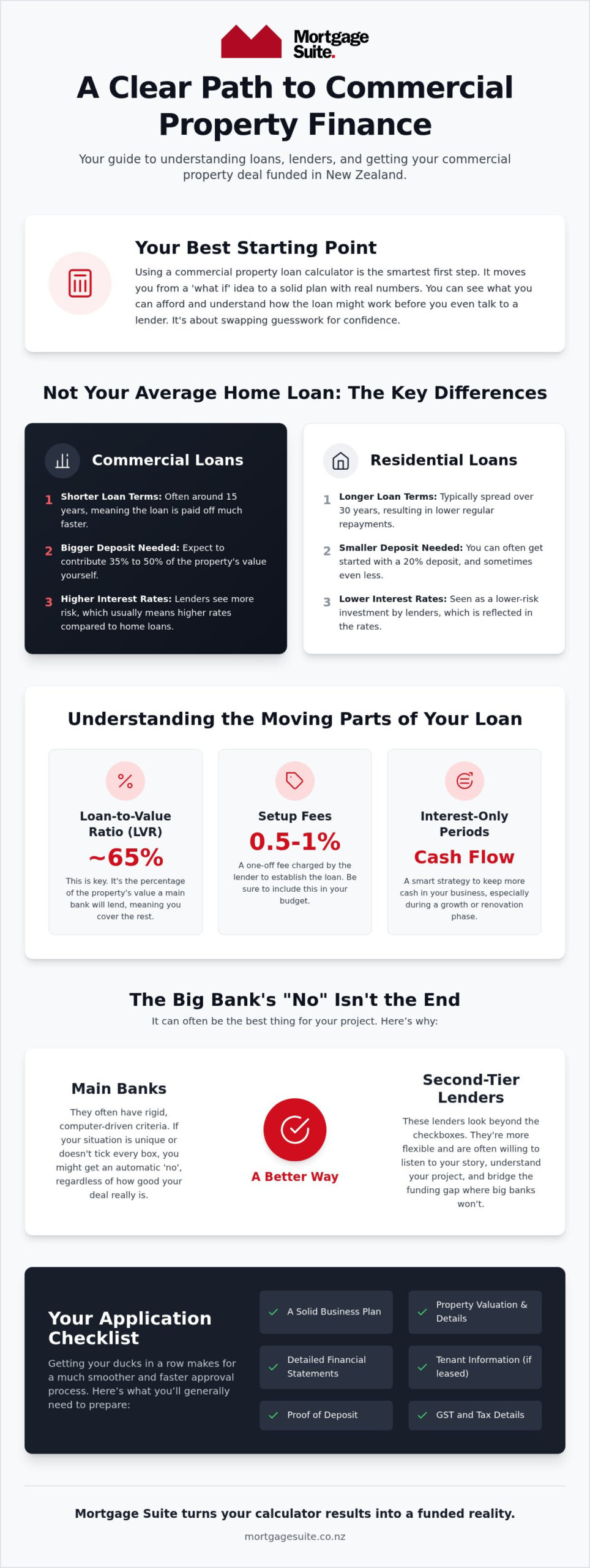
It helps to understand the fundamentals of what a commercial mortgage is compared to the standard house loan you might be used to. Commercial deals don’t follow the same rules as the family home. While you might get a 30-year term on a residential mortgage, commercial loans often wrap up much faster, frequently over 15 years. Because banks see a higher level of risk in business properties, interest rates are typically higher too. You’ll also need a much bigger “skin in the game.” Expect to provide a deposit between 35% and 50%, depending on the property type and its location. Lenders want to see that you have a significant commitment to the property before they agree to partner with you.

The “Guesstimate” vs. the Reality

Think of your calculator result as a helpful guide rather than a final, etched-in-stone offer. In the commercial world, almost everything can be negotiated. Your final interest rate and the total amount you can borrow will depend on your specific situation and the quality of the building itself. A modern office space with a long-term, reliable tenant is viewed very differently by a lender than a vacant industrial shed. Use the numbers from the commercial property loan calculator nz to build your business plan, but realise that these figures are just the starting point for a deeper conversation about strategy. Having a baseline estimate allows you to walk into a meeting with a lender feeling informed and ready to talk shop.

Understanding the “moving parts” under the hood of your loan

While a commercial property loan calculator nz is a brilliant tool for getting those initial numbers on paper, it’s important to remember that interest rates are only one part of the machine. To see if a deal truly stacks up, you need to look at the other moving parts that lenders use to decide if they’ll back you. The biggest factor is usually the loan-to-value amount. This is simply the percentage of the property’s value that the bank is willing to lend you. In the commercial world, this is much tighter than residential, often sitting around 65% for main banks. You also need to factor in the costs that a basic calculator might miss, such as setup fees. These are one-off costs charged by the lender to get the loan started, and they can range from 0.5% to 1% of the total loan amount.

During a growth phase, you might also negotiate an interest-only period. This can be a lifesaver for your cash flow, as it allows you to pay only the interest for a set time, keeping more cash in your business for operations or renovations. If these numbers feel a bit overwhelming, it’s often worth chatting with a specialist who can help you structure your commercial loan correctly from the start. Having a clear plan for these extra costs ensures you won’t be caught out by a cash shortage just as you’re trying to settle the deal.

Interest Coverage: Can the building pay for itself?

When you start looking at what you’ll need for a successful application, you’ll see that banks are obsessed with how well the building’s income covers the debt. They don’t just look at the total rent you collect. They focus on what’s left after all the costs like rates and insurance are paid. If the building generates significantly more than the interest costs, the bank feels much more relaxed about the deal. It’s their way of ensuring that even if interest rates tick up, you won’t be left out of pocket or struggling to meet your commitments each month.

Loan terms and paying off the debt

Standard commercial deals usually run over 15 years. This shorter timeframe means your monthly repayments will be higher than a home loan, but you’ll be clearing the debt much faster. This process of gradually paying off the debt over time is what keeps your equity growing and your business stable. You might also hear about large lump sum payments or term reviews at the end of a few years. These aren’t as scary as they sound; they’re just points in time, usually every three to five years, where the bank checks in to see how the property and your business are performing before renewing the loan. Using a commercial property loan calculator nz helps you model these shorter terms so there are no surprises down the road.

Why the big banks’ ‘computer says no’ isn’t the end of the road

It’s a common story in the Kiwi property market. You’ve run the numbers through a commercial property loan calculator nz, found a property that looks perfect, and then the big bank tells you they can’t help because you don’t fit their specific “box”. Mainstream banks are built for standard, low-risk scenarios. If your situation is even slightly unique, their automated systems often spit out a decline without looking at the actual merits of the deal. This is where 2nd tier lenders become your greatest asset. They don’t just look at a computer screen; they look at the property’s potential and your personal track record.

A calculator might show a higher interest rate for these non-bank options, but a 2nd tier loan could be the bridge you need to get the deal done. These lenders are perfect for “non-conforming” deals, such as specialised industrial sites or properties with shorter lease terms that scare off the big four. Instead of seeing a barrier, these lenders see an opportunity to support a growing business. It’s about finding a way to say yes when others have already walked away.

When to consider a 2nd tier lender

You might be self-employed with only one year of clean accounts, or perhaps you’re eyeing a specialised industrial site that the big banks find too risky. In these cases, 2nd tier lenders in New Zealand offer a vital lifeline. They are far more flexible with how they view income and credit history. Think of these loans as a strategic stepping stone. You secure the property now, build your equity or business history, and then look to move back to a main bank once you’ve ticked more of their traditional boxes later on.

The trade-off: Flexibility vs. Cost

Let’s be upfront about the costs. If you’ve used a commercial property loan calculator nz with main bank rates of 6.50% to 7.50% in mind, the 9% to 11% typically charged by non-bank lenders can look a bit steep. However, you have to weigh that against the “opportunity cost” of missing out on the property altogether. In a growing market, the capital gains or the business revenue generated by owning the building often far outweigh the extra interest paid. Getting the approval today is often much more valuable than waiting for a “yes” from a bank that might never come. It’s about looking at the bigger picture and having a steady hand to guide you through these alternative options.
Commercial Property Loan Calculator NZ: Your 2026 Guide to Getting Sorted

Getting your ducks in a row: What you’ll need for a successful application

Once you’ve used a commercial property loan calculator nz to get a handle on the repayments, it’s time to gather your evidence. Preparation is the secret sauce that turns a “maybe” into a “yes”. Lenders aren’t just looking at your bank balance; they’re looking for a professional, well-organised story. If your application is messy, the bank sees risk. If it’s tidy, you’re a safe bet. In the New Zealand market, the NBS (New Building Standard) rating is a total deal-breaker. This seismic score tells the bank how safe the building is in an earthquake. If the rating is too low, many banks will walk away immediately, no matter how strong your business is.

The paperwork trail

To get the ball rolling, you’ll need to gather a few essentials:

  • Two years of business accounts, including profit and loss statements.
  • Recent tax returns for you and your business.
  • Proof of your personal income.
  • A copy of the draft or current lease for the property.

Your “Statement of Position” is also a vital piece of the puzzle. This is essentially a financial CV that lists everything you own and everything you owe, giving the lender a snapshot of your financial health at a single glance. Providing a clean, easy-to-follow paperwork trail doesn’t just speed up the process; it can actually help you negotiate a lower interest rate because the bank feels more confident in your ability to manage the debt.

Due diligence costs to budget for

The numbers on your commercial property loan calculator nz won’t include the “hidden” costs of getting the deal across the line. You’ll need to have cash set aside for valuations, legal fees, and engineering reports. It’s important to remember that banks won’t accept a “Rateable Value” (RV) from the council. They’ll insist on a full report from one of their own approved valuers. If your plans are a bit more ambitious and you’re looking at how to finance property development for a new build or a major renovation, these costs can be even higher.

The “quality” of the tenant in the building is just as important as your own income. A blue-chip tenant with a long-term lease is a bank’s dream, while a brand-new startup might make them a bit nervous. Having an expert on your side to package this information correctly makes all the difference. We can help you prepare a bulletproof commercial application that speaks the lender’s language and highlights the strengths of your deal.

How Mortgage Suite Ltd turns your calculator results into a reality

You have likely spent some time with the commercial property loan calculator nz and have a rough idea of the costs involved. While those figures are a great starting point, they don’t tell the whole story of how a deal gets across the line. At Mortgage Suite Ltd, we specialise in taking those raw numbers and turning them into a viable financing strategy. We negotiate directly with banks and non-bank lenders to find a structure that actually fits your business goals, rather than just accepting the first offer that comes along.

Krish Krishna uses over 20 years of banking experience to package your application in a way that makes sense to credit managers. We know how to highlight the strengths of your deal, especially those tricky ones that mainstream banks might initially dismiss. It’s about more than just filling out forms; it’s about personal advocacy and making sure your voice is heard in a crowded market. We take the “scary” out of the numbers by providing a steady hand through the entire process.

Your advocate in the lending market

The world of commercial finance has its own rhythm, and we are here to help you navigate it. We speak the language of the lenders so you don’t have to worry about the technical talk. Mortgage Suite Ltd provides national coverage, helping Kiwis from the top of the North Island to the bottom of the South get the funding they need. If you already own a building but think you could be on a better deal or want to tap into your equity, we can also assist with a commercial property refinance to help you get ahead.

Ready to have a yarn about your next move?

A commercial property loan calculator nz provides the “what”, but we provide the “how”. We invite you to have a no-obligation yarn with our team to explore your options and see what’s truly possible in today’s market. Whether you’re a first-time commercial buyer or a seasoned developer, we are here to help you move forward with confidence. The calculator is just the start; the strategy is where the magic happens. Get in touch with the Mortgage Suite Ltd team today and let’s get you sorted.

Ready to turn those numbers into a street address?

Using a commercial property loan calculator nz provides the initial clarity you need to start your search, but the real success lies in the strategy you apply to those figures. We have explored the importance of understanding LVRs, interest coverage, and why a decline from a major bank is often just a detour rather than a dead end. Whether you are dealing with complex seismic ratings or simply need more flexible income criteria, the right preparation turns a daunting process into a manageable one.

At Mortgage Suite Ltd, we pride ourselves on being your dedicated advocates in a fluctuating market. With over 20 years of professional banking experience, we specialise in 2nd tier and alternative lending for those unique scenarios that don’t fit the standard bank mould. Our national service ensures that Kiwis across the country have access to expert negotiation and a steady hand during complex deals.

Let’s chat about your commercial financing goals today. We are ready to help you move beyond the calculator results and secure the property that will take your business or investment portfolio to the next level.

Frequently Asked Questions

How much deposit do I typically need for a commercial property loan in NZ?

You will generally need a deposit between 35% and 50% for a commercial purchase in New Zealand. Mainstream banks are quite conservative and usually lend up to 65% of the property’s value. If you’re looking at a specialised building, they might ask for even more cash up front. This higher deposit requirement is one of the biggest differences between business lending and buying a residential home.

Can I use the equity in my family home to buy a commercial building?

Yes, using the equity in your family home is a very common way to fund a commercial deposit. If your home has increased in value, you can often borrow against it to cover that 35% or 50% “skin in the game” required for the business property. It’s a smart way to get started without needing a massive pile of cash sitting in the bank, provided you have the income to support the extra debt.

What is a “good” interest coverage ratio for a commercial loan?

A “good” interest coverage ratio is typically 1.40x or higher for most mainstream lenders. This means for every dollar of interest you owe, the building’s net rent should bring in at least $1.40. If your ratio is lower, say around 1.00x, you might need to look at non-bank lenders who are more comfortable with tighter margins. This is a key figure to check after using a commercial property loan calculator nz.

Do commercial property loans in New Zealand have GST added to them?

Commercial loans are typically based on the GST-exclusive price of the property if you’re GST registered. Most commercial deals are “plus GST (if any)”, so you’ll need to work closely with your accountant to manage the cash flow during the settlement period. The bank won’t usually lend you the GST portion, as they expect you to claim that back from the IRD shortly after the purchase is finalised.

How long does it usually take to get a commercial loan approved?

You should allow between two to four weeks for a standard bank approval in the current market. Commercial deals require a lot more manual checking than residential ones, including a full review of leases and building reports. If you’re in a hurry, second-tier lenders can often move much faster, sometimes giving you a “yes” in just a few days if your paperwork is tidy and your strategy is clear.

What happens if a bank declines my commercial loan application?

If a bank declines your application, the first step is to look at the second-tier or non-bank market. A decline often just means you didn’t fit that specific bank’s rigid criteria, not that your deal is bad. Non-bank lenders are far more flexible with income types and property styles. We specialise in taking those declined applications and finding a lender that actually wants your business and understands your goals.

Are commercial mortgage rates fixed or floating in NZ?

Both fixed and floating rates are available in New Zealand, though the fixed periods are usually shorter, often between one and five years. Many business owners choose a mix of both to manage their risk. Because commercial terms are shorter overall, you’ll find that your interest rate is reviewed more frequently than it would be on a standard 30-year home mortgage, which keeps you on your toes with budgeting.

Is it harder to get a loan for a retail shop versus an industrial warehouse?

Generally, it is easier to get a loan for an industrial warehouse than a retail shop because banks see warehouses as a lower risk. Retail spaces can be harder to fill if a tenant leaves, whereas a clean industrial shed is always in high demand. If you’re eyeing a retail spot, you might find that using a commercial property loan calculator nz shows you’ll need a larger deposit to satisfy the bank’s risk team.


Article by

Krish Krishna

Experienced Financial Adviser with over 46 years of Banking and Mortgage broking experience and over $2.0 Billion in loan settlements.

Home Loans for First Home Buyers in New Zealand: The 2026 Comprehensive Guide

What if the traditional 20% deposit isn’t the immovable barrier you’ve been led to believe? For many Kiwis, the path to home ownership feels like a maze of shifting interest rates and rigid bank policies that often seem designed to keep you out. It’s frustrating to watch your savings grow while the goalposts move, especially when you’re trying to secure home loans for first home buyers New Zealand in a market that demands both precision and persistence. We understand that the fear of being declined by a mainstream bank is real, and the confusion surrounding KiwiSaver rules only adds to the pressure.

You deserve a clear, professional roadmap that turns that uncertainty into a concrete plan. This guide provides the seasoned expertise you need to navigate the 2026 lending landscape with confidence. We’ll break down the current income caps for the First Home Loan scheme, explain the mid-2026 KiwiSaver legislation changes, and show you how alternative lenders can offer the flexibility that big banks often lack. By the end of this article, you’ll have a thorough understanding of the support schemes available and the strategic steps required to finally unlock your own front door.

Key Takeaways

  • Gain a professional perspective on the 2026 property market to help alleviate anxiety and approach your purchase with seasoned confidence.
  • Navigate the updated 2026 criteria for KiwiSaver withdrawals and government-backed home loans for first home buyers New Zealand to maximise your available deposit.
  • Explore the benefits of 2nd tier lenders as a viable, flexible alternative to the rigid lending criteria often found at mainstream banks.
  • Learn how to accurately calculate your uncommitted monthly income and organise your financial history to present the strongest possible case to lenders.
  • Understand the value of having a dedicated negotiator with deep institutional knowledge to advocate for your success and remove common obstacles.

Entering the 2026 property market requires a steady hand and a clear head. It’s perfectly natural to feel a sense of “ladder anxiety” when you see interest rates like ANZ’s 4.79% for a one-year fixed term or Kiwibank’s 4.49% for six months. While the market has shifted significantly since 2024, the fundamental challenge remains the same: finding a way in. Navigating the New Zealand Property Market involves understanding that the headlines don’t always tell the full story of your personal borrowing potential. You aren’t just a number in a spreadsheet. You’re a future homeowner who needs a partner to translate complex banking jargon into a successful application. The standard bank path is often narrow, but it isn’t the only route available to you.

The Reality of Deposits in 2026

The old rule of a 20% deposit still exists, but it isn’t the only gatekeeper. Many buyers now aim for 10% or even 5% through specific schemes. If you’re looking at home loans for first home buyers New Zealand, you need to account for the Lender’s Mortgage Insurance (LMI). As of July 2025, the premium for the First Home Loan scheme sits at 1.2% of the loan amount. This is a cost for the lender’s security, but it’s often the key that unlocks the door when you haven’t yet built up massive equity. Equity is simply the difference between what your home is worth and what you owe the bank. Starting from scratch is hard, but it’s achievable with the right structure. For a comprehensive overview of every step involved, our first home buyer guide New Zealand walks you through the entire journey from savings to settlement.

Why a “No” from a Mainstream Bank Isn’t the End

Mainstream banks rely on rigid algorithms. If your profile doesn’t fit their specific “box” for risk appetite, their system triggers an automatic decline. This doesn’t mean you’re a bad borrower. It just means that particular institution isn’t the right fit for your current financial snapshot. Different lenders have different appetites for risk. Where a big bank might see a hurdle in your deposit structure or employment history, a 2nd tier lender might see a viable opportunity. We specialise in finding these openings, acting as a bridge between the institutional “no” and your eventual “yes.” Specialised financing can often provide the necessary bridge to get you into your first home when the traditional path feels blocked.

Maximising Government Assistance: KiwiSaver and First Home Loans

While the landscape for government support shifted when the First Home Grant closed in May 2024, several powerful tools remain available to help you bridge the gap. Understanding these first home buyer assistance schemes is vital for anyone looking to secure home loans for first home buyers New Zealand. We see many clients who feel discouraged by the loss of direct grants, but the reality is that your own savings and government-backed lending criteria can still provide a significant advantage if managed correctly. It’s about knowing which levers to pull and when to pull them to ensure your application is as strong as possible.

KiwiSaver: Your Secret Weapon

Your KiwiSaver is likely your most substantial asset in this journey. To utilise it for a withdrawal, you must have been a member for at least three years. You’re permitted to withdraw almost your entire balance, provided you leave a minimum of NZ$1,000 in your account. It’s a common misconception that you can take everything; the “kickstart” or its equivalent must stay behind. Additionally, funds transferred from an Australian superannuation scheme aren’t eligible for withdrawal. Mid-2026 brings even more flexibility, with new legislation allowing those in service tenancies to buy their first home without the immediate requirement to occupy it. This is a game-changer for workers in employer-provided housing. Getting a “letter of entitlement” from your provider early in the process ensures you know exactly what you’re working with before you start making offers.

The Kāinga Ora First Home Loan Advantage

The First Home Loan scheme remains a cornerstone for those with a smaller deposit. Underwritten by Kāinga Ora, it allows eligible buyers to purchase with just a 5% deposit. While some major institutions don’t participate, the options have expanded significantly. ASB joined the programme in February 2026, joining Westpac, Kiwibank, and several building societies. This scheme is particularly effective because house price caps were removed back in 2022, meaning you aren’t restricted by the price of the property, only by your ability to service the debt. However, income caps do apply:

  • Single buyers without dependents: NZ$95,000 or less (before tax) over the last 12 months.
  • Single buyers with dependents: NZ$150,000 or less.
  • Two or more buyers: A combined income of NZ$150,000 or less.

For those looking to build on Māori land, the Kāinga Whenua Loan provides a specific pathway that doesn’t require a traditional land mortgage, acknowledging the unique legal structures involved. Navigating these requirements can feel like a full-time job, but you don’t have to do it alone. If you’re feeling overwhelmed by the criteria, reaching out to the team at Mortgage Suite Ltd can help you determine exactly which scheme fits your financial profile.

Mainstream Banks vs. 2nd Tier Lenders: Finding Your Best Fit

In the New Zealand mortgage market, the “Big Four” often dominate the conversation. However, for many seeking home loans for first home buyers New Zealand, these institutions aren’t always the most accommodating partners. This is where 2nd tier lenders come in. These are non-bank financial institutions that provide residential loans but don’t hold a full banking license. They operate with different funding structures and, crucially, different sets of rules. While a mainstream bank might rely on a rigid “black or white” credit score, a 2nd tier lender often takes a more holistic view of your financial situation.

The core difference lies in flexibility. Mainstream banks are built for volume and speed, which means they use automated systems to filter out anything that looks slightly unusual. If you don’t fit their pre-defined box, you’re out. 2nd tier lenders are generally more human-centric. They’re willing to listen to the story behind a credit blemish or look at the potential of a property that a bank might deem too small or too unique. It’s a partnership based on individual merit rather than a cold algorithm.

When Mainstream Banks Make Sense

Mainstream banks are ideal if you have a “clean” application. This usually means a 20% deposit, stable PAYE income, and a flawless credit history. They offer the most competitive interest rates, such as ANZ’s 4.79% one-year fixed rate as of June 2026. You’ll also find enticing cash-back offers that can assist with moving costs or legal fees. If you fit their narrow criteria, the convenience of having your everyday accounts and mortgage in one place is a significant drawcard.

When to Consider a 2nd Tier Lender

If you’re self-employed with only a year of accounts, or if you’re looking at a small apartment, 2nd tier lenders are often your only path forward. They are also a lifeline for those with a minor credit blemish that triggers a “no” from mainstream institutions. While the interest rate might be higher than the 4.49% to 4.79% range currently offered by major banks, the trade-off is property ownership. We often view these loans as a strategic, short-term move. You pay a slightly higher rate for 12 to 24 months to get into the market, build equity, and then we execute a “pathway back to mainstream” strategy. Once your equity reaches the 20% threshold mentioned earlier, we can look to refinance you back to a bank for long-term savings.

Home Loans for First Home Buyers in New Zealand: The 2026 Comprehensive Guide

Preparing Your Application: A Step-by-Step Guide to Approval

Securing a mortgage isn’t just about having the money; it’s about proving to a lender that you’re a safe bet. In the current 2026 environment, where banks are scrutinising every dollar, your preparation needs to be flawless. We often see eager buyers rush into open homes before they’ve even looked at their own bank statements through a lender’s eyes. This leads to heartbreak when a “dream home” is snatched away because the finance wasn’t ready. To avoid this, you need a methodical approach that addresses the five pillars of a successful application.

  • Step 1: Organise your financial history. Lenders typically require three to six months of bank statements. They’re looking for consistent savings and “clean” spending habits.
  • Step 2: Calculate your true uncommitted monthly income. This is the surplus cash you have left after all fixed expenses, tax, and living costs are deducted from your pay.
  • Step 3: Understand the DTI (Debt-to-Income) ratios. By June 2026, DTI limits have become a standard tool for the Reserve Bank to manage risk. If your total debt is too high relative to your gross income, even a large deposit might not save the deal.
  • Step 4: Get your “Pre-Approval” sorted. This is your license to hunt. It tells real estate agents you’re a serious buyer with the backing of a lender.
  • Step 5: Engage a negotiator. Don’t just walk into your local branch. A professional negotiator presents your case to multiple lenders simultaneously to find the best fit for your goals.

The “Paperwork” Heavy Lifting

Clean spending habits for at least 90 days are non-negotiable. Banks look for red flags like excessive “Buy Now Pay Later” (BNPL) transactions or unarranged overdrafts. Even if you pay your Afterpay off on time, the total credit limit is often viewed as a potential debt by the bank’s algorithm. If you’re a contractor or business owner, the burden of proof is higher. You’ll need at least two years of certified accounts or tax summaries to prove your income is stable. Disclosing all credit card limits, even those with a zero balance, is essential because the bank calculates your borrowing power based on the limit, not what you currently owe.

Understanding Your Borrowing Power

Your borrowing power isn’t determined by the current interest rates you see advertised, such as ANZ’s 4.69% six-month special. Instead, banks use a “stress test” rate, which is often 2% to 3% higher than the market rate. This ensures you can still afford the property if rates rise in the future. Dependants also play a massive role; the bank allocates a fixed “cost per child” that reduces your uncommitted income. Remember, the cheapest rate isn’t always the best loan for your goals. A slightly higher rate with a lender who allows for a smaller deposit or offers more flexible terms might be the strategic choice that actually gets you the keys. If you’re ready to see how your profile stacks up against current criteria, the experts at Mortgage Suite Ltd can review your position before you talk to the banks.

How Mortgage Suite Negotiates Your Way into a First Home

Negotiation is the often-overlooked stage of the mortgage process. While many buyers assume their application is simply a matter of data entry, the way your financial story is presented to a lender matters immensely. Krish Krishna brings more than 20 years of seasoned banking experience to every negotiation, acting as a bridge between your personal goals and the rigid requirements of institutional lending. We don’t just process paperwork; we advocate for your success by speaking the “banker’s language” to credit managers who are looking for reasons to say no. Having an expert who knows the internal credit policies of various institutions is essential when you’re searching for home loans for first home buyers New Zealand.

This level of advocacy is particularly vital for “out of the box” clients. If you’re self-employed, have a non-standard income stream, or are working with a smaller deposit, a standard application might trigger an automatic decline. We specialise in identifying the strengths in your profile that an algorithm might miss. Our reputation for tenacity and industry knowledge allows us to secure home loans for first home buyers New Zealand even when the path seems blocked. Wherever you are in New Zealand, our national service scope ensures every Kiwi has access to high-level negotiation expertise.

A Personalised Approach to Lending

We’ve moved away from the cold, transactional nature of modern banking to a relationship-based model. Every application we handle is structured to highlight your specific financial strengths. This might involve explaining a temporary dip in income or detailing the growth potential of your business. The Mortgage Suite Ltd difference is built on a foundation of reliability and trust; we treat your first home purchase with the same priority and passion as if it were our own. We understand that this isn’t just a loan; it’s the foundation of your future.

Your Long-Term Property Partner

Our commitment to you doesn’t end when you get the keys to your first home. We view ourselves as your long-term property partner. As your equity grows and market conditions shift, we provide ongoing support to help you manage interest rate changes or plan for your first residential investment property. We’re here to ensure your mortgage remains a tool for wealth creation rather than just a monthly expense. If you’re ready to move beyond automated calculators and experience a professional, hands-on approach, Speak with Krish and the team about your first home today and let us start the negotiation for you.

Taking the First Step Toward Your New Front Door

Owning your first home in 2026 is an achievable reality when you have the right strategy and a seasoned advocate in your corner. We’ve explored how to leverage KiwiSaver, navigate updated income caps, and use 2nd tier lenders as a vital bridge to property ownership. Success in this market isn’t just about finding the lowest interest rate; it’s about professional preparation and expert negotiation that speaks the language of the banks. By organising your financial history and understanding your true borrowing power, you position yourself as a priority candidate for lenders.

With over two decades of banking and negotiation experience, our team specialises in finding solutions for “out of the box” profiles and navigating the complex world of non-bank lending. We provide a dedicated, national service that supports Kiwis across all of New Zealand, ensuring you’re never just a number in a system. If you’re ready to move past the automated calculators and secure a partnership built on trust and results, it’s time to act. Secure your first home loan with Mortgage Suite and let us help you find the right home loans for first home buyers New Zealand. Your journey to home ownership starts with a single, confident conversation.

Frequently Asked Questions

How much deposit do I really need for a first home in New Zealand in 2026?

You need as little as a 5% deposit if you qualify for the First Home Loan scheme underwritten by Kāinga Ora. While mainstream banks typically prefer a 20% deposit to avoid low equity margins, many buyers successfully enter the market with 10% by using a 2nd tier lender. If you have less than 20%, you should account for the Lender’s Mortgage Insurance (LMI) premium, which currently sits at 1.2% for government-backed loans.

Can I use my KiwiSaver for a deposit if I have owned a home before?

Yes, you can potentially use your KiwiSaver as a “previous home owner” if Kāinga Ora determines you are in a similar financial position to a first-home buyer. You must still meet the standard withdrawal criteria, such as being a member for at least three years and leaving a minimum balance of NZ$1,000 in your account. This is a vital pathway for those looking to re-enter the market after a significant life change or financial setback.

What is the difference between a bank and a 2nd tier lender?

A mainstream bank is a large institution with rigid, automated criteria, whereas a 2nd tier lender is a non-bank provider that often offers more human-centric flexibility. 2nd tier lenders are a strategic choice for self-employed Kiwis or those with “non-standard” income who don’t fit the narrow algorithms of the major banks. They provide an essential alternative when securing home loans for first home buyers New Zealand in a tight credit environment.

How does the First Home Grant work and am I eligible?

The First Home Grant is no longer available as the government closed the scheme to new applicants in May 2024. Instead, you should focus on the First Home Loan scheme, which still provides a pathway to ownership with a 5% deposit for eligible buyers. We recommend focusing on your KiwiSaver withdrawal and exploring alternative lending structures to bridge any remaining gap in your deposit requirements.

What happens if the bank declines my home loan application?

A decline from a mainstream bank is simply a sign that your profile didn’t fit their specific risk “box,” not the end of your home-owning dreams. We often review these declined applications and find solutions through 2nd tier lenders who take a more holistic view of your financial situation. It’s about finding a lender whose appetite for risk matches your current profile and restructuring your debt to meet modern DTI requirements.

Is it better to have a fixed or floating interest rate as a first-home buyer?

Most first-home buyers opt for a fixed rate to gain certainty over their repayments, especially with 2026 rates like ANZ’s 4.79% for a one-year term. Floating rates are currently higher, often around 5.79%, but they offer the flexibility to make unlimited extra repayments without penalty. Many of our clients choose a “split” mortgage, fixing the bulk of the loan for stability while keeping a small portion floating to pay down faster.

Do I need to pay for the services of a lending expert?

In the majority of standard residential applications, the lender pays a commission to the expert for presenting a high-quality application, meaning there is no direct cost to you. If your situation is particularly complex or requires a specialised 2nd tier lending structure that involves a fee, this will always be discussed with total transparency upfront. Our goal is to act as your advocate and ensure the process is as cost-effective as possible.

How long does the pre-approval process usually take in NZ?

A standard pre-approval usually takes between three to five working days once your full documentation is submitted to the lender. This timeframe can stretch slightly longer for complex applications involving self-employment or 2nd tier lenders that require manual assessment by a credit manager. Having your financial history and income proof organised before you start the process is the most effective way to secure home loans for first home buyers New Zealand quickly.

Article by

Krish Krishna

Experienced Financial Adviser with over 46 years of Banking and Mortgage broking experience and over $2.0 Billion in loan settlements.