
Assessing business loan repayments with bad credit in New Zealand

A bad credit history doesn’t automatically rule out a business loan in New Zealand. If you’re asking how to get a business loan with bad credit in NZ, lenders will look at whether your business is viable and can repay the loan and interest. Your credit history matters, but it is only part of the picture.

It’s understandable to feel uncertain, especially after a lender has declined your application. A decline isn’t a judgement on you or your business, and it doesn’t necessarily close off every option. The next step is to understand what a lender needs to see and whether repayments fit your business’s cash flow.

This guide explains what can affect eligibility, how to assess repayments and which financial documents can support an application. It also covers what to do after a decline, so you can address gaps and decide on a clearer next step.

Key Takeaways

  • Prepare tax returns for the past two to three years, alongside clear financial records, bank statements and a business plan.
  • Build a cash flow forecast using cautious income estimates and realistic costs to see whether repayments fit your business finances.
  • Lenders assess whether your business is viable and can repay the loan and interest; accelerated lending generally calls for at least 12 months of consistent profitability.
  • If an application is declined, use the lender’s reasons to strengthen your business plan and address gaps in the financial evidence.
  • A low credit score doesn’t tell the whole story. Your trading record, repayment capacity and the purpose of the borrowing can all help show your business’s position.

Preparing financial statements, tax returns and bank statements

Organised records help show how your New Zealand business earns, spends and manages money. Before applying, gather financial statements, tax returns and business bank statements. Lenders assess whether a business is viable and can repay the loan and interest. Clear, consistent records make it easier to explain your trading position, especially when your credit history may raise questions.

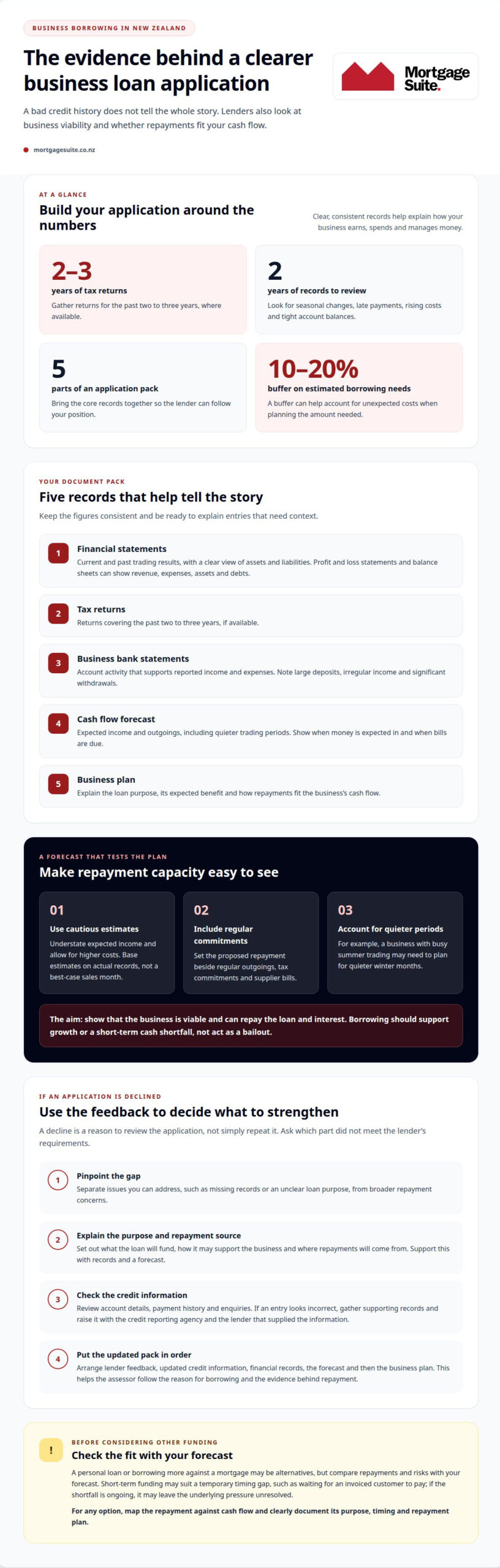
Start with tax returns for the past two to three years, where available, and financial statements for the same period, such as profit and loss statements and balance sheets. These show revenue, expenses, assets and debts. Compare the figures with your bank statements, noting large deposits, irregular income and significant withdrawals. Prepare a short explanation and supporting records for any entries that need context.

Review the past two years of financial records to understand repayment capacity. Look for seasonal changes, late customer payments, rising expenses and periods when the account balance was tight. For example, a business with busy summer trading may need to plan for quieter winter months. Use the records to prepare a cash flow forecast showing when money is expected in and when bills are due.

Prepare these documents as a practical application pack:

  • Financial statements: current and past trading results, plus a clear view of assets and liabilities.
  • Tax returns: returns covering the past two to three years, if available.
  • Bank statements: business account activity that supports the reported income and expenses.
  • Cash flow forecast: expected income and outgoings, including quieter trading periods.
  • Business plan: the loan purpose, expected benefit and how repayments fit the business’s cash flow.

Build the forecast cautiously: understate expected income and allow for higher costs. Base estimates on actual records rather than a best-case sales month. Set the proposed repayment beside regular outgoings, tax commitments and supplier bills. A 10-20% buffer on estimated borrowing needs can help account for unexpected costs. Borrowing should support growth or a short-term cash shortfall, not act as a bailout.

What alternatives to business loans are available for New Zealand businesses with bad credit? If your business has limited financial data to support an application, options may be narrower. A personal loan or borrowing more against a mortgage may be alternatives, but compare the repayments and risks with your forecast before deciding.

Bridging finance or other short-term funding may suit a temporary timing gap, such as waiting for an invoiced customer to pay. Identify the incoming funds expected to cover the gap, then map the repayment against your cash flow forecast. If the shortfall is ongoing, short-term funding may leave the underlying pressure unresolved. Clearly document the purpose, timing and repayment plan.

What if my business loan application is declined?

A decline is a reason to review the application, not simply repeat it. Use the lender’s feedback to address gaps in your business plan, repayment evidence or credit information before applying again.

Strengthening an application

Make your business plan answer three practical questions: what will the loan fund, how will it support the business, and where will repayments come from? For example, explain how new equipment could increase production or meet confirmed customer demand. Support the explanation with financial records and a cash flow forecast showing how repayments fit alongside wages, supplier bills and tax obligations.

Applying with poor credit

A low credit score does not tell a lender everything about your business. Explain the circumstances behind missed payments and provide evidence of current trading and repayment capacity. For example, distinguish a one-off late payment during a temporary cash-flow squeeze from ongoing difficulty meeting business commitments. The application still needs to show that the business is viable and can repay the loan and interest.

High-cost loans and director guarantees

High-cost borrowing can add pressure to cash flow, especially if frequent repayments fall due before customers pay. Before accepting an offer, compare its repayment schedule with your forecast and consider what could happen during a quieter trading period. A director guarantee is a personal commitment connected to the company’s debt. Read the agreement carefully and understand the personal responsibility it creates before signing.

Checking and correcting a credit report

Request your credit report from a credit reporting agency, then review the account details, payment history and enquiries. If an entry appears incorrect, gather supporting records, such as payment receipts or lender correspondence, and raise the error with the agency. Contact the lender that supplied the information too. Keep copies of your request and evidence so you can track the correction process.

For your next application, organise documents in a simple sequence: lender feedback, updated credit information, financial records, forecast, then business plan. This helps the assessor follow your reason for borrowing and the evidence behind repayment. A complete application also makes it easier to identify unanswered questions before assessment begins.

During assessment, the lender considers business viability and whether repayments are affordable. If your application is declined, ask which part did not meet the lender’s requirements. Separate issues you can address, such as missing records or an unclear loan purpose, from broader repayment concerns. Revise the relevant documents rather than resubmitting the same case unchanged.

If the feedback points to weak repayment capacity, review the borrowing amount and timing against your business’s actual cash flow. If it points to credit information, resolve any disputed entry first and include the outcome in your updated application. These steps give the next assessment a clearer, more complete picture of your business.

Assessing repayment capacity with cash flow forecasts

A profit on paper doesn’t show exactly when cash will be available for repayments. Use a cash flow forecast to map expected receipts against payment dates, then test whether the business can meet each instalment without missing essential bills.

Build the forecast around actual cash movements. Record when customers are expected to pay, not simply when you issue invoices. Include regular outgoings such as wages, rent, supplier invoices, tax and existing debt repayments. A late customer payment, for example, may leave the business short when a loan instalment is due, even if the sale was profitable.

Compare the forecast balance before and after each proposed repayment. Ask whether enough cash will remain for ordinary operating needs. If an instalment coincides with payroll or a large supplier payment, test a different repayment date or loan structure. Your forecast should make timing pressure clear, rather than relying on a monthly total that hides low-balance days.

Test more than the expected trading pattern. Model a quieter sales period, delayed customer receipts or an unexpected business expense. Reduce expected income and increase costs in a cautious scenario, then check whether repayments remain manageable. If the forecast only works when every customer pays on time, the borrowing plan may leave too little room for normal disruption.

Include existing commitments in the same calculation. Add current loan repayments, credit facilities and regular business expenses before assessing room for another instalment. Separate one-off costs from recurring bills, but don’t omit costs just because they vary. A realistic forecast helps show whether the proposed borrowing adds a manageable commitment or strains available cash.

The loan term and repayment size also affect affordability. A shorter term or higher repayments may reduce interest charges, provided the business can afford the schedule. Compare the cash left under each option, especially during slower trading periods. Choose a structure your forecast can support, rather than one that only looks attractive because of its headline rate.

Plan for repayment dates and make payments on time. New Zealand banks and other lenders usually charge extra for late or missed loan payments, so add due dates to your business calendar and monitor account balances before each instalment. If cash flow changes, update the forecast promptly and identify pressure before a payment is missed.

Calculate the impact of early repayment too. Compare the interest saved with any early repayment fee before using spare cash to reduce the debt. That cash may be needed for wages, stock or supplier bills before the next customer payment arrives. A forecast helps you weigh potential savings against upcoming business commitments.

Use the final forecast as a decision tool, not just an application attachment. Check available cash across the full repayment schedule, note the periods with the least room, and decide whether the borrowing amount or timing needs to change. The forecast should show how repayments fit your business’s actual trading cycle.
Assessing business loan repayments with bad credit in New Zealand

Applying with a low credit score

A low credit score can make an application harder, but it doesn’t explain the whole business position. Lenders also assess viability and whether the business can repay the loan and interest. Your application should connect your credit history with current trading evidence, the borrowing purpose and a workable repayment plan.

Start by identifying what the credit issue represents. A missed payment during a temporary disruption differs from ongoing difficulty meeting commitments. Explain the circumstances plainly, then show what has changed, such as overdue accounts being settled or payments becoming regular again. Keep the explanation factual and support it with relevant records.

Next, make the loan purpose specific. “Working capital” alone may not explain how the borrowing will help. Describe the need, such as paying a supplier while waiting for an agreed customer payment, and show how the funds fit your business plan. Link the purpose to expected income or a defined short-term gap, not an assumed turnaround.

Present the application as a clear case, not a pile of documents. Put the business plan, financial records and cash flow forecast in a logical order. Highlight recent changes that affect the figures, such as a new contract or the loss of a major customer. This helps the assessor understand your current position instead of drawing conclusions from one credit entry.

  • Explain: Give the date, cause and outcome of the credit problem.
  • Support: Include records showing current account conduct and business activity.
  • Connect: Link the loan purpose to a realistic business need.
  • Test: Show how the repayment fits around existing commitments.

Choose an application route that suits the evidence you can provide. Some New Zealand online lenders can make business lending decisions within 24 to 72 hours using cloud accounting data. Traditional bank business loan applications can take two to six weeks from application to approval. Speed alone doesn’t show whether the repayment structure suits your business.

Ask what information the lender needs and provide a complete response. If the application relies on cloud accounting data, make sure the records reflect current trading and explain unusual entries. When applying through a bank, allow time for questions about credit history, loan purpose or cash flow. A complete file can clarify the assessment, but it cannot replace evidence of repayment capacity.

Keep new borrowing enquiries focused. Before submitting another application, address the reason a previous lender declined and update the relevant information. If the concern was unclear income, for example, explain trading receipts more clearly. If it was the loan purpose, revise the plan so the use of funds and repayment source are easy to follow.

Eligibility requirements for New Zealand businesses

Eligibility depends on more than a credit score. New Zealand lenders assess whether a business is viable and can repay the loan and interest.

Lender credit score requirements

What credit score do New Zealand business lenders require? No single score determines eligibility on its own. Lenders weigh credit history alongside business viability, repayment capacity and the evidence in the application. A low score may prompt questions about missed payments, so explain their cause and show what has changed.

A consistent record of profitability may help support an application for accelerated business lending in New Zealand. That track record can help show how the business performs, but it does not replace an assessment of its ability to meet repayments. Use current trading information to explain changes since the period covered by older accounts.

Security for a business loan

Can a business loan in New Zealand be secured with property, equipment or a personal guarantee? A lender may consider property or equipment as security, or request a director’s personal guarantee. The loan agreement sets out the security and what the borrower or guarantor agrees to. Read those terms closely before signing.

For property or equipment, identify the asset and any existing finance attached to it. For a guarantee, understand who becomes responsible if the business cannot meet its obligations. Ask how the terms relate to the loan amount, repayment schedule and default conditions. Security can affect the lender’s assessment, but it does not replace evidence that repayments are affordable.

What New Zealand rules apply to business lending, responsible lending and loan agreements? Review the written agreement for the amount borrowed, interest, fees, repayment dates, security and consequences of missed payments. Make sure the application and agreement reflect the business’s actual repayment capacity, not an optimistic sales forecast.

Beyond credit and security, lenders look at the business’s financial position and borrowing purpose. Your business plan should explain what the funds will support, while financial records show trading performance and existing commitments. A forecast then connects expected cash flow with the proposed repayments.

Check that the amount requested matches the business need. If borrowing will fund equipment, for example, explain how it supports operations and how repayments fit alongside supplier bills and wages. A clear purpose helps an assessor understand your case. A vague request can make the benefit and repayment source harder to assess.

Before applying, organise evidence around three points: consistent trading, a clear use for the funds and repayment capacity. If profitability has been uneven, explain the pattern using actual business records. Eligibility rests on the whole application, not a credit score alone.

Mortgage Suite: Business Loans

Mortgage Suite offers Business Loans, including 2nd tier lending for borrowers who don’t fit mainstream bank criteria. If a bank has declined your application or your credit history complicates the process, Mortgage Suite can help you consider how your business purpose, financial records and repayment capacity fit together.

Bring your loan purpose, current financial information and any lender feedback to a conversation with Mortgage Suite. This helps clarify your circumstances and the questions an application may need to address. A suitable path depends on your business and its ability to manage repayments, so approval cannot be promised.

If you’d like to discuss your business borrowing needs, contact Mortgage Suite.

Take your next step with a clear plan

Your next move can be a focused conversation about what your business needs and what repayments it can realistically manage. If you’re considering how to get a business loan with bad credit in NZ, bring your borrowing purpose and current financial position to that discussion. A mainstream bank’s decision doesn’t have to be the final word on your plans.

Mortgage Suite offers Business Loans, as well as Home Loans for First Home Buyers and Residential Investment Property Loans. If your business and personal borrowing needs overlap, a conversation can help clarify which lending direction fits your goals.

Contact Mortgage Suite to discuss your options and work through a practical next step. You can move forward with a clearer plan and the support to get sorted.

Frequently Asked Questions

Want a Bad Credit Business Loan Today?

Start by confirming when the money is needed and what payment it must cover. If a supplier invoice is due, ask whether its payment date can be adjusted while you consider funding. Don’t promise a payment date based on a loan that hasn’t been approved. A clear deadline helps you decide whether borrowing is suitable or whether changing the timing could ease immediate pressure.

How much interest will I pay?

The interest rate depends on the lender and loan structure. Ask whether the rate is fixed or can change, and what conditions affect it. A fixed rate stays unchanged for an agreed period, while a variable rate can move. Compare how each structure fits your plans, including whether you value predictable repayments or more flexibility if circumstances change.

What loans am I eligible for?

Business lending can cover needs such as start-up funding, working capital and equipment finance. A business buying a delivery vehicle, for example, may need a different loan structure from one managing a gap between invoices and customer payments. Describe what the funds will support, then consider whether the borrowing period matches how long the business expects to benefit.

Can you get a business loan in New Zealand with bad credit?

Yes, a New Zealand business can apply for a loan with bad credit. Be clear about the business structure and who would borrow, such as a sole trader or a company with directors. This helps frame the application correctly. If personal and business finances have been managed separately, explain the arrangement so the lender can identify which records relate to the business.

Which New Zealand lenders offer business loans to borrowers with bad credit?

Business loan options may come from mainstream banks, non-bank lenders or private lenders. The right category depends on the type of borrowing and the lender’s criteria, rather than a single nationwide list for bad-credit applicants. Mortgage Suite Ltd can consider lending options beyond mainstream banks, including 2nd tier lending. Focus on whether the product suits the business purpose and its plans for the funds.

What interest rates and fees do bad-credit business loans in NZ charge?

There isn’t one interest rate for every borrower or loan. Ask how the rate is set, whether it can change and what might trigger a review. Request the proposed terms in writing so you can understand how the rate applies throughout the loan. Compare the structure and flexibility of each option, not just its opening rate.

What documents and financial information are needed to apply for an NZ business loan?

Alongside financial records, an application may benefit from documents showing who owns or runs the business. Depending on the purpose, relevant records could include an equipment supplier quote, a customer contract or details of the business structure. These connect the application to a real business activity. Keep names, ownership details and the proposed use of funds consistent across the paperwork.

How can you improve your chances of getting approved for a business loan in New Zealand?

Make sure everyone involved in the application agrees on its key details before it goes to a lender. Directors or business owners should align on the borrowing purpose, who will sign and how the funds will be used. If one director expects equipment finance while another describes working capital, resolve that difference first. A consistent account makes the application easier to follow.

Article by

Krish Krishna

Experienced Financial Adviser with over 46 years of Banking and Mortgage broking experience and over $2.0 Billion in loan settlements.

Choose between a business loan and personal equity

A start-up loan doesn’t always need your home as security. An equity loan for a New Zealand business start-up involves borrowing against property equity, while personal equity means contributing your own funds. These options can seem similar when you’re getting a new venture off the ground, but they create different responsibilities for you and your household.

It’s understandable to feel cautious when your business is new and its income is still taking shape. Choosing funding isn’t just about accessing money. You also need to consider repayments, the assets tied to borrowing, and how much personal money you’re comfortable putting into the venture.

This article compares those trade-offs in practical terms. It explains how cash-flow forecasts can help you assess repayment capacity, how security and funding structures affect risk, and what personal contributions mean for a start-up plan. You’ll also learn what lenders may assess, so you can approach your funding decision with clearer questions.

Key Takeaways

  • Forecast income and outgoings across the first six to 12 months of trading to clarify how much funding your startup may need.
  • Assess whether scheduled repayments fit your expected cash flow before taking on debt.
  • Weigh the effect of offering an asset as security against keeping it outside the business borrowing arrangement.
  • Prepare a business plan and relevant financial details to help explain how the startup will operate and repay borrowing.
  • Compare borrowing with contributing personal funds, considering both repayment commitments and the money you place at risk.

Cash flow forecasts and repayment capacity

For a home equity loan, New Zealand banks assess available property equity, income, existing debt and regular household expenses. They consider whether your income can support the proposed repayments alongside current commitments. A start-up’s forecast can help show how business income may contribute.

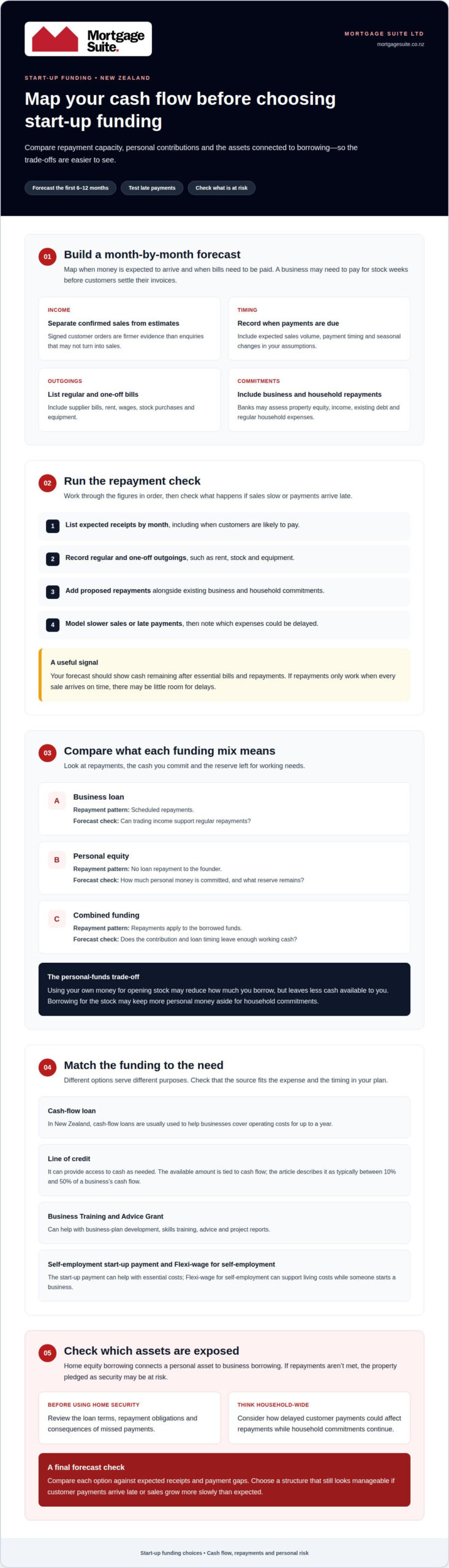
Build a forecast covering the first six to 12 months of trading. Map expected customer payments against supplier bills, rent, wages and other operating expenses. Include the timing of each item: a business may need to pay for stock weeks before customers settle their invoices.

Separate confirmed income from estimates. Signed customer orders, for example, provide firmer evidence than enquiries that may not turn into sales. Record the assumptions behind projected revenue, including expected sales volume, payment timing and seasonal changes. This helps reveal where a cash shortfall could arise.

Use these steps to test whether the proposed repayments fit:

  1. List expected business receipts by month, including when customers are likely to pay.
  2. Record regular and one-off outgoings, such as rent, stock purchases and equipment.
  3. Add the proposed repayments and existing business and household commitments.
  4. Model slower sales or late payments, then identify which expenses can be delayed.

A forecast should show the cash left after essential bills and debt repayments. If repayments are manageable only when every sale arrives on time, the plan may leave little room for delays. Adjust sales timing and costs to see which assumptions have the greatest effect on repayment capacity.

Funding option Repayment pattern Forecast detail to assess Main cash-flow question
Business loan Scheduled repayments Expected operating cash after each payment Can trading income support regular repayments?
Personal equity No loan repayment to the founder Personal funds committed and remaining What personal reserve remains available?
Combined funding Repayments apply to borrowed funds Contribution and loan timing Does the mix leave enough working cash?

Using personal funds for an opening stock order may reduce the amount you borrow, but it also leaves less cash available to you. Compare that with borrowing for the stock and keeping more money for household commitments. Mortgage Suite Ltd can help you model these scenarios so the trade-off is easier to see.

Choose a structure that remains manageable if customer payments arrive late or sales grow more slowly than expected. A month-by-month forecast lets you compare funding options against actual payment timing, rather than relying only on a headline sales target.

Carefully evaluate the timing of repayments and access to working funds when planning your business startup. In New Zealand, cash flow loans are usually used to help businesses cover operating costs for up to a year. A line of credit can offer another way to manage cash needs, with the available amount tied to cash flow. In New Zealand, a line of credit is typically between 10% and 50% of the value of a business’s cash flow. Compare each option with forecast gaps and expected receipts, and check that the business can meet its obligations if income is delayed.

Comparing funding costs and risks

Funding options differ in how you access money, make repayments and put assets at risk. Compare the structure and commitments before choosing a route for your start-up.

Alternative business funding

A home equity loan uses your property as security, while a business loan is assessed as business borrowing. An overdraft provides access to a facility as needed, rather than a single lump sum. Start-up funding can also include personal contributions or government support, which don’t involve the same scheduled loan repayments.

New Zealand support options are available that don’t require home equity. The Business Training and Advice Grant can help with business-plan development, skills training, advice and project reports. The self-employment start-up payment can help with essential costs, while Flexi-wage for self-employment can support living costs as someone starts a business.

Match each option to the need it addresses. A grant for business advice won’t serve the same purpose as funding for equipment, while an overdraft is designed to provide access to cash as needed. Check that the funding source fits the expense and timing in your plan.

Risks of using home security

Using your home as security connects a personal asset to business borrowing. If repayments aren’t met, the property pledged as security may be at risk. Unlike funding that doesn’t use your home as security, this option can put pressure on your household’s housing arrangements if the business struggles.

Consider a start-up facing delayed customer payments: the business may have less cash available for repayments, while household commitments continue. Before securing borrowing against your home, examine the loan terms, repayment obligations and consequences of missed payments. Consider both the uncertainty of the business and your personal circumstances.

Compare options by asking what the funding supports, how repayments work and which assets are exposed. A home-backed loan may provide access to funds, but it puts your home within the borrowing arrangement. A business loan, overdraft, personal contribution or grant has a different structure and purpose.

Choose an approach that fits the start-up’s purpose without overlooking the effect on your personal finances. If you’re considering home security, weigh the business plan against the consequences for your household, not just the funds available.

Asset-backed business loans

Home equity borrowing uses a property as security for funds. In New Zealand, the structure and permitted use determine how this funding compares with other business finance.

Home equity lending options

Home equity lending can take the form of extra borrowing against a property, a separate loan split or a revolving facility secured against the home. A separate split keeps the new borrowing distinct from the existing home loan. A revolving facility lets you draw funds as needed instead of receiving one lump sum.

These structures differ in how you access and repay funds. A lump sum may suit a defined purchase, such as equipment, while a revolving facility may suit costs that arise at different stages. In either case, the home secures the borrowing, and repayments are due under the agreed terms.

Yes, you can use home equity borrowing for start-up expenses if the lender approves that purpose. Funds might cover equipment, initial stock or fit-out work. The proposed use, available equity, repayment capacity and security all affect the application assessment.

Using loan funds for a startup

Using home equity for a start-up puts business funding against a personal asset. It can provide funds before a new venture has a trading history, but you still need a clear plan for how the money will be used and repaid. Keep business spending separate from household transactions so each use of the borrowed funds is easy to trace.

Can you use a home equity loan to fund a New Zealand business start-up? Yes, if the lender accepts the business purpose and the application meets its lending assessment. Set out the planned expenses, their timing and the repayment source. For example, explain whether the funds will pay for equipment upfront or cover stock purchases in stages.

Tie the amount borrowed to identified expenses rather than treating available equity as a spending target. If the start-up needs less than the full amount, borrowing only what the plan requires can limit unnecessary debt. The repayment obligation remains personal, even when the business receives the funds.

Tax and interest deductibility

For tax purposes, using a home as security does not, by itself, determine whether interest is deductible. The use of the borrowed funds matters. Keep loan statements, invoices and business records showing where each drawdown went, especially if one facility funds both household and business expenses.

For example, record a transfer used to buy business equipment separately from any personal withdrawal. Mixed use can make it harder to identify the portion connected with business activity. Keep the loan purpose, transaction records and accounting treatment consistent, then ask a New Zealand tax professional to assess the specific business use.

Before choosing an asset-backed loan, write down the funding structure, planned business expenses and repayment source. This gives you a clearer basis for weighing access to home equity against the personal commitment it involves.

Choose between a business loan and personal equity

Business loan application steps and documents

A clear application links the amount requested to the start-up’s purpose and repayment plan. For a new business without trading history or steady revenue, lenders rely on the business plan and the founder’s personal credit history.

Prepare a funding pack explaining how the venture will operate, what the money will pay for and how repayments could be made. Include documents to support each claim rather than relying on broad sales estimates or informal notes.

  1. Set out the funding purpose. Break the requested amount into specific uses, such as equipment, stock, fit-out work or early operating expenses. Supplier quotes or purchase estimates can help show how each portion will be spent.
  2. Build the business plan. Describe the product or service, intended customers, sales approach and day-to-day operating needs. A plan for a mobile coffee business, for example, could explain its locations, equipment and expected trading hours.
  3. Show forecast income and expenses. Include expected sales, supplier payments, rent, wages and other regular commitments. Explain the assumptions behind projected sales, such as customer numbers, pricing and the time needed to build demand.
  4. Explain repayment capacity. Show how repayments fit alongside business expenses and the founder’s personal commitments. Include a slower-sales scenario, then explain how the business would manage its obligations if customer payments arrived later.
  5. Gather personal and business records. Organise the founder’s credit information, identification, personal financial details and any records already available for the business. If the business has started trading, include relevant account statements and sales records.
  6. Describe any security or personal contribution. Identify assets offered as security and explain any funds the founder is putting into the venture. Keep the proposed security separate from the forecast so the lender can assess both clearly.

Consistency matters. If the plan forecasts equipment purchases before opening, the supporting quotes and cash-flow forecast should show the same timing. If the founder has existing repayments, include them when explaining household affordability rather than leaving a gap in the application.

Before submission, arrange the information in the same order as the funding request: purpose, plan, forecast, supporting records and repayment explanation. This makes it easier to follow how the business will use the funds. A start-up loan application is stronger when each projected income source has a clear basis and each major expense is explained.

A lender may ask for more details after reviewing the initial pack. Keep a dated copy of the submitted forecast and plan so you can explain any revised figures. If sales expectations change, update the forecast and note what changed, such as a delayed opening or a different supplier arrangement.

Personal investment and equity contributions

Putting your own money into a start-up can reduce how much you need to borrow. It also exposes those personal funds to the business’s performance, while a loan creates scheduled repayments. In New Zealand, lenders consider a founder’s personal investment or equity when assessing a loan application.

Personal contributions can cover start-up costs such as initial stock, equipment or set-up work. For example, a founder might use personal funds for a small equipment purchase and seek borrowing for other planned expenses. Show each contribution clearly in the funding plan, distinguishing money already committed from funds you may need to borrow.

Keep a record of where personal funds come from and how they enter the business. A transfer record and matching entry in the business accounts can help explain the contribution. If you contribute an asset rather than cash, describe it and explain how it supports the business’s operations.

A founder contribution differs from an investor’s contribution. An angel investor may provide start-up capital in exchange for a stake in the business. In New Zealand, angel investors may also lend money, take a percentage of profits or ask for partial ownership. Clarify whether an offer is a loan, a share of profits or an ownership stake, as each affects the business differently.

Before deciding how much personal money to commit, work through these points:

  • List the start-up expenses the contribution will cover.
  • Keep enough personal funds available for household needs and unexpected bills.
  • Record any investor arrangement in writing, including whether it involves repayment, profit sharing or ownership.
  • Update the funding plan to show how the contribution changes the amount you need to borrow.

A larger personal contribution may reduce the loan you request, but it also leaves less of your own money outside the business. Consider what happens if sales take longer to build or the business needs extra working cash. A balanced plan can combine founder funds and borrowing without treating all available savings as money that must go into the venture.

Use a loan repayment calculator to explore how a different borrowing amount changes estimated repayments. Then compare those repayments with your business forecast and personal commitments. The calculator can help with the borrowing side of the decision; it doesn’t assess the value of an ownership stake or whether an investor’s terms suit your plans.

Mortgage Suite: Business Loans

Mortgage Suite Ltd can help you explore Business Loans when your start-up needs funding beyond personal contributions or home equity. We’ll consider your business plan, cash-flow forecasts, proposed repayments and available security, then help you understand how the lending structure fits your goals.

A decline from a mainstream bank doesn’t automatically end the conversation. If your circumstances or start-up plans make borrowing complicated, a discussion can help clarify the options and the information that supports an application. You can weigh the business funding need against personal commitments before deciding on your next step.

If you’re ready to discuss funding for your start-up, contact Mortgage Suite Ltd.

Choose a funding path that supports your next move

Your next step is to set a clear boundary between business funding and personal security. Decide what you’re comfortable contributing, what the business needs funding for and which risks you’re prepared to carry. This gives you a practical basis for discussing an equity loan for a New Zealand business start-up alongside other funding structures.

Mortgage Suite Ltd can help you consider Business Loans in the context of your wider financial goals. Its lending support also includes Home Loans to First Home Buyers and residential investment property loans. A conversation can help you work through how your business plans and personal commitments fit together, without assuming one funding approach is right for every founder.

If you’re weighing your options or want to discuss a funding plan for your start-up, contact Mortgage Suite Ltd to discuss your options. A thoughtful next step can help you move forward with a clearer sense of what you’re taking on and what matters most to your business.

Frequently Asked Questions

How long does approval take?

Approval timing varies by lender and application. Some online lenders may decide within a business day, while a traditional bank start-up loan application can take a few weeks. A new business may need more explanation if it has no trading history, so a complete plan and consistent supporting documents can help the lender assess the request.

How much can I borrow for a startup?

New Zealand start-up loans commonly range from NZ$5,000 to NZ$500,000, depending on the funding need and application. Unsecured start-up loans are often available for amounts under NZ$50,000. These are general market ranges, not a borrowing promise or a specific offer. The amount considered depends on the business plan, repayment capacity, credit history, security and how the funds will be used.

What interest rate can a startup expect?

There isn’t one standard rate for every start-up loan. The rate depends on the loan structure, security, credit history and the lender’s assessment of repayment capacity. For context, the Reserve Bank of New Zealand reported an SME new overdraft rate of 10.06% in August 2026. That figure is an overdraft benchmark, not a quoted rate for a start-up loan or home equity borrowing.

How much can I borrow against my home equity in NZ, and how is it calculated?

The available amount depends on your property’s assessed value, existing home lending and the lender’s assessment of repayments. As a starting point, consider the property value less the home loan and other debt secured against it. That isn’t necessarily the amount available to borrow: income, regular commitments, the loan purpose and the lender’s security requirements also affect the decision.

Article by

Krish Krishna

Experienced Financial Adviser with over 46 years of Banking and Mortgage broking experience and over $2.0 Billion in loan settlements.

Mortgage for a Tiny Home NZ: Costs, Rates and Land Rules

Owning land isn’t always essential to borrowing, but a movable tiny home can be harder to use as mortgage security. A mortgage for a tiny home in NZ may depend on whether you own land, have other assets to support the loan and can comfortably manage the repayments.

It’s understandable to feel unsure when a tiny home doesn’t fit the usual home-loan picture. The home’s design, where it will sit and what security you can offer all affect which finance options may suit.

This guide explains how land ownership and other assets may affect an application, how to set a repayment budget and where specialist finance may fit. You’ll get a clearer picture of what lenders assess and the practical details to prepare before deciding what to do next.

Key Takeaways

  • Land ownership isn’t the only factor in borrowing; the lender will also consider what security you can offer and how the tiny home is set up.
  • Build a repayment budget around your regular income and expenses, and test how it feels alongside your usual spending before committing.
  • Compare interest rates alongside repayment terms and loan structure, as specialist finance can work differently from a standard home loan.
  • Clarify who owns the land and how the tiny home will be placed there, as these details can affect the finance assessment.
  • If mainstream lending doesn’t suit your situation, specialist finance may be another avenue to explore.

Do I need to own land or other assets?

Owning the section beneath a tiny home can strengthen a borrowing application, but it isn’t the only possible security. A lender may also consider other property you own and how the home is attached to its site.

Using land or property as security

Security is property a lender can rely on if a borrower can’t repay a loan. For a tiny-home application, land or another property may provide stronger security than the home alone, particularly if the home can be moved.

Consider a house-and-land valuation of NZ$800,000. In this example, banks might lend 80% or even 90% of the combined valuation, depending on the application. That example concerns land and a house together, not a promise that a tiny home will be assessed the same way.

If you own a section, the lender can assess its value alongside the proposed home and your ability to make repayments. If you don’t own land, another property may be relevant security. The key question is what property supports the loan, not whether the tiny home looks like a conventional house.

Before applying, list what you own and how it relates to your tiny-home plans. For example, distinguish land you own from a site where you have permission to place the home. This helps show what security is available and clarifies the arrangement behind the application.

Assessing fixed and movable tiny homes

A tiny home fixed to land may be assessed together with the land, while a movable home may be considered separately. This matters because a home that can be moved may be harder for a lender to rely on as security.

A tiny home on wheels doesn’t automatically qualify for a standard home loan as a house secured by land. A lender may instead assess land or another property offered as security, alongside your ability to make repayments.

For a fixed home, explain how it is attached to the site and what land supports the application. For a movable home, describe where it will be kept and whether you own that land. These details help clarify what the lender could assess if you can’t repay.

Consider the whole arrangement, not just the build. A home on wheels placed on a section you own presents a different security picture from one parked on land you don’t own. If a bank mortgage isn’t suited to the movable home itself, other property may still be relevant to the lending discussion.

Land ownership can help, but it isn’t the only factor. A lender weighs the security available, whether the tiny home is fixed or movable, and whether the repayments fit your finances.

Budgeting for loan repayments

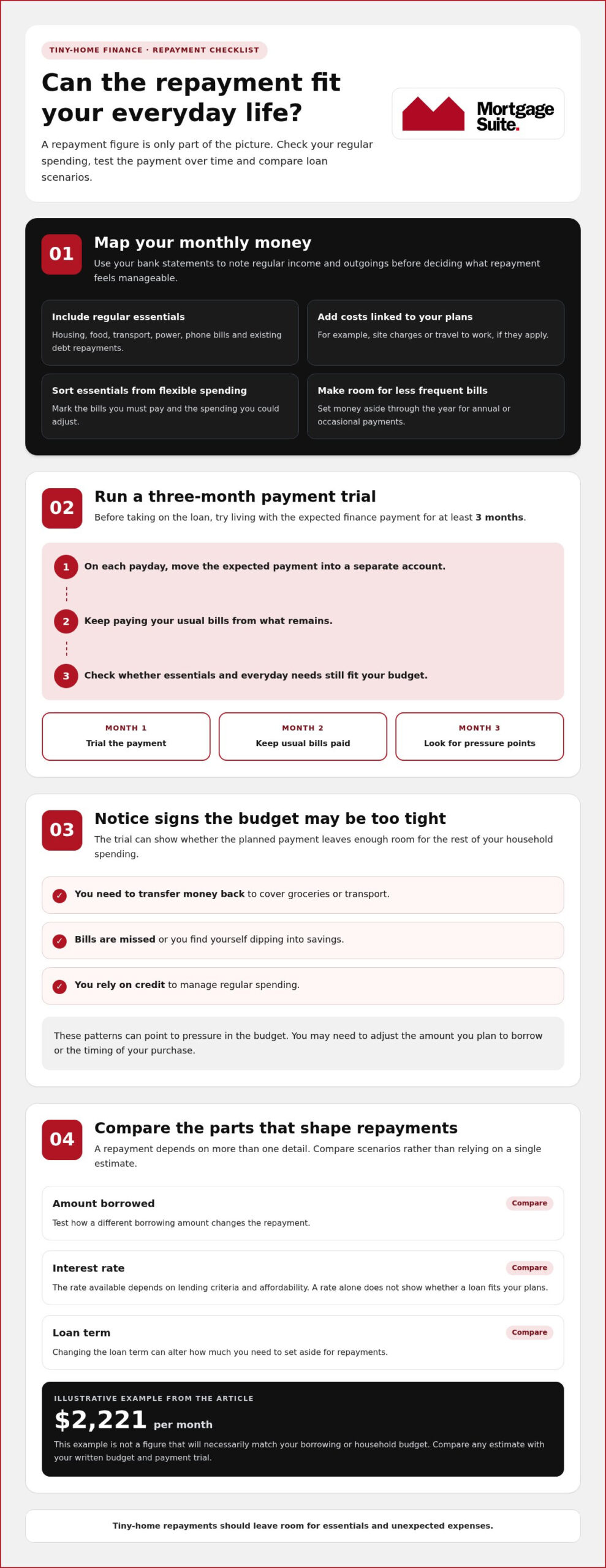
A repayment figure tells only part of the story. Your budget also needs to cover regular household spending, tiny-home upkeep and the income left after bills. Mapping out your monthly finances helps you judge whether a loan fits daily life, not just a lender’s assessment.

There’s no single repayment amount that suits every tiny-home loan. Repayments depend on the amount borrowed, the interest rate and the loan term. Changing any of these can alter what you need to set aside, so compare scenarios rather than relying on one estimate.

Start with your bank statements and record your regular income and outgoings. Include housing, food, transport, power, phone bills and existing debt repayments. Then add expenses linked to your plans, such as site charges or travel to work, if they apply.

  • Separate essentials from flexible spending: Identify bills you must pay and spending you could adjust.
  • Include irregular bills: Set money aside throughout the year for annual or occasional payments.
  • Allow for changes: Consider how your budget would cope if household income fell or another bill increased.
  • Compare scenarios: Test how a different borrowing amount or loan term changes the repayment.

Next, try living with the expected finance payment for at least 3 months before taking on the loan. Move that amount into a separate account on each payday, as though repayments have already started. Keep paying your usual bills from what remains. This practical test shows whether the planned payment leaves room for essentials and everyday needs.

If you need to transfer money back to cover groceries or transport, your repayment plan may be too tight. If you test a budget over time, look for missed bills, dipping into savings or relying on credit. These patterns can reveal pressure points. You may need to adjust the amount you plan to borrow or the timing of your purchase.

A repayment calculator can help you compare scenarios using different borrowing amounts, rates and terms. The mortgage calculator can help show how changing the amount borrowed affects repayments. Compare any result with your written budget and the three-month payment trial before deciding what feels manageable for your household.

An example tiny home finance repayment in New Zealand is $2,221 per month. Treat it as an illustration, not a figure that will necessarily match your borrowing or household budget. Your own estimate should reflect the amount you need, the available loan terms and your regular costs. Check that the repayment leaves enough room for essentials and unexpected expenses, and revisit your budget if your income or spending changes.

What are the interest rates?

Specialist tiny-home finance in New Zealand may have interest rates from 9.99% p.a. Lending criteria and affordability affect the rate available, so treat that figure as a starting point, not a universal offer. A rate alone doesn’t show whether a loan fits your plans. The repayment amount, loan term and conditions also shape the overall commitment.

Compare the loan structure as well as the headline rate. A fixed interest rate stays unchanged for an agreed period, making repayments more predictable during that time. Other structures work differently. Ask how the rate applies, when it can change and how the repayment schedule would affect your budget.

For a fair comparison, line up offers using the same borrowing amount and repayment period. Then check:

  • Interest rate: Note whether the quoted rate is fixed or can change.
  • Repayment schedule: Understand how often payments are due and how long they continue.
  • Loan conditions: Read the terms alongside the rate, including any requirements attached to the finance.
  • Affordability: Compare the proposed payment with your household budget, not just another lender’s rate.

A lower rate can look appealing, but it may not suit you if the loan structure doesn’t match your plans. For example, consider whether repayments remain manageable alongside your regular bills and tiny-home expenses. Comparing the rate, term and repayments together gives you a more useful basis for deciding.

Approval timing depends on the lender receiving the information needed to assess the application. Tiny-home finance approvals in New Zealand are often available within 24 hours after the lender has all the information. That timeframe begins once the application details are complete; preparing clear information about your income, existing commitments, the home and its intended location helps the assessment proceed.

Keep your application details consistent. If your purchase or build plans change, update the information provided, as the lender assesses the application presented. A prompt decision is useful, but speed shouldn’t replace a careful review of repayments and loan terms.

Before accepting an offer, write down the rate, how long it applies, the repayment schedule and the conditions. Compare these details with your budget and the home’s intended use. This helps you assess the whole borrowing arrangement rather than choosing on the interest rate alone.

Mortgage for a Tiny Home NZ: Costs, Rates and Land Rules

Land ownership requirements

Owning the land isn’t automatically a requirement for every tiny-home finance application. In New Zealand, the land arrangement still matters because it shows where the home will sit and what property may support the borrowing.

Separate three parts of your plan: owning a section, having an arrangement to place a home there, and offering land as loan security. These are distinct. You might own the tiny home but not the site, or own both the home and section. Each arrangement gives a lender different information to assess.

If you own the land, gather details showing who owns it and how the tiny home will be placed. If someone else owns the site, explain the arrangement and how long you expect to use it. A lender needs to understand whether the home’s location is stable and how the land relates to the borrowing. Details about site access, services and planned use can also help explain the setup.

Prepare these details before discussing finance:

  • Land ownership: Record whether the section is yours, jointly owned or owned by someone else.
  • Placement arrangement: Explain where the tiny home will sit and what agreement supports that plan.
  • Home setup: Describe whether it will be fixed in place or remain movable.
  • Security: Identify whether the land or another property is being offered to support the loan.

For example, you might own a section and plan to place a movable tiny home there. That doesn’t make the home and land the same asset. Explain each separately, including who owns them and how they’re connected. If the home will sit on a family member’s land, describe that arrangement clearly rather than presenting the site as your own property.

Land ownership can affect what a lender considers as security. A section you own may be assessed differently from land you can use but don’t own. The lender considers the available property, the tiny home’s placement and your ability to repay. Clear information helps distinguish the home’s location from property that can support the borrowing.

Before committing, compare the land arrangement with the loan structure you’re considering. If you’re buying land and a tiny home together, explain both parts of the purchase. If you already own a section, outline how the proposed home will fit the site. Clear details about ownership, placement and security help frame the application around your actual plans.

Specialist tiny home finance

Specialist finance can be another option when a tiny home doesn’t fit a standard mortgage. The loan type, security and repayment plan still need to suit your circumstances.

Lender eligibility criteria

Eligibility criteria are the lender’s requirements for deciding whether an application and its security fit a loan. Specialist lenders in New Zealand may consider tiny-home finance, but their criteria vary. There isn’t one lender list or rule that applies to every borrower.

Lenders assess factors such as income, existing commitments, repayment capacity, the home’s value and whether it can be moved. These factors shape possible loan terms, but they don’t determine an automatic approval amount or term.

A strong application explains the full arrangement: who owns the home, where it will sit, what security is available and how repayments fit your budget. If a mainstream bank declines, that doesn’t settle whether another lender’s criteria may suit your circumstances.

Mortgage eligibility for tiny homes

A mortgage may be possible, but the lender’s assessment depends on the tiny home, the land arrangement, available security and your ability to repay. A home on wheels may be treated differently from one fixed to land, so describe its setup clearly.

Planning and building requirements depend on the site and proposed home. Before committing, identify the relevant local council and ask how its planning rules, building consent process and site requirements apply to your proposal. Don’t assume a tiny home has the same requirements on every section.

There isn’t one total cost for every tiny-home project. Your overall budget depends on the home, land, site preparation and connections such as power or water. List each part separately, then compare the project budget with the borrowing you can manage.

Lenders may also consider whether the home can be valued as security and how readily it could be resold. A movable home’s location, condition and saleability can affect its usefulness as security. Include clear details about the home and site in your finance information.

Application steps and documents

An application brings together your financial position and tiny-home plans, helping a lender assess your repayment ability and available security. Prepare proof of income, a record of regular commitments, details of the home and a clear account of where it will be placed.

Include purchase or build information, the proposed site, land ownership details and any documents describing the placement arrangement. If you own other property, note whether it may support the borrowing. Keep the figures and project details consistent across your budget and application.

Before applying, organise these records and identify any missing project details. Then compare the lender’s proposed amount, term, repayments and conditions against your budget. For help exploring a finance path that fits your circumstances, discuss tiny-home finance options.

Mortgage Suite: Home Loans to First Home Buyers

Mortgage Suite can help you explore home-loan options, including Home Loans to First Home Buyers, when a tiny-home purchase forms part of your first-home plans. If a mainstream bank’s criteria don’t fit your circumstances, its 2nd Tier Loans may offer another lending pathway to discuss.

Bring together your income details, regular commitments, tiny-home plans and information about the land or other security. Mortgage Suite can help you consider how these factors fit together and discuss a suitable next step, without treating one lender’s decision as the final word.

If you’re a first-home buyer considering a tiny home, contact Mortgage Suite to discuss your borrowing situation and possible options.

Take the next step with a clear borrowing plan

Your tiny-home plans don’t have to follow a standard property path. Shape the finance conversation around your goals, how you’ll use the home and what you can comfortably repay. This gives you a clearer basis for deciding whether a mortgage for a tiny home in NZ suits your wider plans.

Mortgage Suite can help you talk through your circumstances and consider which lending pathway may fit. If a mainstream bank’s criteria don’t suit your situation, that doesn’t necessarily end the conversation. The next step is to look at your plans and finances together.

Before getting in touch, bring together an outline of your plans, income and regular commitments. You don’t need every detail sorted to start a useful conversation. A clear starting point can help you work out what to explore next.

Contact Mortgage Suite about your options and take a confident next step towards your tiny-home plans.

Frequently Asked Questions

How much can I get?

There’s no single borrowing amount for a mortgage for a tiny home in NZ. The amount a lender may offer depends on your income, existing commitments, repayment capacity and available security. Separate your borrowing goal from the full project budget, then work out how you’d fund any gap.

What financing options are out there?

For a mortgage for a tiny home in NZ, options may include a home loan supported by land or other property, or specialist finance for tiny homes. The suitable path depends on whether the home is fixed or movable, what security you can offer and how you plan to repay. Buying a tiny home and land together creates a different borrowing structure from purchasing a wheeled home without owning the site.

Can first-home support help fund a tiny home in NZ?

First-home support has its own eligibility rules, and whether it can contribute depends on the buyer and property arrangement. A wheeled tiny home, a home fixed to land and a land-and-home purchase may be treated differently. Keep your borrowing plan workable without relying on support until you know it applies to your purchase. Include any eligible assistance separately in your deposit plan, not as guaranteed funding.

What insurance, valuation, and resale risks affect tiny-home finance in NZ?

A movable tiny home can be harder for a lender to rely on as security and may be assessed separately from the land. The lender may assess the land or another property as security, alongside your ability to repay.

Article by

Krish Krishna

Experienced Financial Adviser with over 46 years of Banking and Mortgage broking experience and over $2.0 Billion in loan settlements.

Commercial Property Loan Calculator NZ: Your 2026 Guide to Getting Sorted

What if the big bank’s “no” was actually the best thing that ever happened to your commercial property ambitions? Many Kiwi investors feel a genuine sense of dread when they look at the complex criteria of mainstream lenders, especially when you factor in the uncertainty of GST and those hefty valuation fees. It’s completely normal to feel a bit stuck when you’re trying to figure out if a deal actually stacks up. That’s why using a commercial property loan calculator nz is such a vital first step. It helps you move past the guesswork and start dealing with real numbers to see exactly how easily you can pay back the loan without the stress.

We know that you’re looking for more than just a generic estimate. You want a clear path to approval and the confidence that you aren’t missing out on better options elsewhere. In this guide, we’ll show you exactly how much you can borrow and what your monthly repayments might look like in the current 2026 market. We’ll also explore why looking beyond the big banks toward non-bank lenders can often be the smartest move you make. By the time you’ve finished reading, you’ll have a realistic guesstimate of your costs and a solid strategy to get your financing sorted.

Key Takeaways

  • Learn how to use a commercial property loan calculator nz to move from general dreaming to concrete planning with baseline figures tailored to your specific property type.
  • Discover why the loan-to-value ratio is often more important than the interest rate and how it dictates exactly how much a lender is willing to tip in.
  • Find out why a “no” from a mainstream bank isn’t the end of the road and how flexible second-tier lenders can bridge the gap for your unique situation.
  • Get a clear checklist of the essential financials you’ll need to package your application so it looks professional and stands the best chance of a quick approval.
  • Understand how expert negotiation and the seasoned experience at Mortgage Suite Ltd can turn your raw calculator results into a successful, funded deal.

Why a commercial property loan calculator is your best starting point

Starting a commercial venture is an exciting milestone, but it’s the numbers that turn a vision into a real street address. Using a commercial property loan calculator nz is the smartest way to bridge the gap between a “what if” idea and a concrete plan. It provides you with a baseline figure to work with, helping you understand your loan affordability before you even step foot in a bank. This is just a straightforward way of asking if the rent from your tenants or your business income can actually cover the debt without putting you under unnecessary pressure. When you have these numbers in front of you, the path forward feels much less like a gamble and more like a calculated business move.

Unlike standard home loans, commercial lending is highly tailored to each specific situation. The numbers change significantly depending on whether you are buying a small retail shop, a large warehouse, or a specialised medical centre. A calculator allows you to play with different “what-if” scenarios. You can see how a slight rise in interest rates might affect your weekly outgoings or how shortening the loan term changes the total interest you’ll pay over the life of the loan. You might even find that a property you thought was out of reach is actually manageable if you structure the loan differently. This level of preparation helps you move from dreaming to doing with a much clearer head.

Commercial vs. residential: Why the numbers look different

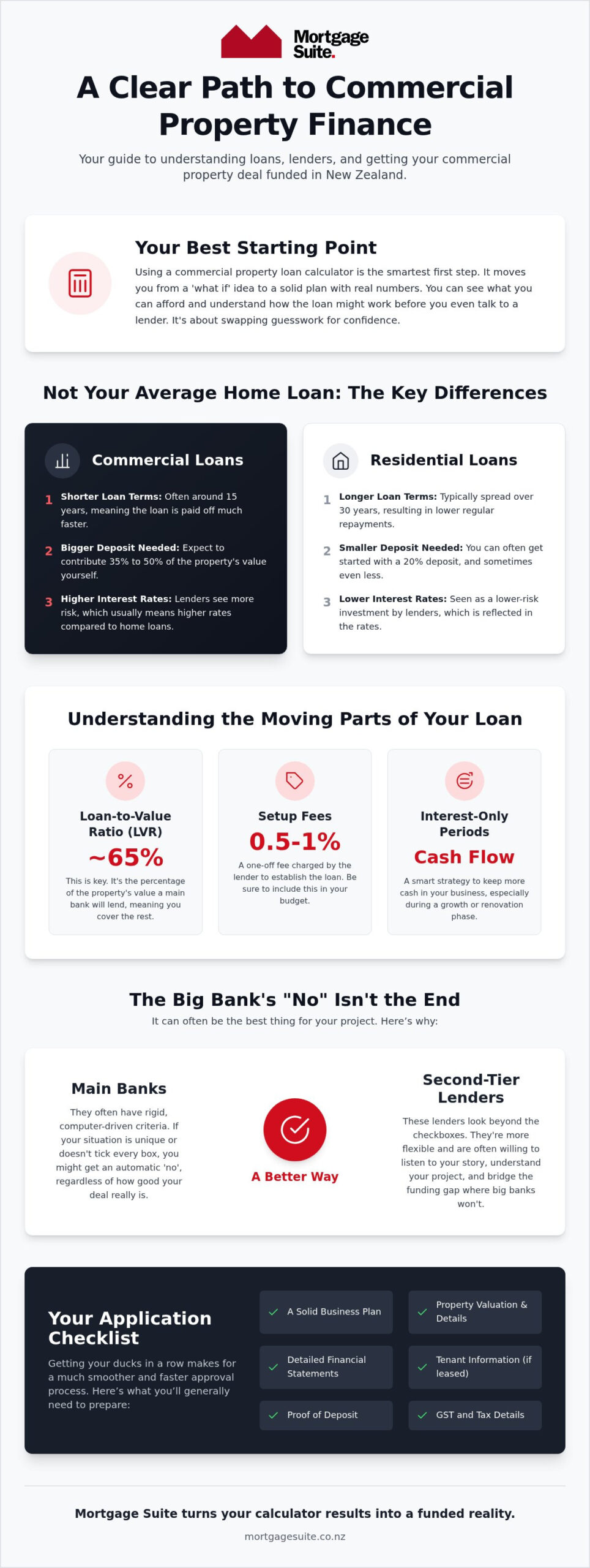
It helps to understand the fundamentals of what a commercial mortgage is compared to the standard house loan you might be used to. Commercial deals don’t follow the same rules as the family home. While you might get a 30-year term on a residential mortgage, commercial loans often wrap up much faster, frequently over 15 years. Because banks see a higher level of risk in business properties, interest rates are typically higher too. You’ll also need a much bigger “skin in the game.” Expect to provide a deposit between 35% and 50%, depending on the property type and its location. Lenders want to see that you have a significant commitment to the property before they agree to partner with you.

The “Guesstimate” vs. the Reality

Think of your calculator result as a helpful guide rather than a final, etched-in-stone offer. In the commercial world, almost everything can be negotiated. Your final interest rate and the total amount you can borrow will depend on your specific situation and the quality of the building itself. A modern office space with a long-term, reliable tenant is viewed very differently by a lender than a vacant industrial shed. Use the numbers from the commercial property loan calculator nz to build your business plan, but realise that these figures are just the starting point for a deeper conversation about strategy. Having a baseline estimate allows you to walk into a meeting with a lender feeling informed and ready to talk shop.

Understanding the “moving parts” under the hood of your loan

While a commercial property loan calculator nz is a brilliant tool for getting those initial numbers on paper, it’s important to remember that interest rates are only one part of the machine. To see if a deal truly stacks up, you need to look at the other moving parts that lenders use to decide if they’ll back you. The biggest factor is usually the loan-to-value amount. This is simply the percentage of the property’s value that the bank is willing to lend you. In the commercial world, this is much tighter than residential, often sitting around 65% for main banks. You also need to factor in the costs that a basic calculator might miss, such as setup fees. These are one-off costs charged by the lender to get the loan started, and they can range from 0.5% to 1% of the total loan amount.

During a growth phase, you might also negotiate an interest-only period. This can be a lifesaver for your cash flow, as it allows you to pay only the interest for a set time, keeping more cash in your business for operations or renovations. If these numbers feel a bit overwhelming, it’s often worth chatting with a specialist who can help you structure your commercial loan correctly from the start. Having a clear plan for these extra costs ensures you won’t be caught out by a cash shortage just as you’re trying to settle the deal.

Interest Coverage: Can the building pay for itself?

When you start looking at what you’ll need for a successful application, you’ll see that banks are obsessed with how well the building’s income covers the debt. They don’t just look at the total rent you collect. They focus on what’s left after all the costs like rates and insurance are paid. If the building generates significantly more than the interest costs, the bank feels much more relaxed about the deal. It’s their way of ensuring that even if interest rates tick up, you won’t be left out of pocket or struggling to meet your commitments each month.

Loan terms and paying off the debt

Standard commercial deals usually run over 15 years. This shorter timeframe means your monthly repayments will be higher than a home loan, but you’ll be clearing the debt much faster. This process of gradually paying off the debt over time is what keeps your equity growing and your business stable. You might also hear about large lump sum payments or term reviews at the end of a few years. These aren’t as scary as they sound; they’re just points in time, usually every three to five years, where the bank checks in to see how the property and your business are performing before renewing the loan. Using a commercial property loan calculator nz helps you model these shorter terms so there are no surprises down the road.

Why the big banks’ ‘computer says no’ isn’t the end of the road

It’s a common story in the Kiwi property market. You’ve run the numbers through a commercial property loan calculator nz, found a property that looks perfect, and then the big bank tells you they can’t help because you don’t fit their specific “box”. Mainstream banks are built for standard, low-risk scenarios. If your situation is even slightly unique, their automated systems often spit out a decline without looking at the actual merits of the deal. This is where 2nd tier lenders become your greatest asset. They don’t just look at a computer screen; they look at the property’s potential and your personal track record.

A calculator might show a higher interest rate for these non-bank options, but a 2nd tier loan could be the bridge you need to get the deal done. These lenders are perfect for “non-conforming” deals, such as specialised industrial sites or properties with shorter lease terms that scare off the big four. Instead of seeing a barrier, these lenders see an opportunity to support a growing business. It’s about finding a way to say yes when others have already walked away.

When to consider a 2nd tier lender

You might be self-employed with only one year of clean accounts, or perhaps you’re eyeing a specialised industrial site that the big banks find too risky. In these cases, 2nd tier lenders in New Zealand offer a vital lifeline. They are far more flexible with how they view income and credit history. Think of these loans as a strategic stepping stone. You secure the property now, build your equity or business history, and then look to move back to a main bank once you’ve ticked more of their traditional boxes later on.

The trade-off: Flexibility vs. Cost

Let’s be upfront about the costs. If you’ve used a commercial property loan calculator nz with main bank rates of 6.50% to 7.50% in mind, the 9% to 11% typically charged by non-bank lenders can look a bit steep. However, you have to weigh that against the “opportunity cost” of missing out on the property altogether. In a growing market, the capital gains or the business revenue generated by owning the building often far outweigh the extra interest paid. Getting the approval today is often much more valuable than waiting for a “yes” from a bank that might never come. It’s about looking at the bigger picture and having a steady hand to guide you through these alternative options.

Commercial Property Loan Calculator NZ: Your 2026 Guide to Getting Sorted

Getting your ducks in a row: What you’ll need for a successful application

Once you’ve used a commercial property loan calculator nz to get a handle on the repayments, it’s time to gather your evidence. Preparation is the secret sauce that turns a “maybe” into a “yes”. Lenders aren’t just looking at your bank balance; they’re looking for a professional, well-organised story. If your application is messy, the bank sees risk. If it’s tidy, you’re a safe bet. In the New Zealand market, the NBS (New Building Standard) rating is a total deal-breaker. This seismic score tells the bank how safe the building is in an earthquake. If the rating is too low, many banks will walk away immediately, no matter how strong your business is.

The paperwork trail

To get the ball rolling, you’ll need to gather a few essentials:

  • Two years of business accounts, including profit and loss statements.
  • Recent tax returns for you and your business.
  • Proof of your personal income.
  • A copy of the draft or current lease for the property.

Your “Statement of Position” is also a vital piece of the puzzle. This is essentially a financial CV that lists everything you own and everything you owe, giving the lender a snapshot of your financial health at a single glance. Providing a clean, easy-to-follow paperwork trail doesn’t just speed up the process; it can actually help you negotiate a lower interest rate because the bank feels more confident in your ability to manage the debt.

Due diligence costs to budget for

The numbers on your commercial property loan calculator nz won’t include the “hidden” costs of getting the deal across the line. You’ll need to have cash set aside for valuations, legal fees, and engineering reports. It’s important to remember that banks won’t accept a “Rateable Value” (RV) from the council. They’ll insist on a full report from one of their own approved valuers. If your plans are a bit more ambitious and you’re looking at how to finance property development for a new build or a major renovation, these costs can be even higher.

The “quality” of the tenant in the building is just as important as your own income. A blue-chip tenant with a long-term lease is a bank’s dream, while a brand-new startup might make them a bit nervous. Having an expert on your side to package this information correctly makes all the difference. We can help you prepare a bulletproof commercial application that speaks the lender’s language and highlights the strengths of your deal.

How Mortgage Suite Ltd turns your calculator results into a reality

You have likely spent some time with the commercial property loan calculator nz and have a rough idea of the costs involved. While those figures are a great starting point, they don’t tell the whole story of how a deal gets across the line. At Mortgage Suite Ltd, we specialise in taking those raw numbers and turning them into a viable financing strategy. We negotiate directly with banks and non-bank lenders to find a structure that actually fits your business goals, rather than just accepting the first offer that comes along.

Krish Krishna uses over 20 years of banking experience to package your application in a way that makes sense to credit managers. We know how to highlight the strengths of your deal, especially those tricky ones that mainstream banks might initially dismiss. It’s about more than just filling out forms; it’s about personal advocacy and making sure your voice is heard in a crowded market. We take the “scary” out of the numbers by providing a steady hand through the entire process.

Your advocate in the lending market

The world of commercial finance has its own rhythm, and we are here to help you navigate it. We speak the language of the lenders so you don’t have to worry about the technical talk. Mortgage Suite Ltd provides national coverage, helping Kiwis from the top of the North Island to the bottom of the South get the funding they need. If you already own a building but think you could be on a better deal or want to tap into your equity, we can also assist with a commercial property refinance to help you get ahead.

Ready to have a yarn about your next move?

A commercial property loan calculator nz provides the “what”, but we provide the “how”. We invite you to have a no-obligation yarn with our team to explore your options and see what’s truly possible in today’s market. Whether you’re a first-time commercial buyer or a seasoned developer, we are here to help you move forward with confidence. The calculator is just the start; the strategy is where the magic happens. Get in touch with the Mortgage Suite Ltd team today and let’s get you sorted.

Ready to turn those numbers into a street address?

Using a commercial property loan calculator nz provides the initial clarity you need to start your search, but the real success lies in the strategy you apply to those figures. We have explored the importance of understanding LVRs, interest coverage, and why a decline from a major bank is often just a detour rather than a dead end. Whether you are dealing with complex seismic ratings or simply need more flexible income criteria, the right preparation turns a daunting process into a manageable one.

At Mortgage Suite Ltd, we pride ourselves on being your dedicated advocates in a fluctuating market. With over 20 years of professional banking experience, we specialise in 2nd tier and alternative lending for those unique scenarios that don’t fit the standard bank mould. Our national service ensures that Kiwis across the country have access to expert negotiation and a steady hand during complex deals.

Let’s chat about your commercial financing goals today. We are ready to help you move beyond the calculator results and secure the property that will take your business or investment portfolio to the next level.

Frequently Asked Questions

How much deposit do I typically need for a commercial property loan in NZ?

You will generally need a deposit between 35% and 50% for a commercial purchase in New Zealand. Mainstream banks are quite conservative and usually lend up to 65% of the property’s value. If you’re looking at a specialised building, they might ask for even more cash up front. This higher deposit requirement is one of the biggest differences between business lending and buying a residential home.

Can I use the equity in my family home to buy a commercial building?

Yes, using the equity in your family home is a very common way to fund a commercial deposit. If your home has increased in value, you can often borrow against it to cover that 35% or 50% “skin in the game” required for the business property. It’s a smart way to get started without needing a massive pile of cash sitting in the bank, provided you have the income to support the extra debt.

What is a “good” interest coverage ratio for a commercial loan?

A “good” interest coverage ratio is typically 1.40x or higher for most mainstream lenders. This means for every dollar of interest you owe, the building’s net rent should bring in at least $1.40. If your ratio is lower, say around 1.00x, you might need to look at non-bank lenders who are more comfortable with tighter margins. This is a key figure to check after using a commercial property loan calculator nz.

Do commercial property loans in New Zealand have GST added to them?

Commercial loans are typically based on the GST-exclusive price of the property if you’re GST registered. Most commercial deals are “plus GST (if any)”, so you’ll need to work closely with your accountant to manage the cash flow during the settlement period. The bank won’t usually lend you the GST portion, as they expect you to claim that back from the IRD shortly after the purchase is finalised.

How long does it usually take to get a commercial loan approved?

You should allow between two to four weeks for a standard bank approval in the current market. Commercial deals require a lot more manual checking than residential ones, including a full review of leases and building reports. If you’re in a hurry, second-tier lenders can often move much faster, sometimes giving you a “yes” in just a few days if your paperwork is tidy and your strategy is clear.

What happens if a bank declines my commercial loan application?

If a bank declines your application, the first step is to look at the second-tier or non-bank market. A decline often just means you didn’t fit that specific bank’s rigid criteria, not that your deal is bad. Non-bank lenders are far more flexible with income types and property styles. We specialise in taking those declined applications and finding a lender that actually wants your business and understands your goals.

Are commercial mortgage rates fixed or floating in NZ?

Both fixed and floating rates are available in New Zealand, though the fixed periods are usually shorter, often between one and five years. Many business owners choose a mix of both to manage their risk. Because commercial terms are shorter overall, you’ll find that your interest rate is reviewed more frequently than it would be on a standard 30-year home mortgage, which keeps you on your toes with budgeting.

Is it harder to get a loan for a retail shop versus an industrial warehouse?

Generally, it is easier to get a loan for an industrial warehouse than a retail shop because banks see warehouses as a lower risk. Retail spaces can be harder to fill if a tenant leaves, whereas a clean industrial shed is always in high demand. If you’re eyeing a retail spot, you might find that using a commercial property loan calculator nz shows you’ll need a larger deposit to satisfy the bank’s risk team.

Article by

Krish Krishna

Experienced Financial Adviser with over 46 years of Banking and Mortgage broking experience and over $2.0 Billion in loan settlements.