

Second mortgage for business in NZ: how it works in 2026

Could business funding put your home at risk, even if you already have a mortgage? For some Kiwis, a second mortgage for business NZ may provide access to property equity without replacing an existing home loan. But it adds another loan secured against the property, so weigh the funding need against the security and repayment risks.

It’s understandable to feel cautious. You may be comparing a second mortgage with a business loan or refinancing, while considering whether your business income and circumstances will meet a lender’s requirements. If the property has to be sold to repay debt, the first mortgage lender generally has priority over the second mortgage lender. Understand how that could affect your options and have a realistic repayment plan before proceeding.

This guide explains how a second mortgage works in 2026, what lenders may assess and what information to prepare. It also sets out questions to ask about repayments, property security and your plan to repay the loan, so you can compare funding paths and make a considered decision.

Key Takeaways

  • A second mortgage for business NZ adds lending secured against property that already has a mortgage, so check how the existing loan’s priority may affect your options.
  • Before proceeding, consider whether the business can manage repayments and what could happen to the property if it can’t.
  • Compare a second mortgage with a term loan or refinancing by checking the security required, repayment structure and impact on existing lending.
  • Prepare accurate business financial information, details of existing lending and a clear plan for repaying the loan.
  • An adviser can help you weigh up the risks and discuss lender options suited to your circumstances, without guaranteeing approval.

What is a second mortgage for business in NZ?

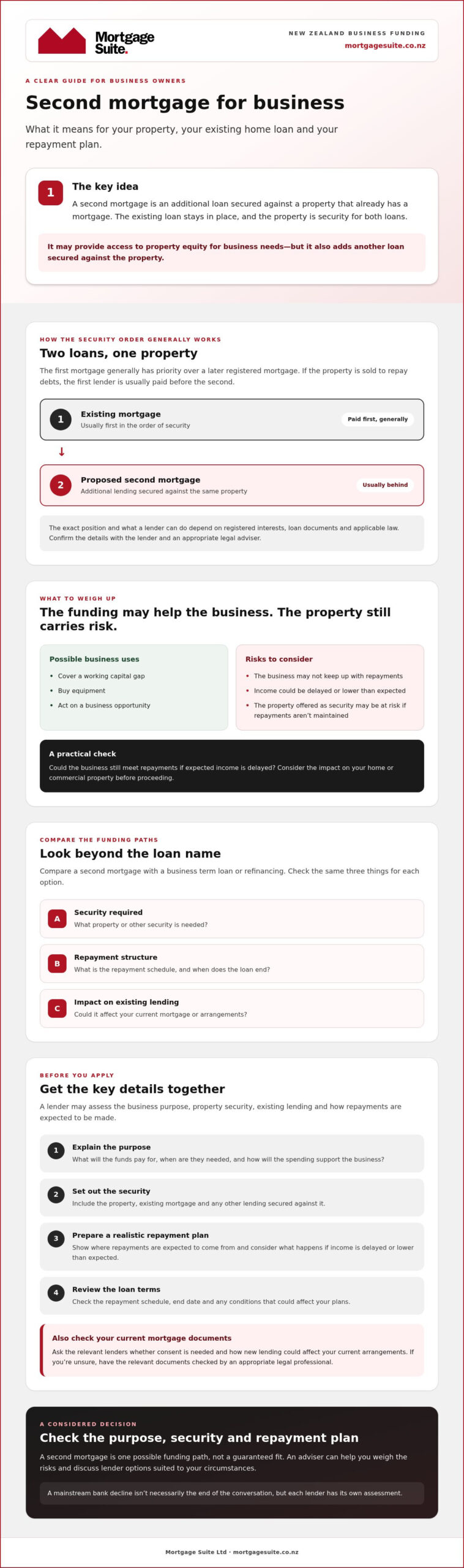
A second mortgage for business is an additional loan secured against property that already has a mortgage. The property could be a home or business property, and the funds are intended for business needs. The second mortgage sits behind the existing mortgage in the order of security. You can read a neutral overview of what a second mortgage is, then check how a particular lender would structure and secure the loan.

In general, the first mortgage has priority over a later registered mortgage. If the property had to be sold to repay debts, the first lender would usually be paid before the second mortgage lender. The exact position can depend on registered interests and the loan documents, so confirm the details with the lender and an appropriate legal adviser before proceeding.

Using the funds for a business doesn’t change the fact that the property is security for the loan. If repayments aren’t maintained, the property offered as security could be at risk. Weigh the business purpose against the possible impact on your home or commercial property, and consider whether the business could still meet repayments if expected income is delayed.

How does a second mortgage differ from a first mortgage?

A first mortgage is usually the main loan secured against a property. A second mortgage is separate lending added while that first mortgage remains in place. The second lender’s position behind the first may affect how it assesses the property, existing lending and available security. Ask how the proposed loan would be recorded and what could happen if repayments fall behind.

Don’t assume the order or enforcement process based on a general explanation alone. Ask the lender to explain its terms and have the relevant documents checked if you’re unsure.

What business needs might prompt this type of lending?

A business owner might explore a second mortgage to cover a working capital gap, buy equipment or act on a business opportunity. These are examples of possible purposes, not a promise that a lender will approve the application. The lender will consider what the funds are for alongside the property security and the borrower’s wider circumstances.

Business-purpose borrowing is different from a home loan taken out to buy or refinance a home, even if the home is offered as security. Be specific about how the funds will be used and where repayments are expected to come from. If a mainstream bank has declined, that isn’t necessarily the end of the conversation. Other lender pathways may be worth discussing, though each has its own assessment.

How does a business second mortgage work, and what is at risk?

Taking out a second mortgage involves more than showing that a property has equity. The lender needs to understand what the business will use the funds for, what property will secure the loan, how existing lending affects that security, and how repayments are expected to be made. Review the proposed terms carefully, including the repayment schedule and what happens if payments are missed.

When property secures business borrowing, the borrower remains responsible for repayments and the property may be at risk if they aren’t made. That’s true even when the loan is intended to support business growth rather than a personal purchase.

  • Explain the purpose: Be ready to describe what the funds will pay for, when they are needed and how the spending supports the business.
  • Review the security: Discuss the property, existing mortgage and any other lending secured against it.
  • Test the repayment plan: Consider how the business will meet repayments if income is delayed or lower than expected.
  • Check the terms: Ask about the repayment schedule, the loan’s end date and any conditions that could affect your plans.

How does the second mortgage sit alongside existing lending?

More than one loan can be secured against the same property. As a general guide, the first registered mortgage has priority over a later one. If the property is sold to repay debts, the first lender is generally paid before the second. The exact position and any steps a lender can take depend on the registered interests, loan documents and applicable law.

Check your existing mortgage documents and ask the relevant lenders whether consent is needed and how the new loan could affect your current arrangements. A qualified legal professional can explain the implications for your particular circumstances. Don’t rely on a general article to settle those details.

What happens if the business cannot keep up with repayments?

If repayments fall behind, arrears can build and the lender may take steps under the loan terms and applicable law. The outcome depends on the circumstances, so don’t assume every lender will respond in the same way. Because the property secures the borrowing, it could ultimately be at risk.

If repayment pressure appears, contact the lender or your adviser early to discuss the situation and possible next steps. For consumer credit, the Commerce Commission explains the transfer of responsibility for regulation of consumer credit. Whether a business-purpose loan falls under consumer credit rules depends on the circumstances, so confirm what applies to your loan.

If you’re weighing up a second mortgage for business NZ, Mortgage Suite can help you discuss the funding need and possible lender pathways. Its mortgage learning resources explain lending terms to help you prepare for a conversation.

Second mortgage vs business loan or refinance: which path fits?

The right option depends on what the business needs, whether property can be offered as security, your existing lending and how repayments could fit your cash flow. A second mortgage for business NZ is one path to discuss, but it isn’t automatically the best fit. Compare the security and repayment structure, the impact on current lending and the consequences of missed payments, not just the amount you may be able to borrow.

Option Security Common use Questions to ask
Second mortgage Property that already secures an existing mortgage. Seeking further business funds while keeping existing lending in place. How does it sit alongside the current mortgage? What property is at risk, and how will repayments work?
Business term loan Depends on the lender and loan terms. Ask whether property or other security is required. A business funding need with a lump sum and a defined repayment schedule and end date. What security is required? How often are repayments due, and when must the loan be repaid?
Refinance Usually involves new lending secured against property or other agreed security; confirm the proposed arrangement. Replacing or restructuring existing lending, often with a different deal or lender. What happens to the existing loan terms? Will the new structure meet the business need and repayment plan?

When might a second mortgage be worth exploring?

You might raise this option if you want to seek extra funds while keeping your current mortgage in place. That’s a discussion point, not a recommendation or a sign that you’ll qualify. Ask the lender to explain how the existing loan affects its assessment, and compare proposed repayments with the business’s expected cash flow. If a mainstream lender’s criteria don’t fit, the Mortgage School guide to lending options may provide further context.

When should you compare a business loan or Refinance instead?

Compare a business loan if you want to understand whether its security and repayment structure could suit your business without adding another mortgage to a property. Terms vary between lenders, so check the details rather than assuming the loan is unsecured. Refinance means replacing or restructuring existing lending, often with a different deal or lender. It may be worth comparing if you’re open to changing your current arrangement. Mortgage Suite can help you discuss business and commercial finance pathways, but the lender will assess your circumstances.

Before choosing, ask each lender to set out the security, repayment schedule, loan end date and implications for existing lending. Mortgage Suite’s Mortgage School learning resources offer plain-English explanations of lending terms to help you prepare those questions.
Second mortgage for business in NZ: how it works in 2026

How to prepare before applying for a business second mortgage

A clear application starts with a clear picture of the business need and how the loan could be repaid. Before discussing a second mortgage for business NZ, work through these steps:

  • Define the purpose: Set out what the funds would pay for and how the spending supports the business.
  • Gather your records: Collect current business accounts and income information, along with details of existing loans.
  • Review the property: Note which property may be offered as security and share relevant ownership or mortgage details.
  • Plan repayments: Map likely repayments against realistic business cash flow and consider how you’d manage if income changed.

Preparation helps a lender understand your request, but it doesn’t guarantee approval. The property, business income and lender criteria all need individual assessment. Accurate records make the discussion clearer, particularly if your income or business circumstances don’t fit a straightforward pattern.

What information should a business owner gather?

Start with up-to-date business accounts, income records and a short explanation of the funding purpose. Add details of current loans, repayments and any property you may offer as security. Be ready to explain how the business expects to use the funds and where repayments will come from. Requirements vary, so ask the lender or adviser for the exact document list before you apply.

Accuracy matters. If figures have changed or trading has been uneven, explain that rather than leaving gaps for the lender to interpret. A broker may help organise the information and discuss which lender pathways could suit your circumstances, though the lender makes its own assessment.

How can you test whether repayments are manageable?

Set out expected repayments alongside the business’s regular income and commitments. Allow for ordinary business needs, existing debt repayments and household commitments where relevant. Then test a less favourable scenario: what if a customer pays late, sales fall or an unexpected business expense arrives? If the plan only works when everything goes smoothly, revisit the amount or structure before proceeding.

The Mortgage Suite calculator may help with general repayment planning. It isn’t a quote or assessment for a business loan, so confirm actual terms and repayments with the lender.

For help discussing business funding needs and possible lending pathways, contact Mortgage Suite about business finance.

Choosing your next step with a New Zealand business finance adviser

Before moving ahead, check that the proposed borrowing matches a real business need and a repayment plan you can explain. Weigh up the security being offered, the risk to the property and alternatives such as a business loan or changing existing lending. A second mortgage for business NZ may be worth discussing, but the right path depends on your circumstances and the lender’s assessment.

An adviser can help organise the facts, present your situation clearly and discuss possible lender options. That support can be useful if your income or business history doesn’t fit a mainstream bank’s usual approach. But advice can’t guarantee a lender will make an offer, set particular terms or approve an application.

What should you ask before accepting an offer?

Take time to understand the offer before you commit. Ask which property secures the borrowing, how repayments are scheduled and when the loan ends. Make sure you understand the conditions and what the lender may do if repayments are missed. If any legal wording or implications are unclear, consider getting independent legal advice before signing.

Then compare the proposed structure with your business plan and other funding paths. Would the repayment plan still make sense if income is delayed? Does the loan solve the need you identified, or could another arrangement better fit your longer-term plans? Ask the lender to explain anything you’re unsure about.

How can Mortgage Suite help you assess possible pathways?

Mortgage Suite arranges business and commercial finance, as well as second-tier lending for situations that may not fit mainstream bank criteria. Its founder, Krish Krishna, has more than two decades of banking experience. A discussion can help you set out the funding purpose, existing lending and repayment plan, then consider which lender pathways may be worth exploring. Each lender makes its own assessment, so there’s no guaranteed outcome.

You can learn more about Mortgage Suite’s background and approach and read client reviews of Mortgage Suite as part of your research.

Before speaking with an adviser, it may help to have your funding purpose, current loan details and repayment plan to hand. You can then use the discussion to consider possible next steps without committing to proceed.

Make your next business funding decision with care

A second mortgage for business NZ may be one way to seek business funds, but it also puts property security and repayment commitments in the picture. Before proceeding, be clear about what the funds are for, how repayments could fit your business cash flow, and whether a business loan or refinance might better suit your needs.

Mortgage Suite facilitates business, commercial property and second-tier lending solutions, including for borrowers whose circumstances may not fit mainstream bank criteria. Founder Krish Krishna brings more than two decades of banking experience to lending conversations. That experience can help you discuss your circumstances and possible lender pathways, but it can’t guarantee an offer, particular terms or approval.

If you’re ready to explore your options, talk through your business lending options with Mortgage Suite. A clear conversation can help you decide what to consider next, at a pace that feels right for you.

Frequently Asked Questions

What is a second mortgage for business in New Zealand?

A second mortgage for business in New Zealand is an additional loan secured against property that already has a mortgage. The property could be a home or business property, depending on the lender’s requirements. The existing mortgage generally has priority over the later one, but the details can depend on registered interests and loan documents. A second mortgage for business NZ still puts the property at risk if repayments aren’t maintained.

Can I use a second mortgage to fund my business?

Yes, a second mortgage may be used to fund a business purpose, such as working capital or a business opportunity, if a lender is willing to offer that structure. The lender will assess the purpose of the borrowing, the property offered as security and your circumstances, including how repayments are expected to be made. Using a home as security doesn’t make the borrowing a home loan, so ask the lender to explain the proposed terms.

Can I get a second mortgage if my bank has declined my business loan?

Possibly, but a bank decline doesn’t mean another lender will approve a second mortgage. Lenders may assess applications differently, and some specialist or second-tier lenders consider situations that don’t fit mainstream bank criteria. They’ll still assess the security, business purpose, repayment plan and your wider circumstances. A finance adviser can help you understand potential lender pathways, but can’t promise an offer or approval.

What property can be used as security for a business second mortgage?

A lender may consider residential or business property, but the type of property it accepts depends on its criteria and the details of the application. Existing mortgages and other claims registered against the property can affect the assessment. Before applying, gather information about the property and current lending, then ask the lender whether it may be acceptable security and whether any existing lender’s consent is needed.

Is a second mortgage riskier than a business loan?

It depends on the security and terms of each option. A second mortgage is secured against property, so missed repayments could put that property at risk. A business loan may have a different security arrangement, but it isn’t automatically unsecured or lower-risk. Compare the repayment schedule, loan end date, security and consequences of missed payments for each offer, and consider how the structure fits your business plan.

How much can I borrow with a second mortgage for business?

There’s no set amount that applies to every borrower. A lender will assess the property and existing lending, the business’s financial position, the requested purpose and its own criteria. The amount offered, if any, will depend on that individual assessment. Prepare accurate business income records and details of current loans, then ask the lender to explain how it arrived at any proposed amount and repayment terms.

What happens if I cannot repay a business second mortgage?

If you can’t make repayments, contact the lender as early as possible and explain what’s changed. Missed payments may lead to arrears and other steps under the loan terms and applicable rules. Because the loan is secured against property, that property could ultimately be at risk. Ask the lender or an adviser about your options and seek independent legal advice if you’re unsure what the loan documents mean.

Article by

Krish Krishna

Experienced Financial Adviser with over 46 years of Banking and Mortgage broking experience and over $2.0 Billion in loan settlements.

Commercial Property Loan Calculator NZ: Your 2026 Guide to Getting Sorted

What if the big bank’s “no” was actually the best thing that ever happened to your commercial property ambitions? Many Kiwi investors feel a genuine sense of dread when they look at the complex criteria of mainstream lenders, especially when you factor in the uncertainty of GST and those hefty valuation fees. It’s completely normal to feel a bit stuck when you’re trying to figure out if a deal actually stacks up. That’s why using a commercial property loan calculator nz is such a vital first step. It helps you move past the guesswork and start dealing with real numbers to see exactly how easily you can pay back the loan without the stress.

We know that you’re looking for more than just a generic estimate. You want a clear path to approval and the confidence that you aren’t missing out on better options elsewhere. In this guide, we’ll show you exactly how much you can borrow and what your monthly repayments might look like in the current 2026 market. We’ll also explore why looking beyond the big banks toward non-bank lenders can often be the smartest move you make. By the time you’ve finished reading, you’ll have a realistic guesstimate of your costs and a solid strategy to get your financing sorted.

Key Takeaways

  • Learn how to use a commercial property loan calculator nz to move from general dreaming to concrete planning with baseline figures tailored to your specific property type.
  • Discover why the loan-to-value ratio is often more important than the interest rate and how it dictates exactly how much a lender is willing to tip in.
  • Find out why a “no” from a mainstream bank isn’t the end of the road and how flexible second-tier lenders can bridge the gap for your unique situation.
  • Get a clear checklist of the essential financials you’ll need to package your application so it looks professional and stands the best chance of a quick approval.
  • Understand how expert negotiation and the seasoned experience at Mortgage Suite Ltd can turn your raw calculator results into a successful, funded deal.

Why a commercial property loan calculator is your best starting point

Starting a commercial venture is an exciting milestone, but it’s the numbers that turn a vision into a real street address. Using a commercial property loan calculator nz is the smartest way to bridge the gap between a “what if” idea and a concrete plan. It provides you with a baseline figure to work with, helping you understand your loan affordability before you even step foot in a bank. This is just a straightforward way of asking if the rent from your tenants or your business income can actually cover the debt without putting you under unnecessary pressure. When you have these numbers in front of you, the path forward feels much less like a gamble and more like a calculated business move.

Unlike standard home loans, commercial lending is highly tailored to each specific situation. The numbers change significantly depending on whether you are buying a small retail shop, a large warehouse, or a specialised medical centre. A calculator allows you to play with different “what-if” scenarios. You can see how a slight rise in interest rates might affect your weekly outgoings or how shortening the loan term changes the total interest you’ll pay over the life of the loan. You might even find that a property you thought was out of reach is actually manageable if you structure the loan differently. This level of preparation helps you move from dreaming to doing with a much clearer head.

Commercial vs. residential: Why the numbers look different

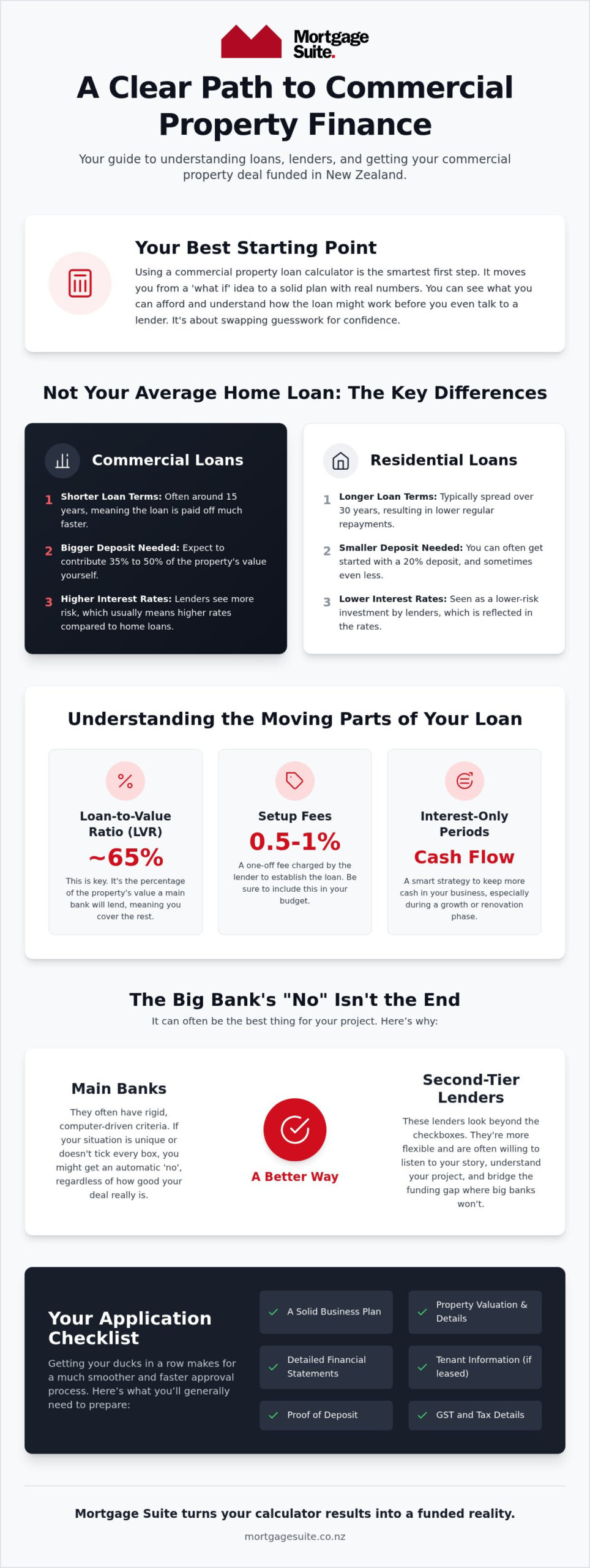
It helps to understand the fundamentals of what a commercial mortgage is compared to the standard house loan you might be used to. Commercial deals don’t follow the same rules as the family home. While you might get a 30-year term on a residential mortgage, commercial loans often wrap up much faster, frequently over 15 years. Because banks see a higher level of risk in business properties, interest rates are typically higher too. You’ll also need a much bigger “skin in the game.” Expect to provide a deposit between 35% and 50%, depending on the property type and its location. Lenders want to see that you have a significant commitment to the property before they agree to partner with you.

The “Guesstimate” vs. the Reality

Think of your calculator result as a helpful guide rather than a final, etched-in-stone offer. In the commercial world, almost everything can be negotiated. Your final interest rate and the total amount you can borrow will depend on your specific situation and the quality of the building itself. A modern office space with a long-term, reliable tenant is viewed very differently by a lender than a vacant industrial shed. Use the numbers from the commercial property loan calculator nz to build your business plan, but realise that these figures are just the starting point for a deeper conversation about strategy. Having a baseline estimate allows you to walk into a meeting with a lender feeling informed and ready to talk shop.

Understanding the “moving parts” under the hood of your loan

While a commercial property loan calculator nz is a brilliant tool for getting those initial numbers on paper, it’s important to remember that interest rates are only one part of the machine. To see if a deal truly stacks up, you need to look at the other moving parts that lenders use to decide if they’ll back you. The biggest factor is usually the loan-to-value amount. This is simply the percentage of the property’s value that the bank is willing to lend you. In the commercial world, this is much tighter than residential, often sitting around 65% for main banks. You also need to factor in the costs that a basic calculator might miss, such as setup fees. These are one-off costs charged by the lender to get the loan started, and they can range from 0.5% to 1% of the total loan amount.

During a growth phase, you might also negotiate an interest-only period. This can be a lifesaver for your cash flow, as it allows you to pay only the interest for a set time, keeping more cash in your business for operations or renovations. If these numbers feel a bit overwhelming, it’s often worth chatting with a specialist who can help you structure your commercial loan correctly from the start. Having a clear plan for these extra costs ensures you won’t be caught out by a cash shortage just as you’re trying to settle the deal.

Interest Coverage: Can the building pay for itself?

When you start looking at what you’ll need for a successful application, you’ll see that banks are obsessed with how well the building’s income covers the debt. They don’t just look at the total rent you collect. They focus on what’s left after all the costs like rates and insurance are paid. If the building generates significantly more than the interest costs, the bank feels much more relaxed about the deal. It’s their way of ensuring that even if interest rates tick up, you won’t be left out of pocket or struggling to meet your commitments each month.

Loan terms and paying off the debt

Standard commercial deals usually run over 15 years. This shorter timeframe means your monthly repayments will be higher than a home loan, but you’ll be clearing the debt much faster. This process of gradually paying off the debt over time is what keeps your equity growing and your business stable. You might also hear about large lump sum payments or term reviews at the end of a few years. These aren’t as scary as they sound; they’re just points in time, usually every three to five years, where the bank checks in to see how the property and your business are performing before renewing the loan. Using a commercial property loan calculator nz helps you model these shorter terms so there are no surprises down the road.

Why the big banks’ ‘computer says no’ isn’t the end of the road

It’s a common story in the Kiwi property market. You’ve run the numbers through a commercial property loan calculator nz, found a property that looks perfect, and then the big bank tells you they can’t help because you don’t fit their specific “box”. Mainstream banks are built for standard, low-risk scenarios. If your situation is even slightly unique, their automated systems often spit out a decline without looking at the actual merits of the deal. This is where 2nd tier lenders become your greatest asset. They don’t just look at a computer screen; they look at the property’s potential and your personal track record.

A calculator might show a higher interest rate for these non-bank options, but a 2nd tier loan could be the bridge you need to get the deal done. These lenders are perfect for “non-conforming” deals, such as specialised industrial sites or properties with shorter lease terms that scare off the big four. Instead of seeing a barrier, these lenders see an opportunity to support a growing business. It’s about finding a way to say yes when others have already walked away.

When to consider a 2nd tier lender

You might be self-employed with only one year of clean accounts, or perhaps you’re eyeing a specialised industrial site that the big banks find too risky. In these cases, 2nd tier lenders in New Zealand offer a vital lifeline. They are far more flexible with how they view income and credit history. Think of these loans as a strategic stepping stone. You secure the property now, build your equity or business history, and then look to move back to a main bank once you’ve ticked more of their traditional boxes later on.

The trade-off: Flexibility vs. Cost

Let’s be upfront about the costs. If you’ve used a commercial property loan calculator nz with main bank rates of 6.50% to 7.50% in mind, the 9% to 11% typically charged by non-bank lenders can look a bit steep. However, you have to weigh that against the “opportunity cost” of missing out on the property altogether. In a growing market, the capital gains or the business revenue generated by owning the building often far outweigh the extra interest paid. Getting the approval today is often much more valuable than waiting for a “yes” from a bank that might never come. It’s about looking at the bigger picture and having a steady hand to guide you through these alternative options.

Commercial Property Loan Calculator NZ: Your 2026 Guide to Getting Sorted

Getting your ducks in a row: What you’ll need for a successful application

Once you’ve used a commercial property loan calculator nz to get a handle on the repayments, it’s time to gather your evidence. Preparation is the secret sauce that turns a “maybe” into a “yes”. Lenders aren’t just looking at your bank balance; they’re looking for a professional, well-organised story. If your application is messy, the bank sees risk. If it’s tidy, you’re a safe bet. In the New Zealand market, the NBS (New Building Standard) rating is a total deal-breaker. This seismic score tells the bank how safe the building is in an earthquake. If the rating is too low, many banks will walk away immediately, no matter how strong your business is.

The paperwork trail

To get the ball rolling, you’ll need to gather a few essentials:

  • Two years of business accounts, including profit and loss statements.
  • Recent tax returns for you and your business.
  • Proof of your personal income.
  • A copy of the draft or current lease for the property.

Your “Statement of Position” is also a vital piece of the puzzle. This is essentially a financial CV that lists everything you own and everything you owe, giving the lender a snapshot of your financial health at a single glance. Providing a clean, easy-to-follow paperwork trail doesn’t just speed up the process; it can actually help you negotiate a lower interest rate because the bank feels more confident in your ability to manage the debt.

Due diligence costs to budget for

The numbers on your commercial property loan calculator nz won’t include the “hidden” costs of getting the deal across the line. You’ll need to have cash set aside for valuations, legal fees, and engineering reports. It’s important to remember that banks won’t accept a “Rateable Value” (RV) from the council. They’ll insist on a full report from one of their own approved valuers. If your plans are a bit more ambitious and you’re looking at how to finance property development for a new build or a major renovation, these costs can be even higher.

The “quality” of the tenant in the building is just as important as your own income. A blue-chip tenant with a long-term lease is a bank’s dream, while a brand-new startup might make them a bit nervous. Having an expert on your side to package this information correctly makes all the difference. We can help you prepare a bulletproof commercial application that speaks the lender’s language and highlights the strengths of your deal.

How Mortgage Suite Ltd turns your calculator results into a reality

You have likely spent some time with the commercial property loan calculator nz and have a rough idea of the costs involved. While those figures are a great starting point, they don’t tell the whole story of how a deal gets across the line. At Mortgage Suite Ltd, we specialise in taking those raw numbers and turning them into a viable financing strategy. We negotiate directly with banks and non-bank lenders to find a structure that actually fits your business goals, rather than just accepting the first offer that comes along.

Krish Krishna uses over 20 years of banking experience to package your application in a way that makes sense to credit managers. We know how to highlight the strengths of your deal, especially those tricky ones that mainstream banks might initially dismiss. It’s about more than just filling out forms; it’s about personal advocacy and making sure your voice is heard in a crowded market. We take the “scary” out of the numbers by providing a steady hand through the entire process.

Your advocate in the lending market

The world of commercial finance has its own rhythm, and we are here to help you navigate it. We speak the language of the lenders so you don’t have to worry about the technical talk. Mortgage Suite Ltd provides national coverage, helping Kiwis from the top of the North Island to the bottom of the South get the funding they need. If you already own a building but think you could be on a better deal or want to tap into your equity, we can also assist with a commercial property refinance to help you get ahead.

Ready to have a yarn about your next move?

A commercial property loan calculator nz provides the “what”, but we provide the “how”. We invite you to have a no-obligation yarn with our team to explore your options and see what’s truly possible in today’s market. Whether you’re a first-time commercial buyer or a seasoned developer, we are here to help you move forward with confidence. The calculator is just the start; the strategy is where the magic happens. Get in touch with the Mortgage Suite Ltd team today and let’s get you sorted.

Ready to turn those numbers into a street address?

Using a commercial property loan calculator nz provides the initial clarity you need to start your search, but the real success lies in the strategy you apply to those figures. We have explored the importance of understanding LVRs, interest coverage, and why a decline from a major bank is often just a detour rather than a dead end. Whether you are dealing with complex seismic ratings or simply need more flexible income criteria, the right preparation turns a daunting process into a manageable one.

At Mortgage Suite Ltd, we pride ourselves on being your dedicated advocates in a fluctuating market. With over 20 years of professional banking experience, we specialise in 2nd tier and alternative lending for those unique scenarios that don’t fit the standard bank mould. Our national service ensures that Kiwis across the country have access to expert negotiation and a steady hand during complex deals.

Let’s chat about your commercial financing goals today. We are ready to help you move beyond the calculator results and secure the property that will take your business or investment portfolio to the next level.

Frequently Asked Questions

How much deposit do I typically need for a commercial property loan in NZ?

You will generally need a deposit between 35% and 50% for a commercial purchase in New Zealand. Mainstream banks are quite conservative and usually lend up to 65% of the property’s value. If you’re looking at a specialised building, they might ask for even more cash up front. This higher deposit requirement is one of the biggest differences between business lending and buying a residential home.

Can I use the equity in my family home to buy a commercial building?

Yes, using the equity in your family home is a very common way to fund a commercial deposit. If your home has increased in value, you can often borrow against it to cover that 35% or 50% “skin in the game” required for the business property. It’s a smart way to get started without needing a massive pile of cash sitting in the bank, provided you have the income to support the extra debt.

What is a “good” interest coverage ratio for a commercial loan?

A “good” interest coverage ratio is typically 1.40x or higher for most mainstream lenders. This means for every dollar of interest you owe, the building’s net rent should bring in at least $1.40. If your ratio is lower, say around 1.00x, you might need to look at non-bank lenders who are more comfortable with tighter margins. This is a key figure to check after using a commercial property loan calculator nz.

Do commercial property loans in New Zealand have GST added to them?

Commercial loans are typically based on the GST-exclusive price of the property if you’re GST registered. Most commercial deals are “plus GST (if any)”, so you’ll need to work closely with your accountant to manage the cash flow during the settlement period. The bank won’t usually lend you the GST portion, as they expect you to claim that back from the IRD shortly after the purchase is finalised.

How long does it usually take to get a commercial loan approved?

You should allow between two to four weeks for a standard bank approval in the current market. Commercial deals require a lot more manual checking than residential ones, including a full review of leases and building reports. If you’re in a hurry, second-tier lenders can often move much faster, sometimes giving you a “yes” in just a few days if your paperwork is tidy and your strategy is clear.

What happens if a bank declines my commercial loan application?

If a bank declines your application, the first step is to look at the second-tier or non-bank market. A decline often just means you didn’t fit that specific bank’s rigid criteria, not that your deal is bad. Non-bank lenders are far more flexible with income types and property styles. We specialise in taking those declined applications and finding a lender that actually wants your business and understands your goals.

Are commercial mortgage rates fixed or floating in NZ?

Both fixed and floating rates are available in New Zealand, though the fixed periods are usually shorter, often between one and five years. Many business owners choose a mix of both to manage their risk. Because commercial terms are shorter overall, you’ll find that your interest rate is reviewed more frequently than it would be on a standard 30-year home mortgage, which keeps you on your toes with budgeting.

Is it harder to get a loan for a retail shop versus an industrial warehouse?

Generally, it is easier to get a loan for an industrial warehouse than a retail shop because banks see warehouses as a lower risk. Retail spaces can be harder to fill if a tenant leaves, whereas a clean industrial shed is always in high demand. If you’re eyeing a retail spot, you might find that using a commercial property loan calculator nz shows you’ll need a larger deposit to satisfy the bank’s risk team.

Article by

Krish Krishna

Experienced Financial Adviser with over 46 years of Banking and Mortgage broking experience and over $2.0 Billion in loan settlements.