
How to Buy Commercial Property: A Step-by-Step Loan Guide for NZ Business Owners

What if the bank’s “no” isn’t actually a reflection of your business’s health, but simply because you’re playing by the wrong set of rules? When you’re ready to buy commercial property loan NZ requirements can often feel like a massive hurdle, especially when you’re met with rigid criteria and deposit demands that look nothing like a standard home mortgage. You’ve worked hard to grow your company, and the last thing you need is a confusing process or worries about personal liability standing in the way of owning your own premises.

We know that the shift from a residential mindset to a commercial one can feel like learning a new language overnight. It’s a different world where mainstream banks look for specific interest cover ratios and seismic ratings before they’ll even consider an application. This guide will show you exactly how to navigate the lending landscape in 2026 without the jargon. We’ll explore whether a big bank or a flexible 2nd tier lender is your best fit, providing a clear roadmap to help you secure a permanent home for your business to thrive.

Key Takeaways

  • Understand why your home loan experience won’t prepare you for the commercial world and how to shift your mindset to business-zoned finance.
  • Discover the specific numbers lenders look for, including why you’ll likely need a 35% deposit when you buy commercial property loan NZ wide.
  • Find out how to choose between the “Big Four” banks and flexible 2nd tier lenders based on your business’s unique needs.
  • Get a clear checklist for organising your financial story, including why a professional valuation is different from a standard home appraisal.
  • Learn how a seasoned advocate can use their “bank-to-broker” experience to negotiate a “yes” even when mainstream criteria feel too rigid.

What is a Commercial Property Loan and Why is it Different?

Think of a commercial loan as the business version of a mortgage. If you have ever bought a house, you probably feel like you understand how the lending process works. However, when you decide to What is a Commercial Property Loan exactly? Essentially, it is finance specifically for buildings zoned for business use rather than living in. This includes anything from a small retail shop in the city centre to a massive warehouse in an industrial park or a professional office suite. Most Kiwis look into these loans for two main reasons. They either want the stability of owning their own business premises to stop paying rent, or they are looking for the higher rental returns that commercial properties often provide compared to residential rentals.

The biggest shock for most people is that your previous home loan experience won’t prepare you for this world. Banks view these properties as higher risk than a standard family home. Because of that, the rules of the game change completely. You aren’t just a homeowner anymore; you are a business operator or a commercial investor in the eyes of the lender. This shift in perspective changes everything from how much you can borrow to how quickly you need to pay it back.

The Core Differences: Residential vs. Commercial

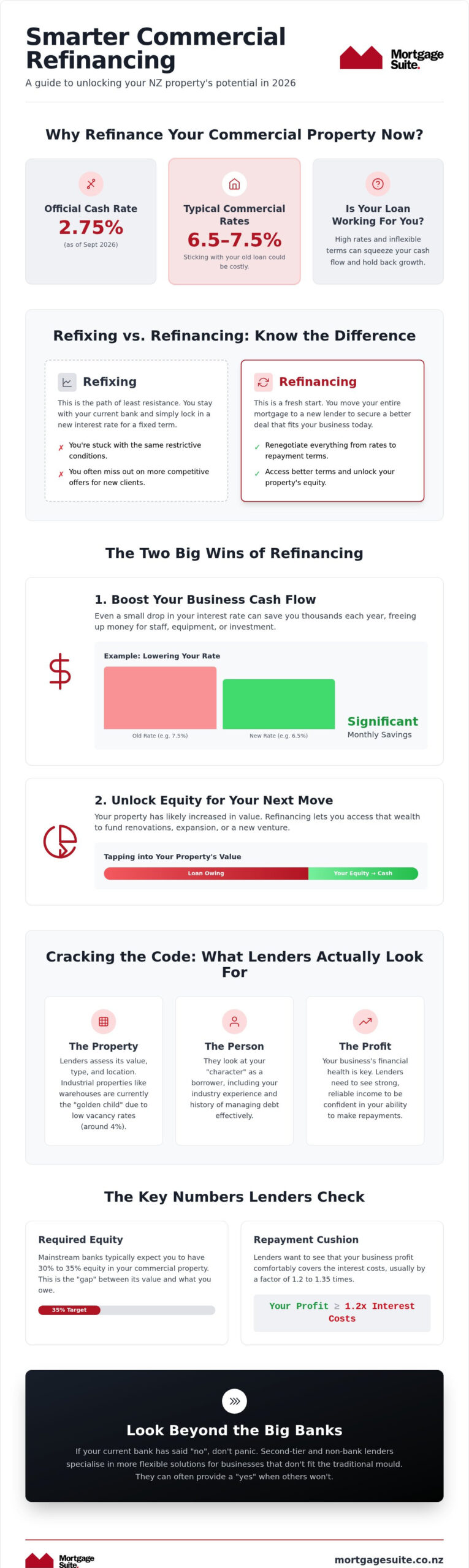
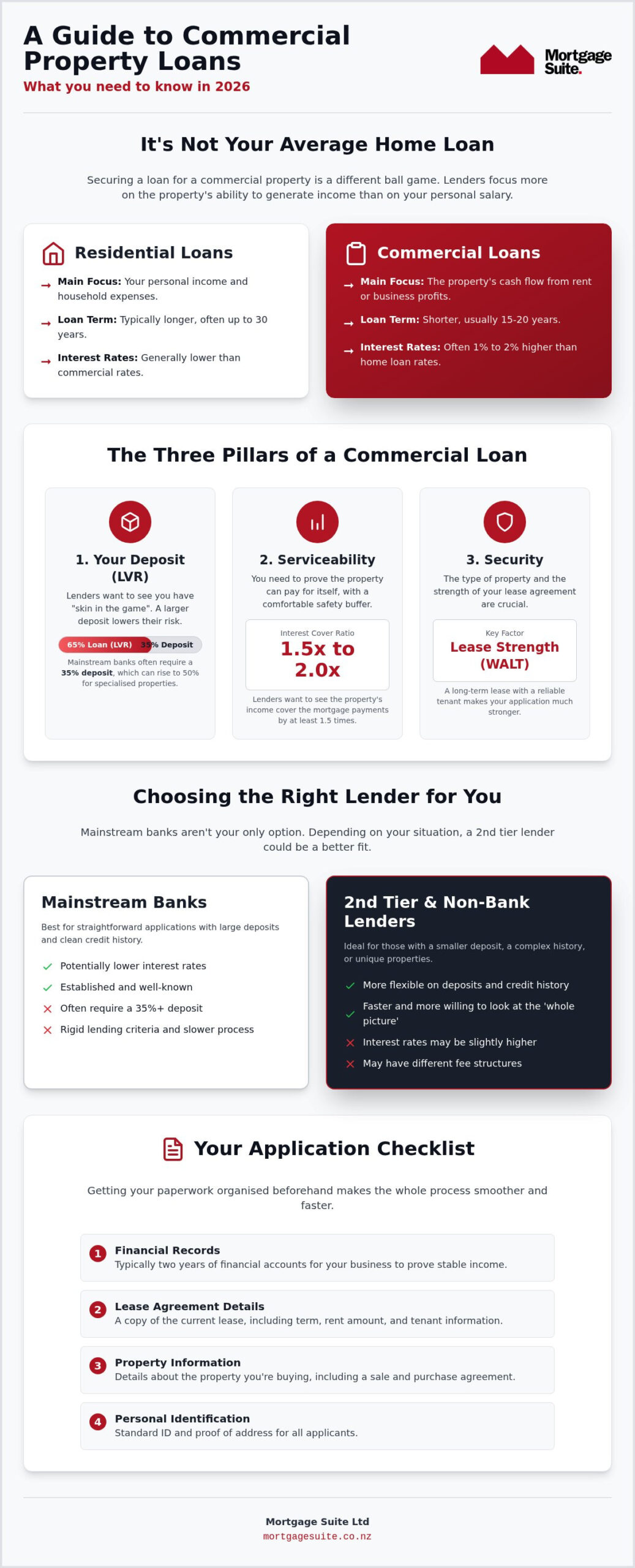
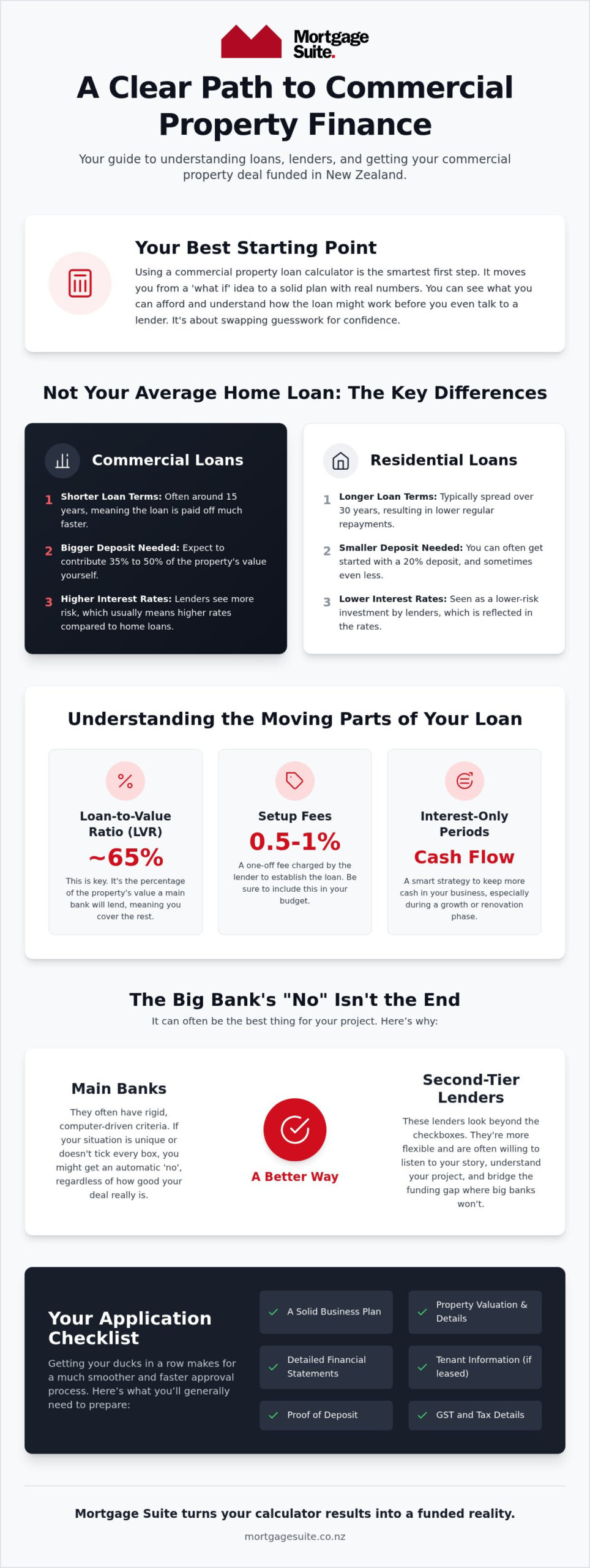
One of the first things you will notice is the deposit requirement. While you might get a house with a 20% deposit, a buy commercial property loan NZ wide typically requires at least 35%. This 65% Loan-to-Value Ratio (LVR) is the standard for most mainstream lenders in 2026. Another major shift is the loan term. You won’t find 30-year terms here; most commercial loans are structured over 15 to 20 years. Lenders also focus heavily on whether the building can “pay for itself” through rent or business profit. They use a calculation called an interest cover ratio to ensure your income comfortably exceeds the loan repayments.

Who is a Commercial Loan For?

Most of our clients fall into two camps. The owner-occupier is a business owner who wants to secure their future. Instead of being at the mercy of a landlord, they buy their own building to give their company a permanent base and build equity. Then there is the investor. These people are looking for yield and long-term growth by leasing the space to other businesses. In both cases, the bank cares deeply about your business history. Your GST returns and profit/loss statements carry more weight than your personal credit card limit. They want to see a track record of success that proves you can handle the repayments even if the market fluctuates.

Understanding the Numbers: How Lenders Decide to Say Yes

Numbers might feel cold and clinical, but to a bank, they tell the story of how safe their money is. When you look to buy commercial property loan NZ lenders will scrutinise your “interest cover” before anything else. This is a simple calculation to see if your business profit or rental income can comfortably handle the interest payments. In 2026, most mainstream banks want to see a ratio of at least 1.50x to 1.75x. This means for every dollar of interest you owe, they want to see at least $1.50 in reliable income coming through the door. It is their way of ensuring you have a safety net if things get a bit tight.

In the 2026 market, the Loan-to-Value Ratio (LVR) is simply the percentage of the property’s total value that the bank is willing to lend you, which for commercial buildings usually tops out at 65%. This “65% Rule” is why you generally need a 35% deposit, a significant jump from the 20% often seen in the residential world. If you find these calculations a bit daunting, getting some professional mortgage advice early on can help you see exactly where you stand before you start making offers.

Deposit and Equity Requirements

You don’t always need a pile of cash sitting in a savings account to meet that 35% requirement. Many Kiwi business owners use the “lazy equity” in their own homes to bridge the gap. By securing part of the commercial loan against your residential property, you can often fund the entire purchase without touching your cash flow. However, the type of building matters immensely. A standard warehouse or office is easy for a bank to value. On the other hand, specialised buildings like car washes, gyms, or cold-storage facilities often face stricter rules because they are harder to sell or repurpose if the business closes.

The Lease: Your Secret Weapon for Approval

If you are buying an investment property, the lease is your most valuable asset. Lenders love a “strong” lease, which usually means a well-known tenant with several years left on their contract. They look closely at the Weighted Average Lease Expiry (WALE). Think of this as the “time left on the clock” across all tenants in the building. A longer WALE gives the bank confidence that the mortgage will be paid.

  • Long-term tenants: These are like gold to a lender and can sometimes help you secure better interest rates.
  • Vacant buildings: These are much harder to finance. Banks see a building with no tenant as a 100% risk, often requiring you to prove you have enough cash reserves to cover the mortgage for a year or more while you find a tenant.
  • Tenant quality: A lease to a government department or a national brand is viewed far more favourably than a lease to a brand-new startup.

Mainstream Banks vs. 2nd Tier Lenders: Choosing Your Path

Choosing the right lender is about more than just finding the lowest number on a page. When you decide to buy commercial property loan NZ options generally fall into two categories: the household name banks and the specialised alternative lenders. Many business owners feel a sense of loyalty to their current bank, but in the commercial world, that loyalty isn’t always rewarded with an easy approval. The reality of the 2026 market is that the “Big Four” have become increasingly selective about who they take on, often leaving small to medium businesses searching for a more flexible partner.

A “no” from your local branch manager isn’t the end of the road; it’s often just a sign that you’re knocking on the wrong door. Different lenders have different appetites for risk. One bank might have reached its limit for retail properties in your specific suburb, while a non-bank lender might be actively looking to grow their portfolio in that exact sector. Understanding these nuances is the key to getting your finance across the line without unnecessary stress.

When the Bank is the Right Choice

The major banks in New Zealand are an excellent choice if you fit into a very specific “perfect” box. They look for clean financial records, several years of steady profit, and properties with long-term, reliable tenants. If you meet these strict requirements, a commercial mortgage New Zealand banks offer will likely provide the most competitive interest rates. However, be prepared for a slower pace. Mainstream institutions are known for their lengthy “committee” approval processes, which can be a major disadvantage if you need to move quickly on a property before a competitor beats you to it.

The Power of Non-Bank and 2nd Tier Lending

If your business has seasonal income or you’ve only been trading for a couple of years, a 2nd tier lender New Zealand wide might be a better fit. These lenders are built for speed and flexibility. They often look at the “big picture” of your business potential rather than just a computer-generated credit score. While interest rates can be higher, with some non-bank providers starting from 6.95% and others ranging up to 20.95% for higher-risk scenarios, they offer solutions that mainstream banks simply won’t consider. This path is particularly useful for business owners who need to secure a building quickly and plan to refinance to a major bank once they have a longer track record of success. When you buy commercial property loan NZ requirements vary wildly, so having access to these alternative paths ensures you aren’t left stranded by a single bank’s rigid policy.

How to Buy Commercial Property: A Step-by-Step Loan Guide for NZ Business Owners

5 Steps to Getting Your Commercial Loan Sorted

Getting the green light for your finance involves a bit more than a quick chat and a handshake. When you’re looking to buy commercial property loan NZ lenders will expect a methodical approach. It’s about building a case that proves your business is a safe bet. Following a structured path ensures you don’t get caught out by unexpected requests halfway through the process. It’s a steady journey from your initial idea to finally holding the keys to your own premises.

Preparing Your Paperwork

Your first task is to organise your financial “story”. This isn’t just about handing over a few bank statements; it’s about showing the bank your trajectory. You’ll need at least two years of GST returns and up-to-date profit and loss statements ready to go. If you’re an owner-occupier, a solid business plan is vital. It shows the lender how owning this building will help your company grow and improve your long-term stability. Sometimes, a small business loan NZ lenders provide can work alongside your property finance to cover fit-out costs or new equipment for your new space.

The Valuation and Due Diligence

Once the paperwork is in, you’ll need a professional valuation. Unlike a house appraisal, a commercial valuation is a deep dive into the building’s income potential and structural health. Lenders will only accept reports from their own approved panel of valuers, so don’t jump the gun and hire someone yourself. They’ll also look at environmental risks and whether the building complies with the Building Act, especially concerning seismic ratings. A low earthquake rating can drastically change your loan terms, so it’s best to get a professional loan assessment before you sign any unconditional contracts.

Step 3 involves choosing your lender path with an expert who knows the current appetite of the market. Based on the scenarios we discussed earlier, you’ll decide whether a mainstream bank or a flexible 2nd tier lender is the right home for your loan. Once you’ve selected a lender, you’ll move to Step 4: navigating the “Conditional Approval” phase. This is the stage where you satisfy the lender’s final checks, such as proof of insurance or verifying lease details. Finally, Step 5 is settlement and beyond. This is where the final paperwork is organised, funds are transferred, and you officially take ownership of your new business asset.

How Mortgage Suite Negotiates the Best Deal for You

Finding the right building is a massive milestone for any company, but the finance phase is where things often get tricky. This is where we step in. Our team brings years of “bank-to-broker” experience to your side of the table. Because we have spent years working inside major New Zealand banks, we understand the hidden boxes that need to be ticked to get an approval. We know how to frame your financial story so it doesn’t just meet the criteria but actually stands out to the people making the decisions.

We act as your personal advocate. When you want to buy commercial property loan NZ lenders can sometimes be incredibly rigid, especially if your business doesn’t fit a standard template. We don’t just pass on a message; we negotiate. If one lender says “no” because of a specific internal policy, we know which alternative lender will see the value in your proposal. You get a single point of contact who manages the entire journey, from that first conversation to the day you move in.

Taking the stress out of the paperwork is our priority. You should be focused on running your business and planning your growth, not chasing bank managers for updates or worrying about fine print. We handle the heavy lifting, ensuring every document is in its right place so there are no last-minute surprises at settlement. We’re here to make sure you get a fair go and the best possible terms the market has to offer.

A Personal Approach to Complex Finance

We treat your business like our own. We aren’t interested in just a one-off transaction; we want to build a long-term partnership that supports your success for years to come. That means looking at how your property fits into your wider goals. As the market shifts and your equity grows, we can also help with a Commercial Property Refinance NZ down the track. This allows you to unlock capital for further expansion or move to better interest rates as your business track record strengthens.

Ready to Secure Your Business Future?

If you’re ready to stop paying rent and start building your own business asset, the first step is a simple conversation. We’ll give you a quick, honest assessment of your borrowing power based on the 2026 lending environment. Our focus is always on your specific goals first, followed by the numbers. We’ll help you understand exactly what’s possible so you can bid with confidence and secure the premises your business deserves.

Get in touch with the Mortgage Suite team today to get your commercial loan sorted. Let’s find the right “home” for your business finance together.

Secure Your Business’s Future Today

Owning your own premises is more than just a financial move; it is a commitment to the longevity of your business. We have covered why the 65% deposit rule matters and how the right lease can act as your secret weapon when you apply for a buy commercial property loan NZ wide. Whether you fit the strict criteria of a major bank or need the flexibility of a 2nd tier lender, the key is having a roadmap that avoids the usual jargon and delays.

With over 20 years of banking and brokerage experience, we specialise in finding solutions for “non-standard” situations that others might find too complex. We pride ourselves on a personalised service that treats you like a partner, not just a number on a spreadsheet. If you are ready to stop paying rent and start building equity, we are here to guide you through every step of the negotiation and paperwork.

Book a conversational chat with Krish Krishna to discuss your commercial goals and get a clear picture of your borrowing power today. Your business deserves a permanent home, and we have the expertise to help you get there.

Frequently Asked Questions

How much deposit do I need to buy a commercial property in NZ?

You typically need a 35% deposit for a standard commercial purchase in New Zealand. While residential buyers are used to 20%, commercial lenders usually cap their lending at 65% of the property’s value. Some non-bank lenders might offer slightly more flexibility, sometimes allowing for a 30% deposit if the business case and the building’s location are particularly strong.

Can I use my house as security for a commercial property loan?

Yes, you can certainly use the equity in your home to secure a buy commercial property loan NZ wide. This is a popular strategy for business owners who don’t want to tie up their working capital in a cash deposit. By using your residential property as additional security, you can often fund the entire purchase and keep your cash for growing the business.

What is the current interest rate for commercial loans in New Zealand?

Interest rates vary significantly depending on whether you choose a mainstream bank or a 2nd tier lender. With the Official Cash Rate sitting at 2.25% in July 2026, mainstream banks offer competitive but tailored rates. Non-bank lenders often start their rates around 6.95%, though these can reach up to 20.95% for higher-risk or short-term “bridge” loans that prioritise speed over cost.

How long does it take to get a commercial loan approved?

Approval times depend entirely on the lender you choose. Mainstream banks are thorough and can take several weeks or even months to move through their internal committees. If you are in a rush to settle, a 2nd tier lender can often provide an answer and get the deal sorted in a matter of days because they have more streamlined processes and direct decision-making.

What happens if my business hasn’t been trading for two years yet?

You can still secure a loan even if your business is relatively new. While mainstream banks generally prefer at least two years of solid trading history, alternative lenders are often willing to look at your professional experience and future projections. They focus more on the “big picture” and the value of the property itself rather than just relying on your past tax returns.

Is it harder to get a commercial loan than a residential one?

It is generally more difficult because lenders view commercial assets as higher risk than family homes. The criteria are stricter, requiring higher deposits and proof that the building’s income can comfortably cover the interest. You also have to navigate specific checks like seismic ratings and environmental reports that simply don’t apply to standard residential houses in the city centre.

Can I get a commercial loan if I’ve been declined by a bank?

Being declined by a bank is not the end of the road. Many of our clients come to us after a “no” from their local branch manager. Because 2nd tier lenders have different appetites for risk and more flexible rules, we can often find a path to approval by matching your specific scenario with the right alternative lender who understands your industry.

Do I need a personal guarantee for a commercial mortgage?

Most lenders will require a personal guarantee, especially if you are borrowing through a company structure. This gives the bank an extra layer of security, ensuring that the directors are personally committed to the loan. It is a standard part of the process for small to medium businesses in New Zealand, though the specific terms can sometimes be negotiated depending on your equity.

Article by

Krish Krishna

Experienced Financial Adviser with over 46 years of Banking and Mortgage broking experience and over $2.0 Billion in loan settlements.

Commercial Property Refinance NZ: Your 2026 Guide to Unlocking Equity and Better Rates

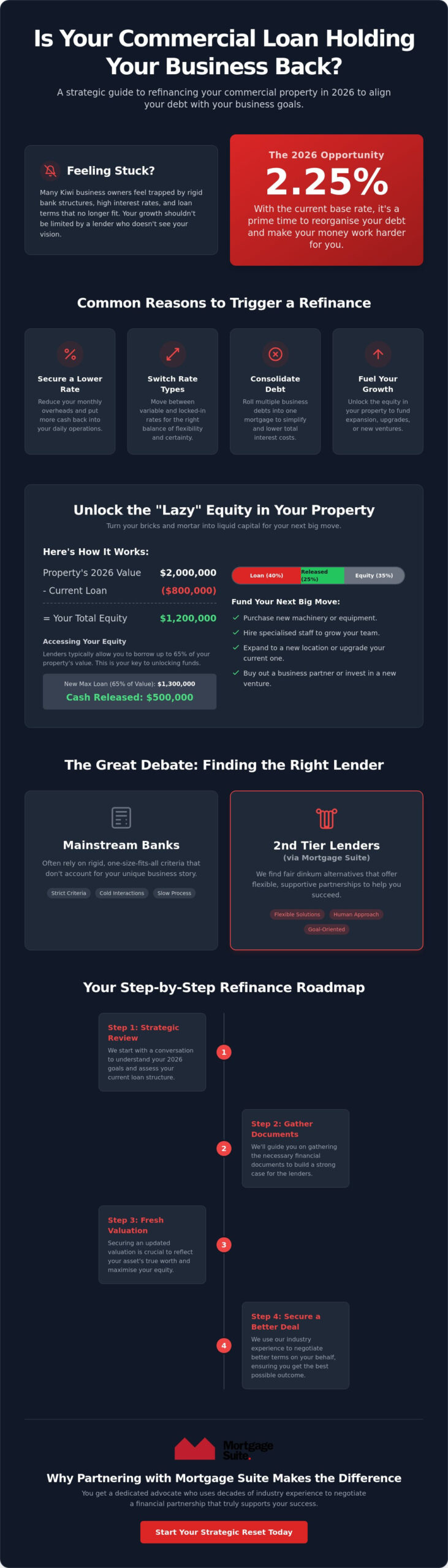
What if the bank’s “no” isn’t actually a dead end, but a sign that your current loan has simply outgrown your business? Many Kiwi property owners feel stuck with high interest rates or rigid terms that were set years ago. It’s draining to feel like your growth is being held back by a lender who doesn’t understand your vision, especially when you’re trying to make sense of complex terms like repayment safety margins or loan-to-value limits. You deserve a financial partner who sees the potential in your portfolio rather than just the risks on a spreadsheet.

Securing a commercial property refinance NZ wide is about more than just finding a cheaper rate; it’s a strategic reset to align your debt with your 2026 goals. In this guide, you’ll learn how to restructure your debt to release equity for expansion and take advantage of the current 2.25% base interest rate environment. We’ll walk through how to navigate the latest financial regulations and show you how to trade cold, corporate interactions for a lending relationship that actually supports your long-term success. Whether you’re looking to lower your monthly repayments or access a lump sum for your next big move, we’ve got the roadmap to get you there.

Key Takeaways

  • Discover how a commercial property refinance NZ wide can help you break free from rigid bank structures and align your debt with your 2026 business goals.
  • Learn how to identify and unlock “lazy” equity in your property to fund your next stage of growth or expansion.
  • Compare the strict criteria of mainstream banks against the flexible, fair dinkum alternatives offered by 2nd tier lenders across New Zealand.
  • Get a clear roadmap for your refinance journey, from gathering your financial documents to securing a fresh valuation that reflects your asset’s true value.
  • Understand the value of having a dedicated advocate from Mortgage Suite Ltd who uses decades of industry experience to negotiate better terms on your behalf.

What is commercial property refinance and why consider it in 2026?

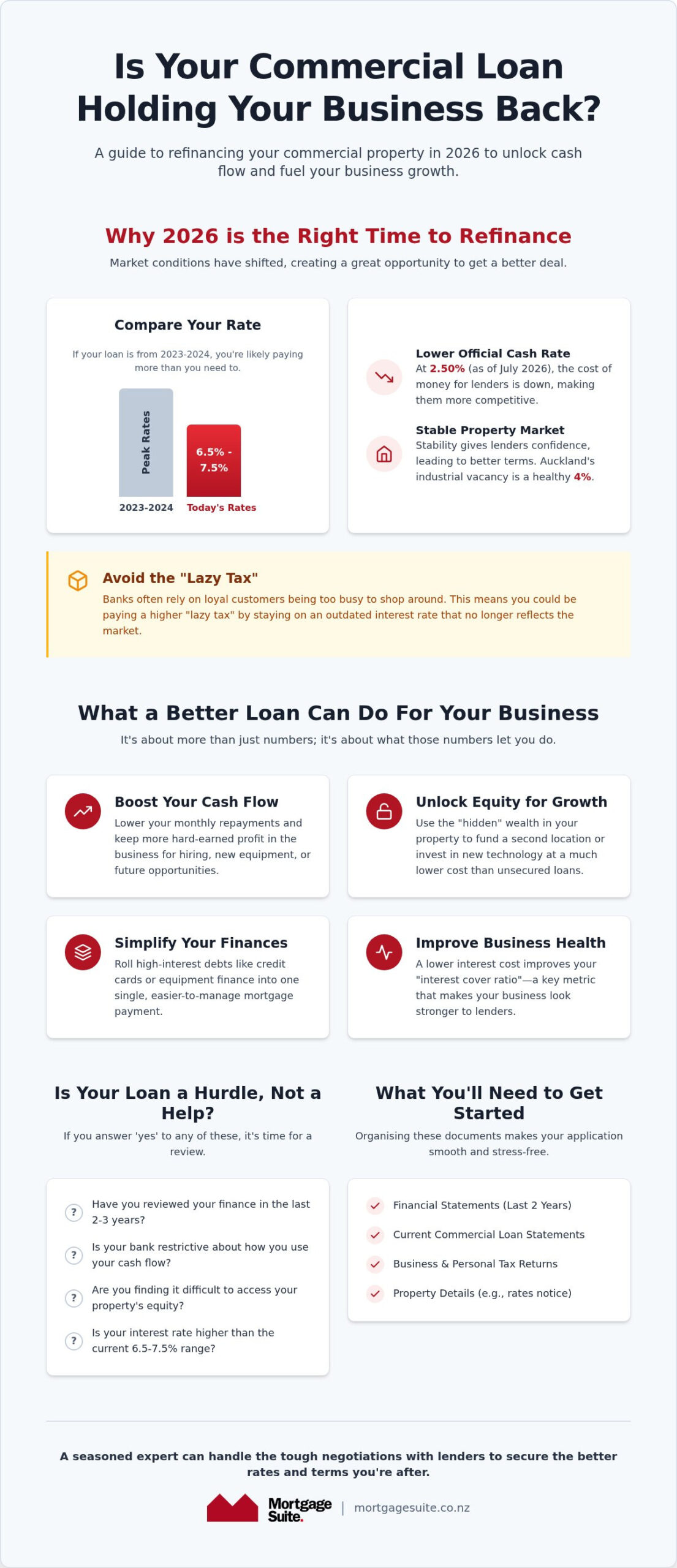
Refinancing is essentially the process of replacing your current commercial loan with a fresh one, often from a new lender who offers better terms. Think of it as a tactical move to improve your financial position or fuel business expansion. In the current market, many Kiwi business owners are finding that the “big four” banks have become a bit too rigid with their lending criteria. By looking at a commercial property refinance NZ wide, you can move away from those strict boxes and find a debt structure that actually breathes with your business.

To understand the basics, you might ask, what is a commercial mortgage and how does it differ when you’re swapping lenders? While the underlying asset stays the same, the rules of the game change based on the lender’s appetite for risk and their current interest rates. With the Reserve Bank’s base rate sitting at 2.25% in mid-2026, it’s a prime time to reorganise your debt to better suit your current cash flow needs. It’s about making your money work harder for you, rather than just serving the bank’s requirements.

Common reasons to trigger a refinance

Most people start looking at their options when they feel they’re paying too much or when their business needs have shifted. Here are the main drivers we see in the 2026 landscape:

  • Securing a lower interest rate: This is the most common reason. Reducing your monthly overheads puts more cash back into your daily operations.
  • Switching interest rate types: You might want to move between variable vs locked-in interest rates to find the right balance of flexibility and certainty based on current market trends.
  • Debt consolidation: You can often roll various business debts into one single commercial mortgage. This simplifies your life and usually lowers your total interest costs significantly.

Refinance vs. New Loan: What is the difference?

You might think a refinance is just as much hassle as buying a new property, but that’s rarely the case. Because you already own the asset, the assessment process can often be much faster than a new purchase. Lenders already have a track record of the property’s performance to look at. However, you do need to weigh up the costs for ending a contract early, often called break fees. We often find that if the long-term savings on a lower interest rate outweigh that initial cost, it’s a very smart move.

Your property’s updated 2026 valuation plays a massive role here too. If your building is worth more now than when you first bought it, your equity has grown. This updated value gives you much more leverage when talking to a commercial property refinance NZ specialist at Mortgage Suite Ltd, as it lowers the lender’s risk and can unlock better pricing tiers that weren’t available to you before.

Unlocking the goldmine: Using equity release for business growth

Your commercial property is more than just a place for the team to work or a spot to store your inventory. If you have owned your building for a few years, there is a good chance it is sitting on a pile of what we call “lazy” equity. Choosing a commercial property refinance NZ wide allows you to tap into that increased value, effectively turning your bricks and mortar into liquid cash. You are essentially replacing your current loan with a larger one and using the difference to fund your next big move, whether that is a new location or a major upgrade.

Using the value in your property is often the most cost-effective way to fund a new business venture because interest rates backed by property are almost always lower than other types of finance. This capital works as a brilliant small business loan NZ alternative, giving you the funds you need for new machinery, hiring specialized staff, or even buying out a business partner. By leveraging an asset you already own, you avoid the high costs and strict terms often found with unsecured business credit lines.

Calculating your usable equity

Lenders decide how much you can borrow based on the percentage of the property’s total value. In the 2026 market, a solid rule of thumb is that most lenders will let you borrow up to 60% or 65% of what the building is currently worth. However, not every property is treated the same. While a standard office or warehouse is usually straightforward, specialised buildings like medical centres or cold storage units might have slightly tighter limits.

According to insights from the Property Institute of New Zealand, professional valuation trends are vital because a fresh appraisal can often reveal far more equity than you might have estimated yourself. You could even use this extra cash to fund the deposit for a residential investment property, allowing you to grow your personal wealth alongside your business without having to save a fresh deposit from your daily cash flow.

Servicing the new debt

While having equity is a great start, you also need to prove that your business can handle the larger repayments. Lenders will look closely at how well your profit covers your interest payments. Simply put, they want to see a healthy safety margin where your business income is significantly higher than the cost of the loan. They aren’t just looking at the building; they are looking at the health and sustainability of the business operating within it.

Most traditional banks prefer to see two years of steady, healthy profit in your financial records. If your recent history has been a bit more varied due to growth or market shifts, some lenders can be more flexible, provided you can show a clear plan for how the released cash will drive your future income. If you are wondering how much your specific property could unlock for your business, it is worth having a chat with the team at Mortgage Suite Ltd to see what is possible for your situation.

The Great Debate: Mainstream banks vs. 2nd tier lenders

Choosing between a mainstream bank and a non-bank lender is one of the most important decisions you’ll make when looking at a commercial property refinance NZ wide. Mainstream banks are often the first port of call because they offer the lowest interest rates. However, they can be incredibly fussy about your financial history. If your business doesn’t fit into their narrow “perfect” box, you might find yourself facing a frustrating rejection. This is where a 2nd tier lender New Zealand owners trust comes into play. They offer a fair dinkum alternative by looking at the bigger picture of your business potential rather than just ticking boxes on a checklist.

The landscape for a commercial mortgage New Zealand wide has evolved significantly by 2026. Non-bank lenders are no longer just a “last resort” for those with bad credit. They’ve become highly competitive, offering tailored solutions that the big banks simply aren’t set up to handle. For many, refinancing to a non-bank is a strategic bridge that helps them navigate a period of rapid growth or a temporary dip in cash flow without the rigid constraints of traditional banking.

When to choose a non-bank refinance

There are several scenarios where a non-bank lender is actually the better choice for your commercial property refinance NZ project:

  • Colourful financials: If you have a short trading history or your most recent tax returns don’t show the full strength of your business yet, a non-bank lender is much more likely to listen to your story and understand your future projections.
  • Need for speed: Big banks are notorious for taking weeks, or even months, to make a decision. If you need to move fast to secure a time-sensitive opportunity, a 2nd tier lender can often provide an answer and the funds in a matter of days.
  • Protecting your home: Many banks insist on “cross-collateralisation,” which means they use your family home as security for your business loan. Refinancing away from the bank can help you untangle these assets and keep your personal life separate from your business risks.

The path back to the bank

One thing many people don’t realise is that a non-bank loan doesn’t have to be a permanent fixture. We often view it as a temporary solution for 12 to 24 months. During this time, you can focus on stabilising your financials and building the “clean” track record that mainstream banks love. Once your business has matured and your books look more traditional, you can “graduate” back to a mainstream bank to secure those lower long-term rates. Having a seasoned advisor in your corner makes this transition much easier, as we know exactly what the big banks need to see before they’ll welcome you back. It’s about playing the long game to get the best result for your business.

Commercial Property Refinance NZ: Your 2026 Guide to Unlocking Equity and Better Rates

Your step-by-step roadmap to a successful refinance

Getting your commercial property refinance NZ project across the line doesn’t have to be a headache if you follow a clear path. By 2026, the lending environment has become more nuanced, requiring a bit more preparation than a standard residential top-up. The first step is always to gather your “ducks in a row.” This means having at least two years of clean financial statements, including profit and loss reports and balance sheets, alongside your current loan details. Lenders want to see that your business is stable and that you’ve been a reliable borrower so far.

Once your paperwork is sorted, the process typically follows this sequence:

  • Get a fresh valuation: With total commercial sales activity increasing by approximately $131 million in recent years, your property’s 2026 value is likely much higher than your last bank assessment.
  • Compare lender appetite: Not every lender wants to fund a suburban retail block or a large industrial warehouse. We help you find the one whose current “appetite” matches your specific asset type to ensure a higher chance of approval.
  • Negotiate the fine print: This is where we look at the General Security Agreements (GSA) and ensure the terms don’t pull your other business assets into the mix unnecessarily.
  • Settlement: Your lawyers will coordinate with the new lender to pay off your old debt. From here, your new journey with better rates or extra capital begins.

Navigating the valuation process

One common trap is thinking you can use a simple residential “app” estimate for a commercial deal. Commercial valuations are far more complex. The valuer will look closely at your “yield” and “cap rates,” which are essentially ways of measuring the property’s income potential against its market risk. If you have strong tenants on long-term leases, your valuation will likely be much stronger. It’s a good idea to tidy up the building and ensure all maintenance records are up to date before the valuer arrives. A well-presented property suggests a well-managed business, which gives the bank more confidence during the commercial property refinance NZ process.

Negotiating the “hidden” terms

It is a mistake to focus solely on the interest rate. While the 2.25% OCR has kept base rates attractive, banks often hide extra costs in “line fees” or strict “covenants.” Covenants are the rules you must follow, such as maintaining a certain level of profit. If these are too tight, they can stifle your growth. We often work to get application fees reduced or waived entirely, and we structure the loan to ensure you have the flexibility to make changes later without being hit by more charges. If you want someone to handle these tricky negotiations for you, reach out to Mortgage Suite Ltd to start your roadmap today.

Why partnering with Mortgage Suite makes the difference

When you are looking to secure a commercial property refinance NZ wide, having the right person in your corner changes everything. Krish Krishna and the team at Mortgage Suite bring over 20 years of deep banking experience directly to your side of the table. We reckon every business owner deserves an advocate who speaks the bank’s language and knows exactly how to navigate their internal systems. Instead of you spending hours on hold or deciphering complex credit policies, we handle the heavy lifting of the application. This leaves you free to stay focused on what really matters; looking after your customers and growing your business.

Our expertise isn’t limited to one specific sector. Whether you are managing a large industrial warehouse, a bustling retail suite, or a specialised medical facility, we know how to present your case. We understand the nuances of the 2026 market and how to highlight the strengths of your property and business cash flow to get the deal sorted. We don’t just submit papers; we tell your story in a way that makes lenders want to say yes.

A personal approach to business finance

We are not a “set and forget” brokerage that disappears once the loan is settled. We are here for the long haul, acting as a steady hand as your business evolves. Our reputation as dedicated negotiators helps us find the “green light” for complex deals that other brokers might find too difficult. We specialise in those “out of the box” scenarios that mainstream banks often struggle with, using our industry connections to find flexible solutions that align with your specific goals. If there is a way to make the numbers work, we will find it.

Ready to chat about your options?

The first conversation you have with us is always free and completely confidential. We take the time to listen to your 2026 goals and look at your current debt structure to see if there is a better deal waiting for you. There is no pressure and no confusing jargon; just honest, professional advice from people who have seen every possible scenario. Let’s see how a commercial property refinance NZ could unlock new opportunities for your portfolio. Get in touch with Mortgage Suite today to explore your refinance options and start your next chapter with confidence.

Ready to unlock your property’s true potential?

The 2026 market offers a unique window to turn your commercial asset into a springboard for future success. Whether you’re looking to lower your overheads or tap into equity for a new venture, a commercial property refinance NZ project gives you the control back. You don’t have to stay stuck with a lender who doesn’t see your vision or understand your specific industry needs. Refinancing is your chance to reset the terms and ensure your debt is working for you, not the other way around.

At Mortgage Suite, we bring over two decades of banking and brokerage expertise to ensure you aren’t just another number in a system. We specialise in finding the right path, whether that’s with a mainstream bank or a flexible 2nd tier lender who can move as fast as you do. Our team acts as your personal advocate, handling the tricky negotiations and paperwork so you can get back to what you do best. We believe in building long-term partnerships based on trust and real results.

If you’re ready to see what’s possible, book a free refinance strategy session with Krish and the team today. We’ll look at your goals and find a solution that fits your business perfectly. It’s time to move forward with a financial partner who is as committed to your success as you are.

Frequently Asked Questions

Is it harder to refinance commercial property than a residential home?

It is generally more complex because lenders look at the strength of your business and the quality of your tenants rather than just your personal income. While a home loan is based on a standard set of rules, commercial deals are assessed on their individual merits. This requires more detailed paperwork and a deeper look at your long-term stability, lease agreements, and the specific industry you operate in.

How much equity can I pull out of my commercial property in NZ?

Most lenders in the current market will allow you to borrow up to 60% or 65% of the property’s total value. If your property is worth more now than when you bought it, you can use a commercial property refinance NZ project to access that extra cash for business growth. This is a great way to fund expansion or new investments, provided your business can comfortably service the larger loan.

What are the typical break fees when refinancing a commercial loan?

Break fees vary between lenders, but you might see a flat fee around $33 or a calculation based on 30 days of interest. It is important to ask your current bank for a specific “break cost” quote before you switch. This helps you determine if the long-term savings from a lower interest rate will outweigh the immediate cost of leaving your current contract early.

Can I refinance if my business has had a “tough” year financially?

You certainly can, though you may need to look beyond the mainstream banks for a solution. If your most recent tax returns show a dip in profit, a non-bank lender will often look at your overall track record and future projections rather than just your last 12 months. This “big picture” approach is a great way to secure the funding you need while your business gets back on its feet.

How long does the commercial refinance process actually take?

You should typically allow between four and eight weeks from your first conversation to the final settlement. While some 2nd tier lenders can move much faster if you have all your documents ready, the process involves valuations and legal checks that take time to get right. Starting the process early ensures you aren’t rushed into a deal and gives us plenty of time to negotiate the best terms.

Do I need a new valuation when I refinance my commercial property?

Yes, almost every lender will require a fresh valuation to confirm the property’s current market value. Since the 2026 lending landscape relies heavily on accurate data, a new report ensures the bank is comfortable with the loan amount. It also gives you the best chance of unlocking the maximum amount of equity if the property has increased in value since you first took out your loan.

What is an “Interest Cover Ratio” and why does it matter for my refinance?

This is a tool lenders use to see if your business makes enough profit to pay the interest on the loan several times over. They want to see a safety margin so that even if your income drops slightly, you can still meet your repayments. A strong ratio makes you a much more attractive borrower and can often lead to more competitive interest rates and better terms.

Can I refinance a commercial property that has a vacant tenancy?

It is possible, but it usually requires a specialist lender who understands your specific market. Mainstream banks generally prefer properties with consistent income from long-term leases. If you have a vacancy, we can often find a commercial property refinance NZ solution that provides a bridge until you find a new tenant. Once the building is full again, we can then look at moving you back to a traditional bank.

Article by

Krish Krishna

Experienced Financial Adviser with over 46 years of Banking and Mortgage broking experience and over $2.0 Billion in loan settlements.

Commercial Mortgage New Zealand: Comparing Mainstream Banks vs 2nd Tier Lenders in 2026

You might assume that the lowest advertised interest rate from a major bank is the gold standard for your next commercial mortgage New Zealand, but for many savvy investors in 2026, the obvious choice is no longer the most profitable one. While the Official Cash Rate has held steady at 2.25 per cent, the reality of securing finance has become a hurdle of rigid serviceability tests and opaque rate structures. We understand how exhausting it is to present a strong business case only to be met with a clinical checklist that ignores your true commercial potential.

This expert comparison is designed to help you master the complexities of the current lending environment. You’ll learn how to weigh the stability of mainstream institutions against the agility of second-tier lenders who often prioritise business vision over historical paperwork. We’ll break down the critical LVR differences between asset types and show you how to structure a deal that secures flexible terms. By the end of this guide, you’ll have the clarity needed to choose a partner that supports your long-term success rather than just processing another transaction.

Key Takeaways

  • Learn how to select a commercial mortgage New Zealand that balances competitive rates with the flexibility your business needs to thrive.
  • Evaluate the hidden costs of mainstream bank criteria and see how second-tier lenders offer a faster path to settlement.
  • Grasp the specific documentation requirements, including the Information Memorandum, to present a professional case that credit managers can’t ignore.
  • Identify the structural differences between owner-occupied and investment loans to maximise your borrowing capacity and long-term capital growth.
  • Gain insights into how seasoned banking expertise can help you find a clear path forward even when traditional lenders say no.

Understanding the Commercial Mortgage Landscape in New Zealand

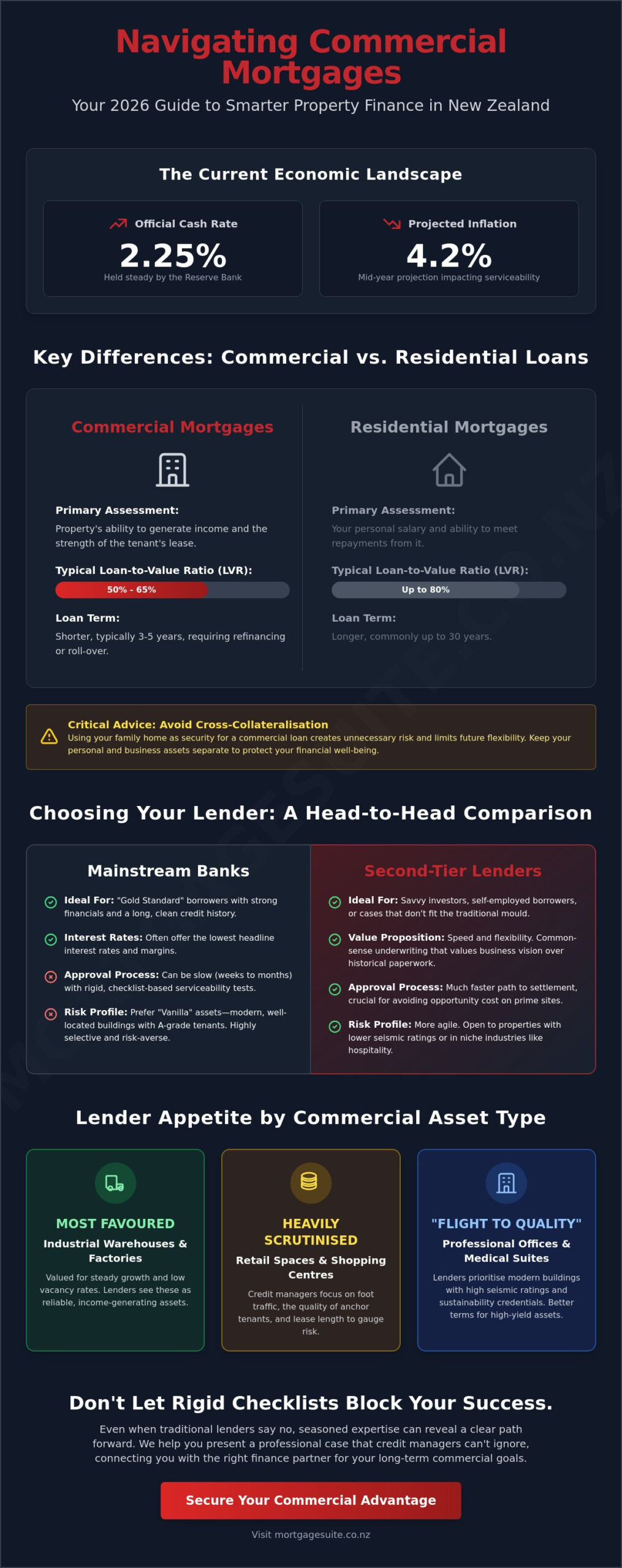
A What is a Commercial Mortgage? is fundamentally a loan secured by non-residential real estate, but the mechanics differ vastly from the home loan you might have for your family residence. While residential lending focuses on your personal ability to meet repayments from your salary, a commercial mortgage New Zealand is judged on the property’s capacity to generate income. In 2026, the lending environment has become more sophisticated. With the Reserve Bank holding the Official Cash Rate at 2.25 per cent and inflation projected to reach 4.2 per cent by mid-year, banks are looking beyond historical data to assess future serviceability. They want to see a clear “intended use” that aligns with current market strengths, such as the robust industrial sector.

The structural differences are significant. Unlike residential loans where you might see Loan-to-Value Ratios (LVR) of 80 per cent, commercial deals usually sit between 50 and 65 per cent. Interest rate margins are also wider, reflecting the higher risk profile of business-related assets. Term lengths are typically shorter, often requiring a refinance or “roll-over” every three to five years. This requires a proactive approach to your portfolio management and a steady hand to navigate the fluctuating margins offered by different institutions.

Asset Types Covered Under Commercial Finance

Lenders categorise risk based on the specific asset you’re purchasing. For retail spaces and shopping centres, credit managers scrutinise foot traffic and the reliability of anchor tenants. Industrial warehouses and factories are currently the most favoured assets in the New Zealand market because of their steady growth and low vacancy rates. If you’re eyeing professional offices or medical suites, be prepared for a “flight to quality” assessment. Lenders in 2026 prioritise modern buildings with high seismic resilience and sustainability credentials, often offering better terms for high-yield, high-quality assets.

Why Residential and Commercial Loans Don’t Mix

The biggest mistake investors make is assuming their residential equity will easily bridge the gap to a commercial purchase. Commercial lending uses a “weighted lease” analysis, where the length and strength of the tenant’s lease are more important than your personal salary. You must also account for GST, which can significantly impact your initial deposit requirements and borrowing power. We often advise against cross-collateralisation, where your home is used as security for a commercial loan. This creates unnecessary risk and can limit your future flexibility if the commercial market fluctuates. Keeping these two worlds separate ensures your personal assets remain protected while your business ventures grow.

Mainstream Banks vs. 2nd Tier Lenders: A Direct Comparison

In the New Zealand market, the “Big Four” (ANZ, ASB, BNZ, and Westpac) traditionally dominate the landscape. However, choosing a commercial mortgage New Zealand based purely on the lowest headline interest rate can be a trap. While a major bank might offer a floating base rate around 4.14 per cent, the rigid serviceability tests often mean your application stalls for weeks. This is where the concept of “opportunity cost” becomes vital. If a bank takes three months to approve a loan while a competitor snaps up a prime industrial site, that lower interest rate hasn’t saved you money; it’s cost you the entire investment.

According to the Property Council New Zealand, the commercial sector is a massive driver of the local economy, yet bank “credit appetite” remains highly selective. Mainstream lenders often shy away from buildings with lower seismic ratings or industries they deem “high risk,” such as hospitality or specific retail niches. Second-tier lenders, by contrast, use common-sense underwriting. They are far more likely to support self-employed borrowers who have strong cash flow but don’t necessarily fit the “perfect” historical tax profile that a major bank demands. Business owners in this position may also benefit from exploring a small business loan NZ to understand the full range of funding options available alongside commercial property finance.

When to Choose a Mainstream Bank

Mainstream banks are the ideal choice for “Gold Standard” borrowers. If you have a clean credit history, two years of strong financial statements, and a property with a long-term lease to a reputable tenant, you should prioritise these institutions. You’ll benefit from lower margins and a full suite of integrated business banking tools. Banks love “Vanilla” assets, which are modern, well-located buildings in major centres like Auckland or Christchurch. If your deal fits this neat box, the major banks offer the stability you need.

The 2nd Tier Advantage: Flexibility and Speed

Second-tier lenders excel where the majors hesitate. They are the go-to for “Vacant Possession” purchases or properties with short-term leases where a bank sees too much risk. These lenders often provide interest-only options or capitalised interest for development projects, allowing you to preserve cash flow during the critical early stages of a project. Second-tier lending serves as the essential bridge for borrowers who do not fit into the rigid boxes of institutional banking. If you find yourself in a complex situation, exploring non-mainstream options can often be the difference between a rejected application and a successful settlement.

Owner-Occupied vs. Investment Commercial Mortgages

The strategy behind your commercial mortgage New Zealand depends entirely on who will be occupying the four walls of your property. Lenders categorise these applications into two distinct buckets: owner-occupied and investment. While they may look similar on a title deed, the credit assessment behind them is world’s apart. If you’re buying a premise to run your own engineering firm or retail boutique, the lender is essentially backing your business’s ability to pay rent to itself. If you’re an investor, they’re backing the strength of your tenants and the lease agreements they’ve signed.

Risk assessment often hinges on the “single-tenant” versus “multi-tenant” factor. Multi-tenant assets, like a block of five shops, are generally viewed as lower risk because a single vacancy won’t stop the mortgage repayments. However, a single-tenant building with a high Weighted Average Lease Expiry (WALE) can be just as attractive. In the 2026 market, a WALE of five years or more is often the “magic number” that unlocks more competitive interest rate margins and longer interest-only periods. Lenders want to see that your income stream is secured well into the future before they commit to a long-term facility.

Financing for Owner-Occupiers

When you buy for your own business, the lender will scrutinise your company’s P&L and balance sheets rather than just the property’s market rent. One significant advantage here is the potential for higher LVRs. Some lenders are willing to stretch beyond the standard 65 per cent if the business is exceptionally robust and has a long history of profitable trading. Owning your own premises also provides significant tax advantages in New Zealand, such as the ability to claim depreciation on certain fit-outs and the deductibility of interest costs, which can turn a monthly expense into a long-term wealth-building tool.

The Investor’s Perspective: Yield and Security

For investors, the focus shifts to “Net” versus “Gross” lease income. A Net lease, where the tenant pays for outgoings like rates and insurance, is far more favourable for loan serviceability than a Gross lease. Lenders also place immense value on “tenant covenant.” A property leased to a government department or a national supermarket chain is viewed as “bankable” security, whereas a lease to a brand-new startup may require a larger deposit or a lower LVR. You must also forecast for “Capex” (capital expenditure) and potential vacancy periods, as lenders will often “stress test” your ability to cover the mortgage even if the building sits empty for six months.

Commercial Mortgage New Zealand: Comparing Mainstream Banks vs 2nd Tier Lenders in 2026

The Application Process: Organising Your Commercial Case

Securing a commercial mortgage New Zealand requires more than just a decent credit score and a deposit. It demands a narrative that convinces a credit manager your project is a calculated success rather than a speculative risk. The centrepiece of this process is the Information Memorandum (IM). Think of the IM as a professional pitch deck for your loan. It should clearly outline the property’s merits, the strength of the tenants, and your own experience as an operator or investor. When a credit manager receives a messy pile of bank statements, they see work; when they receive a polished IM, they see a professional partner.

Your financial documentation must go deeper than basic year-end accounts. Lenders in 2026 expect to see up-to-date GST returns and detailed Debtors and Creditors lists to verify the real-time health of your cash flow. They also want to see a clear “Exit Strategy.” Whether you plan to refinance with a mainstream bank after three years or sell the asset once the lease is renewed, the lender needs to know exactly how they’ll be repaid. A vague plan is a fast track to a declined application.

Technical Reports You Cannot Ignore

In the New Zealand market, the “IEP” or earthquake rating is often the factor that makes or breaks a deal. Most mainstream banks won’t touch a building with an Initial Evaluation Procedure rating below 34 per cent of the New Building Standard (NBS), as these are deemed “earthquake prone.” If you’re eyeing an industrial site, environmental reports are equally non-negotiable. You must prove the land isn’t contaminated from previous heavy use. Finally, remember that your Loan-to-Value Ratio is always determined by a Registered Valuation from a lender-approved panel valuer, not the purchase price or the CV.

Navigating the Credit Committee

The credit committee evaluates your case based on the “Three Cs”: Character, Capacity, and Collateral. They want to know who you are, your ability to service the debt, and the quality of the asset itself. A well-organised application can reduce your interest margin by 0.5% or more. This is where an expert hand is invaluable; we don’t just submit paperwork, we “shop” your deal to multiple tiers to find the lender whose current appetite matches your specific scenario. If you’re ready to present your strongest possible case, reach out to us today and let’s get your application moving.

Why Mortgage Suite is Your Commercial Finance Partner

Choosing the right partner for your commercial mortgage New Zealand often comes down to who has the deepest understanding of the credit committee’s mindset. At Mortgage Suite, we leverage over 20 years of institutional banking experience to give our clients a distinct advantage in every negotiation. We don’t just act as a middleman; we act as your dedicated advocate. Krish Krishna personally handles complex commercial files, ensuring that your business potential is communicated with the same level of authority that the banks themselves use. This high-level expertise allows us to anticipate the concerns of lenders before they even arise, smoothing the path to a successful settlement.

Whether you are looking at an industrial site in Christchurch or a retail block in Auckland, our national reach ensures we understand the local nuances of the diverse New Zealand property market. We specialise in finding a clear path forward when mainstream banks say no. Our experience has taught us that a “decline” from a major bank is rarely the end of the road. It is often just a sign that your scenario requires a more tailored, non-mainstream approach. We pride ourselves on being a steady hand in a fluctuating market, prioritising long-term partnerships over simple transactional lending. This commitment to your success means we stay involved long after the initial loan is approved, helping you navigate future refinances and portfolio growth.

Expertise in 2nd Tier and Structured Finance

Our clients gain access to a wide panel of alternative lenders that you simply won’t find on the high street. These second-tier institutions offer structured finance solutions that are essential for large-scale property developments and complex business acquisitions. We understand how to piece together these intricate deals, ensuring that the terms align with your project’s specific cash flow requirements and timelines. If your project involves interest-only periods or capitalised interest, we know exactly which lenders have the appetite for that level of flexibility and how to present your case to secure those terms.

Take the Next Step in Your Commercial Journey

A bank decline shouldn’t be the roadblock that stops your business growth or investment plans. We have a proven track record of turning “no” into “yes” by restructuring deals and finding the right lender tier for each unique situation. We have spent years helping first home buyers enter the residential market, and we apply those same principles of tireless advocacy to our commercial clients. We understand the stress that comes with large-scale financial decisions, and our goal is to alleviate that pressure through clear communication and reliable results. Contact us today for a confidential review of your commercial financing needs and let us help you secure the future of your business.

Securing Your Commercial Future in 2026

Your journey toward a successful commercial mortgage New Zealand shouldn’t be defined by the rigid boxes of institutional banking. We’ve explored how the right lender tier can determine your project’s viability, from the stability of the Big Four to the common-sense flexibility of second-tier options. Success in this market requires more than just a property; it requires a professional presentation that anticipates credit hurdles before they become roadblocks.

With over 20 years of institutional banking experience and national coverage, we specialise in navigating the complexities of 2nd tier lending and structured finance. We’re here to act as your dedicated advocate, ensuring your business potential is seen and valued by the right financial partners. Don’t let a complex scenario or a traditional bank decline slow your momentum. Contact Mortgage Suite for a specialised commercial finance consultation today and let’s build a clear path forward for your next acquisition or development. We’re ready to help you turn your commercial vision into a reality.

Frequently Asked Questions

What is the typical LVR for a commercial mortgage in New Zealand?

Most lenders provide a Loan-to-Value Ratio (LVR) between 50 and 65 per cent for a commercial mortgage New Zealand. While residential loans often reach 80 per cent or higher, commercial assets require a larger deposit to offset the increased risk and potential for longer vacancy periods. Some second-tier lenders may stretch these limits slightly for high-quality industrial assets or exceptionally strong owner-occupied business cases.

How do commercial interest rates compare to residential rates?

Commercial interest rates are almost always higher than residential rates because they include a wider risk margin. In 2026, while home loans might hover at lower levels, commercial floating rates can range from 4 per cent to over 10 per cent depending on the lender tier. Banks charge this premium to account for the complexity of the security and the shorter term of the facility.

Can I use KiwiSaver for a commercial property purchase?

No, you generally cannot use KiwiSaver funds to purchase a commercial property. KiwiSaver withdrawal rules are strictly designed for first-home residential purchases or retirement. If you’re looking to fund a commercial venture, you’ll need to rely on business capital, personal savings, or equity from existing residential property rather than your retirement savings. This ensures the funds remain dedicated to their intended purpose.

What is an IEP rating and why does it affect my commercial loan?

An Initial Evaluation Procedure (IEP) rating measures a building’s seismic strength relative to the New Building Standard (NBS). Lenders are extremely cautious about buildings rated below 34 per cent NBS because they’re legally classified as earthquake-prone. A low rating can make a property unbankable or require significant capital expenditure to upgrade before a loan is approved, as it represents a major collateral risk.

How long is the term for a typical commercial mortgage?

Commercial loan terms are significantly shorter than the 30-year terms common in residential lending. Most commercial facilities are structured for three to five years. At the end of this period, the loan is usually reviewed and rolled over or refinanced based on the current market value of the property and the strength of the existing leases. This allows lenders to adjust their exposure periodically.

Do I need a business plan to get a commercial mortgage approved?

Yes, a clear business plan or an Information Memorandum is essential for most commercial applications. Lenders want to understand your operational experience, the property’s income potential, and your long-term strategy for the asset. A well-structured plan demonstrates to the credit committee that you’ve accounted for risks like tenant vacancy or rising maintenance costs, making your case much more compelling for approval.

What happens if my business has a “bad credit” history but strong assets?

Strong assets can often bridge the gap if your historical credit is less than perfect. While mainstream banks might decline the application, second-tier lenders specialise in these non-mainstream scenarios. They often prioritise the value of the collateral and your current cash flow over past credit events, providing a pathway to secure a commercial mortgage New Zealand when traditional institutions are unable to help.

Are there specialised loans for property development in NZ?

Yes, property development loans are specific facilities designed for construction or major renovations. These loans often feature drawdowns where funds are released in stages as work is completed and verified. They may also allow for capitalised interest, meaning you don’t make repayments until the project is finished or the units are sold, which preserves your cash flow during the critical building phase.

Article by

Krish Krishna

Experienced Financial Adviser with over 46 years of Banking and Mortgage broking experience and over $2.0 Billion in loan settlements.