
Residential Investment Property Loans NZ: The 2026 Investor’s Reference Guide

What if a “no” from your bank was actually the best thing that could happen to your property portfolio? Many Kiwi investors feel stuck right now, watching great opportunities pass them by because securing residential investment property loans NZ feels harder than ever. It’s incredibly frustrating when you know you have the equity to grow, but the calculations on a bank’s spreadsheet just won’t budge due to strict LVR restrictions and debt-to-income caps.

We agree that the current market requires more than just a standard application; it requires a genuine strategy. In this guide, we’ll show you how to navigate the 2026 lending landscape with confidence and professional insight. You’ll learn how to unlock your existing equity to fund your next purchase, even when mainstream banks say no, and how to structure your debt to make the most of the 100% interest deductibility rules. We’re going to break down the move toward second-tier lenders and interest-only options that can help you organise your finances to prioritise cash flow and long-term growth.

Key Takeaways

  • Get a clear picture of the 2026 market and why a custom strategy for residential investment property loans NZ is the key to building real wealth.
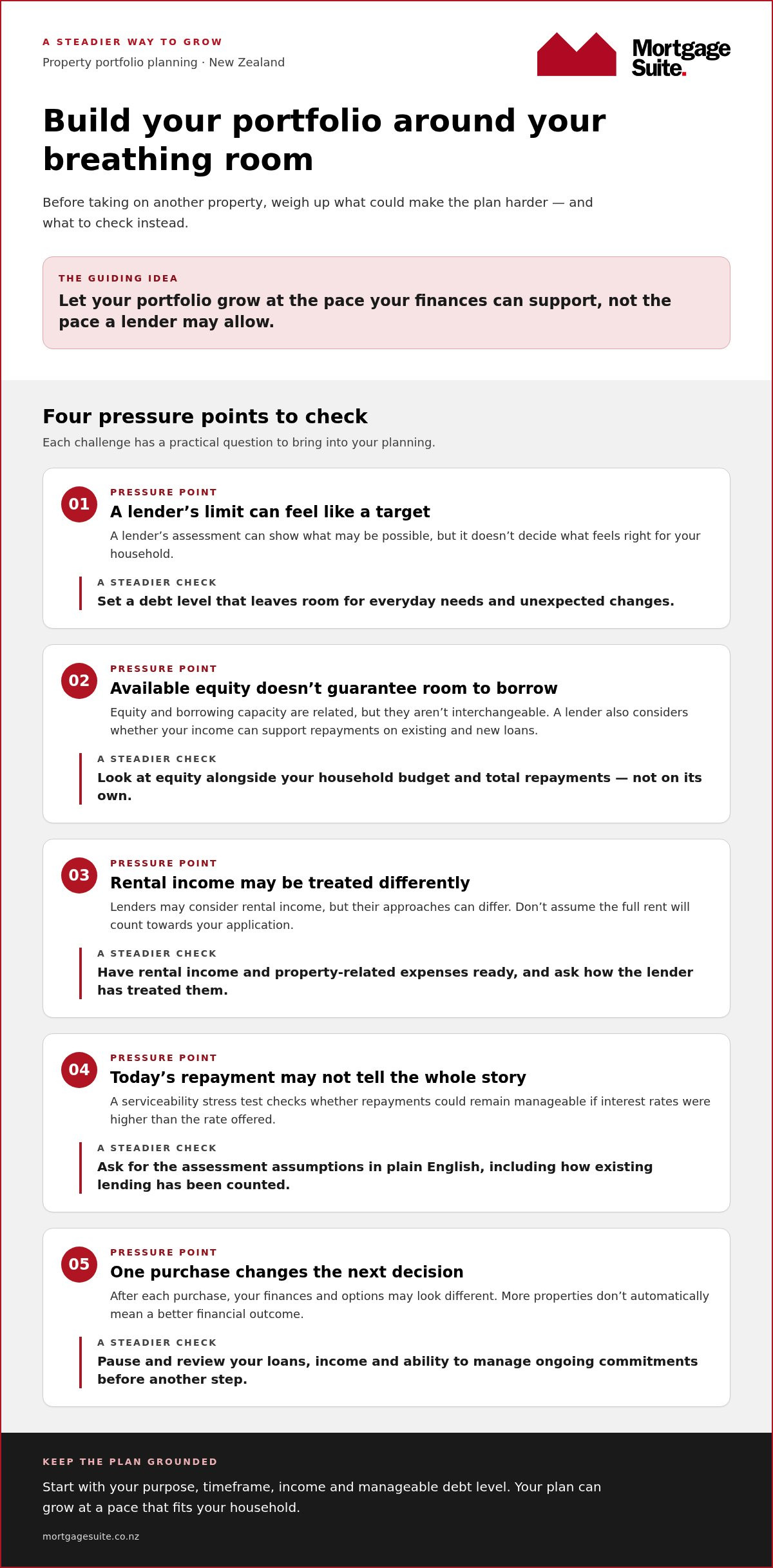
  • Learn how to work around the 30% deposit hurdle by unlocking the value already sitting in your current property.
  • Explore the flexible options offered by second-tier lenders that often say “yes” when the big banks have too many rules.
  • Discover how to structure your loans with interest-only periods to keep your cash flow healthy and make the most of tax benefits.
  • Understand how an expert advocate can handle the hard work and negotiations to ensure you get the best possible outcome for your portfolio.

Exploring the NZ Residential Investment Landscape in 2026

By 2026, the New Zealand property market has found its feet again, but it is certainly not the same game it was five years ago. Investors are now looking at residential investment property loans NZ with a fresh set of eyes. With the Official Cash Rate sitting at 2.25% in late 2025 and mortgage rates hovering between 5% and 6.5% for most of 2026, the “set and forget” mortgage is officially a relic of the past. Banks are constantly tweaking their appetites; one week they are hungry for new business, and the next, they have pulled up the drawbridge based on their internal caps.

The regulatory environment has also shifted significantly. For the 2025/2026 tax year, the return of 100% interest deductibility has breathed new life into the sector. This change makes it much easier to balance the books, especially for seasoned investors looking to expand their portfolios. However, you cannot just rely on the rules being in your favour. Success in this market requires staying ahead of fluctuating interest rates and understanding that bank criteria can change without warning. It is a more active, hands-on era for property owners.

Why Property Still Holds Its Value

Property remains a top choice for Kiwis building long-term wealth because it provides a tangible asset in an uncertain world. While we have seen plenty of headlines about the New Zealand property bubble, the underlying reality is a chronic shortage of quality housing in our major centres. Even when market conditions feel a bit patchy, the long-term capital growth trends across the country have historically rewarded those who stay the course.

  • Capital Gains: Long-term value increases remain a primary driver for wealth building.
  • Rental Yield: In 2026, many investors are prioritising higher yields to help cover bank test rates, which are currently sitting between 8.5% and 9%.
  • Strategic Resilience: A well-chosen rental property provides a steady income stream and a hedge against inflation that other investments struggle to match.

The Role of Professional Advice

This is where having a seasoned pro in your corner makes all the difference. A standard bank manager is often just processing an application, but a long-term mortgage partner is looking at your entire financial future. Talking to a broker is spot on for those wanting to save time and avoid the stress of being declined by a mainstream lender. We know which banks are currently “open for business” for residential investment property loans NZ and which ones have tightened their belts.

We advocate for you to ensure you get a fair go from lenders. This might mean negotiating a discount on advertised rates; mortgage brokers in early 2026 were able to secure average discounts of around 0.13% on 6-month fixed terms. More importantly, we help you navigate the bridge between rigid institutional banking and your personal goals, making sure your loan structure works for you, not just the bank.

Decoding LVR Restrictions and Deposit Requirements for Kiwis

LVR is the percentage of a property’s value that you borrow, acting as a key risk measure for New Zealand lenders. For most people looking at residential investment property loans NZ, this three-letter acronym is the single biggest hurdle between them and their next title deed. While you might have bought your own home with a small deposit, the rules for rentals are historically much tighter. Banks generally view investment properties as slightly higher risk, which is why they ask you to have more skin in the game.

The “30% Rule” has been the standard for some time now. In simple terms, if you want to buy a rental, the bank usually wants you to provide 30% of the purchase price upfront. This ensures that even if the market takes a dip, the bank’s loan is well-covered. However, as of December 2025, there is a bit of breathing room. The Reserve Bank now allows banks to allocate up to 10% of their new investor lending to those with less than a 30% deposit. It isn’t much, but it means a “no” isn’t always final if your overall profile is strong.

How the 70% LVR Limit Works

Getting your head around the math is the first step. If you’re eyeing up a property worth $1 million, a 70% LVR limit means the bank will only lend you $700,000. You need to find the other $300,000 yourself. The Reserve Bank keeps these “speed limits” in place to prevent the economy from overheating and to protect the banking system from sudden shocks. If property values drop, a high LVR could mean you owe more than the house is worth. That is a position no investor wants to be in, so these rules actually provide a bit of a safety net for your portfolio.

Exemptions You Should Know About

Not every deal requires a massive cash deposit. The most common way around the 30% rule is the “New Build” exemption. To encourage more housing supply, the government often allows investors to get into brand-new properties with as little as a 20% deposit. This can be a game-changer for someone starting out. Another powerful strategy is using home equity for investment NZ. Instead of saving cash, you use the value built up in your own home to act as the deposit for the new rental.

You also need to consider your long-term hold strategy in light of the Bright-line test. While the rules have fluctuated, your intention for the property impacts how lenders view your stability. If you are feeling stuck on the numbers, we can help you work out your next move with a quick, no-pressure chat to see what is possible for your situation.

Mainstream Banks vs. 2nd Tier Lenders: Choosing Your Path

Most Kiwis grow up believing that the “Big Four” banks are the only place to go for a mortgage. While they are a solid choice for a standard home loan, they can be incredibly rigid when it comes to residential investment property loans NZ. These major institutions often use a “cookie-cutter” approach. If your financial situation doesn’t fit their specific mould, you might find yourself facing a flat refusal. In 2026, with Debt-to-Income (DTI) restrictions limiting high-debt lending, many investors are being turned away simply because they already have a few properties under their belt.

Being declined by a mainstream bank isn’t the end of your journey; it’s often just the beginning of a much better deal. This is where second-tier and non-bank lenders become a secret weapon for successful investors. These lenders aren’t just a backup plan. They are a strategic alternative for those who need a bit more flexibility than a traditional bank can offer. At Mortgage Suite, we specialise in non bank investment property loans NZ because we know that a “no” from a bank manager usually just means they don’t have the right product for your specific goals.

When the Bank Says No

There are plenty of reasons a bank might say no. Since July 2024, banks have been restricted in how much high-DTI lending they can do. For an investor in 2026, a DTI of 7 is considered high. If your total debt is seven times your gross annual income, a mainstream bank might struggle to approve you. Other common hurdles include being self-employed without two years of perfect tax records or trying to buy a non-standard property. Non-bank lenders take a more “human” approach to your numbers. They are legitimate, safe alternatives that look at the big picture rather than just ticking boxes on a spreadsheet.

Comparing Your Options

When you look beyond the big banks, you’re often trading a slightly higher interest rate for significantly more flexibility and speed. While a major bank might take weeks to process a complex investment application, a second-tier lender can often give you an answer in a matter of days. This speed can be the difference between securing a great deal and missing out entirely. We help you compare these options side-by-side. We’ll show you the true cost of the loan versus the potential growth of your portfolio, ensuring you get a fair go and a loan that actually helps you move forward.

Residential Investment Property Loans NZ: The 2026 Investor’s Reference Guide

Strategic Loan Structures: Interest-Only and Equity Unlocking

While everyone chases the lowest interest rate, savvy investors know that the way you set up your debt is what actually builds wealth. Choosing the right structure for your residential investment property loans NZ can be the difference between a portfolio that grows and one that stays stagnant. In 2026, the strategy is all about flexibility. With the 100% interest deductibility rules fully restored, many of our clients are opting for an interest only investment property loan nz to keep their monthly costs down and make the most of their tax benefits.

This approach allows you to focus your spare cash on paying down the mortgage on your own home first. It is a classic move that we often recommend because it puts money back in your pocket while your investment property hopefully gains value in the background. The goal is to make your money work harder for you, not the other way around. By only paying the interest, you’re keeping your outgoings low and your cash flow healthy, which is vital when bank stress tests are still quite high.

Unlocking Your “Lazy Equity”

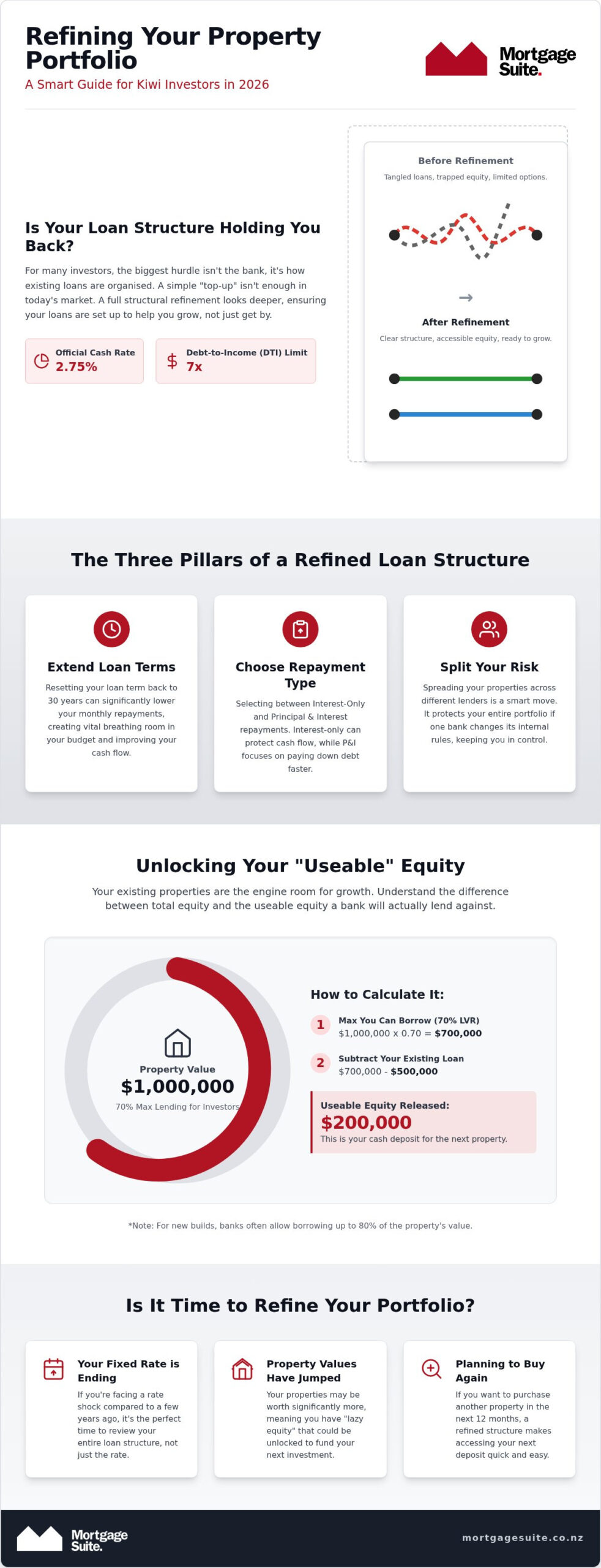
Many people are sitting on a goldmine without even realising it. Equity is simply the difference between what your property is worth and what you owe the bank. You don’t always need a formal valuation to get a rough idea; looking at recent sales in your street is a great place to start. If your home is worth $1.2 million and your mortgage is $500,000, you have $700,000 in equity. Banks won’t let you use all of it, but they might let you borrow up to 80% of your home’s value to fund your next move.

The process of an equity release home loan NZ allows you to pull that value out and use it as a deposit for a rental. This means you can buy your next investment without needing to save a single cent in cash. It is the fastest way to scale your portfolio, provided you have the income to support the new lending. If you want to see how much you could potentially tap into, talk to us about your loan structure today to get a clear picture of your options.

Cash Flow Management Strategies

Managing a rental in 2026 isn’t just about collecting rent; you need to be smart with how that money moves. While interest-only loans are popular for their tax benefits, some investors prefer the traditional route of paying back the loan plus interest to slowly chip away at the debt. It really depends on whether you’re chasing immediate cash flow or long-term debt reduction. We also see a lot of success with offset accounts. By keeping your savings in an account linked to your loan, you only pay interest on the difference, which can save you thousands over the years.

Revolving credit is another handy tool for the modern investor. It acts like a giant overdraft, giving you instant access to funds when a great property deal pops up. Having these structures in place before you start house hunting means you can move quickly when the right opportunity arises. For investors looking to take things further, understanding how property development loans NZ work can open up even more avenues for growing your portfolio through new builds and development projects. It is all about being organised and ready to strike when the market is in your favour with Mortgage Suite Ltd in your corner.

Securing Your Investment Loan with Mortgage Suite Ltd

Securing residential investment property loans NZ shouldn’t feel like a solo battle against a giant machine. When you work with Krish Krishna and the team at Mortgage Suite Ltd, you’re putting over 20 years of deep banking experience in your corner. We know exactly how the big lenders think because we’ve spent decades on the other side of the desk. This insider knowledge is what allows us to fight for your approval, finding the specific path that leads to a “yes” when other brokers might have already thrown in the towel. We don’t just fill out forms; we build a case for your success.

Our process is designed to take the weight off your shoulders. From that very first chat where we map out your goals, all the way through to the day the deal is finalised, we handle the heavy lifting. We don’t just want to get you a loan; we want to ensure it’s the right setup for your long-term wealth. We’re here to build a relationship, acting as your steady hand in a market that can sometimes feel quite unpredictable. Our commitment doesn’t end when the papers are signed; we stay in touch to ensure your finance structure still fits as your life and the market change.

The Mortgage Suite Ltd Advantage

What sets us apart is our ability to look beyond the standard bank offerings. We have access to a huge range of lenders, from the household names to specialist providers that many people don’t even know exist. This means we can find a home for almost any deal, no matter how complex your situation might seem. You’re never just a number to us. We treat every client as a partner, providing a personalised service that focuses on removing obstacles and creating a clear run toward your investment goals. We have a reputation for getting those tricky, non-standard deals across the line because we aren’t afraid to roll up our sleeves and negotiate hard on your behalf.

We act as a bridge between the rigid world of institutional banking and your personal needs. Our proactive attitude and dedication to overcoming challenges have made us a trusted mentor for investors across the country. Whether you’re dealing with self-employment income or a property that doesn’t fit the usual mould, we know how to present your story to the right lender to get the result you need.

Your Next Steps

Ready to see what is possible for your portfolio? To get the ball rolling, it helps to gather a few essentials. Having your income proof, current mortgage details, and a clear idea of your investment goals ready will make our first conversation even more productive. We invite you to book a consultation where we can look at your numbers and show you exactly how to grow your portfolio in 2026. It is about more than just a transaction; it is about setting you up for a future of financial freedom. Get started with Mortgage Suite Ltd and secure your investment future today and let’s turn your property plans into a reality.

Take the Next Step Toward Your Property Goals

Building a property portfolio in today’s market doesn’t have to be a stressful uphill battle. By now, you’ve seen that the right strategy for residential investment property loans NZ is about much more than just chasing the lowest interest rate. It’s about having the flexibility to move quickly, the insight to unlock your existing equity, and the grit to look beyond the big banks when their rigid rules don’t fit your situation. Whether you are a first-time investor or a seasoned pro, the key is to stay proactive and keep your loan structures working as hard as you do.

We’re here to help you navigate these choices with confidence and clarity. With over 20 years of banking and brokerage experience, we specialise in 2nd tier and alternative lending solutions that mainstream banks often overlook. We provide a nationwide service across New Zealand, ensuring every investor gets a fair go and a dedicated advocate in their corner. We know the hurdles, but we also know the way around them.

Your next investment is waiting, and we’d love to help you reach it. Talk to Krish and the team at Mortgage Suite to secure your investment loan today. Let’s get your financing sorted so you can focus on growing your wealth and securing your financial future. You’ve got the vision, and we have the expertise to help you make it happen.

Frequently Asked Questions

How much deposit do I really need for an investment property in NZ in 2026?

You generally need a 30% deposit for most residential investment property loans NZ. While the Reserve Bank allows banks to lend to a small number of investors with less than this, those spots are limited and usually go to the strongest applicants. If you are looking at a brand-new build, you can often still get started with a 20% deposit.

Can I use my KiwiSaver for an investment property loan?

No, you cannot use your KiwiSaver funds to purchase an investment property. KiwiSaver withdrawals are strictly reserved for buying your very first home to live in or for your retirement. However, once you’ve used KiwiSaver to get into your first home and built up some equity, you can eventually use that equity as a deposit for a rental.

What is a 2nd tier lender and are they safe for property investors?

A second-tier lender is a non-bank financial institution that offers property loans outside the traditional “Big Four” banks. They are a perfectly safe and regulated alternative for Kiwis. These lenders often have more flexible criteria, making them ideal for investors who might be self-employed or have complex income structures that mainstream banks struggle to process.

How does the Bright-line test affect my investment loan decision?

The Bright-line test affects your tax obligations rather than the loan itself, but it’s a vital part of your long-term strategy. It determines whether you’ll pay tax on any profit if you sell the property within a certain timeframe. Lenders will want to see that you have a stable plan for the property, as your intention to hold or sell can impact your overall financial position.

Can I get an interest-only loan for my residential investment property?

Yes, interest-only terms are a very common choice for residential investment property loans NZ in 2026. Because 100% of the interest is now tax-deductible for the 2025/2026 tax year, this structure helps you maximise your cash flow. Most lenders will offer interest-only periods for up to five years, though some specialist lenders can provide even longer terms.

What is the maximum LVR for an investment property in New Zealand?

The standard maximum LVR for an existing investment property is 70%, meaning you need a 30% deposit. If you’re buying a new build, the maximum LVR often increases to 80%, allowing you to get in with a 20% deposit. Banks are restricted by “speed limits” that cap how much high-LVR lending they can do each month.

How do I calculate how much equity I can use for a new loan?

You can usually use up to 80% of your current home’s value, minus your existing mortgage. For example, if your home is worth $1 million and you owe $500,000, 80% of the value is $800,000. Subtract your $500,000 mortgage, and you have $300,000 in usable equity. This amount can act as the 30% deposit for a new $1 million investment property.

What should I do if my bank declines my investment property loan application?

Don’t assume a “no” from your bank is the end of the road. Banks often decline applications because of rigid internal rules or high debt-to-income ratios, which currently sit at a cap of 7 for most investors. Your next step should be to look at non-bank lenders who take a more personal approach to your numbers and can often find a way to say “yes”.

Article by

Krish Krishna

Experienced Financial Adviser with over 46 years of Banking and Mortgage broking experience and over $2.0 Billion in loan settlements.

Investment Property Mortgage Calculator NZ: How to Calculate Repayments for Your 2026 Portfolio

What if your next property investment approval didn’t depend on a bank’s rigid checklist, but on your ability to master the numbers before you even apply? With the Official Cash Rate sitting at 2.25% and DTI limits of seven times your gross income now firmly in place, using an investment property mortgage calculator nz is no longer just about checking repayments. It is about understanding how your total debt profile fits within the Reserve Bank’s 2026 framework to ensure your portfolio remains viable.

We understand the frustration of finding a perfect property only to be met with confusion over 2nd tier lending rates or the complexities of the current dual-constraint system. It is natural to feel a bit of pressure when trying to organise your cash flow while floating rates sit as high as 8.61%. This guide promises to clear that fog, providing you with a clear understanding of your monthly costs and a path to approval even if mainstream lenders hesitate. We will preview the latest LVR restrictions, explain the impact of 100% interest deductibility, and give you the confidence to execute a property strategy that works for your specific financial goals.

Key Takeaways

  • Identify the five core variables, including interest rates and repayment frequency, to accurately forecast your portfolio’s monthly cash flow.
  • Master the dual-constraint system of LVR and DTI limits by using an investment property mortgage calculator nz to determine your true borrowing capacity in the 2026 market.
  • Learn why calculating for investment requires a focus on yield and serviceability rather than just simple home loan affordability.
  • Discover how 2nd tier loans provide a vital alternative for investors who find themselves outside the strict lending criteria of the major banks.
  • Follow our step-by-step template to account for often-overlooked costs like legal fees and building reports when establishing your total loan requirement.

Table of Contents

Successful property investment in New Zealand starts long before you visit an open home. It begins at your desk, crunching numbers to ensure a deal actually stacks up in the current 2026 economic environment. While many people use a basic tool to see what they can borrow, a dedicated investment property mortgage calculator nz serves a much more strategic purpose. It acts as your first line of defence against over-leveraging. It is about moving beyond "can I afford this?" to "does this asset work for me?"

In 2026, the landscape has shifted. With the Official Cash Rate at 2.25%, banks are looking closer than ever at your total debt-to-income (DTI) ratio. Calculating your repayments isn’t just about finding a monthly figure; it is about stress testing your strategy against potential interest rate hikes. If you can’t show a clear path to serviceability when banks apply their "test" rates, which often exceed 8.5%, your application will likely end up in the declined pile. Accurate preparation ensures you present a professional, viable case to lenders from the outset.

The Difference Between Yield and Cash Flow

Gross yield is a helpful starting point, but it’s often a vanity metric that can lead investors astray. It simply measures the annual rent against the purchase price. To build a sustainable portfolio, you must focus on net cash flow. This is where your mortgage repayment is just one piece of the puzzle. You need to account for the fact that 100% of your interest is now deductible, which significantly aids your bottom line compared to previous years. However, savvy investors also calculate a "buffer" for maintenance, property management, and potential vacancies. Understanding how mortgage calculators work helps you see how these variables interact with your loan principal to create a true picture of your weekly outgoings.

Why ‘Big Bank’ Calculators Often Fall Short

Most mainstream banking tools are designed for the average home buyer with a standard salary and a perfect credit score. They rarely account for the complexities of an investment portfolio, such as the nuances of 2nd tier lending or the specific 70% LVR requirements for investors. If your situation doesn’t fit the rigid "Big Four" criteria, their automated algorithms might suggest you’re at a dead end. We believe in personalised advocacy over automated results. 2nd tier lenders often offer different repayment maths that can turn a "no" into a "yes," provided you have organised your figures correctly using an investment property mortgage calculator nz that reflects the real-world market.

Understanding the Variables: What Actually Goes Into Your Repayment Calculation?

Calculating repayments isn’t a guessing game; it’s a precise exercise in financial forecasting. To get a reliable result from an investment property mortgage calculator nz, you must look beyond the sticker price of the house. There are five core variables that dictate your success: the loan amount, the loan term, the interest rate, the payment frequency, and the repayment type. Your deposit size is the first hurdle. While the Reserve Bank generally requires a 30% deposit for investors, having a larger equity stake can often unlock more competitive interest rate tiers. If you find the big banks are being too restrictive with their terms, exploring residential investment property loans can provide the tailored approach you need to keep your portfolio growing.

Local investors have the choice of weekly, fortnightly, or monthly instalments. Matching your repayment frequency to your rental income cycle can make your cash flow much easier to organise. Principal and Interest is the standard method for building equity over a 30-year term. However, the type of debt you choose significantly shifts the math. For example, a 30-year term is standard, but some 2nd tier lenders might offer different structures that suit a short-term development or a rapid equity-build strategy.

Fixed vs. Floating Rates: Which Number Should You Use?

Choosing an interest rate for your calculation requires a balanced view of the 2026 market. Fixed rate mortgage options currently range from approximately 4.65% for a one-year term to 5.86% for three years, providing the budget certainty many investors crave. Floating rates, while averaging around 6.15%, offer the flexibility to make extra payments without penalty. When using an investment property mortgage calculator nz, don’t just use today’s advertised specials. It’s wise to use a "test rate" of around 8.5% to ensure your portfolio remains robust even if the Reserve Bank raises the OCR again.

The Interest-Only Strategy for Investors

Interest-only repayments remain a popular choice for Kiwi investors looking to maximise tax efficiency. With 100% interest deductibility fully restored as of April 2025, this strategy helps keep immediate outgoings low while you focus on capital growth or paying down your non-deductible home loan. While this improves your short-term cash flow, it’s vital to calculate the "cliff"; the moment your interest-only period ends and your repayments jump to include principal. Planning for this transition ensures you aren’t caught off guard by a sudden increase in your weekly commitments.

The LVR and DTI Hurdle: Calculating Your Real Borrowing Power

Having a healthy deposit is only half the battle in the 2026 lending environment. While earlier sections focused on the mechanics of repayments, you must also clear the dual hurdles of Loan-to-Value Ratio (LVR) and Debt-to-Income (DTI) restrictions. Currently, the Reserve Bank requires most investors to provide a 30% deposit, meaning your LVR cannot exceed 70%. However, even with a massive pile of cash, your "real" borrowing power is now firmly capped by DTI limits. For most mainstream banks, your total debt cannot exceed seven times your gross annual income. This creates a hard ceiling that an investment property mortgage calculator nz can help you identify before you spend money on building reports or valuations.

Many investors feel the sting of "rental shading" during the application process. Banks rarely count 100% of your projected rental income when calculating serviceability. Instead, they typically recognise only 75% to 80% of the rent to account for costs like rates, insurance, and property management. If you have plenty of equity but the bank says your income is too low, this shading is often the culprit. It’s a common point of frustration, but understanding these internal bank formulas allows you to adjust your strategy and look for properties with higher yields that can offset the income gap. To fully understand how the 6x and 7x thresholds affect your specific situation, our detailed guide on the debt to income ratio NZ rules and what they mean for your 2026 mortgage breaks down the exact maths lenders use.

Unlocking Equity in Your Existing Portfolio

You don’t always need cash in the bank to fund your next move. Usable equity is the secret weapon for growing a portfolio, calculated as the difference between your current mortgage and 80% of your property’s value. For those who have seen significant capital gains since they first secured home loans for first home buyers New Zealand, this equity can often cover the entire 30% deposit for an investment. It’s a methodical way to leverage your existing assets without draining your personal savings, provided you maintain a steady hand on your total debt levels.

When the Mainstream Banks Say No

If your DTI ratio sits slightly above the "Big Four" threshold of seven, it doesn’t mean your investment journey is over. 2nd tier lenders often provide a vital alternative, as they can be more flexible with complex income structures or higher debt levels. When you use an investment property mortgage calculator nz to model these scenarios, you should account for slightly higher interest rates, often 0.5% to 1.5% above standard bank rates. This is where professional advocacy becomes essential. We specialise in finding the bridge between a rigid bank "no" and a structured approval that keeps your 2026 portfolio on track.

Investment Property Mortgage Calculator NZ: How to Calculate Repayments for Your 2026 Portfolio

A Step-by-Step Template to Forecast Your Investment Cash Flow

While an investment property mortgage calculator nz provides a quick answer, knowing the manual steps behind the math gives you true control over your strategy. It allows you to spot a bad deal before you ever talk to a bank. Follow this template to organise your forecast for any 2026 acquisition.

  • Step 1: Determine the total entry cost. Start with the purchase price and add an allowance for legal fees, building inspections, and valuations. These often total between $3,000 and $6,000 depending on the property’s complexity.

  • Step 2: Establish your loan requirement. Subtract your cash deposit or the usable equity you’ve unlocked from your home. This leaves you with the core debt figure.

  • Step 3: Select your structure. Decide if you’ll use an interest-only period to maximise immediate cash flow or start with principal and interest to build equity from day one.

  • Step 4: Use realistic rates. Don’t just use the lowest rate on the market. Apply a standard 2026 fixed rate, such as the 5.19% two-year average, to keep your figures grounded in reality.

  • Step 5: Run the serviceability check. Calculate your monthly repayment and compare it against 80% of your projected gross rent. If the rent doesn’t cover the mortgage at this "shaded" level, you’ll need to contribute from your personal income.

If these steps feel overwhelming or the numbers aren’t quite stacking up, we can help you find a path forward. Our team specialises in securing residential investment property loans that align with your long-term wealth goals.

The ‘Stress Test’ Calculation

Bank managers don’t look at what you can pay today; they look at what you can pay if the market shifts. You should do the same. Recalculate your repayments with an interest rate that is 1% or 2% higher than current offers. This "worst-case" figure is the most vital number in your entire spreadsheet because it defines your safety margin. A robust investment plan should survive a 2% interest rate hike without requiring external capital. If your portfolio can’t weather that storm, it might be time to reconsider the purchase price or your deposit size. Understanding the difference between fixed rate mortgage vs floating rate options is essential when stress testing your portfolio against potential rate movements.

Accounting for the ‘Hidden’ Costs

Many novice investors make the mistake of thinking the mortgage is their only expense. In reality, rates, insurance, and property management fees usually consume about 20% of your gross rental income. These are the "forgotten" costs that can turn a cash-flow positive property into a monthly liability. When you’re using an investment property mortgage calculator nz, always deduct these outgoings from your rental income before comparing it to your loan repayments. Remember that "set and forget" is a myth in property investment. Staying on top of these shifting costs ensures your portfolio remains a source of wealth rather than a source of stress.

Beyond the Calculator: How Tailored Financing Secures Your Portfolio

While an investment property mortgage calculator nz provides the essential coordinates for your journey, it cannot navigate the roadblocks that often appear during a bank’s assessment process. Think of the calculator as your map; it shows you the destination, but a seasoned advocate acts as your guide through the terrain. At Mortgage Suite Ltd, we specialise in residential investment property loans that don’t always fit the rigid, automated criteria of the "Big Four" banks. We understand that your financial story is more than just a credit score or a debt-to-income ratio.

Securing a "fair go" from lenders in 2026 requires more than just submitting an application. It involves presenting a case that highlights the strength of your strategy. For many investors, 2nd tier lending serves as a strategic bridge. It allows you to secure a property and build equity today, rather than waiting for mainstream banks to ease their restrictions. This proactive approach turns a potential "no" into a structured path toward long-term wealth, ensuring you don’t miss out on opportunities while waiting for the perfect market conditions.

The Power of a Specialised Advocate

Krish Krishna brings over two decades of banking experience to your corner, ensuring your application is seen by human eyes rather than just an algorithm. There is a profound difference between a "computer says no" interaction at a local branch and a solution brokered through deep institutional knowledge. When your finances are non-standard or your portfolio is complex, personal connection and a reputation for integrity matter. We act as your dedicated negotiator, removing obstacles and finding the bridge between institutional requirements and your personal goals. Our experience allows us to anticipate lender objections before they arise, saving you time and reducing the stress of the approval process.

Next Steps: From Calculation to Pre-Approval

To move from a theoretical calculation to a formal pre-approval, you’ll need to organise your documentation. This typically includes recent payslips, bank statements, and rental appraisals for your existing or prospective properties. Having these ready allows for a much smoother transition from the research phase to the acquisition phase. We also recommend a "health check" on your current portfolio equity to ensure you are leveraging your assets as efficiently as possible. When you’re ready to turn your data into a concrete offer, organise a consultation with Mortgage Suite Ltd to find the right loan for your next investment. We are here to ensure your 2026 strategy is built on a foundation of professional certainty and personalised care.

Mastering Your Path to Property Success

Mastering the numbers is the first step toward building a resilient property portfolio. By now, you understand that an investment property mortgage calculator nz is a powerful starting point for assessing yield and cash flow. However, clearing the high bars of DTI limits and LVR restrictions requires more than just a digital tool. It demands a strategic approach that accounts for 2026 market realities and the nuances of non-bank lending. Success in this environment comes from preparing for the transition of interest-only periods and ensuring your strategy can weather potential interest rate shifts with a calculated safety margin.

With over 20 years of banking and brokerage experience, Mortgage Suite Ltd provides the seasoned advocacy needed to turn complex financial scenarios into approvals. We specialise in 2nd tier and non-bank lending, offering a nationwide service for all New Zealand investors who want a steady hand in a fluctuating market. You don’t have to navigate these hurdles alone. Secure your investment future with a tailored mortgage strategy from Mortgage Suite Ltd. We are ready to help you move beyond the spreadsheet and into your next successful acquisition with absolute confidence.

Frequently Asked Questions

How much deposit do I need for an investment property in NZ in 2026?

You generally need a 30% deposit for an existing residential investment property in 2026. This requirement aligns with the Reserve Bank’s LVR restrictions, which limit most investor lending to a 70% threshold. If you are purchasing a new build, you may be able to secure a loan with as little as a 20% deposit. Using an investment property mortgage calculator nz helps you determine the exact amount of cash or equity required to meet these criteria.

Can I use my KiwiSaver to buy an investment property?

No, you cannot withdraw KiwiSaver funds to purchase a property intended solely for investment. KiwiSaver withdrawals are strictly reserved for buying your first home to live in, or for cases of significant financial hardship. However, once you have used KiwiSaver to secure your first home, the equity you build in that property can eventually be leveraged to fund a deposit for a future investment property.

What is a ‘good’ DTI ratio for a property investor?

A healthy DTI ratio for an investor is typically considered to be below six. As of mid-2024, the Reserve Bank implemented a formal DTI cap of seven for most investor lending. If your total debt exceeds seven times your gross annual income, mainstream banks will likely decline your application. Maintaining a lower ratio ensures your portfolio remains resilient and gives you more flexibility when interest rates fluctuate.

Are interest rates higher for investment properties than for my own home?

No Interest rates are generally the same. For investors up to 6 investment properties, you can obtain the rate as normal housing rates. For investors with more than 6 properties, some lenders will view you as commercial investors and may apply a slightly higer rate.

What happens if my investment property is vacant for a month?

If your property is vacant, you must be able to cover the full mortgage repayment from your other income sources. This is why banks "shade" your rental income, often only counting 80% of the projected rent in their serviceability tests. We always recommend keeping a cash buffer equivalent to at least four weeks of rent to manage these inevitable vacancy periods without putting undue stress on your personal finances.

Should I choose a 2nd tier lender if my bank declines my application?

Choosing a 2nd tier lender is a very effective strategy if a mainstream bank declines your application due to rigid DTI or LVR rules. These lenders often provide a vital bridge for investors with complex income structures or those who sit just outside the "Big Four" criteria. While the interest rates may be slightly higher, the flexibility they offer can be the difference between growing your portfolio or stalling your investment journey.

How do I calculate the equity in my current home?

To calculate your usable equity, take 80% of your home’s current market value and subtract your remaining mortgage balance. For example, if your home is worth $1,000,000 and your mortgage is $500,000, your usable equity is $300,000. This is calculated as $800,000 minus $500,000. This figure represents the maximum amount you can potentially borrow against to fund a deposit for a new investment property without needing extra cash.

Is interest-only always better for rental properties?

Interest-only is not always the best choice; it depends on your specific financial goals. Many investors prefer interest-only to maximise tax deductibility and keep monthly outgoings low, which is excellent for immediate cash flow. However, Principal and Interest repayments are better if your goal is to build equity and pay off the debt over a 30-year term. It’s about balancing your immediate flexibility against your long-term debt reduction strategy.

Article by

Krish Krishna

Experienced Financial Adviser with over 46 years of Banking and Mortgage broking experience and over $2.0 Billion in loan settlements.