

Financing Multiple Investment Properties NZ: The 2026 Guide to Portfolio Refinement

What if the biggest hurdle to your next purchase isn’t the bank’s ‘no’, but the way your current loans are tied together? For many Kiwi investors, the challenge of financing multiple investment properties nz has become a bit of a puzzle lately. You’ve probably noticed that mainstream banks are getting sticky about further lending; meanwhile, with the Official Cash Rate at 2.75% as of September 2026, those interest rates are likely putting a squeeze on your rental yields. It’s frustrating when you know the equity is there, but the red tape feels like it’s tightening around your long-term goals.

I know it’s confusing to deal with the new 7x debt-to-income (DTI) limits while trying to keep your cash flow healthy. This guide is here to help you restructure your existing debt to unlock that trapped equity and regain control. We’ll look at how to organise a loan structure that stays flexible for the next five years, focusing on lower monthly repayments and a clear path to your next deposit. You’ll discover how to move forward with your New Zealand portfolio with the confidence of someone who knows exactly how the banking system works.

Key Takeaways

  • Learn why a full portfolio audit is the first step to ensuring your current loan setup aligns with your 2026 financial goals.
  • Discover how to calculate your “useable” equity to release cash for your next deposit without needing to sell any of your existing properties.
  • Understand why the big banks might be saying no and how 2nd tier lenders can provide the flexibility you need to keep growing.
  • Follow a clear, step-by-step process for financing multiple investment properties nz that prioritises healthy cash flow and long-term stability.
  • Gain an insider’s perspective on how to structure your debt so it remains adaptable to market changes over the next five years.

What Does Refining Multiple Investment Properties Actually Mean?

Most people think refinancing is just a fancy way to say you’re looking for a lower interest rate. While a better rate is always a win, refining your portfolio goes a lot deeper. If you’re financing multiple investment properties nz, a simple rate-switch doesn’t look at how your loans interact with each other. A true refinement is a full audit of your debt setup. It’s about making sure your current structure actually matches what you want to achieve in 2026 rather than just sticking with what worked three years ago.

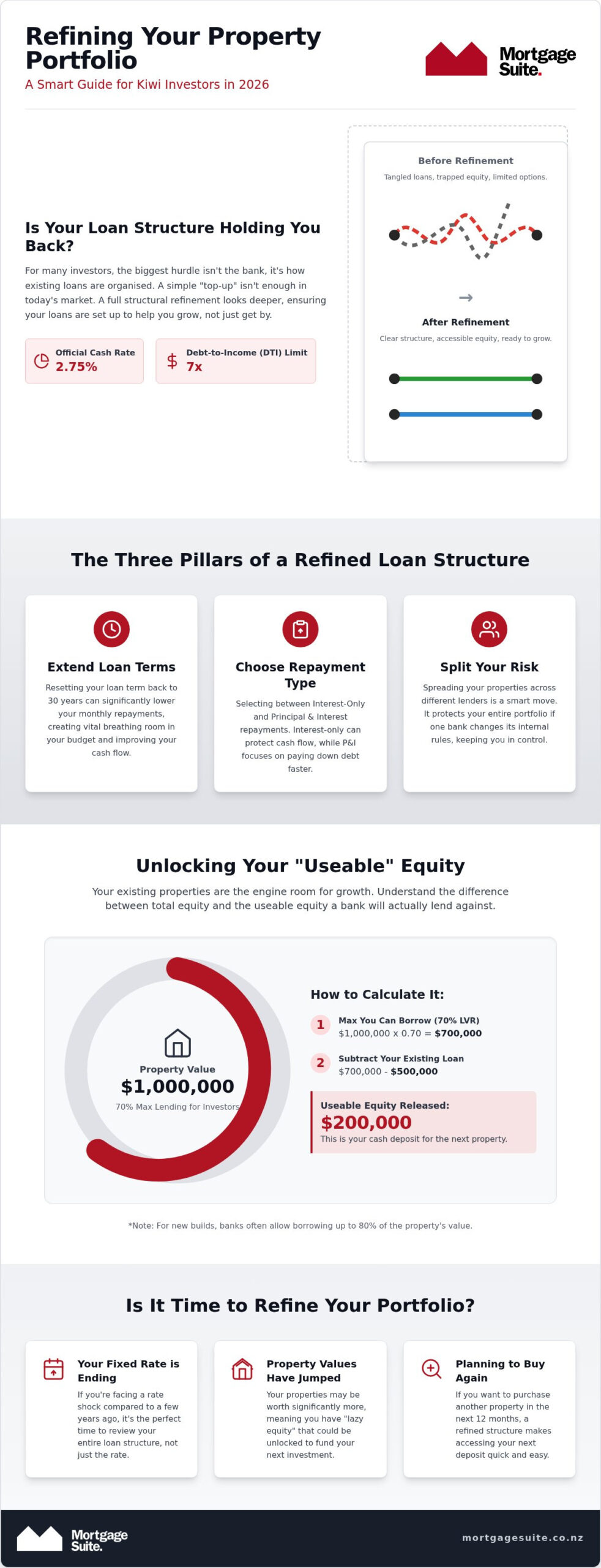
The way the market looks in 2026 has changed significantly. With the Official Cash Rate at 2.75% and debt-to-income (DTI) limits capped at seven times what you earn, the old ‘top-up’ method often hits a wall. A top-up just piles more debt on the existing heap. A structural refinement, however, might involve moving loans between different lenders or changing how your equity is split to give you more freedom. Understanding New Zealand property market dynamics is vital here; as rules shift, your structure has to evolve to keep your portfolio healthy.

The Three Pillars of a Refined Loan

A well-organised portfolio usually rests on three specific choices that impact your daily life and your ability to buy again:

  • Interest-only vs Principal and Interest: We check which one fits your current rental income. In a higher interest environment, interest-only terms can protect your daily cash flow, while principal and interest might be better if you’re focusing on paying down debt.
  • Extending loan terms: Resetting your loan back to a 30-year term gives your monthly budget some vital breathing room, even if you’ve already been paying it down for a few years.
  • Splitting your risk: Putting all your properties with one bank is risky. If they change their internal rules, your whole portfolio gets squeezed. Spreading your loans across different lenders keeps you in the driver’s seat.

Signs It Is Time to Refine Your Portfolio

You don’t have to wait for a problem to check your numbers. If your fixed-rate term is ending soon, you’re probably facing a bit of a shock compared to what you paid a few years ago. This is the perfect time to look at the whole picture. Another sign is a jump in property values. If you reckon your properties are worth significantly more now, you might have “lazy equity” that could be working harder for you. Finally, if you’re planning to buy another investment property within the next 12 months, you’ll need a structure that makes getting that next deposit easy to access without a bank audit slowing you down.

Unlocking Equity: The Engine Room of Your Property Growth

Growth doesn’t always require a huge pile of cash sitting in a savings account. For most Kiwi investors, the fuel for their next purchase is already sitting right under their feet. When you’re looking at financing multiple investment properties nz, your existing portfolio is usually your best source of funding. However, there’s a big difference between the total equity you see on paper and the “useable” equity a bank will actually let you touch. Understanding this distinction is the secret to growing your portfolio without having to sell a single asset.

As of late 2026, the Reserve Bank settings require a 30% deposit for existing investment properties, meaning you can generally borrow up to 70% of the property’s value. For new builds, that requirement often drops to a 20% deposit. By refining your current loans, you can often release this equity as a cash deposit for your next move. You can use our mortgage calculator to get a rough idea of what your current numbers look like before you start the formal process.

Calculating Your Useable Equity

Equity is simply the gap between what your property is worth and what you owe the bank. While you might be able to borrow up to 80% against the value of your own home, the rules for rental properties are stricter. Banks generally cap lending at 70% for existing rentals to stay within current rules. This is why getting a fresh, professional appraisal is the first step in any refinement. If your properties have gone up in value, that “lazy equity” can be unlocked to form the deposit for your next purchase. It’s about making your current assets work harder so you don’t have to.

Refining Your Loan to Buy Again

Once you’ve identified your useable equity, you can use it as a virtual deposit. This means the bank uses the value in your current properties to secure the loan for the new one. A common trap many investors fall into is having the bank tie all your properties together as one big security. This gives the bank a lot of power but leaves you with very little flexibility. A smart refinement strategy keeps your home and your rentals separate. This ensures that if you decide to sell one property later, the bank can’t automatically grab all the money to pay down your other loans. If you want to see how we’ve helped others navigate these structures, feel free to read our client reviews to see the results of a tailored approach.

Mainstream Banks vs 2nd Tier Lenders: Choosing Your Path

It’s a common story in the current market: you’ve built a solid portfolio, your equity is high, but the ‘Big Four’ banks simply won’t budge. This usually happens because mainstream banks operate with very rigid templates. If your situation is slightly outside the box, perhaps you’re self-employed or have complex income streams, you might find yourself stuck. When you’re financing multiple investment properties nz, hitting a wall with your primary bank doesn’t have to be the end of the road. It’s often just a sign that you need to look beyond the high-street branches to find a lender that prioritises your potential over their paperwork.

The rise of non-bank and 2nd tier lenders has changed the game for New Zealand investors. These lenders often have a more common-sense approach to lending. They’re willing to look at the bigger picture of your portfolio’s performance rather than just ticking boxes. Krish Krishna spent over two decades inside the banking system, and he uses that insider knowledge to negotiate directly with these lenders on your behalf. You can learn more about our approach on our about us page, where we explain how we bridge the gap between rigid bank rules and your personal goals.

When a 2nd Tier Lender Makes Sense

A 2nd tier lender isn’t just a fallback option; it’s a strategic tool. You might find this path useful if your debt-to-income (DTI) ratio is slightly over the current 7x limit set for mainstream banks. It’s also a fantastic solution if you need a short-term ‘bridge’ to get a renovation or a small development project finished before you move to long-term finance. If you’re curious about how these alternatives work, check out our 2nd tier lender New Zealand guide for a deeper look at your options.

The Exit Strategy: Moving Back to the Bank

We rarely suggest using a non-bank lender as a forever home for your loan. Instead, we view it as a stepping stone. The goal is to use the flexibility of a 2nd tier lender to secure your property, then refine your financial profile over 12 to 24 months to become ‘bank-ready’ again. This involves maintaining a clean credit history and organising your income records so that a mainstream bank will eventually welcome you back with open arms. By treating this as a journey, you can keep financing multiple investment properties nz without getting permanently sidelined by a single ‘no’ from a mainstream manager.
Financing Multiple Investment Properties NZ: The 2026 Guide to Portfolio Refinement

A Step-by-Step Guide to Refining Your Portfolio in 2026

Refining your portfolio isn’t a weekend DIY project, but it also shouldn’t feel like a mountain of paperwork. Since the 2026 market involves stricter debt limits and a shifting interest rate cycle, the process for financing multiple investment properties nz requires a methodical approach. It’s about moving from a reactive state to a proactive one. Here is the path we take to get your portfolio back in peak condition.

  • Step 1: The Portfolio Audit. We start by gathering your latest mortgage statements and estimated property values. This shows us exactly where your equity is hiding.
  • Step 2: Goal Setting. Are you prioritising monthly cash flow to offset the 2.75% OCR, or are you chasing aggressive growth? Your goals dictate the structure.
  • Step 3: The Broker Chat. This is where we shop the market for you. We compare mainstream banks against 2nd tier lenders to find the best fit for financing multiple investment properties nz.
  • Step 4: The Application. We help you prep a “financial CV” that highlights your strengths to 2026 lenders.
  • Step 5: The Settlement. We handle the transition to your new, refined structure so you can start seeing the benefits.

Preparing Your Financial Paperwork

Lenders in 2026 are obsessed with the spare cash you have left over each month. This is the money you have left after all your living expenses and debts are paid. Banks now use open banking systems to see your real spending habits directly from your accounts. Because of this, tidying up small personal debts like car loans or credit cards before you apply makes the whole process a piece of cake. It clears the path for your investment loans to take centre stage and shows the bank you’re a disciplined borrower.

Navigating the 2026 Interest Rate Cycle

With the OCR at 2.75% as of September 2026, choosing between fixed and floating rates is a balancing act. Refining your portfolio might mean fixing for shorter periods, such as six or twelve months, to stay agile while the market settles. You can dive deeper into these strategies in our Mortgage Rates NZ 2026 Guide to see how different terms affect your bottom line. If you’re ready to see how these steps apply to your specific properties, we invite you to reach out for a consultative chat with our team.

The Mortgage Suite Difference: Mentorship Over Transactions

Finding a lender for financing multiple investment properties nz is one thing, but building a sustainable financial future is quite another. Most people go to a bank and receive a one-off transaction. They get a loan, a rate, and a thank you. At Mortgage Suite Ltd, we believe that serious investors deserve more than just a signature on a page. We approach our work as mentors, guiding you through the complexities of debt structure to ensure your portfolio doesn’t just grow, but thrives over the long term.

This approach is built on a foundation of deep institutional knowledge. Krish Krishna spent over two decades working inside the banking system, which means he knows exactly how the credit teams on the other side of the desk think. He understands the hidden triggers that cause a mainstream bank to say no and, more importantly, how to present your case so they say yes. We often take on the “hard cases” that other brokers might avoid, using our experience to find solutions for self-employed Kiwis or those with complex income streams that don’t fit a standard bank template.

Real Stories, Real Results

Our success isn’t just measured by the loans we settle, but by the wealth our clients build. We act as your dedicated negotiator, standing between you and the lenders to fight for the best possible terms. If you want to see the impact this personal touch has made, you can read through our client reviews. You’ll see stories of investors who were stuck at a dead end until we helped them refine their path. We don’t just focus on the next purchase; we focus on how that purchase fits into your life five or ten years from now. Our commitment is to provide a conversational, jargon-free experience that leaves you feeling empowered rather than overwhelmed.

Your Next Step to a Better Portfolio

Refining your property loans shouldn’t feel like a chore. With the right guide, it’s actually a piece of cake. Whether you’re feeling the “rate shock” of 2026 or you’re ready to unlock equity for your next big move, we’re here to help you organise your next steps with confidence. We invite you to learn more about us and how we operate nationally across New Zealand. When you’re ready, reach out for a no-obligation chat about your current property setup. Let’s take a look at your numbers together and find a way to make financing multiple investment properties nz work for your unique situation.

Take Charge of Your Property Future

Building a successful portfolio in 2026 requires more than just luck; it requires a debt structure that is built to last. You now understand how a strategic audit can turn stagnant equity into a fresh deposit and why non-bank lenders are a practical way to bypass rigid bank templates. By refining your current setup, you ensure your monthly budget has breathing room while keeping your growth plans on track.

Navigating the path of financing multiple investment properties nz is a piece of cake when you have a seasoned mentor by your side. With over two decades of banking experience and a specialty in complex loan scenarios, we offer national service to help Kiwi investors succeed. We invite you to book a conversational chat with Krish to refine your portfolio today. Let’s work together to unlock your equity and build a structure that gives you total confidence for the next five years. Your next big move is closer than you think.

Frequently Asked Questions

Is it worth refining my investment property loan if interest rates are high?

Yes, it is often more important when rates are high. Refining is about managing your monthly cash flow and yields, not just chasing a low rate. By adjusting your loan terms or switching to interest-only, you can create breathing room in your budget. This strategic approach to financing multiple investment properties nz ensures your portfolio remains sustainable even when market conditions are challenging. It’s about long-term stability rather than short-term fixes.

How much equity do I need to release to buy another investment property in NZ?

To buy an existing investment property, you generally need a 30% deposit, while new builds typically require 20%. You can release this deposit from your current properties by calculating your useable equity. This is the difference between your property’s market value and what you owe, usually capped at a 70% loan-to-value ratio for rentals. Getting a fresh appraisal is the best way to see how much “lazy equity” you can actually put to work.

What is the difference between refinancing and refining a mortgage?

Refinancing is usually a simple transaction, like moving to a new bank for a slightly better interest rate. Refining is a much more thorough process. It involves a full audit of your entire portfolio to ensure your loan terms, lender types, and repayment structures align with your 2026 goals. Refining looks at the big picture of your wealth, whereas refinancing is often just a one-off attempt to save a few dollars each month.

Can I refine my loan if I am self-employed or have a complex income?

Absolutely. We specialise in helping self-employed investors and those with non-standard income streams who don’t fit the rigid templates of mainstream banks. Because Krish has over two decades of banking experience, he knows how to package your application to highlight your strengths. We often use 2nd tier lenders who take a more common-sense approach to complex income, ensuring you can keep growing your portfolio without being held back by paperwork.

How long does the process of refining a property loan typically take?

The timeframe can vary, but you should generally allow between four and six weeks from start to finish. This period includes your initial portfolio audit, getting property appraisals, and comparing different lender options. Once we’ve chosen the best path, the formal application and settlement usually move quite quickly. We manage the entire process for you to ensure it’s a piece of cake and stays on track for your next purchase when financing multiple investment properties nz.

Will I have to pay break fees if I switch lenders mid-term?

You might face break fees if you’re currently in a fixed-rate term and decide to switch lenders. However, we don’t just look at the fee in isolation. We run the numbers to see if the long-term savings or the equity you unlock will outweigh that initial cost. Often, a more flexible structure or a better cash flow position makes paying a small fee now a very smart investment for your future.

What happens if a mainstream bank has already declined my application?

A decline from a mainstream bank is often just a sign that you don’t fit their specific internal rules. It doesn’t mean you can’t get a loan. We specialise in 2nd tier lending and alternative finance for exactly these scenarios. By looking at your portfolio through a different lens, we can often find a lender that is happy to support your goals, even if the “Big Four” have already said no.

How does the Official Cash Rate (OCR) affect my decision to refine now?

The OCR, which sits at 2.75% as of September 2026, directly impacts the interest rates banks offer. When the OCR moves, it’s the perfect time to review your structure. Refining now allows you to hedge your bets by choosing the right mix of fixed and floating terms. This keeps you agile, allowing you to take advantage of future market shifts while protecting your current rental yields from unexpected rate shocks.


Article by

Krish Krishna

Experienced Financial Adviser with over 46 years of Banking and Mortgage broking experience and over $2.0 Billion in loan settlements.

Interest Only Investment Property Loan NZ: A Strategic Guide for 2026

What if the smartest way to build your wealth wasn’t actually paying off your debt as fast as possible? Most people think an interest only investment property loan nz is just a temporary fix to keep your head above water, but in 2026, it’s actually a clever strategy to help you grow your portfolio faster. You’ve probably noticed that even with the latest tax rules that let you claim back interest, low rental returns can make it really tough to cover both the loan repayments and the interest every month. It’s discouraging when your big plans are held back by banks with strict rules that don’t seem to care about your personal goals.

We understand that frustration, and we’re here to show you a better path forward by using interest-only periods to free up your cash for your next move. This guide will walk you through how to boost your monthly cash flow, make the most of current tax rules, and create a solid plan for securing your second or third property. You’ll discover how to look beyond the big banks and build a long-term strategy that actually works in today’s New Zealand market. By the time you’ve finished reading, you’ll have a clear, simple roadmap to grow your portfolio and your wealth with total confidence.

Key Takeaways

  • See how switching to interest-only payments can immediately improve your monthly cash flow, giving you more room to manage costs or save for your next move.
  • Explore how an interest only investment property loan nz works with the latest tax changes to help you keep more of your rental income.
  • Learn the truth about “payment shock” and how to use smart refinancing to extend your interest-only periods safely.
  • Discover why looking beyond the big banks can give you the flexibility needed to grow a larger property portfolio.
  • Follow our simple two-step process to audit your current equity and map out a clear path toward your financial goals.

What is an interest only investment property loan in the NZ market?

At its heart, an interest-only loan is a setup where your regular repayments only cover the interest charges on the money you’ve borrowed. You aren’t actually chipping away at the original loan amount during this time. It’s a bit like paying “rent” to the bank for the use of their money while you wait for the property to grow in value or for your rental income to increase. Choosing an interest only investment property loan nz is a deliberate choice for many people who want to keep their monthly outgoings as low as possible.

In the 2026 New Zealand market, this approach has become a go-to strategy for those looking to build a portfolio. With the full restoration of interest tax claims that started back in 2025, the financial landscape for landlords has shifted. Investors are moving away from traditional repayment structures to better manage their rental returns. While the amount you owe stays the same, the extra cash in your pocket provides a safety net or a springboard for your next purchase. Most big banks offer these periods for one to five years, though some specialist lenders are now providing much longer terms if you have the right strategy in place. For a comprehensive overview of how residential investment property loans NZ work in today’s lending environment, our 2026 investor’s reference guide covers the full landscape in detail.

The difference between traditional loans and interest-only

The main difference is how your money is used each month. With a standard loan, your payment is split between the interest and a small portion that reduces your debt. With an interest-only loan, you skip that debt reduction part entirely. On a standard Auckland-priced property, this can be a real game changer for your bank balance. Based on current 2026 interest rates, your monthly repayments could be $600 to $1,000 lower than they would be on a traditional loan. It’s important to remember that this isn’t about avoiding your debt forever. It’s a strategic cash-flow management tool rather than a permanent debt state.

Why 2026 is the year of “Refining” your portfolio

We’ve seen plenty of change lately. With the Official Cash Rate sitting at 2.25% as of late 2025, mortgage rates have stabilised, but they still require careful management to stay profitable. Using interest-only periods allows you to stay in the game even during high-interest cycles without feeling the squeeze on your lifestyle. This year is all about refining investment property NZ portfolios. By structuring your debt more intelligently, you can ensure your existing properties aren’t just sitting there, but are actually working to fund your next move. This interest only investment property loan nz strategy ensures you have the cash ready to jump on new opportunities as they come up.

The top 4 reasons NZ investors choose interest-only loans

Deciding how to pay back your bank is a huge part of your financial strategy. For many, an interest only investment property loan nz isn’t just about making life easier today; it’s a smart way to build wealth much faster. There are four big reasons why this works so well in the current market. First, it keeps your monthly cash flow high. By not paying down the original loan amount, you keep more money in your pocket to cover maintenance, unexpected repairs, or to build a healthy emergency buffer. Second, it’s very tax-efficient. Since you can now claim back 100% of your interest, keeping that loan amount steady can actually help you when it’s time to talk to your accountant.

Growing your portfolio is often a race against time and how much cash you have available. This brings us to the third reason: helping you grow. You can save the extra cash you aren’t giving to the bank to reach your next deposit goal much quicker. Finally, it lets you focus on your personal debt. It makes very little sense to pay off a tax-friendly investment loan while you still have a mortgage on your own family home. Pausing the repayments on your rental debt lets you smash your own home loan first, which is a much more effective way to use your income.

Boosting your actual return

The logic here is quite simple: when your outgoings are lower, your actual return on the money you’ve put into the property goes up. In a market where rental income can be tight, this structure often makes the difference between a property that pays for itself and one that costs you money every week. It also means you aren’t tying up your cash in a low-interest debt when you could be using that money to invest elsewhere for a better result.

The “Home First” strategy

We often talk to clients who feel a bit guilty about not paying off their investment debt, but the “Home First” strategy is a total game changer. Your family home loan isn’t tax-deductible, so it should always be the first thing you try to get rid of. By using the extra cash from your interest-only period, you can make significant extra payments on your own home mortgage. If you’re currently using home equity for investment NZ, this ensures you’re clearing your most expensive debt first while your rental property potentially grows in value. If you want to see how these numbers look for your own situation, our team would love to help you check your lending options and find a plan that puts your home first.

Is an interest-only loan risky? Addressing the big objections

It’s natural to feel a bit of hesitation when considering an interest only investment property loan nz. We often hear the same concern from clients: “What happens when the five-year term is up?” The fear of a “payment shock” — where your repayments suddenly jump because you’re forced onto a principal and interest structure — is a common worry. However, for most proactive investors, this is more of a myth than a reality. You aren’t simply at the mercy of the clock; you’re in the driver’s seat of a strategic financial plan. Most investors don’t wait for the term to end; they’re already looking at their next move well before the deadline hits.

In New Zealand, wealth is traditionally built through capital gains rather than the slow grind of debt reduction. By choosing not to pay down the principal, you’re making a deliberate choice to prioritise your cash flow today. This allows you to hold your property through market cycles, like the current stabilisation phase we’re seeing in 2026. If the property value increases while your debt stays the same, your equity still grows. It’s about understanding that an interest-only period is a tool for a specific phase of your investment journey, not a permanent state of debt.

Managing the “End of Term” transition

When your interest-only period approaches its end, you generally have three paths: refinance with a new lender to start a fresh interest-only term, extend the current arrangement with your existing bank, or transition into principal and interest repayments if your cash flow allows it. This is where having an expert broker becomes vital. We recommend starting these conversations at least six months before your term expires. This gives us enough time to negotiate with lenders or look at second-tier options if the mainstream banks have become too rigid. Every property in your portfolio needs a clear exit strategy or a plan for this transition to ensure you’re never caught off guard.

The impact of DTI and LVR restrictions

The lending environment has changed significantly with the Reserve Bank of NZ’s latest rules. While the 70% LVR restriction for investors is a known factor, the Debt-to-Income (DTI) restrictions introduced in 2026 have added a new layer of assessment. These rules can sometimes limit your ability to simply “roll over” an interest-only loan if your total debt levels are high relative to your earnings. As of 2026, DTI limits have forced non-bank lenders to scrutinise interest-only applications through a much tighter lens, focusing heavily on a borrower’s total debt across their entire portfolio rather than just the individual property’s yield. Structuring your loans correctly from the start is the best way to ensure you remain flexible as regulations evolve. Our guide to residential investment property loans NZ explains exactly how to navigate these DTI and LVR rules when structuring your next application.

Interest Only Investment Property Loan NZ: A Strategic Guide for 2026

Mainstream banks vs. 2nd tier lenders: Where to get your IO loan

Most investors start their journey with one of the big four banks, but many eventually run into what we call “bank fatigue”. It’s a common hurdle where mainstream lenders often cap an interest only investment property loan nz at a total of five years. Once you hit that limit, the bank will typically insist you switch to principal and interest repayments. For a growing portfolio, this sudden increase in monthly outgoings can be a massive blow to your strategy. This is exactly why we look for “hidden” lenders that the big banks don’t want you to know about, ensuring your plans aren’t cut short by rigid internal policies.

You might notice that interest rates at non-bank lenders are sometimes a fraction higher than the “special” rates advertised by the big banks. However, it’s vital to look at the bigger picture of your cash flow. A slightly higher interest rate on an interest-only basis often results in much lower monthly payments than a lower rate on a principal and interest basis. We help you crunch these numbers to see which option actually keeps more money in your pocket each month. It’s about finding the right balance between the cost of the money and the flexibility it gives you to keep moving forward.

When to look beyond the “Big Four”

If your bank has recently declined your application due to high DTI levels or what they call “unserviceable” debt, it’s time to look elsewhere. Non-bank lenders are often much more accommodating for self-employed borrowers or those with complex income structures. Many of our clients also choose a “split banking” strategy to keep their personal home and their investments with different lenders. This protects your family home from being tied up in the same security net as your rentals. You can learn more about these options in our guide to non-bank investment property loans NZ.

The flexibility of 2nd tier loan structures

The real advantage of 2nd tier lenders is their investor-friendly mindset. While a retail bank might have a strict five-year limit, some non-banks are willing to offer longer interest-only periods, sometimes even for the life of the loan in specific cases. This flexibility is a game changer for anyone focused on long-term wealth rather than just paying down debt. With over 20 years of banking experience, Krish Krishna knows exactly how to pitch your case to these lenders to get the best possible outcome. If you feel like your bank is holding you back, contact us today to explore a lending structure that actually fits your goals.

How to set up your interest-only strategy with Mortgage Suite

Setting up an interest only investment property loan nz requires more than just filling out a form; it demands a clear, long-term vision. We’ve refined a four-step process that takes the guesswork out of your lending. It begins with Step 1: The Portfolio Audit. We take a look at your current equity and debt structure to see if your money is working as hard as it should be. Many investors have “lazy” equity sitting in their homes that could be better utilised. Step 2 is all about Defining the Goal. We need to know if your priority is boosting your weekly cash flow or if you’re trying to stockpile a deposit for a new build by the end of 2026.

Once we have your roadmap, we move to Step 3: The Lender Match. This is where our deep institutional knowledge comes into play. We don’t just look at the big banks like ANZ or Westpac; we also scan the second-tier market to find a lender whose criteria match your specific profile. Step 4 is The Application. We handle the heavy lifting, the phone calls, and the complex negotiations on your behalf. Our goal is to remove the obstacles that often stand between an investor and their next property, ensuring the process is as smooth as possible. We make sure the bank understands your strategy so they see you as a professional investor rather than just another borrower.

Why a specialist broker makes the difference

Having a dedicated negotiator in your corner is a massive advantage in today’s shifting market. We understand the nuances of the non-bank landscape and how to present your case to get a “yes” when others might say “no”. We take great pride in helping first-home buyers transition into the world of property investment, guiding them through that first crucial purchase. Because Mortgage Suite serves clients nationally across NZ, we can help you organise your finance regardless of where you are located. You get the benefit of our 20 plus years of experience, combined with a personal touch that the big banks often lack.

Your next steps for 2026

If you’re ready to refine your strategy, the best place to start is with a no-obligation chat. We can review your current interest rates and see if there is a more efficient way to structure your repayments. It is also worth checking our latest guide on equity release home loan NZ to see how you can unlock the value in your existing home to fund your next move. We aren’t just here for a single transaction; we’re here to be your partners in long-term wealth creation. Let’s work together to ensure your portfolio is robust, profitable, and ready for whatever the market brings next.

Take control of your property investment future

An interest only investment property loan nz is more than just a way to lower your monthly outgoings; it’s a tactical choice that gives you the flexibility to grow your portfolio with confidence. We’ve seen how smart debt structuring and choosing the right lender can help you manage your cash flow while staying ahead of changing regulations. Whether you’re looking to clear your personal mortgage faster or secure your next rental, having a clear plan is what separates a successful investor from the rest.

At Mortgage Suite, we bring over 20 years of banking and brokerage experience to the table. We specialise in complex investment structures and have deep connections with both mainstream and second-tier non-bank lenders. We’ll handle the heavy lifting and act as your dedicated negotiator to ensure you get the best possible outcome for your personal situation. Book a strategy session with Krish and the Mortgage Suite team today to start refining your strategy for 2026. We’re excited to partner with you on your journey toward long-term wealth and success.

Frequently Asked Questions

Can I get an interest-only loan for my own home in NZ?

Yes, it is possible, but banks are generally much stricter with home loans for owner-occupiers. They usually only grant these for a short period, typically one to two years, for specific reasons like a temporary drop in income or during major renovations. Mainstream lenders prefer you to pay down the debt on your own home to build equity rather than just paying the interest.

How long can an interest-only period last on an investment property?

Most mainstream banks in New Zealand offer interest-only terms between one and five years. However, there are exceptions, such as ANZ, which currently offers up to ten years for property investors. If you need a longer period to suit your strategy, we often look at non-bank lenders who can provide more flexibility with their timeframes and extension options.

Will an interest-only loan cost me more in the long run?

You will pay more total interest over the life of the loan because you aren’t reducing the principal balance. Since the debt stays the same, the bank charges interest on the full amount for a longer period. While the monthly outgoings are lower, you need to weigh this up against the long-term cost, though many investors find the improved cash flow is worth the trade-off.

Do I need a bigger deposit for an interest-only investment loan?

The deposit requirements are usually the same as a standard loan, which is typically 30% for investors under current 2026 LVR rules. The main difference lies in the bank’s assessment of your ability to pay. They will check your income more rigorously to ensure you can still afford the repayments once the interest-only period ends and you’re required to pay back the principal.

Can I switch from principal and interest to interest-only midway through my loan?

You can certainly ask to switch, but the bank will treat this as a fresh application. They’ll perform a full credit assessment to make sure you meet their current 2026 lending standards. This includes checking your income against the latest debt-to-income (DTI) restrictions to ensure the new repayment structure is sustainable for your personal situation and doesn’t put you at risk.

What happens if the property value drops during my interest-only period?

If the property value falls, your equity decreases because your loan balance remains exactly the same. This doesn’t usually impact your daily life unless you need to sell the property or refinance with a different lender. It’s a reminder of why we always recommend keeping a healthy equity buffer and taking a long-term view of the New Zealand property market.

Are interest-only loans still tax-deductible in New Zealand?

Yes, 100% of the interest on residential investment loans is deductible for the 2025/2026 tax year. This full restoration of deductibility makes an interest only investment property loan nz a highly effective tool for landlords. It allows you to maximise your tax claims while keeping your monthly costs low, which is a significant shift from the rules we saw a few years ago.

Why would a non-bank lender be better for an interest-only loan?

Non-bank lenders often provide a level of flexibility that the big retail banks simply can’t match. They are frequently more willing to offer longer interest-only terms or work with borrowers who have complex income, such as being self-employed. If you’ve hit a wall with your current bank’s internal limits, a second-tier lender can often provide the breathing room you need to keep growing.

Article by

Krish Krishna

Experienced Financial Adviser with over 46 years of Banking and Mortgage broking experience and over $2.0 Billion in loan settlements.