
Business Expansion Loans NZ: Your 2026 Guide to Funding Growth

What if the biggest hurdle to your next big move isn’t your balance sheet, but a bank’s outdated rulebook? If you’ve spent weeks waiting for a callback or felt the sting of a “no” because your financials don’t fit a tidy little box, you aren’t alone. Many Kiwi owners find that securing business expansion loans nz feels like a full-time job in itself, especially with interest rates shifting and traditional lenders often tightening their grip.

It’s incredibly frustrating to have a clear vision for growth but feel stuck behind red tape and confusing talk about using your assets to back a loan. We understand that you need a partner who sees the potential in your numbers, not just the risks. This guide will show you exactly how to find your way through the 2026 lending landscape, from understanding the latest changes to lending rules to choosing between a mainstream bank and a fast-acting lender outside the big banks. You’ll learn how to structure your application to buy a new venture or scale your current one, giving you the confidence to secure the funding you deserve.

Key Takeaways

  • Learn why borrowing to scale your operations is a strategic move that’s very different from just covering daily costs.
  • Discover how to compare big banks and non-bank lenders to find a solution that actually fits your unique situation.
  • Get a clear plan for preparing your financials to secure business expansion loans nz without getting stuck in bank red tape.
  • Find out how to use term loans and other finance options to buy a competitor or move into a new market.
  • See how having a veteran negotiator on your side can help you overcome hurdles and get your funding approved much faster.

What is a Business Expansion Loan and Why Does Your Strategy Matter?

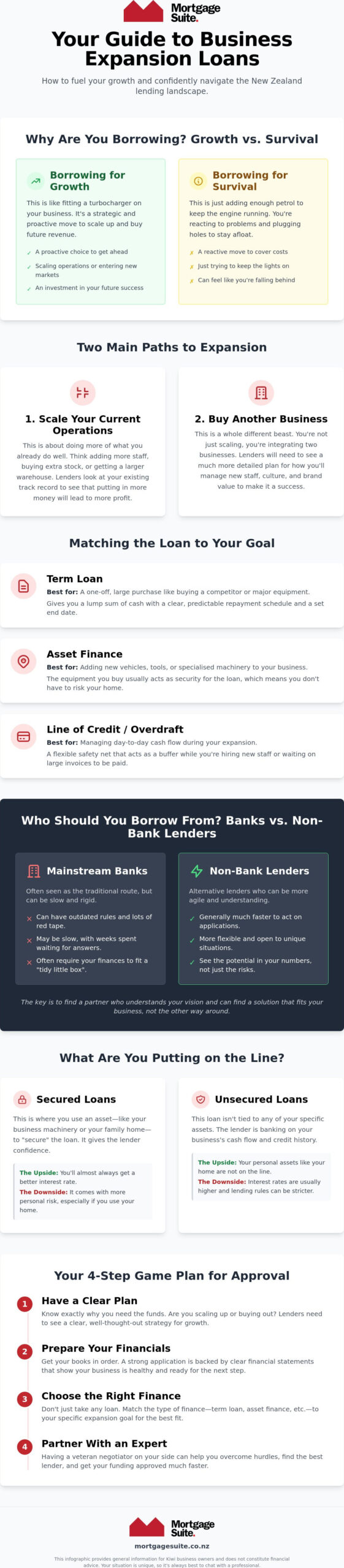
Think about your business like a car. Sometimes you need a bit of petrol just to keep the engine turning over, but an expansion loan is more like fitting a turbocharger. At its core, a business loan designed for growth is a specific type of funding used to scale your operations, enter new markets, or even buy out a competitor. It’s a tool that helps you move past the “ceiling” many Kiwi business owners hit when they have plenty of customers but simply don’t have the staff, space, or equipment to serve them all.

Taking on debt for growth is fundamentally different from borrowing just to stay afloat. When you borrow for survival, you’re often plugging holes. When you look into business expansion loans nz, you’re actually buying future revenue. It’s a proactive choice rather than a reactive one. However, the specific way you plan to grow will dictate exactly what kind of finance you need. A plan to hire five new sales reps in Auckland requires a different financial structure than a plan to buy a rival firm in Christchurch.

Expanding Your Current Operations vs. Buying a New Business

Scaling up your existing setup usually involves gradual steps. You might need extra stock to meet seasonal demand or a larger warehouse to centralise your logistics. Lenders look at your track record here; they want to see that your current model works and that more capital will simply mean more profit. It’s about doing more of what you’re already good at.

Buying a business is a different beast entirely. You aren’t just scaling; you’re integrating. You have to consider existing staff, different cultures, and the actual value of the brand you’re taking over. Because there are more moving parts, a lender will want to see a much more detailed plan for how the two pieces will fit together without the wheels falling off. The “how” of your acquisition is just as important as the “how much”.

The Emotional Side of Growing Your Business

Let’s be honest: expansion is stressful. It often feels like you’re “betting the farm” on your own ability to succeed. This “betting on yourself” can keep you up at night, especially when you start thinking about the responsibility you have toward your team. It’s natural to feel a bit of anxiety when the numbers get bigger.

Having a steady hand in your corner makes a massive difference. Professional advice helps shift your mindset from the anxiety of “owing money” to the excitement of investing in your future. When you have a clear path and a solid negotiator on your side, that weight on your shoulders starts to feel a lot lighter. It’s about turning that nervous energy into the fuel you need to take your business to the next level with the right business expansion loans nz.

Choosing the Right Finance: Different Loans for Different Growth Goals

Finding the right fit for your expansion isn’t just about the dollar amount. It’s about how that money flows in and out of your business. You might need a lump sum for a big purchase, or perhaps a safety net for those months when you’re waiting for new contracts to pay out. For many, business expansion loans nz come in the form of a term loan. This is the go-to for buying a competitor or investing in heavy equipment because it gives you a clear end date and a set repayment schedule.

Asset finance is particularly useful because the equipment itself usually serves as the backup for the lender. This means you don’t have to lean as heavily on your personal home equity to get the tools you need. If you’re a tradie looking to add three more vans to your fleet or a manufacturer needing a specialised machine, this keeps your other credit lines open for daily operations. If you’re worried about cash flow while you hire new staff, a flexible credit line or an overdraft can act as a buffer. While you’re weighing these up, don’t forget to look into financial assistance for small business owners to see if there are any grants or incentives that could complement your loan.

Secured vs. Unsecured: What Are You Putting on the Line?

Lenders often ask for “security”, which is just a way of asking what you’ll use to back the loan if things don’t go to plan. You can use business assets like machinery, or you might use personal property like your home. Using your home often unlocks the best rates for business expansion loans nz, but it comes with more personal risk. Unsecured loans don’t tie up your assets, but they usually have higher interest rates and stricter rules because the lender has less protection. It’s a trade-off between lower costs and the level of risk you’re comfortable carrying.

Fixed vs. Floating Rates for Business Growth

Fixed rates offer the peace of mind of knowing exactly what your repayments will be for the next few years. This is a huge help when you’re trying to manage a tight budget during a growth phase. Floating rates move with the market. They offer more flexibility, allowing you to make extra payments whenever you have a bumper month. For a deeper dive into how these rate structures work, our guide on mortgage rates nz explains the mechanics in plain English. Often, the best move is a mix of both, and getting a professional opinion from Mortgage Suite Ltd can help you strike that balance.

Bank vs. Non-Bank Lenders: Finding the Best Fit for Your Expansion

Most Kiwi business owners head straight to their local branch when they need a boost. It’s the natural first step. However, the big banks often have very rigid boxes that you need to fit into. If your profit and loss statement looks a bit different because you’ve been reinvesting every cent, or if you’ve only been trading for eighteen months, a traditional bank might see you as too risky. This is where the wider world of business expansion loans nz becomes very interesting.

There is a whole group of lenders outside the main street branches that look at things differently. These are often called 2nd tier or alternative lenders. They aren’t necessarily better or worse than a bank; they just have different rules. While a bank might focus purely on your past three years of tax returns, an alternative lender might look more closely at your current contracts and future potential. They often fill the gap when mainstream banks pull back, providing a steady hand when you need it most.

When the Bank Says No: Common Hurdles for NZ SMEs

It’s a common story. You have a great business, but the bank says no because your financials aren’t “clean” enough. Maybe you’re self-employed and haven’t hit that magic two year mark yet. Or perhaps you work in an industry that the bank has flagged as high risk. It can feel like a dead end. This is exactly where Krish Krishna’s twenty years of banking experience comes into play. He knows how bank managers think because he used to be one. He can look at your situation and spot the workaround that a standard bank computer might miss.

The Advantage of Alternative Lending

One of the biggest wins with alternative options is speed. Traditional banks can take anywhere from two to four weeks just to give you an initial answer. In the fast moving world of business, that’s an eternity. Many non-bank lenders can provide a decision and funding much faster, sometimes within a few days. This allows you to jump on an opportunity before a competitor does.

These lenders are also far more open to tailored terms. They can often build a repayment schedule that matches your new revenue stream, giving you breathing room while your expansion starts to pay off. As specialists in 2nd tier lender New Zealand solutions, we help you tell your story to the right people. It’s about finding a lender that sees the person and the potential, not just the paperwork. Securing business expansion loans nz doesn’t have to be a battle if you’re looking in the right places.

Business Expansion Loans NZ: Your 2026 Guide to Funding Growth

How to Get Your Business Loan Approved: A Step-by-Step Guide

Getting a green light for your funding isn’t just a matter of luck or having a massive bank balance. It’s about being prepared and presenting your case in a way that makes sense to a credit manager. If you want to secure business expansion loans nz, you need to show that you aren’t just dreaming big; you’re planning smart. Here is a clear path to getting your application over the line.

  • Step 1: Get your house in order. Lenders will want to see your most recent profit and loss statements. They need to know your current business is healthy enough to support the extra debt.
  • Step 2: Build your growth plan. This is where you explain exactly how the extra capital will generate more revenue. If you’re buying a new machine, how much more can you produce? If you’re hiring staff, how many more clients can they handle?
  • Step 3: Identify your security. We have discussed using assets or property already. Decide early on what you’re willing to put forward and what you’d prefer to keep separate.
  • Step 4: Package it professionally. This is where working with a specialist makes a world of difference. We know what certain lenders love to see and what makes them nervous.

The “Growth Plan”: What Lenders Actually Want to See

A basic business plan won’t cut it when you’re looking for significant funding. Lenders want an expansion roadmap. This means proving your systems and team are ready for the extra weight. If your sales double overnight, can your current office manager handle the admin? Do you have the software to track the new stock? You also need to be honest about the “dip”. Most expansions cost money before they make money, so your cash flow forecasts must show you have enough of a buffer to survive that initial phase.

Navigating the Sale and Purchase Agreement

If you’re using a business loan to buy a business nz, things get a bit more technical. You’ll have a Sale and Purchase Agreement that needs to be carefully aligned with your finance offer. It’s vital to have your lawyer and your broker talking to each other from the very start. This prevents any nasty surprises on settlement day. If your growth involves building a new warehouse or showroom, you might also want to look into property development loans nz to handle the construction side of things. Ready to get started? Talk to us today to begin packaging your application for success.

Partnering with Mortgage Suite Ltd to Secure Your Business Future

Business growth is rarely a straight line. It’s often filled with unexpected turns and decisions that can feel quite heavy when you’re making them on your own. This is where we come in. At Mortgage Suite Ltd, we don’t just see ourselves as a bridge to a loan; we see ourselves as your partner in growth. Having a veteran negotiator in your corner means you aren’t just one of thousands in a bank’s queue. You have someone who understands the nuances of business expansion loans nz and knows exactly how to present your vision to the people holding the purse strings.

Krish Krishna brings over two decades of deep industry experience to the table. Because he spent years working inside the banking system, he knows the internal language and the specific hurdles that often trip up even the best applications. Mortgage Suite Ltd works for you, not the bank. This insider knowledge is a powerful tool when you’re trying to secure funding for a complex commercial project or a quick business acquisition. We take a personal, conversational approach to finance. We believe that if you can’t explain a loan in plain English, it’s probably not the right one for you. Our goal is to remove the obstacles so you can focus on what you do best.

Why a Broker is Better Than Going Direct

Walking into your own bank only gives you one set of options. Working with a broker gives you access to a huge range of lenders across New Zealand, many of whom don’t deal directly with the public. This includes those 2nd tier lenders we discussed earlier who are often more flexible and faster to act. We do the legwork, the phone calls, and the paperwork while you stay focused on running your business. It saves you time, but it also provides long-term peace of mind. We’re here for the journey, helping you move from your first home loan through to major commercial expansions and property development projects.

Ready to Take the Next Step?

If you’re feeling a bit stuck or just want to see what’s possible, reach out for a no-obligation chat about your goals. No question is too simple, and no expansion goal is too big. We’ve seen almost every scenario imaginable over twenty years in the industry, and we know how to find the path forward when others see a dead end. Whether you’re just starting to look at business expansion loans nz or you have a sale and purchase agreement sitting on your desk, we’re here to help you navigate the process with confidence. Let’s talk about your business expansion today and get your growth plans moving.

Take the Next Step Toward Your Business Goals

Scaling up is one of the most exciting phases of your journey, but it shouldn’t be the most stressful. We’ve explored how the right strategy dictates your funding, why 2nd tier lenders offer the flexibility you need, and how to package an application that gets results. Whether you’re moving into a larger centre or buying out a competitor, securing business expansion loans nz is about finding a lender that sees your potential, not just your paperwork.

With over 20 years of banking expertise, we specialise in navigating the alternative lending market to find solutions when the big banks say no. You’ll receive personalised, jargon-free advice that puts your goals first, ensuring you have a steady hand guiding you through every complex financial decision. We handle the heavy lifting so you can stay focused on leading your team and serving your customers.

Talk to Mortgage Suite Ltd about your business growth today. Your next big move is within reach, and we’re ready to help you take it with total confidence.

Frequently Asked Questions

Can I get a business loan to buy a business in NZ without a deposit?

You usually need some form of equity or a cash deposit to buy a business in New Zealand. While “no deposit” loans are very rare, you can often use the equity in your home or other property to cover the deposit amount. This allows you to secure the funding you need without having to find a large pile of cash first.

How long does it typically take to get a business expansion loan approved?

Approval times vary depending on which lender you choose. A traditional bank might take anywhere from two to four weeks to process your application and give you a final answer. If you are in a rush, lenders outside the big banks can often provide a decision within a few days, which is vital for securing business expansion loans nz before a competitor moves in.

What is the difference between a business loan and a commercial mortgage?

The main difference is what the money is used for and what backs the debt. A business loan is generally for growth activities like hiring staff, buying stock, or marketing. A commercial mortgage is specifically for purchasing the physical property where your business operates. In that case, the land and building serve as the backup for the lender.

Do I have to use my home as security for a business growth loan?

No, you don’t always have to use your family home to back the loan. You can often use business assets like machinery, vehicles, or even the value of your unpaid invoices. However, using a home often unlocks the lowest possible interest rates because it represents less risk for the lender. Options that don’t require your home as backup exist but usually come with higher costs.

What happens if my business financials aren’t “perfect” according to the bank?

If the big banks say no because your financials don’t fit their rigid boxes, you still have options. Specialist lenders look past the standard paperwork to see the potential in your business. They focus on your future prospects and current contracts rather than just your past tax returns. This is where having an experienced negotiator from Mortgage Suite Ltd helps you tell the right story to the right people.

How much can I actually borrow for a business expansion in New Zealand?

The amount you can borrow depends on your business’s ability to pay back the loan comfortably. Lenders look at your yearly turnover and your net profit to decide your financial capacity. When applying for business expansion loans nz, they will also consider the extra income your growth plan is expected to generate once the new funding is in place.

Is it better to get a fixed or floating interest rate for my business loan?

It depends on whether you value certainty or flexibility more. A fixed rate gives you the peace of mind of knowing exactly what your repayments are each month, which helps with budgeting. A floating rate moves with the market and offers the flexibility to pay the loan off faster without any penalties. Many business owners choose to split their loan to get a bit of both.

Can I get a loan to buy out my business partner?

Yes, buying out a business partner is a very common reason for seeking finance in New Zealand. Lenders treat this much like a standard business purchase. They will look at the health of the company and ensure that you, as the remaining owner, have the skills and the financial capacity to manage the debt and the operations on your own.

Article by

Krish Krishna

Experienced Financial Adviser with over 46 years of banking and mortgage broking experience and over $2.0 billion in loan settlements.

Property Backed Business Loans NZ: Your 2026 Guide to Asset-Based Lending

What if your most valuable asset was currently working harder for the bank than it was for your own business growth? Most Kiwi business owners feel the sting of a “no” from traditional lenders, especially when they’re told their venture is too new or their paperwork doesn’t fit a rigid, pre-defined box. It’s incredibly frustrating to sit on significant equity while your expansion plans gather dust because of slow approvals. This is where property backed business loans nz come into play, offering a way to bypass the red tape and confusing financial jargon that usually makes borrowing feel like an impossible hurdle.

With the Official Cash Rate sitting at 2.50% and the market showing signs of a steady recovery, now’s the time to use what you already own. You deserve a partner who sees the potential in your property rather than just the risks on a balance sheet. This guide will show you how to turn your equity into fast, flexible capital without the usual bank-induced headaches. We’ll explore how much you can realistically borrow in the 2026 market, the simple path to securing funds, and why 2nd tier lending is the smart solution for those who don’t fit the standard mould.

Key Takeaways

  • Access significantly larger amounts of funding than a standard overdraft by using your property equity as security for your business growth.
  • Discover how property backed business loans nz provide a more affordable path to capital through lower interest rates compared to unsecured finance options.
  • Learn why flexible 2nd tier lenders are often the best choice when mainstream banks decline your application due to rigid “standard” criteria.
  • Follow a straightforward guide to calculating your usable equity and defining your business purpose to ensure a fast and simple approval process.
  • Leverage over twenty years of insider banking expertise to bypass traditional headaches and secure the funding your business needs to thrive in 2026.

What exactly are property backed business loans in NZ?

Think of a property backed business loan as a way to unlock the value currently sleeping in your physical assets. It is essentially a cash injection where your “bricks and mortar” do the heavy lifting for you. Unlike a standard personal loan or a credit card, which rely almost entirely on your personal income or a high credit score, property backed business loans nz focus on the equity you’ve built over time. It’s a practical, common-sense approach to funding that recognizes the real-world value of what you own.

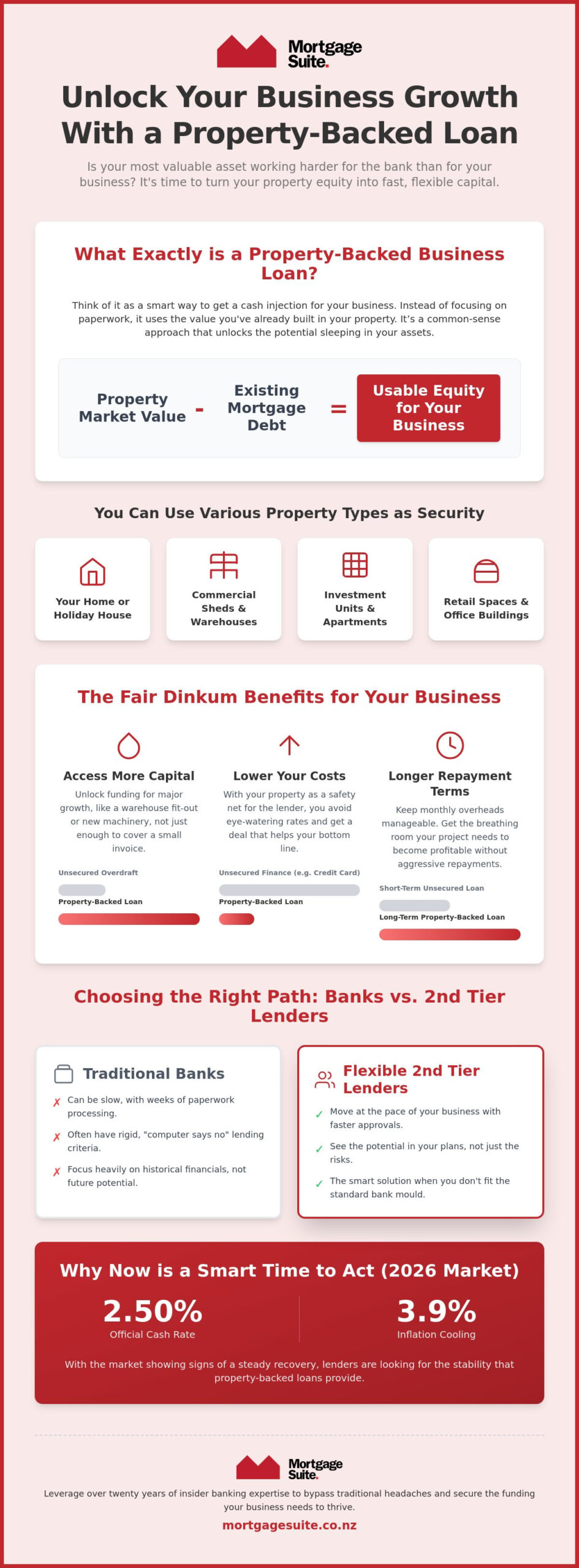
Your borrowing power is directly tied to your equity. This is the difference between the current market value of your property and any debt you still owe on it. In the current 2026 climate, with the Official Cash Rate sitting at 2.50% and inflation showing signs of cooling at 3.9%, lenders are looking for stability. Having a tangible asset as security makes you a far more attractive prospect than someone walking in with nothing but a business plan. You can use various property types to secure this funding, including:

  • Your primary residential home or a holiday house.
  • Commercial sheds, warehouses, or workshops.
  • Residential investment units or apartment blocks.
  • Retail spaces and office buildings.

The difference between secured and unsecured funding

The concept of Asset-based lending is built on the idea of security. When a loan is “secured” against property, it gives the lender a safety net; this confidence usually translates into much lower interest rates for your business. Unsecured funding, like a business credit card, often comes with eye-watering rates because the lender has nothing to fall back on if things go south. The trade-off is straightforward: you use your asset as a guarantee to access significantly more capital at a price that doesn’t cripple your monthly cash flow.

Why Kiwi business owners are choosing asset lending in 2026

The financial world has changed. We’ve seen a clear shift away from rigid, “computer says no” bank managers toward more flexible, 2nd tier lenders. These providers are often more interested in your future potential than your past mistakes. Speed is a massive factor here. While a traditional bank might take weeks to process a stack of paperwork, property-backed solutions can often be sorted in a fraction of the time. This provides a vital lifeline when cash flow is lumpy or an unexpected opportunity requires an immediate response. It’s about moving at the pace of your business, not the pace of a bank’s head office.

The fair dinkum benefits of using your property for business growth

Using your own property as a springboard for your business is one of the smartest moves a Kiwi entrepreneur can make. It’s about more than just getting a “yes” from a lender. It’s about getting a deal that actually works for your bottom line. When you look at property backed business loans nz, the most obvious win is the sheer scale of funding available. While an unsecured overdraft might give you enough to cover a small invoice or two, using your equity can unlock the kind of capital needed for a major warehouse fit-out, new machinery, or a full-scale marketing push that actually moves the needle.

It’s not just about the amount, though. It’s about the cost. Because the lender has the “safety net” of your property, they’re not taking as much of a gamble on your daily cash flow. This means you’re not stuck paying the double-digit interest rates typically found with business credit cards or those “quick cash” lenders that advertise on the radio. You get access to professional rates that reflect the stability of your asset. Plus, you can often secure longer repayment terms. This is a game-changer for keeping your monthly overheads manageable, giving your new project the breathing room it needs to become profitable before you have to worry about aggressive repayments of the actual amount borrowed.

Lowering your cost of capital

Your interest rate isn’t just a random number plucked from thin air. It often reflects the quality and location of the property you’re putting forward as security. To get the best possible deal, it pays to organise your finances and show a clear plan for the funds. By moving away from high-interest debt and onto a property-backed structure, you’re essentially giving your business a pay rise by reducing your monthly interest bill. It’s a way to make your existing assets work harder so you can focus on the work that actually generates revenue.

Flexibility for non-standard situations

One of the biggest hurdles for small businesses is the “three-year rule” many banks insist on. If you’re self-employed or running a fresh start-up, you might not have years of perfect tax returns to show. Asset-based lending focuses on what you have now rather than where you were three years ago. If you already have a portfolio, you can even use residential investment property loans NZ as a source of equity to fuel your business dreams. This flexibility makes property backed business loans nz a primary choice for those who don’t fit the standard bank box but have the drive and the assets to succeed. If you want to see what’s possible for your specific situation, it’s always a good idea to talk to an expert about your options.

Banks vs. 2nd Tier Lenders: Choosing the right path

Most business owners start their search for property backed business loans nz at their local bank branch. It makes sense because that is where your accounts are and where you likely have your home mortgage. However, in 2026, the gap between what a mainstream bank wants and what a growing business actually needs has become quite wide. While banks offer attractive interest rates, they often come with a level of rigidity that can stall your progress just when you need to move quickly.

The big banks typically demand “perfect” paperwork. This usually means three years of audited accounts, a spotless credit history, and a business model that fits into a very specific, low-risk category. If you are a builder, a developer, or a new start-up, you might find that the bank is hesitant to help, regardless of how much equity you have. This is the hidden cost of a “cheap” bank loan. The slow approvals and rigid terms can end up costing you more in lost opportunities than you save in interest.

This is where a 2nd tier lender New Zealand business owners rely on becomes a strategic partner. These lenders are specialists in saying “yes” when the mainstream banks say “no”. They aren’t just a backup plan; they are often the primary choice for entrepreneurs who value speed and flexibility over bank-mandated red tape. They look at the current value of your assets and the potential of your business rather than just your past tax returns.

When the bank says no: alternative solutions

Banks often decline applications for minor credit blips from years ago or because they’ve decided to pull back on lending to your specific industry. Alternative lenders take a broader view. They focus on the big picture, especially the value of your property. Having a veteran negotiator like Krish on your side is vital here. With over twenty years of experience, he knows exactly how to present your case to these lenders to ensure they see the strength of your position, effectively bridging the gap between rigid institutional rules and your personal funding needs.

Speed of funding: a critical factor

In the business world, timing is everything. A typical bank timeline can stretch for weeks as your application moves through various committees. Asset-based loans through 2nd tier providers are built for speed. When you have your property details ready to go, these lenders can often move through the approval process in a matter of days. This fast-track approach is a game-changer when you need to secure a new contract, buy stock at a discount, or manage a sudden cash flow dip. It is about getting the capital you need without the usual administrative headaches.

Property Backed Business Loans NZ: Your 2026 Guide to Asset-Based Lending

How to qualify for a property backed business loan

Qualifying for a loan shouldn’t feel like sitting a university exam. While the big banks often make you jump through hoops, the process for property backed business loans nz is designed to be much more straightforward. The focus shifts from your historical paperwork to the actual value of your asset. If you have equity in a house, an office, or a warehouse, you’re already halfway there. You don’t need to have a perfect credit score or a decade of trading history to get a seat at the table.

To get things moving, you can follow these simple steps:

  • Step 1: Calculate your usable equity. Take the current market value of your property and subtract what you still owe on your mortgage. This is your “pot of gold” for business funding.
  • Step 2: Define your business purpose. Whether you’re buying new equipment, hiring staff, or just need a cash flow buffer, having a clear goal helps lenders understand the “why” behind the loan.
  • Step 3: Gather your paperwork. We don’t need years of audited accounts. Even if you don’t use specific software like MYOB or Xero, we can work with bank statements or basic profit and loss summaries.
  • Step 4: Speak with a specialist. This is where you get a lender match that fits your specific needs rather than a “one size fits all” bank product.
  • Step 5: Get a valuation. A professional valuer will confirm the property’s worth, and you’ll receive your formal offer.

Understanding the loan-to-value ratio (LVR)

LVR is just a fancy way of saying “how much can I borrow against the house?” In the current 2026 market, a standard LVR for commercial properties is around 65%. This means you’ll typically need a 35% deposit or existing equity in the property. For residential security, that percentage can often be higher. If you want to get a better interest rate, having a lower LVR is a great way to show the lender that their investment is extra safe.

Preparing your “business story”

Lenders are people too, and they want to feel confident in your plan. You don’t need a 50-page business plan, but you should be able to explain how the funds will help you grow. When you can show that the capital will lead to more revenue or better efficiency, it builds trust. This clear plan makes the whole approval process move much faster. If you’re ready to see how much equity you can unlock, you can start your application process today and get a clear answer without the usual bank delays.

Why Mortgage Suite is your best partner for business finance

Choosing the right partner for your business finance is a decision that can shape your company’s future for years to come. You need more than just a broker; you need someone who knows the financial system from the inside out. At Mortgage Suite, we bring over twenty years of banking experience to the table, but there’s one major difference: we don’t work for the big banks. We work for you. We’ve spent decades seeing how rigid mainstream lenders can be, and we’ve made it our mission to bridge that gap. We specialise in property backed business loans nz that don’t fit into a standard, pre-defined box.

Our approach is deeply personal and consultative. We don’t just process applications or tick boxes; we listen to your business story and find the path that makes the most sense for your specific goals. While some providers only focus on their local area, we have a national reach that covers every corner of New Zealand. Whether you’re a tradesperson in Southland or a tech start-up in Auckland, we can help you unlock the equity in your assets. We pride ourselves on being a steady hand in a fluctuating market, providing the reliability and trust you need for significant financial moves.

The Mortgage Suite difference: your dedicated negotiator

When you work with us, you gain the advantage of a dedicated negotiator who knows how to speak the language of lenders. Krish Krishna uses his two decades of industry reputation to secure deals that you simply won’t find by going direct. We understand the “inside” of the banking world, which gives us a massive head start for cutting through red tape and overcoming obstacles. You’ll also benefit from having a single point of contact for all your needs, including specialised services like commercial property refinance NZ. This streamlined approach saves you time and ensures your entire financial strategy is working in harmony.

Getting started today

We know you’re busy running a business, so we’ve made our process as simple as possible. There are no complicated forms or endless phone trees here. We start with a straight talk about your goals and what you need to achieve them. We take the stress out of the application process by handling the heavy lifting, from the initial assessment right through to the final approval. Our goal is to make property backed business loans nz feel like a natural, easy extension of your business growth. If you’re ready to take the next step without the usual bank-induced headaches, let’s get your business funding sorted today and give your venture the capital it deserves.

Take the next step toward your business expansion

Your property is more than just a place to live or work; it’s a powerful financial tool that can fuel your next big move. By choosing property backed business loans nz, you’re opting for a faster, more flexible path to capital that respects the reality of running a business in 2026. You don’t have to settle for the slow approvals or rigid terms of traditional banks when alternative solutions are right here at your fingertips.

As a family-owned brokerage with over 20 years of industry experience, we specialise in finding 2nd tier lending options for those who don’t fit the standard bank mould. We take the stress out of the process with a personalised, consultative approach that puts your success first. Whether you’re looking to buy new equipment, manage cash flow, or fund a major development, we have the expertise to make it happen. You deserve a partner who advocates for you and understands the “inside” of the banking world. Talk to Krish about your business funding goals today and let’s get your expansion plans moving. Your business has incredible potential, and we’re here to help you unlock it.

Frequently Asked Questions

Can I use my family home to fund my business startup?

You can certainly use your family home to kickstart your new venture. Many Kiwi entrepreneurs find that using residential equity is the most effective way to secure funding when a business doesn’t have a long trading history. Because the property acts as a solid guarantee, lenders are often more willing to support a fresh startup that a traditional bank might view as too risky.

What happens if I already have a mortgage on the property?

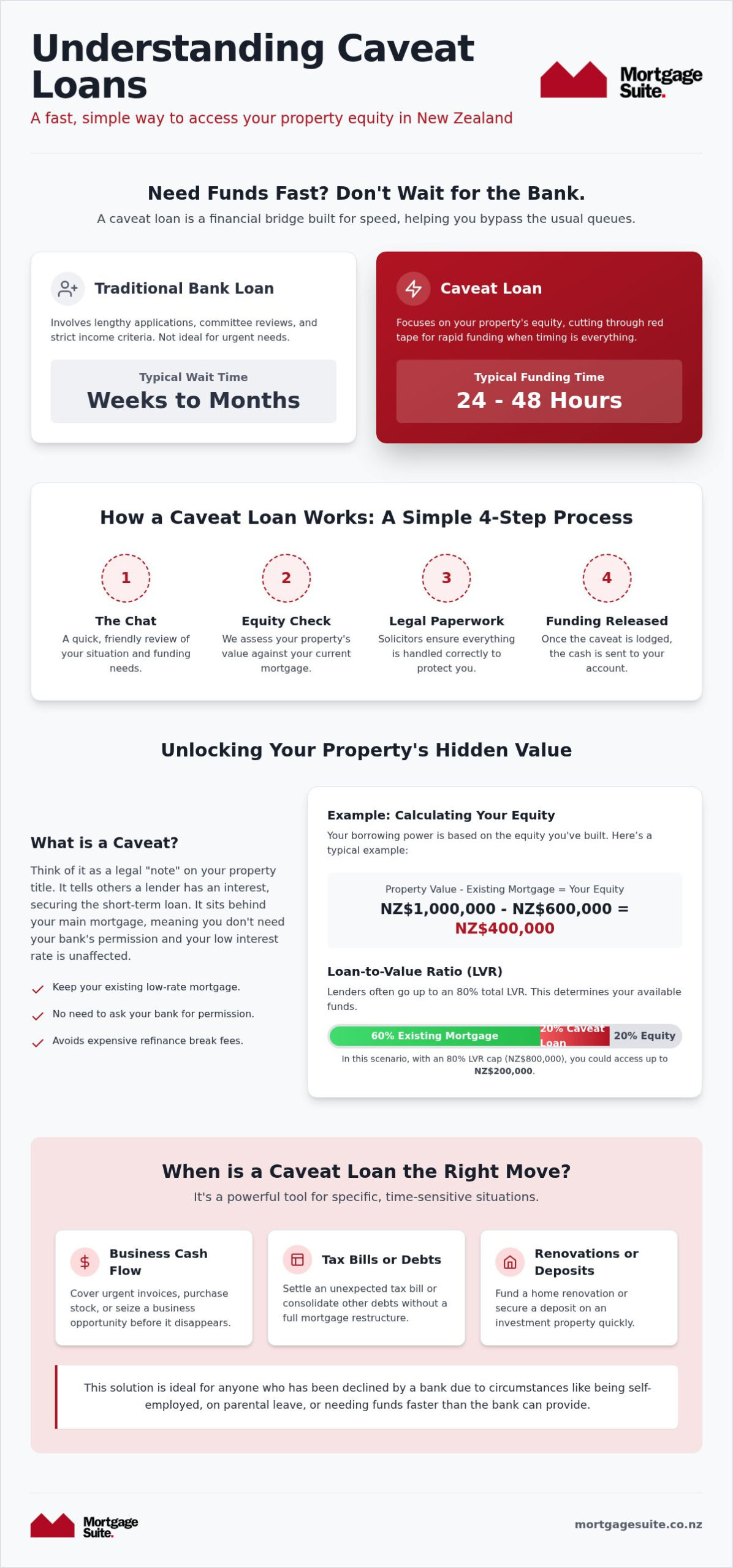
You can still use your property for a loan even if you haven’t paid off your mortgage yet. We focus on your “usable equity,” which is the current market value of your home or building minus what you still owe the bank. If there is enough value left over, a second tier lender can often provide a property backed business loan nz by taking a second mortgage or a caveat over the title.

How fast can I get the money from a property backed loan?

You can often access your funds in a matter of days once the initial paperwork and valuation are sorted. This is significantly faster than the weeks or months typically required by mainstream banks. Because the loan is based on the value of your asset, the approval process is streamlined, making it an ideal solution when you need to move quickly on a business opportunity.

Do I need to have a perfect credit score for asset lending?

You don’t need a spotless credit history to qualify for this type of funding. Since the loan is secured against your “bricks and mortar,” lenders are much more flexible regarding past credit blips or a lack of traditional financial records. They are far more interested in the current value of your property and your plan for the future than a computer-generated credit score.

Is the interest rate fixed or floating for business loans?

Both fixed and floating interest rates are available, and the choice usually depends on your specific business goals. Many owners prefer a floating rate because it often allows for more flexibility to pay back the loan early without facing large penalties. However, if you prefer the certainty of knowing exactly what your repayments will be each month, a fixed rate can be organised to help with your long-term budgeting.

Can I use a commercial property instead of a residential one?

You can absolutely use a commercial building, such as a warehouse, office, or retail shop, to secure your business finance. Commercial assets are excellent forms of security and can often unlock significant amounts of capital. While the percentage you can borrow against a commercial property might differ slightly from a residential home, it remains a very popular way to fund business growth while keeping personal assets separate.

What are the fees involved in setting up a property backed loan?

You will typically encounter a few standard costs when setting up your property backed business loans nz. These generally include a lender’s establishment fee, the cost of a professional valuation from an approved valuer, and legal fees for registering the mortgage or caveat. We always ensure you have a clear understanding of these costs upfront so you can make an informed decision without any hidden surprises.

How long can I borrow the money for?

The term of your loan can be tailored to match your specific business requirements. Some owners only need a short-term “bridge” for six to twelve months to cover a specific project, while others prefer a longer term of several years to keep their monthly overheads as low as possible. We work with you to structure the repayment timeframe so it aligns perfectly with your expected cash flow and growth plans.

Article by

Krish Krishna

Experienced Financial Adviser with over 46 years of Banking and Mortgage broking experience and over $2.0 Billion in loan settlements.

Commercial Property Refinance NZ: Your 2026 Guide to Unlocking Equity and Better Rates

What if the bank’s “no” isn’t actually a dead end, but a sign that your current loan has simply outgrown your business? Many Kiwi property owners feel stuck with high interest rates or rigid terms that were set years ago. It’s draining to feel like your growth is being held back by a lender who doesn’t understand your vision, especially when you’re trying to make sense of complex terms like repayment safety margins or loan-to-value limits. You deserve a financial partner who sees the potential in your portfolio rather than just the risks on a spreadsheet.

Securing a commercial property refinance NZ wide is about more than just finding a cheaper rate; it’s a strategic reset to align your debt with your 2026 goals. In this guide, you’ll learn how to restructure your debt to release equity for expansion and take advantage of the current 2.25% base interest rate environment. We’ll walk through how to navigate the latest financial regulations and show you how to trade cold, corporate interactions for a lending relationship that actually supports your long-term success. Whether you’re looking to lower your monthly repayments or access a lump sum for your next big move, we’ve got the roadmap to get you there.

Key Takeaways

  • Discover how a commercial property refinance NZ wide can help you break free from rigid bank structures and align your debt with your 2026 business goals.
  • Learn how to identify and unlock “lazy” equity in your property to fund your next stage of growth or expansion.
  • Compare the strict criteria of mainstream banks against the flexible, fair dinkum alternatives offered by 2nd tier lenders across New Zealand.
  • Get a clear roadmap for your refinance journey, from gathering your financial documents to securing a fresh valuation that reflects your asset’s true value.
  • Understand the value of having a dedicated advocate from Mortgage Suite Ltd who uses decades of industry experience to negotiate better terms on your behalf.

What is commercial property refinance and why consider it in 2026?

Refinancing is essentially the process of replacing your current commercial loan with a fresh one, often from a new lender who offers better terms. Think of it as a tactical move to improve your financial position or fuel business expansion. In the current market, many Kiwi business owners are finding that the “big four” banks have become a bit too rigid with their lending criteria. By looking at a commercial property refinance NZ wide, you can move away from those strict boxes and find a debt structure that actually breathes with your business.

To understand the basics, you might ask, what is a commercial mortgage and how does it differ when you’re swapping lenders? While the underlying asset stays the same, the rules of the game change based on the lender’s appetite for risk and their current interest rates. With the Reserve Bank’s base rate sitting at 2.25% in mid-2026, it’s a prime time to reorganise your debt to better suit your current cash flow needs. It’s about making your money work harder for you, rather than just serving the bank’s requirements.

Common reasons to trigger a refinance

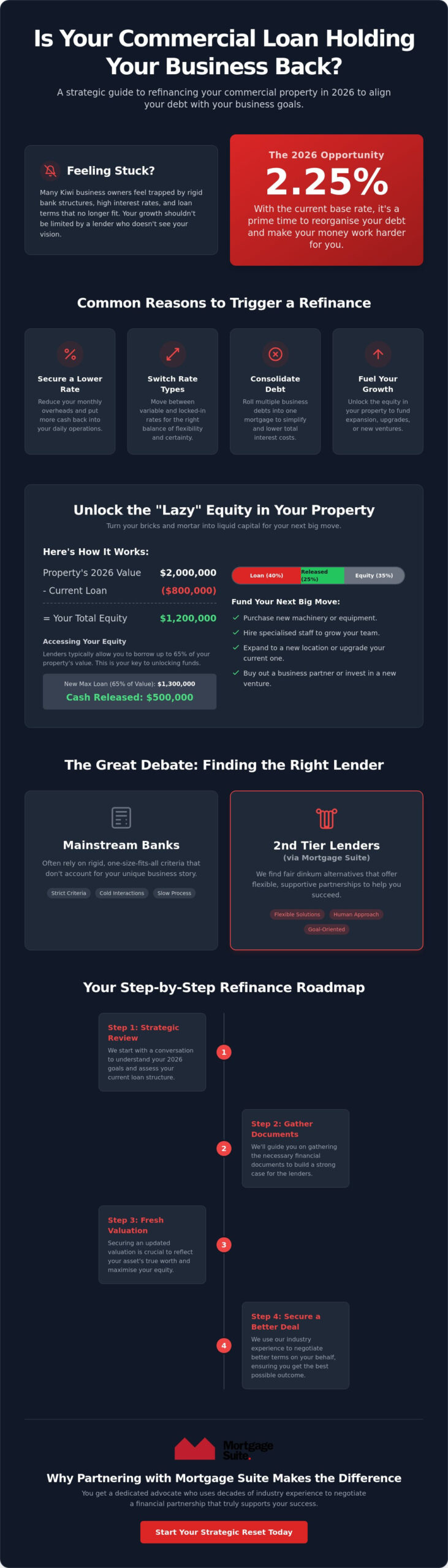
Most people start looking at their options when they feel they’re paying too much or when their business needs have shifted. Here are the main drivers we see in the 2026 landscape:

  • Securing a lower interest rate: This is the most common reason. Reducing your monthly overheads puts more cash back into your daily operations.
  • Switching interest rate types: You might want to move between variable vs locked-in interest rates to find the right balance of flexibility and certainty based on current market trends.
  • Debt consolidation: You can often roll various business debts into one single commercial mortgage. This simplifies your life and usually lowers your total interest costs significantly.

Refinance vs. New Loan: What is the difference?

You might think a refinance is just as much hassle as buying a new property, but that’s rarely the case. Because you already own the asset, the assessment process can often be much faster than a new purchase. Lenders already have a track record of the property’s performance to look at. However, you do need to weigh up the costs for ending a contract early, often called break fees. We often find that if the long-term savings on a lower interest rate outweigh that initial cost, it’s a very smart move.

Your property’s updated 2026 valuation plays a massive role here too. If your building is worth more now than when you first bought it, your equity has grown. This updated value gives you much more leverage when talking to a commercial property refinance NZ specialist at Mortgage Suite Ltd, as it lowers the lender’s risk and can unlock better pricing tiers that weren’t available to you before.

Unlocking the goldmine: Using equity release for business growth

Your commercial property is more than just a place for the team to work or a spot to store your inventory. If you have owned your building for a few years, there is a good chance it is sitting on a pile of what we call “lazy” equity. Choosing a commercial property refinance NZ wide allows you to tap into that increased value, effectively turning your bricks and mortar into liquid cash. You are essentially replacing your current loan with a larger one and using the difference to fund your next big move, whether that is a new location or a major upgrade.

Using the value in your property is often the most cost-effective way to fund a new business venture because interest rates backed by property are almost always lower than other types of finance. This capital works as a brilliant small business loan NZ alternative, giving you the funds you need for new machinery, hiring specialized staff, or even buying out a business partner. By leveraging an asset you already own, you avoid the high costs and strict terms often found with unsecured business credit lines.

Calculating your usable equity

Lenders decide how much you can borrow based on the percentage of the property’s total value. In the 2026 market, a solid rule of thumb is that most lenders will let you borrow up to 60% or 65% of what the building is currently worth. However, not every property is treated the same. While a standard office or warehouse is usually straightforward, specialised buildings like medical centres or cold storage units might have slightly tighter limits.

According to insights from the Property Institute of New Zealand, professional valuation trends are vital because a fresh appraisal can often reveal far more equity than you might have estimated yourself. You could even use this extra cash to fund the deposit for a residential investment property, allowing you to grow your personal wealth alongside your business without having to save a fresh deposit from your daily cash flow.

Servicing the new debt

While having equity is a great start, you also need to prove that your business can handle the larger repayments. Lenders will look closely at how well your profit covers your interest payments. Simply put, they want to see a healthy safety margin where your business income is significantly higher than the cost of the loan. They aren’t just looking at the building; they are looking at the health and sustainability of the business operating within it.

Most traditional banks prefer to see two years of steady, healthy profit in your financial records. If your recent history has been a bit more varied due to growth or market shifts, some lenders can be more flexible, provided you can show a clear plan for how the released cash will drive your future income. If you are wondering how much your specific property could unlock for your business, it is worth having a chat with the team at Mortgage Suite Ltd to see what is possible for your situation.

The Great Debate: Mainstream banks vs. 2nd tier lenders

Choosing between a mainstream bank and a non-bank lender is one of the most important decisions you’ll make when looking at a commercial property refinance NZ wide. Mainstream banks are often the first port of call because they offer the lowest interest rates. However, they can be incredibly fussy about your financial history. If your business doesn’t fit into their narrow “perfect” box, you might find yourself facing a frustrating rejection. This is where a 2nd tier lender New Zealand owners trust comes into play. They offer a fair dinkum alternative by looking at the bigger picture of your business potential rather than just ticking boxes on a checklist.

The landscape for a commercial mortgage New Zealand wide has evolved significantly by 2026. Non-bank lenders are no longer just a “last resort” for those with bad credit. They’ve become highly competitive, offering tailored solutions that the big banks simply aren’t set up to handle. For many, refinancing to a non-bank is a strategic bridge that helps them navigate a period of rapid growth or a temporary dip in cash flow without the rigid constraints of traditional banking.

When to choose a non-bank refinance

There are several scenarios where a non-bank lender is actually the better choice for your commercial property refinance NZ project:

  • Colourful financials: If you have a short trading history or your most recent tax returns don’t show the full strength of your business yet, a non-bank lender is much more likely to listen to your story and understand your future projections.
  • Need for speed: Big banks are notorious for taking weeks, or even months, to make a decision. If you need to move fast to secure a time-sensitive opportunity, a 2nd tier lender can often provide an answer and the funds in a matter of days.
  • Protecting your home: Many banks insist on “cross-collateralisation,” which means they use your family home as security for your business loan. Refinancing away from the bank can help you untangle these assets and keep your personal life separate from your business risks.

The path back to the bank

One thing many people don’t realise is that a non-bank loan doesn’t have to be a permanent fixture. We often view it as a temporary solution for 12 to 24 months. During this time, you can focus on stabilising your financials and building the “clean” track record that mainstream banks love. Once your business has matured and your books look more traditional, you can “graduate” back to a mainstream bank to secure those lower long-term rates. Having a seasoned advisor in your corner makes this transition much easier, as we know exactly what the big banks need to see before they’ll welcome you back. It’s about playing the long game to get the best result for your business.

Commercial Property Refinance NZ: Your 2026 Guide to Unlocking Equity and Better Rates

Your step-by-step roadmap to a successful refinance

Getting your commercial property refinance NZ project across the line doesn’t have to be a headache if you follow a clear path. By 2026, the lending environment has become more nuanced, requiring a bit more preparation than a standard residential top-up. The first step is always to gather your “ducks in a row.” This means having at least two years of clean financial statements, including profit and loss reports and balance sheets, alongside your current loan details. Lenders want to see that your business is stable and that you’ve been a reliable borrower so far.

Once your paperwork is sorted, the process typically follows this sequence:

  • Get a fresh valuation: With total commercial sales activity increasing by approximately $131 million in recent years, your property’s 2026 value is likely much higher than your last bank assessment.
  • Compare lender appetite: Not every lender wants to fund a suburban retail block or a large industrial warehouse. We help you find the one whose current “appetite” matches your specific asset type to ensure a higher chance of approval.
  • Negotiate the fine print: This is where we look at the General Security Agreements (GSA) and ensure the terms don’t pull your other business assets into the mix unnecessarily.
  • Settlement: Your lawyers will coordinate with the new lender to pay off your old debt. From here, your new journey with better rates or extra capital begins.

Navigating the valuation process

One common trap is thinking you can use a simple residential “app” estimate for a commercial deal. Commercial valuations are far more complex. The valuer will look closely at your “yield” and “cap rates,” which are essentially ways of measuring the property’s income potential against its market risk. If you have strong tenants on long-term leases, your valuation will likely be much stronger. It’s a good idea to tidy up the building and ensure all maintenance records are up to date before the valuer arrives. A well-presented property suggests a well-managed business, which gives the bank more confidence during the commercial property refinance NZ process.

Negotiating the “hidden” terms

It is a mistake to focus solely on the interest rate. While the 2.25% OCR has kept base rates attractive, banks often hide extra costs in “line fees” or strict “covenants.” Covenants are the rules you must follow, such as maintaining a certain level of profit. If these are too tight, they can stifle your growth. We often work to get application fees reduced or waived entirely, and we structure the loan to ensure you have the flexibility to make changes later without being hit by more charges. If you want someone to handle these tricky negotiations for you, reach out to Mortgage Suite Ltd to start your roadmap today.

Why partnering with Mortgage Suite makes the difference

When you are looking to secure a commercial property refinance NZ wide, having the right person in your corner changes everything. Krish Krishna and the team at Mortgage Suite bring over 20 years of deep banking experience directly to your side of the table. We reckon every business owner deserves an advocate who speaks the bank’s language and knows exactly how to navigate their internal systems. Instead of you spending hours on hold or deciphering complex credit policies, we handle the heavy lifting of the application. This leaves you free to stay focused on what really matters; looking after your customers and growing your business.

Our expertise isn’t limited to one specific sector. Whether you are managing a large industrial warehouse, a bustling retail suite, or a specialised medical facility, we know how to present your case. We understand the nuances of the 2026 market and how to highlight the strengths of your property and business cash flow to get the deal sorted. We don’t just submit papers; we tell your story in a way that makes lenders want to say yes.

A personal approach to business finance

We are not a “set and forget” brokerage that disappears once the loan is settled. We are here for the long haul, acting as a steady hand as your business evolves. Our reputation as dedicated negotiators helps us find the “green light” for complex deals that other brokers might find too difficult. We specialise in those “out of the box” scenarios that mainstream banks often struggle with, using our industry connections to find flexible solutions that align with your specific goals. If there is a way to make the numbers work, we will find it.

Ready to chat about your options?

The first conversation you have with us is always free and completely confidential. We take the time to listen to your 2026 goals and look at your current debt structure to see if there is a better deal waiting for you. There is no pressure and no confusing jargon; just honest, professional advice from people who have seen every possible scenario. Let’s see how a commercial property refinance NZ could unlock new opportunities for your portfolio. Get in touch with Mortgage Suite today to explore your refinance options and start your next chapter with confidence.

Ready to unlock your property’s true potential?

The 2026 market offers a unique window to turn your commercial asset into a springboard for future success. Whether you’re looking to lower your overheads or tap into equity for a new venture, a commercial property refinance NZ project gives you the control back. You don’t have to stay stuck with a lender who doesn’t see your vision or understand your specific industry needs. Refinancing is your chance to reset the terms and ensure your debt is working for you, not the other way around.

At Mortgage Suite, we bring over two decades of banking and brokerage expertise to ensure you aren’t just another number in a system. We specialise in finding the right path, whether that’s with a mainstream bank or a flexible 2nd tier lender who can move as fast as you do. Our team acts as your personal advocate, handling the tricky negotiations and paperwork so you can get back to what you do best. We believe in building long-term partnerships based on trust and real results.

If you’re ready to see what’s possible, book a free refinance strategy session with Krish and the team today. We’ll look at your goals and find a solution that fits your business perfectly. It’s time to move forward with a financial partner who is as committed to your success as you are.

Frequently Asked Questions

Is it harder to refinance commercial property than a residential home?

It is generally more complex because lenders look at the strength of your business and the quality of your tenants rather than just your personal income. While a home loan is based on a standard set of rules, commercial deals are assessed on their individual merits. This requires more detailed paperwork and a deeper look at your long-term stability, lease agreements, and the specific industry you operate in.

How much equity can I pull out of my commercial property in NZ?

Most lenders in the current market will allow you to borrow up to 60% or 65% of the property’s total value. If your property is worth more now than when you bought it, you can use a commercial property refinance NZ project to access that extra cash for business growth. This is a great way to fund expansion or new investments, provided your business can comfortably service the larger loan.

What are the typical break fees when refinancing a commercial loan?

Break fees vary between lenders, but you might see a flat fee around $33 or a calculation based on 30 days of interest. It is important to ask your current bank for a specific “break cost” quote before you switch. This helps you determine if the long-term savings from a lower interest rate will outweigh the immediate cost of leaving your current contract early.

Can I refinance if my business has had a “tough” year financially?

You certainly can, though you may need to look beyond the mainstream banks for a solution. If your most recent tax returns show a dip in profit, a non-bank lender will often look at your overall track record and future projections rather than just your last 12 months. This “big picture” approach is a great way to secure the funding you need while your business gets back on its feet.

How long does the commercial refinance process actually take?

You should typically allow between four and eight weeks from your first conversation to the final settlement. While some 2nd tier lenders can move much faster if you have all your documents ready, the process involves valuations and legal checks that take time to get right. Starting the process early ensures you aren’t rushed into a deal and gives us plenty of time to negotiate the best terms.

Do I need a new valuation when I refinance my commercial property?

Yes, almost every lender will require a fresh valuation to confirm the property’s current market value. Since the 2026 lending landscape relies heavily on accurate data, a new report ensures the bank is comfortable with the loan amount. It also gives you the best chance of unlocking the maximum amount of equity if the property has increased in value since you first took out your loan.

What is an “Interest Cover Ratio” and why does it matter for my refinance?

This is a tool lenders use to see if your business makes enough profit to pay the interest on the loan several times over. They want to see a safety margin so that even if your income drops slightly, you can still meet your repayments. A strong ratio makes you a much more attractive borrower and can often lead to more competitive interest rates and better terms.

Can I refinance a commercial property that has a vacant tenancy?

It is possible, but it usually requires a specialist lender who understands your specific market. Mainstream banks generally prefer properties with consistent income from long-term leases. If you have a vacancy, we can often find a commercial property refinance NZ solution that provides a bridge until you find a new tenant. Once the building is full again, we can then look at moving you back to a traditional bank.

Article by

Krish Krishna

Experienced Financial Adviser with over 46 years of Banking and Mortgage broking experience and over $2.0 Billion in loan settlements.