
Business Expansion Loans NZ: Your 2026 Guide to Funding Growth

What if the biggest hurdle to your next big move isn’t your balance sheet, but a bank’s outdated rulebook? If you’ve spent weeks waiting for a callback or felt the sting of a “no” because your financials don’t fit a tidy little box, you aren’t alone. Many Kiwi owners find that securing business expansion loans nz feels like a full-time job in itself, especially with interest rates shifting and traditional lenders often tightening their grip.

It’s incredibly frustrating to have a clear vision for growth but feel stuck behind red tape and confusing talk about using your assets to back a loan. We understand that you need a partner who sees the potential in your numbers, not just the risks. This guide will show you exactly how to find your way through the 2026 lending landscape, from understanding the latest changes to lending rules to choosing between a mainstream bank and a fast-acting lender outside the big banks. You’ll learn how to structure your application to buy a new venture or scale your current one, giving you the confidence to secure the funding you deserve.

Key Takeaways

  • Learn why borrowing to scale your operations is a strategic move that’s very different from just covering daily costs.
  • Discover how to compare big banks and non-bank lenders to find a solution that actually fits your unique situation.
  • Get a clear plan for preparing your financials to secure business expansion loans nz without getting stuck in bank red tape.
  • Find out how to use term loans and other finance options to buy a competitor or move into a new market.
  • See how having a veteran negotiator on your side can help you overcome hurdles and get your funding approved much faster.

What is a Business Expansion Loan and Why Does Your Strategy Matter?

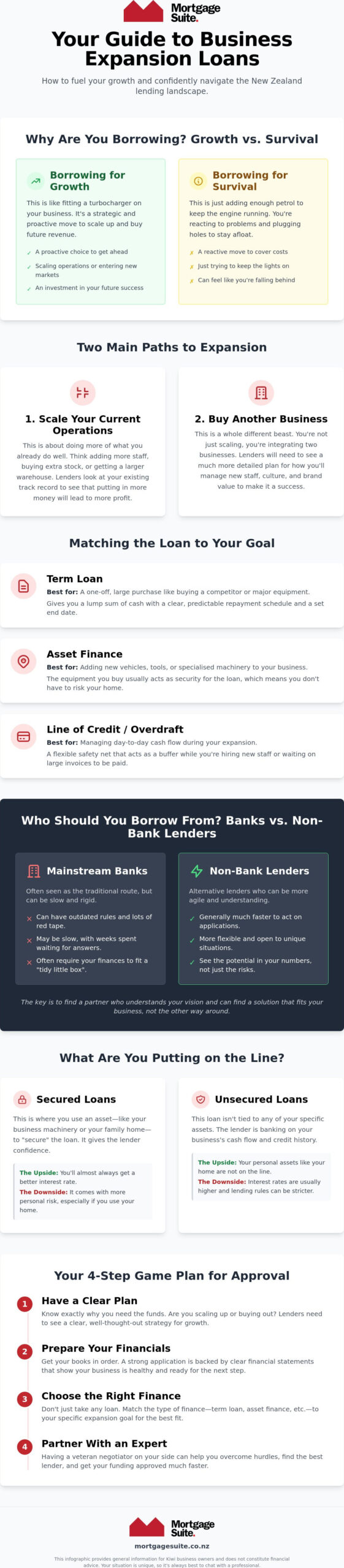
Think about your business like a car. Sometimes you need a bit of petrol just to keep the engine turning over, but an expansion loan is more like fitting a turbocharger. At its core, a business loan designed for growth is a specific type of funding used to scale your operations, enter new markets, or even buy out a competitor. It’s a tool that helps you move past the “ceiling” many Kiwi business owners hit when they have plenty of customers but simply don’t have the staff, space, or equipment to serve them all.

Taking on debt for growth is fundamentally different from borrowing just to stay afloat. When you borrow for survival, you’re often plugging holes. When you look into business expansion loans nz, you’re actually buying future revenue. It’s a proactive choice rather than a reactive one. However, the specific way you plan to grow will dictate exactly what kind of finance you need. A plan to hire five new sales reps in Auckland requires a different financial structure than a plan to buy a rival firm in Christchurch.

Expanding Your Current Operations vs. Buying a New Business

Scaling up your existing setup usually involves gradual steps. You might need extra stock to meet seasonal demand or a larger warehouse to centralise your logistics. Lenders look at your track record here; they want to see that your current model works and that more capital will simply mean more profit. It’s about doing more of what you’re already good at.

Buying a business is a different beast entirely. You aren’t just scaling; you’re integrating. You have to consider existing staff, different cultures, and the actual value of the brand you’re taking over. Because there are more moving parts, a lender will want to see a much more detailed plan for how the two pieces will fit together without the wheels falling off. The “how” of your acquisition is just as important as the “how much”.

The Emotional Side of Growing Your Business

Let’s be honest: expansion is stressful. It often feels like you’re “betting the farm” on your own ability to succeed. This “betting on yourself” can keep you up at night, especially when you start thinking about the responsibility you have toward your team. It’s natural to feel a bit of anxiety when the numbers get bigger.

Having a steady hand in your corner makes a massive difference. Professional advice helps shift your mindset from the anxiety of “owing money” to the excitement of investing in your future. When you have a clear path and a solid negotiator on your side, that weight on your shoulders starts to feel a lot lighter. It’s about turning that nervous energy into the fuel you need to take your business to the next level with the right business expansion loans nz.

Choosing the Right Finance: Different Loans for Different Growth Goals

Finding the right fit for your expansion isn’t just about the dollar amount. It’s about how that money flows in and out of your business. You might need a lump sum for a big purchase, or perhaps a safety net for those months when you’re waiting for new contracts to pay out. For many, business expansion loans nz come in the form of a term loan. This is the go-to for buying a competitor or investing in heavy equipment because it gives you a clear end date and a set repayment schedule.

Asset finance is particularly useful because the equipment itself usually serves as the backup for the lender. This means you don’t have to lean as heavily on your personal home equity to get the tools you need. If you’re a tradie looking to add three more vans to your fleet or a manufacturer needing a specialised machine, this keeps your other credit lines open for daily operations. If you’re worried about cash flow while you hire new staff, a flexible credit line or an overdraft can act as a buffer. While you’re weighing these up, don’t forget to look into financial assistance for small business owners to see if there are any grants or incentives that could complement your loan.

Secured vs. Unsecured: What Are You Putting on the Line?

Lenders often ask for “security”, which is just a way of asking what you’ll use to back the loan if things don’t go to plan. You can use business assets like machinery, or you might use personal property like your home. Using your home often unlocks the best rates for business expansion loans nz, but it comes with more personal risk. Unsecured loans don’t tie up your assets, but they usually have higher interest rates and stricter rules because the lender has less protection. It’s a trade-off between lower costs and the level of risk you’re comfortable carrying.

Fixed vs. Floating Rates for Business Growth

Fixed rates offer the peace of mind of knowing exactly what your repayments will be for the next few years. This is a huge help when you’re trying to manage a tight budget during a growth phase. Floating rates move with the market. They offer more flexibility, allowing you to make extra payments whenever you have a bumper month. For a deeper dive into how these rate structures work, our guide on mortgage rates nz explains the mechanics in plain English. Often, the best move is a mix of both, and getting a professional opinion from Mortgage Suite Ltd can help you strike that balance.

Bank vs. Non-Bank Lenders: Finding the Best Fit for Your Expansion

Most Kiwi business owners head straight to their local branch when they need a boost. It’s the natural first step. However, the big banks often have very rigid boxes that you need to fit into. If your profit and loss statement looks a bit different because you’ve been reinvesting every cent, or if you’ve only been trading for eighteen months, a traditional bank might see you as too risky. This is where the wider world of business expansion loans nz becomes very interesting.

There is a whole group of lenders outside the main street branches that look at things differently. These are often called 2nd tier or alternative lenders. They aren’t necessarily better or worse than a bank; they just have different rules. While a bank might focus purely on your past three years of tax returns, an alternative lender might look more closely at your current contracts and future potential. They often fill the gap when mainstream banks pull back, providing a steady hand when you need it most.

When the Bank Says No: Common Hurdles for NZ SMEs

It’s a common story. You have a great business, but the bank says no because your financials aren’t “clean” enough. Maybe you’re self-employed and haven’t hit that magic two year mark yet. Or perhaps you work in an industry that the bank has flagged as high risk. It can feel like a dead end. This is exactly where Krish Krishna’s twenty years of banking experience comes into play. He knows how bank managers think because he used to be one. He can look at your situation and spot the workaround that a standard bank computer might miss.

The Advantage of Alternative Lending

One of the biggest wins with alternative options is speed. Traditional banks can take anywhere from two to four weeks just to give you an initial answer. In the fast moving world of business, that’s an eternity. Many non-bank lenders can provide a decision and funding much faster, sometimes within a few days. This allows you to jump on an opportunity before a competitor does.

These lenders are also far more open to tailored terms. They can often build a repayment schedule that matches your new revenue stream, giving you breathing room while your expansion starts to pay off. As specialists in 2nd tier lender New Zealand solutions, we help you tell your story to the right people. It’s about finding a lender that sees the person and the potential, not just the paperwork. Securing business expansion loans nz doesn’t have to be a battle if you’re looking in the right places.

Business Expansion Loans NZ: Your 2026 Guide to Funding Growth

How to Get Your Business Loan Approved: A Step-by-Step Guide

Getting a green light for your funding isn’t just a matter of luck or having a massive bank balance. It’s about being prepared and presenting your case in a way that makes sense to a credit manager. If you want to secure business expansion loans nz, you need to show that you aren’t just dreaming big; you’re planning smart. Here is a clear path to getting your application over the line.

  • Step 1: Get your house in order. Lenders will want to see your most recent profit and loss statements. They need to know your current business is healthy enough to support the extra debt.
  • Step 2: Build your growth plan. This is where you explain exactly how the extra capital will generate more revenue. If you’re buying a new machine, how much more can you produce? If you’re hiring staff, how many more clients can they handle?
  • Step 3: Identify your security. We have discussed using assets or property already. Decide early on what you’re willing to put forward and what you’d prefer to keep separate.
  • Step 4: Package it professionally. This is where working with a specialist makes a world of difference. We know what certain lenders love to see and what makes them nervous.

The “Growth Plan”: What Lenders Actually Want to See

A basic business plan won’t cut it when you’re looking for significant funding. Lenders want an expansion roadmap. This means proving your systems and team are ready for the extra weight. If your sales double overnight, can your current office manager handle the admin? Do you have the software to track the new stock? You also need to be honest about the “dip”. Most expansions cost money before they make money, so your cash flow forecasts must show you have enough of a buffer to survive that initial phase.

Navigating the Sale and Purchase Agreement

If you’re using a business loan to buy a business nz, things get a bit more technical. You’ll have a Sale and Purchase Agreement that needs to be carefully aligned with your finance offer. It’s vital to have your lawyer and your broker talking to each other from the very start. This prevents any nasty surprises on settlement day. If your growth involves building a new warehouse or showroom, you might also want to look into property development loans nz to handle the construction side of things. Ready to get started? Talk to us today to begin packaging your application for success.

Partnering with Mortgage Suite Ltd to Secure Your Business Future

Business growth is rarely a straight line. It’s often filled with unexpected turns and decisions that can feel quite heavy when you’re making them on your own. This is where we come in. At Mortgage Suite Ltd, we don’t just see ourselves as a bridge to a loan; we see ourselves as your partner in growth. Having a veteran negotiator in your corner means you aren’t just one of thousands in a bank’s queue. You have someone who understands the nuances of business expansion loans nz and knows exactly how to present your vision to the people holding the purse strings.

Krish Krishna brings over two decades of deep industry experience to the table. Because he spent years working inside the banking system, he knows the internal language and the specific hurdles that often trip up even the best applications. Mortgage Suite Ltd works for you, not the bank. This insider knowledge is a powerful tool when you’re trying to secure funding for a complex commercial project or a quick business acquisition. We take a personal, conversational approach to finance. We believe that if you can’t explain a loan in plain English, it’s probably not the right one for you. Our goal is to remove the obstacles so you can focus on what you do best.

Why a Broker is Better Than Going Direct

Walking into your own bank only gives you one set of options. Working with a broker gives you access to a huge range of lenders across New Zealand, many of whom don’t deal directly with the public. This includes those 2nd tier lenders we discussed earlier who are often more flexible and faster to act. We do the legwork, the phone calls, and the paperwork while you stay focused on running your business. It saves you time, but it also provides long-term peace of mind. We’re here for the journey, helping you move from your first home loan through to major commercial expansions and property development projects.

Ready to Take the Next Step?

If you’re feeling a bit stuck or just want to see what’s possible, reach out for a no-obligation chat about your goals. No question is too simple, and no expansion goal is too big. We’ve seen almost every scenario imaginable over twenty years in the industry, and we know how to find the path forward when others see a dead end. Whether you’re just starting to look at business expansion loans nz or you have a sale and purchase agreement sitting on your desk, we’re here to help you navigate the process with confidence. Let’s talk about your business expansion today and get your growth plans moving.

Take the Next Step Toward Your Business Goals

Scaling up is one of the most exciting phases of your journey, but it shouldn’t be the most stressful. We’ve explored how the right strategy dictates your funding, why 2nd tier lenders offer the flexibility you need, and how to package an application that gets results. Whether you’re moving into a larger centre or buying out a competitor, securing business expansion loans nz is about finding a lender that sees your potential, not just your paperwork.

With over 20 years of banking expertise, we specialise in navigating the alternative lending market to find solutions when the big banks say no. You’ll receive personalised, jargon-free advice that puts your goals first, ensuring you have a steady hand guiding you through every complex financial decision. We handle the heavy lifting so you can stay focused on leading your team and serving your customers.

Talk to Mortgage Suite Ltd about your business growth today. Your next big move is within reach, and we’re ready to help you take it with total confidence.

Frequently Asked Questions

Can I get a business loan to buy a business in NZ without a deposit?

You usually need some form of equity or a cash deposit to buy a business in New Zealand. While “no deposit” loans are very rare, you can often use the equity in your home or other property to cover the deposit amount. This allows you to secure the funding you need without having to find a large pile of cash first.

How long does it typically take to get a business expansion loan approved?

Approval times vary depending on which lender you choose. A traditional bank might take anywhere from two to four weeks to process your application and give you a final answer. If you are in a rush, lenders outside the big banks can often provide a decision within a few days, which is vital for securing business expansion loans nz before a competitor moves in.

What is the difference between a business loan and a commercial mortgage?

The main difference is what the money is used for and what backs the debt. A business loan is generally for growth activities like hiring staff, buying stock, or marketing. A commercial mortgage is specifically for purchasing the physical property where your business operates. In that case, the land and building serve as the backup for the lender.

Do I have to use my home as security for a business growth loan?

No, you don’t always have to use your family home to back the loan. You can often use business assets like machinery, vehicles, or even the value of your unpaid invoices. However, using a home often unlocks the lowest possible interest rates because it represents less risk for the lender. Options that don’t require your home as backup exist but usually come with higher costs.

What happens if my business financials aren’t “perfect” according to the bank?

If the big banks say no because your financials don’t fit their rigid boxes, you still have options. Specialist lenders look past the standard paperwork to see the potential in your business. They focus on your future prospects and current contracts rather than just your past tax returns. This is where having an experienced negotiator from Mortgage Suite Ltd helps you tell the right story to the right people.

How much can I actually borrow for a business expansion in New Zealand?

The amount you can borrow depends on your business’s ability to pay back the loan comfortably. Lenders look at your yearly turnover and your net profit to decide your financial capacity. When applying for business expansion loans nz, they will also consider the extra income your growth plan is expected to generate once the new funding is in place.

Is it better to get a fixed or floating interest rate for my business loan?

It depends on whether you value certainty or flexibility more. A fixed rate gives you the peace of mind of knowing exactly what your repayments are each month, which helps with budgeting. A floating rate moves with the market and offers the flexibility to pay the loan off faster without any penalties. Many business owners choose to split their loan to get a bit of both.

Can I get a loan to buy out my business partner?

Yes, buying out a business partner is a very common reason for seeking finance in New Zealand. Lenders treat this much like a standard business purchase. They will look at the health of the company and ensure that you, as the remaining owner, have the skills and the financial capacity to manage the debt and the operations on your own.

Article by

Krish Krishna

Experienced Financial Adviser with over 46 years of banking and mortgage broking experience and over $2.0 billion in loan settlements.

Property Backed Business Loans NZ: Your 2026 Guide to Asset-Based Lending

What if your most valuable asset was currently working harder for the bank than it was for your own business growth? Most Kiwi business owners feel the sting of a “no” from traditional lenders, especially when they’re told their venture is too new or their paperwork doesn’t fit a rigid, pre-defined box. It’s incredibly frustrating to sit on significant equity while your expansion plans gather dust because of slow approvals. This is where property backed business loans nz come into play, offering a way to bypass the red tape and confusing financial jargon that usually makes borrowing feel like an impossible hurdle.

With the Official Cash Rate sitting at 2.50% and the market showing signs of a steady recovery, now’s the time to use what you already own. You deserve a partner who sees the potential in your property rather than just the risks on a balance sheet. This guide will show you how to turn your equity into fast, flexible capital without the usual bank-induced headaches. We’ll explore how much you can realistically borrow in the 2026 market, the simple path to securing funds, and why 2nd tier lending is the smart solution for those who don’t fit the standard mould.

Key Takeaways

  • Access significantly larger amounts of funding than a standard overdraft by using your property equity as security for your business growth.
  • Discover how property backed business loans nz provide a more affordable path to capital through lower interest rates compared to unsecured finance options.
  • Learn why flexible 2nd tier lenders are often the best choice when mainstream banks decline your application due to rigid “standard” criteria.
  • Follow a straightforward guide to calculating your usable equity and defining your business purpose to ensure a fast and simple approval process.
  • Leverage over twenty years of insider banking expertise to bypass traditional headaches and secure the funding your business needs to thrive in 2026.

What exactly are property backed business loans in NZ?

Think of a property backed business loan as a way to unlock the value currently sleeping in your physical assets. It is essentially a cash injection where your “bricks and mortar” do the heavy lifting for you. Unlike a standard personal loan or a credit card, which rely almost entirely on your personal income or a high credit score, property backed business loans nz focus on the equity you’ve built over time. It’s a practical, common-sense approach to funding that recognizes the real-world value of what you own.

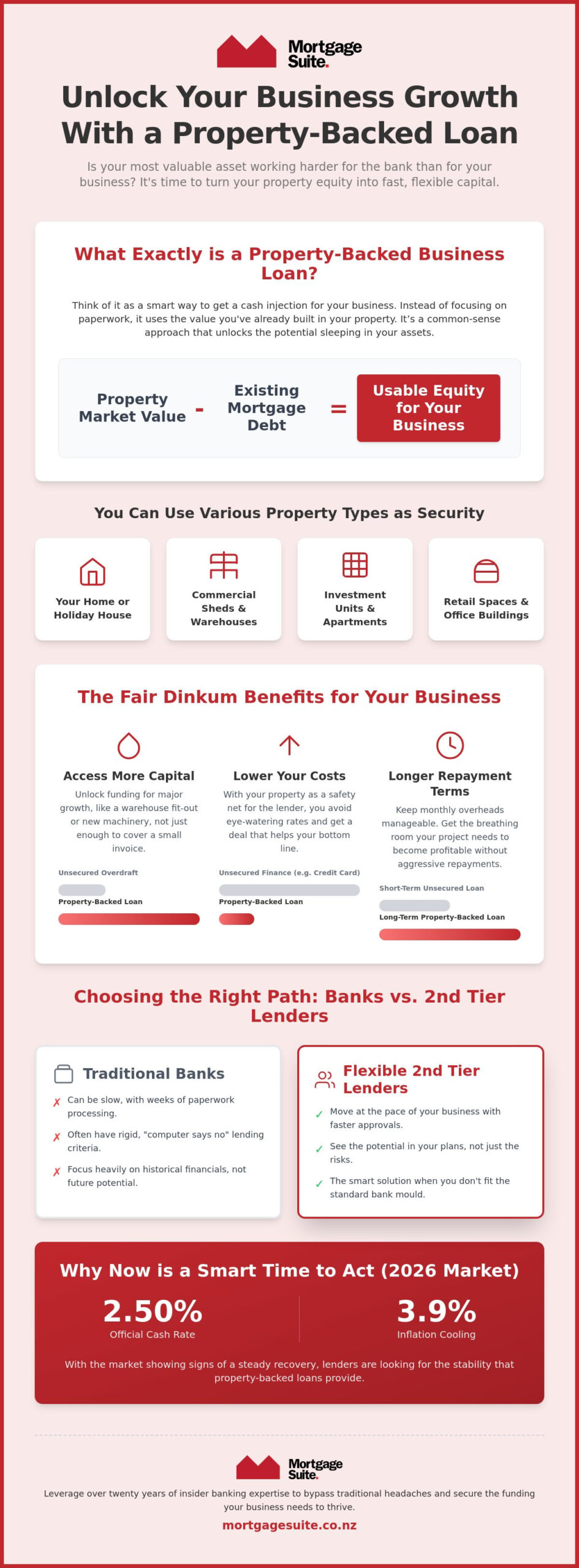
Your borrowing power is directly tied to your equity. This is the difference between the current market value of your property and any debt you still owe on it. In the current 2026 climate, with the Official Cash Rate sitting at 2.50% and inflation showing signs of cooling at 3.9%, lenders are looking for stability. Having a tangible asset as security makes you a far more attractive prospect than someone walking in with nothing but a business plan. You can use various property types to secure this funding, including:

  • Your primary residential home or a holiday house.
  • Commercial sheds, warehouses, or workshops.
  • Residential investment units or apartment blocks.
  • Retail spaces and office buildings.

The difference between secured and unsecured funding

The concept of Asset-based lending is built on the idea of security. When a loan is “secured” against property, it gives the lender a safety net; this confidence usually translates into much lower interest rates for your business. Unsecured funding, like a business credit card, often comes with eye-watering rates because the lender has nothing to fall back on if things go south. The trade-off is straightforward: you use your asset as a guarantee to access significantly more capital at a price that doesn’t cripple your monthly cash flow.

Why Kiwi business owners are choosing asset lending in 2026

The financial world has changed. We’ve seen a clear shift away from rigid, “computer says no” bank managers toward more flexible, 2nd tier lenders. These providers are often more interested in your future potential than your past mistakes. Speed is a massive factor here. While a traditional bank might take weeks to process a stack of paperwork, property-backed solutions can often be sorted in a fraction of the time. This provides a vital lifeline when cash flow is lumpy or an unexpected opportunity requires an immediate response. It’s about moving at the pace of your business, not the pace of a bank’s head office.

The fair dinkum benefits of using your property for business growth

Using your own property as a springboard for your business is one of the smartest moves a Kiwi entrepreneur can make. It’s about more than just getting a “yes” from a lender. It’s about getting a deal that actually works for your bottom line. When you look at property backed business loans nz, the most obvious win is the sheer scale of funding available. While an unsecured overdraft might give you enough to cover a small invoice or two, using your equity can unlock the kind of capital needed for a major warehouse fit-out, new machinery, or a full-scale marketing push that actually moves the needle.

It’s not just about the amount, though. It’s about the cost. Because the lender has the “safety net” of your property, they’re not taking as much of a gamble on your daily cash flow. This means you’re not stuck paying the double-digit interest rates typically found with business credit cards or those “quick cash” lenders that advertise on the radio. You get access to professional rates that reflect the stability of your asset. Plus, you can often secure longer repayment terms. This is a game-changer for keeping your monthly overheads manageable, giving your new project the breathing room it needs to become profitable before you have to worry about aggressive repayments of the actual amount borrowed.

Lowering your cost of capital

Your interest rate isn’t just a random number plucked from thin air. It often reflects the quality and location of the property you’re putting forward as security. To get the best possible deal, it pays to organise your finances and show a clear plan for the funds. By moving away from high-interest debt and onto a property-backed structure, you’re essentially giving your business a pay rise by reducing your monthly interest bill. It’s a way to make your existing assets work harder so you can focus on the work that actually generates revenue.

Flexibility for non-standard situations

One of the biggest hurdles for small businesses is the “three-year rule” many banks insist on. If you’re self-employed or running a fresh start-up, you might not have years of perfect tax returns to show. Asset-based lending focuses on what you have now rather than where you were three years ago. If you already have a portfolio, you can even use residential investment property loans NZ as a source of equity to fuel your business dreams. This flexibility makes property backed business loans nz a primary choice for those who don’t fit the standard bank box but have the drive and the assets to succeed. If you want to see what’s possible for your specific situation, it’s always a good idea to talk to an expert about your options.

Banks vs. 2nd Tier Lenders: Choosing the right path

Most business owners start their search for property backed business loans nz at their local bank branch. It makes sense because that is where your accounts are and where you likely have your home mortgage. However, in 2026, the gap between what a mainstream bank wants and what a growing business actually needs has become quite wide. While banks offer attractive interest rates, they often come with a level of rigidity that can stall your progress just when you need to move quickly.

The big banks typically demand “perfect” paperwork. This usually means three years of audited accounts, a spotless credit history, and a business model that fits into a very specific, low-risk category. If you are a builder, a developer, or a new start-up, you might find that the bank is hesitant to help, regardless of how much equity you have. This is the hidden cost of a “cheap” bank loan. The slow approvals and rigid terms can end up costing you more in lost opportunities than you save in interest.

This is where a 2nd tier lender New Zealand business owners rely on becomes a strategic partner. These lenders are specialists in saying “yes” when the mainstream banks say “no”. They aren’t just a backup plan; they are often the primary choice for entrepreneurs who value speed and flexibility over bank-mandated red tape. They look at the current value of your assets and the potential of your business rather than just your past tax returns.

When the bank says no: alternative solutions

Banks often decline applications for minor credit blips from years ago or because they’ve decided to pull back on lending to your specific industry. Alternative lenders take a broader view. They focus on the big picture, especially the value of your property. Having a veteran negotiator like Krish on your side is vital here. With over twenty years of experience, he knows exactly how to present your case to these lenders to ensure they see the strength of your position, effectively bridging the gap between rigid institutional rules and your personal funding needs.

Speed of funding: a critical factor

In the business world, timing is everything. A typical bank timeline can stretch for weeks as your application moves through various committees. Asset-based loans through 2nd tier providers are built for speed. When you have your property details ready to go, these lenders can often move through the approval process in a matter of days. This fast-track approach is a game-changer when you need to secure a new contract, buy stock at a discount, or manage a sudden cash flow dip. It is about getting the capital you need without the usual administrative headaches.

Property Backed Business Loans NZ: Your 2026 Guide to Asset-Based Lending

How to qualify for a property backed business loan

Qualifying for a loan shouldn’t feel like sitting a university exam. While the big banks often make you jump through hoops, the process for property backed business loans nz is designed to be much more straightforward. The focus shifts from your historical paperwork to the actual value of your asset. If you have equity in a house, an office, or a warehouse, you’re already halfway there. You don’t need to have a perfect credit score or a decade of trading history to get a seat at the table.

To get things moving, you can follow these simple steps:

  • Step 1: Calculate your usable equity. Take the current market value of your property and subtract what you still owe on your mortgage. This is your “pot of gold” for business funding.
  • Step 2: Define your business purpose. Whether you’re buying new equipment, hiring staff, or just need a cash flow buffer, having a clear goal helps lenders understand the “why” behind the loan.
  • Step 3: Gather your paperwork. We don’t need years of audited accounts. Even if you don’t use specific software like MYOB or Xero, we can work with bank statements or basic profit and loss summaries.
  • Step 4: Speak with a specialist. This is where you get a lender match that fits your specific needs rather than a “one size fits all” bank product.
  • Step 5: Get a valuation. A professional valuer will confirm the property’s worth, and you’ll receive your formal offer.

Understanding the loan-to-value ratio (LVR)

LVR is just a fancy way of saying “how much can I borrow against the house?” In the current 2026 market, a standard LVR for commercial properties is around 65%. This means you’ll typically need a 35% deposit or existing equity in the property. For residential security, that percentage can often be higher. If you want to get a better interest rate, having a lower LVR is a great way to show the lender that their investment is extra safe.

Preparing your “business story”

Lenders are people too, and they want to feel confident in your plan. You don’t need a 50-page business plan, but you should be able to explain how the funds will help you grow. When you can show that the capital will lead to more revenue or better efficiency, it builds trust. This clear plan makes the whole approval process move much faster. If you’re ready to see how much equity you can unlock, you can start your application process today and get a clear answer without the usual bank delays.

Why Mortgage Suite is your best partner for business finance

Choosing the right partner for your business finance is a decision that can shape your company’s future for years to come. You need more than just a broker; you need someone who knows the financial system from the inside out. At Mortgage Suite, we bring over twenty years of banking experience to the table, but there’s one major difference: we don’t work for the big banks. We work for you. We’ve spent decades seeing how rigid mainstream lenders can be, and we’ve made it our mission to bridge that gap. We specialise in property backed business loans nz that don’t fit into a standard, pre-defined box.

Our approach is deeply personal and consultative. We don’t just process applications or tick boxes; we listen to your business story and find the path that makes the most sense for your specific goals. While some providers only focus on their local area, we have a national reach that covers every corner of New Zealand. Whether you’re a tradesperson in Southland or a tech start-up in Auckland, we can help you unlock the equity in your assets. We pride ourselves on being a steady hand in a fluctuating market, providing the reliability and trust you need for significant financial moves.

The Mortgage Suite difference: your dedicated negotiator

When you work with us, you gain the advantage of a dedicated negotiator who knows how to speak the language of lenders. Krish Krishna uses his two decades of industry reputation to secure deals that you simply won’t find by going direct. We understand the “inside” of the banking world, which gives us a massive head start for cutting through red tape and overcoming obstacles. You’ll also benefit from having a single point of contact for all your needs, including specialised services like commercial property refinance NZ. This streamlined approach saves you time and ensures your entire financial strategy is working in harmony.

Getting started today

We know you’re busy running a business, so we’ve made our process as simple as possible. There are no complicated forms or endless phone trees here. We start with a straight talk about your goals and what you need to achieve them. We take the stress out of the application process by handling the heavy lifting, from the initial assessment right through to the final approval. Our goal is to make property backed business loans nz feel like a natural, easy extension of your business growth. If you’re ready to take the next step without the usual bank-induced headaches, let’s get your business funding sorted today and give your venture the capital it deserves.

Take the next step toward your business expansion

Your property is more than just a place to live or work; it’s a powerful financial tool that can fuel your next big move. By choosing property backed business loans nz, you’re opting for a faster, more flexible path to capital that respects the reality of running a business in 2026. You don’t have to settle for the slow approvals or rigid terms of traditional banks when alternative solutions are right here at your fingertips.

As a family-owned brokerage with over 20 years of industry experience, we specialise in finding 2nd tier lending options for those who don’t fit the standard bank mould. We take the stress out of the process with a personalised, consultative approach that puts your success first. Whether you’re looking to buy new equipment, manage cash flow, or fund a major development, we have the expertise to make it happen. You deserve a partner who advocates for you and understands the “inside” of the banking world. Talk to Krish about your business funding goals today and let’s get your expansion plans moving. Your business has incredible potential, and we’re here to help you unlock it.

Frequently Asked Questions

Can I use my family home to fund my business startup?

You can certainly use your family home to kickstart your new venture. Many Kiwi entrepreneurs find that using residential equity is the most effective way to secure funding when a business doesn’t have a long trading history. Because the property acts as a solid guarantee, lenders are often more willing to support a fresh startup that a traditional bank might view as too risky.

What happens if I already have a mortgage on the property?

You can still use your property for a loan even if you haven’t paid off your mortgage yet. We focus on your “usable equity,” which is the current market value of your home or building minus what you still owe the bank. If there is enough value left over, a second tier lender can often provide a property backed business loan nz by taking a second mortgage or a caveat over the title.

How fast can I get the money from a property backed loan?

You can often access your funds in a matter of days once the initial paperwork and valuation are sorted. This is significantly faster than the weeks or months typically required by mainstream banks. Because the loan is based on the value of your asset, the approval process is streamlined, making it an ideal solution when you need to move quickly on a business opportunity.

Do I need to have a perfect credit score for asset lending?

You don’t need a spotless credit history to qualify for this type of funding. Since the loan is secured against your “bricks and mortar,” lenders are much more flexible regarding past credit blips or a lack of traditional financial records. They are far more interested in the current value of your property and your plan for the future than a computer-generated credit score.

Is the interest rate fixed or floating for business loans?

Both fixed and floating interest rates are available, and the choice usually depends on your specific business goals. Many owners prefer a floating rate because it often allows for more flexibility to pay back the loan early without facing large penalties. However, if you prefer the certainty of knowing exactly what your repayments will be each month, a fixed rate can be organised to help with your long-term budgeting.

Can I use a commercial property instead of a residential one?

You can absolutely use a commercial building, such as a warehouse, office, or retail shop, to secure your business finance. Commercial assets are excellent forms of security and can often unlock significant amounts of capital. While the percentage you can borrow against a commercial property might differ slightly from a residential home, it remains a very popular way to fund business growth while keeping personal assets separate.

What are the fees involved in setting up a property backed loan?

You will typically encounter a few standard costs when setting up your property backed business loans nz. These generally include a lender’s establishment fee, the cost of a professional valuation from an approved valuer, and legal fees for registering the mortgage or caveat. We always ensure you have a clear understanding of these costs upfront so you can make an informed decision without any hidden surprises.

How long can I borrow the money for?

The term of your loan can be tailored to match your specific business requirements. Some owners only need a short-term “bridge” for six to twelve months to cover a specific project, while others prefer a longer term of several years to keep their monthly overheads as low as possible. We work with you to structure the repayment timeframe so it aligns perfectly with your expected cash flow and growth plans.

Article by

Krish Krishna

Experienced Financial Adviser with over 46 years of Banking and Mortgage broking experience and over $2.0 Billion in loan settlements.

Small Business Loan NZ: A Roundup of Funding Options for 2026

What if the reason your bank said “no” had nothing to do with your company’s potential and everything to do with their rigid, outdated tick-boxes? Many Kiwi business owners spend weeks wrestling with complex application forms only to be met with a cold, automated rejection because their financials look a bit “non-standard”. It is incredibly frustrating to feel like just another file in a giant system when you are trying to build a legacy. We understand that your business is more than just a balance sheet; it is the result of your hard work and passion.

Finding a small business loan NZ doesn’t have to be a source of constant stress. You deserve a flexible lender who acts as a partner rather than a gatekeeper, helping you secure growth funds without the sleepless nights. This article will help you understand the different types of funding available in the current market and how to choose the right fit for your company’s growth. We will break down the funding landscape for 2026, explore the practical differences between secured and unsecured options, and look at how personalised service can help you overcome the obstacles often found at larger institutions.

Key Takeaways

  • Understand how to use business finance as a strategic tool to fuel growth while keeping your personal and company debts separate.
  • Compare classic term loans with flexible lines of credit to find the right cash flow solution for your specific projects.
  • See why a small business loan NZ from a second-tier lender often provides the flexibility that mainstream banks lack for unique businesses.
  • Master the essential steps to get your financials organised and clearly explain how new funding will drive your future profits.
  • Learn how a personalised approach and decades of industry experience can help you bypass automated systems to secure the best possible deal.

What exactly is a small business loan in the NZ market?

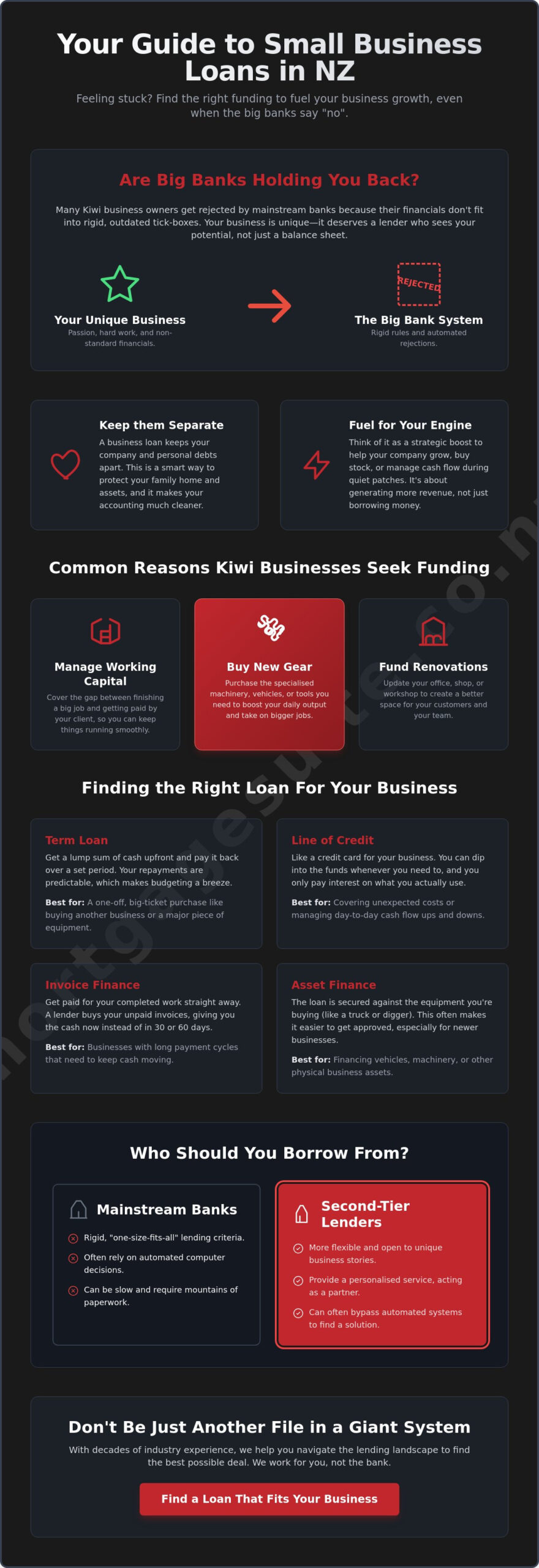
In its simplest form, a small business loan NZ is a financial tool designed to help your company grow or stay steady during quiet patches. Think of it as a boost for your company’s engine. Unlike a personal loan used for a holiday or a new car, business-purpose borrowing is specifically about generating more revenue or improving your operations. It is the fuel that allows you to take on a bigger contract, buy bulk stock at a discount, or move into a larger warehouse before you have the full amount of cash sitting in your account.

Separating your personal debt from your business debt is a smart move for any owner. It helps protect your family assets and makes your yearly accounting much cleaner. We have noticed more Kiwi owners moving away from traditional bank overdrafts recently. This shift is happening because many big banks are tightening their lending rules or trimming overdraft limits without much warning. A structured loan often provides more certainty than an overdraft that could be reviewed or reduced at the bank’s whim. Whether you are dealing with a “feast or famine” cash flow cycle or just need to bridge a gap, the right loan provides a safety net that lets you focus on the work itself rather than worrying about the bank balance every morning.

Common reasons Kiwis seek business funding

  • Purchasing new vehicles or specialised machinery: Getting the right tools to increase your daily output or take on more technical jobs.
  • Funding renovations: Updating your office, retail shop, or workshop to create a better environment for your team and customers.
  • Managing working capital: Covering the gap between finishing a large project and actually getting paid by the client.

Asset finance vs. general business loans

There are several different types of business funding to consider depending on your specific needs. Asset finance is quite straightforward because the equipment you are buying, like a truck or a digger, usually acts as the security for the loan. If you are a newer business, asset finance is often easier to secure because the lender has a physical item to hold as a guarantee. This reduces their risk and can sometimes lead to better terms for you.

General-purpose business loans offer more flexibility. You can use these funds for things that don’t have a physical “serial number”, such as a new marketing campaign, hiring a key staff member, or launching a new service line. Because there is not always a physical asset involved, lenders will look more closely at your overall cash flow and business history. Choosing between these options depends on your long-term goals, but having a seasoned expert to help you weigh up the pros and cons ensures you don’t end up with a structure that hinders your future growth.

A roundup of business funding types available to you

Choosing the right small business loan NZ depends entirely on what you plan to do with the money. A classic term loan is often the best fit for a one-off, long-term project. You receive a lump sum upfront and pay it back over a set period, which makes your monthly budgeting very predictable. If you are looking to buy the building your business operates from, a commercial mortgage works in a similar way but over a much longer timeframe. Owning your premises can be a fantastic way to build equity rather than just paying off someone else’s mortgage.

For day-to-day operations, you might consider a business line of credit or invoice finance. A line of credit lets you dip into funds only when you need them, meaning you only pay interest on what you actually use. Invoice finance is a bit different; it allows you to get paid early for work you have already finished by “selling” your unpaid invoices to a lender. This is a brilliant way to keep cash moving if your clients usually take 30 or 60 days to pay. Even government initiatives like the Small Business Cashflow Scheme have shown how specific, targeted funding can help Kiwis manage through unpredictable times. If you are unsure which path fits your current goals, talking to an expert about business loans can help clarify your options.

Choosing between secured and unsecured loans

The main trade-off here is between cost and speed. A secured loan usually requires you to pledge an asset, such as a property or a piece of heavy machinery, as a guarantee. Because this lowers the risk for the lender, you can often secure a much lower interest rate. For instance, while some specialist lenders might charge 14.99% or more for unsecured debt, a property-backed loan could be significantly cheaper. Unsecured loans are faster to get because there is no asset to value, but you will pay a premium for that convenience through higher rates and smaller borrowing limits.

The rise of flexible business facilities

Modern lending has moved beyond the clunky, old-fashioned bank overdraft. Many SMEs are now opting for flexible business facilities that allow you to pay down your balance and then “re-borrow” up to your limit whenever you need to. A business flexible facility acts as a safety net for cash flow, giving you peace of mind that funds are there if you need them. These facilities are replacing overdrafts because they often offer better terms and more transparency, helping you stay in control of your debt rather than feeling like the bank is in the driver’s seat.

Mainstream banks vs. 2nd tier lenders: Which is right for you?

When you start looking for a small business loan NZ, the local branch is usually the first stop. However, the experience can be a bit of a letdown for many owners. Big banks rely heavily on “tick-box” systems and automated platforms. If your business doesn’t fit their exact template, or if your financials have a few quirks because you’re self-employed, the computer often says no before a human even looks at your file. It is a rigid approach that doesn’t always account for the reality of running a company in 2026, especially when you need a lender who can see your potential rather than just your past tax returns.

This is where 2nd tier lenders come into play. These are specialised companies that take a more holistic, big-picture view of your situation. They don’t just look at a credit score; they look at your current contracts, your daily cash flow, and your future plans. Speed is another massive factor that sets them apart. While a mainstream bank might take weeks to process a single application, a non-bank lender can often give you an answer in a matter of days. If you have found a piece of equipment you need to buy immediately to finish a lucrative job, that speed is worth its weight in gold. Knowing when to use a bank for low-cost, slow-moving debt and when to look for alternative capital is a key skill for any growing business.

The benefits of 2nd tier lending solutions

They offer much more flexible criteria, which is a lifesaver for self-employed Kiwis who might not have two years of perfect tax returns ready to go. If your business has a shorter trading history, a 2nd tier lender is far more likely to listen to your story and look at your bank statements to understand your true earning power. You get a personalised assessment from a person who understands the local market, rather than just being a number in an automated bank queue.

Comparing the long-term costs

We often talk to clients who are worried about the cost of non-bank finance. It is true that 2nd tier lenders often charge a slightly higher interest rate than a mainstream bank. However, you have to weigh that cost against the opportunity of growth. A slightly higher rate is often worth the ease of access if it means you can secure a new contract or expand your team today. Many of our clients use this type of finance as a stepping stone; you use the funds to grow your turnover and prove your stability, which eventually makes you more attractive to a mainstream bank later on. For a deeper dive into these differences, you can read our guide on Commercial Mortgage New Zealand: Comparing Mainstream Banks vs 2nd Tier Lenders in 2026.

Small Business Loan NZ: A Roundup of Funding Options for 2026

How to get your business “loan-ready” in 5 steps

Preparing for a small business loan NZ is a lot like getting a house ready for an auction. You want to make sure everything looks its best before the inspectors start poking around. It isn’t just about filling out a form; it’s about presenting a professional, reliable image of your company. The first and most vital step is to organise your financials. Ensure your Profit and Loss statement and balance sheet are completely up to date. Lenders need to see that you have a firm grip on your numbers. If your records are a bit of a muddle, it signals to the lender that your management might be too.

Next, you must know your “why”. You need to be able to explain, in plain English, exactly how the funds will generate a profit. If you’re borrowing to buy a new piece of specialised machinery, show them the extra revenue that machine will bring in each month. Lenders love a clear plan. While you’re at it, check your credit score. Many owners forget that lenders will often look at both your business and personal credit history. If there’s an old, unpaid utility bill from five years ago causing a blemish, it’s better to fix it now rather than being surprised during the application process. You should also identify what security you can offer, whether it’s the asset you’re buying or equity in a property, to help lower your interest rate.

Finally, don’t try to navigate this alone. Talking to an expert who understands the 2026 lending market can save you dozens of hours of legwork and help you avoid the common traps that lead to a “no”. If you want to put your best foot forward, you can get in touch about a business loan with a team that knows exactly what lenders are looking for.

The documents you’ll likely need

Most lenders now use secure digital links to view your last six months of bank statements, which saves you from printing out reams of paper. You’ll also need a clear, one-page summary of what the funds are for and proof of your business registration and GST status. Having these ready to go shows you’re serious and well-organised.

Common pitfalls to avoid

One of the biggest mistakes is “credit shopping” by applying to multiple lenders at once. Each application can leave a mark on your credit file, and too many at once makes you look like a high-risk borrower. Also, be careful not to underestimate how much you actually need. It’s often better to borrow a slightly larger amount once than to have to go back and ask for more a few months later. Lastly, always have a plan for how you’ll manage repayments during those inevitable quiet months.

Many business owners feel like they are shouting into a void when dealing with big bank call centres. An automated application might be efficient for the bank, but it rarely captures the nuance of your specific situation. Securing a small business loan NZ should be a collaborative process, not a cold transaction. Having a steady hand to guide you means having someone who knows how to frame your story so lenders see the opportunity rather than the risk. It is about moving away from the “computer says no” culture and towards a solution that actually supports your goals.

With 20 years of banking experience, our team has seen how the internal gears of lending institutions turn. We know the questions they will ask before they even ask them. This deep institutional knowledge allows us to act as your dedicated advocate, negotiating terms that a standard application would never uncover. We don’t just look for any loan; we look for the one that fits your business lifecycle. Whether you are a tradie needing a new vehicle or a company looking for complex funding, we bridge the gap between the rigid world of banking and your personal needs as a borrower.

The Mortgage Suite difference for business owners

It starts with personal mentorship from Krish Krishna and the team. We don’t just process files; we provide a consultative experience that helps you understand your options clearly. We specialise in both residential and commercial property-backed business loans, which often provide the most cost-effective way to fund growth. By using equity in your home or premises, we can often unlock better rates than standalone business debt. Our focus is always on the long-term relationship. We want to see your business thrive year after year, which is why we prioritise your success over just closing a one-off transaction.

Taking the next step for your business

The path to growth doesn’t have to be paved with endless paperwork and stress. A quick conversation is often all it takes to clarify which funding option is best for your current stage. We handle the heavy lifting, from the initial negotiations to the final signatures, so you can stay focused on running your company. Having a professional handle the legwork ensures you don’t miss out on better terms simply because you didn’t have time to shop around. If you are ready to explore what is possible, reach out for a no-obligation chat about your goals. We are here to help you find a way forward that feels right for you and your future.

Empowering your business for the years ahead

We have explored how the right funding acts as a powerful catalyst for growth, whether you are choosing between secured debt or understanding why 2nd tier lenders offer the flexibility mainstream banks lack. Getting your company “loan-ready” by organising your financials and knowing your “why” is the most effective way to secure the capital you need to scale. By understanding the full range of options available in 2026, you can make a decision that supports your cash flow rather than hindering it.

Navigating the search for a small business loan NZ doesn’t have to be a solo mission or a source of stress. With over 20 years of banking and brokerage experience, our team at Mortgage Suite Ltd specialises in finding creative solutions for businesses that big institutions often decline. We provide a highly personalised, jargon-free service that treats you like a partner rather than just another application number. Let’s find the right business loan for your next big move and ensure your company has the steady financial support it deserves. You have already done the hard work of building your business; now let us help you secure its future growth with confidence.

Frequently Asked Questions

What is the maximum amount I can borrow for a small business loan in NZ?

The maximum you can borrow for a small business loan NZ typically reaches up to $500,000 with many specialist lenders. Some providers offer smaller amounts starting from $2,000 to cover minor expenses. Your specific limit depends on your company’s turnover, how long you have been trading, and whether you are providing any assets as security for the debt.

Do I need to provide security like my home for a business loan?

You don’t always need to use your family home as security for a business loan. Many lenders offer unsecured options that rely on your business’s cash flow instead of physical assets. However, if you do choose to use property as a guarantee, you will often be rewarded with a lower interest rate and a higher borrowing limit because the lender’s risk is lower.

How long does the application process usually take for a non-bank loan?

Non-bank lenders usually move much faster than traditional institutions, often providing an initial decision within 24 to 48 hours. If your paperwork is organised and you use digital bank statement links, the funds can sometimes be in your account within a single business day. This speed is a massive help when you need to jump on a time-sensitive opportunity or fix a cash flow gap.

Can I get a business loan if I have only been trading for six months?

Yes, you can certainly find funding even if you have only been trading for six months. While mainstream banks often want to see two years of perfect tax returns, 2nd tier lenders are more interested in your recent bank statements and growth potential. You might find that an unsecured small business loan NZ is a more accessible option at this early stage of your journey.

What is the difference between a secured and an unsecured business loan?

The main difference is what happens if you can’t make your repayments. A secured loan is backed by a physical asset, like a truck or a property, which the lender can take if things go wrong. Because this is lower risk for them, the interest rates are usually cheaper. Unsecured loans don’t require assets but come with higher rates to cover the lender’s extra risk.

How do interest rates for business loans compare to home loan rates?

Interest rates for business loans are almost always higher than home loan rates because the risk to the lender is greater. For example, while a home-backed business rate might sit around 6% to 10%, an unsecured loan from a specialist lender could start at 14.99% and go higher. It’s a trade-off for the speed and flexibility you receive when you don’t fit the standard bank criteria.

Can I use a business loan to pay off tax debt or existing creditors?

Yes, using a business loan to clear tax debt or pay off urgent creditors is a common strategy to get a company back on track. Many 2nd tier lenders are happy to help with debt consolidation if it means your daily cash flow will improve. It’s often better to have one manageable loan repayment than several stressful debts hanging over your head while you’re trying to grow.

Will a business loan application affect my personal credit score?

Applying for a business loan will usually show up on your personal credit report. Most lenders perform a thorough check of your credit history as part of their assessment process. It’s a good idea to avoid applying to several different lenders at once. Too many enquiries in a short space of time can lower your score and make you look like a higher risk to potential lenders.

Article by

Krish Krishna

Experienced Financial Adviser with over 46 years of Banking and Mortgage broking experience and over $2.0 Billion in loan settlements.