
Deposit for Investment Property NZ: What to Plan in 2026

What if your deposit for investment property nz is not just a savings target, but part of a wider funding plan? For an existing residential rental, current Reserve Bank of New Zealand Loan-to-Value restrictions set a 30% standard deposit benchmark for bank lending. That’s a useful starting point, but it doesn’t mean every buyer’s situation or every lender’s approach is the same.

It’s understandable to feel unsure about how much you’ll need, especially if your savings don’t tell the whole story. Usable equity in your home or another property may contribute, while your income, existing debt, the property type and a lender’s serviceability stress test can all shape the decision. A bank’s criteria can also affect your plan, so it helps to understand your options before committing to a property.

This guide explains what can shape an investment property deposit in New Zealand, how cash savings and property equity may fit into your funding plan, and what to prepare for a lending conversation. Mortgage Suite provides residential investment property loans and can help you understand your position and present your circumstances to bank and private lenders. That gives you a clearer starting point for practical next steps.

Key Takeaways

  • Plan your deposit for investment property nz as part of your wider funding strategy, not just as a savings goal.
  • Understand how your income, existing lending and the property itself may shape a lender’s assessment.
  • Compare cash savings with home equity to see how each could contribute to your deposit plan.
  • Gather clear details about your finances and investment goals before discussing borrowing options.
  • Mortgage Suite can help you explore deposit requirements, property suitability and potential bank or private lender options.

Deposit for an investment property in NZ: what does it cover?

A deposit is the buyer’s contribution towards a property’s purchase. It may come from savings or another funding source, but having a deposit doesn’t by itself mean a lender will approve the loan. The deposit is one part of a wider assessment that also considers your finances and the property you want to buy.

A deposit is your contribution to the purchase. Loan approval is a separate decision about whether the borrowing and property meet the lender’s criteria.

That distinction can help make sense of the deposit for investment property nz advice you’ll find online. A percentage can give you a starting point, but it isn’t a promise that a particular lender will accept your application.

Why investment property deposits can differ

A lender may assess an investment property differently from a home you plan to live in. The property’s intended use, type and features can affect how the lender views its security and the risk of lending against it. Your circumstances matter too, including your existing lending and ability to manage repayments.

Loan-to-Value restrictions are rules that limit how much a lender can advance compared with a property’s value. The loan-to-value ratio (LVR) compares the loan with the property value, so a larger deposit generally means a lower LVR. In New Zealand, Reserve Bank restrictions affect how banks lend at different LVR levels. Lender policies also shape how those settings apply to individual applications.

These settings and lender criteria can change. A deposit guide you read earlier may not reflect the policy that applies when you’re ready to borrow. Treat online figures as a starting point for planning, rather than a final answer for your own application.

Is there one standard deposit percentage?

No single percentage applies to every borrower, property and lender. Online guides often give a headline figure to help people begin planning. It may reflect one lender’s general approach or a common benchmark, but it can’t account for every detail of your application.

For example, two buyers looking at similar properties could receive different deposit guidance because their financial positions, existing debts or borrowing needs differ. The property itself may also affect a lender’s assessment. A percentage that seems to fit one scenario shouldn’t be treated as a guaranteed minimum for yours.

Use an online percentage as a guidepost. Your actual deposit expectations depend on the lender’s criteria, the applicable Loan-to-Value restrictions and the details of your purchase. If lender requirements change, you may need to adjust your funding plan.

For broader guidance on borrowing for a rental property, explore Mortgage Suite’s Residential Investment Property Loans NZ information. Understanding how the loan is assessed alongside the deposit can help you prepare for a more informed lending conversation.

What affects the deposit a lender may require?

A deposit is only one part of a lender’s assessment. The amount you may need can depend on both the property you’re buying and your financial position. In simple terms, your deposit requirement reflects the lender’s view of the property as security and your ability to manage the borrowing.

Loan-to-Value restrictions set boundaries for how much banks can lend compared with a property’s value, but they don’t decide every part of an application. Lenders also consider their own policies and the full picture of your finances. That’s why two buyers considering similar properties may receive different guidance about the deposit for investment property nz.

How property type and condition can shape lending

A lender needs to assess the property as security for the loan. Its type, condition, location and intended use may influence that assessment, as can the information available about it. The property’s value matters too, because it helps determine how the proposed loan compares with the security being offered.

For instance, an existing property and a newly built home may be considered under different lending policies. That doesn’t guarantee that one will need a smaller deposit. The lender’s criteria and the details of the property and application still matter. A property that needs work, or has features that make it harder to assess or sell, may also prompt closer consideration.

Before settling on a property, gather information that helps explain what you’re buying and how it will be used. This gives a lender a clearer basis for considering its suitability as security, rather than relying on a general deposit estimate.

How income and existing lending fit in

Your income helps a lender assess whether the repayments appear manageable, both now and under its assessment conditions. Existing home loans, personal lending and other financial commitments can affect how much room there is for another loan. A lender may also look at regular expenses and carry out a serviceability stress test, assessing whether repayments could remain manageable if rates were higher.

Expected rent may form part of the assessment, depending on the lender’s policy and the details of the property. But projected rent doesn’t automatically make a smaller deposit acceptable. Rental income is one input. The lender still considers your wider finances, the proposed borrowing and the property’s suitability.

To make a lending conversation more useful, be ready to outline:

  • Your income and how it is earned
  • Existing loans and regular repayment commitments
  • The property type and its intended use
  • Any expected rental income and how you arrived at that estimate
  • The funds or property equity you may be able to contribute

Looking at these details together can help explain why a deposit figure that works in one scenario may not fit another. Mortgage Suite can discuss your deposit position and property suitability, then present your circumstances to potential bank and private lenders. A bank’s response is one lender’s decision, not necessarily the end of the conversation about possible options.

Cash savings or home equity: how could you fund the deposit?

Your deposit doesn’t have to come from one source. Some buyers use cash savings, some may draw on property equity, and others consider a mix. Each option plays a different role in your plan, so separate money you can readily access from funds that would require new lending.

Equity is the difference between a property’s value and the lending secured against it. If a home is worth more than the debt attached to it, the gap is its equity. But that figure isn’t the same as cash in your account, or the amount a lender will let you borrow. Any accessible equity needs to be assessed against the property, existing lending and your ability to manage the extra repayments.

That distinction matters. Using equity may help fund a deposit, but it also means taking on additional borrowing. Your plan needs to account for the resulting repayments as well as the proposed loan for the investment property.

Using savings as a deposit

Savings can be straightforward to map because they’re already held as cash. A clear record of the funds available can help you and the lender understand what contribution you may be able to make. Set out the amount you’re comfortable putting towards the purchase, while keeping separate any money you need for other commitments or a financial buffer.

Organise your figures before discussing a property. Note your available savings, any funds you intend to keep aside, and the amount you’re considering for the deposit. This turns a broad savings balance into a more practical plan, without assuming every dollar should go towards the purchase.

Using equity or combining funding sources

To estimate the equity in a property, subtract the lending secured against it from its current value. That gives you a starting estimate of total equity, not a confirmed borrowing amount. A lender must assess how much, if any, could be made available and whether the additional debt fits your overall borrowing position.

You might, for example, plan to contribute some savings and explore whether approved borrowing against an existing property could provide the rest. This can bring different funding sources together, but it also means considering the repayments and security attached to each loan. Equity isn’t a stand-alone deposit. It’s borrowed money secured against property.

Before relying on equity, map out which property would secure the borrowing, what lending is already attached to it, and how the new repayments could fit your finances. Then compare that option with using savings alone or combining the two. Mortgage Suite can help you understand the questions to raise as you shape your deposit plan.

Deposit for Investment Property NZ: What to Plan in 2026

How to prepare your investment property deposit plan

A clear plan can make the lending conversation feel more manageable. Rather than starting with a property price or a headline deposit figure, work through your goal, available funds, borrowing position and the type of property you’re considering. This helps you see what you know and where you still need guidance.

  1. Set your goal. Think about why you want a rental property, how it fits your wider financial plans and what kind of property you’re considering. Your goal can help shape the questions you ask about lending and suitability.
  2. Map your funds. Separate cash savings from potential equity, and note what funds are already committed elsewhere. Don’t count potential equity as cash in hand. It may require separate borrowing and lender approval.
  3. Review your borrowing position. Summarise your income, current lending, regular repayments and other financial commitments. This gives a lender a clearer view of your overall position.
  4. Discuss the property. Consider how its type, condition and intended rental use may affect a lender’s assessment of it as security.

Set out your funds and borrowing position

Put the key details in one place before discussing a possible purchase. List savings you could contribute, any equity you may want assessed, existing loans and how you earn your income. Keep funds needed for other commitments separate in your notes, so your plan reflects what you can realistically put towards the purchase.

A mortgage calculator can help you explore possible repayments and compare scenarios, but it isn’t an approval estimate. Mortgage Suite’s mortgage calculator is a planning aid, not a substitute for a lender’s assessment of your finances and the property.

Understand the property before making plans

The same deposit plan may not suit every property. A lender considers the proposed rental use and whether the property is suitable security, alongside your borrowing position. Before committing, compare the property you have in mind with your goals and your capacity to manage the borrowing over time.

Leave room in your plan for the wider commitment, not just the deposit. Consider how repayments would fit your household finances and whether your plans still make sense if circumstances change. You don’t need to have every answer before starting, but clear information helps you have a more focused conversation.

If lending language feels unfamiliar, Mortgage Suite’s plain-English mortgage resources can help you build your understanding. For a personal discussion, Mortgage Suite can help you organise your deposit information and explore potential borrowing routes. Start planning your borrowing with Mortgage Suite, with no obligation.

How Mortgage Suite can help you plan an investment property deposit

Working out a deposit can feel like a moving target when different lenders assess borrowers and properties in different ways. Mortgage Suite provides residential investment property loans and can help you understand the factors at play, consider how your funds might fit together and prepare a clear picture of your position before you commit to a property.

The discussion can cover your savings, potential equity, existing lending and the type of property you’re considering. Mortgage Suite can explain how lenders may view the deposit, consider the property’s suitability and explore borrowing options through its network of bank and private lenders. Each lender makes its own assessment, so exploring possible routes doesn’t guarantee a particular offer or approval.

Personal guidance for different deposit situations

Your starting point might be cash savings, equity in an existing property, or a combination of the two. Mortgage Suite can help you consider how those sources fit into a deposit plan and what questions a lender may raise about your finances, the proposed loan and the property. That’s useful if you’re still comparing properties or want to understand your position before making a commitment.

A mortgage broker can also present your circumstances to potential lenders in a clear, organised way. This gives them the context behind your deposit plan rather than reducing your application to a headline figure. Krish Krishna founded Mortgage Suite in 2000 after 18 years in banking, bringing first-hand experience of lending to these conversations.

A low-pressure next step

A conversation can help you identify what information to prepare, which parts of your plan may need closer assessment and what borrowing routes could be worth exploring. It can’t promise a lending outcome, but it may help you approach the next step with a clearer understanding of your options.

Krish Krishna has arranged well over a billion dollars in residential, commercial and business loans. Mortgage Suite’s brokerage service is free of charge with no obligation, so you can discuss your deposit position without pressure to proceed.

If you’re weighing up the deposit for investment property nz, bring together a summary of your income, existing lending and available funds. That gives the discussion a practical starting point. Discuss your investment property deposit options with Mortgage Suite and explore possible next steps with no obligation.

Take your next step with a clearer plan

You don’t need every detail settled before you begin a lending conversation. Start by identifying what you still need to understand, such as how your chosen property may be assessed or whether your funding plan fits your goals. That gives you a practical focus and turns uncertainty about the deposit for investment property nz into useful questions about your own situation.

A discussion with Mortgage Suite can help you organise those questions and consider possible next steps. It won’t guarantee a lending outcome, but it can give you a clearer view of what information may be useful and where to focus your preparation.

Ready to talk through your plans? Discuss your investment property deposit options with Mortgage Suite. Mortgage Suite’s brokerage service is free of charge with no obligation, so you can take the first step without pressure to proceed.

Frequently Asked Questions

Can I buy an investment property in New Zealand if I do not own a home?

Yes, owning a home first isn’t always a requirement. You’ll still need a deposit and must meet a lender’s assessment of your income, existing commitments and the property you want to buy. A deposit for investment property nz buyers put together may come from savings or another acceptable source, but the lender decides how it will assess your application. Mortgage Suite can help you understand what information to prepare.

Do lenders count expected rent when assessing an investment property loan?

They may include expected rent in their assessment, depending on the lender’s policy and the details of the property. For example, a lender might consider the expected rental income alongside your salary and existing repayments when assessing whether the borrowing is manageable. The rent estimate won’t necessarily be counted in full, and it doesn’t replace the lender’s assessment of your deposit, finances or the property.

Can a family member provide a gifted deposit for an investment property?

A family member may be able to contribute a gift, but whether a lender accepts it depends on that lender’s requirements and your circumstances. Be clear about whether the money is a gift or a loan, as money that must be repaid could affect your borrowing position. Discuss the arrangement with Mortgage Suite and make sure everyone involved understands whether the money is a gift or needs to be repaid.

Is the deposit paid under a sale agreement the same as the mortgage deposit?

Not necessarily. The sale agreement deposit is the amount payable under the purchase contract, while the mortgage deposit refers more broadly to your contribution towards the purchase. The contract deposit may form part of that contribution, but the amounts and payment arrangements depend on the agreement. Before signing, make sure you understand when the contract deposit is due and how it fits with your planned funding.

Will a larger deposit guarantee approval for an investment property loan?

No. A larger deposit may reduce the amount you need to borrow compared with the property’s value, but it doesn’t guarantee approval. Lenders also assess your income, existing debts, regular commitments and the property itself. For instance, a strong deposit won’t resolve every concern if the repayments don’t fit the lender’s assessment. If one lender declines, that decision doesn’t automatically determine what other lending options may be available.

Can I use expected rental income to build my deposit before buying?

You can’t save rent from a property you haven’t bought yet, so projected rent won’t be cash available for your deposit at purchase. If you already receive rent from another property, you may be able to save some of that income over time. A lender may also consider rental income when assessing borrowing, subject to its policy, but that’s separate from having deposit funds ready to contribute.

Article by

Krish Krishna

Experienced Financial Adviser with over 46 years of Banking and Mortgage broking experience and over $2.0 Billion in loan settlements.

Auckland broker for comparing banks and non-bank lenders

A mainstream bank’s answer isn’t always the last word on your borrowing options. Mortgage Suite Ltd can present your application to multiple lenders, including banks and non-bank lenders, and help compare options for a first home, an investment property, a self-employed application or a business. A broker arranges lending rather than lending money directly, so the right match depends on your goals, finances and the lender’s criteria.

Comparing lenders can feel like another job on top of an already big decision. A low headline rate may catch your eye, but the loan structure, repayment flexibility and fit with your plans matter too.

Here, you’ll learn what a Mortgage Suite Ltd broker does, how lender comparisons work and what can shape an application. We’ll also cover the different needs involved in buying your first home, applying with self-employed income, purchasing an investment property or seeking business and commercial finance, so you can see what to prepare and what the next steps may look like.

Key Takeaways

  • Compare loan options by more than the headline rate: consider repayment flexibility and how the lending structure fits your plans.
  • For a first home or rental property, understand how your deposit, income and property choice can shape the options available.
  • Self-employed applicants can present their income using business records, including bank statements and profit-and-loss records.
  • Business and commercial lending needs can differ from a standard home loan, so the purpose of the funds and how they’ll be repaid matter.
  • Mortgage Suite can help explore home loans, residential investment property loans and business finance, including options beyond mainstream banks.

First-home buyer and property investor loans

A first-home loan and an investment loan serve different goals, so lenders assess each application in context. Compare the deposit, income evidence, property and repayment structure before choosing a direction.

First-home buyer mortgage advice

First-home mortgage advice can help you understand what lenders may consider before you make an offer. An adviser can review your deposit, income, regular commitments and the property you’re considering, then explain how these details affect possible loan structures. For example, a pre-approval can help you set a borrowing limit before attending open homes. Treat it as a guide, not a final loan offer.

In New Zealand, ask which Financial Advice Provider is responsible for the advice and how its disclosure and complaints process works. A reputable adviser should explain their role, the lenders they can approach and why a suggested option may suit your circumstances.

Auckland brokers may charge fees, while other payment arrangements can apply. The amount depends on the arrangement and your case, so ask for the fee, when it would be payable and any other payment details in writing before proceeding.

To find a suitable Auckland mortgage broker, compare how they explain lender choices, their advice process and relevant experience. Ask how they’ll present your application and what happens if a lender declines it. Clear answers help you understand the service before sharing documents or making decisions.

Using a broker also has limitations. Their lender panel may not include every available option, and a lender can still decline an application. Ask how the broker is paid and whether lender relationships affect the options they present. You remain responsible for deciding whether the proposed repayments fit your budget.

Loans for property investors

Residential investment property loans are assessed against both your financial position and the property’s role in your plans. Discuss the purchase purpose, deposit, expected rental income and how you’ll manage repayments if the property is vacant. These details help frame an application and show whether a proposed structure suits your wider financial commitments.

Compare repayment flexibility as well as the interest rate. A fixed interest rate keeps repayments stable during the agreed fixed term, while floating rates can vary with benchmarks such as swap rates. Floating rates may allow large repayments without a penalty, which can suit investors planning to reduce debt faster. Consider how each structure fits your cash flow and plans.

Before progressing, ask the adviser to explain the recommended loan structure, repayment options and lender criteria in plain language. A clear comparison should connect each option to your deposit, income and property goals, rather than focus on the interest rate alone.

Self-employed mortgage applications

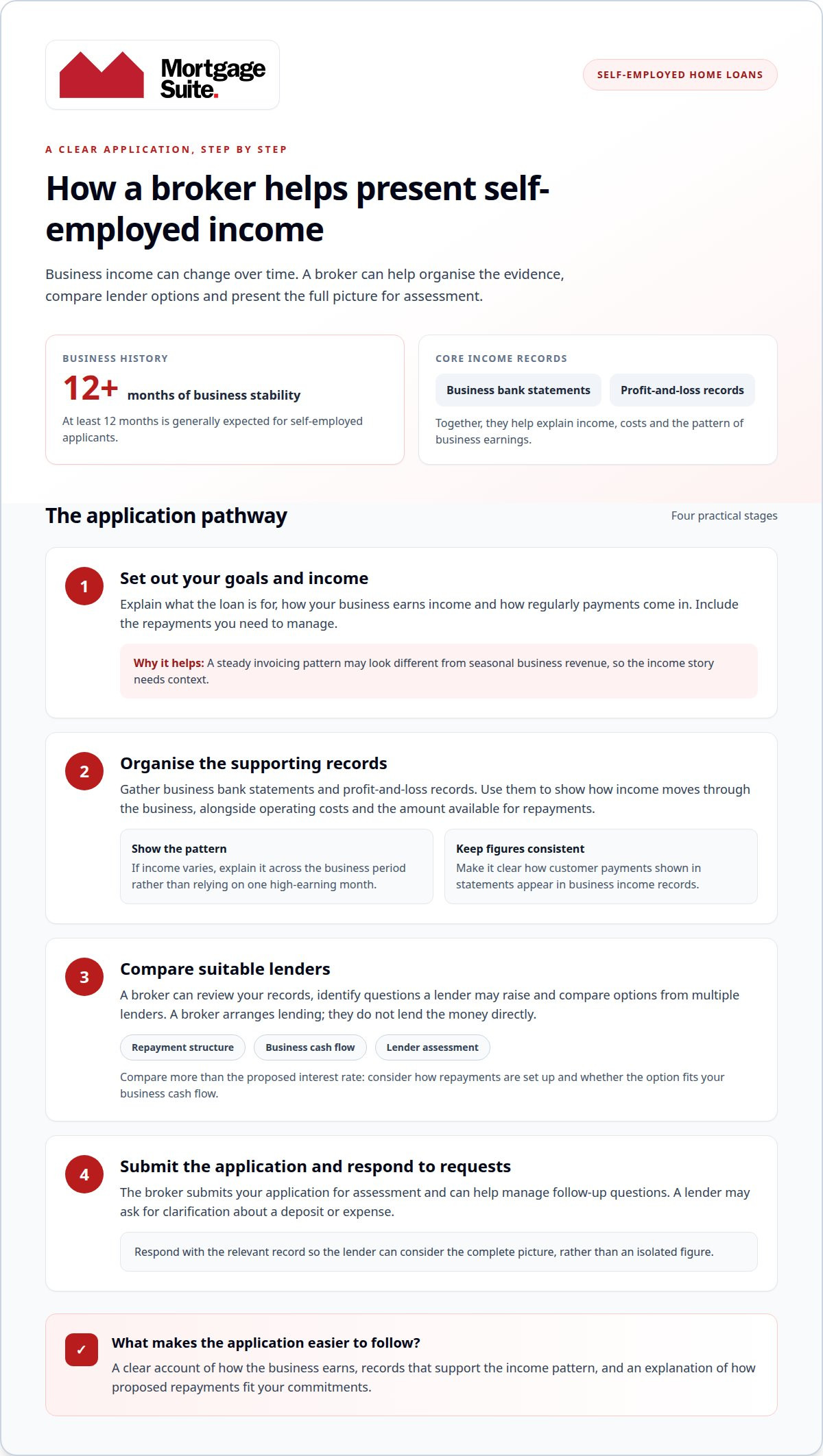
Self-employed income can be harder to present than a regular salary, especially when business earnings change between periods. In New Zealand, applicants are generally expected to show at least 12 months of business stability, and lenders can assess bank statements alongside profit-and-loss records.

Start by explaining how your business earns income and how regularly it receives payments. A contractor with steady invoices, for example, may present a different pattern from a business owner whose revenue changes seasonally. The lender considers the evidence alongside existing commitments and proposed repayments, rather than looking at one strong month alone.

Mortgage application documents

Prepare business bank statements and profit-and-loss records that show how income moves through the business. These documents help explain revenue, operating costs and the amount available to support repayments. If income varies, use the records to show the pattern across the business period, rather than relying on a single high-earning month.

Keep the figures consistent across the records you provide. For example, if a bank statement shows a customer payment, the profit-and-loss record should make its place in business income understandable. Organised documents give the lender a clearer picture of your application and reduce confusion over how you earn.

Business stability matters alongside the amount earned. A trading history of at least 12 months is generally expected for self-employed applicants, while the records help show how that business has performed. If you recently changed the way you work, explain the change and show how your current income is supported by the available evidence.

Steps to a mortgage through a broker

The steps are to discuss your goals and business income, organise supporting records, compare suitable lenders, then submit an application for assessment. A broker acts as an intermediary, presenting your application to multiple lenders rather than lending the money directly.

Start by setting out the loan purpose, the income your business generates and the repayments you need to manage. The broker can then review your bank statements and profit-and-loss records, identify questions a lender may raise, and prepare an application that explains how the figures fit together.

After comparing lender options, the broker submits the application and helps manage follow-up requests. A lender may ask for clarification if a deposit or expense needs explaining. Responding with the relevant record keeps the assessment moving and helps ensure the lender considers the complete picture, not an isolated figure.

Compare more than the proposed interest rate. Ask how repayments are structured, what the lender’s assessment focuses on and whether the option fits your business cash flow. If one mainstream bank declines the application, that decision does not automatically settle what other lenders may consider. Different lenders can assess the same income evidence under different criteria.

Before accepting an offer, make sure you understand the repayment amount, loan structure and any conditions attached to the lender’s decision. A broker can explain those details in plain language, so you can weigh the commitment against your business income and household budget.

Business and commercial loans

A business loan and a commercial property loan address different needs. A business owner seeking equipment finance has a different purpose from a company buying premises. Start by defining what the funds will pay for, how the business expects to repay them, and which assets support the request. That gives a lender a clearer basis for assessing the application.

For a business loan, explain the use of funds in practical terms. For example, a wholesaler might need working capital to pay suppliers before receiving customer payments. A lender can assess the business’s income, expenses, existing debt and repayment capacity against that purpose. A clear cash-flow picture helps show how repayments fit alongside regular operating costs.

Prepare records that make the business’s finances easy to follow. These may include business bank statements, profit-and-loss records and details of current borrowing. If income changes across the year, explain the pattern, such as higher sales during a seasonal trading period. Match the requested loan amount to a defined need, rather than presenting an unexplained figure.

Commercial property finance focuses on the property and its role in the business. A company purchasing its own premises, for instance, can explain how the site supports its operations and how repayments fit its trading income. The lender considers the property alongside the applicant’s financial position. Assess the loan against the planned use, ownership structure and repayment approach.

A term loan is provided as a lump sum with a defined repayment schedule and end date. That structure may suit a specific purchase, such as a business asset or property, where the amount and purpose are known. Compare its repayment pattern with the expected benefit of the purchase. For example, equipment should support business activity throughout the loan period.

Before an application is presented, organise the key details:

  • Purpose: describe the purchase, operating need or property transaction.
  • Repayment plan: explain which business income will meet repayments.
  • Financial records: provide statements and profit-and-loss information that support the figures.
  • Security: identify any property or business assets offered to support lending.

For a commercial property purchase, also set out the proposed use and expected contribution to the business. For example, operating from owned premises may differ from buying a property to earn rent. Those distinctions affect how the lender understands the transaction and assesses its repayment source.

If a mainstream bank declines an application, treat the decision as information about that lender’s assessment, not a verdict on the business. Another lender may consider the purpose, records or security differently. A well-organised application helps explain the business case and gives lenders the details needed to assess it.

Auckland broker for comparing banks and non-bank lenders

Comparing banks and non-bank lenders

There isn’t one best Auckland mortgage broker for every borrower. Compare how each broker explains lender choices, presents your circumstances and weighs loan structure alongside the interest rate. A useful comparison connects the lender’s criteria to your borrowing purpose, income and repayment plans.

A bank lends directly and assesses your application under its own lending criteria. A non-bank lender is also a direct lender, but its assessment approach and loan terms may differ. A broker acts as an intermediary and can present your application to multiple lenders. That can help you see alternatives if one lender’s criteria don’t fit your circumstances.

Compare the whole loan, not just its advertised rate. Check the repayment structure, any conditions, flexibility for extra repayments and how long a fixed interest rate applies. For example, a lower rate may not suit a borrower who values repayment flexibility more. Ask the broker to explain the trade-offs in plain language, using your own goals.

Non-bank lending can be relevant when an application doesn’t fit a mainstream bank’s usual criteria. Second-tier loans are options for borrowers who don’t fit mainstream banks. The lender still assesses the application, including its purpose, income, repayments and supporting information. A different lender may offer another path, but the terms and assessment can differ.

Use these points to compare a broker’s approach:

  • Lender range: ask whether the broker can present your application to banks and non-bank lenders.
  • Reasoning: expect a clear explanation of why a lender may suit your income and loan purpose.
  • Loan structure: compare repayment options and conditions, not only the headline rate.
  • Communication: find out how the broker will explain lender feedback and any next steps.

For example, a self-employed borrower may need an application that explains variable business income clearly. One lender may assess that evidence differently from another. A good comparison shows how the records support the application and why each proposed lender is worth considering. It doesn’t treat a bank’s decline as a final judgement on the borrower.

Before choosing a broker, ask how they’re paid and whether lender relationships affect the options presented. Request a written comparison that outlines the proposed lender, repayment structure, conditions and relevant trade-offs. This gives you a clearer basis for deciding, rather than relying on a broad claim that one lender is always best.

The right Auckland broker is one whose lender access and explanation fit your needs. Compare their approach using the same questions and your actual borrowing goals. A careful discussion should leave you understanding why a bank or non-bank option is being considered, and what the lender will assess.

The best fit is a broker whose lender range matches your circumstances and who clearly explains lender choices, loan structure, conditions and trade-offs. Compare how each broker handles your income and loan purpose, communicates lender feedback, and explains how they’re paid and whether lender relationships affect the options they present.

What types of brokers operate in Auckland, New Zealand?

An Auckland broker may focus on home lending, specialist applications or business finance. A mortgage broker acts as an intermediary, rather than lending money directly, and can present your application to multiple lenders. The useful distinction is the type of borrowing they handle and whether that matches your plans.

A residential mortgage broker works with home-loan applications. That can include a first-home purchase, a move to another home or borrowing for a rental property. For example, a first-home buyer may need help understanding how their deposit and income shape lender choices. An investor may need a discussion centred on the property’s purpose and planned repayments.

Some brokers focus on applications with less straightforward income or circumstances. A self-employed applicant, for instance, may need their business income explained through bank statements and profit-and-loss records. A broker familiar with those applications can help present the records clearly and approach lenders whose criteria may suit the case. The broker arranges the application; the lender makes its own assessment.

Business and commercial finance brokers work with funding for business purposes or commercial property. A business seeking funds for equipment has a different borrowing purpose from a company purchasing premises. Describe the planned use of funds and repayment source, then identify a broker whose work includes that kind of application.

Bank lending staff have a different role from brokers. They discuss lending offered by their own bank, while a broker can take an application to multiple lenders. That distinction matters if you want to compare a bank’s proposal with options from other lenders. Ask which lenders the broker can approach and how they’ll explain the differences.

To work out which type fits, match the broker’s focus to your application:

  • Buying your first home: look for experience with residential home-loan applications and pre-approval.
  • Applying with business income: ask how the broker presents self-employed earnings.
  • Buying a rental property: discuss residential investment lending and repayment plans.
  • Funding a business or premises: choose a broker whose work includes business or commercial finance.

Before sharing documents, explain your goal in one clear sentence, such as buying a first home or funding business premises. Then ask how the broker will handle that specific application, which lenders they can approach and how they’ll outline each option. Those answers help you understand whether their focus fits your borrowing needs.

Mortgage Suite

Mortgage Suite Ltd helps you compare lending options around your goals, income and borrowing needs. If you’re buying your first home, investing in residential property or seeking finance for a business or property development, the team can help present your application to suitable lenders and explain the differences in plain English.

A mainstream bank’s decline doesn’t necessarily end your options. Mortgage Suite Ltd can also consider second-tier lending for applications that don’t fit mainstream bank criteria, while explaining the terms and trade-offs involved. The focus is on helping you make an informed choice, not promising a particular outcome.

If you’d like to talk through your borrowing plans and possible next steps, contact Mortgage Suite Ltd for a free, no-obligation conversation.

Take the next step with a clear borrowing plan

Before moving ahead, decide what a useful lending outcome needs to do for you. You might want confidence about your first home purchase, room to grow a business, or a structure that supports a property purchase over time. Being clear about that priority gives an Auckland broker a practical starting point for discussing suitable options.

Mortgage Suite offers Home Loans to First Home Buyers, Residential Investment property loans and Business Loans. The next step is a conversation about your goal, your circumstances and the questions you want answered. From there, you can understand which lending options may fit and what information an application needs.

You don’t need to have every detail sorted before starting. Bring the outline of your plans, including what you’re hoping to finance and what feels uncertain. Mortgage Suite can help you talk through the lending path and possible next steps, with no obligation to decide on the spot.

Contact Mortgage Suite about your loan and take the next step with a clearer sense of direction.

Frequently Asked Questions

What documents do Auckland brokers need to assess a loan application?

Prepare documents that show your income, commitments and the purpose of the loan. For a self-employed application, this can include business bank statements and profit-and-loss records. A first-home buyer might also prepare information about their deposit, regular expenses and the property they’re considering. For example, someone buying with another person should be ready to explain how each applicant contributes to repayments and manages shared commitments.

How do Auckland mortgage rates and lending criteria compare across banks?

Rates and lending criteria can differ between banks, so compare offers using the same borrowing details. Look beyond the advertised rate: consider repayment structure, conditions, flexibility and how long any fixed rate applies. For example, ask how each bank would assess the same income and deposit, then compare its written offer and requirements. This makes differences easier to understand without assuming the lowest headline rate is automatically the best fit.

What should first-home buyers in Auckland ask a mortgage broker?

Ask which lenders they can approach, how they’ll compare suitable loan structures and what a pre-approval does and doesn’t cover. You could also ask what may change between pre-approval and a final offer, and which conditions you’ll need to meet. If you’re buying with another person, discuss how the application reflects both incomes and shared repayments. Clear answers help you understand the decision before you make an offer.

How are mortgage brokers in New Zealand regulated and checked?

Ask which Financial Advice Provider is responsible for the advice and how its disclosure and complaints process works. You can also compare the broker’s explanation of lender choices, advice process and relevant experience.

Do Auckland mortgage brokers charge fees, and how much?

Auckland brokers may charge fees, but the amount depends on the arrangement and your case. Ask for the fee, when it is payable and any other payment details in writing before proceeding.

Article by

Krish Krishna

Experienced Financial Adviser with over 46 years of Banking and Mortgage broking experience and over $2.0 Billion in loan settlements.

Using Home Equity to Buy an Investment Property in NZ: 2026 Guide

Wondering whether your home could help fund a deposit on an investment property? For Kiwis researching leveraging equity for investment property nz, it’s natural to ask how much a lender might let you borrow and whether repayments on two properties would fit your budget.

Equity is the gap between your home’s value and the amount you owe. It isn’t automatically money you can borrow. A lender will also look at your income, existing debts and ability to manage repayments if circumstances change. That can feel like a lot to weigh up, especially when different loan structures can affect how your home and investment property are connected.

This guide explains the difference between equity and borrowable funds, what lenders may assess, and how to think through the commitment alongside your household plans. You’ll also find practical steps for preparing to discuss suitable lending structures. Mortgage Suite helps clients explore residential investment property lending options based on their circumstances and goals, with advice that’s free of charge and comes with no obligation.

Key Takeaways

  • Understand how home equity is calculated, and why the amount you may be able to borrow can be different from your total equity.
  • Learn what information to gather before discussing whether your home could help fund an investment property deposit.
  • Compare separate and combined lending structures to see how they can affect the way you track repayments and secured debt.
  • Use a practical checklist to consider your goals, household finances and ability to manage repayments if rental income changes.
  • Explore what leveraging equity for investment property nz could involve, with Mortgage Suite helping you consider lending options from banks, private lenders and non-bank lenders.

What does home equity mean when buying an investment property in NZ?

Using equity in your home can seem like a faster way to fund an investment property deposit than saving a separate cash deposit. But equity isn’t money sitting in your bank account, and having it doesn’t automatically mean you can borrow against it. A lender assesses your full application before deciding whether to offer additional lending and, if so, how much.

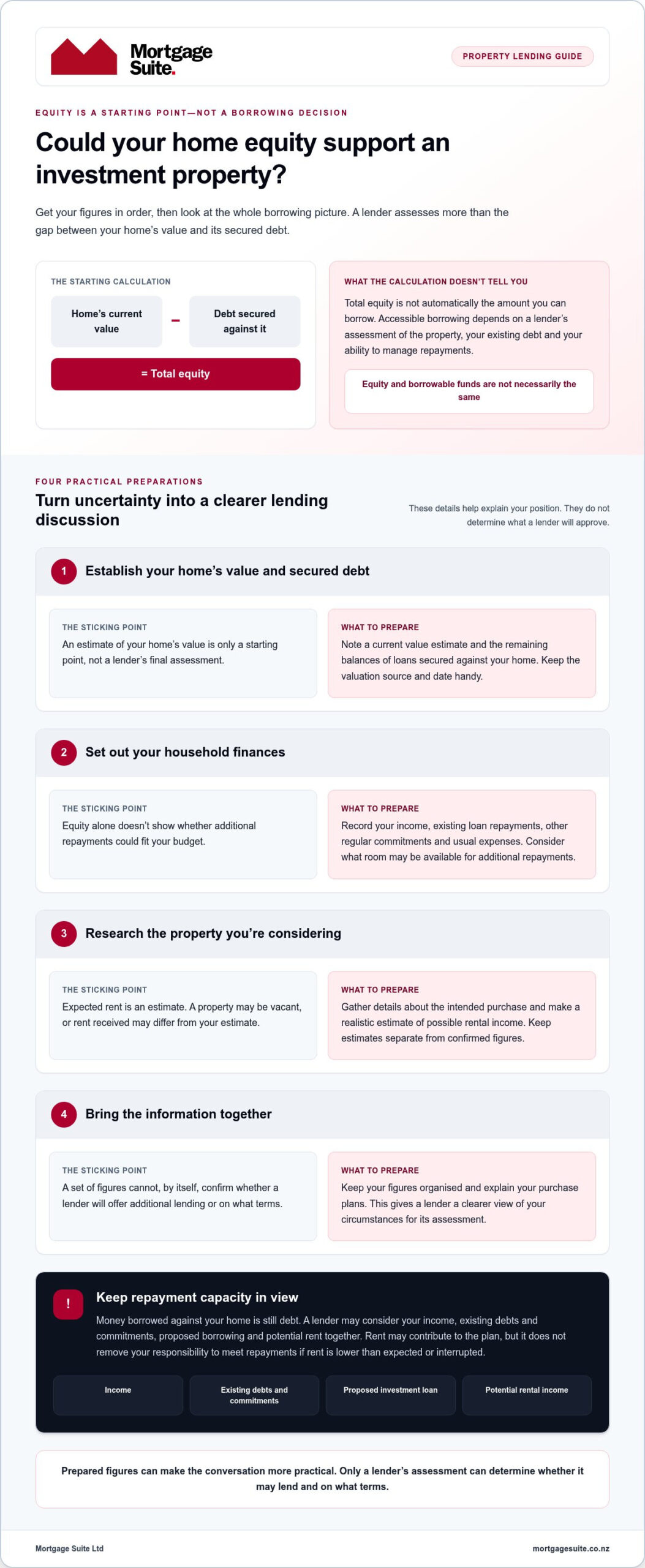
In simple terms, home equity is your property’s current value minus the debt secured against it. If your home’s value changes or you pay down the loan, the gap between those figures changes too. That gap is your total equity, not an amount you can assume is available to borrow.

How does equity build up in your home?

Each time you repay some of your loan principal, you reduce the debt secured against your home. If the property’s value rises, that can also increase the difference between its value and the loan balance. A fall in value can reduce the gap. Property values can move in either direction, so don’t build a borrowing plan around an assumed future increase.

Total equity is the difference between your home’s value and secured debt. Accessible borrowing is the amount a lender may be willing to advance after assessing the property, your existing debt and your ability to manage repayments. The two figures aren’t necessarily the same.

Can home equity help with an investment property deposit?

It may. A lender could consider providing additional lending secured against your existing home, with the borrowed funds contributing towards a deposit on an investment property. Whether this suits you depends on your circumstances and the lender’s assessment. Understanding home equity can help explain why it may support borrowing, but it doesn’t tell you how much you could access.

Keep the repayment side in view. Money borrowed against your home is still debt, even if it’s used for a deposit rather than everyday spending. You’ll need to account for the additional repayments alongside your existing home loan and any lending for the investment property. Rent may contribute to the plan, but it doesn’t remove your responsibility to meet repayments.

For example, a lender may look at your home’s value and the debt already secured against it, then consider your income, regular commitments and the proposed investment loan. The assessment covers your whole borrowing picture, not equity in isolation. If you’re considering using your home’s equity to fund an investment property, separate what you know about your home’s value from what a lender has agreed you may borrow. That gives you a clearer starting point for your next steps.

How to work out whether your home equity could support a purchase

Before making plans around a deposit, gather the figures that describe your current position. They’ll help you have a focused affordability discussion, but they won’t tell you how much a lender will approve. That decision depends on an assessment of your full application, including the proposed purchase and your ability to manage repayments.

  1. Start with your home’s value and secured debt. Note a current estimate of your home’s value and the remaining balances of loans secured against it. Keep the source and date of the valuation handy. An estimate is a starting point, not a lender’s final assessment of the property.
  2. Set out your household finances. Record your income, existing loan repayments and other regular financial commitments. Include your usual expenses so you can consider what room may be available for additional repayments.
  3. Research the property you’re considering. Gather details about the intended purchase and make a realistic estimate of possible rental income. Treat rent as uncertain: the property may be vacant, or the rent received may differ from your estimate.
  4. Bring the information together for a lending discussion. Keep your figures organised and explain your purchase plans. This gives a lender a clearer view of your circumstances, but only its assessment can determine whether it may lend and on what terms.

What figures should you gather first?

Use recent information where you can, and separate confirmed figures from estimates. Your loan balance is a current debt figure, while a rental estimate is only a guide. Note how you arrived at each figure so you can explain what you know and what still needs to be assessed. This preparation can make a conversation about borrowing against home equity more practical.

You can also use Mortgage Suite’s mortgage calculator to explore repayments. Treat any result as an estimate, not an approval or a substitute for a lender’s assessment.

How do lenders assess whether repayments are manageable?

Lenders look at your overall ability to meet repayments, not just the equity in your home. They may consider your income, existing debts and commitments, proposed borrowing and potential rent together. Rental income can inform the discussion, but it doesn’t replace your ability to manage repayments if rent is lower than expected or interrupted.

The wider assessment matters when using home equity to help fund an investment property. Lending criteria and relevant New Zealand lending settings can change, so base decisions on current requirements rather than outdated figures or assumptions.

Having your information ready doesn’t commit you to borrowing. It gives you a practical starting point to discuss your goals and options, and to understand what a lender may need to assess your application.

Compare ways to borrow against home equity, and understand the trade-offs

If you’re considering using your home’s equity, the loan structure matters as well as the amount you borrow. It can affect how you keep track of repayments and which properties are tied to the debt. When exploring leveraging equity for investment property nz, it helps to understand the basic differences before discussing options. There isn’t one structure that suits every borrower. Your circumstances, goals and the lender’s terms all matter.

Separate loan portions or combine lending?

A separate loan portion can make borrowing for different purposes easier to identify in your records. Combined lending may link borrowing across properties in a different way, depending on the lender’s terms. These are broad concepts, not promises about a particular lender’s products. Structures and conditions vary, so understand the terms of any lending you’re considering before deciding what to pursue.

Structure How it may work What to consider
Separate loan portions Borrowing for different purposes is kept in distinct loan portions. This may make it easier to identify which borrowing relates to which purpose. You’ll still need to understand the repayment terms and what security applies to each portion.
Combined lending Borrowing may be arranged in a way that links lending across properties, subject to lender terms. Consider how the connected lending could affect your repayments, records and the properties secured against the debt.

Use the comparison to frame questions rather than choosing based on the structure’s name. Find out how each option would be recorded, what repayments would apply and which property or properties would secure the borrowing. That can help you see how the arrangement fits together, including what may happen if your plans change later.

What risks should you weigh before using home equity?

Additional borrowing means additional repayments and a larger overall debt commitment. If the borrowing is secured against your home, your home forms part of the lending arrangement, so take the repayment pressure seriously. A change in household income, higher expenses or a period without rental income could make the combined commitment harder to manage.

Consider whether your household budget could still meet repayments if rent came in below your estimate or stopped temporarily. Property values and rental income aren’t guaranteed to rise or remain steady, so don’t rely on either as a sure way to cover the debt. A plan for leveraging equity for investment property nz should account for less favourable circumstances, not just the outcome you hope for.

Think, too, about how the structure could affect future plans. If you want to sell one property, change your lending or adjust repayments, the arrangement and lender terms may matter. Before proceeding, make sure you understand what is secured against each property and how you’ll manage repayments across the loans.

Using equity can form part of a purchase plan, but it doesn’t remove the need to consider affordability and security. A discussion based on your circumstances and goals can help you compare options without assuming that separate or combined lending is automatically the right fit.

Using Home Equity to Buy an Investment Property in NZ: 2026 Guide

A practical checklist before using equity for an NZ investment property

Before deciding whether to use your home’s equity, test the idea against your goals, household budget and comfort with extra debt. A checklist won’t tell you whether a lender will approve borrowing, but it can help you prepare for a clearer conversation and identify questions to work through first.

Check your goals and room in the household budget

Start with why you want to buy and how long you expect to hold the property. Your plans can shape what you need from the lending arrangement, so be clear about what matters to you beyond securing a deposit.

  • Clarify your plans. Note why you’re considering a rental property and your expected timeframe for holding it.
  • Review household finances. List regular income, expenses, existing debt and repayments, as well as any future plans that could affect your budget.
  • Allow for changes. Consider whether repayments would remain manageable if household income fell, expenses increased, rent came in lower than expected or the property was temporarily without a tenant.
  • Check your comfort level. Think about whether you’re comfortable adding debt secured against your home, not just whether the proposed repayments appear manageable today.

Try a few repayment scenarios before settling on a plan. The mortgage repayment calculator can help you explore estimated repayments, but it can’t predict future rental income or confirm that a lender will approve an application. Treat the results as a planning aid, not a decision.

Prepare for a lender conversation

Having useful details together can make the discussion more focused. Gather current information about your home’s estimated value and secured loans, your income and commitments, and the investment property you’re considering. Keep estimates separate from confirmed figures, especially for possible rent.

Before the conversation, write down the points you want clarified. For example:

  • How could the borrowing be arranged, and what would secure each part?
  • How would repayments be set up, and what flexibility might be available?
  • What would happen to the lending structure if your plans changed?
  • Which details or documents would the lender need to assess your full application?

Use the discussion to understand possible options and how they fit your circumstances. It doesn’t guarantee lending approval, and only the lender can decide after assessing your application. Current criteria and lending settings can also affect the outcome, so don’t treat an initial conversation or estimate as a final answer.

If you’d like support weighing up residential investment property lending and preparing your questions, talk with Mortgage Suite about your next steps. A thoughtful conversation can help you get sorted without rushing into a commitment.

How Mortgage Suite can help you explore investment property lending

Working out whether your home equity could support an investment property can bring up plenty of questions. You may be weighing up what additional borrowing could mean for your household, which lender options to explore and how the loans might be arranged. Mortgage Suite helps clients explore residential investment property lending in light of their circumstances and goals, so you can make sense of the options without being pushed towards a decision.

What happens when you discuss your borrowing goals?

The conversation starts with your plans and financial circumstances. You can talk through the property you’re considering, your existing lending and what you hope the purchase will achieve. That context helps shape a discussion about possible ways to structure the borrowing and what information a lender may need to assess your application.

Mortgage Suite works with banks, private lenders and non-bank lenders. Your adviser can explore options that may fit your situation and negotiate with lenders on your behalf. The aim is to give you clear guidance, not to promise an outcome. Any lending remains subject to the relevant lender’s assessment of your full application.

This support can help if you’re unsure how to compare different lender approaches or how an additional loan could sit alongside your current home loan. You can raise the questions that matter to you, including how the proposed borrowing fits your household plans. The discussion is tailored to your circumstances, rather than assuming one lending structure is right for every borrower.

Take a straightforward next step

You don’t need to have every detail settled before talking. Sharing what you know about your plans, income, existing commitments and property can make the first conversation more useful. If you’re still weighing up whether the added responsibility feels manageable, that’s part of the discussion too. There’s no pressure to proceed simply because you’ve asked about your options.

Mortgage Suite’s advisory service is free of charge with no obligation. Founder Krish Krishna brings over two decades of banking experience and has personally settled well over a billion dollars in residential, commercial and business loans. That experience informs a practical, client-focused approach, while each lender still makes its own decision about an application.

Take a calm first step to understand what may be possible and what to consider next. Talk through your home loan options with Mortgage Suite, with no commitment to proceed.

Take your next step with a clear plan

Before moving ahead, give yourself room to decide whether the proposed borrowing still feels workable beyond the initial purchase. Set out what you need to understand before making a commitment, such as how repayments fit your plans and what a lender’s assessment would mean for you. You don’t need every answer before starting that conversation.

Using home equity to fund an NZ investment property is a significant household decision, not just a way to put together a deposit. Take time to weigh the opportunity against the ongoing responsibility, and make sure you’re comfortable with the lending arrangement before proceeding. A discussion can help you clarify possible options without obliging you to continue.

If you’re ready to talk through your circumstances and goals, discuss your investment property lending options with Mortgage Suite. A calm, informed first step can help you decide what feels right for your next move.

Frequently Asked Questions

Can I use equity in my home to buy an investment property in NZ?

Yes, a lender may consider lending against your home to help fund an investment property deposit. The funds would be borrowed and secured as agreed with the lender, rather than coming from savings. Approval depends on your full application, including existing debt, household income and the proposed purchase. Before making an offer, clarify whether any borrowing is conditional and what steps remain before finance is confirmed.

How do I calculate the equity in my home?

Subtract the debt secured against your home from its current estimated value to get an estimate of your total equity. Check your latest loan statements and note the date and source of your property-value estimate. If more than one loan is secured against the home, account for each balance. This calculation is a useful starting point, but a lender may assess the property and borrowing differently.

Can I borrow all the equity in my home?

No, you shouldn’t assume that all your equity can be borrowed. A lender may require you to retain a margin in the property and will also assess whether the proposed repayments are manageable. The amount, if any, available to borrow depends on the lender’s criteria and your circumstances. A calculation of your home’s equity alone can’t confirm how much lending may be offered.

What happens if rental income does not cover the investment property repayments?

You’re still responsible for meeting the loan repayments, so your household budget may need to cover any shortfall. Rent may be lower than expected or the property may be empty for a period. Consider whether your income can support repayments during those times, alongside existing commitments. Build your plans around rent being uncertain, rather than relying on it to cover every repayment.

Is using home equity for an investment property risky?

It can increase your financial risk because you’re taking on more debt, and your home may secure some of that borrowing. If your income changes, repayments rise or rental income is interrupted, keeping up with the combined commitments may become harder. Property values and rental income can also change. Think through how you’d manage those situations before deciding whether the added borrowing fits your plans.

Do I need a separate loan to use home equity for an investment property?

Not necessarily. Depending on the lender and your circumstances, borrowing may be set up as a separate portion or linked with existing lending. Separate portions can make it easier to identify what borrowing relates to, while linked arrangements may connect lending across properties. Understand how repayments would be managed and which properties would secure the borrowing. The available structure and terms depend on the lender.

Can a mortgage adviser help if my bank does not offer a suitable option?

Yes. A mortgage adviser can review your goals and circumstances, discuss why your bank’s option may not fit, and explore whether another lending pathway could suit. A bank’s decision isn’t necessarily the final word on your plans, but a different lender will still assess your application and may reach its own decision. An adviser can help you understand the possibilities without promising that finance will be approved.

Article by

Krish Krishna

Experienced Financial Adviser with over 46 years of Banking and Mortgage broking experience and over $2.0 Billion in loan settlements.