

What if your commercial mortgage didn’t feel like a weight around your business’s neck? Many Kiwi owners feel stuck with high interest rates and banks that just don’t get their vision. With the OCR at 2.75 percent as of September 2026 and commercial rates hovering between 6.5 and 7.5 percent, sticking with your current lender out of habit could be a costly mistake. If you’re looking into refinancing commercial property NZ, you’ve likely realised that the traditional banks aren’t always the most flexible partners for growing businesses.
We understand how frustrating it is when your cash flow is squeezed by restrictive terms and confusing financial talk. You deserve a lending partner who sees the person behind the balance sheet and values your potential. This guide will show you how to unlock the equity in your building, slash those monthly repayments, and find a lender who actually understands your goals. We’ll walk you through the 2026 lending landscape, from non-bank options to the latest tax changes, so you can secure a deal that finally supports your growth.
Key Takeaways
- Identify the right time to move your mortgage to take advantage of shifting market trends and improve your daily cash flow.
- Navigate the process of refinancing commercial property NZ without the stress by following a clear, step-by-step plan.
- Explore flexible alternatives beyond the big banks that can offer solutions even if your current lender has said “no”.
- Learn how to present your business and property in the best light to secure the lowest possible interest rates.
- Discover how to unlock hidden equity in your building to fund your next big project or business expansion.
Why Refinancing Your Commercial Property in New Zealand Makes Sense Right Now
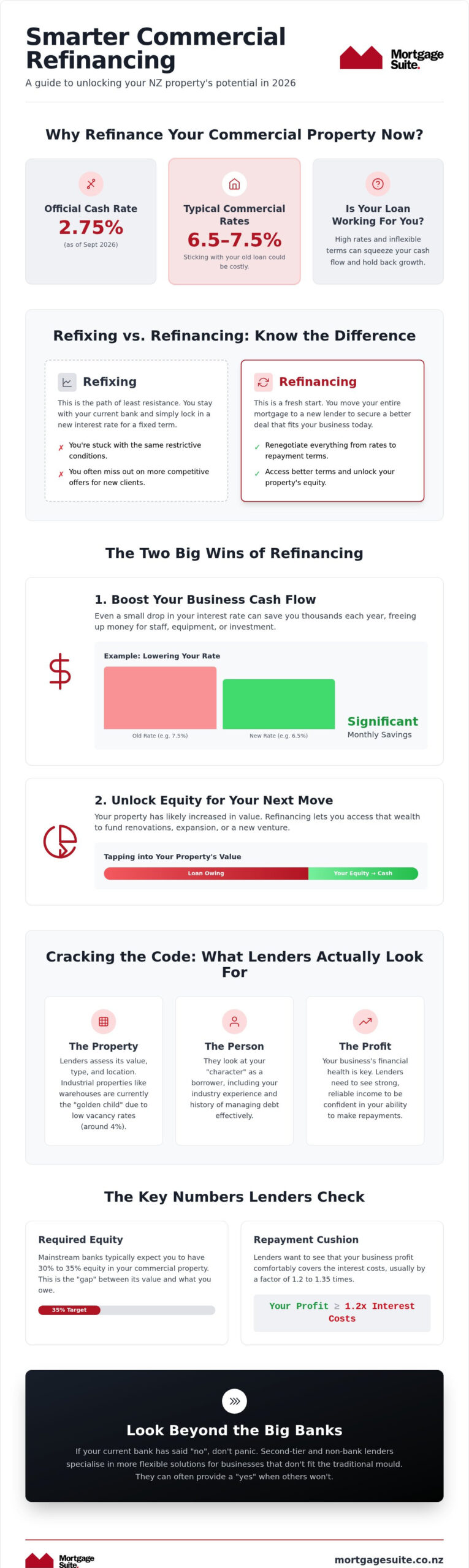
The financial market has shifted significantly as we move through late 2026. With the Official Cash Rate sitting at 2.75 percent, many property owners are finding that the loan structures they set up a few years ago no longer serve their best interests. If you have been with the same lender for a long time, you might be surprised by how much the market has moved without you. Refinancing commercial property NZ isn’t just about chasing a slightly lower number; it’s about ensuring your debt structure actually supports your business goals rather than hindering them.
It is vital to understand the difference between simply refixing and a full refinance. Refixing is when you stay with your current bank and just sign up for a new interest rate term. It’s the path of least resistance, but it often leaves you stuck with the same restrictive conditions and “faceless” service. A full refinance involves moving your commercial mortgage to a different lender. This process allows you to renegotiate everything, from how much you can borrow to the way you make repayments, providing a fresh start that fits your current financial reality.
Boosting Your Cash Flow and Reducing Costs
Commercial loans are typically large, which means even a small reduction in your interest rate can put heaps of money back into your business every month. With current commercial rates ranging between 6.5 and 7.5 percent, moving from a high rate down to the lower end of that scale can save you thousands. Sticking with one bank for a decade might feel loyal, but banks often reserve their most competitive offers for new clients. By switching, you can lower your monthly overheads and use that extra cash to hire new staff or buy better equipment. You can use a mortgage calculator to see exactly how a lower rate changes your monthly commitments.
Unlocking Equity for Your Next Move
Equity is the difference between what your property is worth today and the amount you still owe. Since property values have changed, 2026 is a fair dinkum time to check what your warehouse, office, or shop is actually worth. If your property value has grown, a refinance allows you to “unlock” that value. Instead of that wealth sitting idle in the building, you can access it as cash to fund a new business venture or a major renovation. It’s a proactive way to use your existing assets to fuel future growth without needing to find a separate source of capital.
Cracking the Code: What NZ Lenders Actually Look for When You Refinance
Lenders in New Zealand don’t just look at your bank balance. They focus on what I call the “Big Three”: the property, the person, and the profit. While home loans are mostly about your salary, commercial refinancing is a different beast altogether. Lenders want to see a clear “gap” between what you owe and what the property is worth. In 2026, most mainstream banks expect you to have at least 30 to 35 percent equity in the building. If your property value has climbed, that gap becomes your ticket to a better deal. They also look at your “character” as a borrower, including your experience in the industry and your history of managing debt effectively over the years.
Your Business Health and Income
When you apply to refinance, the lender needs to know you have the “ability to pay” without breaking a sweat. They look for a repayment cushion, usually wanting to see that your profit covers your interest costs by at least 1.2 to 1.35 times. It’s essential to have your books organised and up to date before you start the conversation. If your income is a bit lumpy or seasonal, don’t panic. Specialist lenders are often more comfortable with businesses that don’t have a perfectly flat income line every month, provided the overall annual profit is solid. Understanding the tax implications for commercial property is also part of this prep, as it affects your bottom line and how much cash you actually have available. If you’re unsure where your numbers stand, you can always check in with our team for a quick review of your position.
The Property Value and Type
Not all buildings are treated equally in the eyes of a bank manager. Currently, industrial properties like warehouses are the “golden child” for lenders because vacancy rates remain low, sitting around 4 percent in major hubs. These are often easier to finance than a highly specialised shop because a warehouse can be used by almost any business if the current tenant leaves. Retail spaces can be a bit more challenging, especially if they are designed for a very specific type of tenant. Lenders also look closely at your lease terms. A long-term lease with a reliable tenant makes your application much stronger and can often secure you a better interest rate. You will almost certainly need a fresh independent valuation as part of the process. This ensures the lender is working with current 2026 market values rather than what you paid for the place years ago. Having a recent valuation can often reveal that you have more equity than you thought, opening doors to better lending products.
Beyond the Big Banks: Exploring 2nd Tier and Non-Bank Options
Many Kiwis think the big four banks are the only game in town. But there is a whole world of “2nd tier” lenders that operate right across New Zealand. Simply put, these are financial institutions that aren’t registered banks but still provide substantial loans for business and property. They don’t have the same rigid “box-ticking” culture that you find at a main bank. If your current bank has said no, it is often just because you don’t fit their very specific, narrow criteria. It is rarely the end of the road. In fact, many successful business owners find that refinancing commercial property NZ with a non-bank lender is the smartest move they’ve ever made.
The Pros and Cons of Alternative Lenders
Approval times with these lenders are often much faster. While a big bank might take weeks to shuffle your paperwork between departments, a non-bank lender can often give you a “yes” in a matter of days. This speed is vital if you need to move quickly on a new opportunity. They are also far more flexible for self-employed people or those with seasonal income. As of mid-2026, interest rates for these loans typically range from 6.65 percent to 8.99 percent. While this is higher than a main bank, you have to weigh that cost against the cost of doing nothing. If a slightly higher rate allows you to grow your business or fix a cash flow crisis, it is a small price to pay for progress.
Is a 2nd Tier Loan Right for You?
These lenders shine when you have a short-term gap to fill or perhaps a few credit hiccups from the past that the big banks won’t forgive. They look at the “big picture” of your business rather than just a computer-generated score. At Mortgage Suite, we spend our time finding the hidden gems in the market that most people never hear about. We act as your advocate, negotiating with these lenders to get you the best possible terms for refinancing commercial property NZ. For a deeper look at how these options work, you can read our 2nd Tier Lender New Zealand guide. We help you bridge the gap between where you are now and where you want to be, ensuring you aren’t held back by rigid banking rules.
Your Step-by-Step Plan to Getting Your Commercial Refinance Sorted
Refinancing commercial property NZ doesn’t need to be a confusing maze of forms and phone calls. While big banks might make it feel like you’re just another number in their system, a structured approach makes the whole thing much more manageable. It starts with a clear look at your current position and ends with a loan that actually serves your business. The first thing you should do is get a clear picture of what you currently owe and exactly what you’re paying in interest and fees. You can use our mortgage calculator to run some quick numbers and see how a lower rate might change your monthly commitments.
Once you know where you stand, it’s time to have a yarn with an expert broker. This is where we look at the strategy and see what’s possible in the current market. We’ll help you decide if a traditional bank or a more flexible alternative lender is the right fit for your specific goals. After that, we move into the application and approval phase. We handle the “bank-speak” and the back-and-forth negotiations, so you can stay focused on running your business. Finally, we reach settlement, where your old, expensive loan is paid off and your new, better deal begins.
Gathering the Right Paperwork
Collecting your documents is often the part people dread most, but it’s not as bad as you think when you have a clear list. To get started, your broker will typically need:
- Your last two years of financial statements.
- Current lease agreements for your tenants.
- A recent mortgage statement showing your current balance.
- Personal identification and proof of address.
Having a good accountant in your corner helps heaps during this stage. They can quickly pull the reports we need and ensure your numbers are presented in the best possible light for the lender. When your books are organised, the approval process moves much faster.
The Role of Your Mortgage Broker
We act as the bridge between you and the rigid world of institutional banking. Because we have over 20 years of experience, we know exactly how to package your application to get a “yes”. We often secure deals that you simply can’t get by walking into a local branch because we have access to different departments and a wider range of lenders. We do the heavy lifting, the negotiating, and the problem-solving on your behalf. You can meet the team to see the experts who will be advocating for your business throughout this journey.
If you’re ready to see how much you could save by moving your loan, reach out to Mortgage Suite today for a straightforward chat about your options.
Why Mortgage Suite is Your Secret Weapon for Commercial Refinancing
When you decide on refinancing commercial property NZ, you aren’t just looking for a new set of numbers on a page. You’re looking for a partner who can navigate the corridors of the big banks and the alternative lenders with their eyes closed. Krish Krishna brings over 20 years of deep banking experience to your side of the table. Having spent decades on the inside, he knows exactly how lenders think, what they’re afraid of, and what they need to see to say “yes”. This isn’t just about filling out forms; it’s about having a dedicated negotiator who knows how to push back when a bank tries to offer a sub-par deal.
We don’t just find loans. We find solutions that fit your actual life and your long-term business strategy. Whether you’re dealing with a bank that has become too restrictive or you need to access equity for a new project, we act as your advocate. We’ve helped countless Kiwis move away from faceless bank managers who don’t understand their industry. Our reputation is built on being tough but fair negotiators who don’t take “no” for an answer when we know a deal makes sense for the client.
A Personal Approach in a Corporate World
In a world where banking has become increasingly clinical and automated, we choose to keep things personal. We treat your business like it’s our own because we know how much is on the line for you. You won’t hear any confusing jargon or feel any judgment from us, regardless of your current financial situation. We offer honest, straightforward advice that focuses on your success. If you want to see how we’ve helped others in similar spots, you can check out our Reviews to see what other property owners reckon about working with us.
Ready to See What You Could Save?
Getting started doesn’t involve a mountain of paperwork or a formal commitment right away. It begins with a simple, no-obligation chat. When you first speak with Krish, you’ll find a mentor who listens more than he talks. He’ll take the time to understand your goals, your challenges, and your vision for the future. By the end of that first conversation, you’ll have a much clearer idea of what’s possible for refinancing commercial property NZ and how we can help you get there. If you’re ready to stop overpaying and start growing, Get in touch with Mortgage Suite today and let’s get your refinance sorted.
Take Control of Your Business’s Financial Future
Refinancing is more than just a paperwork exercise; it’s a strategic move to protect your cash flow and fuel your next big venture. By now, you should have a clearer understanding of how refinancing commercial property NZ can lower your costs and why looking beyond the big banks often leads to the most flexible solutions. Whether you’re dealing with restrictive bank terms or just want to see what your equity can actually do for you, you don’t have to navigate these complex decisions alone.
With over 20 years of banking expertise and a reputation as specialists in 2nd tier lending, we’re here to ensure you get a deal that actually fits your life. We’re proud to be highly rated by New Zealand business owners who value a personal touch over a faceless corporate process. You’ve worked hard to build your business, so make sure your mortgage is working just as hard for you. Talk to Krish about your commercial refinance today and let’s find the right path forward together.
Frequently Asked Questions
How much does it cost to refinance commercial property in NZ?
Refinancing involves several standard costs such as legal fees for discharging your old mortgage and registering the new one. You will also likely need to pay for an independent valuation to confirm the building’s current worth. If you are leaving a fixed-term contract early, your current bank might charge break fees. We help you calculate these expenses beforehand to ensure the move actually saves you money in the long run.
Can I refinance if my commercial property is currently vacant?
You can certainly refinance a vacant building, though main banks often find this risky because there is no immediate rental income. Specialist 2nd tier lenders are usually more flexible in these scenarios. They will look at the property’s location, its seismic rating, and your plan for finding a new tenant. Having a solid business track record helps heaps when the building is currently empty and you need a fresh start.
Do I need a new valuation to refinance my business property?
Most lenders will require a fresh, independent valuation as part of the process. They need to know the current 2026 market value to determine how much they can safely lend. Since property values have shifted recently, a new report often reveals you have more equity than you thought. This extra equity can be a powerful tool when you are looking into refinancing commercial property NZ for a better interest rate.
How long does the commercial refinancing process usually take?
The timeframe depends heavily on which lender you choose for your business. Traditional banks can take anywhere from four to eight weeks to process everything through their various departments. If you are in a rush to secure a deal, non-bank lenders are much faster and can often provide a “yes” within a few days. We manage the back-and-forth communication to keep things moving as quickly as possible for you.
What is the maximum I can borrow against my commercial property?
For most commercial properties in New Zealand, mainstream banks will typically lend up to 65 or 70 percent of the property’s value. Some non-bank lenders are willing to go slightly higher, potentially up to 75 percent for high-quality industrial buildings. The exact amount depends on the property type, the strength of your lease, and your business’s ability to cover the interest repayments comfortably without any financial stress.
Can I consolidate other business debts into my commercial mortgage?
Consolidating business debts into your commercial mortgage is a very common and effective strategy. It allows you to move high-interest debt, like equipment finance or business credit cards, into a single loan with a much lower interest rate. This move can significantly improve your monthly cash flow. It simplifies your finances by leaving you with just one manageable payment instead of juggling multiple different lenders every month.
What happens if I have a bad credit history but own a commercial property?
Having a credit hiccup from the past doesn’t automatically mean you can’t refinance your property. While main banks are very strict about credit history, 2nd tier lenders focus more on the value of the property and your plan to move forward. As specialists in these alternative loans, we know which lenders look past the computer-generated score to see the real potential in your business and your assets.