
A property development exit strategy defines exactly how you will settle your construction loan, either through selling completed units or refinancing into long-term debt. Securing non-bank or mainstream bank finance requires showing pre-sale coverage or a validated serviceability stress test before ground preparation (siteworks) begins. Getting your funding sorted early gives Kiwis a fair go at completing successful projects without unnecessary stress.
Key Takeaways: A property development exit strategy ensures you clear construction debt by either selling completed units or refinancing into long-term rental debt.
- Mainstream NZ banks typically require pre-sales to cover 100% of construction debt before funding.
- Holding property is only viable if rental yields pass serviceability stress tests at higher rates.
- Selling suits developers needing immediate liquidity, while holding is best for long-term equity growth.
- The article provides a 5-step execution plan from council approvals to final debt clearance.
3 Exit scenarios: pick your project path
You can sell your build off-the-plan, retain it to rent, or sell immediately upon project completion. Choosing your exit early prevents costly refinancing delays later, and deciding on your target buyer upfront shapes your Cashflow and borrowing structure.
Here is how those paths look in practice:
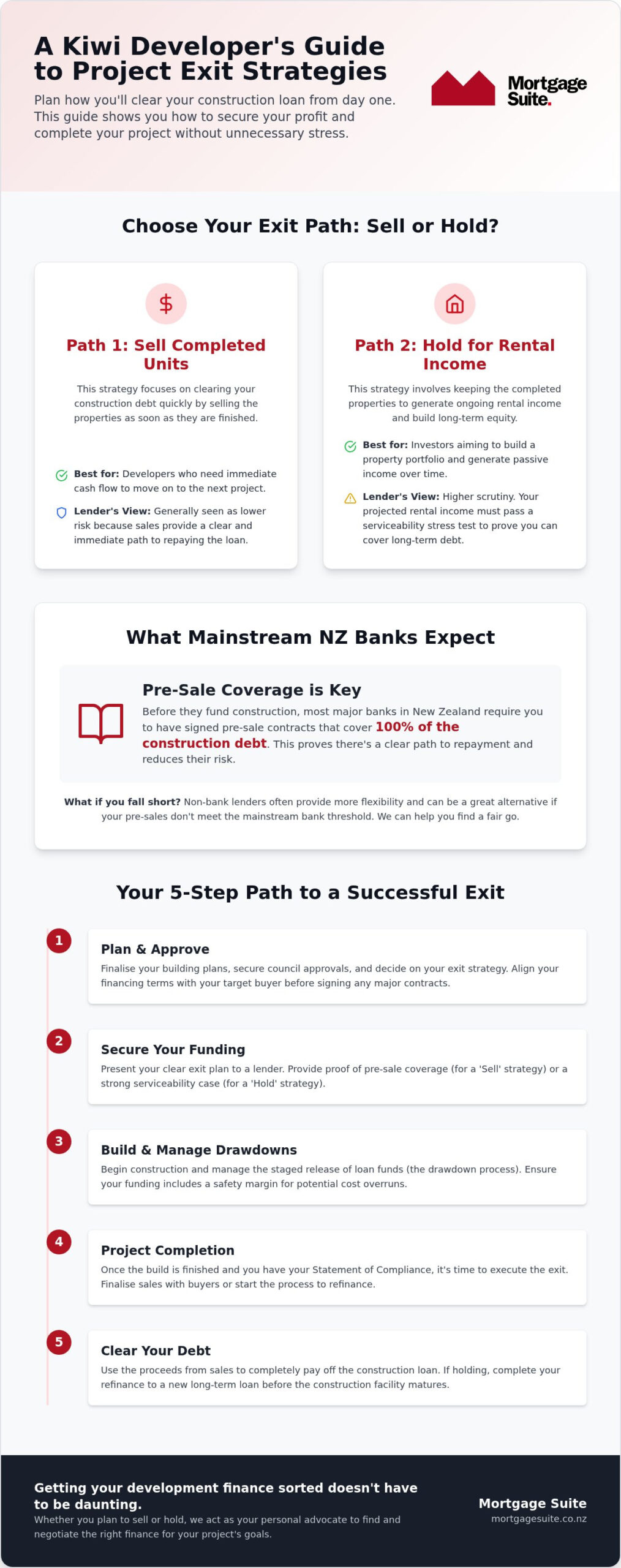
- You want profit out quickly so you can clear build debt: sell finished units and line up buyers before practical completion.
- You want long-term equity and rental income: hold the completed property and arrange bridging into term finance before the construction facility matures.
- Mainstream banks decline because presales fall short: use alternative lenders who will still fund against a clear exit, then refinance once the build is proven.
Selling finished units suits Kiwis who need Cashflow to clear build debt fast. Holding the completed property works better if your goal is equity growth over time. For builds you plan to retain, securing property development funding helps bridge the gap before long-term finance kicks in. Mainstream banks often say no if presales fall short, but alternative lenders still give you a path to get sorted.
Tip: Match your financing terms directly to your end-buyer profiles before signing main contractor agreements.
Sell or refinance: how you clear a development loan
You clear your development loan by either selling the finished properties or switching to long-term finance. Choosing the path early protects your profit and keeps lenders engaged with a repayment story they can follow.
If you pre-sell off the plans, you reduce your overall risk profile because guaranteed buyers satisfy bank presale targets before building starts. Relying entirely on presales can lock in lower margins if construction costs shift before ground preparation ends. Keeping properties to rent out works well if you want long-term equity, but it requires a strong serviceability position so rental income can carry the term debt.
Selling completed homes fits developers who need fast Cashflow. Retaining units suits investors building a portfolio. You can read more about options on our property development Archives, Mortgage Suite mortgage page.
Getting mainstream-bank sign-off still requires a clear repayment path on paper before they release construction funds. Contact Mortgage Suite Ltd when you want help to organise that financing around the exit you have actually chosen.
Why lenders treat a sale path as lower risk than a hold
Lenders usually view quick sales as lower risk because they clear project debt promptly through immediate capital returns. That is why a sale-led exit often moves through credit faster than a hold.
When you plan to hold properties for long-term rental income, financiers look closely at ongoing Cashflow. Banks assess whether rental yield can cover long-term debt through a serviceability assessment (using a higher hypothetical interest rate to test future affordability). If mainstream banks seem hesitant about your long-term plans, non-bank alternatives offer viable pathways forward.
Retaining finished units as rental properties frequently demands refinancing into a term loan before the construction facility matures. Switching strategies halfway through a project can surprise your financier if you have not planned the transition early, so lock the exit into the facility terms from day one.
Securing the right funding structure depends on your final goals. You can explore commercial loans with our team when you want terms shaped around sale or hold. Selling works for developers who need fast capital clearance; a hold strategy fits buyers focused on equity over the long haul.
Talk through your sale versus hold file with us when you are ready to set the structure.
Holding vs selling: tax and LTV math compared
Selling off your development frees up capital instantly, whereas holding builds long-term equity if your income streams stack up. Developers routinely miscalculate their loan-to-value ratios because standard calculators only plan for immediate sales. Choosing a hold strategy means balancing long-term tax obligations against your ongoing equity safety net.
| Strategy | Primary Tax Focus | Capital Structure |
|---|---|---|
| Selling | Income tax on profits | Debt fully cleared |
| Holding | Depreciation and Cashflow | Retained debt against equity |
Aligning financing structures with your intended exit is where many Kiwis hit a wall. Holding makes financial sense only when your rental yield covers your debt without triggering serviceability stress. For the term-loan side of a hold exit, refinancing commercial property walks through the steps for managing that long-term position.
Holding suits investors seeking passive income. Selling fits builders who need cash for their next project. Mainstream banks might hesitate if your Cashflow looks complex, yet alternative options still exist. We work as your personal advocate to negotiate terms that fit the math in the table above: reach out for a friendly chat when you want those numbers tested against lender criteria.
Pre-sale cover NZ banks expect before they fund
Mainstream lenders usually require presales to cover your construction debt before funding your build. Securing those contracts early keeps your project moving, because qualifying buyers must sign unconditional contracts or conditional deals with approved deposits. Having these agreements locked in gives your lender confidence to advance funds.
If your local bank manager seems hesitant, you still have options. Private lenders often offer flexible presale targets when mainstream banks say no. Managing your exit paths early is what keeps funding stable when buyer cover is thin.
Pre-selling fits developers who need guaranteed bank debt clearance. Holding completed units suits long-term investors aiming for rental returns. Let us negotiate with lenders on your behalf so the presale bar matches the exit you can actually deliver.
Among Mortgage Suite Ltd’s Google reviews, Baycom (5★) wrote:
"We have dealt with Krish for over 20 years and in that time we have purchased 5 properties. Krish is knowledgeable, professional, and responsive. We would highly recommend Krish and Mortgage Suite to anyone looking to invest in property, Steve & Rosie Bower"
That review traces a simple arc: a long-run investor needed repeat purchases supported over two decades, worked with a dedicated adviser across five properties, and stayed with the same broker because the process stayed responsive. That is the pattern you want when your own exit depends on advice that holds up across more than one project cycle.
5 Steps to execute your development exit
Executing a property development exit requires a clear plan to pay off your short-term project debt without a scramble at practical completion. Early planning stops late-stage delays, and aligning your timeline early means you avoid rushed decisions when high interest charges loom. Treat the exit like flight planning: you line up the landing long before you approach the runway.
Setting up your long-term finance early also prevents expensive loan penalty fees if sales drag.
Follow these steps to get sorted:
- Review project progress: Confirm that your base construction and ground preparation are fully finished on time.
- Obtain official approvals: Secure your final council Code Compliance Certificate to prove the build meets local standards.
- Choose your route: Decide whether selling units or holding them to refinance commercial property fits your financial goals.
- Apply for finance: Secure your new long-term loan or mortgage pre-approval before your current short-term facility expires.
- Clear existing debt: Complete the drawdown process with your new lender to fully repay the original construction loan.
A mainstream-bank decline does not mean you have run out of options. Reach out to Mortgage Suite Ltd for a friendly chat about the pathway that matches your chosen step 3.
Structure drawdowns so cost overruns do not sink your exit
Unplanned cost escalations during a project cycle will disrupt your planned exit if your debt structure lacks a safety margin. Flexible drawdown planning is how you keep the exit intact when site costs move.
To avoid unexpected shortfalls, build a contingency buffer into your initial drawdown process. That buffer covers cost surges during ground preparation without exhausting your capital prematurely. When project timelines stretch, standard lenders often tighten their terms, and alternative non-bank options offer leeway when traditional banks stall.
Staggering your loan releases aligns Cashflow with completed build phases. That protects your equity safety net and stops high interest charges accumulating before the work is done.
Our team acts as your dedicated negotiator on repayment terms that still give you room to finish. Book a chat with Mortgage Suite Ltd when you want a funding plan with that buffer built in.
When holding finished units costs you more than it returns
Holding finished units turns into a risky gamble when Cashflow dries up or local holding costs start swallowing your profit margins. Developers often trap capital in completed builds while waiting for a slightly higher sale price; that stall blocks new projects and inflates interest payments fast.
Holding makes sense for long-term rental income. Cashing out is the stronger move when you need immediate liquidity or when loan servicing stretches your budget. You get sorted faster by choosing to sell in those conditions rather than guarding empty stock.
We will advocate for your goals with alternative lenders if high holding costs strain your position. Let us talk through the hold-versus-sale numbers on your file before the interest clock runs further.
Details and enquiries: Mortgage Suite Ltd.
Frequently asked questions
How do timing and market conditions affect exit returns?
Market conditions directly influence buyer demand and final sales prices when you finish a project. Waiting for the right market window can improve your overall profit margins. Poor timing often leads to higher holding costs such as ongoing interest payments, so you need a solid property development exit strategy that still works if demand softens.
What tax treatments apply to different exit strategies?
Selling a completed build usually triggers different tax obligations compared with keeping it as a long-term rental property. Mainstream tax rules apply to trading profits, while long-term holds focus on rental income stream assessments. Working with certified accountants helps you understand your exact obligations early, and our team can help you line the funding path up with that advice.
How should financing structures align with exit plans?
Your initial loan agreement must match your intended way out, whether that involves selling quickly or refinancing. Short-term construction finance requires a clear repayment pathway before any lender will release funds. A well-structured term loan works better if you plan to hold the finished property, and matching loan terms to your actual timeline saves unnecessary penalty costs.
How do lenders view sale versus hold strategies?
Banks generally view pre-sold units as lower risk because the repayment path is clear. Choosing to retain property requires proving you can service the ongoing debt through stable rental returns. Lenders run a serviceability stress test to ensure you can afford higher interest rates over time. We act as your personal advocate to negotiate flexible terms on either path.
What pre-sale cover do NZ banks require?
Mainstream NZ banks often insist on a set percentage of pre-sales before construction funds are released. Non-bank financial institution options can provide more realistic requirements if bank hurdles feel too high. A strong safety margin in your pre-sales protects your project from sudden market shifts, and we help you find practical funding options that fit the cover you can genuinely secure.
Getting your property development exit strategy sorted in 2026
A clear property development exit strategy keeps your project moving from construction to final payout, on the same sell-or-refinance choice you set at the start. Developers run into delays when council Code Compliance Certificate issue takes longer than planned, and having an alternative non-bank pathway gives you a safety net when mainstream bank timelines drag out.
Planning ahead saves stress and protects your profit on the exit you already chose.
Ready to secure your end position? Contact the Mortgage Suite Ltd advisers today for a friendly, confidential chat about your funding options.